3.2. Synthesis of Compounds
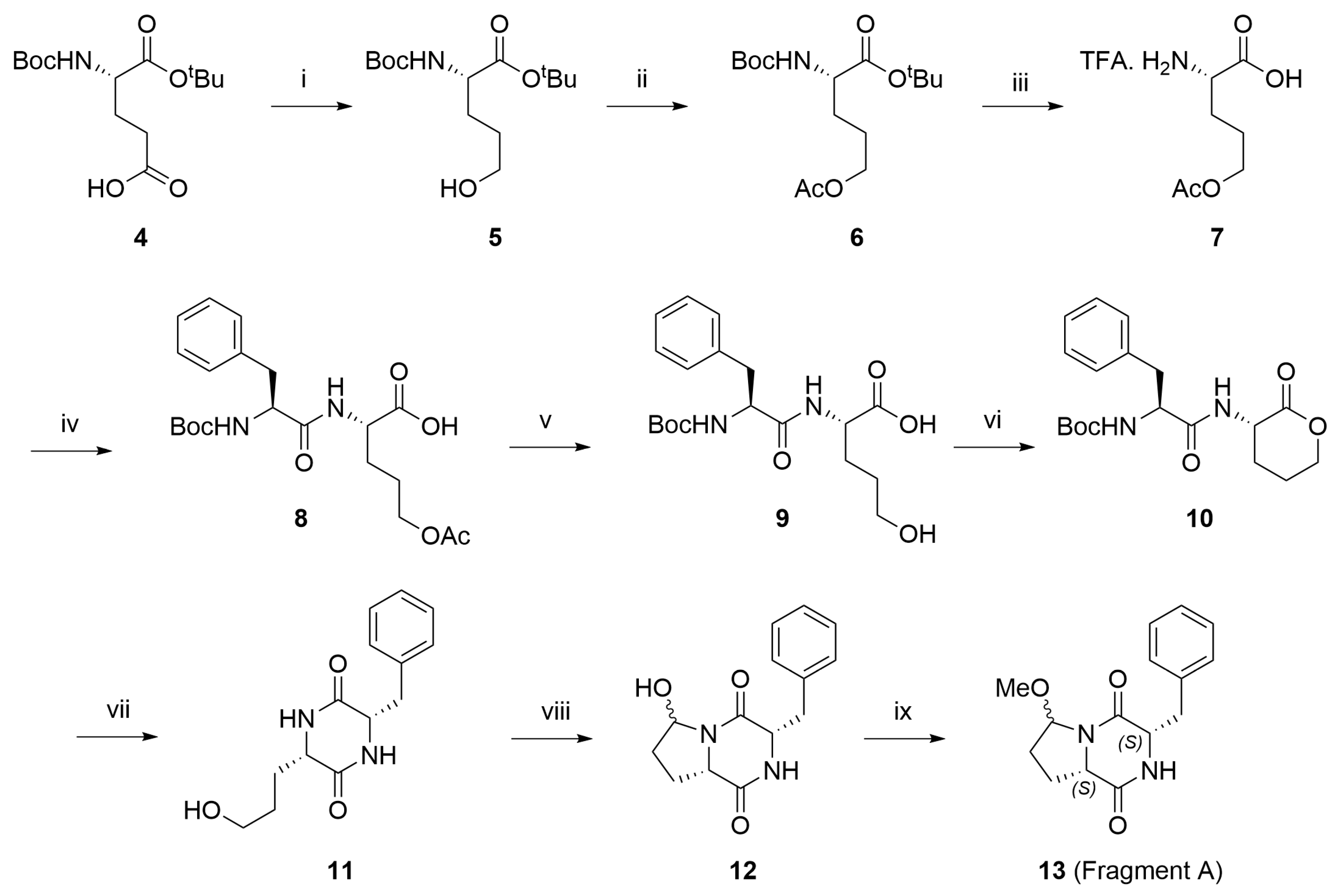
3.2.1. Tert-Butyl (S)-5-acetoxy-2-((tert-butoxycarbonyl)amino)pentanoate (6)
To an ice-cold solution of (S)-5-(tert-butoxy)-4-((tert-butoxycarbonyl)amino)-5-oxopentanoic acid (10.0 g, 33.0 mmol) in an oven-dried flask under nitrogen in anhydrous tetrahydrofuran (200 mL) and triethylamine (3.60 g, 3.28 mL, 33.7 mmol), ethyl chloroformate (3.40 g, 4.68 mL, 33.7 mmol) was added and the mixture was stirred at 0 °C for 30 min. The suspension was filtered through a Büchner funnel. The filtrate was added dropwise to a suspension of sodium borohydride (3.76 g, 99.0 mmol) in water:tetrahydrofuran (1:5, 88 mL) under nitrogen, and the mixture was stirred at room temperature for 3.5 h. The reaction was quenched with 1 M hydrochloric acid (150 mL) and extracted with diethyl ether (3 × 100 mL). The combined organic layers were washed with water (200 mL), satd. brine (600 mL), dried (MgSO4), and concentrated to give tert-butyl (S)-2-((tert-butoxycarbonyl)amino)-5-hydroxypentanoate (9.65 g) as a colourless oil. TLC: Rf = 0.3 (ethyl acetate—petrol, 3:7 v/v).
To an ice-cold solution of tert-butyl (S)-2-((tert-butoxycarbonyl)amino)-5-hydroxypentanoate (9.65 g, 38.4 mmol) in an oven-dried flask under nitrogen in anhydrous pyridine:anhydrous dichloromethane (1:2, 139 mL), acetyl chloride was added (2.88 g, 2.51 mL, 36.7 mmol), and the mixture was stirred at room temperature for 2 h. The reaction was quenched with 1 M hydrochloric acid (150 mL) and the layers were separated. The aqueous layer was extracted with dichloromethane (2 × 80 mL). The combined organic layers were washed with 1 M hydrochloric acid (150 mL), water (150 mL), satd. aqueous sodium bicarbonate (150 mL), satd. brine (600 mL), dried (MgSO4) and concentrated to give a yellow oil. This material was purified using automated chromatography under normal phase conditions (gradient of 0 → 100% ethyl acetate in petrol) to give tert-butyl (S)-5-acetoxy-2-((tert-butoxycarbonyl)amino)pentanoate (8.61 g, 79% over 2 steps) as a colourless oil. TLC: Rf = 0.5 (ethyl; acetate—petrol, 3:7 v/v). 1H NMR (300 MHz, DMSO-d6): δ 7.12 (d, 1 H, J = 7.8 Hz, NH), 4.01–3.95 (m, 2H, CH2O), 3.84–3.74 (m, 1 H, α-CH), 1.99 (s, 3 H, CH3), 1.72–1.52 (m, 4 H, 2 × CH2), 1.41–1.30 (m, 18 H, Boc and tert-butyl). 13C{1H} NMR (75 MHz, DMSO-d6): δ 171.6, 170.3, 155.5, 80.3, 78.0, 63.3, 53.9, 28.2, 27.6, 27.3, 24.8, 20.7. LC-MS (ESI positive, m/z) calcd. for C16H29NO6 [M + Na]+: 354.19, found: 354.15.
3.2.2. (S)-5-Acetoxy-2-aminopentanoic Acid Trifluoroacetic salt (7)
A solution of tert-butyl (S)-5-acetoxy-2-((tert-butoxycarbonyl)amino)pentanoate (8.61 g, 26.0 mmol) and triethylsilane (15.1 g, 20.8 mL, 130 mmol) in trifluoroacetic acid: anhydrous dichloromethane (1:1, 94 mL) was stirred at room temperature overnight. The solution was azeotropically concentrated with diethyl ether and dichloromethane to give (S)-5-acetoxy-2-aminopentanoic acid trifluoroacetic acid salt (8.4 g) as an oily white foam that was used without further purification. 1H NMR (300 MHz, DMSO-d6): δ 8.35 (br s, 3 H, NH3+), 4.01 (t, 1 H, J = 6.0 Hz, CH2O), 3.96–3.88 (br m, 1 H, α-CH), 2.00 (s, 3 H, CH3), 1.89–1.58 (m, 4 H, 2 × CH2). 13C{1H} NMR (75 MHz, DMSO-d6): δ 170.9, 170.4, 158.7, 158.3, 63.1, 51.7, 26.7, 23.9, 20.7. LC-MS (ESI positive, m/z) calcd. for C7H13NO4 [M + H]+: 176.09, found: 176.05.
3.2.3. (S)-5-Acetoxy-2-((S)-2-((tert-butoxycarbonyl)amino)-3-phenylpropanamido)pentanoic Acid (8)
To a solution of (S)-5-acetoxy-2-aminopentanoic acid trifluoroacetic acid salt (8.40 g, 26 mmol, theoretical) in anhydrous dimethylformamide (200 mL) under nitrogen, Hünig’s base (6.70 g, 9.04 mL, 51.9 mmol) was added, followed by 2,5-dioxopyrrolidin-1-yl (tert-butoxycarbonyl)-L-phenylalaninate (6.27 g, 17.3 mmol), and the mixture was stirred overnight at room temperature. The reaction was quenched with 1 M hydrochloric acid (100 mL) and extracted with ethyl acetate (3 × 150 mL). The combined organic layers were washed with water (3 × 200 mL), satd. brine (300 mL), dried (MgSO4) and concentrated to give (S)-5-acetoxy-2-((S)-2-((tert-butoxycarbonyl)amino)-3-phenylpropanamido)pentanoic acid (7.57 g) as a white foam. 1H NMR (300 MHz, DMSO-d6): δ 8.13 (d, 1 H, J = 6.9 Hz, NH), 7.33–7.23 (m, 5 H, 5 × ArH), 6.90 (d, 1 H, J = 8.7 Hz, NH), 4.30–4.12 (m, 2 H, 2 × α-CH), 4.04–3.94 (m, 2 H, CH2O), 2.97 (dd, 1 H, J = 13.7, 3.8 Hz, 0.5 × benzylic CH2), 2.73 (dd, 1 H, J = 13.5, 10.8 Hz, 0.5 × benzylic CH2), 2.00 (s, 3 H, CH3), 1.86–1.74 (m, 1 H, 0.5 × CH2), 1.70–1.57 (m, 3 H, 1.5 × CH2), 1.29 (s, 9 H, Boc). 13C{1H} NMR (75 MHz, DMSO-d6): δ 173.3, 171.9, 170.4, 155.2, 138.2, 129.2, 128.0, 126.2, 78.0, 63.4, 55.6, 51.4, 37.3, 28.1, 27.8, 24.6, 20.7. LC-MS (ESI positive, m/z) calcd. for C21H30N2O7 [M + H]+: 423.21, found: 423.20.
3.2.4. (S)-2-((S)-2-((tert-Butoxycarbonyl)amino)-3-phenylpropanamido)-5-hydroxypentanoic Acid (9)
To a solution of (S)-5-acetoxy-2-((S)-2-((tert-butoxycarbonyl)amino)-3-phenylpropanamido)pentanoic acid (7.57 g, 17.9 mmol) in methanol (102 mL), 1 M aqueous sodium hydroxide solution (44.9 mL, 44.9 mmol) was added, and the mixture was stirred for 3 h at room temperature. The methanol was removed under vacuum, and the aqueous mixture was acidified to pH 2 with 1 M hydrochloric acid and extracted with ethyl acetate (3 × 50 mL). The combined organic layers were washed with satd. brine (100 mL), dried (MgSO4) and concentrated to give (S)-2-((S)-2-((tert-butoxycarbonyl)amino)-3-phenylpropanamido)-5-hydroxypentanoic acid (6.76 g, 68% over 3 steps) as a white foam. 1H NMR (300 MHz, DMSO-d6): δ 8.09 (d, 1 H, J = 7.8 Hz, NH), 7.35–7.13 (m, 5 H, 5 × ArH), 6.88 (d, 1 H, J = 8.7 Hz, NH), 4.28–4.13 (m, 2 H, 2 × α-CH), 3.40 (t, 2 H, J = 6.2 Hz, CH2O), 2.98 (dd, 1 H, J = 13.8, 3.6 Hz, 0.5 × benzylic CH2), 2.78–2.64 (m, 1 H, 0.5 × benzylic CH2), 1.85–1.71 (m, 1 H, 0.5 × CH2), 1.71–1.57 (m, 1 H, 0.5 × CH2), 1.54–1.42 (m, 2 H, CH2), 1.29 (s, 9 H, Boc). 13C{1H} NMR (75 MHz, DMSO-d6): δ 173.6, 171.8, 155.2, 138.2, 129.2, 128.0, 126.2, 78.0, 60.2, 55.6, 51.8, 47.4, 37.5, 28.7, 28.2, 28.0, 24.6, 20.7. LC-MS (ESI positive, m/z) calcd. for C19H28N2O6 [M + H]+: 381.20, found: 381.15.
3.2.5. Tert-Butyl ((S)-1-oxo-1-(((S)-2-oxotetrahydro-2H-pyran-3-yl)amino)-3-phenylpropan-2-yl) carbamate (10)
To a solution of (S)-2-((S)-2-((tert-butoxycarbonyl)amino)-3-phenylpropanamido)-5-hydroxypentanoic acid (8.62 g, 22.7 mmol) in anhydrous dichloromethane (90 mL) under nitrogen, EDCI hydrochloride (4.78 g, 24.9 mmol) was added, followed by Hünig’s base (8.79 g, 11.8 mL, 67.9 mmol), and the mixture was stirred for 2 h at room temperature. The reaction was quenched with 1 M hydrochloric acid (200 mL) and extracted with dichloromethane (3 × 100 mL). The combined organic layers were washed with water (150 mL), satd. aqueous sodium bicarbonate (150 mL), satd. brine (300 mL), dried (MgSO4) and concentrated to give tert-butyl ((S)-1-oxo-1-(((S)-2-oxotetrahydro-2H-pyran-3-yl)amino)-3-phenylpropan-2-yl) carbamate (6.94 g, 86%) as a white solid. TLC: Rf = 0.45 (ethyl acetate—dichloromethane, 3:7 v/v). 1H NMR (300 MHz, DMSO-d6): δ 8.29 (m, 1 H, NH), 7.24 (m, 5 H, 5 × ArH), 6.90 (d, 1 H, J = 8.7 Hz, NH), 4.66–4.54 (m, 1 H, lactone α-CH), 4.46–4.33 (m, 1 H, 0.5 × CH2O), 4.28–4.15 (m, 2 H, α-CH and 0.5 × CH2O), 3.08–2.91 (m, 1 H, 0.5 × benzylic CH2), 2.81–2.68 (m, 1 H, 0.5 × benzylic CH2), 2.20–2.04 (m, 1 H, 0.5 × CH2), 1.97–1.80 (m, 2 H, CH2), 1.79–1.60 (m, 1 H, 0.5 × CH2), 1.29 (s, 9 H, Boc). 13C{1H} NMR (75 MHz, DMSO-d6): δ 171.6, 171.5, 171.3, 155.2, 138.0, 129.2, 128.0, 126.2, 78.0, 67.7, 59.8, 55.6, 37.4, 28.1, 25.0, 24.7, 21.2, 21.1, 14.1 (additional resonances are due to rotamers). LC-MS (ESI positive, m/z) calcd. for C19H26N2O5 [M + H]+: 363.19, found: 363.15.
3.2.6. (3S,6S)-3-Benzyl-6-(3-hydroxypropyl)piperazine-2,5-dione (11)
A solution of tert-butyl ((S)-1-oxo-1-(((S)-2-oxotetrahydro-2H-pyran-3-yl)amino)-3-phenylpropan-2-yl) carbamate (4.90 g, 13.5 mmol) in trifluoroacetic acid: anhydrous dichloromethane (1:1, 90 mL) was stirred for 45 min at room temperature. The solution was subjected to azeotropic distillation with diethyl ether and dichloromethane to give (S)-2-amino-N-((S)-2-oxotetrahydro-2H-pyran-3-yl)-3-phenylpropanamide trifluoroacetic acid salt that was used without further purification.
To a solution of (S)-2-amino-N-((S)-2-oxotetrahydro-2H-pyran-3-yl)-3-phenylpropanamide trifluoroacetic acid salt (13.5 mmol) in anhydrous dimethylformamide (80 mL) under nitrogen, Hünig’s base (3.49 g, 4.71 mL, 27.1 mmol) was added, and the mixture was stirred overnight at room temperature. The suspension was diluted with diethyl ether (200 mL) and the resulting solid was collected by Büchner filtration to give (3S,6S)-3-benzyl-6-(3-hydroxypropyl)piperazine-2,5-dione (2.66 g, 75%) as a white solid. 1H NMR (300 MHz, DMSO-d6): δ 8.10 (br s, 1 H, NH), 8.03 (br s, 1 H, NH), 7.28–7.12 (m, 5 H, 5 × ArH), 4.26 (t, 1 H, J = 5.1 Hz, OH), 4.18–4.14 (m, 1 H, α-CH), 3.58–3.54 (m, 1 H, α-CH), 3.14–3.09 (m, 3 H, CH2O and 0.5 × benzylic CH2), 2.85 (dd, 1 H, J = 13.5, 4.9 Hz, 0.5 × benzylic CH2), 1.20–1.09 (m, 1 H, 0.5 × CH2), 0.99–0.90 (m, 2 H, CH2), 0.70–0.60 (m, 1 H, 0.5 × CH2). 13C{1H} NMR (75 MHz, DMSO-d6): δ 167.2, 166.2, 136.2, 130.3, 128.0, 126.6, 60.4, 55.4, 53.9, 38.3, 30.4, 27.4. LC-MS (ESI positive, m/z) calcd. for C14H18N2O3 [M + H]+: 263.14, found: 263.10.
3.2.7. (3S,8aS)-3-Benzyl-6-hydroxyhexahydropyrrolo[1,2-a]pyrazine-1,4-dione (12)
To a solution of (3S,6S)-3-benzyl-6-(3-hydroxypropyl)piperazine-2,5-dione (2.66 g, 10.2 mmol) in anhydrous DMSO (50 mL), 2-iodoxybenzoic acid (containing stabiliser, 30%, IBX) (10.9 g, 11.7 mmol) was added, and the mixture was stirred at room temperature overnight. The suspension was diluted with water (100 mL) and stirred for 5 min. The solid was removed by Büchner filtration and discarded. The filtrate was concentrated under vacuum to ~50 mL and the residual material was purified using automated chromatography under reversed-phase conditions (gradient of 0 → 100% acetonitrile in water). The fractions containing the product were concentrated under vacuum to remove acetonitrile. The aqueous mixture was basified to pH 8–9 with satd. aqueous sodium bicarbonate and extracted with ethyl acetate (6 × 100 mL). The combined organic layers were washed with water (125 mL), satd. brine (125 mL), dried (MgSO4) and concentrated to give (3S,8aS)-3-benzyl-6-hydroxyhexahydropyrrolo[1,2-a]pyrazine-1,4-dione (1.77 g, 68%) as a 7 to 3 mixture of diastereomers. 1H NMR (300 MHz, DMSO-d6): δ 8.04 (br s, 0.7 H, 0.7 × NH), 7.87 (br s, 0.3 H, 0.3 × NH), 7.39–7.15 (m, 5 H, 5 × ArH), 6.06 (d, 1 H, J = 4.2 Hz, OH), 5.52–5.45 (m, 0.7 H, 0.7 × CHNO), 5.45–5.39 (m, 0.3 H, 0.3 × CHNO), 4.39–4.12 (m, 2 H, 2 × α-CH), 3.25–2.87 (m, 2 H, benzylic CH2), 2.11–1.41 (m, 4 H, 2 × CH2). 13C{1H} NMR (75 MHz, DMSO-d6): δ 170.7, 169.0, 166.7, 165.3, 138.0, 137.2, 129.8, 129.5, 129.3, 128.6, 128.1, 126.4, 126.2, 79.7, 78.5, 58.7, 56.7, 55.8, 55.6, 35.4, 33.8, 32.7, 31.6, 25.5, 24.2. LC-MS (ESI positive, m/z) calcd. for C14H16N2O3 [M + H]+: 261.12, found: 261.10.
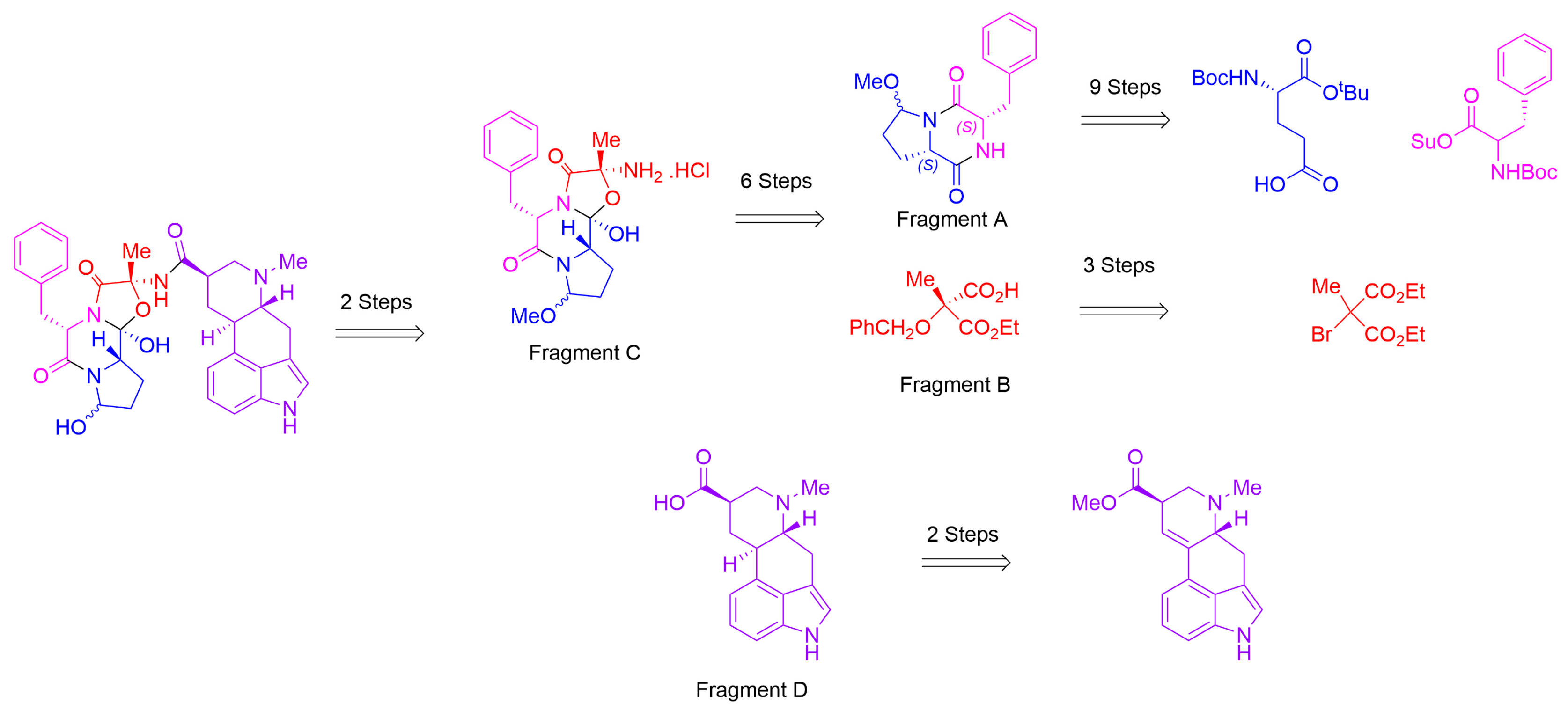
3.2.8. (3S,8aS)-3-Benzyl-6-methoxyhexahydropyrrolo[1,2-a]pyrazine-1,4-dione (Fragment A, 13)
To a solution of (3S,8aS)-3-benzyl-6-hydroxyhexahydropyrrolo[1,2-a]pyrazine-1,4-dione (1.36 g, 5.23 mmol) in anhydrous methanol (25 mL) under nitrogen, p-toluenesulfonic acid (30.0 mg, 0.16 mmol) was added, and the mixture was stirred at room temperature for 1.5 h. The reaction was concentrated and the material was partitioned between satd. aqueous sodium bicarbonate (20 mL) and ethyl acetate (20 mL). The layers were separated and the aqueous layer was extracted with ethyl acetate (2 × 20 mL). The combined organic layers were washed with satd. brine (30 mL), dried (MgSO4) and concentrated to give (3S,8aS)-3-benzyl-6-methoxyhexahydropyrrolo[1,2-a]pyrazine-1,4-dione (1.22 g, 85%) as a white foam. 1H NMR (300 MHz, DMSO-d6): δ 8.11 (br s, 0.7 H, 0.7 × NH), 7.96 (br s, 0.3 H, 0.3 × NH), 7.38–7.18 (m, 5 H, 5 × ArH), 5.28 (t, 0.7 H, J = 3.5 Hz, 0.7 × CHNO), 5.16 (d, 0.3 H, J = 3.5 Hz, 0.3 × CHNO), 4.45 (t, 0.7 H, J = 5.2 Hz, 0.7 × α-CH), 4.36 (t, 0.3 H, J = 5.6 Hz, 0.3 × α-CH), 4.21–4.13 (m, 1 H, α-CH), 3.26 (s, 2.1 H. 2.1 × CH3), 3.22–2.92 (m, 2.9 H, 0.9 × CH3 and benzylic CH2), 2.06–1.80 (m, 2 H, CH2), 1.67–1.46 (m, 2 H, CH2). 13C{1H} NMR (75 MHz, DMSO-d6): δ 170.6, 168.6, 168.1, 166.5, 137.7, 137.0, 129.7, 129.6, 128.1, 128.0, 126.5, 126.3, 87.4, 86.3, 58.9, 56.9, 56.3, 56.1, 55.7, 55.5, 35.6, 33.8, 30.6, 29.6, 25.2, 24.00. LC-MS (ESI positive, m/z) calcd. for C15H18N2O3 [M + H + CH3CN]+: 316.17, found: 316.15.
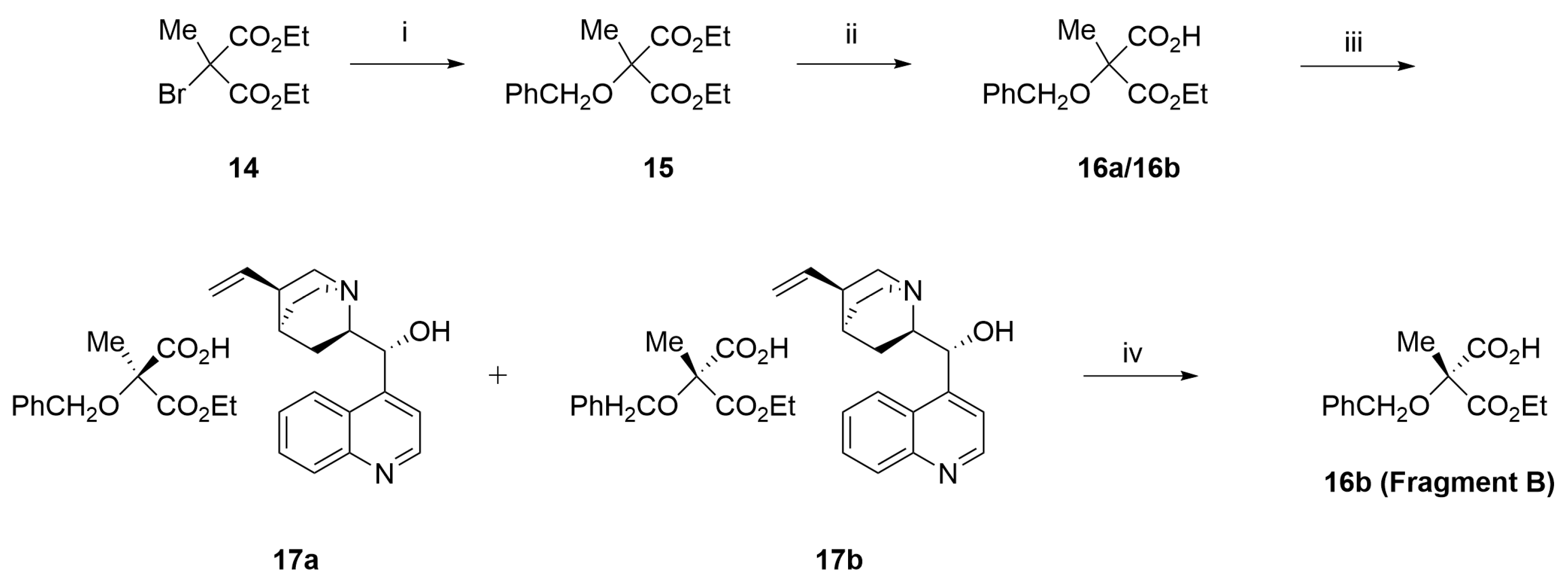
3.2.9. Rac.-Diethyl 2-(benzylidyne-λ6-oxidaneyl)-2-methylmalonate (15)
To a suspension of sodium hydride (60% disp. in oil, 1.39 g, 34.8 mmol) in anhydrous toluene (176 mL) in an oven-dried flask under nitrogen, benzyl alcohol (3.24 g, 3.28 mL, 31.6 mmol) was added, and the suspension was stirred for 1 h at room temperature. Diethyl 2-bromo-2-methylmalonate (8.00 g, 6.04 mL, 31.6 mmol) was added dropwise and the mixture was heated at 110 °C for 2 h. The reaction mixture was cooled to room temperature and quenched with 1 M hydrochloric acid (150 mL) and extracted with diethyl ether (3 × 80 mL). The combined organic layers were washed with satd. aqueous sodium bicarbonate (150 mL), satd. brine (150 mL), dried (MgSO4) and concentrated to give a yellow oil. This material was purified using automated chromatography under normal phase conditions (gradient of 0 → 100% diethyl ether in petrol) to give rac.-diethyl 2-(benzylidyne-λ6-oxidaneyl)-2-methylmalonate (7.58 g) as a colourless oil. This material was used without further purification.
3.2.10. Rac.-2-(Benzylidyne-λ6-oxidaneyl)-3-ethoxy-2-methyl-3-oxopropanoic Acid (16a/16b)
To a solution of diethyl 2-(benzylidyne-λ6-oxidaneyl)-2-methylmalonate (7.58 g, 27.1 mmol) in ethanol (142 mL), potassium hydroxide (1.82 g, 32.5 mmol) was added, and the mixture was stirred for 2 h at room temperature. The suspension was filtered through Celite, and the filtrate was concentrated under vacuum to give a yellow oil. This material was partitioned between satd. aqueous sodium bicarbonate (150 mL) and dichloromethane (150 mL) and the layers were separated. The aqueous layer was washed with dichloromethane (3 × 80 mL) and the organic layers were discarded. The aqueous layer was acidified to pH 1–2 with 6 M hydrochloric acid and extracted with dichloromethane (3 × 80 mL). The combined organic layers were washed with 1 M hydrochloric acid (100 mL), water (100 mL), satd. brine (150 mL), dried (MgSO4) and concentrated to give an oil. This material was purified using automated chromatography under reversed-phase conditions (gradient of 0 → 100% acetonitrile in water) to give rac.-2-(benzylidyne-λ6-oxidaneyl)-3-ethoxy-2-methyl-3-oxopropanoic acid (3.76 g, 47% over 2 steps) as a colourless oil.
3.2.11. (R)-2-(Benzylidyne- λ6-oxidaneyl)-3-ethoxy-2-methyl-3-oxopropanoic Acid (16b, Fragment B)
To a solution of rac.-2-(benzylidyne-λ6-oxidaneyl)-3-ethoxy-2-methyl-3-oxopropanoic acid (3.18 g, 12.6 mmol) in dimethyl carbonate (90 mL), cinchonidine (3.71 g, 12.6 mmol) was added, and the suspension was stirred for 15 min at room temperature. The suspension was warmed until a clear solution was obtained, which was allowed to cool to room temperature. The resulting solid was collected by suction filtration (6.17 g). The filtrate was concentrated to give an oily solid. This material was partitioned between 1 M hydrochloric acid (20 mL) and ethyl acetate (20 mL). The layers were separated, and the aqueous layer was extracted with ethyl acetate (2 × 20 mL). The combined organic layers were washed with satd. brine (30 mL), dried (MgSO4) and concentrated under reduced pressure to give (R)-2-(benzylidyne- λ6-oxidaneyl)-3-ethoxy-2-methyl-3-oxopropanoic acid (1.06 g, 75.2% ee) as an oil. The solid collected above (6.17 g) was suspended in dimethyl carbonate (120 mL) and warmed until a clear solution was obtained, which was allowed to warm to room temperature. The resulting solid was collected by suction filtration (2.7 g). The filtrate was concentrated under vacuum to give an oily solid. This material was partitioned between 1 M hydrochloric acid (40 mL) and ethyl acetate (40 mL). The layers were separated and the aqueous layer was extracted with ethyl acetate (2 × 40 mL). The combined organic layers were washed with satd. brine (80 mL), dried (MgSO4) and concentrated to give (R)-2-(benzylidyne-λ6-oxidaneyl)-3-ethoxy-2-methyl-3-oxopropanoic acid (0.87 g, 66.6% ee) as an oil. 1H NMR (300 MHz, CDCl3): δ 8.25 (br s, COOH), 7.38 (m, 5 H, 5 × ArH), 4.63 (s, 2 H, benzylic CH2), 4.28 (q, 2 H, J = 7.1 Hz, CH2CH3), 1.78 (s, 3 H, CH3), 1.31 (t, 3 H, J = 7.1 Hz, CH2CH3). 13C{1H} NMR (75 MHz, CDCl3): δ 172.3, 168.8, 136.9, 128.6, 128.3, 128.2, 81.9, 68.7, 62.7, 20.6, 14.1. LC-MS (ESI negative, m/z) calcd. for C13H16O5 [M − H]−: 251.09, found: 251.05. Enantiomeric excesses were measured with a Phenomenex Lux-Cellulose 2 column (250 × 4.6 mm, 5 µm) eluting with hexane:ethanol:diethylamine (93:7:0.1 v/v/v).
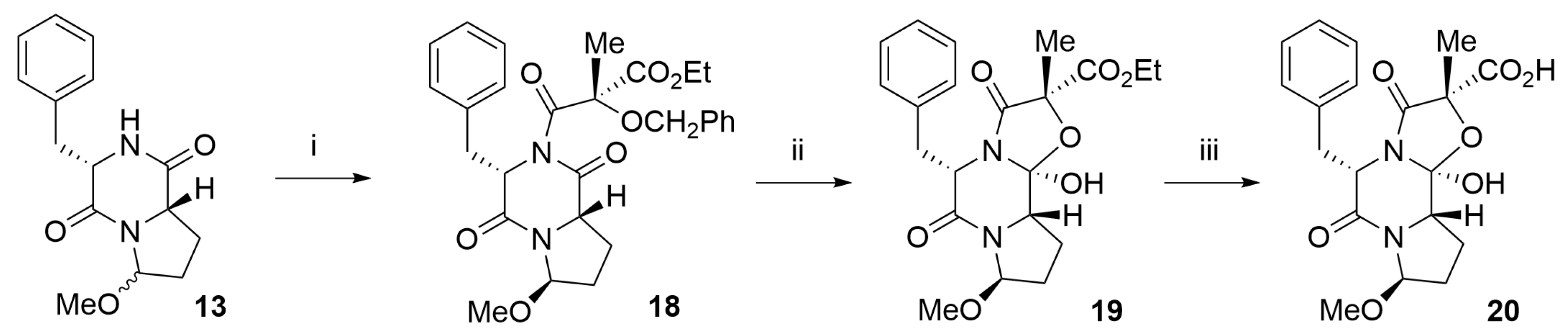
3.2.12. Ethyl (R)- and (S)-3-((3S,6R,8aS)-3-benzyl-6-methoxy-1,4-dioxohexahydropyrrolo[1,2-a]pyrazin-2(1H)-yl)-2-(benzyloxy)-2-methyl-3-oxopropanoate (major isomer: 18)
To an ice-cold solution of (R)-2-(benzylidyne-λ6-oxidaneyl)-3-ethoxy-2-methyl-3-oxopropanoic acid (1.87 g, 7.42 mmol) and anhydrous dimethylformamide (0.58 g, 0.62 mL, 7.99 mmol) in an oven -dried flask under nitrogen in anhydrous dichloromethane (26 mL), thionyl chloride (1.76 g, 1.10 mL, 14.8 mmol) was added, and the mixture was heated at 41 °C for 2.5 h. The reaction was cooled to room temperature and concentrated under high vacuum to give a yellow oil. A solution of this material in anhydrous dichloromethane (10 mL) was added to a −30 °C solution of (3S,8aS)-3-benzyl-6-methoxyhexahydropyrrolo[1,2-a]pyrazine-1,4-dione (1.41 g, 5.15 mmol) in an oven-dried flask under nitrogen in anhydrous pyridine:anhydrous dichloromethane (1:1, 20 mL), and the mixture was allowed to warm slowly to room temperature and stirred overnight. The orange suspension was cooled to 0 °C and the reaction was quenched with 1 M hydrochloric acid (20 mL) and diluted with ethyl acetate (20 mL). The layers were separated, and the aqueous layer was extracted with ethyl acetate (2 × 30 mL). The combined organic extracts were washed with 1 M hydrochloric acid (40 mL), water (40 mL), satd. aqueous sodium bicarbonate (40 mL), satd. brine (40 mL), dried (MgSO4) and concentrated to give an orange oily foam. This material was purified using automated chromatography under normal phase conditions (gradient of 0 → 100% ethyl acetate in petrol) to give ethyl (R)- and (S)-3-((3S,6R,8aS)-3-benzyl-6-methoxy-1,4-dioxohexahydropyrrolo[1,2-a]pyrazin-2(1H)-yl)-2-(benzyloxy)-2-methyl-3-oxopropanoate (1.75 g, 67%) in an 8 to 2 ratio. 1H NMR (400 MHz, DMSO-d6): Major isomer—δ 7.30–7.20 (m, 8 H, 8 × ArH), 6.96–6.90 (m, 2 H, 2 × ArH), 5.35–5.30 (m, 1 H, CHNO), 4.93 (t, 1 H, J = 3.8 Hz, α-CH), 4.70 (d, 1 H, J = 10.9 Hz, 0.5 × benzylic CH2), 4.32 (d, 1 H, J = 10.9 Hz, 0.5 × benzylic CH2), 4.29–4.17 (m, 2 H, CH2), 3.70–3.64 (m, 1 H, α-CH), 3.30 (s, 3 H. OCH3), 3.27–3.23 (m, 2 H, benzylic CH2), 1.75 (s, 3 H, CH3), 1.69–1.52 (m, 3 H, 0.5 × CH2 and CH2), 1.39–1.22 (m, 4 H, 0.5 × CH2 and CH3). 13C{1H} NMR (100 MHz, DMSO-d6): δ 171.0, 168.7, 168.1, 164.0, 137.2, 134.3, 130.7, 128.4, 128.2, 181.1, 127.9, 127.5, 87.9, 82.7, 66.8, 61.1, 59.4, 57.7, 55.9, 37.9, 28.7, 26.3, 20.5, 13.9 (not all carbon resonances were detected). TLC: Rf = 0.55 (ethyl acetate—petrol, 4:6 v/v). LC-MS (ESI positive, m/z) calcd. for C28H32N2O7 [M + Na]+: 531.21, found: 531.20.
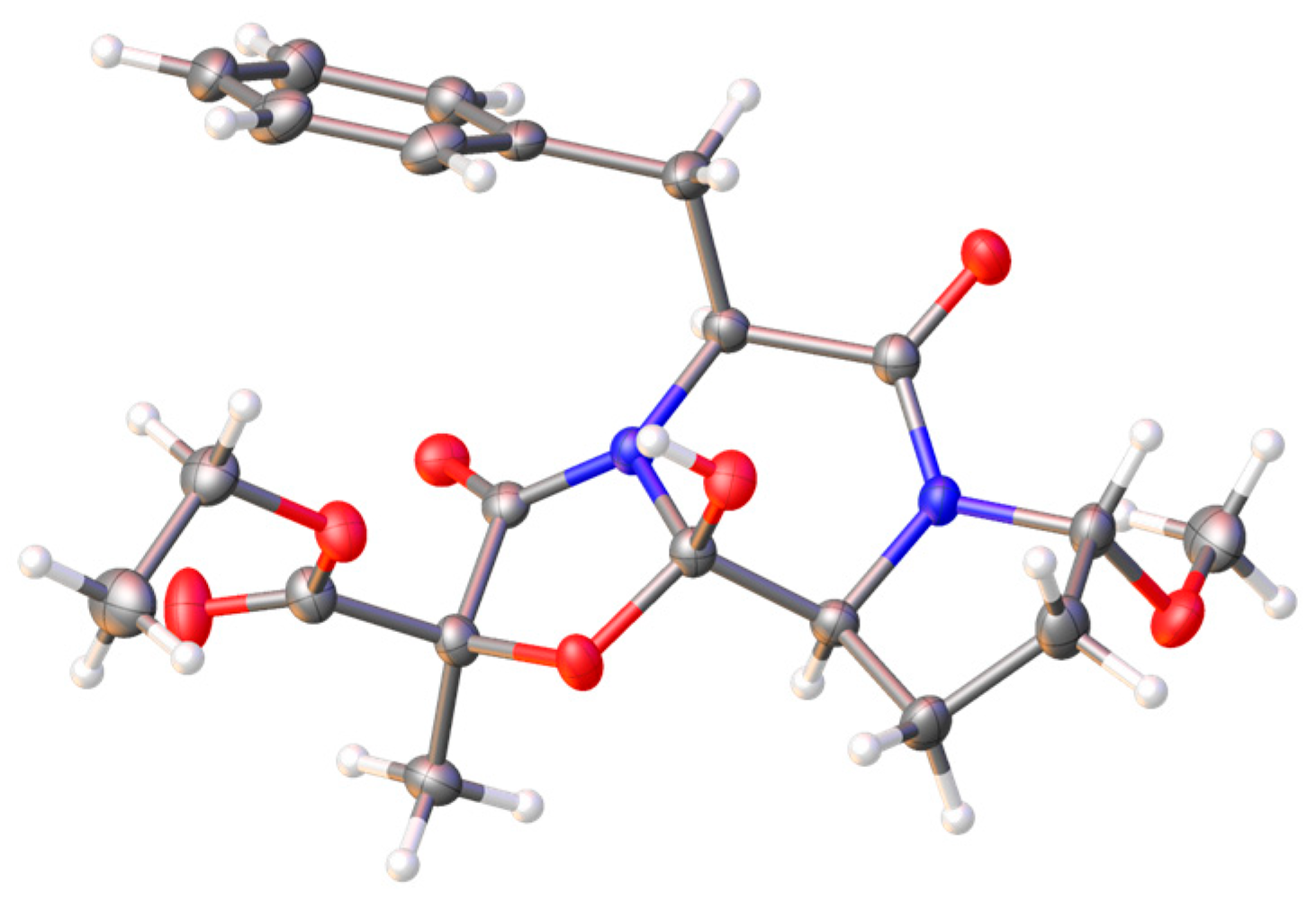
3.2.13. Ethyl (2R,5S,10aS,10bS)-5-benzyl-10b-hydroxy-8-methoxy-2-methyl-3,6-dioxooctahydro-8H-oxazolo[3,2-a]pyrrolo[2,1-c]pyrazine-2-carboxylate (19)
To a suspension of Pd on C (10%) (0.70 g, 40% weight) in tetrahydrofuran:methanol (1:10, 24 mL) was added a solution of ethyl 3-((3S,8aS)-3-benzyl-6-methoxy-1,4-dioxohexahydropyrrolo[1,2-a]pyrazin-2(1H)-yl)-2-(benzyloxy)-2-methyl-3-oxopropanoate (1.75 g, 3.44 mmol) in methanol (5.6 mL) and the mixture was evacuated and filled with hydrogen (via balloon). This procedure was repeated three times, and the mixture was stirred overnight at room temperature. The suspension was filtered through Celite, and the filtrate was concentrated to give a mixture of product and starting material. This material was purified using automated chromatography under normal phase conditions (gradient of 0 → 100% ethyl acetate in petrol) to give ethyl (2R,5S,10aS,10bS)-5-benzyl-10b-hydroxy-8-methoxy-2-methyl-3,6-dioxooctahydro-8H-oxazolo[3,2-a]pyrrolo[2,1-c]pyrazine-2-carboxylate (490 mg) and starting material (0.59 g).
To a suspension of Pd on C (10%) (236 mg, 40% weight) in tetrahydrofuran:methanol (1:10, 9 mL) was added a solution of ethyl 3-((3S,8aS)-3-benzyl-6-methoxy-1,4-dioxohexahydropyrrolo[1,2-a]pyrazin-2(1H)-yl)-2-(benzyloxy)-2-methyl-3-oxopropanoate (0.59 g, 1.16 mmol) in methanol (5.6 mL) and the mixture was evacuated and filled with hydrogen (via balloon). This procedure was repeated three times, and the mixture was stirred overnight at room temperature. The suspension was filtered through Celite, and the filtrate was concentrated to give a white foam. This material was purified using automated chromatography under normal phase conditions (gradient of 0 → 100% ethyl acetate in petrol) to give ethyl (2R,5S,10aS,10bS)-5-benzyl-10b-hydroxy-8-methoxy-2-methyl-3,6-dioxooctahydro-8H-oxazolo[3,2-a]pyrrolo[2,1-c]pyrazine-2-carboxylate (366 mg). This material was combined with the first purification to give ethyl (2R,5S,10aS,10bS)-5-benzyl-10b-hydroxy-8-methoxy-2-methyl-3,6-dioxooctahydro-8H-oxazolo[3,2-a]pyrrolo[2,1-c]pyrazine-2-carboxylate (0.86 g, 59%) as a single isomer. TLC: Rf = 0.55 (ethyl acetate—petrol, 45:55 v/v). 1H NMR (300 MHz, DMSO-d6): δ 7.43 (br s, 1 H, OH), 7.31–7.11 (m, 5 H, 5 × ArH), 5.48–5.45 (m, 1 H, CHNO), 4.58 (dd, 1 H, J = 8.1, 5.0 Hz, α-CH), 4.18 (q, 2 H, J = 7.1 Hz, CH2CH3), 3.88 (dd, 1 H, J = 8.7, 4.1 Hz, α-CH), 3.35–3.21 (m, 4 H, OMe and 0.5 × benzylic CH2), 2.88 (dd, 1 H, J = 13.6, 8.1 Hz, 0.5 × benzylic CH2), 2.19–2.00 (m, 2 H, CH2), 1.80–1.68 (m, 2 H, CH2), 1.46 (s, 3 H, CH3), 1.22 (t, 3 H, J = 7.1 Hz, CH2CH3). 13C{1H} NMR (75 MHz, DMSO-d6): δ 168.1, 165.4, 165.2, 138.0, 129.7, 127.8, 126.1, 104.4, 88.3, 82.0, 62.9, 61.9, 55.9, 55.4, 38.4, 29.6, 23.5, 20.6, 13.9. LC-MS (ESI positive, m/z) calcd. for C21H26N2O7 [M + Na]+: 441.16, found: 441.15.
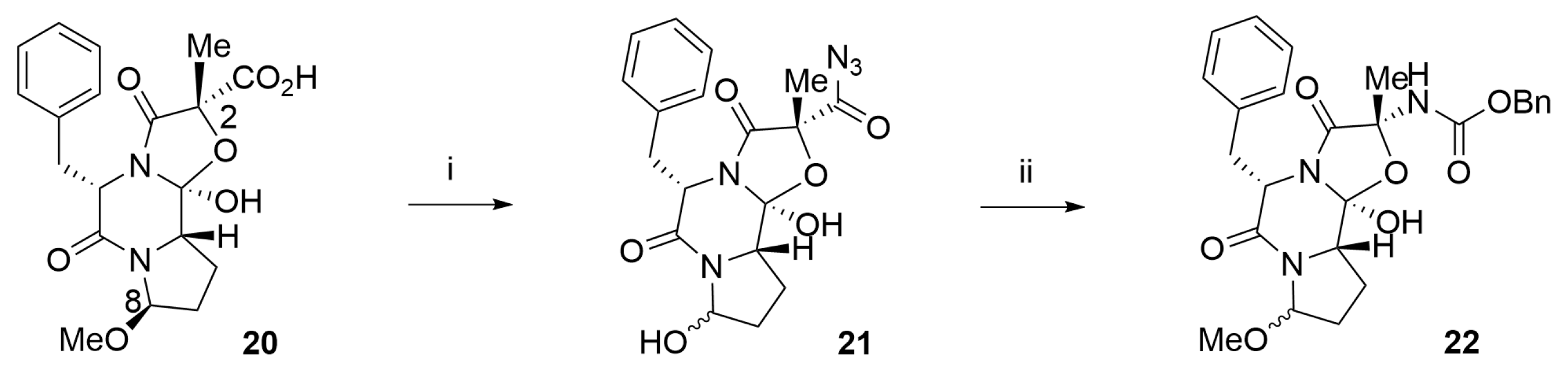
3.2.14. (2R,5S,8R,10aS,10bS)-5-benzyl-10b-hydroxy-8-methoxy-2-methyl-3,6-dioxooctahydro-8H-oxazolo[3,2-a]pyrrolo[2,1-c]pyrazine-2-carboxylic Acid (20)
To a solution of ethyl (2R,5S,10aS,10bS)-5-benzyl-10b-hydroxy-8-methoxy-2-methyl-3,6-dioxooctahydro-8H-oxazolo[3,2-a]pyrrolo[2,1-c]pyrazine-2-carboxylate (0.85 g, 2.03 mmol) in tetrahydrofuran (5.5 mL), 1 M aqueous sodium hydroxide solution (5.08 mL, 5.08 mmol) was added, and the mixture was stirred at room temperature for 2 h. The solution was cooled to 0 °C and quenched with 1 M hydrochloric acid (10 mL, to pH 1–2) and extracted with ethyl acetate (3 × 20 mL). The combined organic extracts were washed with satd. brine (30 mL), dried (MgSO4) and concentrated to give (2R,5S,10aS,10bS)-5-benzyl-10b-hydroxy-8-methoxy-2-methyl-3,6-dioxooctahydro-8H-oxazolo [3,2-a]pyrrolo[2,1-c]pyrazine-2-carboxylic acid (0.80 g, 99%) as a white foam. TLC: Rf = 0.55 (ethyl acetate—petrol, 4:6 v/v). 1H NMR (300 MHz, DMSO-d6): δ 7.31–7.10 (m, 5 H, 5 × ArH), 5.44–5.40 (m, 1 H, CHNO), 4.57 (dd, 1 H, J = 6.8, 4.0 Hz, α-CH), 3.84 (dd, 1 H, J = 7.9, 4.8 Hz, α-CH), 3.21 (s, 3 H, OMe), 3.15 (dd, 1 H, J = 13.7, 6.9 Hz, 0.5 × benzylic CH2), 3.00 (dd, 1 H, J = 13.7, 3.9 Hz, 0.5 × benzylic CH2), 2.13–2.01 (m, 2 H, CH2), 1.77–1.66 (m, 2 H, CH2), 1.39 (s, 3 H, CH3). 13C{1H} NMR (75 MHz, DMSO-d6): δ 170.7, 169.0, 166.3, 138.7, 129.8, 127.8, 125.9, 104.3, 88.0, 85.1, 62.0, 55.3, 37.5, 29.6, 23.6, 20.0. LC-MS (ESI negative, m/z) calcd. for C19H22N2O7 [M − H]−: 389.14, found: 389.10.
3.2.15. (2R,5S,10aS,10bS)-5-Benzyl-8,10b-dihydroxy-2-methyl-3,6-dioxooctahydro-8H-oxazolo[3,2-a]pyrrolo[2,1-c]pyrazine-2-carbonyl Azide (21)
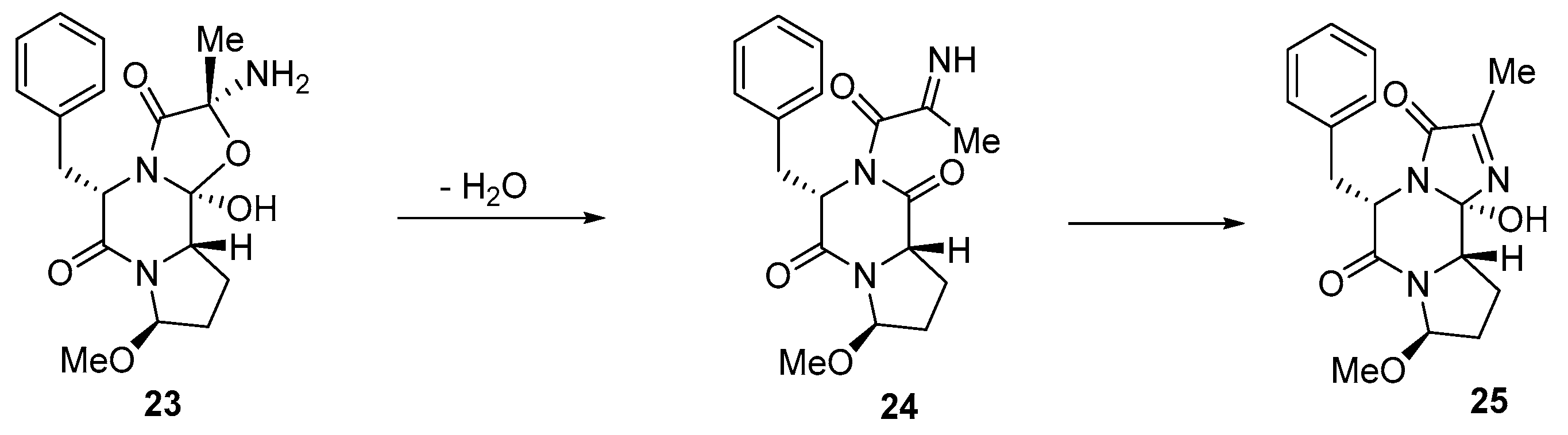
To an ice-cold solution of (2R,5S,8R,10aS,10bS)-5-benzyl-10b-hydroxy-8-methoxy-2-methyl-3,6-dioxooctahydro-8H-oxazolo[3,2-a]pyrrolo[2,1-c]pyrazine-2-carboxylic acid (100 mg, 0.25 mmol) and anhydrous dimethylformamide (3.7 mg, 4 µL, 0.05 mmol) in anhydrous dichloromethane (2 mL) under nitrogen, oxalyl chloride (84 mg, 57 µL, 0.51 mmol) was added, and the mixture was stirred for 2 h at room temperature and subsequently concentrated under high vacuum. This material was dissolved in acetone (2 mL) and cooled to −78 °C. A solution of tetra-butylammonium azide (78 mg, 0.28 mmol) in acetone (1 mL) was added, and the mixture was stirred at −78 °C for 1 h followed by 0 °C for 15 min. The reaction was quenched with water (10 mL) and extracted with ethyl acetate (3 × 10 mL). The combined organic extracts were washed with satd. aqueous sodium bicarbonate (20 mL), satd. brine (20 mL), dried (MgSO4) and concentrated to give an off-white foam. This material was purified using automated chromatography under normal phase conditions (gradient of 0 → 100% ethyl acetate in dichloromethane) to give (2R,5S,10aS,10bS)-5-benzyl-8,10b-dihydroxy-2-methyl-3,6-dioxooctahydro-8H-oxazolo[3,2-a]pyrrolo[2,1-c]pyrazine-2-carbonyl azide (52 mg, 52%) as an impure 8 to 2 mixture of diastereomers. TLC: Rf = 0.45 (ethyl acetate—dichloromethane, 3:7 v/v). 1H NMR (300 MHz, CDCl3): δ 7.26–6.98 (m, 5 H, 5 × ArH), 5.65–5.52 (m, 1 H, CHNO), 4.67–4.58 (m, 1 H, α-CH), 4.04 (br s, 1H, OH), 3.79–3.62 (m, 1 H, α-CH), 3.34–3.13 (m, 2 H, benzylic CH2), 2.28–2.05 (m, 2 H, CH2), 1.81–1.53 (m, 2 H, CH2), 1.41 (s, 3 H, CH3). Minor LC-MS (ESI positive, m/z) calcd. for C18H19N5O6 [M + Na]+: 424.12, found: 424.10. Major LC-MS (ESI positive, m/z) calcd. for C18H19N5O6 [M + Na]+: 424.12, found: 424.15.
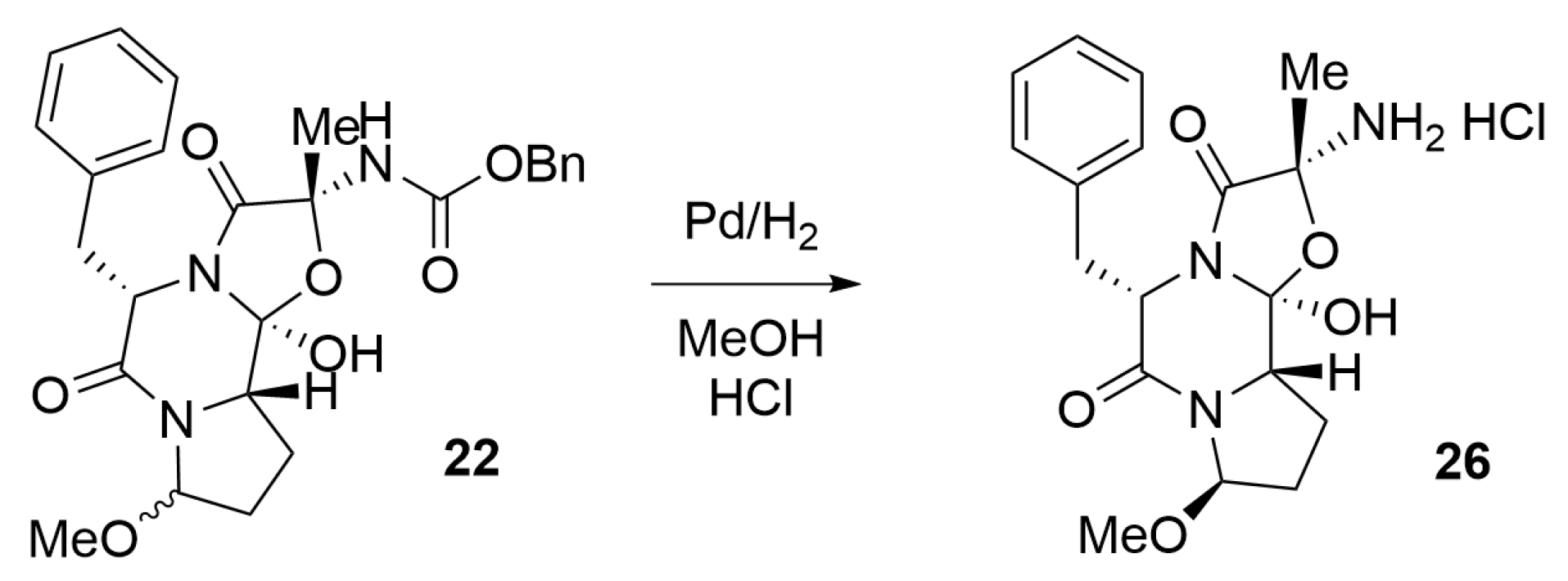
3.2.16. Benzyl ((2R,5S,10aS,10bS)-5-benzyl-10b-hydroxy-8-methoxy-2-methyl-3,6-dioxooctahydro-8H-oxazolo[3,2-a]pyrrolo[2,1-c]pyrazin-2-yl)carbamate (22)
A solution of (2R,5S,10aS,10bS)-5-benzyl-8,10b-dihydroxy-2-methyl-3,6-dioxooctahydro-8H-oxazolo[3,2-a]pyrrolo[2,1-c]pyrazine-2-carbonyl azide (287 mg, 0.72 mmol) in benzyl alcohol (4 mL) under nitrogen was heated at 130 °C for 3 min, and the benzyl alcohol was removed by Kugelrohr distillation at 50 °C to give a yellow oil. This material was purified using automated chromatography under normal phase conditions (gradient of 0 → 100% ethyl acetate in petrol) to give benzyl ((2R,5S,10aS,10bS)-5-benzyl-10b-hydroxy-8-methoxy-2-methyl-3,6-dioxooctahydro-8H-oxazolo[3,2-a]pyrrolo[2,1-c] pyrazin-2-yl)carbamate (240 mg, 70%) as a mixture of diastereomers.
To a solution of benzyl ((2R,5S,10aS,10bS)-5-benzyl-10b-hydroxy-8-methoxy-2-methyl-3,6-dioxooctahydro-8H-oxazolo[3,2-a]pyrrolo[2,1-c] pyrazin-2-yl)carbamate (240 mg, 0.59 mmol) in anhydrous methanol (6.5 mL), p-toluenesulfonic acid (3.20 mg, 18.0 µmol) was added, and the mixture was stirred at room temperature for 45 min. The reaction was quenched with sat. aqueous sodium bicarbonate (20 mL) and extracted with ethyl acetate (3 × 20 mL). The combined organic extracts were washed with satd. aqueous sodium bicarbonate (20 mL), satd. brine (30 mL), dried (MgSO4) and concentrated to give benzyl ((2R,5S,10aS,10bS)-5-benzyl-10b-hydroxy-8-methoxy-2-methyl-3,6-dioxooctahydro-8H-oxazolo[3,2-a]pyrrolo[2,1-c]pyrazin-2-yl)carbamate (223 mg, 90%) as a mixture of diastereomers.
TLC: Rf = 0.55 (ethyl acetate—petrol, 4:6 v/v). 1H NMR (300 MHz, CD3CN): δ 7.46–7.16 (m, 10 H, 10 × ArH), 6.95 (br s, 1 H, carbamate NH), 5.66–5.62 (m, 1 H, OH), 5.55–5.49 (m, 1 H, CHNO), 5.13 (s, 2 H, carbamate benzylic CH2), 4.69–4.62 (m, 1 H, α-CH), 3.88–3.79 (m, 1 H, α-CH), 3.39–3.15 (m, 5 H, benzylic CH2 and OMe), 2.19–2.08 (m, 2 H, CH2), 1.81–1.70 (m, 2 H, CH2), 1.49 (s, 3 H, CH3). 13C{1H} NMR (75 MHz, CD3CN): δ 166.6, 166.6, 156.5, 139.4, 136.7, 130.7, 129.1, 128.9, 128.7, 128.5, 126.8, 103.5, 89.2, 87.6, 67.7, 62.8, 57.1, 55.9, 38.8, 30.3, 24.1, 23.9. LC-MS (ESI positive, m/z) calcd. for C26H29N3O7 [M + Na]+: 518.19, found: 518.15.
TLC: Rf = 0.2 (ethyl acetate—petrol, 4:6 v/v). 1H NMR (300 MHz, CD3CN): δ 7.38–7.12 (m, 10 H, 10 × ArH), 6.88 (br s, 1 H, carbamate NH), 5.69 (br s, 1 H, OH), 5.19–5.15 (m, 1 H, CHNO), 5.11 (s, 2 H, carbamate benzylic CH2), 4.52 (t, 1 H, J = 5.6 Hz α-CH), 3.57–3.47 (m, 1 H, α-CH), 3.34–3.18 (m, 5 H, benzylic CH2 and OMe), 2.01–1.59 (m, 4 H, 2 × CH2), 1.39 (s, 3 H, CH3). 13C{1H} NMR (75 MHz, CD3CN): δ 167.4, 166.9, 156.9, 139.1, 137.2, 131.4, 129.6, 129.3, 129.2, 128.8, 127.3, 104.1, 88.7, 87.8, 68.1, 65.7, 58.6, 57.0, 39.9, 30.9, 30.7, 24.5, 24.3. LC-MS (ESI positive, m/z) calcd. for C26H29N3O7 [M + Na]+: 518.19, found: 518.15.
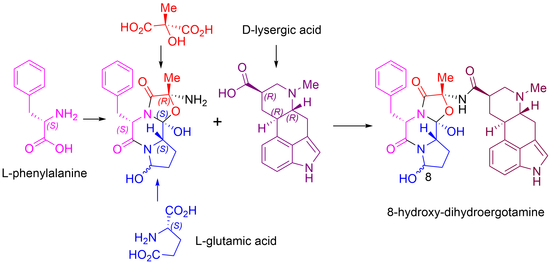
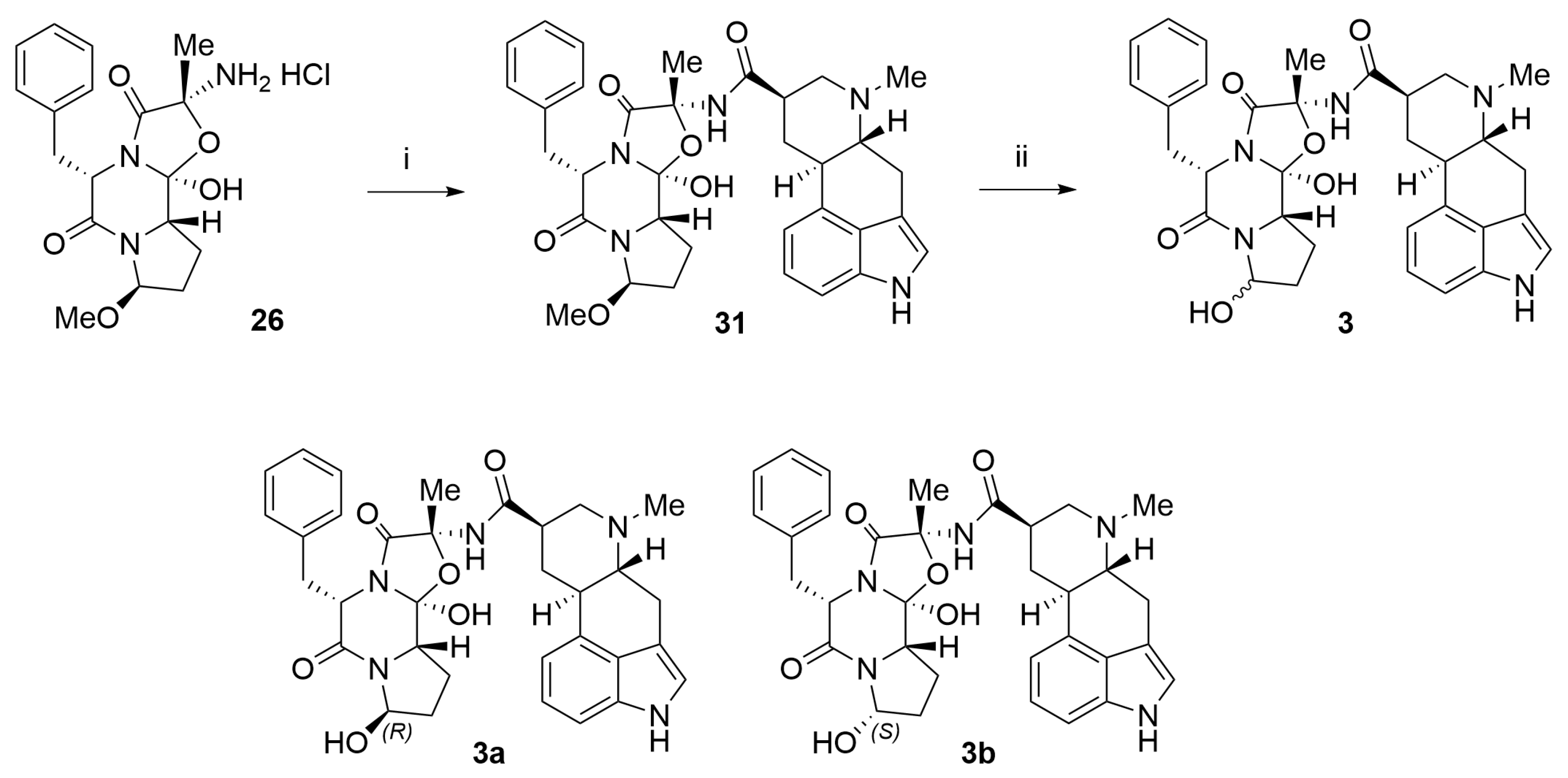
3.2.17. (6aR,9R,10aR)-N-((2R,5S,10aS,10bS)-5-Benzyl-10b-hydroxy-8-methoxy-2-methyl-3,6-dioxo octahydro-8H-oxazolo[3,2-a]pyrrolo[2,1-c]pyrazin-2-yl)-7-methyl-4,6,6a,7,8,9,10,10a-octa hydroindolo[4,3-fg]quinoline-9-carboxamide Formate Salt (31)
To a suspension of Pd on C (10%) (0.70 g, 40% weight) in tetrahydrofuran:methanol (1:10, 6.6 mL), a solution benzyl ((2R,5S,10aS,10bS)-5-benzyl-10b-hydroxy-8-methoxy-2-methyl-3,6-dioxooctahydro-8H-oxazolo[3,2-a]pyrrolo[2,1-c]pyrazin-2-yl)carbamate (223 mg, 0.45 mmol) in methanol (1.3 mL) was added, and the mixture was evacuated and filled with hydrogen (via balloon). This process was repeated three times. Hydrochloric acid in methanol (1.25 M, 1.44 mL, 1.80 mmol) was added, and the mixture was stirred for 1 h at room temperature. The suspension was filtered through Celite and the filtrate was concentrated azeotropically with dichloromethane and diethyl ether to give (2R,5S,10aS,10bS)-2-amino-5-benzyl-10b-hydroxy-8-methoxy-2-methyltetrahydro-8H-oxazolo [3,2-a] pyrrolo[2,1-c]pyrazine-3,6(2H,5H)-dione hydrochloride (179 mg) as an off-white solid.
To a solution of dihydrolysergic acid hydrochloride (277 mg, 0.90 mmol) in anhydrous dimethylformamide (4.5 mL) under nitrogen, HATU (360 mg, 0.95 mmol) was added, followed by Hünig’s base (349 mg, 0.48 mL, 2.71 mmol), and the mixture was stirred at room temperature for 1.5 h. (2R,5S,10aS,10bS)-2-Amino-5-benzyl-10b-hydroxy-8-methoxy-2-methyltetrahydro-8H-oxazolo [3,2-a] pyrrolo[2,1-c]pyrazine-3,6(2H,5H)-dione hydrochloride (179 mg, 0.45 mmol) was added, and the mixture was stirred for 2.5 h at room temperature. The reaction was quenched with water (15 mL) and extracted with ethyl acetate (3 × 20 mL). The combined organic extracts were washed with water (3 × 15 mL), satd. brine (30 mL), dried (MgSO4) and concentrated to give an orange solid (286 mg). This material was purified using automated chromatography under reversed-phase conditions (gradient of 0 → 100% acetonitrile in 0.1% formic acid in water) with detection at 278 nm to give impure (6aR,9R,10aR)-N-((2R,5S,10aS,10bS)-5-benzyl-10b-hydroxy-8-methoxy-2-methyl-3,6-dioxooctahydro-8H-oxazolo[3,2-a]pyrrolo[2,1-c]pyrazin-2-yl)-7-methyl-4,6,6a,7,8,9,10,10a-octahydroindolo[4,3-fg]quinoline-9-carboxamide (160 mg). This material was purified using semi-preparative HPLC (Luna C18(2) (250 mm x 10 mm, 100 Å,10 µm) column eluting with water containing 0.1% HCOOH (A) and acetonitrile (B)) at a flow-rate of 5.0 mL/min and monitored at 280 nm). Separation of the diastereomers was achieved with a gradient ratio starting at 90:10 (A:B), changing to 70:30 (A:B) after 40 min to give (6aR,9R,10aR)-N-((2R,5S,10aS,10bS)-5-benzyl-10b-hydroxy-8-methoxy-2-methyl-3,6-dioxooctahydro-8H-oxazolo [3,2-a]pyrrolo[2,1-c]pyrazin-2-yl)-7-methyl-4,6,6a,7,8,9,10,10a-octahydroindolo[4,3-fg]quinoline-9-carboxamide formate salt (59 mg, 21% over 2 steps from 26) as a white solid. 1H NMR (700 MHz, CD3CN): δ 8.20 (s, 1 H, HCO2), 7.36 (d, 2 H, J = 8.2 Hz, 2 × ArH), 7.24 (t, 2 H, J = 7.3 Hz, 2 × ArH), 7.21 (d, 1 H, J = 8.1 Hz, ArH), 7.18–7.16 (m, 1 H, ArH), 7.13–7.11 (m, 1 H, ArH), 6.95 (br s, 1 H, ArH), 6.88 (d, 1H, J = 7.1 Hz, ArH), 5.52 (dd, 1 H, J = 5.0, 1.4 Hz, CHNO), 4.65 (dd, 1 H, J = 6.7, 4.7 Hz, α-CH), 3.86 (dd, 1 H, J = 8.0, 5.3 Hz, α-CH), 3.43 (dd, 1 H, J = 14.5, 4.3 Hz, 0.5 × benzylic CH2), 3.30–3.23 (m, 5 H, CH2 and OMe), 3.17 (dd, 1 H, J = 14.5, 4.3 Hz, 0.5 × benzylic CH2), 3.12–3.08 (m, 1 H, 0.5 × CH2), 3.04–3.00 (m, 1 H, 0.5 × CH2), 2.80–2.73 (m, 2 H, CH2), 2.59–2.54 (m, 4 H, NCH3 and CH), ca. 2.48 (obscure m, 1 H, CH), 2.17–2.10 (m, 2H, CH2), 1.82–1.74 (m, 2 H, CH2), 1.61 (q, 1 H, J = 12.4 Hz, CH), 1.54 (s, 3 H, CH3). 13C{1H} NMR (175 MHz, CD3CN): δ 176.2, 167.2, 167.0, 164.8, 139.9, 134.5, 132.4, 132.3, 131.1, 128.1, 127.5, 126.8, 123.7, 119.6, 113.7, 110.8, 110.1, 104.2, 89.7, 87.1, 67.6, 63.3, 58.7, 57.7, 56.3, 42.5, 42.3, 39.8, 39.5, 31.2, 30.7, 26.5, 24.5, 24.1. LC-MS (ESI positive, m/z) calcd. for C34H39N5O6 [M + H]+: 614.30, found: 614.35. rt: 36.1 min.
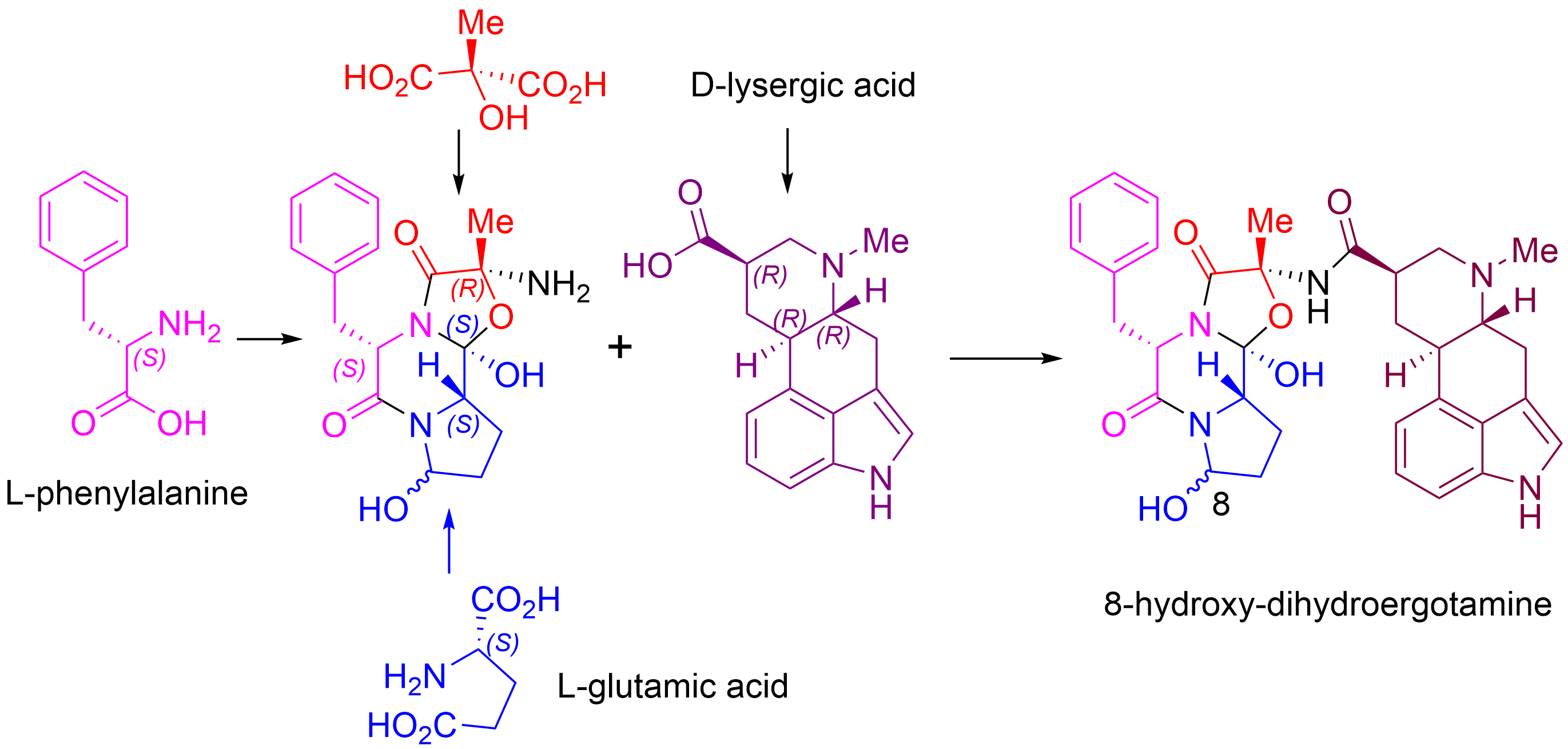
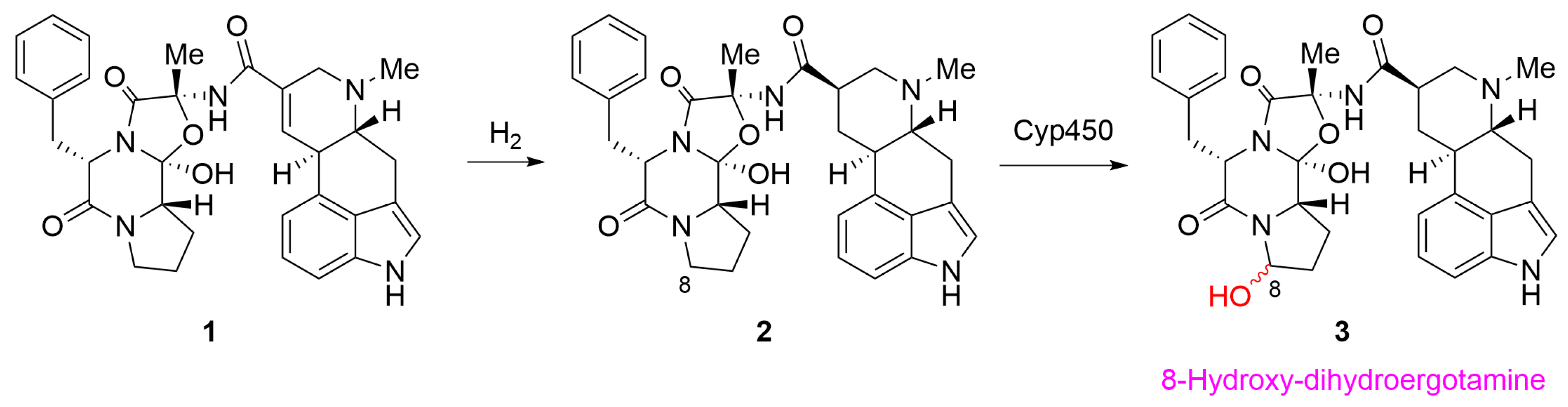
3.2.18. (6aR,9R,10aR)-N-((2R,5S,8R,10aS,10bS)-5-Benzyl-8,10b-dihydroxy-2-methyl-3,6-dioxooctahydro-8H-oxazolo[3,2-a]pyrrolo[2,1-c]pyrazin-2-yl)-7-methyl-4,6,6a,7,8,9,10,10a-octahydroindolo[4,3-fg]quinoline-9-carboxamide Hydrochloride/Formate (4:6) Salt and (8S)-epimer (3a)/(3b)
To a solution of (6aR,9R,10aR)-N-((2R,5S,8R,10aS,10bS)-5-benzyl-10b-hydroxy-8-methoxy-2-methyl-3,6-dioxooctahydro-8H-oxazolo[3,2-a]pyrrolo[2,1-c]pyrazin-2-yl)-7-methyl-4,6,6a,7,8,9,10,10a-[4,3-fg]quinoline-9-carboxamide (59 mg, 97 µmol) in acetonitrile (1.6 mL), 1 M hydrochloric acid (6.7 mL) was added, and the mixture was stirred for 5 h at room temperature. This material was purified using automated chromatography under reversed-phase conditions (gradient of 0 → 100% acetonitrile in 0.1% formic acid water) with detection at 278 nm to give (6aR,9R,10aR)-N-((2R,5S,8R,10aS,10bS)-5-benzyl-8,10b-dihydroxy-2-methyl-3,6-dioxooctahydro-8H-oxazolo[3,2-a]pyrrolo[2,1-c]pyrazin-2-yl)-7-methyl-4,6,6a,7,8,9,10,10a-octahydroindolo[4,3-fg]quinoline-9-carboxamide hydrochloride/formate (4:6) salt and (8S)-epimer (52 mg, 90%) as a white solid after lyophilization. 1H NMR (400 MHz, DMSO-d6): δ 10.7 (s, 1 H, NH indole), 9.37 (s, 0.6 H, 0.6 × NH), 9.32 (s, 0.4 H, 0.4 × NH), 8.14 (s, 0.6 H, 0.6 × HCO2), 7.34–7.30 (m, 2 H, 2 × ArH), 7.21 (q, 2 H, J = 7.6 Hz, 2 × ArH), 7.16–7.12 (m, 1 H, ArH), 7.07–7.03 (m, 1 H, ArH), 7.00 (br s, 1 H, ArH), 6.81 (d, 1H, J = 7.1 Hz, ArH), 6.72 (br s, 0.4 × OH), 6.66 (br s, 0.6 H, 0.6 × OH), 6.03 (d, 0.4 H, J = 5.1 Hz, 0.4 × OH), 6.02 (d, 0.6 H, J = 4.9 Hz, 0.6 × OH), 5.62 (dt, 0.6 H, J = 4.7, 5.0 Hz, 0.6 × CHNO), 5.43 (t, 0.4 H, J = 5.2 Hz, 0.6 × CHNO), 4.52 (dd, 0.6 H, J = 6.9, 4.4 Hz, 0.6 × α-CH), 4.47 (dd, 0.4 H, J = 6.5, 5.4 Hz, 0.4 × α-CH), 3.94 (td, 0.6 H, J = 7.2, 1.9 Hz, 0.6 × α-CH), 3.67 (ddd, 0.4 H, J = 11.4, 5.2, 1.8 Hz, 0.4 × α-CH), 3.22–3.17 (m, 1 H, 0.5 × benzylic CH2), 3.11–3.03 (m, 1 H, 0.5 × benzylic CH2), 2.91–2.84 (m, 1.8 H, 1.8 × NCH3), 2.72–2.65 (m, 1.2 H, 1.2 × NCH3), 2.60–2.55 (m, 1 H, 0.5 × CH2), ca. 2.44 (obscure m, 1 H, CH), 2.12–2.07 (m, 1 H, 0.5 × CH2), 2.05–1.97 (m, 2 H, CH2), 1.93–1.88 (m, 1 H, 0.5 × CH2), 1.85–1.81 (m, 1 H, 0.5 × CH2), 1.79–1.75 (m, 0.6 H, 0.6 × CH), 1.74–1.71 (m, 0.4 H, 0.4 × CH), 1.61–1.56 (m, 1 H, CH), 1.53–1.44 (m, 4 H, 3 H, CH3 and CH). 13C{1H} NMR (100 MHz, DMSO-d6): δ 166.0, 156.9, 165.0, 164.8, 163.1, 138.9, 138.6, 133.2, 129.8, 129.7, 127.8, 127.7, 126.0, 125.8, 122.1, 118.7, 112.0, 108.9, 102.8, 102.6, 85.6, 85.7, 80.9, 79.6, 66.3, 64.4, 62.3, 56.4, 56.1, 38.3, 37.8, 31.2, 30.5, 23.9, 23.0. Minor isomer HRMS (ESI positive, m/z) calcd. for C33H37N5O6 [M + H]+: 600.2817, found: 600.2811. Major isomer HRMS (ESI positive, m/z) calcd. for C33H37N5O6 [M + H]+: 600.2817, found: 600.2811.
3.2.19. (6aR,9R,10aR)-N-((2R,5S,8R,10aS,10bS)-5-((phenyl-d5)methyl)-8,10b-dihydroxy-2-methyl-3,6-dioxooctahydro-8H-oxazolo[3,2-a]pyrrolo[2,1-c]pyrazin-2-yl)-7-methyl-4,6,6a,7,8,9,10,10a-octahydroindolo[4,3-fg]quinoline-9-carboxamide Hydrochloride/Formate (4:6) Salt and (8S)-epimer (2H5-3a)/(2H5-3b)
To a solution of (6aR,9R,10aR)-N-((2R,5S,8R,10aS,10bS)-5-((phenyl-d5)methyl)-10b-hydroxy-8-methoxy-2-methyl-3,6-dioxooctahydro-8H-oxazolo[3,2-a]pyrrolo[2,1-c]pyrazin-2-yl)-7-methyl-4,6,6a,7,8,9,10,10a-octahydroindolo[4,3-fg]quinoline-9-carboxamide (22 mg, 36 µmol) in acetonitrile (0.62 mL), 1 M hydrochloric acid (2.6 mL) was added, and the mixture was stirred for 5 h at room temperature. The product in the resulting solution was purified using automated chromatography under normal phase conditions (gradient of 0 → 100% acetonitrile in 0.1% formic acid water) with detection at 278 nm to give (6aR,9R,10aR)-N-((2R,5S,10aS,10bS)-5-((phenyl-d5)methyl)-8,10b-dihydroxy-2-methyl-3,6-dioxooctahydro-8H-oxazolo[3,2-a]pyrrolo[2,1-c]pyrazin-2-yl)-7-methyl-4,6,6a,7,8,9,10,10a-octahydroindolo[4,3-fg]quinoline-9-carboxamide hydrochloride/formate (4:6) salt (20 mg, 95%) as a white solid after lyophilization. 1H NMR (700 MHz, DMSO-d6): δ 10.7 (s, 1 H, NH indole), 9.37 (s, 0.6 H, 0.6 × NH), 9.32 (s, 0.4 H, 0.4 × NH), 8.17 (s, 0.6 H, 0.6 × HCO2), 7.17–7.13 (m, 1 H, ArH), 7.08–7.03 (m, 1 H, ArH), 7.01 (br s, 1 H, ArH), 6.82 (d, 1H, J = 7.3 Hz, ArH), 6.71 (br s, 0.4 × H, OH), 6.65 (br s, 0.6 H, 0.6 × H, OH), 6.03 (d, 0.4 H, J = 5.1 Hz, 0.4 × OH), 6.02 (d, 0.6 H, J = 4.8 Hz, 0.6 × OH), 5.62 (dt, 0.6 H, J = 4.6, 5.1 Hz, 0.6 × CHNO), 5.44 (t, 0.4 H, J = 5.3 Hz, 0.6 × CHNO), 4.52 (dd, 0.6 H, J = 6.9, 4.5 Hz, 0.6 × α-CH), 4.47 (dd, 0.4 H, J = 6.5, 5.4 Hz, 0.4 × α-CH), 3.94 (td, 0.6 H, J = 7.2, 1.9 Hz, 0.6 × α-CH), 3.68 (ddd, 0.4 H, J = 11.4, 5.2, 1.8 Hz, 0.4 × α-CH), 3.19 (ddd, 1 H, J = 13.9, 6.8, 5.0 Hz, 0.5 × benzylic CH2), 3.07 (ddd, 1 H, J = 23.1, 13.9, 4.9 Hz, 0.5 × benzylic CH2), 2.93–2.82 (m, 1.8 H, 1.8 × NCH3), 2.73–2.66 (m, 1 H, 1.2 × NCH3), ca. 2.52 (obscure m, 1 H, 0.5 × CH2), ca. 2.44 (obscure m, 1H, CH), 2.12–2.06 (m, 1 H, 0.5 × CH2), 2.05–1.97 (m, 2 H, CH2), 1.93–1.88 (m, 1 H, 0.5 × CH2), 1.85–1.81 (m, 1 H, CH), 1.80–1.75 (m, 0.6 H, 0.6 × CH), 1.74–1.70 (m, 0.4 H, 0.4 × CH), 1.62–1.56 (m, 1 H, CH), 1.53–1.44 (m, 3 H, CH3). Minor isomer HRMS (ESI positive, m/z) calcd. for C33H32D5N5O6 [M + H]+: 605.3125, found: 605.3125. Major isomer HRMS (ESI positive, m/z) calcd. for C33H32D5N5O6 [M + H]+: 605.3125, found: 605.3125. The 1H NMR spectrum showed no phenyl resonances consistent with the compound’s origin from [2,3,4,5,6-2H5]L-phenylalanine (Merck Darmstadt, Germany: ≥98 atom % D) and there was no detectable d4 component in the HRMS.
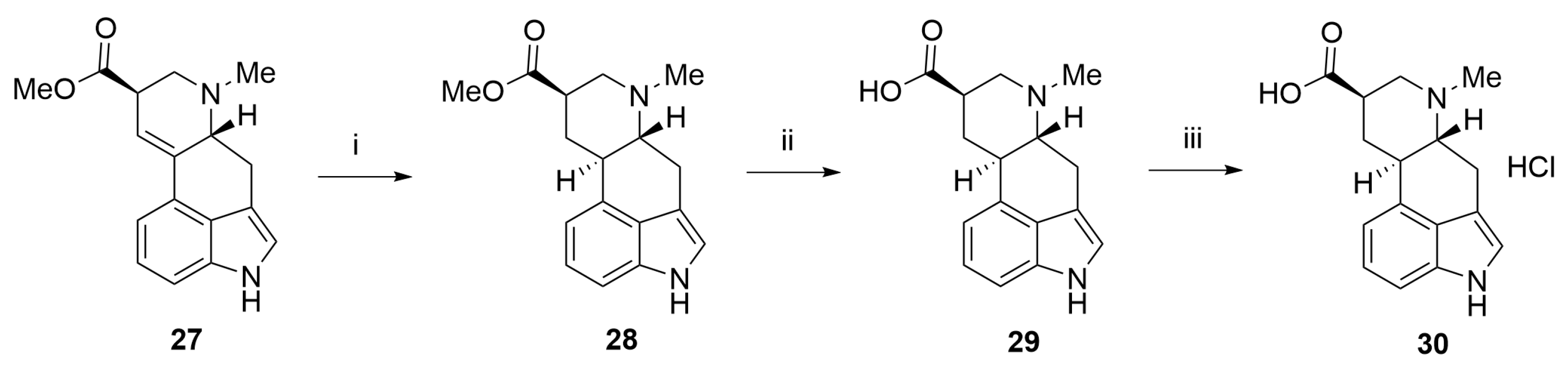
3.2.20. Dihydrolysergic Acid Hydrochloride (30)
To a suspension of 10% Pd on carbon (0.70 g, 40% weight) in methanol (15 mL), a solution of D-lysergic acid methyl ester (500 mg, 1.77 mmol) in methanol (5 mL) was added, and the mixture was evacuated and filled with hydrogen (via balloon). This process was repeated three times, and the mixture was heated at 35 °C overnight. The suspension was filtered through Celite, and the filtrate was concentrated to give a brown residue. This material was purified using automated chromatography under normal phase conditions (gradient of 0 → 100% ethyl acetate in petrol) with detection at 278 nm to give dihydrolysergic acid methyl ester (337 mg, 67%) as a pale-yellow solid. TLC: R
f = 0.29 (methanol—ethyl acetate, 5:95
v/
v).
1H NMR data [
44].
To a solution of dihydrolysergic acid methyl ester (0.68 g, 2.38 mmol) in methanol (12 mL), 1 M aqueous sodium hydroxide solution (11.9 mL, 11.9 mmol) was added, and the mixture was heated at 40 °C for 3 h. The reaction mixture was cooled to room temperature and adjusted to pH 6 with 1 M hydrochloric acid. The solution was concentrated to give a brown solid. This material was suspended in ice-cold water, and the resulting solid was collected by Büchner filtration to give a beige solid. The solid was suspended in acetonitrile (20 mL) and stirred for 1 h at room temperature. The solid was collected by Büchner filtration to give dihydrolysergic acid (478 mg, 74%) as an off-white solid. TLC: R
f = 0.29 (methanol—ethyl acetate, 5: 95
v/
v).
1H NMR data [
44].
To a suspension of dihydrolysergic acid (316 mg, 1.17 mmol) in acetonitrile: water (2.5:1, 8 mL), 1 M hydrochloric acid was added, and the reaction mixture was stirred for 15 min at room temperature. The resulting solid collected by Büchner filtration was washed with acetonitrile (3 × 5 mL) to give dihydrolysergic acid hydrochloride (291 mg, 81%) as an off-white solid.





 ,
,