Article

Study of Dangling Bond States in Magnetron-Sputtered a-Si Thin Films via Parametrization Using a Single UV–Vis–NIR Transmittance Spectrum


1
Scientific Research Section (NIS), Technical University, 1000 Sofia, Bulgaria
2
Department of Microelectronics, Faculty of Electronics Engineering and Technologies, Technical University, 1000 Sofia, Bulgaria
3
Department of Technology and Management of Communication Systems, Faculty of Telecommunications, Technical University, 1000 Sofia, Bulgaria
4
Department of Condensed-Matter Physics, Faculty of Science, University of Cadiz, Puerto Real, 11510 Cadiz, Spain
5
Photovoltaic Solar Energy Unit, Centre for Energy, Environmental and Technological Research (CIEMAT), Avenida Complutense 40, 28040 Madrid, Spain
6
Computer Science Department, Northwestern University, Evanston, IL 60208, USA
*
Author to whom correspondence should be addressed.
Molecules 2026, 31(9), 1469; https://doi.org/10.3390/molecules31091469
Submission received: 25 February 2026 / Revised: 18 April 2026 / Accepted: 21 April 2026 / Published: 28 April 2026
(This article belongs to the Section Materials Chemistry)

Abstract

While both Urbach tails and dangling bonds are known to be present in a-Si films, the current literature lacks parametrization that simultaneously accounts for both types of defects using only transmittance spectra, reflectance spectra, or spectroscopic ellipsometry. To address this issue, we performed parametrizations of three magnetron-sputtered a-Si thin films deposited on glass substrates at different low pressures of argon gas, using only their measured UV–Vis–NIR transmittance spectra T(λ = [300, 2500] nm) and different dispersion models. We preprocessed T(λ) by suppressing both general and bandpass noise to yield the spectrum Td(λ). The films were parametrized from Td(λ) using two versions of the Tauc–Lorentz–Urbach dispersion model and the universal dispersion model (UDM) of Franta. The most accurate parametrization was achieved employing UDM including Urbach tail and three subgap oscillators. JDOS and the dielectric function ε(E) were computed by this UDM, and it was concluded that these three oscillators correspond to electron transitions via two bands of dangling bonds. The respective DOS is similar to the DOS previously reported for a-Si:H, but not to a-Si, indicating a relatively low density of dangling bonds in our a-Si films. Record low parametrization errors are achieved, which confirms the accuracy of these results.

1. Introduction

Most applications in optoelectronics, electro-optics, and optics use light from the UV–Vis–NIR spectral region and thin films [1,2,3]. This leads to the wide use of UV–Vis–NIR spectrophotometers and spectroscopic ellipsometers, which can measure transmittance spectrum or reflectance spectrum in this spectral region, for characterization of thin films [4,5,6,7].
In most cases, the measurement sample consists of the film formed on a non-transparent thick glass substrate of thickness ds >> λ2/(2nsΔλ), where ns(λ) is the refractive index of the substrate and Δλ is the bandpass of the spectrophotometer or the ellipsometer [5,8]. In general, the thickness d of the film can vary over the light spot such that d  [ d ¯ − ∆d, d ¯ + ∆d], where d ¯ is the average film thickness over the light spot and ∆d > 0 is the non-uniformity of the film [9]. The measured normal incidence UV–Vis–NIR transmittance spectrum of such a sample is denoted as T(λ); in spectrophotometry, it is commonly recorded from λmax downward. The mathematical formula for the transmittance spectrum T(λ) of such a sample was developed by using the flow graphs approach [10], and it was shown that it is identical to the respective formula derived by the matrix approach [11].
In relation to the above, it is well known that the bandgap energies Eg of the vast majority of semiconductors and many dielectric materials correspond to photon energies within the UV–Vis–NIR spectral range [12,13]. This means that light from this range with photon energy E > Eg can be strongly absorbed in a semiconductor or dielectric film because it triggers transitions of electrons from the valence band into the conduction band [14]. Also, passing such light with E < Eg through such a film with average thickness λ/(2n) < d ¯ << λ2/(2nΔλ), where n(λ) is the refractive index of the film and E (eV) ≈ 1239.8/λ (nm), causes thin-film interference, as revealed by the presence of interference maxima and minima in T(λ) [15,16]. Therefore, such a thin semiconductor or dielectric film is associated with the appearance of different geometrical features in its T(λ) and significant changes in its first derivative, which is favorable for accurate film characterization from T(λ).
In general, amorphous materials exhibit the Urbach tail, which is an exponential increase of the absorption coefficient α = 4πk/λ vs. E < Eg, where k is the extinction coefficient, caused by structural disorder creating band tails near the conduction and valence band edges [17,18,19]. The degree of structural disorder in amorphous materials is proportional to the Urbach energy EU, which can be calculated from the slope of a linear section from the dependence log10(α) vs. E [20,21]. In this regard, a study of a thin a-Si:H film deposited by PECVD at 250 °C has reported Eg = 1.71 eV, EU ~ 0.060 eV, a conduction band tail width of 0.37 eV, and a valence band tail width of 0.56 eV; thus, the valence band tail has been wider than the conduction band tail [22].
Additionally, according to the Mott–Davis model, tetrahedral amorphous materials with covalent bonding contain a significant concentration of dangling bonds, which are associated with both microvoids and vacancies [23]. Furthermore, a “neutral dangling bond” commonly exists in such an atom with one unpaired electron and a net neutral charge, while its electronic state is usually denoted by D0. Accordingly, a “positive dangling bond”, with electronic state D+, occurs after the unpaired electron has left its neutral dangling bond. Moreover, a “negative dangling bond”, with electronic state D−, arises when the neutral dangling bond has captured an extra electron, resulting in a net negative charge of the atom. Consequently, D+ can accept an electron, transitioning to D0, essentially acting as electron acceptor, while D− can donate an electron, transitioning to D0, acting as electron donor [24].
The electronic states corresponding to dangling bonds are localized states in the bandgap, whereby D+ is located above the Fermi level EF, while D− is below EF. Furthermore, a high density of D+ and D− pin EF between them, according to the Defect Pool Model [25]. Partially overlapping bands of dangling bond states D+ and D− have been established in a-Si:H, where hydrogen atoms passivate some dangling bonds [26]. However, there are no publications about studying dangling bonds in non-hydrogenated amorphous silicon (a-Si) films by using only transmittance or reflectance spectrum.
The main practical applications of a-Si are in thin-film photovoltaic devices, thin-film transistor displays, anodes of lithium-ion batteries, and photocatalysts in hydrogen production from water [27,28]. Compared with a-Si:H with [3, 25]% hydrogen, a-Si has a higher concentration of dangling bonds, which makes its optical properties significantly dependent on the preparation method [29,30]. However, it was shown in [31] that a-Si thin films prepared by magnetron sputtering (MS) at Ar pressure of ≤1.1 Pa contain a negligible concentration of microvoids; therefore, they are expected to have not too high a concentration of dangling bonds [30]. This should be beneficial for practical applications because dangling bonds mostly act as non-radiative centers that trap charge and reduce mobility—unlike band tails, which, in general, are radiative centers [30]. In addition, obtaining a-Si films via magnetron sputtering is important because it provides higher film density and adhesion, as well as a low-temperature alternative, compared with those of thermal evaporation and plasma-enhanced chemical vapor deposition (PECVD) [28,31]. Notably, the analysis in [31] was performed assuming uniformity of the a-Si films, i.e., ∆d = 0, as well as transparency of the substrate, i.e., substrate extinction coefficient ks(λ) = 0.
The Tauc–Lorentz–Urbach dispersion model (TLU) has been employed for characterization of different amorphous semiconductor materials [32,33,34] since it includes the Urbach tail for E < Eg, in addition to the Tauc–Lorentz model. In particular, MS a-Si thin films have been parametrized by the TLU dispersion model of Foldyna et al. (TLUF) [35,36], as well as by the TLU dispersion model of Rodriguez et al. (TLUR) [37,38]. The main difference between these two models is that the imaginary part of the dielectric function in the Urbach tail is expressed as εi(E) = const/E × exp(E/EU) in TLUF [35] and εi(E) = const × E × exp(E/EU) in TLUR [37]. However, both TLUF and TLUR are single oscillator models not including any oscillator with a central energy Ep < Eg (also known as a subgap oscillator), which means that they cannot describe accurately absorption involving dangling bonds. Unlike TLUF and TLUR, the universal dispersion model (UDM) of Franta et al. can include both Urbach tail and subgap Gaussian oscillators (GOs) [39,40], which can correspond to electron transitions via dangling bond states. One feature of UDM is that it considers electron transitions corresponding only to E > Eg/2 as possibly due to the Urbach tail, unlike the assumption of E > 0 as possibly due to the Urbach tail in both TLUF and TLUR. Moreover, the UDM provides a formula for the joint density of states (JDOS), i.e., the number of pairs of electronic states—one occupied and one unoccupied—separated by photon energy E. Notably, all parameters included in TLUF, TLUR, and TLU should have values ≥ 0, according to [35,37,39].
The results from the optical characterization of MS a-Si films, from either T(λ) or reflectance spectrum R(λ), have been reported in [36,38,41,42]. Nevertheless, there is no published data from characterization of MS a-Si film by using a dispersion model (DM) that includes at least one subgap oscillator. However, a recent study using an advanced envelope method for T(λ) shows that a dispersion model employing only one oscillator with a central energy above Eg is insufficiently accurate for the subgap characterization of MS a-Si films [43].
Furthermore, every measured spectrum T(λ) contains some noise. To alleviate this problem, a method, abbreviated as SMEDM, was developed for superior suppression of general noise from T(λ) [44], utilizing a complete ensemble empirical mode decomposition with adaptive noise (CEEMDAN) [45]. In [45], SMEDM was applied to two model spectra T(λ), including four sets of model noises, and it was indicated that the relative error of the reconstructed noise did not exceed 26% for T(λ) > 0.01, with a bias of less than 22% from the effective noise level. Additionally, T(λ) includes a bandpass noise in the common case when the spectrophotometer or ellipsometer contains a monochromator [46]. Such monochromators typically have triangular bandpass functions, which allows for filtering the bandpass noise formulated by Equation (1) from [47]. Denoising of T(λ) for MS a-Si film samples was demonstrated in [43] by removing outliers from T(λ) using SMEDM and filtering the bandpass noise. In general, accurate characterization of a semiconductor or dielectric thin film from T(λ) in the UV–Vis–NIR region is difficult because, typically, k(E < Eg) << n(E < Eg), which hampers precise computation of k(E < Eg). Based on the above, it is expected that denoising the T(λ) of such a film sample by employing only SMEDM and filtering bandpass noise should increase the accuracy of characterization of the film. However, such denoising has yet to be applied to thin-film parametrization via TLUF, TLUR, and the UDM.
In short, there are no published parametrizations of non-hydrogenated a-Si films derived solely by means of spectroscopic ellipsometry or spectrophotometry that take into account both Urbach tails and dangling bonds. The main goal of this work was to study subgap electron transitions (caused by absorption of photons with E < Eg) in high-quality MS a-Si films prepared at low Ar pressure (≤1.1 Pa) using only the transmittance spectrum T(λ). A record low error in the parametrization of such films was achieved by employing the UDM including Urbach tail and three subgap GOs. The respectively computed JDOSs and the log10(α) vs. E plots reveal electron transitions via both Urbach tails and two bands of dangling bond states located close to the center of the bandgap.

2. Results

The same three MS a-Si thin film samples, A079, A031, and A072, and their respective measured spectra T(λ) used in [43] were employed in this study. To ensure consistency of the visualization, in all figures with three columns in this section, the panels in the first column refer to sample A079, those in the second to A031, and those in the third to A072. In addition, the vertical axis label is the same for all panels in a particular row in each one of these figures. Regarding the substrate, its transmissivity xs(λ) = exp(−4πks(λ)ds/λ) represents the fraction of monochromatic light energy passing once between its two surfaces; therefore, xs(λ) ≥ T(λ).

2.1. Denoising of the Transmittance Spectra T(λ)

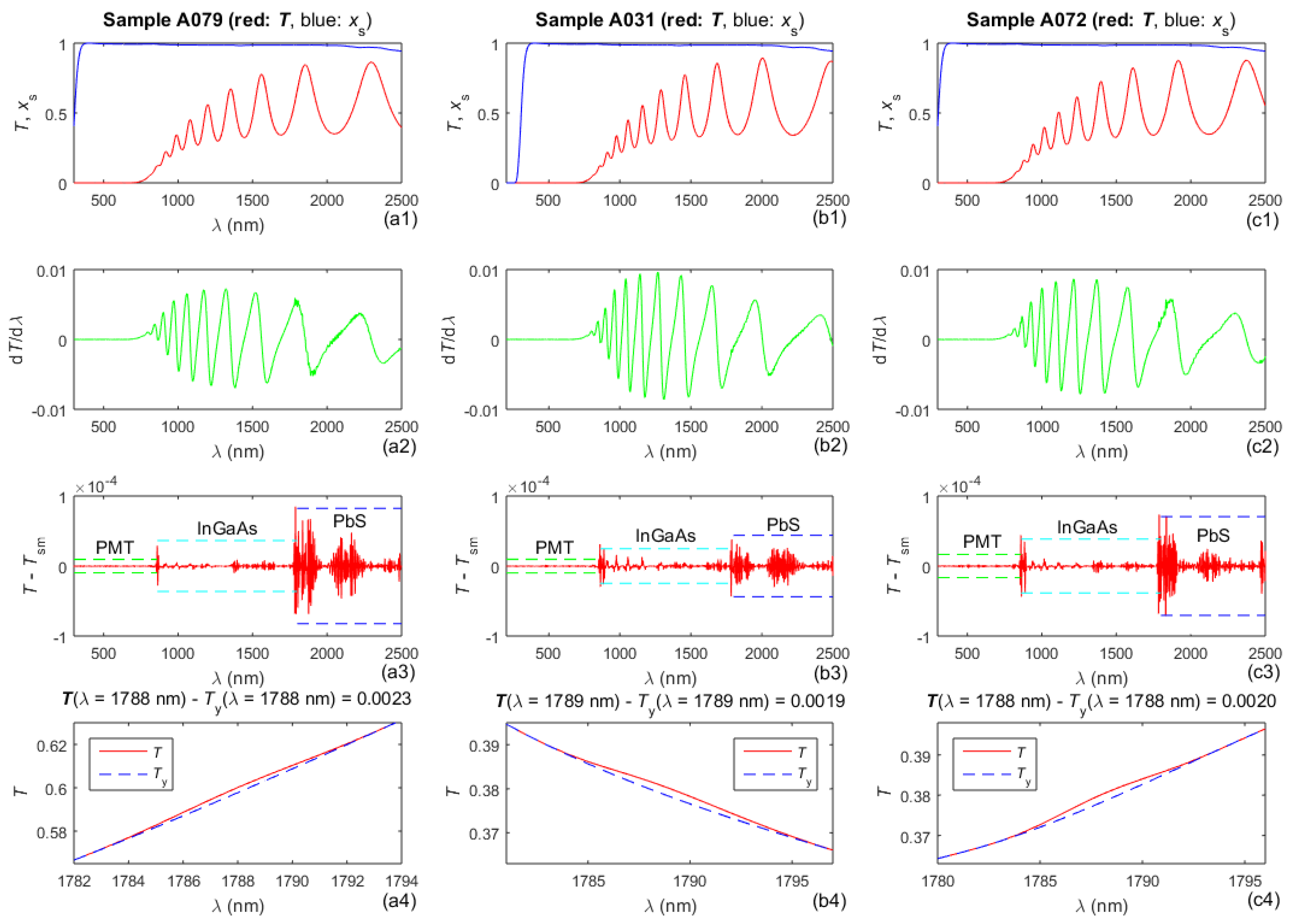
T(λ), its first derivative dT/dλ, and T(λ) − Tsm(λ) of the studied films are included in the first row, the second row, and the third row of Figure 1, respectively, where Tsm(λ) was obtained by Savitzki–Golay smoothing of T(λ) [48]. Six sigma limits [49] of the difference T(λ) − Tsm(λ) are depicted by differently colored dashed horizontal lines in the third row of Figure 1 over the spectral ranges covered by the employed detectors of PMT, InGaAs, and PbS, respectively. The fourth row of Figure 1 shows a magnified inset of T(λ) from the first row and of Ty(λ), which is identical to T(λ) except for the visualized region just below 1800 nm, where it represents a smoothed T(λ) since │T(λ) − Tsm(λ)│ has its largest value there.
Evidence of the general noise in T(λ) is seen by the apparent presence of noise in some regions of dT/dλ and T(λ) − Tsm(λ). Furthermore, the curves for xs(λ) from the first row in Figure 1 show that there is noticeable absorption in the substrate for λ = [2000, 2500] nm, and the substrate is opaque for λ = [200, 250] nm. Therefore, it is expected that the consideration of substrate absorption in this study should result in improved accuracy of characterization of the a-Si film compared with [31], where the substrates were regarded as transparent. Additionally, the data from the third row in Figure 1 indicate that the general noise in T(λ) is the largest when the PbS detector is utilized and smallest when the PMT detector is used, as was already established in [43].
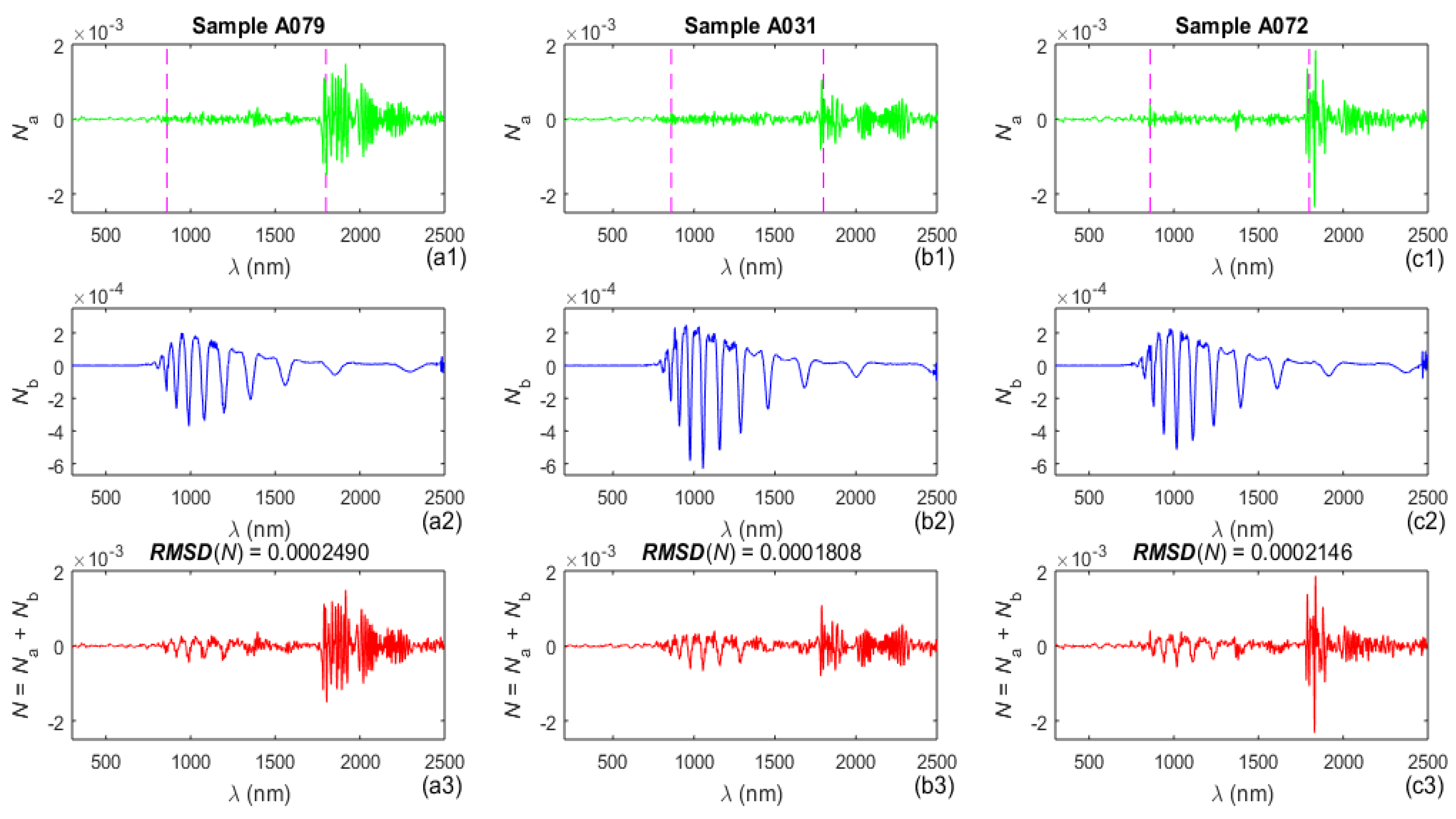
In this study, outliers above the upper and below the lower dashed horizontal six sigma lines in the third row in Figure 1 were not removed from T(λ), unlike in [43], and the reasons for this are discussed later. The suppression of general noise from T(λ) was performed by using only SMEDM, as described in [44]. The general noise Na(λ) in T(λ) thus derived is shown in the top row of Figure 2. The bandpass noise Nb(λ) was calculated using Equation (1) in [47]; applied to the measured transmittance spectrum with suppressed general noise, T(λ) − Na(λ); and is plotted in the middle row of Figure 2.
Based on the above, the denoised transmittance spectrum of a given sample is Td(λ) = T(λ) − Na(λ) − Nb(λ). These denoised spectra Td(λ) were used thereafter, instead of T(λ), in the subsequent parametrizations of the three a-Si films. Similarly, each spectrum Ty(λ) is denoised and its denoised spectrum is Tyd(λ) = Ty(λ) − Ny(λ), where Ny(λ) is the total noise in Ty(λ). These spectra Tyd(λ) were then used instead of Ty(λ) in other parameterizations of the a-Si films.

2.2. Parametrization of the Three a-Si Films

Each of the TLUF, TLUR and UDM dispersion models provides formulae for the real part εr(E) and the imaginary part εi(E) of the dielectric function, using several parameters that depend on the dispersion model. These formulae for εr(E) and εi(E), as well as ns(λ), ks(λ), and ds, can be substituted into the expression for the transmittance spectrum of the sample from [10]. This allows for execution of the respective parametrization, which provides computed values of all the dispersion model parameters, the thickness parameters d ¯ and ∆d of the film, and the computed spectrum Tc(λ) of the sample. In this paper, the following figure of merit
F O M λ ( j 2 ) , λ ( j 1 ) = 1000 × j = j 1 j 2 T c λ ( j ) T d λ ( j ) 2 j 2 j 1 + 1 0 ,
represents the parametrization error over the interval λ ⊂ [λ(j2), λ(j1)], where j is the number of the wavelength value counted sequentially from λmax. Therefore, a smaller FOM corresponds to a more accurate parametrization of a particular thin film, based on its Td(λ), over this interval.
The TLUF parametrizations were performed as described in [35]. The TLUR parametrizations are executed as in [37] using the damping parameter a = 0.0002. The computed parameters obtained from the TLUF and TLUR parametrizations of the films A079, A031, and A072 are listed in Table 1. The symbols representing these parameters in Table 1 are the same as those used in the papers [35,37] that present TLUF and TLUR, where A is the amplitude, E0 is the central energy, C is the broadening parameter, Eg is the optical bandgap, and Ec is the boundary energy between the Tauc–Lorentz and Urbach regions.
The UDM parametrizations performed in this study use the dispersion model from [39], excluding high-energy valence electron excitations. This is because these excitations correspond to electron transitions with energies higher than the maximum photon energy for our measured spectra T(λ). Moreover, the electron transitions between the valence band and the conduction band are represented by a symmetrical term and one excitonic term, where the strength of these transitions is denoted by Nvc. The parameters describing the symmetrical term are its relative strength A0 and the width of the conduction band Eh (Eh > Eg), while those expressing the excitonic term are its relative strength A1, central energy Ec (Ec > Eg), and broadening parameter Bc [39].
In this study, the following types of UDM parametrizations were performed: without GOs (abbreviated as UDM.0), with two subgap GOs (UDM.2), and with three subgap GOs (UDM.3). In the UDM, the parameters corresponding to the subgap electronic transitions are as follows: Nut and Npj are the strengths of the electron transitions via the Urbach tail states and the j-th GO; EU and Epj (Epj < Eg) are the Urbach energy and central energy of the j-th GO; and Bpj is the broadening parameter of the j-th GO.
The procedure for performing UDM.3 began with execution of UDM.0; its output parameters are then included in the initial approximation for execution of UDM.2. The output parameters from UDM.2 include parameters approximating the two strongest subgap GOs, and these output parameters were then included in the initial approximation for UDM.3. Thereafter, UDM.3 was executed three times with different initial approximations for the weakest subgap GO, which were selected so that its central energy is to the left of, to the right of, or between the central energies of the two strongest GOs obtained from UDM2. Out of these three executions, the output from UDM.3 was selected as the one yielding the smallest FOM. This procedure was designed to provide UDM.3 with a global minimum of the FOM. The parameters obtained by UDM.0 and UDM.3 parametrizations of the studied a-Si films are presented in Table 2, which also includes the sensitivity ranges corresponding to subgap electron transitions. For comparison, the following values have been obtained when employing the UDM, based on a multi-sample method combining ellipsometry and spectrophotometry, applied to a-Si:H films [40]: Nvc = 114.2, Eg = 1.82 eV, A0 = 1.0, Eh = 2.63 eV, A1 = 36, Ec = 3.50 eV, Nut = 0.045, Eut = 0.75 eV, Np1 = 1.7 × 10⁻⁵, Ep1 = 1.39 eV, and Bp1 = 0.134 eV.
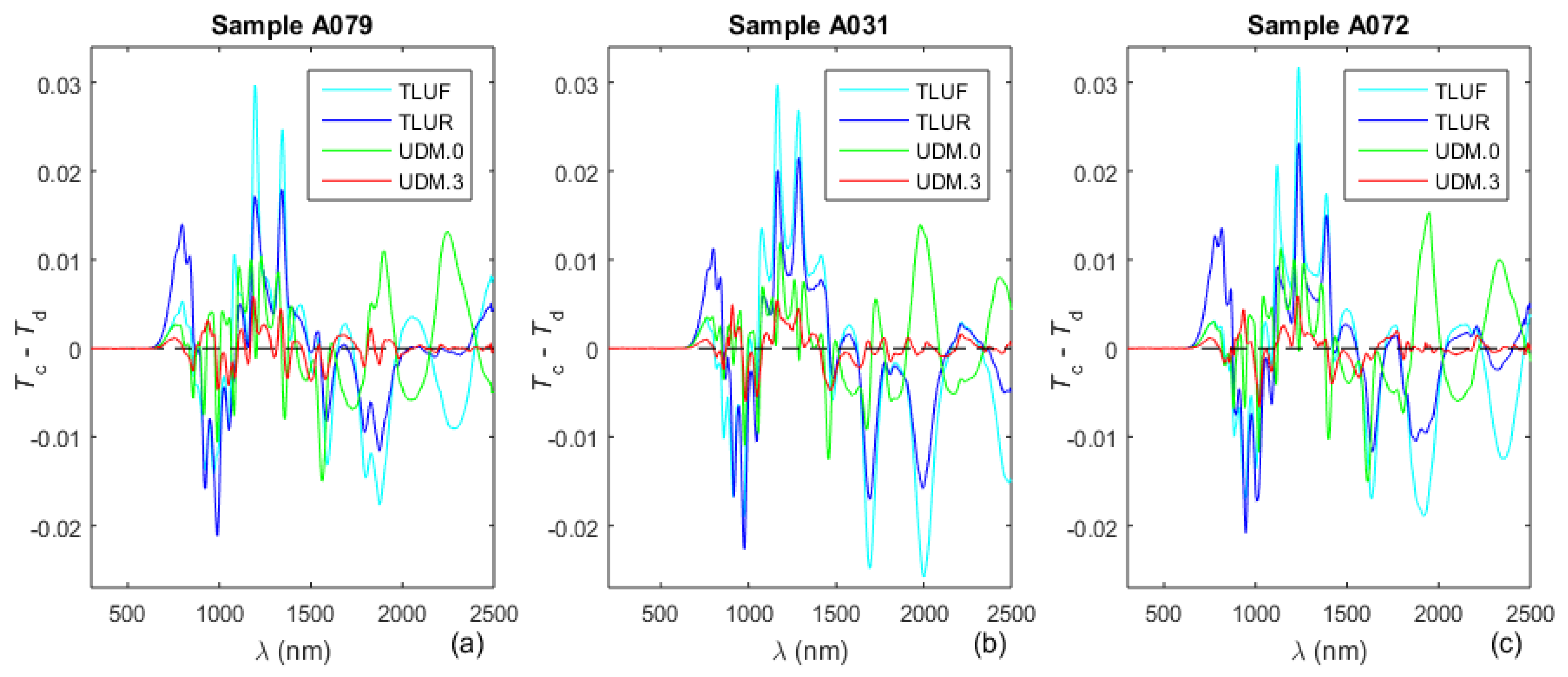
Since a more accurate parametrization using Td(λ) corresponds to a closer proximity of the computed spectrum Tc(λ) to Td(λ) according to Equation (1), we evaluated this proximity directly. Therefore, the difference Tc(λ) − Td(λ) is shown in Figure 3a–c for the a-Si film parametrizations featured in Table 1 and Table 2.
As seen from Table 1 and Table 2, the bandgap energy Eg was computed from each TLUF, TLUR, or UDM parametrization, which yielded a corresponding bandgap wavelength λg (nm) ≈ 1239.8/Eg (eV). Because the interference spectrum T(λ) profile differs significantly between the weak and strong absorption regions of the film, FOMs were calculated for λ > λg, λ < λg, and the entire range of T(λ). Such FOMs are included in Table 3 for all of the performed parametrizations of the three a-Si films.
Additionally, the quantities
D F O M a v A , B = w = 1 3 F O M A w F O M B w 3 ; R D F O M a v A , B = D F O M a v A , B w = 1 3 F O M A w × 3 × 100 ( % )
were calculated using FOMs from the last column in Table 3, where A is one of the following parametrizations: TLUF, TLUR, UDM.0, UDM2, UDM.3, UDM.3y, or AEM; B is a parametrization providing FOM[B(w)] < FOM[A(w)]; and w = 1, 2, or 3 corresponds to each of the three a-Si films. D[FOMav(A,B)] is the difference between the FOMs from the parametrization A and the parametrization B, averaged over these a-Si films, while RD[FOMav(A,B)] is the relative difference representing D[FOMav(A,B)] averaged over these films. D[FOMav(A,B)] and RD[FOMav(A,B)] calculated from Equation (2), for different parametrizations A and B, are presented in Table 4.
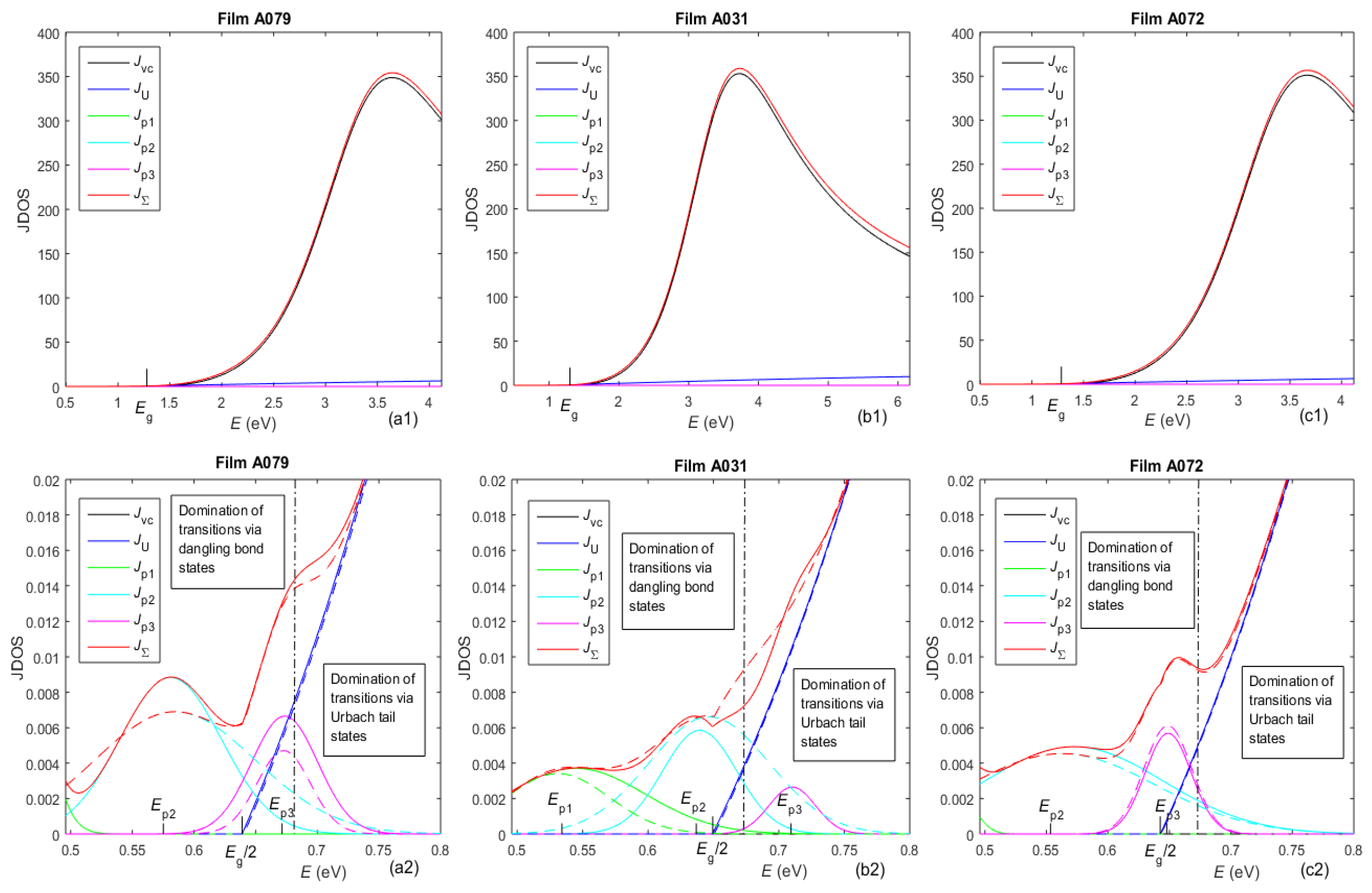
The following types of electron transitions were considered, e.g., in UDM.3: from the valence band to the conduction band, via Urbach tails, and via each one of the three GOs, according to [39]. The computed JDOSs are designated as Jvc, JU, Jp1, Jp2, and Jp3. Their sum JΣ represents the total JDOS, and all of these values are shown in Figure 4. The boundary between the spectral regions dominated by electron transitions via Urbach tail states and those via dangling bonds was determined from the equation JU = Jp1 + Jp2 + Jp3.
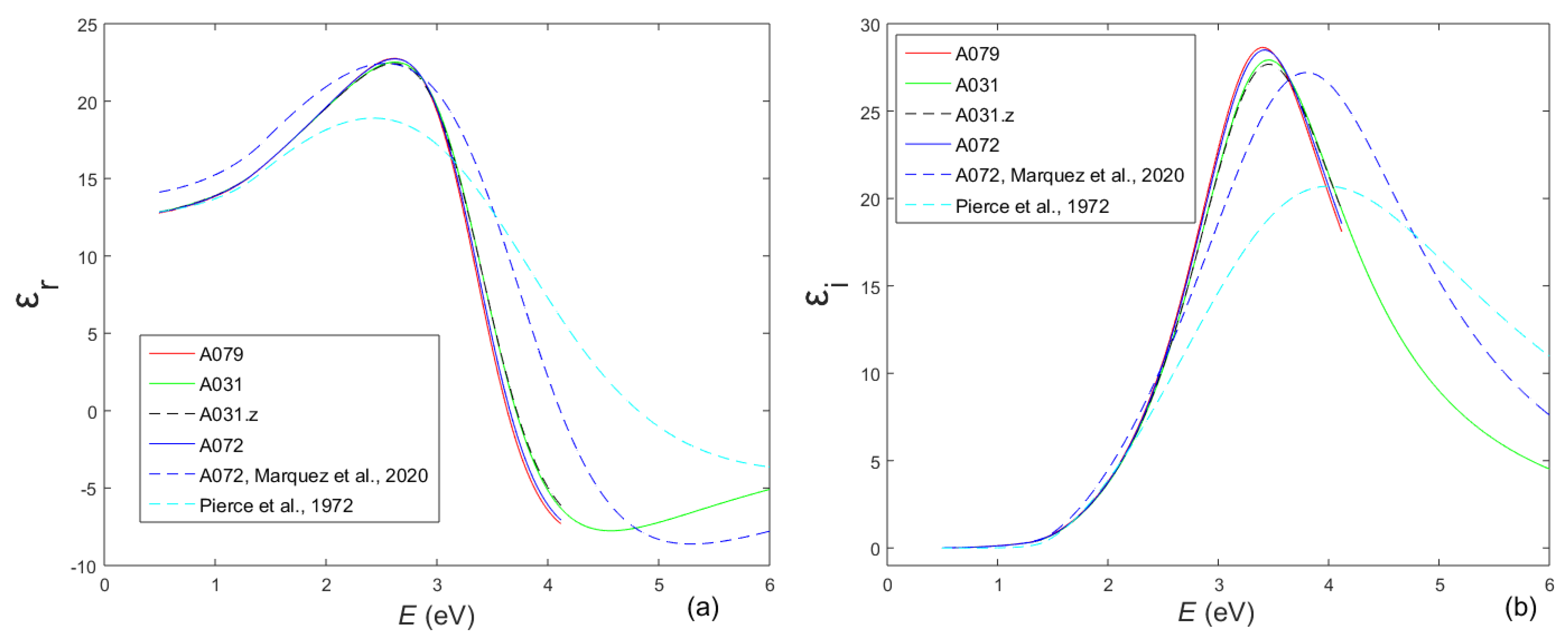
The real part εr and the imaginary part εi of the dielectric function of the studied a-Si films, computed by UDM.3, are included in Figure 5.
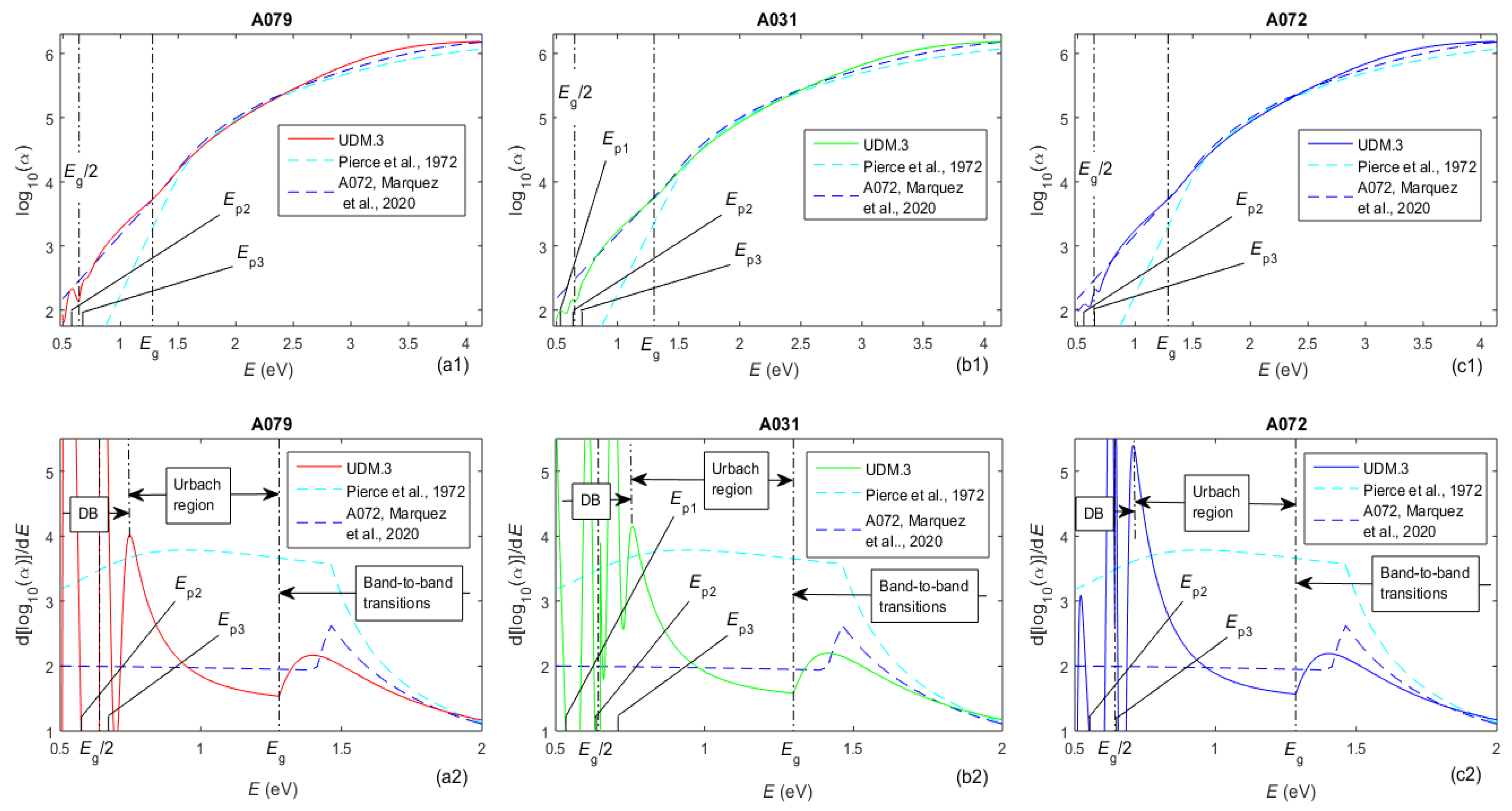
Graphs associated with the absorption coefficient α(E) of the three a-Si films, calculated from k(E) determined using UDM.3, are shown in Figure 6.

3. Discussion

In general, Td(λmin < λ < λg) is significantly smaller than Td(λ > λg) for interference transmittance spectra T(λ) [15,31], e.g., as derived from Eg in Table 1 and Table 2 and seen from the graphs in the top row in Figure 1. This indicates that such interference spectra T(λ) are particularly suitable for accurate subgap parametrization because the relative error of Tc(λ > λg) should be smaller than that of Tc(λmin < λ < λg) to provide a small FOM, according to Equation (1).
The plots in Figure 3a–c show that the fit of the computed transmittance spectrum Tc(λ) to Td(λ) improves according to the following order of parametrizations for all studied a-Si films: TLUF, TLUR, UDM.0, and UDM.3. Therefore, the accuracy of parametrization of these films should increase in the same order; thus, TLUF should provide the least accurate parametrization, and UDM.3 should be the most accurate amongst these parametrizations. Notably, it is seen from Table 1 and Table 2 that all parameters computed using TLUF, TLUR, or the UDM have values ≥ 0, which is a requirement of these dispersion models, thus confirming the validity of the computed parameters.
The smaller values of FOM for TLUR compared with those for TLUF, from the last column in Table 3, reconfirm that TLUR provides more accurate parametrization than TLUF for all studied a-Si films, which is consistent with the results from [38]. It was also concluded from there that TLUR parametrization of a given a-Si film is less accurate than each UDM parametrization of that film. In particular, FOM for the UDM.0 parametrization, i.e., without GOs, is smaller than that for TLUF or TLUR, for each of the a-Si films. This indicates that the consideration of Urbach tail transitions only for E > Eg/2, as in UDM [39], is more accurate than assuming Urbach tail transitions, even for smaller energies E > 0, as in TLUF and TLUR [35,37], in the studied a-Si films.
It is also seen from the last column in Table 3 that FOM(UDM.0) > FOM(UDM.2) > FOM(UDM.3) for each of the a-Si films. This shows that including three GOs in the UDM results in more accurate parametrization of these films than the UDM without such oscillators and the UDM with two GOs. Also, the data about RD[FOMav(A,B)] from Table 4 indicate that the most significant improvement in the accuracy of parametrization amongst the parametrizations featured in Table 3 is achieved by adding two GOs to UDM.0. Furthermore, the addition of a third GO also improves the accuracy but significantly less than the above since RD[FOMav(UDM.2,UDM.3)] = 0.44 << RD[FOMav(UDM.0,UDM.2] = 7.69. Moreover, RD[FOMav(AEM,UDM.3)] = 4.85, implying that the parametrizations by UDM with 3 GOs provide significantly more accurate data for the three a-Si films compared with their previous most accurate characterization by AEM from [43]. The discussion in this paragraph indicates that parametrization of the three a-Si films from Td(λ) using the UDM with three GOs provides the most accurate characterization of MS a-Si films published so far.
According to the panels in the bottom row in Figure 1, max{│T(λ) − Ty(λ)│} equals 0.0023 for the sample A079, 0.0019 for A031, and 0.0020 for A072. After the suppression of general noise by SMEDM, the value corresponding to the above function decreases by factors of 3.22, 2.79, and 4.05 for A079, A031, and A072, respectively. In addition, the computed film thickness parameters d ¯ and ∆d essentially do not depend on whether they are obtained by employing UDM.3 or UDM.3y, as seen from Table 3. Moreover, the RD[FOMav(UDM3,UDM.3y)] = 0.04 from Table 3 is very small. The above results indicate that the suppression of general noise by SMEDM also suppresses outliers in T(λ) for these a-Si samples, thus justifying why outliers are not removed from T(λ) in this study, unlike in [43].
In addition, the main source of systematic instrumental error in the measurement of T(λ) is the photometric non-linearity, which is ΔT(λ > 1000 nm, T = 0.8) = ± 0.00055 and ΔT(λ > 1000 nm, T = 0.4) = ±0.00028 for our spectrophotometer, the Perkin-Elmer Lambda 1050 UV/visible/NIR [51]. In fact, this error is reduced further by the use of SMEDM in this study, as discussed in the last paragraph. With regard to this, we evaluated a computed spectrum Tc0(λ) by using the parameters obtained by UDM.3, as presented in Table 2, excluding all three GOs for each of the three a-Si films. It turns out that the difference Tc0(λ) − Tc(λ) reaches the largest values [0.025, 0.03] for λ > 2λg around the maxima of Tc(λ) for all three films. These data show that the contribution of the three GOs to T(λ) is much bigger than that of the photometric non-linearity and reconfirm the validity of the computed results in this study.
Data from Table 2 also show that the strengths of the electron transitions, computed by UDM.3, have the following orders of magnitude: Nvc ~ 320, Nut ~ 20, and Npj = [1 × 10⁻⁴, 3 × 10⁻³]. Such strong electron transitions from the valence to conduction band, medium strength transitions via Urbach tail states, and weak transitions via dangling bond states can be expected for a-Si:H [25,26] and perhaps for a-Si with a small concentration of microvoids [31]. This assertion is confirmed by the fact that the central energies Epj of all GOs, computed by UDM.3, are smaller than Eg, as seen from Table 2 and Figure 4. Moreover, the data from Table 2 and Figure 4 show that the central energy Ep1 is significantly smaller than Eg/2, Ep2 is slightly smaller than Eg/2, and Ep3 is slightly larger than Eg/2.
The above results about the strengths Npj and the central energies Epj of the three GOs show that the GOs with central energies Ep2 and Ep3 correspond to electron transitions via two dangling bond bands, and the GO with a central energy Ep1 is attributed to electron transitions between these two dangling bond bands. In addition, the ratio of the strengths of the electron transitions via dangling bond states to those via tail states is Np/Nut ~ 20 × 10−4/20 = 1 × 10⁻⁴, as seen from Table 2, which shows that the concentration of the dangling bonds is much smaller than that of the band tails.
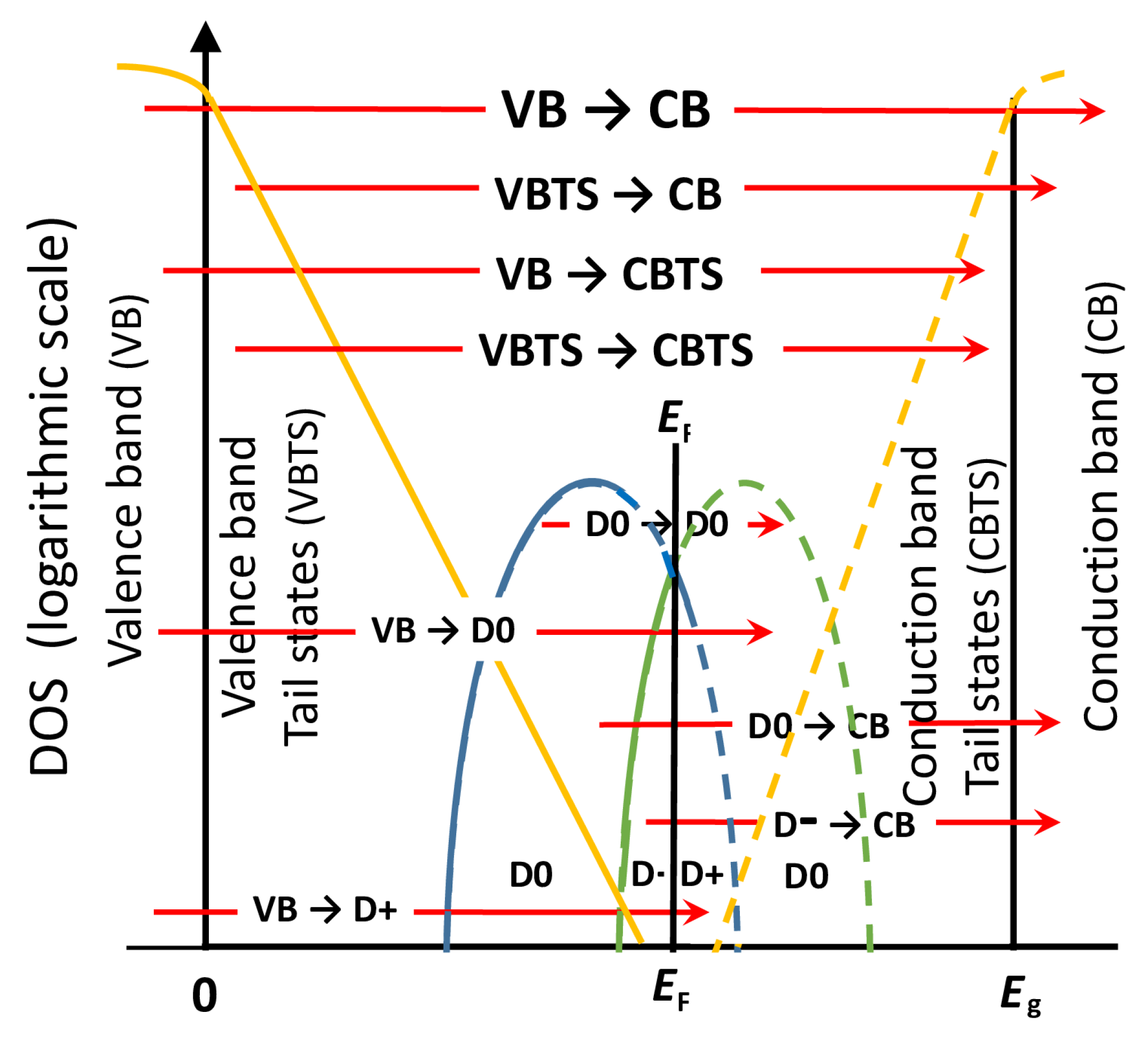
Taking into account that a-Si has a higher concentration of dangling bonds than a-Si:H with [3, 25]% hydrogen [29,30], it can be inferred by analogy with well-established literature about the application of the Defect Pool Model to a-Si:H [25] that the Fermi level EF should be located between these two dangling bond bands in the absence of illumination. In addition, it can be presumed that the valence band tail is wider than the conduction band tail, by analogy with the already discussed data about a-Si:H from [22]. These results are consistent with the DOS and electron transitions upon illumination, as illustrated in Figure 7.
Additionally, the relative length of a particular red arrow in Figure 7 identifies which of the three GOs employed by UDM.3 correspond to the respective electronic transition. Therefore, the electron transitions D0 → D0 are described by the GO with central energy Ep1. Moreover, the transitions D0 → CB and D- → CB are represented by the oscillator with central energy Ep2, and the transitions VB → D0 and VB → D+ are represented by the oscillator with central energy Ep3. Notably, this kind of DOS energy spectrum and electron transitions involving dangling bonds have been applied to a-Si:H [22,52], but they have not been used for a-Si.
The static refractive index nv = n(E → 0) of the studied film is determined by using n(λ), as obtained by UDM.3, and the Wemple–DiDomenico plot depicting (n2 − 1)−1 vs. E2, similarly to that in [31]. Furthermore, the volume fraction of voids fvoid is calculated by means of the Bruggeman effective medium approximation, employing nv and the static refractive index n0 = 3.697 of pure a-Si without voids (derived from data in [53]), as described in [31]. Such calculations provide fvoid = 6.7% for the film A079, fvoid = 6.1% for A031, and fvoid = 6.4% for A072. These low values of fvoid should lead to a relatively low concentration of dangling bonds and a higher material density compared with a-Si films with a larger fvoid. Moreover, the higher material density of the films studied here should result in a higher refractive index n according to the Lorentz–Lorentz relation [54], as well as a relatively high real part εr = n2k2 and imaginary part ε2 = 2nk of their dielectric function. Therefore, the relatively low peaks of εr and εi from [50] in Figure 5 are attributed to a lower material density of electron-gun-evaporated a-Si compared with MS a-Si, which is in accordance with the results from [55].
On the other hand, εi(E < Eg) for A072, obtained in [41] by spectroscopic ellipsometry and assuming validity of the Cody–Lorentz dispersion model, is significantly higher than our corresponding result for the same film, as seen from Figure 5a. However, MS a-Si films were characterized in [41], and for each one, the computed average film thickness d ¯ was smaller than the value measured by SEM. This indicates that the refractive index n(E < Eg) and εr(E < Eg) computed in [41] are larger than their respective true values, according to the interference fringes equation, 2 d ¯ n(Et < Eg) = const(Et) [16], where Et corresponds to a tangent point between Td(λ) and its two envelopes. This discrepancy of results from [41] is caused by an apparently insufficient accuracy of the Cody–Lorentz dispersion model for MS a-Si films.
Furthermore, the results computed by UDM.3 and presented in Figure 5 show that the dielectric functions of the three MS a-Si films are very similar over the interval λ = [300, 2500] nm, although these films were prepared at different Ar gas pressures. In addition, the curves denoted by A031 (computed for λ = [200, 2500] nm) and A031.z (computed for λ = [300, 2500] nm) in Figure 5 are almost identical over the interval λ = [300, 2500] nm. This result and data from Table 3 indicate that the characteristics of the film A031 computed by UDM.3 over the interval λ = [300, 2500] nm are practically independent of whether the parametrization is executed over this interval or over the wider interval λ = [200, 2500] nm.
Notably, the TLUF, TLUR and Cody–Lorentz dispersion models assume the existence of a Urbach tail for E < Eg, which makes them applicable to amorphous materials [56]. Therefore, utilization of these dispersion models results in a linear relationship between log10(α) and E for E < Eg [56]. This is visualized by the blue dashed lines in the top row of Figure 6, which represent the Cody–Lorentz model characterization of film A072 from [41]. However, the curves corresponding to UDM.3 characterizations of the three a-Si films, also from the top row of Figure 6, indicate that the absorption is actually weaker for E < Eg/2, which is attributed to electron transitions via the dangling bond bands.
According to the Tauc equation, (αE)1/q = const × (EEg), where q = 1/2 for direct allowed electron transitions, q = 3/2 for direct forbidden transitions, q = 2 for indirect allowed transitions, and q = 3 for indirect forbidden transitions [57]. On the other hand, the first-order Taylor series expansion of the Tauc equation provides q ≈ d[log10(αE)]/dE [58]; correspondingly, this function drawn in the bottom row of Figure 6 represents an approximation of q. Therefore, it was concluded, from the solid curves in the bottom row of Figure 6, that the dominant electron transitions with E close above Eg are with q ≈ 2, i.e., indirect allowed transitions from the top of the valence band to the bottom of the conduction band, as in crystalline Si [55]. Additionally, the solid lines from the bottom row of Figure 6 are heavily folded for E = [0.5, 0.7] eV, with maxima above 6 and minima below 0, thus confirming involvement of dangling bond states in the electron transitions. It is also seen from there that the dominant electron transitions are indirectly forbidden for E = [0.75, 0.85] eV and directly forbidden for E = [1.1, Eg] eV, as both should involve band tail states. Furthermore, the dominant electron transitions are also direct forbidden for E = [1.7, 1.9] eV, with contributions from direct allowed transitions above this energy range. It is recognized that the dangling bond bands in MS a-Si thin films, as discussed in this section, are identified solely through optical data from T(λ) and modeling assumptions, without independent defect-sensitive measurements.
In short, our results provide the dielectric function in the UV–Vis–NIR spectral region of a-Si thin films, taking into account both tail states and dangling bond states, as well as the volume fraction of voids, by using only the spectrum T(λ) of the sample. On the other hand, in a-Si:H, hydrogen atoms attach to dangling bonds, which leads to large decrease in both the structural disorder and the concentration of dangling bonds (by several orders) [22]. Indeed, EU ~ 220 meV in this study of a-Si and EU ~ 60 meV for a-Si:H in [22]. Therefore, some studies of a-Si:H thin films use dielectric functions corresponding to a combination of Tauc–Lorentz oscillators at energies above Eg, while disregarding Urbach tails and dangling bonds, but including voids to represent surface layers [59,60,61].
Furthermore, photocatalytic films typically have high porosity to yield maximum active sites for the reaction and relatively wide bandgaps providing strong chemical stability and high redox potential [62]. In this respect, the Eg of photocatalytic films have been determined by using both UV–Vis and diffuse reflectance spectroscopy, while disregarding tail states and dangling bond states, whose spectroscopic features are mostly in the NIR spectral region [63]. However, studying such subgap states similar to the one in this paper would be beneficial for broadening the light absorption and controlling charge carrier lifetime, which is a bottleneck in photocatalytic efficiency [62].

4. Materials and Methods

Each of the samples was prepared by magnetron sputtering with Ar gas to produce an a-Si thin film on Corning Glass Eagle XG substrate with thickness ds = 1 mm. Three such samples were used, whereby Ar gas pressure of pAr = 0.1 Pa was supplied for the film from sample A079, pAr = 0.7 Pa for the film from sample A031, and pAr = 1.1 Pa for the film from sample A072. All the depositions were performed at room temperature, and the value of the RF power applied was 525 W.
The transmittance spectrum T(λ) of each sample was measured using a Perkin-Elmer Lambda 1050 UV/visible/NIR double-beam spectrophotometer (Waltham, MA, USA) covering the spectral range 175–3300 nm. The measurements were performed at normal incidence to the film with an illuminated film area of 10 mm × 3 mm. The spectral range was λ = [200, 2500] nm for the measurements of the samples A072 and A079, and λ = [300, 2500] nm for the sample A031. Notably, accurate measurement of T(λ < 200 nm) would require a high-grade nitrogen purge or a vacuum system, and the substrate absorbs much more strongly for λ > 2500 nm. The measurements of each T(λ) were conducted with the following detectors as the wavelength λ was decreasing: a PbS detector for the range [1801, 2500] nm, an InGaAs detector for [861, 1800] nm, and a PMT for [min(λ), 860] nm. The wavelength step is 1 nm in this study. Further details about the preparation of the samples and the measurement of their transmittance spectra T(λ) have been reported in [31].
The normal incidence transmittance spectrum Ts(λ) and quasi normal incidence reflectance spectrum Rs(λ) of a 1 mm thick bare Corning Glass Eagle XG substrate were also measured. The refractive index ns(λ) and the extinction coefficient ks(λ) of the substrate are computed by solving a system of two equations, each of them equating Ts(λ) or Rs(λ) with its respective formula from Equation (3) or Equation (4) in [11].

5. Conclusions

The most accurate parametrizations of the studied MS a-Si thin films were achieved by employing the dispersion model UDM.3, including an Urbach tail and three subgap oscillators. Analysis of the respective JDOS indicated that they are associated with electron transitions via both tail states and dangling bonds states, as shown in Figure 7. Notably, this distinction between electron transitions via dangling bonds and band tails, alongside the analysis of thickness and dielectric function, offers a new perspective on amorphous films, derived solely from a single transmittance or reflectance spectrum.
The approach and results described in this paper can be used in the design of devices involving a-Si films, as dangling bonds commonly lead to non-radiative recombination and decreased mobility, unlike tail states. In the future, such studies can be performed for thin amorphous films with different compositions.

Author Contributions

Conceptualization, D.M.; methodology, D.M. and E.B.; software, D.M. and R.R.; validation, E.B. and M.B.; formal analysis, D.M. and G.A.; investigation, D.N.; resources, G.A.; data curation, E.B. and S.F.; writing—original draft, D.M. and M.B.; writing—review and editing, E.M.; visualization, D.N.; supervision, G.A.; project administration, R.R.; funding acquisition, G.A. All authors have read and agreed to the published version of the manuscript.

Funding

This research was funded by the European Regional Development Fund within the Operational Programme “Bulgarian national recovery and resilience plan”, procedure for direct provision of grants “Establishing of a network of research higher education institutions in Bulgaria”, under Project BG-RRP-2.004-0005 “Improving the research capacity and quality to achieve international recognition and resilience of TU-Sofia (IDEAS)”. In addition, the scientific and data analyses presented in this publication were conducted with the research infrastructure and resources developed under Project BG16RFPR002-1.014-0006 “National Centre of Excellence Mechatronics and Clean Technologies” under "Research Innovation and Digitization for Smart Transformation" program 2021–2027, European Regional Development Fund.

Institutional Review Board Statement

Not applicable.

Informed Consent Statement

Not applicable.

Data Availability Statement

The original contributions presented in this study are included in the article. Further inquiries can be sent to the corresponding author.

Conflicts of Interest

The authors declare no conflicts of interest. The funders had no role in the design of the study; in the collection, analyses, or interpretation of data; in the writing of the manuscript; or in the decision to publish the results.

Abbreviations

The following abbreviations are used in this manuscript:
UV–Vis–NIRUltraviolet–visible–near infrared
a-SiAmorphous silicon
MSMagnetron sputtering
TLUTauc–Lorentz–Urbach dispersion model
TLUF TLUDispersion model of Foldyna et al.
TLUR TLUDispersion model of Rodriguez et al.
GOGaussian oscillator
UDMUniversal dispersion model
UDM.0UDM without Gaussian oscillators
UDM.2UDM with two Gaussian oscillators
UDM.3UDM with three Gaussian oscillators
AEMAdvanced envelope method
a-Si:HAmorphous silicon containing 5–15% hydrogen
JDOSJoint density of states
CEEMDANComplete ensemble empirical mode decomposition with adaptive noise
SMEDMSmoothed median envelope denoising method
FOMFigure of merit
DOSDensity of states
D0Neutral dangling bond
D+Positive dangling bond
D−Negative dangling bond
PECVDPlasma-enhanced chemical vapor deposition

References

  1. El-Newehy, M.H.; El-Mahalawy, A.M.; Thamer, B.M.; Moydeen, A.H. Fabrication and characterization of eco-friendly thin films as potential optical absorbers for efficient multi-functional opto-electronic and solar cell applications. Materials 2023, 16, 3475. [Google Scholar] [CrossRef] [PubMed]
  2. Sinatkas, G.; Christopoulos, T.; Tsilipakos, O.; Kriezis, E.E. Electro-optic modulation in integrated photonics. J. Appl. Phys. 2021, 130, 010901. [Google Scholar] [CrossRef]
  3. Yousefi, F.; Mousavi, S.B.; Heris, S.Z.; Naghash-Hamed, S. UV-shielding properties of a cost-effective hybrid PMMA-based thin film coatings using TiO2 and ZnO nanoparticles: A comprehensive evaluation. Sci. Rep. 2023, 13, 7116. [Google Scholar] [CrossRef]
  4. Dhruv, S.D.; Sharko, S.A.; Solanki, P.; Vala, M.; Thakker, I.T.; Kataria, B.; Dhruv, D.K. Optical Characterization of Semiconducting Thin Films Using UV-VIS-NIR Spectroscopy: A Review. Solid State Phenom. 2023, 350, 115–124. [Google Scholar] [CrossRef]
  5. Kumar, A.; Shukla, R.K.; Gupta, R. Study of optical parameters of sulphur doped Se-As thin films as optical materials. Optik 2021, 243, 167447. [Google Scholar] [CrossRef]
  6. Politano, G.G.; Versace, C. Spectroscopic ellipsometry: Advancements, applications and future prospects in optical characterization. Spectrosc. J. 2023, 1, 163–181. [Google Scholar] [CrossRef]
  7. Datta, P.; Sharmin, M.; Podder, J.; Choudhury, S. Enhancement of the structural, morphological, optical, and electrical properties of Mn doped CuO thin films via spray pyrolysis. J. Optoelectron. Adv. Mater. 2023, 25, 508–516. [Google Scholar]
  8. Mohamed, R.A.; Atyia, H.E. Experimental analysis and ANFIS modeling of optical properties and band gap engineering in Se–Te–Ge film composition and insights into its photonic applications. Eur. Phys. J. Plus 2024, 139, 750–757. [Google Scholar] [CrossRef]
  9. Swanepoel, R. Determination of surface roughness and optical constants of inhomogeneous amorphous silicon films. J. Phys. E Sci. Instrum. 1984, 17, 896–903. [Google Scholar] [CrossRef]
  10. Minkov, D. Flow graph approach for optical analysis of planar structures. Appl. Opt. 1994, 33, 7698–7703. [Google Scholar] [CrossRef] [PubMed]
  11. Minkov, D.; Swanepoel, R. A comparative study of the use of the matrix approach and the flow graph approach for optical analysis of isotropic stratified planar structures. Proc. SPIE 1995, 2540, 131–138. [Google Scholar]
  12. Vanini, S.S.; Cabeza, G.F. Decoding the optical band gap: A methodological comparison using DFT-based absorption spectra. Next Mater. 2026, 10, 101498. [Google Scholar] [CrossRef]
  13. Almora, O.; Cabrera, C.I.; Garcia-Cerrillo, J.; Kirchartz, T.; Rau, U.; Brabec, C.J. Quantifying the absorption onset in the quantum efficiency of emerging photovoltaic devices. Adv. Energy Mater. 2021, 11, 2100022. [Google Scholar] [CrossRef]
  14. Varley, J.B.; Shen, B.; Higashiwaki, M. Wide bandgap semiconductor materials and devices. J. Appl. Phys. 2022, 131, 230401. [Google Scholar] [CrossRef]
  15. Fu, Z.; Cheng, Z.; Wang, F.; Dong, Y.; Zhang, X.; Zhang, A.; Liang, H. Multilayer film based on thin-film interference and impedance matching for dual-laser and infrared stealth as well as thermal management. Optik 2023, 289, 171261. [Google Scholar]
  16. González-Leal, J.M.; Prieto-Alcón, R.; Angel, J.A.; Minkov, D.A.; Marquez, E. Influence of substrate absorption on the optical and geometrical characterization of thin dielectric films. Appl. Opt. 2002, 41, 7300–7308. [Google Scholar] [CrossRef]
  17. Shin, B.G.; Park, J.H.; Kong, J.; Jung, S.J. Characterizing critical behavior and band tails on the metal-insulator transition in structurally disordered two-dimensional semiconductors: Autocorrelation and multifractal analysis. Phys. Rev. Res. 2023, 5, 043029. [Google Scholar] [CrossRef]
  18. Luo, Y.; Flewitt, A.J. Understanding localized states in the band tails of amorphous semiconductors exemplified by a-Si: H from the perspective of excess delocalized charges. Phys. Rev. B 2024, 109, 104203. [Google Scholar] [CrossRef]
  19. Wolter, M.H.; Carron, R.; Avancini, E.; Bissig, B.; Weiss, T.P.; Nishiwaki, S.; Feurer, T.; Buecheler, S.; Jackson, P.; Siebentritt, S. How band tail recombination influences the open-circuit voltage of solar cells. Prog. Photovolt. Res. Appl. 2022, 30, 702–712. [Google Scholar] [CrossRef]
  20. Kwon, J.H.; Lee, H.; Kim, B.; Zhang, X.; Jang, J.; Bae, J.H.; Park, J. Urbach-energy-dictated spatial propagation of electrons in thermodynamically tuned amorphous zirconia thin films. Adv. Mater. Interfaces 2021, 8, 2101104. [Google Scholar] [CrossRef]
  21. Diksha, D.; Amato, A.; Spagnuolo, V.; Roorda, S.; Chicoine, M.; Martin, I.W.; Steinlechner, J. Urbach tails and optical absorption of amorphous silicon coatings. Class. Quantum Gravity 2025, 42, 235001. [Google Scholar] [CrossRef]
  22. He, J.; Guo, A.; Li, W.; Mu, J.; Hou, X.; Xue, C.; Chou, X. Structural and optoelectronic properties of a-Si:H: A new analysis based on spectroscopic ellipsometry. Vacuum 2017, 146, 409–421. [Google Scholar] [CrossRef]
  23. Mott, N.F.; Davis, E.A.; Street, R.A. States in the gap and recombination in amorphous semiconductors. Philos. Mag. 1975, 32, 961–996. [Google Scholar] [CrossRef]
  24. Singh, J. Electronic processes in amorphous semiconductors. J. Mater. Sci. Mater. Electron. 2003, 14, 171–186. [Google Scholar] [CrossRef]
  25. Rahmouni, M.; Belarbi, S. Defect pool numerical model in amorphous semiconductor device modeling program. J. Nano Electron. Phys. 2019, 11, 02008. [Google Scholar] [CrossRef]
  26. Prentice, J.S.C. Effect of gap-state parameters in intrinsic a-Si: H. J. Non-Cryst. Solids 2000, 278, 164–169. [Google Scholar]
  27. Lee, T.; Seong, M.J.; Ahn, H.C.; Baek, M.; Park, K.; Oh, J.; Choi, T.; Choi, J.W. Fast-chargeable lithium-ion batteries by μ-Si anode-tailored full-cell design. Proc. Natl. Acad. Sci. USA 2024, 122, e2417053121. [Google Scholar] [CrossRef]
  28. Hosseinpour, M.; Abdoos, H. Semiconductors: History and Applications, 1st ed.; Intechopen: Winchester, UK, 2025; pp. 4–15. [Google Scholar]
  29. Li, H.; Matsumoto, M. Optical response of hydrogenated amorphous silicon: Investigation with electronic dynamics simulations. Appl. Phys. A 2022, 128, 924. [Google Scholar] [CrossRef]
  30. Luo, Y.; Flewitt, A.J.J. Revisiting Band Tails and Localized States in Amorphous semiconductors. Electrochem. Soc. Meet. Abstr. 2024, MA2024-02, 2383. [Google Scholar] [CrossRef]
  31. Marquez, E.; Saugar, E.; Díaz, J.M.; García-Vázquez, C.; Fernández-Ruano, S.M.; Blanco, E.; Ruiz-Pérez, J.J.; Minkov, D.A. The influence of Ar pressure on the structure and optical properties of non-hydrogenated a-Si thin films grown by rf magnetron sputtering onto room temperature glass substrates. J. Non-Cryst. Solids 2019, 517, 31–43. [Google Scholar] [CrossRef]
  32. Ruiz-Pérez, J.J.; Navarro, E.M. Optical transmittance for strongly-wedge-shaped semiconductor films: Appearance of envelope-crossover points in amorphous as-based chalcogenide materials. Coatings 2020, 10, 1063. [Google Scholar] [CrossRef]
  33. Kalas, B.; Zolnai, Z.; Sáfrán, G.; Serényi, M.; Agocs, E.; Lohner, T.; Nemeth, A.; Khamh, N.Q.; Fried, M.; Petrik, P. Micro-combinatorial sampling of the optical properties of hydrogenated amorphous Si1-x Gex for the entire range of compositions towards a database for optoelectronics. Sci. Rep. 2020, 10, 19266. [Google Scholar] [CrossRef]
  34. Stojanoska, I.; Okorn, M.; Kmet, B.; Uršič, H.; Gradišnik, V.; Cakara, D.; Kovac, J.; Kuscer, D. Indium-zinc-oxide thin films produced by low-cost chemical solution deposition: Tuning the microstructure, optical and electrical properties with the processing conditions. Heliyon 2023, 9, e19744. [Google Scholar] [CrossRef] [PubMed]
  35. Foldyna, M.; Postava, K.; Bouchal, J.; Pitora, J.; Yamaguchi, T. Model dielectric function of amorphous materials including Urbach tail. Proc. SPIE 2003, 5445, 301–305. [Google Scholar]
  36. Marquez, E.; Ruiz Pérez, J.J.; Ballester, M.; Pilar, M.; Blanco, E.; Minkov, D.; Fernández, S.M.; Saugar, E. Optical Characterization of H-Free a-Si Layers Grown by rf-Magnetron Sputtering by Inverse Synthesis Using Matlab: Tauc–Lorentz–Urbach Parameterization. Coatings 2021, 11, 1324. [Google Scholar] [CrossRef]
  37. Rodríguez-de Marcos, L.V.; Larruquert, J.I. Analytic optical-constant model derived from Tauc-Lorentz and Urbach tail. Opt. Express 2016, 24, 28561–28572. [Google Scholar] [CrossRef] [PubMed]
  38. Ballester, M.; García, M.; Márquez, A.P.; Blanco, E.; Fernández, S.M.; Minkov, D.A.; Katsaggelos, A.K.; Cossairt, O.; Willomitzer, F.; Marquez, E. Application of the holomorphic Tauc-Lorentz-Urbach function to extract the optical constants of amorphous semiconductor thin films. Coatings 2022, 12, 1549. [Google Scholar] [CrossRef]
  39. Franta, D.; Necas, D.; Ohlídal, I.; Giglia, A. Dispersion model for optical thin films applicable in wide spectral range. Proc. SPIE 2015, 9628, 342–353. [Google Scholar]
  40. Franta, D.; Nečas, D.; Zajíčková, L.; Ohlídal, I.; Stuchlík, J. Advanced modeling for optical characterization of amorphous hydrogenated silicon films. Thin Solid Films 2013, 541, 12–16. [Google Scholar] [CrossRef]
  41. Marquez, E.; Blanco, E.; García-Vázquez, C.; Díaz, J.M.; Saugar, E. Spectroscopic ellipsometry study of non-hydrogenated fully amorphous silicon films deposited by room-temperature radio-frequency magnetron sputtering on glass: Influence of the argon pressure. J. Non-Cryst. Solids 2020, 547, 120305. [Google Scholar] [CrossRef]
  42. Minkov, D.; Angelov, G.; Marquez, E.; Radonov, R.; Rusev, R.; Nikolov, D.; Ruano, S. Increasing the Accuracy of the Characterization of a Thin Semiconductor or Dielectric Film on a Substrate from Only One Quasi-Normal Incidence UV/Vis/NIR Reflectance Spectrum of the Sample. Nanomaterials 2023, 13, 2407. [Google Scholar] [CrossRef]
  43. Minkov, D.; Angelov, G.; Nikolov, D.; Rusev, R.; Ballester, M.; Fernandez, S.; Marquez, E. High accuracy characterization of a single thin film on a substrate from one transmittance spectrum by an advanced envelope method addressing voids, tail electron transitions, and deep-level electron transitions in a-Si films. Nanomaterials 2026, 16, 522. [Google Scholar]
  44. Minkov, D.; Angelov, G.; Nikolov, D.; Rusev, R.; Marquez, E.; Fernandez, S. Method for superior denoising of UV/Vis/NIR transmittance spectra of thin films. Opt. Express 2024, 19, 33758–33777. [Google Scholar] [CrossRef] [PubMed]
  45. Torres, M.E.; Colominas, M.A.; Schlotthauer, G.; Flandrin, P. A complete ensemble empirical mode decomposition with adaptive noise. In Proceedings of the IEEE International Conference on Acoustics, Speech and Signal Processing (ICASSP), Prague, Czech Republic, 22–27 May 2011; pp. 4144–4147. [Google Scholar]
  46. Eichstädt, S.; Schmähling, F.; Wübbeler, G.; Anhalt, K.; Bünger, I.; Krüger, U.; Elster, C. Comparison of the Richardson–Lucy method and a classical approach for spectrometer bandpass correction. Metrologia 2013, 50, 107–118. [Google Scholar] [CrossRef]
  47. Woolliams, E.R.; Cox, M.G.; Harris, P.M.; Pegrum, H.M. Correcting for Bandwidth Effects in Monochromator Measurements, National Physical Laboratory. 2005. Available online: https://eprintspublications.npl.co.uk/3481/1/001260.pdf (accessed on 15 March 2025).
  48. Schmid, M.; Rath, D.; Diebold, U. Why and How Savitzky–Golay Filters Should Be Replaced. ACS Meas. Sci. Au 2022, 2, 185–196. [Google Scholar] [CrossRef]
  49. Ma, M.; Li, M.; Zhang, K.; Ma, P.; Hu, Z.; Yan, H.; Men, K.; Dai, J. Applying the six-sigma methodology to determine the limits of quality control (QC) tests for a specific linear accelerator. J. Appl. Clin. Med. Phys. 2024, 25, e14460. [Google Scholar] [CrossRef]
  50. Pierce, D.T.; Spicer, W.E. Electronic structure of amorphous Si from photoemission and optical studies. Phys. Rev. B 1972, 5, 3017–3029. [Google Scholar] [CrossRef]
  51. Technical Specifications for the LAMBDA 1050 UV/Vis/NIR and LAMBDA 950 UV/Vis/NIR Spectrophotometers. Available online: https://covalent.com/wp-content/uploads/2025/12/Lambda-1050-spec-sheet.pdf (accessed on 18 February 2026).
  52. Balent, J.; Smole, F.; Topic, M.; Krc, J. Analysis of effects of dangling-bond defects in doped a-Si: H layers in heterojunction silicon solar cells with different electron affinities of ITO contacts. Inf. MIDEM 2022, 52, 129–142. [Google Scholar]
  53. Shen, H.; Shen, W.Z. Perspectives in the characteristics and applications of Tauc-Lorentz dielectric function model. Surf. Coat. Technol. 2005, 43, 503–507. [Google Scholar]
  54. Kragh, H. The Lorenz-Lorentz formula: Origin and early history. Substantia 2018, 2, 7–18. [Google Scholar] [CrossRef]
  55. Liu, X.; Abernathy, M.R.; Metcalf, T.H.; Judgersuren, B.; Culbertson, C.; Molina-Ruiz, M.; Hellman, F. Comparing amorphous silicon prepared by electron-beam evaporation and sputtering toward eliminating atomic tunneling states. J. Alloys Compd. 2021, 855, 157431. [Google Scholar] [CrossRef]
  56. Franta, D.; Čermák, M.; Vohánka, J.; Ohlídal, I. Dispersion models describing interband electronic transitions combining Tauc’s law and Lorentz model. Thin Solid Films 2017, 631, 12–22. [Google Scholar] [CrossRef]
  57. Tauc, J. Optical properties and electronic structure of amorphous Ge and Si. Mater. Res. Bull. 1968, 3, 37–46. [Google Scholar] [CrossRef]
  58. Haryński, L.; Olejnik, A.; Grochowska, K.; Siuzdak, K. A facile method for Tauc exponent and corresponding electronic transitions determination in semiconductors directly from UV–Vis spectroscopy data. Opt. Mater. 2022, 127, 112205. [Google Scholar] [CrossRef]
  59. Murata, D.; Yuguchi, T.; Fujiwara, H. Characterization of μc-Si: H/a-Si: H tandem solar cell structures by spectroscopic ellipsometry. Thin Solid Films 2014, 571, 756–761. [Google Scholar] [CrossRef]
  60. Oka, R.; Yamamoto, Y.; Hilfiker, J.N.; Maekawa, T.; Tampo, H.; Nagai, T.; Fujiwara, H. Deep learning ellipsometry: Ultrafast and high-accuracy determination of optical constants, film structures, and bandgaps. Mater. Today Commun. 2025, 48, 113448. [Google Scholar] [CrossRef]
  61. Fujiwara, H.; Kondo, M.; Matsuda, A. Real-time studies of amorphous and microcrystalline Si:H growth by spectroscopic ellipsometry and infrared spectroscopy. Thin Solid Films 2004, 455, 670–674. [Google Scholar] [CrossRef]
  62. Sadikin, S.N.; Ridwan, J.; Umar, M.I.A.; Raub, A.A.M.; Yunas, J.; Hamzah, A.A.; Dahlan, D.; Rahman, M.Y.A.; Umar, A.A. Photocatalytic activity and stability properties of porous TiO2 film as photocatalyst for methylene blue and methylene orange degradation. Int. J. Electrochem. Sci. 2023, 18, 100246. [Google Scholar] [CrossRef]
  63. Acosta-Silva, Y.D.J.; Lugo-Arredondo, M.I.; Gallardo-Hernández, S.; Garcia-Trejo, J.F.; Matsumoto, Y.; Rivas, S.; Feregrino-Pérez, A.; Godínez, L.; Méndez-López, A. Comparison of photocatalytic activity: Impact of hydrophilic properties on TiO2 and ZrO2 thin films. Inorganics 2024, 12, 320. [Google Scholar] [CrossRef]
Figure 1. T(λ), xs(λ), and plots related to features of the general noise in T(λ).
Molecules 31 01469 g001
Figure 2. The noise in T(λ) and its components. General noise Na(λ) (top row), bandpass noise Nb(λ) (middle row), and total noise N(λ) = Na(λ) + Nb(λ) (bottom row). The vertical dashed pink lines in the top row correspond to replacements of the detectors.
Molecules 31 01469 g002
Figure 3. Difference between the computed transmittance spectrum Tc(λ) and the denoised spectrum Td(λ) for the TLUF, TLUR, UDM.0, and UDM.3 parametrizations.
Molecules 31 01469 g003
Figure 4. JDOSs for the different types of electron transitions in UDM.3 and UDM.2. The panels in the bottom row represent magnified images of those in the top row, but for E < Eg. The solid lines, as well as the marks for Eg, Eg/2, and Epj correspond to UDM.3, and the correspondingly colored dashed lines to UDM.2. Band-to-band transitions dominate the spectral region E > Eg, and the boundary between the spectral regions dominated by transitions via Urbach tail states and via dangling bond states is illustrated by the vertical dash–dot lines in the panels from the bottom row.
Molecules 31 01469 g004
Figure 5. Computed (a) real part εr(E) and (b) imaginary part εi(E) of the dielectric function. Data for the three a-Si films were obtained using UDM.3 parametrizations; specifically, the UDM.3z parametrization for film A031 is denoted here as A031.z. Results for the film A072, obtained via spectroscopic ellipsometry by Marquez et al. [41], and for the electron-gun-evaporated a-Si from Pierce et al. [50] are also included.
Molecules 31 01469 g005
Figure 6. Two kinds of graphs related to α(E) computed via UDM.3 for the a-Si films. The respective Eg, Eg/2, and Epj, as well as the types of electron transitions, are also shown, where the labels DB in the second-row panels refer to the spectral region where the transitions via dangling bond states are prominent. Results for the film A072, obtained via spectroscopic ellipsometry by Marquez et al. [41], and for the electron-gun-evaporated a-Si from Pierce et al. [50] are also included.
Molecules 31 01469 g006
Figure 7. Logarithmic graph of the DOS energy spectrum and electron transitions upon illumination in the studied MS a-Si thin films. The area enclosed by the blue line represents the band of dangling bond states D+ and D0, while the area enclosed by the green line depicts the band of dangling bond states D− and other D0. The solid and dashed yellow lines indicate the valence band tail states and the conduction band tail states, respectively. The electron transitions upon illumination are depicted by red arrows. Electronic states below EF are represented by solid lines because they can emit electrons, whereas states above EF are shown by dashed lines since they can absorb electrons.
Molecules 31 01469 g007
Table 1. Computed parameters derived from the TLUF and TLUR parametrizations of the three studied a-Si films.
DMFilm A079
TLUFA (eV)E0 (eV)C (eV)Eg (eV)Ec (eV) d ¯ (nm)Δd (nm)
101.73.4421.6281.0641.5851305.614.8
TLURA (eV)E0 (eV)C (eV)Eg (eV)Ec (eV) d ¯ (nm)Δd (nm)
102.73.4131.4341.0691.6821286.720.0
DMFilm A031
TLUFA (eV)E0 (eV)C (eV)Eg (eV)Ec (eV) d ¯ (nm)Δd (nm)
96.673.4881.4341.0091.4911400.20
TLURA (eV)E0 (eV)C (eV)Eg (eV)Ec (eV) d ¯ (nm)Δd (nm)
104.73.4631.5051.0761.6541395.50
DMFilm A072
TLUFA (eV)E0 (eV)C (eV)Eg (eV)Ec (eV) d ¯ (nm)Δd (nm)
100.13.4571.5661.0471.5481346.90
TLURA (eV)E0 (eV)C (eV)Eg (eV)Ec (eV) d ¯ (nm)Δd (nm)
100.63.4131.3891.0091.4911338.36.2
Table 2. Computed parameters from the UDM.0 and UDM.3 parametrizations of the a-Si films.
DMFilm A079
UDM.0NvcA0A1Eg (eV)Ec (eV)Bc (eV)Eh (eV)
328.60.895222.101.2663.3200.825655.62
NutEU (eV) d ¯ (nm)Δd (nm)
27.510.21811249.926.9
UDM.3NvcA0A1Eg (eV)Ec (eV)Bc (eV)Eh (eV)
314.60.964411.871.278 ± 0.025%3.2850.873544.69
NutEU (eV)Np1Ep1 (eV)Bp1 (eV)Np2Ep2 (eV)
20.78
± 0.49%
0.2394
± 0.30%
2.633 × 10⁻³ ± 9.1%0.4460
± 0.41%
0.02187
± 6.0%
1.577 × 10⁻³
± 4.5%
0.5751
± 1.0%
Bp2 (eV)Np3Ep3 (eV)Bp3 (eV) d ¯ (nm)Δd (nm)
0.04134
± 4.6%
6.680 × 10⁻⁴
± 11%
0.6714
± 0.96%
0.02697
± 2.4%
1281.1
± 0.042%
20.8
± 4.9%
DMFilm A031
UDM.0NvcA0A1Eg (eV)Ec (eV)Bc (eV)Eh (eV)
250.9−0.00020.014671.298 3.6530.722510.46
NutEU (eV) d ¯ (nm)Δd (nm)
3.7730.21841363.814.8
UDM.3NvcA0A1Eg (eV)Ec (eV)Bc (eV)Eh (eV)
320.00.688317.751.299 ± 0.013%3.3260.932644.90
NutEU (eV)Np1Ep1 (eV)Bp1 (eV)Np2Ep2 (eV)
22.09
± 0.23%
0.2325
± 0.21%
9.144 × 10⁻⁴
± 10%
0.5342
± 3.8%
0.05361
± 11%
6.527 × 10⁻⁴
± 1.6%
0.6369
± 0.60%
Bp2 (eV)Np3Ep3 (eV)Bp3 (eV) d ¯ (nm)Δd (nm)
0.02848
± 3.9%
1.658 × 10⁻⁴
± 12%
0.7093
± 1.0%
0.01774
± 12%
1388.0
± 0.012%
0
DMFilm A072
UDM.0NvcA0A1Eg (eV)Ec (eV)Bc (eV)Eh (eV)
269.1−1.83931.461.2703.4210.809224.83
NutEU (eV) d ¯ (nm)Δd (nm)
10.480.21641299.419.7
UDM.3NvcA0A1Eg (eV)Ec (eV)Bc (eV)Eh (eV)
312.40.918119.141.285 ± 0.51%3.2980.890945.44
NutEU (eV)Np1Ep1 (eV)Bp1 (eV)Np2Ep2 (eV)
21.51
± 0.25%
0.2346
± 0.083%
1.093 × 10⁻⁴
± 11%
0.4821
± 0.074%
0.01255
± 12%
1.579 × 10⁻³
± 7.4%
0.5544
± 3.7%
Bp2 (eV)Np3Ep3 (eV)Bp3 (eV) d ¯ (nm)Δd (nm)
0.07308
± 7.6%
4.123 × 10⁻⁴
± 2.4%
0.6479
± 11.0%
0.01895
± 2.5%
1325.8
± 0.068%
11.2
± 3.6%
Table 3. Computed film parameters and FOMs calculated from Equation (1). The dispersion model UDM.3y utilized the denoised spectrum Tyd(λ) and three GOs. UDM.3z employed the denoised spectrum Td(λ) of the sample A031, though only over the narrower interval λ = [300, 2500] nm, and three GOs. AEM * refers to the advanced envelope method from [43].
Film A079
Dispersion Modelmin(λ) d ¯ (nm), Δd (nm)λg (nm)FOM (λ < λg)FOM (λ > λg)FOM (all λ)
TLUF3001305.6, 14.811655.0568.7417.531
TLUR3001286.7, 20.011606.7255.7276.138
AEM *6651282.6, 20.010080.513 3.5943.296
UDM.03001249.9, 26.99801.8506.0945.169
UDM.23001277.9, 21.19680.9251.7771.568
UDM.33001281.1, 20.89700.9161.6271.448
UDM.3y3001281.0, 20.89700.9221.6181.442
Film A031
Dispersion Modelmin(λ) d ¯ (nm), Δd (nm)λg (nm)FOM (λ < λg)FOM (λ > λg)FOM (all λ)
TLUF2001400.2, 012287.88410.969.708
TLUR2001395.5, 011525.9367.8697.129
AEM *6831382.9, 010010.866 2.1191.959
UDM.02001363.8, 14.89551.4385.7014.745
UDM.22001389.0, 09531.0081.9031.664
UDM.32001388.0, 09550.9131.8691.618
UDM.3y2001388.1, 09540.984 1.8451.615
UDM.3z3001388.0, 09531.0391.8481.650
Film A072
Dispersion Modelmin(λ) d ¯ (nm), Δd (nm)λg (nm)FOM (λ < λg)FOM (λ > λg)FOM (all λ)
TLUF3001346.9, 011846.0579.6038.362
TLUR3001338.3, 6.211676.9596.1006.453
AEM *6991329.5, 8.610000.798 2.9102.675
UDM.03001299.4, 19.79761.7726.1565.218
UDM.23001324.7, 11.39640.9231.5901.422
UDM.33001325.9, 11.09650.9141.5691.404
UDM.3y3001325.9, 11.09650.9171.5781.412
Table 4. Values of D[FOMav(A,B)] and RD[FOMav(A,B)] for different parametrizations A and B.
D[FOMav(A,B)]
[TLUF,TLUR]
D[FOMav(A,B)]
[TLUR,UDM.0]
D[FOMav(A,B)] [UDM.0,UDM.2]D[FOMav(A,B)] [UDM.2,UDM.3]D[FOMav(A,B)] [UDM.3,UDM.3y]D[FOMav(A,B)] [AEM,UDM.3]
1.9601.5273.4930.0610.0061.153
RD[FOMav(A,B)] [TLUF,TLUR]RD[FOMav(A,B)] [TLUR,UDM.0]RD[FOMav(A,B)] [UDM.0,UDM.2]RD[FOMav(A,B)] [UDM.2,UDM.3]RD[FOMav(A,B)] [UDM.3,UDM.3y]RD[FOMav(A,B)] [AEM,UDM.3]
2.552.587.690.440.044.85
Disclaimer/Publisher’s Note: The statements, opinions and data contained in all publications are solely those of the individual author(s) and contributor(s) and not of MDPI and/or the editor(s). MDPI and/or the editor(s) disclaim responsibility for any injury to people or property resulting from any ideas, methods, instructions or products referred to in the content.