Article

Green Synthesis of CHA Zeolite from Expanded Perlite Waste for Rapid and Selective Pb2+ and Cd2+ Removal
1
State Key Laboratory of Inorganic Synthesis and Preparative Chemistry, College of Chemistry, Jilin University, Changchun 130012, China
2
Changchun Institute of Optics, Fine Mechanics and Physics, Chinese Academy of Sciences, Changchun 130033, China
3
State Key Laboratory of Advanced Manufacturing for Optical Systems, Changchun 130033, China
4
University of Chinese Academy of Sciences, Beijing 100049, China
*
Author to whom correspondence should be addressed.
Molecules 2026, 31(9), 1377; https://doi.org/10.3390/molecules31091377
Submission received: 30 March 2026 / Revised: 19 April 2026 / Accepted: 20 April 2026 / Published: 22 April 2026

Abstract

The increasing release of non-biodegradable heavy metals, particularly lead (Pb2+) and cadmium (Cd2+), poses severe risks to ecosystems and human health. Herein, we present a sustainable “treating-waste-with-waste” strategy that simultaneously addresses heavy-metal contamination in water and the accumulation of expanded perlite waste. Expanded perlite waste was directly converted into a high-purity, low-silica CHA zeolite via a simple, one-pot, template-free hydrothermal conversion. The resulting sodium-exchanged material (Na-CHA-p) demonstrated excellent Pb2+ and Cd2+ removal performance, featuring ultrafast adsorption kinetics (reaching equilibrium within 5 min for both ions), high adsorption capacities (555.6 mg·g−1 for Pb2+ and 211.0 mg·g−1 for Cd2+), and superior selectivity. This study demonstrates an efficient pathway for the high-value utilization of perlite waste and highlights the strong potential of waste-derived CHA zeolites as advanced adsorbents for heavy-metal wastewater remediation.

1. Introduction

Rapid industrialization has led to increasing emissions of heavy metals into the environment, among which Pb2+ and Cd2+ are of particular concern due to their widespread occurrence and high toxicity. These contaminants are released primarily via industrial effluents, mining activities, and other anthropogenic processes [1,2]. Pb2+ is non-biodegradable and readily accumulates in the human body; even low-level exposure can cause neurological damage, renal dysfunction, and other serious health effects. Similarly, Cd2+ exposure is associated with multi-organ toxicity and an elevated risk of carcinogenesis [3]. The effective removal of Pb2+ and Cd2+ from wastewater is therefore of critical importance.
A variety of technologies have been developed for Pb2+ and Cd2+ removal, including chemical precipitation, membrane separation, electrochemical treatment, and ion exchange [4,5,6,7,8]. Nevertheless, chemical precipitation and membrane-based processes often suffer from high energy consumption, complex operation, or secondary pollution, while electrochemical methods can be costly and difficult to scale. In contrast, ion exchange is widely regarded as a highly efficient and environmentally benign approach, offering strong selectivity and operational simplicity for targeted heavy-metal removal [9,10].
Zeolites are crystalline microporous aluminosilicates that are extensively applied in ion exchange, gas separation, and catalysis [11,12,13]. Their excellent performance arises from a negatively charged framework and a well-defined pore architecture, which together enable efficient cation exchange. To date, more than 260 distinct zeolite framework types have been recognized by the International Zeolite Association Structure Committee (IZA-SC), each designated by a unique three-letter code, such as CHA. Among them, low-silica zeolites are particularly attractive for heavy-metal adsorption because their high aluminum content provides a high density of exchangeable sites [14,15].
CHA-type zeolites, composed of double-6-ring (d6r) units and small eight-ring pore openings, exhibit especially high ion-exchange capacities and strong affinity toward divalent metal ions [16,17]. Despite these advantages, the large-scale application of low-silica CHA zeolites (typically with Si/Al ≈ 2) remains limited by challenges associated with their synthesis [18,19,20,21,22,23,24,25]. Conventional methods often rely on costly FAU-type precursors, fluoride-containing mineralizers, or multistep procedures, resulting in complex processes and high production costs. Developing greener, simpler, and more economical synthesis routes for low-silica CHA zeolites therefore remains an important research goal.
Driven by the need for greener and more cost-effective synthesis routes, increasing attention has been directed toward the use of alternative silica and alumina sources for the production of CHA-type zeolites. Conventional methods typically rely on commercial reagents such as colloidal silica and aluminum hydroxide [26]. In contrast, waste-derived feedstocks, including fly ash [22,27] and rice husk ash [28], have emerged as promising alternatives. Despite these advances, the direct conversion of expanded perlite waste into high-purity CHA zeolite remains largely unreported.
In addition to synthesis, practical application requires evaluation under realistic industrial conditions. In industries such as electroplating, metallurgy, and oil refining, wastewater is often discharged at elevated temperatures (>50 °C) prior to cooling. Accordingly, it is essential to investigate the adsorption behavior of heavy metals over a wide temperature range. In this study, temperatures from ambient conditions (25 °C) to elevated levels (60–80 °C) were selected to simulate hot industrial effluents and to assess performance under realistic operating conditions.
Perlite is a naturally occurring volcanic glass composed predominantly of silica and alumina and typically contains 2–6% chemically bound water. Expanded perlite, the most widely used commercial form, is produced by rapidly heating raw perlite to approximately 870 °C, causing the bound water to vaporize and generate a lightweight, highly porous structure [29,30]. However, fine perlite particles often fail to expand efficiently during this process, leading to inferior products and the generation of large quantities of industrial waste [31,32]. This waste is difficult to manage and poses long-term environmental and land-use challenges. Although the recycling of perlite waste into zeolite-based composites has been explored [30,33,34], its direct utilization as a silica–alumina source for synthesizing high-purity, single-phase zeolites remains largely underexplored [35,36].
In this study, we report a simple, economical, and template-free one-pot strategy for the direct conversion of expanded perlite waste into high-purity CHA zeolite. The resulting material exhibits superior Pb2+ and Cd2+ removal performance compared with conventionally synthesized CHA zeolites, including ultrafast adsorption kinetics, high adsorption capacity, and excellent selectivity. This work provides a practical and sustainable pathway for perlite waste valorization while offering an efficient solution for heavy-metal wastewater treatment.

2. Results and Discussion

2.1. Characterization of Expanded Perlite Waste

X-ray fluorescence (XRF) analysis (Table S1) shows that SiO2 and Al2O3 together account for more than 89 wt.% of the expanded perlite waste, accompanied by minor amounts of Na, K, Ca, Fe, and Ti oxides.
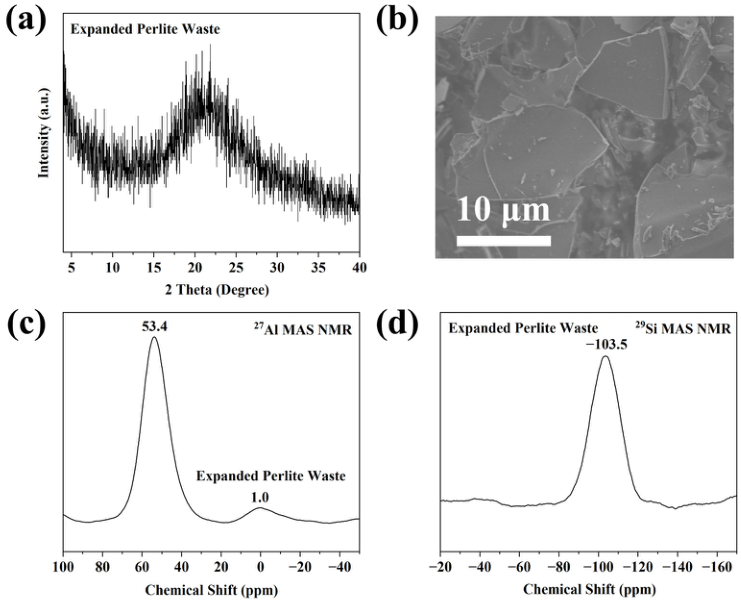
The X-ray diffraction (XRD) pattern (Figure 1a) displays a broad diffuse halo without sharp reflections, confirming the predominantly amorphous nature of the material. The scanning electron microscopy (SEM) image (Figure 1b) reveals irregular, sheet-like particles with an average size of ~10 μm.
The coordination environments of Si and Al were further investigated using 27Al and 29Si magic-angle spinning nuclear magnetic resonance (MAS NMR) spectroscopy (Figure 1c,d). The 27Al MAS NMR spectrum exhibits signals at 53.4 ppm and 1.0 ppm, corresponding to tetrahedrally coordinated framework Al and octahedrally coordinated extra-framework Al species, respectively [37]. The 29Si MAS NMR spectrum shows a dominant resonance at −103.5 ppm, assigned to Q4(1Al) silicon environments. These results confirm that expanded perlite waste provides a suitable amorphous silica–alumina source for zeolite synthesis.

2.2. Characterization of As-Synthesized CHA Zeolites

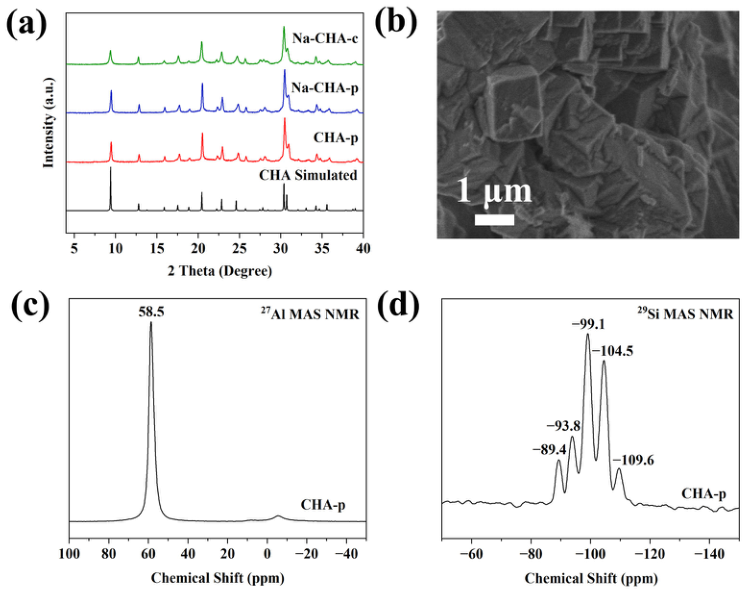
The CHA zeolite synthesized from expanded perlite waste is denoted as CHA-p, while the reference sample synthesized from pure chemical reagents is referred to as CHA-c. The XRD patterns of Na+-exchanged CHA-p (Na-CHA-p) and CHA-c (Na-CHA-c) (Figure 2a) closely match the simulated CHA pattern, confirming the formation of phase-pure CHA zeolite. No characteristic peaks associated with impurities from the raw perlite were detected, demonstrating the effectiveness of the synthesis protocol. The relative crystallinity of Na-CHA-p, determined by peak area integration, reaches 89.2% of that of Na-CHA-c. The SEM image (Figure 2b) shows aggregates of interconnected cuboid crystals with an average particle size of ~1.5 μm, consistent with reported morphologies of low-silica CHA zeolite [23].
Thermogravimetric (TG) analysis of Na-CHA-p and Na-CHA-c is presented in Figure S1. Both samples exhibit a major weight loss below 300 °C, attributed to the removal of weakly bound water (12.8 wt.% for Na-CHA-p and 15.6 wt.% for Na-CHA-c). A minor weight loss above 300 °C (0.6 wt.% and 1.0 wt.%, respectively) is associated with more strongly bound or framework-associated water [16]. These results provide a baseline for subsequent Pb2+ and Cd2+ adsorption studies.
By combining inductively coupled plasma optical emission spectrometry (ICP-OES) data (Table S2) with TG results, the unit-cell composition of CHA-p was determined as Na1.4K11Si23.6Al12.4O72·22.3H2O, corresponding to an Si/Al ratio of 1.9 and confirming the successful synthesis of low-silica CHA zeolite. The 27Al MAS NMR spectrum of CHA-p (Figure 2c) shows a dominant sharp resonance at 58.5 ppm and a weak, broad signal centered near 0 ppm. These signals are assigned to tetrahedral framework Al (AlIV) and minor octahedral extra-framework Al (AlVI) species, respectively [36]. Quantitative deconvolution using Lorentzian functions (Table S3) reveals that framework AlIV accounts for 94.7% of the total aluminum signal, confirming the efficient incorporation of Al into the zeolite framework. The 29Si MAS NMR spectrum (Figure 2d) displays five resonances at −109.6, −104.5, −99.1, −93.8, and −89.4 ppm, corresponding to Si(0Al) to Si(4Al) environments, consistent with reported CHA structures [38]. The Si/Al ratio calculated from 29Si MAS NMR (2.2) is consistent with values obtained from ICP-OES (1.9) and XRF (1.9).
The N2 adsorption–desorption isotherms measured at 77 K for Ca2+-exchanged CHA-p (Ca-CHA-p) and CHA-c (Ca-CHA-c) are shown in Figure S2. Both samples exhibit steep uptake at low relative pressure (P/P0 < 0.05), characteristic of Type-I isotherms and indicative of well-developed microporosity. The specific surface area (SBET) was calculated using the multipoint Brunauer–Emmett–Teller (BET) method. The selected relative pressure ranges (0.0000–0.0198 for Ca-CHA-p and 0.0000–0.0230 for Ca-CHA-c) satisfy the Rouquerol criteria, ensuring the validity of the BET analysis. To avoid overestimation arising from interparticle capillary condensation, the total pore volume (Vtotal) was determined at P/P0 ≤ 0.90, following established methodological recommendations [39]. The corresponding textural parameters are summarized in Table S4.

2.3. Crystallization Process of CHA-p

The crystallization behavior of CHA-p was monitored using XRD and SEM (Figures S3 and S4). Figure S3a compares XRD patterns collected at different crystallization times with the simulated CHA pattern, while Figure S3b shows the evolution of relative crystallinity. Corresponding morphological changes are presented in Figure S4.
During the first 6 h, the product remained amorphous, as evidenced by the absence of characteristic CHA reflections. After 12 h, weak CHA diffraction peaks appeared, corresponding to a relative crystallinity of 25.2%, accompanied by the formation of small cuboid crystals (Figures S3b and S4d). From 12 to 48 h, crystallinity increased rapidly, with the morphology evolving from loosely aggregated cuboids at 24 h to well-defined crystalline aggregates at 48 h (Figure S4e,f). Prolonging the crystallization time beyond 48 h did not further enhance crystallinity, indicating that 48 h is sufficient for the formation of highly crystalline CHA-p. The textural properties were further examined by a transmission electron microscope (TEM) (Figure S4g,h). The images show that the aggregates at both 24 h and 48 h are composed of dense crystalline subunits with well-defined edge contours. These features closely resemble the intergrown rhombohedral morphology. Notably, the TEM image of the sample crystallized at 48 h (Figure S4h) confirms the high crystallinity and structural integrity of the synthesized CHA-p, providing direct microscopic evidence that complements the XRD and SEM results.

2.4. Factors Affecting the Crystallization of CHA-p

The formation of phase-pure CHA zeolite is strongly influenced by gel alkalinity, Si/Al ratio, water content, and hydrothermal temperature. A gel composition of 0.16 Na2O:0.85 K2O:3.5 SiO2:Al2O3:111 H2O produced high-quality CHA-p. To accommodate the compositional complexity of expanded perlite waste, the synthesis parameters were systematically optimized. The optimal compositional window was identified as 0.16 Na2O:0.85 K2O:(3.5–4) SiO2:Al2O3:(111–131) H2O, as supported by Figure S5 and summarized in Table 1.
Hydrothermal synthesis conducted between 120 and 200 °C revealed that deviations from the optimal temperature range led to reduced phase purity. The optimal conditions are summarized in Run 1 (Table 1), while the conventional synthesis of CHA-c (Si/Al = 2.2) is provided for comparison in Run 8.

2.4.1. Effect of K2O/SiO2 and Na2O/SiO2 Ratios

Previous studies have shown that K+ is essential for CHA formation under organic template-free conditions, whereas excessive K2O/SiO2 ratios favor the formation of MER zeolite [26]. In the present system, K2O/SiO2 ratios of 0.41 and 0.47 resulted in mixed CHA/MER phases (Figure S5a; Table 1, Runs 2 and 3). Reducing this ratio to 0.24 yielded phase-pure CHA-p (Figure S5a; Table 1, Run 1).
Although both K+ and Na+ are commonly used in CHA synthesis [40], excessive Na+ increases gel alkalinity and promotes MER formation. This effect was observed at a Na2O/SiO2 ratio of 0.13 (Figure S5b; Table 1, Run 4). Notably, phase-pure CHA-p was obtained without external Na+ addition, relying solely on sodium inherently present in the perlite waste (Figure S5b; Table 1, Run 1).

2.4.2. Effect of SiO2/Al2O3 Ratio

To obtain low-silica CHA, the SiO2/Al2O3 ratio was systematically varied. Ratios below 3.5 failed to yield CHA, whereas ratios between 3.5 and 4 produced phase-pure CHA with an Si/Al ratio of 1.9–2.2 (Figure S5c; Table 1, Runs 1 and 5). An SiO2/Al2O3 ratio of 3.5 was selected as optimal, enabling the synthesis of low-silica CHA without compromising crystallinity.

2.4.3. Effect of H2O/SiO2 Ratio

As shown in Figure S5d, an excessively high H2O/SiO2 ratio (43.1) suppressed CHA formation. Reducing this ratio to 31.7–37.4 enabled the formation of phase-pure CHA-p (Figure S5d; Table 1, Runs 1 and 6). To minimize dilution effects and maximize product yield, the lowest effective ratio (31.7) was selected as optimal.

2.4.4. Effect of Crystallization Temperature

The effect of crystallization temperature was evaluated between 170 and 180 °C. Both samples synthesized at 170 °C and 180 °C were phase-pure CHA-p, with relative crystallinity of 100% at 180 °C and 82.6% at 170 °C (Figure S5e; Table 1, Runs 1 and 7). This result indicates that increasing the synthesis temperature promotes more complete crystallization of the perlite-derived aluminosilicate gel. Accordingly, 180 °C was selected as the optimal crystallization temperature.

2.5. Removal of Pb2+ and Cd2+

Prior to adsorption experiments, CHA-p and CHA-c were converted to their Na+ forms (denoted Na-CHA-p and Na-CHA-c, respectively) via ion exchange. Na-CHA-c was used as the reference material.

2.5.1. Influence of Adsorbent Dosage

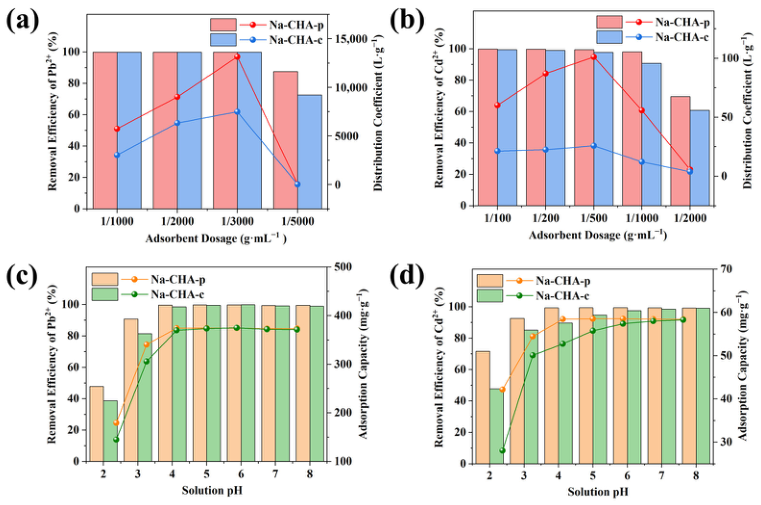
The influence of adsorbent dosage on Pb2+ removal was first evaluated using a Pb2+ solution with an initial concentration of 100 mg·L−1 (15 mL). As shown in Figure 3a, both the removal efficiency and the distribution coefficient (Kd) were strongly dependent on the adsorbent dosage. At a dosage of 1/1000 g·mL−1, both Na-CHA-p and Na-CHA-c achieved Pb2+ removal efficiencies of 99.9%. This high performance was maintained at lower dosages of 1/2000 and 1/3000 g·mL−1.
The maximum Kd value was observed at a dosage of 1/3000 g·mL−1, where Na-CHA-p (1.3 × 10⁴ L·g−1) significantly outperformed Na-CHA-c (7.5 × 10³ L·g−1). The lower adsorption capacity of Na-CHA-c is attributed to its lower alumina content, which results in fewer available ion-exchange sites [41]. This explains why Na-CHA-p exhibits superior Pb2+ and Cd2+ adsorption despite its lower surface area and pore volume (Table S4). Further reduction of the dosage to 1/5000 g·mL−1 led to a pronounced decline in Pb2+ removal efficiency, decreasing to 87.6% for Na-CHA-p and 72.7% for Na-CHA-c. Accordingly, a dosage of 1/3000 g·mL−1 was selected as optimal for Pb2+ removal using Na-CHA-p.
For Cd2+ removal (100 mg·L−1, 10 mL), the optimal dosage was determined to be 1/500 g·mL−1 (Figure 3b). At this dosage, Na-CHA-p achieved a Cd2+ removal efficiency of 99.4% and a Kd value of 101.1 L·g−1, significantly higher than those of Na-CHA-c (97.8% and 25.7 L·g−1). These results clearly demonstrate the superior adsorption efficiency of Na-CHA-p for both Pb2+ and Cd2+ at optimized dosages.
The superior adsorption performance of Na-CHA-p (Figure 3) arises from its well-defined, phase-pure CHA framework featuring 8-ring pore openings, cubic crystals of ~1.5 μm, as well as the high microporous surface area of 456.58 m2·g−1 of Ca-CHA-p (Table S4). The preferential adsorption of Pb2+ over Cd2+ is primarily governed by its lower hydration energy, which facilitates dehydration and enhances diffusion into the zeolitic micropores [42].

2.5.2. Influence of Initial pH

The influence of initial solution pH on Pb2+ and Cd2+ removal by Na-CHA-p and Na-CHA-c was investigated over a pH range of 2–8. Based on the solubility product constants (Ksp), precipitation of Pb2+ and Cd2+ at a concentration of 100 mg·L−1 would occur at pH values above 8.6 and 8.5, respectively. All experiments were therefore conducted below these thresholds to eliminate contributions from metal hydroxide precipitation.
As shown in Figure 3c, Pb2+ removal was strongly suppressed at pH 2, with removal efficiencies of 47.9% for Na-CHA-p and 38.7% for Na-CHA-c. This behavior is attributed to strong competition between H3O+ and Pb2+ for ion-exchange sites under highly acidic conditions [15]. Increasing the pH to 3 resulted in a sharp increase in Pb2+ removal, reaching 90.8% for Na-CHA-p and 81.5% for Na-CHA-c. At pH values between 4 and 8, both materials exhibited consistently high removal efficiencies, exceeding 99.5% for Na-CHA-p and 98.6% for Na-CHA-c. The adsorption capacity followed a similar trend, reflecting the diminished competitive effect of protons at higher pH.
Cd2+ adsorption showed a comparable pH dependence (Figure 3d). At pH values between 4 and 8, Na-CHA-p maintained Cd2+ removal efficiencies above 99.3%, whereas Na-CHA-c achieved efficiencies above 89.7%. Across the entire pH range examined, Na-CHA-p consistently outperformed Na-CHA-c. These results demonstrate that Na-CHA-p provides stable and efficient Pb2+ and Cd2+ removal under environmentally relevant pH conditions, highlighting its suitability for practical wastewater treatment.

2.5.3. Selectivity Toward Pb2+ and Cd2+

In practical wastewater systems, Pb2+ and Cd2+ coexist with other heavy metals and with high concentrations of common cations such as Na+, K+, Ca2+, and Mg2+ [43]. Because zeolites preferentially adsorb cations with a high charge density, small hydrated radius, and low hydration energy [44], competitive adsorption experiments were conducted to assess the selectivity of Na-CHA-p under multi-ion conditions. Parallel experiments using Na-CHA-c were performed for comparison.
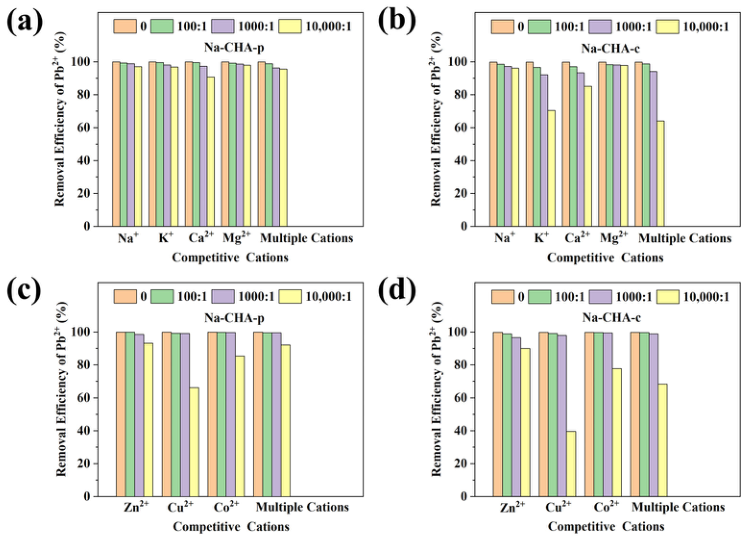
For Pb2+ adsorption in the presence of competitive alkali and alkaline-earth cations, the molar ratio of competitive ions (Mn+) to Pb2+ was varied from 100:1 to 10,000:1 (Figure 4a,b). At Mn+/Pb2+ ratios of 100:1 and 1000:1, Na-CHA-p retained Pb2+ removal efficiencies above 96.3%, whereas Na-CHA-c showed slightly lower efficiencies (>92.1%). This superior performance of Na-CHA-p is primarily attributed to the lower hydration energy of Pb2+ relative to the competitive cations [45]. When the ratio increased to 10,000:1, Pb2+ removal decreased noticeably, particularly in the presence of Ca2+, where the removal efficiency dropped to 90.7%. This pronounced inhibition arises from the high charge density of Ca2+ combined with its overwhelming concentration [16].
The selectivity of Na-CHA-p toward Pb2+ was further evaluated in the presence of competitive divalent heavy metal ions (Zn2+, Cu2+, Co2+, or their mixture). As shown in Figure 4c,d, Pb2+ removal efficiencies remained above 98.5% for Na-CHA-p and 96.7% for Na-CHA-c at M2+/Pb2+ ratios ranging from 100:1 to 1000:1. These results confirm the strong preference of CHA zeolites—particularly Na-CHA-p—for Pb2+ in complex heavy-metal systems, again reflecting its relatively low hydration energy [45]. At a ratio of 10,000:1, Pb2+ removal declined substantially, with Cu2+ exerting the strongest inhibitory effect due to its small hydrated radius [15].
The selectivity toward Cd2+ was examined under analogous conditions (Figure S6). In the presence of common cations at an Mn+/Cd2+ ratio of 100:1, Na-CHA-p maintained Cd2+ removal efficiencies above 95.5%, significantly higher than those of Na-CHA-c (>69.8%) (Figure S6a,b). Increasing the ratio to 1000:1 led to a marked decline in Cd2+ removal, particularly in the presence of Ca2+, owing to its high charge density and competitive advantage [16]. In systems containing multiple heavy-metal ions (Figure S6c,d), Cu2+ again exerted the strongest inhibitory effect on Cd2+ adsorption, consistent with its small hydrated radius. Overall, Na-CHA-p exhibits superior selectivity for Cd2+ compared with Na-CHA-c, although its selectivity is lower than that observed for Pb2+, reflecting the more favorable hydration properties of Pb2+.

2.5.4. Adsorption Kinetics

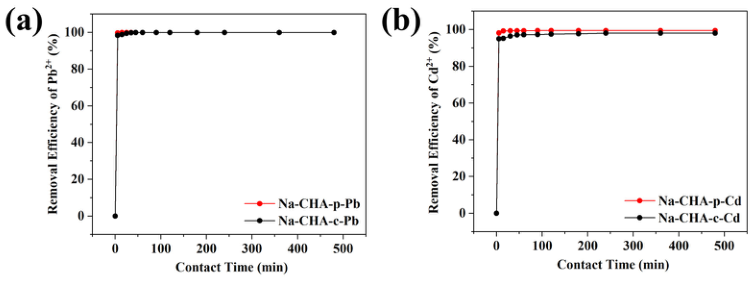
Adsorption mechanisms of heavy metals on zeolites are commonly inferred from kinetic and isotherm analyses [46]. The time-dependent adsorption behavior of Pb2+ and Cd2+ on Na-CHA-p and Na-CHA-c is shown in Figure 5.
As shown in Figure 5a, Na-CHA-p exhibited extremely rapid Pb2+ uptake, achieving 99.7% removal within the first 5 min. Only marginal increases were observed thereafter, indicating that adsorption equilibrium was rapidly attained. Kinetic data were fitted using pseudo-first-order and pseudo-second-order models (Figure S7a,b). As summarized in Table S5, the pseudo-second-order model provided a significantly better fit (R2 = 0.999) than the pseudo-first-order model (R2 = 0.795), suggesting that Pb2+ adsorption is dominated by a chemisorption mechanism involving ion exchange [47]. Na-CHA-c displayed a similar kinetic profile, indicating an analogous adsorption mechanism.
Cd2+ adsorption on Na-CHA-p also reached equilibrium within 5 min (Figure 5b). Kinetic modeling again confirmed that the pseudo-second-order model best described the experimental data (R2 = 0.999) (Figure S7c,d and Table S5), confirming that Cd2+ uptake is likewise governed by chemisorption. These results highlight the exceptionally fast adsorption kinetics of Na-CHA-p, which are highly advantageous for practical water treatment applications.

2.5.5. Adsorption Isotherms

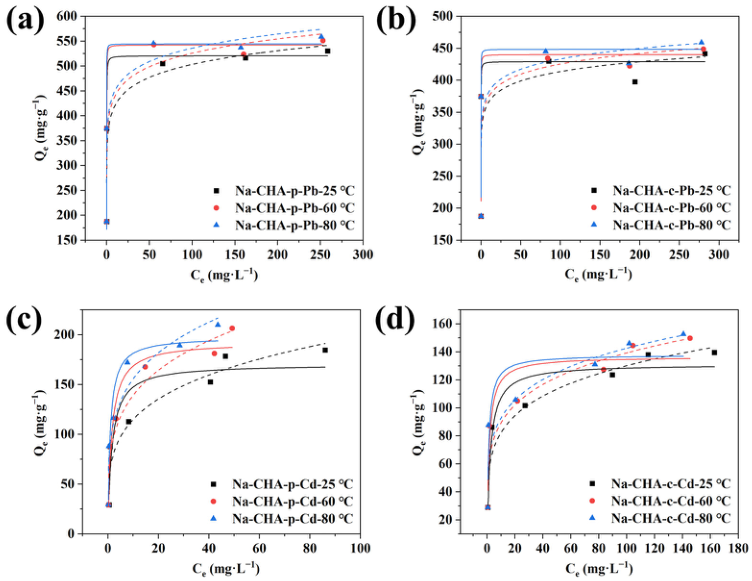
To assess the feasibility of Na-CHA-p for treating hot industrial effluents, adsorption isotherms for Pb2+ and Cd2+ were measured at 25, 60, and 80 °C. The equilibrium adsorption behavior was analyzed using the Langmuir and Freundlich isotherm models. The experimental isotherm data (Figure 6), along with their linear fittings (Figures S8 and S9), demonstrate that adsorption of both metal ions is well described by the Langmuir model, indicating monolayer adsorption on a homogeneous distribution of active sites [48]. The corresponding fitting parameters are summarized in Tables S6 and S7.
The maximum adsorption capacities (Qm) increased progressively with temperature from 25 °C to 80 °C, confirming the endothermic nature of the adsorption process. At 80 °C, which is representative of hot industrial effluent, Na-CHA-p exhibited exceptional high capacities of 555.6 mg·g−1 for Pb2+ and 211.0 mg·g−1 for Cd2+, which are substantially higher than those of Na-CHA-c (450.5 mg·g−1 for Pb2+ and 153.1 mg·g−1 for Cd2+). Comparison with previously reported adsorbents (Table 2 and Table 3) demonstrates the outstanding adsorption performance of Na-CHA-p for both metal ions.
Based on elemental compositions obtained from XRF analysis (Tables S1 and S8), the theoretical maximum adsorption capacities of Na-CHA-p were calculated to be 638.4 mg·g−1 for Pb2+ and 346.3 mg·g−1 for Cd2+. These values exceed the experimentally observed capacities, indicating that not all ion-exchange sites are fully utilized under the tested conditions and suggesting further potential for performance optimization.

2.5.6. Reusability

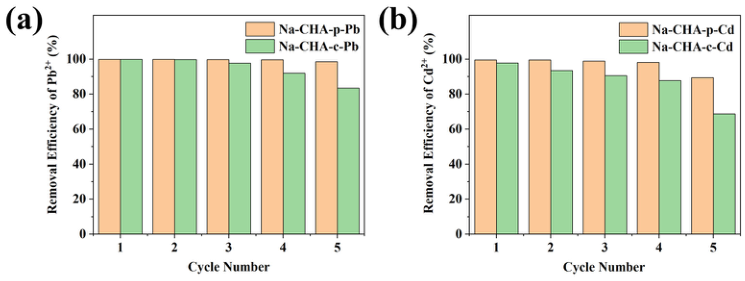
The reusability of Na-CHA-p and Na-CHA-c was evaluated over five consecutive adsorption–desorption cycles (Figure 7).
For Pb2+ removal, Na-CHA-p maintained a removal efficiency above 98.5% throughout all five cycles. In contrast, Na-CHA-c retained efficiencies above 97.7% only during the first three cycles, followed by a decline to 91.9% in the fourth cycle. This behavior indicates inferior cycling stability of Na-CHA-c. The observed decrease is attributed to incomplete Pb2+ desorption and progressive structural deterioration. XRD analysis after cycling (Figure S10) confirms that the framework of Na-CHA-p remains largely well preserved, whereas Na-CHA-c undergoes more pronounced degradation.
For Cd2+ removal, Na-CHA-p sustained removal efficiencies above 98.2% over the first four cycles, with a decrease to 89.5% in the fifth cycle. In contrast, Na-CHA-c showed a continuous decline in performance starting from the second cycle. Consistent with these results, XRD analysis confirms that the framework structure of Na-CHA-p remains largely intact after repeated cycling.

2.6. Leachability and Retention Mechanism of Spent Adsorbents

As shown in Table S9, the leaching concentrations of Pb2+ from exhausted Na-CHA-p and Na-CHA-c were 0.21 and 0.48 mg·L−1, respectively, while those of Cd2+ were 0.11 and 0.25 mg·L−1. All values are well below the US EPA regulatory limits for hazardous waste (5.0 mg·L−1 for Pb and 1.0 mg·L−1 for Cd) [66], indicating a low risk of secondary contamination under landfill conditions. The low leachability is attributed to the strong retention of Pb2+ and Cd2+ at ion-exchange sites, coupled with the constrained pore openings of the CHA framework, which limit outward diffusion of the entrapped ions [67].

3. Materials and Methods

3.1. Materials

Expanded perlite waste was obtained from Changchun Songbinlinyun Building Materials Co., Ltd., Changchun, China. The following reagents were used as received: pseudo-boehmite (Sasol, Hamburg, Germany, 72.7 wt.%), NaCl (Tianjin Guangfu Fine Chemical Research Institute, Tianjin, China), NaOH (Tianjin Fuchen Chemical Reagents Factory, Tianjin, China, NaOH ≥ 96.0%), KOH (Tianjin Guangfu Fine Chemical Research Institute, KOH ≥ 85.0%), Pb(NO3)2 (Shanghai Aladdin Biochemical Technology Co., Ltd., Shanghai, China), NaNO3 (Beijing Chemical Works, Beijing, China), KNO3 (Sinopharm Chemical Reagent Co., Ltd., Shanghai, China), Ca(NO3)2 (Tianjin Fuchen Chemical Reagents Factory), Mg(NO3)2 (Sinopharm Chemical Reagent Co., Ltd.), HNO3 (Beijing Chemical Works), CdCl2·2.5H2O (Shanghai Macklin Biochemical Technology Co., Ltd., Shanghai, China), KCl (Tianjin Fuchen Chemical Reagents Factory), CaCl2 (Tianjin Guangfu Fine Chemical Research Institute), MgCl2 (Shanghai Aladdin Biochemical Technology Co., Ltd.), Zn(NO3)2·6H2O (Shanghai Macklin Biochemical Technology Co., Ltd.), Cu(NO3)2·3H2O (Shanghai Macklin Biochemical Technology Co., Ltd.), Co(NO3)2·6H2O (Shanghai Macklin Biochemical Technology Co., Ltd.), and HCl (Beijing Chemical Reagent Research Institute Co., Ltd., Beijing, China). Ludox AS-40 (40 wt.%, suspension in water) was purchased from Aldrich (Saint Louis, MO, USA).

3.2. Synthesis of CHA Zeolite

3.2.1. Synthesis of CHA-p Zeolite

Zeolite CHA-p was synthesized from an initial gel with a molar composition of 0.16 Na2O:0.85 K2O:3.5 SiO2:Al2O3:111 H2O. To prepare the gel, 1.84 g of KOH was dissolved in 40 mL of deionized water. The Na2O component was supplied from the expanded perlite waste. Subsequently, 1.78 g of pseudo-boehmite and 5.52 g of expanded perlite waste were added while stirring. The mixture was stirred for 4 h to ensure homogeneity, then transferred to a Teflon-lined stainless-steel autoclave and heated at 180 °C for 48 h. The resulting solid was collected by filtration, thoroughly washed with deionized water until the pH was below 8, and dried at 80 °C.

3.2.2. Synthesis of CHA-c Zeolite

For comparison, zeolite CHA-c was synthesized from pure chemical raw materials according to a previous report [17], with a molar composition of 0.092 Na2O:Al2O3:3.99 SiO2:1.067 K2O:171 H2O. In a typical synthesis, 0.096 g of NaOH and 1.83 g of KOH were dissolved in 35 mL of deionized water. Then, 1.82 g of pseudo-boehmite and 7.78 g of Ludox AS-40 were slowly added while stirring. The mixture was stirred for 3 h to ensure homogeneity, then transferred to a Teflon-lined stainless-steel autoclave and heated at 160 °C for 96 h. The product was treated using the same method as described in Section 3.2.1.

3.3. Na+ Modification of CHA-p and CHA-c

CHA-p and CHA-c were ion-exchanged with 1.0 mol·L−1 NaCl solution at a solid-to-liquid ratio of 20 g·L−1. The suspensions were stirred at 60 °C for 3 h. Next, the solid was filtered and washed with deionized water until the pH was below 8. This process was repeated twice more (three times in total). Finally, the ion-exchanged product was dried at 80 °C. The Na+-exchanged samples are referred to as Na-CHA-p and Na-CHA-c, respectively, and were used in subsequent Pb2+ and Cd2+ adsorption experiments.

3.4. Pb2+ and Cd2+ Adsorption Experiments

To evaluate adsorption performance, batch experiments were conducted for Pb2+ and Cd2+ removal using Na-CHA-p and Na-CHA-c at 25 °C (ambient condition), 60 °C, and 80 °C (industrial condition). For Pb2+ removal, 5 mg of zeolite was dispersed into 15 mL of solution with various Pb2+ concentrations. For Cd2+ removal, 20 mg of zeolite was dispersed into 10 mL of solution with various Cd2+ concentrations. The pH of the Pb2+ solution was adjusted using 1.0 mol·L−1 KOH or 1.0 mol·L−1 HNO3, while the pH of the Cd2+ solution was adjusted using 1.0 mol·L−1 KOH or 1.0 mol·L−1 HCl. The mixtures were stirred for 8 h. The solution was then filtered using a 0.22 μm polyethersulfone (PES) membrane filter, and the concentrations of Pb2+ or Cd2+ in the filtrate were measured by ICP-OES. The physically adsorbed water content in zeolite CHA was determined by TG analysis, and adsorption capacities were calculated based on the dry mass of the zeolite.
The removal efficiency R (%), equilibrium adsorption capacity Qe (mg⋅g−1), and distribution coefficient Kd (L⋅g−1) were calculated as:
R % = C i C e C i × 100 % ,
Q e = C i C e × V m  
and
K d = C i C e C e × V m   ,
where Ci and Ce (mg⋅L−1) are the initial and equilibrium concentrations of Pb2+ or Cd2+, respectively; V (L) is the solution volume; and m (g) is the dry zeolite mass. Na-CHA-c was employed as a reference material.

3.4.1. Influence of Adsorbent Dosage

The influence of the adsorbent dosage on Pb2+ removal was examined using solid-to-liquid ratios of 1/1000, 1/2000, 1/3000 and 1/5000 (g⋅mL−1), while that on Cd2+ removal was examined using solid-to-liquid ratios of 1/100, 1/200, 1/500, 1/1000 and 1/2000 (g⋅mL−1). The initial Pb2+ or Cd2+ concentration was 100 mg⋅L−1, and the initial pH was adjusted to 6.0. The contact time was 8 h under stirring.

3.4.2. Influence of Initial pH

The influence of pH on Pb2+ or Cd2+ removal was investigated within a pH range from 2 to 8. The adsorbent dosage was 1/3000 (g⋅mL−1) for Pb2+ removal and 1/500 (g⋅mL−1) for Cd2+ removal. The initial Pb2+ or Cd2+ concentration was 100 mg⋅L−1, with a contact time of 8 h under stirring.

3.4.3. Selectivity Toward Pb2+ and Cd2+

For Pb2+ removal, the selectivity of Na-CHA-p and Na-CHA-c was tested using 5 mg·L−1 Pb2+ solutions at 25 °C containing Na+, K+, Ca2+, Mg2+, or a mixture at molar ratios of Mn+/Pb2+ = 0, 100:1, 1000:1 and 10,000:1. For selectivity tests involving other heavy metal cations, Na-CHA-p and Na-CHA-c were added to 5 mg·L−1 Pb2+ solutions at 25 °C containing Zn2+, Cu2+, Co2+, or a mixture at molar ratios of M2+/Pb2+ = 0, 100:1, 1000:1 and 10,000:1. For mixed-ion systems, the cations were present in an equimolar ratio (1:1:1:1). The pH of the mixed solutions was set as 6.0, and the contact time was 8 h under stirring.
For Cd2+ removal, the selectivity of Na-CHA-p and Na-CHA-c was tested using 5 mg·L−1 Cd2+ solutions at 25 °C containing Na+, K+, Ca2+, Mg2+, or a mixture at molar ratios of Mn+/Cd2+ = 0, 100:1 and 1000:1. For selectivity tests with other heavy metal cations, Na-CHA-p and Na-CHA-c were added to 5 mg·L−1 Cd2+ solutions at 25 °C containing Zn2+, Cu2+, Co2+, or a mixture at molar ratios of M2+/Cd2+ = 0, 10:1 and 100:1. For mixed-ion systems, the cations were present in an equimolar ratio (1:1:1:1). The pH of the mixed solutions was set as 6.0, and the contact time was 8 h under stirring.

3.4.4. Adsorption Kinetics

The influence of contact time on Pb2+ or Cd2+ removal was studied from 5 min to 480 min with an initial pH of 6.0. The adsorbent dosage was 1/3000 (g⋅mL−1) for Pb2+ removal and 1/500 (g⋅mL−1) for Cd2+ removal, and the initial concentration of both ions was 100 mg⋅L−1.
The kinetic data were fitted using pseudo-first-order and pseudo-second-order models:
Pseudo-first-order model [68]:
Q t = Q e 1 e K 1 t   ,
where Qt (mg⋅g−1) is the adsorption amount at the adsorption time of t (min), Qe (mg⋅g−1) is the equilibrium adsorption capacity, and K1 (min−1) is the rate constant.
Pseudo-second-order model [69,70]:
Q t = K 2 Q e 2 t 1 + K 2 Q e t   ,
where K2 (g⋅mg−1⋅min−1) is the rate constant, and other parameters are defined as above.

3.4.5. Adsorption Isotherms

Adsorption isotherms were measured at 25 °C, 60 °C, and 80 °C with initial Pb2+ or Cd2+ concentrations ranging from 50 to 400 mg⋅L−1. The adsorbent dosage was 1/3000 (g⋅mL−1) for Pb2+ removal and 1/500 (g⋅mL−1) for Cd2+ removal. The initial pH was set as 6.0, with a contact time of 8 h.
The data were fitted using the Langmuir and Freundlich models:
Langmuir model [48]:
Q e = Q m K L C e 1 + K L C e   ,
where Qm (mg·g−1) is the maximum adsorption capacity and KL (L·mg−1) is the Langmuir constant.
Freundlich model [71]:
Q e = K F C e 1 n   ,
where KF (mg1−1/n·L1/n·g−1) and n are Freundlich constants related to adsorption capacity and intensity. The model fits were evaluated by linear regression.

3.4.6. Reusability

The reusability of Na-CHA-p and Na-CHA-c for Pb2+ and Cd2+ removal was systematically evaluated. For Pb2+ adsorption, a solid-to-liquid ratio of 1/3000 g⋅mL−1 was used, whereas for Cd2+ adsorption, the ratio was 1/500 g⋅mL−1. All experiments were conducted at initial pH of 6 with a contact time of 8 h. After each adsorption cycle, the spent adsorbents were regenerated by immersion in 1 mol⋅L−1 NaCl solution for 12 h, followed by thorough washing with deionized water. The adsorption–regeneration process was repeated for five consecutive cycles.

3.5. Leaching Tests

The leaching stability of the spent adsorbents was evaluated using the Toxicity Characteristic Leaching Procedure (TCLP) method [72]. Metal-loaded samples were mixed with acetic acid extraction fluid (pH 2.88) at a liquid-to-solid ratio of 20 mL·g−1 and agitated for 18 h. The concentrations of Pb2+ and Cd2+ in the resulting leachates were quantified by ICP-OES.

3.6. Characterization

Powder X-ray diffraction (PXRD) patterns were collected over 2θ = 4–40° using a Rigaku (Tokyo, Japan) D/Max 2550 diffractometer with Cu Kα radiation (λ = 1.5418 Å) and a step size of 0.02°. The relative crystallinity of CHA-p was calculated as:
R e l a t i v e   C r y s t a l l i n i t y = A s a m p l e A r e f e r e n c e × 100 %   ,
where A is the integrated area of a characteristic diffraction peak. The calculation was based on the CHA reflections located at approximately 2θ = 9.4°, 12.8°, 15.9°, 17.6°, 20.4°, 22.9°, 24.7°, 30.4°, 34.3°, and 35.8°.
The chemical composition of expanded perlite waste and Na-CHA-p was analyzed by XRF using a PANalytical (Worcestershire, UK) Axios Advanced X-ray fluorescence spectrometer. Morphologies were examined by SEM using a Jeol JSM-7800F microscope (Peabody, MA, USA). TEM images were obtained with the electron microscope Tecnai F20 (Hillsboro, OR, USA). TG analysis was conducted in air on a Q500 analyzer (New Castle, DE, USA) with a heating rate of 10 °C⋅min−1 from ambient temperature to 800 °C. The Si/Al ratio and the concentrations of Pb2+ and Cd2+ were determined by ICP-OES using a Thermo Scientific (Waltham, MA, USA) iCAP 7600 DUO instrument. 27Al and 29Si MAS NMR spectra were acquired on a Bruker (Billerica, MA, USA) Avance NEO spectrometer at 14.09 T to probe the local atomic environments. The Si/Al ratio was calculated from the NMR data using the following formula:
S i A l N M R = n = 0 n = 4 I S i n A l n = 0 n = 4 0.25 × n × I S i n A l .
N2 adsorption–desorption isotherms were measured at 77 K using a BSD-660M analyzer (Beijing, China). Prior to analysis, the samples were degassed at 573 K for at least 8 h. Surface areas and pore volumes were calculated using the BET and t-plot methods, respectively. The total pore volume was determined at P/P0 = 0.90.

4. Conclusions

In this study, a low-silica CHA zeolite was synthesized directly from expanded perlite waste via a one-pot, template-free hydrothermal strategy, providing a sustainable route for waste valorization. After Na+ exchange, the resulting Na-CHA-p exhibited exceptional performance for Pb2+ and Cd2+ removal from aqueous solutions. At 25 °C and an initial concentration of 100 mg·L−1, ultrafast adsorption was achieved, reaching equilibrium within 5 min, with removal efficiencies of 99.9% for Pb2+ and 99.4% for Cd2+ (solid-to-liquid ratio: 1/3000 g⋅mL−1 for Pb2+ and 1/500 g⋅mL−1 for Cd2+). The material delivered high adsorption capacities of 555.6 mg·g−1 for Pb2+ and 211.0 mg·g−1 for Cd2+, together with strong selectivity in the presence of competing cations. Notably, Na-CHA-p demonstrated excellent durability, maintaining >98.5% Pb2+ removal over five cycles and >98.2% Cd2+ removal over four cycles. Leaching tests confirmed the robust immobilization of heavy metals, with Pb2+ and Cd2+ concentrations remaining well below EPA regulatory limits under acidic conditions, highlighting the environmental safety of the spent adsorbent. Overall, this study establishes a scalable and sustainable strategy for converting industrial waste into a high-performance zeolitic adsorbent, offering significant potential for rapid, selective, and practical heavy-metal remediation in complex aqueous systems.

Supplementary Materials

The following supporting information can be downloaded at: https://www.mdpi.com/article/10.3390/molecules31091377/s1. Refs. [39,66] are cited in the Supplementary Materials.

Author Contributions

Writing—original draft preparation, C.F.; methodology, C.F. and B.W.; formal analysis, C.F.; conceptualization, C.F. and W.Y.; investigation, C.F., B.W., P.X., J.L., H.Z. and Z.L.; data curation, C.F., P.X., J.L., H.Z. and Z.L.; validation, B.W., P.X., J.L., H.Z. and Z.L.; writing—review and editing, W.Y.; supervision, W.Y.; funding acquisition, W.Y. All authors have read and agreed to the published version of the manuscript.

Funding

This research was funded by the National Key Research and Development Program of China (2024YFE0201000), the National Natural Science Foundation of China (22288101), the ‘111 Center’ (B17020).

Institutional Review Board Statement

Not applicable.

Informed Consent Statement

Not applicable.

Data Availability Statement

The original contributions presented in this study are included in the article/Supplementary Material. Further inquiries can be directed to the corresponding author.

Conflicts of Interest

The authors declare no conflicts of interest.

References

  1. Yusuf, B.; Aliyu, M.; Azeez, M.; Taialla, O.; Lateef, S.; Sulaimon, R.; Akinpelu, A.; Ganiyu, S. Comprehensive Technologies for Heavy Metal Remediation: Adsorption, Membrane Processes, Photocatalysis, and AI-Driven Design. Desalination 2025, 615, 119261. [Google Scholar] [CrossRef]
  2. Zheng, X.; Alam, O.; Zhou, Y.; Du, D.; Li, G.; Zhu, W. Heavy Metals Detection and Removal from Contaminated Water: A Critical Review of Adsorption Methods. J. Environ. Chem. Eng. 2024, 12, 114366. [Google Scholar] [CrossRef]
  3. Alam, O.; Zheng, X.; Du, D.; Qiao, X.; Dai, L.; Li, J.; Xia, J.; Ye, J.; Zhong, S. A Critical Review on Advances in Remediation of Toxic Heavy Metals Contaminated Solids by Chemical Processes. J. Environ. Chem. Eng. 2024, 12, 113149. [Google Scholar] [CrossRef]
  4. Ko, Y.G. Hybrid Method Integrating Adsorption and Chemical Precipitation of Heavy Metal Ions on Polymeric Fiber Surfaces for Highly Efficient Water Purification. Chemosphere 2024, 363, 142909. [Google Scholar] [CrossRef] [PubMed]
  5. Cevallos-Mendoza, J.; Amorim, C.; Rodríguez-Díaz, J.; Montenegro, M. Removal of Contaminants from Water by Membrane Filtration: A Review. Membranes 2022, 12, 570. [Google Scholar] [CrossRef]
  6. Bakry, S.; Matta, M.; Noureldin, A.; Zaher, K. Performance Evaluation of Electrocoagulation Process for Removal of Heavy Metals from Wastewater Using Aluminum Electrodes under Variable Operating Conditions. Desalin. Water Treat. 2024, 318, 100396. [Google Scholar] [CrossRef]
  7. Tang, C.; Li, Y.; Yu, Y.; Shi, Y.; Xu, H.; Zhang, Y.; Xue, J.; Zheng, N. Selective Capacitive Removal of Pb(II) Ions from Industrial Wastewater Using NF/Mn2CoO4@MoO2 Electrodes. Chem. Eng. J. 2024, 495, 153196. [Google Scholar] [CrossRef]
  8. Jasim, A.; Ajjam, S. Removal of Heavy Metal Ions from Wastewater Using Ion Exchange Resin in a Batch Process with Kinetic Isotherm. S. Afr. J. Chem. Eng. 2024, 49, 43–54. [Google Scholar] [CrossRef]
  9. Jing, F.; Xu, X.; Lu, W.; Jin, M.; He, X.; Yu, R. Design and Characterization of Concave Hollow Double-Layer Nanospheres for Efficient Cd(II) and Pb(II) Adsorption. Langmuir 2025, 41, 10323–10331. [Google Scholar] [CrossRef]
  10. Lingamdinne, L.; Kulkarni, R.; Ryu, Y.; Kim, S.; Yoon, M.; Won, S.; Koduru, J.; Chang, Y. Efficient Synthesis of Zeolite-A from Bottom Ash for Sustainable Heavy Metal Removal from Real Environmental Samples. New J. Chem. 2025, 49, 15457–15469. [Google Scholar] [CrossRef]
  11. Bai, R.; Yan, N.; He, G.; Ye, Y.; Bai, R.; Li, D.; Guo, P.; Mei, D.; Yan, W.; Yu, J. Ethylene Pretreatment Enhances Ethylene Adsorption and Separation over Cu@SAPO-RHO Zeolite. Angew. Chem. Int. Ed. 2025, 64, e202501053. [Google Scholar] [CrossRef]
  12. Parsapur, R.; Melinte, G.; Saih, Y.; Abou-Hamad, E.; Samaras, V.; Hodgkins, R.; Koseoglu, O.; Aljishi, M.; Bendjeriou-Sedjerari, A.; Lai, Z.; et al. Partially Ordered Mesoporous Zeolite Beta Frameworks as Naphtha-Selective Catalysts in Vacuum Gas Oil Hydrocracking. J. Am. Chem. Soc. 2025, 147, 41109–41121. [Google Scholar] [CrossRef]
  13. Xiao, P.; Tang, X.; Tan, J.; Nakamura, K.; Toyoda, H.; Sawada, M.; Wang, Y.; Gies, H.; Zheng, A.; Yokoi, T. Transition-Metal-Free Aluminosilicate Small-Pore Zeolites Upgrade Methane to Light Olefins. J. Am. Chem. Soc. 2025, 147, 33790–33798. [Google Scholar] [CrossRef]
  14. Lv, Y.; Ma, B.; Liu, Y.; Wang, C.; Chen, Y. Adsorption Behavior and Mechanism of Mixed Heavy Metal Ions by Zeolite Adsorbent Prepared from Lithium Leach Residue. Microporous Mesoporous Mater. 2022, 329, 111553. [Google Scholar] [CrossRef]
  15. Wang, Y.; Liu, S.; Pan, J.; Zhang, H.; Wang, B.; Yan, W. MER Zeolite with Remarkable Pb2+ and Cd2+ Removal Capability Cost-Effectively Synthesized from Postprocessed Natural Stellerite. Inorg. Chem. 2024, 64, 393–403. [Google Scholar] [CrossRef]
  16. Wang, Y.; Su, H.; Liu, S.; Pan, J.; Zhang, H.; Ding, X.; Yan, Y.; Jin, K.; Wang, B.; Yan, W. Silicoaluminophosphate-Seeded Al-Pair-Enriched Low-Silica Zeolites for Enhanced Sr2+ Capture. Mater. Chem. Front. 2025, 9, 666–675. [Google Scholar] [CrossRef]
  17. Hao, W.; Yan, X.; Guo, X.; Wang, W.; Yan, T.; Zhang, J.; Yan, W. Synthesis of a Low-Silica Zeolite with Exceptional Selectivity for Radioactive 137Cs+. Inorg. Chem. Front. 2023, 10, 1894–1906. [Google Scholar] [CrossRef]
  18. Ridha, F.; Yang, Y.; Webley, P. Adsorption Characteristics of a Fully Exchanged Potassium Chabazite Zeolite Prepared from Decomposition of Zeolite Y. Microporous Mesoporous Mater. 2009, 117, 497–507. [Google Scholar] [CrossRef]
  19. Nedyalkova, R.; Montreuil, C.; Lambert, C.; Olsson, L. Interzeolite Conversion of FAU Type Zeolite into CHA and Its Application in NH3-SCR. Top. Catal. 2013, 56, 550–557. [Google Scholar] [CrossRef]
  20. Liu, B.; Zheng, Y.; Hu, N.; Gui, T.; Li, Y.; Zhang, F.; Zhou, R.; Chen, X.; Kita, H. Synthesis of Low-Silica CHA Zeolite Chabazite in Fluoride Media without Organic Structural Directing Agents and Zeolites. Microporous Mesoporous Mater. 2014, 196, 270–276. [Google Scholar] [CrossRef]
  21. Anand, C.; Kaneda, T.; Inagaki, S.; Okamura, S.; Sakurai, H.; Sodeyama, K.; Matsumoto, T.; Kubota, Y.; Okubo, T.; Wakihara, T. Downsizing the K-CHA Zeolite by a Postmilling-Recrystallization Method for Enhanced Base-Catalytic Performance. New J. Chem. 2016, 40, 492–496. [Google Scholar] [CrossRef]
  22. Du, T.; Fang, X.; Wei, Y.; Shang, J.; Zhang, B.; Liu, L. Synthesis of Nanocontainer Chabazites from Fly Ash with a Template- and Fluoride-Free Process for Cesium Ion Adsorption. Energy Fuels 2017, 31, 4301–4307. [Google Scholar] [CrossRef]
  23. Nasser, G.; Muraza, O.; Nishitoba, T.; Malaibari, Z.; Al-Shammari, T.; Yokoi, T. OSDA-Free Chabazite (CHA) Zeolite Synthesized in the Presence of Fluoride for Selective Methanol-to-Olefins. Microporous Mesoporous Mater. 2019, 274, 277–285. [Google Scholar] [CrossRef]
  24. Vallace, A.; Kester, G.; Casteel, W.; Lau, G.; Whitley, R.; Coe, C. A study of Structural Defects in X- and Y-Type Zeolites and Their Effect on Their Transformation to Aluminum-Rich Chabazite. J. Phys. Chem. C 2021, 125, 12848–12856. [Google Scholar] [CrossRef]
  25. Liu, S.; Lian, X.; Yue, B.; Xu, S.; Wu, G.; Chai, Y.; Zhang, Y.; Li, L. Control of Zeolite Local Polarity toward Efficient Xenon/Krypton Separation. J. Am. Chem. Soc. 2024, 146, 8335–8342. [Google Scholar] [CrossRef] [PubMed]
  26. Deng, X.; Zhou, P.; Yan, X.; Xiong, R.; Kou, H.; Luo, W. Green Synthesis of Low-Silica CHA Zeolite without Organic Structural Directing Agents, Fluoride Media and Seeds. Microporous Mesoporous Mater. 2021, 310, 110618. [Google Scholar] [CrossRef]
  27. Che, S.; Fang, X.; Li, S.Y.; Chen, X.D.; Du, T. Modification of Potassium Chabazites Derived from Fly Ash by Dosing Extra Cations: Promoted CO2 Adsorption Capacities and Fine-Tuned Frameworks. Z. Anorg. Allg. Chem. 2019, 645, 1365–1371. [Google Scholar] [CrossRef]
  28. Sun, S.H.; Che, S.; Yu, X.C.; Huang, R.; Chen, X.H.; Zhu, Y.A. Synthesis of CHA Zeolite with Low Si-Al Ratio from Rice Husk Ash for CO2 Capture. J. Sol-Gel Sci. Technol. 2025, 115, 937–954. [Google Scholar] [CrossRef]
  29. Król, M.; Morawska, J.; Mozgawa, W.; Pichór, W. Low-Temperature Synthesis of Zeolite from Perlite Waste—Part I: Review of Methods and Phase Compositions of Resulting Products. Mater. Sci.-Pol. 2014, 32, 503–513. [Google Scholar] [CrossRef]
  30. Kasai, M.; Kobayashi, Y.; Yoshida, K.; Sasaki, Y.; Togo, M.; Nakahira, A. Synthesis and Evaluation of Zeolite Surface-Modified Perlite. J. Ceram. Soc. Jpn. 2018, 126, 115–121. [Google Scholar] [CrossRef]
  31. Christidis, G.E.; Paspaliaris, I.; Kontopoulos, A. Zeolitisation of Perlite Fines Mineralogical Characteristics of the End Products and Mobilization of Chemical Elements. Appl. Clay Sci. 1999, 15, 305–324. [Google Scholar] [CrossRef]
  32. Król, M.; Matras, E.; Mozgawa, W. Sorption of Cd2+ Ions onto Zeolite Synthesized from Perlite Waste. Int. J. Environ. Sci. Technol. 2016, 13, 2697–2704. [Google Scholar]
  33. Wang, W.; Kong, S.; Zhou, X.; Yuan, D.; Li, H.; Ren, S.; Shen, B. Perlite Templated Y Zeolite Assembly and Its Potential as an Efficient Catalytic Cracking Catalyst. Microporous Mesoporous Mater. 2017, 243, 130–134. [Google Scholar] [CrossRef]
  34. Zhang, Y.; Wang, Q.; Louis, B. ZSM-5 Zeolite Coatings on Perlite Support for MTO Application. Microporous Mesoporous Mater. 2021, 323, 111172. [Google Scholar] [CrossRef]
  35. Qu, Y.; Dong, P.; Yang, L.; Yue, Y.; Wang, H.; Cheng, J.; Yang, C. Synthesis of NaY Zeolite from a Submolten Depolymerized Perlite: Alkalinity Effect and Crystallization Kinetics. Chin. J. Chem. Eng. 2024, 70, 130–138. [Google Scholar] [CrossRef]
  36. Ren, W.; Li, J.; Han, L.; Wang, B.; Wang, J.; Chang, L.; Bao, W. One-Step Synthesis of Zeolite ZSM-5 from Perlite Tailings by Crystal Seed Solution Assisted Method. Fuel 2024, 374, 132489. [Google Scholar] [CrossRef]
  37. Zujovic, Z.; Wheelwright, W.; Kilmartin, P.; Hanna, J.; Cooney, R. Structural Investigations of Perlite and Expanded Perlite Using 1H, 27Al and 29Si Solid-State NMR. Ceram. Int. 2018, 44, 2952–2958. [Google Scholar] [CrossRef]
  38. Zhu, J.; Qian, Y.; Lu, Z.; Jiang, Q.; Xu, X.; Dai, G.; Song, R.; Jiang, J. Synthesis of Low-Silica CHA Zeolites with KFI Seeds in a K+ System. J. Porous Mater. 2025, 32, 2085–2095. [Google Scholar] [CrossRef]
  39. De Lange, M.F.; Vlugt, T.J.H.; Gascon, J.; Kapteijn, F. Adsorptive Characterization of Porous Solids: Error Analysis Guides the Way. Microporous Mesoporous Mater. 2014, 200, 199–215. [Google Scholar] [CrossRef]
  40. Imai, H.; Hayashida, N.; Yokoi, T.; Tatsumi, T. Direct Crystallization of CHA-Type Zeolite from Amorphous Aluminosilicate Gel by Seed-Assisted Method in the Absence of Organic-Structure-Directing Agents. Microporous Mesoporous Mater. 2014, 196, 341–348. [Google Scholar] [CrossRef]
  41. Wang, Y.; Bai, P.; Jin, Z.; Li, Y.; Li, Y.; Shi, W.; Zhou, X.; Xu, J.; Yan, W.; Xu, R. Stellerite-Seeded Facile Synthesis of Zeolite Heulandite with Exceptional Aqueous Cd2+ Capture Performance. Inorg. Chem. Front. 2019, 6, 1785–1792. [Google Scholar] [CrossRef]
  42. Marcus, Y. Thermodynamics of Solvation of Ions. Part 5. Gibbs Free Energy of Hydration at 298.15 K. J. Chem. Soc. Faraday Trans 1991, 87, 2995–2999. [Google Scholar] [CrossRef]
  43. Joseph, I.; Tosheva, L.; Doyle, A. Simultaneous Removal of Cd(II), Co(II), Cu(II), Pb(II), and Zn(II) Ions from Aqueous Solutions via Adsorption on FAU-Type Zeolites Prepared from Coal Fly Ash. J. Environ. Chem. Eng. 2020, 8, 103895. [Google Scholar] [CrossRef]
  44. Pan, J.; Wang, B.; Zhang, H.; Wang, Y.; Liu, S.; Yan, W. Synthesis of MOR Zeolite from Natural Stellerite and Clinoptilolite for Efficient Pb2+ and Cd2+ Removal from Aqueous Solutions. Cryst. Growth Des. 2025, 25, 2484–2497. [Google Scholar] [CrossRef]
  45. Marcus, Y. Ionic Radii in Aqueous Solutions. Chem. Rev. 1988, 88, 1475–1498. [Google Scholar] [CrossRef]
  46. Hong, M.; Yu, L.; Wang, Y.; Zhang, J.; Chen, Z.; Dong, L.; Zan, Q.; Li, R. Heavy Metal Adsorption with Zeolites: The Role of Hierarchical Pore Architecture. Chem. Eng. J. 2019, 359, 363–372. [Google Scholar] [CrossRef]
  47. Tan, W.; Zhou, H.; Tang, S.; Zeng, P.; Gu, J.; Liao, B. Enhancing Cd(II) Adsorption on Rice Straw Biochar by Modification of Iron and Manganese Oxides. Environ. Pollut. 2022, 300, 118899. [Google Scholar] [CrossRef]
  48. Langmuir, I. The Adsorption of Gases on Plane Surfaces of Glass, Mica and Platinum. J. Am. Chem. Soc. 1918, 40, 1361–1403. [Google Scholar] [CrossRef]
  49. Bu, N.; Liu, X.; Song, S.; Liu, J.; Yang, Q.; Li, R.; Zheng, F.; Yan, L.; Zhen, Q.; Zhang, J. Synthesis of NaY Zeolite from Coal Gangue and Its Characterization for Lead Removal from Solution. Adv. Powder Technol. 2020, 31, 2699–2710. [Google Scholar] [CrossRef]
  50. Jangkorn, S.; Youngme, S.; Praipipat, P. Comparative Lead Adsorptions in Synthetic Wastewater by Synthesized Zeolite A of Recycled Industrial Wastes from Sugar Factory and Power Plant. Heliyon 2022, 8, e09323. [Google Scholar] [CrossRef]
  51. Yang, L.; Jiang, T.; Xiong, P.; Yang, S.; Gao, M.; Nagasaka, T. Green Activating Silica-Alumina Insoluble Phase of Fly Ash to Synthesize Zeolite P with High Adsorption Capacity for Pb(II) in Solution. Adv. Powder Technol. 2023, 34, 103938. [Google Scholar] [CrossRef]
  52. Abdellaoui, Y.; El Ibrahimi, B.; Ahrouch, M.; Kassab, Z.; Billah, R.; Coppel, Y.; López-Maldonado, E.; Abou Oualid, H.; de León, J.; Leiviskä, T.; et al. New Hybrid Adsorbent Based on APTES Functionalized Zeolite W for Lead and Cadmium Ions Removal: Experimental and Theoretical Studies. Chem. Eng. J. 2024, 499, 156056. [Google Scholar] [CrossRef]
  53. Phouthavong, V.; Hagio, T.; Park, J.; Nijpanich, S.; Duangkhai, K.; Rujiravanit, R.; Thaveemas, P.; Chounlamany, V.; Kong, L.; Li, L.; et al. Removal of Heavy Metals by BEA Zeolite/Fe3O4 Composite Prepared via Dry-Gel Conversion Method Using Agrowaste-Derived Raw Material. Solid State Sci. 2024, 149, 107473. [Google Scholar] [CrossRef]
  54. Nakamoto, K.; Ohshiro, M.; Kobayashi, T. Mordenite Zeolite-Polyethersulfone Composite Fibers Developed for Decontamination of Heavy Metal Ions. J. Environ. Chem. Eng. 2017, 5, 513–525. [Google Scholar] [CrossRef]
  55. Chmielewská, E.; Tylus, W.; Bujdos, M. Study of mono- and bimetallic Fe and Mn oxide-supported clinoptilolite for improved Pb(II) removal. Molecules 2021, 26, 4143. [Google Scholar] [CrossRef] [PubMed]
  56. Zhang, X.; Cheng, T.; Chen, C.; Wang, L.; Deng, Q.; Chen, G.; Ye, C. Synthesis of a Novel Magnetic Nano-Zeolite and Its Application as an Efficient Heavy Metal Adsorbent. Mater. Res. Express 2020, 7, 085007. [Google Scholar] [CrossRef]
  57. Nasiri, A.; Malakootian, M.; Javid, N. Modelling and Optimization of Lead Adsorption by CoFe2O4@CMC@HZSM-5 from Aqueous Solution Using Response Surface Methodology. Desalin. Water Treat. 2022, 248, 134–148. [Google Scholar] [CrossRef]
  58. Gao, S.; Liu, Y. Potassium-Assisted Synthesis of SUZ-4 Zeolite as an Efficient Adsorbent for Pb2+ Removal from Wastewater. Sep. Purif. Technol. 2022, 286, 120438. [Google Scholar] [CrossRef]
  59. Küçük, M.; Makarava, I.; Kinnarinen, T.; Häkkinen, A. Simultaneous Adsorption of Cu(II), Zn(II), Cd(II) and Pb(II) from Synthetic Wastewater Using NaP and LTA Zeolites Prepared from Biomass Fly Ash. Heliyon 2023, 9, e20253. [Google Scholar] [CrossRef]
  60. Li, Y.; Bai, P.; Yan, Y.; Yan, W.; Shi, W.; Xu, R. Removal of Zn2+, Pb2+, Cd2+, and Cu2+ from Aqueous Solution by Synthetic Clinoptilolite. Microporous Mesoporous Mater. 2019, 273, 203–211. [Google Scholar] [CrossRef]
  61. Zhang, S.; Lv, T.; Mu, Y.; Zheng, J.; Meng, C. High Adsorption of Cd (II) by Modification of Synthetic Zeolites Y, A and Mordenite with Thiourea. Chin. J. Chem. Eng. 2020, 28, 3117–3125. [Google Scholar] [CrossRef]
  62. Chao, H.; Chen, S. Adsorption Characteristics of Both Cationic and Oxyanionic Metal Ions on Hexadecyltrimethylammonium Bromide-Modified NaY Zeolite. Chem. Eng. J. 2012, 193, 283–289. [Google Scholar] [CrossRef]
  63. Grygorczuk-Planeta, K.; Panek, R.; Kusmierz, M.; Komaniecka, I.; Franus, W.; Szewczuk-Karpisz, K. Insight into Immobilization Mechanisms of Metal/Metalloid Ions and Herbicide Molecules on Waste-Derived Na-X Zeolite Covered with Macromolecules. Appl. Surf. Sci. 2024, 678, 161116. [Google Scholar] [CrossRef]
  64. Yakout, S.; Borai, E. Adsorption Behavior of Cadmium onto Natural Chabazite: Batch and Column Investigations. Desalin. Water Treat. 2014, 52, 4212–4222. [Google Scholar] [CrossRef]
  65. Zhang, F.; Wang, M.; Zhou, L.; Ma, X.; Zhou, Y. Removal of Cd(II) from Aqueous Solution Using Cross-Linked Chitosan-Zeolite Composite. Desalin. Water Treat. 2015, 54, 2546–2556. [Google Scholar] [CrossRef]
  66. Lee, S.; An, J.; Kim, Y.J.; Nam, K. Binding Strength-Associated Toxicity Reduction by Birnessite and Hydroxyapatite in Pb and Cd Contaminated Sediments. J. Hazard. Mater. 2011, 186, 2117–2122. [Google Scholar] [CrossRef]
  67. Ouki, S.K.; Kavannagh, M. Performance of Natural Zeolites for the Treatment of Mixed Metal-Contaminated Effluents. Waste Manage. Res. 1997, 15, 383–394. [Google Scholar] [CrossRef]
  68. Lagergren, S. About the Theory of So-Called Adsorption of Soluble Substances. Sven. Vetenskapsakad. Handl. 1898, 24, 1–39. [Google Scholar]
  69. Ho, Y.S.; McKay, G. Pseudo-Second Order Model for Sorption Processes. Process Biochem. 1999, 34, 451–465. [Google Scholar] [CrossRef]
  70. Malatesta, F. The Study of Bimolecular Reactions under Non-Pseudo-First Order Conditions. Biophys. Chem. 2005, 116, 251–256. [Google Scholar] [CrossRef]
  71. Freundlich, H. Über die adsorption in lösungen. Z. Phys. Chem. 1907, 57U, 385–470. [Google Scholar] [CrossRef]
  72. US EPA. Method 1311: Toxicity Characteristic Leaching Procedure. In Test Methods for Evaluating Solid Waste, Physical/Chemical Methods (SW-846); US EPA: Washington, DC, USA, 1992. [Google Scholar]
Figure 1. X-ray diffraction (XRD) pattern (a), Scanning electron microscopy (SEM) image (b), 27Al magic-angle spinning nuclear magnetic resonance (MAS NMR) spectrum (c), and 29Si magic-angle spinning nuclear magnetic resonance (MAS NMR) spectrum (d) of expanded perlite waste.
Molecules 31 01377 g001
Figure 2. XRD patterns of the CHA zeolite synthesized from expanded perlite waste (CHA-p) and the reference sample synthesized from pure chemical reagents (CHA-c) after Na+ exchange (a), SEM image of CHA-p (b), 27Al MAS NMR spectrum (c), and 29Si MAS NMR spectrum (d) of CHA-p.
Molecules 31 01377 g002
Figure 3. Influence of adsorbent dosage on the adsorption of Pb2+ (a) and Cd2+ (b) by Na+-exchanged CHA-p (Na-CHA-p) and Na+-exchanged CHA-c (Na-CHA-c); influence of initial solution pH on the adsorption of Pb2+ (c) and Cd2+ (d) by Na-CHA-p and Na-CHA-c.
Molecules 31 01377 g003
Figure 4. Influence of Na+, K+, Ca2+, and Mg2+ cations and their mixture on Pb2+ adsorption by Na-CHA-p (a) and Na-CHA-c (b); influence of Zn2+, Cu2+, Co2+ cations and their mixture on Pb2+ adsorption by Na-CHA-p (c) and Na-CHA-c (d).
Molecules 31 01377 g004
Figure 5. Adsorption kinetics of Pb2+ (a) and Cd2+ (b) on Na-CHA-p and Na-CHA-c.
Molecules 31 01377 g005
Figure 6. Adsorption isotherms of Pb2+ on Na-CHA-p (a) and Na-CHA-c (b), and of Cd2+ on Na-CHA-p (c) and Na-CHA-c (d). Solid and dashed lines represent Langmuir and Freundlich fittings, respectively.
Molecules 31 01377 g006
Figure 7. Reusability of Na-CHA-p and Na-CHA-c for Pb2+ (a) and Cd2+ (b) removal.
Molecules 31 01377 g007
Table 1. Synthesis conditions and elemental compositions of CHA samples.
RunSample 1K2O/SiO2Na2O/SiO2SiO2/Al2O3H2O/SiO2TemperatureCrystallization PhaseSi/Al 2Si/Al 3
1CHA-p0.240.053.531.7180 °CCHA1.91.9
2CHA-p-0.410.410.053.531.7180 °CCHA + MER
3CHA-p-0.470.470.053.531.7180 °CCHA + MER
4CHA-p-0.130.240.133.531.7180 °CCHA + MER
5CHA-p-40.240.05431.7180 °CCHA2.2
6CHA-p-37.40.240.053.537.4180 °CCHA2.0
7CHA-p-1700.240.053.531.7170 °CCHA2.0
8CHA-c0.270.023.9942.9160 °CCHA2.2
1 Sample names reflect key synthetic parameters (K2O/SiO2, Na2O/SiO2, SiO2/Al2O3, H2O/SiO2, and temperature). 2 Determined by ICP-OES. 3 Determined by XRF.
Table 2. Comparison of maximum adsorption capacities of various adsorbents for Pb2+ removal.
MaterialTemperature (°C)Qm (mg·g−1)Ref.
Na-CHA-p25529.1This work
Na-CHA-p60546.5This work
Na-CHA-p80555.6This work
NaY25431.6[49]
zeolite A 556[50]
FAU zeolite25109.9[43]
zeolite P25497.0[51]
APTES-functionalized zeolite W35399.8[52]
BEA zeolite/Fe3O4 composite26139.9[53]
Mordenite25151.3[54]
MnOx-clinoptilolite23219.0[55]
Linde F (K) zeolite/KAlSiO4·1.5H2O25476.1[56]
CoFe2O4@CMC@HZSM-525142.8[57]
SUZ-4 zeolite25174.1[58]
Table 3. Comparison of maximum adsorption capacities of various adsorbents for Cd2+ removal.
MaterialTemperature (°C)Qm (mg·g−1)Ref.
Na-CHA-p25188.3This work
Na-CHA-p60202.8This work
Na-CHA-p80211.0This work
FAU zeolite2574.1[43]
zeolite P24117.3[59]
synthetic clinoptilolite2544.6[60]
modified MOR zeolite2589.7[61]
modified NaY zeolite2523.0[62]
Na-X25238[63]
natural chabazite25120[64]
zeolite A24223.5[59]
APTES-functionalized zeolite W35204.4[52]
cross-linked chitosan-zeolite25102.2[65]
S-heulandite2590.1[41]
Disclaimer/Publisher’s Note: The statements, opinions and data contained in all publications are solely those of the individual author(s) and contributor(s) and not of MDPI and/or the editor(s). MDPI and/or the editor(s) disclaim responsibility for any injury to people or property resulting from any ideas, methods, instructions or products referred to in the content.