SO2 Management and Yeast Inoculation Strategies (NoSO2-Spont, NoSO2Sc, SO2Sc) During Fermentation Shape the Chemical, Polyphenolic, Microbiological, and Sensory Profiles of ‘Solaris’ White Wine

 , ,
, ,  and
and 
Abstract
1. Introduction
2. Results and Discussion
2.1. Yeasts in Must and Wine
2.2. Basic Parameters of Must and Wines
2.3. Major Fermentation By-Products
2.4. Polyphenolic Compounds
2.5. Sensory and Technological Implications
2.6. Principal Component Analysis
3. Materials and Methods
3.1. Characteristics of the Area of Research and Plant Material
3.2. Variety Description and Wine Production
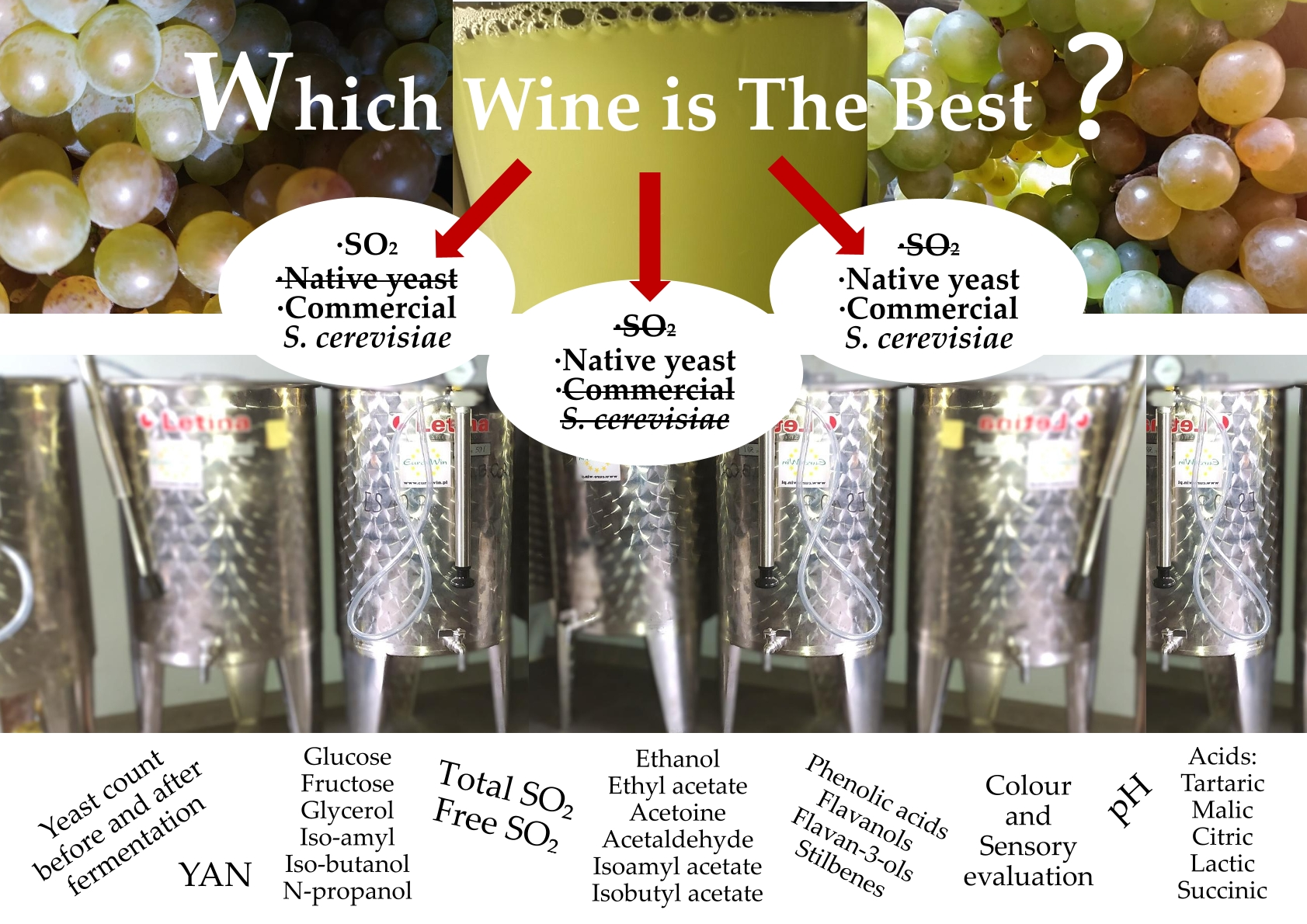
- NoSO2-Spont: spontaneous fermentation without SO2 addition and without inoculation (indigenous microbiota).
- NoSO2Sc: no SO2 addition; inoculated with Saccharomyces cerevisiae ES181.
- SO2Sc: sulphited must; inoculated with S. cerevisiae ES181.
3.3. Yeast, Identification and Content
3.4. Compounds in Wine—Identification and Content
3.5. Identification of Phenolic Compounds with the UPLC-PDA/MS Method
3.6. Colour Measurement
3.7. Sensory Evaluation
3.8. Statistical Analysis
4. Conclusions
Author Contributions
Funding
Institutional Review Board Statement
Informed Consent Statement
Data Availability Statement
Conflicts of Interest
References
- Vally, H.; Misso, N.L.A. Adverse reactions to the sulphite additives. Gastroenterol. Hepatol. Bed Bench 2012, 5, 16–23. [Google Scholar]
- Błaszak, M.; Nowak, A.; Lachowicz, S.; Migdał, W.; Ochmian, I. E-Beam Irradiation and Ozonation as an Alternative to the Sulphuric Method of Wine Preservation. Molecules 2019, 24, 3406. [Google Scholar] [CrossRef]
- Silva, M.; Lidon, F. Food preservatives—An overview on applications and side effects. Emir. J. Food Agric. 2016, 28, 366–373. [Google Scholar] [CrossRef]
- Magnuson, B.; Munro, I.; Abbot, P.; Baldwin, N.; Lopez Garcia, R.; Ly, K.; McGirr, L.; Roberts, A.; Socolovsky, S. Review of the regulation and safety assessment of food substances in various countries and jurisdictions. Food Addit. Contam. Part A 2013, 30, 1147–1220. [Google Scholar] [CrossRef] [PubMed]
- Mercanti, N.; Macaluso, M.; Marianelli, A.; Mannucci, I.; Casu, B.; Palla, F.; Verdini, P.G.; Fedel, M.; Zinnai, A. Precision vinification without added sulphur dioxide: Real-time gas monitoring across multiple vintages. Foods 2026, 15, 563. [Google Scholar] [CrossRef]
- Francesca, N.; Sannino, C.; Settanni, L.; Corona, O.; Barone, E.; Moschetti, G. Microbiological and chemical monitoring of Marsala base wine obtained by spontaneous fermentation during large-scale production. Ann. Microbiol. 2014, 64, 1643–1657. [Google Scholar] [CrossRef]
- Malfeito-Ferreira, M. Yeasts and wine off-flavours: A technological perspective. Ann. Microbiol. 2011, 61, 95–102. [Google Scholar] [CrossRef]
- Barata, A.; Malfeito-Ferreira, M.; Loureiro, V. The microbial ecology of wine grape berries. Int. J. Food Microbiol. 2012, 153, 243–259. [Google Scholar] [CrossRef] [PubMed]
- Pei, Y.; Chen, M.; Chen, Q. Microbial dynamics in a Musalais wine fermentation: A metagenomic study. Foods 2025, 14, 2570. [Google Scholar] [CrossRef] [PubMed]
- Xu, W.; Liu, B.; Wang, C.; Kong, X. Organic cultivation of grape affects yeast succession and wine sensory quality during spontaneous fermentation. LWT 2020, 120, 108894. [Google Scholar] [CrossRef]
- Lu, Y.; Sun, F.; Wang, W.; Liu, Y.; Wang, J.; Sun, J.; Mu, J.; Gao, Z. Effects of spontaneous fermentation on the micro-organisms diversity and volatile compounds during ‘Marselan’ from grape to wine. LWT 2020, 134, 110193. [Google Scholar] [CrossRef]
- Benito, S.; Ruiz, J.; Belda, I.; Kiene, F.; Beisert, B.; Navascués, E.; Marquina, D.; Calderón, F.; Santos, A.; Rauhut, D. Application of non-Saccharomyces yeasts in wine production. In Non-Conventional Yeasts: From Basic Research to Application; Sibirny, A., Ed.; Springer: Cham, Switzerland, 2019; pp. 75–89. [Google Scholar] [CrossRef]
- Vilanova, M.; Ugliano, M.; Varela, C.; Siebert, T.; Pretorius, I.S.; Henschke, P.A. Assimilable nitrogen utilisation and production of volatile and non-volatile compounds in chemically defined medium by Saccharomyces cerevisiae wine yeasts. Appl. Microbiol. Biotechnol. 2007, 77, 145–157. [Google Scholar] [CrossRef]
- Wei, R.; Wang, L.; Ding, Y.; Zhang, L.; Gao, F.; Chen, N.; Song, Y.; Li, H.; Wang, H. Natural and sustainable wine: A review. Crit. Rev. Food Sci. Nutr. 2023, 63, 8249–8260. [Google Scholar] [CrossRef]
- Kostelnikova, K.; Baron, M.; Kumsta, M.; Sochor, J. The influence of winemaking processes on the formation of biogenic amines in wine. Fermentation 2025, 11, 687. [Google Scholar] [CrossRef]
- Bene, Z.; Hegyi, Á.I.; Weninger, H.; Váczy, K.Z. Metschnikowia pulcherrima as a tool for sulphite reduction and enhanced volatile retention in noble rot wine fermentation. Fermentation 2025, 11, 491. [Google Scholar] [CrossRef]
- Ochmian, I.; Malinowski, R. Effect of multi-year protection of grapevines with copper pesticides on the content of heavy metals in soil, leaves, and fruit. Agronomy 2024, 14, 1677. [Google Scholar] [CrossRef]
- Ochmian, I.; Przemieniecki, S.W.; Błaszak, M.; Twarużek, M.; Lachowicz-Wiśniewska, S. Antioxidant, nutritional properties, microbiological, and health safety of juice from organic and conventional “Solaris” wine (Vitis vinifera L.) farming. Antioxidants 2024, 13, 1214. [Google Scholar] [CrossRef] [PubMed]
- Liu, J.; Toldam-Andersen, T.B.; Petersen, M.A.; Zhang, S.; Arneborg, N.; Bredie, W.L.P. Instrumental and sensory characterisation of Solaris white wines in Denmark. Food Chem. 2015, 166, 133–142. [Google Scholar] [CrossRef] [PubMed]
- Zhang, S.; Petersen, M.A.; Liu, J.; Toldam-Andersen, T.B. Influence of pre-fermentation treatments on wine volatile and sensory profile of the new disease tolerant cultivar Solaris. Molecules 2015, 20, 21609–21625. [Google Scholar] [CrossRef] [PubMed]
- Garrido-Bañuelos, G.; Ballester, J.; Buica, A.; Mihnea, M. Exploring the typicality, sensory space, and chemical composition of Swedish Solaris wines. Foods 2020, 9, 1107. [Google Scholar] [CrossRef]
- Duley, G.; Ceci, A.T.; Longo, E.; Darnal, A.; Boselli, E. Are white wines from disease-resistant hybrid grapes comparable to Vitis vinifera? A chemical and sensory analysis from South Tyrol. OENO One 2025, 59, 1–18. [Google Scholar] [CrossRef]
- Morgan, S.C.; Tantikachornkiat, M.; Scholl, C.M.; Benson, N.L.; Cliff, M.A.; Durall, D.M. The effect of sulfur dioxide addition at crush on the fungal and bacterial communities and the sensory attributes of Pinot gris wines. Int. J. Food Microbiol. 2019, 290, 1–14. [Google Scholar] [CrossRef] [PubMed]
- Álvarez-Barragán, J.; Mallard, J.; Ballester, J.; David, V.; Vichi, S.; Tourdot-Maréchal, R.; Alexandre, H.; Roullier-Gall, C. Influence of spontaneous, “pied de cuve” and commercial dry yeast fermentation strategies on wine molecular composition and sensory properties. Food Res. Int. 2023, 174, 113648. [Google Scholar] [CrossRef]
- Bekris, F.; Lola, D.; Papadopoulou, E.; Vasileiadis, S.; Paramithiotis, S.; Kotseridis, Y.; Karpouzas, D.G. Spontaneous vinification supports different microbiota, volatilome and leads to wines with different sensory attributes compared to vinifications inoculated with commercial and indigenous to Vidiano cultivar Saccharomyces cerevisiae. LWT 2024, 205, 116543. [Google Scholar] [CrossRef]
- Imre, A.; Crook, N. The emerging roles of non-Saccharomyces yeasts in fermented foods and human health. FEMS Yeast Res. 2025, 25, foaf056. [Google Scholar] [CrossRef]
- Feng, X.; Dong, Y.; Feng, Y.; Zhang, A.; Huang, Z.; Wang, S.; Niu, D. Recent advances in physical/chemical methods as alternatives to SO2 for winemaking: Principles, challenges and perspectives. Innov. Food Sci. Emerg. Technol. 2024, 97, 103839. [Google Scholar] [CrossRef]
- Fazio, N.A.; Di Sanzo, R.; Marino, G.; Carabetta, S.; Ligato, F.; Ioppolo, F.; Caccamo, M. Impact of native S. cerevisiae and non-Saccharomyces yeasts in chemical, aromatic, and sensory profiles of Carricante wines. Food Biosci. 2025, 68, 106559. [Google Scholar] [CrossRef]
- Romano, P.; Fiore, C.; Paraggio, M.; Caruso, M.; Capece, A. Function of yeast species and strains in wine flavour. Int. J. Food Microbiol. 2003, 86, 169–180. [Google Scholar] [CrossRef]
- Cui, W.; Wang, X.; Han, S.; Guo, W.; Meng, N.; Li, J.; Sun, B.; Zhang, X. Research progress of tartaric acid stabilization on wine characteristics. Food Chem. X 2024, 23, 101728. [Google Scholar] [CrossRef]
- Ribéreau-Gayon, P.; Glories, Y.; Maujean, A.; Dubourdieu, D. Handbook of Enology: The Chemistry of Wine—Stabilization and Treatments, 2nd ed.; John Wiley & Sons: Chichester, UK, 2006; Volume 2. [Google Scholar]
- Sánchez-Suárez, F.; Palenzuela, M.d.V.; Rosal, A.; Peinado, R.A. Innovative fermentation approach employing Lachancea thermotolerans for the selective production of high-acidity wines, designed for blending with low-acidity counterparts to achieve chemically and organoleptically balanced final compositions. Foods 2025, 14, 2773. [Google Scholar] [CrossRef]
- Payan, C.; Gancel, A.-L.; Jourdes, M.; Christmann, M.; Teissedre, P.-L. Wine acidification methods: A review. OENO One 2023, 57, 113–126. [Google Scholar] [CrossRef]
- Paramithiotis, S.; Stasinou, V.; Tzamourani, A.; Kotseridis, Y.; Dimopoulou, M. Malolactic fermentation—Theoretical advances and practical considerations. Fermentation 2022, 8, 521. [Google Scholar] [CrossRef]
- Balmaseda, A.; Miot-Sertier, C.; Lytra, G.; Poulain, B.; Reguant, C.; Lucas, P.; Nioi, C. Application of white wine lees for promoting lactic acid bacteria growth and malolactic fermentation in wine. Int. J. Food Microbiol. 2024, 413, 110583. [Google Scholar] [CrossRef] [PubMed]
- Windholtz, S.; Miot-Sertier, C.; Maupeu, J.; Vallet-Courbin, A.; Lucas, M.; Pelonnier-Magimel, E.; Duarte, V.; Becquet, S.; Vinsonneau, E.; Lucas, P.; et al. Influence of sulphur dioxide management on microbial populations during wine ageing. OENO One 2025, 59, 9346. [Google Scholar] [CrossRef]
- Chidi, B.S.; Bauer, F.F.; Rossouw, D. Organic acid metabolism and the impact of fermentation practices on wine acidity: A review. S. Afr. J. Enol. Vitic. 2018, 39, 315–329. [Google Scholar] [CrossRef]
- Vilela, A. Use of nonconventional yeasts for modulating wine acidity. Fermentation 2019, 5, 27. [Google Scholar] [CrossRef]
- Jackson, R.S. Wine Science: Principles and Applications, 5th ed.; Academic Press: Amsterdam, The Netherlands, 2020. [Google Scholar]
- Waterhouse, A.L.; Sacks, G.L.; Jeffery, D.W. Understanding Wine Chemistry, 2nd ed.; John Wiley & Sons: Hoboken, NJ, USA, 2024. [Google Scholar]
- du Toit, W.J.; Marais, J.; Pretorius, I.S.; Du Toit, M. Oxygen in must and wine: A review. S. Afr. J. Enol. Vitic. 2006, 27, 76–94. [Google Scholar] [CrossRef]
- Nioi, C.; Lisanti, M.T.; Meunier, F.; Massot, A.; Moine, V. Yeast derivatives: A promising alternative for white wine oxidation prevention. IVES Tech. Rev. Vine Wine 2023, 7665. [Google Scholar] [CrossRef]
- Liu, W.; Ji, R.; Aimaier, A.; Sun, J.; Pu, X.; Shi, X.; Cheng, W.; Wang, B. Adjustment of impact phenolic compounds, antioxidant activity and aroma profile in Cabernet Sauvignon wine by mixed fermentation of Pichia kudriavzevii and Saccharomyces cerevisiae. Food Chem. X 2023, 18, 100685. [Google Scholar] [CrossRef]
- Puxeu, M.; Sánchez-Mateos, C.; Horcajo-Abal, I.; Sunyer-Figueres, M.; Castillo, V.; Fernández-Vázquez, D.; Andorrà, I. Effect of UHPH and sulphur dioxide content on Verdejo vinification: Sensory, chemical, and microbiological approach after accelerated aging test. Microorganisms 2025, 13, 2623. [Google Scholar] [CrossRef]
- Comuzzo, P.; del Fresno, J.M.; Voce, S.; Loira, I.; Morata, A. Emerging biotechnologies and non-thermal technologies for winemaking in a context of global warming. Front. Microbiol. 2023, 14, 1273940. [Google Scholar] [CrossRef]
- Regodón Mateos, J.A.; Pérez-Nevado, F.; Ramírez Fernández, M. Influence of Saccharomyces cerevisiae yeast strain on the major volatile compounds of wine. Enzym. Microb. Technol. 2006, 40, 151–157. [Google Scholar] [CrossRef]
- Fleet, G.H. Yeast interactions and wine flavour. Int. J. Food Microbiol. 2003, 86, 11–22. [Google Scholar] [CrossRef] [PubMed]
- Jolly, N.P.; Varela, C.; Pretorius, I.S. Not your ordinary yeast: Non-Saccharomyces yeasts in wine production uncovered. FEMS Yeast Res. 2014, 14, 215–237. [Google Scholar] [CrossRef] [PubMed]
- Yalcin, S.K.; Ozbas, Z.Y. Effects of pH and temperature on growth and glycerol production kinetics of two indigenous wine strains of Saccharomyces cerevisiae from Turkey. Braz. J. Microbiol. 2008, 39, 325–332. [Google Scholar] [CrossRef]
- Lambrechts, M.G.; Pretorius, I.S. Yeast and its importance to wine aroma—A review. S. Afr. J. Enol. Vitic. 2000, 21, 97–129. [Google Scholar] [CrossRef]
- Cortés-Diéguez, S.; Rodriguez-Solana, R.; Domínguez, J.M.; Díaz, E. Impact odorants and sensory profile of young red wines from four Galician (NW of Spain) traditional cultivars. J. Inst. Brew. 2015, 121, 628–635. [Google Scholar] [CrossRef]
- Llauradó, J.M.; Rozès, N.; Constantí, M.; Mas, A. Study of some Saccharomyces cerevisiae strains for winemaking after preadaptation at low temperatures. J. Agric. Food Chem. 2005, 53, 1003–1011. [Google Scholar] [CrossRef]
- Jiang, B.; Zhang, Z. Volatile compounds of young wines from Cabernet Sauvignon, Cabernet Gernischet and Chardonnay varieties grown in the Loess Plateau region of China. Molecules 2010, 15, 9184–9196. [Google Scholar] [CrossRef]
- Zoecklein, B.; Fugelsang, K.C.; Gump, B.H.; Nury, F.S. Wine Analysis and Production; Springer: New York, NY, USA, 2013. [Google Scholar] [CrossRef]
- Cucciniello, R.; Forino, M.; Picariello, L.; Coppola, F.; Moio, L.; Gambuti, A. How acetaldehyde reacts with low molecular weight phenolics in white and red wines. Eur. Food Res. Technol. 2021, 247, 2935–2944. [Google Scholar] [CrossRef]
- Styger, G.; Prior, B.; Bauer, F.F. Wine flavor and aroma. J. Ind. Microbiol. Biotechnol. 2011, 38, 1145–1159. [Google Scholar] [CrossRef] [PubMed]
- Ciani, M.; Comitini, F.; Mannazzu, I.; Domizio, P. Controlled mixed culture fermentation: A new perspective on the use of non-Saccharomyces yeasts in winemaking. FEMS Yeast Res. 2010, 10, 123–133. [Google Scholar] [CrossRef]
- Salvadores, M.P.; Díaz, M.E.; Cardell, E. Autochthonous yeasts isolated in Tenerife wines and their influence on ethyl acetate and higher alcohol concentrations analyzed by gas chromatography. Microbiologia 1993, 9, 107–112. [Google Scholar] [PubMed]
- Kelly, J.; van Dyk, S.; Dowling, L.K.; Pickering, G.; Kemp, B.S.; Inglis, D. Saccharomyces bayanus isolate consumes acetic acid during fermentation of high sugar juice and juice with high starting volatile acidity. OENO One 2020, 54, 199–211. [Google Scholar] [CrossRef]
- Ferreira-Lima, N.; Vallverdú-Queralt, A.; Meudec, E.; Pinasseau, L.; Verbaere, A.; Bordignon-Luiz, M.T.; Le Guernevé, C.; Cheynier, V.; Sommerer, N. Quantification of hydroxycinnamic derivatives in wines by UHPLC-MRM-MS. Anal. Bioanal. Chem. 2018, 410, 3483–3490. [Google Scholar] [CrossRef]
- Motta, S.; Tirelli, A.; Guaita, M.; Bosso, A. Effect of SO2, glutathione and gallotannins on the shelf-life of a Cortese white wine bottled with different oxygen intakes. OENO One 2022, 56, 221–235. [Google Scholar] [CrossRef]
- Garcia, L.; Poulain, B.; Douliez, A.; Naud, E.; Valls-Fonayet, J.; Nioi, C. White wine lees as a source of antioxidants: Insights into their chemical profile. Food Chem. 2025, 494, 146118. [Google Scholar] [CrossRef]
- Cheynier, V.; Comte, G.; Davies, K.M.; Lattanzio, V.; Martens, S. Plant phenolics: Recent advances on their biosynthesis, genetics, and ecophysiology. Plant Physiol. Biochem. 2013, 72, 1–20. [Google Scholar] [CrossRef]
- Ochmian, I.; Angelov, L.; Chełpiński, P.; Stalev, B.; Rozwarski, R.; Dobrowolska, A. The characteristics of fruits morphology, chemical composition and colour changes in must during maceration of three grapevine cultivars. J. Hortic. Res. 2013, 21, 71–78. [Google Scholar] [CrossRef]
- Chatonnet, P.; Dubourdieu, D.; Boidron, J.-N.; Lavigne, V. Synthesis of volatile phenols by Saccharomyces cerevisiae in wines. J. Sci. Food Agric. 1993, 62, 191–202. [Google Scholar] [CrossRef]
- Pachnowska, K.; Kochel-Karakulska, J.; Augustyniak, A.; Obradović, V.; Ochmian, I.; Lachowicz-Wiśniewska, S.; Kapusta, I.; Maślana, K.; Mijowska, E.; Cendrowski, K. UV-C and nanomaterial-based approaches for sulfite-free wine preservation: Effects on polyphenol profile and microbiological quality. Molecules 2025, 30, 221. [Google Scholar] [CrossRef]
- Santos, M.C.; Nunes, C.; Saraiva, J.A.; Coimbra, M.A. Chemical and physical methodologies for the replacement/reduction of sulfur dioxide use during winemaking: Review of their potentialities and limitations. Eur. Food Res. Technol. 2012, 234, 1–12. [Google Scholar] [CrossRef]
- Ribéreau-Gayon, P.; Dubourdieu, D.; Donèche, B.; Lonvaud, A. Handbook of Enology: The Microbiology of Wine and Vinifications, 2nd ed.; John Wiley & Sons: Chichester, UK, 2006; Volume 1. [Google Scholar]
- Schneider, V.; Kost, C. Routine measurement of flavonoid phenols related to astringency and premature aging of white wines, and technical consequences. Internet J. Vitic. Enol. 2021, 6, 3. [Google Scholar]
- Kennedy, J.A. Grape and wine phenolics: Observations and recent findings. Cienc. Investig. Agrar. 2008, 35, 107–120. [Google Scholar] [CrossRef]
- Ćorković, I.; Pichler, A.; Šimunović, J.; Kopjar, M. A comprehensive review on polyphenols of white wine: Impact on wine quality and potential health benefits. Molecules 2024, 29, 5074. [Google Scholar] [CrossRef] [PubMed]
- Liu, S.; Boschian, L.; Čuletić, A.; Pizzinato, D.; Sparrow, C.; Vincenzi, S. Influence of matter other than grapes on quercetin evolution and wine polyphenols. OENO One 2025, 59, 8491. [Google Scholar] [CrossRef]
- Singleton, V.L. Oxygen with phenols and related reactions in musts, wines, and model systems: Observations and practical implications. Am. J. Enol. Vitic. 1987, 38, 69–77. [Google Scholar] [CrossRef]
- Gambuti, A.; Picariello, L.; Rinaldi, A.; Forino, M.; Blaiotta, G.; Moine, V.; Moio, L. New insights into the formation of precipitates of quercetin in Sangiovese wines. J. Food Sci. Technol. 2020, 57, 2602–2611. [Google Scholar] [CrossRef]
- Bustamante, M.; Gil-Cortiella, M.; Peña-Neira, Á.; Gombau, J.; García-Roldán, A.; Cisterna, M.; Montané, X.; Fort, F.; Rozès, N.; Canals, J.M.; et al. Oxygen-induced enzymatic and chemical degradation kinetics in wine model solution of selected phenolic compounds involved in browning. Food Chem. 2025, 484, 144421. [Google Scholar] [CrossRef]
- Atanacković, M.; Petrović, A.; Jović, S.; Gojković-Bukarica, L.; Bursać, M.; Cvejić, J. Influence of winemaking techniques on the resveratrol content, total phenolic content and antioxidant potential of red wines. Food Chem. 2012, 131, 513–518. [Google Scholar] [CrossRef]
- Wenzel, E.; Somoza, V. Metabolism and bioavailability of trans-resveratrol. Mol. Nutr. Food Res. 2005, 49, 472–481. [Google Scholar] [CrossRef]
- Zhao, Y.; Shi, M.; Ye, J.-H.; Zheng, X.-Q.; Lu, J.-L.; Liang, Y.-R. Photo-Induced chemical reaction of trans-resveratrol. Food Chem. 2015, 171, 137–143. [Google Scholar] [CrossRef]
- Jaa, A.; de Moura, P.H.B.; Valls-Fonayet, J.; Da Costa, G.; Ruiz-Larrea, M.B.; Krisa, S.; Richard, T. Stilbenes in red wine: Formation and biological potential of resveratrol and piceid dimers. Molecules 2024, 29, 6067. [Google Scholar] [CrossRef]
- Jaa, A.; de Moura, P.H.B.; Ruiz-Larrea, M.B.; Ruiz Sanz, J.I.; Richard, T. Potential transformation of food resveratrol: Mechanisms and biological impact. Molecules 2025, 30, 536. [Google Scholar] [CrossRef] [PubMed]
- Gawel, R. Red wine astringency: A review. Aust. J. Grape Wine Res. 1998, 4, 74–95. [Google Scholar] [CrossRef]
- González-Manzano, S.; Rivas-Gonzalo, J.C.; Santos-Buelga, C. Extraction of flavan-3-ols from grape seed and skin into wine using simulated maceration. Anal. Chim. Acta 2004, 513, 283–289. [Google Scholar] [CrossRef]
- Magwaza, B.; Amobonye, A.; Pillai, S. Microbial β-glucosidases: Recent advances and applications. Biochimie 2024, 225, 49–67. [Google Scholar] [CrossRef]
- Noviello, M.; Antonino, C.; Gambacorta, G.; Paradiso, V.M.; Caponio, F. Use of vine-shoots stilbene extract to the reduction of SO2 in red and rosé Italian wine: Effect on phenolic, volatile, and sensory profiles. Heliyon 2024, 10, e34310. [Google Scholar] [CrossRef] [PubMed]
- Romano, P.; Braschi, G.; Siesto, G.; Patrignani, F.; Lanciotti, R. Role of yeasts on the sensory component of wines. Foods 2022, 11, 1921. [Google Scholar] [CrossRef]
- Bindon, K.A.; Kassara, S.; Hayasaka, Y.; Schulkin, A.; Smith, P.A. Commercial Saccharomyces cerevisiae yeast strains significantly differ in their effects on wine macromolecular phenolics and mouthfeel attributes. Molecules 2019, 24, 3118. [Google Scholar]
- Sun, Q.; Cui, R.; Zhao, Y. Regional aroma characteristics of spontaneously fermented Cabernet Sauvignon wines produced from seven sub-regions in Shangri-La of China. Sci. Rep. 2024, 14, 24566. [Google Scholar] [CrossRef] [PubMed]
- Toldam-Andersen, T.B.; Zhang, S.; Liu, J.; Bredie, W.L.P.; Petersen, M.A. Sulfite management during vinification and impact on the flavor of Solaris wine. Fermentation 2024, 10, 210. [Google Scholar] [CrossRef]
- Philipp, C.; Bagheri, B.; Horacek, M.; Eder, P.; Bauer, F.F.; Setati, M.E. Inoculation of grape musts with single strains of Saccharomyces cerevisiae yeast reduces the diversity of chemical profiles of wines. PLoS ONE 2021, 16, e0254919. [Google Scholar] [CrossRef]
- Błaszak, M.; Lachowicz-Wiśniewska, S.; Kapusta, I.; Szewczuk, M.; Ochmian, I. Enhanced extraction of polyphenols, physicochemical properties, and microbial control in Vitis vinifera L. juice using ultrasound-assisted maceration. Molecules 2025, 30, 587. [Google Scholar] [CrossRef]
- Błaszak, M.; Jakubowska, B.; Lachowicz-Wiśniewska, S.; Migdał, W.; Gryczka, U.; Ochmian, I. Effectiveness of E-beam radiation against Saccharomyces cerevisiae, Brettanomyces bruxellensis, and wild yeast and their influence on wine quality. Molecules 2023, 28, 4867. [Google Scholar] [CrossRef]
- OIV (International Organisation of Vine and Wine). OIV-MA-AS323-04A1: Free Sulphur Dioxide (Type IV Method). In Compendium of International Methods of Wine and Must Analysis; OIV: Paris, France, 2021. [Google Scholar]
- OIV (International Organisation of Vine and Wine). OIV-MA-AS323-04A2: Total Sulphur Dioxide (Type II Method). In Compendium of International Methods of Wine and Must Analysis; OIV: Paris, France, 2021. [Google Scholar]
- Ruraż, K.; Przemieniecki, S.W.; Błaszak, M.; Czarnomska, S.D.; Ochmian, I.; Piwowarczyk, R. Stigmas of holoparasitic Phelipanche arenaria (Orobanchaceae)—A suitable ephemeric flower habitat for development unique microbiome. BMC Plant Biol. 2023, 23, 486. [Google Scholar] [CrossRef]
- OIV (International Organisation of Vine and Wine). OIV-MA-AS313-15: pH (Type I Method). In Compendium of International Methods of Analysis of Wines and Musts; OIV: Paris, France, 2011. [Google Scholar]
- OIV (International Organisation of Vine and Wine). OIV-MA-AS313-01: Total Acidity (Type I Method). In Compendium of International Methods of Analysis of Wines and Musts; OIV: Paris, France, 2015. [Google Scholar]
- OIV (International Organisation of Vine and Wine). OIV-MA-AS312-01A: Alcoholic Strength by Volume. In Compendium of International Methods of Analysis of Wines and Musts; OIV: Paris, France, 2016. [Google Scholar]
- OIV (International Organisation of Vine and Wine). OIV-MA-AS322-01: Ammonium (Type IV Method). In Compendium of International Methods of Analysis of Wines and Musts; OIV: Paris, France, 2009. [Google Scholar]
- Dukes, B.C.; Butzke, C.E. Rapid determination of primary amino acids in grape juice using an o-phthaldialdehyde/N-acetyl-L-cysteine spectrophotometric assay. Am. J. Enol. Vitic. 1998, 49, 125–134. [Google Scholar] [CrossRef]
- Di Stefano, R.; Ciolfi, G. Produzione di acetaldeide da parte di stipiti di lieviti di specie diverse. Riv. Vitic. Enol. 1982, 35, 474–480. [Google Scholar]
- OIV (International Organisation of Vine and Wine). OIV-MA-AS313-02: Volatile Acidity (Type I Method). In Compendium of International Methods of Analysis of Wines and Musts; OIV: Paris, France, 2015. [Google Scholar]



| Variants ** | Before * | After |
|---|---|---|
| log10 CFU/mL | ||
| NoSO2-Spont | 4.88 d *** | 1.48 a |
| NoSO2Sc | 5.51 f | 4.40 c |
| SO2Sc | 5.40 e | 3.63 b |
| Parameters | Must | SO2Sc ** | NoSO2-Spont | NoSO2Sc | |
|---|---|---|---|---|---|
| pH | 3.27 a | 3.38 ab | 3.46 b | 3.41 b | |
| Total SO2 (mg/L) | 5 a | 44 b | 6 a | 7 a | |
| Free SO2 (mg/L) | 3 a | 27 b | 3 a | 3 a | |
| Glucose (g/L) | 108 c | 0.3 a | 2.4 b | 0.8 a | |
| Fructose (g/L) | 122 c | 1.6 a | 4.5 b | 2.3 a | |
| Titratable acidity, TA (g/L) | 7.47 c | 7.02 a | 7.31 b | 7.57 c | |
| Tartaric acid (g/L) | 4.5 c | 4 b | 3.5 a | 3.8 ab | |
| Malic acid (g/L) | 2.5 c | 2.1 a | 2.3 b | 2.5 c | |
| Citric acid (g/L) | 0.2 a | 0.2 a | 0.1 a | 0.2 a | |
| Lactic acid (g/L) | 0.07 a | 0.12 a | 0.21 b | 0.27 b | |
| Succinic acid (g/L) | 0.2 a | 0.6 b | 1.2 c | 0.8 b | |
| YAN (mg/L) | 250 c | 18 b | 12 a | 23 b | |
| L * | 69.40 a | 78.55 c | 77.47 bc | 76.49 b | |
| Colour CIE | a * | 0.25 a | −0.57 b | −2.26 d | −0.94 c |
| b * | 11.06 d | 2.52 a | 6.21 c | 3.79 b | |
| Parameters | SO2Sc ** | NoSO2-Spont | NoSO2Sc |
|---|---|---|---|
| Ethanol % v/v | 13.5 b | 12.9 a | 13.4 b |
| Glycerol (g/L) | 7.7 a | 14.5 c | 10.2 b |
| Iso-amyl (mg/L) | 57.0 a | 115.9 c | 81.5 b |
| Iso-butanol (mg/L) | 24.2 c | 15.0 a | 20.2 b |
| N-propanol (mg/L) | 19.8 a | 26.6 c | 21.6 b |
| 2 and 3-Methyl-butanol (mg/L) | 36.4 a | 62.1 c | 44.7 b |
| Ethyl acetate (mg/L) | 44.8 c | 20.6 a | 25.9 b |
| Acetoin (mg/L) | 0.21 b | 0.53 c | 0.15 a |
| Acetaldehyde (mg/L) | 34.9 a | 55.7 c | 39.2 b |
| Isoamyl acetate (mg/L) | 0.12 a | 0.23 b | 0.14 a |
| Isobutyl acetate (mg/L) | 0.19 a | 0.29 c | 0.24 b |
| Volatile acidity (g/L acetic acid) | 0.21 a | 0.78 b | 0.74 b |
| Compounds (µg/mL) | Must | SO2Sc ** | NoSO2-Spont | NoSO2Sc | |
|---|---|---|---|---|---|
| Phenolic acids | Gallic acid | 0.10 b | 0.05 a * | 0.19 c | 0.22 d |
| Protocatechuic acid | 0.16 a | 0.17 a | 0.19 a | 0.31 b | |
| Caftaric acid | 3.00 c | 1.00 a | 1.83 b | 6.32 d | |
| Coutaric acid | 2.20 b | 1.92 a | 2.38 c | 2.98 d | |
| Caffeic acid | 0.10 ab | 0.08 a | 0.13 b | 0.15 b | |
| p-Coumaric acid | 0.14 b | 0.05 a | 0.21 c | 0.26 d | |
| Coumaric acid | 0.11 a | 0.13 a | 0.13 a | 0.14 a | |
| Ferulic acid | 0.17 a | 0.18 a | 0.17 a | 0.17 a | |
| Sum | 5.98 b | 3.58 a | 5.23 b | 10.53 c | |
| Flavonols | Myricetin 3-O-glucoside | 0.01 a | 0.01 a | 0.01 a | 0.01 a |
| Myricetin 3-O-rutinoside | 0.01 a | 0.01 a | 0.03 b | 0.03 b | |
| Quercetin 3-O-rutinoside | 0.06 b | 0.01 a | 0.15 c | 0.25 d | |
| Isorhamnetin 3-O-glucoside | 0.03 b | 0.01 a | 0.04 b | 0.12 c | |
| Quercetin 3-O-glucoside | 0.12 b | 0.03 a | 0.38 c | 0.55 d | |
| Dihydroquercetin 3-O-rhamnoside | 0.02 a | 0.03 a | 0.02 a | 0.05 b | |
| Quercetin 3-O-rhamnoside | 0.20 b | 0.05 a | 0.70 c | 1.19 d | |
| Sum | 0.45 b | 0.15 a | 1.32 c | 2.20 d | |
| Flavan-3-ols | Procyanidin type B | 1.60 a | 2.92 b | 2.93 b | 3.60 c |
| Procyanidin type B | 0.85 a | 1.36 b | 1.42 b | 1.79 c | |
| (+)-catechin | 0.30 a | 0.42 b | 0.45 b | 0.61 c | |
| Procyanidin type A | 1.00 a | 1.66 b | 1.80 c | 2.14 d | |
| Procyanidin type A | 0.16 a | 0.23 b | 0.26 b | 0.34 c | |
| (−)-epicatechin | 2.10 a | 3.16 b | 4.04 c | 5.44 d | |
| Epicatechin gallate | 1.30 a | 2.21 b | 2.41 c | 3.03 d | |
| Sum | 7.31 a | 11.96 b | 13.31 c | 16.96 d | |
| Stilbenes | Trans-resveratrol | 0.03 a | 0.03 a | 0.04 a | 0.08 b |
| Cis-resveratrol | 0.18 a | 0.26 b | 0.28 b | 0.35 c | |
| Trans-piceid | 0.45 a | 0.67 c | 0.60 b | 0.60 b | |
| Cis-piceid | 0.25 a | 0.27 a | 0.42 b | 0.56 c | |
| Sum | 0.91 a | 1.23 a | 1.36 ab | 1.59 b | |
| TOTAL | 14.65 A | 16.92 A | 21.22 B | 31.28 C | |
| No. | Compound | RT * | [M-H]− | Fragment Ions | Absorbance Maxima |
|---|---|---|---|---|---|
| (min.) | (m/z) | (m/z) | (nm) | ||
| Phenolic acid | |||||
| 1 | Gallic acid | 1.47 | 169 | 125 | 272 |
| 2 | Protocatechuic acid | 2.25 | 153 | 109 | 308 |
| 3 | Caftaric acid | 2.49 | 311 | 179 | 328, 294 |
| 4 | Coutaric acid | 3.08 | 295 | 163 | 310 |
| 5 | Caffeic acid | 3.46 | 153 | 109 | 260, 294 |
| 6 | p-Coumaric acid | 4.39 | 163 | 119 | 308 |
| 7 | Coumaric acid | 4.82 | 163 | 119 | 310 |
| 8 | Ferulic acid | 4.92 | 193 | 134 | 323, 293 |
| Flavonols | |||||
| 1 | Myricetin 3-O-glucoside | 3.06 | 479 | 317 | 260, 353 |
| 2 | Myricetin 3-O-rutinoside | 3.53 | 625 | 463, 317 | 256, 356 |
| 3 | Quercetin 3-O-rutinoside | 3.73 | 609 | 447, 301 | 255, 355 |
| 4 | Isorhamnetin 3-O-glucoside | 4.26 | 477 | 315 | 254, 369 |
| 5 | Quercetin 3-O-glucoside | 4.32 | 463 | 301 | 253, 365 |
| 6 | Dihydroquercetin 3-O-rhamnoside | 4.67 | 449 | 303 | 253, 372 |
| 7 | Quercetin 3-O-rhamnoside | 4.99 | 447 | 301 | 254, 369 |
| Flavan-3-ols | |||||
| 1 | Procyanidin type B | 2.66 | 577 | 425, 285 | 280 |
| 2 | Procyanidin type B | 2.81 | 577 | 425, 285 | 276 |
| 3 | (+)-catechin | 3.01 | 289 | - | 280 |
| 4 | Procyanidin type A | 3.31 | 577 | 425, 285 | 279 |
| 5 | Procyanidin type A | 3.34 | 577 | 425, 285 | 280 |
| 6 | (−)-epicatechin | 3.68 | 289 | - | 280 |
| 7 | Epicatechin gallate | 4.06 | 441 | 289 | 279 |
| Stilbenes | |||||
| 1 | Trans-resveratrol | 6.24 | 227 | 185 | 327 |
| 2 | Cis-resveratrol | 7.42 | 227 | 143 | 327 |
| 3 | Trans-piceid | 4.75 | 389 | 227 | 327 |
| 4 | Cis-piceid | 5.94 | 389 | 227 | 327 |
Disclaimer/Publisher’s Note: The statements, opinions and data contained in all publications are solely those of the individual author(s) and contributor(s) and not of MDPI and/or the editor(s). MDPI and/or the editor(s) disclaim responsibility for any injury to people or property resulting from any ideas, methods, instructions or products referred to in the content. |
© 2026 by the authors. Licensee MDPI, Basel, Switzerland. This article is an open access article distributed under the terms and conditions of the Creative Commons Attribution (CC BY) license.
Share and Cite
Błaszak, M.; Ochmian, I.; Kapusta, I.; Lachowicz-Wiśniewska, S. SO2 Management and Yeast Inoculation Strategies (NoSO2-Spont, NoSO2Sc, SO2Sc) During Fermentation Shape the Chemical, Polyphenolic, Microbiological, and Sensory Profiles of ‘Solaris’ White Wine. Molecules 2026, 31, 1344. https://doi.org/10.3390/molecules31081344
Błaszak M, Ochmian I, Kapusta I, Lachowicz-Wiśniewska S. SO2 Management and Yeast Inoculation Strategies (NoSO2-Spont, NoSO2Sc, SO2Sc) During Fermentation Shape the Chemical, Polyphenolic, Microbiological, and Sensory Profiles of ‘Solaris’ White Wine. Molecules. 2026; 31(8):1344. https://doi.org/10.3390/molecules31081344
Chicago/Turabian StyleBłaszak, Magdalena, Ireneusz Ochmian, Ireneusz Kapusta, and Sabina Lachowicz-Wiśniewska. 2026. "SO2 Management and Yeast Inoculation Strategies (NoSO2-Spont, NoSO2Sc, SO2Sc) During Fermentation Shape the Chemical, Polyphenolic, Microbiological, and Sensory Profiles of ‘Solaris’ White Wine" Molecules 31, no. 8: 1344. https://doi.org/10.3390/molecules31081344
APA StyleBłaszak, M., Ochmian, I., Kapusta, I., & Lachowicz-Wiśniewska, S. (2026). SO2 Management and Yeast Inoculation Strategies (NoSO2-Spont, NoSO2Sc, SO2Sc) During Fermentation Shape the Chemical, Polyphenolic, Microbiological, and Sensory Profiles of ‘Solaris’ White Wine. Molecules, 31(8), 1344. https://doi.org/10.3390/molecules31081344