Chemical Constituents Comparison Between the Flowers of Sophora japonica L. and Robinia pseudoacacia L. by UPLC-Q-TOF-MS/MS and HPLC


Abstract
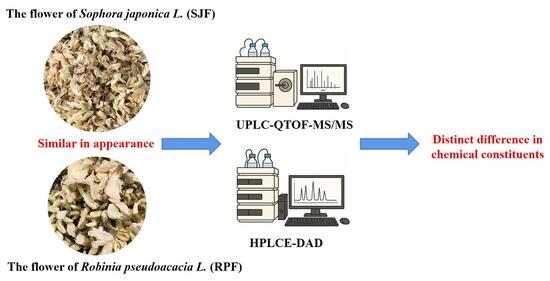
1. Introduction
2. Results and Discussion
2.1. Constituents Identification Through UPLC-Q-TOF-MS/MS Analysis
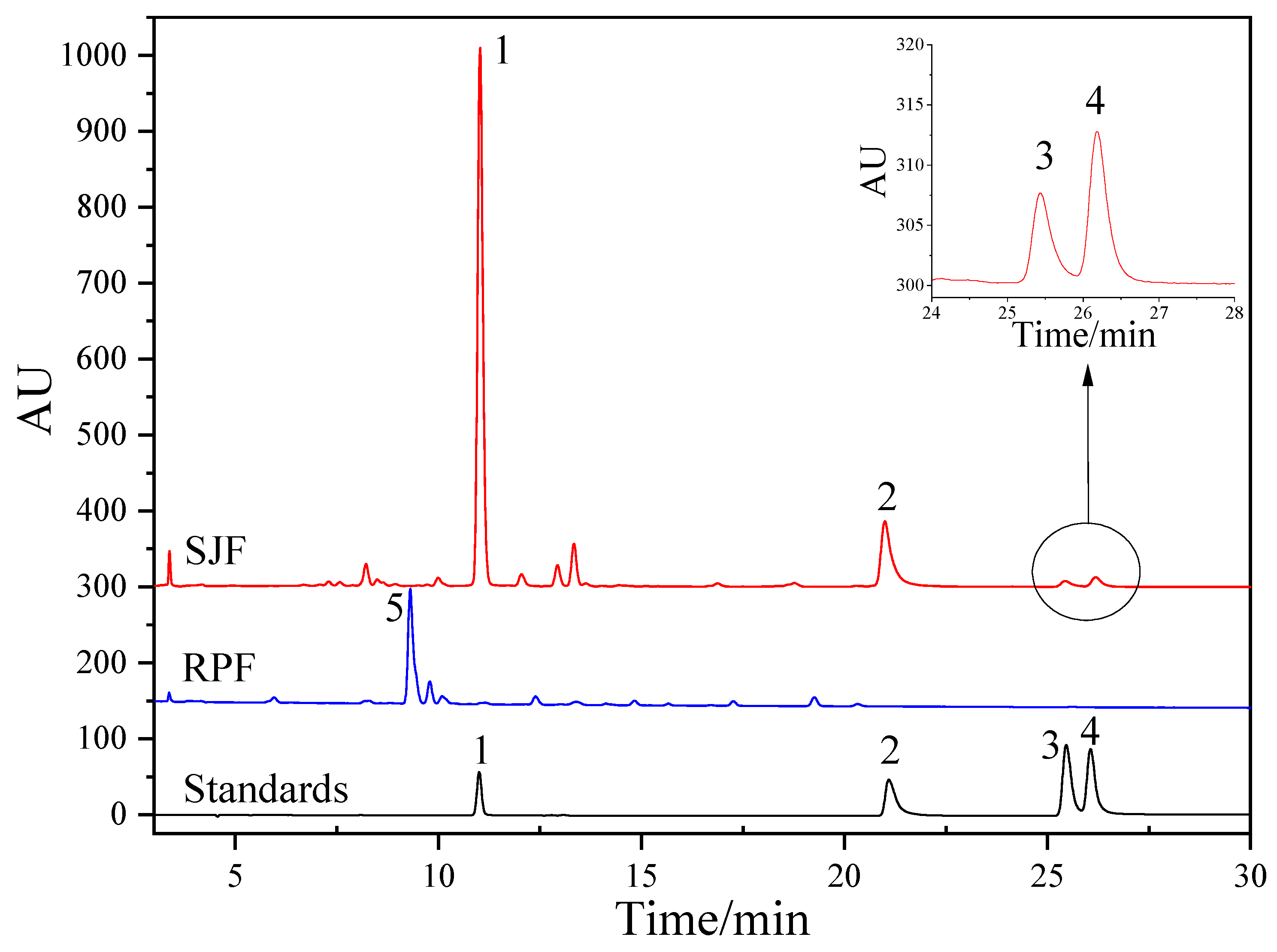
2.2. Quantification of Main Flavonoids in SJF and RPF by HPLC
3. Materials and Methods
3.1. Materials and Reagents
3.2. Sample Preparation and Extraction
3.3. UPLC-Q-TOF-MS/MS Analysis
3.4. HPLC Analysis
3.5. Statistical Analysis
4. Conclusions
Author Contributions
Funding
Institutional Review Board Statement
Informed Consent Statement
Data Availability Statement
Conflicts of Interest
References
- Chinese Pharmacopoeia Committee. Chinese Pharmacopoeia, Part 1; China Medical Science Press: Beijing, China, 2020; 370p. [Google Scholar]
- Xie, Z.; Lam, S.; Wu, J.; Yang, D.; Xu, X. Chemical fingerprint and simultaneous determination of flavonoids in Flos Sophorae Immaturus by HPLC-DAD and HPLC-DAD-ESI-MS/MS combined with chemometrics analysis. Anal. Methods 2014, 6, 4328–4335. [Google Scholar] [CrossRef] [Scilit]
- Guo, N.; Chen, Z.; Cao, S.; Shang, F. Sophora japonica L. bioactives: Chemistry, sources, and processing techniques. Food Front. 2024, 5, 1166–1187. [Google Scholar] [CrossRef] [Scilit]
- Wang, T.; Miao, M.; Bai, M.; Li, Y.; Li, M.; Li, C.; Xu, Y. Effect of sophora japonica total flavonoids on pancreas, kidney tissue morphology of streptozotocin-induced diabetic mice model. Saudi J. Biol. Sci. 2017, 24, 741–747. [Google Scholar] [CrossRef] [Scilit]
- Song, D.; Zhao, H.; Wang, L.; Wang, F.; Fang, L.; Zhao, X. Ethanol extract of Sophora japonica flower bud, an effective potential dietary supplement for the treatment of hyperuricemia. Food Biosci. 2023, 52, 102457. [Google Scholar] [CrossRef] [Scilit]
- Liu, Y.; Huang, W.; Ji, S.; Wang, J.; Luo, J.; Lu, B. Sophora japonica flowers and their main phytochemical, rutin, regulate chemically induced murine colitis in association with targeting the NF-κB signaling pathway and gut microbiota. Food Chem. 2022, 393, 133395. [Google Scholar] [CrossRef] [Scilit]
- Bhalla, P.; Bajpai, V.K. Chemical composition and antibacterial action of Robinia pseudoacacia L. flower essential oil on membrane permeability of foodborne pathogens. J. Essent. Oil Bear. Plants 2017, 20, 632–645. [Google Scholar] [CrossRef] [Scilit]
- Tian, J.; Gong, Y.; Li, J. Nutritional Attributes and Phenolic Composition of Flower and Bud of Sophora japonica L. and Robinia pseudoacacia L. Molecules 2022, 27, 8932. [Google Scholar] [CrossRef] [Scilit] [PubMed]
- Wang, D.; Zhang, H.; Liao, X.; Li, J.; Zeng, J.; Wang, Y.; Zhang, M.; Ma, X.; Wang, X.; Ren, F.; et al. Oral administration of Robinia pseudoacacia L. flower exosome-like nanoparticles attenuates gastric and small intestinal mucosal ferroptosis caused by hypoxia through inhibiting HIF-1α- and HIF-2α-mediated lipid peroxidation. J. Nanobiotechnol. 2024, 22, 479. [Google Scholar] [CrossRef] [Scilit]
- Uzelac, M.; Sladonja, B.; Šola, I.; Dudaš, S.; Bilić, J.; Famuyide, I.M.; McGaw, L.J.; Eloff, J.N.; Mikulic-Petkovsek, M.; Poljuha, D. Invasive alien species as a potential source of phytopharmaceuticals: Phenolic composition and antimicrobial and cytotoxic activity of Robinia pseudoacacia L. leaf and flower extracts. Plants 2023, 12, 2715. [Google Scholar] [CrossRef] [Scilit] [PubMed]
- McNab, H.; Ferreira, E.S.; Hulme, A.N.; Quye, A. Negative ion ESI–MS analysis of natural yellow dye flavonoids—An isotopic labelling study. Int. J. Mass Spectrom. 2009, 284, 57–65. [Google Scholar] [CrossRef] [Scilit]
- Wu, W.; Liu, Z.; Song, F.; Liu, S. Structural analysis of selected characteristic flavones by electrospray tandem mass spectrometry. Anal. Sci. 2004, 20, 1103–1105. [Google Scholar] [CrossRef] [Scilit]
- Abu-Reidah, I.M.; Ali-Shtayeh, M.S.; Jamous, R.M.; Arráez-Román, D.; Segura-Carretero, A. HPLC-DAD-ESI-MS/MS screening of bioactive components from Rhus coriaria L. (Sumac) fruits. Food Chem. 2015, 166, 179–191. [Google Scholar] [CrossRef] [Scilit] [PubMed]
- Cai, Y.-Z.; Xing, J.; Sun, M.; Zhan, Z.-Q.; Corke, H. Phenolic antioxidants (hydrolyzable tannins, flavonols, and anthocyanins) identified by LC-ESI-MS and MALDI-QIT-TOF MS from Rosa chinensis flowers. J. Agric. Food Chem. 2005, 53, 9940–9948. [Google Scholar] [CrossRef] [Scilit] [PubMed]
- Rösch, D.; Krumbein, A.; Mügge, C.; Kroh, L.W. Structural investigations of flavonol glycosides from sea buckthorn (Hippophaë rhamnoides) pomace by NMR spectroscopy and HPLC-ESI-MS(n). J. Agric. Food Chem. 2004, 52, 4039–4046. [Google Scholar] [CrossRef] [Scilit]
- Ghareeb, M.; Saad, A.; Ahmed, W.; Refahy, L.; Nasr, S. HPLC-DAD-ESI-MS/MS characterization of bioactive secondary metabolites from Strelitzia nicolai leaf extracts and their antioxidant and anticancer activities in vitro. Pharmacogn. Res. 2018, 10, 368–378. [Google Scholar] [CrossRef] [Scilit]
- Vallverdú-Queralt, A.; Jáuregui, O.; Medina-Remón, A.; Andrés-Lacueva, C.; Lamuela-Raventós, R.M. Improved characterization of tomato polyphenols using liquid chromatography/electrospray ionization linear ion trap quadrupole Orbitrap mass spectrometry and liquid chromatography/electrospray ionization tandem mass spectrometry. Rapid Commun. Mass Spectrom. 2010, 24, 2986–2992. [Google Scholar] [CrossRef] [Scilit]
- Pacifico, S.; Piccolella, S.; Marciano, S.; Galasso, S.; Nocera, P.; Piscopo, V.; Fiorentino, A.; Monaco, P. LC-MS/MS profiling of a mastic leaf phenol enriched extract and its effects on H2O2 and Aβ (25–35) oxidative injury in SK-B-NE (C)-2 cells. J. Agric. Food Chem. 2014, 62, 11957–11966. [Google Scholar] [CrossRef] [Scilit]
- Yang, R.-Z.; Wei, X.-L.; Gao, F.-F.; Wang, L.-S.; Zhang, H.-J.; Xu, Y.-J.; Li, C.-H.; Ge, Y.-X.; Zhang, J.-J.; Zhang, J. Simultaneous analysis of anthocyanins and flavonols in petals of lotus (Nelumbo) cultivars by high-performance liquid chromatography-photodiode array detection/electrospray ionization mass spectrometry. J. Chromatogr. A 2009, 1216, 106–112. [Google Scholar] [CrossRef] [Scilit] [PubMed]
- Bravo, L.; Goya, L.; Lecumberri, E. LC/MS characterization of phenolic constituents of mate (Ilex paraguariensis, St. Hil.) and its antioxidant activity compared to commonly consumed beverages. Food Res. Int. 2007, 40, 393–405. [Google Scholar] [CrossRef] [Scilit]
- Simirgiotis, M.J.; Schmeda-Hirschmann, G. Direct identification of phenolic constituents in Boldo Folium (Peumus boldus Mol.) infusions by high-performance liquid chromatography with diode array detection and electrospray ionization tandem mass spectrometry. J. Chromatogr. A 2010, 1217, 443–449. [Google Scholar] [CrossRef] [Scilit]
- Chen, S.; Wu, B.-H.; Fang, J.-B.; Liu, Y.-L.; Zhang, H.-H.; Fang, L.-C.; Guan, L.; Li, S.-H. Analysis of flavonoids from lotus (Nelumbo nucifera) leaves using high performance liquid chromatography/photodiode array detector tandem electrospray ionization mass spectrometry and an extraction method optimized by orthogonal design. J. Chromatogr. A 2012, 1227, 145–153. [Google Scholar] [CrossRef] [Scilit]
- Abu-Reidah, I.M.; del Mar Contreras, M.; Arraez-Roman, D.; Fernández-Gutiérrez, A.; Segura-Carretero, A. UHPLC-ESI-QTOF-MS-based metabolic profiling of Vicia faba L. (Fabaceae) seeds as a key strategy for characterization in foodomics. Electrophoresis 2014, 35, 1571–1581. [Google Scholar] [CrossRef] [Scilit]
- Shakya, R.; Navarre, D.A. Rapid screening of ascorbic acid, glycoalkaloids, and phenolics in potato using high-performance liquid chromatography. J. Agric. Food Chem. 2006, 54, 5253–5260. [Google Scholar] [CrossRef] [Scilit]
- Ben Said, R.; Hamed, A.I.; Mahalel, U.A.; Al-Ayed, A.S.; Kowalczyk, M.; Moldoch, J.; Oleszek, W.; Stochmal, A. Tentative Characterization of Polyphenolic Compounds in the Male Flowers of Phoenix dactylifera by Liquid Chromatography Coupled with Mass Spectrometry and DFT. Int. J. Mol. Sci. 2017, 18, 512. [Google Scholar] [CrossRef] [Scilit]
- Taylor, W.G.; Fields, P.G.; Sutherland, D.H. Fractionation of lentil seeds (Lens culinaris Medik.) for insecticidal and flavonol tetraglycoside components. J. Agric. Food Chem. 2007, 55, 5491–5498. [Google Scholar] [CrossRef] [Scilit]
- Hvattum, E.; Ekeberg, D. Study of the collision-induced radical cleavage of flavonoid glycosides using negative electrospray ionization tandem quadrupole mass spectrometry. J. Mass Spectrom. 2003, 38, 43–49. [Google Scholar] [CrossRef] [Scilit] [PubMed]
- Ma, X.L.; Chen, J.Z.; Lu, X.; Zhe, Y.T.; Jiang, Z.B. HPLC coupled with quadrupole time of flight tandem mass spectrometry for analysis of glycosylated components from the fresh flowers of two congeneric species: Robinia hispida L. and Robinia pseudoacacia L. J. Sep. Sci. 2021, 44, 1537–1551. [Google Scholar] [CrossRef] [Scilit] [PubMed]
- Abdelaziz, S.; Al Yousef, H.M.; Al-Qahtani, A.S.; Hassan, W.H.B.; Fantoukh, O.I.; El-Sayed, M.A. Phytochemical profile, antioxidant and cytotoxic potential of Parkinsonia aculeata L. growing in Saudi Arabia. Saudi Pharm. J. 2020, 28, 1129–1137. [Google Scholar] [CrossRef] [Scilit] [PubMed]
- Duarte, M.; Pedrosa, S.S.; Khusial, P.R.; Madureira, A.R. The biological potential and health-benefits of flavonoids: A review and development opportunities. Chem. Interact. 2025, 421, 111755. [Google Scholar] [CrossRef] [Scilit]
- Parmenter, B.H.; Thompson, A.S.; Bondonno, N.P.; Jennings, A.; Murray, K.; Perez-Cornago, A.; Hodgson, J.M.; Tresserra-Rimbau, A.; Kühn, T.; Cassidy, A. High diversity of dietary flavonoid intake is associated with a lower risk of all-cause mortality and major chronic diseases. Nat. Food 2025, 6, 668–680. [Google Scholar] [CrossRef] [Scilit]
- Prasad, R.; Prasad, S.B. A review on the chemistry and biological properties of Rutin, a promising nutraceutical agent. Asian J. Pharm. Pharmacol. 2019, 5, 1–20. [Google Scholar] [CrossRef] [Scilit]
- Altinterim, B. Citrus, rutin and on their vein permeability effects. Res. J. Agric. Environ. Manag. 2014, 3, 80–81. [Google Scholar]
- Zhang, J.; Li, H.; Yuan, F.; Cui, Q.; Wu, D.; Li, H.; Zhang, X.; Zhu, M.; Piao, G.; Yuan, H. Acacetin: A Panorama of Biological Sources, Multitarget Pharmacological Actions, Pharmacokinetics, and Toxicology. J. Chem. 2025, 2025, 4979289. [Google Scholar] [CrossRef] [Scilit]



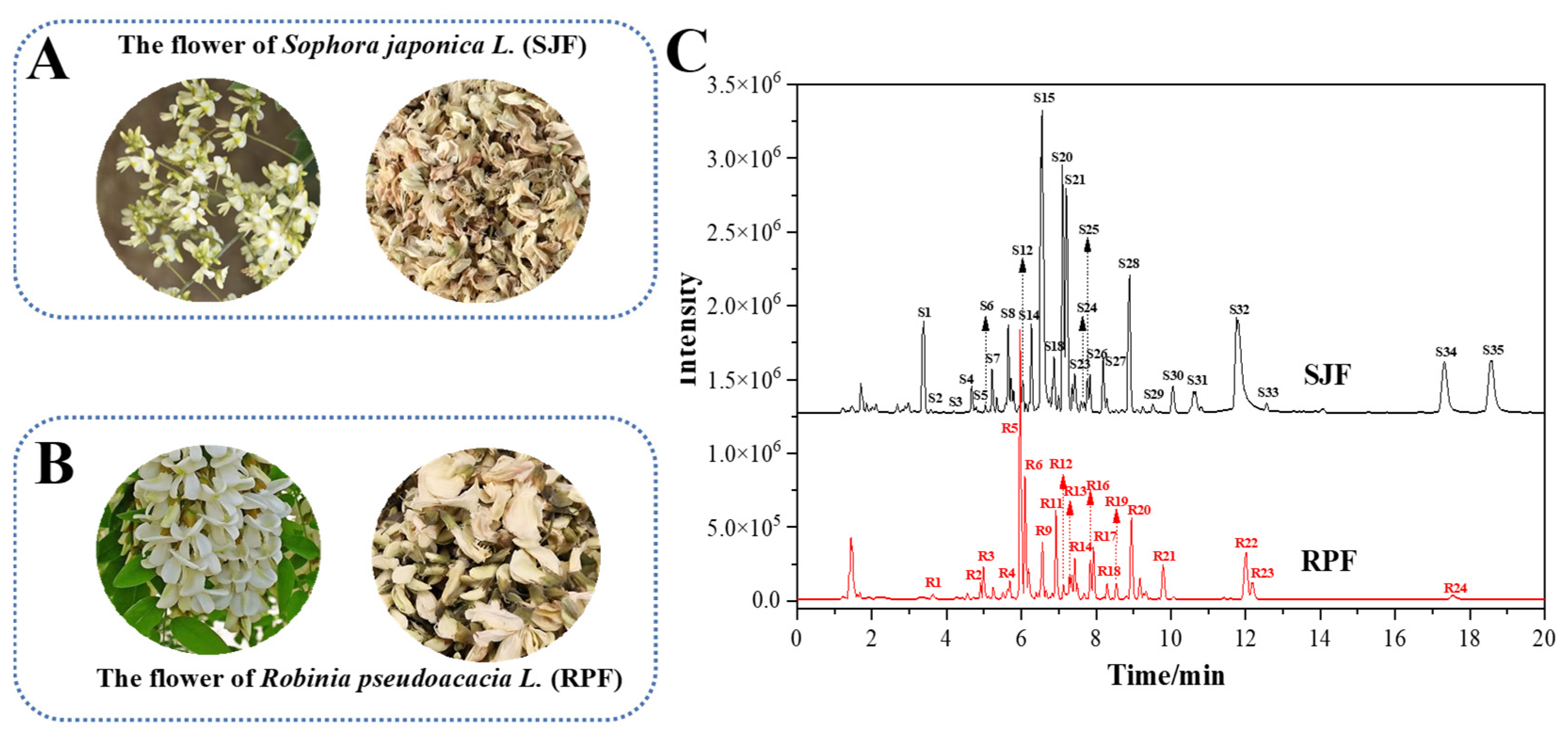
| Peak | tR (min) | [M−H]− | Major and Important MS2 Ions | Identification | Reference |
|---|---|---|---|---|---|
| S1 | 3.374 | 399.1513 | 207(100), 353(34), 161(26), 101(24) | C15H27O12 * | |
| S2 | 3.561 | 331.0619 | 169(100), 125(60) | Gallic acid-glc | [13] |
| S3 | 4.203 | 447.1160 | 152(72), 108(10), 315(4), 271(3) | I-pen | |
| S4 | 4.673 | 483.0787 | 169(100), 331(61), 125(51), 287(30), 439(23), 313(21), 271(7) | Di-O-galloyl-glc a | [14] |
| S5 | 4.804 | 771.2022 | 771(100), 609(50), 463(16), 301(12), 271(2) | Q-glc-glc-rha b | [15] |
| S6 | 5.033 | 483.0788 | 169(100), 331(36), 125(17), 313(5), 151(2) | Di-O-galloyl-glc a | [14] |
| S7 | 5.218 | 563.1631 | 419(100), 461(31), 125(29), 161(24), 501(10), 101(10), 203(8) | C26H31O14 * | |
| S8 | 5.647 | 771.2016 | 300(36), 178(5), 271(5), 591(4), 255(2), 609(3) | Q-glc-glc-rha b | [15] |
| S9 | 5.726 | 755.2026 | 609(56), 446(17), 301(14) | Q-3-(2 G rha-rut) c | [16] |
| S10 | 5.805 | 609.1474 | 446(100), 299(62), 463(29), 271(8) | Q-3-glc-7-rha d | [15] |
| S11 | 5.949 | 755.2066 | 755(100), 300(32), 271(3) | Q-glc-rha-rha c | [15] |
| S12 | 6.035 | 785.2175 | 785(100), 314(20), 300(6), 623(2), 605(4), 271(2) | I-glc-rut | |
| S13 | 6.124 | 739.2117 | 593(100), 739(36), 285(27), 431(10) | K-rha-glc-rha | |
| S14 | 6.269 | 741.1912 | 301(28), 271(3), 609(2), 179(2) | R-O-pen | [17] |
| S15 | 6.543 | 609.1473 | 301(100), 609(79), 271(14), 255(8), 179(7), 151(6) | Q-rut d | [18] |
| S16 | 6.743 | 447.1049 | 285(100), 447(22) | K-3-O-gal e | [19] |
| S17 | 6.822 | 755.2066 | 755(100), 315(50), 300(5), 271(2), 623(1) | K-rut-hex | |
| S18 | 6.854 | 463.0889 | 300(100), 271(22), 255(13) | Q-3-O-glc | [20] |
| S19 | 6.996 | 610.4197 | 564(100), 225(6), 300(2) | Q-rha-di(pen) | |
| S20 | 7.092 | 593.1518 | 285(100), 255(16), 227(8), 151(2) | K-3-O-rut | [15] |
| S21 | 7.156 | 623.1632 | 315(100), 300(20), 271(10), 243(5) | I-rut | [21] |
| S22 | 7.360 | 447.0942 | 285(100) | K-3-O-glc e | [19] |
| S23 | 7.424 | 609.1480 | 301(100), 151(11), 178(10) | Q-rut d | [18] |
| S24 | 7.598 | 477.1048 | 314(100), 271(32), 243(28), 300(12) | I-3-O-hex | [22] |
| S25 | 7.758 | 609.1482 | 301(100), 609(22), 178(8), 151(8) | Q-rut d | [18] |
| S26 | 7.853 | 449.1095 | 151(100), 287(72), 135(30), 107(4), 125(3) | Eriodictyol-O-hex | [17] |
| S27 | 8.187 | 709.2007 | 145(100), 565(58), 419(46), 607(43), 163(36), 461(20) | C32H37O18 * | |
| S28 | 8.885 | 577.1582 | 145(100), 163(78), 475(37), 433(36), 307(26), 515(23) | C20H33O19 * | |
| S29 | 9.501 | 379.0674 | 119(100), 259(60), 216(17), 233(7) | C27H23O2 * | |
| S30 | 10.048 | 409.1778 | 119(100), 134(95), 259(67), 149(66), 289(51), 393(6) | C28H25O3 * | |
| S31 | 10.500 | 609.1476 | 300(76), 271(10), 255(5), 151(4) | Q-rut d | |
| S32 | 11.792 | 301.0367 | 151(100), 121(43), 178(33), 271(12) | Q | [23] |
| S33 | 12.533 | 445.1142 | 283(100), 268(34), 151(4) | A-hex | |
| S34 | 17.319 | 285.0417 | 285(100), 185(18), 239(14), 211(14), 159(12) | K | [24] |
| S35 | 18.569 | 315.0521 | 300(100), 271(30), 164(21), 255(20) | I | [25] |
| Peak | tR (min) | [M−H]− | Major and Important MS2 Ions | Identification | Reference |
|---|---|---|---|---|---|
| R1 | 3.632 | 437.2131 | 218(100), 146(22) | C23H33O8 * | |
| R2 | 4.910 | 755.2038 | 593(100), 285(8), 446(3) | K-glc-rha-rha | [15] |
| R3 | 4.986 | 901.2619 | 755(100), 285(10), 430(4), 575(2) | K-tetra(glc) f | [26] |
| R4 | 5.693 | 755.2041 | 609(49), 446(17), 301(15), 271(2) | Q-glc-rha-rha | [15] |
| R5 | 5.966 | 739.2093 | 593(100), 285(22), 430(17), 327(4), 255(3) | K-di(rha)-hex | [27] |
| R6 | 6.015 | 593.1507 | 447(100), 430(85), 283(50), 255(8) | K-gal-rha | [28] |
| R7 | 6.102 | 739.2093 | 593(100), 285(34), 431(22) | C33H39O19 * | |
| R8 | 6.210 | 769.2200 | 623(100), 315(22), 461(9), 300(1) | I-rha-glc-rha | |
| R9 | 6.561 | 609.1457 | 609(100), 300(100), 271(14), 255(8) | R | [18] |
| R10 | 6.793 | 463.0872 | 300(100), 271(24), 255(12), 178(5) | Q-3-O-glc | [20] |
| R11 | 6.926 | 593.1509 | 284(100), 255(20), 227(7), 151(4) | K-3-O-rut | [15] |
| R12 | 7.158 | 623.1595 | 314(65), 299(20), 271(5), 151(2) | I-rut | [21] |
| R13 | 7.286 | 447.0929 | 284(100), 255(52), 227(35) | K-hex | [19] |
| R14 | 7.428 | 723.5026 | 677(100), 225(5), 659(3), 338(2) | C39H71O11 * | |
| R15 | 7.682 | 607.1662 | 299(100), 284(17) | Diosmetin-7-O-rut | [29] |
| R16 | 7.859 | 836.5869 | 790(100), 225(3) | C41H71O10 * | |
| R17 | 7.928 | 767.2043 | 283(100), 767(28), 268(12), 483(11) | A-hex-pen | |
| R18 | 8.292 | 949.6712 | 901(100), 949(40) | K-tetra(glc) f | |
| R19 | 8.541 | 799.2310 | 283(100), 753(31), 268(6) | A-glc-glc-rha | |
| R20 | 8.943 | 577.1558 | 145(100), 163(72), 475(42), 433(39), 515(27), 307(22) | C44H84O14 * | |
| R21 | 9.793 | 769.2197 | 283(100), 723(16), 268(8), 591(2) | A-rut-pen | |
| R22 | 12.003 | 637.1764 | 283(100), 268(22), 591(3) | A-rha-gal | [28] |
| R23 | 12.181 | 431.0978 | 285(100), 151(49), 431(40), 257(39), 213(6), 229(5) | K-rha | [28] |
| R24 | 17.495 | 285.0407 | 185(10), 229(8), 151(6) | K | [24] |
| Standard | RSD/% | Regression Equation | Linear Range/(μg/mL) | Linearity (R) | Recovery Rate/% | |
|---|---|---|---|---|---|---|
| Retention Time | Peak Area | |||||
| Rutin | 0.40 | 0.51 | Y = 21.520X | 1~100 | 0.9995 | 102.73 ± 0.62 |
| Quercetin | 0.12 | 1.14 | Y = 27.586X | 1~100 | 0.9995 | 95.42 ± 1.38 |
| Kaempferol | 0.24 | 0.87 | Y = 45.400X | 1~100 | 0.9999 | 104.64 ± 0.26 |
| Isorhamnetin | 0.11 | 0.79 | Y = 50.245X | 1~100 | 0.9999 | 96.32 ± 0.62 |
Disclaimer/Publisher’s Note: The statements, opinions and data contained in all publications are solely those of the individual author(s) and contributor(s) and not of MDPI and/or the editor(s). MDPI and/or the editor(s) disclaim responsibility for any injury to people or property resulting from any ideas, methods, instructions or products referred to in the content. |
© 2026 by the authors. Licensee MDPI, Basel, Switzerland. This article is an open access article distributed under the terms and conditions of the Creative Commons Attribution (CC BY) license.
Share and Cite
Sun, C.-C.; Chen, Y.-T.; Xu, H.-X.; Guo, Y.-X.; Zhang, Q.-F. Chemical Constituents Comparison Between the Flowers of Sophora japonica L. and Robinia pseudoacacia L. by UPLC-Q-TOF-MS/MS and HPLC. Molecules 2026, 31, 1238. https://doi.org/10.3390/molecules31081238
Sun C-C, Chen Y-T, Xu H-X, Guo Y-X, Zhang Q-F. Chemical Constituents Comparison Between the Flowers of Sophora japonica L. and Robinia pseudoacacia L. by UPLC-Q-TOF-MS/MS and HPLC. Molecules. 2026; 31(8):1238. https://doi.org/10.3390/molecules31081238
Chicago/Turabian StyleSun, Cui-Cui, Yi-Ting Chen, Hai-Xia Xu, Yu-Xian Guo, and Qing-Feng Zhang. 2026. "Chemical Constituents Comparison Between the Flowers of Sophora japonica L. and Robinia pseudoacacia L. by UPLC-Q-TOF-MS/MS and HPLC" Molecules 31, no. 8: 1238. https://doi.org/10.3390/molecules31081238
APA StyleSun, C.-C., Chen, Y.-T., Xu, H.-X., Guo, Y.-X., & Zhang, Q.-F. (2026). Chemical Constituents Comparison Between the Flowers of Sophora japonica L. and Robinia pseudoacacia L. by UPLC-Q-TOF-MS/MS and HPLC. Molecules, 31(8), 1238. https://doi.org/10.3390/molecules31081238