Chemical Characterization, Evaluation of Antimicrobial Potential, and Cytotoxic Activity of Thuja occidentalis L. and Myrtus communis L. Essential Oils for Topical Applications

 , ,
, ,  , , , and
Abstract
1. Introduction
2. Results and Discussion
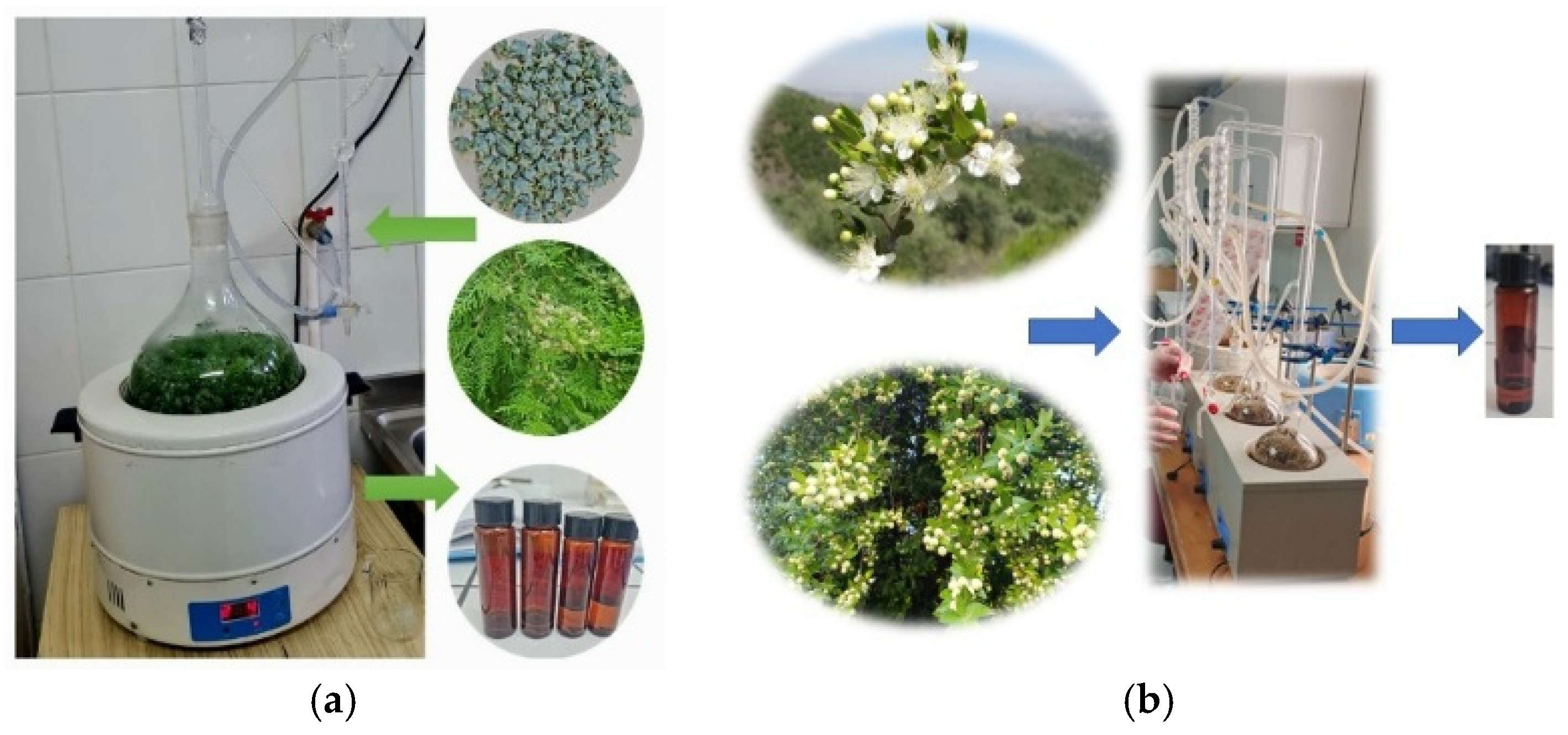
2.1. Extraction of the Essential Oils
2.2. Chromatographic Analysis
2.3. Antimicrobial Activity
2.4. In Vitro Cytotoxicity Assessment: XTT and LDH Assays on Human Keratinocytes
2.5. Skin Compatibility Assessment by In Vivo Testing
3. Materials and Methods
3.1. Material Sampling
3.2. EOs Extraction
3.3. Characterization of EOs
3.3.1. Chromatographic Analysis
3.3.2. Antimicrobial Activity
3.3.3. Cell Culture Techniques
Statistical Analysis
3.3.4. Skin Compatibility Assessment by In Vivo Testing
4. Conclusions
Supplementary Materials
Author Contributions
Funding
Institutional Review Board Statement
Informed Consent Statement
Data Availability Statement
Acknowledgments
Conflicts of Interest
References
- Guzmán, E.; Lucia, A. Essential Oils and Their Individual Components in Cosmetic Products. Cosmetics 2021, 8, 114. [Google Scholar] [CrossRef]
- Gershenzon, J.; Dudareva, N. The function of terpene natural products in the natural world. Nat. Chem. Biol. 2007, 3, 408–414. [Google Scholar] [CrossRef] [PubMed]
- Ekor, M. The growing use of herbal medicines: Issues relating to adverse reactions and challenges in monitoring safety. Front. Neurol. 2013, 4, 177. [Google Scholar] [CrossRef] [PubMed]
- Sarkic, A.; Stappen, I. Essential oils and their single compounds in cosmetics—A critical review. Cosmetics 2018, 5, 11. [Google Scholar] [CrossRef]
- Dhifi, W.; Bellili, S.; Sabrine, J. Essential oils’ chemical characterization and investigation of some biological activities: A critical review. Medicines 2016, 3, 25. [Google Scholar] [CrossRef]
- Asgarpanah, J.; Ariamanesh, A. Phytochemistry and pharmacological properties of Myrtus communis L. Indian J. Tradit. Knowl. 2015, 14, 82–87. [Google Scholar]
- Shahbazian, D.; Karami, A.; Raouf Fard, F.; Eshghi, S.; Maggi, F. Essential Oil Variability of Superior Myrtle (Myrtus communis L.) Accessions Grown under the Same Conditions. Plants 2022, 11, 3156. [Google Scholar] [CrossRef] [PubMed]
- Hennia, A.; Nemmiche, S.; Dandlen, S.; Miguel, M.G. Myrtus communis essential oils: Insecticidal, antioxidant and antimicrobial activities: A review. J. Essent. Oil Res. 2019, 31, 487–545. [Google Scholar] [CrossRef]
- Giampieri, F.; Cianciosi, D.; Forbes-Hernández, T.Y. Myrtle (Myrtus communis L.) berries, seeds, leaves, and essential oils: New undiscovered sources of natural compounds with promising health benefits. Food Front. 2020, 1, 276–295. [Google Scholar] [CrossRef]
- Aleksic, V.; Knezevic, P. Antimicrobial and antioxidative activity of extracts and essential oils of Myrtus communis L. Microbiol. Res. 2014, 169, 240–254. [Google Scholar] [CrossRef]
- Rahmana Putra, N.; Suharmiati, S.; Junaidi, L.; Loppies, J.E.; Rosniati, R.; Trisnawati, N.W.; Airlangga, B.; Irianto, I. A comparative review of Myrtle oil extraction methods and their impact on bioactive composition. Sep. Sci. Technol. 2025, 60, 1521–1546. [Google Scholar] [CrossRef]
- Yangui, I.; Zouaoui Boutiti, M.; Boussaid, M.; Messaoud, C. Essential oils of Myrtaceae species growing wild in Tunisia: Chemical variability and antifungal activity against Biscogniauxia mediterranea, the causative agent of charcoal canker. Chem. Biodivers. 2017, 14, e1700058. [Google Scholar] [CrossRef]
- Mir, M.A.; Bashir, N.; Alfaify, A.; Oteef, M.D.Y. GC-MS analysis of Myrtus communis extract and its antibacterial activity against Grampositive bacteria. BMC Complement. Med. Ther. 2020, 20, 86. [Google Scholar] [CrossRef]
- Gospodarek, J.; Krajewska, A.; Paśmionka, I.B.; Bruździńska, J.; Tamiru, G. Potential of Thuja occidentalis L. Essential Oil and Water Extracts against Field Crop Pests. Molecules 2024, 29, 1457. [Google Scholar] [CrossRef] [PubMed]
- Seo, K.-S.; Jin, W.S.; Choi, S.; Won Yun, K. Antibacterial Activity of Thuja occidentalis, Thuja orientalis and Chamaecyparis obtuse. Int. J. Pharm. Qual. Assur. 2017, 8, 78–81. [Google Scholar] [CrossRef][Green Version]
- Caruntu, S.; Ciceu, A.; Olah, N.K.; Don, I.; Hermenean, A.; Cotoraci, C. Thuja occidentalis L. (Cupressaceae): Ethnobotany, Phytochemistry and Biological Activity. Molecules 2020, 25, 5416. [Google Scholar] [CrossRef]
- Giudice, D.P. Skin Infections Caused by Staphylococcus aureus. Acta Derm.-Venereol. 2020, 100, 208–215. [Google Scholar] [CrossRef] [PubMed]
- Oliveira, F.; Rohde, H.; Vilanova, M.; Cerca, N. Fighting Staphylococcus epidermidis Biofilm Associated Infections: Can Iron Be the Key to Success? Front. Cell. Infect. Microbiol. 2021, 11, 798563. [Google Scholar] [CrossRef]
- Elfadadny, A.; Ragab, R.F.; AlHarbi, M.; Badshah, F.; Ibáñez-Arancibia, E.; Farag, A.; Hendawy, A.O.; De los Ríos-Escalante, P.R.; Aboubakr, M.; Zakai, S.A.; et al. Antimicrobial resistance of Pseudomonas aeruginosa: Navigating clinical impacts, current resistance trends, and innovations in breaking therapies. Front. Microbiol. 2024, 15, 1374466. [Google Scholar] [CrossRef]
- Ding, X.; Tang, Q.; Xu, Z.; Xu, Y.; Zhang, H.; Zheng, D.; Wang, S.; Tan, Q.; Maitz, J.; Maitz, P.K.; et al. Challenges and innovations in treating chronic and acute wound infections: From basic science to clinical practice. Burn Trauma 2022, 10, tkac014. [Google Scholar] [CrossRef]
- Amann, V.; Kissmann, A.-K.; Firacative, C.; Rosenau, F. Biofilm-Associated Candidiasis: Pathogenesis, Prevalence, Challenges and Therapeutic Options. Pharmaceuticals 2025, 18, 460. [Google Scholar] [CrossRef]
- Lwigale, F.; Kibombo, D.; Kasango, S.D.; Tabajjwa, D.; Atuheire, C.; Kungu, J.; Bosco Kalule, J.; Otita, M.; Kakooza, F.; Nabukenya, I.; et al. Prevalence, resistance profiles and factors associated with skin and soft-tissue infections at Jinja regional referral hospital: A retrospective study. PLoS Glob. Public Health 2024, 4, e0003582. [Google Scholar] [CrossRef]
- Lis, A.; Liszkiewicz, R.; Krajewska, A. Comparison of chemical composition of the essential oils from different parts of Thuja occidentalis L. ‘Brabant’ and T. occidentalis L. ‘Smaragd’. Herba Pol. 2016, 62, 20–27. [Google Scholar] [CrossRef]
- Elaissi, A.; Rouis, Z.; Ben Salem, N.A.; Mabrouk, S.; ben Salem, Y.; Haj Salah, K.B.; Aouni, M.; Farhat, F.; Chemli, R.; Harzallah-Skhiri, F.; et al. Chemical composition of 8 eucalyptus species’ essential oils and the evaluation of their antibacterial, antifungal and antiviral activities. BMC Complement. Altern. Med. 2012, 12, 81. [Google Scholar] [CrossRef]
- Ait-Ouazzou, A.; Cherrat, L.; Espina, L.; Lorán, S.; Rota, C.; Pagán, R. The antimicrobial activity of hydrophobic essential oil constituents acting alone or in combined processes of food preservation. Innov. Food Sci. Emerg. Technol. 2011, 12, 320–329. [Google Scholar] [CrossRef]
- Kovač, J.; Šimunović, K.; Wu, Z.; Klančnik, A.; Bucar, F.; Zhang, Q.; Smole Možina, S. Antibiotic Resistance Modulation and Modes of Action of (-)-α-Pinene in Campylobacter jejuni. PLoS ONE 2015, 10, e0122871. [Google Scholar] [CrossRef]
- Ben Nouri, A.; Dhifi, W.; Bellili, S.; Ghazghazi, H.; Aouadhi, C.; Chérif, A.; Hammami, M.; Mnif, W. Chemical Composition, Antioxidant Potential, and Antibacterial Activity of Essential Oil Cones of Tunisian Cupressus sempervirens. J. Chem. 2015, 2015, 538929. [Google Scholar] [CrossRef]
- Xie, Q.; Liu, Z. Chemometrics of the composition and antioxidant capacity of essential oils obtained from six Cupressaceae taxa. Sci. Rep. 2024, 14, 18612. [Google Scholar] [CrossRef] [PubMed]
- Bakó, E.; Böszörményi, A.; Vargáné Szabó, B.; Engh, M.A.; Hegyi, P.; Ványolós, A.; Csupor, D. Chemometric analysis of monoterpenes and sesquiterpenes of conifers. Front. Plant Sci. 2024, 4, 1392539. [Google Scholar] [CrossRef] [PubMed]
- Keeling, C.I.; Bohlmann, J. Genes, enzymes and chemicals of terpenoid diversity in the constitutive and induced defence of conifers against insects and pathogens. New Phytol. 2006, 170, 639–910. [Google Scholar] [CrossRef]
- Gangwar, A.; Tewari, G.; Pande, C.; Prakash, O.; Kanyal, B.; Tewari, L.M.; Joshi, M.; Siddiqui, A. Effect of drying conditions on the chemical compositions, molecular docking interactions and antioxidant activity of Hedychium spicatum Buch.-Ham. Rhizome essential oil. Sci. Rep. 2024, 14, 28568. [Google Scholar] [CrossRef] [PubMed]
- Niranjana Kumar, A.; Kotesh Kumar, J.; Satya Srinivas Vijay, K.V.N.; Kumar, M.; Kiranbabu, G.D.; Ravi, G. Effect of different drying methods on the variation of volatile oil composition in different parts of Trachyspermum ammi (L.). J. Med. Aromat. Plant Sci. 2021, 43, 143–147. [Google Scholar] [CrossRef]
- Sun, L.; Ma, J.; Purcaro, G.; Wang, G.; Jin, J.; Xing, F. A comprehensive review of post-harvest agricultural product deterioration signature volatile organic compounds. Food Chem. X 2025, 29, 102866. [Google Scholar] [CrossRef] [PubMed]
- Turek, C.; Stintzing, F.C. Stability of Essential Oils: A Review. Compr. Rev. Food Sci. Food Saf. 2013, 12, 40–53. [Google Scholar] [CrossRef]
- Dudareva, N.; Klempien, A.; Muhlemann, J.K.; Kaplan, I. Biosynthesis, function and metabolic engineering of plant volatile organic compounds. New Phytol. 2013, 198, 16–32. [Google Scholar] [CrossRef] [PubMed]
- Nassar, M.I.; Aboutabl, E.-S.A.; Ahmed, R.F.; El-Khrisy, E.-D.A.; Ibrahim, K.M.; Sleem, A.A. Secondary metabolites and bioactivities of Myrtus communis. Pharmacogn. Res. 2010, 2, 325–329. [Google Scholar] [CrossRef]
- Dahham, S.S.; Tabana, Y.M.; Iqbal, M.A.; Ahamed, M.B.K.; Ezzat, M.O.; Majid, A.S.A.; Majid, A.M.S.A. The Anticancer, Antioxidant and Antimicrobial Properties of the Sesquiterpene β-Caryophyllene from the Essential Oil of Aquilaria crassna. Molecules 2015, 20, 11808–11829. [Google Scholar] [CrossRef]
- Asha, R.; Nisha, P.; Suneer Khan, K.; Mythili, A.; Shafeeq Hassan, A.; Panneer Selvam, K.; Manikandan, P.; Shobana, C.S. In vitro activity of various potencies of homeopathic drug thuja against molds involved in mycotic keratitis. Int. J. Pharm. Pharm. Sci. 2014, 6, 555–559. [Google Scholar]
- Bellili, S.; Aouadhi, C.; Dhifi, W.; Ghazghazi, H.; Jlassi, C.; Sadaka, C.; Beyrouthy, M.E.; Maaroufi, A.; Cherif, A.; Mnif, W. The Influence of Organs on Biochemical Properties of Tunisian Thuja occidentalis Essential Oils. Symmetry 2018, 10, 649. [Google Scholar] [CrossRef]
- Hoch, C.C.; Petry, J.; Griesbaum, L.; Weiser, T.; Werner, K.; Ploch, M.; Verschoor, A.; Multhoff, G.; Dezfouli, A.B.; Wollenb, B. 1,8-cineole (eucalyptol): A versatile phytochemical with therapeutic applications across multiple diseases. Biomed. Pharmacother. 2023, 167, 115467. [Google Scholar] [CrossRef] [PubMed]
- Cristani, M.; D’Arrigo, M.; Mandalari, G.; Castelli, F.; Sarpietro, M.G.; Micieli, D.; Venuti, V.; Bisignano, G.; Saija, A.; Trombetta, D. Interaction of Four Monoterpenes Contained in Essential Oils with Model Membranes: Implications for Their Antibacterial Activity. J. Agric. Food Chem. 2007, 55, 6300–6308. [Google Scholar] [CrossRef]
- Al-Maharik, N.; Jaradat, N.; Al-Hajj, N.; Jaber, S. Myrtus communis L.: Essential oil chemical composition, total phenols and flavonoids contents, antimicrobial, antioxidant, anticancer, and α-amylase inhibitory activity. Chem. Biol. Technol. Agric. 2023, 10, 41. [Google Scholar] [CrossRef]
- Brahmi, F.; Mokhtari, O.; Yahyaoui, M.I.; Zraibi, L.; Eddine Bentouhami, N.; Abdeslam, A.; Legssyer, B. Phytochemical composition, antioxidant, and antifungal activity of essential oil from Myrtus communis, L. Mater. Today Proc. 2023, 72, 3826–3830. [Google Scholar] [CrossRef]
- Caputo, L.; Capozzolo, F.; Amato, G.; De Feo, V.; Fratianni, F.; Vivenzio, G.; Nazzaro, F. Chemical composition, antibiofilm, cytotoxic, and anti-acetylcholinesterase activities of Myrtus communis L. leaves essential oil. BMC Complement. Med. Ther. 2022, 22, 142. [Google Scholar] [CrossRef] [PubMed]
- Tsiri, D.; Graikou, K.; Pobłocka-Olech, L.; Krauze-Baranowska, M.; Spyropoulos, C.; Chinou, I. Chemosystematic Value of the Essential Oil Composition of Thuja species Cultivated in Poland—Antimicrobial Activity. Molecules 2009, 14, 4707–4715. [Google Scholar] [CrossRef]
- Nurzynska-Wierdak, R. Antibiofilm Potential of Natural Essential Oils. Appl. Sci. 2025, 15, 5847. [Google Scholar] [CrossRef]
- Touati, A.; Mairi, A.; Adam Ibrahim, N.; Idres, T. Essential Oils for Biofilm Control: Mechanisms, Synergies, and Translational Challenges in the Era of Antimicrobial Resistance. Antibiotics 2025, 14, 503. [Google Scholar] [CrossRef] [PubMed]
- Dragoljub, L.M.; Marija, V.D.; Mihajilov-Krstev, T.M.; Marković, M.S.; Ćirić, V.M. The significance of minor components on the antibacterial activity of essential oil via chemometrics. LWT 2021, 136, 110305. [Google Scholar] [CrossRef]
- Surowiak, A.K.; Poręba, M.; Strub, D.J. Evaluation of cytotoxic effects of diverse essential oils on human keratinocytes (HaCaT). bioRxiv 2025, 16, 1668594. [Google Scholar] [CrossRef]
- Fonacier, L.; Noor, I. Contact Dermatitis and Patch Testing for the Allergist. Ann. Allergy Asthma Immunol. 2018, 120, 592–598. [Google Scholar] [CrossRef] [PubMed]
- Houle, M.-C.; DeKoven, J.G.; Atwater, A.R.; Reeder, M.J.; Warshaw, E.M.; Pratt, M.D.; Belsito, D.V.; Taylor, J.S. North American Contact Dermatitis Group Patch Test Results. Dermatitis 2025, 36, 2021–2022. [Google Scholar] [CrossRef] [PubMed]
- Fonacier, L.; Uter, W.; Johansen, J.D. Recognizing and Managing Allergic Contact Dermatitis: Focus on Major Allergens. J. Allergy Clin. Immunol. Pract. 2024, 12, 2227–2241. [Google Scholar] [CrossRef]
- Mowad, C.M.; Anderson, B.; Scheinman, P.; Pootongkam, S.; Nedorost, S.; Brod, B. Allergic Contact Dermatitis: Patient Diagnosis and Evaluation. J. Am. Acad. Dermatol. 2016, 74, 1029–1040. [Google Scholar] [CrossRef] [PubMed]
- Johansen, J.D.; Aalto-Korte, K.; Agner, T.; Andersen, K.E.; Bircher, A.; Uter, W. European Society of Contact Dermatitis Guideline for Diagnostic Patch Testing—Recommendations on Best Practice. Contact Dermat. 2015, 73, 195–221. [Google Scholar] [CrossRef]
- Steele, R.; Pacheco, K.; Sher, E.; Ross, J.; Tanzer, R.; Fonacier, L.; Aquino, M.R. Contact Dermatitis and Patch Testing Education: A Work Group Report from the Allergic Skin Diseases Committee of the AAAAI. J. Allergy Clin. Immunol. Pract. 2025, 13, 1970–1979. [Google Scholar] [CrossRef] [PubMed]



| EO Sample | Relative Density at 20 °C (g/mL) | Average Yield, g EO/100 g Vegetable Material |
|---|---|---|
| 1-thuja fresh leaves | 0.913 ± 0.003 | 0.210 ± 0.002 |
| 2-thuja dry leaves | 0.942 ± 0.005 | 0.330 ± 0.006 |
| 3-thuja fresh cones | 0.967 ± 0.004 | 0.510 ± 0.005 |
| 4-thuja dry cones | 0.980 ± 0.003 | 1.630 ± 0.002 |
| 5-myrtle | 0.894 ± 0.002 | 0.700 ± 0.001 |
| Peak | Compound | MF * | Mw * (g/mol) | RI * | tR (min) | Area (%) |
|---|---|---|---|---|---|---|
| Monoterpene hydrocarbons | ||||||
| 1 | α-Pinene | C10H16 | 136.125 | 937 | 8.731 | 20.98 |
| 2 | p-Cymene | C10H14 | 134.11 | 1025 | 12.62 | 1.57 |
| Total Monoterpene hydrocarbons | 22.55 | |||||
| Oxygenated monoterpenes | ||||||
| 3 | Eucalyptol | C10H18O | 154.136 | 1032 | 12.973 | 41.86 |
| 4 | Linalool | C10H18O | 154.136 | 1099 | 16.168 | 4.95 |
| 5 | α-Terpineol | C10H18O | 154.136 | 1189 | 20.36 | 7.7 |
| 6 | Myrtenol | C10H16O | 152.12 | 1213 | 20.597 | 1.91 |
| 7 | Geraniol | C10H18O | 154.136 | 1255 | 23.34 | 1.78 |
| Total Oxygenated monoterpenes | 58.2 | |||||
| Monoterpenoid esters | ||||||
| 8 | Linalyl acetate | C12H20O2 | 196.146 | 1257 | 23.434 | 2.43 |
| 9 | Myrtenyl acetate | C12H18O2 | 194.131 | 1327 | 26.48 | 4.72 |
| 10 | α-Terpinyl acetate | C12H20O2 | 196.146 | 1350 | 27.532 | 6.99 |
| 11 | Geranyl acetate | C12H20O2 | 196.146 | 1382 | 29.047 | 3.03 |
| Total Monoterpenoid esters | 17.17 | |||||
| Total % identified | 97.92 | |||||
| Peak | Compound | MF * | Mw * (g/mol) | RI * | tR (min) | Area (%) | ||||
|---|---|---|---|---|---|---|---|---|---|---|
| Fresh | Dry | |||||||||
| Leaves (Sample 1) | Cones (Sample 3) | Cones (Sample 4) | Leaves (Sample 2) | |||||||
| Monoterpene hydrocarbons | ||||||||||
| 1 | α-Thujene | C10H16 | 136.13 | 929 | 8.46 | - | 0.92 | 3.89 | 1.99 | |
| 2 | α-Pinene | C10H16 | 136.13 | 937 | 8.69–8.80 | 65.78 | 29.12 | 33.65 | 30.02 | |
| 3 | Camphene | C10H16 | 136.13 | 952 | 9.28 | - | 0.34 | 0.54 | 0.38 | |
| 4 | β-Thujene | C10H16 | 136.13 | 974 | 10.35 | 3.47 | 4.66 | 12.09 | 6.54 | |
| 5 | β-Pinene | C10H16 | 136.13 | 979 | 10.45 | 1.7 | 2 | 2.39 | 1.62 | |
| 6 | β-Myrcene | C10H16 | 136.13 | 991 | 11.17 | 1.56 | 3.07 | 4 | 3.2 | |
| 7 | α-Phellandrene | C10H16 | 136.13 | 1005 | 11.68 | - | 0.38 | - | 0.7 | |
| 8 | 3-carene | C10H16 | 136.13 | 1011 | 11.94 | 4.08 | 6.62 | 1.69 | 3 | |
| 9 | α-Terpinene | C10H16 | 136.13 | 1017 | 12.24 | - | 0.36 | 2.78 | 0.58 | |
| 10 | p-Cymene | C10H14 | 134.11 | 1025 | 12.6 | 2.25 | 1.33 | 0.47 | 1.41 | |
| 11 | Limonene | C10H16 | 136.13 | 1031 | 12.78 | 3.11 | 2.91 | 2.92 | 3.12 | |
| Oxygenated monoterpenes | ||||||||||
| 12 | Eucalyptol | C10H18O | 154.14 | 1032 | 12.88 | 1.51 | 0.36 | - | - | |
| Monoterpene hydrocarbons | ||||||||||
| 13 | γ-Terpinene | C10H16 | 136.13 | 1060 | 14.19 | - | 0.67 | 4.33 | 1 | |
| 14 | α-Terpinolene | C10H16 | 136.13 | 1088 | 15.56 | - | 3.1 | 4.23 | 2.43 | |
| Total Monoterpene hydrocarbons | 81.95 | 55.48 | 72.98 | 55.99 | ||||||
| Oxygenated monoterpenes | ||||||||||
| 15 | Terpinen-4-ol | C10H18O | 154.14 | 1177 | 19.70–19.74 | - | 1.18 | 10.68 | 2.92 | |
| 16 | α-Terpineol | C10H18O | 154.14 | 1189 | 20.33 | - | - | 0.84 | - | |
| Total Oxygenated monoterpenes | 1.51 | 1.54 | 11.52 | 2.92 | ||||||
| Monoterpenoid esters | ||||||||||
| 17 | Borneol acetate | C12H20O2 | 196.15 | 1293 | 24.71 | 0.86 | 2.38 | 1.81 | 1.36 | |
| 18 | α-Terpinyl acetate | C12H20O2 | 196.15 | 1350 | 27.51 | 0.89 | 2.52 | 1.02 | 1.59 | |
| Total Monoterpenoid esters | 1.75 | 4.90 | 2.83 | 2.95 | ||||||
| Sesquiterpene hydrocarbons | ||||||||||
| 19 | Cedrene | C15H24 | 204.19 | 1410 | 30.12 | 0.68 | 1.75 | 0.49 | 1.51 | |
| 20 | Caryophyllene | C15H24 | 204.19 | 1419 | 30.44–30.45 | 2.9 | 5.72 | 1.74 | 5.63 | |
| 21 | cis-Thujopsene | C15H24 | 204.19 | 1429 | 30.9 | 4.07 | 5.58 | 1.48 | 3.82 | |
| 22 | Humulene | C15H24 | 204.19 | 1454 | 31.84 | 1.74 | 3.45 | 0.96 | 3.98 | |
| 23 | Germacrene D | C15H24 | 204.19 | 1481 | 32.98 | - | 1.65 | 0.71 | 2.29 | |
| 24 | Cuparene | C15H22 | 202.17 | 1505 | 33.97 | - | 0.89 | - | 0.54 | |
| Total Sesquiterpene hydrocarbons | 9.39 | 19.04 | 5.38 | 17.77 | ||||||
| Oxygenated sesquiterpenes | ||||||||||
| 25 | Khusian-2-ol | C15H26O | 222.2 | 1599 | 37.21 | - | 1.32 | 0.47 | 1.92 | |
| 26 | Cedrol | C15H26O | 222.2 | 1599 | 37.65–37.72 | 5.40 | 10.95 | 5.54 | 16.52 | |
| 27 | α-Acorenol | C15H26O | 222.2 | 1630 | 38.76 | - | 1.32 | - | 0.67 | |
| Total Oxygenated sesquiterpenes | 5.40 | 13.59 | 6.01 | 19.11 | ||||||
| Total % identified | 100 | 94.55 | 98.72 | 98.74 | ||||||
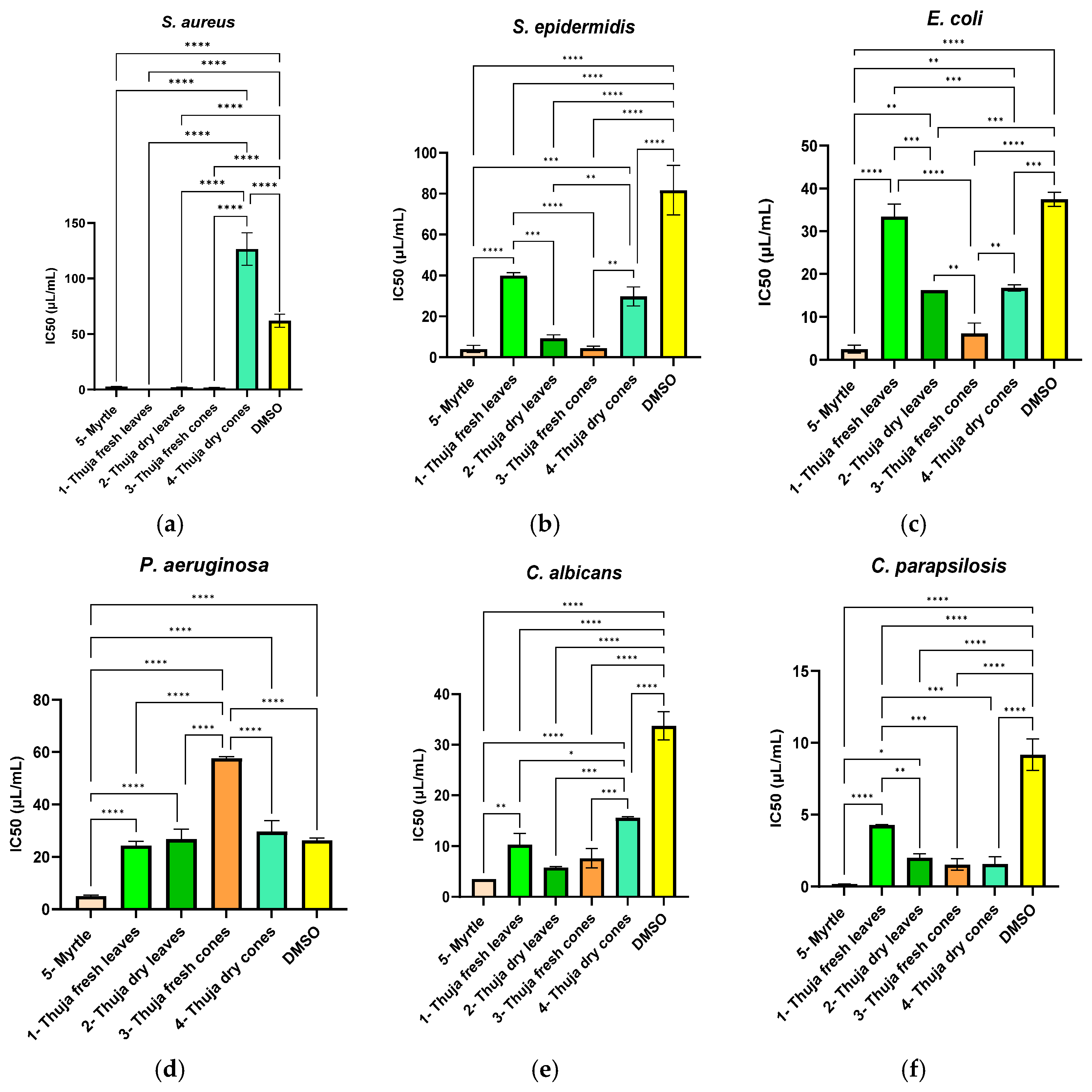
| Sample | Determined Parameter | S. aureus ATCC 25923 | S. epidermidis ATCC 12228 | P. aeruginosa ATCC 27853 | E. coli ATCC 25922 | C. albicans ATCC 10231 | C. parapsilosis ATCC 22019 |
|---|---|---|---|---|---|---|---|
| 1-Thuja fresh leaves | DIZ | 8.5 ± 0.7 | 8.5 ± 0.7 | 5.0 ± 0.0 | 5.5 ± 0.7 | 9.0 ± 0.0 | 5.5 ± 0.7 |
| MIC | 1.953 | 125 | >125 | 125 | 31.25 | 15.625 | |
| MMC | 1.953 | 125 | >125 | 125 | 125 | 62.5 | |
| MICMA | 7.813 | 62.5 | 62.5 | 62.5 | 62.5 | 7.8125 | |
| 2-Thuja dry leaves | DIZ | 12.5 ± 0.7 | 11 ± 1 | 5.5 ± 0.7 | 6.0 ± 0.0 | 10.0 ± 0.0 | 11.5 ± 0.7 |
| MIC | 15.625 | 62.5 | 62.5 | 31.25 | 7.8125 | 7.8125 | |
| MMC | 31.25 | 31.25 | 62.5 | 62.5 | 31.25 | 125 | |
| MICMA | 3.906 | 62.5 | 62.5 | 62.5 | 15.625 | 3.906 | |
| 3-Thuja fresh cones | DIZ | 5.5 ± 0.7 | 9.5 ± 0.7 | 6.5 ± 0.7 | 10.5 ± 0.7 | 9.5 ± 0.7 | 6.5 ± 0.7 |
| MIC | 7.813 | 31.25 | 125 | 15.625 | 15.625 | 7.8125 | |
| MMC | 7.813 | 62.5 | 125 | 15.625 | 62.5 | 62.5 | |
| MICMA | 7.813 | 31.25 | 125 | 7.813 | 15.625 | 7.8125 | |
| 4-Thuja dry cones | DIZ | 10.5 ± 0.7 | 9 ± 2 | 7.0 ± 0.0 | 0.0 ± 0.0 | 9.0 ± 0.0 | 8.5 ± 0.7 |
| MIC | >125 | 62.5 | 62.5 | 62.5 | 31.25 | 7.8125 | |
| MMC | >125 | >125 | 62.5 | 62.5 | >125 | 62.5 | |
| MICMA | >125 | 62.5 | 62.5 | 62.5 | 62.5 | 7.8125 | |
| 5-Myrtle | DIZ | 18 ± 3 | 11.5 ± 0.7 | 8.5 ± 0.7 | 16 ± 3 | 18 ± 4 | 17 ± 1 |
| MIC | 3.096 | 7.813 | 7.813 | 3.096 | 7.813 | 7.813 | |
| MMC | 15.625 | 7.8125 | 7.813 | 15.625 | 125 | 62.5 | |
| MICMA | 7.813 | 7.813 | 7.813 | 3.096 | 7.813 | 7.813 | |
| DMSO (negative control) | DIZ | 0.0 ± 0.0 | 0.0 ± 0.0 | 0.0 ± 0.0 | 0.0 ± 0.0 | 0.0 ± 0.0 | 0.0 ± 0.0 |
| MIC | 250 | >250 | 125 | 125 | 125 | 62.5 | |
| MMC | >250 | >250 | 250 | >250 | 250 | 125 | |
| MICMA | >250 | >250 | 125 | 125 | 125 | 62.5 | |
| Gentamicin | MIC (µg/mL) | 1.09 | 0.55 | 4.38 | 17.5 | - | - |
| MMC (µg/mL) | 17.5 | 4.38 | 8.75 | 70 | - | - | |
| MICMA (µg/mL) | 17.5 | 1.09 | 4.38 | 17.5 | - | - | |
| Ketoconazole | MIC (µg/mL) | - | - | - | - | 8.75 | 1.09 |
| MMC (µg/mL) | - | - | - | - | 70 | 2.19 | |
| MICMA (µg/mL) | - | - | - | - | 17.5 | 1.09 |
Disclaimer/Publisher’s Note: The statements, opinions and data contained in all publications are solely those of the individual author(s) and contributor(s) and not of MDPI and/or the editor(s). MDPI and/or the editor(s) disclaim responsibility for any injury to people or property resulting from any ideas, methods, instructions or products referred to in the content. |
© 2026 by the authors. Licensee MDPI, Basel, Switzerland. This article is an open access article distributed under the terms and conditions of the Creative Commons Attribution (CC BY) license.
Share and Cite
Dănilă, E.; Marinas, I.C.; Gaboreanu, M.D.; Neacșu, V.A.; Titorencu, I.; Marin, M.M.; Kaya, D.A.; Çeliktaş, N.; Albu Kaya, M.; Țuțuianu, R. Chemical Characterization, Evaluation of Antimicrobial Potential, and Cytotoxic Activity of Thuja occidentalis L. and Myrtus communis L. Essential Oils for Topical Applications. Molecules 2026, 31, 1225. https://doi.org/10.3390/molecules31071225
Dănilă E, Marinas IC, Gaboreanu MD, Neacșu VA, Titorencu I, Marin MM, Kaya DA, Çeliktaş N, Albu Kaya M, Țuțuianu R. Chemical Characterization, Evaluation of Antimicrobial Potential, and Cytotoxic Activity of Thuja occidentalis L. and Myrtus communis L. Essential Oils for Topical Applications. Molecules. 2026; 31(7):1225. https://doi.org/10.3390/molecules31071225
Chicago/Turabian StyleDănilă, Elena, Ioana Cristina Marinas, Madalina Diana Gaboreanu, Vlad Andrei Neacșu, Irina Titorencu, Minodora Maria Marin, Durmuş Alpaslan Kaya, Nafiz Çeliktaş, Mădălina Albu Kaya, and Raluca Țuțuianu. 2026. "Chemical Characterization, Evaluation of Antimicrobial Potential, and Cytotoxic Activity of Thuja occidentalis L. and Myrtus communis L. Essential Oils for Topical Applications" Molecules 31, no. 7: 1225. https://doi.org/10.3390/molecules31071225
APA StyleDănilă, E., Marinas, I. C., Gaboreanu, M. D., Neacșu, V. A., Titorencu, I., Marin, M. M., Kaya, D. A., Çeliktaş, N., Albu Kaya, M., & Țuțuianu, R. (2026). Chemical Characterization, Evaluation of Antimicrobial Potential, and Cytotoxic Activity of Thuja occidentalis L. and Myrtus communis L. Essential Oils for Topical Applications. Molecules, 31(7), 1225. https://doi.org/10.3390/molecules31071225