

Article

Novel Small Molecule GLP-1R Agonists Based on 1H-Benzo[d]imidazole-5-Carboxylic Acid Scaffold

by
Elena V. Tolkacheva
1,*,
Tagir L. Salakhov
1,
Alexandr Yu. Saliev
1,
Natalia D. Lebedeva
1,
Alisa M. Krasnodubets
1,
Eugene Y. Smirnov
2,
Sergey A. Silonov
2,
Konstantin V. Balakin
3,
Vladimir V. Chernyshov
1,3 and
Roman A. Ivanov
1
1
Medicinal Biotechnology Department, Sirius University of Science and Technology, Olimpiyskiy Ave. 1, Sirius 354340, Krasnodar Region, Russia
2
Laboratory of Structural Dynamics, Stability and Folding of Proteins, Institute of Cytology, Russian Academy of Sciences, Tikhoretsky Ave. 4, St. Petersburg 194064, Russia
3
Institute of Future Biophysics, Institutsky Lane, 9, Dolgoprudny 141700, Moscow Region, Russia
*
Author to whom correspondence should be addressed.
Molecules 2026, 31(7), 1129; https://doi.org/10.3390/molecules31071129
Submission received: 18 February 2026 / Revised: 23 March 2026 / Accepted: 27 March 2026 / Published: 29 March 2026
(This article belongs to the Section Medicinal Chemistry)

Abstract

Glucagon-like peptide-1 (GLP-1) is an incretin hormone secreted by intestinal endocrine L cells that activates the GLP-1 receptor (GLP-1R), leading to glucose-dependent insulin secretion and suppression of glucagon release. In recent years, GLP-1R agonists (GLP-1RAs) have become one of the leading therapeutic options for the treatment of type 2 diabetes mellitus; however, for a long time clinically approved GLP-1RAs were limited to peptide drugs unsuitable for oral administration. The discovery of the “first-in-class” small molecule agonist danuglipron in 2018 demonstrated the feasibility of orally available GLP-1RAs and stimulated the development of numerous danuglipron-like compounds, some of which showed increased efficacy over the prototype. In this study, we report the design and synthesis of novel GLP-1RAs based on a regioisomeric danuglipron scaffold, 1H-benzo[d]imidazole-5-carboxylic acid. A series of 35 compounds was synthesized and evaluated in vitro for cytotoxicity and GLP-1R agonistic activity using a cAMP accumulation assay. A potent lead compound 12r (pEC50 = 7.72, pCC50 < 3.60) was found which is a close structural analog of danuglipron with reduced cytotoxicity and excellent selectivity over two other class B GPCRs, including GCGR and GIPR. Despite decreased potency compared to danuglipron, the obtained results hold promise for further optimization and provide valuable structure–activity relationship insights.

1. Introduction

Glucagon-like peptide-1 (GLP-1) is an incretin hormone secreted by intestinal endocrine L cells. It activates the glucagon-like peptide-1 receptor (GLP-1R), which, in turn, stimulates insulin release in a glucose-dependent manner and inhibits glucagon secretion. GLP-1 promotes satiety, reduces food intake, slows gastric emptying, and reduces human body weight [1,2,3,4,5]. Identification of GLP-1R as a valuable biological target and establishing its role in metabolic regulation significantly influenced type 2 diabetes (T2DM) and obesity treatment [6,7]. Glucagon-like peptide-1 receptor agonists (GLP-1RAs) have demonstrated superiority over previously used drugs targeting other targets in the treatment of T2DM (sulfonylureas [8], peroxisome proliferator-activated receptor-γ (PPARγ) agonists [9,10], α-glucosidase inhibitors [11], dipeptidyl peptidase-4 inhibitors (DPP-4i), and sodium glucose cotransporter 2 inhibitors (SGLT-2i)) [12,13,14,15,16]. They have also demonstrated the ability to exert cardio- and neuroprotective effects [17,18,19,20], reduce the risks of atherosclerosis and other cardiovascular diseases (CVD), and provide kidney protection [7,21]. For a long time, only peptide molecules were approved for clinical use, including exenatide (Eli Lilly), liraglutide (Novo Nordisk), dulaglutide (Eli Lilly), semaglutide (Novo Nordisk, the only drug for oral use since 2019), albiglutide (GlaxoSmithKline) and tirzepatide (Eli Lilly, a dual GIP/GLP-1 receptor agonist), which have a significant drawback—poor bioavailability in case of oral administration (<1% for semaglutide) [22,23,24]. The unmet medical need for effective oral drugs has led to the search for small molecule GLP-1RAs that combine high efficacy and safety with ease of use [25,26,27,28,29,30,31,32,33,34].
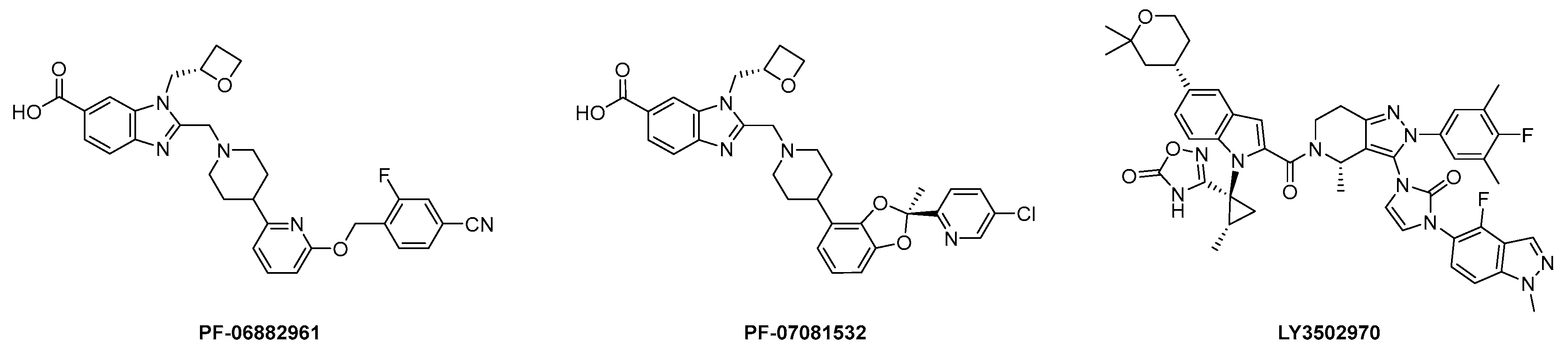
Pfizer and Eli Lilly were pioneers in the field of highly active small molecule GLP-1RAs. In 2018–2019, the former introduced two structurally similar “first-in-class” agonists, danuglipron (PF 06882961) [35,36] and lotiglipron (PF 07081532) [37], and the latter introduced orforglipron (LY3502970) [38,39] (Figure 1).
Lotiglipron was withdrawn from clinical trials in phase I studies due to dose-dependent increase in liver enzymes, indicating potential hepatotoxicity [40]. Danuglipron successfully completed Phase I trials and demonstrated dose-dependent, placebo-adjusted reductions in glycated hemoglobin (HbA1c), plasma glucose, and body weight in Phase II. However, a high incidence of gastrointestinal (GI) side effects, including nausea (73% of cases), vomiting (47% of cases), and diarrhea (25% of cases), led to the early withdrawal of 53% of volunteers from the clinical trials. Although the company attempted to optimize the dosing regimen of danuglipron to improve tolerability, its hepatotoxic properties identified during clinical trials in April 2025 terminated its development [41]. Thus, orforglipron became the first oral small molecule GLP-1RA drug to successfully complete phase III clinical trials in April 2025 [42].
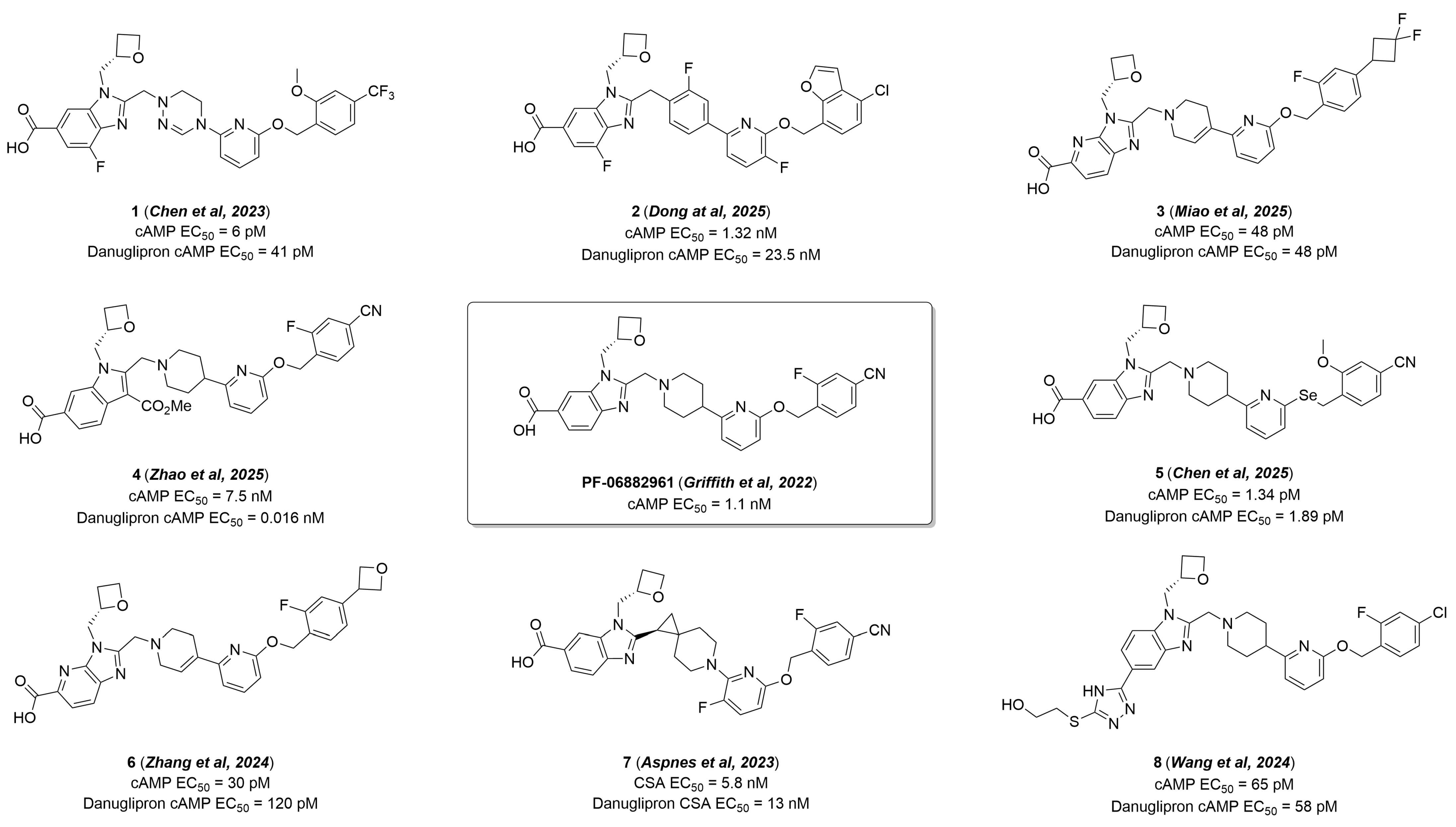
Since danuglipron and lotiglipron were disclosed as highly active small molecule GLP-1RAs in 2018–2019, a wide variety of “next-in-class” agonists have been reported in 2020–2025, as shown in our patent review [43] and some published papers [44,45,46,47,48,49,50,51]. The reported agonists can be divided into two groups: those structurally similar to “first-in-class” GLP-1RA, which were designed through evolutionary modifications of prototypes, and compounds obtained via significant transformations of the original scaffolds. According to structure–activity relationship (SAR) analysis, each of these groups yielded highly active GLP-1RAs with comparable or superior functional activity to their prototypes [43]. Figure 2 shows the structures of some reported “next-in-class” GLP-1RAs 18 (highly active lead compounds), structural analogs of danuglipron [44,45,46,47,48,49,50,51].
Based on cAMP assay data, most of the developed lead compounds 18 are superior to or equal to danuglipron in terms of EC50 values (Figure 2). The only exception is the 1H-indole derivative 4 [47], which, according to cAMP accumulation assay, is more than 450-fold less active than danuglipron, despite the presence in the structure of most of the key structural motifs inherent to the prototype (Figure 2). Despite a two-fold increase in the functional activity of compound 7 from Pfizer compared to danuglipron, high intrinsic clearance (Clint) combined with off-target PDE3A1 activity led to the discontinuation of its development (Figure 2) [50]. Compounds 3 [46], 5 [48], and 8 [51] are comparable in functional activity to the prototype (Figure 2). At the same time, the pharmacokinetic profile of compounds 3 and 5 has improved significantly compared to danuglipron; in particular, oral bioavailability has increased to 54% and 20%, respectively. The EC50 values for agonists 1 [44], 2 [45], and 6 [49] exceed those for danuglipron by 7, 18, and 4 times, respectively (Figure 2). The development of new 5,6-dihydro-1,2,4-triazine derivatives as GLP-1RAs has resulted in some improvement in the pharmacokinetic properties of the target compounds, highlighting the need for further effort in the search for the most promising drug candidate [44]. Meanwhile, the oral bioavailability of agonists 2 [45] and 6 [49] increased to 20% and 33%, respectively, and their pharmacokinetic profile was significantly improved compared to danuglipron, allowing these drug candidates to enter Phase I clinical trials. Available structure–activity data indicate that even minimal modifications of danuglipron can significantly improve the candidate’s pharmacokinetic properties while maintaining or improving their functional activity. In this regard, the development and synthesis of similar “next-in-class” GLP-1 receptor agonists is a highly pressing issue due to the discontinuation of danuglipron’s development.
Most of the reported potent GLP-1RAs contain a privileged 2-substituted 1-((S)-oxetan-2-ylmethyl)-1H-benzo[d]imidazole scaffold (or its aza analogs and fluoro-substituted derivatives) containing a carboxyl functional group, its bioisostere, or a heterocyclic substituent at the 6-position of the heterocycle. The number of described agonists with 5-substituents, mainly bioisosteric heteroaromatic analogs of the carboxyl group, is quite limited, although very promising compounds with activity in a subnanomolar range have been identified among them [51,52,53,54,55]. Therefore, it was reasonable to conduct further study of this underexplored area of chemical space by varying the 5-substituents and some other structural motifs typical of highly active compounds. The aim of this study was to design and synthesize new potent GLP-1RAs containing a 1H-benzo[d]imidazole-5-carboxylic acid scaffold or its heteroaromatic analogs and to identify key SAR trends in this structural series.
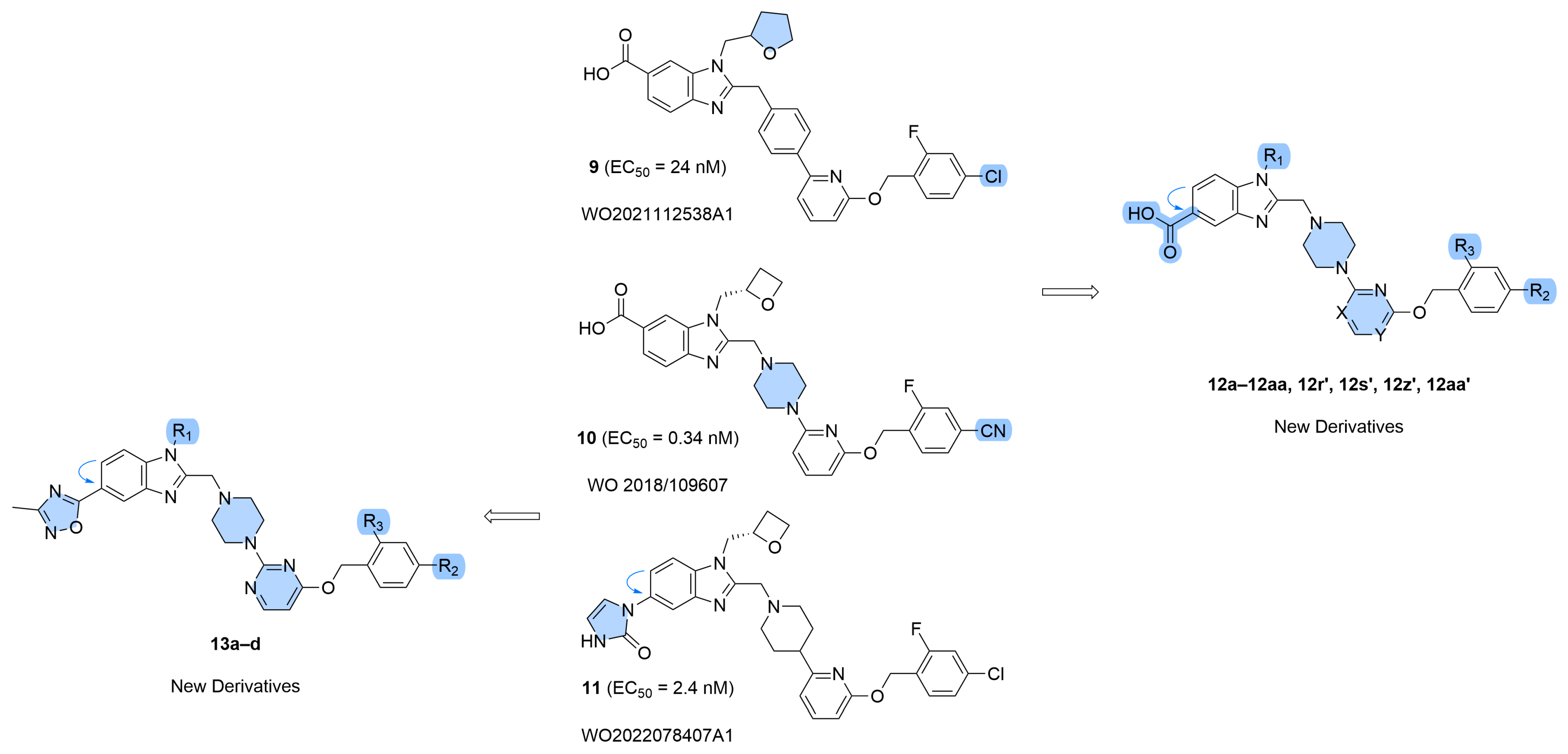
The design of the target compounds of general formula 12 was primarily aimed at introducing a carboxyl group into position 5 of the 1H-benzo[d]imidazole moiety, as a key modification of the prototype, for analysis of SAR trends. To avoid significant changes in the binding pattern of the resulting compounds to the biotarget, the remaining parts of the molecular scaffold were subjected only to evolutionary structural modifications relative to danuglipron structure. Specifically, we replaced the pyridine and piperidine moieties with pyrimidine and piperazine ones, respectively. As shown in our analysis of the patent literature [43], such modifications can lead to nanomolar agonists such as 10 [36] and 9 [56] (Figure 3). To simplify the analysis of SAR dependencies, we used a limited set of structural modifications of the terminal benzyl alcohol residue in this structural series.
Compounds 13ad represent another experimental series containing a heterocyclic 5-substituent in place of the carboxyl group (Figure 3). As previously shown, such compounds often exhibit nanomolar agonist activity [51,52,53,54,55]; one example is compound 11 [54] (Figure 3). The 3-methyl-1,2,4-oxadiazol-5-yl substituent was chosen due to its versatile pharmacological activity [57] and the absence of similar derivatives as GLP-1RAs in previously published studies. It should be noted that in this part of research our objectives were related not only to the discovery of active agonists but, first of all, to the development of effective synthetic approaches to key compounds. This explains the limited structural variability of compounds 13ad.
In addition to compounds of general formula 12, GLP-1RAs 13ad containing a heterocyclic substituent in place of the carboxyl group were proposed (Figure 3). As previously shown, such compounds often exhibit nanomolar agonist activity [51,52,53,54,55]; one example is compound 11 [54] (Figure 3). The 3-methyl-1,2,4-oxadiazol-5-yl substituent was chosen due to its versatile pharmacological activity [57] and the absence of similar derivatives as GLP-1RAs in previously published studies.

2. Results and Discussion

2.1. Chemistry

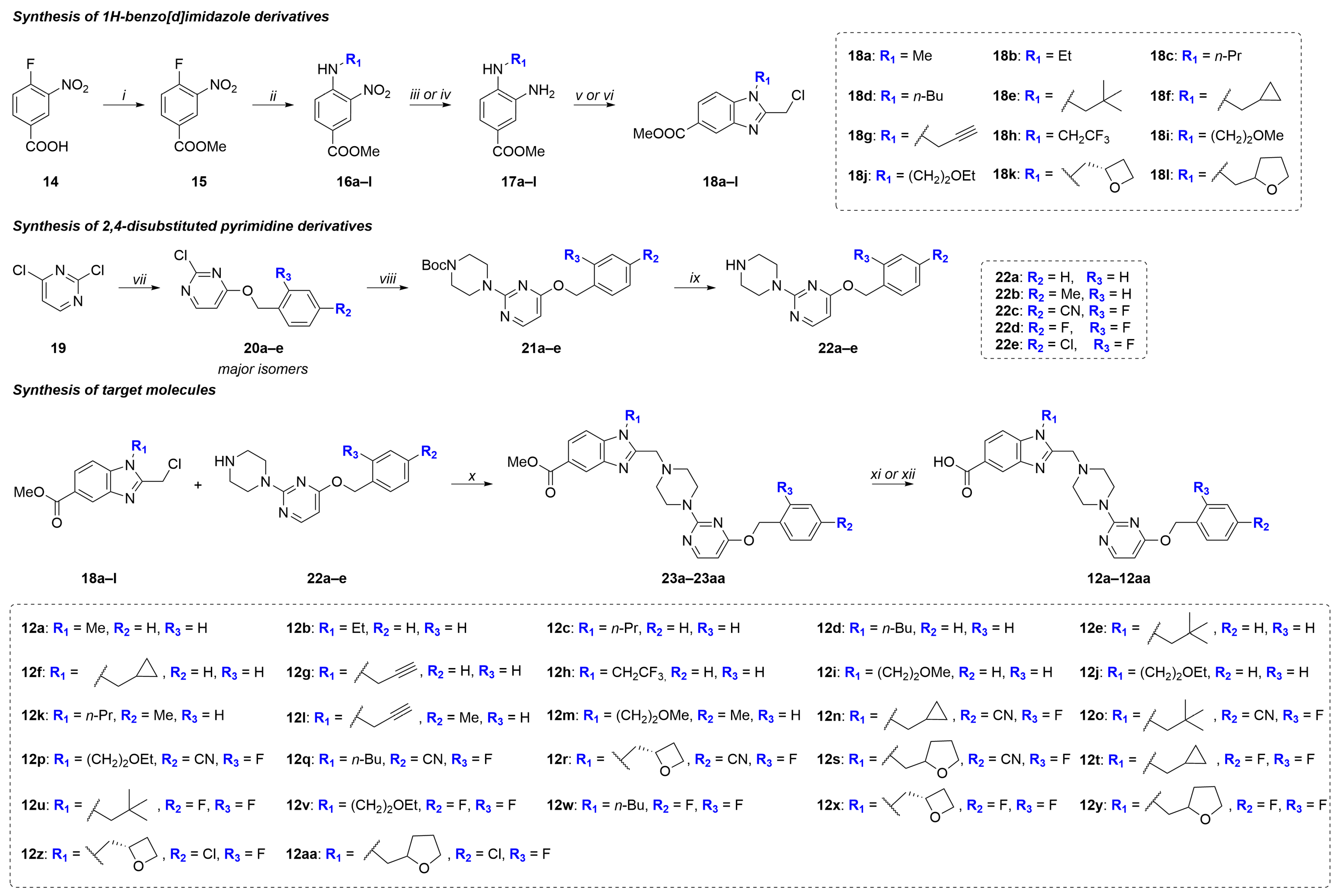
A total of 27 target 2-((4-(4-(benzyloxy)pyrimidin-2-yl)piperazin-1-yl)methyl)-1-substituted-1H-benzo[d]imidazole-5-carboxylic acids 12a12aa were obtained from the commercially available precursors 14 and 19 as shown on the scheme (Figure 4).
1H-Benzo[d]imidazole derivatives 18al were prepared by the classical method [58,59] from commercially available 3-nitro-4-fluorobenzoic acid 10 in 4 steps (Figure 4). Esterification of acid 14 gave methyl ester 15 [60], which was then introduced into a SNAr reaction with a series of primary amines according to a previously described method [61]. The resulting compounds 16al were then reduced to o-phenylenediamine derivatives 17al according to two reported protocols [62,63]. The target 1H-benzo[d]imidazole derivatives 18al were prepared using two previously described protocols: acylation with chloroacetyl chloride [64] followed by heterocyclization under acidic conditions [65], and treatment with 2-chloro-1,1,1-trimethoxyethane in the presence of pTSA [35]. In the first case, we observed the formation of a by-product of intramolecular substitution of the chlorine atom in the acyl intermediates, and therefore the yield of the target 1H-benzo[d]imidazoles was lower compared to the second protocol.
2,4-Disubstituted pyrimidines 22ae were synthesized according to previously reported methods [66,67,68] from 2,4-dichloropyrimidine 19 in three steps: a regioselective, kinetically controlled reaction with a series of benzyl alcohols leading to compounds 20ae, then a reaction with N-Boc-piperazine leading to compounds 21ae, and removal of the Boc-protecting group in the final step (Figure 4).
The final steps of synthesis of target compounds 12a12aa included alkylation [69] of pyrimidine derivatives 22ae with benzo[d]imidazole derivatives 18al to form esters 23a23aa, which were further hydrolyzed using NaOH solution (1 M in H2O), MeOH, or 1,5,7-triazabicyclo [4.4.0]dec-5-ene (TBD, 0.97 M in H2O) [35] in AcN solution (Figure 4).
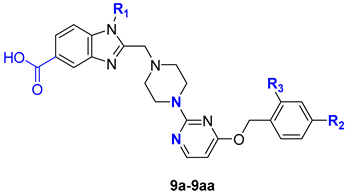
In the first stage of our study, we prepared 1H-benzo[d]imidazole-5-carboxylic acid derivatives 12aj containing an unsubstituted benzyl alcohol residue (R2 = R3 = H) and various substituents at the nitrogen atom, including alkyl, cycloalkyl, fluorine-containing, and ether substituents (Figure 4). These compounds were obtained to refine the synthetic scheme and confirm the presence of functional activity in this chemotype, as well as to study the effect of substituents both in the benzyl alcohol and the 1H-benzo[d]imidazole fragments on the target activity. Then we focused on compounds 12km containing the electron-donating methyl groups (R2 = Me, R3 = H) (EDG) and compounds 12n12aa containing electron-withdrawing groups (EWG) in the benzyl alcohol moiety (R2 = CN, R3 = F; R2 = R3 =F; R2 = Cl, R3 = F) (Figure 4). In the final step, R1 substituents in the 1H-benzo[d]imidazole scaffold, present in the structures of the most active molecules from the 9aj series, as well as privileged (S)-oxetan-2-ylmethyl and homologous (rac)-tetrahydrofuran-2-ylmethyl substituents, were introduced into the structures of the target compounds 9n9aa containing 2,4-EWG-disubstituted benzyl alcohol residues.
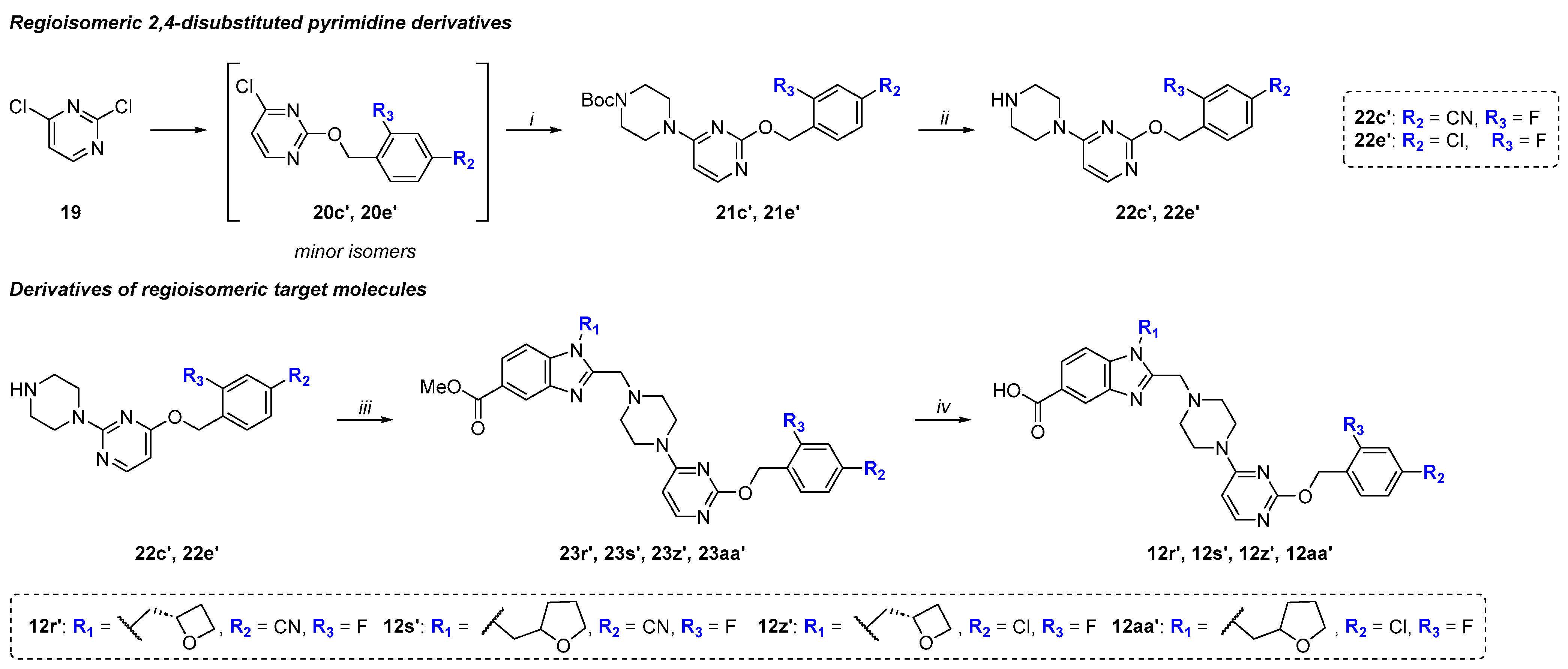
At the stage of synthesis of compounds 21c and 21e, we isolated minor regioisomers 21c′ and 21e′ using column chromatography, which were used to obtain the target regioisomeric pyrimidine derivatives 22c′ and 22e′ (Figure 5). Using compounds 22c′, 22e′ and 1H-benzo[d]imidazole derivatives 18k, 18l, the corresponding regioisomeric methyl esters 23r′, 23s′, 23z′, 23aa′ and target acids 12r′, 12s′, 12z′, 12aa′ were obtained according to the above-described protocol.
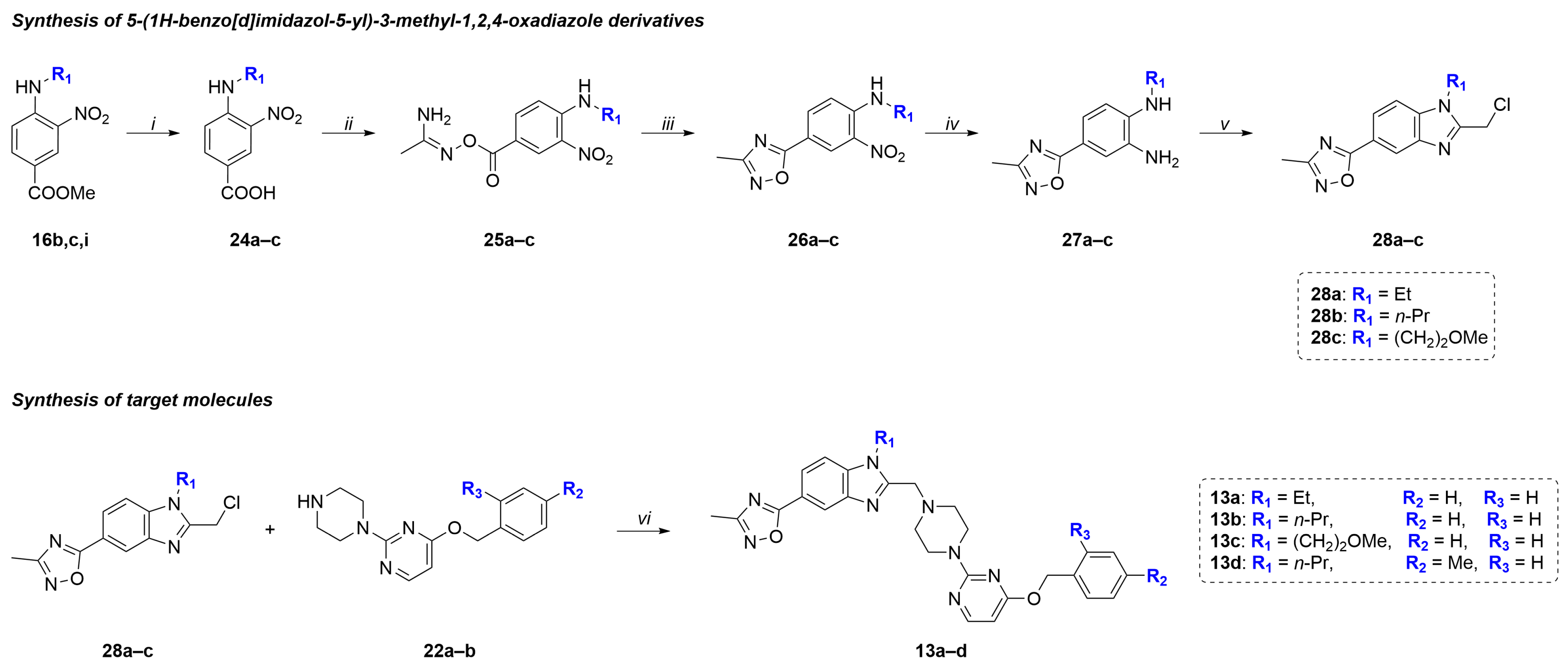
The synthesis of target compounds 13ad began with the preparation of 5-(1H-benzo[d]imidazol-5-yl)-3-methyl-1,2,4-oxadiazole derivatives 28ac from the previously obtained compounds 16b,c,i (Figure 6).
The synthesis of 1,2,4-oxadiazole derivatives is shown in Figure 6. First, esters 16b,c,i were hydrolyzed to form benzoic acids 24ac, which were activated with N,N′-carbonyldiimidazole (CDI) and then reacted with acetoamidoxime. The resulting O-acylamidoximes 25ac were treated with tetrabutylammonium fluoride (TBAF) as described previously [70,71,72] to form 1,2,4-oxadiazole derivatives 26ac. The transformation of compounds 26ac into the target 5-(1H-benzo[d]imidazol-5-yl)-3-methyl-1,2,4-oxadiazole derivatives 28ac was carried out similarly to the scheme depicted in Figure 4. In the final step, compounds 28ac were used for the alkylation of 2,4-disubstituted pyrimidines 22ab to form the target compounds 13ad.

2.2. In Vitro Signaling Studies

GLP-1R belongs to the class B family of transmembrane G protein-coupled receptors (GPCRs). Upon activation by an agonist, the receptor competitively interacts with heterotrimeric G proteins, primarily Gαs, which in turn activates membrane-bound adenylyl cyclase (AC). This enhances the conversion of ATP to cAMP, which binds to the regulatory subunits of protein kinase A (PKA). PKA phosphorylates numerous proteins, including the transcription factor CREB, which is involved in the regulation of β-cell proliferation and survival [73]. Concurrently, cAMP activates EPAC (cAMP-regulated guanine nucleotide exchange factor), triggering other effector pathways that influence exocytosis, calcium signaling, and transcription [74]. Both PKA and EPAC mediate glucose-dependent insulin secretion via exocytosis in β-cells.
In the cell-based test system used in this study, expression of the firefly luciferase gene is regulated by CREB. Although an increase in cAMP levels and subsequent CREB activation can also be induced by other effectors, this reporter system remains highly informative for evaluating the functional activity of GLP-1R agonists. This is because the intensity of the luminescent signal, which is proportional to the amount of luciferase expressed, directly reflects the degree to which the tested compound activates the intracellular signaling cascade.

2.3. GLP-1R Agonist Activity and Cytotoxicity

All the synthesized target compounds, 12a12aa, 12r′, 12s′, 12z′, 12aa′, and 13ad, were further experimentally tested for cytotoxicity against a human embryonic kidney cell line (HEK293), and their GLP-1R activity in cAMP assay was measured and compared with danuglipron (entry 36, the negative logarithm of half-maximal effective concentration pEC50 9.96, the negative logarithm of cytotoxic concentration pCC50 3.94, Table 1).
Compounds 12a12j, containing an unsubstituted benzyl alcohol residue in the structure, were almost completely inactive and noncytotoxic (entries 1–10, Table 1). A noticeable increase in activity while maintaining moderate cytotoxicity was observed when comparing homologues 12g and 12l, 12i and 12m (positions 12–13). Compounds 12n12aa, containing 2,4-EWG-disubstituted benzyl alcohols, deserve special attention: almost all presented compounds exhibited GLP-1R activity in the submicromolar concentration range (entries 14–27). The presence of a 4-chloro-2-fluorobenzyl alcohol residue in the studied chemotype led to a nanomolar agonist 12z and a submicromolar agonist 12aa, but both compounds showed pCC50 values above 4.25, indicating their cytotoxicity (entries 26–27). The introduction of a 4-cyano-2-fluorobenzyl alcohol residue into the GLP-1RA structure was the most successful modification both in terms of activity and moderate cytotoxicity of the target compounds 12n12s (entries 14–19). The least successful were 2,4-difluorosubstituted benzyl derivatives (entries 20–25), both in terms of GLP-1R activity and cytotoxicity. Replacement of the (S)-oxetan-2-ylmethyl substituent with its linear ethoxyethyl analog significantly decreased activity (compounds 12v and 12p, entries 16, 22). Cyclopropylmethyl and butyl substitutions led to equipotent agonists 12n and 12q, 12t and 12w (entries 14, 17, 20, 23), while neopentyl derivatives 12o and 12u (entries 15, 21) had a decreased agonistic activity, probably due to the increased branching.
As expected, the use of the privileged (S)-oxetan-2-ylmethyl and homologous (rac)-tetrahydrofuran-2-ylmethyl substituents as the R1-group resulted in the most potent agonists 12r, 12s, 12x, 12z, 12aa. The most preferred, both in terms of activity and safety, was the (S)-oxetan-2-ylmethyl moiety. The target activities of the regioisomeric compounds did not differ in the case of structures 12s′ and 12aa′ with (rac)-tetrahydrofuran-2-ylmethyl substituents (entries 29, 31) but differed more than 10-fold in the case of agonists 12r and 12z substituted with (S)-oxetan-2-ylmethyl group (entries 28, 30).
The replacement of the carboxyl group with a 1,2,4-oxadiazole fragment in compounds 13ad resulted in submicromolar agonistic activity of GLP-1R, but with pronounced cytotoxic effects (entries 32–35).
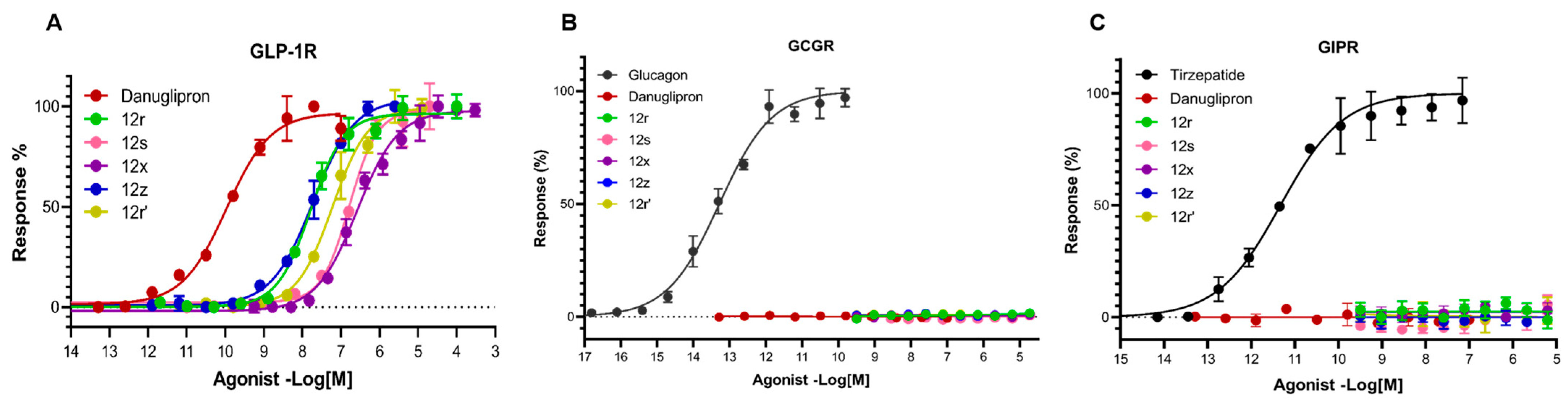
Based on the experimental results, five most interesting molecules can be identified among the tested compounds. The most active nanomolar agonist is compound 12r; being the closest analog of danuglipron, it is inferior in activity but less cytotoxic. Secondly, nanomolar cytotoxic agonist 12z, as well as three submicromolar agonists 12s, 12x, 12r′ with moderate to low cytotoxicity, deserve attention. The dose–effect curves of danuglipron and the mentioned agonists, obtained in our cAMP assay, are presented in Figure 7.
Compounds 12r, 12s, 12x, 12z, 12r′ were further evaluated for selectivity over other class B GPCRs, including GCGR and GIPR. No response to the tested compounds was detected at these receptors, while the native ligands of these receptors can effectively activate them, indicating the excellent selectivity of our agonists to GLP-1R (Figure 7). However, the results of cAMP assay showed that even the most active compounds are inferior in activity to danuglipron. This is likely due to the translocation of the carboxyl group from position 6 to position 5 of the 1H-benzo[d]imidazole scaffold.

3. Materials and Methods

3.1. Chemistry

All the experimental details, including procedures of synthesis of all the compounds described in the work, full physicochemical data for all compounds synthesized, as well as copies of their NMR and HRMS spectra are presented in the Supplementary Materials.

3.2. Plasmid Vectors

The firefly luciferase gene (Addgene plasmid #72684) was integrated into the pBabe plasmid vector (Addgene plasmid #15682) along with two cAMP-dependent CRE elements and a minimal CMV promoter (miniCMV) assembled from oligonucleotides using overlap PCR. The inserts were cloned using the SLIC method with overlapping primers and T4 polymerase (SE-E339 SibEnzyme, Novosibirsk, Russia). The resulting construct was named pBabe-CRE_Luc. The sequence of the human GLP-1R gene was amplified from cDNA of a human insulinoma provided by the FSBI “I.I. Dedov National Medical Research Center of Endocrinology” of the Ministry of Health of the Russian Federation. The plasmid construct for receptor expression was generated based on the pgRNA-humanized vector (Addgene plasmid #44248), from which the fragment containing the U6 promoter and the gRNA scaffold was removed. Using the restriction-ligation method, the vector was digested at the XhoI isoschizomer-Sfr274I (SE-E125 SibEnzyme, Novosibirsk, Russia) and PsiI (SE-E279 SibEnzyme, Novosibirsk, Russia) sites. Subsequently, the sticky end of Sfr274I was blunted using T4 polymerase, destroying the site, and ligated with T4 ligase (SE-E329 SibEnzyme, Russia). The human GLP-1R sequence was fused to GFP via a T2A peptide sequence using overlap PCR. The 5′ primer contained a NheI restriction site, the 3′ T2A primer contained an XhoI restriction site, as did the 5′ primer for GFP; the 3′ primer for GFP contained an EcoRI restriction site. The vector was digested using AsuNHI (SE-E063 SibEnzyme, Novosibirsk, Russia), which is an isoschizomer of NheI, and EcoRI (SE-E057 SibEnzyme, Novosibirsk, Russia). The amplified GLP1R-T2A fragment was digested using AsuNHI and Sfr274I. The amplified GFP gene was digested at the Sfr274I and EcoRI sites. The three resulting fragments were ligated using T4 ligase, and the constructs were transformed into NEB Stable Competent E. coli (High Efficiency) (C3040H, New England Biolabs, Ipswich, MA, USA). After colony screening and verification by Sanger sequencing, the resulting plasmid vector was used for lentiviral vector production. This vector was named pHumanized_GLP1R-T2A-GFP.

3.3. Transduction of HEK293T Cells

At all stages, cells were cultured in a DMEM medium (PanEco, Moscow, Russia) containing 4.5 g/L glucose, 2 mM L-glutamine (PanEco, Moscow, Russia), and 10% FBS (Cytiva (HyClone), Wilmington, DE, USA), under conditions of 37 °C and 5% CO2. In the first stage, a clone of 293T cell line from ATCC, transduced with retroviral vectors containing the firefly luciferase gene under the control of a minimal CMV promoter and two CRE elements, was generated. Viral vectors were obtained by transfecting the pBabe-CRE_Luc plasmid into the Phoenix helper-free retrovirus producer line [75] using the transfection reagent PEI MAX (24765, PolySciences, Warrington, PA, USA) according to the manufacturer’s protocol. For transduction, the supernatant from transfected cells collected at 24 and 48 h was pooled and filtered through a 0.45 µm syringe filter (PTF405013, Jet Biofil, Guangzhou, China). For transduction, 293T cells were seeded onto a 6 cm dish for adherent cultures (TCD010060, Jet Biofil, Guangzhou, China). Upon reaching 60% confluency, half of the medium was replaced with supernatant containing viral particles. To enhance transduction efficiency, 0.8 µg/mL of polybrene (TR 1003-50UL, Sigma-Aldrich, Moscow, Russia) was also added to the cells. Cells were incubated during transduction under standard conditions at 37 °C and 5% CO2 for 24 h, after which the cells were cultured in a fresh culture medium with 0.5 µg/mL puromycin (A1113803, Gibco™, Waltham, MA, USA) for selection for 7 d. Cloning was performed by limiting dilution; cells were seeded into 96-well plates (CAP011096, Jet Biofil, Guangzhou, China) at a density of 0.5 cells/well in 100 µL of a complete growth medium. The resulting clonal cell cultures were cultured in the presence of 0.3 µg/mL puromycin and analyzed for the functionality of the luciferase reporter using forskolin (TC472-25MG, HiMedia, Maharashtra, India), which promotes an increase in intracellular cAMP levels. A cell line whose luciferase response remained stable over a month of cultivation, with a luminescence signal-to-background ratio greater than 2, was selected for further work. These cells were named HEK CRE Luc. In the next stage, lentiviral vectors were produced in 293T cells. The transfer plasmid pHumanized_GLP1R-T2A-GFP and helper plasmids pMDLg/pRRE (Addgene plasmid #12251), pRSV-Rev (Addgene plasmid #12253), and pVSV-G (Addgene plasmid #138479) were used at a ratio of 10:5:3:1, respectively. The total amount of DNA was 10 µg per 6 cm diameter dish with cells at 70% confluency. The transfection reagent PEI MAX (24765, PolySciences, Warrington, PA, USA) was used at a 3:1 ratio to the total DNA mass. The HEK CRE Luc cells obtained earlier were transduced with the lentiviral vectors. For this, the supernatant from transfected cells collected at 24 and 48 h was pooled and filtered through a 0.45 µm syringe filter (PTF405013, Jet Biofil, Guangzhou, China). For transduction, HEK CRE Luc cells were seeded onto a 12-well plate for adherent cultures (TCP011012 Jet Biofil, Guangzhou, China). Upon reaching 60% confluency, 10, 25, 50, or 125 µL of supernatant with lentiviral vectors was added to the plate wells, bringing the volume of the culture medium in the well to 500 µL. Then, 0.4 µg of polybrene was added per well, and the plates were centrifuged for 1 h at 30 °C and 1000 g. After centrifugation, the plates were incubated under standard conditions at 37 °C and 5% CO2, with the culture medium replaced with a fresh medium after 24 h. After 48 h, the percentage of GFP-positive cells was assessed. Wells containing approximately 30–40% GFP-positive cells were analyzed by flow cytometry, and single cells were sorted into individual wells of a 96-well U-bottom plate (CAP012096, Jet Biofil, Guangzhou, China) using a BD FACSAria III (Becton Dickinson, Franklin Lakes, NJ, USA). From the obtained clones, the most suitable one for analyzing the activity of GLP-1R agonists activating the cAMP-dependent signaling pathway was selected. For this, the relative level of GLP-1R expression was determined, the presence of target inserts in the genome was confirmed by qualitative PCR, the functionality and specificity of the system were confirmed using GLP-1 and GIP agonists, and stability over 20 passages was confirmed. The resulting cell line was named HEK CRE Luc GLP-1R-GFP.

3.4. Analysis of GLP-1R Agonist Activity

HEK CRE Luc GLP-1R-GFP cells were collected, resuspended, and adjusted to a density of 0.5 × 10⁶ cells/mL in a complete DMEM medium (PanEco, Moscow, Russia) containing 4.5 g/L glucose, 2 mM L-glutamine, and 10% FBS (Cytiva(HyClone), Wilmington, DE, USA). Cells were seeded into a black opaque 96-well plate (30296, SPL Lifesciences, Gyeonggi-do, Korea) at 100 µL per well and incubated overnight in a CO2 incubator (37 °C, 5% CO2). The test compounds and the reference drug danuglipron (PF-06882961, Pfizer, New York, NY, USA) were dissolved in DMSO (131954.1611, PanReac Applichem, Barcelona, Spain). Immediately prior to the assay, compound solutions at a concentration of 1–3 mM were prepared in a complete DMEM medium, followed by serial dilutions in a complete DMEM. Then, 50 µL of the diluted compound was transferred to the plate wells with cells. After 20 h of incubation, 70 µL of the medium was removed from each well. Then, 40 µL of D-luciferin solution in lysis buffer was added to the remaining 80 µL using the AbiLux Firefly Luciferase Assay Kit (LUX-011-3-100ML, Abisense, Sirius, Russia). The plate was incubated on a shaker (PST-60HL-4, BIOSAN, Riga, Latvia) at 500 rpm for 5 min at room temperature, after which chemiluminescence was measured using a microplate reader (BMG LABTECH CLARIOstar Plus, Ortenberg, Germany). Each experiment included three technical and three biological replicates. pEC50 and 95% CI EC50 values were determined by fitting dose–response curves using a four-parameter equation in the GraphPad Prism 8.2.1 software (San Diego, CA, USA).

3.5. Analysis of Specific Agonist Activity

To confirm the specific activity of the tested small molecules, biological activity assays against GIPR and GCGR were performed. Reporter cells expressing GIPR or GCGR were generated analogously to the GLP-1R cell line, using HEK CRE Luc cells. Receptor genes were cloned from the following plasmid vectors: GIPR-Tango (Addgene plasmid #66294) and GCGR-Tango (Addgene plasmid #66291), both gifts from Bryan Roth. For the GIPR-expressing cell line, Tirzepatide (LY3298176, Eli Lilly, Indianapolis, IN, USA) was used as a positive control, as it functions as a dual GLP-1R/GIPR agonist. For the GCGR-expressing cell line, Glucagon (H04AA01, Novo Nordisk, Bagsværd, Denmark) was used as the agonist control. Test compounds were prepared from DMSO stock solutions as described in Section 3.4. The concentration range for testing was selected based on the compounds’ known activity against GLP-1R. A series of 3-fold dilutions was prepared, starting from the maximum effective concentration. The assay procedure followed the same protocol described for GLP-1R agonist activity testing (Section 3.4). Each assay was performed in three independent experiments, each with three technical replicates. Dose–response curves were plotted and analyzed using GraphPad Prism 8.2.1 software (San Diego, CA, USA).

3.6. Cytotoxicity Assay

The HEK293 cell line was kindly provided by the cell culture collection of the Institute of Cytology RAS. The day before the assay, cells were seeded at a density of 1 × 10⁴ cells per well of 96-well microplates (Wuxi NEST Biotechnology Co., Wuxi, China). The cells were incubated overnight at 37 °C with 5% CO2 in a humidified incubator. Various concentrations of test compounds were prepared in a complete culture medium (DMEM containing 10% FBS, 2 mM L-glutamine, and 50 μg/mL gentamicin; all from Biolot, Moscow, Russia) and added to the wells. After 48 h incubation, the medium was replaced with 200 μL of a fresh culture medium containing 0.5 mg/mL MTT (PanEko, Moscow, Russia) and plates were incubated for 2 h to allow formazan crystal formation. Subsequently, the medium was removed, and formazan crystals were dissolved in 150 μL of DMSO (Helicon, Moscow, Russia). Absorbance was measured at 595 nm using an iMark microplate absorbance reader (Bio-Rad, Hercules, CA, USA). Each experiment included three technical replicates per plate. Statistical analysis and curve fitting were performed using GraphPad Prism 7 software (GraphPad Software, San Diego, CA, USA). pCC50 and SEMpCC50 values were calculated using a four-parameter logistic equation.

4. Conclusions

In conclusion, in this work we attempted to look into the underexplored chemical space of 5-substituted regioisomeric analogs of danuglipron-like GLP-1R agonists. A series of novel “next-in-class” GLP-1RAs structurally similar to danuglipron were synthesized and evaluated in vitro for cytotoxicity and GLP-1R agonistic activity using a cAMP accumulation assay. Translocation of the carboxyl group from position 6 to position 5 of the 1H-benzo[d]imidazole core resulted in an overall decrease in agonistic activity compared to danuglipron, although in several cases this modification was accompanied by a decrease in cytotoxicity. More than half of the synthesized compounds demonstrated lower cytotoxicity than the prototype, with twelve compounds showing pCC50 values lower than 3.60. We have found that the position of the 2,4-disubstituted pyrimidine linker significantly influenced cytotoxicity, with compounds containing a 2-benzyloxypyrimidin-4-yl moiety exhibiting lower cytotoxicity than their 4-benzyloxypyrimidin-2-yl regioisomers.
Compound 12r was identified as a nanomolar GLP-1R agonist (pEC50 = 7.80) with low cytotoxicity (pCC50 < 3.60) and excellent selectivity over two other class B GPCRs, including GCGR and GIPR. Thus, unlike dual agonists (e.g., Tirzepatide) or triple agonists, compound 12r does not target GIPR or GCGR, making it a “pure” GLP-1R agent. Several additional nanomolar analogs were obtained which can be considered as a starting point for further optimization. This work also reports, for the first time in this chemotype, the replacement of the carboxyl group with a 3-methyl-1,2,4-oxadiazole-5-yl substituent. Collectively, these findings provide useful chemical and biological information that can guide the rational optimization of compounds within this chemotype and address current limitations in the field.

Supplementary Materials

The following supporting information can be downloaded at: https://www.mdpi.com/article/10.3390/molecules31071129/s1; Experimental details, including procedures of synthesis of all the compounds described in the work, full physicochemical data for all compounds synthesized, as well as copies of their NMR and HRMS spectra.

Author Contributions

Conceptualization, E.V.T. and V.V.C.; methodology, V.V.C.; investigation, E.V.T., T.L.S., A.Y.S., N.D.L., A.M.K., E.Y.S., S.A.S. and V.V.C.; data curation, E.V.T., S.A.S., K.V.B. and V.V.C.; supervision, S.A.S., K.V.B. and V.V.C.; writing—original draft preparation, E.V.T., A.M.K., S.A.S., K.V.B. and V.V.C.; writing—review and editing, E.V.T., A.Y.S., K.V.B. and V.V.C.; project administration, R.A.I. All authors have read and agreed to the published version of the manuscript.

Funding

This research was funded by the Ministry of Science and Higher Education of the Russian Federation, Agreement 075-10-2025-017.

Institutional Review Board Statement

Not applicable.

Informed Consent Statement

Not applicable.

Data Availability Statement

Data are contained within the article and Supplementary Materials.

Acknowledgments

The authors would like to thank Bunev A.S. (Medicinal Chemistry Center, Togliatti, Russia) and Kuleshova S.A. (Sirius University, Krasnodar region, Russia) for their valuable support, which contributed to this work.

Conflicts of Interest

The authors declare no conflicts of interest.

Abbreviations

The following abbreviations are used in this manuscript:
GLP-1Glucagon-like peptide-1
GLP-1RAGlucagon-like peptide-1 receptor agonist
GCGRG-protein-coupled receptor
GIPRGastric inhibitory polypeptide receptor
GPCRsTransmembrane G protein-coupled receptors
ACAdenylyl cyclase
PKAProtein kinase A
cAMPCyclic adenosine monophosphate
EPACExchange Protein directly Activated by cAMP
pEC50A negative logarithm of half-maximal effective concentration
pCC50A negative logarithm of 50% Cytotoxic concentration
SARStructure-activity relationship

References

  1. Bagge Hansen, K.; Krag Knop, F.; Vilsbøll, T. Positioning Glucagon-like-Peptide-1—Based Treatments within an Optimal Management Regimen for Type 2 Diabetes. Eur. Endocrinol. 2008, 4, 44. [Google Scholar] [CrossRef]
  2. Alavi, S.E.; Cabot, P.J.; Moyle, P.M. Glucagon-Like Peptide-1 Receptor Agonists and Strategies To Improve Their Efficiency. Mol. Pharm. 2019, 16, 2278–2295. [Google Scholar] [CrossRef]
  3. Mayendraraj, A.; Rosenkilde, M.M.; Gasbjerg, L.S. GLP-1 and GIP Receptor Signaling in Beta Cells—A Review of Receptor Interactions and Co-Stimulation. Peptides 2022, 151, 170749. [Google Scholar] [CrossRef]
  4. Jee Choe, H.; Min Cho, Y. Peptidyl and Non-Peptidyl Oral Glucagon-like Peptide-1 Receptor Agonists. Endocrinol. Metab. 2021, 36, 22–29. [Google Scholar] [CrossRef]
  5. Zhang, H.; Wu, T.; Wu, Y.; Peng, Y.; Wei, X.; Lu, T.; Jiao, Y. Binding Sites and Design Strategies for Small Molecule GLP-1R Agonists. Eur. J. Med. Chem. 2024, 275, 116632. [Google Scholar] [CrossRef]
  6. Sztanek, F.; Tóth, L.I.; Pető, A.; Hernyák, M.; Diószegi, Á.; Harangi, M. New Developments in Pharmacological Treatment of Obesity and Type 2 Diabetes—Beyond and within GLP-1 Receptor Agonists. Biomedicines 2024, 12, 1320. [Google Scholar] [CrossRef] [PubMed]
  7. Ma, X.; Liu, Z.; Ilyas, I.; Little, P.J.; Kamato, D.; Sahebka, A.; Chen, Z.; Luo, S.; Zheng, X.; Weng, J.; et al. GLP-1 Receptor Agonists (GLP-1RAs): Cardiovascular Actions and Therapeutic Potential. Int. J. Biol. Sci. 2021, 17, 2050–2068. [Google Scholar] [CrossRef]
  8. Volke, V.; Katus, U.; Johannson, A.; Toompere, K.; Heinla, K.; Rünkorg, K.; Uusküla, A. Systematic Review and Meta-Analysis of Head-to-Head Trials Comparing Sulfonylureas and Low Hypoglycaemic Risk Antidiabetic Drugs. BMC Endocr. Disord. 2022, 22, 251. [Google Scholar] [CrossRef]
  9. Sharma, V.; Patial, V. Peroxisome Proliferator-Activated Receptor Gamma and Its Natural Agonists in the Treatment of Kidney Diseases. Front. Pharmacol. 2022, 13, 991059. [Google Scholar] [CrossRef] [PubMed]
  10. Alnuaimi, S.; Reljic, T.; Abdulla, F.S.; Memon, H.; Al-Ali, S.; Smith, T.; Serdarevic, F.; Velija Asimi, Z.; Kumar, A.; Semiz, S. PPAR Agonists as Add-on Treatment with Metformin in Management of Type 2 Diabetes: A Systematic Review and Meta-Analysis. Sci. Rep. 2024, 14, 8809. [Google Scholar] [CrossRef] [PubMed]
  11. Singh, A.; Singh, K.; Sharma, A.; Kaur, K.; Kaur, K.; Chadha, R.; Bedi, P.M.S. Recent Developments in Synthetic α-Glucosidase Inhibitors: A Comprehensive Review with Structural and Molecular Insight. J. Mol. Struct. 2023, 1281, 135115. [Google Scholar] [CrossRef]
  12. Padhi, S.; Nayak, A.K.; Behera, A. Type II Diabetes Mellitus: A Review on Recent Drug Based Therapeutics. Biomed. Pharmacother. 2020, 131, 110708. [Google Scholar] [CrossRef]
  13. Artasensi, A.; Pedretti, A.; Vistoli, G.; Fumagalli, L. Type 2 Diabetes Mellitus: A Review of Multi-Target Drugs. Molecules 2020, 25, 1987. [Google Scholar] [CrossRef]
  14. Salmen, T.; Bobirca, F.-T.; Bica, I.-C.; Mihai, D.-A.; Pop, C.; Stoian, A.P. The Safety Profile of Sodium-Glucose Cotransporter-2 Inhibitors and Glucagon-like Peptide 1 Receptor Agonists in the Standard of Care Treatment of Type 2 Diabetes Mellitus. Life 2023, 13, 839. [Google Scholar] [CrossRef]
  15. Małyszczak, A.; Przeździecka-Dołyk, J.; Szydełko-Paśko, U.; Misiuk-Hojło, M. Novel Antidiabetic Drugs and the Risk of Diabetic Retinopathy: A Systematic Review and Meta-Analysis of Randomized Controlled Trials. J. Clin. Med. 2024, 13, 1797. [Google Scholar] [CrossRef]
  16. Salmen, T.; Serbanoiu, L.I.; Bica, I.C.; Serafinceanu, C.; Muzurović, E.; Janez, A.; Busnatu, S.; Banach, M.; Rizvi, A.A.; Rizzo, M.; et al. A Critical View over the Newest Antidiabetic Molecules in Light of Efficacy—A Systematic Review and Meta-Analysis. Int. J. Mol. Sci. 2023, 24, 9760. [Google Scholar] [CrossRef] [PubMed]
  17. De Giorgi, R.; Ghenciulescu, A.; Yotter, C.; Taquet, M.; Koychev, I. Glucagon-like Peptide-1 Receptor Agonists for Major Neurocognitive Disorders. J. Neurol. Neurosurg. Psychiatry 2025, 96, 870–883. [Google Scholar] [CrossRef] [PubMed]
  18. Lv, D.; Feng, P.; Guan, X.; Liu, Z.; Li, D.; Xue, C.; Bai, B.; Hölscher, C. Neuroprotective Effects of GLP-1 Class Drugs in Parkinson’s Disease. Front. Neurol. 2024, 15, 1462240. [Google Scholar] [CrossRef] [PubMed]
  19. Iacobini, C.; Vitale, M.; Haxhi, J.; Pesce, C.; Pugliese, G.; Menini, S. Food-Related Carbonyl Stress in Cardiometabolic and Cancer Risk Linked to Unhealthy Modern Diet. Nutrients 2022, 14, 1061. [Google Scholar] [CrossRef]
  20. Siddeeque, N.; Hussein, M.H.; Abdelmaksoud, A.; Bishop, J.; Attia, A.S.; Elshazli, R.M.; Fawzy, M.S.; Toraih, E.A. Neuroprotective Effects of GLP-1 Receptor Agonists in Neurodegenerative Disorders: A Large-Scale Propensity-Matched Cohort Study. Int. Immunopharmacol. 2024, 143, 113537. [Google Scholar] [CrossRef]
  21. Greco, E.V.; Russo, G.; Giandalia, A.; Viazzi, F.; Pontremoli, R.; De Cosmo, S. GLP-1 Receptor Agonists and Kidney Protection. Medicina 2019, 55, 233. [Google Scholar] [CrossRef] [PubMed]
  22. Mariam, Z.; Niazi, S.K. Glucagon-like Peptide Agonists: A Prospective Review. Endocrinol. Diabetes Metab. 2024, 7, e462. [Google Scholar] [CrossRef]
  23. Hu, E.-H.; Tsai, M.-L.; Lin, Y.; Chou, T.-S.; Chen, T.-H. A Review and Meta-Analysis of the Safety and Efficacy of Using Glucagon-like Peptide-1 Receptor Agonists. Medicina 2024, 60, 357. [Google Scholar] [CrossRef]
  24. Overgaard, R.V.; Navarria, A.; Ingwersen, S.H.; Bækdal, T.A.; Kildemoes, R.J. Clinical Pharmacokinetics of Oral Semaglutide: Analyses of Data from Clinical Pharmacology Trials. Clin. Pharmacokinet. 2021, 60, 1335–1348. [Google Scholar] [CrossRef] [PubMed]
  25. Fang, H.; Niu, B.; Chen, Q. The Discovery and Development of Glucagon-Like Peptide-1 Receptor Agonists. Curr. Med. Chem. 2023, 31, 2921–2943. [Google Scholar] [CrossRef]
  26. Liu, Q.; Li, N.; Yuan, Y.; Lu, H.; Wu, X.; Zhou, C.; He, M.; Su, H.; Zhang, M.; Wang, J.; et al. Cyclobutane Derivatives as Novel Nonpeptidic Small Molecule Agonists of Glucagon-like Peptide-1 Receptor. J. Med. Chem. 2012, 55, 250–267. [Google Scholar] [CrossRef]
  27. Decara, J.M.; Vázquez-Villa, H.; Brea, J.; Alonso, M.; Srivastava, R.K.; Orio, L.; Alén, F.; Suárez, J.; Baixeras, E.; García-Cárceles, J.; et al. Discovery of V-0219: A Small-Molecule Positive Allosteric Modulator of the Glucagon-Like Peptide-1 Receptor toward Oral Treatment for “Diabesity”. J. Med. Chem. 2022, 65, 5449–5461. [Google Scholar] [CrossRef]
  28. Redij, T.; McKee, J.A.; Do, P.; Campbell, J.A.; Ma, J.; Li, Z.; Miller, N.; Srikanlaya, C.; Zhang, D.; Hua, X.; et al. 2-Aminothiophene Derivatives as a New Class of Positive Allosteric Modulators of Glucagon-like Peptide 1 Receptor. Chem. Biol. Drug Des. 2022, 99, 857–867. [Google Scholar] [CrossRef]
  29. Liu, C.; Zou, Y.; Qian, H. GLP-1R Agonists for the Treatment of Obesity: A Patent Review (2015–Present). Expert Opin. Ther. Pat. 2020, 30, 781–794. [Google Scholar] [CrossRef]
  30. Yang, X.; Zhang, M.; Lu, Z.; Zhi, L.; Xue, H.; Liu, T.; Liu, M.; Cui, L.; Liu, Z.; He, P.; et al. Novel Small Molecule Glucagon-Like Peptide-1 Receptor Agonist S6 Stimulates Insulin Secretion From Rat Islets. Front. Pharmacol. 2021, 12, 664802. [Google Scholar] [CrossRef] [PubMed]
  31. Redij, T.; Chaudhari, R.; Li, Z.; Hua, X.; Li, Z. Structural Modeling and in Silico Screening of Potential Small-Molecule Allosteric Agonists of a Glucagon-like Peptide 1 Receptor. ACS Omega 2019, 4, 961–970. [Google Scholar] [CrossRef]
  32. Zhang, Y.J.; Shen, L.L.; Cheon, H.G.; Xu, Y.N.; Jeong, J.H. Synthesis and Biological Evaluation of Glucagon-like Peptide-1 Receptor Agonists. Arch. Pharm. Res. 2014, 37, 588–599. [Google Scholar] [CrossRef][Green Version]
  33. Cheong, Y.-H.; Kim, M.-K.; Son, M.-H.; Kaang, B.-K. Two Small Molecule Agonists of Glucagon-like Peptide-1 Receptor Modulate the Receptor Activation Response Differently. Biochem. Biophys. Res. Commun. 2012, 417, 558–563. [Google Scholar] [CrossRef] [PubMed]
  34. Xue, H.; Xing, H.J.; Wang, B.; Fu, C.; Zhang, Y.S.; Qiao, X.; Guo, C.; Zhang, X.L.; Hu, B.; Zhao, X.; et al. Cinchonine, a Potential Oral Small-Molecule Glucagon-Like Peptide-1 Receptor Agonist, Lowers Blood Glucose and Ameliorates Non-Alcoholic Steatohepatitis. Drug Des. Devel. Ther. 2023, 17, 1417–1432. [Google Scholar] [CrossRef] [PubMed]
  35. Griffith, D.A.; Edmonds, D.J.; Fortin, J.P.; Kalgutkar, A.S.; Kuzmiski, J.B.; Loria, P.M.; Saxena, A.R.; Bagley, S.W.; Buckeridge, C.; Curto, J.M.; et al. A Small-Molecule Oral Agonist of the Human Glucagon-like Peptide-1 Receptor. J. Med. Chem. 2022, 65, 8208–8226. [Google Scholar] [CrossRef]
  36. Aspnes, G.E.; Bagley, S.W.; Curto, J.M.; Dowling, M.S.; Edmonds, D.J.; Flanagan, M.E.; Futatsugi, K.; Griffith, T.A.; Huard, K.; Ingle, G.; et al. GLP-1 Receptor Agonists and Uses Thereof. WO 2018/109607, 21 June 2018. [Google Scholar]
  37. Aspnes, G.E.; Bagley, S.W.; Curto, J.M.; Edmonds, D.J.; Flanagan, M.E.; Futatsugi, K.; Griffith, T.A.; Huard, K.; Lian, Y.; Limberakis, C.; et al. GLP-1 Receptor Agonists and Uses Thereof. WO 2019/239319, 19 December 2019. [Google Scholar]
  38. Kawai, T.; Sun, B.; Yoshino, H.; Feng, D.; Suzuki, Y.; Fukazawa, M.; Nagao, S.; Wainscott, D.B.; Showalter, A.D.; Droz, B.A.; et al. Structural Basis for GLP-1 Receptor Activation by LY3502970, an Orally Active Nonpeptide Agonist. Proc. Natl. Acad. Sci. USA 2020, 117, 29959–29967. [Google Scholar] [CrossRef]
  39. Yoshino, H.; Tsuchiya, S.; Matsuo, A.; Sato, T.; Nishimoto, M.; Oguri, K.; Ogawa, H.; Nishimura, Y.; Furuta, Y.; Kashiwagi, H.; et al. Pyrazolopyridine Derivative Having GLP-1 Receptor Agonist Effect. WO 2018/056453, 23 March 2018. [Google Scholar]
  40. Amin, N.B.; Frederich, R.; Tsamandouras, N.; Haggag, A.Z.; Schuster, T.; Zmuda, W.; Palmer, A.; Vasas, S.; Buckley, G.; Smith, T.R.; et al. Evaluation of an Oral Small-molecule Glucagon-like Peptide-1 Receptor Agonist, Lotiglipron, for Type 2 Diabetes and Obesity: A Dose-ranging, Phase 2, Randomized, Placebo-controlled Study. Diabetes Obes. Metab. 2025, 27, 215–227. [Google Scholar] [CrossRef]
  41. Buckeridge, C.; Cobain, S.; Bays, H.E.; Matsuoka, O.; Fukushima, Y.; Halstead, P.; Tsamandouras, N.; Sherry, N.; Gorman, D.N.; Saxena, A.R. Efficacy and Safety of Danuglipron (PF-06882961) in Adults with Obesity: A Randomized, Placebo-Controlled, Dose-Ranging Phase 2b Study. Diabetes Obes. Metab. 2025, 27, 4915–4926. [Google Scholar] [CrossRef]
  42. Rosenstock, J.; Hsia, S.; Nevarez Ruiz, L.; Eyde, S.; Cox, D.; Wu, W.-S.; Liu, R.; Li, J.; Fernández Landó, L.; Denning, M.; et al. Orforglipron, an Oral Small-Molecule GLP-1 Receptor Agonist, in Early Type 2 Diabetes. N. Engl. J. Med. 2025, 393, 1065–1076. [Google Scholar] [CrossRef]
  43. Tolkacheva, E.V.; Saliev, A.Y.; Salakhov, T.L.; Balakin, K.V.; Ivanov, R.A.; Chernyshov, V.V. “Next-in-Class” GLP-1R Danuglipron- and Lotiglipron-like Agonists: A Patent Review (2020–2024). Curr. Med. Chem. 2025. [Google Scholar] [CrossRef] [PubMed]
  44. Chen, L.; Yun, Y.; Guo, S.; Wang, X.; Xiong, M.; Zhao, T.; Xu, T.; Shen, J.; Xie, X.; Wang, K. Discovery of Novel 5,6-Dihydro-1,2,4-Triazine Derivatives as Efficacious Glucagon-Like Peptide-1 Receptor Agonists. J. Med. Chem. 2023, 66, 7988–8010. [Google Scholar] [CrossRef]
  45. Dong, G.; Ye, Q.; Li, W.; Zhang, S.; Yang, Z.; Zhang, R.; Deng, T.; Li, H.; Zhang, Y.; Zhang, X.; et al. Discovery and Evaluation of DA-302168S as an Efficacious Oral Small-Molecule Glucagon-Like Peptide-1 Receptor Agonist. J. Med. Chem. 2025, 68, 9555–9583. [Google Scholar] [CrossRef] [PubMed]
  46. Miao, L.; Lou, J.; Xu, S.; Zhang, J.; Zhong, Y.; Wang, G.; Li, Y.; Lei, S.; Shao, S.; Wang, J.; et al. Discovery of New Difluorocyclobutyl Derivatives as Effective Glucagon-Like Peptide-1 Receptor Agonists with Reduced HERG Inhibitory Activities. J. Med. Chem. 2025, 68, 7662–7692. [Google Scholar] [CrossRef]
  47. Zhao, W.; Yin, Y.; Shi, Z.; Yang, K.; Li, X.; Yang, Y.; Jing, T.; Kang, Z. Discovery and Optimization of Novel Indolecarboxylic Acid Derivative as Potent Glucagon-like Peptide-1 Receptor Agonists. Mol. Divers. 2025, 30, 873–875. [Google Scholar] [CrossRef] [PubMed]
  48. Chen, X.; Xu, S.; Yang, S.; Yu, Z.; Chen, Y.; Wu, H.; Bao, Q.; You, Q.; Guo, X.; Jiang, Z. Discovery of Selenium-Containing Derivatives as Potent and Orally Bioavailable GLP-1R Agonists. J. Med. Chem. 2025, 68, 3386–3408. [Google Scholar] [CrossRef]
  49. Zhang, Z.; Pan, H.; Guo, L.; Cai, C.; Chen, T.; Zhang, Z.; Yang, X.; Zheng, H.; Jiang, C.; Wang, Z.; et al. Design and Evaluation of 3-Phenyloxetane Derivative Agonists of the Glucagon-Like Peptide-1 Receptor. J. Med. Chem. 2024, 67, 14820–14839. [Google Scholar] [CrossRef]
  50. Aspnes, G.E.; Bagley, S.W.; Coffey, S.B.; Conn, E.L.; Curto, J.M.; Edmonds, D.J.; Genovino, J.; Griffith, D.A.; Ingle, G.; Jiao, W.; et al. 6-Azaspiro[2.5]Octanes as Small Molecule Agonists of the Human Glucagon-like Peptide-1 Receptor. Bioorganic Med. Chem. Lett. 2023, 94, 129454. [Google Scholar] [CrossRef] [PubMed]
  51. Wang, X.; Yun, Y.; Chen, L.; Guo, S.; Niu, B.; Fang, J.; Yuan, Q.; Shen, J.; Xie, X.; Wang, K. A Novel Approach to Exploit Small-Molecule Glucagon-like Peptide-1 Receptor Agonists with High Potency. Bioorganic Med. Chem. 2024, 107, 117761. [Google Scholar] [CrossRef]
  52. Meng, Q.; Xing, W.; Jennings, A. Heterocyclic GLP-1 Agonists. WO 2023/198140, 13 April 2023. [Google Scholar]
  53. Liang, B.; Yang, Y.; Wang, P.; Yang, B.; Lai, Y.; Wu, J.J. GLP-1 Receptor Modulating Compounds. US 2023/0271949, 10 February 2023. [Google Scholar]
  54. Xing, W.; Lin, X.; Jennings, A. Heterocyclic GLP-1 Agonists. WO 2022/078407, 11 April 2022. [Google Scholar]
  55. Lin, X.; Meng, Q.; Zhang, H. GLP-1 Receptor Agonists and Uses Thereof. WO 2023/179542, 28 September 2023. [Google Scholar]
  56. Lee, H.K.; Hwang, J.-U.; Lee, K.-H.; Choi, H.-H.; Jang, J.-I.; Lee, H.-J.; Kang, S.-T.; Yoon, H.-H.; Ha, N.; La, H.-H.; et al. GLP-1 Receptor Agonist. WO 2021/112538, 10 June 2020. [Google Scholar]
  57. Cherkasova, A.; Astolfi, R.; Nawrozkij, M.; Gladkikh, B.; Proia, E.; Giuliani, L.; Rotili, D.; Ragno, R.; Ivanov, R. 1,2,4-Oxadiazoles in Medicinal Chemistry: Trends of the Last Years. Eur. J. Med. Chem. 2025, 297, 117935. [Google Scholar] [CrossRef] [PubMed]
  58. Patel, M.; Avashthi, G.; Gacem, A.; Alqahtani, M.S.; Park, H.K.; Jeon, B.H. A Review of Approaches to the Metallic and Non-Metallic Synthesis of Benzimidazole (BnZ) and Their Derivatives for Biological Efficacy. Molecules 2023, 28, 5490. [Google Scholar] [CrossRef] [PubMed]
  59. Chernyshov, V.V.; Yarovaya, O.I.; Vatsadze, S.Z.; Borisevich, S.S.; Trukhan, S.N.; Gatilov, Y.V.; Peshkov, R.Y.; Eltsov, I.V.; Martyanov, O.N.; Salakhutdinov, N.F. Unexpected Ring Opening During the Imination of Camphor-Type Bicyclic Ketones. Eur. J. Org. Chem. 2021, 2021, 452–463. [Google Scholar] [CrossRef]
  60. Rehpenn, A.; Walter, A.; Storch, G. Molecular Flavin Catalysts for C–H Functionalisation and Derivatisation of Dehydroamino Acids. Chem. Sci. 2022, 13, 14151–14156. [Google Scholar] [CrossRef] [PubMed]
  61. Yellol, G.S.; Donaire, A.; Yellol, J.G.; Vasylyeva, V.; Janiak, C.; Ruiz, J. On the Antitumor Properties of Novel Cyclometalated Benzimidazole Ru(II), Ir(III) and Rh(III) Complexes. Chem. Commun. 2013, 49, 11533–11535. [Google Scholar] [CrossRef]
  62. Seth, P.P.; Robinson, D.E.; Jefferson, E.A.; Swayze, E.E. Efficient Solution Phase Synthesis of 2-(N-Acyl)-Aminobenzimidazoles. Tetrahedron Lett. 2002, 43, 7303–7306. [Google Scholar] [CrossRef]
  63. Álvarez-Constantino, A.M.; Álvarez-Pérez, A.; Varela, J.A.; Sciortino, G.; Ujaque, G.; Saá, C. Chemoselective Ru-Catalyzed Oxidative Lactamization vs Hydroamination of Alkynylamines: Insights from Experimental and Density Functional Theory Studies. J. Org. Chem. 2023, 88, 1185–1193. [Google Scholar] [CrossRef]
  64. Teno, N.; Gohda, K.; Wanaka, K.; Tsuda, Y.; Akagawa, M.; Akiduki, E.; Araki, M.; Masuda, A.; Otsubo, T.; Yamashita, Y. Novel Type of Plasmin Inhibitors: Providing Insight into P4 Moiety and Alternative Scaffold to Pyrrolopyrimidine. Bioorganic Med. Chem. 2015, 23, 3696–3704. [Google Scholar] [CrossRef] [PubMed]
  65. Ding, Y.; Liu, K.; Zhao, X.; Lv, Y.; Yu, R.; Kang, C. Design, Synthesis, and Antitumor Activity of Novel Benzoheterocycle Derivatives as Inhibitors of Vascular Endothelial Growth Factor Receptor-2 Tyrosine Kinase. J. Chem. Res. 2020, 44, 286–294. [Google Scholar] [CrossRef]
  66. Haidasz, E.A.; Pratt, D.A. Diazaphenoxazines and Diazaphenothiazines: Synthesis of the “Correct” Isomers Reveals They Are Highly Reactive Radical-Trapping Antioxidants. Org. Lett. 2017, 19, 1854–1857. [Google Scholar] [CrossRef]
  67. Fizia, A.; Gaffga, M.; Lang, J.; Sun, Y.; Niedner-Schatteburg, G.; Thiel, W.R. Cyclopalladation in the Periphery of a NHC Ligand as the Crucial Step in the Synthesis of Highly Active Suzuki–Miyaura Cross-Coupling Catalysts. Chem. A Eur. J. 2017, 23, 14563–14575. [Google Scholar] [CrossRef]
  68. Taldone, T.; Kang, Y.; Patel, H.J.; Patel, M.R.; Patel, P.D.; Rodina, A.; Patel, Y.; Gozman, A.; Maharaj, R.; Clement, C.C.; et al. Heat Shock Protein 70 Inhibitors. 2. 2,5′-Thiodipyrimidines, 5-(Phenylthio)Pyrimidines, 2-(Pyridin-3-Ylthio)Pyrimidines, and 3-(Phenylthio)Pyridines as Reversible Binders to an Allosteric Site on Heat Shock Protein 70. J. Med. Chem. 2014, 57, 1208–1224. [Google Scholar] [CrossRef]
  69. Firsova, A.A.; Chernyshov, V.V.; Esaulkova, I.L.; Salakhov, T.L.; Saliev, A.Y.; Ivanov, R.A.; Zarubaev, V.V.; Vatsadze, S.Z. Synthesis of New 4-(5-R-1-Phenyl-1H-1,2,4-Triazol-3-Yl)Benzamides. Russ. Chem. Bull. 2025, 74, 1428–1437. [Google Scholar] [CrossRef]
  70. Gangloff, A.R.; Litvak, J.; Shelton, E.J.; Sperandio, D.; Wang, V.R.; Rice, K.D. Synthesis of 3,5-Disubstituted-1,2,4-Oxadiazoles Using Tetrabutylammonium Fluoride as a Mild and Efficient Catalyst. Tetrahedron Lett. 2001, 42, 1441–1443. [Google Scholar] [CrossRef]
  71. Zhukovets, A.A.; Chernyshov, V.V.; Al’mukhametov, A.Z.; Seregina, T.A.; Revtovich, S.V.; Kasatkina, M.A.; Isakova, Y.E.; Kulikova, V.V.; Morozova, E.A.; Cherkasova, A.I.; et al. Novel Hydroxamic Acids Containing Aryl-Substituted 1,2,4- or 1,3,4-Oxadiazole Backbones and an Investigation of Their Antibiotic Potentiation Activity. Int. J. Mol. Sci. 2024, 25, 96. [Google Scholar] [CrossRef] [PubMed]
  72. Chernyshov, V.V.; Yarovaya, O.I.; Esaulkova, I.L.; Sinegubova, E.; Borisevich, S.S.; Popadyuk, I.I.; Zarubaev, V.V.; Salakhutdinov, N.F. Novel O-Acylated Amidoximes and Substituted 1,2,4-Oxadiazoles Synthesised from (+)-Ketopinic Acid Possessing Potent Virus-Inhibiting Activity against Phylogenetically Distinct Influenza A Viruses. Bioorganic Med. Chem. Lett. 2022, 55, 128465. [Google Scholar] [CrossRef] [PubMed]
  73. Marzook, A.; Tomas, A.; Jones, B. The Interplay of Glucagon-Like Peptide-1 Receptor Trafficking and Signalling in Pancreatic Beta Cells. Front. Endocrinol. 2021, 12, 678055. [Google Scholar] [CrossRef]
  74. Holz, G.G. A New CAMP-Binding Protein in Support of Glucagon-like Peptide-1 Receptor-Mediated Signal Transduction in the Pancreatic Beta-Cell. Diabetes 2004, 53, 5–13. [Google Scholar] [CrossRef]
  75. Pear, W.S.; Nolan, G.P.; Scott, M.L.; Baltimore, D. Production of High-Titer Helper-Free Retroviruses by Transient Transfection. Proc. Natl. Acad. Sci. USA 1993, 90, 8392–8396. [Google Scholar] [CrossRef]
Figure 1. “First-in-class” small molecule GLP-1RAs: danuglipron (PF-06882961, [35,36]), lotiglipron (PF-07081532, [37]), orforglipron (LY3502970, [38,39]).
Molecules 31 01129 g001
Figure 2. “Next-in-class” small molecules GLP-1RAs 18 structurally similar to danuglipron [35,44,45,46,47,48,49,50,51].
Molecules 31 01129 g002
Figure 3. Design of the “next-in-class” target molecules of general formulas 12 and 13. The blue arrows indicate a change in the position of the carboxyl group [36,54,56].
Molecules 31 01129 g003
Figure 4. Synthetic route to intermediates 18al, 22ae, and target molecules 12a12aa. Reagents and conditions: (i) MeOH, H2SO4 (conc), reflux, 28 h, 95%; (ii) primary amine, DCM, DIPEA, N2, rt, 2 h, 90–98%; (iii) H2, Pd/C, EtOH, rt, 2 h, 85–98%; (iv) Fe, NH4Cl, THF:MeOH:H2O (6:3:1), reflux, 5 h, 85–90%; (v) (1) ClCH2COCl, DIPEA, THF, N2, rt, 1 h; (2) AcOH, 90 °C, 3 h, 40–75%; (vi) ClCH2CH(OMe)3, pTSA, AcN, 60 °C, 1 h, 55–75%; (vii) benzyl alcohol, tert-BuOK, THF, DMF, −50 °C, 3 h, summary yield 80–90%; (viii) N-Boc-piperazine, THF, reflux, 6 h, 75–85%; (ix) (1) TFA, DCM, reflux, 2 h; (2) Na2CO3 (aq), 85–90%; (x) K2CO3, KI, AcN, rt, 24 h, 90–95%; (xi) (1) NaOH (1 M, H2O), MeOH, rt, 24 h; (2) aqueous citric acid (1 N), 85–90%; (xii) (1) TBD (0.97 M, H2O), AcN, rt, 24 h; (2) aqueous citric acid (1 N), 75–90%.
Molecules 31 01129 g004
Figure 5. Synthetic route to intermediates 22c′, 22e′, target molecules 12r′, 12s′, 12z′, 12aa′. Reagents and conditions: (i) N-Boc-piperazine, THF, reflux, 6 h, 80–90%; (ii) (1) TFA, DCM, reflux, 2 h; (2) Na2CO3 (aq), 85%; (iii) 18k, 18l, K2CO3, KI, AcN, rt, 24 h, 85–90%; (iv) (1) TBD (0.97 M, H2O), AcN, rt, 24 h; (2) aqueous citric acid (1 N), 80–90%.
Molecules 31 01129 g005
Figure 6. Synthetic route to intermediates 28ac and target molecules 13ad. Reagents and conditions: (i) (1) NaOH (1.5 M, H2O), THF, reflux, 2 h; (2) H2SO4 (10%, H2O), 90–95%; (ii) (1) CDI, DCM, rt, 1.5 h; (2) CH3C(=NOH)NH2, rt, 4–6 h, 80–85%; (iii) TBAF (1 M, THF), THF, reflux, 1 h, 90–95%; (iv) Fe, NH4Cl, THF:MeOH:H2O (6:3:1), reflux, 5 h, 85–90%; (v) (1) ClCH2COCl, DIPEA, THF, rt, 0.5 h; (2) AcOH, 90 °C, 3 h, 40–50%; (vi) K2CO3, KI, AcN, rt, 24 h, 70–75%.
Molecules 31 01129 g006
Figure 7. Dose–response curves of compounds 12r, 12s, 12x, 12z, 12r′ based on cAMP accumulation in HEK293T cells expressing GLP-1R (A), GCGR (B), and GIPR (C). Compounds 12r, 12s, 12x, 12z, 12r′ do not activate other class B1 GPCRs, and are selective GLP-1R agonists (A).
Molecules 31 01129 g007
Table 1. Structure, cAMP Activity, and Cytotoxicity of Compounds 12a12aa, 12r′, 12s′, 12z′, 12aa′, 13ad in experiments in vitro.
Molecules 31 01129 i001
EntryCmpdR1R2R3pEC50 [a]95% CI [b]pCC50 [c]SEM
pCC50 [d]
112aMeHH<5.00ND [e]<3.60ND
212bEtHH<5.00ND<3.60ND
312cn-PrHH<5.00ND3.913.73–4.09
412dn-BuHH5.095.01–5.19<3.60ND
512eMolecules 31 01129 i002HH5.00ND4.123.86–4.38
612fMolecules 31 01129 i003HH<5.00ND4.113.91–4.30
712gMolecules 31 01129 i004HH<5.00ND<3.60ND
812hCH2CF3HH<5.00ND4.053.92–4.18
912i(CH2)2OMeHH<5.00ND<3.60ND
1012j(CH2)2OEtHH<5.00ND<3.60ND
1112kn-PrMeH<5.00ND4.073.94–4.19
1212lMolecules 31 01129 i005MeH5.765.60–5.793.853.50–4.21
1312m(CH2)2OMeMeH5.435.30–5.57<3.60ND
1412nMolecules 31 01129 i006CNF5.985.86–6.084.093.95–4.22
1512oMolecules 31 01129 i007CNF5.425.32–5.504<3.60ND
1612p(CH2)2OEtCNF6.086.00–6.163.903.53–4.26
1712qn-BuCNF6.386.28–6.54.073.50–4.64
1812rMolecules 31 01129 i008CNF7.727.68–7.80<3.60ND
1912sMolecules 31 01129 i009CNF6.646.52–6.753.853.75–3.95
2012tMolecules 31 01129 i010FF5.395.35–5.444.143.91–4.36
2112uMolecules 31 01129 i011FF<5.00ND4.324.17–4.47
2212v(CH2)2OEtFF5.185.13–5.244.394.02–4.76
2312wn-BuFF5.415.37–5.464.294.10–4.48
2412xMolecules 31 01129 i012FF6.576.47–6.663.873.48–4.27
2512yMolecules 31 01129 i013FF5.145.03–5.254.173.87–4.47
2612zMolecules 31 01129 i014ClF7.807.60–7.964.404.27–4.53
2712aaMolecules 31 01129 i015ClF6.416.35–6.524.314.25–4.38
Molecules 31 01129 i016
EntryCmpdR1R2R3pEC50 [a]95% CI [b]pCC50 [c]SEM
pCC50 [d]
2812r′Molecules 31 01129 i017CNF6.856.64–7.10<3.60ND [e]
2912s′Molecules 31 01129 i018CNF6.516.23–6.70<3.60ND
3012z′Molecules 31 01129 i019ClF5.00ND<3.60ND
3112aa′Molecules 31 01129 i020ClF6.496.39–6.603.743.51–3.97
Molecules 31 01129 i021
EntryCmpdR1R2R3pEC50 [a]95% CI [b]pCC50 [c]SEM
pCC50 [d]
3213aEtHH7.006.72–7.304.804.63–4.97
3313bn-PrHH6.175.91–6.435.004.86–5.14
3413c(CH2)2OMeHH5.445.35–5.475.064.92–5.21
3513dn-PrMeH5.305.18–5.504.344.08–4.60
36danuglipron9.969.89–10.053.943.63–4.25
[a] A negative logarithm of half-maximal effective concentration; the concentration of a substance that gives 50% response of a biological pathway; pEC50 values represent the means of three independent experiments (R squared > 0.95). [b] 95% Confidence Interval pEC50; a range of values calculated from a sample that is likely to contain the true population value 95% of the time. [c] A negative logarithm of 50% cytotoxic concentration; the concentration resulting in 50% death of cells; pCC50 values represent the means of three independent experiments (R squared > 0.95). [d] Standard error of the mean. [e] Not Determined. The most active compounds and the prototype are highlighted in bold font.
Disclaimer/Publisher’s Note: The statements, opinions and data contained in all publications are solely those of the individual author(s) and contributor(s) and not of MDPI and/or the editor(s). MDPI and/or the editor(s) disclaim responsibility for any injury to people or property resulting from any ideas, methods, instructions or products referred to in the content.