Low-Processed Extracts from Peppermint Leaves (Mentha × piperita L.) as a Source of Polyphenols and Essential Oils: Evaluation of Green Solvents and Valorization of Post-Extraction Plant Material


Abstract
1. Introduction
2. Results and Discussion
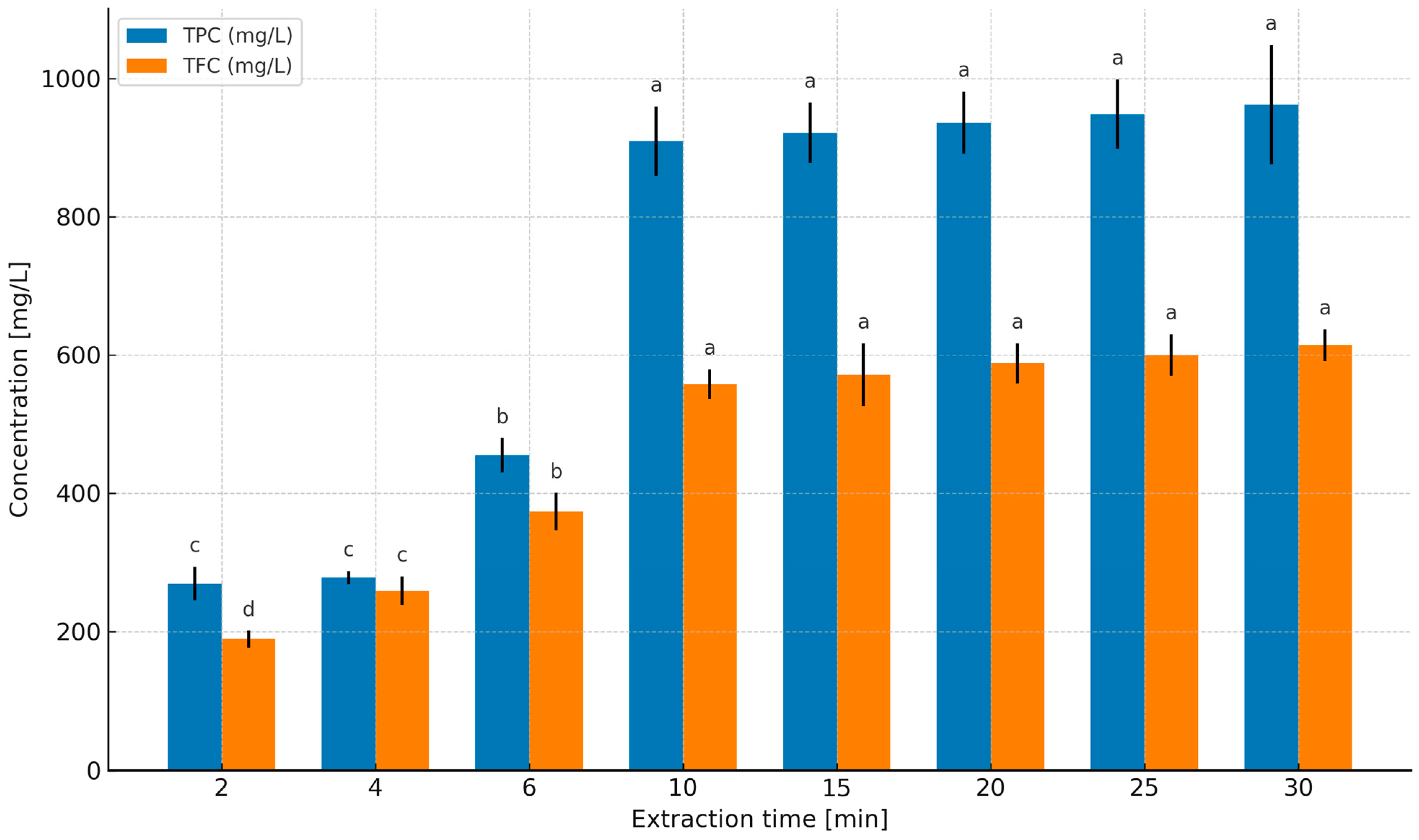
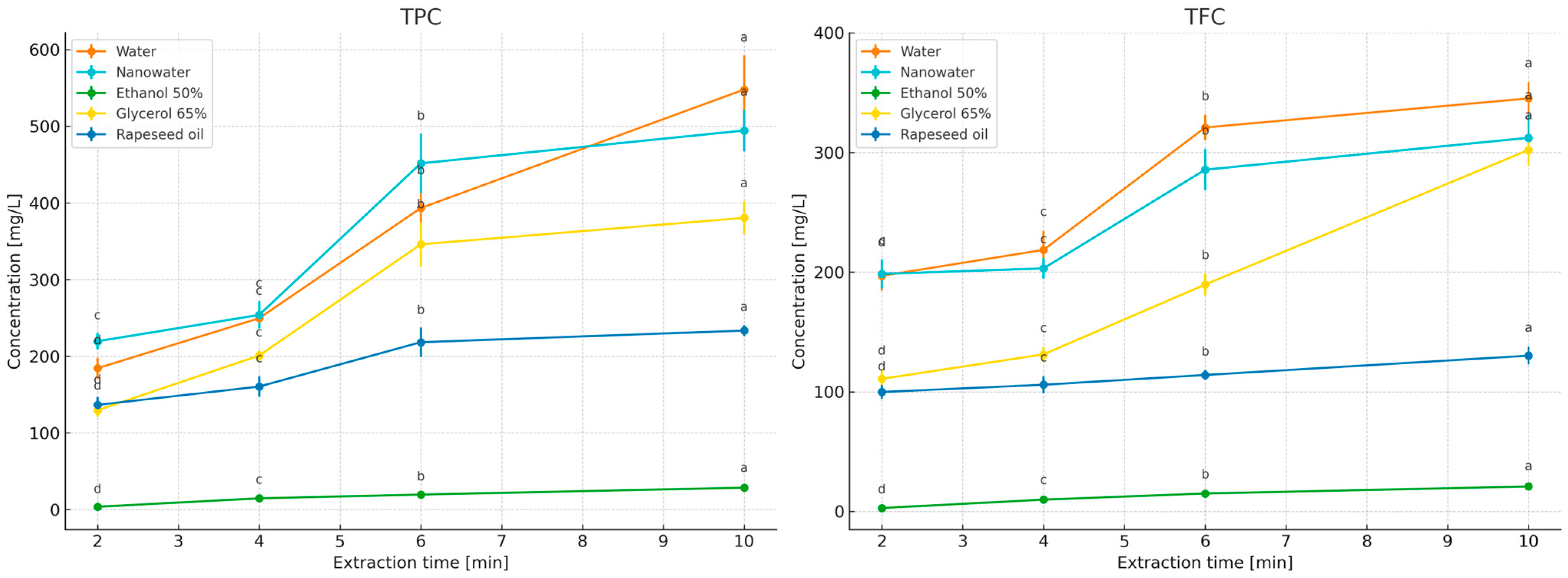
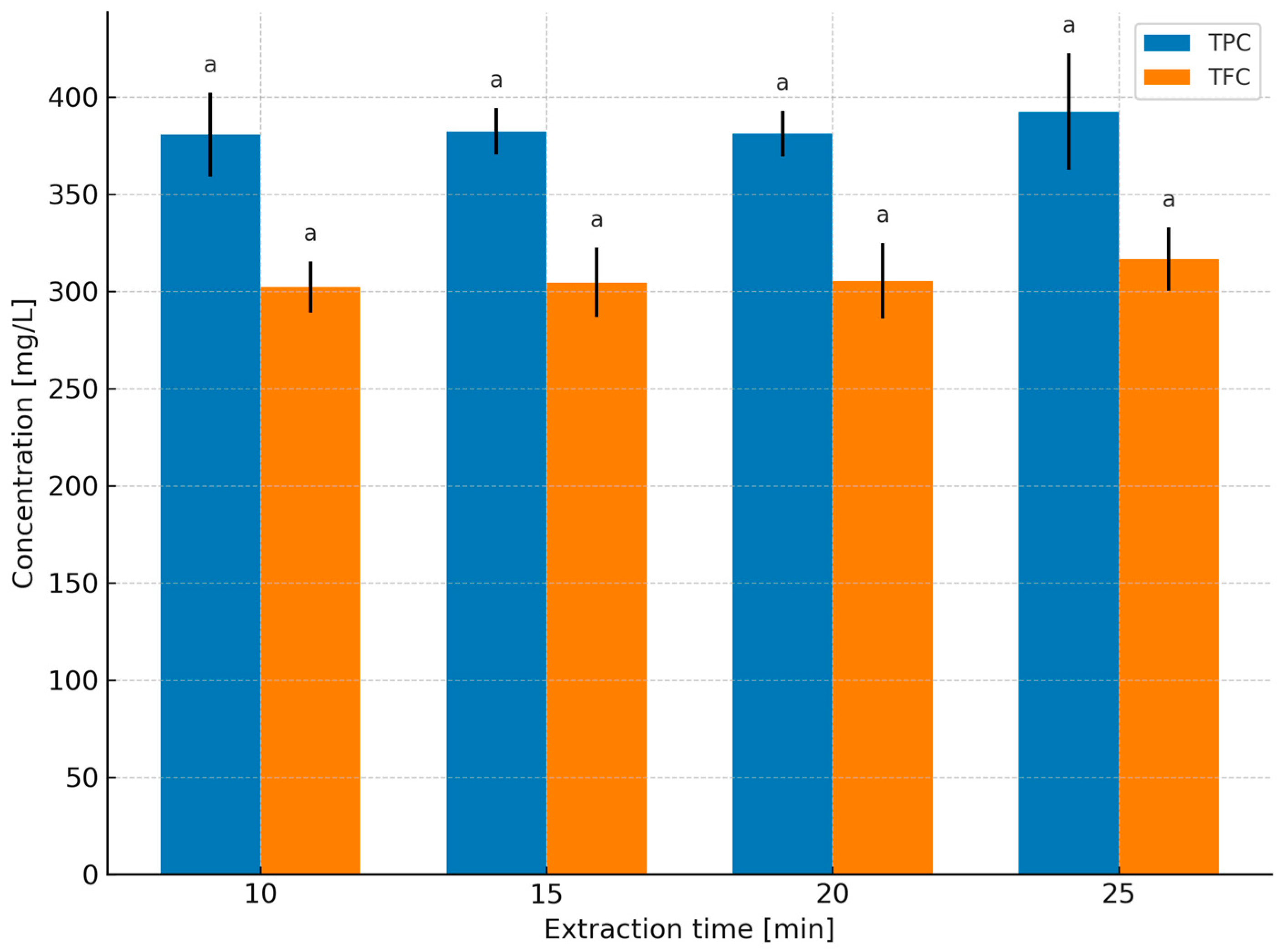
2.1. Determination of Boundary Conditions for Extraction Time
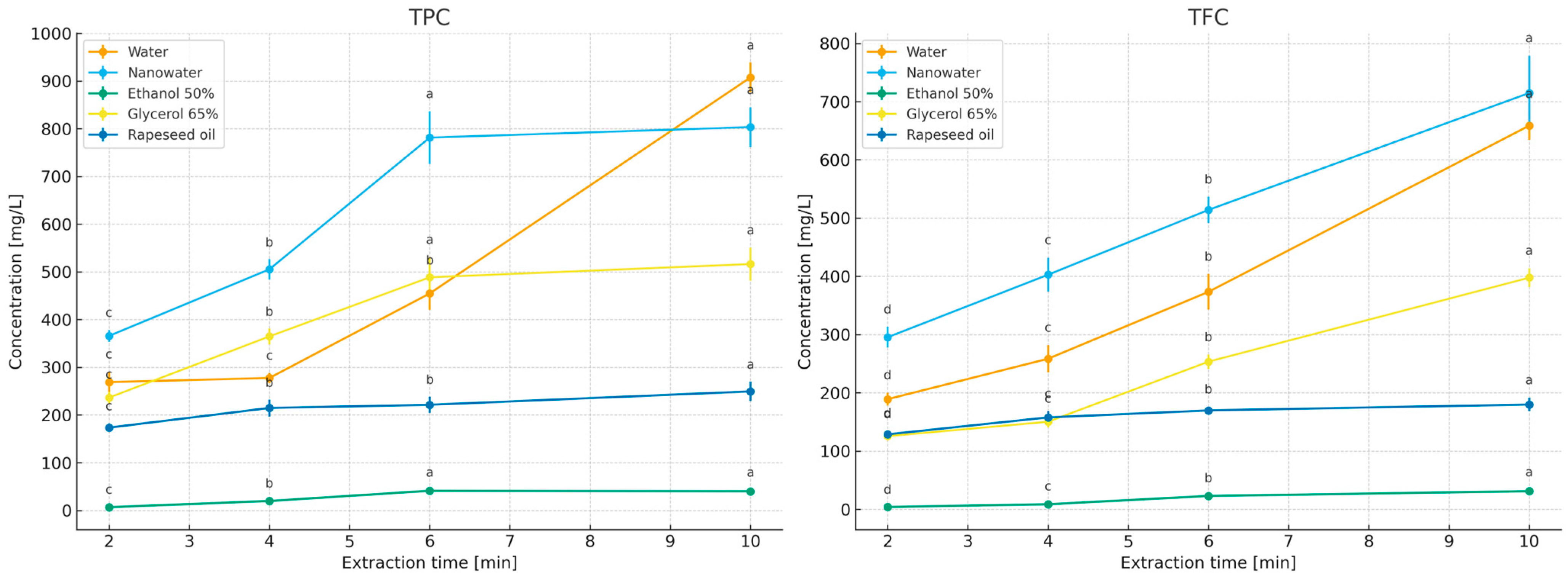
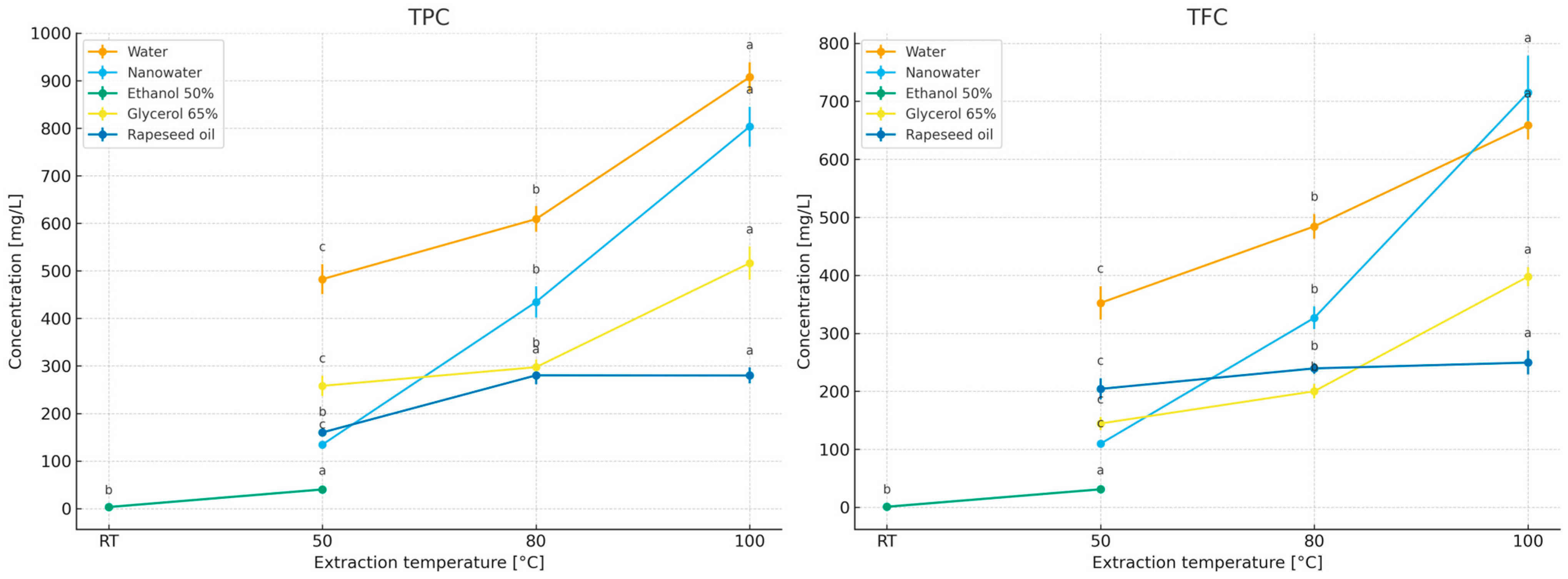
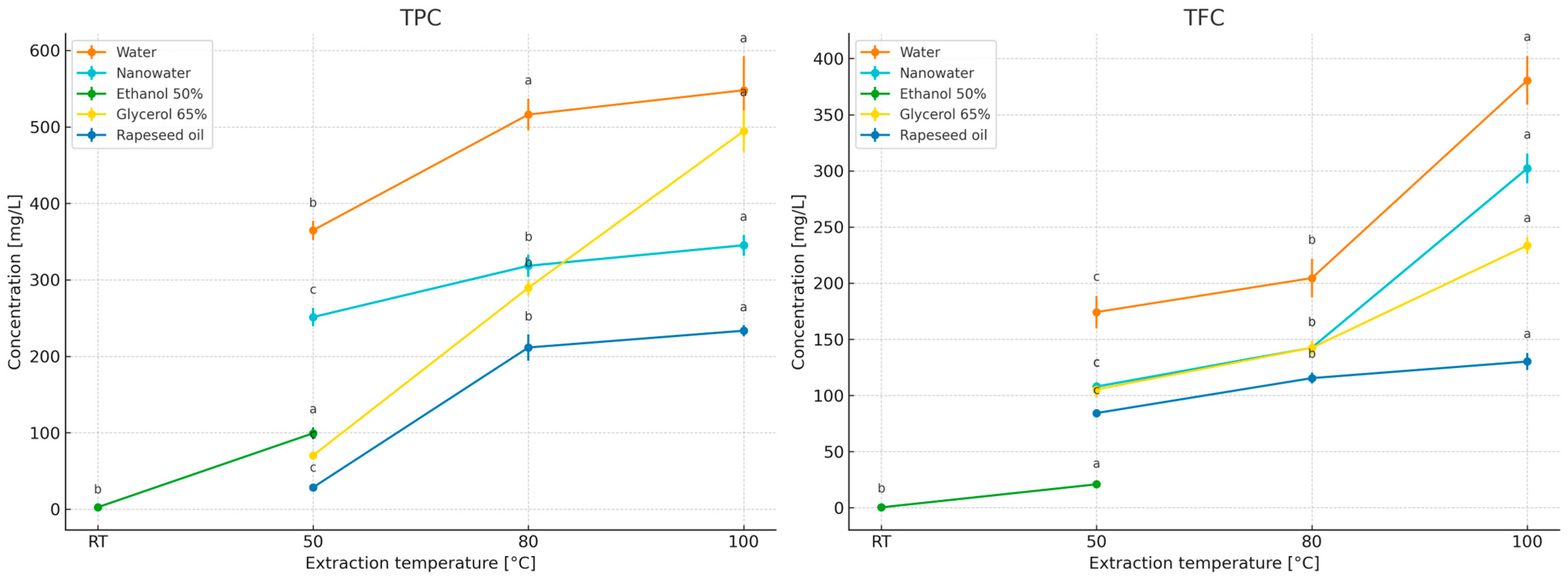
2.2. Assessment of the Suitability of Green Solvents for the Extraction of Active Compounds—Primary Extraction
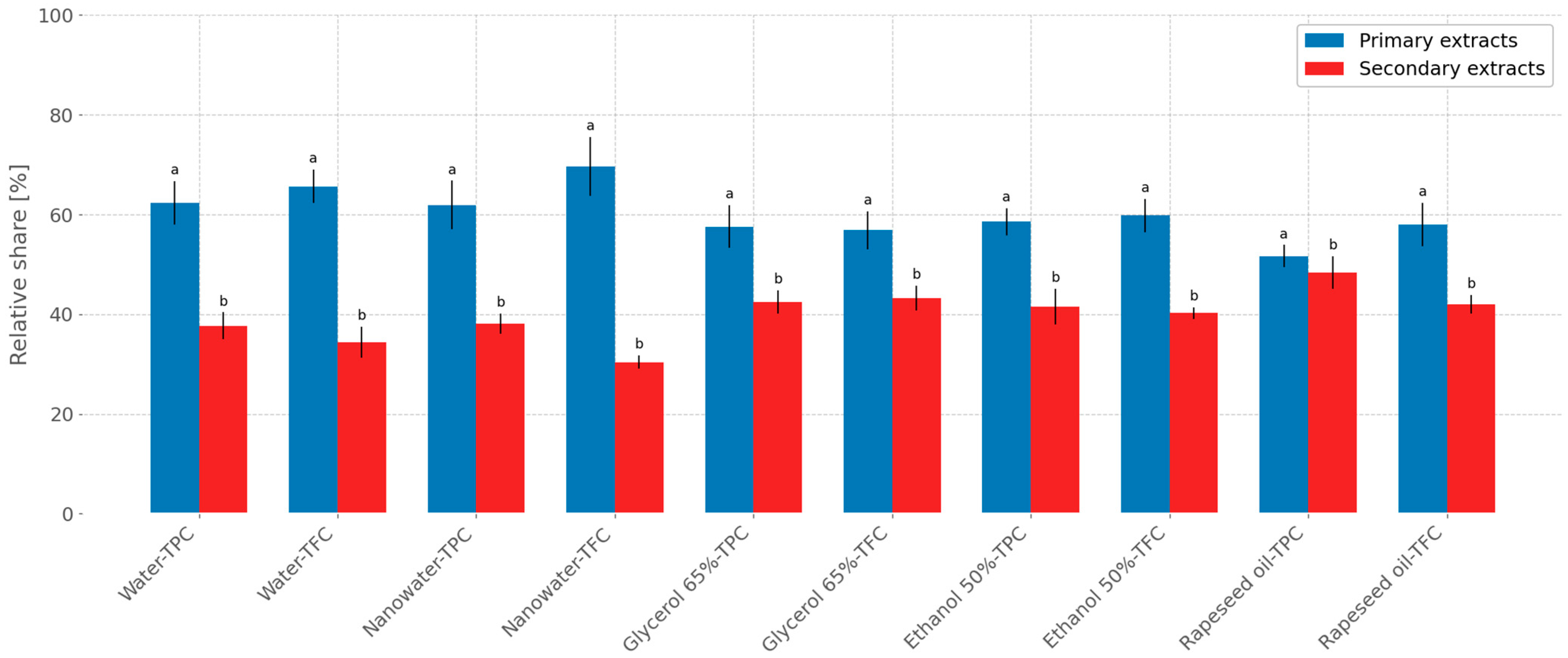
2.3. Secondary Extraction
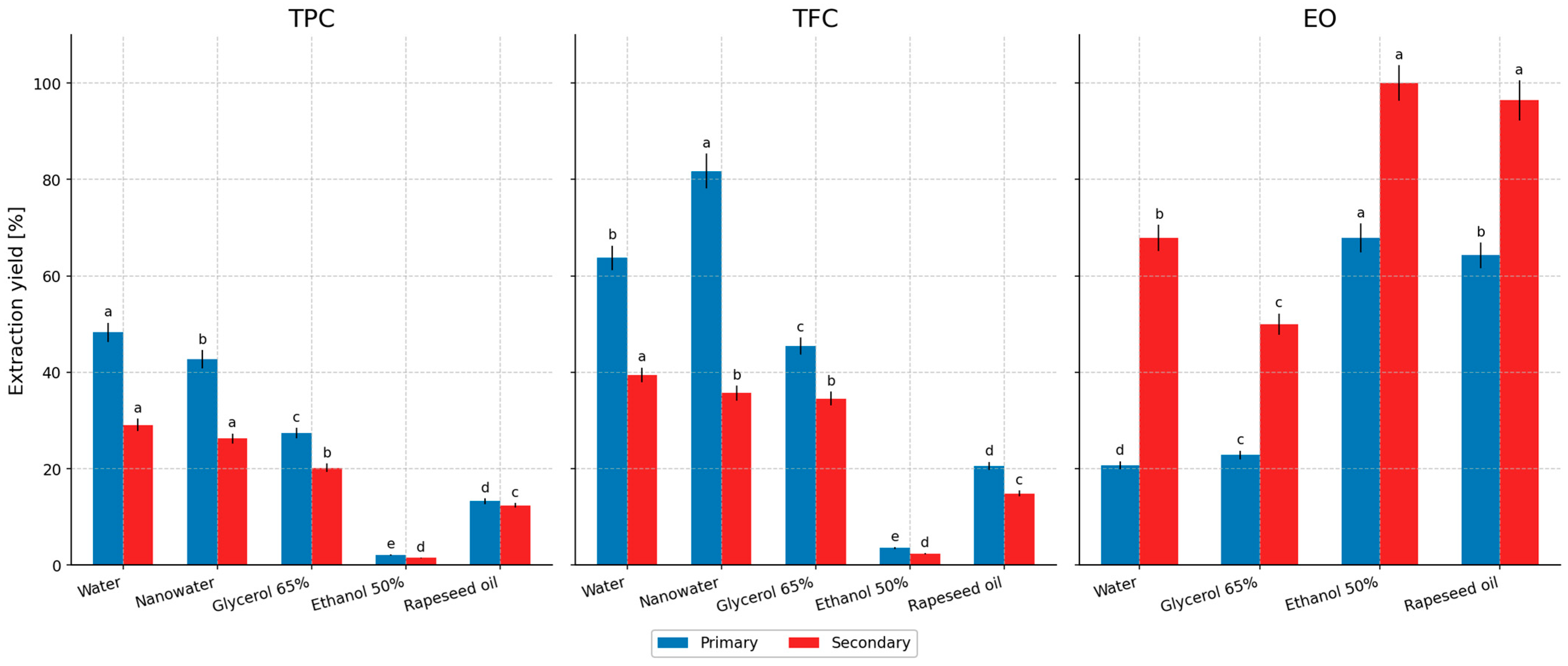
2.4. Extraction Yield
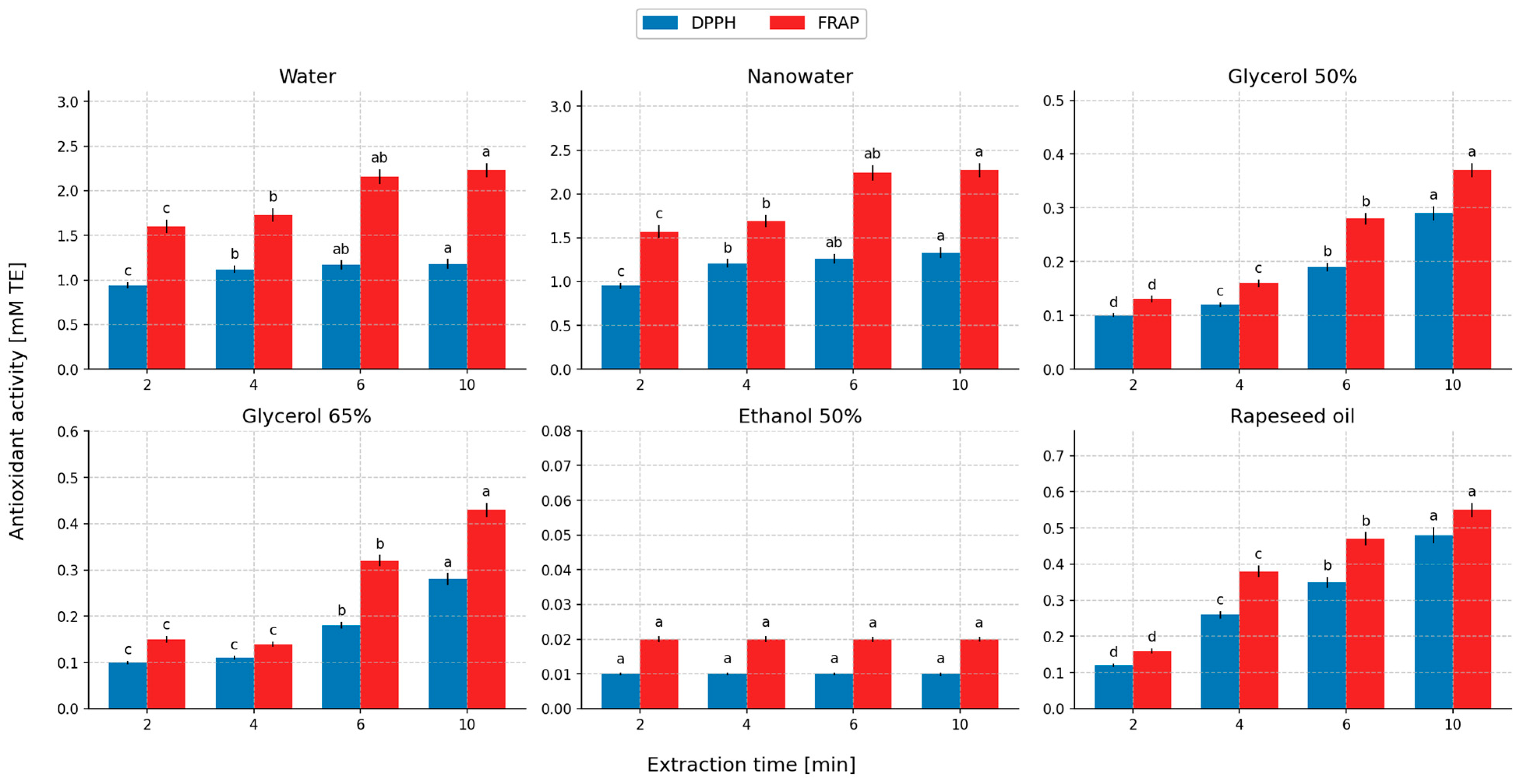
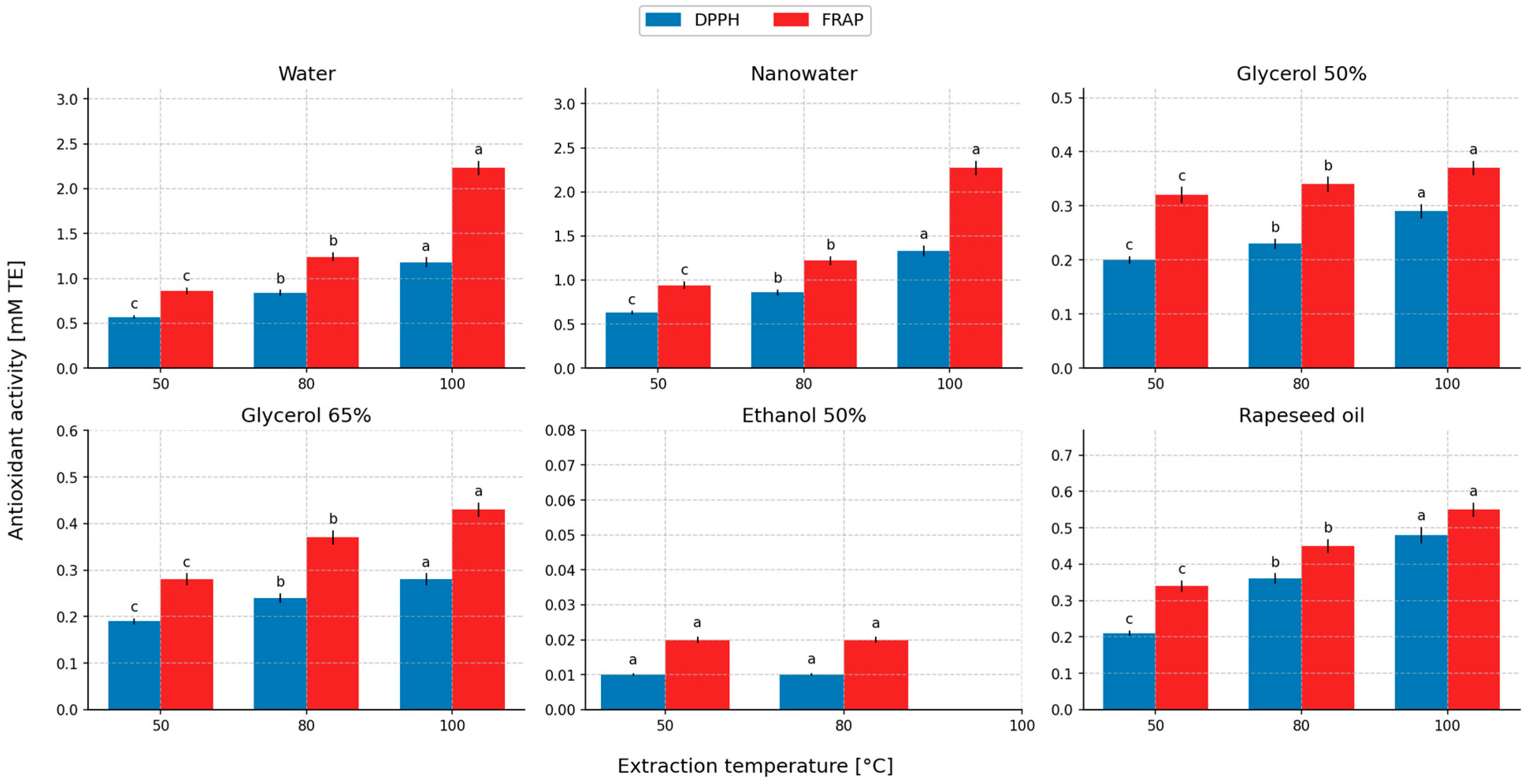
2.5. Evaluation of Antioxidant Activity of the Extracts
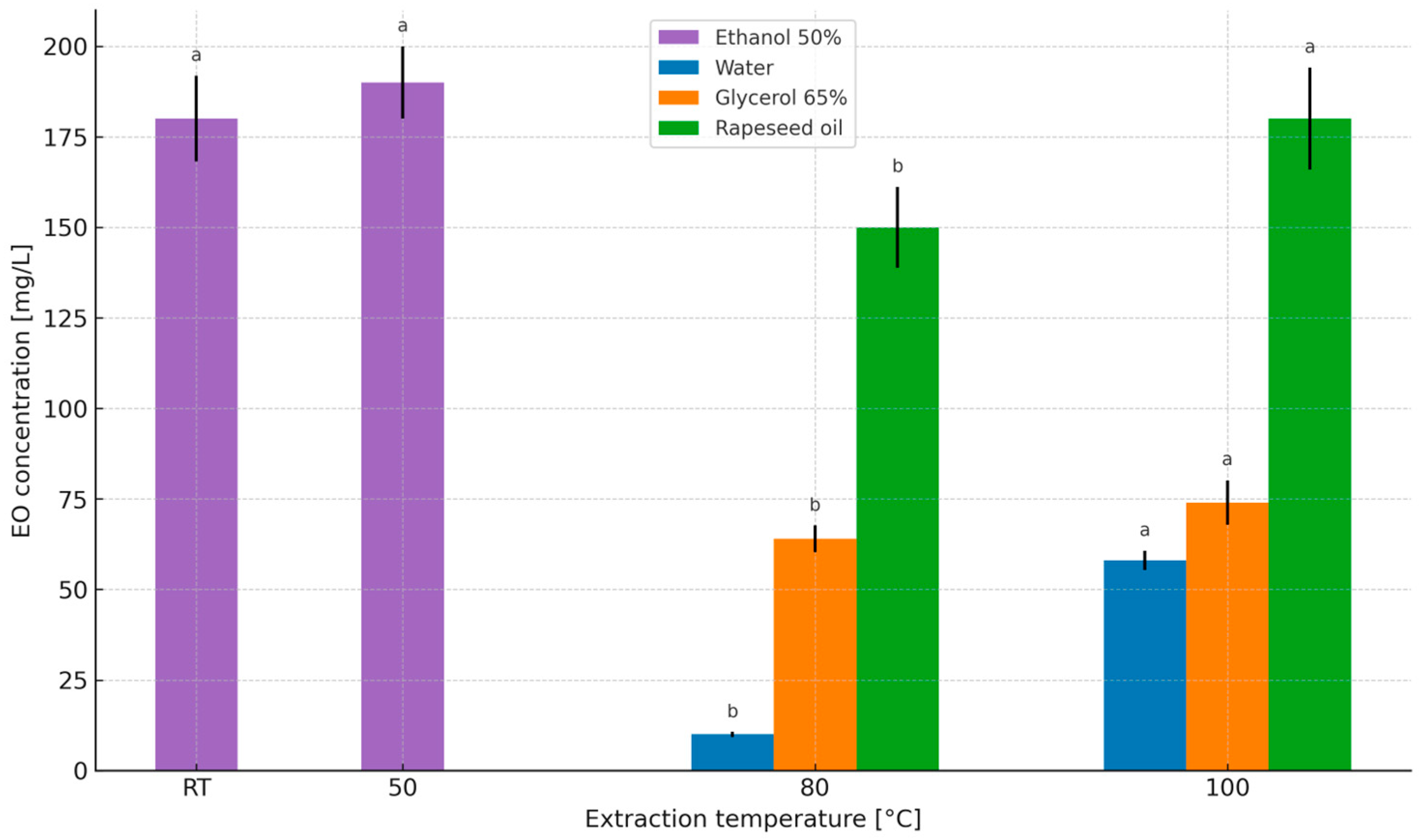
2.6. EO Content in Post-Extraction Material
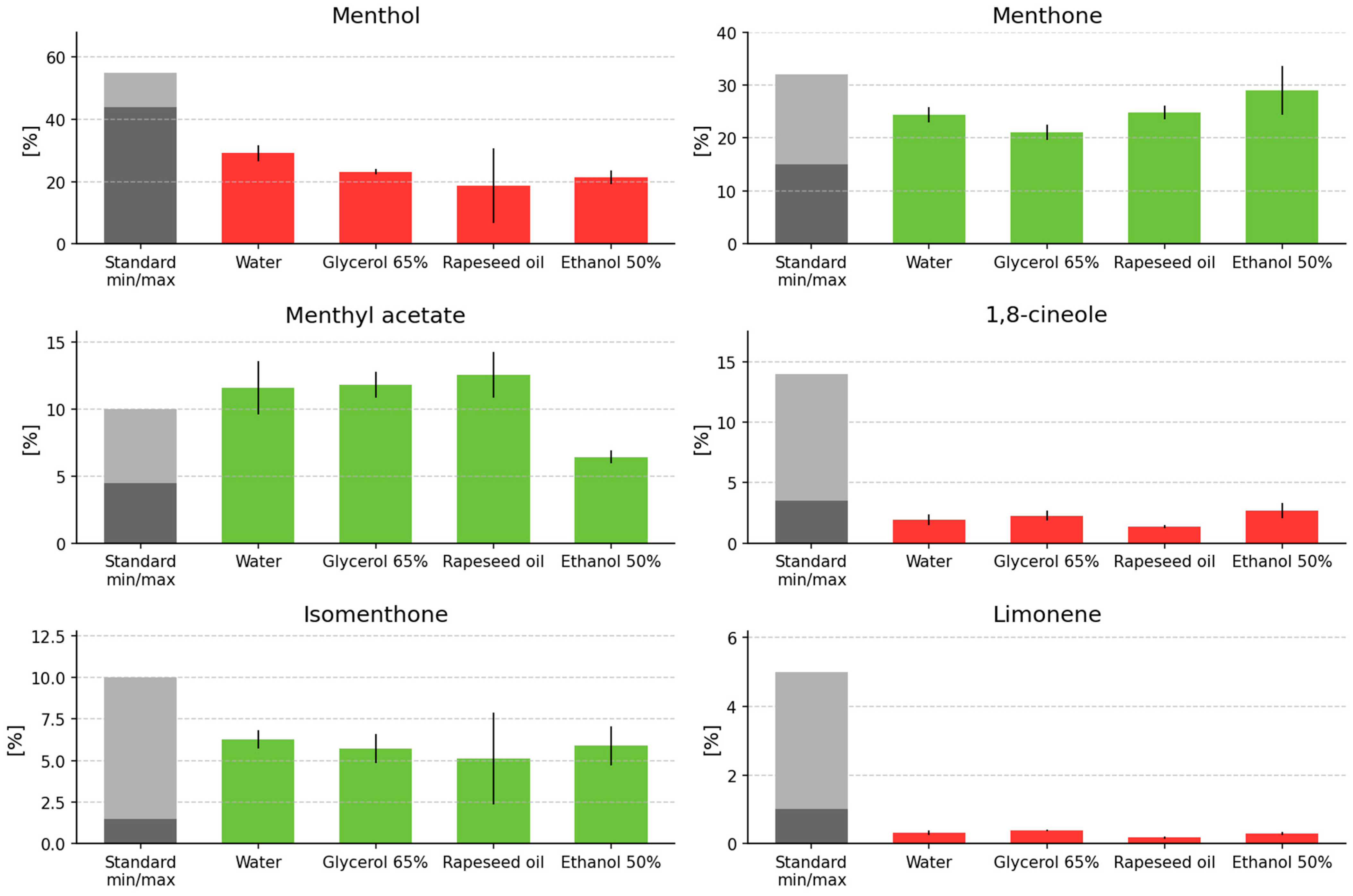
2.7. Characterization of the EO Composition in the Initial Plant Material and Post-Extraction Residues
3. Materials and Methods
3.1. Plant Material
3.2. Chemicals
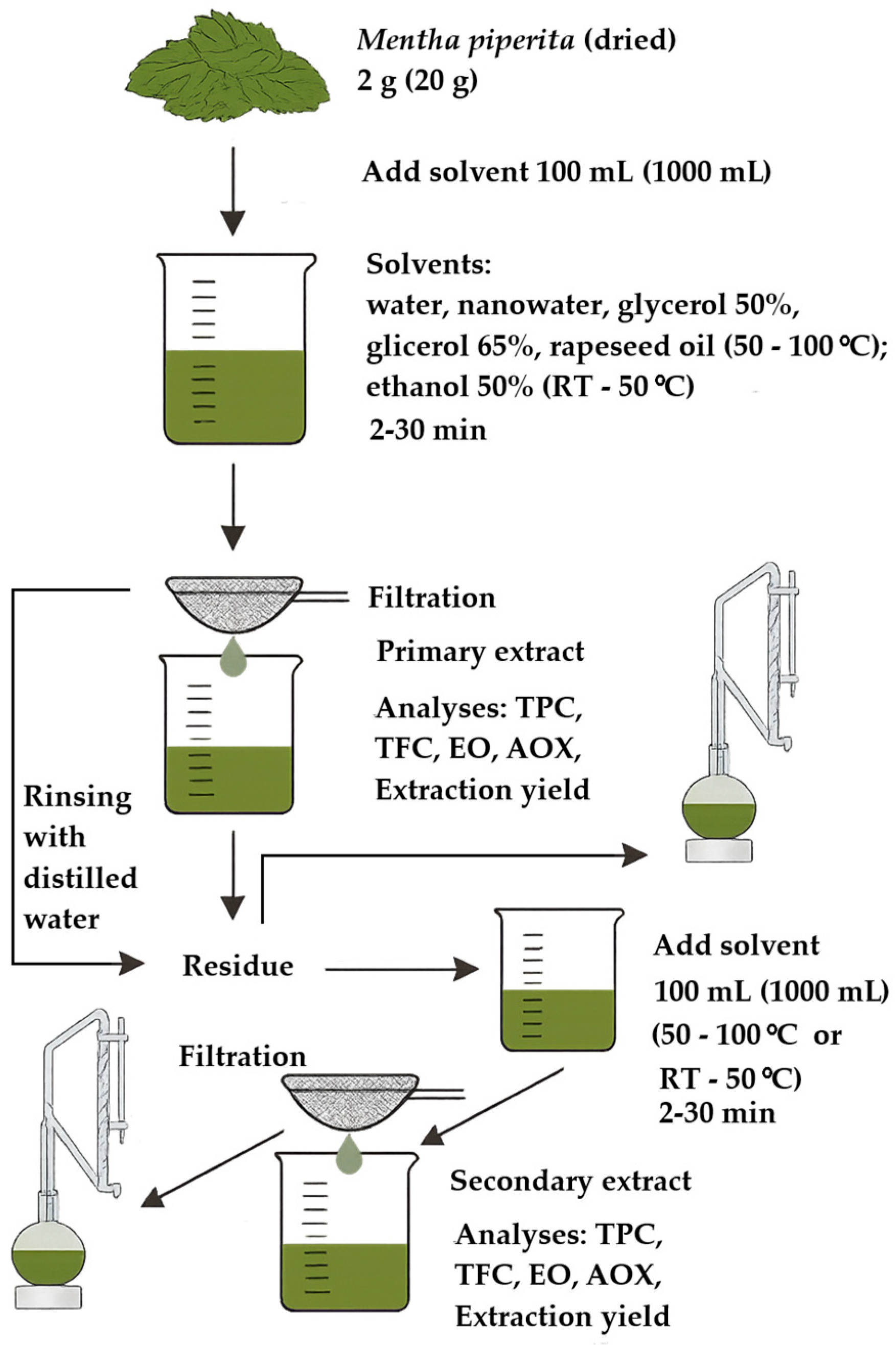
3.3. Extraction
3.4. Methanolic Extraction
3.5. Determination of Total Phenolic Compound Content
3.6. Determination of Total Flavonoid Content
3.7. Determination of Essential Oil Content in Plant Material
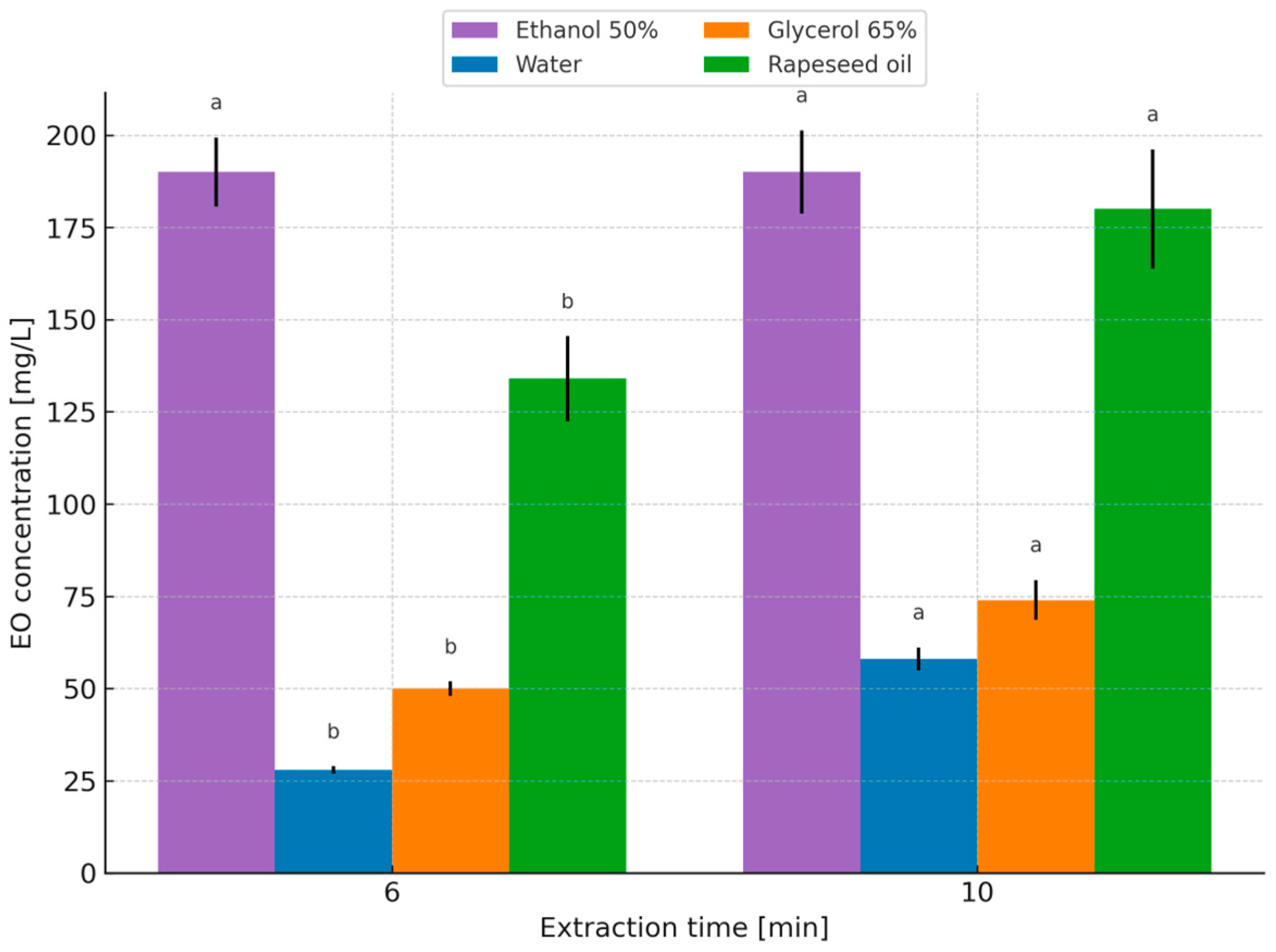
3.8. Indirect Estimation of EO Recovery in Infusions (Depletion-Based Approach)
3.9. Chromatographic Analysis
3.10. Extraction Yield
3.11. Relative Contribution of Active Compounds in Primary and Secondary Extracts
3.12. Free Radical-Scavenging Ability by the Use of a Stable DPPH• Radical
3.13. Ferric Reducing Antioxidant Power (FRAP) Assay
3.14. Statistical Analysis
4. Summary
5. Conclusions
- Under short, infusion-like extraction conditions, solvent selection strongly determines process selectivity: aqueous media favor recovery of polar phytochemicals (TPC/TFC), whereas the ethanol–water mixture (50%) and rapeseed oil favor recovery of essential oil constituents.
- The highest TPC/TFC yields under the selected “optimal conditions” were obtained for water and nanowater, which also showed the strongest antioxidant activity (DPPH/FRAP), consistent with the distribution of phenolic antioxidants in peppermint leaves.
- The ethanol–water mixture (50%) and rapeseed oil exhibited the highest EO recovery, and the two-step extraction scheme enabled near-complete depletion of EO in the ethanol system, indicating high phase affinity toward peppermint volatiles.
- Secondary extraction allowed recovery of a substantial additional fraction of bioactive compounds, often exceeding 30% of the combined TPC/TFC across solvent systems, confirming that post-extraction residues represent a valuable raw material rather than waste.
- From an application perspective, a sequential extraction strategy is recommended: (i) water/nanowater or a glycerol–water system to obtain phenolic-rich extracts with high antioxidant capacity, followed by (ii) ethanol–water or edible oil to obtain essential-oil-enriched preparations.
- From a practical perspective, this strategy may support the design of application-oriented peppermint preparations obtained with food-grade solvents, including phenolic-rich antioxidant extracts and essential-oil-enriched formulations, while simultaneously reducing waste through secondary use of post-extraction biomass.
- Overall, the proposed low-processed, food-grade approach represents a practical pathway for sustainable production of peppermint extracts and straightforward utilization of post-extraction biomass within a circular-economy framework.
6. Limitations
Author Contributions
Funding
Data Availability Statement
Acknowledgments
Conflicts of Interest
Abbreviations
| TPC | total phenolic content |
| TFC | total flavonoid content |
| EO | essential oil |
| DPPH | 2,2-diphenyl-1-picrylhydrazyl |
| FRAP | ferric reducing antioxidant power |
| GC-FID | gas chromatography–flame ionization detection |
| GC-MS | gas chromatography–mass spectrometry |
References
- Kowalski, R.; Kowalska, G.; Włodarczyk-Stasiak, M.; Mazurek, A. Green Solvent Systems for Extraction of Bioactives from Common Thyme (Thymus vulgaris L.) in Sustainable Food Production. In Food in a Sustainable World; Sujka, M., Gustaw, W., Pankiewicz, U., Wójciak, K., Eds.; Polskie Towarzystwo Technologów Żywności Wydawnictwo Naukowe PTTŻ: Kraków, Poland, 2025; pp. 105–124. [Google Scholar]
- Chemat, F.; Vian, M.A.; Cravotto, G. Green Extraction of Natural Products: Concept and Principles. Int. J. Mol. Sci. 2012, 13, 8615–8627. [Google Scholar] [CrossRef] [Scilit] [PubMed]
- PN-ISO 3103; Herbata—Przygotowanie Naparu Do Badań Sensorycznych. International Organization for Standardization: Geneva, Switzerland, 1996.
- Shehata, E.; Grigorakis, S.; Loupassaki, S.; Makris, D.P. Extraction Optimisation Using Water/Glycerol for the Efficient Recovery of Polyphenolic Antioxidants from Two Artemisia Species. Sep. Purif. Technol. 2015, 149, 462–469. [Google Scholar] [CrossRef] [Scilit]
- Eyiz, V.; Tontul, I.; Turker, S. Optimization of Green Extraction of Phytochemicals from Red Grape Pomace by Homogenizer Assisted Extraction. J. Food Meas. Charact. 2020, 14, 39–47. [Google Scholar] [CrossRef] [Scilit]
- Kurtulbaş, E.; Pekel, A.G.; Bilgin, M.; Makris, D.P.; Şahin, S. Citric Acid-Based Deep Eutectic Solvent for the Anthocyanin Recovery from Hibiscus sabdariffa through Microwave-Assisted Extraction. Biomass Convers. Biorefin. 2020, 12, 351–360. [Google Scholar] [CrossRef] [Scilit]
- Apostolakis, A.; Grigorakis, S.; Makris, D.P. Optimisation and Comparative Kinetics Study of Polyphenol Extraction from Olive Leaves (Olea europaea) Using Heated Water/Glycerol Mixtures. Sep. Purif. Technol. 2014, 128, 89–95. [Google Scholar] [CrossRef] [Scilit]
- Karakashov, B.; Grigorakis, S.; Loupassaki, S.; Makris, D.P. Optimisation of Polyphenol Extraction from Hypericum perforatum (St. John’s Wort) Using Aqueous Glycerol and Response Surface Methodology. J. Appl. Res. Med. Aromat. Plants 2015, 2, 1–8. [Google Scholar] [CrossRef] [Scilit]
- Michail, A.; Sigala, P.; Grigorakis, S.; Makris, D.P. Kinetics of Ultrasound-Assisted Polyphenol Extraction from Spent Filter Coffee Using Aqueous Glycerol. Chem. Eng. Commun. 2016, 203, 407–413. [Google Scholar] [CrossRef] [Scilit]
- Philippi, K.; Tsamandouras, N.; Grigorakis, S.; Makris, D.P. Ultrasound-Assisted Green Extraction of Eggplant Peel (Solanum melongena) Polyphenols Using Aqueous Mixtures of Glycerol and Ethanol: Optimisation and Kinetics. Environ. Process. 2016, 3, 369–386. [Google Scholar] [CrossRef] [Scilit]
- Mairapetyan, S.; Alexanyan, J.; Tovmasyan, A.; Daryadar, M.; Stepanian, B.; Mamikonyan, V. Productivity, Biochemical Indices and Antioxidant Activity of Peppermint (Mentha piperita L.) and Basil (Ocimum basilicum L.) in Condition of Hydroponics. J. Sci. Technol. Environ. Inform. 2016, 3, 191–194. [Google Scholar] [CrossRef] [Scilit]
- Liu, X.; Sun, Z.-L.; Jia, A.-R.; Shi, Y.-P.; Li, R.-H.; Yang, P.-M. Extraction, Preliminary Characterization and Evaluation of in Vitro Antitumor and Antioxidant Activities of Polysaccharides from Mentha Piperita. Int. J. Mol. Sci. 2014, 15, 16302–16319. [Google Scholar] [CrossRef] [Scilit]
- Ayrle, H.; Mevissen, M.; Kaske, M.; Nathues, H.; Gruetzner, N.; Melzig, M.; Walkenhorst, M. Medicinal Plants—Prophylactic and Therapeutic Options for Gastrointestinal and Respiratory Diseases in Calves and Piglets? A Systematic Review. BMC Vet. Res. 2016, 12, 89. [Google Scholar] [CrossRef] [Scilit]
- McKay, D.L.; Blumberg, J.B. A Review of the Bioactivity and Potential Health Benefits of Peppermint Tea (Mentha piperita L.). Phytother. Res. 2006, 20, 619–633. [Google Scholar] [CrossRef] [Scilit]
- Mimica-Dukic, N.; Bozin, B. Mentha L. Species (Lamiaceae) as Promising Sources of Bioactive Secondary Metabolites. Curr. Pharm. Des. 2008, 14, 3141–3150. [Google Scholar] [CrossRef] [Scilit]
- Riachi, L.G.; De Maria, C.A.B. Peppermint Antioxidants Revisited. Food Chem. 2015, 176, 72–81. [Google Scholar] [CrossRef] [Scilit]
- Belwal, T.; Ezzat, S.M.; Rastrelli, L.; Bhatt, I.D.; Daglia, M.; Baldi, A.; Devkota, H.P.; Orhan, I.E.; Patra, J.K.; Das, G.; et al. A Critical Analysis of Extraction Techniques Used for Botanicals: Trends, Priorities, Industrial Uses and Optimization Strategies. TrAC Trends Anal. Chem. 2018, 100, 82–102. [Google Scholar] [CrossRef] [Scilit]
- Płotka-Wasylka, J.; Rutkowska, M.; Owczarek, K.; Tobiszewski, M.; Namieśnik, J. Extraction with Environmentally Friendly Solvents. TrAC Trends Anal. Chem. 2017, 91, 12–25. [Google Scholar] [CrossRef] [Scilit]
- Labbé, D.; Tremblay, A.; Bazinet, L. Effect of Brewing Temperature and Duration on Green Tea Catechin Solubilization: Basis for Production of EGC and EGCG-Enriched Fractions. Sep. Purif. Technol. 2006, 49, 1–9. [Google Scholar] [CrossRef] [Scilit]
- Dmowski, P.; Śmiechowska, M.; Sagan, E. Wpływ Czasu Parzenia i Stopnia Rozdrobnienia Herbaty Czarnej Na Barwę Naparu i Jego Właściwości Przeciwutleniające. Zywnosc. Nauka. Technol. Jakosc/Food. Sci. Technol. Qual. 2014, 21, 206–216. [Google Scholar]
- Ramalho, S.A.; Nigam, N.; Oliveira, G.B.; de Oliveira, P.A.; Silva, T.O.M.; dos Santos, A.G.P.; Narain, N. Effect of Infusion Time on Phenolic Compounds and Caffeine Content in Black Tea. Food Res. Int. 2013, 51, 155–161. [Google Scholar] [CrossRef] [Scilit]
- Kelebek, H. LC-DAD–ESI-MS/MS Characterization of Phenolic Constituents in Turkish Black Tea: Effect of Infusion Time and Temperature. Food Chem. 2016, 204, 227–238. [Google Scholar] [CrossRef] [Scilit]
- Pinelo, M.; Rubilar, M.; Jerez, M.; Sineiro, J.; Núñez, M.J. Effect of Solvent, Temperature, and Solvent-to-Solid Ratio on the Total Phenolic Content and Antiradical Activity of Extracts from Different Components of Grape Pomace. J. Agric. Food Chem. 2005, 53, 2111–2117. [Google Scholar] [CrossRef] [Scilit] [PubMed]
- Pinelo, M.; Fabbro, P.; Manzocco, L.; Nunez, M.; Nicoli, M. Optimization of Continuous Phenol Extraction from Byproducts. Food Chem. 2005, 92, 109–117. [Google Scholar] [CrossRef] [Scilit]
- Yilmaz, Y.; Toledo, R.T. Oxygen Radical Absorbance Capacities of Grape/Wine Industry Byproducts and Effect of Solvent Type on Extraction of Grape Seed Polyphenols. J. Food Compos. Anal. 2006, 19, 41–48. [Google Scholar] [CrossRef] [Scilit]
- Spigno, G.; De Faveri, D.M. Antioxidants from Grape Stalks and Marc: Influence of Extraction Procedure on Yield, Purity and Antioxidant Power of the Extracts. J. Food Eng. 2007, 78, 793–801. [Google Scholar] [CrossRef] [Scilit]
- Spigno, G.; Tramelli, L.; De Faveri, D.M. Effects of Extraction Time, Temperature and Solvent on Concentration and Antioxidant Activity of Grape Marc Phenolics. J. Food Eng. 2007, 81, 200–208. [Google Scholar] [CrossRef] [Scilit]
- Bonilla, F. Extraction of Phenolic Compounds from Red Grape Marc for Use as Food Lipid Antioxidants. Food Chem. 1999, 66, 209–215. [Google Scholar] [CrossRef] [Scilit]
- Pekić, B.; Kovač, V.; Alonso, E.; Revilla, E. Study of the Extraction of Proanthocyanidins from Grape Seeds. Food Chem. 1998, 61, 201–206. [Google Scholar] [CrossRef] [Scilit]
- Jayaprakasha, G.K.; Singh, R.P.; Sakariah, K.K. Antioxidant Activity of Grape Seed (Vitis vinifera) Extracts on Peroxidation Models in Vitro. Food Chem. 2001, 73, 285–290. [Google Scholar] [CrossRef] [Scilit]
- Lapornik, B.; Prošek, M.; Golc Wondra, A. Comparison of Extracts Prepared from Plant By-Products Using Different Solvents and Extraction Time. J. Food Eng. 2005, 71, 214–222. [Google Scholar] [CrossRef] [Scilit]
- Chemat, F.; Abert-Vian, M.; Fabiano-Tixier, A.S.; Strube, J.; Uhlenbrock, L.; Gunjevic, V.; Cravotto, G. Green Extraction of Natural Products. Origins, Current Status, and Future Challenges. TrAC Trends Anal. Chem. 2019, 118, 248–263. [Google Scholar] [CrossRef] [Scilit]
- Lee, J.-E.; Jayakody, J.; Kim, J.-I.; Jeong, J.-W.; Choi, K.-M.; Kim, T.-S.; Seo, C.; Azimi, I.; Hyun, J.; Ryu, B. The Influence of Solvent Choice on the Extraction of Bioactive Compounds from Asteraceae: A Comparative Review. Foods 2024, 13, 3151. [Google Scholar] [CrossRef] [Scilit]
- Tahirović, I.; Kožljak, M.; Toromanović, J.; Čopra-Janićijević, A.; Klepo, L.; Topčagić, A.; Demirović, H. Total Phenolic Content and Antioxidant Capacity in Infusions of Various Herbal Teas. Bull. Chem. Technol. Bosnia Herzeg. 2014, 42, 51–55. [Google Scholar]
- Cho, K.S.; Shin, M.; Kim, S.; Lee, S.B. Recent Advances in Studies on the Therapeutic Potential of Dietary Carotenoids in Neurodegenerative Diseases. Oxid. Med. Cell. Longev. 2018, 2018, 4120458. [Google Scholar] [CrossRef] [Scilit] [PubMed]
- Fărcaş, A.C.; Socaci, S.A.; Tofană, M.; Mureșan, C.; Cuceu, A.; Salanţă, L.; Pop, A. Comparative Evaluation of Biofunctional Compounds Content from Different Herbal Infusions. Bull. Univ. Agric. Sci. Vet. Med. Cluj-Napoca. Food Sci. Technol. 2015, 72, 11632. [Google Scholar] [CrossRef] [Scilit]
- Atoui, A. Tea and Herbal Infusions: Their Antioxidant Activity and Phenolic Profile. Food Chem. 2005, 89, 27–36. [Google Scholar] [CrossRef] [Scilit]
- He, G.; Xiong, H.; Chen, Q.; Ruan, H.; Wang, Z.; Traoré, L. Optimization of Conditions for Supercritical Fluid Extraction of Flavonoids from Hops (Humulus lupulus L.). J. Zhejiang Univ. Sci. 2005, 6, 999–1004. [Google Scholar] [CrossRef] [Scilit] [PubMed]
- Vuong, Q.V.; Golding, J.B.; Stathopoulos, C.E.; Nguyen, M.H.; Roach, P.D. Optimizing Conditions for the Extraction of Catechins from Green Tea Using Hot Water. J. Sep. Sci. 2011, 34, 3099–3106. [Google Scholar] [CrossRef] [Scilit]
- Vuong, Q.V.; Hirun, S.; Roach, P.D.; Bowyer, M.C.; Phillips, P.A.; Scarlett, C.J. Effect of Extraction Conditions on Total Phenolic Compounds and Antioxidant Activities of Carica Papaya Leaf Aqueous Extracts. J. Herb. Med. 2013, 3, 104–111. [Google Scholar] [CrossRef] [Scilit]
- Yılmaz, F.M.; Karaaslan, M.; Vardin, H. Optimization of Extraction Parameters on the Isolation of Phenolic Compounds from Sour Cherry (Prunus cerasus L.) Pomace. J. Food Sci. Technol. 2015, 52, 2851–2859. [Google Scholar] [CrossRef] [Scilit]
- Murawski, M.; Schwarz, T.; Grygier, J.; Patkowski, K.; Oszczęda, Z.; Jelkin, I.; Kosiek, A.; Gruszecki, T.M.; Szymanowska, A.; Skrzypek, T.; et al. The Utility of Nanowater for Ram Semen Cryopreservation. Exp. Biol. Med. 2015, 240, 611–617. [Google Scholar] [CrossRef] [Scilit]
- Samsonowicz, M.; Regulska, E. Evaluation of Influence of Selected Metal Cations on Antioxidant Activity of Extracts from Savory (Satureja hortensis)‡. Chem. Pap. 2016, 70, 811–819. [Google Scholar] [CrossRef] [Scilit]
- Kowalska, G.; Wyrostek, J.; Kowalski, R.; Pankiewicz, U. Evaluation of Glycerol Usage for the Extraction of Anthocyanins from Black Chokeberry and Elderberry Fruits. J. Appl. Res. Med. Aromat. Plants 2021, 22, 100296. [Google Scholar] [CrossRef] [Scilit]
- Adusei-Gyamfi, J.; Ouddane, B.; Rietveld, L.; Cornard, J.-P.; Criquet, J. Natural Organic Matter-Cations Complexation and Its Impact on Water Treatment: A Critical Review. Water Res. 2019, 160, 130–147. [Google Scholar] [CrossRef] [Scilit]
- Wyrostek, J.; Kowalski, R. The Effect of Water Mineralization on the Extraction of Active Compounds from Selected Herbs and on the Antioxidant Properties of the Obtained Brews. Foods 2021, 10, 1227. [Google Scholar] [CrossRef] [Scilit]
- Wyrostek, J.; Kowalski, R.; Pankiewicz, U.; Solarska, E. Estimation of the Content of Selected Active Substances in Primary and Secondary Herbal Brews by UV-VIS and GC-MS Spectroscopic Analyses. J. Anal. Methods Chem. 2020, 2020, 8891855. [Google Scholar] [CrossRef] [Scilit]
- Eghdami, A.; Eizadi, M.; Sadeghi, F. Polyphenolic Content and Antioxidant Activity of Hydroalcohlic and Alcoholic Extract of Thymus Vulgaris. J. Biodivers. Environ. Sci. 2013, 3, 94–101. [Google Scholar]
- Mohammedi, Z.; Atik, F. Impact of Solvent Extraction Type on Total Polyphenols Content and Biological Activity from Tamarix aphylla (L.) Karst. Int. J. Pharma Bio Sci. 2011, 2, 601–615. [Google Scholar]
- Abdul Qadir, M.; Shahzadi, S.K.; Bashir, A.; Munir, A.; Shahzad, S. Evaluation of Phenolic Compounds and Antioxidant and Antimicrobial Activities of Some Common Herbs. Int. J. Anal. Chem. 2017, 2017, 3475738. [Google Scholar] [CrossRef] [Scilit] [PubMed]
- Rahimi, Y.; Taleei, A.; Ranjbar, M. Long-Term Water Deficit Modulates Antioxidant Capacity of Peppermint (Mentha piperita L.). Sci. Hortic. 2018, 237, 36–43. [Google Scholar] [CrossRef] [Scilit]
- Siddhuraju, P.; Becker, K. Antioxidant Properties of Various Solvent Extracts of Total Phenolic Constituents from Three Different Agroclimatic Origins of Drumstick Tree (Moringa oleifera Lam.) Leaves. J. Agric. Food Chem. 2003, 51, 2144–2155. [Google Scholar] [CrossRef] [Scilit]
- Boulekbache-Makhlouf, L.; Medouni, L.; Medouni-Adrar, S.; Arkoub, L.; Madani, K. Effect of Solvents Extraction on Phenolic Content and Antioxidant Activity of the Byproduct of Eggplant. Ind. Crops Prod. 2013, 49, 668–674. [Google Scholar] [CrossRef] [Scilit]
- Cowan, M.M. Plant Products as Antimicrobial Agents. Clin. Microbiol. Rev. 1999, 12, 564–582. [Google Scholar] [CrossRef] [Scilit]
- Peschel, W.; Sánchez-Rabaneda, F.; Diekmann, W.; Plescher, A.; Gartzía, I.; Jiménez, D.; Lamuela-Raventós, R.; Buxaderas, S.; Codina, C. An Industrial Approach in the Search of Natural Antioxidants from Vegetable and Fruit Wastes. Food Chem. 2006, 97, 137–150. [Google Scholar] [CrossRef] [Scilit]
- Arabshahi-Delouee, S.; Urooj, A. Antioxidant Properties of Various Solvent Extracts of Mulberry (Morus indica L.) Leaves. Food Chem. 2007, 102, 1233–1240. [Google Scholar] [CrossRef] [Scilit]
- Li, Y.; Guo, C.; Yang, J.; Wei, J.; Xu, J.; Cheng, S. Evaluation of Antioxidant Properties of Pomegranate Peel Extract in Comparison with Pomegranate Pulp Extract. Food Chem. 2006, 96, 254–260. [Google Scholar] [CrossRef] [Scilit]
- Anwar, F.; Abdul Qayyum, H.M.; Ijaz Hussain, A.; Iqbal, S. Antioxidant Activity of 100% and 80% Methanol Extracts from Barley Seeds (Hordeum vulgare L.): Stabilization of Sunflower Oil. Grasas Aceites 2010, 61, 237–243. [Google Scholar] [CrossRef] [Scilit]
- Walczak, Z.; Starzycki, M. Ocena Profilu Kwasów Tłuszczowych w Olejach Tłoczonych Na Zimno w Kontekście Rekomendacji Ich w Żywieniu Osób Aktywnych Fizycznie. Bromat. Chem. Toksykol. 2013, 46, 316–322. [Google Scholar]
- Tańska, M.; Rotkiewicz, D.; Ambrosewicz, M. Porównanie Trwałości Tłoczonych Na Zimno Olejów Lnianego i Rzepakowego. Comparision of Stability of Flax and Rapeseed Cold-Pressed Oils. Bromat. Chem. Toksykol. 2011, 44, 521–527. [Google Scholar]
- Kozłowska, M.; Żontała, K. Stabilność Oksydacyjna Oleju Słonecznikowego Tłoczonego Na Zimno Wzbogaconego w Ekstrakty z Roślin Przyprawowych. Bromat. Chem. Toksykol. 2015, 58, 423–428. [Google Scholar]
- Manousaki, A.; Jancheva, M.; Grigorakis, S.; Makris, D. Extraction of Antioxidant Phenolics from Agri-Food Waste Biomass Using a Newly Designed Glycerol-Based Natural Low-Transition Temperature Mixture: A Comparison with Conventional Eco-Friendly Solvents. Recycling 2016, 1, 194–204. [Google Scholar] [CrossRef] [Scilit]
- Brahmi, F.; Madani, K.; Dahmoune, F.; Rahmani, T.; Bousbaa, K.; Oukmanou, S.; Chibane, M. Optimisation of Solvent Extraction of Antioxidants (Phenolic compounds) from Algerian Mint (Mentha spicata L.). Pharmacogn. Commun. 2012, 2, 72–86. [Google Scholar]
- Pagliaro, M.; Rossi, M. The Future of Glycerol: New Uses of a Versatile Raw Material; Royal Society of Chemistry: Cambridge, UK, 2008; ISBN 978-0-85404-124-4. [Google Scholar]
- Mortensen, A.; Aguilar, F.; Crebelli, R.; Di Domenico, A.; Dusemund, B.; Frutos, M.J.; Galtier, P.; Gott, D.; Gundert-Remy, U.; Leblanc, J.; et al. Re-evaluation of Glycerol (E 422) as a Food Additive. EFSA J. 2017, 15, e04720. [Google Scholar] [CrossRef] [Scilit] [PubMed]
- Soe’eib, S.; Puspa Asri, N.; Dwi Saptati, A.N.; Diah Agustina, D.P. Enfleurage Essential Oil from Jasmine and Rose Using Cold Fat Adsorbent. J. Ilm. Widya Tek. 2016, 15, 58–61. [Google Scholar]
- Behgar, M.; Ghasemi, S.; Naserian, A.; Borzoie, A.; Fatollahi, H. Gamma Radiation Effects on Phenolics, Antioxidants Activity and in Vitro Digestion of Pistachio (Pistachia vera) Hull. Radiat. Phys. Chem. 2011, 80, 963–967. [Google Scholar] [CrossRef] [Scilit]
- Troszyńska, A.; Honke, J.; Kozłowska, H.; Troszyńska, A.; Honke, J.; Kozłowska, H. Natural Non-Nutrients of Plant Origin as the Components of Functional Food. Postępy Fitoter. 2000, 2, 17–22. [Google Scholar]
- Venables, M.C.; Hulston, C.J.; Cox, H.R.; Jeukendrup, A.E. Green Tea Extract Ingestion, Fat Oxidation, and Glucose Tolerance in Healthy Humans. Am. J. Clin. Nutr. 2008, 87, 778–784. [Google Scholar] [CrossRef] [Scilit]
- Ameer, K.; Shahbaz, H.M.; Kwon, J. Green Extraction Methods for Polyphenols from Plant Matrices and Their Byproducts: A Review. Compr. Rev. Food Sci. Food Saf. 2017, 16, 295–315. [Google Scholar] [CrossRef] [Scilit]
- Hou, Y.; Jin, C.; An, R.; Yin, X.; Piao, Y.; Yin, X.; Jin, L.; Zhang, C. A New Flavonoid from the Stem Bark of Acer Tegmentosum. Biochem. Syst. Ecol. 2019, 83, 1–3. [Google Scholar] [CrossRef] [Scilit]
- Chen, G.-L.; Fan, M.-X.; Wu, J.-L.; Li, N.; Guo, M.-Q. Antioxidant and Anti-Inflammatory Properties of Flavonoids from Lotus Plumule. Food Chem. 2019, 277, 706–712. [Google Scholar] [CrossRef] [Scilit] [PubMed]
- Wang, H.; Helliwell, K.; You, X. Isocratic Elution System for the Determination of Catechins, Caffeine and Gallic Acid in Green Tea Using HPLC. Food Chem. 2000, 68, 115–121. [Google Scholar] [CrossRef] [Scilit]
- Yanagimoto, K.; Lee, K.-G.; Ochi, H.; Shibamoto, T. Antioxidative Activity of Heterocyclic Compounds Found in Coffee Volatiles Produced by Maillard Reaction. J. Agric. Food Chem. 2002, 50, 5480–5484. [Google Scholar] [CrossRef] [Scilit]
- Abdeltaif, S.A.; SirElkhatim, K.A.; Hassan, A.B. Estimation of Phenolic and Flavonoid Compounds and Antioxidant Activity of Spent Coffee and Black Tea (Processing) Waste for Potential Recovery and Reuse in Sudan. Recycling 2018, 3, 27. [Google Scholar] [CrossRef] [Scilit]
- Kobus-Cisowska, J.; Flaczyk, E.; Siger, A.; Kmiecik, D. Effect of the Extraction Process on Yield and Composition of Selected Extracts from Maidenhair Tree Green and Yellow Leaves. Nauka Przyr. Technol. 2015, 9, 1–15. [Google Scholar] [CrossRef] [Scilit]
- Fecka, I.; Turek, S. Determination of Water-Soluble Polyphenolic Compounds in Commercial Herbal Teas from Lamiaceae: Peppermint, Melissa, and Sage. J. Agric. Food Chem. 2007, 55, 10908–10917. [Google Scholar] [CrossRef] [Scilit]
- Kowalski, R.; Belniak, K.; Kowalska, G.; Włodarczyk-Stasiak, M.; Mazurek, A.; Baj, T. Hardtank® Technology in Extraction of Caffeine and Chlorogenic Acid from Coffee: Analysis of Chemical Composition and Antioxidant Properties of Coffee Beverages. Front. Chem. 2025, 13, 1681137. [Google Scholar] [CrossRef] [Scilit]
- Yara-Varón, E.; Li, Y.; Balcells, M.; Canela-Garayoa, R.; Fabiano-Tixier, A.-S.; Chemat, F. Vegetable Oils as Alternative Solvents for Green Oleo-Extraction, Purification and Formulation of Food and Natural Products. Molecules 2017, 22, 1474. [Google Scholar] [CrossRef] [Scilit]
- Li, Y.; Fabiano-Tixier, A.S.; Tomao, V.; Cravotto, G.; Chemat, F. Green Ultrasound-Assisted Extraction of Carotenoids Based on the Bio-Refinery Concept Using Sunflower Oil as an Alternative Solvent. Ultrason. Sonochem. 2013, 20, 12–18. [Google Scholar] [CrossRef] [Scilit]
- Chiyoda, C.; Capellini, M.C.; Geremias, I.M.; Carvalho, F.H.; Aracava, K.K.; Bueno, R.S.; Gonçalves, C.B.; Rodrigues, C.E.C. Deterpenation of Bergamot Essential Oil Using Liquid−Liquid Extraction: Equilibrium Data of Model Systems at 298.2 K. J. Chem. Eng. Data 2011, 56, 2362–2370. [Google Scholar] [CrossRef] [Scilit]
- Figueroa-Pérez, M.G.; Rocha-Guzmán, N.E.; Pérez-Ramírez, I.F.; Mercado-Silva, E.; Reynoso-Camacho, R. Metabolite Profile, Antioxidant Capacity, and Inhibition of Digestive Enzymes in Infusions of Peppermint (Mentha piperita) Grown under Drought Stress. J. Agric. Food Chem. 2014, 62, 12027–12033. [Google Scholar] [CrossRef] [Scilit] [PubMed]
- Makris, D.P.; Lalas, S. Glycerol and Glycerol-Based Deep Eutectic Mixtures as Emerging Green Solvents for Polyphenol Extraction: The Evidence so Far. Molecules 2020, 25, 5842. [Google Scholar] [CrossRef] [Scilit] [PubMed]
- Farnad, N.; Heidari, R.; Aslanipour, B. Phenolic Composition and Comparison of Antioxidant Activity of Alcoholic Extracts of Peppermint (Mentha piperita). J. Food Meas. Charact. 2014, 8, 113–121. [Google Scholar] [CrossRef] [Scilit]
- Fatemi, F.; Dini, S.; Rezaei, M.B.; Dadkhah, A.; Dabbagh, R.; Naij, S. The Effect of γ-Irradiation on the Chemical Composition and Antioxidant Activities of Peppermint Essential Oil and Extract. J. Essent. Oil Res. 2014, 26, 97–104. [Google Scholar] [CrossRef] [Scilit]
- Galanakis, C.M. Recovery of High Added-Value Components from Food Wastes: Conventional, Emerging Technologies and Commercialized Applications. Trends Food Sci. Technol. 2012, 26, 68–87. [Google Scholar] [CrossRef] [Scilit]
- Dorman, H.J.D.; Koşar, M.; Kahlos, K.; Holm, Y.; Hiltunen, R. Antioxidant Properties and Composition of Aqueous Extracts from Mentha Species, Hybrids, Varieties, and Cultivars. J. Agric. Food Chem. 2003, 51, 4563–4569. [Google Scholar] [CrossRef] [Scilit]
- Derwich, E.; Chabir, R.; Taouil, R.; Senhaji, O. In-Vitro Antioxidant Activity and GC/MS Studies on the Leaves of Mentha Piperita (Lamiaceae) from Morocco. Int. J. Pharm. Sci. Drug Res. 2011, 3, 130–136. [Google Scholar] [CrossRef] [Scilit]
- Duband, F.; Carnat, A.P.; Carnat, A.; Petitjean-Freytet, C. Aromatic and Polyphenolic Composition of Infused Peppermint, Mentha x piperita L. Ann. Pharm. Fr. 1992, 50, 146–155. [Google Scholar]
- Adaszyńska, M.; Swarcewicz, M.; Markowska-Szczupak, A.; Jadczak, D. Skład Chemiczny i Właściwości Przeciwdrobnoustrojowe Olejku Eterycznego i Ekstraktu z Mięty Pieprzowej Odmiany ‘Asia’. Żywność. Nauka. Technol. Jakość 2013, 87, 116–125. [Google Scholar]
- Freire, M.M.; Jham, G.N.; Dhingra, O.D.; Jardim, C.M.; Barcelos, R.C.; Valente, V.M.M. Composition, Antifungal Activity and Main Fungitoxic Components of the Essential Oil of Mentha piperita L. J. Food Saf. 2012, 32, 29–36. [Google Scholar] [CrossRef] [Scilit]
- Kowalski, R.; Kowalska, G.; Mazurek, A.; Pankiewicz, U.; Sujka, M.; Włodarczyk-Stasiak, M. Ocena Zawartości Olejku Eterycznego w Liściu Mięty, Zielu Majeranku, Zielu Tymianku i Koszyczku Rumianku Przechowywanych w Różnych Warunkach. In XLIV Konferencja Komitetu Nauk o Żywności i Żywieniu PAN. Nauka, Technologia i Innowacje w Żywności i Żywieniu. Mongrafia Naukowa, Red: Budryn, G., Śliżewska, K. Wydawnictwo Politechniki Łódzkiej; Budryn, G., Śliżewska, K., Eds.; Wydawnictwo Politechniki Łódzkiej: Łódź, Poland, 2019; pp. 171–181. ISBN 978-83-66287-14-3. [Google Scholar]
- Hudz, N.; Kobylinska, L.; Pokajewicz, K.; Horčinová Sedláčková, V.; Fedin, R.; Voloshyn, M.; Myskiv, I.; Brindza, J.; Wieczorek, P.P.; Lipok, J. Mentha Piperita: Essential Oil and Extracts, Their Biological Activities, and Perspectives on the Development of New Medicinal and Cosmetic Products. Molecules 2023, 28, 7444. [Google Scholar] [CrossRef] [Scilit]
- Pharmacopoeia Helvetica (Ph. Helv. VII), 7th ed.; Office Central Fdral des Imprims et du Matriel: Bern, Switzerland, 1987; Volume 14.
- Polish Pharmacopoeia VIII; PTFarm: Warsaw, Poland, 2008.
- Kowalski, R.; Kowalska, G.; Jamroz, J.; Nawrocka, A.; Metyk, D. Effect of the Ultrasound-Assisted Preliminary Maceration on the Efficiency of the Essential Oil Distillation from Selected Herbal Raw Materials. Ultrason. Sonochem. 2015, 24, 214–220. [Google Scholar] [CrossRef] [Scilit]
- Adams, R.P. Identification of Essential Oil Compounds by Gas Chromatography/Quadrupole Mass Spectroscopy; Allured: Carol Stream, IL, USA, 2001. [Google Scholar]
- Van Den Dool, H.; Kratz, P.D. A Generalization of the Retention Index System Including Linear Temperature Programmed Gas—Liquid Partition Chromatography. J. Chromatogr. A 1963, 11, 463–471. [Google Scholar] [CrossRef] [Scilit]
- Mahboubi, M.; Kazempour, N. Chemical Composition and Antimicrobial Activity of Peppermint (Mentha piperita L.) Essential Oil. Songklanakarin J. Sci. Technol. 2014, 36, 83–87. [Google Scholar]
- Kazem Alvandi, R.; Sharifan, A.; Aghazadeh Meshgi, M. Study of Chemical Composition and Antimicrobial Activity of Peppermint Essential Oil. Comp. Pathobiol. 2011, 7, 355–363. [Google Scholar]
- Saharkhiz, M.J.; Motamedi, M.; Zomorodian, K.; Pakshir, K.; Miri, R.; Hemyari, K. Chemical Composition, Antifungal and Antibiofilm Activities of the Essential Oil of Mentha piperita L. ISRN Pharm. 2012, 2012, 718645. [Google Scholar] [CrossRef] [Scilit]
- İşcan, G.; Kirimer, N.; Kürkcüoǧlu, M.; Başer, H.C.; Demirci, F. Antimicrobial Screening of Mentha piperita Essential Oils. J. Agric. Food Chem. 2002, 50, 3943–3946. [Google Scholar] [CrossRef] [Scilit]
- Behnam, S.; Farzaneh, M.; Ahmadzadeh, M.; Tehrani, A.S. Composition and Antifungal Activity of Essential Oils of Mentha Piperita and Lavendula Angustifolia on Post-Harvest Phytopathogens. Commun. Agric. Appl. Biol. Sci. 2006, 71, 1321–1326. [Google Scholar] [PubMed]
- Hussain, A.I.; Chatha, S.A.S.; Noor, S.; Khan, Z.A.; Arshad, M.U.; Rathore, H.A.; Sattar, M.Z.A. Effect of Extraction Techniques and Solvent Systems on the Extraction of Antioxidant Components from Peanut (Arachis hypogaea L.) Hulls. Food Anal. Methods 2012, 5, 890–896. [Google Scholar] [CrossRef] [Scilit]
- Yadegarinia, D.; Gachkar, L.; Rezaei, M.B.; Taghizadeh, M.; Astaneh, S.A.; Rasooli, I. Biochemical Activities of Iranian Mentha piperita L. and Myrtus communis L. Essential Oils. Phytochemistry 2006, 67, 1249–1255. [Google Scholar] [CrossRef] [Scilit]
- Kowalski, R.; Pankiewicz, U.; Kowalska, G.; Wyrostek, J.; Sujka, M.; Mazurek, A.; Włodarczyk-Stasiak, M.; Zielińska, E. Ocena Możliwości Wykorzystania Pozostałości Poekstrakcyjnych Pąków Goździkowca Korzennego Jako Wtórnego Surowca Olejkowego. In Żywność w XXI Wieku. Od Producenta do Konsumenta; Gałkowska, D., Kowalski, S., Gabriela Zięć, G., Eds.; Polskie Towarzystwo Technologów Żywności Wydawnictwo Naukowe PTTŻ: Kraków, Poland, 2021; pp. 208–217. [Google Scholar]
- European Pharmacopoeia VIII, 8th ed.; Council of Europe: Strasbourg, France, 2015.
- Singleton, V.L.; Rossi, J.A. Colorimetry of Total Phenolics with Phosphomolybdic-Phosphotungstic Acid Reagents. Am. J. Enol. Vitic. 1965, 16, 144–158. [Google Scholar] [CrossRef] [Scilit]
- Karadeniz, F.; Burdurlu, H.; Koca, N.; Soyer, Y. Antioxidant Activity of Selected Fruits and Vegetables Grown in Turkey. Turk J Agric 2005, 29, 297–303. [Google Scholar]
- Kowalski, R.; Wawrzykowski, J. Essential Oils Analysis in Dried Materials and Granulates Obtained from Thymus vulgaris L., Salvia officinalis L., Mentha piperita L. and Chamomilla recutita L. Flavour Fragr. J. 2009, 24, 31–35. [Google Scholar] [CrossRef] [Scilit]
- Stein, S.E. NIST/EPA/NIH Mass Spectral Library with Search Program; National Institute of Standards and Technology: Gaithersburg, MD, USA, 2005.
- Brand-Williams, W.; Cuvelier, M.E.; Berset, C. Use of a Free Radical Method to Evaluate Antioxidant Activity. LWT Food Sci. Technol. 1995, 28, 25–30. [Google Scholar] [CrossRef] [Scilit]
- Rumpf, J.; Burger, R.; Schulze, M. Statistical Evaluation of DPPH, ABTS, FRAP, and Folin-Ciocalteu Assays to Assess the Antioxidant Capacity of Lignins. Int. J. Biol. Macromol. 2023, 233, 123470. [Google Scholar] [CrossRef] [Scilit] [PubMed]
- Benzie, I.F.; Strain, J.J. Ferric Reducing/Antioxidant Power Assay: Direct Measure of Total Antioxidant Activity of Biological Fluids and Modified Version for Simultaneous Measurement of Total Antioxidant Power and Ascorbic Acid Concentration. Methods Enzymol. 1999, 299, 15–27. [Google Scholar] [CrossRef] [Scilit] [PubMed]






| Extraction System | Concentration ± SD [mg/L] | |
|---|---|---|
| TPC | TFC | |
| Glycerol (65%, 100 °C) | 516.33 a ± 35.02 | 397.62 a ± 16.29 |
| Glycerol (50%, 100 °C) | 520.36 a ± 27.79 | 401.25 a ± 18.74 |
| EO Content in Plant Material [% v/w] | ||||||||||||||||
|---|---|---|---|---|---|---|---|---|---|---|---|---|---|---|---|---|
| Raw Material | Water 100 °C 10 min | Water 100 °C 6 min | Water 80 °C 10 min | Water 80 °C 6 min | Glycerol 65% 100 °C 10 min | Glycerol 65% 100 °C 6 min | Glycerol 65% 80 °C 10 min | Glycerol 65% 80 °C 6 min | Rapeseed Oil 100 °C 10 min | Rapeseed Oil 100 °C 6 min | Rapeseed Oil 80 °C 10 min | Rapeseed Oil 80 °C 6 min | Ethanol 50%, RT 10 min | Ethanol 50%, RT 6 min | Ethanol 50%, 50 °C 10 min | Ethanol 50%, 50 °C 6 min |
| after primary extraction | ||||||||||||||||
| 1.40 a | 1.11 d | 1.26 c | 1.35 b | 1.35 b | 1.03 f | 1.15 d | 1.08 e | 1.10 e | 0.50 j | 0.73 g | 0.65 h | 0.65 h | 0.50 j | 0.55 i | 0.45 k | 0.45 k |
| after secondary extraction | ||||||||||||||||
| 1.40 a | 0.45 g | 0.45 g | 0.50 f | 0.55 ef | 0.70 c | 0.85 b | 0.60 d | 0.65 cd | 0.05 h | 0.05 h | 0.02 i | 0.01 i | 0.00 i | 0.00 i | 0.00 i | 0.00 i |
| EO Remaining After Primary Extraction [%] | |||||||||||||||
|---|---|---|---|---|---|---|---|---|---|---|---|---|---|---|---|
| Water 100 °C 10 min | Water 100 °C 6 min | Water 80 °C 10 min | Water 80 °C 6 min | Glycerol 65% 100 °C 10 min | Glycerol 65% 100 °C 6 min | Glycerol 65% 80 °C 10 min | Glycerol 65% 80 °C 6 min | Rapeseed Oil 100 °C 10 min | Rapeseed Oil 100 °C 6 min | Rapeseed Oil 80 °C 10 min | Rapeseed Oil 80 °C 6 min | Ethanol 50%, RT 10 min | Ethanol 50%, RT 6 min | Ethanol 50%, 50 °C 10 min | Ethanol 50%, 50 °C 6 min |
| after primary extraction | |||||||||||||||
| 79.29 cd | 90.00 b | 96.43 a | 96.43 a | 73.57 e | 82.14 c | 77.14 d | 78.57 d | 35.71 i | 52.14 f | 46.43 g | 46.43 g | 35.71 i | 39.29 h | 32.14 j | 32.14 j |
| after secondary extraction | |||||||||||||||
| 32.14 f | 32.14 f | 35.71 e | 39.28 de | 50.00 b | 60.71 a | 42.86 d | 46.43 c | 3.57 g | 3.57 g | 1.43 h | 0.71 i | 0.00 j | 0.00 j | 0.00 j | 0.00 j |
| EO Released [%] | |||||||||||||||
|---|---|---|---|---|---|---|---|---|---|---|---|---|---|---|---|
| Water 100 °C 10 min | Water 100 °C 6 min | Water 80 °C 10 min | Water 80 °C 6 min | Glycerol 65% 100 °C 10 min | Glycerol 65% 100 °C 6 min | Glycerol 65% 80 °C 10 min | Glycerol 65% 80 °C 6 min | Rapeseed Oil 100 °C 10 min | Rapeseed Oil 100 °C 6 min | Rapeseed Oil 80 °C 10 min | Rapeseed Oil 80 °C 6 min | Ethanol 50%, RT 10 min | Ethanol 50%, RT 6 min | Ethanol 50%, 50 °C 10 min | Ethanol 50%, 50 °C 6 min |
| after primary extraction | |||||||||||||||
| 20.71 h | 10.00 j | 3.57 k | 3.57 k | 26.43 f | 17.86 i | 22.86 gh | 21.43 gh | 64.29 b | 47.86 e | 53.57 d | 53.57 d | 64.29 b | 60.71 c | 67.86 a | 67.86 a |
| after secondary extraction | |||||||||||||||
| 67.86 c | 67.86 c | 64.29 d | 60.72 e | 50.00 h | 39.29 i | 57.14 f | 53.57 g | 96.43 b | 96.43 b | 98.57 a | 99.29 a | 100.00 a | 100.00 a | 100.00 a | 100.00 a |
| Compound | RI | RILIT [97] | Relative Content ± SD | ||
|---|---|---|---|---|---|
| [%] | |||||
| α-Pinene | 927 | 932 | 0.47 | ± | 0.02 |
| Thuja-2,4(10)-diene | 947 | 953 | 0.03 | ± | 0.00 |
| Sabinene | 966 | 969 | 0.37 | ± | 0.02 |
| β-Pinene | 972 | 974 | 0.77 | ± | 0.03 |
| Myrcene | 984 | 988 | 0.20 | ± | 0.01 |
| 3-Octanol | 992 | 988 | 0.21 | ± | 0.02 |
| p-Cymene | 1018 | 1020 | 0.04 | ± | 0.00 |
| Limonene | 1022 | 1024 | 0.45 | ± | 0.02 |
| 1,8-Cineole | 1025 | 1026 | 3.07 | ± | 0.25 |
| Z-β-Ocimene | 1028 | 1032 | 0.12 | ± | 0.02 |
| E-β-Ocimene | 1038 | 1044 | tr. | ± | |
| γ-Terpinene | 1049 | 1054 | 0.02 | ± | 0.00 |
| cis-Sabinene hydrate | 1060 | 1065 | 0.04 | ± | 0.00 |
| Terpinolene | 1074 | 1086 | tr. | ± | |
| Linalool | 1087 | 1095 | 0.29 | ± | 0.02 |
| Isopentyl isovalerate | 1094 | 1102 | 0.03 | ± | 0.00 |
| Octyl octanoate | 1106 | 1120 | 0.03 | ± | 0.00 |
| trans-Sabinol | 1130 | 1137 | 0.21 | ± | 0.02 |
| cis-Verbenol | 1132 | 1137 | 0.06 | ± | 0.00 |
| trans-Verbenol | 1136 | 1140 | 0.11 | ± | 0.01 |
| Isopulegol | 1139 | 1145 | 0.17 | ± | 0.01 |
| Menthone | 1148 | 1148 | 32.06 | ± | 0.93 |
| Isomenthone | 1157 | 1158 | 6.32 | ± | 0.52 |
| Neomenthol | 1163 | 1161 | 2.19 | ± | 0.18 |
| Menthol | 1173 | 1167 | 36.1 | ± | 0.85 |
| Isomenthol | 1183 | 1179 | 0.48 | ± | 0.03 |
| Neo-isomenthol | 1187 | 1184 | 0.16 | ± | 0.01 |
| Myrtenol | 1191 | 1194 | 0.14 | ± | 0.01 |
| trans-Carveol | 1205 | 1215 | 0.06 | ± | 0.00 |
| Pulegone | 1236 | 1233 | 1.72 | ± | 0.08 |
| Carvone | 1243 | 1239 | 0.02 | ± | 0.00 |
| Piperitone | 1253 | 1249 | 1.46 | ± | 0.07 |
| trans-Myrtanol | 1263 | 1258 | 0.02 | ± | 0.00 |
| Neomenthyl acetate | 1271 | 1271 | 0.19 | ± | 0.01 |
| Limonen-10-ol | 1276 | 1288 | 0.03 | ± | 0.00 |
| Menthyl acetate | 1290 | 1294 | 10.32 | ± | 0.09 |
| Isomenthyl acetate | 1305 | 1304 | 0.23 | ± | 0.02 |
| Neo-isopulegyl acetate | 1308 | 1312 | 0.03 | ± | 0.00 |
| Eugenol | 1351 | 1356 | 0.04 | ± | 0.00 |
| α-Copaene | 1372 | 1374 | 0.06 | ± | 0.00 |
| β-Bourbonene | 1379 | 1387 | 0.57 | ± | 0.02 |
| β-Elemene | 1385 | 1389 | 0.78 | ± | 0.03 |
| E-Jasmone | 1390 | 1390 | 0.05 | ± | 0.00 |
| cis-α-Bergamotene | 1398 | 1411 | 0.08 | ± | 0.00 |
| Sum | 99.80% | ||||
| Percentage | |||||||||||||||||
|---|---|---|---|---|---|---|---|---|---|---|---|---|---|---|---|---|---|
| Compound | Raw Material | Water 100 °C 10 min | Water 100 °C 6 min | Water 80 °C 10 min | Water 80 °C 6 min | Glycerol 65% 100 °C 10 min | Glycerol 65% 100 °C 6 min | Glycerol 65% 80 °C 10 min | Glycerol 65% 80 °C 6 min | Rapeseed Oil 100 °C 10 min | Rapeseed Oil 100 °C 6 min | Rapeseed Oil 80 °C 10 min | Rapeseed Oil 80 °C 6 min | Ethanol 50%, RT 10 min | Ethanol 50%, RT 6 min | Ethanol 50%, 50 °C 10 min | Ethanol 50%, 50 °C 6 min |
| Limonene | 0.45 a | 0.37 d | 0.34 g | 0.22 k | 0.35 f | 0.34 g | 0.40 b | 0.39 c | 0.37 d | 0.18 m | 0.21 L | 0.15 o | 0.16 n | 0.25 j | 0.36 e | 0.29 h | 0.27 i |
| 1,8-Cineole | 3.07 b | 2.02 f | 1.74 h | 1.53 i | 2.56 e | 1.79 h | 2.05 f | 2.69 d | 2.59 e | 1.36 j | 1.52 i | 1.26 k | 1.29 k | 1.93 g | 3.44 a | 2.89 c | 2.56 e |
| Linalool | 0.29 d | 0.24 e | 0.19 i | 0.21 g | 0.31 c | 0.32 b | 0.38 a | 0.23 f | 0.21 g | 0.23 f | 0.24 e | 0.1 L | 0.12 k | 0.12 k | 0.20 h | 0.19 i | 0.17 j |
| Menthone | 36.1 a | 25.89 de | 22.41 i | 24.25 g | 25.03 f | 22.81 hi | 21.51 j | 19.83 k | 20.05 k | 25.46 ef | 26.28 d | 24.3 g | 23.18 h | 22.14 ij | 32.06 b | 30.25 c | 31.56 b |
| Isomenthone | 6.32 e | 5.92 g | 5.76 h | 6.5 d | 6.97 c | 6.01 fg | 4.43 i | 6.32 e | 6.13 f | 7.10 b | 7.87 a | 2.81 j | 2.68 k | 4.37 i | 7.19 b | 6.14 f | 5.89 g |
| Neomenthol | 2.19 h | 2.81 c | 2.56 e | 2.87 b | 2.66 d | 2.48 f | 2.31 g | 2.69 d | 2.58 e | 2.77 c | 2.93 a | 0.88 L | 0.45 m | 0.35 n | 1.89 i | 1.56 j | 1.48 k |
| Menthol | 22.45 h | 31.46 a | 26.92 d | 31.12 a | 26.88 d | 24.45 e | 22.89 gh | 23.15 g | 22.89 gh | 28.39 c | 29.66 b | 9.03 k | 7.72 L | 1.71 m | 23.77 f | 20.69 i | 19.56 j |
| Isomenthol | 0.33 L | 0.52 i | 0.60 f | 0.68 c | 0.59 g | 0.57 h | 0.52 i | 0.49 j | 0.48 k | 0.64 e | 0.65 d | 0.81 a | 0.79 b | 0.26 n | 0.26 n | 0.28 m | 0.25 o |
| Pulegone | 1.72 c | 0.24 ghi | 0.25 fgh | 0.26 fgh | 0.28 ef | 0.26 fgh | 0.45 d | 2.22 a | 1.80 b | 0.31 e | 0.31 e | 0.21 ij | 0.27 fg | 0.18 j | 0.23 hi | 0.19 j | 0.14 k |
| piperitone | 1.46 c | 1.24 f | 1.08 h | 1.34 e | 1.35 e | 1.12 g | 0.98 i | 0.90 j | 0.85 k | 1.51 b | 1.56 a | 0.60 n | 0.69 m | 0.77 L | 1.58 a | 1.47 c | 1.38 d |
| Menthyl acetate | 10.32 f | 10.12 f | 12.88 b | 13.69 a | 9.73 g | 12.56 c | 12.56 c | 11.59 d | 10.57 e | 13.77 e | 11.39 d | 3.58 k | 1.93 L | 6.66 i | 6.98 h | 5.98 j | 6.12 j |
| Percentage | |||||||||||||||||
|---|---|---|---|---|---|---|---|---|---|---|---|---|---|---|---|---|---|
| Compound | Raw Material | Water 100 °C 10 min | Water 100 °C 6 min | Water 80 °C 10 min | Water 80 °C 6 min | Glycerol 65% 100 °C 10 min | Glycerol 65% 100 °C 6 min | Glycerol 65% 80 °C 10 min | Glycerol 65% 80 °C 6 min | Rapeseed Oil 100 °C 10 min | Rapeseed Oil 100 °C 6 min | Rapeseed Oil 80 °C 10 min | Rapeseed Oil 80 °C 6 min | Ethanol 50%, RT 10 min | Ethanol 50%, RT 6 min | Ethanol 50%, 50 °C 10 min | Ethanol 50%, 50 °C 6 min |
| Limonene | 0.45 b | 0.23 g | 0.25 f | 0.19 i | 0.21 h | 0.42 c | 0.38 e | 0.41 d | 0.5 a | 0.09 j | 0.02 p | 0.06 m | 0.04 n | 0.03 o | 0.06 m | 0.07 L | 0.08 k |
| 1,8-Cineole | 3.07 a | 1.52 a | 1.53 e | 1.45 f | 1.38 g | 2.05 c | 1.86 d | 2.12 b | 1.53 e | 0.67 k | 0.58 L | 0.61 kL | 0.63 kL | 0.19 m | 1.05 i | 0.9 j | 1.12 h |
| Linalool | 0.29 c | 0.14 h | 0.18 e | 0.17 f | 0.19 d | 1.04 b | 1.2 a | 0.17 f | 0.15 g | 0.09 i | 0.05 m | 0.07 k | 0.06 L | 0.08 j | 0.06 L | 0.05 m | 0.06 L |
| Menthone | 36.1 a | 19.8 b | 18.86 c | 17.4 d | 17.5 d | 11.85 g | 13.85 ef | 14.57 e | 13.5 f | 10.56 h | 10.62 h | 11.8 g | 12.1 g | 12.5 g | 14.2 ef | 18.5 c | 19.25 bc |
| Isomenthone | 6.32 a | 4.52 d | 3.89 f | 4.58 d | 3.45 g | 3.12 h | 2.85 i | 3.17 h | 2.27 k | 2.56 j | 1.85 m | 2.13 L | 1.91 m | 3.14 h | 4.16 e | 5.17 b | 4.89 c |
| Neomenthol | 2.19 a | 1.56 c | 1.62 b | 1.32 d | 1.21 e | 0.85 h | 0.74 i | 0.89 h | 0.62 j | 1.03 f | 1.02 f | 0.97 g | 0.85 h | 0.15 k | 0.18 k | 1.05 f | 0.75 i |
| Menthol | 22.45 b | 23.46 a | 20.86 c | 19.86 d | 17.6 e | 7.45 j | 8.95 i | 9.12 i | 6.8 k | 15.68 f | 13.15 h | 14.2 g | 13.8 g | 0.89 n | 5.26 m | 6.14 L | 7.12 jk |
| Isomenthol | 0.33 c | 0.26 f | 2.27 a | 0.12 m | 1.02 b | 0.13 L | 0.26 f | 0.24 g | 0.28 e | 0.31 d | 0.21 h | 0.24 g | 0.26 f | 0.14 k | 0.17 i | 0.18 j | 0.14 k |
| Pulegone | 1.72 b | 0.16 e | 0.17 e | 0.16 e | 0.19 e | 1.46 d | 1.75 b | 1.67 c | 1.8 a | 0.05 fg | 0.03 gh | 0.03 gh | 0.01 h | 0.06 fg | 0.18 e | 0.05 fg | 0.07 f |
| piperitone | 1.46 b | 0.97 f | 0.87 g | 0.79 h | 0.74 i | 1.52 a | 1.32 d | 1.12 e | 1.37 c | 0.89 g | 0.58 k | 0.86 g | 0.67 j | 0.21 o | 0.34 n | 0.41 m | 0.38 L |
| Menthyl acetate | 10.32 a | 3.17 f | 2.85 g | 4.12 c | 3.85 d | 3.12 f | 3.51 e | 3.10 f | 2.31 h | 2.12 hi | 1.92 ij | 2.02 ij | 1.85 j | 2.02 ij | 3.15 f | 4.12 c | 5.18 b |
| Solvent | Initial Extraction Temperature | Extraction Time |
|---|---|---|
| Aqueous glycerol solution (65% and 50%) | 50 °C, 80 °C, 100 °C | 2–30 min |
| Distilled water | ||
| Nanowater | ||
| Rapeseed oil | ||
| Aqueous ethanol solution (50%) | 50 °C, room temperature |
Disclaimer/Publisher’s Note: The statements, opinions and data contained in all publications are solely those of the individual author(s) and contributor(s) and not of MDPI and/or the editor(s). MDPI and/or the editor(s) disclaim responsibility for any injury to people or property resulting from any ideas, methods, instructions or products referred to in the content. |
© 2026 by the authors. Licensee MDPI, Basel, Switzerland. This article is an open access article distributed under the terms and conditions of the Creative Commons Attribution (CC BY) license.
Share and Cite
Kowalski, R.; Kałwa, K.; Mazurek, A.; Kowalska, G. Low-Processed Extracts from Peppermint Leaves (Mentha × piperita L.) as a Source of Polyphenols and Essential Oils: Evaluation of Green Solvents and Valorization of Post-Extraction Plant Material. Molecules 2026, 31, 1128. https://doi.org/10.3390/molecules31071128
Kowalski R, Kałwa K, Mazurek A, Kowalska G. Low-Processed Extracts from Peppermint Leaves (Mentha × piperita L.) as a Source of Polyphenols and Essential Oils: Evaluation of Green Solvents and Valorization of Post-Extraction Plant Material. Molecules. 2026; 31(7):1128. https://doi.org/10.3390/molecules31071128
Chicago/Turabian StyleKowalski, Radosław, Klaudia Kałwa, Artur Mazurek, and Grażyna Kowalska. 2026. "Low-Processed Extracts from Peppermint Leaves (Mentha × piperita L.) as a Source of Polyphenols and Essential Oils: Evaluation of Green Solvents and Valorization of Post-Extraction Plant Material" Molecules 31, no. 7: 1128. https://doi.org/10.3390/molecules31071128
APA StyleKowalski, R., Kałwa, K., Mazurek, A., & Kowalska, G. (2026). Low-Processed Extracts from Peppermint Leaves (Mentha × piperita L.) as a Source of Polyphenols and Essential Oils: Evaluation of Green Solvents and Valorization of Post-Extraction Plant Material. Molecules, 31(7), 1128. https://doi.org/10.3390/molecules31071128