Article

Isocoumarin Synthesis via Metal-Free C-Arylation of Acetoacetates with ortho-Ester-Functionalized Diaryliodonium Salts

by
Elghareeb E. Elboray
1,2,*,
Daichi Kashiwagi
1,
Kotaro Kikushima
1,
Mihoyo Fujitake
3 and
Toshifumi Dohi
1,*
1
College of Pharmaceutical Sciences, Ritsumeikan University, 1-1-1 Nojihigashi, Kusatsu 525-8577, Shiga, Japan
2
Department of Chemistry, Faculty of Science, South Valley University, Qena 83523, Egypt
3
Center for Pharmaceutical Research and Development, Osaka Medical and Pharmaceutical University, 4-20-1 Nasahara, Takatsuki 569-1094, Osaka, Japan
*
Authors to whom correspondence should be addressed.
Molecules 2026, 31(7), 1069; https://doi.org/10.3390/molecules31071069
Submission received: 13 February 2026 / Revised: 12 March 2026 / Accepted: 18 March 2026 / Published: 24 March 2026
(This article belongs to the Special Issue 30th Anniversary of Molecules—Recent Advances in Organic Chemistry)

Abstract

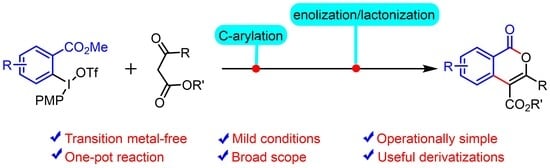
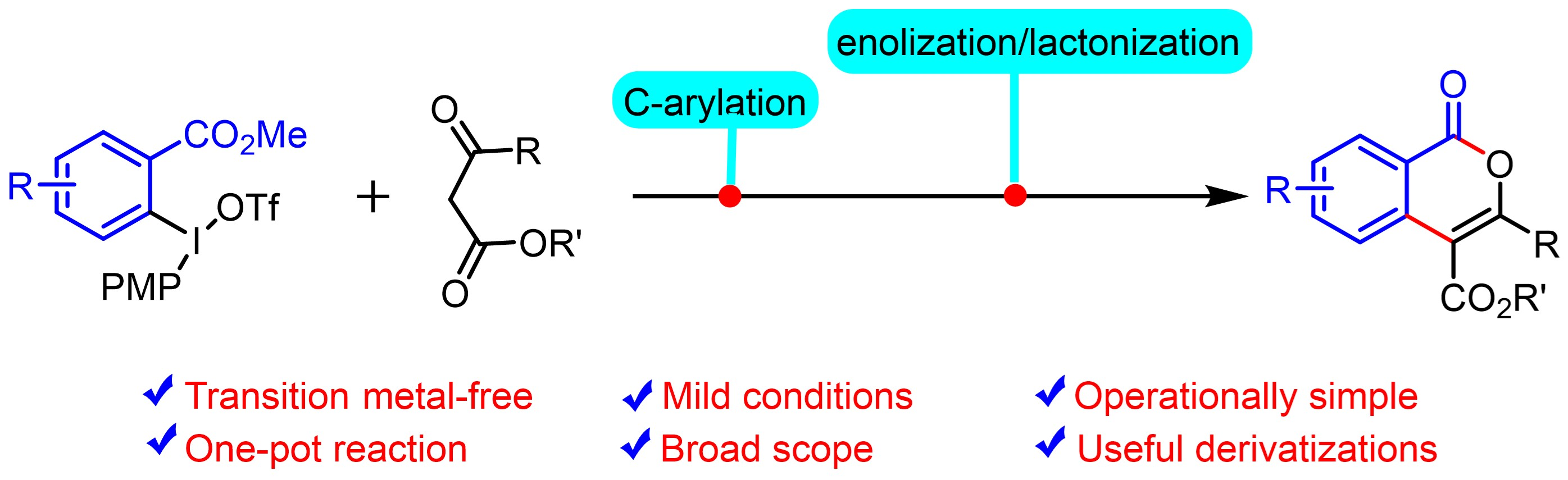
In this study, a metal-free approach was developed for the synthesis of isocoumarin frameworks by exploiting the reactivity between ortho-carboxylate-ester-substituted diaryliodonium salts and acetoacetates. This transformation involved the sequential C-arylation of an activated methylene substrate, followed by in situ enolization and intramolecular lactonization to construct an isocoumarin core. Under operationally simple conditions, a range of diaryliodonium salts and acetoacetate esters were employed to afford structurally diverse isocoumarins. The resulting products contained synthetically valuable functional groups, including halogen, nitro, carboxylate ester, and azide substituents, which facilitated further derivatization and extension toward complex architectures and potential applications. Subsequent transformation of the selected isocoumarin products enabled the synthesis of furo[3,4-c]isochromene-1,5-dione motifs, which are observed in several natural products.

Graphical Abstract

1. Introduction

Isocoumarins (also referred to as 1H-isochromen-1-ones, 1H-2-benzopyran-1-ones, or 3,4-benzo-2-pyrones) are heterocyclic aromatic compounds consisting of a benzene ring fused to an unsaturated δ-lactone (α-pyranone) moiety. Isocoumarin derivatives represent an important class of naturally occurring metabolites found in various plants, molds, lichens, bacteria, and fungi. To date, nearly one thousand natural isocoumarin derivatives have been identified, displaying a diverse array of bioactivities, including cytotoxic, antibiotic, antifungal, antimalarial, antitubercular, antileukemic, antidiabetic, antifouling, antiplatelet, and antiviral effects [1,2,3,4,5,6,7,8]. Furthermore, isocoumarins serve as crucial intermediates in the synthesis of pharmaceutically active compounds [9,10,11], the construction of various isoquinolines, isochromenes, and aromatic derivatives [12,13,14,15], and the development of fluorescent materials for efficient organic light-emitting diode (OLED) devices (Figure 1) [16,17,18]. Consequently, the isocoumarin skeleton is regarded as a privileged structure with diverse applications in drug discovery, medicinal chemistry, materials science, and organic synthesis [19,20,21,22].
Owing to their diverse biological activities and significance as key scaffolds in synthetic chemistry, considerable research efforts have been dedicated toward the synthesis of isocoumarin derivatives. Traditional synthetic methods typically involve multistep processes and harsh reaction conditions, resulting in low yields and regioselectivities, along with the formation of undesired byproducts [12,13,14,15]. For instance, the reaction of ortho-halobenzoic acids with 1,3-diketones leads to additional diacylation, yielding 4-unsubstituted isocoumarin derivatives under both metal- and metal-free conditions [23,24,25,26]. Consequently, advanced methodologies have been developed using transition metal catalysts, such as palladium, copper, ruthenium, rhodium, and iridium [27,28,29,30,31,32]. Common synthetic strategies involve the formation of ortho-alkynylbenzoic acids or their ester/amide derivatives, followed by intramolecular cyclization via one-pot cascades or multistep processes. Besides transition metal-catalyzed conditions, Lewis/Brønsted acids and electrophilic reagents have been employed to facilitate these cyclization reactions [27,28,29,30,31,32]. Metal-catalyzed processes have also been used to promote the annulation of benzoic acid derivatives with ketones, alkynes, alkenes, diazoalkanes, and sulfonium ylides, among other substrates.
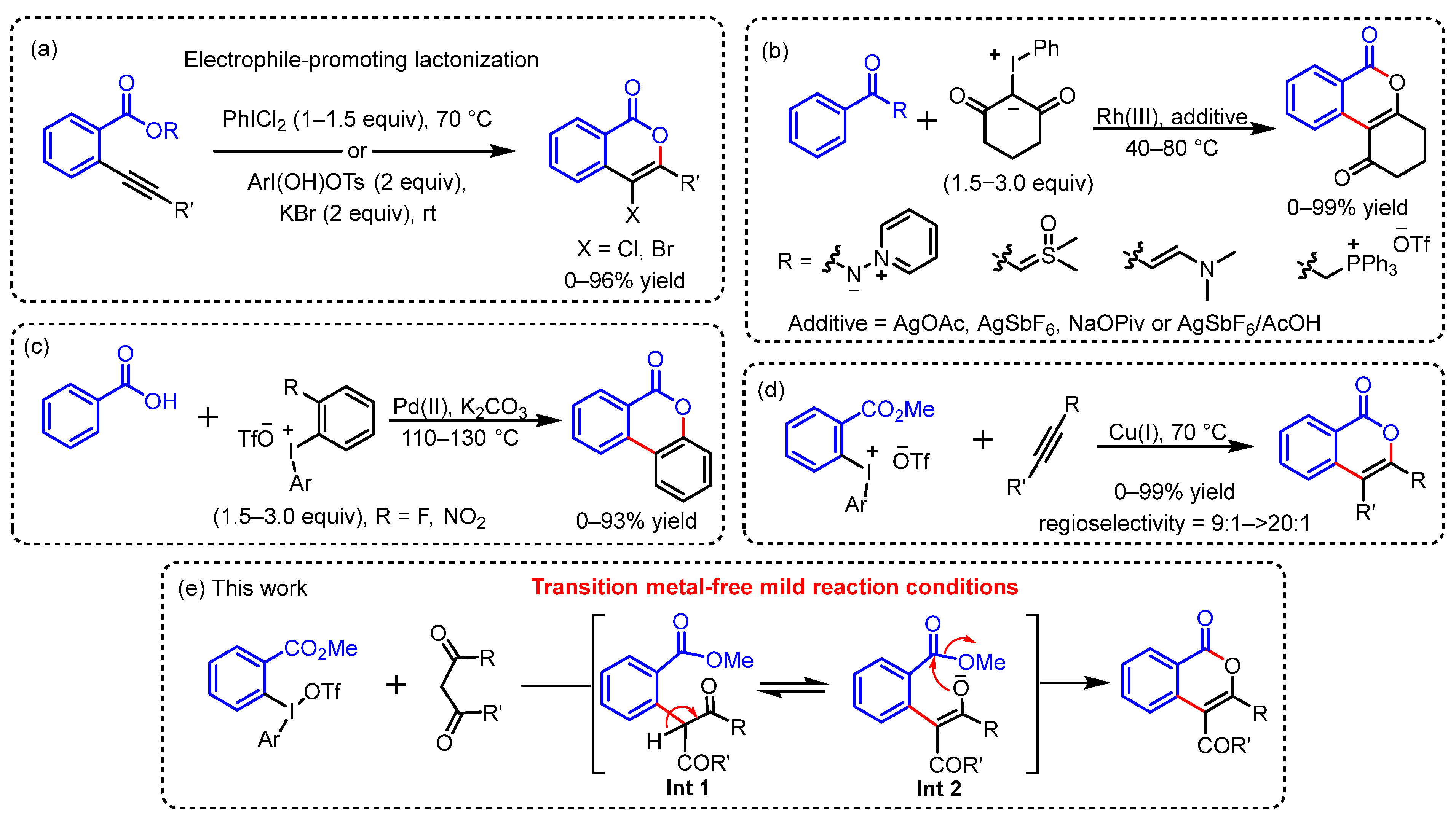
Hypervalent iodine reagents and diaryliodonium salts are either commercially available or readily prepared, and they exhibit broad applicability [33,34]. For example, (dichloroiodo)benzene has been employed as both an oxidant and chlorinating agent for the intramolecular cyclization of ortho-alkynylbenzoate, leading to the formation of 4-chloroisocoumains (Scheme 1a) [35]. Additionally, a combination of the Koser reagent and potassium bromide has been used as an electrophilic reagent system for the brominative annulation of ortho-alkynylbenzoate, enabling the synthesis of 4-bromoisocoumarin derivatives [36]. Furthermore, hypervalent iodonium ylides have been annulated with iminopyridinium ylides, sulfoxonium ylides, phenacyl phosphoniums, and N,N-dimethyl enaminones via rhodium(III)-catalyzed C–H activation, carbene insertion, and nucleophilic addition protocols (Scheme 1b) [37,38,39,40,41]. Unsymmetrical scaffolds afforded mixtures of regioisomers, whereas iodonium ylides bearing 5-/7-membered cyclic 1,3-diones gave low yields, and those derived from acyclic 1,3-diones were unreactive. Moreover, ortho-functionalized aryliodonium salts effectively participated in the construction of benzopyranone skeletons under transition metal-catalyzed conditions. Iodonium salts substituted with ortho-fluoro and -nitro groups were efficiently cyclized with aryl carboxylic acids under palladium(II) acetate conditions to produce the corresponding pyranone derivatives (Scheme 1c) [42,43]. In these reactions, palladium-promoted nucleophilic substitution of the ortho-nitro and ortho-fluoro groups by a coordinated carboxylate facilitates intramolecular lactonization. Generally, polynuclear aryl carboxylic acids cyclize more effectively than simple benzoic acid derivatives. In this context, ortho-carboxylate-ester-functionalized aryliodonium salts were successfully annulated with naphthols in the presence of a Cu catalyst to afford isocoumarin derivatives; however, the yields decreased when phenols were used, resulting in the formation of regioisomers [44]. Notably, aryliodonium salts substituted with ortho-carboxylate esters underwent annulation with alkynes under Cu catalysis to produce a diverse range of substituted isocoumarins in high yields with excellent regioselectivity (Scheme 1d) [45].
Previously, our group pioneered metal-free cross-coupling reactions employing diaryliodonium salts for C–C bond formation, including the synthesis of heteroaromatic biaryl compounds [46,47]. Our group further demonstrated the versatility of these C-, O-, and N-arylation protocols and established a practical, transition-metal-free approach for the synthesis of benzisoxazolone heterocycles from ortho-carboxylate-ester-substituted aryliodonium salts and protected hydroxylamines [48,49,50,51,52]. Building on this longstanding interest, the aim of the current study is to develop a mild, metal-free approach to isocoumarin derivatives via the C-arylation of activated methylenes with ortho-carboxylate-ester-substituted diaryliodonium salts, followed by intramolecular lactonization in a single step (Scheme 1e).

2. Results and Discussion

Diaryliodonium salts are stable, low-toxicity arylating agents that are extensively used in the construction of diverse C–C and C–heteroatom bonds under both metal-free and metal-catalyzed conditions [34,53,54]. Notably, metal-free transformations have garnered considerable interest as efficient and sustainable synthetic methodologies [34]. Additionally, the advanced design of diaryliodonium salts has facilitated the highly selective arylation of a wide array of nucleophiles, enhancing the practicality of these reactions and addressing the limitations associated with classical iodonium salts [46,47,55,56,57,58].
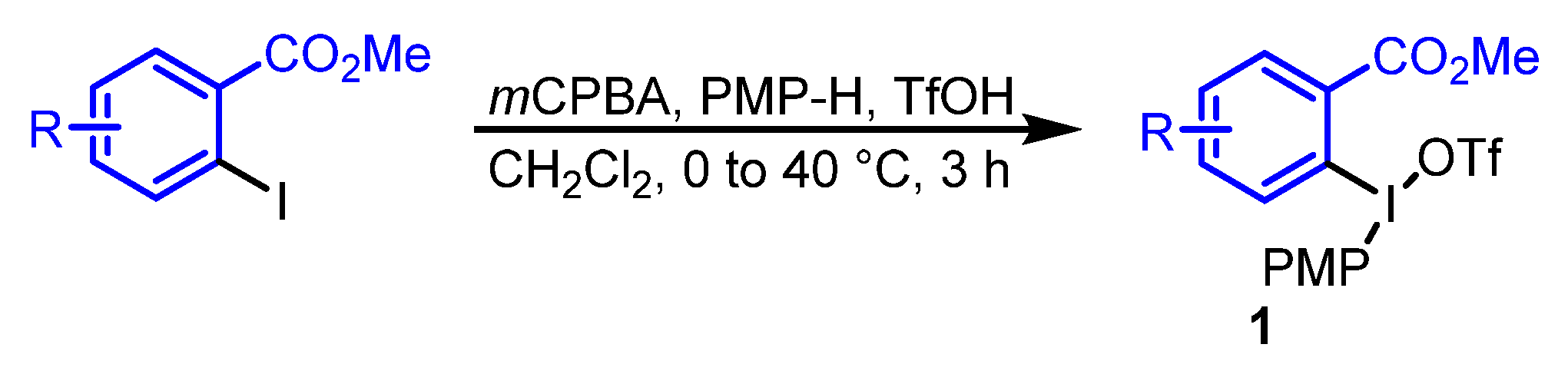
ortho-Carboxylate-ester-functionalized diaryliodonium triflates 1 are easily accessible substrates through oxidation of commercially available ortho-carboxylate-ester-substituted (hetero)aryl iodides with meta-chloroperbenzoic acid (mCPBA), then coupling with anisole (PMP-H) in the presence of trifluoromethanesulfonic acid (TfOH) (Scheme 2) [59]. Aryl iodide scaffolds substituted with electron-rich, electron-poor, and sterically hindered groups were transformed smoothly into the related ortho-carboxylate-ester-functionalized Ar(PMP)IOTf 1.
As a continuation of our investigations into ortho-carboxylate-ester-functionalized diaryliodonium salts bearing a para-methoxyphenyl (PMP) dummy ligand to synthesize valuable heterocyclic products [59], a new approach was developed for the synthesis of isocoumarin derivatives. The feasibility of this transformation was initially assessed using ortho-carboxylate-ester-substituted aryl(PMP)iodonium triflate 1a and methyl acetoacetate 2a, and subsequent optimization of the reaction parameters. Preliminary screening of commonly used conditions for the C-arylation of activated methylene scaffolds [60,61], including sodium hydride and potassium tert-butoxide in N,N-dimethylformamide (DMF), resulted in trace amounts of the desired product (Table 1, entries 1 and 2; Table S1). Notably, our previously reported reaction conditions afforded isocoumarin 3aa in 66% yield (entry 3). Reducing the loading of iodonium salt 1a to 1.0 or 1.5 equivalents resulted in decreased yields (54 and 60%, respectively), whereas increasing the amounts of methyl acetoacetate 2a and base to 1.5 and 3.0 equivalents yielded isocoumarin 3aa in 50 and 62% yields, respectively (Table S1). Conducting the reaction in dry diethyl ether without 4 Å molecular sieves gave a comparable yield (entry 4). Reduced solvent volumes (i.e., higher reactant concentrations) were detrimental to product formation (entries 5 and 6). Variations in the reaction temperature and time for the reaction employing iodonium salt 1a (1–2 equiv.) failed to increase the yield of product 3aa (entries 7 and 8; Table S1). Subsequent screening of organic and inorganic bases, along with a range of nonpolar and polar (a)protic solvents, identified cesium carbonate and diethyl ether as the optimal base and solvent, respectively (entries 9–16; Table S1). Remarkably, commercially available diethyl ether used as received afforded isocoumarin 3aa in 77% isolated yield, whereas a mixed solvent system (diethyl ether/water) led to the complete consumption of iodonium salt 1a, but resulted in a poor yield or no detectable formation of the desired product (entries 17 and 18; Table S1). In contrast, other ortho-carboxylate-substituted diaryliodonium salts bearing mesityl (Mes), 2,4,6-trimethoxyphenyl (TMP), or 3,5-dimethyl-4-isoxazolyl (DMIX) dummy aryl groups in combination with tosylate or triflate counteranions, afforded the corresponding products in lower yields (Table S2).
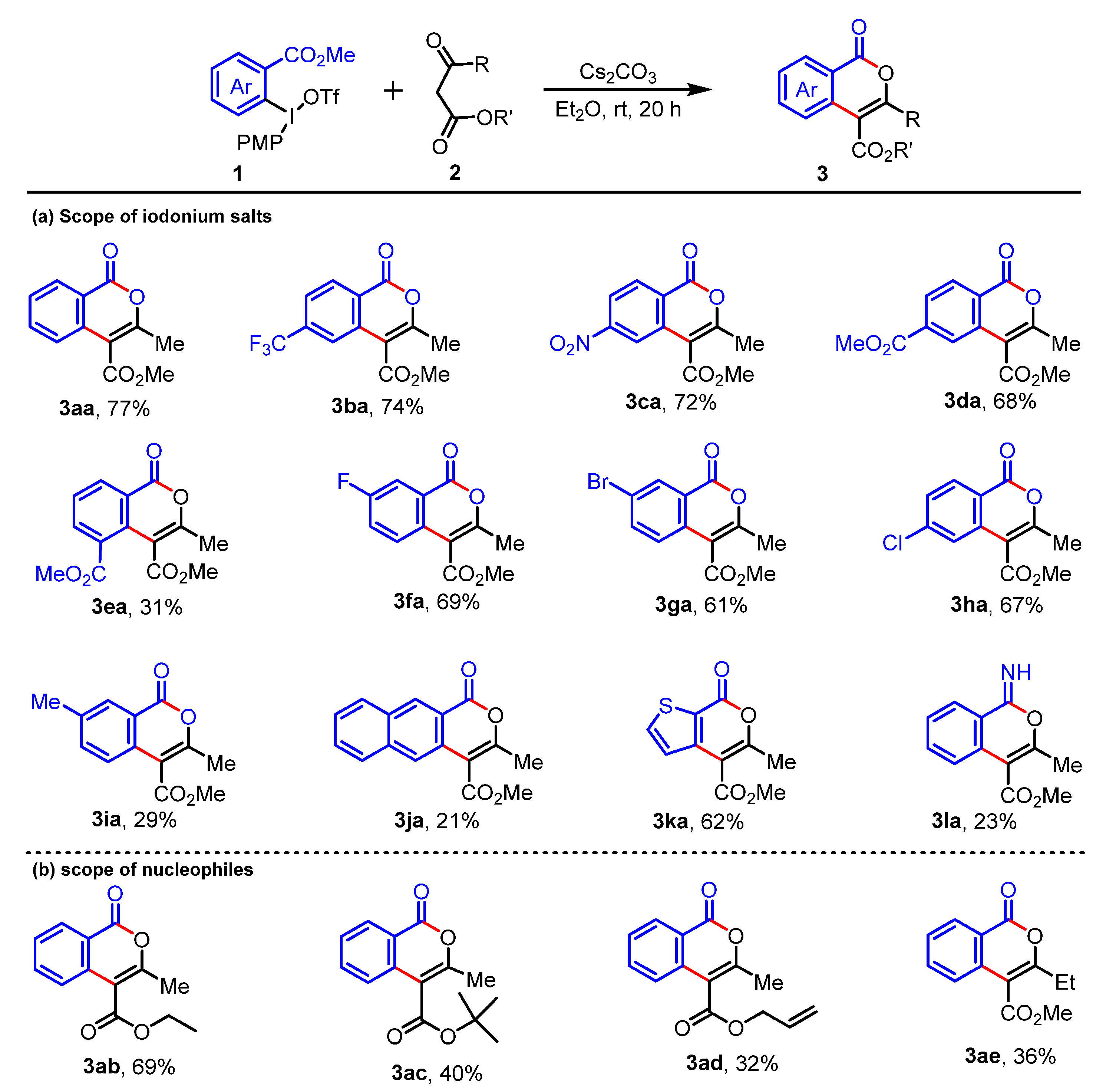
With the optimized conditions in hand (Table 1, entry 17), the substrate scope of ortho-carboxylate-ester-substituted aryl(PMP)iodonium triflates was investigated in their reaction with methyl acetoacetate 2a to access a range of isocoumarin derivatives (Scheme 3). Iodonium salts 1b1d substituted with various electron-withdrawing groups—including CF3, NO2, and CO2Me—reacted efficiently, affording the corresponding isocoumarin derivatives 3ba3da in high yields. Sterically hindered iodonium salt 1e, characterized by its 2,6-dicarboxylate ester substitution pattern, reacted with acetoacetate 2a to produce novel isocoumarin 3ea, which contains 4,5-dicarboxylate ester groups, in moderate yield. Generally, sterically hindered substrates pose challenges to isocoumarin synthesis under both metal-catalyzed and metal-free conditions [35,36,37,38,39,40,43,45]. Consequently, novel isocoumarin 3ea may be of particular interest and represents a potentially useful analog of widely employed naphthalene-1,8-dicarboxylate esters [62]. Additionally, iodonium salts 1f1h functionalized with halogen substituents (F, Br ad Cl) afforded the corresponding isocoumarins 3fa3ha in 69–61% yields, respectively. These halogenated products, which are often difficult to obtain under metal-catalyzed conditions, offer valuable handles for further derivatization. Furthermore, methyl-substituted iodonium salt 1i and naphthyliodonium salt 1j produced the corresponding isocoumarins 3ia and 3ja in moderate yields. Notably, heterocyclic iodonium salt 1k reacted efficiently to furnish the thienopyranone skeleton 3ka in good yield. ortho-Cyano-functionalized iodonium salt 1l was also compatible with this approach, affording imino derivative 3la in 23% yield.
Subsequently, the substrate scope was expanded by employing acetoacetates bearing various ester groups. The reactions of acetoacetates 2b and 2c furnished the corresponding isocoumarin products 3ab and 3ac, with yields reflecting the steric demands of the ester substituents. Notably, an increase in ester bulk from ethyl to t-butyl resulted in a pronounced decrease in yield from 69 to 40%. Additionally, allyl acetoacetate 2d produced allyl ester isocoumarin 3ad in 32% yield. Furthermore, the reaction of methyl 3-oxopentanoate 2e with iodonium salt 1a afforded the corresponding isocoumarin 3ae in moderate yield. Thus, at this stage of the investigation, the method’s applicability appeared limited to a single class of activated methylene compounds. Similar substrate-dependent limitations have frequently been reported in C-arylation reactions of activated methylenes with diaryliodonium salts [61,63,64]. Indeed, these systems are susceptible to side reactions, including aldol addition/condensation of β-ketoesters [65], deacylation of C-arylation products [23,24,25,26,60,66], double arylation of activated methylenes [60,67,68], and decomposition of iodonium salts [69,70,71]. Within this context, the current protocol therefore represents a reliable metal-free approach that enables the formation of two bonds in a single operation, affording isocoumarin derivatives via C-arylation followed by intramolecular lactonization.
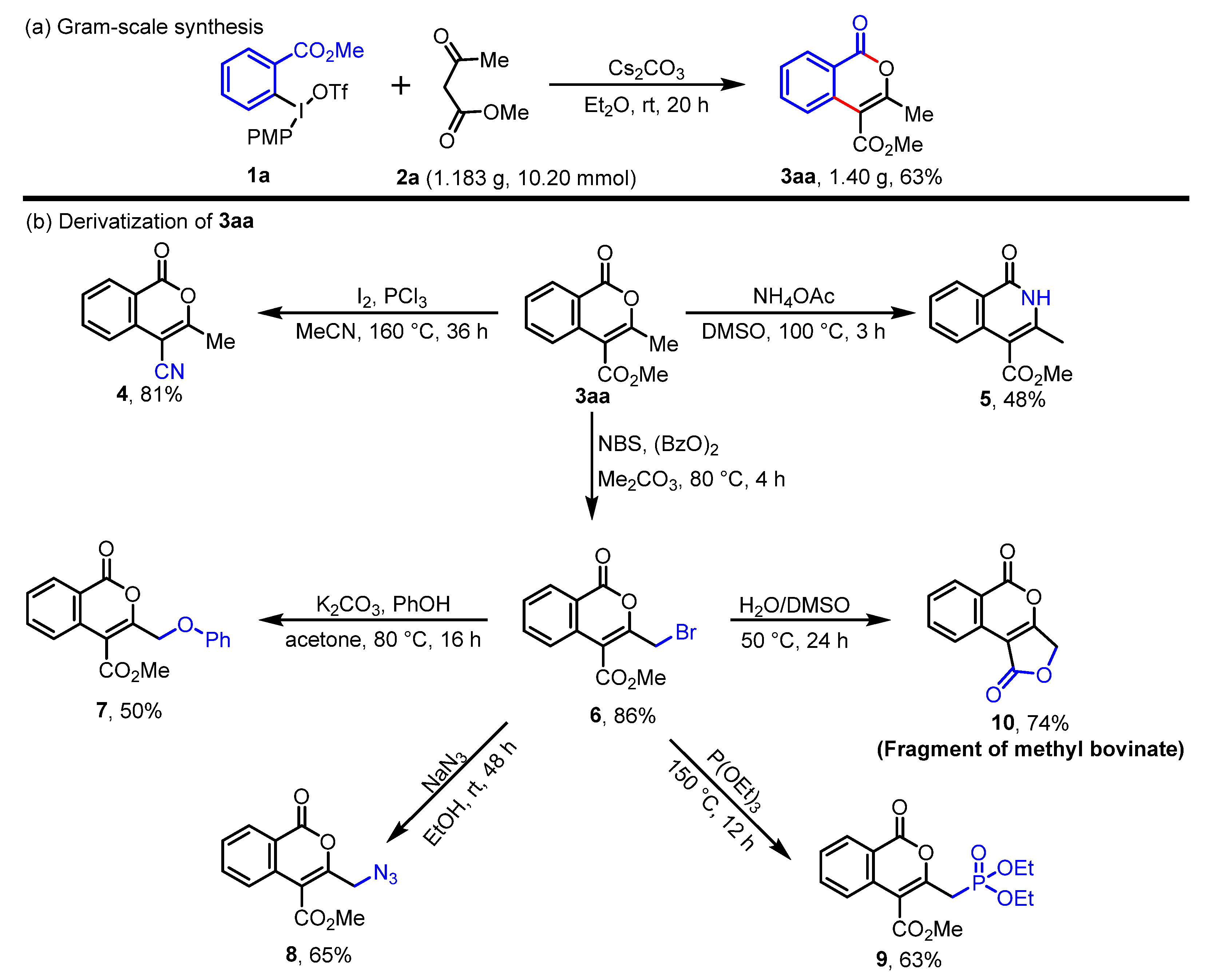
These conditions were also applicable to large-scale synthesis, affording the desired isocoumarin product 3aa in 63% yield (Scheme 4a). To illustrate the synthetic value of the isocoumarin derivatives, 3aa was converted into valuable intermediates. Specifically, the 4-ester group of isocoumarin 3aa was efficiently transformed into 4-cyano-derivative 4 via reaction with acetonitrile in the presence of I2/PCl3 (Scheme 4b) [72]. Additionally, treatment of 3aa with ammonium acetate afforded isoquinoline derivative 5 in moderate yield, while the reaction of 3aa with N-bromosuccinimide (NBS) afforded 3-bromomethyl derivative 6 in 86% yield. This derivative serves as a useful precursor for further functionalization; nucleophilic substitution of the bromo-group in 6 with phenol, azide, and triethyl phosphite afforded the corresponding ether-, azide-, and phosphonate derivatives 79 in good yields. Notably, azide-functionalized isocoumarin 8 has extensive applications in click chemistry. Moreover, the substitution of bromo-derivative 6 with water generated the corresponding alcohol, which underwent lactonization with the adjacent carboxylate ester group to form furo[3,4-c]isochromene-1,5-dione 10 in 74% yield. This furoisochromene–dione skeleton is the main fragment of the natural product methyl bovinate [73]. Notably, compounds analogous to 10 have previously been reported via a Rh(III)-catalyzed regioselective annulation of benzoic acid with 4-hydroxy-2-alkynoates, followed by intramolecular lactonization [74]. That method afforded a mixture of regioisomeric products and required a transition metal catalyst in combination with AgSbF6 as an activator, Ag2CO3 as an oxidant, and LiOAc as a base, and was performed at 100 °C for 16 h. In contrast, the present protocol delivers compound 10 as a single regioisomer in significantly higher yield under metal-free conditions, without expensive silver additives or external oxidants, and proceeds under milder and operationally simpler conditions.

3. Materials and Methods

3.1. General Information

Melting points were measured using a Yanaco MP-500P melting point (Yanagimoto Scientific Instruments, Kyoto, Japan) apparatus and are uncorrected. Nuclear magnetic resonance (NMR) spectra were recorded on a JEOL JMN-AL400 spectrometer (JEOL Ltd., Tokyo, Japan, 1H NMR: 400 MHz; 13C NMR: 101 MHz) at 25 °C. Chemical shifts in the 1H NMR spectra were referenced to the residual solvent signal (CDCl3, δ 7.26), and chemical shifts in the 13C NMR spectra were referenced to the residual solvent signal (CDCl3, δ 77.0). Data are reported as follows: chemical shift in ppm (δ), multiplicity (s = singlet, d = doublet, t = triplet, m = multiplet), coupling constant (Hz), and integration. Infrared (IR) spectra were obtained using a JASCO FT/IR-4200 (JASCO, Tokyo, Japan) spectrometer; absorptions are reported in reciprocal centimetres (cm−1) for strong and structurally diagnostic peaks. High-resolution mass spectra (HRMS) were obtained using the electron ionization (EI) method and recorded using a JMS-700 spectrometer (JEOL Ltd., Tokyo, Japan). Flash column chromatography and analytical thin-layer chromatography (TLC) were performed on Merck silica gel 60 (230–400 mesh) and Merck silica gel F254 plates (0.25 mm), respectively. Spots and bands were visualized by UV irradiation (254 nm). All reactions requiring heating were carried out using an IKA® C-MAG HS 4 digital hotplate (IKA-Werke GmbH & Co. KG, Staufen im Breisgau, Germany) equipped with aluminium heating blocks. Room temperature in this work refers to a range of 25–30 °C. All commercially available reagents were used as received unless otherwise noted.

3.2. General Procedure for the Synthesis of Iodonium Triflates 1 [59]

To a stirred solution of aryl iodide (1.0 mmol) in DCM (5 mL, 0.2 M) were added m-CPBA (1.28 equiv) and anisole (1.0 equiv), and the reaction mixture was cooled to 0 °C. TfOH (2.0 equiv) was then added dropwise, and the mixture was stirred at 0 °C for 10 min and subsequently at 40 °C for 3 h. The solvent was removed under reduced pressure, and the resulting residue was triturated with Et2O to afford the desired aryl(PMP)iodonium triflate.
ortho-Ester-substituted aryl(PMP)iodonium triflates 1a1d and 1g1k and their corresponding cyano-substituted analogues were prepared according to our previous work [59].
Dimethyl 2-((4-methoxyphenyl)(((trifluoromethyl)sulfonyl)oxy)-λ3-iodaneyl)isopht-halate (1e). Gray amorphous solid (295.1 mg, 51%). M.p. 148–149 °C. 1H NMR (400 MHz, CDCl3 + drop CD3OD): δ 8.14 (d, J = 7.8 Hz, 2H, Ar–H), 7.83 (d, J = 8.8 Hz, 2H, Ar–H), 7.72 (t, J = 7.6 Hz, 1H, Ar–H), 6.88 (d, J = 8.8 Hz, 2H, Ar–H), 3.85 (s, 6H, 2 × CO2Me), 3.78 (s, 3H, OMe). 13C{1H} NMR (101 MHz, CDCl3 + drop CD3OD): δ 165.7, 163.0, 138.5, 135.7, 133.9, 132.5, 117.2, 115.5, 103.5, 55.8, 54.1.
Methyl 5-fluoro-2-((4-methoxyphenyl)(((trifluoromethyl)sulfonyl)oxy)-λ3-iodaney-l)benzoate (1f). Gray amorphous solid (285.9 mg, 64%). M.p. 120–121 °C. 1H NMR (400 MHz, CDCl3): δ 8.01–7.98 (m, 1H, Ar–H), 8.01 (d, J = 8.8 Hz, 2H, Ar-H), 7.34–7.30 (m, 1H, Ar–H), 7.10 (d, J = 8.8 Hz, 2H, Ar–H), 6.96 (dd, J = 9.0, 4.6 Hz, 1H, Ar–H), 4.12 (s, 3H, CO2Me), 3.91 (s, 3H, OMe). 13C{1H} NMR (CDCl3): δ 167.0 (d, J = 2.5 Hz), 164.1 (d, J = 255.7 Hz), 164.0, 140.2, 131.5 (d, J = 8.3 Hz), 128.7 (d, J = 7.4 Hz), 124.3 (d, J = 22.3 Hz), 120.2 (d, J = 24.8 Hz), 118.7, 108.5 (d, J = 2.5 Hz), 98.2, 56.0, 55.2.

3.3. General Procedure for the Synthesis of Isocoumarin 3

To a screw-capped reaction tube were added the β-ketoester (0.10 mmol), diethyl ether (1.0 mL, 0.1 M), and cesium carbonate (0.20 mmol). The resulting mixture was stirred at room temperature for 10 min, after which the diaryliodonium salt (0.20 mmol) was added. The reaction mixture was then stirred at room temperature for 20 h. Upon completion, the crude mixture was purified by column chromatography on silica gel, eluting with 10–20% ethyl acetate in n-hexane, to afford the corresponding isocoumarin product.
Methyl 3-methyl-1-oxo-1H-isochromene-4-carboxylate (3aa). White amorphous solid (16.9 mg, 77%). M.p. 96–97 °C. 1H NMR (400 MHz, CDCl3): δ 8.28 (d, J = 8.3 Hz, 1H, Ar–H), 7.76–7.71 (m, 2H, Ar–H), 7.52–7.48 (m, 1H, Ar–H), 3.97 (s, 3H, CO2Me), 2.45 (s, 3H, Me). 13C{1H} NMR (101 MHz, CDCl3): δ 166.4, 161.3, 158.2, 135.3, 134.7, 1298, 128.3, 124.3 119.6, 110.1, 52.6, 19.5. These data are consistent with the previously reported results [75].
Methyl 3-methyl-1-oxo-6-(trifluoromethyl)-1H-isochromene-4-carboxylate (3ba). White amorphous solid (22.0 mg, 74%). M.p. 102–103 °C. 1H NMR (400 MHz, CDCl3): δ 8.40 (d, J = 8.3 Hz, 1H, Ar–H), 8.13 (s, 1H. Ar–H), 7.73 (d, J = 8.3 Hz, 1H, Ar–H), 4.00 (s, 3H, CO2Me), 2.51 (s, 3H, Me). 13C{1H} NMR (101 MHz, CDCl3): δ 165.7, 160.5, 160.0, 136.6 (q, J = 33.1 Hz), 135.2, 130.7, 124.6 (q, J = 3.6 Hz), 123.4 (q, J = 273.4 Hz), 121.9 (q, J = 4.1 Hz), 109.4, 52.7, 19.9. 19F NMR (376 MHz, CDCl3): δ −63.0 ppm. IR (KBr): 2962 (C–H), 1768 (C=O), 1718 (C=O), 1181 (C–O) cm−1. HRMS-DART (m/z): [M+] Calcd for C13H9F3O4+ 286.0453; Found 286.0455.
Methyl 3-methyl-6-nitro-1-oxo-1H-isochromene-4-carboxylate (3ca). Reddish yellow amorphous solid (19.9 mg, 72%). M.p. 167–168 °C. 1H NMR (400 MHz, CDCl3): δ 8.76 (d, J = 2.0 Hz, 1H, Ar–H), 8.45 (d, J = 8.8 Hz, 1H, Ar–H), 8.27 (dd, J = 8.8, 2.0 Hz, 1H, Ar–H), 4.03 (s, 3H, CO2Me), 2.54 (s, 3H, Me). 13C{1H} NMR (101 MHz, CDCl3): δ 165.4, 161.7, 159.5, 152.0, 136.1, 131.7, 123.5, 122.3, 120.3, 109.2, 53.0, 20.1. IR (KBr): 2933 (C–H), 1758 (C=O), 1717 (C=O), 1540 (NO2) cm−1. HRMS-DART (m/z): [M+] Calcd for C12H9NO6 263.0430; Found 263.0427.
Dimethyl 3-methyl-1-oxo-1H-isochromene-4,6-dicarboxylate (3da). White amorphous solid (19.3 mg, 68%). M.p. 155–156 °C. 1H NMR (400 MHz, CDCl3): δ 8.44 (s, 1H, Ar–H), 8.34 (d, J = 8.3 Hz, 1H, Ar–H), 8.11 (dd, J = 8.3, 1.0 Hz, 1H, Ar–H), 4.00 (s, 3H, CO2Me), 3.97 (s, 3H, CO2Me), 2.48 (s, 3H, Me). 13C{1H} NMR (101 MHz, CDCl3): δ 166.0, 165.9, 160.5, 159.3, 136.0, 134.8, 130.1, 128.6, 126.0, 122.5, 109.9, 52.9, 52.8, 19.7. IR (KBr): 2967 (C–H), 1717 (C=O), 1295 (C-O), 1061 (C–O) cm−1. HRMS-DART (m/z): [M+] Calcd for C14H12O6+ 276.0634; Found 276.0637.
Dimethyl 3-methyl-1-oxo-1H-isochromene-4,5-dicarboxylate (3ea). White amorphous solid (9.2 mg, 31%). M.p. 108–109 °C. 1H NMR (400 MHz, CDCl3): δ 8.43 (dd, J = 7.8, 1.5 Hz, 1H, Ar–H), 8.12 (dd, J = 7.8, 1.5 Hz, 1H, Ar–H), 7.56 (t, J = 7.8 Hz, 1H, Ar–H), 3.89 (s, 3H, CO2Me), 3.81 (s, 3H, CO2Me), 2.52 (s, 3H, Me). 13C{1H} NMR (101 MHz, CDCl3): δ 167.6, 166.2, 160.4, 159.6, 136.4, 133.7, 132.8, 128.7, 127.7, 121.1, 109.2, 52.4, 52.0, 19.1. IR (KBr): 2953 (C–H), 1730 (C=O), 1623 (C=C), 1448 (C=C) cm−1. HRMS-DART (m/z): [M+] Calcd for C14H12O6+ 276.0634; Found 276.0632.
Methyl 7-fluoro-3-methyl-1-oxo-1H-isochromene-4-carboxylate (3fa). White amorphous solid (16.1 mg, 69%). M.p. 112–113 °C. 1H NMR (400 MHz, CDCl3): δ 7.94 (dd, J = 8.3, 2.4 Hz, 1H, Ar–H), 7.85 (dd, J = 8.3, 4.9 Hz, 1H, Ar–H), 7.49–7.44 (m, 1H, Ar–H), 3.97 (s, 3H, CO2Me), 2.47 (s, 3H, Me). 13C{1H} NMR (101 MHz, CDCl3): δ 166.0, 161.6 (d, J = 250.8 Hz), 160.2 (d, J = 3.3 Hz), 158.0 (d, J = 2.5 Hz), 131.1 (d, J = 3.3 Hz), 127.1 (d, J = 7.4 Hz), 123.3 (d, J = 22.3 Hz), 121.2 (d, J = 8.3 Hz), 115.0 (d, J = 23.2 Hz), 109.3, 52.6, 19.4. 19F NMR (376 MHz, CDCl3): δ −107.5 ppm. IR (KBr): 3082 (C–H), 2926 (C–H), 1727 (C=O), 1498 (C=C), 1096 (C–F) cm−1. HRMS-DART (m/z): [M+] Calcd for C12H9FO4+ 236.0485; Found 236.0483.
Methyl 7-bromo-3-methyl-1-oxo-1H-isochromene-4-carboxylate (3ga). White amorphous solid (17.5 mg, 61%). M.p. 111–112 °C. 1H NMR (400 MHz, CDCl3): δ 8.39 (d, J = 2.2 Hz, 1H, Ar–H), 7.81 (dd, J = 8.8, 2.2 Hz, 1H, Ar–H), 7.69 (d, J = 8.8 Hz, 1H, Ar–H), 3.96 (s, 3H, CO2Me), 2.45 (s, 3H, Me). 13C{1H} NMR (101 MHz, CDCl3): δ 166.0, 159.9, 159.2, 138.3, 133.5, 132.2, 126.3, 122.0, 121.1, 109.5, 52.7, 19.8. IR (KBr): 3077 (C–H), 2953 (C–H), 1747 (C=O), 1618 (C=C), 1243 (C–O) cm−1. HRMS-DART (m/z): [M+] Calcd for C12H9BrO4+ 295.9684; Found 295.9685.
Methyl 6-chloro-3-methyl-1-oxo-1H-isochromene-4-carboxylate (3ha). White amorphous solid (18.2 mg, 67%). M.p. 145–146 °C. 1H NMR (400 MHz, CDCl3): δ 8.18 (d, J = 8.6 Hz, 1H, Ar–H), 7.80 (d, J = 1.7 Hz, 1H, Ar–H), 7.45 (dd, J = 8.6, 1.7 Hz, 1H, Ar–H), 3.97 (s, 3H, CO2Me), 2.46 (s, 3H, Me). 13C{1H} NMR (101 MHz, CDCl3): δ 165.79, 160.35, 160.19, 142.17, 135.99, 131.31, 128.80, 124.29, 117.80, 109.08, 52.67, 19.84. IR (KBr): 2959 (C–H), 1772 (C=O), 1724 (C=O), 1059 (C–O) cm−1. HRMS-DART (m/z): [M+] Calcd for C12H9ClO4+ 252.0189; Found 252.0188.
Methyl 3,7-dimethyl-1-oxo-1H-isochromene-4-carboxylate (3ia). White amorphous solid (6.3 mg, 29%). M.p. 119–120 °C. 1H NMR (400 MHz, CDCl3): δ 8.09 (d, J = 1.5 Hz, 1H, Ar–H), 7.67 (d, J = 8.3 Hz, 1H, Ar–H), 7.55 (dd, J = 8.3, 1.5 Hz, 1H, Ar–H), 3.96 (s, 3H, CO2Me), 2.46 (s, 3H, Me), 2.44 (s, 3H, Me). 13C{1H} NMR (101 MHz, CDCl3): δ 166.6, 161.5, 157.5, 138.7, 136.5, 132.2, 129.5, 124.3, 119.5, 110.0, 52.5, 21.3, 19.5. These data are consistent with the previously reported results [75].
Methyl 3-methyl-1-oxo-1H-benzo[g]isochromene-4-carboxylate (3ja). Pale yellow amorphous solid (6.1 mg, 21%). M.p. 138–139 °C. 1H NMR (400 MHz, CDCl3): δ 8.93 (s, 1H, Ar–H), 8.18 (s, 1H, Ar–H), 8.02 (d, J = 8.3 Hz, 1H, Ar–H), 7.94 (d, J = 8.3 Hz, 1H, Ar–H), 7.65 (t, J = 7.3 Hz, 1H, Ar–H), 7.57 (t, J = 7.3 Hz, 1H, Ar–H), 4.04 (s, 3H, CO2Me), 2.47 (s, 3H, Me). 13C{1H} NMR (101 MHz, CDCl3): δ 166.8, 161.6, 156.5, 132.3, 129.8, 129.6, 129.1, 128.5, 127.3, 123.2, 117.8, 110.1, 52.7, 19.6. IR (KBr): 2992 (C–H), 1718 (C=O), 1660 (C=O), 1440 (C=C), 1260 (C–O) cm−1. HRMS-DART (m/z): [M+] Calcd for C16H12O4+ 268.0736; Found 268.0734.
Methyl 5-methyl-7-oxo-7H-thieno[2,3-c]pyran-4-carboxylate (3ka). Yellow amorphous solid (14.1 mg, 62%). M.p. 129–130 °C. 1H NMR (400 MHz, CDCl3): δ 7.85 (d, J = 4.9 Hz, 1H, Ar–H), 7.70 (d, J = 5.4 Hz, 1H, Ar–H), 3.95 (s, 3H, CO2Me), 2.65 (s, 3H, Me). 13C{1H} NMR (101 MHz, CDCl3): δ 165.5, 164.8, 157.1, 145.2, 136.8, 126.4, 122.3, 108.0, 52.4, 20.2. IR (KBr): 3108 (C–H), 2961 (C–H), 1746 (C=O), 1715 (C=O), 1423 (C=C) cm−1. HRMS-DART (m/z): [M+] Calcd for C10H8O4S+ 224.0143; Found 224.0140.
Methyl 1-imino-3-methyl-1H-isochromene-4-carboxylate (3la). Pale yellow amorphous solid (5.4 mg, 23%). M.p. 80–81 °C. 1H NMR (400 MHz, CDCl3): δ 13.10 (s, 1H, NH), 7.65 (d, J = 7.3 Hz, 1H, Ar–H), 7.54 (t, J = 7.3 Hz, 1H, Ar–H), 7.37 (t, J = 7.3 Hz, 1H, Ar–H), 7.25 (d, J = 7.3 Hz, 1H, Ar–H), 3.67 (s, 3H, CO2Me), 1.82 (s, 3H, Me). 13C{1H} NMR (101 MHz, CDCl3): δ 175.7, 171.8, 139.2, 132.9, 132.7, 132.6, 128.0, 118.0, 115.3, 101.4, 52.2, 19.9. IR (KBr): 3064 (C–H), 1609 (C=N),1443 (C=C), 1263 (C–O) cm−1. HRMS-DART (m/z): ([M+]) Calcd for C12H11NO3+ 217.0739; Found 217.0736.
Ethyl 3-methyl-1-oxo-1H-isochromene-4-carboxylate (3ab). Pale yellow oil (15.9 mg, 69%). 1H NMR (400 MHz, CDCl3): δ 8.27 (d, J = 7.3 Hz, 1H, Ar–H), 7.77–7.70 (m, 2H, Ar–H), 7.52–7.48 (m, 1H, Ar–H), 4.44 (q, J = 7.1 Hz, 2H, CH2), 2.45 (s, 3H, Me), 1.42 (t, J = 7.1 Hz, 3H, Me). 13C{1H} NMR (101 MHz, CDCl3): δ 165.9, 161.3, 157.8, 135.2, 134.7, 129.8, 128.3, 124.2, 119.6, 110.3, 61.8, 19.4, 14.3. These data are consistent with the previously reported results [75].
tert-Butyl 3-methyl-1-oxo-1H-isochromene-4-carboxylate (3ac). Pale yellow oil (10.6 mg, 40%). 1H NMR (400 MHz, CDCl3): δ 8.28 (d, J = 8.3 Hz, 1H, Ar–H), 7.73–7.71 (m, 2H, Ar–H), 7.50–7.49 (m, 1H, Ar–H), 2.43 (s, 3H, Me), 1.63 (s, 9H, 3 x Me). 13C{1H} NMR (101 MHz, CDCl3): δ 165.2, 161.6, 156.4, 135.2, 135.0, 129.8, 128.2, 124.0, 119.7, 111.8, 83.2, 28.4, 19.1. These data are consistent with the previously reported results [76].
Allyl 3-methyl-1-oxo-1H-isochromene-4-carboxylate (3ad). Pale yellow oil (7.8 mg, 32%). 1H NMR (400 MHz, CDCl3): δ 8.29 (d, J = 7.3 Hz, 1H, Ar–H), 7.76–7.74 (m, 2H, Ar–H), 7.54–7.50 (m, 1H. Ar–H), 6.10–6.00 (m, 1H, =CH), 5.45 (dd, J = 17.1, 1.3 Hz, 1H, =CH), 5.36 (dd, J = 10.5, 1.3 Hz, 1H, =CH), 4.88 (dt, J = 3.7, 2.1 Hz, 2H, CH2), 2.47 (s, 3H, Me). 13C{1H} NMR (101 MHz, CDCl3): δ 165.7, 161.3, 158.2, 135.3, 134.7, 131.4, 129.9, 128.4, 124.3, 120.0, 119.6, 110.2, 66.5, 19.6. These data are consistent with the previously reported results [76].
Methyl 3-ethyl-1-oxo-1H-isochromene-4-carboxylate (3ae). Pale yellow oil (8.1 mg, 36%).1H NMR (400 MHz, CDCl3): δ 8.30 (d, J = 8.3 Hz, 1H, Ar–H), 7.76–7.72 (m, 1H, Ar–H), 7.69 (d, J = 7.7 Hz, 1H, Ar–H), 7.52 (t, J = 7.7 Hz, 1H, Ar–H), 3.98 (s, 3H, CO2Me), 2.71 (q, J = 7.5 Hz, 2H, CH2), 1.33 (t, J = 7.3 Hz, 3H, Me). 13C{1H} NMR (101 MHz, CDCl3): δ 166.4, 161.9, 161.5, 135.2, 134.6, 129.8, 128.3, 124.2, 119.6, 109.6, 52.6, 26.5, 12.3. IR (KBr): 2940 (C–H), 1750 (C=O), 1626 (C=C), 1488 (C=C) cm−1. HRMS-DART (m/z): [M+] Calcd for C13H12O4+ 232.0736; Found 232.0740.

3.4. Derivatization of Isocoumarin 3aa

3-Methyl-1-oxo-1H-isochromene-4-carbonitrile (4). To a screw-capped reaction tube were added isocoumarin 3aa (21.2 mg, 0.10 mmol), iodine (11.0 mg, 0.09 mmol), phosphorus trichloride (7 μL, 0.08 mmol), and MeCN (2.0 mL, 0.05 M). The reaction mixture was stirred at 160 °C for 36 h, after which the solvent was removed under reduced pressure. The resulting crude residue was quenched with an aqueous solution of Na2S2O3, and the aqueous phase was extracted with EtOAc (3 ×). The combined organic extracts were washed with brine, dried over Na2SO4, filtered, and concentrated under reduced pressure. The crude product was purified by column chromatography on silica gel, eluting with 15% EtOAc in n-hexane, to afford the desired product as a white amorphous solid (14.5 mg, 81%). M.p. 124–125 °C. 1H NMR (400 MHz, CDCl3): δ 8.29 (d, J = 8.5 Hz, 1H, Ar–H), 7.86 (t, J = 7.6 Hz, 1H, Ar–H), 7.71 (d, J = 8.5 Hz, 1H, Ar–H), 7.61 (t, J = 7.6 Hz, 1H, Ar–H), 2.61 (s, 3H, Me). 13C{1H} NMR (101 MHz, CDCl3): δ 165.5, 159.7, 136.2, 133.4, 130.2, 129.7, 123.8, 118.7, 114.3, 92.9, 20.0. These data are consistent with the previously reported results [77].
Methyl 3-methyl-1-oxo-1,2-dihydroisoquinoline-4-carboxylate (5). To a screw-capped reaction tube were added isocoumarin 3aa (23.9 mg, 0.11 mmol), NH4OAc (23.1 mg, 0.30 mmol), and DMSO (2.0 mL, 0.055 M). The reaction mixture was stirred at 100 °C for 3 h, after which it was diluted with water and extracted with EtOAc (3 ×). The combined organic extracts were washed with brine, dried over Na2SO4, and concentrated under reduced pressure. The crude residue was purified by column chromatography on silica gel, eluting with 15% EtOAc in n-hexane, to afford the desired product as a white amorphous solid (11.5 mg, 48%). M.p. 233–234 °C. 1H NMR (400 MHz, DMSO-d6): δ 11.68 (s, 1H, NH), 8.19 (dd, J = 7.8, 1.0 Hz, 1H, Ar–H), 7.79 (d, J = 8.3 Hz, 1H, Ar–H), 7.72 (td, J = 7.6, 1.5 Hz, 1H, Ar–H), 7.49 (t, J = 7.6 Hz, 1H, Ar–H), 3.87 (s, 3H, CO2Me), 2.34 (s, 3H, Me). 13C{1H} NMR (101 MHz, DMSO-d6): δ 167.0, 161.7, 142.2, 135.0, 133, 126.8, 126.2, 124.1, 123.9, 107.1, 52.1, 18.1. These data are consistent with the previously reported results [78].
Methyl 3-(bromomethyl)-1-oxo-1H-isochromene-4-carboxylate (6). To a screw-capped reaction tube were added isocoumarin 3aa (663.6 mg, 3.0 mmol), N-bromosuccinimide (635.6 mg, 3.6 mmol), benzoyl peroxide (74.7 mg, 0.30 mmol), and dimethyl carbonate (2.0 mL, 1.5 M). The reaction mixture was stirred at 80 °C for 4 h, after which the solvent was removed under reduced pressure. The crude residue was purified by column chromatography on silica gel, eluting with 15% ethyl acetate in n-hexane, to afford the desired product as a white amorphous solid (618.4 mg, 68%). M.p. 108–109 °C. 1H NMR (400 MHz, CDCl3): δ 7.73 (d, J = 7.8 Hz, 1H, Ar–H), 7.27–7.23 (m, 2H, Ar–H), 7.04 (t, J = 7.3 Hz, 1H, Ar–H), 3.94 (s, 2H, CH2), 3.51 (s, 3H, CO2Me). 13C{1H} NMR (101 MHz, CDCl3): δ 165.2, 160.3, 154.8, 135.5, 133.7, 130.1, 129.7, 125.4, 120.5, 111.8, 53.2, 26.0. IR (KBr): 3078 (C-H), 2957 (C–H), 1742 (C=O), 1714 (C=O), 1613 (C=C), 1086 (C–O) cm−1 HRMS-DART (m/z): ([M+]) Calcd for C12H9BrO4+ 295.9684; Found 295.9680 (79Br), 297.9663 (81Br).
Methyl 1-oxo-3-(phenoxymethyl)-1H-isochromene-4-carboxylate (7). To a screw-capped reaction tube were added isocoumarin 6 (57.4 mg, 0.19 mmol), K2CO3 (57.7 mg, 0.42 mmol), phenol (41.4 mg, 0.44 mmol), and acetone (2.0 mL, 0.095 M). The reaction mixture was stirred at 80 °C for 6 h, then filtered. The filtrate was concentrated under reduced pressure, and the resulting crude residue was purified by column chromatography on silica gel, eluting with 15% EtOAc in n-hexane, to afford the desired product as a pale yellow oil (29.7 mg, 50%). M.p. 70–71 °C. 1H NMR (400 MHz, CDCl3): δ 8.25 (d, J = 7.8 Hz, 1H, Ar–H), 7.70–7.68 (m, 2H, Ar–H), 7.51 (t, J = 6.6 Hz, 1H, Ar–H), 7.22 (t, J = 7.8 Hz, 2H, Ar–H), 6.94–6.86 (m, 3H, Ar–H), 4.97 (s, 2H, CH2), 3.83 (s, 3H, Me). 13C{1H} NMR (101 MHz, CDCl3): δ 165.4, 160.6, 157.9, 154.2, 135.4, 133.8, 130.0, 129.8, 129.4, 124.7, 122.0, 120.3, 114.8, 112.3, 65.8, 53.0. IR (KBr): 3067 (C–H), 2954 (C–H), 1733 (C=O), 1600 (C=C), 1492 (C=C), 1219 (C–O) cm−1. HRMS-DART (m/z): ([M+]) Calcd for C18H14O5+ 310.0841; Found 310.0839.
Methyl 3-(azidomethyl)-1-oxo-1H-isochromene-4-carboxylate (8). To a screw-capped reaction tube were added isocoumarin 6 (27.5 mg, 0.09 mmol), NaN3 (12.0 mg, 0.18 mmol), and dry EtOH (2.0 mL, 0.045 M). The reaction mixture was stirred at room temperature for 48 h, after which EtOAc was added. The organic phase was washed with water and brine, dried over Na2SO4, filtered, and concentrated under reduced pressure. The crude residue was purified by column chromatography on silica gel, eluting with 15% ethyl acetate in n-hexane, to afford the desired product as a white solid (15.5 mg, 65%). M.p. 75–76 °C. 1H NMR (400 MHz, CDCl3): δ 8.32 (d, J = 8.3 Hz, 1H, Ar–H), 7.82–7.78 (m, 2H, Ar–H), 7.62–7.58 (m, 1H, Ar–H), 4.35 (s, 2H, CH2), 4.01 (s, 3H, Me). 13C{1H} NMR (101 MHz, CDCl3): δ 165.0, 160.0, 153.9, 135.3, 133.3, 130.0, 129.5, 125.1, 120.2, 112.0, 52.9, 50.4. IR (KBr): 3079 (C–H), 2108 (N3), 1726 (C=C), 1435 (C=C), 1055 (C–O) cm−1. HRMS-DART (m/z): [M+] Calcd for C12H9N3O4+ 259.0593; Found 259.0595.
Methyl 3-((diethoxyphosphoryl)methyl)-1-oxo-1H-isochromene-4-carboxylate (9). To a screw-capped reaction tube were added isocoumarin 6 (30.6 mg, 0.10 mmol) and P(OEt)3 (52 μL, 0.30 mmol). The reaction mixture was stirred at 150 °C for 12 h, after which EtOAc was added. The organic phase was washed with water and brine, dried over Na2SO4, filtered, and concentrated under reduced pressure. The crude residue was purified by column chromatography on silica gel, eluting with 15% EtOAc in n-hexane, to afford the desired product as a pale yellow oil (30.1 mg, 63%). M.p. 74–75 °C. 1H NMR (400 MHz, CDCl3): δ 8.26 (d, J = 7.8 Hz, 1H, Ar–H), 7.81 (d, J = 8.3 Hz, 1H, Ar–H), 7.73 (dt, J = 8.3, 1.3 Hz, 1H, Ar–H), 7.52 (t, J = 7.6 Hz, 1H, Ar–H), 4.18–4.07 (m, 4H, 2 × CH2), 3.95 (s, 3H, CO2Me), 3.52 (d, J = 22.4 Hz, 2H, CH2), 1.29 (t, J = 7.1 Hz, 6H, 2 × Me). 13C{1H} NMR (101 MHz, CDCl3): δ 165.5 (d, J = 3.3 Hz), 160.5, 152.9 (d, J = 13.2 Hz), 135.3, 134.3 (d, J = 3.3 Hz), 129.7, 128.8, 124.9, 119.8, 111.6 (d, J = 9.9 Hz), 62.8 (d, J = 5.8 Hz), 52.7, 31.4 (d, J = 135.7 Hz), 16.3 (d, J = 6.6 Hz). IR (KBr): 2982 (C–H), 1725 (C=O), 1624 (C=C), 1486 (C=C), 1262 (P=O/C–O) cm−1. HRMS-DART (m/z): [M+] Calcd for C16H19O7P+ 354.0868; Found 354.0867.
1H-Furo[3,4-c]isochromene-1,5(3H)-dione (10). To a screw-capped reaction tube were added isocoumarin 6 (23.5 mg, 0.08 mmol), DMSO (0.17 mL), and water (0.33 mL). The reaction mixture was stirred at 50 °C for 24 h, after which EtOAc was added. The organic phase was washed with water and brine, dried over Na2SO4, filtered, and concentrated under reduced pressure. The crude residue was purified by column chromatography on silica gel, eluting with 15% EtOAc in n-hexane, to afford the desired product as a white solid (11.9 mg, 74%). M.p. 167–168 °C. 1H NMR (400 MHz, CDCl3): δ 8.30 (d, J = 7.8 Hz, 1H, Ar–H), 8.25 (d, J = 7.8 Hz, 1H, Ar–H), 7.87 (t, J = 7.8 Hz, 1H, Ar–H), 7.63 (t, J = 7.8 Hz, 1H, Ar–H), 5.08 (s, 2H, CH2). 13C{1H} NMR (101 MHz, CDCl3): δ 170.4, 167.7, 160.1, 136.4, 131.2, 130.6, 129.9, 123.0, 119.1, 103.1, 66.0. IR (KBr): 3078 (C–H), 2972 (C–H), 1767 (C=O), 1673 (C=O), 1599 (C=C), 1505 (C=C) cm−1. HRMS-DART (m/z): [M+] Calcd for C11H6O4+ 202.0266; Found 202.0265.

4. Conclusions

In summary, a mild, metal-free protocol was developed for the synthesis of diverse isocoumarins via the reaction of ortho-carboxylate-ester-substituted diaryliodonium salts with acetoacetates and sequential derivatization. This transformation proceeds via C-arylation of an activated methylene substrate, followed by intramolecular lactonization, culminating in the construction of the isocoumarin framework. A wide range of diaryliodonium salts and acetoacetate esters were effectively employed in this reaction under operationally simple, metal-free conditions. Isocoumarin products featuring synthetically useful functional handles (e.g., halogen, nitro, carboxylate ester, and azide groups) were obtained, facilitating further derivatization and expanding their potential applicability. Moreover, derivatization of the isocoumarin product enabled access to furo[3,4-c]isochromene-1,5-dione, a motif observed in several natural products. Further derivatization and synthesis of key heterocyclic scaffolds are currently underway in our laboratory and will be reported in due course.

Supplementary Materials

The following supporting information can be downloaded at https://www.mdpi.com/article/10.3390/molecules31071069/s1, Table S1: optimization of the reaction conditions, effect of dummy ligand and counteranion and 1H and 13C NMR spectra of the iodonium salts 1e and 1f, and the isocoumarin products 3 and their derivatives 410.

Author Contributions

E.E.E. designed the experiments; E.E.E. and D.K. optimized reaction conditions, expanded the substrate scope, analyzed the data and wrote the ESI; E.E.E. wrote the manuscript; K.K. reviewed and edited the manuscript; M.F. also contributed to the experiments; T.D. directed the project and finalized the manuscript with critical discussion. All authors have read and agreed to the published version of the manuscript.

Funding

This work was financially supported by JST CREST (grant number JPMJCR20R1), Hoansha Foundation (Osaka, Japan), and the Ritsumeikan Global Innovation Research Organization (R-GIRO) project.

Data Availability Statement

The data supporting this work is in the article and Supplementary Materials.

Conflicts of Interest

The authors declare no conflicts of interest.

References

  1. Tammam, M.A.; Gamal El-Din, M.I.; Abood, A.; El-Demerdash, A. Recent advances in the discovery, biosynthesis, and therapeutic potential of isocoumarins derived from fungi: A comprehensive update. RSC Adv. 2023, 13, 8049–8089. [Google Scholar] [CrossRef]
  2. Shabir, G.; Saeed, A.; El-Seedi, H.R. Natural isocoumarins: Structural styles and biological activities, the revelations carry on …. Phytochemistry 2021, 181, 112568. [Google Scholar] [CrossRef] [PubMed]
  3. Noor, A.O.; Almasri, D.M.; Bagalagel, A.A.; Abdallah, H.M.; Mohamed, S.G.A.; Mohamed, G.A.; Ibrahim, S.R.M. Naturally occurring isocoumarin derivatives from endophytic fungi: Sources, isolation, structural characterization, biosynthesis, and biological activities. Molecules 2020, 25, 395. [Google Scholar] [CrossRef] [PubMed]
  4. Saeed, A. Isocoumarins, miraculous natural products blessed with diverse pharmacological activities. Eur. J. Med. Chem. 2016, 116, 290–317. [Google Scholar] [CrossRef]
  5. Hussain, H.; Green, I.R. A Patent Review of Two Fruitful Decades (1997–2016) of Isocoumarin Researc. Expert Opin. Ther. Pat. 2017, 27, 1267–1275. [Google Scholar] [CrossRef]
  6. Saddiqa, A.; Usman, M.; Çakmak, O. Isocoumarins and 3,4-dihydroisocoumarins, amazing natural products: A review. Turk. J. Chem. 2017, 41, 153–178. [Google Scholar] [CrossRef]
  7. Wijeratne, E.M.K.; Paranagama, P.A.; Gunatilaka, A.A.L. Five new isocoumarins from Sonoran desert plant-associated fungal strains Paraphaeosphaeria quadriseptata and Chaetomium chiversii. Tetrahedron 2006, 62, 8439–8446. [Google Scholar] [CrossRef]
  8. Matsuda, H.; Wang, Q.; Matsuhira, K.; Nakamura, S.; Yuan, D.; Yoshikawa, M. Inhibitory effects of thunberginols A and B isolated from Hydrangeae Dulcis Folium on mRNA expression of cytokines and on activation of activator protein-1 in RBL-2H3 cells. Phytomedicine 2008, 15, 177–184. [Google Scholar] [CrossRef]
  9. Thirupataiah, B.; Reddy, G.S.; Ghule, S.S.; Kumar, J.S.; Mounika, G.; Hossain, K.A.; Mudgal, J.; Mathew, J.E.; Shenoy, G.G.; Parsa, K.V.L.; et al. Synthesis of 11,12-dihydro benzo[c]phenanthridines via a Pd-catalyzed unusual construction of isocoumarin ring/FeCl3-mediated intramolecular arene-allyl cyclization: First identification of a benzo[c]phenanthridine based PDE4 inhibitor. Bioorg. Chem. 2020, 97, 103691. [Google Scholar] [CrossRef]
  10. Thirupataiah, B.; Mounika, G.; Reddy, G.S.; Kumar, J.S.; Hossain, K.A.; Medishetti, R.; Samarpita, S.; Rasool, M.; Mudgal, J.; Mathew, J.E.; et al. PdCl2-catalyzed synthesis of a new class of isocoumarin derivatives containing aminosulfonyl/aminocarboxamide moiety: First identification of a isocoumarin based PDE4 inhibitor. Eur. J. Med. Chem. 2021, 221, 113514. [Google Scholar] [CrossRef]
  11. Das, V.; Kaishap, P.P.; Duarah, G.; Chikkaputtaiah, C.; Deka Boruah, H.P.; Pal, M. Cytotoxic and apoptosis-inducing effects of novel 8-amido isocoumarin derivatives against breast cancer cells. Naunyn-Schmiedeberg’s Arch. Pharmacol. 2021, 394, 1437–1449. [Google Scholar] [CrossRef]
  12. Barry, R.D. Isocoumarins, developments since 1950. Chem. Rev. 1964, 64, 229–260. [Google Scholar] [CrossRef]
  13. Jang, Y.-J.; Chen, G.-Y.; Jhan, Y.-L.; Lo, P.-T.; Hsu, W.-Y.; Wang, K.; Hsu, Y.-T.; Lee, C.-L.; Yang, Y.-L.; Wu, Y.-C. Chemo- and regioselective construction of functionalized isocoumarin, flavone, and isoquinolinedione via a one-pot reaction of o-quinol acetate and soft nucleophiles. Adv. Synth. Catal. 2023, 365, 2900–2911. [Google Scholar] [CrossRef]
  14. Zhang, X.; Wan, X.; Cong, Y.; Zhen, X.; Li, Q.; Zhang-Negrerie, D.; Du, Y.; Zhao, K. Lactonization of 2-Alkynylbenzoates for the Assembly of Isochromenones Mediated by BF3·Et2O. J. Org. Chem. 2019, 84, 10402–10411. [Google Scholar] [CrossRef]
  15. Choi, I.-S.; Kim, P.-S.; Ha, W.; Kim, Y.H.; Yoo, H.J.; Lee, J.; Youn, S.W. Harnessing NHC/Base-Catalyzed Regiodivergent Oxidative Cyclization for Versatile Aminolactone Synthesis. ACS Catal. 2023, 13, 15939–15947. [Google Scholar] [CrossRef]
  16. Qian, S.; Zhang, H.; Lan, J.; Bin, Z. Facile access to isocoumarin-based D-A-D triad: A thermally activated delayed-fluorescence host for efficient red phosphorescent OLEDs. Org. Electron. 2020, 84, 105792. [Google Scholar] [CrossRef]
  17. Molotkov, A.P.; Arsenov, M.A.; Kapustin, D.A.; Muratov, D.V.; Shepel’, N.E.; Fedorov, Y.V.; Smol’yakov, A.F.; Knyazeva, E.I.; Lypenko, D.A.; Dmitriev, A.V.; et al. Effect of Cp-Ligand methylation on rhodium(III)-catalyzed annulations of aromatic carboxylic acids with alkynes: Synthesis of isocoumarins and PAHs for organic light-emitting devices. ChemPlusChem 2020, 85, 334–345. [Google Scholar] [CrossRef]
  18. Chen, J.-X.; Liu, W.; Zheng, C.-J.; Wang, K.; Liang, K.; Shi, Y.-Z.; Ou, X.-M.; Zhang, X.-H. Coumarin-Based Thermally Activated Delayed Fluorescence Emitters with High External Quantum Efficiency and Low Efficiency Roll-off in the Devices. ACS Appl. Mater. Interfaces 2017, 9, 8848–8854. [Google Scholar] [CrossRef]
  19. Pal, S.; Pal, M. Isocoumarin, Thiaisocoumarin and Phosphaisocoumarin: Natural Occurrences, Synthetic Approaches and Pharmaceutical Applications; Elsevier: Amsterdam, The Netherlands, 2019. [Google Scholar]
  20. Pal, S.; Chatare, V.; Pal, M. Isocoumarin and Its Derivatives: An Overview on their Synthesis and Applications. Curr. Org. Chem. 2011, 15, 782–800. [Google Scholar] [CrossRef]
  21. Mayakrishnan, S.; Arun, Y.; Maheswari, N.U.; Perumal, P.T. Rhodium(III)-catalysed decarbonylative annulation through C–H activation: Expedient access to aminoisocoumarins by weak coordination. Chem. Commun. 2018, 54, 11889–11892. [Google Scholar] [CrossRef]
  22. Loginov, D.A.; Molotkov, A.P.; Shepel’, N.E. Synthesis and fluorescence of 3,4,6,7,8,9-hexaphenyl-1H-benzo[g]isochromen-1-one. J. Organomet. Chem. 2018, 867, 67–70. [Google Scholar] [CrossRef]
  23. Cai, S.; Wang, F.; Xi, C. Assembly of 3-Substituted Isocoumarins via a CuI-Catalyzed Domino Coupling/Addition/Deacylation Process. J. Org. Chem. 2012, 77, 2331–2336. [Google Scholar] [CrossRef] [PubMed]
  24. Liu, L.; Hu, J.; Wang, X.-C.; Zhong, M.-J.; Liu, X.-Y.; Yang, S.-D.; Liang, J.-M. ortho-Induced transition-metal-free C-arylation cyclization reaction for the synthesis of polysubstituted isocoumarins. Tetrahedron 2012, 68, 5391–5395. [Google Scholar] [CrossRef]
  25. Woon, E.C.Y.; Sunderland, P.T.; Paine, H.A.; Lloyd, M.D.; Thompson, A.S.; Threadgill, M.D. One-pot tandem Hurtley–retro-Claisen–cyclisation reactions in the synthesis of 3-substituted analogues of 5-aminoisoquinolin 1-one (5-AIQ), a water-soluble inhibitor of PARPs. Bioorg. Med. Chem. 2013, 21, 5218–5227. [Google Scholar] [CrossRef][Green Version]
  26. Kavala, A.; Wang, C.-C.; Barange, D.-K.; Kuo, C.-W.; Lei, P.-M.; Yao, C.-F. Synthesis of Isocoumarin Derivatives via the Copper-Catalyzed Tandem Sequential Cyclization of 2-Halo-N-phenyl Benzamides and Acyclic 1,3-Diketones. J. Org. Chem. 2012, 77, 5022–5029. [Google Scholar] [CrossRef]
  27. Gogoi, N.; Parhi, R.; Tripathi, R.K.P.; Pachuau, L.; Kaishap, P.P. Recent advances in synthesis of isocoumarins: An overview. Tetrahedron 2024, 150, 133740. [Google Scholar] [CrossRef]
  28. Ashraf, Z. Metal-catalyzed synthesis of isocoumarin derivatives (microreview). Chem. Heterocycl. Compd. 2016, 52, 149–151. [Google Scholar] [CrossRef]
  29. Saeed, A.; Haroon, M.; Muhammad, F.; Larik, F.A.; Hesham, E.; Channar, P.A. Advancesintransition-metal-catalyzedsynthesisof3-substituted isocoumarins. J. Organomet. Chem. 2017, 834, 88–103. [Google Scholar] [CrossRef]
  30. Saikia, P.; Gogoi, S. Isocoumarins: General Aspects and Recent Advances in their Synthesis. Adv. Synth. Catal. 2018, 360, 2063–2075. [Google Scholar] [CrossRef]
  31. Chutia, K.; Sarmah, M.; Gogoi, P. Substituted Isocoumarins: An Assemble of Synthetic StrategiesTowards 3-Substituted and 3,4-Disubstituted Isocoumarins. Chem. Asian J. 2023, 18, e202201240. [Google Scholar] [CrossRef]
  32. Petcu, A.S.; Lázaro-Milla, C.; Rodríguez, F.J.; Iriepa, I.; Bautista-Aguilera, Ó.M.; Aragoncillo, C.; Alonso, J.M.; Almendros, P. Straightforward Synthesis of Bis[(trifluoromethyl)sulfonyl]ethylated Isocoumarins from 2-Ethynylbenzoates. J. Org. Chem. 2023, 88, 7373–7380. [Google Scholar] [CrossRef] [PubMed]
  33. Yoshimura, A.; Zhdankin, V.V. Recent Progress in Synthetic Applications of Hypervalent Iodine(III) Reagents. Chem. Rev. 2024, 124, 11108–11186. [Google Scholar] [CrossRef] [PubMed]
  34. Dohi, T.; Elboray, E.E.; Kikushima, K.; Morimoto, K.; Kita, Y. Iodoarene Activation: Take a Leap Forward toward Green and Sustainable Transformations. Chem. Rev. 2025, 125, 3440–3550. [Google Scholar] [CrossRef] [PubMed]
  35. Xing, L.; Zhang, Y.; Li, B.; Du, Y. Synthesis of 4-Chloroisocoumarins via Intramolecular Halolactonization of o-Alkynylbenzoates: PhICl2-Mediated C–O/C–Cl Bond Formation. Org. Lett. 2019, 21, 1989–1993. [Google Scholar] [CrossRef]
  36. Sodoor, M.; Selvakumar, S. Metal-Free Synthesis of 4-Bromoisocoumarins throughBrominative Annulation of 2-Alkynylaryloate Esters UsingIn Situ Generated Transient Bromoiodane. Eur. J. Org. Chem. 2023, 26, e202300925. [Google Scholar] [CrossRef]
  37. Dong, Z.; Li, P.; Li, X.; Liu, B. Rh(III)-Catalyzed Diverse C—H Functionalization of Iminopyridinium Ylid. Chin. J. Chem. 2021, 39, 2489–2494. [Google Scholar] [CrossRef]
  38. Yin, C.; Li, L.; Yu, C. Rh(III)-catalyzed C–H annulation of sulfoxonium ylides with iodonium ylides towards isocoumarins. Org. Biomol. Chem. 2022, 20, 1112–1116. [Google Scholar] [CrossRef]
  39. Jiang, L.; Gao, L.; Li, X.; Shao, T.; Yao, J.; Miao, M.; Zhou, H. Rh(III)-Catalyzed Synthesis of Isocoumarins via C–H Activation of Phenacyl Phosphoniums with Iodonium Ylides. Synthesis 2024, 56, 47–54. [Google Scholar] [CrossRef]
  40. Gao, Q.-C.; Li, Y.-F.; Xuan, J.; Hu, X.-Q. Practical synthesis of isocoumarins via Rh(III)-catalyzed C–H activation/annulation cascade. Beilstein J. Org. Chem. 2023, 19, 100–106. [Google Scholar] [CrossRef]
  41. Zhang, M.; Chen, L.; Liu, D.; Liu, Z.; Huang, J.; Li, X.; Yu, F. Rh(iii)-catalyzed cascade annulation reaction of N,N-dimethyl enaminones with iodonium ylides to give substituted isocoumarins. New J. Chem. 2023, 47, 12274–12278. [Google Scholar] [CrossRef]
  42. Pan, C.; Wang, L.; Han, J. Palladium-Catalyzed Site-Selective Benzocylization of Aromatic Acids with o-Fluoro-Substituted Diaryliodonium Salts toward 3,4 Benzocoumarins. Org. Lett. 2020, 22, 4776–4780. [Google Scholar] [CrossRef] [PubMed]
  43. Liu, X.; Wang, L.; Han. ortho-Nitro-substituted diaryliodonium salts enabled regioselective cyclization of arylcarboxylic acids toward 3,4-naphthocoumarins. Org. Biomol. Chem. 2022, 20, 8628–8632. [Google Scholar] [CrossRef] [PubMed]
  44. Jiang, K.; Pan, C.; Wang, L.; Wang, H.-Y.; Han, J. Ortho-ester-substituted diaryliodonium salts enabled regioselective arylocyclization of naphthols toward 3,4-benzocoumarins. Beilstein J. Org. Chem. 2024, 20, 841–851. [Google Scholar] [CrossRef] [PubMed]
  45. Wang, W.; Zhou, J.; Wang, C.; Zhang, C.; Zhang, X.-Q.; Wang, Y. Design, development and applications of copper catalyzed regioselective (4 + 2) annulations between diaryliodonium salts and alkynes. Commun. Chem. 2022, 5, 145. [Google Scholar] [CrossRef]
  46. Kita, Y.; Morimoto, K.; Ito, M.; Ogawa, C.; Goto, A.; Dohi, T. Metal-Free Oxidative Cross-Coupling of Unfunctionalized Aromatic Compounds. J. Am. Chem. Soc. 2009, 131, 1668–1669. [Google Scholar] [CrossRef]
  47. Dohi, T.; Ito, M.; Yamaoka, N.; Morimoto, K.; Fujioka, H.; Kita, Y. Unusual ipso Substitution of Diaryliodonium Bromides Initiated by a Single-Electron-Transfer Oxidizing Process. Angew. Chem. Int. Ed. 2010, 49, 3334–3337. [Google Scholar] [CrossRef]
  48. Kikushima, K.; Miyamoto, N.; Watanabe, K.; Koseki, D.; Kita, Y.; Dohi, T. Ligand- and Counterion-Assisted Phenol O-Arylation with TMP Iodonium(III) Acetates. Org. Lett. 2022, 24, 1924–1928. [Google Scholar] [CrossRef]
  49. Kikushima, K.; Morita, A.; Elboray, E.E.; Bae, T.; Miyamoto, N.; Kita, Y.; Dohi, T. Transition-Metal-Free N-Arylation of N-Methoxysulfonamides and N,O-Protected Hydroxylamines with Trimethoxyphenyliodonium (III) Acetates. Synthesis 2022, 54, 5192–5202. [Google Scholar] [CrossRef]
  50. Elboray, E.E.; Bae, T.; Kikushima, K.; Kita, Y.; Dohi, T. Transition Metal-Free O-Arylation of N-Alkoxybenzamides Enabled by Aryl(trimethoxyphenyl)iodonium Salts. Adv. Synth. Catal. 2023, 365, 2703–2710. [Google Scholar] [CrossRef]
  51. Dohi, T.; Koseki, D.; Sumida, K.; Okada, K.; Mizuno, S.; Kato, A.; Morimoto, K.; Kita, Y. Metal-Free O-Arylation of Carboxylic Acid by Active Diaryliodonium(III) Intermediates Generated in situ from Iodosoarenes. Adv. Synth. Catal. 2017, 359, 3503–3508. [Google Scholar] [CrossRef]
  52. Kikushima, K.; Yamada, K.; Umekawa, N.; Yoshio, N.; Kita, Y.; Dohi, T. Decarboxylative arylation with diaryliodonium(III) salts: Alternative approach for catalyst-free difluoroenolate coupling to aryldifluoromethyl ketones. Green Chem. 2023, 25, 1790–1796. [Google Scholar] [CrossRef]
  53. Kikushima, K.; Elboray, E.E.; Jiménez-Halla, J.O.C.; Solorio-Alvarado, C.R.; Dohi, T. Diaryliodonium(III) salts in one-pot double functionalization of C–IIII and ortho C–H bonds. Org. Biomol. Chem. 2022, 20, 3231–3248. [Google Scholar] [CrossRef] [PubMed]
  54. Villo, P.; Olofsson, B. Arylations Promoted by Hypervalent Iodine Reagents. In PATAI’S Chemistry of Functional Groups; John Wiley & Sons, Ltd.: New York, NY, USA, 2018. [Google Scholar]
  55. Malmgren, J.; Santoro, S.; Jalalian, N.; Himo, F.; Olofsson, B. Arylation with Unsymmetrical Diaryliodonium Salts: A Chemoselectivity Study. Chem. Eur. J. 2013, 19, 10334–10342. [Google Scholar] [CrossRef] [PubMed]
  56. Stuart, D.R. Aryl Transfer Selectivity in Metal-Free Reactions of Unsymmetrical Diaryliodonium Salts. Chem. Eur. J. 2017, 23, 15852–15863. [Google Scholar] [CrossRef]
  57. Nilova, A.; Metze, B.; Stuart, D.R. Aryl(TMP)iodonium Tosylate Reagents as a Strategic Entry Point to Diverse Aryl Intermediates: Selective Access to Arynes. Org. Lett. 2021, 23, 4813–4817. [Google Scholar] [CrossRef]
  58. Chen, Y.; Gu, Y.; Meng, H.; Shao, Q.; Xu, Z.; Bao, W.; Gu, Y.; Xue, X.-S.; Zhao, Y. Metal-Free CH Functionalization via Diaryliodonium Salts with a Chemically Robust Dummy Ligand. Angew. Chem. Int. Ed. 2022, 61, e202201240. [Google Scholar] [CrossRef]
  59. Elboray, E.E.; Bae, T.; Kikushima, K.; Takenaga, N.; Kita, Y.; Dohi, T. Metal-Free Synthesis of Benzisoxazolones Utilizing ortho-Ester and ortho-Cyano-Functionalized Diaryliodonium Salts with Protected Hydroxylamines. J. Org. Chem. 2024, 89, 17518–17527. [Google Scholar] [CrossRef]
  60. Monastyrskyi, A.; Namelikonda, N.K.; Manetsch, R. Metal-Free Arylation of Ethyl Acetoacetate with Hypervalent Diaryliodonium Salts: An Immediate Access to Diverse 3-Aryl 4(1H)-Quinolones. J. Org. Chem. 2015, 80, 2513–2520. [Google Scholar] [CrossRef]
  61. Das, P.; Shibata, N. Electrophilic Triflyl-arylation and Triflyl-pyridylation by Unsymmetrical Aryl/Pyridyl-λ3-iodonium Salts: Synthesis of Aryl and Pyridyl Triflones. J. Org. Chem. 2017, 82, 11915–11924. [Google Scholar] [CrossRef]
  62. Sanaullah; Walczak, K. 1,8-Naphthalimide derivatives as small molecules with multi-applications in chemistry and biology. Org. Biomol. Chem. 2025, 23, 6287–6319. [Google Scholar] [CrossRef]
  63. Mondal, S.; Gunschera, B.; Olofsson, B. Transition-Metal-FreeC-Diarylations to Reach All-Carbon Quaternary Centers. JACS Au 2024, 4, 2832–2837. [Google Scholar] [CrossRef]
  64. Oh, C.H.; Kim, J.S.; Jung, H.H. Highly Efficient Arylation of Malonates with Diaryliodonium Salts. J. Org. Chem. 1999, 64, 1338–1340. [Google Scholar] [CrossRef]
  65. Beringer, F.M.; Galton, A.S.; Huang, S.J. Diaryliodonium Salts. XVII. The Phenylation of 1,3-Indandiones. Am. Chem. Soc. 1962, 84, 2819–2823. [Google Scholar] [CrossRef]
  66. Zaheer, M.K.; Vaishanv, N.K.; Kant, R.; Mohanan, K. Utilization of Unsymmetric Diaryliodonium Salts in α-Arylation of α-Fluoroacetoacetamides. Chem. Asian J. 2020, 15, 4297–4301. [Google Scholar] [CrossRef] [PubMed]
  67. Mao, S.; Geng, X.; Yang, Y.; Qian, X.; Wu, S.; Han, J.; Wang, L. Base promoted direct C4-arylation of 4-substituted-pyrazolin-5-ones with diaryliodonium salts. RSC Adv. 2015, 5, 36390–36393. [Google Scholar] [CrossRef]
  68. Dey, C.; Lindstedt, E.; Olofsson, B. Metal-Free C-Arylation of Nitro Compounds with Diaryliodonium Salts. Org. Lett. 2015, 17, 4554–4557. [Google Scholar] [CrossRef]
  69. Wang, B.; Qin, L.; Neumann, K.D.; Uppaluri, S.H.; Cerny, R.L.; DiMagno, S.G. Improved Arene Fluorination Methodology for I(III) Salts. Org. Lett. 2010, 12, 3352–3355. [Google Scholar] [CrossRef][Green Version]
  70. Iyanaga, M.; Aihara, Y.; Chatani, N. Direct Arylation of C(sp3)–H Bonds in Aliphatic Amides with Diaryliodonium Salts in the Presence of a Nickel Catalyst. J. Org. Chem. 2014, 79, 11933–11939. [Google Scholar] [CrossRef]
  71. Linstad, E.J.; Vāvere, A.L.; Hu, B.; Kempinger, J.J.; Snyderc, S.E.; DiMagno, S.G. Thermolysis and radiofluorination of diaryliodonium salts derived from anilines. Org. Biomol. Chem. 2017, 15, 2246–2252. [Google Scholar] [CrossRef]
  72. Xiao, J.; Guo, F.; Li, Y.; Li, F.; Li, Q.; Tang, Z.-L. Iodine Promoted Conversion of Esters to Nitriles and Ketones under Metal-Free Conditions. J. Org. Chem. 2021, 86, 2028–2035. [Google Scholar] [CrossRef]
  73. Besl, H.; Bresinsky, A.; Kilpert, C.; Marschner, W.; Schmidt, M.H.; Steglich, W. Isolation and Synthesis of Methyl Bovinate, an Unusual Pulvinic Acid Derivative from Suillus bovinus (Basidiomycetes). Z. Naturforsch. B 2008, 63, 887–893. [Google Scholar] [CrossRef]
  74. Kumar, A.; Prabhu, K.R. Rhodium(III)-Catalyzed C–H Activation: A Cascade Approach for the Regioselective Synthesis of Fused Heterocyclic Lactone Scaffolds. J. Org. Chem. 2020, 85, 3548–3559. [Google Scholar] [CrossRef]
  75. Chen, X.; Liu, Y. Copper-catalyzed one-pot reactions of acetyl chloride, o-halobenzoic acids and Wittig reagents toward 3-methyl isocoumarin synthesis. RSC Adv. 2017, 7, 37839–37843. [Google Scholar] [CrossRef]
  76. Dong, G.; Li, C.; Liu, H. Benzamides with Diazo Compounds: Approach to Isocoumarins Rh(III)-Catalyzed Annulation of Boc-Protected Benzamides with Diazo Compounds: Approach to Isocoumarins. Molecules 2019, 24, 937. [Google Scholar] [CrossRef]
  77. Deady, L.W.; Quazi, N.H. Acetylation of α-Cyano-o-tolunitrile: A Reinvestigation and Convenient Synthesis of Isoquinolines. Synth. Commun. 1995, 25, 309–320. [Google Scholar] [CrossRef]
  78. Wu, Y.; Sun, P.; Zhang, K.; Yang, T.; Yao, H.; Lin, A. Rh(III)-Catalyzed Redox-Neutral Annulation of Primary Benzamides with Diazo Compounds: Approach to Isoquinolinones. J. Org. Chem. 2016, 81, 2166–2173. [Google Scholar] [CrossRef]
Figure 1. Examples of natural products and synthetically useful isocoumarin derivatives.
Molecules 31 01069 g001
Scheme 1. Participation of hypervalent iodine species in the synthesis of isocoumarin derivatives through (a) intramolecular cyclization of ortho-alkynylbenzoate; (b) Rh-catalyzed annulation with aroyl derivatives; (c) Pd-catalyzed cyclization with aryl carboxylic acid; (d) Cu-catalyzed annulation with alkyne; and (e) metal-free with β-ketoester.
Molecules 31 01069 sch001
Scheme 2. Synthesis of ortho-carboxylate-ester-functionalized diaryliodonium salts 1.
Molecules 31 01069 sch002
Scheme 3. Scope of the iodonium salt in the reaction with acetoacetates to afford a range of isocoumarins.
Molecules 31 01069 sch003
Scheme 4. Gram-scale synthesis (a) and derivatization (b) of isocoumarin 3aa.
Molecules 31 01069 sch004
Table 1. Optimization of the reaction conditions a.
Molecules 31 01069 i001
EntryBase (Equiv.)SolventTemp.Time (h)Yield (%) b
1 cNaH (1.5)DMFrt72trace
2 cNaH (1.5)DMF706trace
3 dCs2CO3 (2)Et2Ort2066
4Cs2CO3 (2)Et2Ort2064
5 eCs2CO3 (2)Et2Ort2063
6 fCs2CO3 (2)Et2Ort2040
7Cs2CO3 (2)Et2Ort3058
8Cs2CO3 (2)Et2O402066
9K2CO3 (2)Et2Ort209
10t-BuOK (2)Et2Ort209
11K3PO4 (2)Et2Ort209
12DBU (2)Et2Ort2010
13Cs2CO3 (2)Toluenert2027
14Cs2CO3 (2)DCMrt2013
15Cs2CO3 (2)THFrt205
16Cs2CO3 (2)t-BuOMert206
17 gCs2CO3 (2)Et2Ort2081 (77) h
18Cs2CO3 (2)Et2O/H2Ort20ND
a Reaction conditions: 1a (2.0 equiv), 2a (0.1 mmol), base (2 equiv), and anhydrous solvent (1.0 mL). b 1H NMR yield using 1,1,2,2-tetrachloroethane as an internal standard. c 1a (1.0 equiv) was used. d 4 Å MS were added. e Et2O (2.0 mL) was used. f Et2O (0.5 mL) was used. g Et2O was used as received without further dehydration. h Isolated yield.
Disclaimer/Publisher’s Note: The statements, opinions and data contained in all publications are solely those of the individual author(s) and contributor(s) and not of MDPI and/or the editor(s). MDPI and/or the editor(s) disclaim responsibility for any injury to people or property resulting from any ideas, methods, instructions or products referred to in the content.