Recent Advances in the High-Value Conversion of Alkenes Induced by Electrochemistry


Abstract
1. Introduction
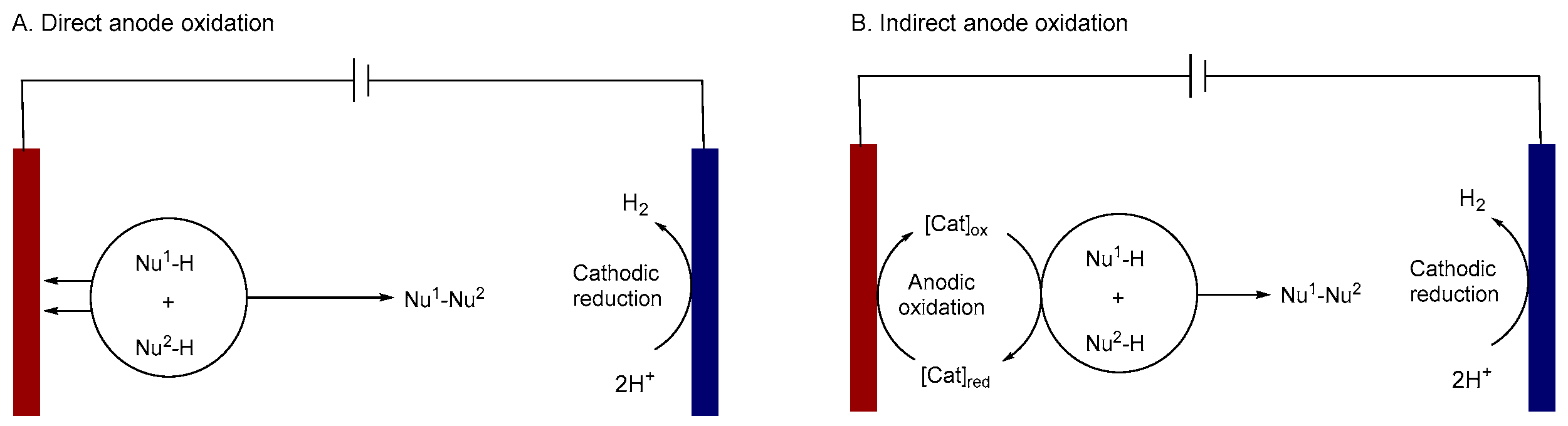
1.1. Electrosynthesis: Oxidation and Reduction Electrosynthesis
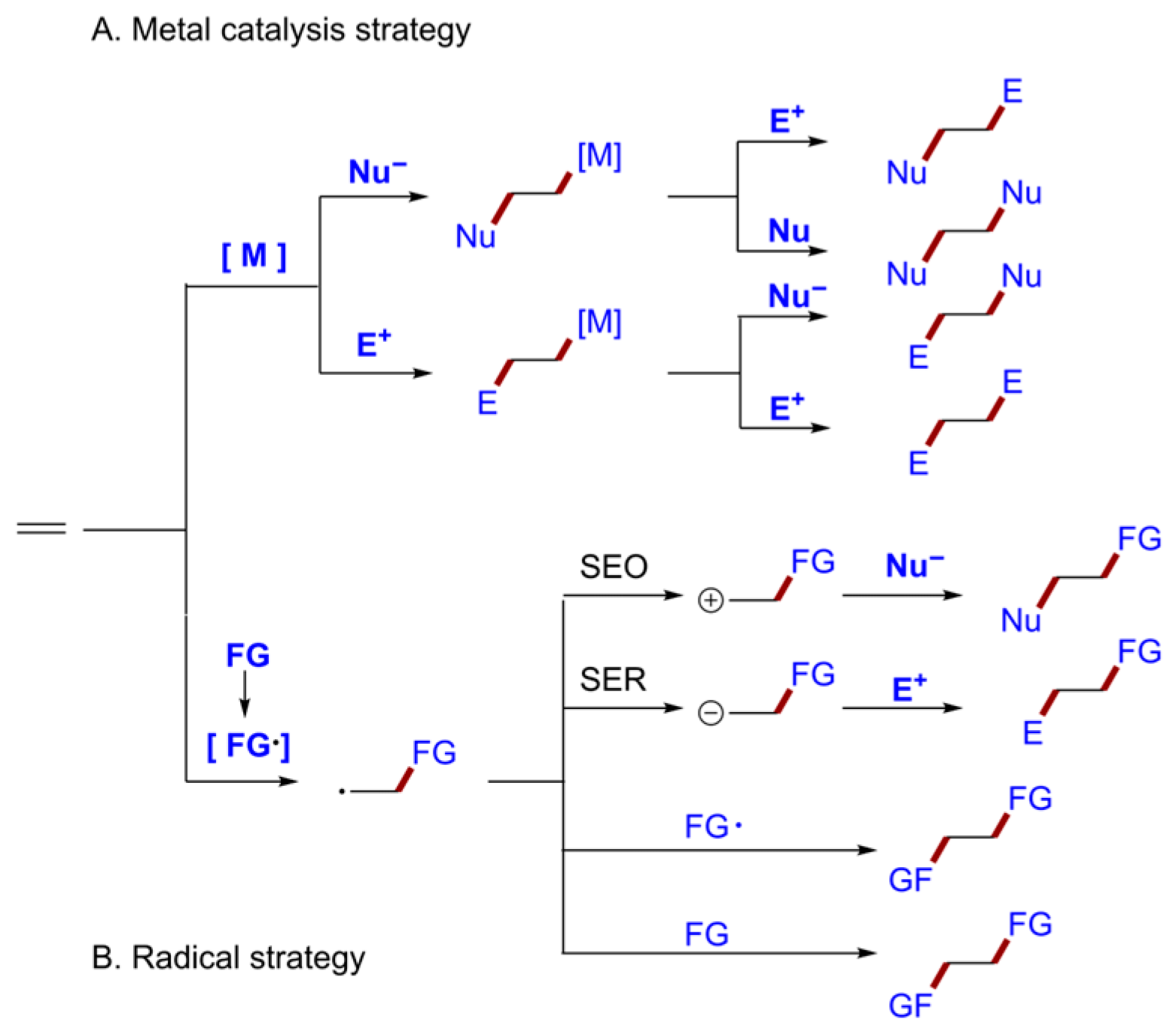
1.2. High-Value Conversion of Alkenes
2. Functionalization of Alkenes
2.1. Anodic Alkene Functionalization
2.1.1. C–C Bonds Formation
2.1.2. C–N Bonds Formation
2.1.3. C–O Bonds Formation
2.1.4. C–S Bonds Formation
2.1.5. C–X Bonds Formation
2.1.6. Other Bonds Formation
2.2. Cathodic Alkene Functionalization
2.2.1. Reduction in Alkyl Halides
2.2.2. Hydrogenation of Alkenes
3. Conclusions and Future Directions
- (1)
- Current strategies predominantly rely on SET-enabled cleavage of heteroatom-heteroatom or carbon-halogen bonds to generate radicals, a process that demands relatively low energy compared to cleaving inert C–H or C–C bonds. While this facilitates efficient radical trapping by alkenes, it also presents an opportunity to advance classical radical chemistry by developing new reactions that involve the direct activation of C–H or C–C bonds to generate carbon-centered radicals for alkene difunctionalization.
- (2)
- Most methodologies are largely applicable only to arylalkenes. There is a pressing need to develop general protocols that encompass a broader range of alkenes, particularly unactivated alkylalkenes and other unsaturated hydrocarbons like alkynes and enynes.
- (3)
- The scope of terminating reagents is currently limited, which opens avenues for introducing novel functional groups as terminators to construct unprecedented molecular architectures.
- (4)
- Selectivity Control: Advanced strategies for regioselective and enantioselective control are urgently needed, making the development of efficient chiral catalytic systems a top priority for achieving asymmetric synthesis.
- (5)
- Industrialization remains a major challenge: the challenges lie in the design of reaction devices and the management of thermal effects in batteries, which are two key scientific issues to be addressed.
Author Contributions
Funding
Institutional Review Board Statement
Informed Consent Statement
Data Availability Statement
Conflicts of Interest
References
- Kolbe, H. Beobachtungen über die oxydirende Wirkung des Sauerstoffs, wenn derselbe mit Hülfe einer elektrischen Säule entwickelt wird. J. Prakt. Chem. 1847, 41, 137–139. [Google Scholar] [CrossRef] [Scilit]
- Kolbe, H. Zersetzung der Valeriansäure durch den elektrischen Strom. Justus Liebigs Ann. Chem. 1848, 64, 339–341. [Google Scholar]
- Sherbo, R.S.; Delima, R.S.; Chiykowski, V.A.; MacLeod, B.P.; Berlinguette, C.P. Complete electron economy by pairing electrolysis with hydrogenation. Nat. Catal. 2018, 1, 501–507. [Google Scholar] [CrossRef] [Scilit]
- Zhao, H.B.; Xu, P.; Song, J.; Xu, H.C. Cathode material determines product selectivity for electrochemical C–H functionalization of biaryl ketoximes. Angew. Chem. Int. Ed. 2018, 57, 15153–15156. [Google Scholar] [CrossRef] [Scilit] [PubMed]
- Wang, H.; Gao, X.; Lv, Z.; Abdelilah, T.; Lei, A. Recent advances in oxidative R1-H/R2-H cross-coupling with hydrogen evolution via photo-/electrochemistry. Chem. Rev. 2019, 119, 6769–6787. [Google Scholar]
- Malapit, C.A.; Prater, M.B.; Cabrera-Pardo, J.R.; Li, M.; Pham, T.D.; McFadden, T.P.; Blank, S.; Minteer, S.D. Advances on the merger of electrochemistry and transition metal catalysis for organic synthesis. Chem. Rev. 2021, 122, 3180–3218. [Google Scholar] [CrossRef] [Scilit] [PubMed]
- Yan, M.; Kawamata, Y.; Baran, P.S. Synthetic organic electrochemical methods since 2000: On the verge of a renaissance. Chem. Rev. 2017, 117, 13230–13319. [Google Scholar] [CrossRef] [Scilit]
- Siu, J.C.; Fu, N.; Lin, S. Catalyzing Electrosynthesis: A Homogeneous Electrocatalytic Approach to Reaction Discovery. Acc. Chem. Res. 2020, 53, 547–560. [Google Scholar] [CrossRef] [Scilit]
- Jiao, K.-J.; Xing, Y.-K.; Yang, Q.-L.; Qiu, H.; Mei, T.-S. Site-Selective C–H Functionalization via Synergistic Use of Electrochemistry and Transition Metal Catalysis. Acc. Chem. Res. 2020, 53, 300–310. [Google Scholar]
- Ackermann, L.; Metalla-electrocatalyzed, C.-H. Activation by Earth-Abundant 3d Metals and Beyond. Acc. Chem. Res. 2019, 53, 84–104. [Google Scholar]
- Xu, H.-C.; Moeller, K.D. Electrochemistry in Synthetic Organic Chemistry. J. Org. Chem. 2021, 86, 15845–15846. [Google Scholar] [CrossRef] [Scilit]
- Medcalf, Z.; Moeller, K.D. Anodic Olefin Coupling Reactions: Elucidating Radical Cation Mechanisms and the Interplay between Cyclization and Second Oxidation Steps. Chem. Rec. 2021, 21, 2442–2452. [Google Scholar] [CrossRef] [Scilit]
- Novaes, L.F.T.; Ho, J.S.K.; Mao, K.; Villemure, E.; Terrett, J.A.; Lin, S. α,β-Desaturation and Formal β-C(sp3)–H Fluorination of N-Substituted Amines: A Late-Stage Functionalization Strategy Enabled by Electrochemistry. J. Am. Chem. Soc. 2024, 146, 22982–22992. [Google Scholar] [CrossRef] [Scilit] [PubMed]
- Little, R.D. A Perspective on Organic Electrochemistry. J. Org. Chem. 2020, 85, 13375–13390. [Google Scholar] [CrossRef] [Scilit] [PubMed]
- Moeller, K.D. Using Physical Organic Chemistry To Shape the Course of Electrochemical Reactions. Chem. Rev. 2018, 118, 4817–4833. [Google Scholar] [CrossRef] [Scilit]
- Wu, T.; Nguyen, B.H.; Daugherty, M.C.; Moeller, K.D. Paired Electrochemical Reactions and the On-Site Generation of a Chemical Reagent. Angew. Chem. Int. Ed. 2019, 58, 3562–3565. [Google Scholar] [CrossRef] [Scilit] [PubMed]
- Pollok, D.; Waldvogel, S.R. Electro-organic synthesis—A 21stcentury technique. Chem. Sci. 2020, 11, 12386–12400. [Google Scholar] [CrossRef] [Scilit]
- Barham, J.P.; König, B. Synthetic Photoelectrochemistry. Angew. Chem. Int. Ed. 2020, 59, 11732–11747. [Google Scholar] [CrossRef] [Scilit]
- Wu, Z.; Meng, J.; Liu, H.; Li, Y.; Zhang, X.; Zhang, W. Multi-site programmable functionalization of alkenes via controllable alkene isomerization. Nat. Chem. 2023, 15, 988–997. [Google Scholar] [CrossRef] [Scilit]
- Vasseur, A.; Bruffaerts, J.; Marek, I. Remote functionalization through alkene isomerization. Nat. Chem. 2016, 8, 209–219. [Google Scholar] [CrossRef] [Scilit]
- Zhang, M.; Liu, T.; Chen, X.-Q.; Jin, H.; Lv, J.-J.; Wang, S.; Yu, X.; Yang, C.; Wang, Z.-J. Recent advances in electrochemical 1,2-difunctionalization of alkenes: Mechanisms and perspectives. Org. Biomol. Chem. 2025, 23, 2323–2357. [Google Scholar] [CrossRef] [Scilit]
- Nicewicz, D.; Roth, H.; Romero, N. Experimental and calculated electrochemical potentials of common organic molecules for applications to single-electron redox chemistry. Synlett 2015, 27, 714–723. [Google Scholar] [CrossRef] [Scilit]
- Fu, N.; Sauer, G.S.; Lin, S. Electrocatalytic Radical Dichlorination of Alkenes with Nucleophilic Chlorine Sources. J. Am. Chem. Soc. 2017, 139, 15548–15553. [Google Scholar] [CrossRef] [Scilit]
- Zhang, Y.; Zhou, Z.L.; Li, J.H.; Li, Y.T. Electrochemical Difunctionalization of Alkenes. Chem. Rec. 2025, 25, e202400263. [Google Scholar] [CrossRef] [Scilit]
- Wang, B.; Zhao, J.; Ying, J.; Cheng, B.; Lu, Z. Asymmetric Heck Silylation of Unactivated Alkenes. Angew. Chem. Int. Ed. 2025, 137, e202421500. [Google Scholar] [CrossRef] [Scilit]
- Tajima, H.; Ishii, H.; Inagi, S.; Fuchigami, T. Development of a highly efficient electrocatalytic hydrogenation and dehalogenation system using a flow cell with a Pd tube cathode. Green Chem. 2024, 26, 11328–11333. [Google Scholar] [CrossRef] [Scilit]
- Boucher, D.G.; Pendergast, A.D.; Wu, X.; Nguyen, Z.A.; Jadhav, R.G.; Lin, S.; White, H.S.; Minteer, S.D. Unraveling Hydrogen Atom Transfer Mechanisms with Voltammetry: Oxidative Formation and Reactivity of Cobalt Hydride. J. Am. Chem. Soc. 2023, 145, 17665–17677. [Google Scholar] [CrossRef] [Scilit] [PubMed]
- Wu, T.; Moeller, K.D. Organic Electrochemistry: Expanding the Scope of Paired Reactions. Angew. Chem. Int. Ed. 2021, 60, 12883–12890. [Google Scholar] [CrossRef] [Scilit] [PubMed]
- Gao, Y.; Hill, D.E.; Hao, W.; McNicholas, B.J.; Vantourout, J.C.; Hadt, R.G.; Reisman, S.E.; Blackmond, D.G.; Baran, P.S. Electrochemical Nozaki–Hiyama–Kishi Coupling: Scope, Applications, and Mechanism. J. Am. Chem. Soc. 2021, 143, 9478–9488. [Google Scholar] [CrossRef] [Scilit]
- Li, Q.; Bu, L.; Xu, K.; Zeng, C. Electrochemical Radical-Polar Crossover Enabled Multi-ester Functionalized O-Containing Heterocycles Synthesis. Adv. Synth. Catal. 2025, 367, e202500174. [Google Scholar] [CrossRef] [Scilit]
- Li, Q.; Hu, D.; Xu, K.; Zeng, C. Electrochemical Umpolung of C–H Nucleophiles Bearing Three Electron-Withdrawing Groups to Trigger Radical 1,2-Alkylarylations of Allylic Alcohols. Adv. Synth. Catal. 2025, 367, e202401522. [Google Scholar] [CrossRef] [Scilit]
- Tan, Z.; Jiang, Y.; Xu, K.; Zeng, C. Electrophotoredox/cerium-catalyzed unactivated alkanes activation for the sustainable synthesis of alkylated benzimidazo-fused isoquinolinones. J. Catal. 2023, 417, 473–480. [Google Scholar] [CrossRef] [Scilit]
- Jie, L.-H.; Guo, B.; Song, J.; Xu, H.-C. Organoelectrocatalysis Enables Direct Cyclopropanation of Methylene Compounds. J. Am. Chem. Soc. 2022, 144, 2343–2350. [Google Scholar] [CrossRef] [Scilit]
- Xiao, J.; Long, F.; Yi, S.; Luo, H.; Cai, C.; Gong, H. Electrocatalytic linear coupling of alkenes via radical anion under mild conditions. Green Chem. 2025, 27, 5764–5769. [Google Scholar] [CrossRef] [Scilit]
- He, Y.; Wang, Z.-H.; Liu, H.-L.; Fang, P.; Ma, C.; Xu, H.; Mei, T.-S. TEMPO-Mediated Electrochemical α-Allylation of Tetrahydroisoquinolines. Org. Lett. 2025, 27, 4638–4643. [Google Scholar] [CrossRef] [Scilit] [PubMed]
- Dana, S.; Pandit, N.K.; Boos, P.; von Münchow, T.; Peters, S.E.; Trienes, S.; Haberstock, L.; Herbst-Irmer, R.; Stalke, D.; Ackermann, L. Parametrization of κ2-N,O-Oxazoline Preligands for Enantioselective Cobaltaelectro-Catalyzed C–H Activations. ACS Catal. 2025, 15, 4450–4459. [Google Scholar] [CrossRef] [Scilit] [PubMed]
- Kim, S.; Kim, H. Cu-Electrocatalysis Enables Vicinal Bis(difluoromethylation) of Alkenes: Unraveling Dichotomous Role of Zn(CF2H)2(DMPU)2 as Both Radical and Anion Source. J. Am. Chem. Soc. 2024, 146, 22498–22508. [Google Scholar] [CrossRef] [Scilit]
- He, Z.; Liu, H.-L.; Wang, Z.-H.; Jiao, K.-J.; Li, Z.-M.; Li, Z.-J.; Fang, P.; Mei, T.-S. C(sp3)–H Aerobic Alkenylation of Tetrahydroisoquinolines via Organic Electrosynthesis. J. Org. Chem. 2023, 88, 6203–6208. [Google Scholar] [CrossRef] [Scilit] [PubMed]
- Lai, X.-L.; Xu, H.-C. Photoelectrochemical Asymmetric Catalysis Enables Enantioselective Heteroarylcyanation of Alkenes via C–H Functionalization. J. Am. Chem. Soc. 2023, 145, 18753–18759. [Google Scholar] [CrossRef] [Scilit]
- Wang, Q.; Wang, P.; Gao, X.; Wang, D.; Wang, S.; Liang, X.; Wang, L.; Zhang, H.; Lei, A. Regioselective/electro-oxidative intermolecular [3 + 2] annulation for the preparation of indolines. Chem. Sci. 2020, 11, 2181–2186. [Google Scholar] [CrossRef] [Scilit]
- Tan, Z.; Xiang, F.; Xu, K.; Zeng, C. Electrochemical Organoselenium-Catalyzed Intermolecular Hydroazolylation of Alkenes with Low Catalyst Loadings. Org. Lett. 2022, 24, 5345–5350. [Google Scholar] [CrossRef] [Scilit]
- Wang, Q.; Wang, Q.; Zhang, Y.; Mohamed, Y.M.; Pacheco, C.; Zheng, N.; Zare, R.N.; Chen, H. Electrocatalytic redox neutral [3 + 2] annulation of N-cyclopropylanilines and alkenes. Chem. Sci. 2021, 12, 969–975. [Google Scholar] [CrossRef] [Scilit] [PubMed]
- Siu, J.C.; Parry, J.B.; Lin, S. Aminoxyl-Catalyzed Electrochemical Diazidation of Alkenes Mediated by a Metastable Charge-Transfer Complex. J. Am. Chem. Soc. 2019, 141, 2825–2831. [Google Scholar] [CrossRef] [Scilit] [PubMed]
- Wang, S.; Wang, P.; Li, S.-J.; Chen, Y.-H.; Sun, Z.-J.; Lei, A. Electrochemical flow aziridination of unactivated alkenes. Natl. Sci. Rev. 2023, 10, nwad187. [Google Scholar] [CrossRef] [Scilit] [PubMed]
- Liu, S.; Lin, H.; Peng, T.; Yang, Z.; Wan, P.; Li, J.; Yang, L.; Dai, X.; Tu, S.; Long, X.; et al. Electrochemical Amino-Oxygenation Cyclization via Alkene Radical Cation/Bisnucleophile Engagement to Saturated N/O-Heterocycles. Angew. Chem. Int. Ed. 2025, 64, e202501424. [Google Scholar] [CrossRef] [Scilit]
- Ošeka, M.; Laudadio, G.; van Leest, N.P.; Dyga, M.; Bartolomeu, A.d.A.; Gooßen, L.J.; de Bruin, B.; de Oliveira, K.T.; Noël, T. Electrochemical Aziridination of Internal Alkenes with Primary Amines. Chem 2021, 7, 255–266. [Google Scholar] [CrossRef] [Scilit]
- Novaes, L.F.T.; Wang, Y.; Liu, J.; Riart-Ferrer, X.; Cindy Lee, W.-C.; Fu, N.; Ho, J.S.K.; Zhang, X.P.; Lin, S. Electrochemical Diazidation of Alkenes Catalyzed by Manganese Porphyrin Complexes with Second-Sphere Hydrogen-Bond Donors. ACS Catal. 2022, 12, 14106–14112. [Google Scholar] [CrossRef] [Scilit]
- Cai, C.-Y.; Zheng, Y.-T.; Li, J.-F.; Xu, H.-C. Cu-Electrocatalytic Diazidation of Alkenes at ppm Catalyst Loading. J. Am. Chem. Soc. 2022, 144, 11980–11985. [Google Scholar] [CrossRef] [Scilit]
- Fu, N.; Song, L.; Liu, J.; Shen, Y.; Siu, J.C.; Lin, S. New Bisoxazoline Ligands Enable Enantioselective Electrocatalytic Cyanofunctionalization of Vinylarenes. J. Am. Chem. Soc. 2019, 141, 14480–14485. [Google Scholar] [CrossRef] [Scilit]
- von Münchow, T.; Liu, Y.R.; Parmar, R.; Peters, S.E.; Trienes, S.; Ackermann, L. Cobaltaelectro-Catalyzed C–H Activation for Central and Axial Double Enantio-Induction. Angew. Chem. Int. Ed. 2024, 63, e202405423. [Google Scholar] [CrossRef] [Scilit]
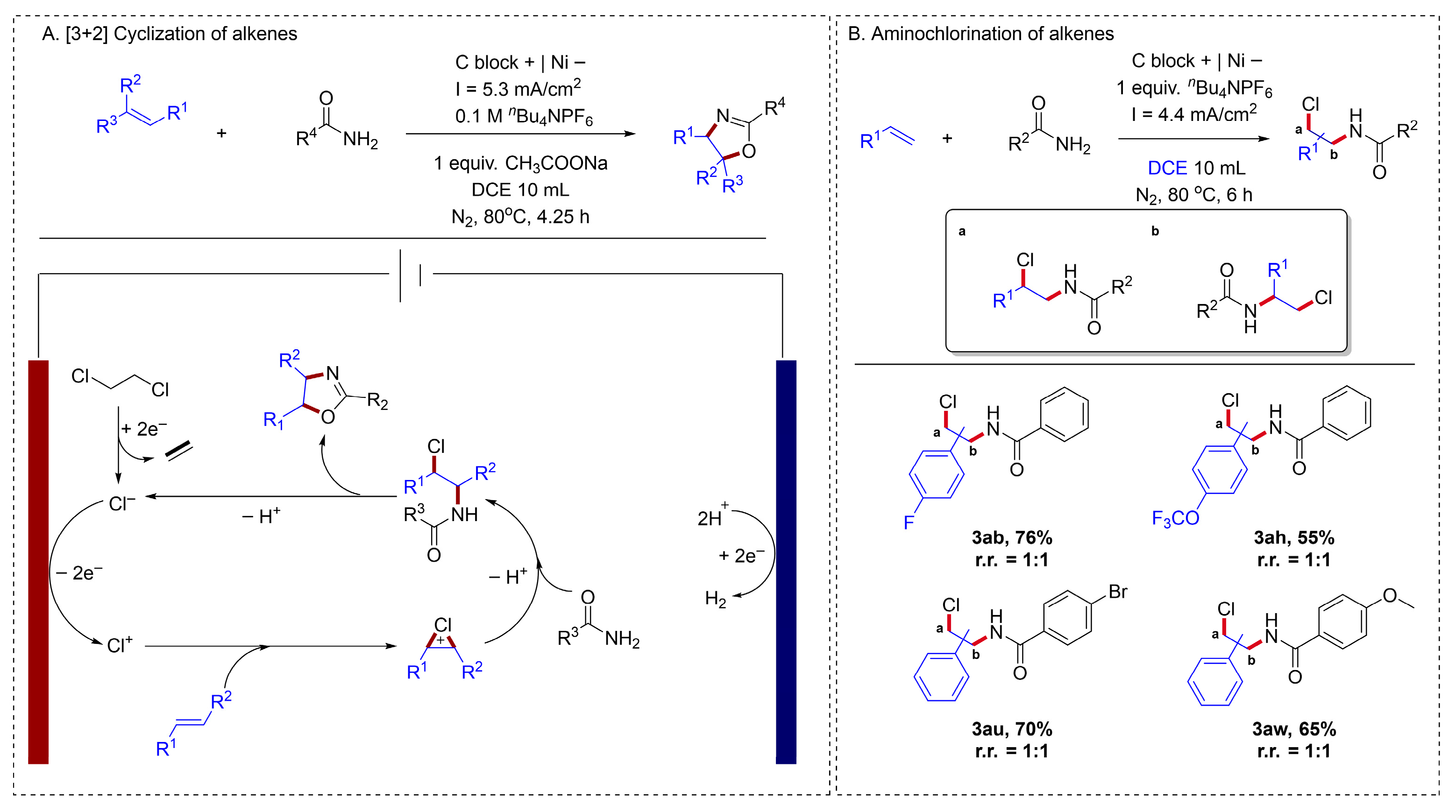
- Liang, X.-A.; Niu, L.; Wang, S.; Lei, A. Electrochemical (3 + 2) cyclization between amides and olefins. Chem Catal. 2021, 1, 1055–1064. [Google Scholar] [CrossRef] [Scilit]
- Liang, X.-A.; Chen, Q.-A.; Wu, W.; Li, Y.; Cheng, Y.; Huang, M.; Mo, S. Electrochemical amidochlorination between low-cost styrenes and amides. Org. Biomol. Chem. 2025, 23, 6610–6615. [Google Scholar] [CrossRef] [Scilit]
- Wu, W.; Linghu, R.; Jian, B.; Shi, J.; Chi, Q.; Jiang, B.; Ren, H. Electrochemical Oxidative Reassembly of 1,3-Diketones with Aryl Alkenes and Water via Carbon–Carbon Bond Cleavage Rearrangement. Org. Lett. 2025, 27, 4663–4668. [Google Scholar] [CrossRef] [Scilit]
- Okamoto, K.; Shida, N.; Atobe, M. Electrochemical [3 + 2] Cycloaddition Proceeding at Low Electrolyte Concentration in Laminar-Flow Microreactor. ChemElectroChem 2023, 10, e202300386. [Google Scholar] [CrossRef] [Scilit]
- Nakamura, Y.; Linden, M.; Winter, J.; Hofmann, S.; Shida, N.; Atobe, M.; Waldvogel, S.R. Biphasic Electrosynthesis of 2-Isoxazol(in)e-3-carboxylates: Reaction Optimization from Milligram to Hectogram Scale. ACS Sustain. Chem. Eng. 2024, 12, 11369–11376. [Google Scholar] [CrossRef] [Scilit]
- Park, S.H.; Jang, J.; Shin, K.; Kim, H. Electrocatalytic Radical-Polar Crossover Hydroetherification of Alkenes with Phenols. ACS Catal. 2022, 12, 10572–10580. [Google Scholar] [CrossRef] [Scilit]
- Li, Y.; Xu, J.; Oliveira, J.C.A.; Scheremetjew, A.; Ackermann, L. Electrochemical Enantioselective C–H Annulation by Achiral Rhodium(III)/Chiral Brønsted Base Domino Catalysis. ACS Catal. 2024, 14, 8160–8167. [Google Scholar] [CrossRef] [Scilit]
- Luo, X.; Wang, S.; Lei, A. Electrochemical-Induced Hydroxysulfonylation of α-CF3 Alkenes to Access Tertiary β-Hydroxysulfones. Adv. Synth. Catal. 2022, 364, 1016–1022. [Google Scholar] [CrossRef] [Scilit]
- Luo, D.; Wang, Q.; Liu, J.; Mei, H.; Han, J. Electrochemical synthesis of γ-carbolinones via sulfonylation-triggered cyclization of indole-3-carboxamides. Org. Biomol. Chem. 2025, 23, 1309–1313. [Google Scholar] [CrossRef] [Scilit]
- Yin, Z.; Yu, Y.; Mei, H.; Han, J. Electrosynthesis of functionalized tetrahydrocarbazolesviasulfonylation triggered cyclization reaction of indole derivatives. Green Chem. 2021, 23, 3256–3260. [Google Scholar] [CrossRef] [Scilit]
- Liu, J.; Xu, J.; Mei, H.; Han, J. Electrochemical multi-component reaction of potassium metabisulfite with alkenes and alcohols enabling synthesis of sulfonate esters. Green Chem. 2022, 24, 6113–6118. [Google Scholar] [CrossRef] [Scilit]
- de A. Bartolomeu, A.; Breitschaft, F.A.; Schollmeyer, D.; Pilli, R.A.; Waldvogel, S.R. Electrochemical Multicomponent Synthesis of Alkyl Alkenesulfonates using Styrenes, SO2 and Alcohols. Chem. Eur. J. 2024, 30, e202400557. [Google Scholar] [CrossRef] [Scilit]
- de Souza, A.A.N.; Bartolomeu, A.d.A.; Brocksom, T.J.; Noël, T.; de Oliveira, K.T. Direct Synthesis of α-Sulfenylated Ketones under Electrochemical Conditions. J. Org. Chem. 2022, 87, 5856–5865. [Google Scholar] [CrossRef] [Scilit]
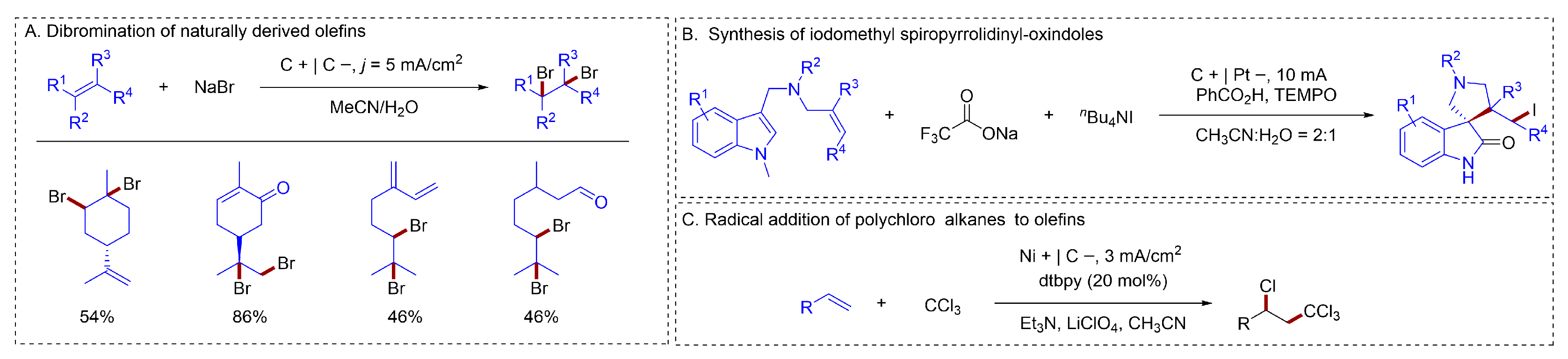
- Gombos, L.G.; Werner, L.; Schollmeyer, D.; Martínez-Huitle, C.A.; Waldvogel, S.R. Selective Electrochemical Dibromination of Terpenes and Naturally Derived Olefins. Eur. J. Org. Chem. 2022, 2022, e202200857. [Google Scholar] [CrossRef] [Scilit]
- He, J.; Mei, H.; Escorihuela, J.; Han, J. Electrochemical Multicomponent Cascade Radical Process Enabling Synthesis of Iodomethyl Spiropyrrolidinyl-Oxindoles. Chin. J. Chem. 2024, 42, 1691–1698. [Google Scholar] [CrossRef] [Scilit]
- Lian, F.; Luo, F.; Wang, M.; Xu, K.; Zeng, C. Electrochemical Atom Transfer Radical Addition of Polychloroalkanes to Olefins Promoted by 4,4-Di-tert-butyl Bipyridine. Chin. J. Chem. 2023, 41, 1583–1588. [Google Scholar] [CrossRef] [Scilit]
- Sun, L.; Wang, L.; Alhumade, H.; Yi, H.; Cai, H.; Lei, A. Electrochemical Radical Selenylation of Alkenes and Arenes via Se–Se Bond Activation. Org. Lett. 2021, 23, 7724–7729. [Google Scholar] [CrossRef] [Scilit] [PubMed]
- Jafarzadeh, M.; Nassir, M.; Gherardi, L.; Raheja, N.; Kawamata, Y.; Baran, P.S. Electrifying P(V): Access to Polar and Radical Reactivity. Angew. Chem. Int. Ed. 2025, 137, e202421163. [Google Scholar] [CrossRef] [Scilit]
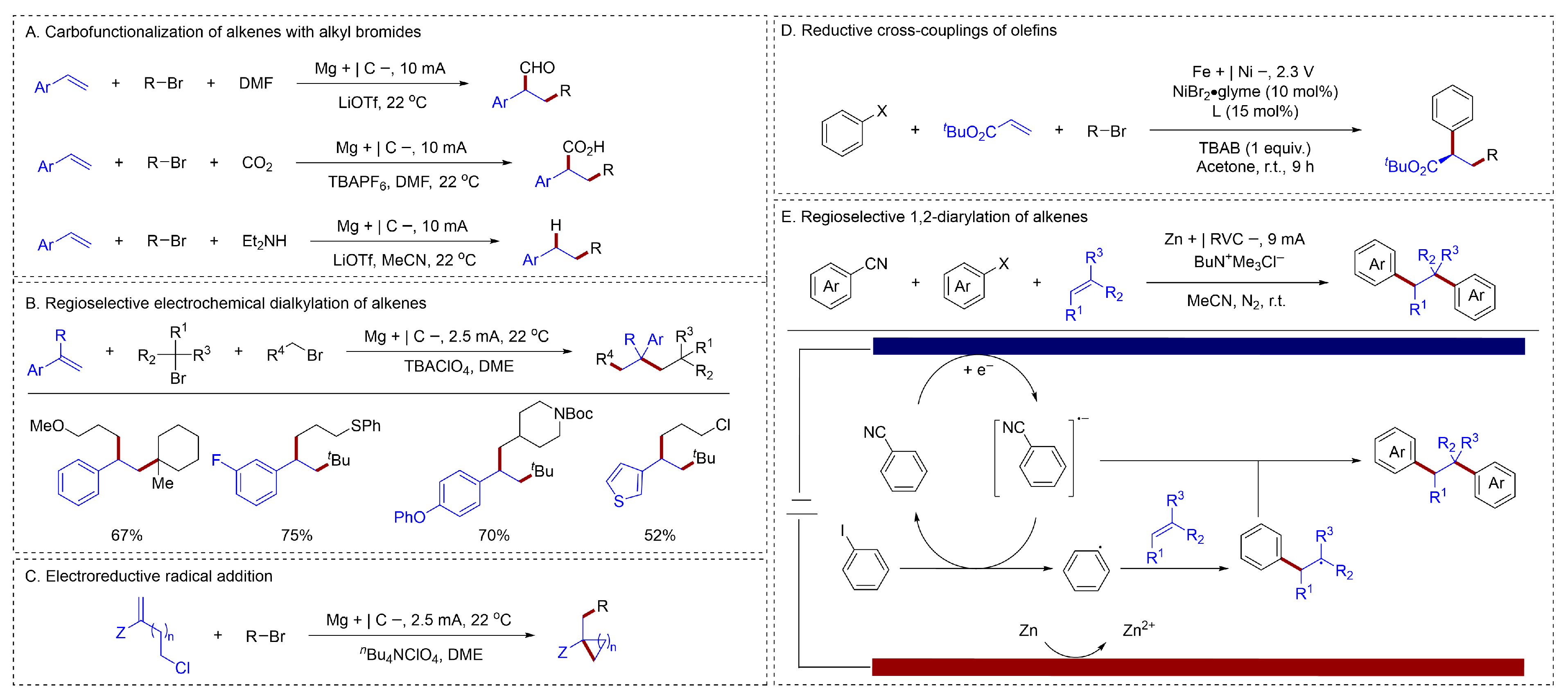
- Zhang, W.; Lin, S. Electroreductive Carbofunctionalization of Alkenes with Alkyl Bromides via a Radical-Polar Crossover Mechanism. J. Am. Chem. Soc. 2020, 142, 20661–20670. [Google Scholar] [CrossRef] [Scilit] [PubMed]
- Lu, L.; Wang, Y.; Zhang, W.; Zhang, W.; See, K.A.; Lin, S. Three-Component Cross-Electrophile Coupling: Regioselective Electrochemical Dialkylation of Alkenes. J. Am. Chem. Soc. 2023, 145, 22298–22304. [Google Scholar] [CrossRef] [Scilit]
- Wang, Y.; Deng, J.; Ressler, A.J.; Lin, S. Electroreductive Radical Addition–Polar Cyclization Cascade to Access Cycloalkanes. Org. Lett. 2023, 26, 116–121. [Google Scholar] [CrossRef] [Scilit]
- Wang, Y.-Z.; Sun, B.; Zhu, X.-Y.; Gu, Y.-C.; Ma, C.; Mei, T.-S. Enantioselective Reductive Cross-Couplings of Olefins by Merging Electrochemistry with Nickel Catalysis. J. Am. Chem. Soc. 2023, 145, 23910–23917. [Google Scholar] [CrossRef] [Scilit]
- Yu, W.; Wang, S.; He, M.; Jiang, Z.; Yu, Y.; Lan, J.; Luo, J.; Wang, P.; Qi, X.; Wang, T.; et al. Electroreduction Enables Regioselective 1,2-Diarylation of Alkenes with Two Electrophiles. Angew. Chem. Int. Ed. 2023, 135, e202219166. [Google Scholar] [CrossRef] [Scilit]
- Hu, P.; Peters, B.K.; Malapit, C.A.; Vantourout, J.C.; Wang, P.; Li, J.; Mele, L.; Echeverria, P.-G.; Minteer, S.D.; Baran, P.S. Electroreductive Olefin–Ketone Coupling. J. Am. Chem. Soc. 2020, 142, 20979–20986. [Google Scholar] [CrossRef] [Scilit]
- Song, L.; Fu, N.; Ernst, B.G.; Lee, W.H.; Frederick, M.O.; DiStasio, R.A.; Lin, S. Dual electrocatalysis enables enantioselective hydrocyanation of conjugated alkenes. Nat. Chem. 2020, 12, 747–754. [Google Scholar] [CrossRef] [Scilit] [PubMed]
- Huang, C.; Tao, Y.; Cao, X.; Zhou, C.; Lu, Q. Asymmetric Paired Electrocatalysis: Enantioselective Olefin–Sulfonylimine Coupling. J. Am. Chem. Soc. 2023, 146, 1984–1991. [Google Scholar] [CrossRef] [Scilit]
- Wu, X.; Gannett, C.N.; Liu, J.; Zeng, R.; Novaes, L.F.T.; Wang, H.; Abruña, H.D.; Lin, S. Intercepting Hydrogen Evolution with Hydrogen-Atom Transfer: Electron-Initiated Hydrofunctionalization of Alkenes. J. Am. Chem. Soc. 2022, 144, 17783–17791. [Google Scholar] [CrossRef] [Scilit]
- Hu, P.; Xu, W.; Tian, L.; Zhu, H.; Li, F.; Qi, X.; Lu, Q. Electrocatalytic Hydrogenation of Olefins. Angew. Chem. Int. Ed. 2025, 64, e202501215. [Google Scholar] [CrossRef] [Scilit] [PubMed]
- Bu, F.; Deng, Y.; Lu, L.; Li, Y.; Song, W.; Yang, Z.; Luo, X.; Dong, X.; Yi, R.; Yang, D.; et al. Electrocatalytic Alkene Hydrogenation/Deuteration. J. Am. Chem. Soc. 2025, 147, 5785–5795. [Google Scholar] [CrossRef] [Scilit] [PubMed]








Disclaimer/Publisher’s Note: The statements, opinions and data contained in all publications are solely those of the individual author(s) and contributor(s) and not of MDPI and/or the editor(s). MDPI and/or the editor(s) disclaim responsibility for any injury to people or property resulting from any ideas, methods, instructions or products referred to in the content. |
© 2026 by the authors. Licensee MDPI, Basel, Switzerland. This article is an open access article distributed under the terms and conditions of the Creative Commons Attribution (CC BY) license.
Share and Cite
Liang, X.; Wang, H.; Xie, W.; Liu, Z.; Qin, D. Recent Advances in the High-Value Conversion of Alkenes Induced by Electrochemistry. Molecules 2026, 31, 1027. https://doi.org/10.3390/molecules31061027
Liang X, Wang H, Xie W, Liu Z, Qin D. Recent Advances in the High-Value Conversion of Alkenes Induced by Electrochemistry. Molecules. 2026; 31(6):1027. https://doi.org/10.3390/molecules31061027
Chicago/Turabian StyleLiang, Xing’an, Haolin Wang, Wei Xie, Zhenhua Liu, and Dongmiao Qin. 2026. "Recent Advances in the High-Value Conversion of Alkenes Induced by Electrochemistry" Molecules 31, no. 6: 1027. https://doi.org/10.3390/molecules31061027
APA StyleLiang, X., Wang, H., Xie, W., Liu, Z., & Qin, D. (2026). Recent Advances in the High-Value Conversion of Alkenes Induced by Electrochemistry. Molecules, 31(6), 1027. https://doi.org/10.3390/molecules31061027