Effects of TiO2 Nanoparticle Doping on the Micro-Arc Oxidation Coating Structure and Corrosion Resistance of 6061 Aluminum Alloy
 and
and
Abstract
1. Introduction
2. Results
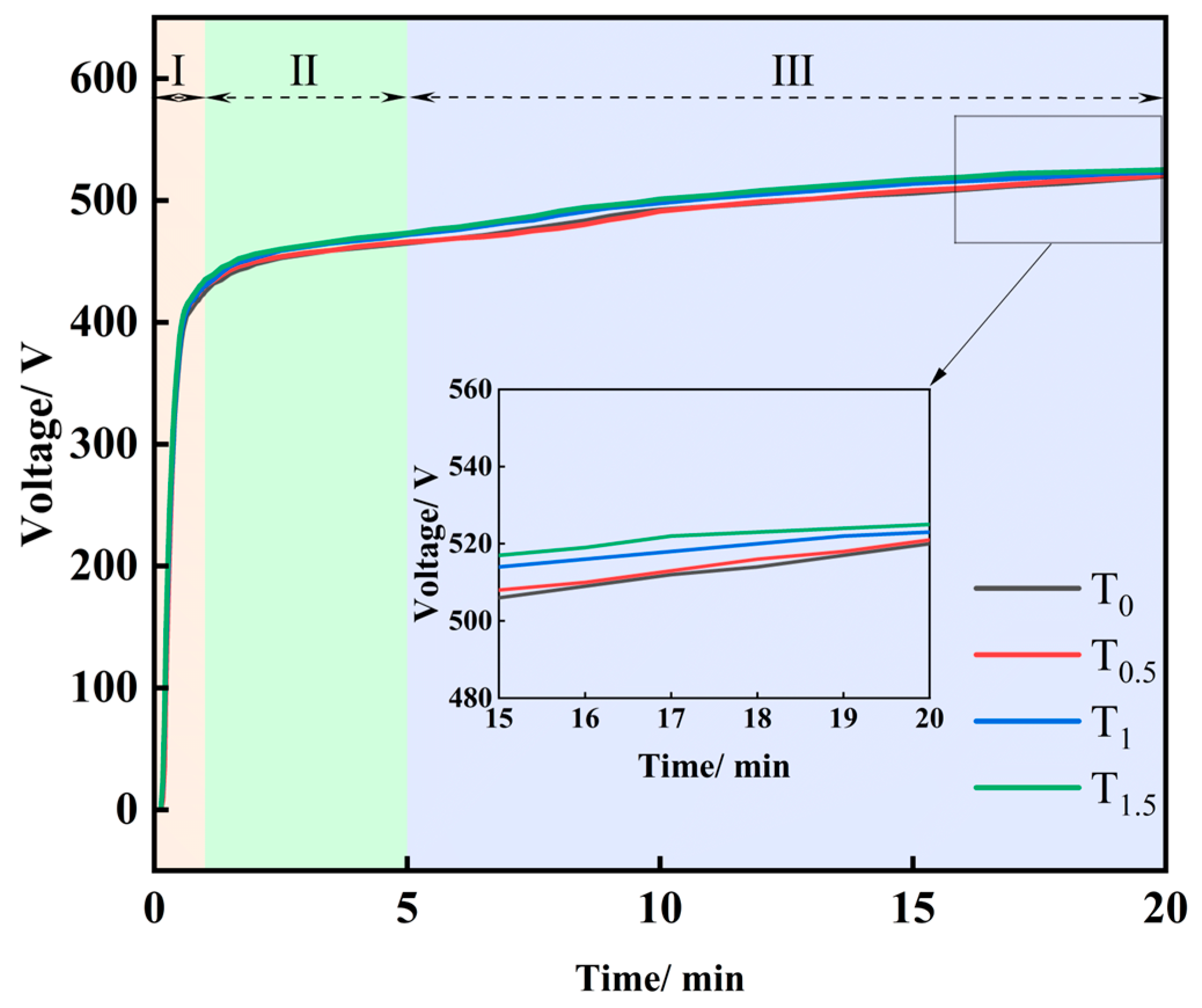
2.1. Evolution of Anodic Voltage
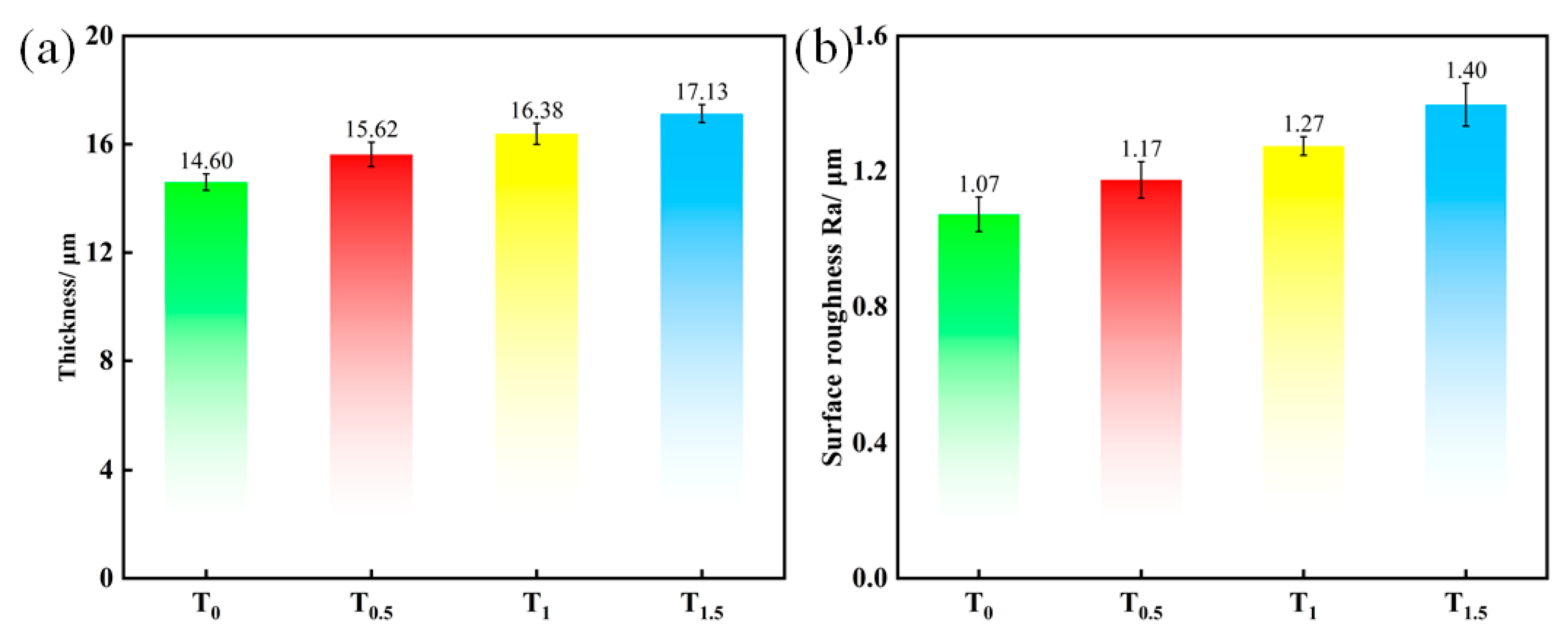
2.2. Effects of TiO2 on Coating Thickness and Surface Roughness
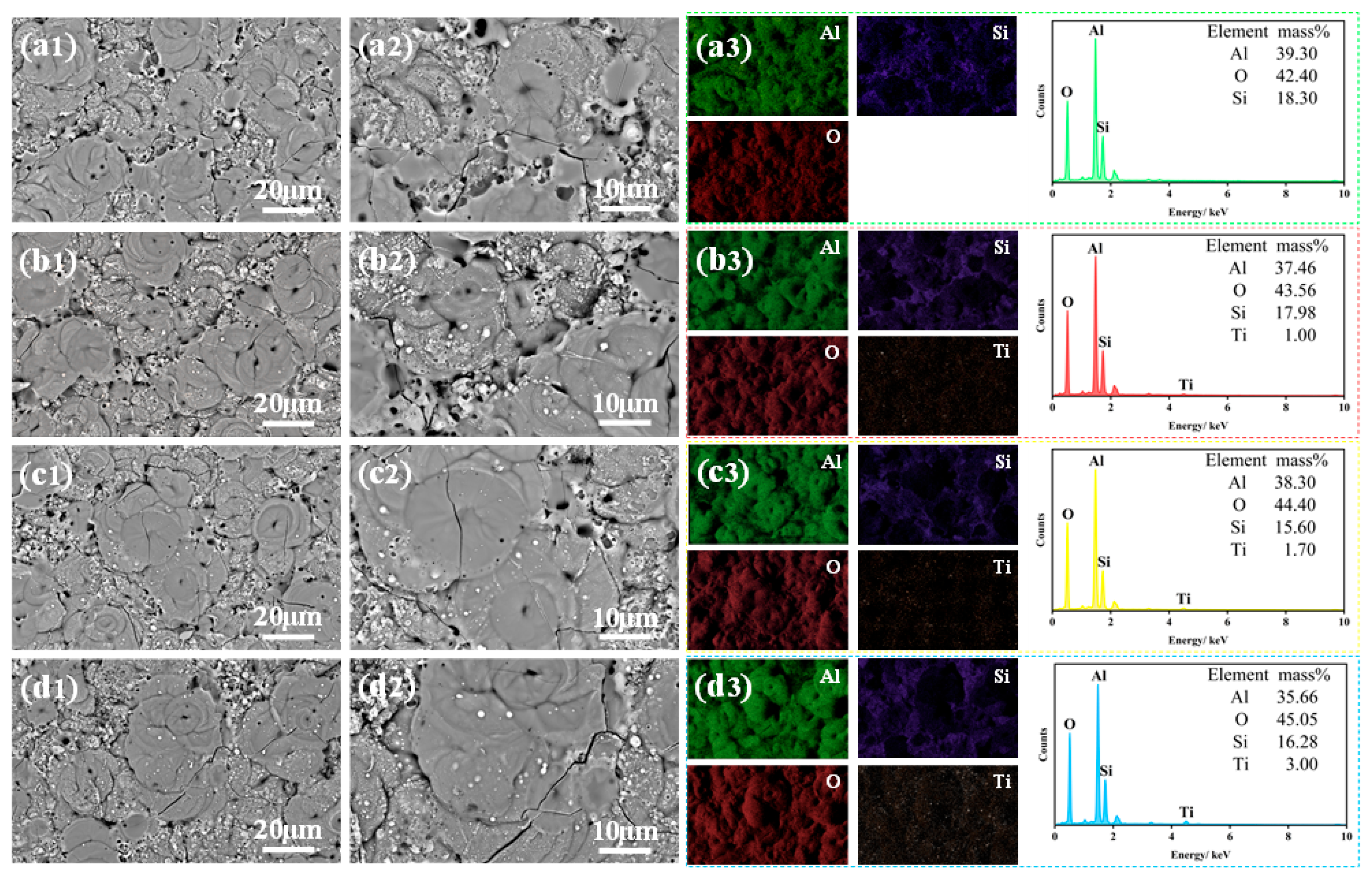
2.3. Effects of TiO2 on Surface Micro-Morphology
2.3.1. Surface Morphology
2.3.2. EDS Analysis
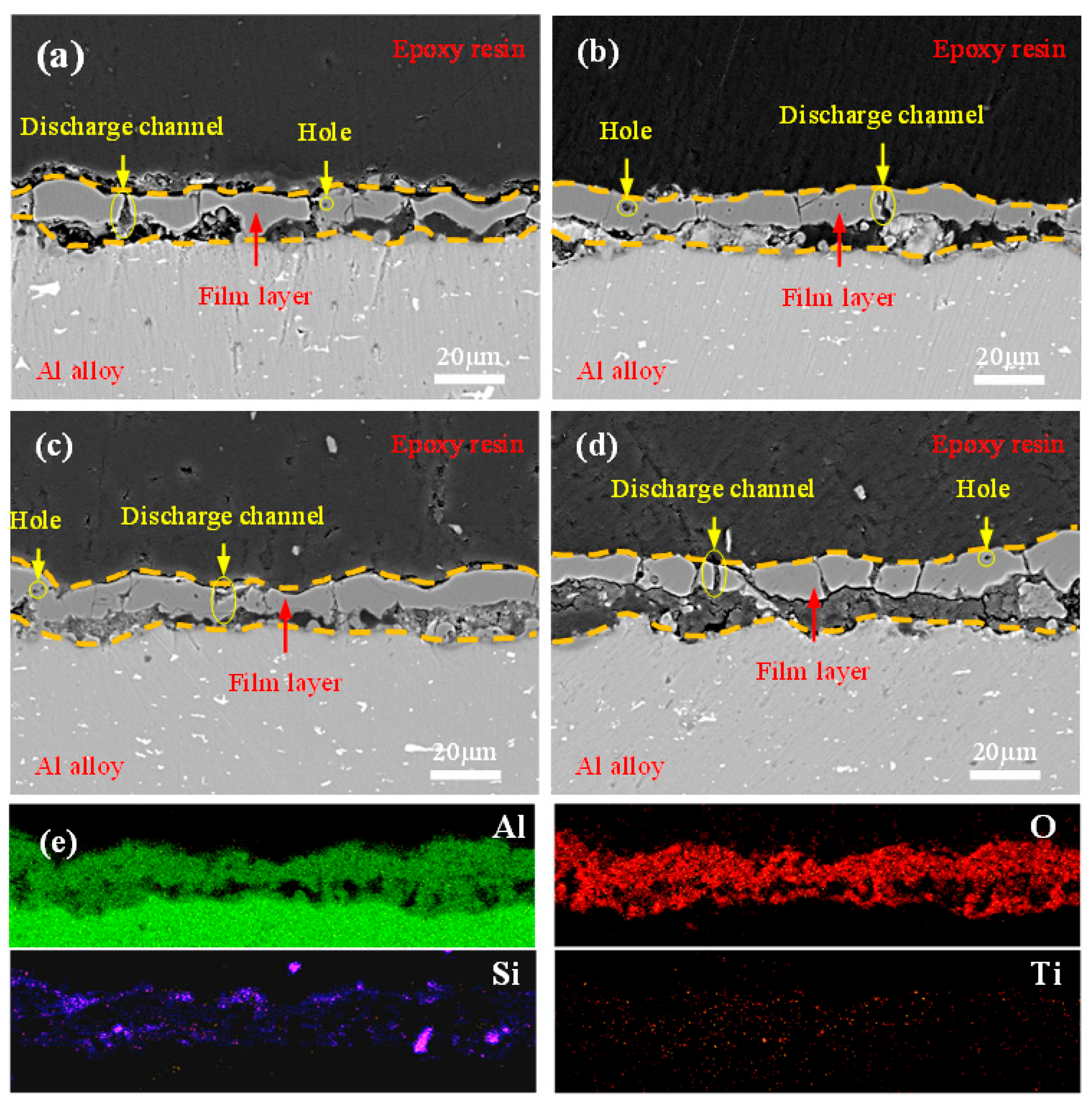
2.4. Effect of TiO2 on Coating Cross-Sectional Morphology
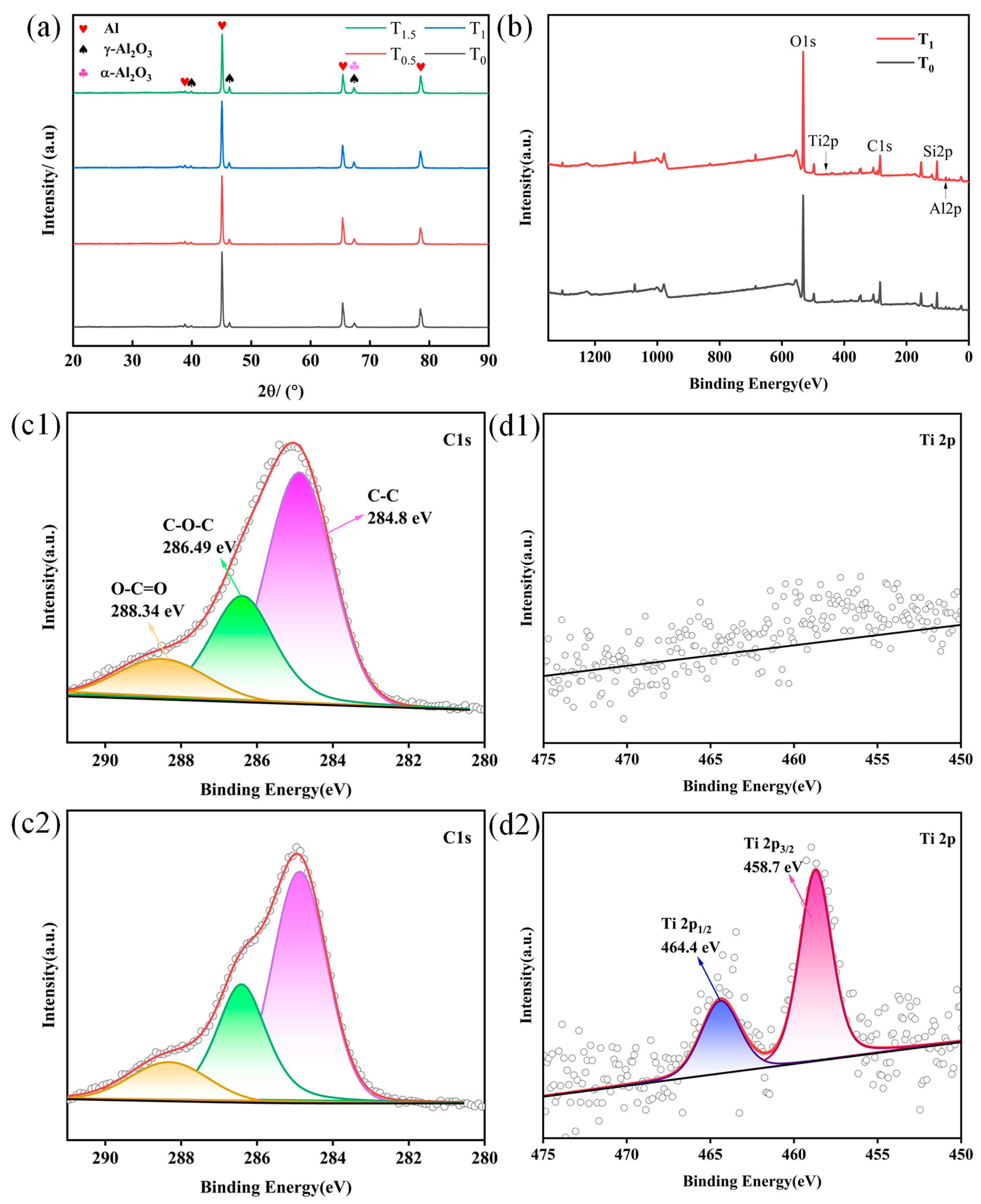
2.5. Effect of TiO2 on Phase Composition of the Coatings
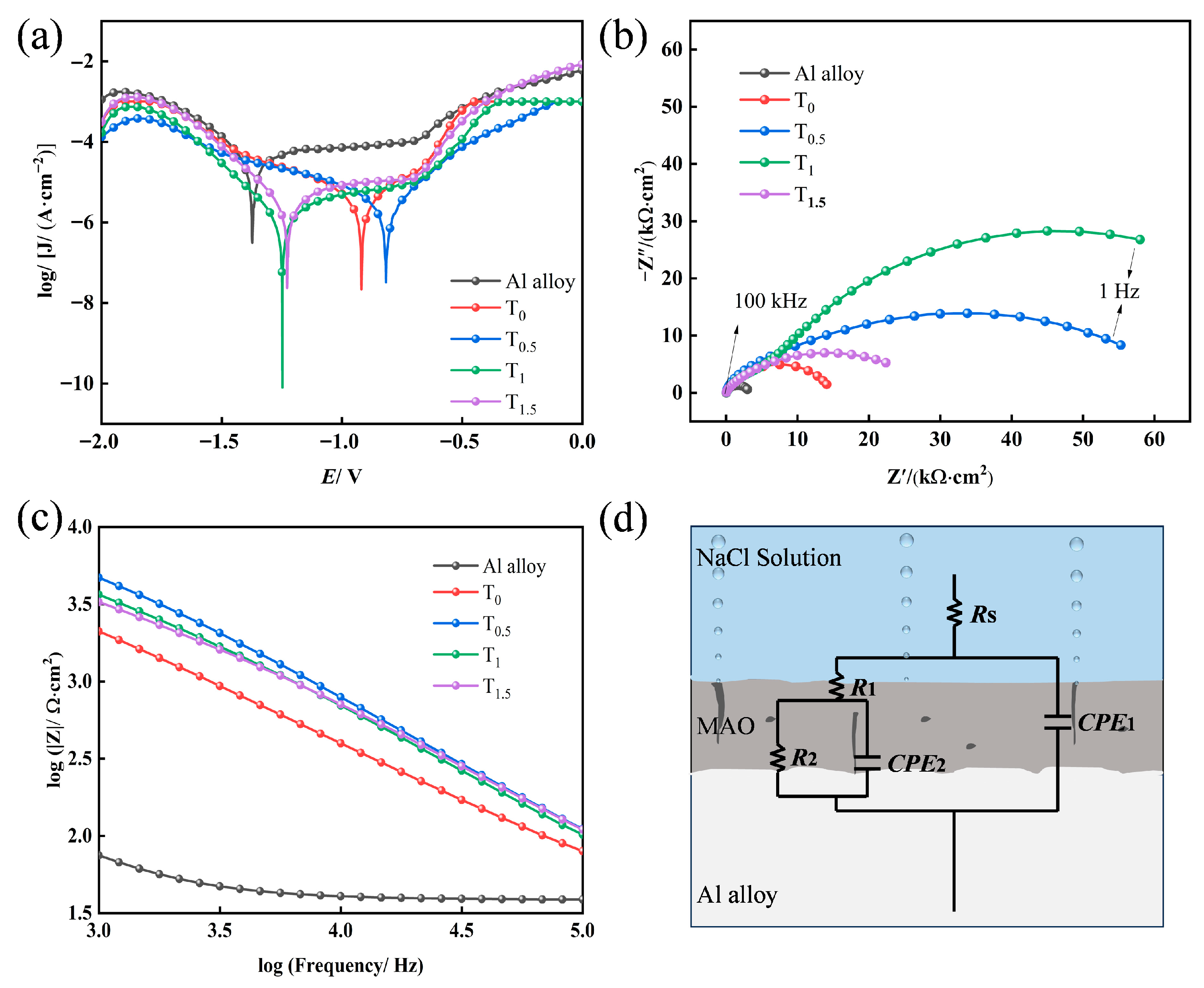
2.6. Effect of TiO2 on the Corrosion Resistance of the Coatings
3. Materials and Methods
3.1. Materials
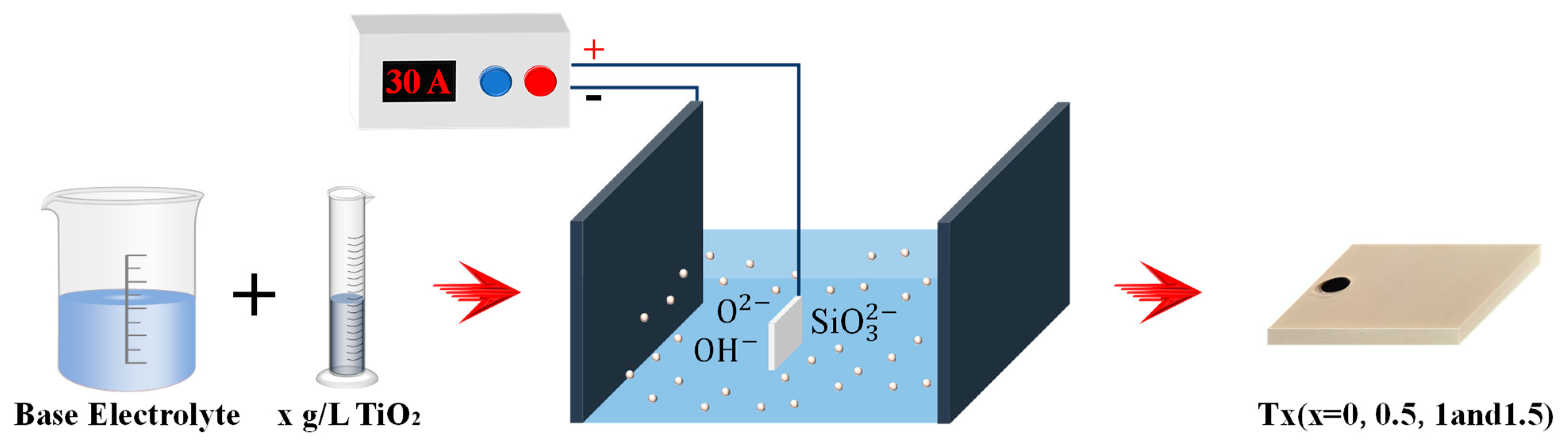
3.2. Electrolyte and Nanoparticles
3.3. MAO Setup
3.4. Structural Characterization of the Coatings
3.5. Corrosion Characterization
4. Conclusions
- TiO2 nanoparticles were uniformly distributed within the MAO coating. The primary phase composition consisted of α-Al2O3 and γ-Al2O3. While doping had minimal influence on the phase composition, it significantly altered the coating’s microstructure, leading to increased surface roughness and thickness with higher doping levels.
- Appropriate TiO2 doping reduced the coating porosity and improved its density, thereby enhancing corrosion resistance. However, for the sample with the highest addition amount studied (T1.5), a decrease in coating densification was observed compared to the optimally doped T1 sample, resulting in diminished corrosion performance.
- Within the experimental scope, the T1 coating exhibited the optimal corrosion resistance. This study provides insights for optimizing MAO processes and designing protective coatings for 6061 aluminum alloys in chloride-containing environments. It demonstrates that controlling the doping amount of TiO2 nanoparticles is a critical factor for improving the corrosion resistance of MAO coatings.
Author Contributions
Funding
Data Availability Statement
Conflicts of Interest
References
- Nie, Z.H.; Lu, H.L.; Yang, F.; Xu, G. Preparation and property enhancement of SiC particle-reinforced aluminum matrix composites based on micro-arc oxidation. J. Alloys Compd. 2025, 1010, 177388. [Google Scholar] [CrossRef] [Scilit]
- Qin, L.Y.; Fu, Z.Y.; Liu, L.; Han, X.; Ma, J.; Li, B.; Zhu, X. Influence of micro-arc oxidation on the microstructure and dielectric properties of anodic aluminum oxide. Sci. Rep. 2024, 14, 23673. [Google Scholar] [CrossRef] [Scilit]
- Mohannad, M.S.; Bosta, A.; Ma, K.J. Influence of hydroxide-silicate composition and electrolyte temperature on microstructure and infrared emissivity of MAO coatings on Al 6061. Mater. Chem. Phys. 2025, 384, 131491. [Google Scholar]
- Chen, C.J.; Shao, J.Q.; Lu, Y.K.; Tian, C.; Zhang, M.; Zhang, W. Influence of plasma electrolytic oxidation parameters on laser welding of aluminum alloy and glass. J. Mater. Eng. Perform. 2025, 34, 23321–23340. [Google Scholar] [CrossRef] [Scilit]
- Wang, X.Y.; Yu, F.Y.; Wang, W.Q. Effects of halloysite nanotube integration on the soft sparking micro-arc oxidation process and coating properties of aluminum alloys. Surf. Coat. Technol. 2025, 511, 132301. [Google Scholar] [CrossRef] [Scilit]
- Liu, Z.H.; Lu, H.L.; Zhao, Z.Y.; Zhu, Z.; Li, S. Influence of ultrasonic power modulation on the optimisation of aluminium alloy micro-arc oxidation coating properties. Appl. Surf. Sci. 2025, 679, 161067. [Google Scholar] [CrossRef] [Scilit]
- Zhu, M.Y.; Song, Y.W.; Dong, K.H.; Shan, D.; Han, E.-H. Effect of initial oxide film on the formation and performance of plasma electrolytic oxidation coating on 7075 aluminum alloy. Acta Metall. Sin. (Engl. Lett.) 2022, 35, 1559–1571. [Google Scholar] [CrossRef] [Scilit]
- Morello, D.; Leone, C.; Lamanna, G.; Silvio, G. A two-step full laser surface treatment to improve the adhesive bonding of aluminium-aluminium joints. Int. J. Adhes. Adhes. 2025, 142, 104089. [Google Scholar] [CrossRef] [Scilit]
- Fan, X.L.; Chen, F.; Zhang, G.W.; Zhan, L.; Zhou, X.; Zhou, X.; Ding, J.C.; Li, J.; Zheng, J. Modifying the aluminum current collector/active material layer interface through physical vapor deposition technology to achieve a high-performance sulfur cathode. Electrochim. Acta 2025, 533, 146562. [Google Scholar] [CrossRef] [Scilit]
- Yang, F.; Lu, H.L.; Fan, Z.S.; Nie, Z.; Zhang, L.; Cui, X. Study on the secondary cathodic deposition modification and properties of anodic oxidation coating on 6061 aluminum alloy. Langmuir ACS J. Surf. Colloids 2025, 41, 14618–14632. [Google Scholar] [CrossRef] [Scilit]
- Valizade, N.; Jarjoura, G.; Kipouros, J.G.; Plucknett, K.; Shakerin, S.; Mohammadi, M. Microstructure, hardness, and tribological properties of AA2014 powder metallurgy alloys: A sizing mechanical surface treatment study. Eng. Fail. Anal. 2025, 174, 109550. [Google Scholar] [CrossRef] [Scilit]
- Tan, R.D.; Li, H.F.; Liu, J.W.; Wu, Z.; Wang, Q.; Ramachandran, C.S. Low-temperature fabrication of carbon nanotube–aluminum composite powders via rotary chemical vapor deposition: Process optimization and growth mechanisms. Materials 2025, 18, 1654. [Google Scholar] [CrossRef] [Scilit]
- Yang, X.; Huang, Z.; Liao, X.X.; Lei, H.; Hao, D.; Zhang, T.; Jiang, B. The effect of oxidation time on the organization and corrosion performance of 6061 aluminum alloy micro-arc oxidation coatings. Coatings 2025, 15, 117. [Google Scholar] [CrossRef] [Scilit]
- Liu, X.D.; Wang, C.X.; Lei, J.L.; Song, P.; Huang, T.; Zhang, X.; Yang, T.; Ji, V. Micro-arc oxidation of aluminum alloys: Mechanism, defects, and corrosion resistance. Adv. Eng. Mater. 2025, 27, 2402748. [Google Scholar] [CrossRef] [Scilit]
- Zhu, Z.Q.; Lu, H.L.; Shen, T.J.; Wang, Z.; Xu, G.; Liu, Z.; Yang, H. Performance study of scanning micro-arc oxidation ceramic coatings on aluminum alloys based on different electrolyte flow rates. Surf. Coat. Technol. 2025, 496, 131686. [Google Scholar] [CrossRef] [Scilit]
- Meng, X.Z.; Zhu, L.Y.; Li, Y.Y.; Hu, P.; Cai, G.; Liu, J.; Zhang, Q.; Dong, Z.; Zhang, X. The influence of ultrasonic vibration on micro-arc oxidation behaviour of manganese aluminium bronze. J. Mater. Res. Technol. 2024, 33, 758–772. [Google Scholar] [CrossRef] [Scilit]
- Pecherskaya, E.A.; Konovalov, S.V.; Golubkov, P.E.; Mitrokhin, M.; Gurin, S. Study of optical characteristics of microdischarges in the micro-arc oxidation process. Vacuum 2024, 229, 113558. [Google Scholar] [CrossRef] [Scilit]
- Yang, H.P.; Yang, B.; Wang, P.; Li, C.; Yang, S.; Wang, X.; Luo, X.; Zheng, Y. Effect of Pr(NO3)3 doping on the characteristics of TC4 micro-arc oxidation coatings. Mater. Sci. Technol. 2024, 40, 517–527. [Google Scholar] [CrossRef] [Scilit]
- Chen, X.W.; Song, H.; Pu, H.; Zheng, R.; Zhang, M.; Zhang, D. Study of wear and corrosion resistance of ATO nanoparticle–doped micro-arc oxide film layers. Int. J. Appl. Ceram. Technol. 2023, 21, 1078–1093. [Google Scholar] [CrossRef] [Scilit]
- Zhang, M.; Ma, X.N.; Zhang, S.Y.; Hou, L.; Kim, K.H. One-step fabrication of wear resistant and friction-reducing Al2O3/MoS2 nanocomposite coatings on 2A50 aluminum alloy by plasma electrolytic oxidation with MoS2 nanoparticle additive. Surf. Coat. Technol. 2025, 497, 131796. [Google Scholar] [CrossRef] [Scilit]
- Yu, D.L.; Jiang, B.; Qi, X.; Wang, C.; Song, R. Study on the microstructure and comprehensive properties of black MAO/TiO2 coatings prepared on 6063 aluminum alloy. Mater. Today Commun. 2025, 42, 111317. [Google Scholar] [CrossRef] [Scilit]
- Huang, Q.; Wu, Z.Z.; Wu, H.; Ji, S.; Ma, Z.; Wu, Z.; Chen, P.; Zhu, J.; Fu, R.K.; Lin, H.; et al. Corrosion behavior of ZnO-reinforced coating on aluminum alloy prepared by plasma electrolytic oxidation. Surf. Coat. Technol. 2019, 374, 1015–1023. [Google Scholar] [CrossRef] [Scilit]
- Wang, P.; Wei, X.W.; Cao, W.J.; Tang, Y.T.; Wang, Y.; Gong, Z.Y.; Hu, J.; Pu, J.; Zu, X.T. Effect of TiO2 nanoparticles on the characteristics of MAO coatings. Int. J. Electrochem. Sci. 2020, 14, 9311–9325. [Google Scholar] [CrossRef] [Scilit]
- Tang, S.; Chen, X.W.; Zhang, D.F.; Xie, W.; Ran, Q.; Luo, B.; Luo, H.; Yang, J. Effects of nano-SiO2 particle addition on the structure and properties of micro-arc oxidation ceramic coatings on 7075 aluminum alloy. Anti-Corros. Methods Mater. 2024, 71, 482–490. [Google Scholar] [CrossRef] [Scilit]
- Qi, X.; Gao, H.; He, Y.F.; Su, X.; Jiang, B.; Song, R. A self-sealing and lubricating MAO/TiO2/PTFE composite coating fabricated by microarc oxidation on a 6063 aluminum alloy for wear and corrosion resistance. J. Alloys Compd. 2025, 1017, 179163. [Google Scholar] [CrossRef] [Scilit]
- Ma, P.; Fang, Y.Y.; Zhang, D.; Cheng, H.-B.; Fu, N.; Zhou, X.; Fang, S.; Lin, Y. Surface functionalization of TiO2 nanoparticles influences the conductivity of ionic liquid-based composite electrolytes. ACS Appl. Nano Mater. 2019, 3, 342–350. [Google Scholar] [CrossRef] [Scilit]
- Maj, L.; Muhaffel, F.; Jarzebska, A.; Trelka, A.; Kulczyk, M.; Cimenoglu, H.; Bieda, M. Microstructure characterization of titania-based micro-arc oxidation coatings with nanoparticles. Mater. Proc. 2023, 14, 14. [Google Scholar]
- Lian, H.M.; Du, H.Y.; Gao, Z.Q.; Huang, H.; Wei, Y.; Hou, L.; Wang, Q.; Wei, H.; Liu, X.; Zhou, Y. Enhancing conductivity and corrosion resistance of micro-arc oxidation coatings by incorporating ATO nanoparticles. Ceram. Int. 2025, 51, 34505–34518. [Google Scholar] [CrossRef] [Scilit]
- Reginaldo, T.K.; Danielle, D.D.; Rodrigo, F.; Alves, A.P.R. XPS Characterization of TiO2 Nanotubes Growth on the Surface of the Ti15Zr15Mo Alloy for Biomedical Applications. J. Funct. Biomater. 2023, 14, 353. [Google Scholar]





| Ecorr/V | Jcorr/(A·cm−2) | Rp/(Ω·cm2) | |
|---|---|---|---|
| Al alloy | −1.374 | 2.446 × 10⁻⁵ | 1.964 × 10³ |
| T0 | −0.919 | 2.911 × 10⁻⁶ | 1.538 × 10⁴ |
| T0.5 | −0.817 | 1.835 × 10⁻⁶ | 2.245 × 10⁴ |
| T1 | −1.248 | 1.127 × 10⁻⁶ | 3.558 × 10⁴ |
| T1.5 | −1.228 | 2.744 × 10⁻⁶ | 1.433 × 10⁴ |
| Rs/(Ω·cm2) | Y1/ (Ω−1·sn·cm−2) | n1 | R1/(Ω·cm2) | Y2/ (Ω−1·sn·cm−2) | n2 | R2/(Ω·cm2) | Equivalent Model | |
|---|---|---|---|---|---|---|---|---|
| 6061 | 38.55 | 8.145 × 10⁻⁶ | 0.877 | 3.204 × 10³ | ---- | ---- | ---- | R(QR) |
| T0 | 35.43 | 5.108 × 10⁻⁸ | 0.919 | 2.782 × 10³ | 5.927 × 10⁻⁷ | 0.659 | 1.220 × 10⁴ | R{Q[R(QR)]} |
| T0.5 | 26.98 | 6.229 × 10⁻⁸ | 0.895 | 7.303 × 10³ | 2.683 × 10⁻⁶ | 0.506 | 5.889 × 10⁴ | R{Q[R(QR)]} |
| T1 | 28.30 | 4.720 × 10⁻⁸ | 0.777 | 9.538 × 10³ | 1.664 × 10⁻⁶ | 0.756 | 7.859 × 10⁴ | R{Q[R(QR)]} |
| T1.5 | 33.29 | 4.621 × 10⁻⁸ | 0.919 | 1.407 × 10³ | 2.375 × 10⁻⁶ | 0.522 | 2.826 × 10⁴ | R{Q[R(QR)]} |
| Si | Mg | Fe | Cu | Mn | Cr | Zn | Ti | Al |
|---|---|---|---|---|---|---|---|---|
| 0.4~0.8 | 0.8~1.2 | 0.7 | 0.15~0.4 | 0.15 | 0.25 | 0.25 | 0.15 | Bal |
Disclaimer/Publisher’s Note: The statements, opinions and data contained in all publications are solely those of the individual author(s) and contributor(s) and not of MDPI and/or the editor(s). MDPI and/or the editor(s) disclaim responsibility for any injury to people or property resulting from any ideas, methods, instructions or products referred to in the content. |
© 2026 by the authors. Licensee MDPI, Basel, Switzerland. This article is an open access article distributed under the terms and conditions of the Creative Commons Attribution (CC BY) license.
Share and Cite
Huang, Z.; Yang, S.; Liao, X.; Yang, S.; Zhang, T.; Jiang, B. Effects of TiO2 Nanoparticle Doping on the Micro-Arc Oxidation Coating Structure and Corrosion Resistance of 6061 Aluminum Alloy. Molecules 2026, 31, 468. https://doi.org/10.3390/molecules31030468
Huang Z, Yang S, Liao X, Yang S, Zhang T, Jiang B. Effects of TiO2 Nanoparticle Doping on the Micro-Arc Oxidation Coating Structure and Corrosion Resistance of 6061 Aluminum Alloy. Molecules. 2026; 31(3):468. https://doi.org/10.3390/molecules31030468
Chicago/Turabian StyleHuang, Zhu, Shaodian Yang, Xiuxiang Liao, Shengxiang Yang, Tong Zhang, and Bingchun Jiang. 2026. "Effects of TiO2 Nanoparticle Doping on the Micro-Arc Oxidation Coating Structure and Corrosion Resistance of 6061 Aluminum Alloy" Molecules 31, no. 3: 468. https://doi.org/10.3390/molecules31030468
APA StyleHuang, Z., Yang, S., Liao, X., Yang, S., Zhang, T., & Jiang, B. (2026). Effects of TiO2 Nanoparticle Doping on the Micro-Arc Oxidation Coating Structure and Corrosion Resistance of 6061 Aluminum Alloy. Molecules, 31(3), 468. https://doi.org/10.3390/molecules31030468