Article

High-Throughput Screening of Co-Protoporphyrin IX-Binding Proteins for Enhanced Hydrogen Production

by
Nicholas Ryan Halloran
,
Mohammad Imtiazur Rahman
,
Roman Christopher Fabry
,
Abesh Banerjee
and
Giovanna Ghirlanda
*
School of Molecular Sciences, Arizona State University, Tempe, AZ 85287, USA
*
Author to whom correspondence should be addressed.
Molecules 2026, 31(2), 346; https://doi.org/10.3390/molecules31020346
Submission received: 17 November 2025 / Revised: 22 December 2025 / Accepted: 10 January 2026 / Published: 19 January 2026
(This article belongs to the Special Issue Feature Papers in Photochemistry and Photocatalysis—2nd Edition)

Abstract

Artificial metalloenzymes incorporating cobalt protoporphyrin IX (Co-PPIX) are promising for sustainable hydrogen production; however, slow protein preparation and a lack of suitable detection methods limit the systematic optimization of their catalytic performance. Here, we report a streamlined workflow that combines the direct in vivo incorporation of Co-PPIX into cytochrome b562 (cyt b562) variants with a colorimetric assay for hydrogen evolution, scalable to hundreds of mutants. We screened 103 members of a mutant library and selected the variant Co-Mut25, which displayed activity double than wild type on the screen, and produced over 70% more hydrogen than WT as assessed by gas chromatography. This approach enables the rapid and scalable identification of high-performing cobalt–protein catalysts and expands the toolkit for artificial hydrogenase development.

1. Introduction

Artificial metalloenzymes can be created by incorporating organometallic catalysts into protein frameworks. They serve as bridges between traditional molecular catalysts and enzymes and offer the advantage of broadening the range of chemical reactions beyond those found in natural enzymes. For instance, natural heme-binding proteins have been engineered to perform reactions that are absent in nature, such as carbene and nitrene transfer and Kemp elimination, achieved through rational design and directed evolution [1,2,3,4,5,6,7,8,9] or by substituting the central iron with other metals to explore different chemistries [10,11,12,13,14,15].
Recently, our group and others reported artificial metalloenzymes containing cobalt protoporphyrin IX, demonstrating their activity in hydrogen production and, more recently, in carbon dioxide reduction under photocatalytic and electrocatalytic conditions [3,16,17,18,19,20,21,22,23,24]. These constructs leverage the inherent reactivity of organometallic cobalt porphyrins [25,26,27,28,29,30] and address challenges, such as low solubility, synthetic complexity, and difficulties in modifying primary and secondary coordination spheres to optimize their reactivity. The protein scaffold, whether derived from natural proteins or constructed from scratch, modulates the reactivity of the organometallic center, provides adjustable primary and secondary coordination spheres, and protects the organometallic center from degradation [31,32,33,34,35,36,37,38].
The activity of WT scaffolds can be influenced by mutations in both the primary and secondary spheres, as demonstrated by rationally designed mutants [3,16,22,23,24]. For instance, substituting the coordinating His102 and Met7 in Co-cyt b562 with Ala, Asp, or Glu increased TON substantially. Modeling indicates that Asp can relay protons to cobalt, whereas Ala likely facilitates water coordination [16,22]. However, the limited number of mutants explored per scaffold was unlikely to yield significant improvements or generalizable insights.
The application of a directed evolutionary strategy to identify high-performing mutants from extensive libraries is impeded by the labor-intensive process of preparing recombinant proteins. This process involves overexpression of the apo protein, which frequently results in a hemin-bound form, followed by purification and reconstitution with cobalt protoporphyrin IX (Co-PPIX). Another significant challenge is the lack of a sensitive and scalable high-throughput method for evaluating the hydrogen production efficiency of metalloproteins. Molecular hydrogen production was accurately quantified using gas chromatography, which is not easily scalable. Current methodologies, such as coupled enzymatic assays with hydrogenase, are often labor-intensive, exhibit limited sensitivity, and necessitate conditions that are incompatible with our expression system [31,32,33,34].
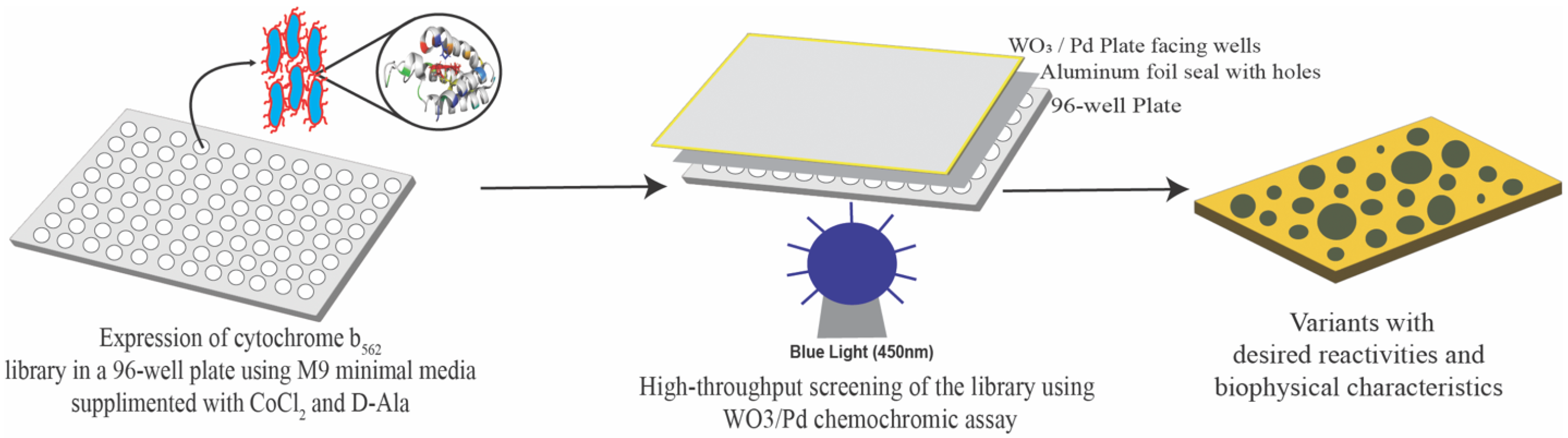
In this study, we present a comprehensive workflow for the preparation and screening of a Co-cyt b562 mutant library. This process is based on the direct in vivo incorporation of Co-PPIX, facilitated by co-expression of the heme transporter ChuA or metabolic biosynthesis in engineered E. coli. The activities of the mutants were evaluated using a colorimetric method. Employing this approach, we effectively screened a library generated by error-prone PCR, which led to the identification of Co-Mut25, a mutant that demonstrated enhanced hydrogen production activity compared to the wild type (Scheme 1).

2. Results

2.1. Optimization of Protein Expression

Metalloporphyrin-substituted heme proteins can be produced in the E. coli BL21 strain either through intracellular reconstitution with the desired porphyrin, or via Co-PPIX biosynthesis in the case of cobalt. In the first approach, a plasmid encoding the target protein was co-transformed with a plasmid encoding the outer-membrane heme transporter ChuA [35,36]. To inhibit heme biosynthesis and incorporation, cells were cultivated in minimal medium without iron, and the growth medium was supplemented with the desired porphyrin simultaneously with IPTG induction, leading to direct incorporation of the metalloporphyrin-substituted protein. ChuA’s promiscuity extends to metalloporphyrins such as Co3+, Zn2+, Ir3+, and Mn3+ PPIX, and it accommodates alterations in the porphyrin ring, generally achieving over 90% incorporation efficiency with high yields [2,13,37,38].
We adapted this method for high-throughput protein expression to facilitate the extraction of pure proteins incorporating the desired metalloporphyrin from the periplasmic space, thereby eliminating the need for purification and enhancing the incorporation efficiency. Briefly, protein localization is directed to the periplasm using a Sec translocation tag, which is cleaved simultaneously with translocation [35]. SecB, a component of the Sec translocase system, binds to the Sec signal sequence and guides protein translocation in its unfolded state [39,40]. Interestingly, we discovered that the periplasmic fraction contained Co-cyt b562, whereas the cytoplasm contained small amounts of Fe(II)-PPIX bound to cyt b562, likely because of incomplete translocation into the periplasm and the reducing environment of the cytoplasm. The species were identified by UV–Vis spectroscopy based on the characteristic Soret peaks at 416 nm for Fe(III) cyt b562, 425 nm for Fe(II) cyt b562, and 427 nm for Co(III) cyt b562, along with distinctive Q bands (Figure S1) [22]. The second protocol for overexpressing Co-cyt b562 exploited the ability of E. coli BL21(DE3) to biosynthesize cobalt protoporphyrin IX (Co-PPIX) when cultured in a medium supplemented with high concentrations of cobalt and the heme biosynthesis precursor δ-aminolevulinic acid (δ-ALA) [41]. In BL21(DE3), which lacks the RcnA efflux system, cobalt accumulates intracellularly and is inserted into free-base porphyrins by promiscuous E. coli ferrochelatase (EcHemH). Cofactor incorporation occurs concurrently with hemoprotein expression, allowing the protein to sequester cobalt as Co-PPIX and mitigate the toxicity of free cobalt.
We used two distinct methodologies to express a library of mutants generated by error-prone PCR. In both approaches, the holo protein was localized within the periplasmic space. Individual colonies were cultivated in deep-well 96-well plates, and the periplasmic fraction was released through cold osmotic shock. The initial characterization of the mutants was conducted using UV–Visible spectroscopy on a plate reader to determine the concentration of Co-cyt b562 by monitoring the Soret band at 427 nm, while the protein concentration was independently assessed at 280 nm. The ratio of absorbance at 427 nm to that at 280 nm provided an estimate of the relative Co-PPIX incorporation efficiency for each mutant. The plates were subsequently used for further characterization and analysis.

2.2. High-Throughput Assay Development

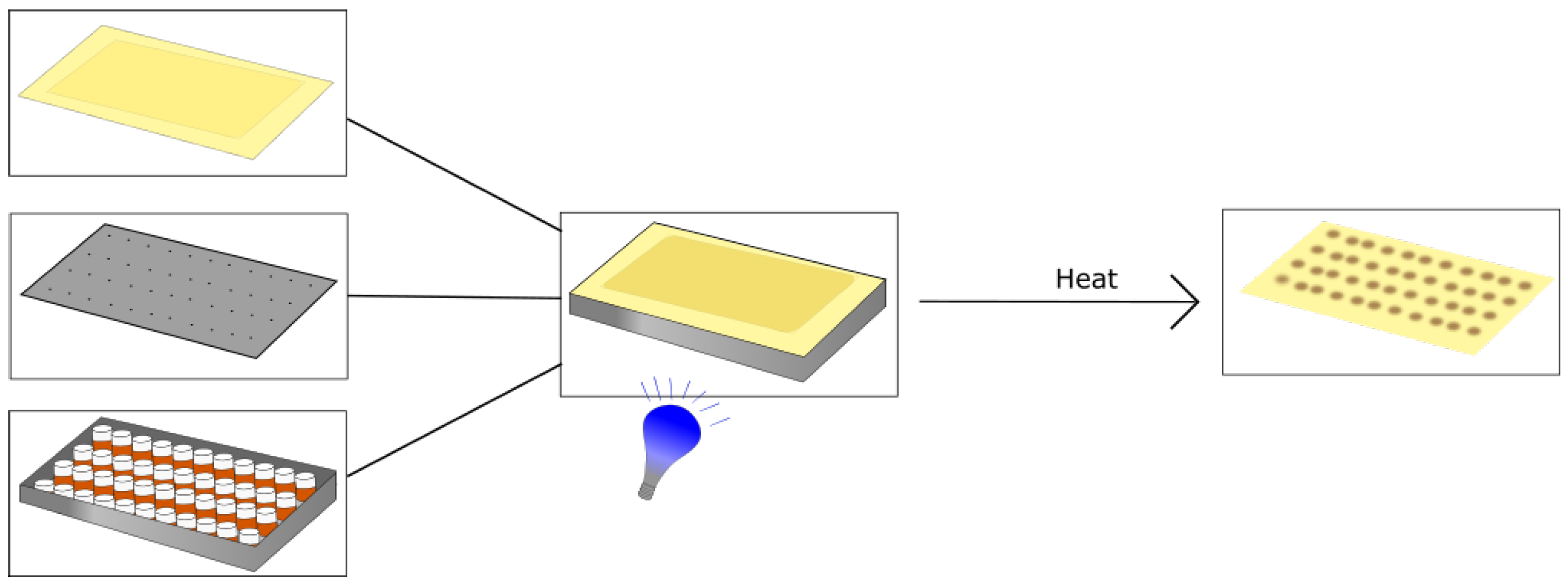
Our colorimetric screen relies on tungsten (VI) oxide (WO3), a metal oxide that undergoes a color change from yellow to blue upon partial reduction from W6+ to W5+ in the presence of hydrogen. This gasochromic effect, typically catalyzed by surface-bound palladium or platinum, which facilitates H2 dissociation, has been extensively studied for industrial hydrogen leak detection. However, many WO3-based assays require inert conditions, elevated temperatures, or specialized instrumentation, which limit their applicability in biological or photocatalytic assays. We adapted this assay for reactions occurring in aerobic and aqueous environments under continuous illumination, which interferes with detection. We deposited WO3 nanoparticles on a glass plate support and added a solution of Pd(II) to the dry coating to prepare Pd/WO3 plates. The plates were placed over a 96-well plate covered with foil sealing film and pierced in correspondence with each well (Figure 1).
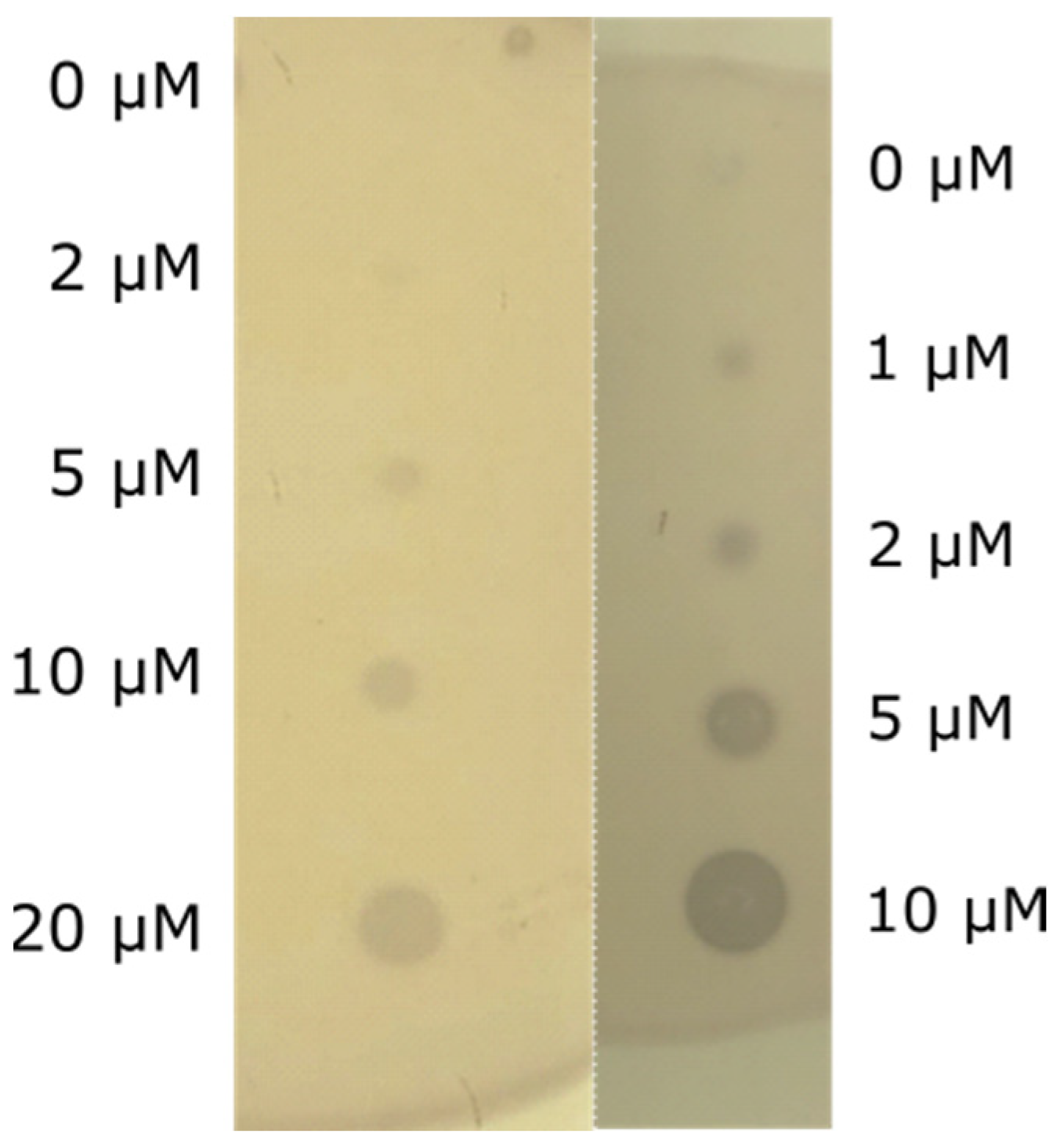
The Pd/WO3 plates were evaluated for their response to varying levels of hydrogen gas. Control reactions using increasing concentrations of Co-PPIX showed a corresponding increase in H2 production, as evidenced qualitatively by the size and intensity of the blue coloration above each well after heating (Figure 2). We compared the activity of free Co-PPIX with that of Co-M1, a peptide that catalyzes hydrogen production with an efficiency approximately eight times higher than that of free Co-PPIX under similar conditions [42]. Consistent with previous observations, the M1-bound form exhibited higher activity than the free porphyrin, as indicated by the darker and larger colorimetric responses. A lower detection limit was established for 1 µM protein-bound Co-PPIX, which produced a visible color change. The detection limit of gas chromatography was determined to be approximately 20–25 nmol of H2, equivalent to ~0.3% H2 in the 180 µL headspace of a 96-well plate (Figure 2).

2.3. Isolation and Validation of Mut25

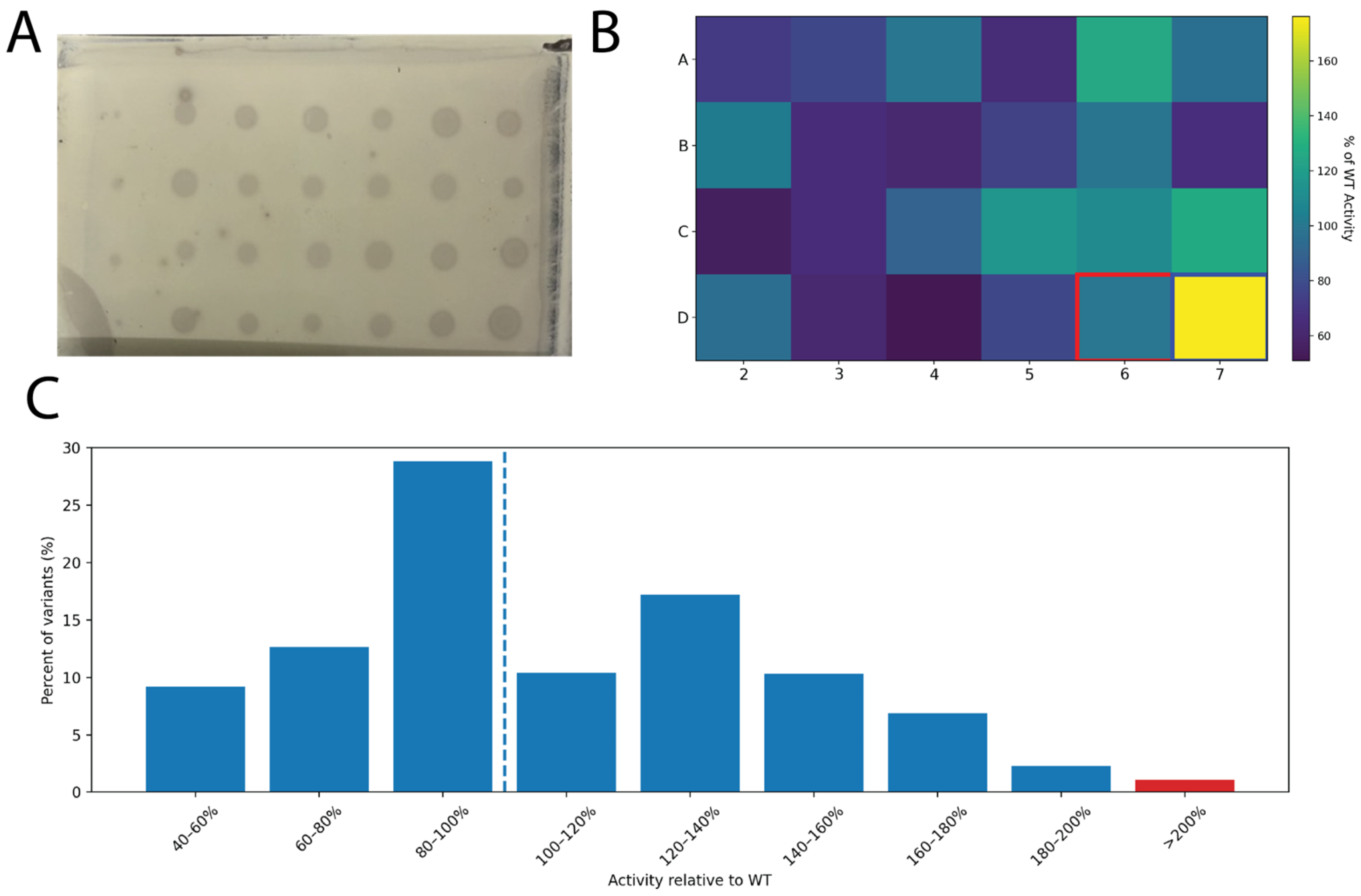
The hydrogen evolution activity of the mutants was evaluated by directly screening the crude periplasmic fractions using WO3/Pd plates. Briefly, aliquots (200 µL) containing 5 µM Co-PPIX-bound protein, 1 mM [Ru(bpy)3]2+, and 200 mM ascorbic acid were dispensed into a fresh 96-well plate. The plates were sealed, overlaid with a WO3/Pd sensor glass, irradiated with a 55 mW cm−2 blue LED array for 10 min, and left in the dark for 15 min. After oven-drying the plate, the wells corresponding to the largest circles and the deepest blue hue exhibited the highest H2 evolution. The plate images were analyzed to estimate the amount of hydrogen produced from the raw WO3/Pd colorimetric intensities, which were normalized to WT (set to 100%) within each plate. Figure 3A,B show the raw image and heatmap of activity values at their corresponding plate positions for a typical plate, revealing substantial variations among variants and highlighting WT (D6) and Mut25 (D7). To assess the overall performance landscape of the library, WT-normalized activities from all screening experiments were pooled and summarized as a histogram (Figure 3C). Normalization within each experiment to the mean WT activity corrects for inter-experiment variability and allows direct comparison across plates. The resulting distribution is centered near WT activity, with approximately 40% of variants falling within 80–120% of WT. Approximately 20% display enhancements greater than 140% of WT. Mut25 consistently occupies the extreme upper end of the distribution and is the only variant to reproducibly exceed 194 ± 0.17% of WT activity (~1%), and qualitatively outperformed WT- at every purification stage (whole cells, periplasm, and purified protein (Figure S2)).
Sequence analysis identified seven point-mutations within the gene encoding Mut25, four of which were silent. Two mutations correspond to two amino acid substitutions, A20V and D21N, using WT numbering (PDB 2BC5). An A to T mutation resulted in the conversion of the native lysine codon (Lys 15) to the Amber stop codon “TAG.” Note that a serine had been added at the N terminus to improve the yield of TEV cleavage during library construction. Although Mut25 should be truncated at position 15, the full-length protein was successfully obtained following expression and purification using the same protocol as for WT, albeit in small quantities (yield < 1 mg for 1 L fermentation). Analytical HPLC comparison indicated that Mut25 eluted at a solvent composition 1% higher in B than the wild type (WT) (Figure S4). MALDI analysis of HPLC-purified Mut25 revealed a mass of 11,969.14 Da, consistent with the presence of A20V, D21N, and the additional serine residue at the N terminus (Figure S5).
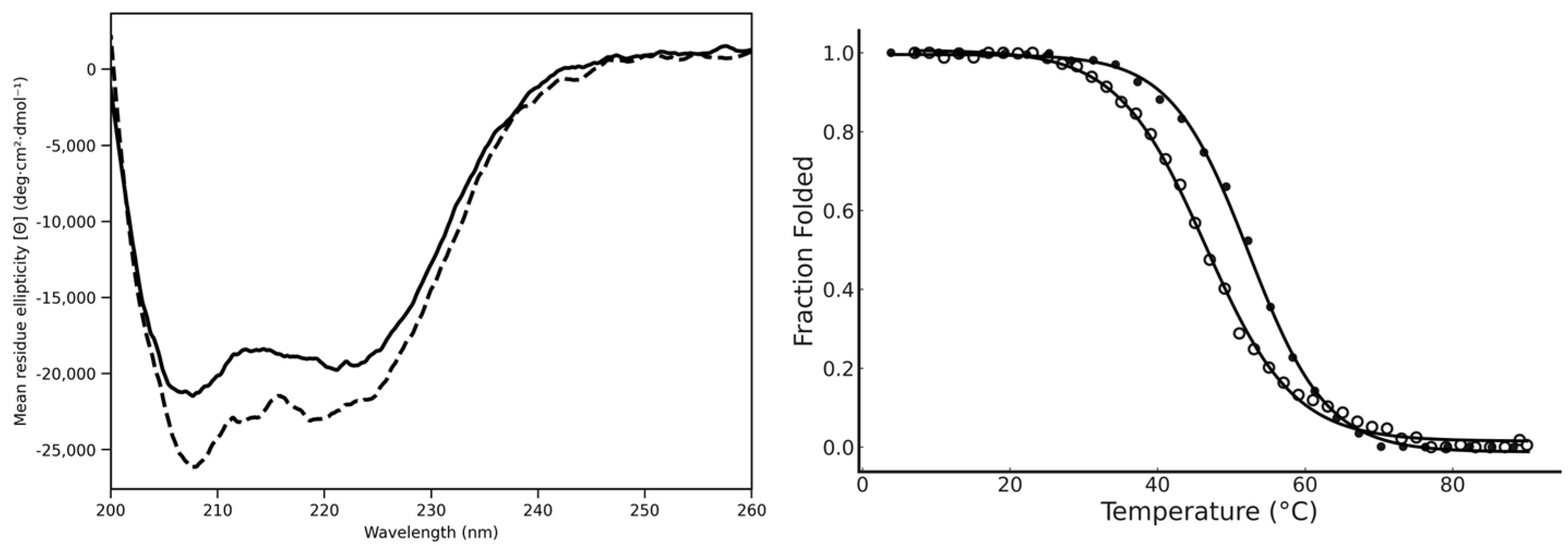
We characterized the secondary structure and stability of Mut25 in the apo and CoPPIX-bound states using circular dichroism. Both states were α-helical, as shown by the minima at 208 and 222 nm (Figure 4), consistent with AlphaFold 3 modeling (Figure S6). Binding to CoPPIX resulted in minimal changes in this region, indicating that the incorporation of the cofactor had little effect on the structure of the protein at room temperature. Thermal denaturation curves obtained by monitoring the loss of intensity of the 222 nm peak at increasing temperatures show that the holo state is more stable than the apo state: the apparent midpoint of the thermal denaturation, Tm, increases from 46.5 °C to 52.3 °C upon binding of the porphyrin, consistent with prior observations on WT and its mutants [22].
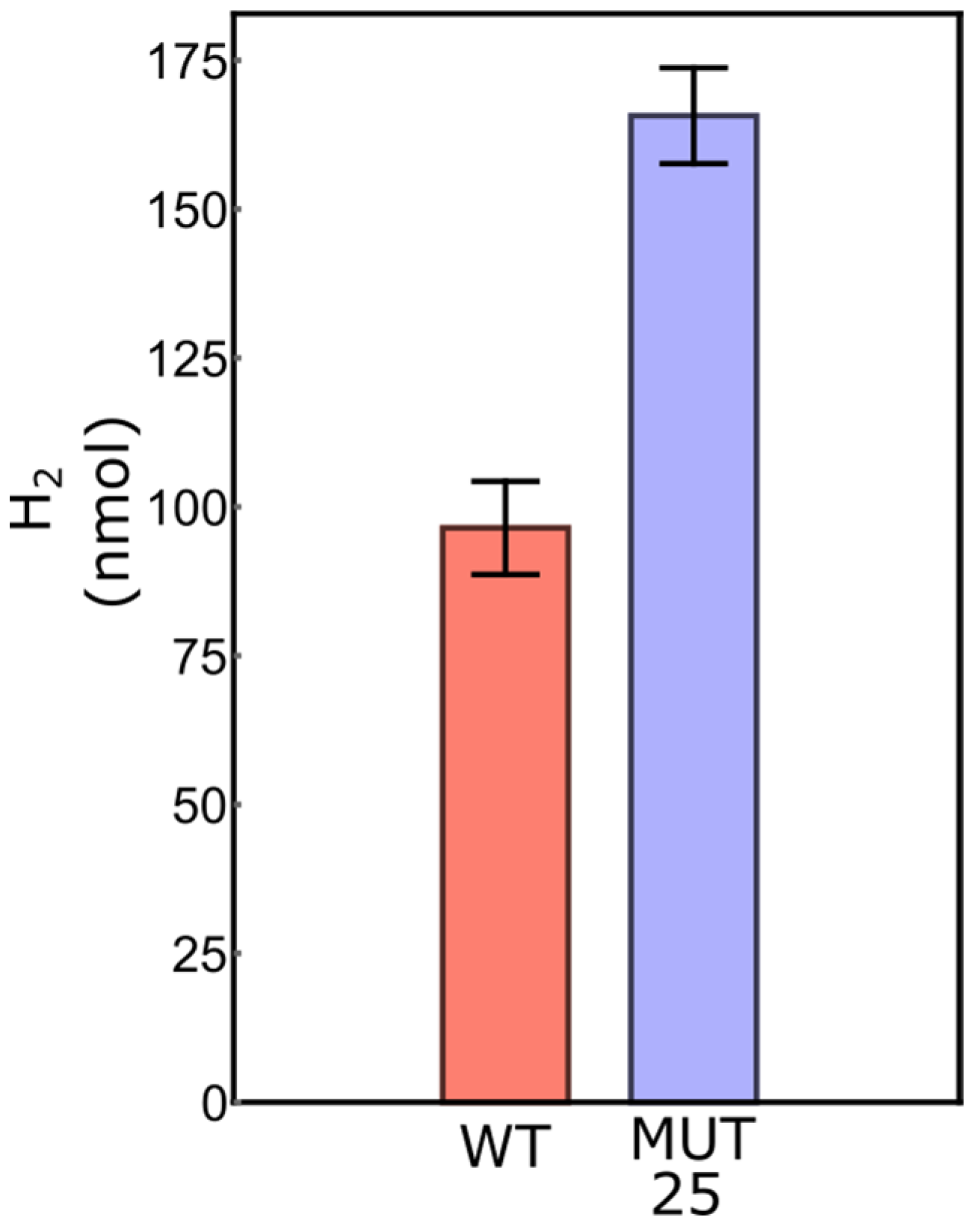
Next, we verified the results of the high-throughput activity screening by comparing the activity of Co-Mut25 with that of the wild type (WT) using gas chromatography. The proteins were expressed and purified in their apo form, reconstituted with Co-PPIX in vitro, and assessed in triplicates at a concentration of approximately 1 mM. Gas chromatographic analysis after 30 min (0.86 µM CoPPIX, 5 µM protein, pH 6.5, 25 °C, 55 mW cm−2 blue light, 30 min) confirmed a 70% increase, with Mut25 producing 165 ± 4 nmol H2 compared to 96 ± 3 nmol for the wild type (Figure 5). Because hydrogen evolution did not reach a steady state or plateau within the 30 min, we report the H2 yield at 30 min, which serves as a measure of the extent of catalysis under these standardized conditions.

3. Discussion

This study provides a workflow for the direct expression of cobalt-substituted heme-binding protein libraries and screening of photocatalytic hydrogen production. To date, the direct incorporation of cobalt in heme-binding proteins has been demonstrated for individual proteins but has not been adapted for high-throughput use [43,44]. Similarly, the screening of catalysts for hydrogen production has been limited to hydrogenase mutants, which produce hydrogen under different conditions and in larger amounts [32]. High-throughput screening under photocatalytic conditions has been demonstrated for organometallic catalysts under conditions incompatible with protein expression [33]. Furthermore, our method requires minimal equipment, provides high sensitivity, and is compatible with various conditions. Comparative analysis between the WO3/Pd colorimetric assay and gas chromatography confirmed the assay’s reliability and high sensitivity as a surrogate measure of hydrogen evolution.
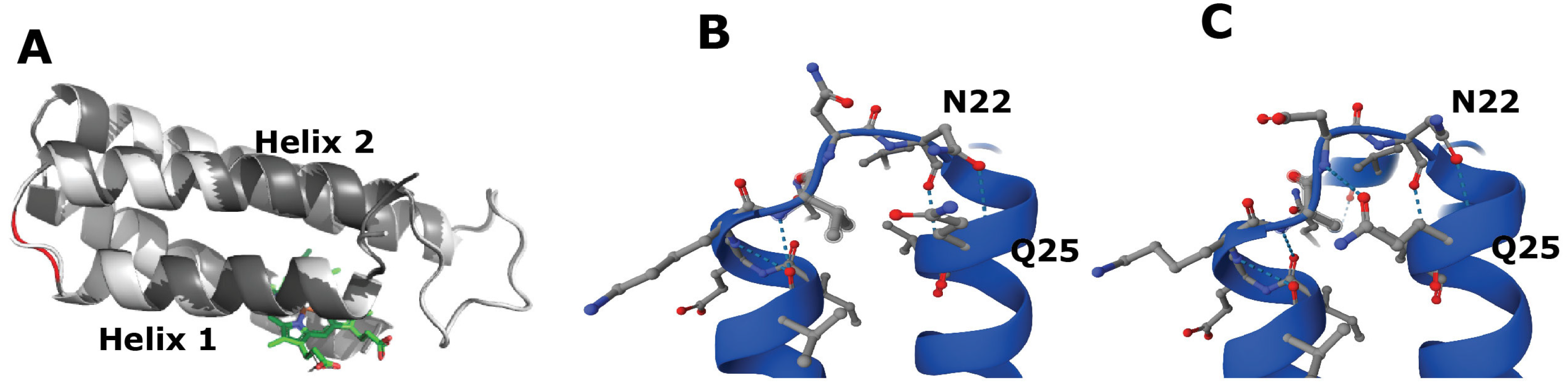
Using this workflow, we discovered a mutant of cyt b562 that consistently displayed the highest activity on plate assay. Further characterization by gas chromatography confirmed that the purified Mut25 catalyzes photoinduced hydrogen production with H2 yield at 30 min 70% higher than WT. Mutations in Mut25 (A20V, D21N using WT nomenclature) were located outside the immediate axial coordination sphere of the cobalt center, suggesting that subtle changes in the secondary shell environment can modulate catalytic efficiency. Comparison of models of Mut25 and of WT cyt b562 generated by AlphaFold3 reveal high similarity (Figure 6), but indicated that these mutations affect the sidechain to backbone hydrogen bonding observed at the N terminus of helix 2 in WT (N22, Q25); in addition the mutations may reposition helix 1, which bears the axial Met7 ligand, by interacting with neighboring Val16. These findings align with previous reports that modifications beyond the primary coordination sphere can significantly influence peroxidase activity in mutants of Fe(III)PPIX bound cyt b562 through a surprisingly large effect on the redox potential of the Fe(II)/Fe(III) couple [41,45].
Mut25 also comprises the amber codon “TAG,” a termination codon, at position 19; however, we recovered the full-length protein, as assessed by MALDI spectrometry (Figure S5). There is evidence that the TAG codon can be translated as near-cognate lysine or glutamine in non-modified strains at a non-negligible frequency [46,47]. Furthermore, the presence of aminoglycoside antibiotics during protein expression may increase the misreading error rate [48]. A read-through of the amber codon also explains the significantly reduced yield of pure protein compared with that of the wild type.

4. Materials and Methods

Plasmid Construction and Protein Expression: Detailed protocols are described in SI. Briefly, cyt b562 was cloned into plasmid pET26b (Addgene, Watertown, MA, USA) containing a second translocation signal, His-tag, and TEV cleavage site [22]. Two methods were used for Co-PPIX incorporation. ChuA Transporter Method: the ChuA gene from the original kanamycin-resistant plasmid (pChuA #42539, Addgene, USA) was transferred into T7p14_15His_deGFP (ampicillin-resistant) to ensure double selection with antibiotics of the co-transformed cells. Plasmids encoding cyt b562 and ChuA were co-transformed into E. coli BL21 DE3 (New England Bioloabs, Ipswich, MA, USA) under double antibiotic selection. Cells were grown in M9 medium and induced with 1 mM IPTG at OD600. Cells were pelleted, washed with M9 medium, and a solution of Co-PPIX (Sigma-Aldrich, St. Louis, MO, USA) to a final concentration of 5 mM was added to the suspension. After 30 min, the periplasmic fraction was isolated using cold osmotic shock with 1 mM MgCl2 and purified using affinity chromatography on Ni-NTA resin (Cytiva, Marlborough, MA, USA). Fractions containing the desired proteins were pooled, treated with TEV protease, and re-purified using affinity chromatography. Metabolic biosynthesis methods. The second method involved directly expressing the Co-PPIX-bound protein in E. coli BL21(DE3) by supplementation with cobalt chloride and δ-aminolevulinic acid in the growth medium M9. After induction at OD600, holo protein was purified from the periplasmic fraction, as described above.
Library Generation and Expression: A library of random mutants of Sec-His-cytochrome b562 was generated using the Agilent GeneMorph II EZClone Domain Mutagenesis Kit (Santa Clara, CA, USA) by error-prone PCR using primers designed to protect tagging sites and stop codons (Table S4). Error-prone PCR was performed following the manufacturer’s instructions, selecting the initial DNA template and PCR cycles to obtain 4.5–9.0 bp mutants per kb gene as mutation frequency, corresponding to 2–3 bp mutations per colony for a 318 bp gene (100 ng plasmid, 25 cycles of amplification). An annealing temperature of 60 °C was used for amplification during error-prone PCR. The amplicon from error-prone PCR was used as a megaprimer for RF cloning of the Sec-His-cytochrome b562 variants. The PCR product was purified using a Promega DNA Cleanup kit (Madison, WI, USA), transformed into a cloning strain, and the cells were plated on agar. All colonies were collected and plasmid DNA was extracted using the Qiagen Spin Miniprep Kit (Hilden, Germany).
High-throughput screening for hydrogen production activity was performed using WO3/Pd-coated glass plates, as described in the Supplementary Information. Molecular hydrogen generated under photocatalytic conditions induced a measurable darkening reaction on these plates. The plates were imaged and analyzed with the MicrobeJ plug-in in Fiji [49,50].
Hydrogen evolution: The CoPPIX stock solution was formulated by dissolving the solid compound in dimethyl sulfoxide (DMSO) at a concentration of 1 mg/100 µL, followed by 1:1000 dilution in 500 mM sodium phosphate buffer (pH 6.9). The concentration was verified using UV–Vis spectroscopy (Perkin Elmer, Shelton, CT, USA). CoPPIX was then introduced to a five-fold molar excess of M1 protein and incubated at ambient temperature for 30 min. Tris(bipyridine)ruthenium(II) chloride ([Ru(bpy)3]2+) was dissolved in 500 mM sodium phosphate buffer (pH 6.9) to function as a photosensitizer, whereas ascorbic acid was dissolved to act as an electron donor. The reaction mixtures were prepared in Eppendorf tubes (Hamburg, Germany) at final concentrations of 5 µM M1, 1 µM CoPPIX, 200 mM ascorbic acid, and 1 mM [Ru(bpy)3]2+ in 500 mM sodium phosphate buffer (pH 6.5). These mixtures were subsequently transferred to 2 mL glass vials, sealed, and purged with nitrogen gas. The samples were placed in a HepatoChem Temperature-Controlled PhotoRedOx Box (Cambridge, MA, USA), maintained at 25 °C through water circulation, and illuminated with an EvoluChem 55 mW/cm2 blue LED. The hydrogen evolved from the reactions was quantified using a gas chromatograph (SRI Instruments, Torrance, CA, USA) equipped with a thermal conductivity detector (TCD) and a 3′ × 1/8″ molecular sieve 5 Å column. Argon was employed as the carrier gas and the TCD temperature was maintained at 100 °C to facilitate the detection of hydrogen, oxygen, and nitrogen gases in the samples. At one-hour intervals, the reaction vials were removed from the light source, inverted, and allowed to stand on the bench for 15 min. A 250 µL Hamilton gas-tight syringe, purged with argon, was used to inject 100 µL of argon into each inverted vial. Immediately thereafter, 100 µL of headspace gas was withdrawn and injected into the gas chromatography column. This procedure was repeated for all the samples before they were returned to the photoreactor. All gas chromatography experiments were conducted in triplicate unless otherwise specified.
The total amount of H2 produced was calculated using a standard curve (Figure S7).

5. Conclusions

The development of a high-throughput screening platform for Co-PPIX-binding proteins addresses significant bottlenecks in the directed evolution of artificial metalloenzymes for hydrogen production. By combining in vivo Co-PPIX incorporation with a sensitive WO3/Pd-based colorimetric assay, we enabled the rapid and scalable evaluation of hydrogen evolution activity directly from crude periplasmic extracts, bypassing the laborious purification and gas chromatographic quantification traditionally required. The assay’s ability to detect as little as 25 nmol H2 with a straightforward visual readout under aerobic, aqueous conditions represents a considerable advancement in accessibility and throughput for screening metalloprotein libraries. The successful identification of the Mut25 variant, which exhibited a 70% enhancement in hydrogen production relative to wild-type cyt b562, validates the utility of this approach. We plan to expand this approach by characterizing and sequencing a larger number of mutants. Given the increasing interest in cobalt-substituted heme-binding proteins for various catalytic applications, we hope that our workflow will find broad use.
Future efforts will focus on expanding the mutant library size and integrating computational modeling to comprehensively map the structure–activity relationships. This approach promises to provide further insights into how distal residues influence cobalt porphyrin reactivity, ultimately guiding rational design and directed evolution strategies for enhanced artificial hydrogenases. Additionally, the simplicity and stability of the WO3/Pd plates position this assay as a broadly applicable tool for distributed research and educational settings.

Supplementary Materials

The following supporting information can be downloaded at: https://www.mdpi.com/article/10.3390/molecules31020346/s1. References [16,22,43,44,51] are cited in the Supplementary Materials.

Author Contributions

Conceptualization, G.G.; investigation, N.R.H., M.I.R., R.C.F., and G.G.; writing: original draft preparation, N.R.H., A.B., and M.I.R.; writing: review and editing, G.G.; and funding acquisition, G.G. All authors have read and agreed to the published version of the manuscript.

Funding

This research was supported by NSF grants 1935105 and 1844327 awarded to Ghirlanda.

Institutional Review Board Statement

Not applicable.

Informed Consent Statement

Not applicable.

Data Availability Statement

The original contributions presented in this study are included in the article/Supplementary Material. Further inquiries can be directed to the corresponding author(s).

Conflicts of Interest

The funders had no role in the design of the study; in the collection, analyses, or interpretation of data; in the writing of the manuscript; or in the decision to publish the results.

References

  1. Bhattacharya, S.; Margheritis, E.G.; Takahashi, K.; Kulesha, A.; D’Souza, A.; Kim, I.; Yoon, J.H.; Tame, J.R.H.; Volkov, A.N.; Makhlynets, O.V.; et al. NMR-Guided Directed Evolution. Nature 2022, 610, 389–393. [Google Scholar] [CrossRef]
  2. Bordeaux, M.; Singh, R.; Fasan, R. Intramolecular C(Sp3)H Amination of Arylsulfonyl Azides with Engineered and Artificial Myoglobin-Based Catalysts. Bioorganic Med. Chem. 2014, 22, 5697–5704. [Google Scholar] [CrossRef]
  3. Deng, Y.; Dwaraknath, S.; Ouyang, W.O.; Matsumoto, C.J.; Ouchida, S.; Lu, Y. Engineering an Oxygen-Binding Protein for Photocatalytic CO2 Reductions in Water. Angew. Chem. Int. Ed. 2023, 62, e202215719. [Google Scholar] [CrossRef]
  4. Lin, Y.-W.; Yeung, N.; Gao, Y.-G.; Miner, K.D.; Tian, S.; Robinson, H.; Lu, Y. Roles of Glutamates and Metal Ions in a Rationally Designed Nitric Oxide Reductase Based on Myoglobin. Proc. Natl. Acad. Sci. USA 2010, 107, 8581–8586. [Google Scholar] [CrossRef]
  5. Liu, Z.; Arnold, F.H. New-to-Nature Chemistry from Old Protein Machinery: Carbene and Nitrene Transferases. Curr. Opin. Biotechnol. 2021, 69, 43–51. [Google Scholar] [CrossRef] [PubMed]
  6. Moore, E.J.; Fasan, R. Effect of Proximal Ligand Substitutions on the Carbene and Nitrene Transferase Activity of Myoglobin. Tetrahedron 2019, 75, 2357–2363. [Google Scholar] [CrossRef]
  7. Sigman, J.A.; Kwok, B.C.; Lu, Y. From Myoglobin to Heme-Copper Oxidase: Design and Engineering of a Cu B Center into Sperm Whale Myoglobin. J. Am. Chem. Soc. 2000, 122, 8192–8196. [Google Scholar] [CrossRef]
  8. Tinzl, M.; Diedrich, J.V.; Mittl, P.R.E.; Clémancey, M.; Reiher, M.; Proppe, J.; Latour, J.-M.; Hilvert, D. Myoglobin-Catalyzed Azide Reduction Proceeds via an Anionic Metal Amide Intermediate. J. Am. Chem. Soc. 2024, 146, 1957–1966. [Google Scholar] [CrossRef] [PubMed]
  9. Vargas, D.A.; Ren, X.; Sengupta, A.; Zhu, L.; Roy, S.; Garcia-Borràs, M.; Houk, K.N.; Fasan, R. Biocatalytic Strategy for the Construction of Sp3-Rich Polycyclic Compounds from Directed Evolution and Computational Modelling. Nat. Chem. 2024, 16, 817–826. [Google Scholar] [CrossRef]
  10. Cai, Y.-B.; Yao, S.-Y.; Hu, M.; Liu, X.; Zhang, J.-L. Manganese Protoporphyrin IX Reconstituted Myoglobin Capable of Epoxidation of the CC Bond with Oxone®. Inorg. Chem. Front. 2016, 3, 1236–1244. [Google Scholar] [CrossRef]
  11. Dydio, P.; Key, H.M.; Nazarenko, A.; Rha, J.Y.-E.; Seyedkazemi, V.; Clark, D.S.; Hartwig, J.F. An Artificial Metalloenzyme with the Kinetics of Native Enzymes. Science 2016, 354, 102–106. [Google Scholar] [CrossRef]
  12. Gengenbach, A.; Syn, S.; Wang, X.; Lu, Y. Redesign of Cytochrome c Peroxidase into a Manganese Peroxidase:  Role of Tryptophans in Peroxidase Activity. Biochemistry 1999, 38, 11425–11432. [Google Scholar] [CrossRef]
  13. Key, H.M.; Dydio, P.; Liu, Z.; Rha, J.Y.-E.; Nazarenko, A.; Seyedkazemi, V.; Clark, D.S.; Hartwig, J.F. Beyond Iron: Iridium-Containing P450 Enzymes for Selective Cyclopropanations of Structurally Diverse Alkenes. ACS Cent. Sci. 2017, 3, 302–308. [Google Scholar] [CrossRef]
  14. Low, D.W.; Abedin, S.; Yang, G.; Winkler, J.R.; Gray, H.B. Manganese Microperoxidase-8. Inorg. Chem. 1998, 37, 1841–1843. [Google Scholar] [CrossRef]
  15. Mann, S.I.; Nayak, A.; Gassner, G.T.; Therien, M.J.; DeGrado, W.F. De Novo Design, Solution Characterization, and Crystallographic Structure of an Abiological Mn–Porphyrin-Binding Protein Capable of Stabilizing a Mn(V) Species. J. Am. Chem. Soc. 2021, 143, 252–259. [Google Scholar] [CrossRef]
  16. Alcala-Torano, R.; Halloran, N.; Gwerder, N.; Sommer, D.J.; Ghirlanda, G. Light-Driven CO2 Reduction by Co-Cytochrome B562. Front. Mol. Biosci. 2021, 8, 609654. [Google Scholar] [CrossRef] [PubMed]
  17. Alvarez-Hernandez, J.L.; Salamatian, A.A.; Han, J.W.; Bren, K.L. Potential- and Buffer-Dependent Selectivity for the Conversion of CO2 to CO by a Cobalt Porphyrin-Peptide Electrocatalyst in Water. ACS Catal. 2022, 12, 14689–14697. [Google Scholar] [CrossRef]
  18. Edwards, E.H.; Le, J.M.; Salamatian, A.A.; Peluso, N.L.; Leone, L.; Lombardi, A.; Bren, K.L. A Cobalt Mimochrome for Photochemical Hydrogen Evolution from Neutral Water. J. Inorg. Biochem. 2022, 230, 111753. [Google Scholar] [CrossRef] [PubMed]
  19. Edwards, E.H.; Bren, K.L. Light-Driven Catalysis with Engineered Enzymes and Biomimetic Systems. Biotechnol. Appl. Biochem. 2020, 67, 463–483. [Google Scholar] [CrossRef] [PubMed]
  20. Firpo, V.; Le, J.M.; Pavone, V.; Lombardi, A.; Bren, K.L. Hydrogen Evolution from Water Catalyzed by Cobalt-Mimochrome VI*a, a Synthetic Mini-Protein. Chem. Sci. 2018, 9, 8582–8589. [Google Scholar] [CrossRef]
  21. Kleingardner, J.G.; Kandemir, B.; Bren, K.L. Hydrogen Evolution from Neutral Water under Aerobic Conditions Catalyzed by Cobalt Microperoxidase-11. J. Am. Chem. Soc. 2014, 136, 4–7. [Google Scholar] [CrossRef]
  22. Sommer, D.J.; Vaughn, M.D.; Clark, B.C.; Tomlin, J.; Roy, A.; Ghirlanda, G. Reengineering Cyt B562 for Hydrogen Production: A Facile Route to Artificial Hydrogenases. Biochim. Biophys. Acta (BBA)-Bioenerg. 2016, 1857, 598–603. [Google Scholar] [CrossRef]
  23. Sommer, D.J.; Vaughn, M.D.; Ghirlanda, G. Protein Secondary-Shell Interactions Enhance the Photoinduced Hydrogen Production of Cobalt Protoporphyrin IX. Chem. Commun. 2014, 50, 15852–15855. [Google Scholar] [CrossRef]
  24. Labidi, R.J.; Faivre, B.; Carpentier, P.; Perard, J.; Gotico, P.; Li, Y.; Atta, M.; Fontecave, M. Light-Activated Artificial CO2-Reductase: Structure and Activity. J. Am. Chem. Soc. 2024, 146, 28296–28305. [Google Scholar] [CrossRef]
  25. Manbeck, G.F.; Fujita, E. A Review of Iron and Cobalt Porphyrins, Phthalocyanines and Related Complexes for Electrochemical and Photochemical Reduction of Carbon Dioxide. J. Porphyr. Phthalocyanines 2015, 19, 45–64. [Google Scholar] [CrossRef]
  26. Zhang, X.; Wu, Z.; Zhang, X.; Li, L.; Li, Y.; Xu, H.; Li, X.; Yu, X.; Zhang, Z.; Liang, Y.; et al. Highly Selective and Active CO2 Reduction Electrocatalysts Based on Cobalt Phthalocyanine/Carbon Nanotube Hybrid Structures. Nat. Commun. 2017, 8, 14675. [Google Scholar] [CrossRef] [PubMed]
  27. Birdja, Y.Y.; Vos, R.E.; Wezendonk, T.A.; Jiang, L.; Kapteijn, F.; Koper, M.T.M. Effects of Substrate and Polymer Encapsulation on CO2 Electroreduction by Immobilized Indium(III) Protoporphyrin. ACS Catal. 2018, 8, 4420–4428. [Google Scholar] [CrossRef]
  28. Rao, H.; Lim, C.-H.; Bonin, J.; Miyake, G.M.; Robert, M. Visible-Light-Driven Conversion of CO2 to CH4 with an Organic Sensitizer and an Iron Porphyrin Catalyst. J. Am. Chem. Soc. 2018, 140, 17830–17834. [Google Scholar] [CrossRef] [PubMed]
  29. Call, A.; Cibian, M.; Yamamoto, K.; Nakazono, T.; Yamauchi, K.; Sakai, K. Highly Efficient and Selective Photocatalytic CO2 Reduction to CO in Water by a Cobalt Porphyrin Molecular Catalyst. ACS Catal. 2019, 9, 4867–4874. [Google Scholar] [CrossRef]
  30. Fukuzumi, S.; Lee, Y.-M.; Nam, W. Photocatalytic Redox Reactions with Metalloporphyrins. J. Porphyr. Phthalocyanines 2020, 24, 21–32. [Google Scholar] [CrossRef]
  31. Wecker, M.S.A.; Ghirardi, M.L. High-throughput Biosensor Discriminates between Different Algal H2-photoproducing Strains. Biotech. Bioeng. 2014, 111, 1332–1340. [Google Scholar] [CrossRef]
  32. Wecker, M.S.A.; Meuser, J.E.; Posewitz, M.C.; Ghirardi, M.L. Design of a New Biosensor for Algal H2 Production Based on the H2-Sensing System of Rhodobacter Capsulatus. Int. J. Hydrogen Energy 2011, 36, 11229–11237. [Google Scholar] [CrossRef]
  33. Lopato, E.M.; Eikey, E.A.; Simon, Z.C.; Back, S.; Tran, K.; Lewis, J.; Kowalewski, J.F.; Yazdi, S.; Kitchin, J.R.; Ulissi, Z.W.; et al. Parallelized Screening of Characterized and DFT-Modeled Bimetallic Colloidal Cocatalysts for Photocatalytic Hydrogen Evolution. ACS Catal. 2020, 10, 4244–4252. [Google Scholar] [CrossRef]
  34. Motz, R.N.; Lopato, E.M.; Connell, T.U.; Bernhard, S. High-Throughput Screening of Earth-Abundant Water Reduction Catalysts toward Photocatalytic Hydrogen Evolution. Inorg. Chem. 2021, 60, 774–781. [Google Scholar] [CrossRef]
  35. Natale, P.; Brüser, T.; Driessen, A.J.M. Sec- and Tat-Mediated Protein Secretion across the Bacterial Cytoplasmic Membrane—Distinct Translocases and Mechanisms. Biochim. et Biophys. Acta (BBA)-Biomembr. 2008, 1778, 1735–1756. [Google Scholar] [CrossRef]
  36. Varnado, C.L.; Goodwin, D.C. System for the Expression of Recombinant Hemoproteins in Escherichia Coli. Protein Expr. Purif. 2004, 35, 76–83. [Google Scholar] [CrossRef]
  37. Reynolds, E.W.; Schwochert, T.D.; McHenry, M.W.; Watters, J.W.; Brustad, E.M. Orthogonal Expression of an Artificial Metalloenzyme for Abiotic Catalysis. ChemBioChem 2017, 18, 2380–2384. [Google Scholar] [CrossRef] [PubMed]
  38. Lelyveld, V.S.; Brustad, E.; Arnold, F.H.; Jasanoff, A. Metal-Substituted Protein MRI Contrast Agents Engineered for Enhanced Relaxivity and Ligand Sensitivity. J. Am. Chem. Soc. 2011, 133, 649–651. [Google Scholar] [CrossRef] [PubMed]
  39. Freudl, R. Signal Peptides for Recombinant Protein Secretion in Bacterial Expression Systems. Microb. Cell Factories 2018, 17, 52. [Google Scholar] [CrossRef] [PubMed]
  40. Lycklama a Nijeholt, J.A.; Driessen, A.J.M. The Bacterial Sec-Translocase: Structure and Mechanism. Philos. Trans. R. Soc. B Biol. Sci. 2012, 367, 1016–1028. [Google Scholar] [CrossRef]
  41. Springs, S.L.; Bass, S.E.; Bowman, G.; Noelman, I.; Schutt, C.E.; McLendon, G.L. A Multigeneration Analysis of Cytochrome b(562) Redox Variants: Evolutionary Strategies for Modulating Redox Potential Revealed Using a Library Approach. Biochemistry 2002, 41, 4321–4328. [Google Scholar] [CrossRef] [PubMed]
  42. Halloran, N.R.; Banerjee, A.; Ghirlanda, G. Self-Assembling Peptide–Co-PPIX Complex Catalyzes Photocatalytic Hydrogen Evolution and Forms Hydrogels. Molecules 2025, 30, 1707. [Google Scholar] [CrossRef] [PubMed]
  43. Perkins, L.J.; Weaver, B.R.; Buller, A.R.; Burstyn, J.N. De Novo Biosynthesis of a Nonnatural Cobalt Porphyrin Cofactor in E. coli and Incorporation into Hemoproteins. Proc. Natl. Acad. Sci. USA 2021, 118, e2017625118. [Google Scholar] [CrossRef]
  44. Weaver, B.R.; Perkins, L.J.; Fernandez Candelaria, F.O.; Burstyn, J.N.; Buller, A.R. Molecular Determinants of Efficient Cobalt-Substituted Hemoprotein Production in E. Coli. ACS Synth. Biol. 2023, 12, 3669–3679. [Google Scholar] [CrossRef]
  45. Mazumdar, S.; Springs, S.L.; McLendon, G.L. Effect of Redox Potential of the Heme on the Peroxidase Activity of Cytochrome B562. Biophys. Chem. 2003, 105, 263–268. [Google Scholar] [CrossRef]
  46. Nilsson, M.; Rydén-Aulin, M. Glutamine Is Incorporated at the Nonsense Codons UAG and UAA in a Suppressor-Free Escherichia Coli Strain. Biochim. Biophys. Acta (BBA)-Gene Struct. Expr. 2003, 1627, 1–6. [Google Scholar] [CrossRef]
  47. Kramer, E.B.; Farabaugh, P.J. The Frequency of Translational Misreading Errors in E. coli Is Largely Determined by tRNA Competition. RNA 2007, 13, 87–96. [Google Scholar] [CrossRef]
  48. Salas-Marco, J.; Bedwell, D.M. Discrimination Between Defects in Elongation Fidelity and Termination Efficiency Provides Mechanistic Insights into Translational Readthrough. J. Mol. Biol. 2005, 348, 801–815. [Google Scholar] [CrossRef] [PubMed]
  49. Ducret, A.; Quardokus, E.M.; Brun, Y.V. MicrobeJ, a Tool for High Throughput Bacterial Cell Detection and Quantitative Analysis. Nat. Microbiol. 2016, 1, 16077. [Google Scholar] [CrossRef]
  50. Schindelin, J.; Arganda-Carreras, I.; Frise, E.; Kaynig, V.; Longair, M.; Pietzsch, T.; Preibisch, S.; Rueden, C.; Saalfeld, S.; Schmid, B.; et al. Fiji: An Open-Source Platform for Biological-Image Analysis. Nat. Methods 2012, 9, 676–682. [Google Scholar] [CrossRef]
  51. Malherbe, G.; Humphreys, D.P.; Davé, E. A Robust Fractionation Method for Protein Subcellular Localization Studies in Escherichia coli. BioTechniques 2019, 66, 171–178. [Google Scholar] [CrossRef] [PubMed]
Scheme 1. Summary of work.
Molecules 31 00346 sch001
Figure 1. Diagram of WO3/Pd reaction setup in 96 well plate.
Molecules 31 00346 g001
Figure 2. WO3/Pd plates after exposure to increasing concentrations of Co-PPIX. Control reactions with increasing Co-PPIX concentrations in the wells showed that the color change increases with increased H2 production. (Left): Free Co-PPIX, (Right): Co-PPIX-M1; Numbers refer to concentration of Co-PPIX in the reaction wells.
Molecules 31 00346 g002
Figure 3. High-throughput screening of cytochrome b562 variants using a WO3/Pd colorimetric hydrogen evolution assay. (A) Raw image of a representative screening plate showing WO3/Pd darkening induced by hydrogen evolution. (B) Corresponding heat map of WT-normalized activity (WT = 100%), with WT (D6) and Mut25 (D7) positions highlighted. (C) Histogram of WT-normalized activities pooled across all experiments, showing a distribution centered near WT (dotted line) with a pronounced high-activity tail and Mut25 as the sole > 200% WT outlier.
Molecules 31 00346 g003
Figure 4. CD spectra (left) of Mut25 in the apo (solid line) and bound (dashed line) states and thermal denaturation curves (right) of Mut25 in the apo (open circles) and bound (filled circles) states. Conditions: Mut25 8 µM in 50 mM sodium phosphate, pH 7.5; CoPPIX 20 µM.
Molecules 31 00346 g004
Figure 5. Hydrogen evolution by WT cyt b562 (red) and Mut25 (blue). Conditions: 0.86 µM Co-PPIX, 860 µM [Ru(bpy)3]2+, 43 mM ascorbic acid, and 3 µM protein in sodium phosphate buffer pH 6.5 at 25 °C after 30 min of illumination; samples were run in triplicate.
Molecules 31 00346 g005
Figure 6. AlphaFold3 generated models of WT cyt b562 and Mut 25. (A) Overlay of WT (light grey) and Mut25 (dark grey, mutations in red). The mutations are located in the first loop and affect the hydrogen bonding network: In Mut25 (Panel (B)) the A20V mutation perturbs side chain to backbone hydrogen bonding observed for N22 and Q25 in WT (Panel (C)).
Molecules 31 00346 g006
Disclaimer/Publisher’s Note: The statements, opinions and data contained in all publications are solely those of the individual author(s) and contributor(s) and not of MDPI and/or the editor(s). MDPI and/or the editor(s) disclaim responsibility for any injury to people or property resulting from any ideas, methods, instructions or products referred to in the content.