Article

Nucleophilic Addition of Stabilized Phosphorus Ylides to Closo-Decaborate Nitrilium Salts: A Synthetic Route to Boron Cluster-Functionalized Iminoacyl Phosphoranes and Their Application in Potentiometric Sensing


by
Vera V. Voinova
1,
Eugeniy S. Turyshev
2,
Sergey S. Novikov
1,3,
Nikita A. Selivanov
1,
Alexander Yu. Bykov
1,
Ilya N. Klyukin
1,
Andrey P. Zhdanov
1,*,
Mikhail S. Grigoriev
4,
Konstantin Yu. Zhizhin
1 and
Nikolay T. Kuznetsov
1
1
N.S. Kurnakov Institute of General and Inorganic Chemistry of the Russian Academy of Sciences, Leninskii pr.31, 119991 Moscow, Russia
2
Institute for African Studies of the Russian Academy of Sciences (IAS), st. Spiridonovka 30/1, 123001 Moscow, Russia
3
Faculty of Fundamental Physical and Chemical Engineering, Lomonosov Moscow State University, Leninskie Gory 1, 119991 Moscow, Russia
4
Frumkin Institute of Physical Chemistry and Electrochemistry, Russian Academy of Sciences, Leninskii pr. 31, Bldg 4, 119071 Moscow, Russia
*
Author to whom correspondence should be addressed.
Molecules 2026, 31(2), 231; https://doi.org/10.3390/molecules31020231
Submission received: 26 November 2025 / Revised: 19 December 2025 / Accepted: 7 January 2026 / Published: 9 January 2026

Abstract

This work explores a novel and efficient synthetic approach to a new class of boron cluster derivatives via the nucleophilic addition of stabilized phosphorus ylides, Ph3P=CHR2 (R2 = COOEt, CN), to a series of nitrilium salts of the closo-decaborate anion, [2-B10H9NCR1] (R1 = Me, Et, nPr, iPr, Ph). The reaction proceeds regio- and stereospecifically, affording a diverse range of iminoacyl phosphorane derivatives, [2-B10H9NH=C(R1)C(PPh3)R2], in high isolated yields (up to 95%). The obtained compounds (10 examples) were isolated as tetrabutylammonium or tetraphenylphosphonium salts and thoroughly characterized by multinuclear NMR (11B, 1H, 13C, 31P), high-resolution mass spectrometry, and single-crystal X-ray diffraction. The reaction feasibility was found to be strongly influenced by the steric hindrance of the R1 group. Furthermore, the practical utility of these novel hybrids was demonstrated by employing the [2-B10H9NH=C(CH3)C(COOC2H5)=PPh3] anion as a highly effective membrane-active component in ion-selective electrodes. The developed tetraphenylphosphonium (TPP+) sensor exhibited a near-Nernstian response, a low detection limit of 3 × 10⁻⁸ M, and excellent selectivity over a range of common inorganic and organic cations, showcasing the potential of closo-borate-based ionophores in analytical chemistry.

1. Introduction

Anionic boron clusters and carboranes have attracted considerable research interest owing to their broad applicability across various scientific and technological domains. These compounds are integral to the development of antiviral and antimicrobial agents [1,2,3,4], materials with tailored magnetic and optical properties, catalytic systems [5,6], and energy conversion devices [7,8,9]. Recently, the utilization of boron clusters in Boron Neutron Capture Therapy (BNCT) has gained substantial momentum, driven by the emergence of new stable accelerator-based neutron sources [10,11,12,13].
The development of effective pharmaceutical agents and materials with predefined properties necessitates robust synthetic methodologies for substituted closo-borate anions that permit the introduction of diverse functional groups. The three-dimensional aromaticity of boron clusters enables hydrogen substitution via electrophilic, radical, and nucleophilic pathways. Nevertheless, the most promising strategies for directed functionalization involve the modification of pre-introduced exo-polyhedral groups. These include nucleophilic ring-opening of cyclic substituents [14,15], electrophilic alkylation of sulfo [16,17,18] and amino [19,20] groups, and ipso-substitution reactions [21,22,23].
Nucleophilic addition reactions to nitrilium substituents are of particular significance, as they provide a versatile route for incorporating a wide array of functional moieties, including those suitable for constructing complex biomimetic systems [24,25,26,27,28]. To date, the literature reports only two examples of C-nucleophile addition to nitrilium derivatives of closo-borates: reactions with azomethine ylides [29] and compounds bearing an activated methylene group [30].
Stabilized phosphorus ylides constitute a promising class of reagents in the context of functionalization. These versatile 1,2-dipolar compounds feature a negative charge localized on the carbon atom, stabilized by an adjacent phosphonium group, which imparts unique reactivity [31]. Carbonyl-stabilized phosphorus ylides have been successfully employed in cyclization reactions to facilitate the efficient synthesis of 1-fluoroalkyl-5-substituted-1,2,3-triazoles, which represent valuable structural motifs in medicinal chemistry [32]. Furthermore, polymers derived from phosphorus ylides exhibit promising antifouling properties and selective bactericidal activity, rendering them attractive candidates for biomedical applications [33]. The chemical diversity inherent in these compounds opens new avenues for catalyst design and precision molecular engineering [34].
A critical aspect of employing modified boron clusters lies in the development of analytical systems for environmental monitoring. The control of organic pollutants in industrial and agricultural effluents represents a pressing global challenge. Closo-decaborate derivatives are employed as active components in potentiometric sensor membranes designed for the detection of substances such as lidocaine, procaine, articaine, terbinafine, and quaternary ammonium compounds. Advances in synthetic methodologies enable the production of derivatives bearing novel functional groups, thereby expanding the capabilities for identifying challenging-to-detect organic compounds in complex matrices [35,36].
In the present study, we expand the range of C-nucleophilic reagents employed and provide a detailed examination of the nucleophilic addition of stabilized phosphorus ylides to nitrilium derivatives of closo-decaborate anion. Additionally, this work describes the synthesis of the compound TPP[B10H9NH=C(CH3)C(COOC2H5)=PPh3] and investigates its potential application as a membrane-active component in a potentiometric sensor for the direct determination of the tetraphenylphosphonium cation.

2. Results

2.1. Synthesis and Characterization of Borylated Iminoacyl Phosphoranes

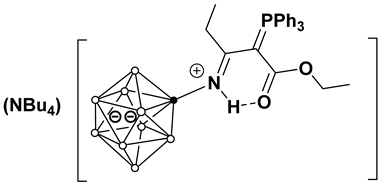
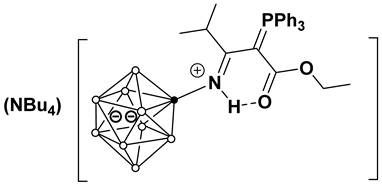
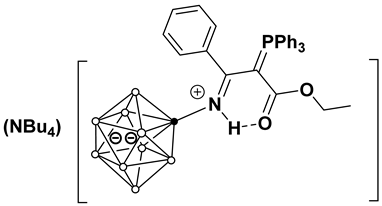
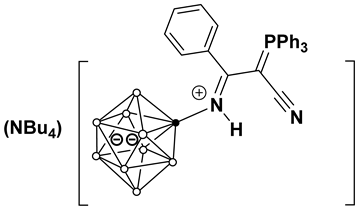
This work investigates the nucleophilic addition of stabilized phosphorus ylides, as neutral C-nucleophiles Ph3P=CH-R2 (R2 = COOEt, CN), to the activated triple bond of closo-decaborate nitrilium derivatives [2-B10H9NCR1] (R1 = Me, Et, nPr, iPr, tBu, Ph) (Figure 1). The reaction proceeds efficiently and selectively to yield the corresponding iminoacylation products. It is noteworthy that no byproducts arising from triphenylphosphine group migration, which are common in analogous reactions with platinum nitrile complexes, were observed [37,38]. The reaction feasibility (specifically, the required temperature and reagent excess) was found to be strongly influenced by the steric hindrance of the R1 group. While high yields were eventually achieved for most substrates through condition optimization, the reactivity profiles differed significantly. For derivatives with R1 = Me, Et, nPr, Ph, the reaction proceeded smoothly at room temperature in dichloromethane using an equimolar amount of the ylide. However, the isobutyronitrile-derived substrate (R1 = iPr) required heating to 70 °C in acetonitrile and a fivefold excess of the phosphorus ylide. No reaction was observed for the tert-butyl derivative (R1 = tBu) even under more forcing conditions. The resulting compounds, [2-B10H9N=HC(R1)(C=PPh3R2)], can be classified as highly stabilized phosphorus ylides [39,40,41,42,43,44].
All obtained salts (Bu4N)[2-B10H9N=HC(R1)(C=PPh3R2)] were characterized by 11B{1H}, 1H, 13C{1H}, and 31P NMR spectroscopy, as well as HRMS-ESI.
The NMR spectra reveal distinct structural features for the ester-substituted products 3 (a-e) versus their cyano-analogs 4 (a-e). In the 11B{1H} NMR spectra, both series exhibit similar patterns, though signals for 4 (a-e) are shifted downfield. For derivatives 3 (a-e), signals appear in characteristic ranges: apical B(10) (δ −0.9 to −0.6) and B(1) (δ −3.4 to −2.3), substituted equatorial B(2) (δ −14.2 to −13.9), and two sets of equatorial signals for B(3,5,6,9) and B(4,7,8) between δ −25.4 and −28.3. In contrast, the cyano derivatives 4 (a-e) display apical signals at δ −1.6 to −0.6 and −3.7 to −3.1, with B(2) at δ −14.3 to −13.8. Notably, the equatorial belt in 4 (a-e) splits into three distinct signals (δ −25.8 to −25.2, −29.0 to −28.6, and −30.6 to −29.7), reflecting lower symmetry.
The 1H NMR spectra highlight a fundamental structural difference: derivatives 3 (a-e) show a broad NH signal at δ 10.43–10.21, indicative of a strong intramolecular hydrogen bond (C=O … H-N). Conversely, in 4 (a-e), the NH signal shifts significantly upfield to δ 6.09–5.73, confirming the absence of such bonding. While the ethoxy group signals in 3 confirm the ester structure, the alkyl/aryl substituents in 4 appear as broadened signals, suggesting greater conformational flexibility.
13C{1H} NMR analysis further differentiates the series. In 3 (a-e), the phosphorylated methine group (P-C-C=O) resonates at δ 63.0–61.2 (1JC-P 124–123 Hz) with carbonyl signals at δ 178.5–169.3. For 4 (a-e), the corresponding phosphorylated methine fragment (P-C-C≡N) shifts to δ 46.7–43.1 (1JC-P 120.7–120.0 Hz), with the nitrile carbon appearing as a doublet at δ 123.1–119.9. 31P{1H} NMR spectra for all compounds show a single signal in the narrow range δ 19.4–16.9, consistent with a single phosphorus environment.
HRMS-ESI data confirm the composition and structure of the obtained compounds. In the spectra of derivatives 3 (a-e), peaks corresponding to molecular ions [A] are observed, where A = [B10H9NHC(R1)(Ph3PCCOOEt)], as well as peaks of aggregated forms, such as {2[A] + Na} and {[A] + Na + 2HCOO-H}. In the spectra of derivatives 4 (a-e), peaks [A] are observed, where A = [B10H9NHC(R1)(Ph3PCCN)].

2.2. X-Ray Structure Determination

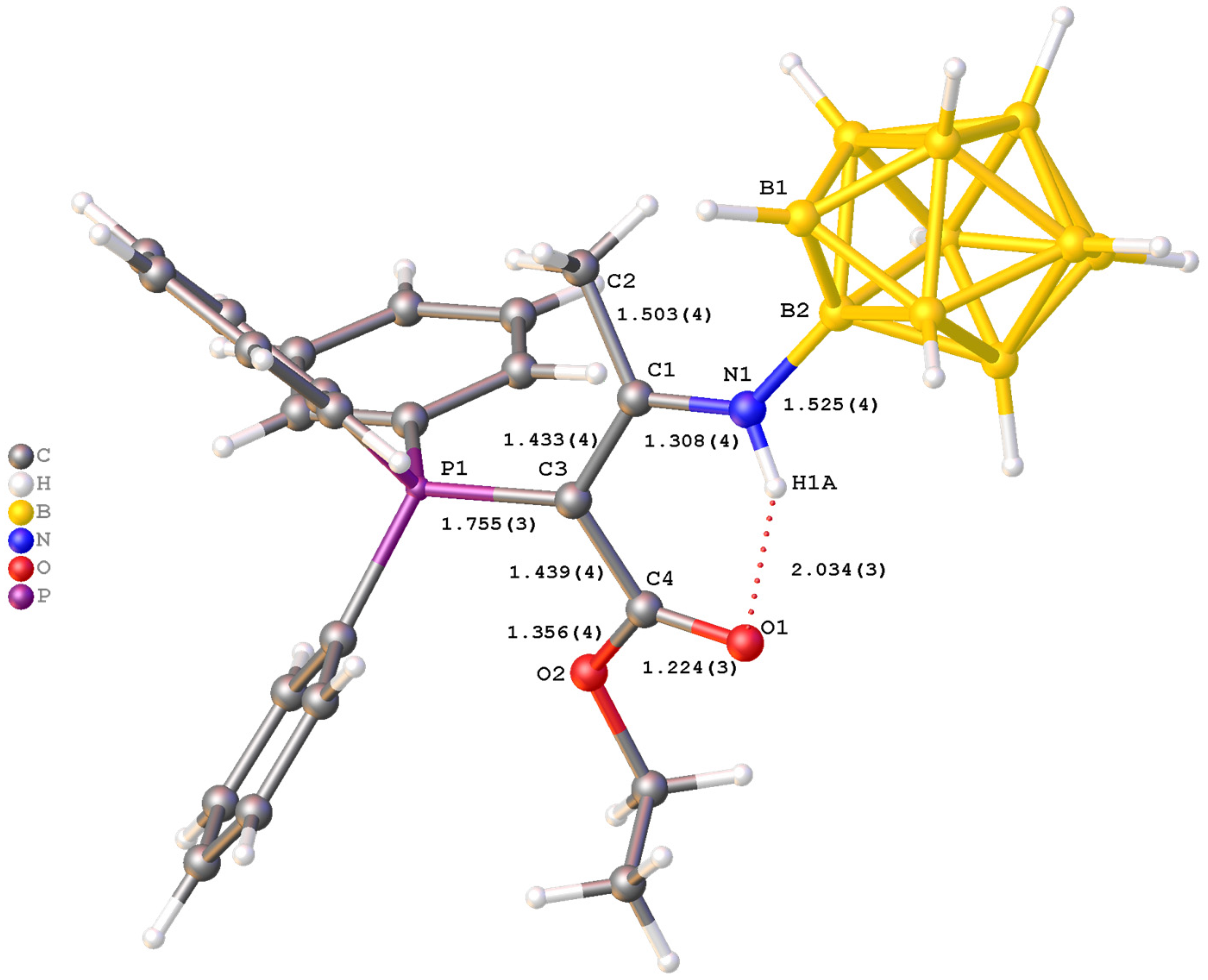
The structure of two compounds, (Ph4P)(3a) and (Bu4N)(4b), was determined by single-crystal X-ray diffraction. The crystal structure of (Ph4P)(3a) is built from tetraphenylphosphonium cations and substituted closo-decaborate anions. In the molecular structure of (Ph4P)(3a) (Figure 2), the anion has the geometry of a slightly distorted bicapped Archimedean antiprism. The substituent is in an equatorial position. The N(1)–B(2) bond length is 1.525(4) Å, which is typical for a single B–N(sp2) bond. The bond lengths N(1)–C(1) and C(1)–C(3) (1.308(4) and 1.433(4) Å, respectively) have an intermediate order between single and double bonds, although the N(1)–C(1) bond is closer to a double bond, while the C(1)–C(3) bond length corresponds to a single C(sp2)–C(sp2) bond. A similar structure is found in acylated derivatives [40,42] and adducts of stabilized phosphorus ylides and phenyl isothiocyanate [45].
The carboxylate group shows characteristic bond lengths: C(4)=O(1) 1.224(3) Å (double bond) and C(4)–O(2) 1.356(4) Å (single bond) [46]. The geometry of the N(1)-C(1)-C(3)-P(1) fragment is nearly planar. The torsional angle value is −6.9° (3). All bond lengths and angles in the phenyl substituents at the phosphorus atoms and the cation are typical for aromatic systems. The phosphorus centers have a tetrahedral environment with angles in the range of 102–114°. It is worth noting that the structural rigidity of the substituent is provided by an intramolecular hydrogen bond—N(1)–H(1A)···O(1) with parameters:
H(1A)···O(1) = 2.03 Å;
N(1)···O(1) = 2.718(3) Å;
N(1)–H(1A)···O(1) = 133.8°.
This H-bond forms a six-membered ring between the carboxyl group and the amino group of the imine. The N(1)···O(1) distance is significantly shorter than the sum of the van der Waals radii (~3.07 Å), confirming a substantial interaction energy.
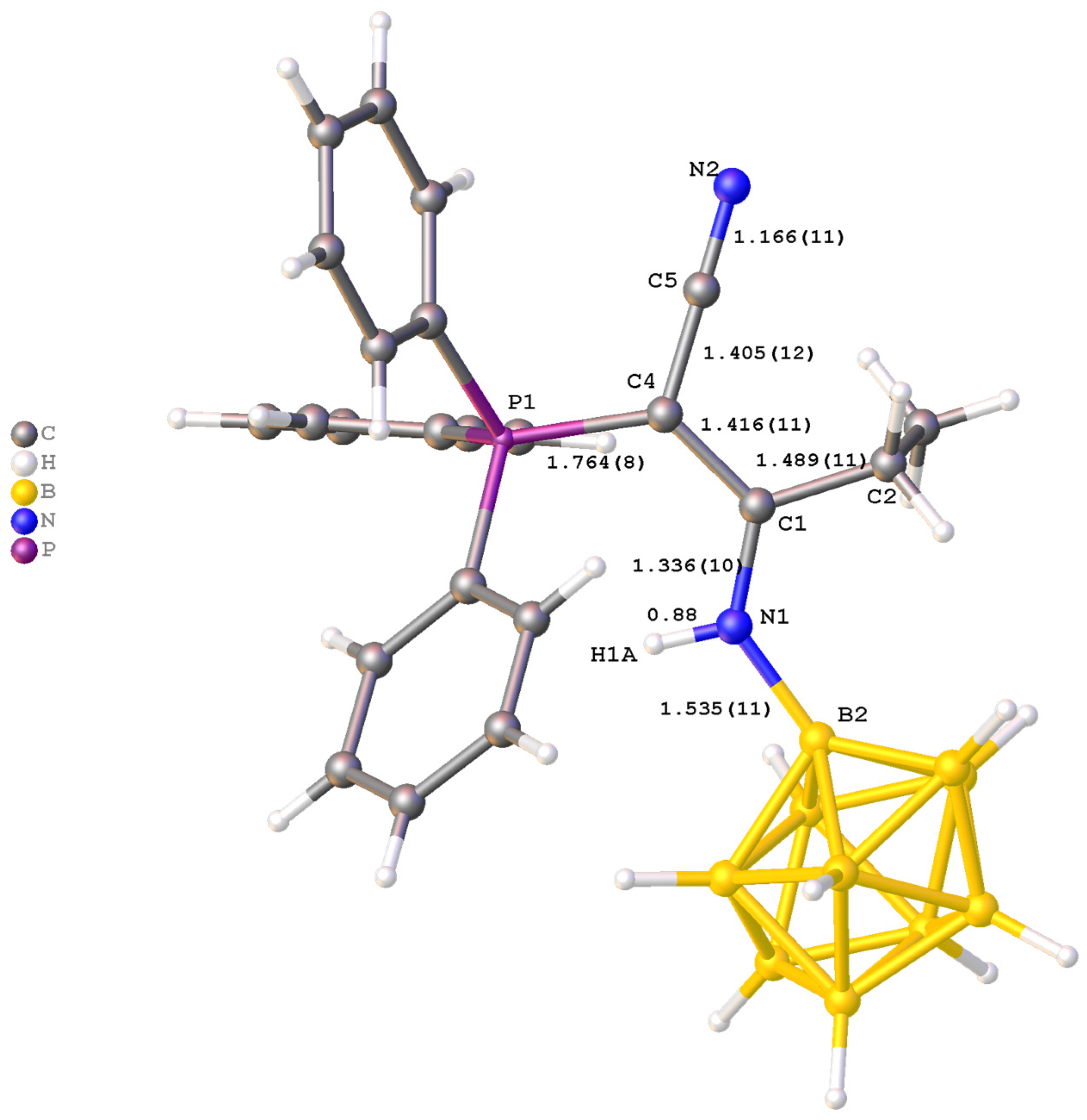
In the molecular structure of (Bu4N)(4b), the substituent in the boron cluster anion is also in an equatorial position (Figure 3). The N(1)–B(2) bond length is 1.535(11) Å, which is typical for a single B–N bond with an sp2-hybridized nitrogen atom. The bond lengths N(1)–C(1) and C(1)–C(4) (1.336(10) and 1.416(11) Å, respectively) indicate an intermediate bond order between single and double. The N(1)–C(1) bond demonstrates a pronounced double bond character, while the C(1)–C(4) bond is closer to a single Csp2–Csp2 bond. The C(4)–C(5) bond length (1.405(12) Å) also has an intermediate character between single and double, while the C(5)–N(2) bond length (1.166(11) Å) corresponds to a triple C≡N bond.
The iminoacylated ylide fragment is almost planar, as evidenced by the torsional angles:
B(2)N(1)C(1)C(4): −177.8(9)°;
N(1)C(1)C(4)C(5): −174.2(9)°;
C(1)C(4)C(5)N(2): 179.3(11)°.
All key atoms N(1), C(1), C(4), C(5), and N(2) are in a trans-conformation relative to each other, forming a fully conjugated π-system. The bond lengths and angles in the phenyl substituents at the phosphorus atom P(1) are typical for such structures.
The comparison of (Ph4P)(3a) and (Bu4N)(4b) reveals that the spatial arrangement of the ylide substituent is governed by a balance between electronic conjugation and steric requirements. In (Ph4P)(3a), the ylide fragment adopts a specific E-conformation (relative to the C(1)-C(3) bond), locked by the intramolecular N–H···O hydrogen bond. This conformation creates a planar, six-membered pseudo-cyclic ring that rigidly extends from the boron cage. This rigid planar geometry has significant steric implications. The bulky triphenylphosphonium group is positioned anti to the boron cluster relative to the C(1)–C(3) bond axis to minimize steric hindrance with the cage. Consequently, the phosphorus atom and its three phenyl rings effectively shield one face of the ylidic carbon, while the boron cluster shields the “tail” of the substituent. This steric effect restricts rotation around the P–C and C–C bonds, locking the substituent into a fixed orientation that is optimal for π-overlap but effectively inaccessible to external nucleophiles. This steric protection is a key factor in the remarkable hydrolytic and thermal stability of these compounds, preventing the typical degradation pathways (like hydrolysis) often seen in non-stabilized ylides.
The synthesis of these derivatives confirms that the chosen strategy is a powerful method for functionalizing closo-decaborate anion. The combination of resonance stabilization, intramolecular H-bonding (locking the conformation), and steric shielding (by PPh3 and the boron cage) renders these substituents chemically inert to hydrolysis and oxidation while maintaining specific reactivity for sensing applications.

2.3. Potentiometric Response Characteristics of the Sensors

The measurements were conducted using a measuring electrode fitted with a membrane, with both the measuring and reference electrodes simultaneously immersed in the sample solution. The solution was continuously stirred during the measurements. The measurement was continued until a stable reading was obtained on the instrument: 20–40 s for concentrations between 10−2 and 10−5, and 45–60 s for concentrations between 10−6 and 10−8. After the measurements, the electrodes were rinsed with deionized water and reused.
The tetraphenylphosphonium (TPP) ion-selective membrane sensors were calibrated, and the potentiometric selectivity coefficients were determined. The potentiometric response characteristics of the sensor were found to be dependent on the amount of the membrane active compound—TPP[B10H9NH=C(CH3)C(COOC2H5)=PPh3] in the membrane composition (Table 1).
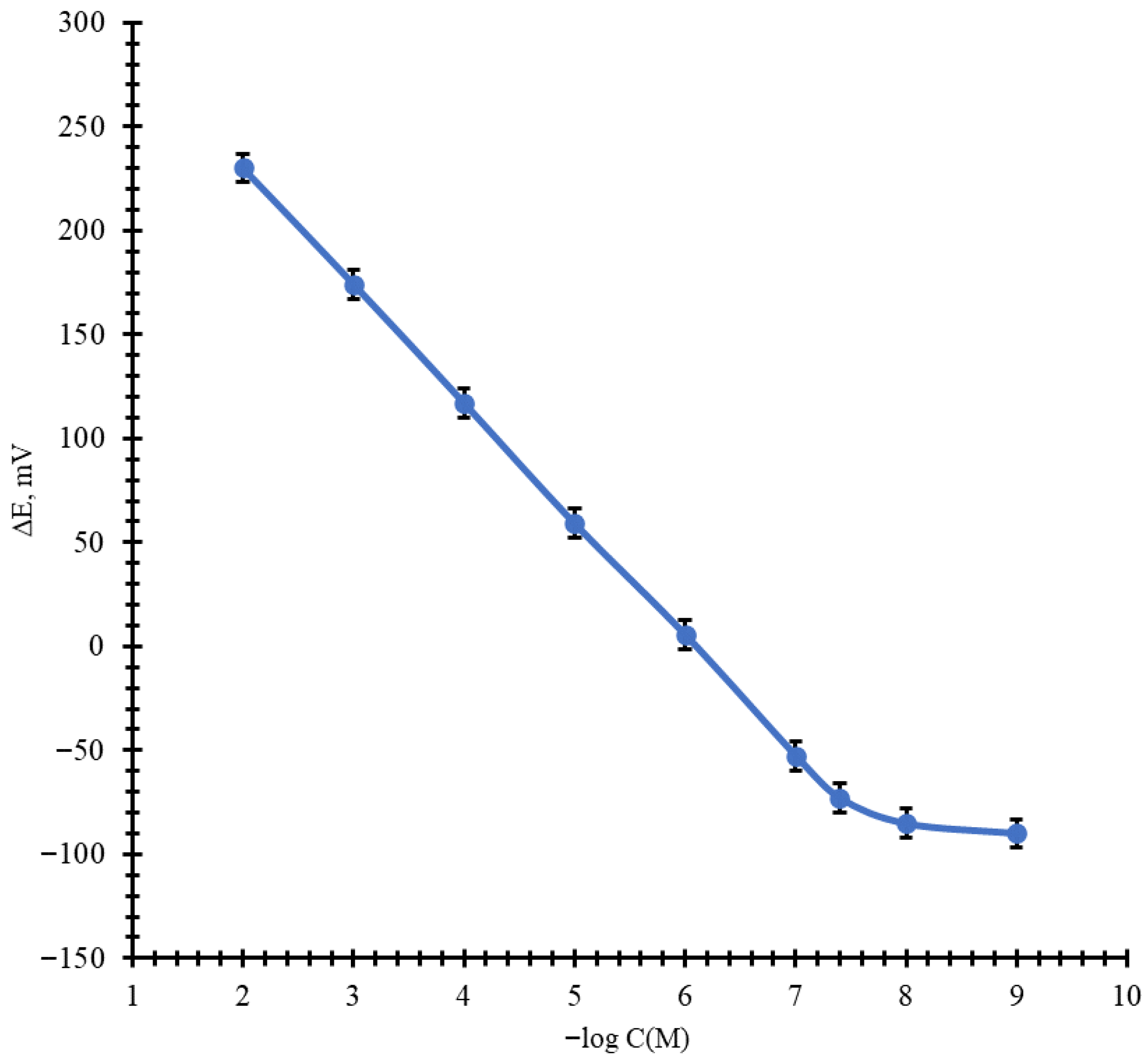
As follows from the results obtained, the sensor based on the membrane No. 2 (Figure 4) exhibited optimal characteristics. This sensor showed a near-Nernstian response in the concentration range of 1 × 10⁻⁷–1 × 10⁻² mol/L in the pH range of 4.0–7.5, and the lower detection limit (LOD) of 3 × 10⁻⁸ mol/L.
The average calibration curve was constructed from 50 measurements. The measured potential values differ by no more than ±0.3 mV. The potential for concentrations of 10−2–10−5 stabilizes within 15–30 s, for concentrations of 10−5–10−7 within 30–60 s. The TPP sensor with membrane No. 2 was studied for 6 months (100 measurements), and the potential drift was no more than ±2 mV. Averaged calibration curves for other compositions are provided in the Supplementary Materials (Figure S53).
The interference of some common cations on the sensor response was studied by the mixed solution method [47]. The potentiometric measurements were carried out using test solutions containing the constant concentration of an interfering cation (0.01 mol/L). The calculated selectivity coefficients values (pKpot TPP, Cation) are shown in Table 2. These values clearly indicate that the TPP sensor is fairly selective to TPP cations over the different tested cations. The selectivity coefficients were calculated using 5 measurements. The errors in calculating the selectivity coefficients (pKpot TPP/Cation) were no more than ±0.1. A graphical method for determining the selectivity coefficients is provided in the Supplementary Materials (Figures S54–S66).
The interfering ions were chosen to reflect the most common inorganic cations present in environmental and laboratory aqueous media (alkali/alkaline-earth ions, NH4+, H+), and ions of different charge that may alter membrane ion-exchange equilibria. Bu4N+ was included as a representative lipophilic organic monovalent cation to evaluate competitive extraction/ion pairing with the target TPP+.
Selective determination of TPP in the presence of TBA can be quite challenging because both cations are lipophilic, organic, and singly charged. However, tetraphenylphosphonium is frequently used as an analytical reagent in extractive spectrophotometry for the detection of various metals [48,49,50].
The use of TPP[B10H9NH=C(CH3)C(COOC2H5)=PPh3] allows for the selective identification of TPP+ in the presence of Bu4N+ with a selectivity coefficient (pKpot TPP/Cation) of 2.3. This is achieved thanks to TPP[B10H9NH=C(CH3)C(COOC2H5)=PPh3], which acts as an ion pair. Its lipophilic anionic component is water-insoluble and remains stable over time, maintaining a stable equilibrium between TPP+ ions in the membrane phase and the solution.
The low detection limit is attributed to the low content of this membrane component, just 1%, which reduces ion diffusion from the membrane into the solution when there is zero current.
The proposed TPP-selective membrane sensor offers valuable performance features, making it effective for the quick detection of tetraphenylphosphonium chloride, whether in its pure form or in complex salt solutions.
The sensing mechanism can be described within the classical PVC-membrane ISE concept. The membrane incorporates a lipophilic anionic species (the functionalized closo-decaborate), which provides ion-exchange/ion-association sites for bulky organic cations. Upon contact with the sample, TPP+ is preferentially extracted into the membrane phase and forms an ion pair with the lipophilic anion, giving rise to a phase-boundary potential. The near-Nernstian slope observed for TPP+ is consistent with the response expected for a monovalent cation. The selectivity pattern (including discrimination against Bu4N+) is attributed to differences in the partitioning/ion-pairing equilibria of competing cations in the plasticized PVC membrane.
Some undoubtedly interesting questions remain open. One such question is the mechanism of ion exchange of the large TPP cation between the membrane and solution phases. It is known that the boron cluster carries a permanent negative charge and participates in electrostatic interactions. Additionally, the specific distribution of the functionalized boron cluster within the polymer matrix—whether it is homogeneously dispersed or forms aggregates—has not yet been characterized by surface analysis methods (e.g., SEM/EDX). The influence of such microstructural factors on the sensitivity and selectivity needs further exploration. We hope that these questions will attract the interest of researchers, and that answers to them will facilitate the development of functional materials with specific electroanalytical properties.

3. Materials and Methods

3.1. NMR Spectroscopy

1H, 31P{1H}, 13C{1H}, 11B{1H} NMR spectra of solutions in CD2Cl2 or (CD3)2CO were recorded on a q-ONE AS400 Quantum I Plus spectrometer (Q.One Instruments Ltd., Wuhan, China) at frequencies of 399.879; 161.874; 100.549; 128.297 MHz, respectively, with internal deuterium stabilization. TMS, 85% phosphoric acid and BF3·OEt2 were used as external standards, respectively.

3.2. High-Resolution Mass Spectroscopy

High-resolution mass spectra were recorded on a LCMS-9030 device (Shimadzu, Kyoto, Japan) by electrospray ionization mass spectrometry (ESI-MS). Measurements were carried out in negative and positive ion mode; samples were dissolved in acetonitrile and injected into the mass-spectrometer chamber from an HPLC system LC-40 Nexera (Shimadzu, Kyoto, Japan). The following parameters were used: capillary voltage −3.0 kV (4 kV for positive ions); mass scanning range: m/z 50–1000; external calibration with a NaI solution in MeOH/H2O; drying and heating gases (nitrogen) (each 10 L/min); nebulizing gas (nitrogen) (3 L/min); interface temperature: 250 °C; and flow rate 100% acetonitrile or (50:50 (v/v) acetonitrile/water 0.4 mL/min. Molecular ions in the spectra were analyzed and matched with the appropriately calculated m/z and isotopic profiles in the LabSolutions v.5.114 program.

3.3. X-Ray Diffraction Experiments

Diffraction data were collected at 20 °C on a Bruker KAPPA APEX II automatic four-circle diffractometer equipped with a CCD area detector (Bruker AXS Inc.: Madison, WI, USA) (MoKα radiation, λ = 0.71073 Å) [51]. The experiment was performed at the Center for the collective use of physical methods of research of the Frumkin Institute of Physical Chemistry and Electrochemistry of the Russian Academy of Sciences (IPCE RAS). The unit cell parameters were refined using the entire data set [52]. The structure was solved by the direct method [53] and refined by full-matrix least-squares on F2 in the anisotropic approximation for all non-hydrogen atoms [54]. The hydrogen atoms of the boron cluster were located from difference Fourier maps and refined isotropically, with Uiso(H) = 1.2 Ueq(B). The positions of the hydrogen atoms in the organic part of the molecule were calculated geometrically, and their isotropic thermal parameters were set to Uiso(H) = 1.2 Ueq(C) for CH2 groups and 1.5 Ueq(C) for methyl groups. The absolute structure was not determined. Crystal structure images were prepared using the OLEX2 software package (version 1.5) [55].
Single crystals suitable for analysis were grown by isothermal crystallization from an acetonitrile/1-hexanol solvent mixture. The atomic coordinates have been deposited with the Cambridge Crystallographic Data Centre (CCDC 2497196 and 2497197). Key crystallographic data are presented in Table S1.

3.4. Potentiometric Characteristic Measurements

Working standard solutions of tetraphenylphosphonium chloride (TPPCl) were prepared in a concentration range of 10−1–10−8 mol/L by serial dilution. Constant pH and ionic strength were maintained during the measurements.
The electrode membranes were fabricated using a standard potentiometric technique [56]. To prepare a PVC-matrix membrane, a weighted sample of the closo-decaborate salt (7.5–30.0 mg) was dissolved in 1.0 mL of bis(1-butylpentyl) adipate (BBPA) plasticizer. This solution was then mixed with a solution of 435 mg of PVC in 10 mL of tetrahydrofuran (THF). The resulting membrane cocktail was degassed by sonication for 30 min and cast into a glass ring (28 mm i.d.) fixed on a Petri dish. The solvent was allowed to evaporate at room temperature for approximately 48 h to form a polymer film with a thickness of about 300 µm. To ensure the reproducibility of the potentiometric characteristics, the homogeneity of the mixture and the evaporation rate of THF were carefully controlled.
Disks with a diameter of 6 mm were punched from the master film and mounted in a standard Philips IS 561 electrode body. The body was filled with an inner solution (10 mM KCl, 1.0 mM TPPCl). Before use, the assembled sensor was conditioned in a 1.0 mM TPPCl solution for 24 h and subsequently rinsed with distilled water.
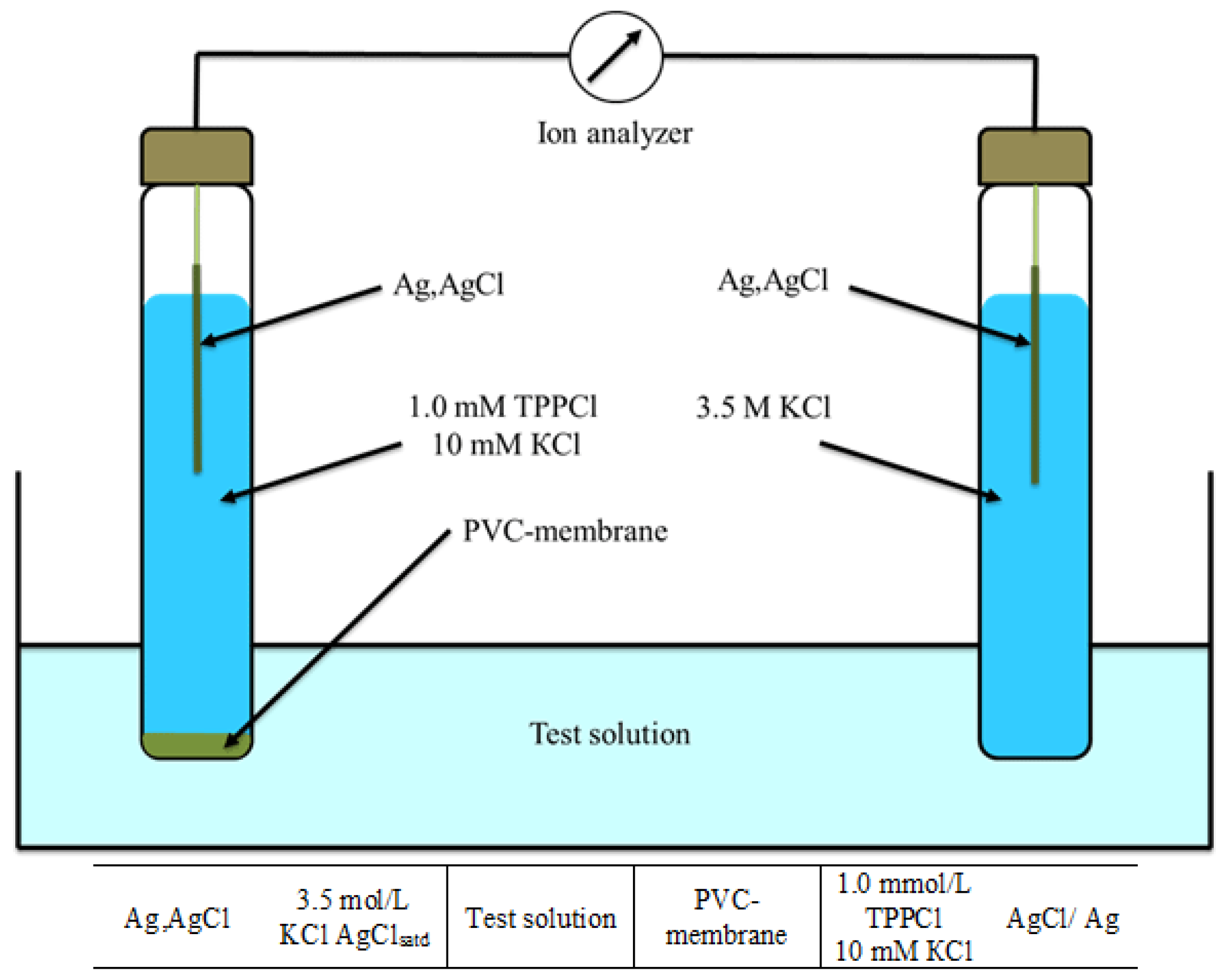
Potential measurements were carried out at 21 ± 1 °C in stirred solutions using a Radelkis OP-300 pH/ion analyzer (Budapest, Hungary). The electromotive force (EMF) was measured under zero-current conditions for the electrochemical cell shown in Figure 5. A Radelkis OP 0820 silver/silver chloride electrode (Radelkis Kft., Budapest, Hungary) served as the external reference electrode. The potential was recorded after stabilizing to within ±0.2 mV. Calibration plots were constructed by plotting the potential versus −log[TPPCl]. All electroanalytical parameters were determined in accordance with IUPAC recommendations [47].

3.5. Materials

Ethyl bromoacetate (Aldrich, St. Louis, MO, USA, 98%), chloroacetonitrile (Aldrich, 99%), and triphenylphosphine (Aldrich, 99%) were used without additional purification. All solvents were purified according to the literature method [57]. Phosphorus ylides were prepared according to literature procedures [58] (for Ph3P=CH-COOEt (2a)) and [59] (for Ph3P=CH-CN (2b). Nitrilium derivatives of closo-decaborate anions were synthesized by known procedures [30,60].

3.6. General Synthetic Procedure for Compounds (Bu4N)[2-B10H9NH=C(R1)C(PPh3)R2] (R2 = COOEt, R1 = Me (3a), Et (3b), nPr (3c), Ph (3e); R2 = CN, R1 = Me (4a), Et (4b), nPr (4c), Ph (4e)), (Ph4P)[2-B10H9NH=C(Me)C(PPh3)COOEt] (Ph4P)3(a)

A solution of the respective nitrilium derivative (0.65 mmol) and the phosphorus ylide (0.65 mmol) in dichloromethane (5 mL) was stirred for 30 min under a dry argon atmosphere at room temperature. The solution was then concentrated under reduced pressure, and the residue was purified by flash chromatography on silica gel, eluting with a mixture of DCM/acetonitrile (5:1). The collected target fraction was concentrated, and the product was recrystallized from an ethanol/isopropanol mixture and dried over P2O5.

3.7. Synthetic Procedure for Compounds (Bu4N)[2-B10H9NH=C(iPr)C(PPh3)R2] (R2 = COOEt (3d), CN (4d))
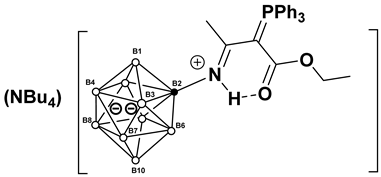
A solution of the nitrilium derivative 2d (0.5 mmol) and the phosphorus ylide (2.5 mmol) in MeCN (5 mL) was stirred for 5 h under a dry argon atmosphere at 70 °C. The solution was concentrated under reduced pressure, and the residue was purified by flash chromatography on silica gel, eluting with a mixture of DCM/acetonitrile (5:1). The collected target fraction was concentrated, and the product was recrystallized from an ethanol/isopropanol mixture and dried over P2O5.
Molecules 31 00231 i001
(Bu4N)[2-B10H9NHC(Ph3PCCOOEt)CH3)] (3a). Yield 340 mg (91%).
11B [1H]-NMR (CD2Cl2) δ (ppm): −0.6 (s, 1B, B(10)), −3.4 (s, 1B, B(1)), −14.1 (s, 1B, B(2)), −25.3 (s, 4B, B(3,5,6,9)), −28.3 (s, 3B, B(4,7,8)). 1H-NMR (CD2Cl2) δ (ppm): 10.23 (s, 1H, NH), 7.74, 7.65, 7.56 (m, 15H, (C6H5)3P), 3.55 (q, 2H, OCH2CH3, J = 7.2 Hz), 3.18 (8H, NBu4), 1.63, 1.62 (m, 11H, NHCCH3 + NBu4), 1.46 (8H, NBu4), 1.00 (12H, NBu4), 0.48 (t, 3H, OCH2CH3, J = 7.2 Hz). 13C NMR (CD2Cl2) δ (ppm): 172.9 (d, C=O, JC-P = 16.7 Hz), 168.8 (d, NH=C, JC-P = 10.7 Hz), 133.9 (d, (C6H5)3P JC-P = 9.9 Hz), 133.5 (d, (C6H5)3P, JC-P = 3.2 Hz), 129.8 (d, (C6H5)3P, JC-P = 12.3 Hz), 125.9 (d, (C6H5)3P, JC-P = 92.2 Hz), 63.0 (d, C-C=O, JC-P = 124.8 Hz), 59.6 (OCH2CH3), 59.4 (NBu4), 24.6 (NBu4), 24.1 (d, NHCCH3, JC-P = 3.2 Hz), 20.3 (NBu4), 14.0 (NBu4), 13.8 (OCH2CH3). 31P NMR (CD2Cl2) δ (ppm): 18.6. HRMS (ESI) (m/z): 506.3260 (A refers to the molecular weight of [(B10H9NHCCH3(C6H5)3PCCOOC2H5)], calculated for [A] 506.3252), 1035.6416 (calculated for {2[A]+Na]} 1035.6402).
Molecules 31 00231 i002
(Ph4P)[2-B10H9NHC(Ph3PCCOOEt)CH3)] Ph4P(3a). Yield 380 mg (95%).
11B[1H]-NMR ((CD3)2CO) δ (ppm): 0.1 (s, 1B, B(10)), −3.6 (s, 1B, B(1)), −13.9 (s, 1B, B(2)), −24.9 (s, 4B, B(3,5,6,9)), −28.2 (s, 3B, B(4,7,8)). 1H-NMR ((CD3)2CO) δ (ppm): 10.41 (s, 1H, NH), 8.01, 7.88, 7.85, 7.74, 7.69 (m, 35H, (C6H5)3P + Ph4P), 3.46 (q, 2H, OCH2CH3, J = 7.2 Hz), 1.66 (s, 3H, NHCCH3), 0.43 (t, 3H, OCH2CH3, J = 7.2 Hz).
Molecules 31 00231 i003
(Bu4N)[2-B10H9NHC(Ph3PCCOOEt)C2H5)] (3b). Yield 325 mg (85%).
11B[1H]-NMR (CD2Cl2) δ (ppm): −0.6 (s, 1B, B(10)), −2.9 (s, 1B, B(1)), −14.2 (s, 1B, B(2)), −25.1 (s, 4B, B(3,5,6,9)), −27.9 (s, 3B, B(4,7,8)). 1H-NMR (CD2Cl2) δ (ppm): 10.24 (s, 1H, NH), 7.72, 7.65, 7.55 (m, 15H, (C6H5)3P), 3.52 (q, 2H, OCH2CH3, J = 7.2 Hz), 3.17 (8H, NBu4), 2.19 (q, 2H, NH=CCH2CH3, J = 7.4 Hz), 1.61 (8H, NBu4), 1.45 (8H, NBu4), 1.00 (12H, NBu4), 0.68 (t, 3H, NH=CCH2CH3, J = 7.4 Hz), 0.48 (t, 3H, OCH2CH3, J = 7.2 Hz). 13C NMR (CD2Cl2) δ (ppm): 178.5 (d, C=O, JC-P = 16.7 Hz), 169.0 (d, NH=C, JC-P = 10.3 Hz), 133.8 (d, (C6H5)3P JC-P = 9.5 Hz), 133.4 (d, (C6H5)3P, JC-P = 3.2 Hz), 129.8 (d, (C6H5)3P, JC-P = 12.3 Hz), 126.4 (d, (C6H5)3P, JC-P = 92.2 Hz), 61.2 (d, C-C=O, JC-P = 124.0 Hz), 59.7 (OCH2CH3), 59.3 (NBu4), 26.7 (d, NHCCH2CH3, JC-P = 3.2 Hz), 24.6 (NBu4), 20.3 (NBu4), 14.0 (NBu4), 13.6 (NHCCH2CH3 + OCH2CH3). 31P NMR (CD2Cl2) δ (ppm): 17.9. HRMS (ESI) (m/z): 520.3413 (A refers to the molecular weight of [(B10H9NHCC2H5(C6H5)3PCCOOC2H5)], calculated for [A] 520.3409), 632.3180 (calculated for {[A] + Na + 2HCOO-H]} 632.3181), 1063.6724 (calculated for {2[A] + Na]} 1063.6712).
Molecules 31 00231 i004
(Bu4N)[2-B10H9NHC(Ph3PCCOOEt)nC3H7)] (3c). Yield 352 mg (90%).
11B[1H]-NMR (CD2Cl2) δ (ppm): −0.6 (s, 1B, B(10)), −3.0 (s, 1B, B(1)), −14.2 (s, 1B, B(2)), −25.3 (s, 4B, B(3,5,6,9)), −27.9 (s, 3B, B(4,7,8)). 1H-NMR (CD2Cl2) δ (ppm): 10.29 (s, 1H, NH), 7.70, 7.65, 7.55 (m, 15H, (C6H5)3P), 3.52 (q, 2H, OCH2CH3, J = 7.1 Hz), 3.17 (8H, NBu4), 2.09 (m, 2H, NH=CCH2CH2CH3), 1.61 (8H, NBu4), 1.45 (8H, NBu4), 1.21 (m, 2H, NH=CCH2CH2CH3), 1.00 (12H, NBu4), 0.41 (t, 6H, OCH2CH3 + NHCCH2CH2CH3, J = 7.2 Hz). 13C NMR (CD2Cl2) δ (ppm): 177.2 (d, C=O, JC-P = 16.7 Hz), 169.0 (d, NH=C, JC-P = 10.3 Hz), 133.8 (d, (C6H5)3P JC-P = 9.9 Hz), 133.3 (d, (C6H5)3P, JC-P = 3.2 Hz), 129.8 (d, (C6H5)3P, JC-P = 12.7 Hz), 126.6 (d, (C6H5)3P, JC-P = 92.2 Hz), 61.4 (d, C-C=O, JC-P = 123.6 Hz), 59.7 (OCH2CH3), 59.3 (NBu4), 35.1 (NHCCH2CH2CH3), 24.6 (NBu4), 22.4 (NHCCH2CH2CH3), 20.3 (NBu4), 14.0 (NBu4), 13.8 (OCH2CH3), 13.6 (NHCCH2CH2CH3). 31P NMR (CD2Cl2) δ (ppm): 17.9. HRMS (ESI) (m/z): 535.3542 (A refers to the molecular weight of [(B10H9NHCC3H7(C6H5)3PCCOOC2H5)], calculated for [A] 535.3565), 647.3308 (calculated for {[A] + Na + 2HCOO-H]} 647.3301), 1092.6996 (calculated for {2[A] + Na]} 1092.6992).
Molecules 31 00231 i005
(Bu4N)[2-B10H9NHC(Ph3PCCOOEt)iC3H7)] (3d). Yield 311 mg (80%).
11B[1H]-NMR (CD2Cl2) δ (ppm): −0.6 (s, 1B, B(10)), −2.3 (s, 1B, B(1)), −13.9 (s, 1B, B(2)), −25.1 (s, 4B, B(3,5,6,9)), −27.7 (s, 3B, B(4,7,8)). 1H-NMR (CD2Cl2) δ (ppm): 8.81 (s, 1H, NH), 7.71, 7.66, 7.55 (m, 15H, (C6H5)3P), 3.59 (q, 2H, OCH2CH3, J = 7.1 Hz), 3.15 (8H, NBu4), 3.02 (m, 1H, NH=CCH(CH3)2), 1.60 (8H, NBu4), 1.44 (8H, NBu4), 1.13 (d, 6H, NH=CCH(CH3)2, J = 7.1 Hz), 1.00 (12H, NBu4), 0.61 (t, 3H, OCH2CH3, J = 7.1 Hz). 13C NMR (CD2Cl2) δ (ppm): 183.3 (d, C=O, JC-P =12.3 Hz), 168.4 (d, NH=C, JC-P = 11.5 Hz), 133.7 (d, (C6H5)3P, JC-P =9.9 Hz), 133.2 (d, (C6H5)3P, JC-P = 3.2 Hz), 129.9 (d, (C6H5)3P, JC-P = 12.7 Hz), 125.9 (d, (C6H5)3P, JC-P = 91.8 Hz), 60.6 (d, C-C=O, JC-P = 122.4 Hz), 59.5 (OCH2CH3), 59.3 (NBu4), 37.4 (d, NH=CH(CH3)2, JC-P = 4.7 Hz), 24.6 (NBu4), 20.2 (NBu4), 19.2 (NH=CH(CH3)2), 14.0 (NBu4 + OCH2CH3). 31P NMR (CD2Cl2) δ (ppm): 18.4. HRMS (ESI) (m/z): 535.3542 (A refers to the molecular weight of [(B10H9NHCC3H7(C6H5)3PCCOOC2H5)], calculated for [A] 535.3565), 647.3308 (calculated for {[A] + Na + 2HCOO-H]} 647.3301), 1092.7005 (calculated for {2[A] + Na]} 1092.6992).
Molecules 31 00231 i006
(Bu4N)[2-B10H9NHC(Ph3PCCOOEt)C6H5)] (3e). Yield 353 mg (87%).
11B[1H]-NMR (CD2Cl2) δ (ppm): −1.0 (s, 1B, B(10)), −2.5 (s, 1B, B(1)), −13.9 (s, 1B, B(2)), −25.3 (s, 4B, B(3,5,6,9)), −28.0 (s, 2B, B(7,8)), −30.1 (s, 1B, B(4)). 1H-NMR (CD2Cl2) δ (ppm): 10.43 (s, 1H, NH), 7.49, 7.46, 7.38 (m, 15H, (C6H5)3P), 6.99, 6.83, 6.73 (m, 5H, NH=C-C6H5), 3.57 (q, 2H, OCH2CH3, J = 7.1 Hz), 3.10 (8H, NBu4), 1.57 (8H, NBu4), 1.41 (8H, NBu4), 0.99 (12H, NBu4), 0.44 (t, 3H, OCH2CH3, J = 7.2 Hz). 13C NMR (CD2Cl2) δ (ppm): 174.6 (d, C=O, JC-P = 16.7 Hz), 169.2 (d, NH=C, JC-P = 10.9 Hz), 135.9 (NH=C-C6H5), 133.6 (d, (C6H5)3P JC-P=9.5 Hz), 132.7 (d, (C6H5)3P, JC-P = 3.2 Hz), 130.6 (NH=C-C6H5), 129.4 (d, (C6H5)3P, JC-P = 12.3 Hz), 129.3 (NH=C-C6H5), 127.8 (NH=C-C6H5), 125.5 (d, (C6H5)3P, JC-P = 93.0 Hz), 63.7 (d, C-C=O, JC-P = 111.7 Hz), 60.0 (OCH2CH3), 59.3 (NBu4), 24.6 (NBu4), 20.3 (NBu4), 14.0 (NBu4), 13.6 (OCH2CH3). 31P NMR (CD2Cl2) δ (ppm): 19.4. HRMS (ESI) (m/z): 535.3542 (A refers to the molecular weight of [(B10H9NHCC3H7(C6H5)3PCCOOC2H5)], calculated for [A] 535.3565), 647.3308 (calculated for {[A] + Na + 2HCOO-H]} 647.3301), 1092.6996 (calculated for {2[A] + Na]} 1092.6992).
Molecules 31 00231 i007
(Bu4N)[2-B10H9NHC(Ph3PCCN)CH3)] (4a). Yield 327 mg (93%).
11B[1H]-NMR (CD2Cl2) δ (ppm): −0.6 (s, 1B, B(10)), −3.7 (s, 1B, B(1)), −13.8 (s, 1B, B(2)), −25.4 (s, 4B, B(3,5,6,9)), −28.8 (s, 3B, B(4,7,8)). 1H-NMR (CD2Cl2) δ (ppm): 7.78, 7.62, 7.59 (m, 15H, (C6H5)3P), 6.91 (s, 1H, NH), 3.14 (8H, NBu4), 2.15 (br.s, 3H, NH=CCH3), 1.60 (8H, NBu4), 1.43 (8H, NBu4), 0.99 (12H, NBu4). 13C NMR (CD2Cl2) δ (ppm): 174.3 (NH=C), 135.0 (C6H5)3P), 134.2 (d, (C6H5)3P, JC-P = 10.3 Hz), 130.5 (d, (C6H5)3P, JC-P = 12.7 Hz), 121.3 (C-CN), 119.9 ((C6H5)3P), 59.3 (NBu4), 44.0 (d, C-CN, JC-P = 120.7 Hz), 24.5 (NBu4), 22.4 (d, NHCCH3, JC-P = 4.4 Hz), 20.2 (NBu4), 14.0 (NBu4). 31P NMR (CD2Cl2) δ (ppm): 17.0. HRMS (ESI) (m/z): 459.3002 (A refers to the molecular weight of [(B10H9NHCCH3(C6H5)3PCCN)], calculated for [A] 459.2993).
Molecules 31 00231 i008
(Bu4N)[2-B10H9NHC(Ph3PCCN)C2H5)] (4b). Yield 320 mg (89%).
11B[1H]-NMR (CD2Cl2) δ (ppm): −0.7 (s, 1B, B(10)), −3.6 (s, 1B, B(1)), −14.3 (s, 1B, B(2)), −25.4 (s, 4B, B(3,5,6,9)), −28.7 (s, 2B, B(7,8)), −30.0 (s, 1B, B(4)). 1H-NMR (CD2Cl2) δ (ppm): 7.79, 7.65, 7.54 (m, 15H, (C6H5)3P), 5.79 (s, 1H, NH), 3.13 (10H, NH=CCH2CH3 + NBu4), 1.58 (8H, NBu4), 1.44 (8H, NBu4), 1.30 (br.m, 3H, NH=CCH2CH3), 0.98 (12H, NBu4). 13C NMR (CD2Cl2) δ (ppm): 180.7 (NH=C), 135.2 (C6H5)3P), 134.3 (d, (C6H5)3P, JC-P = 10.7 Hz), 130.7 (d, (C6H5)3P, JC-P = 12.7 Hz), 120.4 (d, (C6H5)3P, JC-P = 89.0 Hz), 120.5 (d, CN, JC-P = 13.9 Hz), 59.3 (NBu4), 43.1 (d, C-CN, JC-P = 120.4 Hz), 28.1 (NHCCH2CH3), 24.5 (NBu4), 20.2 (NBu4), 14.0 (NBu4), 12.8 (NHCCH2CH3). 31P NMR (CD2Cl2) δ (ppm): 16.9. HRMS (ESI) (m/z): 473.3157 (A refers to the molecular weight of [(B10H9NHCC2H5(C6H5)3PCCN)], calculated for [A] 473.3150).
Molecules 31 00231 i009
(Bu4N)[2-B10H9NHC(Ph3PCCN)nC3H7)] (4c). Yield 318 mg (87%).
11B[1H]-NMR (CD2Cl2) δ (ppm): −0.7 (s, 1B, B(10)), −3.6 (s, 1B, B(1)), −14.2 (s, 1B, B(2)), −25.3 (s, 4B, B(3,5,6,9)), −28.6 (s, 2B, B(7,8)), −29.7 (s, 1B, B(4)). 1H-NMR (CD2Cl2) δ (ppm): 7.78, 7.65, 7.56 (m, 15H, (C6H5)3P), 5.78 (s, 1H, NH), 3.11 (8H, NBu4), 3.05 (br.m, 2H, NH=CCH2CH2CH3), 1.78 (br.m, 2H, NH=CCH2CH2CH3), 1.58 (8H, NBu4), 1.44 (8H, NBu4), 0.99 (m, 15H, NBu4 + NH=CCH2CH2CH3). 13C NMR (CD2Cl2) δ (ppm): 179.3 (NH=C), 135.0 ((C6H5)3P,), 134.3 (d, (C6H5)3P, JC-P = 10.3 Hz), 130.5 (d, (C6H5)3P, JC-P = 13.1 Hz), 120.5 (d, (C6H5)3P, JC-P= 89.2 Hz), 120.3 (d, CN, JC-P = 12.7 Hz), 59.3 (NBu4), 44.1 (d, C-CN, JC-P = 120.0 Hz), 30.2 (NHCCH2CH2CH3), 24.5 (NBu4), 22.4 (NHCCH2CH2CH3).20.2 (NBu4), 14.0 (NBu4 + NHCCH2CH2CH3). 31P NMR (CD2Cl2) δ (ppm): 16.9. HRMS (ESI) (m/z): 487.3315 (A refers to the molecular weight of [(B10H9NHCC3H7(C6H5)3PCCN)], calculated for [A] 487.3306).
Molecules 31 00231 i010
(Bu4N)[2-B10H9NHC(Ph3PCCN)nC3H7)] (4d). Yield 300 mg (82%).
11B[1H]-NMR (CD2Cl2) δ (ppm): −0.9 (s, 1B, B(10)), −3.1 (s, 1B, B(1)), −14.2 (s, 1B, B(2)), −25.2 (s, 4B, B(3,5,6,9)), −28.9 (s, 2B, B(7,8)), −29.8 (s, 1B, B(4)). 1H-NMR (CD2Cl2) δ (ppm): 7.79, 7.65, 7.55 (m, 15H, (C6H5)3P), 5.73 (s, 1H, NH), 4.29 (m, 1H, NH=CCH(CH3)2), 3.11 (8H, NBu4), 1.58 (8H, NBu4), 1.42 (14H, NBu4 + NH=CCH(CH3)2), 1.00 (12H, NBu4). 13C NMR (CD2Cl2) δ (ppm): 183.6 (NH=C), 135.2 (d, (C6H5)3P, JC-P=3.2 Hz), 134.4 (d, (C6H5)3P, JC-P=10.4 Hz), 130.6 (d, (C6H5)3P, JC-P=13.1 Hz), 120.3 (d, (C6H5)3P, JC-P=90.2 Hz), 120.6 (CN), 59.3 (NBu4), 43.5 (d, C-CN, JC-P=120.3 Hz), 32.6 (NHCH(CH3)2), 24.5 (NBu4), 20.2 (NBu4), 18.8 (NHCH(CH3)2), 14.0 (NBu4). 31P NMR (CD2Cl2) δ (ppm): 19.4. HRMS (ESI) (m/z): 487.3314 (A refers to the molecular weight of [(B10H9NHCC3H7(C6H5)3PCCN)], calculated for [A] 487.3306).
Molecules 31 00231 i011
(Bu4N)[2-B10H9NHC(Ph3PCCN)C6H5)] (4e). Yield 351 mg (92%).
11B[1H]-NMR (CD2Cl2) δ (ppm): −1.6 (s, 1B, B(10)), −3.7 (s, 1B, B(1)), −14.0 (s, 1B, B(2)), −25.8 (s, 4B, B(3,5,6,9)), −29.0 (s, 2B, B(7,8)), −30.6 (s, 1B, B(4)). 1H-NMR (CD2Cl2) δ (ppm): 7.75, 7.63, 7.41 (br.m, 20H, (C6H5)3P+ NH=CC6H5), 6.09 (s, 1H, NH), 3.06 (8H, NBu4), 1.53 (8H, NBu4), 1.39 (8H, NBu4), 0.98 (12H, NBu4). 13C NMR (CD2Cl2) δ (ppm): 176.4 (NH=C), 134.3 (d, (C6H5)3P, JC-P = 10.3 Hz), 130.5, 127.9 ((C6H5)3P + NH=CC6H5), 120.4 (CN), 59.2 (NBu4), 46.1 (C-CN, JC-P = 122.8 Hz), 24.5 (NBu4), 20.2 (NBu4), 14.0 (NBu4). 31P NMR (CD2Cl2) δ (ppm): 17.4. HRMS (ESI) (m/z): 522.3113 (A refers to the molecular weight of [(B10H9NHCC6H5(C6H5)3PCCN)], calculated for [A] 522.3129).

4. Conclusions

In summary, we have developed a novel and efficient methodology for the functionalization of the closo-decaborate cluster via the nucleophilic addition of stabilized phosphorus ylides to its nitrilium derivatives. This reaction provides a direct and high-yielding route to a new family of boron–hybrid iminoacyl phosphoranes, which were comprehensively characterized. The study revealed a significant steric effect of the substituent R1 on the reactivity of the nitrilium precursor.
Furthermore, we demonstrated the practical utility of these novel hybrid materials by implementing one of the synthesized anions as a membrane-active component in ion-selective electrodes. The fabricated tetraphenylphosphonium sensor exhibited outstanding analytical performance, including a low detection limit, high selectivity, and a wide linear range. This work not only expands the chemistry of boron clusters by introducing a new class of functional derivatives but also paves the way for their application in electroanalytical chemistry, particularly in the determination of biologically and industrially relevant organic cations.

Supplementary Materials

The following supporting information can be downloaded at: https://www.mdpi.com/article/10.3390/molecules31020231/s1, the supplementary information includes NMR spectra, ESI-HRMS spectra, crystal structure data files, and raw potentiometric data.

Author Contributions

Manuscript conception, A.P.Z.; writing and original draft preparation, V.V.V., I.N.K., E.S.T. and A.P.Z.; synthesis of derivatives V.V.V. and A.P.Z.; NMR analysis, N.A.S. and A.Y.B.; potentiometric measurements E.S.T. and S.S.N.; X-ray analysis M.S.G.; editing, data analysis, and interpretation, A.P.Z., K.Y.Z. and N.T.K.; supervision, K.Y.Z. and N.T.K. All authors have read and agreed to the published version of the manuscript.

Funding

This article was prepared within the project “The ‘Clean Water’ project as the most important component of cooperation between the Russian Federation and the countries of the Global South: socio-economic and technological dimensions” supported by a grant from the Ministry of Science and Higher Education of the Russian Federation program for research projects in priority areas of scientific and technological development (Agreement № 075-15-2024-546).

Institutional Review Board Statement

Not applicable.

Informed Consent Statement

Not applicable.

Data Availability Statement

Date on the compounds are available from the authors.

Conflicts of Interest

The authors declare no conflicts of interest.

References

  1. Druzina, A.A.; Grammatikova, N.E.; Zhidkova, O.B.; Nekrasova, N.A.; Dudarova, N.V.; Kosenko, I.D.; Grin, M.A.; Bregadze, V.I. Synthesis and Antibacterial Activity Studies of the Conjugates of Curcumin with Closo-Dodecaborate and Cobalt Bis(Dicarbollide) Boron Clusters. Molecules 2022, 27, 2920. [Google Scholar] [CrossRef] [Scilit]
  2. Varkhedkar, R.; Yang, F.; Dontha, R.; Zhang, J.; Liu, J.; Spingler, B.; van der Veen, S.; Duttwyler, S. Natural-Product-Directed Catalytic Stereoselective Synthesis of Functionalized Fused Borane Cluster–Oxazoles for the Discovery of Bactericidal Agents. ACS Cent. Sci. 2022, 8, 322–331. [Google Scholar] [CrossRef] [Scilit]
  3. Voloshin, Y.Z. Alternative Approach to Avoid Drug Resistance: Polyhedral Inorganic and Metallomacrobicyclic 3D-Shaped Guests Strongly Binding to Allosteric Sites and/or Macromolecular Interfaces. Chem. Asian J. 2025, 20, e01842. [Google Scholar] [CrossRef] [Scilit] [PubMed]
  4. Avdeeva, V.V.; Garaev, T.M.; Breslav, N.V.; Burtseva, E.I.; Grebennikova, T.V.; Zhdanov, A.P.; Zhizhin, K.Y.; Malinina, E.A.; Kuznetsov, N.T. New Type of RNA Virus Replication Inhibitor Based on Decahydro-Closo-Decaborate Anion Containing Amino Acid Ester Pendant Group. JBIC J. Biol. Inorg. Chem. 2022, 27, 421–429. [Google Scholar] [CrossRef] [Scilit]
  5. Wang, Z.; Wang, Z.; Ma, X.; Liu, Y.; Zhang, H. Direct Conversion of Methane into Methanol and Ethanol via Spherical Au@Cs2[Closo-B12H12] and Pd@Cs2[Closo-B12H12] Nanoparticles. Int. J. Hydrogen Energy 2021, 46, 30750–30761. [Google Scholar] [CrossRef] [Scilit]
  6. Emin Kilic, M.; Jena, P. Catalytic Potential of [B12X11]2− (X = F, Cl, Br, I, CN) Dianions. J. Phys. Chem. Lett. 2023, 14, 8697–8701. [Google Scholar] [CrossRef] [Scilit] [PubMed]
  7. Deysher, G.; Chen, Y.-T.; Sayahpour, B.; Lin, S.W.-H.; Ham, S.-Y.; Ridley, P.; Cronk, A.; Wu, E.A.; Tan, D.H.S.; Doux, J.-M.; et al. Evaluating Electrolyte–Anode Interface Stability in Sodium All-Solid-State Batteries. ACS Appl. Mater. Interfaces 2022, 14, 47706–47715. [Google Scholar] [CrossRef] [Scilit]
  8. Duchêne, L.; Remhof, A.; Hagemann, H.; Battaglia, C. Status and Prospects of Hydroborate Electrolytes for All-Solid-State Batteries. Energy Storage Mater. 2020, 25, 782–794. [Google Scholar] [CrossRef] [Scilit]
  9. Maltsev, A.P.; Chepkasov, I.V.; Oganov, A.R. Order-Disorder Phase Transition and Ionic Conductivity in a Li2B12H12 Solid Electrolyte. ACS Appl. Mater. Interfaces 2023, 15, 42511–42519. [Google Scholar] [CrossRef] [Scilit]
  10. Dymova, M.A.; Taskaev, S.Y.; Richter, V.A.; Kuligina, E.V. Boron Neutron Capture Therapy: Current Status and Future Perspectives. Cancer Commun. 2020, 40, 406–421. [Google Scholar] [CrossRef] [Scilit]
  11. Zavjalov, E.; Zaboronok, A.; Kanygin, V.; Kasatova, A.; Kichigin, A.; Mukhamadiyarov, R.; Razumov, I.; Sycheva, T.; Mathis, B.J.; Maezono, S.E.B.; et al. Accelerator-Based Boron Neutron Capture Therapy for Malignant Glioma: A Pilot Neutron Irradiation Study Using Boron Phenylalanine, Sodium Borocaptate and Liposomal Borocaptate with a Heterotopic U87 Glioblastoma Model in SCID Mice. Int. J. Radiat. Biol. 2020, 96, 868–878. [Google Scholar] [CrossRef] [Scilit]
  12. Seneviratne, D.S.; Saifi, O.; Mackeyev, Y.; Malouff, T.; Krishnan, S. Next-Generation Boron Drugs and Rational Translational Studies Driving the Revival of BNCT. Cells 2023, 12, 1398. [Google Scholar] [CrossRef] [Scilit]
  13. Ryabchikova, M.N.; Nelyubin, A.V.; Klyukin, I.N.; Selivanov, N.A.; Bykov, A.Y.; Kubasov, A.S.; Skribitsky, V.A.; Finogenova, Y.A.; Shpakova, K.E.; Kasianov, A.A.; et al. Synthesis of New Promising BNCT Agents Based on Conjugates of Closo-Dodecaborate Anion and Aliphatic Diamino Acids. Int. J. Mol. Sci. 2024, 26, 68. [Google Scholar] [CrossRef] [Scilit] [PubMed]
  14. Semioshkin, A.A.; Sivaev, I.B.; Bregadze, V.I. Cyclic Oxonium Derivatives of Polyhedral Boron Hydrides and Their Synthetic Applications. Dalton Trans. 2008, 11, 977–992. [Google Scholar] [CrossRef] [Scilit]
  15. Olid, D.; Núñez, R.; Viñas, C.; Teixidor, F. Methods to Produce B–C, B–P, B–N and B–S Bonds in Boron Clusters. Chem. Soc. Rev. 2013, 42, 3318. [Google Scholar] [CrossRef] [Scilit] [PubMed]
  16. Kubasov, A.S.; Turishev, E.S.; Golubev, A.V.; Bykov, A.Y.; Zhizhin, K.Y.; Kuznetsov, N.T. The Method for Synthesis of 2-Sulfonium Closo-Decaborate Anions Derivatives with Exo-Polyhedral Aminogroups. Inorg. Chim. Acta 2020, 507, 119589. [Google Scholar] [CrossRef] [Scilit]
  17. Isono, A.; Tsuji, M.; Sanada, Y.; Matsushita, A.; Masunaga, S.; Hirayama, T.; Nagasawa, H. Design, Synthesis, and Evaluation of Lipopeptide Conjugates of Mercaptoundecahydrododecaborate for Boron Neutron Capture Therapy. ChemMedChem 2019, 14, 823–832. [Google Scholar] [CrossRef] [Scilit]
  18. Genady, A.R.; Ioppolo, J.A.; Azaam, M.M.; El-Zaria, M.E. New Functionalized Mercaptoundecahydrododecaborate Derivatives for Potential Application in Boron Neutron Capture Therapy: Synthesis, Characterization and Dynamic Visualization in Cells. Eur. J. Med. Chem. 2015, 93, 574–583. [Google Scholar] [CrossRef] [Scilit]
  19. Vöge, A.; Lork, E.; Sesalan, B.Ş.; Gabel, D. N-Arylammonio- and N-Pyridinium-Substituted Derivatives of Dodecahydro-Closo-Dodecaborate(2-). J. Organomet. Chem. 2009, 694, 1698–1703. [Google Scholar] [CrossRef] [Scilit]
  20. Hoffmann, S.; Justus, E.; Ratajski, M.; Lork, E.; Gabel, D. B12H11-Containing Guanidinium Derivatives by Reaction of Carbodiimides with H3N–B12H11(1−). A New Method for Connecting Boron Clusters to Organic Compounds. J. Organomet. Chem. 2005, 690, 2757–2760. [Google Scholar] [CrossRef] [Scilit]
  21. Kaszyński, P.; Ringstrand, B. Functionalization of Closo -Borates via Iodonium Zwitterions. Angew. Chem. Int. Ed. 2015, 54, 6576–6581. [Google Scholar] [CrossRef] [Scilit]
  22. Hietsoi, O.; Kapuściński, S.P.; Friedli, A.C.; Kaszyński, P. [Closo-B10H8-1,10-(NHC(NH2)Me)2]: A Rare Zwitterionic Amidinium Derivative. J. Mol. Struct. 2023, 1284, 135324. [Google Scholar] [CrossRef] [Scilit]
  23. Kapuściński, S.; Hietsoi, O.; Pietrzak, A.; Friedli, A.C.; Kaszyński, P. [Closo-B10H8-1,10-(COOH)2]2−: A Building Block for Functional Materials? Chem. Commun. 2022, 58, 851–854. [Google Scholar] [CrossRef] [Scilit]
  24. Ezhov, A.V.; Vyal’ba, F.Y.; Kluykin, I.N.; Zhdanova, K.A.; Bragina, N.A.; Zhdanov, A.P.; Zhizhin, K.Y.; Mironov, A.F.; Kuznetsov, N.T. Synthesis of New Bioinorganic Systems Based on Nitrilium Derivatives of Closo-Decaborate Anion and Meso-Arylporphyrins with Pendant Amino Groups. Macroheterocycles 2017, 10, 505–509. [Google Scholar] [CrossRef] [Scilit]
  25. Nelyubin, A.V.; Selivanov, N.A.; Bykov, A.Y.; Klyukin, I.N.; Novikov, A.S.; Zhdanov, A.P.; Karpechenko, N.Y.; Grigoriev, M.S.; Zhizhin, K.Y.; Kuznetsov, N.T. Primary Amine Nucleophilic Addition to Nitrilium Closo-Dodecaborate [B12H11NCCH3]−: A Simple and Effective Route to the New BNCT Drug Design. Int. J. Mol. Sci. 2021, 22, 13391. [Google Scholar] [CrossRef] [Scilit]
  26. Voinova, V.V.; Selivanov, N.A.; Plyushchenko, I.V.; Vokuev, M.F.; Bykov, A.Y.; Klyukin, I.N.; Novikov, A.S.; Zhdanov, A.P.; Grigoriev, M.S.; Rodin, I.A.; et al. Fused 1,2-Diboraoxazoles Based on Closo-Decaborate Anion–Novel Members of Diboroheterocycle Class. Molecules 2021, 26, 248. [Google Scholar] [CrossRef] [Scilit]
  27. Stogniy, M.Y.; Erokhina, S.A.; Sivaev, I.B.; Bregadze, V.I. Nitrilium Derivatives of Polyhedral Boron Compounds (Boranes, Carboranes, Metallocarboranes): Synthesis and Reactivity. Phosphorus Sulfur Silicon Relat. Elem. 2019, 194, 983–988. [Google Scholar] [CrossRef] [Scilit]
  28. Laskova, J.; Ananiev, I.; Kosenko, I.; Serdyukov, A.; Stogniy, M.; Sivaev, I.; Grin, M.; Semioshkin, A.; Bregadze, V.I. Nucleophilic Addition Reactions to Nitrilium Derivatives [B12H11NCCH3] and [B12H11NCCH2CH3]. Synthesis and Structures of Closo -Dodecaborate-Based Iminols, Amides and Amidines. Dalton Trans. 2022, 51, 3051–3059. [Google Scholar] [CrossRef] [Scilit] [PubMed]
  29. Mindich, A.L.; Bokach, N.A.; Kuznetsov, M.L.; Haukka, M.; Zhdanov, A.P.; Zhizhin, K.Y.; Miltsov, S.A.; Kuznetsov, N.T.; Kukushkin, V.Y. Coupling of Azomethine Ylides with Nitrilium Derivatives of Closo -Decaborate Clusters: A Synthetic and Theoretical Study. Chempluschem 2012, 77, 1075–1086. [Google Scholar] [CrossRef] [Scilit]
  30. Daines, E.A.; Bolotin, D.S.; Bokach, N.A.; Gurzhiy, V.V.; Zhdanov, A.P.; Zhizhin, K.Y.; Kuznetsov, N.T. Push-Pull Alkenes Bearing Closo-Decaborate Cluster Generated via Nucleophilic Addition of Carbanions to Borylated Nitrilium Salts. Inorganica Chim. Acta 2018, 471, 372–376. [Google Scholar] [CrossRef] [Scilit]
  31. Sarbajna, A.; Swamy, V.S.V.S.N.; Gessner, V.H. Phosphorus-Ylides: Powerful Substituents for the Stabilization of Reactive Main Group Compounds. Chem. Sci. 2021, 12, 2016–2024. [Google Scholar] [CrossRef] [Scilit]
  32. Tichý, D.; Černý, T.; Filgas, J.; Voltrová, S.; Klepetářová, B.; Beier, P. Synthesis of 1-Fluoroalkyl-5-Substituted-1,2,3-Triazoles from Carbonyl-Stabilized Phosphonium Ylides. J. Org. Chem. 2025, 90, 11838–11843. [Google Scholar] [CrossRef] [Scilit]
  33. Karagrigoriou, D.; Berking, B.B.; Wang, Q.; Sánchez-Cerrillo, D.M.; Galimberti, D.R.; Wilson, D.A.; Neumann, K. Unveiling the Antifouling Potential of Stabilized Poly(Phosphorus Ylides). ACS Macro Lett. 2023, 12, 1608–1613. [Google Scholar] [CrossRef] [Scilit] [PubMed]
  34. Poddar, A.; Pigge, F.C. Groups 9 and 10 Complexes of C–Donor Ligands Derived from Pyridinium-Stabilized Phosphorus Ylides. Organometallics 2024, 43, 1608–1618. [Google Scholar] [CrossRef] [Scilit]
  35. Turyshev, E.S.; Golubev, A.V.; Bykov, A.Y.; Zhizhin, K.Y.; Kuznetsov, N.T. Preparation of a New Active Component 1,10-B10H8(S(C18H37)2)2 for Potentiometric Membranes for the Determination of Terbinafine Hydrochloride. Inorganics 2025, 13, 35. [Google Scholar] [CrossRef] [Scilit]
  36. Turyshev, E.S.; Kopytin, A.V.; Zhizhin, K.Y.; Kubasov, A.S.; Shpigun, L.K.; Kuznetsov, N.T. Potentiometric Quantitation of General Local Anesthetics with a New Highly Sensitive Membrane Sensor. Talanta 2022, 241, 123239. [Google Scholar] [CrossRef] [Scilit]
  37. Vicente, J.; Chicote, M.T.; Fernandez-Baeza, J.; Lahoz, F.J.; Lopez, J.A. Platinum-Assisted Addition of Carbonyl-Stabilized Phosphorus Ylides to Benzonitrile to Give Iminophosphorane Complexes of Platinum(II). Crystal and Molecular Structure of Trans-[PtCl2{E-N(:PPh3)C(Ph):CHCO2Et}(NCPh)].Cntdot.1/2Me2CO. Inorg. Chem. 1991, 30, 3617–3620. [Google Scholar] [CrossRef] [Scilit]
  38. Vicente, J.; Chicote, M.-T.; Lagunas, M.-C.; Jones, P.G. Platinum-Assisted C-C Bond Formation. Synthesis of Platinum Imidoyl Phosphorus Ylide Complexes and the First Crystal Structure of an Imidoyl Phosphorus Ylide Complex. Inorg. Chem. 1995, 34, 5441–5445. [Google Scholar] [CrossRef] [Scilit]
  39. Chopard, P.A.; Searle, R.J.G.; Devitt, F.H. The Reaction of Stable Phosphoranes with Acid Anhydrides. A New Synthesis of Acetylenic Ketones. J. Org. Chem. 1965, 30, 1015–1019. [Google Scholar] [CrossRef] [Scilit]
  40. Aitken, R.A.; Karodia, N.; Lightfoot, P. The Solid State Conformation of Oxo Stabilised Ylides: X-Ray Structures of Four New Polyoxo Phosphorus Ylides. J. Chem. Soc. Perkin Trans. 2 2000, 333–340. [Google Scholar] [CrossRef] [Scilit]
  41. Aitken, R.A.; Karodia, N.; McCarron, H.B.; Rouxel, C.; Sahabo, N.; Slawin, A.M.Z. Synthesis, Structure and Pyrolysis of Stabilised Phosphonium Ylides Containing Saturated Oxygen Heterocycles. Org. Biomol. Chem. 2016, 14, 1794–1804. [Google Scholar] [CrossRef] [Scilit] [PubMed]
  42. Castañeda, F.; Silva, P.; Teresa Garland, M.; Shirazi, A.; Bunton, C.A. Molecular Structures and Preferred Conformations of Stabilized Keto Diester Phosphonium Ylides. J. Mol. Struct. 2011, 1004, 284–291. [Google Scholar] [CrossRef] [Scilit]
  43. Keglevich, G.; Forintos, H.; Ujvári, A.; Imre, T.; Ludányi, K.; Nagy, Z.; Tőke, L. Reactions of β-Oxo-α,β-Bis(Alkoxycarbonyl)Phosphonium Ylides Based on P-Heterocycles. J. Chem. Res. 2004, 2004, 432–434. [Google Scholar] [CrossRef] [Scilit]
  44. Kim, M.J.; Luo, S.M.; Greenlee, A.J.; Young, V.G.; Cao, D.D. A Highly Stabilized Phosphonium Ylide That Forms Supramolecular Dimers in Solution and the Solid State. Chem. A Eur. J. 2019, 25, 15257–15261. [Google Scholar] [CrossRef] [Scilit]
  45. Arsanious, M.H.N. X-Ray Crystal Structures of Ethoxycarbonyl-, Diethyl-2-Triphenyl-Λ5-Phosphoranylidene-N.-Phenylimide Derivatives. J. Chem. Res. 2010, 34, 710–713. [Google Scholar] [CrossRef] [Scilit]
  46. Allen, F.H.; Kennard, O.; Watson, D.G.; Brammer, L.; Orpen, A.G.; Taylor, R. Tables of Bond Lengths Determined by X-Ray and Neutron Diffraction. Part I. Bond Lengths in Organic Compounds. J. Chem. Soc. Perkin Trans. 2 1987, S1–S19. [Google Scholar] [CrossRef] [Scilit]
  47. Buck, R.P.; Lindner, E. Recommendations for Nomenclature of Ionselective Electrodes (IUPAC Recommendations 1994). Pure Appl. Chem. 1994, 66, 2527–2536. [Google Scholar] [CrossRef] [Scilit]
  48. Mojski, M.; Plesińska, M. Extraction-Spectrophotometric Determination of Palladium with Triphenylphosphine (TPP). Microchem. J. 1979, 24, 117–123. [Google Scholar] [CrossRef] [Scilit]
  49. Tamhina, B.; Ivšić, A.G. Extraction and Spectrophotometric Determination of Niobium by Tetraphenylarsonium and Phosphonium Chloride from a Hydrochloric Acid Solution. Microchem. J. 1984, 30, 178–185. [Google Scholar] [CrossRef] [Scilit]
  50. El-Shahawi, M.S.; Hassan, S.S.M.; Othman, A.M.; Zyada, M.A.; El-Sonbati, M.A. Chemical Speciation of Chromium(III, VI) Employing Extractive Spectrophotometry and Tetraphenylarsonium Chloride or Tetraphenylphosphonium Bromide as Ion-Pair Reagent. Anal. Chim. Acta 2005, 534, 319–326. [Google Scholar] [CrossRef] [Scilit]
  51. APEX2, version 2.1-0; Bruker AXS Inc.: Madison, WI, USA, 2006.
  52. SADABS, version 2004/1; Bruker AXS Inc.: Madison, WI, USA, 2004.
  53. Sheldrick, G.M. A Short History of SHELX. Acta Crystallogr. A 2007, 64, 112–122. [Google Scholar] [CrossRef] [Scilit]
  54. Sheldrick, G.M. SHELXT—Integrated Space-Group and Crystal-Structure Determination. Acta Crystallogr. A 2015, 71, 3–8. [Google Scholar] [CrossRef] [Scilit]
  55. Dolomanov, O.V.; Bourhis, L.J.; Gildea, R.J.; Howard, J.A.K.; Puschmann, H. OLEX2: A Complete Structure Solution, Refinement and Analysis Program. J. Appl. Crystallogr. 2009, 42, 339–341. [Google Scholar] [CrossRef] [Scilit]
  56. Fu, B.; Bakker, E.; Yun, J.H.; Yang, V.C.; Meyerhoff, M.E. Response Mechanism of Polymer Membrane-Based Potentiometric Polyion Sensors. Anal. Chem. 1994, 66, 2250–2259. [Google Scholar] [CrossRef] [Scilit]
  57. Williams, D.B.G.; Lawton, M. Drying of Organic Solvents: Quantitative Evaluation of the Efficiency of Several Desiccants. J. Org. Chem. 2010, 75, 8351–8354. [Google Scholar] [CrossRef] [Scilit]
  58. Craig, R.; Sorrentino, E.; Connon, S.J. Enantioselective Alkylation of 2-Oxindoles Catalyzed by a Bifunctional Phase-Transfer Catalyst: Synthesis of (−)-Debromoflustramine B. Chem. A Eur. J. 2018, 24, 4528–4531. [Google Scholar] [CrossRef] [Scilit]
  59. Burling, S.; Paine, B.M.; Nama, D.; Brown, V.S.; Mahon, M.F.; Prior, T.J.; Pregosin, P.S.; Whittlesey, M.K.; Williams, J.M.J. CH Activation Reactions of Ruthenium N-Heterocyclic Carbene Complexes: Application in a Catalytic Tandem Reaction Involving CC Bond Formation from Alcohols. J. Am. Chem. Soc. 2007, 129, 1987–1995. [Google Scholar] [CrossRef] [Scilit]
  60. Zhdanov, A.P.; Bykov, A.Y.; Kubasov, A.S.; Polyakova, I.N.; Razgonyaeva, G.A.; Zhizhin, K.Y.; Kuznetsov, N.T. Hydrolysis of Nitrilium Derivatives of the Closo-Decaborate Anion [2-B10H9(N≡CR)]– (R = CH3, C2H5, C(CH3)3, or C6H5). Russ. J. Inorg. Chem. 2017, 62, 468–475. [Google Scholar] [CrossRef] [Scilit]
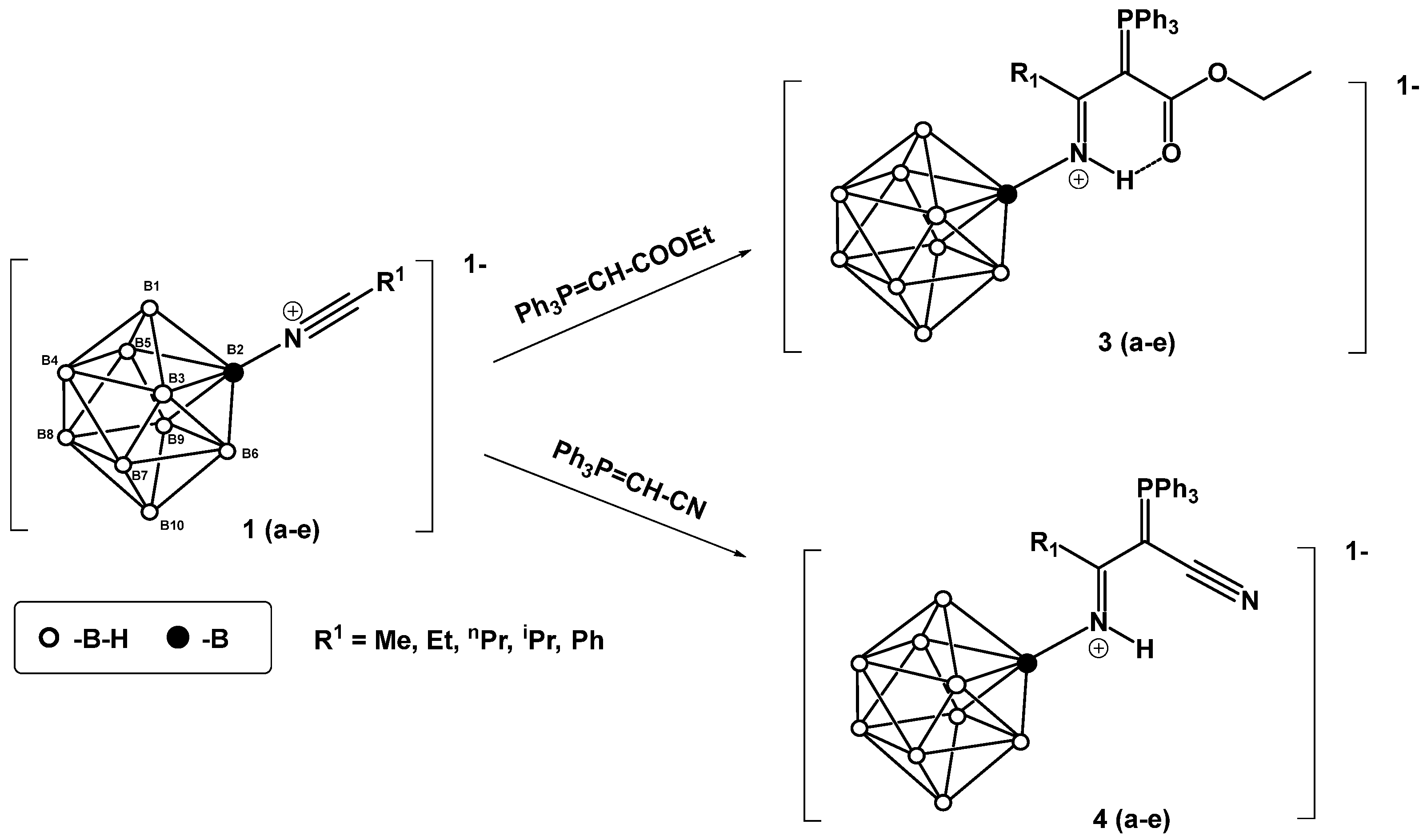
Figure 1. Reaction scheme of iminoacylation process of stabilized phosphorus ylides.
Molecules 31 00231 g001
Figure 2. Molecular structure of anion in (Ph4P)(3a).
Molecules 31 00231 g002
Figure 3. Molecular structure of anion in (Bu4N)(4b).
Molecules 31 00231 g003
Figure 4. Average potentiometric calibration plot for the TPP-selective sensor (Membrane No. 2).
Molecules 31 00231 g004
Figure 5. The scheme of the electroanalytical cell.
Molecules 31 00231 g005
Table 1. Potentiometric response characteristics of TPP sensor as a function of the membrane composition.
Membrane Composition, % wt.Linear Range, mol/LLower Detection Limit, mol/LSlope, mV/Decade
Membrane Active CompoundBis(1-butylpentyl)adipatePVC
10.570.529.0≈10−7–10−2≈1 × 10⁻⁸≈58 ± 2
21.070.029.01 × 10−7–10−23 × 10−857.2 ± 0.3
31.569.529.05 × 10−7–10−28 × 10−855.8 ± 0.2
42.069.029.01 × 10−6–10−23 × 10−753.2 ± 0.1
52.568.529.05 × 10−6–10−27 × 10−751.2 ± 0.2
63.068.029.01 × 10−6–10−29 × 10−750.1 ± 0.2
Table 2. Potentiometric selectivity coefficients obtained for TPP sensor.
Interfering
Cation
Li+Na+K+Rb+Cs+Mg2+Ca2+Sr2+Ba2+NH4+Pb2+H+Bu4N+
pKpot TPP/Cation7.07.15.67.05.67.17.37.47.56.86.44.72.3
Disclaimer/Publisher’s Note: The statements, opinions and data contained in all publications are solely those of the individual author(s) and contributor(s) and not of MDPI and/or the editor(s). MDPI and/or the editor(s) disclaim responsibility for any injury to people or property resulting from any ideas, methods, instructions or products referred to in the content.