
Next Article in Journal
Photocatalytic Performance of Zr-Modified TS-1 Zeolites: Structural, Textural and Kinetic Studies
Previous Article in Journal
Multivariate Characterization of Essential Oils for Their Antibacterial Activity Against Escherichia coli: A Data-Driven Interpretation of Experimental Results
Previous Article in Special Issue
The Role of Noncovalent Interactions in the Infrared Spectra of Lignin Model Compounds: A DFT Study
error_outline You can access the new MDPI.com website here. Explore and share your feedback with us.
 
 
Article

Theoretical Insight on the Tautomerism and ESIPT Process in Some Hydroxyaryl(hetaryl)idene Azomethine Imines


1
Institute of Optical Materials and Technologies “Acad. J. Malinowski”, Bulgarian Academy of Sciences, 1113 Sofia, Bulgaria
2
Institute of Electronics, Bulgarian Academy of Sciences, 1784 Sofia, Bulgaria
*
Author to whom correspondence should be addressed.
Molecules 2026, 31(2), 208; https://doi.org/10.3390/molecules31020208
Submission received: 29 November 2025 / Revised: 5 January 2026 / Accepted: 5 January 2026 / Published: 7 January 2026
(This article belongs to the Special Issue Advances in Computational Spectroscopy, 2nd Edition)

Abstract

The current study aims to model the potential energy surface (PES) of three much less investigated hydroxyaryl(hetaryl)idene azomethine imine derivatives, possessing the same proton crane unit—namely the azomethine imine moiety—but slightly differing in the structure of the proton transfer platform (stator), by applying the tools of computational chemistry. The obtained calculational results are compared with already reported experimental structural, 1H NMR, and UV absorption spectra in an attempt to shed light on the observed data, mainly with regard to the efficiency of the excited state intramolecular proton transfer.

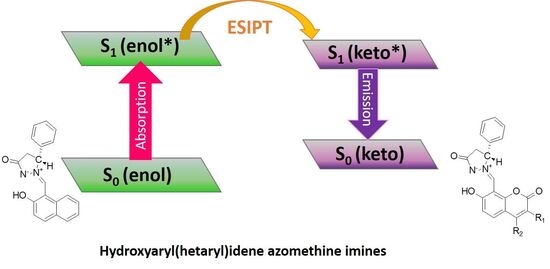
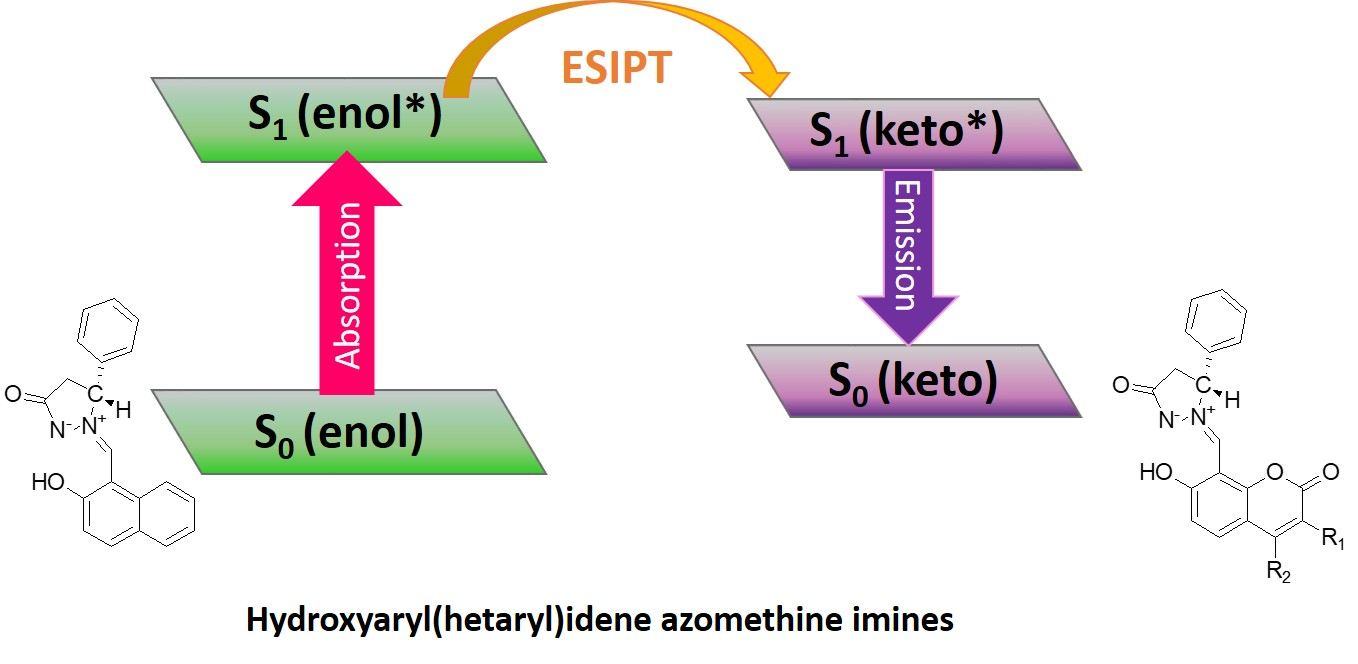
Graphical Abstract

1. Introduction

Excited state intramolecular proton transfer (ESIPT), as the abbreviation suggests, is a photochemical process characterized by the translocation of a proton upon photon absorption in the molecule of a compound possessing both proton (hydrogen) donating/accepting groups. Observed and reported for the first time for salicylic acid in 1955 [1], ESIPT has been the main focus of numerous studies aiming to reveal the intimate mechanism of the process [2,3,4,5], as well as to design novel materials with diverse applications as optical sensors [6,7,8], including ESIPT fluorescence-based sensors for cations such as Mg2+ [9], Cu+/2+ [10], Fe2+/3+ [11], anions like pyrophosphate P2O74− [12], the difficult-to-detect superoxide O2 [13], and small neutral molecules [14,15,16,17,18,19,20,21]. Moreover, by employing the ESIPT process, the activity of different enzymes of great significance for the proper performance of biochemical reactions, e.g., esterases, phosphatases, proteases, and nitroreductases, could be assessed [22,23,24,25,26]. The intriguing field of ultrahigh-density erasable optical memory, attributed to bistable photoswitching of fluorescence emitted by organic molecules, should further be outlined as a plausible application [27,28,29,30,31], along with the area of organic light-emitting diodes (OLEDs) [32,33,34,35].
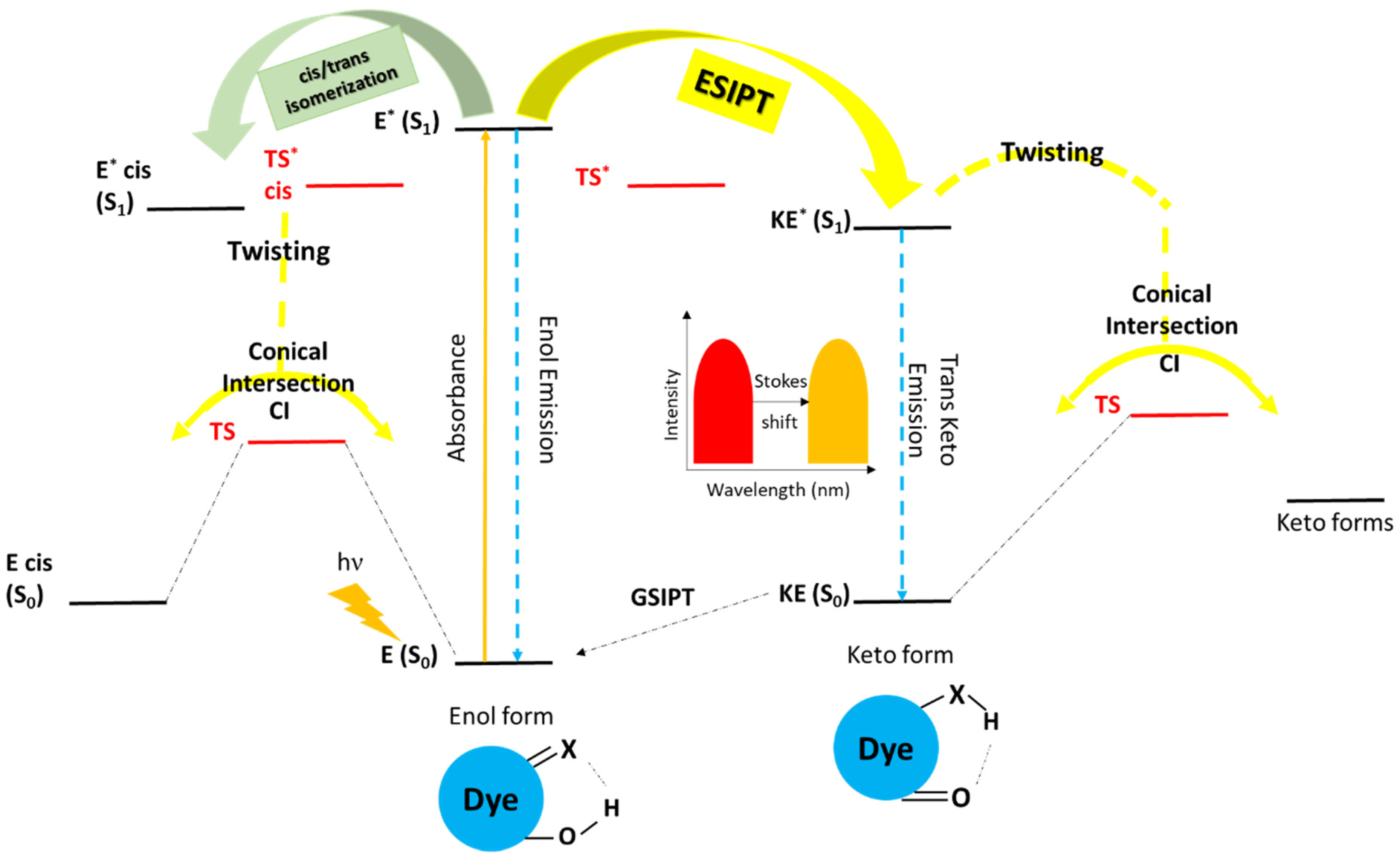
A typical ESIPT occurs when a chemical compound incorporating in its structure both a hydrogen bond donor, most commonly –OH and in some cases –NH2 [36], and an acceptor (usually =N– and C=O) is irradiated with an appropriate wavelength, hence redistributing the electronic charge, which results in increased acidity for the donor and enhanced basicity of the acceptor groups within the initial enol (E) form (Figure 1). Note that at the ground state, chromophores typically exist in this particular form, where the distance between the two interacting groups is of immense significance [37,38]. The photoexcitation populates the singlet excited state enol form (denoted as E*). The genuine ESIPT process occurs at this stage, where from the excited state enol form, a proton is transferred to the corresponding excited state keto from (indicated as KE*). This phototautomerization happens on a very short timescale, within femtoseconds (kESIPT > 1012 s−1) [39]. Afterwards, the KE* undergoes electronic relaxation back to the ground state, being either radiative, characterized by the strongly red-shifted fluorescence designated as the ‘hallmark’ of ESIPT, when the skeleton is rigid as in 10-hydroxybenzo[h]quinoline [40], or non-radiative, most commonly attributed to a trans/cis isomerization reaction (twisting) when the skeleton is flexible [41]. In the former scenario, a full transformation cycle is completed by relocating the proton back to the enol form through the so-called ground state intramolecular proton transfer (GSIPT), whereas the route from the trans-keto form to the cis-keto one is characterized by an energy barrier rendering the process slow. These characteristics allow for experimental measurement of the ESIPT process by fluorescence up-conversion techniques [42,43] or from linewidth information from Shpol’skii matrices [44], as well as the observation of the slower cis/trans isomerization by the nanosecond time-resolved transient difference absorption spectroscopy [45]. It should be noted that, depending on the structure and flexibility of the enol form, trans/cis isomerization is also possible as a process competitive with ESIPT, as observed in some tautomeric azomethine and azo compounds [46,47].
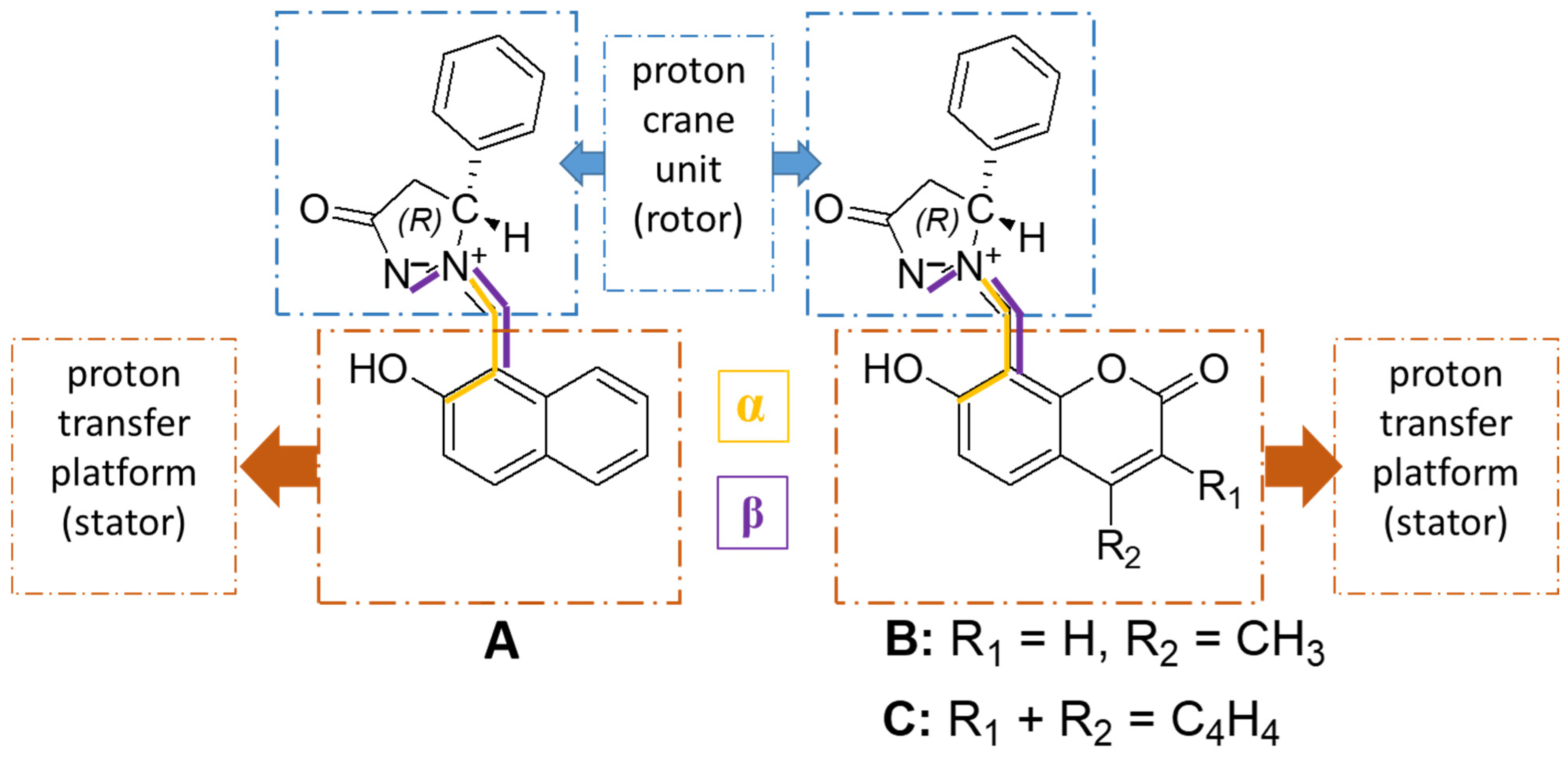
From a chemical point of view, a great number of compounds fulfill the requirement of possessing a proton donor group in the vicinity of a proton acceptor moiety in combination with a conjugated system, although analogs of 2-(2′-hydroxyphenyl)benzimidazole, 2-(2′-hydroxyphenyl)benzoxazole, and 2-(2′-hydroxy- phenyl)benzothiazole present the most common ESIPT fluorophores [48]. Other ESIPT fluorophores exerting great potential to be noted are those based on quinolone [49], benzophenones [49], flavones [50], anthraquinones [51], and Schiff bases [52,53,54]. The current research focuses on the much less investigated azomethine imine moiety building the structure of three derivatives, namely (A) 1-[(2-Hydroxynaphthalen-1-yl)methylidene]-3-oxo-5-phenyl-pyrazolidinium-1,2-ylide; (B) (2Z)-2-[(7-Hydroxy-4-methyl-2-oxo-2H-chromen-8-yl)methylidene]-5-oxo-3-phenylpyrazolidin-2-ium-1-ide; and (C) (2Z)-2-[(3-Hydroxy-6-oxo-6H-benzo[c]chromen-4-yl)methylidene]-5-oxo-3-phenylpyrazolidin-2-ium-1-ide, presented in Figure 2, and its effect on the tautomerism and the ESIPT process by employing the tools of theoretical chemistry. In these molecules, two fragments can be identified: the proton transfer platform (stator) and the proton crane unit (rotor). The two dihedral angles denoted as α (between the C-C-C-N atoms) and β (between the C-C-N-N atoms), colored in yellow and purple, respectively, in Figure 2, should further be outlined as structural characteristics of great significance for describing the relaxation processes upon irradiation.
The polar 1,3-dipole –N–N+=C< fragment in azomethine imines delineates these compounds as indispensable precursors for the preparation of diverse fused heterocycles yielded by cycloaddition reactions [55,56]. On the other hand, they are known for their intriguing spectral properties, like negative photochromism, and their possible application as bistable photochromic compounds [57,58]. Notably, the structures under study have already been synthesized, and their IR, UV absorption, and 1H NMR spectra reported [59,60]; hence, the aim of the suggested theoretical approach is to fill in the gaps regarding the mechanism, and the effects of solvent and substituents, which are known to play a crucial role in the excited state intramolecular proton transfer process. Our previous experience with similar ESIPT systems [38,61,62,63] in applying theoretical methods to unveil experimental observables is a solid premise for the reliability of the presented results.

2. Results and Discussion

In their possible application as tautomeric molecular switches, the compounds in the current investigation possess the same proton crane unit—namely, the azomethine imine moiety. Their differences, on the other hand, derive from the composition of the proton transfer platform (the conjugated aromatic system containing the OH group): while in compound A it is naphthalene, compounds B and C share the 2-oxo-chromen moiety with diverse substituents at positions 3 and 4. These differences allow not only for distinguishing structural effects on the ESIPT process, but also indicate that the lack of a heteroatom in the second ring leads to a simpler geometry of compound A, rendering proton transfer in this part of the molecule after twisting less probable. All considered initial geometries for structures A to C are given in Figures S1–S3, respectively. Those found to be the most stable were used to sketch the potential energy surface of the investigated compounds, with the main focus placed on the ESIPT region. First, we report the results obtained for compound A in acetonitrile, presented in Figure 3, and in Figure S4 when modeled in toluene as the solvent.
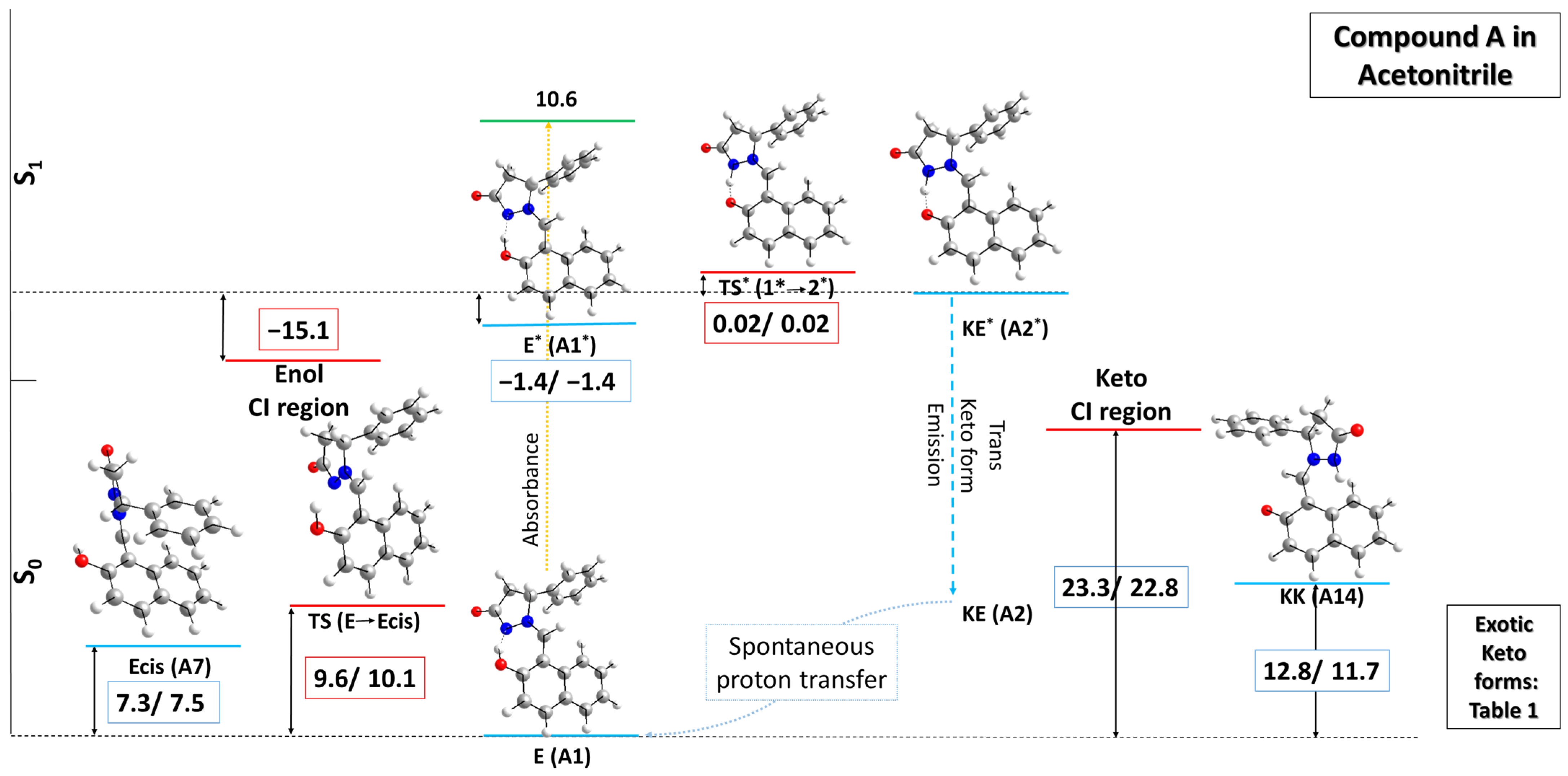
The performed theoretical calculations draw a relatively clear picture of the potential energy surface of compound A in the implicit solvent. Not surprisingly, in the ground state it exclusively exists in its enol form, which is found to be the most stable and hence considered a benchmark when comparing all other possible structures in this particular region. Note that two geometries determined by the far asymmetry in the rotor have been taken into account when modeling the enol structure with regard to the dihedral angle α, which differ by about 0.6 kcal mol−1 in terms of relative energy when the rotor is positioned either at 32° or −32°, but in both cases secure the necessary proximity of the OH group to the N atom of the pyrazole ring. Upon photoabsorption, the molecule is excited to its first singlet state, given as E*, with a Frank–Condon state substantially high in energy. Interestingly, E* is found to be 1.4 kcal mol−1 more stable than the excited keto form (KE*), which, as seen from Figure 3, is taken as the reference structure for the potential energy surface (PES) in the excited state region. This outcome could be attributed to geometrical characteristics such as a shorter O-H bond of 1.04 Å compared to an N-H bond of 1.11 Å, secured by the slightly more planar structure of E* due to a dihedral angle α of −13.3°, as compared to KE* with an α of −16.0°. Additionally, the former is less sterically hindered in the region of the CH axle, where the distance between the two H atoms (one from the axle and the other from the aromatic unit) is 1.95 Å, whereas these atoms are separated by 1.93 Å in the latter. The natural charges in this part of the molecule are affected as well: they change from 0.034 in E* to −0.392 in KE* for the O atom and from −0.205 to 0.170 for the N atom, respectively, due to proton transfer. Moreover, the corresponding transition state from E* to KE* is found to be only 0.02 kcal mol−1 higher compared to the excited state keto form. The keto emission to the ground state is expected to directly produce the E form, as all performed optimizations of the KE form in the ground state lead to spontaneous proton transfer. On the other hand, twisting of the rotor around the CH axle is an alternative path for KE* relaxation, leading to the conical intersection (CI) region. At the corresponding S0 transition states, the proton crane unit is positioned perpendicularly to the stator. The energy required for the formation of the two possible transition state (TS) geometries, distinguished by opposing values of α (−91.8° vs. 89.9°), is estimated to be 23.3/22.8 kcal mol−1 in terms of relative energy ∆E/relative Gibbs energy ∆G, respectively, for the former structure. These values differ by just about 0.5 kcal mol−1 in the latter geometry; therefore, these data are omitted for clarity in Figure 3 and, further, in the other two PES sketches for compounds B and C. Passing through these transition states yields diverse keto forms, which in the studied compounds can be designated as ‘exotic’ due to their much higher relative energy ∆E/relative Gibbs energy ∆G compared to the most stable E form. The calculated respective ΔE/ΔG values in kcal mol−1 of some geometries considered intriguing by the authors are presented in Table 1 for acetonitrile and in Table S1 for toluene.
The calculated ∆E/∆G stand firmly on positive ground, being 18.3/17.6 and 16.5/15.4 kcal mol−1 for structures A3 and A15, respectively, implying that the formation of these tautomers is thermodynamically unfavorable. As can be seen from Table 1, where the optimized geometries of these structures are presented, structures A3 and A15 correspond to a secondary proton transfer to the carbonyl O atom in the pyrazole ring but twisted around the dihedral α angle at about 190°. Note that the rest of the considered geometries, as shown in Figure S1, could be up to 26 kcal mol−1 less stable in terms of ∆G than the enol form (structure A6, for example). Therefore, this part of the potential energy surface falls outside the scope of the present research. Since the second ring in compound A lacks a heteroatom, no process of subsequent transfer of the proton in this part of the molecule could be observed, unlike in compounds B and C.
Flexibility, on the other hand, and the existence of a double bond in the connecting moiety between the proton transfer platform and the proton crane unit, on the other hand, give rise to the possibility of an alternative non-radiative pathway attributed to trans/cis isomerization in the modeled enol structures. The corresponding cis stereoisomer of the enol form of compound A is found to stand 7.3/7.5 kcal mol−1 higher in terms of ∆E/∆G, the route to it defined by two transition states, once again designated to the presence of an asymmetric C atom in the rotor. The performed calculations yielded a transition state from the E to the Ecis forms that is 9.6/10.1 ∆E/∆G kcal mol−1 higher than the most stable structure in the ground state. When excited to S1, the Frank–Condon state is found to stand quite high—at 30.2 kcal mol−1 in relative energy terms. The relaxed excited singlet state in this part is found to exist in a conical intersection region geometry (twisting around the double C=N bond), almost 15 kcal mol−1 lower in energy as compared to the reference KE*. From there on, decay along the side leading to regeneration of the enol form occurs. This non-radiative process competes with ESIPT, decreasing its efficiency [64]. The theoretically observed outcome explains the reported experimental data, as discussed later. It should be noted that an analogous topology of the potential energy surface is drawn for all compounds in the current study due to the retained moieties responsible for the described processes. Therefore, the focus for compounds B and C falls on the ESIPT region only.
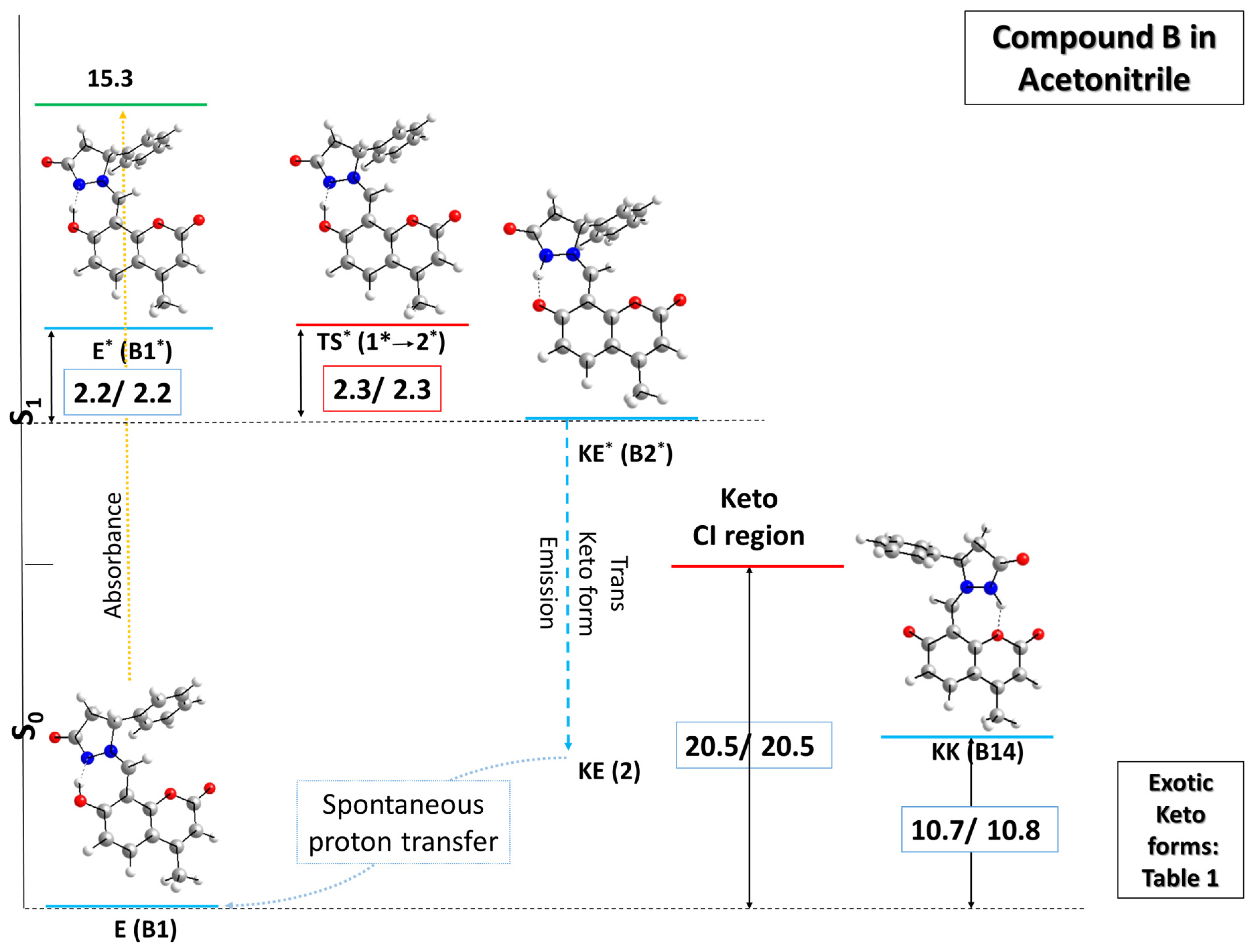
The results obtained for compound B in acetonitrile are further presented in Figure 4, and in Figure S5 for toluene.
The calculations draw a similar sketch of the PES for compound B in comparison with compound A in the ground state region. The most stable enol form, with an α of −32.6°, an O-H bond of 1.02 Å, and a hydrogen N-H bond distance of 1.56 Å, is again considered as the reference structure in this part of the PES. Its corresponding Frank–Condon and first singlet excited states, however, stand at 15.3 (only ΔE) and 2.2 kcal mol−1 higher in terms of both ∆E/∆G, respectively, with respect to the first singlet excited state of the keto form. Additionally, the transition state between the two excited structures falls in the same range of relative energy/relative Gibbs energy, with values of 2.3/2.3 kcal mol−1. This difference between compounds A and B, namely in the ESIPT region, can be assigned to structural characteristics of the E* form of the latter, predisposing the molecule to facilitated proton transfer: the H-atom is bonded to oxygen at 1.06 Å and lies just 1.41 Å away from the nitrogen, with a dihedral angle α of only −0.1°, rendering this structure practically planar and very close to the necessary transition state geometry. Note that the corresponding distances in the E* form of compound A are 1.04 and 1.47 Å, with an α of −13.3°. Moreover, the N-H bond in the KE* form of compound B is as long as the OH one in the E* form—1.06 Å, whereas the O-H distance now spans 1.52 Å. The dihedral angle almost does not change as well, being calculated to be 1.1°. Bearing in mind that the rotor is the same in both molecules, the observed subtle differences should be ascribed to the proton transfer unit, although no significant change in charge distribution is evidenced by the NBO analysis: shifting from 0.030 in E* to −0.429 in KE* for the O atom and from −0.201 to 0.181 for the N atom, respectively, as a result of proton transfer. Hence, the calculations provide strong evidence for the closeness of E*, KE*, and the transition state connecting them, both in energy and structural characteristics, in the first singlet excited state region, leading to a probable ESIPT process. Again, the ground state keto form of compound B is not stable and isomerizes to the enol form. If twisting around the dihedral angle α after relaxation is considered, the corresponding transition state poses quite high relative energy value of 20.5 kcal mol−1. The results obtained for subsequent geometries with proton transfer to the carbonyl group in the five-membered ring (structures B3 and B15 in Table 1) mirror those calculated for compound A, with relative energy ∆E/relative Gibbs energy ∆G values of 17.6/17.6 and 16.6/16.5 kcal mol−1, respectively. Moreover, the possibility of transferring the proton to the carbonyl group in the pyran site of the molecule yields a structure denoted as B19 with 27.4/26.7 kcal mol−1 higher in ∆E/∆G.
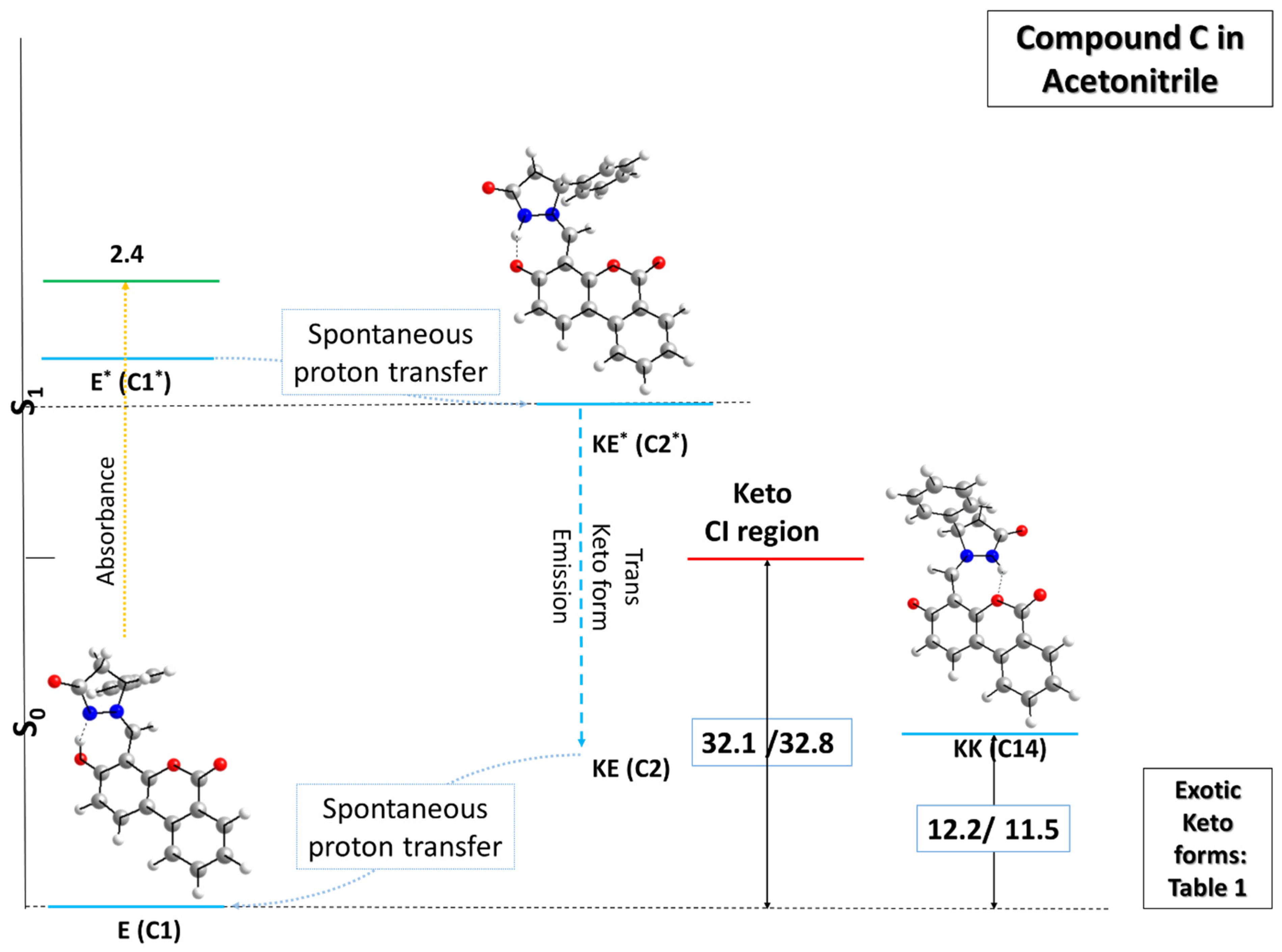
Finally, the results obtained for sketching the PES of the third modeled compound C are depicted in Figure 5 for acetonitrile and in Figure S6 for toluene.
The most stable E form of compound C resembles to a great extent the previously described compound B in its structural characteristics, with an α of 33.5°, an O-H bond length of 1.02 Å, and a hydrogen N-H bond distance of 1.57 Å. Upon photoabsorption, however, the first singlet excited state E* easily transfers the mobile proton from the OH group to the N atom, yielding the KE* form, in which the NH bond is again 1.06 Å, the O-H distance increases to 1.51 Å, and the dihedral angle α is found to be −1.3°. The keto form in the ground state spontaneously transfers the proton back to the most stable enol form. If twisting around the CH axle is considered, the transition state stands 32.1/32.8 kcal mol−1 higher in terms of ∆E/∆G than the reference point in the ground state, yielding twisted keto forms similar to those in Table 1 when comparing the compounds in terms of dihedral angle values and relative changes in the calculated relative energy ∆E/relative Gibbs energy ∆G. A slight difference could be found when examining structures 19 for the two compounds. It can be seen that this geometry is about 8 kcal mol−1 less stable for compound C as compared with compound B. This outcome can be attributed to the slightly elongated H-O distance in the former, resulting from the presence of a third aromatic ring engaging the oxygen atom in additional interactions in this part of the molecule. Nevertheless, the structural differences in the stator in compounds B and C do not affect the overall topology of the potential energy surface of these molecules, as implied by the obtained calculations.
Comparing the results obtained in the two modeled solvents, the stabilizing effect of polar acetonitrile should be outlined. The calculated structures stand closer to the reference enol forms in the ground state, and the energy required to reach the desired transition states is about 2 to 3 kcal mol−1 lower. Moreover, in the first singlet excited state, most of the desired structures required for drawing the potential energy surface in the ESIPT region have been successfully optimized, whereas in toluene the mobile proton is much more readily transferred between the forms. This outcome supports the experimental observations, where the most exploited solvent is acetonitrile [59,60].
A final step in the current study involves comparing the results obtained through the applied theoretical approach with the reported experimental data in [57,59,60]. Table 2 summarizes the simulated NMR spectra at two different levels of theory—M062X and B3LYP—in conjunction with the TZVP basis set in both cases.
The experimental spectra of compound A1 in CDCl3 show a methine proton signal in the range of 7.1–7.8 ppm, while the hydroxyl proton resonates at 12.8 ppm. The chemical shifts calculated for the methine proton of A1 (8.0 ppm at M062X/TZVP and 7.6 ppm at B3LYP/TZVP) and for the hydroxyl proton of the stator unit (12.4 ppm at M062X/TZVP and 11.8 ppm at B3LYP/TZVP) show very good agreement with the experimentally measured values for A1 in chloroform. This correspondence highlights the reliability of the applied theoretical approach and confirms the existence of the enol form in solution. The keto tautomer, if exists, should be deshielded [46].
Experimental data for A1 are also available in DMSO-d6. In this solvent, the calculations predict either no downfield shift or only a very slight one for the A1 signals relative to those in CHCl3.
For the preferred enol form of compound B (B1), for which experimental data are available only in DMSO-d6, the methine proton is calculated to resonate at 8.0 ppm (M062X/TZVP) and 7.6 ppm (B3LYP/TZVP). The hydroxyl proton is predicted to be shifted downfield relative to A1, appearing at 13.6 ppm and 12.9 ppm at the M062X/TZVP and B3LYP/TZVP levels of theory, respectively (Table 2). For C1, again experimentally characterized only in DMSO-d6, the methine proton is calculated to resonate at 8.2 ppm (M062X/TZVP) and 7.8 ppm (B3LYP/TZVP), while the hydroxyl proton is predicted to lie at 13.2 ppm and 12.5 ppm at the M062X/TZVP and B3LYP/TZVP levels of theory, respectively (Table 2).
Overall, the chemical shifts calculated for the methine and hydroxyl protons of B1 and C1 fall within the same ranges as those of A1, supporting the consistency of the computational results and the reliability of the prediction for exclusive presence of the enol tautomer across the series.
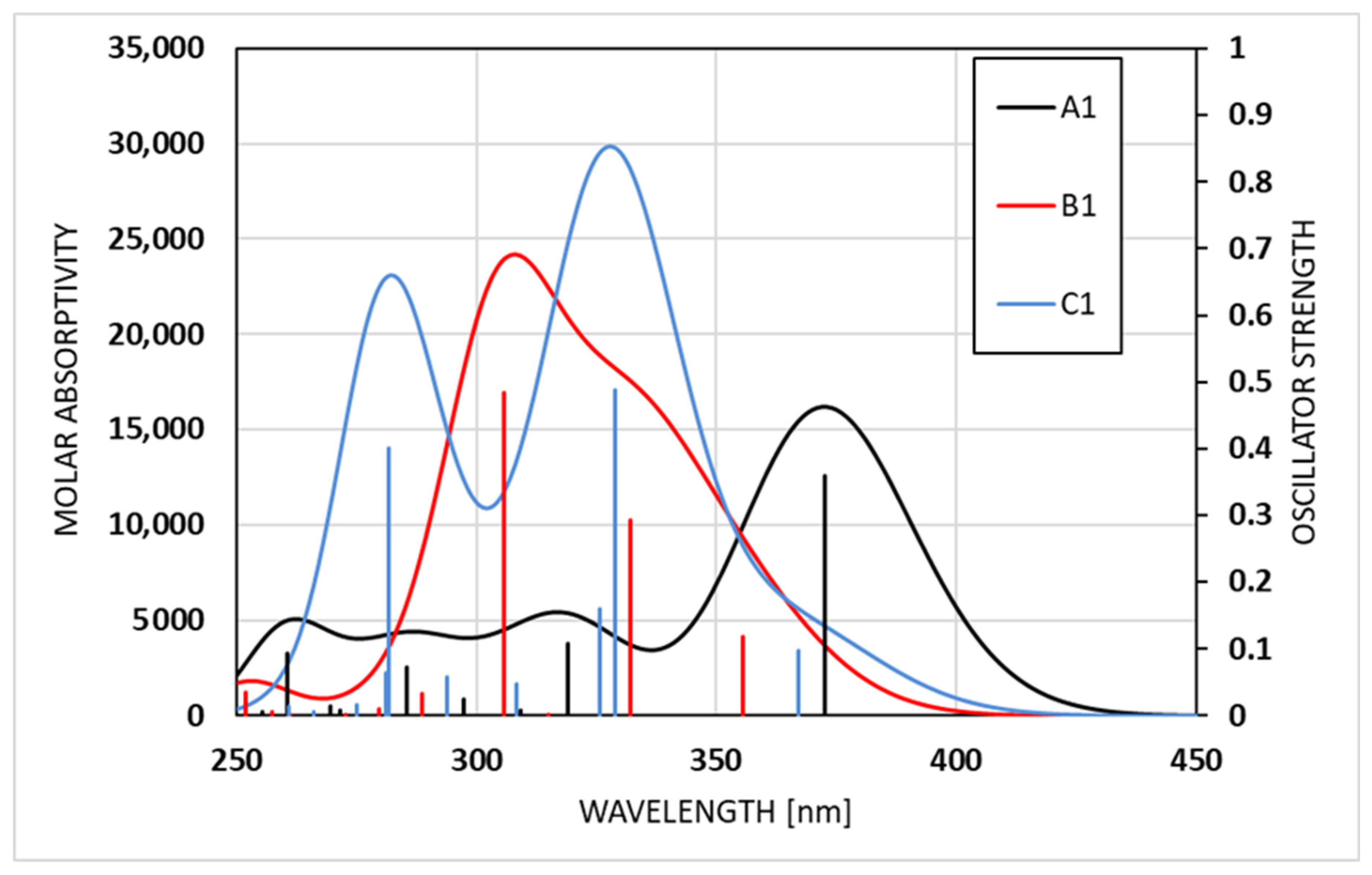
The absorption spectra of the preferred enol form of compounds AC are shown in Figure 6 and Figure S7 for acetonitrile and toluene, respectively. The overall spectral profiles reflect the Gaussian broadening applied to the discrete calculated transitions, with peak intensities scaled according to the corresponding oscillator strengths. The simulated absorption spectra of A1, B1, and C1 on acetonitrile reveal clear differences arising from variations in their electronic structures (Figure 6 and Table 3). A1 shows the most bathochromically shifted band, with a broad maximum at 372 nm, consistent with lower calculated excitation energies and moderate oscillator strengths. Notably, the experimentally observed absorption spectrum of compound A exhibits the strongest band at 377 nm [57]. B1 exhibits two pronounced maxima in the range of 300–350 nm, both associated with higher oscillator strengths (Table 3). The authors of [60] report similar results, with the most pronounced λmax at 324 nm and a shoulder at 389 nm (ε = 24,000 and 5600 L/(cm.M), respectively), which agrees in both shape and intensity with Figure 6. In contrast, as seen from Table 3, C1 displays the most intense and most hypsochromically shifted simulated absorption, dominated by strong transitions in the 290–310 nm region (experimental λmax at 289 and 336 nm (with a shoulder at 400 nm) [60]), indicative of highly allowed excitations and enhanced electronic delocalization. Overall, as seen from Table 3 and Figure 6, the simulated absorption spectra of the enol forms reproduce the experimental spectra of the compounds under study in very good agreement [59,60], capturing both the overall band shapes and the relative positions and intensities of the main transitions. According to general knowledge of similar azomethine systems, the existence of the keto tautomer should lead to substantially red-shifted absorption maxima [46].
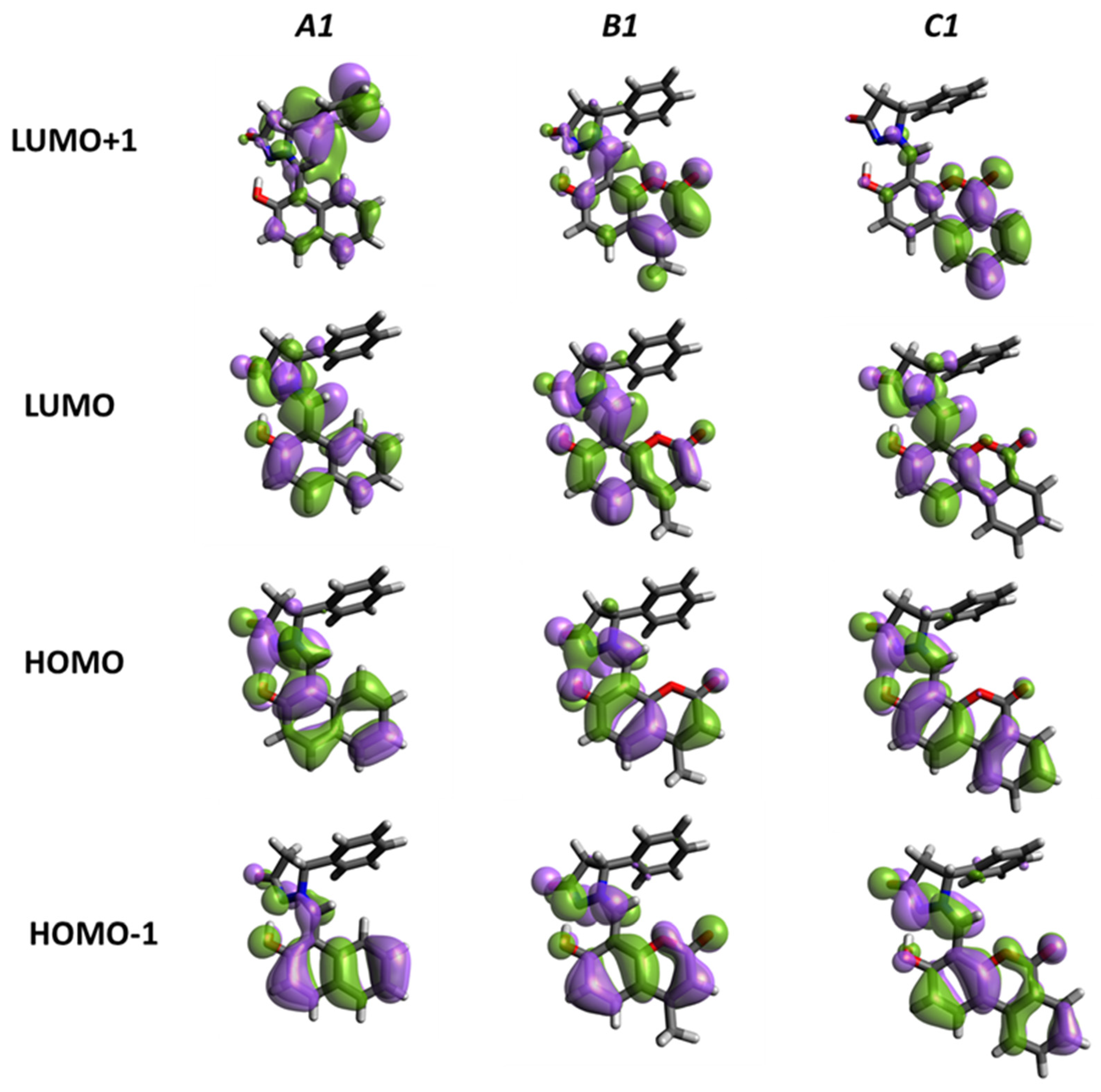
The TDDFT results (Table 3 in acetonitrile and Table S3 in toluene) show that the low-lying excited states of compounds AC in both acetonitrile and toluene are characterized predominantly by π–π* electron transitions involving mainly the frontier molecular orbitals (HOMO, HOMO−1, LUMO, and LUMO+1). The frontier molecular orbitals are mainly distributed over the conjugated π-system of the molecule, with negligible contribution from the substituent groups, as further seen in Figure 7.
For compound A, the first excited state is characterized by a strong HOMO→LUMO transition with a relatively high oscillation strength (f = 0.3599) and an excitation energy of 3.33 eV (372 nm). This transition is optically allowed and involves mainly single-orbital excitation. The second excited state involves mixed contributions, mainly from HOMO−1→LUMO, and exhibits a lower but still noticeable oscillatory strength (f = 0.1078). In compound B, there are several optically active transitions. The lowest-energy excited state consists of multiple configurations, including HOMO→LUMO and adjacent orbital transitions, resulting in a moderate oscillator strength (f = 0.1178). The second excited state, dominated by HOMO−1→LUMO, shows an increased oscillator strength (f = 0.2923). A higher excited state (excited state 4) shows the highest oscillator strength (f = 0.4829), mainly associated with the HOMO→LUMO+1 transition, suggesting an increased dipole moment of the transition due to increased orbital overlap. For compound C, the first excited state is predominantly HOMO→LUMO in nature but has a relatively small oscillator strength (f = 0.0979). In contrast, the second excited state, dominated by HOMO−1→LUMO, shows a pronounced oscillatory strength (f = 0.4883), representing the most intense transition in the low-energy region. Higher excited states include transitions to LUMO+1 and LUMO+2, maintain significant oscillator forces, and show extended π-conjugation.
Similar qualitative trends are observed in toluene, albeit with slight changes in excitation energies and oscillator strengths (see Table S3). For compound A, the first excited state remains a strong HOMO→LUMO transition, accompanied by a slight bathochromic shift and an increased oscillator strength (f = 0.3914) compared to acetonitrile. For compound B, multiple excited states contribute to the absorption profile. The first and second excited states arise from mixed HOMO/HOMO−1→LUMO transitions with moderate oscillator strengths, while excited state 4 shows the highest intensity (f = 0.5709), mainly due to HOMO→LUMO+1 excitation. This suggests that higher-energy virtual orbitals play an important role in determining the optical response in a less polar solvent. In compound C, the first excited state is again predominantly HOMO→LUMO in nature, with moderate oscillator strength. The second and third excited states show mixed orbital contributions and comparable oscillatory strengths, while excited state 6, dominated by HOMO→LUMO+1, shows the highest intensity (f = 0.5040), corresponding to a higher-energy absorption band.
Comparison between acetonitrile and toluene shows that the solvent polarity slightly affects the excitation energies and intensities but does not significantly change the nature of the electronic transitions. The dominant transitions retain their π–π* character in both solvents, while variations in oscillator strengths suggest changes in orbital mixing and dipole moments of the transition caused by the solvent environment.
The predicted excited state PESs shown in Figure 3, Figure 4 and Figure 5 indicate a substantial difference between A, on the one hand, and B and C, on the other hand. In A, the ESIPT process seems to be prohibited, as KE* is less stable compared to E*. This means that the relaxation through the E to Ecis conical intersection remains the dominant channel. In practical means, this suggests that no ESIPT emission could be detected. According to [55], no emission has been detected for this compound, which nicely confirms our theoretical hypothesis. In the case of B and C, weak emission has been measured [58] at approximately 540 and 538 nm in acetonitrile. The corresponding Stokes shifts of 7200 and 6400 cm−1, respectively, clearly indicate an ESIPT process, as suggested in Figure 4 and Figure 5. Nevertheless, emissionless channels, either through trans-to-cis enol or keto forms, remain the major pathways for relaxation to the ground state in these two compounds.

3. Theoretical Methodology

Using the Gaussian 16 suite of programs [65], all necessary calculations were performed without restrictions in the modeled surrounding media, employing tight optimization criteria and an ultrafine grid in the computation of two-electron integrals and their derivatives. The structures under study have been subjected to full geometry optimization at the M062X [66,67] theoretical level in the ground state and at the CAM-B3LYP [68] level for the singlet excited states using the time-dependent DFT procedure [69], both combined with the TZVP basis set [70]. This was followed by vibrational frequency analysis in all cases. The latter indicated local minima on the potential energy surface, as no imaginary frequencies were observed for the obtained optimized geometries. The Polarizable Continuum Model [71], as implemented in Gaussian 16 in its integral equation formalism variant, IEFPCM, was used to implicitly simulate the two solvents, toluene and acetonitrile. Gibbs energy calculations were performed at 298 K and 1 atm using the rigid-rotor harmonic oscillator approximation. We note that this approach may introduce uncertainties for flexible systems with low-frequency vibrational modes; however, relative free energy trends and rotational barriers are expected to be less affected due to error cancelation [72,73]. The version of the NBO analysis integrated into Gaussian 16: NBO 7.0, was implemented to prepare the results discussed in terms of natural bond orbitals. Furthermore, transition states were estimated at the CAM-B3LYP theoretical level in conjunction with the TZVP basis set and verified once more by performing frequency calculations in the modeled medium. Notably, the presence of only one imaginary frequency with a sufficiently high value corresponding to the sought bond-breaking/forming indicated the particular transition state.
The utilized theoretical methodology has been widely verified and applied in previous studies [63,74,75]. First, exploration of the ground state potential energy surface by optimizing tautomeric structures at the M062X theoretical level provides very good predictability in solution. In the case of 8- (benzo[d]thiazol-2-yl)quinolin-7-ol (HQBT), a compound never synthesized or studied before but previously suggested by us [63], it was demonstrated that the results for the excited state PESs obtained by either M062X or CAM-B3LYP are in essence the same. Nevertheless, the latter method was applied in the current study for exploring excited states based on its reported better performance (in comparison with a variety of density functionals, including M062X) in describing valuable characteristics such as electronic excitation energies, excited state geometries, dipole moments, and oscillator strengths across a wide range of systems, including the ESIPT process. Moreover, by comparing DFT results for both ground and excited states in HQBT [68] at the chosen theoretical level with the ‘gold standard’ methods—chemical accuracy-domain-based local pair natural orbital coupled-cluster singles and doubles with perturbative triple excitations (DLPNO-CCSD(T)) and domain-based local pair natural orbital similarity-transformed equation-of-motion coupled-cluster singles and doubles (DLPNO-STEOM-CCSD), respectively—the applied theoretical methodology has been validated and proven accurate. In regard to the respective compounds in the current study, solid evidence for the reliability of the implemented methodology is provided in Table S2, where calculated and experimental (X-ray) parameters for the preferred enol tautomers of compounds AC (gas-phase optimized) are compared. The three examined structures show a high degree of geometric consistency, with most C–N, N–N, and C–C bond lengths differing by only a few hundredths of an ångström. A meaningful variation appears in the C7–C8–O2 region, where A1 exhibits the shortest C7–C8 bond, whereas B1 and C1 display slightly shorter C8–O2 distances, indicating a small redistribution of π-electron density. The C(3)-O(1) bond is shorter in all three structures compared with the experimental A1 value. The intramolecular hydrogen bond H(2)…N(2) is strongest in B1, as reflected by the shortest H…N distance. Conformationally, B1 and C1 show somewhat smaller dihedral angles in Fragment I, pointing to a more planar arrangement and slightly enhanced conjugation. Overall, the structural differences are subtle but consistent with small variations in electronic delocalization and hydrogen bond strength.
Using the M062X optimized ground state geometries, the UV-Vis spectra were predicted by the B3LYP functional [76] (again in combination with the TZVP basis set). For each structure under study for which a UV spectrum was simulated in the corresponding solvent, six excited states were considered during the calculation. The methodology previously described by us [77] was implemented to simulate the spectra according to a single Gaussian band shape with a half-bandwidth (∆ν1/2) of 3000 cm−1.
The 13C and 1H NMR chemical shieldings were computed using the Gauge-Including Atomic Orbitals (GIAOs) method as implemented in Gaussian 16. All calculations were carried out at the density functional theory (DFT) level employing two exchange–correlation functionals, M062X and B3LYP, in combination with the TZVP basis set. To enable direct comparison with the experimental spectra, the calculated absolute shieldings were converted to chemical shifts relative to tetramethylsilane (TMS), according to the following equation:
δ = δcalc (TMS) − δcalc
Both δcalc (TMS) and δcalc were obtained using the same functional and basis set to ensure internal consistency. Solvent effects were incorporated by employing the PCM implicit solvation model with acetonitrile as the solvent during geometry optimization and subsequent NMR shielding calculations.
Figure 7 was prepared through the implementation of the Avogadro open-source molecular builder and visualization tool [78,79].

4. Conclusions

Excited state intramolecular proton transfer (ESIPT) is an intriguing process with diverse applications in many scientific fields, such as optics. The continuous search for appropriate molecules exhibiting the desired properties has led us to the investigation of hydroxyaryl(hetaryl)idene azomethine imines by utilizing the tools of theoretical chemistry to observe processes at the molecular level. The obtained results indicate a more probable ESIPT on the potential energy surface of compounds B and C as compared to compound A. It was found, however, that the non-radiative trans–cis isomerization provides an alternative relaxation pathway due to the specific structural composition of the stator-binding and rotor moieties retained in all cases. The conclusions drawn regarding, for example, the effect of chemical composition and the nature of the solvent are in good agreement with previously reported data. Simulated 1H NMR and UV absorption spectra, in line with experimental ones, further prove the reliability of the results presented in the current research.

Supplementary Materials

The following supporting information can be downloaded at: https://www.mdpi.com/article/10.3390/molecules31020208/s1, Figure S1: Chemical structures considered as initial geometries for the studied compound A. Those used for sketching the PES are circled in blue. Their relation to the PES is denoted with the widely accepted designation E, KE, KK, and K; Figure S2: Chemical structures considered as initial geometries for the studied compound B. Those used for sketching the PES are circled in blue. Their relation to the PES is denoted with the widely accepted designation E, KE, KK, and K; Figure S3: Chemical structures considered as initial geometries for the studied compound C. Those used for sketching the PES are circled in blue. Their relation to the PES is denoted with the widely accepted designation E, KE, KK, and K; Figure S4: Sketch of the potential energy surface (PES) of model compound A (presented as R stereoisomer) in toluene in the ground (M062X/TZVP) and first singlet excited (CAM-B3LYP/TZVP) states. The stationary tautomeric forms are indicated in blue, the transition states in red, and the Frank–Condon state in green. The numerical values present relative energy ∆E/relative Gibbs energy ∆G given in units of kcal mol−1. ∆E and ∆G values in the ground and first singlet excited states are calculated with respect to E and KE*, respectively; Figure S5: Sketch of the potential energy surface (PES) of model compound B (presented as R stereoisomer) in toluene in the ground (M062X/TZVP) and first singlet excited (CAM-B3LYP/TZVP) states. The stationary tautomeric forms are indicated in blue, the transition states in red, and the Frank–Condon state in green. The numerical values present relative energy ∆E/relative Gibbs energy ∆G given in units of kcal mol−1. ∆E and ∆G values in the ground and first singlet excited states are calculated with respect to E and KE*, respectively; Figure S6: Sketch of the potential energy surface (PES) of model compound C (presented as R stereoisomer) in toluene in the ground (M062X/TZVP) and first singlet excited (CAM-B3LYP/TZVP) states. The stationary tautomeric forms are indicated in blue, the transition states in red, and the Frank–Condon state in green. The numerical values present relative energy ∆E/relative Gibbs energy ∆G given in units of kcal mol−1. ∆E and ∆G values in the ground and first singlet excited states are calculated with respect to E and KE*, respectively; Figure S7: TDDFT-simulated absorption spectra of the compounds under study, structures A1 (black), B1 (red), and C1 (blue) in toluene. The vertical lines indicate the oscillator strengths of the corresponding transitions; Table S1: Calculated ∆E/∆G values in units of kcal mol−1 at the M062X/TZVP theoretical level for obtaining some intriguing/ exotic keto forms in toluene; Table S2: Calculated and experimental (X-ray) parameters for the preferred enol tautomers of compounds AC (gas-phase optimized); Table S3: Calculated excitation energies (E), wavelengths (λ), oscillator strengths (f), and dominant orbital contributions for the low-lying excited states of the preferred enol forms of compounds AC in toluene, obtained using TDDFT at the B3LYP/TZVP level of theory. Only excited states with oscillator strengths ≥ 0.1 are reported.

Author Contributions

Conceptualization, L.A.; Methodology, L.A.; Investigation, N.K., S.D., L.A. and S.A.; Resources, L.A.; Writing—Original Draft, N.K., Writing—Review and Editing, N.K., L.A. and S.A.; Visualization, S.D.; Supervision, L.A. and S.A.; Funding Acquisition, L.A. All authors have read and agreed to the published version of the manuscript.

Funding

N.K. and L.A. thank the Multilateral Academic Projects Program (MAPS) provided by the Swiss National Science Foundation, Project Number IZ11Z0_230935, for financially supporting this investigation. The theoretical calculations were carried out using the infrastructure purchased under the National Roadmap for RI, financially coordinated by the MES of the Republic of Bulgaria (grant No D01-325/1 December 2023).

Institutional Review Board Statement

Not applicable.

Informed Consent Statement

Not applicable.

Data Availability Statement

The original contributions presented in this study are included in the article/Supplementary Materials. Further inquiries can be directed to the corresponding author.

Acknowledgments

The authors gratefully acknowledge the financial and institutional support provided by the Swiss–Bulgarian Research Program (funding scheme MAPS, project number IZ11Z0_230935 PROTON DREAMS) in the framework of the second Swiss Contribution to selected EU Member States.

Conflicts of Interest

The authors declare no conflicts of interest.

References

  1. Weller, A. Über die Fluoreszenz der Salizylsäure und Verwandter Verbindungen. Naturwissenschaften 1955, 42, 175–176. [Google Scholar] [CrossRef]
  2. Wu, J.; Liu, W.; Ge, J.; Zhang, H.; Wang, P. New Sensing Mechanisms for Design of Fluorescent Chemosensors Emerging in Recent Years. Chem. Soc. Rev. 2011, 40, 3483–3495. [Google Scholar] [CrossRef] [PubMed]
  3. Yang, D.; Zheng, R.; Wang, Y.; Lv, J. Theoretical Investigation on ESIPT Mechanism of a New Fluorescent Sensor in Different Solvents. Spectrochim. Acta-Part A Mol. Biomol. Spectrosc. 2016, 159, 30–34. [Google Scholar] [CrossRef] [PubMed]
  4. Zhou, P.; Han, K. Unraveling the Detailed Mechanism of Excited state Proton Transfer. Acc. Chem. Res. 2018, 51, 1681–1690. [Google Scholar] [CrossRef]
  5. Fu, P.-Y.; Yi, S.-Z.; Pan, M.; Su, C.-Y. Excited state Intramolecular Proton Transfer (ESIPT) Based Metal–Organic Supramolecular Optical Materials: Energy Transfer Mechanism and Luminescence Regulation Strategy. Acc. Mater. Res. 2023, 4, 939–952. [Google Scholar] [CrossRef]
  6. Chen, L.; Fu, P.-Y.; Wang, H.-P.; Pan, M. Excited state Intramolecular Proton Transfer (ESIPT) for Optical Sensing in Solid State. Adv. Opt. Mater. 2021, 9, 2001952. [Google Scholar] [CrossRef]
  7. Kwon, J.E.; Park, S.Y. Advanced Organic Optoelectronic Materials: Harnessing Excited state Intramolecular Proton Transfer (ESIPT) Process. Adv. Mater. 2011, 23, 3615–3642. [Google Scholar] [CrossRef]
  8. Li, Y.; Dahal, D.; Abeywickrama, C.S.; Pang, Y. Progress in Tuning Emission of the Excited state Intramolecular Proton Transfer (ESIPT)-Based Fluorescent Probes. ACS Omega 2021, 6, 6547–6553. [Google Scholar] [CrossRef]
  9. Liu, M.; Yu, X.; Li, M.; Liao, N.; Bi, A.; Jiang, Y.; Liu, S.; Gong, Z.; Zeng, W. Fluorescent Probes for the Detection of Magnesium Ions (Mg2+): From Design to Application. RSC Adv. 2018, 8, 12573–12587. [Google Scholar] [CrossRef]
  10. Yang, C.Y.; Chen, Y.; Wu, K.; Wei, T.; Wang, J.L.; Zhang, S.S.; Han, Y.F. A Paper and Ink Analysis Method for Forensic Science. Anal. Methods 2015, 7, 3327–3330. [Google Scholar] [CrossRef]
  11. Kuzu, B.; Tan, M.; Ekmekci, Z.; Menges, N. A Novel Fluorescent Sensor Based on Imidazole Derivative for Fe3+ Ions. J. Lumin. 2017, 192, 1096–1103. [Google Scholar] [CrossRef]
  12. Chen, W.-H.; Xin, Y.; Pang, Y. A Highly Selective Pyrophosphate Sensor Based on ESIPT Turn-On in Water. Org. Lett. 2011, 13, 1362–1365. [Google Scholar] [CrossRef] [PubMed]
  13. Murale, D.P.; Kim, H.; Choi, W.S.; Churchill, D.G. Highly Selective Excited State Intramolecular Proton Transfer (ESIPT)-Based Superoxide Probing. Org. Lett. 2013, 15, 3946–3949. [Google Scholar] [CrossRef] [PubMed]
  14. Yang, X.; Guo, Y.; Strongin, R.M. Conjugate Addition/Cyclization Sequence Enables Selective and Simultaneous Fluorescence Detection of Cysteine and Homocysteine. Angew. Chem.—Int. Ed. 2011, 50, 10690–10693. [Google Scholar] [CrossRef] [PubMed]
  15. Li, R.; Huang, X.; Lu, G.; Feng, C. A Fluorescence and UV/Vis Absorption Dual-Signaling Probe with Aggregation-Induced Emission Characteristics for Specific Detection of Cysteine. RSC Adv. 2018, 8, 24346–24354. [Google Scholar] [CrossRef]
  16. Ren, X.; Wang, F.; Lv, J.; Wei, T.; Zhang, W.; Wang, Y.; Chen, X. An ESIPT-Based Fluorescent Probe for Highly Selective Detection of Glutathione in Aqueous Solution and Living Cells. Dye. Pigment. 2016, 129, 156–162. [Google Scholar] [CrossRef]
  17. Liu, X.; Tian, H.H.; Yang, L.; Su, Y.; Guo, M.; Song, X. A Sensitive and Selective Fluorescent Probe for the Detection of Hydrogen Peroxide with a Red Emission and a Large Stokes Shift. Sens. Actuators B Chem. 2018, 255, 1160–1165. [Google Scholar] [CrossRef]
  18. Biswas, S.; Das, J.; Barman, S.; Pinninti, B.R.; Maiti, T.K.; Singh, N.D.P. Environment Activatable Nanoprodrug: Two-Step Surveillance in the Anticancer Drug Release. ACS Appl. Mater. Interfaces 2017, 9, 28180–28184. [Google Scholar] [CrossRef]
  19. Chen, L.; Wu, D.; Yoon, J. An ESIPT Based Fluorescence Probe for Ratiometric Monitoring of Nitric Oxide. Sens. Actuators B Chem. 2018, 259, 347–353. [Google Scholar] [CrossRef]
  20. Jin, X.; Liu, C.; Wang, X.; Huang, H.; Zhang, X.; Zhu, H. A Flavone-Based ESIPT Fluorescent Sensor for Detection of N2H4 in Aqueous Solution and Gas State and Its Imaging in Living Cells. Sens. Actuators B Chem. 2015, 216, 141–149. [Google Scholar] [CrossRef]
  21. Wang, Y.; Xiang, H.; Zhaoa, R.; Huang, C. A Renewable Test Strip Combined with Solid-State Ratiometric Fluorescence Emission Spectra for the Highly Selective and Fast Determination of Hydrazine Gas. Analyst 2018, 143, 3900–3906. [Google Scholar] [CrossRef] [PubMed]
  22. Hu, J.; Cheng, K.; Wu, Q.; Ding, D.; Li, C.; Li, Z. A Dual Fluorogenic and 19F NMR Probe for the Detection of Esterase Activity. Mater. Chem. Front. 2018, 2, 1201–1206. [Google Scholar] [CrossRef]
  23. Tian, M.; Tang, J.S.; Dong, B.; Lin, W. Discriminating Live and Dead Cells in Dual-Color Mode with a Two-Photon Fluorescent Probe Based on ESIPT Mechanism. Anal. Chem. 2017, 90, 998–1005. [Google Scholar] [CrossRef] [PubMed]
  24. Hu, Q.; Zeng, F.; Yu, C.; Wu, S. A Fluorescent Probe for Alkaline Phosphatase via Excited State Intramolecular Proton Transfer. Sens. Actuators B Chem. 2015, 220, 720–726. [Google Scholar] [CrossRef]
  25. Jia, Y.; Li, P.; Han, K. AMP/GMP Analogs as Affinity ESIPT Probes for Highly Selective Sensing of Alkaline Phosphatase Activity in Living Systems. Chem.—Asian J. 2015, 10, 2444–2451. [Google Scholar] [CrossRef]
  26. Thorn-Seshold, O.; Vargas-Sanchez, M.; McKeona, S.; Hasserodt, J. A Robust, High-Sensitivity Stealth Probe for Peptidases. Chem. Commun. 2012, 48, 6253–6255. [Google Scholar] [CrossRef]
  27. Pianowski, Z.L. (Ed.) Molecular Photoswitches; Wiley-VCH: Weinheim, Germany, 2022; ISBN 9783527351039. [Google Scholar]
  28. Elguero, J.; Taylor, P.J.; Antonov, L.; Hansen, P.E.; Bally, T.; Nagy, P.I.; Kumagai, T.; Grill, L.; Castet, F.; Champagne, B.; et al. Tautomerism Concepts and Applications in Science and Technology; Antonov, L., Ed.; Wiley-VCH: Weinheim, Germany, 2014; ISBN 1550508460640. [Google Scholar]
  29. Van Der Loop, T.H.; Ruesink, F.; Amirjalayer, S.; Sanders, H.J.; Buma, W.J.; Woutersen, S. Unraveling the Mechanism of a Reversible Photoactivated Molecular Proton Crane. J. Phys. Chem. B 2014, 118, 12965–12971. [Google Scholar] [CrossRef]
  30. Lim, S.; Seo, J.; Park, S.Y. Photochromic Switching of Excited state Intramolecular Proton-Transfer (ESIPT) Fluorescence: A Unique Route to High-Contrast Memory Switching and Nondestructive Readout. J. Am. Chem. Soc. 2006, 128, 14542–14547. [Google Scholar] [CrossRef]
  31. Lapinski, L.; Nowak, M.J.; Nowacki, J.; Rode, M.F.; Sobolewski, A.L. A Bistable Molecular Switch Driven by Photoinduced Hydrogen-Atom Transfer. ChemPhysChem 2009, 10, 2290–2295. [Google Scholar] [CrossRef]
  32. Duarte, L.G.T.A.; Germino, J.C.; Berbigier, J.F.; Barboza, C.A.; Faleiros, M.M.; de Alencar Simoni, D.; Galante, M.T.; de Holanda, M.S.; Rodembusch, F.S.; Zambon Atvars, T.D. White-Light Generation from All-Solution-Processed OLEDs Using a Benzothiazole–Salophen Derivative Reactive to the ESIPT Process. Phys. Chem. Chem. Phys. 2019, 21, 1172–1182. [Google Scholar] [CrossRef]
  33. Trannoy, V.; Léaustic, A.; Gadan, S.; Guillot, R.; Allain, C.; Clavier, G.; Mazerat, S.; Geffroy, B.; Yu, P. A Highly Efficient Solution and Solid State ESIPT Fluorophore and Its OLED Application. New J. Chem. 2021, 45, 3014–3021. [Google Scholar] [CrossRef]
  34. Wu, X.; Ni, S.; Wang, C.H.; Zhu, W.; Chou, P.T. Comprehensive Review on the Structural Diversity and Versatility of Multi-Resonance Fluorescence Emitters: Advance, Challenges, and Prospects toward OLEDs. Chem. Rev. 2025, 125, 6685–6752. [Google Scholar] [CrossRef] [PubMed]
  35. Stoerkler, T.; Pariat, T.; Laurent, A.D.; Jacquemin, D.; Ulrich, G.; Massue, J. Excited state Intramolecular Proton Transfer Dyes with Dual-State Emission Properties: Concept, Examples and Applications. Molecules 2022, 27, 2443. [Google Scholar] [CrossRef] [PubMed]
  36. Chen, C.L.; Chen, Y.T.; Demchenko, A.P.; Chou, P.T. Amino Proton Donors in Excited state Intramolecular Proton-Transfer Reactions. Nat. Rev. Chem. 2018, 2, 131–143. [Google Scholar] [CrossRef]
  37. Rode, M.F.; Sobolewski, A.L. Effect of Chemical Substituents on the Energetical Landscape of a Molecular Photoswitch: An Ab Initio Study. J. Phys. Chem. A 2010, 114, 11879–11889. [Google Scholar] [CrossRef]
  38. Nedeltcheva-Antonova, D.; Antonov, L. Improving the Long-Range Intramolecular Proton Transfer—Further Molecular Design of the Successful Molecular Switch 8-(Benzo[d]Thiazol-2-Yl)Quinolin-7-Ol (HQBT). Molecules 2025, 30, 1935. [Google Scholar] [CrossRef]
  39. Antonov, L.; Joshi, H.C. Excited state Intramolecular Proton Transfer: A Short Introductory Review. Molecules 2021, 26, 1475. [Google Scholar] [CrossRef]
  40. Marciniak, H.; Hristova, S.; Deneva, V.; Kamounah, F.S.; de Hansen, P.E.; Lochbrunner, S.; Antonov, L. Dynamics of excited state proton transfer in nitro substituted 10-hydroxybenzo[h]quinolines. Phys. Chem. Chem. Phys. 2017, 19, 26621–26629. [Google Scholar] [CrossRef]
  41. Sobolewski, A.L.; Domcke, W. Photophysics of Intramolecularly Hydrogen-Bonded Aromatic Systems: Ab Initio Exploration of the Excited State Deactivation Mechanisms of Salicylic Acid. Phys. Chem. Chem. Phys. 2006, 8, 3410–3417. [Google Scholar] [CrossRef]
  42. Ameer-Beg, S.; Ormson, S.M.; Brown, R.G.; Matousek, P.; Towrie, M.; Nibbering, E.T.J.; Foggi, P.; Neuwahl, F.V.R. Ultrafast Measurements of Excited State Intramolecular Proton Transfer (ESIPT) in Room Temperature Solutions of 3-Hydroxyflavone and Derivatives. J. Phys. Chem. A 2001, 105, 3709–3718. [Google Scholar] [CrossRef]
  43. Wnuk, P.; Burdziński, G.; Sliwa, M.; Kijak, M.; Grabowska, A.; Sepioła, J.; Kubicki, J. From Ultrafast Events to Equilibrium—Uncovering the Unusual Dynamics of ESIPT Reaction: The Case of Dually Fluorescent Diethyl-2,5-(Dibenzoxazolyl)-Hydroquinone. Phys. Chem. Chem. Phys. 2013, 14, 2542–2552. [Google Scholar] [CrossRef]
  44. Bader, A.N.; Ariese, F.; Gooijer, C. Proton Transfer in 3-Hydroxyflavone Studied by High-Resolution 10 K Laser-Excited Shpol’skii Spectroscopy. J. Phys. Chem. A 2002, 106, 2844–2849. [Google Scholar] [CrossRef]
  45. Zhao, J.; Ji, S.; Chen, Y.; Guo, H.; Yang, P. Excited State Intramolecular Proton Transfer (ESIPT): From Principal Photophysics to the Development of New Chromophores and Applications in Fluorescent Molecular Probes and Luminescent Materials. Phys. Chem. Chem. Phys. 2012, 14, 8803–8817. [Google Scholar] [CrossRef] [PubMed]
  46. Rode, M.F.; Nedeltcheva-Antonova, D.; Antonov, L. Long-Range Proton Transfer in 7-Hydroxy-Quinoline-Based Azomethine Dyes: A Hidden Reason for the Low Efficiency. Molecules 2022, 27, 8225. [Google Scholar] [CrossRef] [PubMed]
  47. Zaharieva, L.; Deneva, V.; Kamounah, F.S.; Vassilev, N.; Angelov, I.; Pittelkow, M.; Antonov, L. Tautomerism and Switching in 7-Hydroxy-8-(Azophenyl)-Quinoline and Similar Compounds. Beilstein J. Org. Chem. 2025, 21, 1404–1421. [Google Scholar] [CrossRef]
  48. Sedgwick, A.C.; Wu, L.; Han, H.H.; Bull, S.D.; He, X.P.; James, T.D.; Sessler, J.L.; Tang, B.Z.; Tian, H.; Yoon, J. Excited state Intramolecular Proton-Transfer (ESIPT) Based Fluorescence Sensors and Imaging Agents. Chem. Soc. Rev. 2018, 47, 8842–8880. [Google Scholar] [CrossRef]
  49. Hristova, S.; Dobrikov, G.; Kamounah, F.S.; Kawauchi, S.; Hansen, P.E.; Deneva, V.; Nedeltcheva, D.; Antonov, L. 10-Hydroxybenzo[h]Quinoline: Switching between Single- and Double-Well Proton Transfer through Structural Modifications. RSC Adv. 2015, 5, 102495–102507. [Google Scholar] [CrossRef]
  50. Ghosh, D.; Batuta, S.; Das, S.; Begum, N.A.; Mandal, D. Proton Transfer Dynamics of 4′-N,N-Dimethylamino-3-Hydroxyflavone Observed in Hydrogen-Bonding Solvents and Aqueous Micelles. J. Phys. Chem. B 2015, 119, 5650–5661. [Google Scholar] [CrossRef]
  51. Schmidtke, S.J.; Underwood, D.F.; Blank, D.A. Following the Solvent Directly during Ultrafast Excited State Proton Transfer. J. Am. Chem. Soc. 2004, 126, 8620–8621. [Google Scholar] [CrossRef]
  52. Ganorkar, K.; Mukherjee, S.; Wankar, S.; Joshi, R.; Das, C.; Ghosh, S.K. Exploration of the ESIPT Process in a Newly Designed Potential Bioactive Thiosemicarbazone Schiff Base: Spectroscopic Analysis Accompanied by Molecular Optimization and Crystallographic Study. J. Photochem. Photobiol. A Chem. 2019, 371, 81–90. [Google Scholar] [CrossRef]
  53. Zhao, Y.; Cui, X.; Cui, M.; Zhang, C.; Meng, Q. ESIPT and AIE Characteristics of Three Schiff Base Derivatives and the Relevant Photophysical Mechanism Analyses. J. Lumin. 2022, 248, 118951–118959. [Google Scholar] [CrossRef]
  54. Bag, R.; Sikdar, Y.; Sahu, S.; Islam, M.; Mandal, S.; Goswami, S. Experimental and Theoretical Exploration of ESIPT in a Systematically Constructed Series of Benzimidazole Based Schiff Base Probes: Application as Chemosensors. Chem. A Eur. J. 2023, 29, e202203399. [Google Scholar] [CrossRef] [PubMed]
  55. Belskaya, N.P.; Bakulev, V.A.; Fan, Z. Synthesis and (3+2) Cycloaddition Reactions of N,N′- and C,N-Cyclic Azomethine Imines. Chem. Heterocycl. Compd. 2016, 52, 627–636. [Google Scholar] [CrossRef]
  56. Deepthi, A.; Thomas, N.V.; Sruthi, S.L. An Overview of the Reactions Involving Azomethine Imines over Half a Decade. New J. Chem. 2021, 45, 8847–8873. [Google Scholar] [CrossRef]
  57. Popova, O.S.; Bren’, V.A.; Tkachev, V.V.; Utenyshev, A.N.; Revinskii, Y.V.; Tikhomirova, K.S.; Starikov, A.G.; Borodkin, G.S.; Dubonosov, A.D.; Shilov, G.V.; et al. Benzenoid-Quinoid Tautomerism of Azomethines and Their Structural Analogs 56. Azomethine Imines, Derivatives of Salicylic and 2-Hydroxynaphthoic Aldehydes. Russ. Chem. Bull. 2016, 65, 648–653. [Google Scholar] [CrossRef]
  58. Bren, V.A.; Dubonosov, A.D.; Popova, O.S.; Revinskii, Y.V.; Tikhomirova, K.S.; Minkin, V.I. Synthesis and Photo- and Ionochromic and Spectral-Luminescent Properties of 5-Phenylpyrazolidin-3-One Azomethine Imines. Int. J. Photoenergy 2018, 2018, 9746534. [Google Scholar] [CrossRef]
  59. Bren, V.A.; Popova, O.S.; Tolpygin, I.E.; Chernoivanov, V.A.; Revinskii, Y.V.; Dubonosov, A.D. New Ionochromic Azomethinimine Chemosensors. Russ. Chem. Bull. 2015, 64, 668–671. [Google Scholar] [CrossRef]
  60. Nikolaeva, O.G.; Popova, O.S.; Dubonosova, I.V.; Karlutova, O.Y.; Dubonosov, A.D.; Bren, V.A.; Minkin, V.I. Spectral-Luminescent and Ionochromic Properties of Azomethine Imine-Coumarin Conjugates. Russ. J. Gen. Chem. 2022, 92, 841–849. [Google Scholar] [CrossRef]
  61. Zaharieva, L.; Nedeltcheva-Antonova, D.; Antonov, L. 8-(Pyridin-2-Yl)Quinolin-7-Ol and Beyond: Theoretical Design of Tautomeric Molecular Switches with Pyridine as a Proton Crane Unit. Chemistry 2024, 6, 1608–1621. [Google Scholar] [CrossRef]
  62. Slavova, S.; Antonov, L. Theoretical Understanding of the Long-Range Proton Transfer Mechanism in 7-Hydroxy Quinoline-Based Molecular Switches: Varma’s Proton Crane and Its Analogues. J. Phys. Chem. A 2024, 128, 1280–1287. [Google Scholar] [CrossRef]
  63. Rehhagen, C.; Argüello Cordero, M.A.; Kamounah, F.S.; Deneva, V.; Angelov, I.; Krupp, M.; Svenningsen, S.W.; Pittelkow, M.; Lochbrunner, S.; Antonov, L. Reversible Switching Based on Truly Intramolecular Long-Range Proton Transfer─Turning the Theoretical Concept into Experimental Reality. J. Am. Chem. Soc. 2024, 146, 2043–2053. [Google Scholar] [CrossRef] [PubMed]
  64. Paterson, M.J.; Robb, M.A.; Blancafort, L.; DeBellis, A.D. Mechanism of an Exceptional Class of Photostabilizers: A Seam of Conical Intersection Parallel to Excited State Intramolecular Proton Transfer (ESIPT) in o-Hydroxyphenyl-(1,3,5)-Triazine. J. Phys. Chem. A 2005, 109, 7527–7537. [Google Scholar] [CrossRef] [PubMed]
  65. Frisch, M.J.; Trucks, G.W.; Schlegel, H.B.; Scuseria, G.E.; Robb, M.A.; Cheeseman, J.R.; Scalmani, G.; Barone, V.; Petersson, G.A.; Nakatsuji, H.; et al. Gaussian 16, Revision B.01; Gaussian, Inc.: Wallingford, CT, USA, 2016.
  66. Zhao, Y.; Truhlar, D.G. The M06 Suite of Density Functionals for Main Group Thermochemistry, Thermochemical Kinetics, Noncovalent Interactions, Excited States, and Transition Elements: Two New Functionals and Systematic Testing of Four M06-Class Functionals and 12 Other Function. Theor. Chem. Acc. 2008, 120, 215–241. [Google Scholar] [CrossRef]
  67. Zhao, Y.; Truhlar, D.G. Density Functionals with Broad Applicability in Chemistry. Acc. Chem. Res. 2008, 41, 157–167. [Google Scholar] [CrossRef]
  68. Yanai, T.; Tew, D.P.; Handy, N.C. A New Hybrid Exchange-Correlation Functional Using the Coulomb-Attenuating Method (CAM-B3LYP). Chem. Phys. Lett. 2004, 393, 51–57. [Google Scholar] [CrossRef]
  69. Adamo, C.; Jacquemin, D. The Calculations of Excited state Properties with Time-Dependent Density Functional Theory. Chem. Soc. Rev. 2013, 42, 845–856. [Google Scholar] [CrossRef]
  70. Weigend, F.; Ahlrichs, R. Balanced Basis Sets of Split Valence, Triple Zeta Valence and Quadruple Zeta Valence Quality for H to Rn: Design and Assessment of Accuracy. Phys. Chem. Chem. Phys. 2005, 7, 3297–3305. [Google Scholar] [CrossRef]
  71. Tomasi, J.; Mennucci, B.; Cammi, R. Quantum Mechanical Continuum Solvation Models. Chem. Rev. 2005, 105, 2999–3093. [Google Scholar] [CrossRef]
  72. Wieder, M.; Fass, J.; Chodera, J.D. Fitting Quantum Machine Learning Potentials to Experimental Free Energy Data: Predicting Tautomer Ratios in Solution. Chem. Sci. 2021, 12, 11364–11381. [Google Scholar] [CrossRef]
  73. Dzib, E.; Merino, G. The Hindered Rotor Theory: A Review. WIREs Comput. Mol. Sci. 2021, 12, e1583. [Google Scholar] [CrossRef]
  74. Deneva, V.; Vassilev, N.G.; Hristova, S.; Yordanov, D.; Hayashi, Y.; Kawauchi, S.; Fennel, F.; Völzer, T.; Lochbrunner, S.; Antonov, L. Chercher de l’eau: The Switching Mechanism of the Rotary Switch Ethyl-2-(2-(Quinolin-8-Yl)Hydrazono)-2-(Pyridin-2-Yl)Acetate. Comput. Mater. Sci. 2020, 177, 109570. [Google Scholar] [CrossRef]
  75. Rayne, S.; Forest, K. A Comparative Examination of Density Functional Performance against the ISOL24/11 Isomerization Energy Benchmark. Comput. Theor. Chem. 2016, 1090, 147–152. [Google Scholar] [CrossRef]
  76. Lee, C.; Yang, W.; Parr, R.G. Development of the Colle-Salvetti Correlation-Energy Formula into a Functional of the Electron Density. Phys. Rev. B 1988, 37, 785–789. [Google Scholar] [CrossRef]
  77. Nedeltcheva-Antonova, D.; Antonov, L. Ground-State Tautomerism and Excited state Proton Transfer in 7-Hydroxy-4-Methyl-8-((Phenylimino)Methyl)-2H-Chromen-2-One as a Potential Proton Crane. Physchem 2024, 4, 91–105. [Google Scholar] [CrossRef]
  78. Avogadro: An Open-Source Molecular Builder and Visualization Tool. Available online: https://avogadro.cc/ (accessed on 29 December 2025).
  79. Hanwell, M.D.; Curtis, D.E.; Lonie, D.C.; Vandermeerschd, T.; Zurek, E.; Hutchison, G.R. Avogadro: An Advanced Semantic Chemical Editor, Visualization, and Analysis Platform. J. Cheminform. 2012, 4, 17. [Google Scholar] [CrossRef]
Figure 1. Schematic representation of the ESIPT process in a system with a flexible molecular skeleton.
Molecules 31 00208 g001
Figure 2. Chemical structures of the compounds under study. Two important dihedral angles α (between atoms C-C-C-N, colored in yellow) and β (between atoms C-C-N-N, colored in purple) are presented. The proton transfer platform (stator), which differs among the compounds, is encircled in brown, whereas the proton crane unit (rotor), which is the same in all cases, is encased in blue.
Molecules 31 00208 g002
Figure 3. Sketch of the potential energy surface (PES) of compound A (presented as R stereoisomer) in acetonitrile in the ground (M062X/TZVP) and first singlet excited (CAM-B3LYP/TZVP) states. The stationary tautomeric forms are indicated in blue, the transition states in red, and the Frank–Condon state in green. The numerical values present relative energy ∆E/relative Gibbs energy ∆G, given in units of kcal mol−1. ∆E and ∆G values in the ground and first singlet excited states are calculated with respect to E and KE*, respectively. “Enol CI” and “Keto CI” correspond to twisting around the corresponding double bonds (CH=N and C=CH, resp.) in S1.
Molecules 31 00208 g003
Figure 4. Sketch of the potential energy surface (PES) of model compound B (presented as R stereoisomer) in acetonitrile in the ground (M062X/TZVP) and first singlet excited (CAM-B3LYP/TZVP) states. The stationary tautomeric forms are indicated in blue, the transition states in red, and the Frank–Condon state in green. The numerical values present relative energy ∆E/relative Gibbs energy ∆G and are given in units of kcal mol−1. ∆E and ∆G values in the ground and first singlet excited states are calculated with respect to E and KE*, respectively.
Molecules 31 00208 g004
Figure 5. Sketch of the potential energy surface (PES) of model compound C (presented as R stereoisomer) in acetonitrile in the ground (M062X/TZVP) and first singlet excited (CAM-B3LYP/TZVP) states. The stationary tautomeric forms are indicated in blue, the transition states in red, and the Frank–Condon state in green. The numerical values present relative energy ∆E/relative Gibbs energy ∆G given in units of kcal mol−1. ∆E and ∆G values in the ground and first singlet excited states are calculated with respect to E and KE*, respectively.
Molecules 31 00208 g005
Figure 6. TDDFT-simulated absorption spectra of the compounds under study: enol structures A1 (black), B1 (red), and C1 (blue) in acetonitrile. The vertical lines indicate the oscillator strengths of the corresponding transitions.
Molecules 31 00208 g006
Figure 7. Illustration of frontier molecular orbitals of the preferred enol forms of compounds AC. The orbitals are visualized with the Avogadro molecule editor and visualizer. The contour threshold of 0.02 a.u. has been applied.
Molecules 31 00208 g007
Table 1. Calculated ∆E/∆G values in kcal mol−1 units at the M062X/TZVP theoretical level for obtaining some intriguing/exotic keto forms in acetonitrile.
Forms (See Figures S1–S3)Optimized Geometryα/β
[°]
∆E∆G
Compound AA3Molecules 31 00208 i001−36.3/
−18.8
18.317.6
A15Molecules 31 00208 i002157.6/
−13.1
16.515.4
A19----
Compound BB3Molecules 31 00208 i003−37.2/
−13.2
17.617.6
B15Molecules 31 00208 i004151.4/
−10.4
16.616.5
B19Molecules 31 00208 i005−144.0/1.727.426.7
Compound CC3Molecules 31 00208 i006−35.7/
−14.0
18.217.9
C15Molecules 31 00208 i007151.5/
−10.6
17.416.9
C19Molecules 31 00208 i008−152.8/2.135.735.5
Table 2. Comparison between experimentally reported 1H NMR chemical shifts (in ppm) of selected atoms in compounds A1 ([57], superscript 1), B1, and C1 ([60], superscript 2), and those calculated at two theoretical levels (geometry of the preferred enol tautomer) in chloroform and DMSO. Underlined atoms indicate the nuclei for which NMR signals are reported.
ExperimentM062X/TZVPB3LYP/TZVP
A1B1C1A1B1C1A1B1C1
AtomChloroform
>CH7.1–7.8 1--8.08.08.17.67.67.7
OH12.8 1--12.413.713.411.813.012.6
Dimethyl sulfoxide
>CH7.7–8.4 17.8 27.9 28.18.08.27.77.77.8
OH13.1 113.7 213.7 212.413.613.211.712.912.5
Table 3. Calculated excitation energies (E), wavelengths (λ), oscillator strengths (f), and dominant orbital contributions for the low-lying excited states of the preferred enol forms of compounds AC in acetonitrile, obtained using TDDFT at the B3LYP/TZVP level of theory. Only excited states with oscillator strengths ≥ 0.1 are reported.
Structure TransitionEigenvectorsE, eVλ, nmf
A1Excited state 183 -> 84 (HOMO -> LUMO)0.698913.32863720.3599
Excited state 280 -> 840.136943.88783190.1078
82 -> 84 (HOMO-1 -> LUMO)0.66338
83 -> 88−0.15625
B1Excited state 190 -> 920.238853.48783550.1178
91 -> 92 (HOMO -> LUMO)0.62379
91 -> 930.21217
Excited state 290 -> 92 (HOMO-1 -> LUMO)0.604183.73213320.2923
91 -> 92−0.29510
91 -> 930.18044
Excited state 490 -> 92−0.244644.05493060.4829
91 -> 92−0.11647
91 -> 93 (HOMO -> LUMO+1)0.63385
C1Excited state 199 -> 101−0.143353.37833670.0979
100 -> 101 (HOMO -> LUMO)0.67067
100 -> 1020.12421
Excited state 299 -> 101 (HOMO-1 -> LUMO)0.668473.76943290.4883
100 -> 1010.15006
Excited state 3100 -> 101−0.116033.80563260.1586
100 -> 102 (HOMO -> LUMO+1)0.68358
Excited state 697 -> 101−0.204734.40262820.3999
99 -> 102−0.15033
100 -> 103 (HOMO -> LUMO+2)0.62810
Disclaimer/Publisher’s Note: The statements, opinions and data contained in all publications are solely those of the individual author(s) and contributor(s) and not of MDPI and/or the editor(s). MDPI and/or the editor(s) disclaim responsibility for any injury to people or property resulting from any ideas, methods, instructions or products referred to in the content.