Mechanistic Pathways and Product Selectivity in Pyrolysis of PE, PP and PVC: A Foundation for Applied Chemistry in Europe


Abstract
1. Introduction
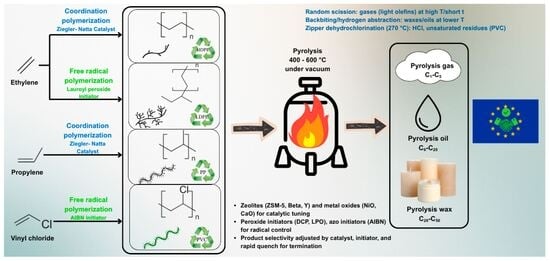
2. Polymerization—Derived Microstructure of HDPE, LDPE, PP, and PVC
2.1. Coordination Polymerization Mechanism of HDPE/MPDE and PP
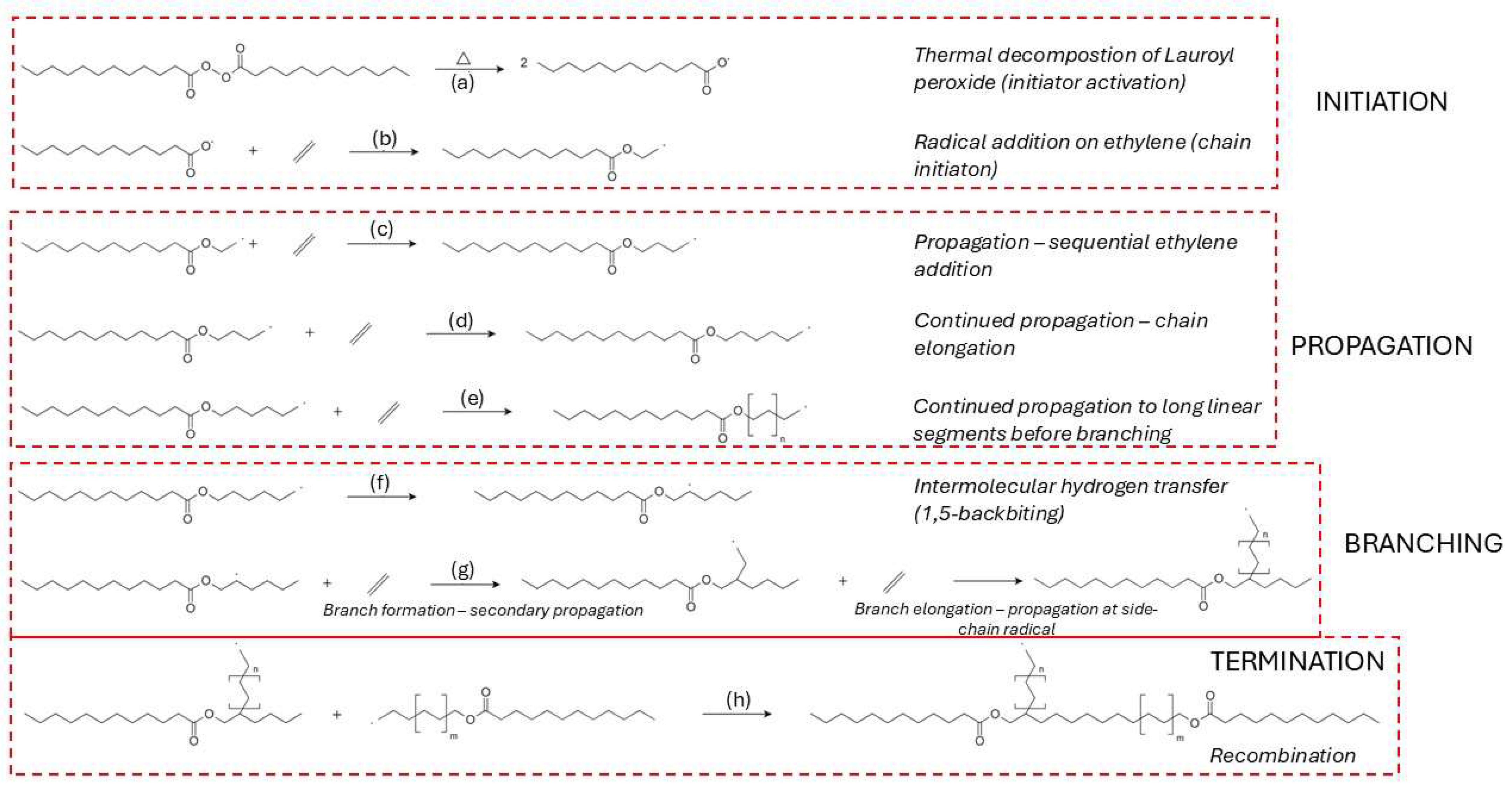
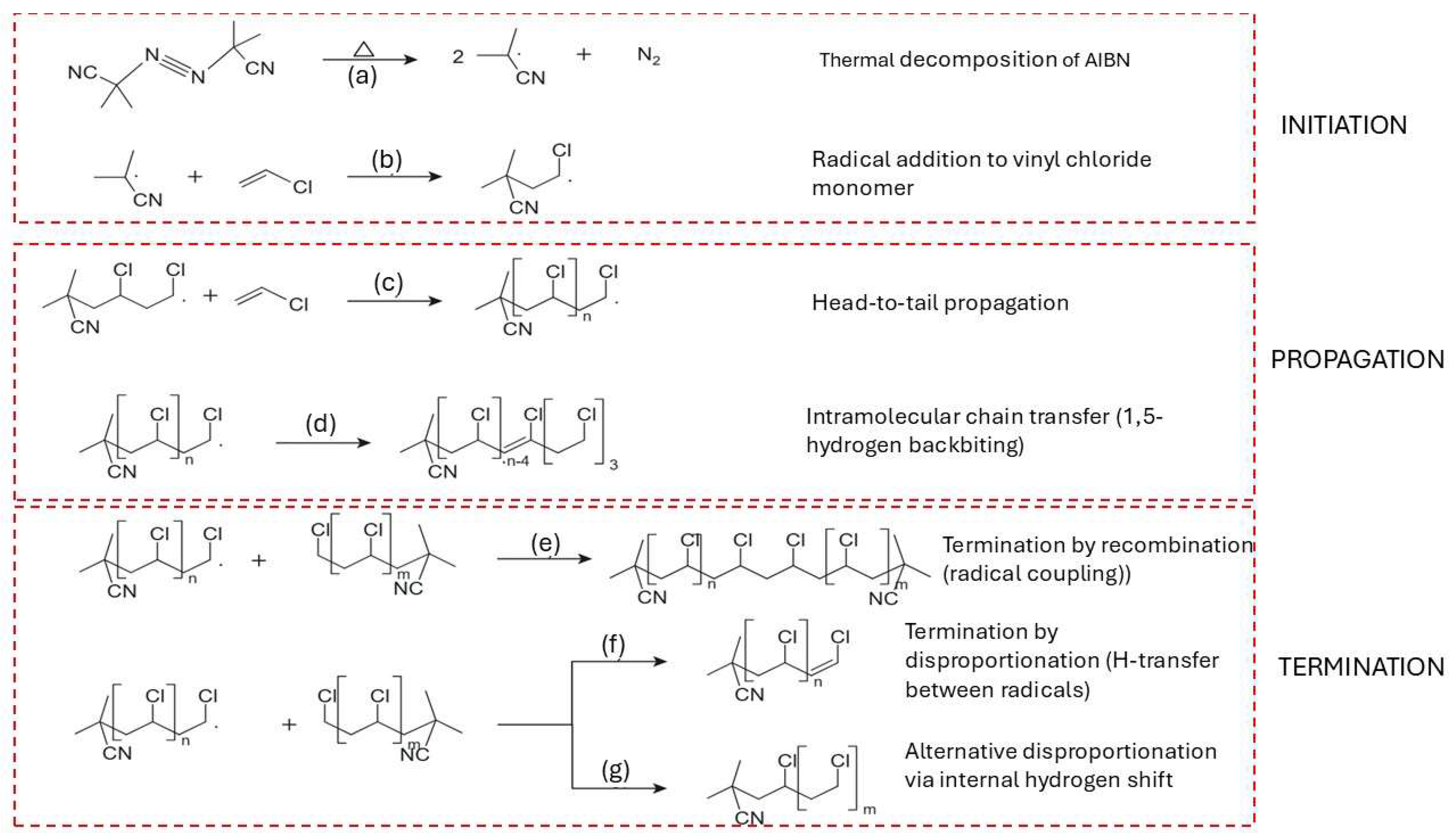
2.2. Free Radical Polymerization of LDPE and PVC
2.3. Linking Polymerization-Derived Microstructure to Pyrolysis: Radical Chain Kinetics and Product Selectivity

| Polymerization Control (Specific Agents/Conditions) | Chain Architecture Descriptor (Molecular) | Pyrolysis Conditions | Pyrolysis Product Selectivity | Rationale | Refs. |
|---|---|---|---|---|---|
| Ziegler–Natta catalyst (TiCl4/AlR3), ↑ H2 cofeed (PE) | SCB ↓ (0.1 → 0.02/1000 C); linear sequence fraction ↑ (60 → 75%); Mw ↓ (by up to 50%) | Continuous conical spouted bed reactor: inert nitrogen atmosphere, heating rate 10 °C per min atmospheric pressure, reactor temperature 450 to 600 °C, polymer feed rate about 1 g per min, nitrogen spouting flow about 11 L per min, short vapor residence time | Wax yield +10–15%; olefin yield −10% | H2 acts as a chain transfer agent, shortening chains and increasing linearity and branching density; fewer branches and more linear segments favour paraffinic wax formation during pyrolysis. | [54,129,130,142] |
| Metallocene catalyst (e.g., Cp2ZrCl2/MAO, PP, PE) | Tacticity ↑ (meso pentad > 99% for PP); Mw/Mn ↓ (6 → 2); defects isolated | Fixed bed reactor: inert nitrogen environment, heating rate 10 °C per min, reactor temperature 500 to 600 °C, isothermal hold 30 min, effective pyrolysis duration about 5 to 10 min depending on temperature. | BTX (catalytic) yield +15–20%; higher wax fractions | Single site control produces highly uniform, stereoregular chains, enhancing the fraction of long, substituted segments that aromatize and survive as heavy waxes in pyrolysis. | [130,143] |
| Peroxide initiator (e.g., di tert-butyl peroxide, LDPE), ↑ concentration, T ↑ | SCB ↑ (6 → 12 /1000 C atoms); branch point density increases, including tertiary carbon sites | Fixed bed reactor: inert nitrogen environment, heating rate 10 °C per min, reactor temperature 500 to 600 °C, isothermal hold 30 min, no carrier gas flow during pyrolysis, effective reaction time about 5 to 10 min. | Light olefin yield +20%; wax yield −15% | Peroxide initiated radical polymerization generates more branching and amorphous content; branched sites undergo β-scission more readily, giving shorter C2–C4 olefins. | [144,145,146] |
| PVC via free radical route (e.g., AIBN), ↑ conversion/temperature | Labile defects ↑ (<1 → 5/1000; tertiary/allylic Cl, HTHT units) | Batch tube reactor: isothermal 530 °C, residence time 25 min, inert atmosphere, heating rate 15 °C per min | Dehydrochlorination T ↓ −30 °C; aromatics/char yield +10% | Higher conversion or temperature increases labile Cl—containing defects, lowering the barrier for HCl elimination and promoting backbone crosslinking and aromatization. | [21,134,135,147] |
| Polymer | Pyrolysis Onset T (°C) | Ea (kJ mol−1) | Basis Conditions (Kinetics and Yields) | Oil/Wax Yield 450–600 °C (%) | Olefin Yield (%) | BTX Yield w/o HZSM-5 (%) | BTX Yield w/HSZM-5 | Refs. |
|---|---|---|---|---|---|---|---|---|
| HDPE | 400–440 | 222–270 | TGA under inert gas, heating rate 5 to 30 K min−1; reactor pyrolysis at 450 to 600 °C, inert or vacuum atmosphere, vapor residence time 1.4 to 5.6 s, catalyst polymer ratio (mass): 33:1 | 50–80 | 30–45 | <10 | 25–35 | [137,150,151] |
| LDPE/LLDPE | 410–475 | 190–240 | TGA under inert gas, heating rate 5 to 30 K min−1; reactor pyrolysis at 450 to 600 °C, inert or vacuum atmosphere, vapor residence time at or below 0.5 s for liquid rich operation, catalyst polymer ratio (mass): 10:1 | 35–45 | 45–60 | 10–20 | 30–40 | [128,138,149] |
| PP (isotactic) | 370–420 | 240–301 | TGA under inert gas, heating rate 5 to 30 K min−1; reactor pyrolysis at 450 to 600 °C, inert or vacuum atmosphere, vapor residence time 1.4 to 5.6 s, catalyst polymer ratio (mass): 80:1 | 40–60 | 35–50 | 15–20 | 35–53 | [132,152,153] |
| PVC | 270–320 (dehydrochlorination) | 131–199 | TGA under inert gas, heating rate 5 to 30 K min. Increasing heating rate from 5 to 30 K min−1 shifts the main decomposition peak from about 266 °C to 307 °C inert atmosphere. Product yields depend strongly on residence time and secondary reactions under the reactor conditions reported in the cited studies. Catalyst polymer ratio (CaO/Cl): 1:2 | 10–20 | <5 | <5 | <10 | [134,135] |
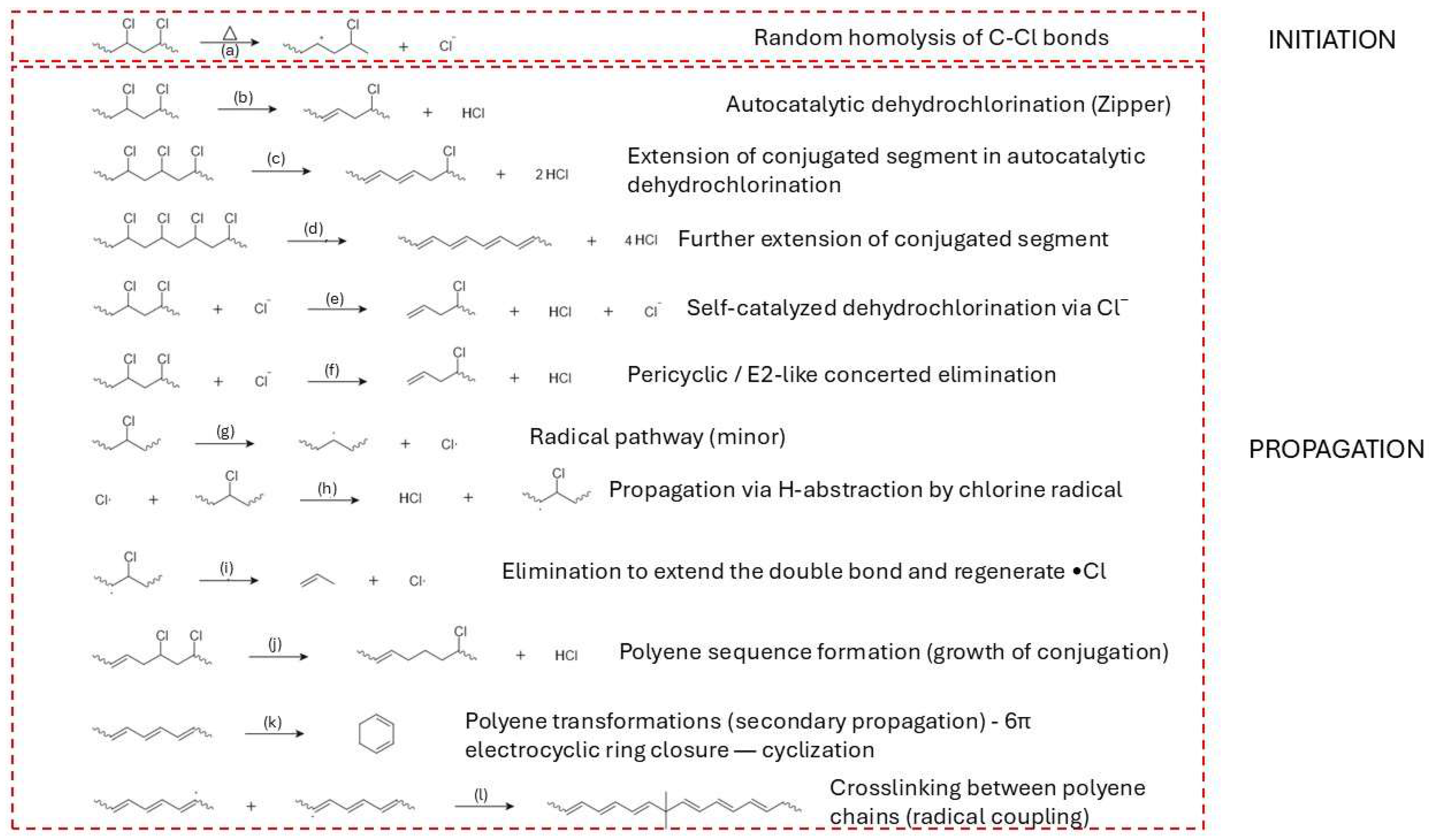
3. Mechanistic Pathways and Kinetic Characteristics of Thermal Degradation in HDPE, LDPE, PP and PVC
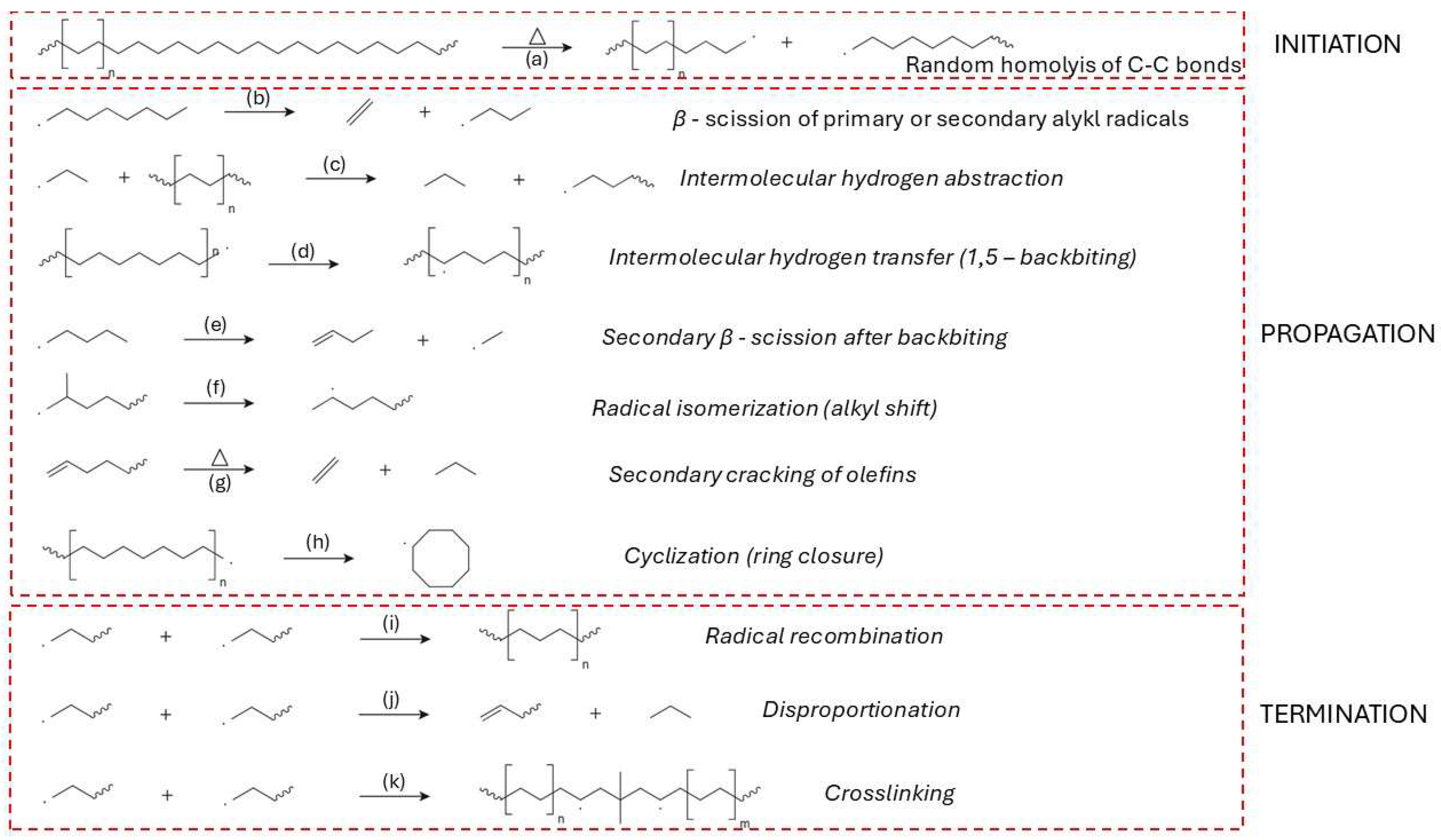
3.1. HDPE
3.2. LDPE
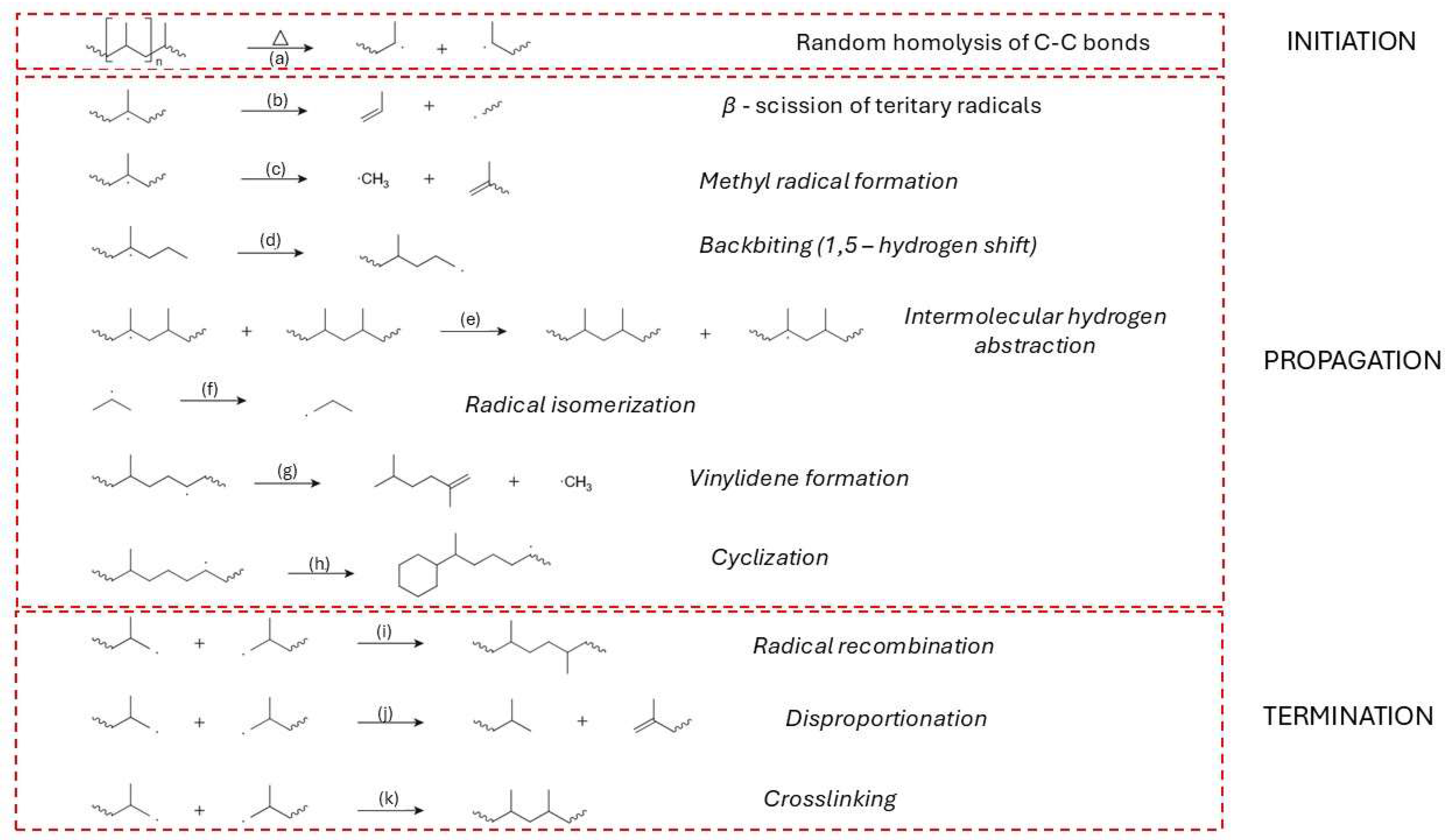
3.3. PP
3.4. PVC
4. Tuning Thermal Degradation Pathways with Potential Catalysts and Initiators: Lowering Onset and Enabling Selective Termination
4.1. PE, PP and PVC: Influence of Catalysts, Initiators, and Termination Procedures
4.1.1. Catalyst Effect for HDPE, LDPE, PP and PVC Pyrolysis
4.1.2. Initiator Effects for HDPE, LDPE, PP and PVC Pyrolysis
4.1.3. Termination Strategies for HDPE, LDPE, PP and PVC Pyrolysis
5. Conclusions
Author Contributions
Funding
Institutional Review Board Statement
Informed Consent Statement
Data Availability Statement
Conflicts of Interest
Abbreviations
| PVC | Poly(vinyl chloride) |
| PE HD/MD | Polyethylene High and Medium Density |
| PE LD/LLD | Polyethylene Low and Linear Low Density |
| PP | Polypropylene |
| BTX | Benzene, Toluene and Xylenes |
| EU | European Union |
| HZSM-5 | Hydrogen form Zeolite Socony Mobil-5 |
| CHP | Combined Heat and Power |
| VOC | Volatile Organic Compound |
| TG-FTIR | Thermogravimetric—Fourier Transform Infrared Spectroscopy |
| HMFI | H-form MFI-type zeolite |
| PCM | Phase Change Materials |
| Et3Al | triethylaluminum |
| MAO | Methylaluminoxane |
| BHE | β-hydride elimination |
| BHT | β-hydride transfer to monomer |
| SBI | s-bis(indenyl) |
| TSA | Syn Transition State |
| TSC | Anti Transition State |
| CLDT | Chain-length-dependent termination |
| PLP | Pulsed Laser Polymerization |
| EPR | Electron Paramagnetic Resonance |
| MWD | Molecular Weight Distribution |
| SP-PLP-EPR | Single Pulse-Pulsed Laser Polymerization-Electron Paramagnetic Resonance |
| AIBN | Azobisisobutyronitrile |
| MCR | Mid-chain radical |
| G3(MP2)-RAD | Gaussian-3 (Møller–Plesset 2)—Radical |
| ONIOM | Our-N-layer Integrated Orbital and Molecular Mechanics |
| SCB | Short-chain Branching |
| GPC | Gel Permeation Chromatography |
| NMR | Nuclear Magnetic Resonance |
| DSC | Differential Scanning Calorimetry |
| TGA | Thermogravimetric Analysis |
| PAH | Polycyclic aromatic hydrocarbons |
| MNDO | Modified Neglect of Diatomic Overlap |
| AM1 | Austin Model 1 |
| DFT | Density Functional Theory |
| HY | Hydrogen-form Y-type Zeolite |
| MCM-41 | Mobil Composition of Matter 41 |
| SBA-15 | Santa Barbara Amorphous-15 |
| HUSY | Hydrogen-form Ultra-Stable Y-type Zeolite |
| HBEA | Hydrogen-form Beta Zeolite |
| MOF | Metal–Organic Framework |
| FCC | Fluid Catalytic Cracking |
| DCP | Dicumyl peroxide |
| 2-EHN | 2-ethylexyl nitrate |
| NOR | Nitroxide-mediated system |
| PGMA | Polyglycidyl methacrylate |
| BHT | Butylated hydroxytoluene |
References
- Sun, J.; Dong, J.; Gao, L.; Zhao, Y.-Q.; Moon, H.; Scott, S.L. Catalytic Upcycling of Polyolefins. Chem. Rev. 2024, 124, 9457–9579. [Google Scholar] [CrossRef]
- Xu, S.; Tang, J.; Fu, L. Catalytic Strategies for the Upcycling of Polyolefin Plastic Waste. Langmuir 2024, 40, 3984–4000. [Google Scholar] [CrossRef] [PubMed]
- Faust, K.; Denifl, P.; Hapke, M. Recent Advances in Catalytic Chemical Recycling of Polyolefins. ChemCatChem 2023, 15, e202300310. [Google Scholar] [CrossRef]
- Lopez, E.C.R. Pyrolysis of Polyvinyl Chloride, Polypropylene, and Polystyrene: Current Research and Future Outlook. Eng. Proc. 2023, 56, 44. [Google Scholar] [CrossRef]
- Svadlenak, S.; Wojcik, S.; Ogunlalu, O.; Vu, M.; Dor, M.; Boudouris, B.W.; Wildenschild, D.; Goulas, K.A. Upcycling of Polyvinyl Chloride to Hydrocarbon Waxes via Dechlorination and Catalytic Hydrogenation. Appl. Catal. B Environ. 2023, 338, 123065. [Google Scholar] [CrossRef]
- Kruse, T.M.; Wong, H.; Broadbelt, L.J. Mechanistic Modeling of Polymer Pyrolysis: Polypropylene. Macromolecules 2003, 36, 9594–9607. [Google Scholar] [CrossRef]
- Popov, K.V.; Knyazev, V.D. Initial Stages of the Pyrolysis of Polyethylene. J. Phys. Chem. A 2015, 119, 11737–11760. [Google Scholar] [CrossRef]
- Gascoin, N.; Fau, G.; Gillard, P.; Mangeot, A. Flash Pyrolysis of High Density Polyethylene. In Proceedings of the 49th AIAA/ASME/SAE/ASEE Joint PropulsionConference, San Jose, CA, USA, 15–17 July 2013. [Google Scholar] [CrossRef]
- Jayarama Krishna, J.V.; Perez, B.A.; Toraman, H.E. Parametric Study of Polyethylene Primary Decomposition Using a Micropyrolyzer Coupled with Two-Dimensional Gas Chromatography. ACS Sustain. Chem. Eng. 2024, 12, 7508–7518. [Google Scholar] [CrossRef]
- Yan, G.; Jing, X.; Wen, H.; Xiang, S. Thermal Cracking of Virgin and Waste Plastics of PP and LDPE in a Semibatch Reactor under Atmospheric Pressure. Energy Fuels 2015, 29, 2289–2298. [Google Scholar] [CrossRef]
- Marcilla, A.; Beltrán, M.I.; Navarro, R. Evolution of Products Generated during the Dynamic Pyrolysis of LDPE and HDPE over HZSM5. Energy Fuels 2008, 22, 2917–2924. [Google Scholar] [CrossRef]
- Hujuri, U.; Ghoshal, A.; Gumma, S. Temperature-Dependent Pyrolytic Product Evolution Profile for Polypropylene. J. Appl. Polym. Sci. 2011, 119, 2318–2325. [Google Scholar] [CrossRef]
- Danforth, J.D.; Spiegel, J.; Bloom, J. The Kinetics and Mechanism of the Thermal Dehydrochlorination of Poly(Vinyl Chloride). J. Macromol. Sci. Part A Chem. 1982, 17, 1107–1127. [Google Scholar] [CrossRef]
- Nolan, K.; Shapiro, J. Presence of Dual Mechanism in Poly(Vinyl Chloride) Dehydrochlorination. J. Polym. Sci. Polym. Symp. 2007, 55, 201–209. [Google Scholar] [CrossRef]
- Wu, J.; Papanikolaou, K.G.; Cheng, F.; Addison, B.; Cuthbertson, A.A.; Mavrikakis, M.; Huber, G.W. Kinetic Study of Polyvinyl Chloride Pyrolysis with Characterization of Dehydrochlorinated PVC. ACS Sustain. Chem. Eng. 2024, 12, 7402–7413. [Google Scholar] [CrossRef]
- Patel, K.; Velazquez, A.; Calderon, H.S.; Brown, G.R. Studies of the Solid-State Thermal Degradation of PVC. I. Autocatalysis by Hydrogen Chloride. J. Appl. Polym. Sci. 1992, 46, 179–187. [Google Scholar] [CrossRef]
- Cheng, W.-H.; Liang, Y.C. Catalytic Pyrolysis of Polyvinylchloride in the Presence of Metal Chloride. J. Appl. Polym. Sci. 2000, 77, 2464–2471. [Google Scholar] [CrossRef]
- Ballistreri, A.; Foti, S.; Maravigna, P.; Montaudo, G.; Scamporrino, E. Effect of Metal Oxides on the Evolution of Aromatic Hydrocarbons in the Thermal Decomposition of PVC. J. Polym. Sci. Polym. Chem. Ed. 1980, 18, 3101–3110. [Google Scholar] [CrossRef]
- Lattimer, R.P.; Kroenke, W.J. Mechanisms of Formation of Volatile Aromatic Pyrolyzates from Poly(Vinyl Chloride). J. Appl. Polym. Sci. 1982, 27, 1355–1366. [Google Scholar] [CrossRef]
- Jafari, A.J.; Donaldson, J.D. Determination of HCl and VOC Emission from Thermal Degradation of PVC in the Absence and Presence of Copper, Copper(II) Oxide and Copper(II) Chloride. J. Chem. 2009, 6, 753835. [Google Scholar] [CrossRef]
- Meng, H.; Liu, J.; Xia, Y.; Hu, B.; Sun, H.; Li, J.; Lu, Q. Migration and Transformation Mechanism of Cl during Polyvinyl Chloride Pyrolysis: The Role of Structural Defects. Polym. Degrad. Stab. 2024, 224, 110750. [Google Scholar] [CrossRef]
- Beneš, M.; Milanov, N.; Matuschek, G.; Kettrup, A.; Plaček, V.; Balek, V. Thermal Degradation of PVC Cable Insulation Studied by Simultaneous TG-FTIR and TG-EGA Methods. J. Therm. Anal. Calorim. 2004, 78, 621–630. [Google Scholar] [CrossRef]
- Xu, S.; Sun, Z.; Hou, K.; Wang, G.; Liu, M.; Zhang, Y.; Zhang, C.; Zhang, Z. Quantifying the Modulation of Modified ZSM-5 Acidity/Alkalinity on Olefin Catalytic Pyrolysis to Maximize Light Olefin Selectivity. J. Energy Inst. 2024, 115, 101688. [Google Scholar] [CrossRef]
- Farah, E.; Demianenko, L.; Engvall, K.; Kantarelis, E. Controlling the Activity and Selectivity of HZSM-5 Catalysts in the Conversion of Biomass-Derived Oxygenates Using Hierarchical Structures: The Effect of Crystalline Size and Intracrystalline Pore Dimensions on Olefins Selectivity and Catalyst Deactivatio. Top. Catal. 2023, 66, 1310–1328. [Google Scholar] [CrossRef]
- Wang, R.; Gong, Y.; Wang, P.; Zheng, A.; Wang, Z.; Sha, Y.; Jiang, Q.; Xin, M.; Cao, D.; Song, H.; et al. 3D-Printed Monolithic ZSM-5@nano-ZSM-5: Hierarchical Core-Shell Structured Catalysts for Enhanced Cracking of Polyethylene-Derived Pyrolysis Oils. Addit. Manuf. 2024, 79, 103890. [Google Scholar] [CrossRef]
- Rzepka, P.; Sheptyakov, D.; Wang, C.; van Bokhoven, J.A.; Paunović, V. How Micropore Topology Influences the Structure and Location of Coke in Zeolite Catalysts. ACS Catal. 2024, 14, 5593–5604. [Google Scholar] [CrossRef]
- Wang, T.; Feng, X.; Lin, D.; Li, Y.; Shang, J.; Zhang, J.; Li, S.; Liu, Y.; Zhao, H.; Ma, Z.; et al. Regulating Framework Aluminum Location towards Boosted Light Olefins Generation in Ex-Situ Catalytic Pyrolysis of Low-Density Polyethylene. Chem. Eng. J. 2024, 485, 149737. [Google Scholar] [CrossRef]
- Chen, Z.; Lyu, W.; Wang, R.; Li, Y.; Xu, C.; Jiang, G.; Zhang, L. A Molecular Kinetic Model Incorporating Catalyst Acidity for Hydrocarbon Catalytic Cracking. AIChE J. 2023, 69, e18060. [Google Scholar] [CrossRef]
- Chen, D.; Liu, D.; He, H.; Zhao, L.; Gao, J.; Xu, C. Rational Tuning of Monomolecular, Bimolecular and Aromatization Pathways in the Catalytic Pyrolysis of Hexane on ZSM-5 from a First-Principles-Based Microkinetics Analysis. Fuel 2024, 366, 131368. [Google Scholar] [CrossRef]
- Ureel, Y.; Alexopoulos, K.; Van Geem, K.M.; Sabbe, M.K. Predicting the Effect of Framework and Hydrocarbon Structure on the Zeolite-Catalyzed Beta-Scission. Catal. Sci. Technol. 2024, 14, 7020–7036. [Google Scholar] [CrossRef]
- Zhang, J.; Dengguo, L.; Chen, Z.; Wang, X.; Xiong, Q.; Li, J.; Zhang, X.; Oboirien, B.O.; Xu, G. CO2-Assisted Catalytic Pyrolysis of Polyolefins to Aromatics over Mesoporous HZSM-5 and Ga/ZSM-5 Catalysts. ACS Sustain. Chem. Eng. 2024, 12, 13137–13148. [Google Scholar] [CrossRef]
- He, Q.; Akin, O.; Ureel, Y.; Yazdani, P.; Li, L.; Varghese, R.J.; Geem, K.M. Van Enhancing Catalytic Pyrolysis of Polypropylene Using Mesopore-Modified HZSM-5 Catalysts: Insights and Strategies for Improved Performance. Front. Chem. Eng. 2024, 6, 1439400. [Google Scholar] [CrossRef]
- Kim, C.A.; Sahasrabudhe, C.A.; Wang, Y.-Y.; Yappert, R.; Heyden, A.; Huang, W.; Sadow, A.D.; Peters, B. Population Balance Equations for Reactive Separation in Polymer Upcycling. Langmuir 2024, 40, 4096–4107. [Google Scholar] [CrossRef]
- Wu, Y.; Han, J.; Zhang, W.; Yu, Z.; Wang, K.; Fang, X.; Wei, Y.; Liu, Z. Combined Strategies Enable Highly Selective Light Olefins and Para-Xylene Production on Single Catalyst Bed. J. Am. Chem. Soc. 2024, 146, 8086–8097. [Google Scholar] [CrossRef]
- Duan, J.; Chen, W.; Wang, C.; Wang, L.; Liu, Z.; Yi, X.; Fang, W.; Wang, H.; Wei, H.; Xu, S.; et al. Coking-Resistant Polyethylene Upcycling Modulated by Zeolite Micropore Diffusion. J. Am. Chem. Soc. 2022, 144, 14269–14277. [Google Scholar] [CrossRef]
- Eschenbacher, A.; Varghese, R.J.; Delikonstantis, E.; Mynko, O.; Goodarzi, F.; Enemark-Rasmussen, K.; Oenema, J.; Abbas-Abadi, M.S.; Stefanidis, G.D.; Van Geem, K.M. Highly Selective Conversion of Mixed Polyolefins to Valuable Base Chemicals Using Phosphorus-Modified and Steam-Treated Mesoporous HZSM-5 Zeolite with Minimal Carbon Footprint. Appl. Catal. B Environ. 2022, 309, 121251. [Google Scholar] [CrossRef]
- Tennakoon, A.; Wu, X.; Meirow, M.; Howell, D.; Willmon, J.; Yu, J.; Lamb, J.V.; Delferro, M.; Luijten, E.; Huang, W.; et al. Two Mesoporous Domains Are Better Than One for Catalytic Deconstruction of Polyolefins. J. Am. Chem. Soc. 2023, 145, 17936–17944. [Google Scholar] [CrossRef]
- Ando, Y.; Miyakage, T.; Anzai, A.; Huang, M.; Ait El Fakir, A.; Toyao, T.; Nakasaka, Y.; Phuekphong, A.; Ogawa, M.; Kolganov, A.A.; et al. Conversion of Polypropylene to Light Olefins by HMFI Catalysts below Pyrolytic Temperature: Catalytic, Spectroscopic, and Theoretical Studies. J. Phys. Chem. C 2025, 129, 1678–1691. [Google Scholar] [CrossRef]
- Ashuiev, A.; Allouche, F.; Wili, N.; Searles, K.; Klose, D.; Copéret, C.; Jeschke, G. Molecular and Supported Ti(Iii)-Alkyls: Efficient Ethylene Polymerization Driven by the π-Character of Metal-Carbon Bonds and Back Donation from a Singly Occupied Molecular Orbital. Chem. Sci. 2021, 12, 780–792. [Google Scholar] [CrossRef]
- Nakayama, Y.; Shiono, T. Coordination Polymerization (Olefin and Diene). In Encyclopedia of Polymeric Nanomaterials; Kobayashi, S., Müllen, K., Eds.; Springer: Berlin/Heidelberg, Germany, 2021; pp. 1–6. ISBN 978-3-642-36199-9. [Google Scholar]
- Tran, T.V.; Do, L.H. Tunable Modalities in Polyolefin Synthesis via Coordination Insertion Catalysis. Eur. Polym. J. 2021, 142, 110100. [Google Scholar] [CrossRef]
- Fushimi, M.; Damma, D. Exploring Ti Active Sites in Ziegler-Natta Catalysts through Realistic-Scale Computer Simulations with Universal Neural Network Potential. Mol. Catal. 2024, 565, 114414. [Google Scholar] [CrossRef]
- Young, M.J.; Ma, C.C.M.; Ting, C. Activation Energy and Transition State Determination of the Olefin Insertion Process of Metallocene Catalysts Using a Semiempirical Molecular Orbital Calculation. Russ. J. Coord. Chem. 2002, 28, 25–31. [Google Scholar] [CrossRef]
- Ehm, C.; Budzelaar, P.H.M.; Busico, V. Calculating Accurate Barriers for Olefin Insertion and Related Reactions. J. Organomet. Chem. 2015, 775, 39–49. [Google Scholar] [CrossRef]
- Clementi, E.; Giunchi, G.; Introduction, I. Theoretical Study on a Reaction Pathway of Ziegler-Natta- Type Catalysis. J. Chem. Phys. 1978, 68, 2337–2351. [Google Scholar]
- Ortega, D.E.; Matute, R.A.; Toro-Labbé, A. Exploring the Nature of the Energy Barriers on the Mechanism of the Zirconocene-Catalyzed Ethylene Polymerization: A Quantitative Study from Reaction Force Analysis. J. Phys. Chem. C 2020, 124, 8198–8209. [Google Scholar] [CrossRef]
- Huang, J.; Rempel, G.L. Ziegler-Natta Catalysts for Olefin Polymerization: Mechanistic Insights from Metallocene Systems. Prog. Polym. Sci. 1995, 20, 459–526. [Google Scholar] [CrossRef]
- Fan, H.; Kang, X.; Dai, S. Stable Ultrahighly Branched Polyethylene Synthesis via Externally Robust Chain-Walking Polymerization. ACS Catal. 2024, 14, 13531–13541. [Google Scholar] [CrossRef]
- Ashuiev, A.; Humbert, M.; Gajan, D.; Norsic, S.; Searles, K.; Klose, D.; Lesage, A.; Pintacuda, G.; Ashuiev, A.; Humbert, M.; et al. Spectroscopic Signature and Structure of Active Centers in Ziegler-Natta Polymerization Catalysts Revealed by Electron Paramagnetic Resonance. 2020. Available online: https://hal.science/hal-03017383/ (accessed on 27 September 2025).
- So, L.C.; Faucher, S.; Zhu, S. Synthesis of Low Molecular Weight Polyethylenes and Polyethylene Mimics with Controlled Chain Structures. Prog. Polym. Sci. 2014, 39, 1196–1234. [Google Scholar] [CrossRef]
- Kissin, Y.V. Active Centers in Ziegler–Natta Catalysts: Formation Kinetics and Structure. J. Catal. 2012, 292, 188–200. [Google Scholar] [CrossRef]
- Shiga, A. Theoretical Study of Ethylene Polymerization on Ziegler–Natta Catalysts and on Metallocene Catalysts. J. Mol. Catal. A Chem. 1999, 146, 325–334. [Google Scholar] [CrossRef]
- Koltzenburg, S.; Maskos, M.; Nuyken, O. Coordination Polymerization. In Polymer Chemistry; Springer: Berlin/Heidelberg, Germany, 2023; pp. 295–324. ISBN 978-3-662-64929-9. [Google Scholar]
- Yu, Y.; Fu, Z.; Fan, Z. Chain Transfer Reactions of Propylene Polymerization Catalyzed by AlEt 3 Activated TiCl4/MgCl2 Catalyst under Very Low Monomer Addition Rate. J. Mol. Catal. A Chem. 2012, 363–364, 134–139. [Google Scholar] [CrossRef]
- Margl, P.; Deng, L.; Ziegler, T. A Unified View of Ethylene Polymerization by D0 and D0f(n) Transition Metals. 3. Termination of the Growing Polymer Chain. J. Am. Chem. Soc. 1999, 121, 154–162. [Google Scholar] [CrossRef]
- Talarico, G.; Budzelaar, P.H.M. A Second Transition State for Chain Transfer to Monomer in Olefin Polymerization Promoted by Group 4 Metal Catalysts. J. Am. Chem. Soc. 2006, 128, 4524–4525. [Google Scholar] [CrossRef]
- Tsutsui, T.; Kashiwa, N.; Mizuno, A. Effect of Hydrogen on Propene Polymerization with Ethylenebis(1-indenyl)Zirconium Dichloride and Methylalumoxane Catalyst System. Die Makromol. Chem. Rapid Commun. 1990, 11, 565–570. [Google Scholar] [CrossRef]
- Kissin, Y.V.; Rishina, L.A.; Vizen, E.I. Hydrogen Effects in Propylene Polymerization Reactions with Titanium-Based Ziegler-Natta Catalysts. II. Mechanism of the Chain-Transfer Reaction. J. Polym. Sci. Part A Polym. Chem. 2002, 40, 1899–1911. [Google Scholar] [CrossRef]
- Guo, Y.; Zhang, Z.; Guo, W.; Khan, A.; Fu, Z.; Xu, J.; Fan, Z. Kinetics and Mechanism of Metallocene-Catalyzed Olefin Polymerization: Comparison of Ethylene, Propylene Homopolymerizations, and Their Copolymerization. J. Polym. Sci. Part A Polym. Chem. 2017, 55, 867–875. [Google Scholar] [CrossRef]
- Naweephattana, P.; Walaijai, K.; Rungnim, C.; Luanphaisarnnont, T.; Watthanaphanit, A.; Patthamasang, S.; Phiriyawirut, P.; Surawatanawong, P. The Role of Organoaluminum and Electron Donors in Propene Insertion on the Ziegler–Natta Catalyst. Dalton Trans. 2024, 53, 11050–11059. [Google Scholar] [CrossRef]
- Kumawat, J.; Gupta, V.K.; Vanka, K. Effect of Donors on the Activation Mechanism in Ziegler-Natta Catalysis: A Computational Study. ChemCatChem 2016, 8, 1809–1818. [Google Scholar] [CrossRef]
- Kissin, Y.V.; Liu, X.; Pollick, D.J.; Brungard, N.L.; Chang, M. Ziegler-Natta Catalysts for Propylene Polymerization: Chemistry of Reactions Leading to the Formation of Active Centers. J. Mol. Catal. A Chem. 2008, 287, 45–52. [Google Scholar] [CrossRef]
- Magni, E.; Somorjai, G.A. Ethylene and Propylene Polymerization Catalyzed by a Model Ziegler-Natta Catalyst Prepared by Gas Phase Deposition of Magnesium Chloride and Titanium Chloride Thin Films. Catal. Lett. 1995, 35, 205–214. [Google Scholar] [CrossRef]
- Fushimi, M.; Damma, D. The Role of External Donors in Ziegler-Natta Catalysts through Nudged Elastic Band Simulations on Realistic-Scale Models Employing a Universal Neural Network Potential. J. Phys. Chem. C 2024, 128, 6646–6657. [Google Scholar] [CrossRef]
- Li, C.; Feng, H.; Liu, H.; Zhuang, Z.; Zhou, J.; Liu, D. Effect of Dioldibenzoate Isomers as Electron Donors on the Performances of Ziegler–Natta Polypropylene Catalysts: Experiments and Calculations. J. Phys. Chem. C 2023, 127, 2294–2302. [Google Scholar] [CrossRef]
- Tritto, I.; Sacchi, M.C.; Locatelli, P. Ziegler-Natta Polymerization of Propene: Cooperative Effects of Titanium Ligands on the Steric Control of the First Addition of Monomer. Die Makromol. Chem. 1986, 187, 2145–2151. [Google Scholar] [CrossRef]
- Resconi, L.; Piemontesi, F.; Franciscono, G.; Abis, L.; Fiorani, T. Olefin Polymerization at Bis(Pentamethylcyclopentadienyl)Zirconium and -Hafnium Centers: Chain-Transfer Mechanisms. J. Am. Chem. Soc. 1992, 114, 1025–1032. [Google Scholar] [CrossRef]
- Ewen, J.A.; Elder, M.J.; Jones, R.L.; Haspeslagh, L.; Atwood, J.L.; Bott, S.G.; Robinson, K. Metallocene/Polypropylene Structural Relationships: Implications on Polymerization and Stereochemical Control Mechanisms. Makromol. Chem. Macromol. Symp. 1991, 48–49, 253–295. [Google Scholar] [CrossRef]
- Busico, V.; Cipullo, R.; Pellecchia, R.; Ronca, S.; Roviello, G.; Talarico, G. Design of Stereoselective Ziegler-Natta Propene Polymerization Catalysts. Proc. Natl. Acad. Sci. USA 2006, 103, 15321–15326. [Google Scholar] [CrossRef] [PubMed]
- Busico, V.; Cipullo, R.; Ronca, S.; Budzelaar, P.H.M. Mimicking Ziegler-Natta Catalysts in Homogeneous Phase, 1: C2-Symmetric Octahedral Zr(IV) Complexes with Tetradentate [ONNO]-Type Ligands. Macromol. Rapid Commun. 2001, 22, 1405–1410. [Google Scholar] [CrossRef]
- Castro, L.; Therukauff, G.; Vantomme, A.; Welle, A.; Haspeslagh, L.; Brusson, J.M.; Maron, L.; Carpentier, J.F.; Kirillov, E. A Theoretical Outlook on the Stereoselectivity Origins of Isoselective Zirconocene Propylene Polymerization Catalysts. Chem. Eur. J. 2018, 24, 10784–10792. [Google Scholar] [CrossRef]
- Chadwick, J.C.; Heere, J.J.R.; Sudmeijer, O. Factors Influencing Chain Transfer with Monomer and with Hydrogen in Propene Polymerization Using MgCl2-Supported Ziegler-Natta Catalysts. Macromol. Chem. Phys. 2000, 201, 1846–1852. [Google Scholar] [CrossRef]
- Cavallo, L.; Guerra, G.; Corradini, P. Mechanisms of Propagation and Termination Reactions in Classical Heterogeneous Ziegler-Natta Catalytic Systems: A Nonlocal Density Functional Study. J. Am. Chem. Soc. 1998, 120, 2428–2436. [Google Scholar] [CrossRef]
- Santoro, O.; Piola, L.; Mc Cabe, K.; Lhost, O.; Den Dauw, K.; Vantomme, A.; Welle, A.; Maron, L.; Carpentier, J.F.; Kirillov, E. Long-Chain Branched Polyethylene via Coordinative Tandem Insertion and Chain-Transfer Polymerization Using Rac-{EBTHI}ZrCl2/MAO/Al-Alkenyl Combinations: An Experimental and Theoretical Study. Macromolecules 2020, 53, 8847–8857. [Google Scholar] [CrossRef]
- Sifri, R.J.; Padilla-Vélez, O.; Coates, G.W.; Fors, B.P. Controlling the Shape of Molecular Weight Distributions in Coordination Polymerization and Its Impact on Physical Properties. J. Am. Chem. Soc. 2020, 142, 1443–1448. [Google Scholar] [CrossRef]
- Becker, P.; Buback, M.; Sandmann, J. Initiator Efficiency of Peroxides in High-Pressure Ethene Polymerization. Macromol. Chem. Phys. 2002, 203, 2113–2123. [Google Scholar] [CrossRef]
- Davis, T.P. Handbook of Radical; John Wiley & Sons, Inc.: Hoboken, NJ, USA, 2002; ISBN 047139274X. [Google Scholar]
- Goller, A.; Obenauf, J.; Kretschmer, W.P.; Kempe, R. The Highly Controlled and Efficient Polymerization of Ethylene. Angew. Chem. Int. Ed. 2023, 62, e202216464. [Google Scholar] [CrossRef]
- Scorah, M.J.; Cosentino, R.; Dhib, R.; Penlidis, A. Experimental Study of a Tetrafunctional Peroxide Initiator: Bulk Free Radical Polymerization of Butyl Acrylate and Vinyl Acetate. Polym. Bull. 2006, 57, 157–167. [Google Scholar] [CrossRef]
- Koptelov, A.A.; Milekhin, Y.M.; Baranets, Y.N. Simulation of Thermal Decomposition of a Polymer at Random Scissions of C–C Bonds. Russ. J. Phys. Chem. B 2012, 6, 626–633. [Google Scholar] [CrossRef]
- Poutsma, M.L. Reexamination of the Pyrolysis of Polyethylene: Data Needs, Free-Radical Mechanistic Considerations, and Thermochemical Kinetic Simulation of Initial Product-Forming Pathways. Macromolecules 2003, 36, 8931–8957. [Google Scholar] [CrossRef]
- Yeiser, T.M.; Kline, G.M.; Arnett, R.L.; Stacy, C.J. Kinetics of the Thermal Degradation of Linear Polyethylene Complete Description of Thermal Degradation Would. Polym. Eng. Sci. 1966, 6, 295–298. [Google Scholar]
- Ding, W.; Liang, J.; Anderson, L.L. Thermal and Catalytic Degradation of High Density Polyethylene and Commingled Post-Consumer Plastic Waste. Fuel Process. Technol. 1997, 51, 47–62. [Google Scholar] [CrossRef]
- Holmstrom, A.; Sorvik, E.M. Thermal degradation of polyethylene in a nitrogen atmosphere of low oxygen content. IV. Structural changes occurring in different types of high-density polyethylene. J. Polym. Sci. Polym. Symp. 1976, 53, 33–53. [Google Scholar] [CrossRef]
- Lee, E.J.; Park, H.J.; Kim, S.M.; Lee, K.Y. Effect of Azo and Peroxide Initiators on a Kinetic Study of Methyl Methacrylate Free Radical Polymerization by DSC. Macromol. Res. 2018, 26, 322–331. [Google Scholar] [CrossRef]
- Pielichowski, K.; Njuguna, J.; Majka, T. Thermal Degradation of Polymers, Copolymers, and Blends. In Thermal Degradation of Polymeric Materials; Elsevier: Amsterdam, The Netherlands, 2023; pp. 49–147. ISBN 9780128230237. [Google Scholar]
- Androvič, L.; Bartáček, J.; Sedlák, M. Recent Advances in the Synthesis and Applications of Azo Initiators. Res. Chem. Intermed. 2016, 42, 5133–5145. [Google Scholar] [CrossRef]
- Scorah, M.J.; Dhib, R.; Penlidis, A. Use of a Novel Tetrafunctional Initiator in the Free Radical Homo- and Copolymerization of Styrene, Methyl Methacylate and α-Methyl Styrene. J. Macromol. Sci. Part A Pure Appl. Chem. 2005, 42, 403–426. [Google Scholar] [CrossRef]
- Luft, G.; Bitsch, H.; Seidl, H. Effectiveness of Organic Peroxide Initiators in the High-Pressure Polymerization of Ethylene. J. Macromol. Sci. Chem. 1977, 11, 1089–1112. [Google Scholar] [CrossRef]
- Khubi-Arani, Z.; Salami-Kalajahi, M.; Najafi, M.; Roghani-Mamaqani, H.; Haddadi-Asl, V.; Ghafelebashi-Zarand, S.M. Simulation of Styrene Free Radical Polymerization over Bi-Functional Initiators Using Monte Carlo Simulation Method and Comparison with Mono-Functional Initiators. Polym. Sci. Ser. B 2010, 52, 184–192. [Google Scholar] [CrossRef]
- Machi, S.; Kise, S.; Hagiwara, M.; Kagiya, T. Mechanisms of Propagation, Transfer, and Short-chain Branching Reactions in the Free-radical Polymerization of Ethylene. J. Polym. Sci. Part A-1 Polym. Chem. 1967, 5, 3115–3128. [Google Scholar] [CrossRef]
- Izgorodina, E.I.; Coote, M.L. Accurate Ab Initio Prediction of Propagation Rate Coefficients in Free-Radical Polymerization: Acrylonitrile and Vinyl Chloride. Chem. Phys. 2006, 324, 96–110. [Google Scholar] [CrossRef]
- Ashfaq, A.; Clochard, M.C.; Coqueret, X.; Dispenza, C.; Driscoll, M.S.; Ulański, P.; Al-Sheikhly, M. Polymerization Reactions and Modifications of Polymers by Ionizing Radiation. Polymers 2020, 12, 2877. [Google Scholar] [CrossRef]
- Liu, Y.A.; Sharma, N. Free Radical Polymerizations: LDPE and EVA. In Integrated Process Modeling Advanced Control and Data Analytics and Data Analytics for Optimizing Polyolefin Manufacturing; John Wiley & Sons: Hoboken, NJ, USA, 2023; ISBN 9783527843831. [Google Scholar]
- Mavroudakis, E.; Cuccato, D.; Moscatelli, D. Quantum Mechanical Investigation on Bimolecular Hydrogen Abstractions in Butyl Acrylate-Based Free Radical Polymerization Processes. J. Phys. Chem. A 2014, 118, 1799–1806. [Google Scholar] [CrossRef]
- Konstantinov, I.; Ewart, S.; Brown, H.; Eddy, C.; Mendenhall, J.; Munjal, S. Accurate Density Functional Theory (DFT) Protocol for Screening and Designing Chain Transfer and Branching Agents for LDPE Systems. Mol. Syst. Des. Eng. 2018, 3, 228–242. [Google Scholar] [CrossRef]
- Beuermann, S.; Buback, M. Free-Radical Polymerization Under High Pressure. In High Pressure Molecular Science; Winter, R., Jonas, J., Eds.; Springer: Dordrecht, The Netherlands, 1999; pp. 331–367. ISBN 978-94-011-4669-2. [Google Scholar]
- Seif, A.; Domingo, L.R.; Ahmadi, T.S. Calculation of the Rate Constants for Hydrogen Abstraction Reactions by Hydroperoxyl Radical from Methanol, and the Investigation of Stability of CH3OH. HO2 Complex. Comput. Theor. Chem. 2020, 1190, 113010. [Google Scholar] [CrossRef]
- Chabira, S.F.; Sebaa, M.; G’sell, C. Oxidation and Crosslinking Processes during Thermal Aging of Low-Density Polyethylene Films. J. Appl. Polym. Sci. 2012, 124, 5200–5208. [Google Scholar] [CrossRef]
- Iedema, P.; Wulkow, M.; Hoefsloot, H. Modeling Molecular Weight and Degree of Branching Distribution of Low-Density Polyethylene. Macromolecules 2000, 33, 7173–7184. [Google Scholar] [CrossRef]
- Odian, G. Radical Chain Polymerization. In Principles of Polymerization; John Wiley & Sons, Ltd.: Hoboken, NJ, USA, 2004; pp. 198–349. ISBN 9780471478751. [Google Scholar]
- Barner-Kowollik, C.; Russell, G.T. Chain-Length-Dependent Termination in Radical Polymerization: Subtle Revolution in Tackling a Long-Standing Challenge. Prog. Polym. Sci. 2009, 34, 1211–1259. [Google Scholar] [CrossRef]
- de Kock, J.B.L. Chain-Length Dependent Bimolecular Termination in Free-Radical Polymerization: Theory, Validation and Experimental Application of Novel Model-Independent Methods. Ph.D. Thesis, Technische Universiteit Eindhoven, Eindhoven, The Netherlands, 1999. [Google Scholar]
- Alghamdi, M.M.; Russell, G.T. On the Activation Energy of Termination in Radical Polymerization, as Studied at Low Conversion. Polymers 2024, 16, 3225. [Google Scholar] [CrossRef]
- Barner-kowollik, C.; Buback, M.; Egorov, M.; Fukuda, T.; Goto, A.; Friedrich, O.; Russell, G.T.; Vana, P.; Yamada, B.; Zetterlund, P.B. Critically Evaluated Termination Rate Coefficients for Free-Radical Polymerization: Experimental Methods. Prog. Polym. Sci. 2005, 30, 605–643. [Google Scholar] [CrossRef]
- Nikitin, A.N.; Hutchinson, R.A. Determination of the Mode of Free Radical Termination from Pulsed Laser Polymerization Experiments. Macromol. Theory Simul. 2007, 16, 29–42. [Google Scholar] [CrossRef]
- Van Cauter, K.; Van Speybroeck, V.; Waroquier, M. Ab Initio Study of Poly(Vinyl Chloride) Propagation Kinetics: Head-to-Head versus Head-to-Tail Additions. ChemPhysChem 2007, 8, 541–552. [Google Scholar] [CrossRef]
- Cuccato, D.; Dossi, M.; Moscatelli, D.; Storti, G. A Density Functional Theory Study of Poly(Vinyl Chloride) (PVC) Free Radical Polymerization. Macromol. Symp. 2011, 302, 100–109. [Google Scholar] [CrossRef]
- Ibrahim, A.; Ali, Y.; Saad, H.; Amur, I. Kinetics and Mechanism of Bulk Polymerization of Vinyl Chloride in a Polymerization Reactor. J. Eng. Res. 2015, 12, 41–50. [Google Scholar] [CrossRef]
- De Roo, T.; Wieme, J.; Heynderickx, G.J.; Marin, G.B. Estimation of Intrinsic Rate Coefficients in Vinyl Chloride Suspension Polymerization. Polymer 2005, 46, 8340–8354. [Google Scholar] [CrossRef]
- Abreu, C.M.R.; Fonseca, A.C.; Rocha, N.M.P.; Guthrie, J.T.; Serra, A.C.; Coelho, J.F.J. Poly(Vinyl Chloride): Current Status and Future Perspectives via Reversible Deactivation Radical Polymerization Methods. Prog. Polym. Sci. 2018, 87, 34–69. [Google Scholar] [CrossRef]
- Bárkányi, Á.; Németh, S.; Lakatos, B.G. Modelling and Simulation of Suspension Polymerization of Vinyl Chloride via Population Balance Model. Comput. Chem. Eng. 2013, 59, 211–218. [Google Scholar] [CrossRef]
- Cuccato, D.; Dossi, M.; Moscatelli, D.; Storti, G. Quantum Chemical Investigation of Secondary Reactions in Poly(Vinyl Chloride) Free-Radical Polymerization. Macromol. React. Eng. 2012, 6, 330–345. [Google Scholar] [CrossRef]
- Dedov, A.V. Modeling the Kinetics of the Extraction of Vinyl Chloride from Polyvinyl Chloride. Fibre Chem. 2012, 44, 186–188. [Google Scholar] [CrossRef]
- Starnes, W.H., Jr.; Wojciechowski, B.J. Mechanism and microstructure in the free-radical polymerization of vinyl chloride: Head-to-head addition revisited. In Makromolekulare Chemie. Macromolecular Symposia; Hüthig & Wepf Verlag: Basel, Switzerland, 1993; Volume 11, pp. 1–11. [Google Scholar]
- Wieme, J.; Marin, G.B. Microkinetic Modeling of Structural Properties of Poly(Vinyl Chloride). Macromolecules 2009, 42, 7797–7810. [Google Scholar] [CrossRef]
- Percec, V.; Popov, A.V.; Ramirez-Castillo, E.; Weichold, O. Living Radical Polymerization of Vinyl Chloride Initiated with Iodoform and Catalyzed by Nascent Cu0/Tris(2-aminoethyl)Amine or Polyethyleneimine in Water at 25 °C Proceeds by a New Competing Pathways Mechanism. J. Polym. Sci. Part A 2003, 41, 3283–3299. [Google Scholar] [CrossRef]
- Pauwels, K.F.D.; Agostini, M.; Bruinsma, M.; Vorenkamp, E.J.; Schouten, A.J.; Coote, M.L. Experimental and Theoretical Evaluation of the Reactions Leading to Formation of Internal Double Bonds in Suspension PVC. Macromolecules 2008, 41, 5527–5539. [Google Scholar] [CrossRef]
- Purmova, J.; Pauwels, K.F.; Van Zoelen, W.; Vorenkamp, E.J.; Schouten, A.J.; Coote, M.L. New Insight into the Formation of Structural Defects in Poly(Vinyl Chloride). Macromolecules 2005, 38, 6352–6366. [Google Scholar] [CrossRef][Green Version]
- Heuts, J.P.; Sudarko; Gilbert, R.G. First-principles Prediction and Interpretation of Propagation and Transfer Rate Coefficients. Macromol. Symp. 1996, 111, 147–157. [Google Scholar] [CrossRef]
- Buback, M.; Egorov, M.; Gilbert, R.G.; Kaminsky, V.; Olaj, O.F.; Russell, G.T.; Vana, P.; Zifferer, G. Critically Evaluated Termination Rate Coefficients for Free-Radical Polymerization, 1 The Current Situation. Macromol. Chem. Phys. 2002, 203, 2570–2582. [Google Scholar] [CrossRef]
- Buback, M.; Russell, G.T. Detailed Analysis of Termination Kinetics in Radical Polymerization. Polym. Int. 2023, 72, 869–880. [Google Scholar] [CrossRef]
- Yamin, N.; Tosaka, M.; Yamago, S. Elucidation of the Termination Mechanism of the Radical Polymerization of Isoprene. Macromolecules 2025, 58, 4665–4672. [Google Scholar] [CrossRef]
- Moad, G.; Solomon, D.H. 5—Termination. In The Chemistry of Radical Polymerization, 2nd ed.; Moad, G., Solomon, D.H., Eds.; Elsevier Science Ltd.: Amsterdam, The Netherlands, 2005; pp. 233–278. ISBN 978-0-08-044288-4. [Google Scholar]
- Dubikhin, V.V.; Knerel’man, E.I.; Nazin, G.M.; Prokudin, V.G.; Stashina, G.A.; Shastin, A.V.; Shunina, I.G. Solvent and External Pressure Effects on the Ratio of the Cyanoisopropyl Radical Recombination and Disproportionation Rates. Kinet. Catal. 2013, 54, 404–407. [Google Scholar] [CrossRef]
- Starnes, W. Structural Defects in Poly(Vinyl Chloride) and the Mechanism of Vinyl Chloride Polymerization: Comments on Recent Studies. Procedia Chem. 2012, 4, 1–10. [Google Scholar] [CrossRef]
- Balzer, A.H.; Hinton, Z.R.; Vance, B.C.; Vlachos, D.G.; Korley, L.S.T.J.; Epps, T.H. Tracking Chain Populations and Branching Structure during Polyethylene Deconstruction Processes. ACS Cent. Sci. 2024, 10, 1755–1764. [Google Scholar] [CrossRef] [PubMed]
- Hejazi-Dehaghani, Z.A.; Arabi, H.; Thalheim, D.; Vidakovic, D.; Nekoomanesh Haghighi, M.; Veith, L.; Klapper, M. Organic Versus Inorganic Supports for Metallocenes: The Influence of Rigidity on the Homogeneity of the Polyolefin Microstructure and Properties. Macromolecules 2021, 54, 2667–2680. [Google Scholar] [CrossRef]
- Shamiri, A.; Chakrabarti, M.H.; Jahan, S.; Hussain, M.A.; Kaminsky, W.; Aravind, P.V.; Yehye, W.A. The Influence of Ziegler-Natta and Metallocene Catalysts on Polyolefin Structure, Properties, and Processing Ability. Materials 2014, 7, 5069–5108. [Google Scholar] [CrossRef]
- García-Peñas, A.; Cerrada, M.L.; Gómez-Elvira, J.M.; Pérez, E. Microstructure and Thermal Stability in Metallocene IPP-Materials: 1-Pentene and 1-Hexene Copolymers. Polym. Degrad. Stab. 2016, 124, 77–86. [Google Scholar] [CrossRef]
- Iedema, P.D.; Remerie, K.; Seegers, D.; McAuley, K.B. Tacticity Changes during Controlled Degradation of Polypropylene. Macromolecules 2021, 54, 8921–8935. [Google Scholar] [CrossRef]
- Chammingkwan, P.; Yamaguchi, F.; Terano, M.; Taniike, T. Influence of Isotacticity and Its Distribution on Degradation Behavior of Polypropylene. Polym. Degrad. Stab. 2017, 143, 253–258. [Google Scholar] [CrossRef]
- Sun, J.; Zhao, X.; Dong, M.; Wang, Y.; Chen, W.; Yu, J. The Pyrolysis of Polyvinyl Chloride: Kinetic Study and Product Evolution. Polym. Degrad. Stab. 2025, 241, 111577. [Google Scholar] [CrossRef]
- Miskolczi, N.; Bartha, L.; Angyal, A. Pyrolysis of Polyvinyl Chloride (PVC)-Containing Mixed Plastic Wastes for Recovery of Hydrocarbons. Energy Fuels 2009, 23, 2743–2749. [Google Scholar] [CrossRef]
- Orozco, S.; Lopez, G.; Suarez, M.A.; Artetxe, M.; Alvarez, J.; Bilbao, J.; Olazar, M. Oxidative Fast Pyrolysis of High-Density Polyethylene on a Spent Fluid Catalytic Cracking Catalyst in a Fountain Confined Conical Spouted Bed Reactor. ACS Sustain. Chem. Eng. 2022, 10, 15791–15801. [Google Scholar] [CrossRef] [PubMed]
- Matthiesen, K.; Plessing, L.; Luinstra, G.A. Fast Pyrolysis Product Analysis of Commercial Polyethylenes. Energy Fuels 2024, 38, 15543–15559. [Google Scholar] [CrossRef]
- Sogancioglu, M.; Yel, E.; Ahmetli, G. Pyrolysis of Waste High Density Polyethylene (HDPE) and Low Density Polyethylene (LDPE) Plastics and Production of Epoxy Composites with Their Pyrolysis Chars. J. Clean. Prod. 2017, 165, 369–381. [Google Scholar] [CrossRef]
- Núñez Zorriqueta, I.J. Pyrolysis of Polypropylene By Ziegler-Natta Catalysts. Doctoral Dissertation, Staats-und Universitätsbibliothek Hamburg Carl von Ossietzky, Hamburg, Germany, 2006. [Google Scholar]
- Zhao, Z.; Mikenas, T.B.; Guan, P.; Matsko, M.A.; Zakharov, V.A.; Wu, W. Ziegler–Natta Catalysts with Vanadium Active Component but Different Copolymerization of Ethylene with 1—Hexene over Highly Active Supported Ziegler–Natta Catalysts with Vanadium Active Component but Different Vanadium Contents. Iran. Polym. J. 2024, 34, 625–635. [Google Scholar] [CrossRef]
- De Rosa, C.; Auriemma, F.; Spera, C.; Talarico, G.; Tarallo, O. Comparison between Polymorphic Behaviors of Ziegler–Natta and Metallocene-Made Isotactic Polypropylene: The Role of the Distribution of Defects in the Polymer Chains. Macromolecules 2004, 37, 1441–1454. [Google Scholar] [CrossRef]
- Yu, X.; Fang, Z.; Liu, Q.; Li, D.; Meng, Y.; Luo, C.; Wang, K.; Lin, Z. Effects of Peroxide Initiator on the Structure and Properties of Ultralow Loss Thermosetting Polyphenylene Oxide-Based Composite. Polymers 2022, 14, 1752. [Google Scholar] [CrossRef]
- Zhang, Z.; Xu, W.; Zhu, Y.; Ma, S.; Li, Y.; Jiang, J.; Yang, Z.; Cheng, W.; Zhou, Z.; Sun, B. The Decomposition Mechanism of Ethylene and Modeling Simulation during LDPE Production: A Comprehensive Review and Perspectives. J. Anal. Appl. Pyrolysis 2023, 175, 106199. [Google Scholar] [CrossRef]
- Wang, Z.; Cui, F.; Sui, Y.; Yan, J. Radical Chemistry in Polymer Science: An Overview and Recent Advances. Beilstein J. Org. Chem. 2023, 19, 1580–1603. [Google Scholar] [CrossRef]
- Jha, R.K.; Neyhouse, B.J.; Young, M.S.; Fagnani, D.E.; McNeil, A.J. Revisiting Poly(Vinyl Chloride) Reactivity in the Context of Chemical Recycling. Chem. Sci. 2024, 15, 5802–5813. [Google Scholar] [CrossRef]
- Celik, G.; Kennedy, R.M.; Hackler, R.A.; Ferrandon, M.; Tennakoon, A.; Patnaik, S.; LaPointe, A.M.; Ammal, S.C.; Heyden, A.; Perras, F.A.; et al. Upcycling Single-Use Polyethylene into High-Quality Liquid Products. ACS Cent. Sci. 2019, 5, 1795–1803. [Google Scholar] [CrossRef] [PubMed]
- Wijayanti, W.; Musyaroh, M.; Sasongko, M.N. Low-Density Polyethylene Plastic Waste to Liquid Fuel Using Pyrolysis Method: An Effect of Temperatures on the Oil Yields Physicochemical Properties. J. Sustain. Dev. Energy Water Environ. Syst. 2022, 10, 1–18. [Google Scholar] [CrossRef]
- Kang, J.; Kim, J.Y.; Sung, S.; Lee, Y.; Gu, S.; Choi, J.W.; Yoo, C.J.; Suh, D.J.; Choi, J.; Ha, J.M. Chemical Upcycling of PVC-Containing Plastic Wastes by Thermal Degradation and Catalysis in a Chlorine-Rich Environment. Environ. Pollut. 2024, 342, 123074. [Google Scholar] [CrossRef]
- Natesakhawat, S.; Weidman, J.; Garcia, S.; Means, N.C.; Wang, P. Pyrolysis of High-Density Polyethylene: Degradation Behaviors, Kinetics, and Product Characteristics. J. Energy Inst. 2024, 116, 101738. [Google Scholar] [CrossRef]
- Moya, E.L.; Thelakkadan, A.S.; Sesto, E.V.; Gómez-Elvira, J.M. The Role of Microstructure in the Pyrolysis of Polypropylene. A Preliminary Study on the Syndiotactic Stereoisomer. Polym. Degrad. Stab. 2011, 96, 1087–1096. [Google Scholar] [CrossRef]
- van de Minkelis, J.H.; Hergesell, A.H.; van der Waal, J.C.; Altink, R.; Vollmer, I.; Weckhuysen, B.M. Catalytic Pyrolysis of Polyethylene with Microporous and Mesoporous Materials: Assessing Performance and Mechanistic Understanding. ChemSusChem 2025, 18, e202401141. [Google Scholar] [CrossRef] [PubMed]
- Ruiz, M.P.; Zairin, D.M.; Kersten, S.R.A. On the Intrinsic Reaction Rate of Polyethylene Pyrolysis and Its Interplay with Mass Transfer. Chem. Eng. J. 2023, 469, 143886. [Google Scholar] [CrossRef]
- Wang, Y.; Cheng, L.; Gu, J.; Zhang, Y.; Wu, J.; Yuan, H.; Chen, Y. Catalytic Pyrolysis of Polyethylene for the Selective Production of Monocyclic Aromatics over the Zinc-Loaded ZSM-5 Catalyst. ACS Omega 2022, 7, 2752–2765. [Google Scholar] [CrossRef]
- Chen, Y.; Wang, B. Effect of Diatomite on the Thermal Degradation Behavior of Polypropylene and Formation of Graphene Products. Polymers 2022, 14, 3764. [Google Scholar] [CrossRef]
- Jung, S.-H.; Cho, M.-H.; Kang, B.-S.; Kim, J.-S. Pyrolysis of a Fraction of Waste Polypropylene and Polyethylene for the Recovery of BTX Aromatics Using a Fluidized Bed Reactor. Fuel Process. Technol. 2010, 91, 277–284. [Google Scholar] [CrossRef]
- Ye, L.; Li, T.; Hong, L. Understanding Enhanced Char Formation in the Thermal Decomposition of PVC Resin: Role of Intermolecular Chlorine Loss. Mater. Today Commun. 2021, 26, 102186. [Google Scholar] [CrossRef]
- Jordan, K.J.; Suib, S.L.; Koberstein, J.T. Determination of the Degradation Mechanism from the Kinetic Parameters of Dehydrochlorinated Poly(Vinyl Chloride) Decomposition. J. Phys. Chem. B 2001, 105, 3174–3181. [Google Scholar] [CrossRef]
- Starnes, W.H.; Ge, X. Mechanism of Autocatalysis in the Thermal Dehydrochlorination of Poly(Vinyl Chloride). Macromolecules 2004, 37, 352–359. [Google Scholar] [CrossRef]
- Gonzalez-Aguilar, A.M.; Cabrera-Madera, V.P.; Vera-Rozo, J.R.; Riesco-Ávila, J.M. Effects of Heating Rate and Temperature on the Thermal Pyrolysis of Expanded Polystyrene Post-Industrial Waste. Polymers 2022, 14, 4957. [Google Scholar] [CrossRef]
- Wu, Y.; Wang, K.; Wei, B.; Yang, H.; Jin, L.; Hu, H. Pyrolysis Behavior of Low-Density Polyethylene over HZSM-5 via Rapid Infrared Heating. Sci. Total Environ. 2022, 806, 151287. [Google Scholar] [CrossRef] [PubMed]
- Shaker, M.; Rabnawaz, M. Tailoring Olefin Contents Formation during Waste Plastic Pyrolysis. ACS Appl. Polym. Mater. 2024, 6, 9866–9874. [Google Scholar] [CrossRef]
- Kim, J.-K.; Park, K.-B.; Kim, D.K.; Song, S.-H.; Kim, J.-S. Direct Production of Olefins from Waste Plastic Using a Pyrolysis and Fluid Catalytic Cracking Integrated Process: Part 1. Study on the Production and Analysis of Waxy Oil Obtained Using a New Type of a Fluidized Bed Reactor. Energy 2024, 306, 132420. [Google Scholar] [CrossRef]
- Kulas, D.G.; Zolghadr, A.; Shonnard, D. Micropyrolysis of Polyethylene and Polypropylene Prior to Bioconversion: The Effect of Reactor Temperature and Vapor Residence Time on Product Distribution. ACS Sustain. Chem. Eng. 2021, 9, 14443–14450. [Google Scholar] [CrossRef]
- Lele, A.D.; Ju, Y. Assessment of the Impact of Reactor Residence Time Distribution on Non-Equilibrium Product Selectivity of Polypropylene Pyrolysis Using Reactive Molecular Dynamics Simulations. Fuel 2023, 338, 127328. [Google Scholar] [CrossRef]
- Jerzak, W.; Magdziarz, A. Dehydrochlorination of Polyvinyl Chloride and Co-Pyrolysis with Maize Cob: Insight into Product Composition and Thermal Behaviour. Thermochim. Acta 2025, 749, 180023. [Google Scholar] [CrossRef]
- Handawy, M.K.M.; Abdellatief, T.M.M.; Duan, X.; Tawalbeh, M.; Salameh, T.; Hamid, A.-K.; Hussein, M.; Abdelmotalib, H.M. A Hybrid AI-Kinetic Framework for Predicting the Pyrolysis of Food Packaging Plastic Waste: Integrating TGA, Model-Free Kinetics, and Artificial Neural Networks. Appl. Energy Combust. Sci. 2025, 24, 100418. [Google Scholar] [CrossRef]
- Pinheiro, L.A.; Chinelatto, M.A.; Canevarolo, S.V. The Role of Chain Scission and Chain Branching in High Density Polyethylene during Thermo-Mechanical Degradation. Polym. Degrad. Stab. 2004, 86, 445–453. [Google Scholar] [CrossRef]
- Zhang, Y.; Li, A.; Zhang, Y.S.; Xie, W.; Liu, C.; Peng, Y.; Zhang, H.; Kang, Y.; Qu, B.; Ji, G. In-Situ Catalytic Pyrolysis of Polyethylene to Co-Produce BTX Aromatics and H2 by Ni/ZSM-5 in the Rotary Reactor with Solid Heat Carriers. Fuel 2024, 371, 131950. [Google Scholar] [CrossRef]
- Seifali, M.; Abadi, A. The Effect of Process and Structural Parameters on the Stability, Thermo—Mechanical and Thermal Degradation of Polymers with Hydrocarbon Skeleton Containing PE, PP, PS, PVC, NR, PBR and SBR. J. Therm. Anal. Calorim. 2020, 143, 2867–2882. [Google Scholar] [CrossRef]
- Holmstrom, A. Thermal Degradation of Polyethylene in a Nitrogen Atmosphere of Low Oxygen Content. 11. Structural Changes Occurring in Low-Density Polyethylene at an Oxygen Content. J. Appl. Polym. Sci. 1974, 18, 761–778. [Google Scholar] [CrossRef]
- Kuzema, P.O.; Bolbukh, Y.M.; Tertykh, V.A.; Laguta, I.V. Vacuum Thermal Decomposition of Polyethylene Containing Antioxidant and Hydrophilic/Hydrophobic Silica. J. Therm. Anal. Calorim. 2015, 121, 1167–1180. [Google Scholar] [CrossRef]
- Tsuchiyat, Y.; Sumit, K. Thermal Decomposition Products of Polyethylene. J. Polym. Sci. Part A-1 Polym. Chem. 1968, 6, 415–424. [Google Scholar] [CrossRef]
- Gracida-alvarez, U.R.; Mitchell, M.K.; Sacramento-rivero, J.C.; Shonnard, D.R. Effect of Temperature and Vapor Residence Time on the Micropyrolysis Products of Waste High Density Polyethylene. Ind. Eng. Chem. Res. 2018, 57, 1912–1923. [Google Scholar] [CrossRef]
- Da Cruz, M.; Van Schoors, L.; Benzarti, K.; Colin, X. Thermo-Oxidative Degradation of Additive Free Polyethylene. Part I. Analysis of Chemical Modifications at Molecular and Macromolecular Scales. J. Appl. Polym. Sci. 2019, 133. [Google Scholar] [CrossRef]
- Rychlý, J.; Rychlá, L. Polyolefins: From Thermal and Oxidative Degradation to Ignition and Burning; Springer: Cham, Switzerland, 2016; pp. 285–314. [Google Scholar]
- Andersson, T.; Stålbom, B.; Wesslén, B. Degradation of Polyethylene during Extrusion. II. Degradation of Low-Density Polyethylene, Linear Low-Density Polyethylene, and High-Density Polyethylene in Film Extrusion. J. Appl. Polym. Sci. 2004, 91, 1525–1537. [Google Scholar] [CrossRef]
- Bifulco, A.; Gaan, S.; Price, D.; Horrocks, A.R. Thermal Decomposition of Flame Retardant Polymers. In Fire Retardancy of Polymeric Materials; CRC Press: Boca Raton, FL, USA, 2024; pp. 11–35. [Google Scholar]
- Chen, X.; Zhuo, J.; Jiao, C. Thermal Degradation Characteristics of Fl Ame Retardant Polylactide Using TG-IR. Polym. Degrad. Stab. 2012, 97, 2143–2147. [Google Scholar] [CrossRef]
- Vesely, D.; Castro-Diaz, L. Diffusion Controlled Oxidative Degradation of Un-Stabilised Polyethylene. Univers. J. Mater. Sci. 2016, 4, 1–7. [Google Scholar] [CrossRef]
- Harlin, A.L.I.; Heino, E. Comparison of Rheological Properties of Cross-Linked and Thermal-Mech Anically Degraded HDPE. J. Polym. Sci. Part B Polym. Phys. 1995, 33, 479–486. [Google Scholar] [CrossRef]
- del Teso Sánchez, K.; Allen, N.S.; Liauw, C.M.; Johnson, B. Effects of Type of Polymerization Catalyst System on the Degradation of Polyethylenes in the Melt State. Part 1: Unstabilized Polyethylenes (Including Metallocene Types). J. Vinyl Addit. Technol. 2011, 17, 28–39. [Google Scholar] [CrossRef]
- Rideal, G.R.; Padget, J.C. The Thermal-Mechanical Degradation of High Density Polyethylene. J. Polym. Sci. Polym. Symp. 1976, 15, 1–15. [Google Scholar] [CrossRef]
- Srivastava, D.; Kumar, P.; Mathur, G.N. Aging Characteristics of Ternary Blends of Polyethylenes. I. Mater. Manuf. Process. 2001, 16, 419–425. [Google Scholar] [CrossRef]
- Dickens, B. Thermally Degrading Polyethylene Studied by Means of Factor-Jump Thermogravimetry. J. Polym. Sci. Polym. Chem. Ed. 1982, 20, 1065–1087. [Google Scholar] [CrossRef]
- Popov, K.V.; Knyazev, V.D. Molecular Dynamics Simulation of C–C Bond Scission in Polyethylene and Linear Alkanes: Effects of the Condensed Phase. J. Phys. Chem. A 2014, 118, 2187–2195. [Google Scholar] [CrossRef]
- Peterson, J.D.; Vyazovkin, S.; Wight, C.A. Kinetics of the Thermal and Thermo-Oxidative Degradation of Polystyrene, Polyethylene and Poly(Propylene). Macromol. Chem. Phys. 2001, 202, 775–784. [Google Scholar] [CrossRef]
- Smagala, T.G.; McCoy, B.J. Mechanisms and Approximations in Macromolecular Reactions: Reversible Initiation, Chain Scission, and Hydrogen Abstraction. Ind. Eng. Chem. Res. 2003, 42, 2461–2469. [Google Scholar] [CrossRef]
- Kiran, E.; Gillham, J.K. Pyrolysis-Molecular Weight Chromatography: A New on-Line System for Analysis of Polymers. II. Thermal Decomposition of Polyolefins: Polyethylene, Polypropylene, Polyisobutylene. J. Appl. Polym. Sci. 1976, 20, 2045–2068. [Google Scholar] [CrossRef]
- Seeger, M.; Cantow, H.-J. Theory of Thermal Decomposition and Volatilization of Normal Alkanes and Linear Polyethylene. Polym. Bull. 1979, 1, 347–354. [Google Scholar] [CrossRef]
- Anderson, D.A.; Freeman, E.S. The Kinetics o f the Thermal Degradation of Polystyrene and Polyethylene. J. Polym. Sci. 1961, 54, 253–260. [Google Scholar] [CrossRef]
- Jellinek, H.H.G. Thermal Degradation of Polystyrene and Polyethylene. Part III. J. Polym. Sci 1949, 4, 13–36. [Google Scholar] [CrossRef]
- Sawaguchi, T.; Ikemura, T.; Seno, M. Thermal Degradation of Polymers in the Melt, 2. Kinetic Approach to the Formation of Volatile Oligomers by Thermal Degradation of Polyisobutylene. Macromol. Chem. Phys. 1996, 197, 215–222. [Google Scholar] [CrossRef]
- Wedlake, M.D.; Kohl, P.A. Thermal Decomposition Kinetics of Functionalized Polynorbornene. J. Mater. Res. 2002, 17, 632–640. [Google Scholar] [CrossRef]
- Kumar, G.S.; Kumar, V.R.; Madras, G. Continuous Distribution Kinetics for the Thermal Degradation of LDPE in Solution. J. Appl. Polym. Sci. 2002, 84, 681–690. [Google Scholar] [CrossRef]
- Pielichowski, K.; Njuguna, J.; Majka, T. Mechanisms of Thermal Degradation of Polymers. In Thermal Degradation of Polymeric Materials; Elsevier: Amsterdam, The Netherlands, 2023; pp. 9–11. ISBN 9780128230237. [Google Scholar]
- Madorsky, S.L. Rates of Thermal Degradation of Polystyrene and Polyethylene in a Vacuum. J. Polym. Sci. 1952, 9, 133–156. [Google Scholar] [CrossRef]
- Kruse, T.M.; Woo, O.S.; Wong, H.; Khan, S.S.; Broadbelt, L.J. Mechanistic Modeling of Polymer Degradation: A Comprehensive Study of Polystyrene. Macromolecules 2002, 35, 7830–7844. [Google Scholar] [CrossRef]
- Sohma, J. Radical Migration as an Elementary Process in Degradation. Pure Appl. Chem. 1983, 55, 1595–1601. [Google Scholar] [CrossRef]
- Timpe, H.-J.; Kronfeld, K.-P. Kinetic Treatment of Termination Processes at Radical Polymerizations. Acta Polym. 1991, 42, 415–419. [Google Scholar] [CrossRef]
- Thomas, J.K. Fundamental Aspects of the Radiolysis of Solid Polymers: Crosslinking and Degradation. ChemInform 2009, 40. [Google Scholar] [CrossRef]
- Costa, L.; Bracco, P. Mechanisms of Cross-Linking, Oxidative Degradation, and Stabilization of UHMWPE; Elsevier: Amsterdam, The Netherlands, 2016; pp. 467–487. [Google Scholar] [CrossRef]
- Davis, T.E.; Tobias, R.L.; Peterli, E.B. Thermal Degradation of Polypropylene. J. Polym. Sci. 1962, 56, 485–499. [Google Scholar] [CrossRef]
- Dickens, B. Thermal Degradation Study of Isotactic Polypropylene Using Factor-Jump Thermogravimetry. J. Polym. Sci. Part A 1982, 20, 1169–1183. [Google Scholar] [CrossRef]
- Ishikawa, T.; Ohkawa, T.; Suzuki, M.; Tsuchiya, T.; Takeda, K. Semiquantitative Analysis of the Thermal Degradation of Polypropylene. J. Appl. Polym. Sci. 2003, 88, 1465–1472. [Google Scholar] [CrossRef]
- Tsuchiya, Y.; Sumi, K. Thermal Decomposition Products of Polypropylene. J. Polym. Sci. Part A-1 Polym. Chem. 1969, 7, 1599–1607. [Google Scholar] [CrossRef]
- Kumar, R.; Madras, G. Thermal Degradation Kinetics of Isotactic and Atactic Polypropylene. J. Appl. Polym. Sci. 2003, 90, 2206–2213. [Google Scholar] [CrossRef]
- Qian, S.; Igarashi, T.; Nitta, K. Thermal Degradation Behavior of Polypropylene in the Melt State: Molecular Weight Distribution Changes and Chain Scission Mechanism. Polym. Bull. 2011, 67, 1661–1670. [Google Scholar] [CrossRef]
- Sidhu, N.; Mastalski, I.; Zolghadr, A.; Patel, B.; Uppili, S.; Go, T.; Maduskar, S.; Wang, Z.; Neurock, M.; Dauenhauer, P.J. On the Intrinsic Reaction Kinetics of Polypropylene Pyrolysis. Matter 2023, 6, 3413–3433. [Google Scholar] [CrossRef]
- Bresler, S.E.; Os’minskaia, A.T.; Popov, A.G. The Thermal Degradation of Stereoregular Polypropylene. Polym. Sci. USSR 1961, 2, 224–227. [Google Scholar] [CrossRef]
- Fu, Z.; Sun, Q.; Hua, F.; Yang, S.; Ji, Y.; Cheng, Y. A Molecular-Level Kinetic Model for the Primary and Secondary Reactions of Polypropylene Pyrolysis. J. Anal. Appl. Pyrolysis 2023, 175, 106182. [Google Scholar] [CrossRef]
- Rätzsch, M.; Arnold, M.; Borsig, E.; Bucka, H.; Reichelt, N. Radical Reactions on Polypropylene in the Solid State. Prog. Polym. Sci. 2002, 27, 1195–1282. [Google Scholar] [CrossRef]
- Sawaguchi, T.; Seno, M. On the Stereoisomerization in Thermal Degradation of Isotactic Poly(Propylene). Macromol. Chem. Phys. 1996, 197, 3995–4015. [Google Scholar] [CrossRef]
- Straznicky, J.I.; Iedema, P.D.; Remerie, K.; Mcauley, K.B. A Deterministic Model to Predict Tacticity Changes During Controlled Degradation of Polypropylene. Chem. Eng. Sci. 2024, 293, 120064. [Google Scholar] [CrossRef]
- He, P.; Xiao, Y.; Zhang, P.-M.; Zhu, N.; Zhu, X.; Yan, D. In Situ Fourier Transform Infrared Spectroscopic Study of the Thermal Degradation of Isotactic Poly(Propylene). Appl. Spectrosc. 2005, 59, 33–38. [Google Scholar] [CrossRef]
- Alam, S. Revising the Mechanism of Polyolefin, Degradation and Stabilisation: Insights from Chemiluminescence, Volatiles and Extractables. Doctoral Dissertation, Manchester Metropolitan University, Manchester, UK, 2019. [Google Scholar]
- Shibryaeva, L. Thermal Oxidation of Polypropylene and Modified Polypropylene—Structure Effects. In Polypropylene; IntechOpen: London, UK, 2012. [Google Scholar]
- Yoshiga, A.; Otaguro, H.; Parra, D.F.; Lima, L.F.C.P.; Lugão, A.B. Controlled Degradation and Crosslinking of Polypropylene Induced by Gamma Radiation and Acetylene. Polym. Bull. 2009, 63, 397–409. [Google Scholar] [CrossRef]
- Troitskii, B.B.; Troitskaya, L.S.; Myakov, V.N.; Lepaev, A.F. Mechanism of the Thermal Degradation of Poly(Vinyl Chloride). J. Polym. Sci. Polym. Symp. 2007, 42, 1347–1361. [Google Scholar] [CrossRef]
- Lv, Y.; Liu, J.; Luo, Z.; Wang, H.; Wei, Z. Construction of Chain Segment Structure Models, and Effects on the Initial Stage of the Thermal Degradation of Poly(Vinyl Chloride). RSC Adv. 2017, 7, 37268–37275. [Google Scholar] [CrossRef]
- Abbås, K.B.; Sörvik, E.M. On the Thermal Degradation of Poly(Vinyl Chloride). IV. Initiation Sites of Dehydrochlorination. J. Appl. Polym. Sci. 1976, 20, 2395–2406. [Google Scholar] [CrossRef]
- Lukáš, R.; Přádová, O. Thermal Dehydrochlorination of Poly(Vinyl Chloride), 2. Transiently and Permanently Acting Structural Defects. Die Makromol. Chem. 1986, 187, 2111–2122. [Google Scholar] [CrossRef]
- Wang, Y.; Wang, X.; Liu, L.; Peng, X. Theoretical Study on the Thermal Dehydrochlorination of Model Compounds for Poly(Vinyl Chloride). J. Mol. Struct. THEOCHEM 2009, 896, 34–37. [Google Scholar] [CrossRef]
- Bacaloglu, R.; Fisch, M.H. Reaction Mechanism of Poly(Vinyl Chloride) Degradation. Molecular Orbital Calculations. J. Vinyl Addit. Technol. 1995, 1, 241–249. [Google Scholar] [CrossRef]
- Rogestedt, M.; Hjertberg, T. Structure and Degradation of Commercial Poly(Vinyl Chloride) Obtained at Different Temperatures. Macromolecules 1993, 26, 60–64. [Google Scholar] [CrossRef]
- Troitskii, B.B.; Troitskaya, L.S. Some Aspects of The Thermal Degradation of Poly(Vinyl Chloride). Int. J. Polym. Mater. 1998, 41, 285–324. [Google Scholar] [CrossRef]
- Fisch, M.H.; Bacaloglu, R. Kinetics and Mechanism of the Thermal Degradation of Poly(Vinyl Chloride). J. Vinyl Addit. Technol. 1995, 1, 233–240. [Google Scholar] [CrossRef]
- Krongauz, V.V. Kinetics of Plasticized Poly(Vinyl Chloride) Thermal Degradation, Induction, Autocatalysis, Glass Transition, Diffusion. Chemistryselect 2024, 9, e202401031. [Google Scholar] [CrossRef]
- Yanborisov, V.M.; Borisevich, S.S. Quantum-Chemical Modeling of the Mechanism of Autocatalytic Dehydrochlorination of PVC. Theor. Exp. Chem. 2005, 41, 352–358. [Google Scholar] [CrossRef]
- Chatterjee, N.; Basu, S.; Palit, S.K.; Maiti, M.M. A Reexamination of the Degradation of Polyvinylchloride by Thermal Analysis. J. Polym. Sci. Part A Polym. Chem. 1994, 32, 1225–1236. [Google Scholar] [CrossRef]
- Yanborisov, V.; Borisevich, S. Mechanism of Initiation and Growth of Polyene Sequences during Thermal Degradation of Poly(Vinyl Chloride). Polym. Sci. Ser. A 2005, 47, 844–854. [Google Scholar]
- Bettens, T.; Eeckhoudt, J.; Hoffmann, M.; Alonso, M.; Geerlings, P.; Dreuw, A.; Proft, F. Designing Force Probes Based on Reversible 6π-Electrocyclizations in Polyenes Using Quantum Chemical Calculations. J. Org. Chem. 2021, 86, 7477–7489. [Google Scholar] [CrossRef]
- Tüdős, F.; Kelen, T. INVESTIGATION OF THE KINETICS AND MECHANISM OF PVC DEGRADATION. In Macromolecular Chemistry–8; Saarela, K., Ed.; Butterworth-Heinemann: Oxford, UK, 1973; pp. 393–412. ISBN 978-0-408-70516-5. [Google Scholar]
- Lattimer, R.P.; Kroenke, W.J. 15—Studies of volatile pyrolyzate, smoke, and char formation in Poly(Vinyl Chloride). In Analytical Pyrolysis; Voorhees, K.J., Ed.; Butterworth-Heinemann: Oxford, UK, 1984; pp. 453–473. ISBN 978-0-408-01417-5. [Google Scholar]
- Brauman, S.K. Char Formation in Polyvinyl Chloride. III. Mechanistic Aspects of Isothermal Degradation of PVC Containing Some Dehydrochlorination/Charring Agents. J. Appl. Polym. Sci. 1981, 26, 353–371. [Google Scholar] [CrossRef]
- Nagy, T.; Iván, B.; Turcsányi, B.; Kelen, T.; Tüdös, F. Crosslinking, Scission and Benzene Formation during PVC Degradation under Various Conditions. Polym. Bull. 1980, 3, 613–620. [Google Scholar] [CrossRef]
- Kelen, T. Secondary Processes of Thermal Degradation of PVC. J. Macromol. Sci. Part A 1978, 12, 349–360. [Google Scholar] [CrossRef]
- Gupta, V.P.; St. Pierre, L.E. Thermal Degradation of Poly(Vinyl Chloride). II. Degradation Mechanism Based on Decomposition Energetics. J. Polym. Sci. Part A 1973, 11, 1841–1850. [Google Scholar] [CrossRef]
- Coelho, A.; Fonseca, I.M.; Matos, I.; Marques, M.M.; Botelho do Rego, A.M.; Lemos, M.A.N.D.A.; Lemos, F. Catalytic Degradation of Low and High Density Polyethylenes Using Ethylene Polymerization Catalysts: Kinetic Studies Using Simultaneous TG/DSC Analysis. Appl. Catal. A Gen. 2010, 374, 170–179. [Google Scholar] [CrossRef]
- Artetxe, M.; Lopez, G.; Amutio, M.; Elordi, G.; Bilbao, J.; Olazar, M. Cracking of High Density Polyethylene Pyrolysis Waxes on HZSM-5 Catalysts of Different Acidity. Ind. Eng. Chem. Res. 2013, 52, 10637–10645. [Google Scholar] [CrossRef]
- Marcilla, A.; Beltrán, M.I.; Navarro, R. Thermal and Catalytic Pyrolysis of Polyethylene over HZSM5 and HUSY Zeolites in a Batch Reactor under Dynamic Conditions. Appl. Catal. B Environ. 2009, 86, 78–86. [Google Scholar] [CrossRef]
- Lee, H.W.; Park, Y.-K. Catalytic Pyrolysis of Polyethylene and Polypropylene over Desilicated Beta and Al-MSU-F. Catalysts 2018, 8, 501. [Google Scholar] [CrossRef]
- Mousavi, S.A.H.S.; Dehaghani, A.H.S. Catalytic Pyrolysis of Plastic Waste to Gasoline, Jet Fuel and Diesel with Nano MOF Derived-Loaded Y Zeolite: Evaluation of Temperature, Zeolite Crystallization and Catalyst Loading Effects. Energy Convers. Manag. 2024, 299, 117825. [Google Scholar] [CrossRef]
- Psarreas, A.; Tzoganakis, C.; McManus, N.T.; Penlidis, A. Nitroxide-Mediated Controlled Degradation of Polypropylene. Polym. Eng. Sci. 2007, 47, 2118–2123. [Google Scholar] [CrossRef]
- Kharitontsev, V.; Tissen, E.; Matveenko, E.; Mikhailov, Y.; Tretyakov, N.; Zagoruiko, A.; Elyshev, A. Estimating the Efficiency of Catalysts for Catalytic Pyrolysis of Polyethylene. Katal. Promyshlennosti 2023, 23, 58–65. [Google Scholar] [CrossRef]
- Manos, G.; Garforth, A.; Dwyer, J. Catalytic Degradation of High-Density Polyethylene on an Ultrastable-Y Zeolite. Nature of Initial Polymer Reactions, Pattern of Formation of Gas and Liquid Products, and Temperature Effects. Ind. Eng. Chem. Res. 2000, 39, 1203–1208. [Google Scholar] [CrossRef]
- Coelho, A.; Costa, L.; Marques, M.D.M.; Fonseca, I.; Lemos, M.A.; Lemos, F. Using Simultaneous DSC/TG to Analyze the Kinetics of Polyethylene Degradation-Catalytic Cracking Using HY and HZSM-5 Zeolites. React. Kinet. Mech. Catal. 2010, 99, 5–15. [Google Scholar] [CrossRef]
- Ivanova, S.R.; Minsker, K.S.; Zaikov, G.E. Catalytic Degradation of Polyolefins. Oxid. Commun. 2002, 25, 325–349. [Google Scholar] [CrossRef]
- Marcilla, A.; Beltrán, M.I.; Navarro, R. Evolution of Products during the Degradation of Polyethylene in a Batch Reactor. J. Anal. Appl. Pyrolysis 2009, 86, 14–21. [Google Scholar] [CrossRef]
- Marcilla, A.; Beltrán, M.I.; Navarro, R. Evolution with the Temperature of the Compounds Obtained in the Catalytic Pyrolysis of Polyethylene over HUSY. Ind. Eng. Chem. Res. 2008, 47, 6896–6903. [Google Scholar] [CrossRef]
- Mesquita, K.; Pinto, J.; Pacheco, H. Assessment of Performance and Deactivation Resistance of Catalysts in the Pyrolysis of Polyethylene and Post-Consumer Polyolefin Waste. Macromol. React. Eng. 2024, 18, 2300061. [Google Scholar] [CrossRef]
- Yang, G.; Peng, P.; Guo, H.; Song, H.; Li, Z. The Catalytic Pyrolysis of Waste Polyolefins by Zeolite-Based Catalysts: A Critical Review on the Structure-Acidity Synergies of Catalysts. Polym. Degrad. Stab. 2024, 222, 110712. [Google Scholar] [CrossRef]
- Pinto, F.; Costa, P.; Gulyurtlu, I.; Cabrita, I. Pyrolysis of Plastic Wastes. 2. Effect of Catalyst on Product Yield. J. Anal. Appl. Pyrolysis 1999, 51, 57–71. [Google Scholar] [CrossRef]
- Saha, B.; Vedachalam, S.; Dalai, A.K.; Saxena, S.; Dally, B.; Roberts, W.L. Review on Production of Liquid Fuel from Plastic Wastes through Thermal and Catalytic Degradation. J. Energy Inst. 2024, 114, 101661. [Google Scholar] [CrossRef]
- Zhang, Z.; Chen, H.; Li, G.; Hu, W.; Niu, B.; Long, D.; Zhang, Y. Highly Selective Upgrading of Polyethylene into Light Aromatics via a Low-Temperature Melting-Catalysis Strategy. ACS Catal. 2024, 14, 2552–2561. [Google Scholar] [CrossRef]
- Hesse, N.D.; Lin, R.; Bonnet, E.; Cooper, J.; White, R.L. In Situ Analysis of Volatiles Obtained from the Catalytic Cracking of Polyethylene. J. Appl. Polym. Sci. 2001, 82, 3118–3125. [Google Scholar] [CrossRef]
- Liu, Y.; Dai, W.; Zheng, J.; Du, Y.; Wang, Q.; Hedin, N.; Qin, B.; Li, R. Selective and Controllable Cracking of Polyethylene Waste by Beta Zeolites with Different Mesoporosity and Crystallinity. Adv. Sci. 2024, 11, e2404426. [Google Scholar] [CrossRef]
- Marcilla, A.; Beltrán, M.I.; Navarro, R. Study of the Deactivation Process of HZSM5 Zeolite during Polyethylene Pyrolysis. Appl. Catal. A Gen. 2007, 333, 57–66. [Google Scholar] [CrossRef]
- Liu, T.; Li, Y.; Zhou, Y.; Deng, S.; Zhang, H. Efficient Pyrolysis of Low-Density Polyethylene for Regulatable Oil and Gas Products by ZSM-5, HY and MCM-41 Catalysts. Catalysts 2023, 13, 382. [Google Scholar] [CrossRef]
- Tan, J.Z.; Ortega, M.; Miller, S.A.; Hullfish, C.W.; Kim, H.; Kim, S.; Hu, W.; Hu, J.; Lercher, J.A.; Koel, B.E.; et al. Catalytic Consequences of Hierarchical Pore Architectures within MFI and FAU Zeolites for Polyethylene Conversion. ACS Catal. 2024, 14, 7536–7552. [Google Scholar] [CrossRef]
- Upare, D.P.; Lee, C.W.; Lee, D.K.; Kang, Y.S. Effect of Acidity of Solid Acid Catalysts during Non-Oxidative Thermal Decomposition of LDPE. Carbon Lett. 2024, 35, 277–285. [Google Scholar] [CrossRef]
- Rahman, M.; Mondal, B.K.; Ahmed, N.; Hossain, M.D. Catalytic Pyrolysis of Waste High-Density (HDPE) and Low-Density Polyethylene (LDPE) to Produce Liquid Hydrocarbon Using Silica-Alumina Catalyst. J. Bangladesh Acad. Sci. 2023, 47, 195–203. [Google Scholar] [CrossRef]
- Pyra, K.; Tarach, K.A.; Janiszewska, E.; Majda, D.; Góra-Marek, K. Evaluation of the Textural Parameters of Zeolite Beta in LDPE Catalytic Degradation: Thermogravimetric Analysis Coupled with FTIR Operando Studies. Molecules 2020, 25, 926. [Google Scholar] [CrossRef] [PubMed]
- Tomaszewska, K.; KalŁuzna-Czaplińska, J.; Jozwiak, W. Thermo-Catalytic Degradation of Low Density Polyethylene over Clinoptilolite—The Effect of Carbon Residue Deposition. Polimery 2010, 55, 222–226. [Google Scholar] [CrossRef]
- Okonsky, S.T.; Krishna, J.V.J.; Toraman, H.E. Catalytic Co-Pyrolysis of LDPE and PET with HZSM-5, H-Beta, and HY: Experiments and Kinetic Modelling. React. Chem. Eng. 2022, 7, 2175–2191. [Google Scholar] [CrossRef]
- Inayat, A.; Inayat, A.; Schwieger, W.; Klemencova, K.; Lestinsky, P. Chemical Recycling of Waste Polypropylene via Thermo-catalytic Pyrolysis over HZSM-5 Catalysts. Chem. Eng. Technol. 2023, 46, 1289–1297. [Google Scholar] [CrossRef]
- Bozkurt, O.D.; Toraman, H.E. Conversion of Polypropylene into Light Hydrocarbons and Aromatics by Metal Exchanged Zeolite Catalysts. Langmuir 2024, 40, 9636–9650. [Google Scholar] [CrossRef]
- Lim, S.Y.; Fu, S.; Lee, J. Enhancement of Light Hydrocarbon Production from Polypropylene Waste by HZSM-11-Catalyzed Pyrolysis. Energy Environ. 2024. [Google Scholar] [CrossRef]
- Bautista, A.S.; Rivera, K.N.O.; Suratos, T.A.K.M.; Dimaano, M. Conversion of Polypropylene (PP) Plastic Waste to Liquid Oil through Catalytic Pyrolysis Using Philippine Natural Zeolite. IOP Conf. Ser. Mater. Sci. Eng. 2024, 1318, 012053. [Google Scholar] [CrossRef]
- Irawan, A.; Kurniawan, T.; Nurkholifah, N.; Melina, M.; Nandiyanto, A.B.D.; Firdaus, M.A.; Alwan, H.; Bindar, Y. Pyrolysis of Polyolefins into Chemicals Using Low-Cost Natural Zeolites. Waste Biomass Valorization 2023, 14, 1705–1719. [Google Scholar] [CrossRef]
- Heng, J.Z.X.; Tan, T.T.Y.; Li, X.; Loh, W.W.; Chen, Y.; Xing, Z.; Lim, Z.; Ong, J.L.Y.; Lin, K.S.; Nishiyama, Y.; et al. Pyrolytic Depolymerization of Polyolefins Catalysed by Zirconium-Based UiO-66 Metal–Organic Frameworks. Angew. Chem. Int. Ed. 2024, 63, e202408718. [Google Scholar] [CrossRef] [PubMed]
- Nisar, J.; Farid, R.; Ali, G.; Muhammad, F.; Shah, A.; Farooqi, Z.H.; Shah, F. Kinetics and Fuel Properties of the Oil Obtained from the Pyrolysis of Polypropylene over Cobalt Oxide. Clean. Chem. Eng. 2022, 4, 100083. [Google Scholar] [CrossRef]
- Aisien, F.A.; Aisien, E.T. Liquid Fluids from Thermo-Catalytic Degradation of Waste Low-Density Polyethylene Using Spent Fcc Catalyst. Detritus 2022, 19, 75–83. [Google Scholar] [CrossRef]
- Akhtar, M.N.; Riaz, S.; Ahmad, N.; Jaseer, E.A. Pioneering Aromatic Generation from Plastic Waste via Catalytic Thermolysis: A Minireview. Energy Fuels 2024, 38, 11363–11390. [Google Scholar] [CrossRef]
- Miandad, R.; Rehan, M.; Barakat, M.A.; Aburiazaiza, A.S.; Khan, H.; Ismail, I.M.I.; Dhavamani, J.; Gardy, J.; Hassanpour, A.; Nizami, A.S. Catalytic Pyrolysis of Plastic Waste: Moving toward Pyrolysis Based Biorefineries. Front. Energy Res. 2019, 7, 437000. [Google Scholar] [CrossRef]
- Wootthikanokkhan, J.; Jaturapiree, A.; Meeyoo, V. Effect of Metal Compounds and Experimental Conditions on Distribution of Products from PVC Pyrolysis. J. Polym. Environ. 2003, 11, 1–6. [Google Scholar] [CrossRef]
- Iida, T.; Nakanishi, M.; Goto, K. Investigations on Poly(Vinyl Chloride)—1. Evolution of Aromatics on Pyrolysis of Poly(Vinyl Chloride) and Its Mechanism. J. Polym. Sci. Polym. Chem. Ed. 1974, 12, 737–749. [Google Scholar] [CrossRef]
- Lattimer, R.P.; Kroenke, W.J. The Functional Role of Molybdenum Trioxide as a Smoke Retarder Additive in Rigid Poly(Vinyl Chloride). J. Appl. Polym. Sci. 1981, 26, 1191–1210. [Google Scholar] [CrossRef]
- Loong, G.K.M.; Okada, K.; Morishige, N.; Konakahara, N.; Yokota, M.; Tanoue, K. Investigation of the Uptake and Catalytic Effect of Calcium and Potassium-Based Additives under Low-Temperature Pyrolysis of Polyvinyl Chloride. Environ. Prog. Sustain. Energy 2024, 43, e14352. [Google Scholar] [CrossRef]
- Fedorov, A.A.; Chekryshkin, Y.S.; Rudometova, O.V.; Vnutskikh, Z.A. Application of Inorganic Compounds at the Thermal Processing of Polyvinylchloride. Russ. J. Appl. Chem. 2008, 81, 1673–1685. [Google Scholar] [CrossRef]
- Glas, D.; Hulsbosch, J.; Dubois, P.; Binnemans, K.; Vos, D. De End-of-Life Treatment of Poly(Vinyl Chloride) and Chlorinated Polyethylene by Dehydrochlorination in Ionic Liquids. ChemSusChem 2014, 7, 610–617. [Google Scholar] [CrossRef]
- Triacca, V.J.; Gloor, P.E.; Zhu, S.; Hrymak, A.N.; Hamielec, A.E. Free Radical Degradation of Polypropylene: Random Chain Scission. Polym. Eng. Sci. 1993, 33, 445–454. [Google Scholar] [CrossRef]
- Uebe, J.; Zukauskaite, A.; Kryzevicius, Z.; Vanagiene, G. Use of 2-Ethylhexyl Nitrate for the Slow Pyrolysis of Plastic Waste. Processes 2022, 10, 1418. [Google Scholar] [CrossRef]
- Costa, C.S.; Fernandes, A.; Muñoz, M.; Ribeiro, M.R.; Silva, J.M. Analyzing HDPE Thermal and Catalytic Degradation in Hydrogen Atmosphere: A Model-Free Approach to the Activation Energy. Catalysts 2024, 14, 514. [Google Scholar] [CrossRef]
- Coelho, A.; Costa, L.; Marques, M.M.; Fonseca, I.; Lemos, M.A.N.D.A.; Lemos, F. The Effect of ZSM-5 Zeolite Acidity on the Catalytic Degradation of High-Density Polyethylene Using Simultaneous DSC/TG Analysis. Appl. Catal. A Gen. 2012, 413, 183–191. [Google Scholar] [CrossRef]
- Koç, A. Thermal Pyrolysis of Waste Disposable Plastic Syringes and Pyrolysis Thermodynamics. Adv. Chem. Eng. Sci. 2022, 12, 96–113. [Google Scholar] [CrossRef]
- Karaduman, A.; Koçak, M.Ç.; Bilgesü, A.Y. Flash Vacuum Pyrolysis of Low Density Polyethylene in a Free-Fall Reactor. Polym. Plast. Technol. Eng. 2003, 42, 181–191. [Google Scholar] [CrossRef]
- Kayacan, İ.; Doğan, Ö.M. Pyrolysis of Low and High Density Polyethylene. Part I: Non-Isothermal Pyrolysis Kinetics. Energy Sources Part A Recovery Util. Environ. Eff. 2008, 30, 385–391. [Google Scholar] [CrossRef]
- Khaghanikavkani, E.; Farid, M. Thermal Pyrolysis of Polyethylene: Kinetic Study. Energy Sci. Technol. 2011, 2, 1–10. [Google Scholar] [CrossRef]
- Audisio, G.; Bertini, F.; Beltrame, P.L.; Carniti, P. Catalytic Degradation of Polyolefins. Macromol. Symp. 1992, 57, 191–209. [Google Scholar] [CrossRef]
- Anene, F.; Fredriksen, B.; Sætre, K.A.; Tokheim, L.-A. Experimental Study of Thermal and Catalytic Pyrolysis of Plastic Waste Components. Sustainability 2018, 10, 3979. [Google Scholar] [CrossRef]
- Xu, D.; Huang, G.; Guo, L.; Chen, Y.; Ding, C.; Ding, C.; Liu, C. Enhancement of Catalytic Combustion and Thermolysis for Treating Polyethylene Plastic Waste. Adv. Compos. Hybrid Mater. 2021, 5, 113–129. [Google Scholar] [CrossRef]
- Rajan, K.P.; Mustafa, I.; Gopanna, A.; Thomas, S.P. Catalytic Pyrolysis of Waste Low-Density Polyethylene (LDPE) Carry Bags to Fuels: Experimental and Exergy Analyses. Recycling 2023, 8, 63. [Google Scholar] [CrossRef]
- Scorah, M.J.; Zhu, S.; Psarreas, A.; McManus, N.T.; Dhib, R.; Tzoganakis, C.; Penlidis, A. Peroxide-controlled Degradation of Polypropylene Using a Tetra-functional Initiator. Polym. Eng. Sci. 2009, 49, 1760–1766. [Google Scholar] [CrossRef]
- Masai, Y.; Kiyotsukuri, T. Effects of Additves on the Thermal Decomposition of Polypropylene. Sen-I Gakkaishi 1991, 47, 37–43. [Google Scholar] [CrossRef][Green Version]
- Mizutani, Y.; Yamamoto, K.; Matsuoka, S.; Hisano, S. Studies on Reactions of Polypropylene. VIII. The Thermal Degradation of Polypropylene Accelerated by Polyglycidyl Methacrylate. Bull. Chem. Soc. Jpn. 1967, 40, 1526–1530. [Google Scholar] [CrossRef]
- Hu, Y.; Li, M.; Zhou, N.; Yuan, H.; Guo, Q.; Jiao, L.; Ma, Z. Catalytic Stepwise Pyrolysis for Dechlorination and Chemical Recycling of PVC-Containing Mixed Plastic Wastes: Influence of Temperature, Heating Rate, and Catalyst. Sci. Total Environ. 2024, 908, 168344. [Google Scholar] [CrossRef]
- Zhao, L.; Cao, Z.; Fang, Z.; Guo, Z. Influence of Fullerene on the Kinetics of Thermal and Thermo-Oxidative Degradation of High-Density Polyethylene by Capturing Free Radicals. J. Therm. Anal. Calorim. 2013, 114, 1287–1294. [Google Scholar] [CrossRef]
- Abbas, A.S.; Saber, M.G. Thermal and Catalytic Degradation Kinetics of High-Density Polyethylene Over NaX Nano-Zeolite. J. Chem. Pet. Eng. 2016, 17, 33–43. [Google Scholar] [CrossRef]
- Zaggout, F.R.; Al Mughari, A.R.; Garforth, A. Catalytic Degradation of High Density Polyethylene Using Zeolites. J. Environ. Sci. Health Part A 2001, 36, 163–175. [Google Scholar] [CrossRef]
- Anggoro, D.D. Optimization of Catalytic Degradation of Plastic to Aromatics Over HY Zeolite. In Proceedings of the Second International Conference of The Indonesian Society on Environmental Chemistry and Toxicology (InSECT), Yogyakarta, Indonesia, 25–26 April 2005. [Google Scholar]
- Lee, K.-H.; Jeon, S.-G.; Kim, K.-H.; Noh, N.-S.; Shin, D.-H.; Seo, Y.-H.; Yee, J.-J.; Kim, G.-T. Thermal and Catalytic Degradation of Waste High-Density Polyethylene (HDPE) Using Spent FCC Catalyst. Korean J. Chem. Eng. 2003, 20, 693–697. [Google Scholar] [CrossRef]
- Lee, K.-H.; Shin, D.-H. Catalytic Degradation of Waste Polyolefinic Polymers Using Spent FCC Catalyst with Various Experimental Variables. Korean J. Chem. Eng. 2003, 20, 89–92. [Google Scholar] [CrossRef]
- Kumar, R.; Sadhukhan, A.K.; Gupta, P.; Singh, R.K.; Ruj, B. Recovery of Enhanced Gasoline-Range Fuel from Catalytic Pyrolysis of Waste Polypropylene: Effect of Heating Rate, Temperature, and Catalyst on Reaction Kinetics, Products Yield, and Compositions. Process Saf. Environ. Prot. 2024, 188, 793–806. [Google Scholar] [CrossRef]
- Prabha, B.; Ramesh, D.; Sriramajayam, S.; Uma, D. Optimization of Pyrolysis Process Parameters for Fuel Oil Production from the Thermal Recycling of Waste Polypropylene Grocery Bags Using the Box–Behnken Design. Recycling 2024, 9, 15. [Google Scholar] [CrossRef]
- Aremanda, R.B.; Singh, R.K. Conversion of Waste Polypropylene Disposable Cups into Liquid Fuels by Thermal and Catalytic Pyrolysis Using Activated Carbon. Sustinere J. Environ. Sustain. 2022, 6, 79–91. [Google Scholar] [CrossRef]
- Fu, H.; Li, X.; Shao, S.; Cai, Y. Jet Fuel Range Hydrocarbon Generation from Catalytic Pyrolysis of Lignin and Polypropylene with Iron-Modified Activated Carbon. J. Anal. Appl. Pyrolysis 2024, 177, 106360. [Google Scholar] [CrossRef]
- Faisal, F.; Rasul, M.; Chowdhury, A.A.; Jahirul, M.I. Optimisation of Process Parameters to Maximise the Oil Yield from Pyrolysis of Mixed Waste Plastics. Sustainability 2024, 16, 2619. [Google Scholar] [CrossRef]
- Jaydev, S.D.; Martín, A.J.; Pérez-Ramírez, J. Direct Conversion of Polypropylene into Liquid Hydrocarbons on Carbon-Supported Platinum Catalysts. ChemSusChem 2021, 14, 5179–5185. [Google Scholar] [CrossRef]
- Al-Zaidi, B.Y.; Almukhtar, R.; Hamawand, I. Optimization of Polypropylene Waste Recycling Products as Alternative Fuels through Non-Catalytic Thermal and Catalytic Hydrocracking Using Fresh and Spent Pt/Al2O3 and NiMo/Al2O3 Catalysts. Energies 2023, 16, 4871. [Google Scholar] [CrossRef]
- Castro, A.; Carneiro, C.; Vilarinho, C.; Soares, D.; Maçães, C.; Sousa, C.; Castro, F. Study of a Two Steps Process for the Valorization of PVC-Containing Wastes. Waste Biomass Valorization 2013, 4, 55–63. [Google Scholar] [CrossRef][Green Version]
- O’Rourke, G.; Hennebel, T.; Stalpaert, M.; Skorynina, A.; Bugaev, A.; Janssens, K.; Van Emelen, L.; Lemmens, V.; De Oliveira Silva, R.; Colemonts, C.; et al. Catalytic Tandem Dehydrochlorination–Hydrogenation of PVC towards Valorisation of Chlorinated Plastic Waste. Chem. Sci. 2023, 14, 4401–4412. [Google Scholar] [CrossRef]
- Scalfani, V.; Ezendu, S.; Ryoo, D.; Shinde, P.S.; Anderson, J.L.; Szilvási, T.; Rupar, P.A.; Bara, J.E. PVC Modification through Sequential Dehydrochlorination–Hydrogenation Reaction Cycles Facilitated via Fractionation by Green Solvents. ACS Appl. Polym. Mater. 2024, 6, 9656–9662. [Google Scholar] [CrossRef]
- Figge, K.; Findeiß, W. Untersuchungen Zum Mechanismus Der PVC-Stabilisierung Mit Organozinn-Verbindungen. Angew. Makromol. Chem. 1975, 47, 141–179. [Google Scholar] [CrossRef]
- Ahmad, Z.; ur Rehman, H.; Ali, S.; Sarwar, M.I. Thermal Degradation of Poly(Vinyl Chloride)-Stabilization Effect of Dichlorotin Dioxine. Int. J. Polym. Mater. 2000, 46, 547–559. [Google Scholar] [CrossRef]
- Mahmood, F.; Qadeer, R. Effects of Alkaline Earth Metal Stearates on the Dehydrochlorination of Poly(Vinyl Chloride). J. Therm. Anal. 1994, 42, 1167–1173. [Google Scholar] [CrossRef]
- Zhang, B.; Yan, X.Y.; Shibata, K.; Uda, T.; Tada, M.; Hirasawa, M. Thermogravimetric-Mass Spectrometric Analysis of the Reactions between Oxide (ZnO, Fe2O3 or ZnFe2O4) and Polyvinyl Chloride under Inert Atmosphere. Mater. Trans. JIM 2000, 41, 1342–1350. [Google Scholar] [CrossRef]


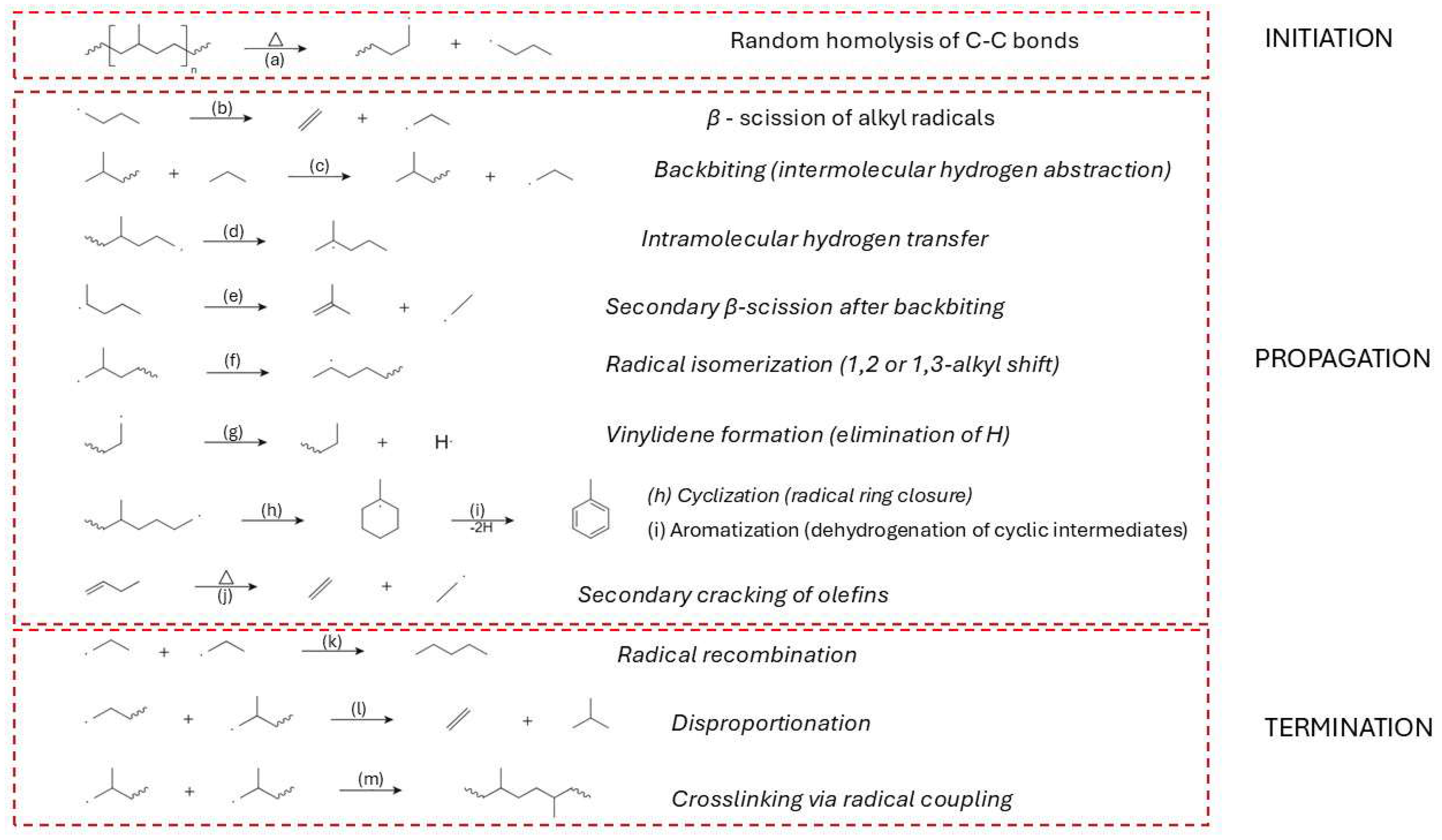


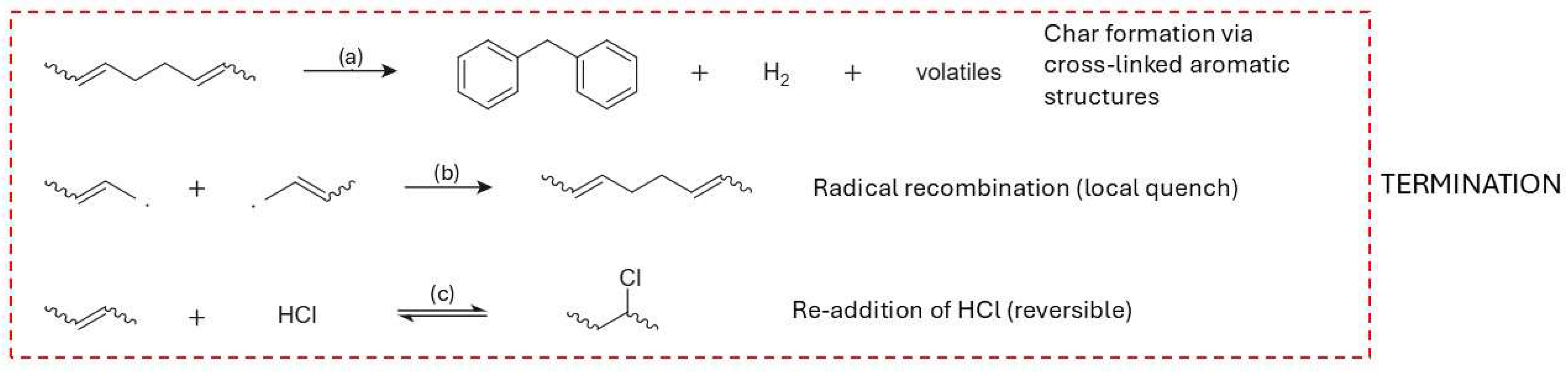
| Polymer | Polymerization Method | Branching Degree (per 1000 C Atoms) | Tacticity/Stereoregularity | Mw/Mn | Refs. |
|---|---|---|---|---|---|
| HDPE | Ziegler–Natta/Metallocene coordination | <0.1–2 | N/A (linear) | 3–12 | [128,130,136] |
| LDPE | Radical (High Pressure) | 6–12 | N/A (branched) | 5–8 | [128,137,138] |
| LLDPE | Ziegler–Natta/Metallocene coordination copolymerization (ethylene + -olefin) | 2–8 | N/A (linear + SCB) | 2–6 | [139,140] |
| PP (isotactic) | Ziegler–Natta/Metallocene coordination | Methyl side chains | Isotactic > 90% | 4–8 | [132,133,141] |
| PVC | Radical (vinyl chloride) | Linear backbone with Cl | Syndiotactic/Atactic | 2–3 | [133,134,135] |
Disclaimer/Publisher’s Note: The statements, opinions and data contained in all publications are solely those of the individual author(s) and contributor(s) and not of MDPI and/or the editor(s). MDPI and/or the editor(s) disclaim responsibility for any injury to people or property resulting from any ideas, methods, instructions or products referred to in the content. |
© 2026 by the authors. Licensee MDPI, Basel, Switzerland. This article is an open access article distributed under the terms and conditions of the Creative Commons Attribution (CC BY) license.
Share and Cite
Tetičkovič, T.; Klinar, D.; Rižnar, K.; Pečar, D. Mechanistic Pathways and Product Selectivity in Pyrolysis of PE, PP and PVC: A Foundation for Applied Chemistry in Europe. Molecules 2026, 31, 202. https://doi.org/10.3390/molecules31020202
Tetičkovič T, Klinar D, Rižnar K, Pečar D. Mechanistic Pathways and Product Selectivity in Pyrolysis of PE, PP and PVC: A Foundation for Applied Chemistry in Europe. Molecules. 2026; 31(2):202. https://doi.org/10.3390/molecules31020202
Chicago/Turabian StyleTetičkovič, Tim, Dušan Klinar, Klavdija Rižnar, and Darja Pečar. 2026. "Mechanistic Pathways and Product Selectivity in Pyrolysis of PE, PP and PVC: A Foundation for Applied Chemistry in Europe" Molecules 31, no. 2: 202. https://doi.org/10.3390/molecules31020202
APA StyleTetičkovič, T., Klinar, D., Rižnar, K., & Pečar, D. (2026). Mechanistic Pathways and Product Selectivity in Pyrolysis of PE, PP and PVC: A Foundation for Applied Chemistry in Europe. Molecules, 31(2), 202. https://doi.org/10.3390/molecules31020202