


Abstract
In traditional Chinese medicine, Symplocos chinensis (Lour.) Druce is a well-known herbal remedy prescribed to treat malaria, snakebites, and thermal injuries (burns and scalds). The objective of this study was to characterize the volatile profile of S. chinensis essential oil (EO) and evaluate its therapeutic potential through antioxidant, acetylcholinesterase (AChE), and β-lactamase inhibitory assays. The major components of S. chinensis EO included squalene (12.08%), octanol (7.01%), edulan III (6.81%), n-Hexadecanoic acid (6.81%), geranylacetone (4.80%), β-longipinene (4.60%), 2-methyl-1-octene (2.55%), (E, E)-2,4-decadienal (2.15%), and linalool (2.00%). Antioxidant evaluation revealed that the S. chinensis EO possessed relatively moderate radical scavenging properties, achieving 39.6% inhibition of DPPH radicals at 10 mg/mL, while its activity against ABTS radicals yielded an IC50 of 6.85 ± 1.97 mg/mL. Its reducing power, as determined by the FRAP assay, was further quantified at 175.50 ± 23.25 µmol/g. Furthermore, the EO exhibited inhibitory activities against AChE (IC50 = 149.40 ± 16.92 μg/mL) and β-lactamase (IC50 = 30.20 ± 0.84 μg/mL). These results demonstrate that S. chinensis EO exhibits antioxidant, AChE-inhibitory, and β-lactamase-inhibitory activities in vitro, warranting further comprehensive, systematic studies to evaluate its biological properties and potential applications.
1. Introduction
As representative natural products, essential oils (EOs) have been extensively applied across diverse fields, including food, medicine, and cosmetics [1]. EOs are regarded as the essence of plants and can display complex natural mixtures of volatile compounds. Owing to their chemically diverse compositions, EOs typically exhibit a broad spectrum of pharmacological properties, demonstrating a notable ability to interact with multiple molecular targets and modulate biological processes at both cellular and multicellular levels [2]. EOs usually exhibit multiple bioactivities, such as antibacterial, antifungal, and antioxidant properties, as demonstrated by previous research [3].
Free radicals—reactive species characterized by the presence of one or more unpaired electrons at the atomic or molecular level—exert considerable influence on human physiological well-being [4]. Oxidative stress arises from a disruption of the oxidant-antioxidant equilibrium, leading to excessive free radical production and irreversible deterioration of essential biological constituents such as DNA, membrane lipids, and functional proteins, and this process could ultimately cause cardiovascular diseases such as myocardial infarction (MI) and heart failure [4]. Additionally, oxidative stress has been widely acknowledged as a key contributor to the pathogenesis of Alzheimer’s disease (AD) [5]. Consequently, EOs exhibiting antioxidant activity are widely considered promising natural antioxidant candidates.
Alzheimer’s disease (AD) is an age-related neurodegenerative condition predominantly affecting the elderly, characterized by progressive cognitive impairment and the aberrant deposition of beta-amyloid peptide (Aβ) [6]. The pathogenesis of AD involves multiple hypotheses, with oxidative stress and diminished acetylcholine levels as potential key pathologies [7,8]. The level of reactive oxygen species (ROS) increases due to the abnormal accumulation of Aβ, tau protein, and heme. Excessive ROS can damage essential cellular components, ultimately leading to impaired neural function and tissue dysfunction [9]. Therefore, the development of antioxidant-based therapeutic agents represents an increasingly essential area of research for treating AD [10]. Additionally, acetylcholine levels are comparatively reduced in patients with AD [11]. Acetylcholinesterase (AChE), responsible for the hydrolysis of acetylcholine, has been shown to promote the aggregation of Aβ peptides into Alzheimer-associated amyloid deposits, consequently amplifying their neurotoxic effects [12]. AChE inhibitors can suppress enzyme activity, thereby elevating acetylcholine levels and producing therapeutic effects [13]. Consequently, EO with antioxidant and anti-AChE properties may contribute to the discovery of novel candidates for AD-related studies.
β-Lactam antibiotics have been extensively employed in the treatment of bacterial infections, owing to their broad-spectrum antimicrobial efficacy, favorable tolerability, and comparatively low toxicity profile [14]. Nevertheless, the overuse of β-lactam antibiotics has accelerated the emergence and spread of bacterial resistance [15]. Among complex resistance mechanisms, enzyme-mediated resistance has emerged as a particularly alarming challenge. β-Lactamase, mainly produced by Gram-negative bacteria, can hydrolyze the β-lactam ring of β-lactam antibiotics, ultimately rendering the antibiotic ineffective [16]. Those EOs, consequently, possess anti-β-lactamase activity and may represent promising sources of bioactive compounds for combating antibiotic resistance.
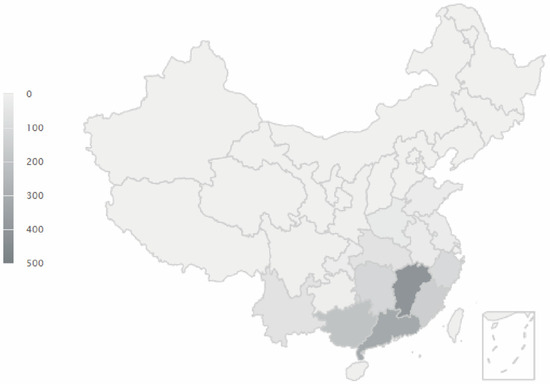
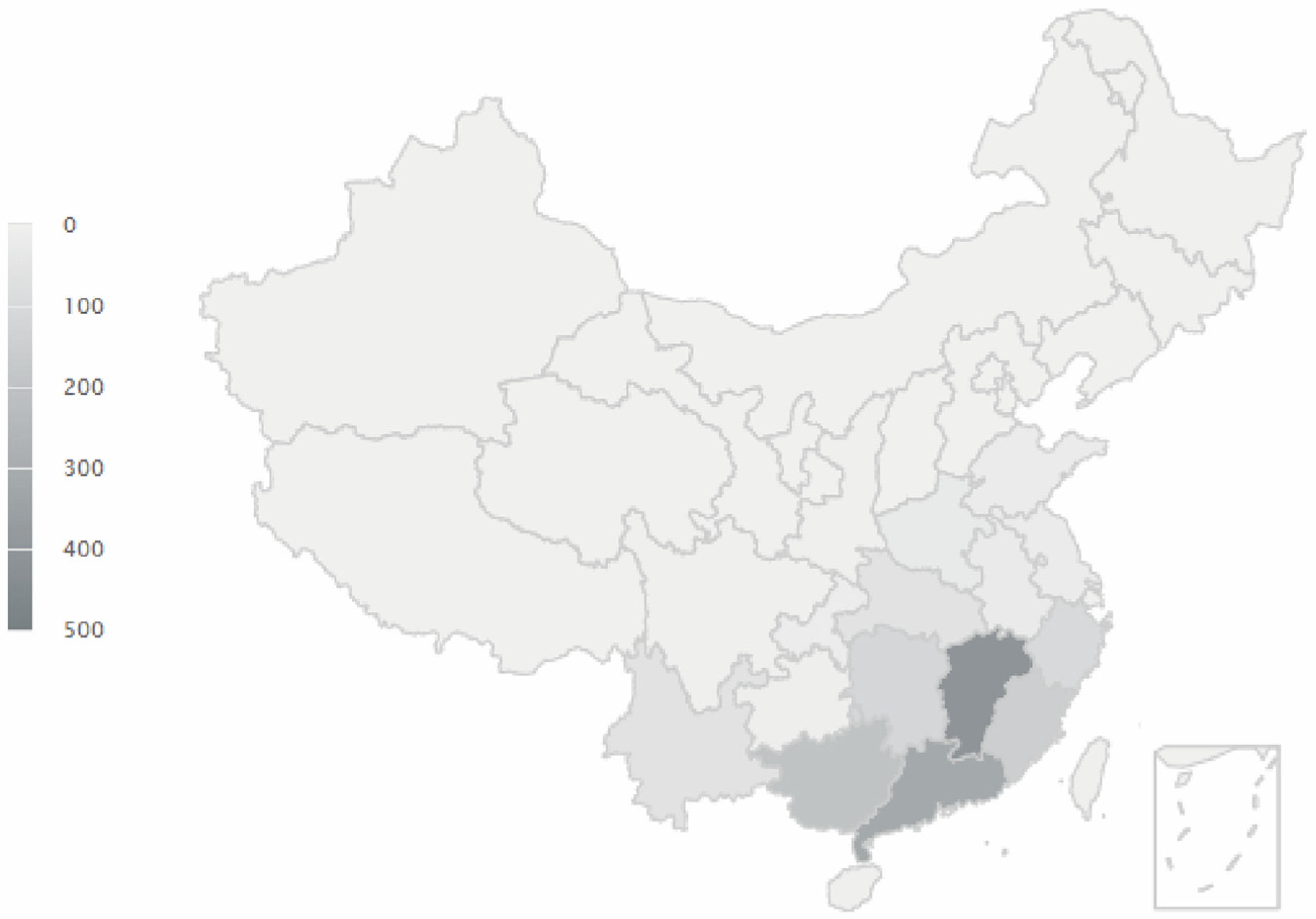
The Symplocos (Symplocaceae) comprises approximately 300 species, mainly distributed in tropical and subtropical regions of Asia, Oceania, and the Americas [17] (pp. 75–76). Symplocos plants have significant medicinal value in traditional medicine. Symplocos chinensis (Lour.) Druce belongs to a shrub distributed in Jiangxi, Fujian, Guangdong, and Guangxi provinces of China (Figure 1), characterized by its elliptic leaves, which are covered with dense, grayish-yellow, crisped, and soft trichomes on branches and foliage. Conventionally, its roots have been used to treat malaria and acute nephritis, while the fresh juice from its leaves is administered orally with alcohol as an antidote for snakebites. Additionally, the crushed leaves are traditionally applied to treat burns and traumatic bleeding [17] (pp. 75–76). However, traditional medicinal applications primarily involve using the whole roots or leaves of S. chinensis. In contrast, the chemical composition and biological activities of the EO derived from the plant remain insufficiently characterized. To address this gap, the present study aimed to elucidate the chemical profile of S. chinensis EO and evaluate its antioxidant, anti-AChE, and anti-β-lactamase activities.
Figure 1.
Distribution heatmap of Symplocos chinensis (Lour.) Druce in China based on specimen occurrence records retrieved from the Chinese Virtual Herbarium (CVH; https://www.cvh.ac.cn, accessed on 2 July 2026).
2. Results and Discussion
2.1. EO Chemical Component Analysis
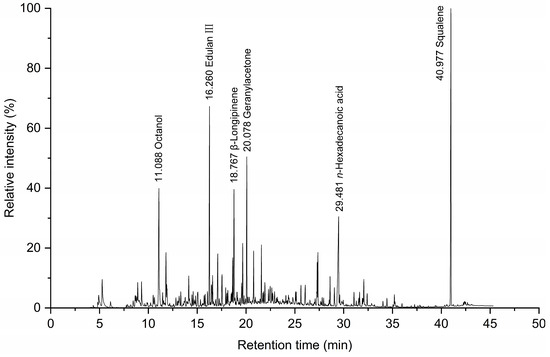
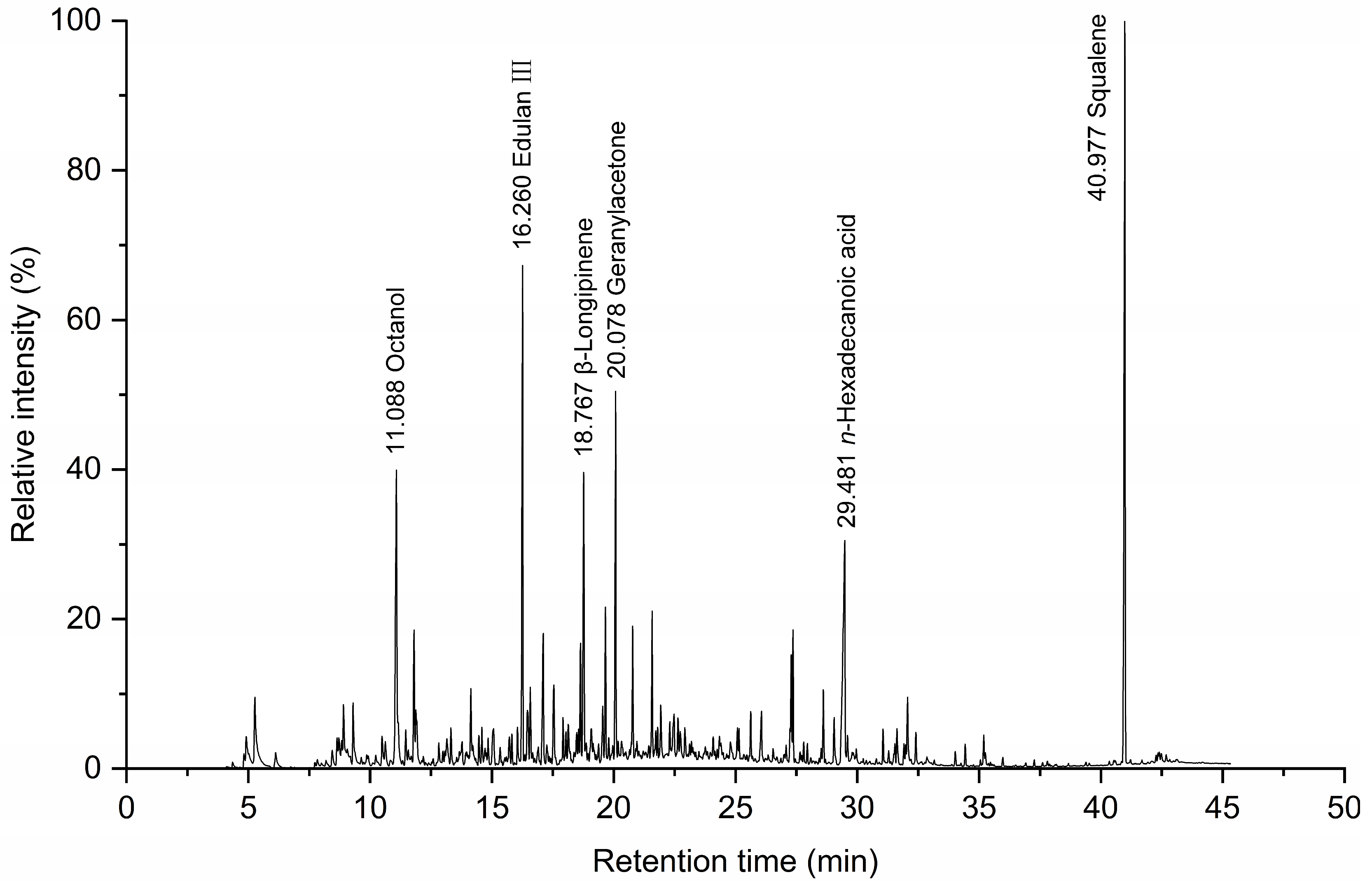
S. chinensis EO, a yellowish-green oil, was obtained by hydrodistillation from 828 g of dry plant material, which displayed a yield of 0.22 mL/kg. Figure 2 displays the total ion chromatogram (TIC) obtained from the essential oil (EO) of S. chinensis.
Figure 2.
The total ion chromatogram (TIC) of S. chinensis essential oil (EO).
Using gas chromatography–mass spectrometry (GC-MS) (Supplementary Materials) combined with flame ionization detection (GC-FID), a total of 83 compounds were characterized, collectively representing 97.48% of the total composition (Table 1). The major constituents included squalene (12.08%), octanol (7.01%), edulan III (6.81%), n-Hexadecanoic acid (6.81%), geranylacetone (4.80%), β-longipinene (4.60%), 2-methyl-1-octene (2.55%), (E, E)-2,4-decadienal (2.15%), and linalool (2.00%). Further classification revealed that aliphatic compounds accounted for the majority (63.52%), followed by terpenoids (30.21%) and aromatic compounds (3.35%).
Table 1.
Chemical constituents of the EO from S. chinensis.
Squalene (12.08%), the most abundant compound in S. chinensis EO, exhibited multiple properties typical of a triterpenoid, including immunity enhancement, anti-skin aging, hypolipidemic, antioxidant, antitumor, antibacterial, and detoxifying effects. Therefore, it contributes substantially to the food and pharmaceutical industries [18]. The second most abundant compound, octanol (7.01%), demonstrated potent antifungal activity against Botrytis cinerea, a pathogenic fungus that causes grey mould [19]. In addition, plant-derived octanol exhibited broad-spectrum antimicrobial activity and food safety advantages [20,21]. As a consequence, this compound may serve as a natural and effective fungicide. n-Hexadecanoic acid (6.81%) exhibited antioxidant and antitumor properties. As a result, this compound has been recognized as a potential agent for therapeutic interventions in conditions including cancer [22,23]. Furthermore, geranylacetone (4.80%) has been shown to exhibit repellent activity against aphids, a pest group responsible for devastating economic losses in temperate-climate agriculture [24], indicating its potential as an antifeedant against these insects. Considering the considerable phytochemical diversity identified in S. chinensis EO, comprehensive in vitro investigations were undertaken to explore its antioxidant efficacy and inhibitory effects on key enzymes.
2.2. Antioxidant Activity Evaluation
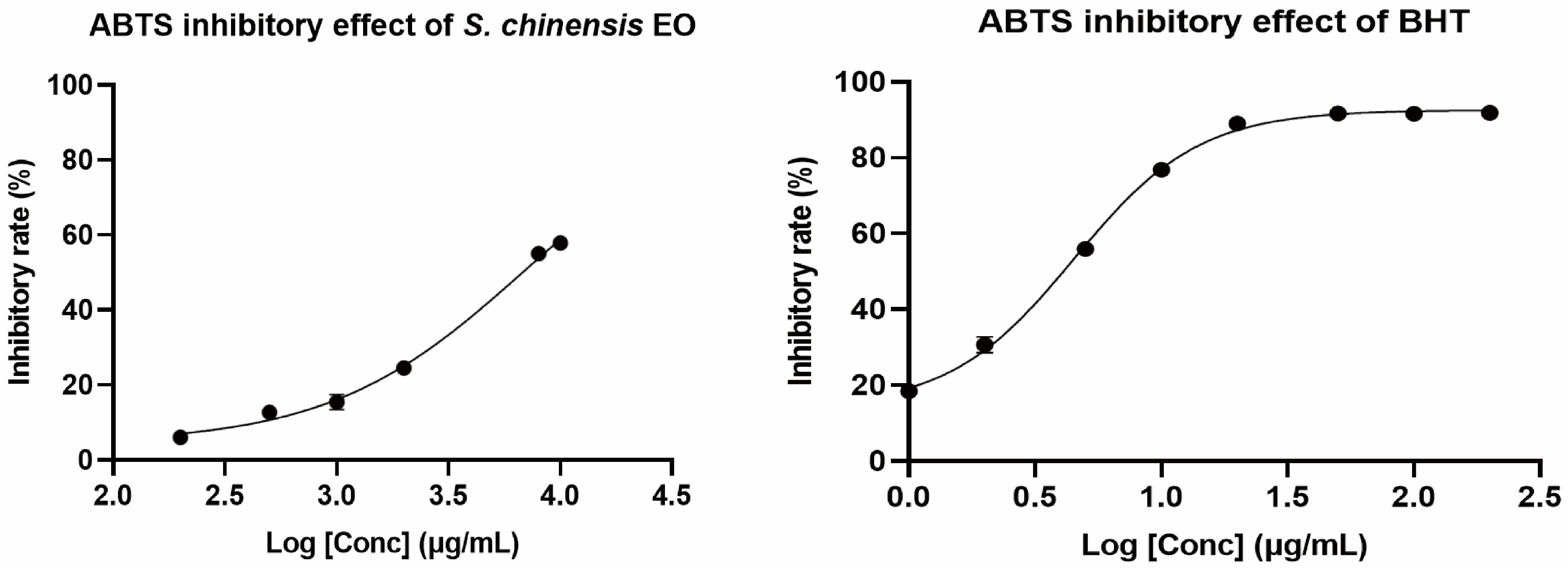
To comprehensively evaluate the antioxidant potential of the samples, several analytical methods were employed in this study. At the maximum tested concentration of 10 mg/mL, the DPPH radical inhibition rate reached only 39.6%. In contrast, the IC50 of the positive control BHT was 52.33 ± 1.05 μg/mL (Table 2), suggesting that the essential oil (EO) exhibited a relatively limited capacity to scavenge DPPH radicals. Regarding ABTS radical scavenging activity, as illustrated in Figure 3, the activity of S. chinensis EO displayed a characteristic S-shaped dose–response curve, with an IC50 value of 6.85 ± 1.97 mg/mL (Table 2), reflecting a moderate level of ABTS radical scavenging ability.
Table 2.
The antioxidant activities of S. chinensis EO using DPPH, ABTS, and FRAP assays.
Figure 3.
ABTS activity of S. chinensis EO and BHT at different concentrations.
The total antioxidant capacity of the EO was further evaluated using the FRAP assay. In contrast to free radical scavenging methods, this assay measures the overall reducing power of a sample by monitoring the electron transfer-mediated reduction of Fe3+ to Fe2+ under acidic conditions, which produces a characteristic color shift from yellow to bluish-green. The magnitude of this color change is directly proportional to the sample’s reductive capacity, thus reflecting its antioxidant potential [25]. As presented in Table 2, the S. chinensis EO exhibited a FRAP value of 175.50 ± 23.25 µmol/g (Trolox equivalent antioxidant concentration), demonstrating moderate overall antioxidant activity.
The three phenyl rings in DPPH create steric effects that hinder hydrogen atom transfer [26]. In contrast, the ABTS method operates through an electron transfer mechanism, rendering it applicable to both hydrophilic and lipophilic antioxidants [26]. Accordingly, the EO demonstrated moderately notable ABTS scavenging capacity alongside limited DPPH radical scavenging capacity. The FRAP assay further reflected the moderate total reducing power of S. chinensis EO. A higher degree of conjugation is generally associated with enhanced antioxidant performance [27]. Based on compositional analysis, S. chinensis EO is particularly rich in conjugated systems, encompassing terpenoids such as squalene (12.08%), linalool (2.00%), and isoshyobunone (1.70%), as well as α,β-unsaturated carbonyl compounds including (E, E)-2,4-decadienal (2.15%) and damascenone (1.57%). Therefore, the moderate antioxidant activity of S. chinensis EO is likely driven by its abundant conjugated terpenoids and α,β-unsaturated carbonyl constituents.
2.3. Anti-AChE Capacity of S. chinensis EO
Alzheimer’s disease (AD) ranks among the most widespread chronic brain-degenerative conditions worldwide. The enzyme acetylcholinesterase (AChE) plays a pivotal role in its pathophysiology, and targeting this enzyme through inhibition has emerged as a well-established therapeutic strategy [28]. Based on this, the AChE inhibitory activity of S. chinensis EO was evaluated.
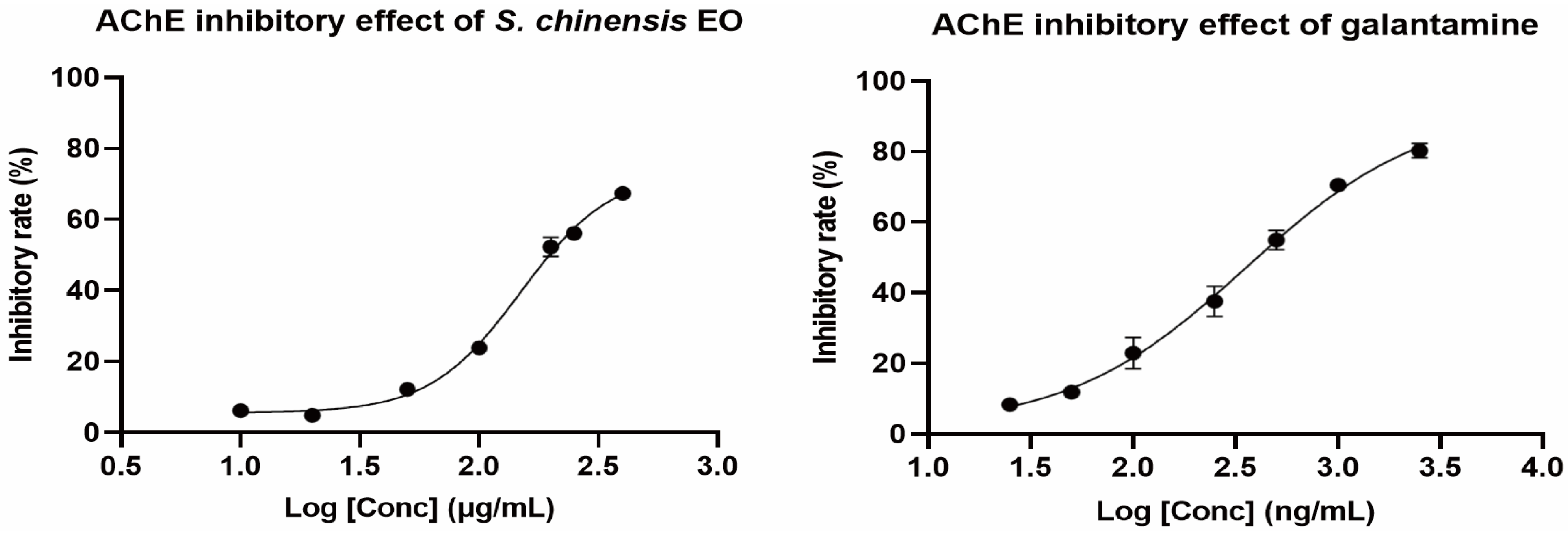
According to the tests, S. chinensis EO inhibited AChE with an IC50 value of 149.40 ± 16.92 μg/mL, whereas galantamine (positive control) yielded an IC50 of 357.0 ± 52.82 ng/mL (Table 3). The concentration-dependent inhibitory profiles are displayed in Figure 4. The AChE inhibitory activity of S. chinensis EO was weaker than that of the positive control. For the purpose of determining the relative efficacy of the EO, a comparative analysis was conducted between its AChE inhibitory activity and that of other plant-derived EOs. In comparison, S. chinensis EO displayed stronger inhibitory activity than EO from Coriandrum sativum, Carum carvi, and Arbutus unedo (IC50 = 0.68 ± 0.03 mg/mL, 0.82 ± 0.05 mg/mL, 378.57 ± 0.05 μg/mL) [29,30]. Pulicaria undulata EO (IC50 = 139.30 ± 2.00 μg/mL) exhibited comparable inhibitory activity to S. chinensis EO [31]. Overall, these results indicated that S. chinensis EO exhibited moderate AChE-inhibitory activity.
Table 3.
The activities for AChE and β-lactamase inhibition assays.
Figure 4.
AChE inhibitory activities of S. chinensis EO and galantamine at varying concentrations.
Squalene (12.08%) was the most abundant compound identified in S. chinensis EO. Studies have shown that squalene exhibits considerable anti-AChE capacity, achieving an inhibition rate exceeding 80% at 100 μg/mL [32]. Therefore, squalene may serve as a key contributor to the observed AChE inhibitory effect of the EO. An in vivo study also showed that linalool (2.00%) inhibits oxidative stress-induced increases in AChE activity via the Nrf2/HO-1 pathway [33]. Therefore, despite the in vitro experiment of our EO assays, linalool could potentially contribute to the observed anti-AChE activity. Other monoterpene alcohols, α-terpineol (1.17%) and terpinen-4-ol, have also been documented to inhibit AChE (IC50 = 1.30 ± 0.06, 3.20 ± 2.30 mg/mL) [34]. These compounds may therefore serve as minor contributors to the observed anti-AChE activity of the EO. It should be noted that the discussion of individual constituents is based on previous studies and is presented for illustrative purposes only. Their actual contributions and possible synergistic or antagonistic interactions remain to be determined by further investigation.
2.4. Anti-β-Lactamase Capacity of S. chinensis EO
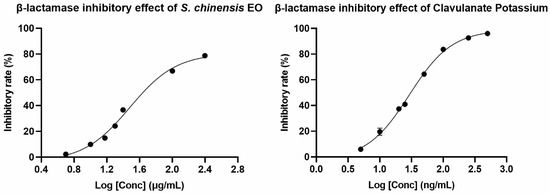
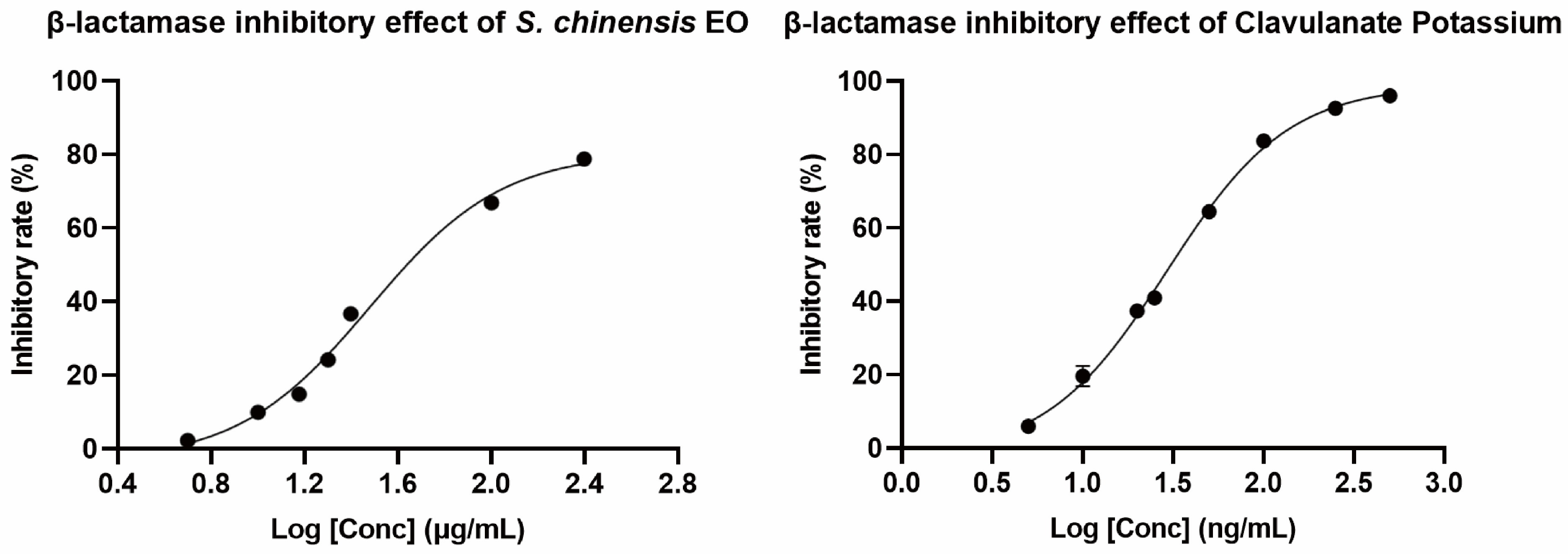
The growing prevalence of antibiotic resistance has emerged as a critical public health challenge. β-lactamases hydrolyze the amide bond within the β-lactam ring, thereby rendering β-lactam antibiotics ineffective [35]. One promising approach to overcoming this resistance mechanism involves the administration of β-lactamase inhibitors [36]. Based on this fact, the present work examined the anti-β-lactamase activity of S. chinensis EO. The inhibitory sigmoid curves are displayed in Figure 5. As shown in Table 3, the IC50 value was 30.20 ± 0.84 µg/mL, while the IC50 for clavulanate potassium was 29.23 ± 1.83 ng/mL. The inhibitory activity of the positive control was much stronger than that of the S. chinensis EO. Compared with previous studies, S. chinensis EO exhibits stronger inhibitory activity than EOs from Clerodendrum fortunatum L. and Clerodendrum cyrtophyllum Turcz. (IC50 = 673.50 ± 1.27, 41.34 ± 0.84 μg/mL) [37]. Therefore, S. chinensis EO demonstrates modest anti-β-lactamase activity. Previous papers have indicated that certain terpenoid compounds, such as α-terpineol, linalool, and citral, displayed comparatively superior inhibitory activity against β-lactamase [38]. These compounds were present in relatively high abundance in S. chinensis EO. Therefore, we preliminarily hypothesize that the monoterpenoid compounds present in abundant content may be associated with the modest anti-β-lactamase activity of S. chinensis EO.
Figure 5.
β-Lactamase inhibitory activities of S. chinensis EO and clavulanate potassium.
3. Materials and Methods
3.1. Plant Material
Fresh specimens of S. chinensis were collected in September 2024 from Qinbei District, Qinzhou City, Guangxi, China (22.0232° N, 108.6562° E). The species was authenticated as Symplocos chinensis (Lour.) Druce by Prof. Hong Zhao through morphological examination. A voucher specimen (accession no. EO2408) has been deposited at the Biological Science Analysis and Testing Center, Shandong University, Weihai, China.
3.2. EO Extraction
The aerial portions of S. chinensis (828 g) were ground into fine particles and transferred into a 5 L round-bottomed flask containing 2.5 L of ultrapure water. Essential oil was obtained through hydrodistillation over approximately 4 h using a Clevenger-type apparatus (Synthware, Chongqing, China), following the procedure described in a previous study [39]. The oil fraction was subsequently separated from the aqueous phase by diethyl ether extraction. The resulting essential oil was dried over anhydrous sodium sulfate to remove residual moisture, and the solvent was then carefully evaporated under a stream of nitrogen gas in a dark, sealed environment.
3.3. The Chemical Constituent Analysis
The chemical composition and relative content of the EO were determined by GC-MS and GC-FID analysis [26]. GC-MS analysis was carried out using an Agilent 7890 GC coupled with a 5975C mass detector (Agilent Technologies, Santa Clara, CA, USA) fitted with an HP-5MS column (30 m × 0.25 mm, 0.25 μm). The oven temperature was programmed from 50 °C (4 min) to 280 °C at 6 °C/min and held for 3 min. Helium (99.999%) was used as the carrier gas at 1.0 mL/min. The injector, transfer line, and quadrupole temperatures were maintained at 260, 280, and 150 °C, respectively. Mass spectra were acquired in EI mode (70 eV) within the m/z range of 25–500. Samples were prepared in dichloromethane (1%, w/v), and 0.3 μL was injected without splitting. Relative quantification of the constituents was obtained by GC-FID using a PerkinElmer Clarus 500 instrument (Shelton, CT, USA) equipped with an HP-5 column of identical dimensions (Agilent, Santa Clara, CA, USA). The chromatographic conditions were the same as those applied in GC-MS analysis. Nitrogen was employed as the carrier gas (1.1 mL/min), and the injector and detector temperatures were set at 260 and 305 °C, respectively.
Component identification was achieved by matching mass spectra with the NIST/EPA/NIH 2023 database, with further confirmation through comparison of retention indices against published reference values. Retention indices were calculated using a series of n-alkane standards (C8–C30) on an HP-5MS capillary column.
3.4. Antioxidant Activities Evaluation
3.4.1. DPPH Method
The free radical scavenging activity was evaluated using the 2,2-diphenyl-1-picrylhydrazyl (DPPH) assay, performed with slight modifications to a previously established method. Butylated hydroxytoluene (BHT) was used as the positive control. Stock solutions of BHT, essential oil (EO), and DPPH were prepared in ethanol at concentrations of 1.0 mg/mL, 50 mg/mL, and 0.17 mmol/L, respectively. In each assay, 50 μL of the EO solution and 200 μL of the DPPH solution were pipetted into individual wells of a 96-well microplate. The mixture was then allowed to react for 30 min at 25 °C under dark conditions, after which the absorbance was measured at 516 nm using an Epoch microplate spectrophotometer (BioTek Instruments, Minneapolis, MN, USA) [40]. All measurements were carried out in triplicate to ensure reproducibility. The DPPH radical scavenging capacity (RSC%) was calculated according to Formula (1):
where ASample represents the absorbance measured from the sample at each concentration, AControl refers to the absorbance of the DPPH control solution, and ASample blank indicates the absorbance of the ethanol blank sample in the absence of DPPH.
3.4.2. ABTS Method
The ABTS radical scavenging assay was performed following a previously reported protocol with minor modifications [40]. Stock solutions of butylated hydroxytoluene (BHT, used as a positive control) and the essential oil (EO) were separately prepared in anhydrous ethanol across a series of concentrations—1.0, 2.0, 5.0, 10.0, 20.0, 50.0, 100.0, and 200.0 μg/mL for BHT, and 0.2, 0.5, 1.0, 2.0, 8.0, and 10.0 mg/mL for EO. For the assay, 50 µL of each serially diluted EO solution in ethanol was combined with 200 µL of the pre-prepared ABTS+• working solution in a microplate well. The mixture was briefly agitated for 10 s to achieve homogeneity, then allowed to react at room temperature for 6 min. Absorbance was subsequently recorded at 734 nm. The radical scavenging capacity (RSC%) of ABTS was determined using Equation (2) to assess the antioxidant potential of the samples:
where A0 denotes the absorbance measured at 734 nm for the blank mixture consisting of 200 µL of ABTS+• working reagent combined with 50 µL of pure ethanol, and A refers to the corresponding absorbance recorded when the ethanol was replaced by an equal volume (50 µL) of the EO sample solution. The IC50 value was determined by fitting the data to a sigmoidal dose–response curve using GraphPad Prism 9.5.
3.4.3. FRAP Method
The FRAP assay was performed following a previously reported method [26]. A calibration curve constructed with Trolox served as the reference standard, and the total antioxidant capacity of the EO was expressed as Trolox equivalents. Stock solutions of EO were prepared at 50 mg/mL in ethanol and subsequently diluted to working concentrations of 0.1, 0.2, 1.0, 2.0, and 5.0 mg/mL. In a microplate format, 50 μL of each EO concentration was mixed with 200 μL of freshly prepared FRAP reagent, followed by incubation at 37 °C under light-shielded conditions. Absorbance was then measured at 593 nm. The antioxidant activity equivalent to Trolox was determined by substituting the measured absorbance (A) of a known sample concentration into the calibration equation. All measurements were conducted in triplicate, and results are reported as mean values.
3.5. Anti-AChE Activity Test
Galanthamine served as the positive control inhibitor in this assay [41]. The essential oil (EO) was diluted with phosphate-buffered saline (PBS, pH 8.0) to prepare a series of working concentrations: 400, 250, 200, 100, 50, 20, and 10 μg/mL. For each reaction, 25 μL of the EO sample was added to a well pre-loaded with 75 μL of PBS (pH 8.0) and 80 μL of acetylcholinesterase (AChE) solution (0.28 U/mL). The plate was then incubated in the dark for 20 min. 5,5′-Dithiobis-(2-nitrobenzoic acid) (DTNB) was used as the chromogenic reagent, and acetylthiocholine iodide (ATCI) was used as the substrate. Absorbance was recorded at 412 nm, and the enzymatic reaction rate was determined from the absorbance–time curve. Blank control measurements were conducted under identical conditions, with the EO solution replaced by 20 μL of solvent. The AChE inhibitory rate was calculated according to the following equation:
where K and K0 represent the reaction rate measured in the presence and absence of the test sample, respectively, the IC50 value was fitted through an S-shaped curve using GraphPad Prism 9.5.
3.6. Anti-β-Lactamase Activity Test
Potassium clavulanate was used as the positive control inhibitor. The EO was prepared as a serial dilution in phosphate-buffered saline (PBS, pH 7.0) to yield working concentrations of 2.50, 1.00, 0.25, 0.20, 0.15, 0.10, and 0.05 mg/mL. For the assay, each well of a 96-well microplate received 20 µL of β-lactamase solution (5000 U/mL), 110 µL of PBS (50 mM, pH 7.0), and 20 µL of the EO sample. Following thorough mixing, the plate was incubated at 31 °C for 10 min, after which 50 µL of nitrocefin solution (0.1 mg/mL) was introduced into each well. Incubation was continued at 31 °C for an additional 10 min, and the optical density was subsequently measured at 489 nm [42]. The percentage inhibition was calculated according to Equation (4):
where As denotes the absorbance measured in the EO-treated well, Asb refers to the absorbance of the background well, Ae corresponds to the absorbance obtained from the uninhibited reaction, and Ab represents the absorbance of the blank control. IC50 values were determined by applying non-linear regression analysis.
3.7. Statistical Analysis
All experiments were performed in triplicate, and the results are expressed as mean ± standard deviation. IC50 values were calculated by nonlinear regression analysis using GraphPad Prism 9.0 (GraphPad Software, San Diego, CA, USA).
4. Conclusions
This study performed a comprehensive chemical characterization of S. chinensis essential oil (EO), leading to the identification of 83 distinct compounds. The predominant constituents were squalene (12.08%), octanol (7.01%), edulan III (6.81%), n-Hexadecanoic acid (6.81%), geranylacetone (4.80%), β-longipinene (4.60%), 2-methyl-1-octene (2.55%), (E, E)-2,4-decadienal (2.15%), and linalool (2.00%), collectively reflecting the remarkable chemical complexity of this EO. The EO displayed moderate antioxidant properties and inhibitory effects against acetylcholinesterase (AChE) and β-lactamase, indicating its potential as a source of natural antioxidants and bioactive compounds. The results may provide useful insights into the in vitro antioxidant, anti-AChE, and anti-β-lactamase activities of S. chinensis EO and support further investigations into its potential biological applications.
Nevertheless, the current findings are primarily derived from in vitro assays, which offer only preliminary, macroscopic insights into the biological activities of this EO. Future studies incorporating microbiological approaches are necessary to determine whether the EO can enhance antibiotic efficacy or reverse β-lactam resistance in bacterial systems. In addition, cytotoxicity evaluation and cell-based assays are important to establish the safety profile of S. chinensis EO. Accordingly, combining molecular docking simulations with rigorous in vivo experimental studies is strongly recommended for further development and application of S. chinensis EO.
Supplementary Materials
The following supporting information can be downloaded at: https://www.mdpi.com/article/10.3390/molecules31132372/s1, GC-MS Analysis Report.
Author Contributions
Conceptualization, Z.D., Y.Z., Z.L. and X.L.; methodology, Z.D., Y.Z. and X.L.; software, Z.D. and Y.Z.; validation, Z.D., Y.Z. and X.L.; formal analysis, Z.D. and Y.Z.; investigation, Z.D., Y.Z. and Z.L.; resources, X.L.; data curation, Z.D. and Y.Z.; writing—original draft preparation, Z.D.; writing—review and editing, Z.D., Y.Z. and X.L.; supervision, X.L.; project administration, X.L.; funding acquisition, X.L. All authors have read and agreed to the published version of the manuscript.
Funding
This research received no external funding.
Data Availability Statement
Data is available on request from the authors.
Acknowledgments
We express our gratitude to Hong Zhao for his kind help in plant identification.
Conflicts of Interest
The authors declare no conflicts of interest.
Abbreviations
The following abbreviations are used in this manuscript:
| ABTS | 2,2′-azino-bis(3-ethylbenzothiazoline-6-sulfonic acid) |
| AChE | Acetylcholinesterase |
| AD | Alzheimer’s disease |
| ATCI | Acetylthiocholine iodide |
| Aβ | Beta-amyloid |
| BHT | Butylated hydroxytoluene |
| DPPH | 2,2-diphenyl-1-picrylhydrazyl |
| DTNB | 5,5′-dithiobis(2-nitrobenzoic acid) |
| EO | Essential oil |
| EOs | Essential oils |
| FRAP | Ferric reducing antioxidant power |
| GC-FID | Gas chromatography–flame ionization detector |
| GC-MS | Gas chromatography–mass spectrometry |
| IC50 | Half-maximal inhibitory concentration |
| MI | Myocardial infarction |
| PBS | Phosphate-buffered saline |
| ROS | Reactive oxygen species |
| RSC% | Radical scavenging capacity |
| S. chinensis | Symplocos chinensis (Lour.) Druce |
| TIC | Total ion chromatogram |
| Trolox | (±)-6-Hydroxy-2,5,7,8-tetramethylchromane-2-carboxylic acid |
References
- Liu, X.; Zhang, P.; Zhao, Q.; Huang, A.C. Making small molecules in plants: A chassis for synthetic biology-based production of plant natural products. J. Integr. Plant Biol. 2022, 65, 417–443. [Google Scholar] [CrossRef] [Scilit] [PubMed]
- De Sousa, D.P.; Damasceno, R.O.S.; Amorati, R.; Elshabrawy, H.A.; De Castro, R.D.; Bezerra, D.P.; Nunes, V.R.V.; Gomes, R.C.; Lima, T.C. Essential oils: Chemistry and pharmacological activities. Biomolecules 2023, 13, 1144. [Google Scholar] [CrossRef] [Scilit] [PubMed]
- Hou, T.; Sana, S.S.; Li, H.; Xing, Y.; Nanda, A.; Netala, V.R.; Zhang, Z. Essential oils and its antibacterial, antifungal and antioxidant activity applications: A review. Food Biosci. 2022, 47, 101716. [Google Scholar] [CrossRef] [Scilit]
- Chandimali, N.; Bak, S.G.; Park, E.H.; Lim, H.-J.; Won, Y.-S.; Kim, E.-K.; Park, S.-I.; Lee, S.J. Free radicals and their impact on health and antioxidant defenses: A review. Cell Death Discov. 2025, 11, 19. [Google Scholar] [CrossRef] [Scilit] [PubMed]
- Bai, R.; Guo, J.; Ye, X.-Y.; Xie, Y.; Xie, T. Oxidative stress: The core pathogenesis and mechanism of Alzheimer’s disease. Ageing Res. Rev. 2022, 77, 101619. [Google Scholar] [CrossRef] [Scilit] [PubMed]
- Peitzika, S.-C.; Pontiki, E. A review on recent approaches on molecular docking studies of novel compounds targeting acetylcholinesterase in Alzheimer disease. Molecules 2023, 28, 1084. [Google Scholar] [CrossRef] [Scilit] [PubMed]
- Zhu, X.; Su, B.; Wang, X.; Smith, M.A.; Perry, G. Causes of oxidative stress in Alzheimer disease. Cell. Mol. Life Sci. 2007, 64, 2202–2210. [Google Scholar] [CrossRef] [Scilit] [PubMed]
- Ferreira-Vieira, T.H.; Guimaraes, I.M.; Silva, F.R.; Ribeiro, F.M. Alzheimer’s disease: Targeting the Cholinergic System. Curr. Neuropharmacol. 2016, 14, 101–115. [Google Scholar] [CrossRef] [Scilit] [PubMed]
- Yu, N.; Pasha, M.; Chua, J.J.E. Redox changes and cellular senescence in Alzheimer’s disease. Redox Biol. 2024, 70, 103048. [Google Scholar] [CrossRef] [Scilit] [PubMed]
- Guo, J.; Zhu, Y.; Zhi, J.; Lou, Q.; Bai, R.; He, Y. Antioxidants in anti-Alzheimer’s disease drug discovery. Ageing Res. Rev. 2025, 107, 102707. [Google Scholar] [CrossRef] [Scilit] [PubMed]
- Pitchai, A.; Rajaretinam, R.K.; Mani, R.; Nagarajan, N. Molecular interaction of human acetylcholinesterase with trans-tephrostachin and derivatives for Alzheimer’s disease. Heliyon 2020, 6, e04930. [Google Scholar] [CrossRef] [Scilit] [PubMed]
- Carvajal, F.J.; Inestrosa, N.C. Interactions of AChE with Aβ aggregates in Alzheimer’s brain: Therapeutic Relevance of IDN 5706. Front. Mol. Neurosci. 2011, 4, 19. [Google Scholar] [CrossRef] [Scilit] [PubMed]
- Gajendra, K.; Pratap, G.K.; Poornima, D.V.; Shantaram, M.; Ranjita, G. Natural acetylcholinesterase inhibitors: A multi-targeted therapeutic potential in Alzheimer’s disease. Eur. J. Med. Chem. Rep. 2024, 11, 100154. [Google Scholar] [CrossRef] [Scilit]
- Zhang, S.; Liao, X.; Ding, T.; Ahn, J. Role of β-Lactamase inhibitors as potentiators in antimicrobial chemotherapy targeting Gram-Negative bacteria. Antibiotics 2024, 13, 260. [Google Scholar] [CrossRef] [Scilit] [PubMed]
- Batool, S.; Farid, R.; Azam, S.S.; Hassan, A. Design, synthesis, and evaluation of β-Lactamase inhibitors as potential therapeutics for antimicrobial resistance. ACS Omega 2025, 10, 61032–61047. [Google Scholar] [CrossRef] [Scilit] [PubMed]
- Kang, S.-J.; Kim, D.-H.; Lee, B.-J. Metallo-β-lactamase inhibitors: A continuing challenge for combating antibiotic resistance. Biophys. Chem. 2024, 309, 107228. [Google Scholar] [CrossRef] [Scilit] [PubMed]
- Wu, R.; Guo, L. SYMPLOCACEAE. In Higher Plants of China, 1st ed.; Fu, L., Hong, T., Eds.; Qingdao Publishing House: Qingdao, China, 2003; Volume 6, pp. 75–76. [Google Scholar]
- Cheng, L.; Ji, T.; Zhang, M.; Fang, B. Recent advances in squalene: Biological activities, sources, extraction, and delivery systems. Trends Food Sci. Technol. 2024, 146, 104392. [Google Scholar] [CrossRef] [Scilit]
- Xu, D.; Quan, S.; Xing, M.; Chen, T.; Li, B.; Tian, S.; Chen, Y. Multi-target antifungal action of 1-octanol against Botrytis cinerea and its application in curdlan hydrogel for gray mold control. Postharvest Biol. Technol. 2025, 232, 114011. [Google Scholar] [CrossRef] [Scilit]
- Duan, W.-Y.; Qin, Y.-L.; Zhang, S.-B.; Zhai, H.-C.; Lv, Y.-Y.; Wei, S.; Ma, P.-A.; Hu, Y.-S. Inhibitory mechanisms of plant volatile 1-Octanol on the germination of Aspergillus flavus spores. Food Biophys. 2023, 19, 96–108. [Google Scholar] [CrossRef] [Scilit]
- Chen, Y.; Xing, M.; Chen, T.; Tian, S.; Li, B. Effects and mechanisms of plant bioactive compounds in preventing fungal spoilage and mycotoxin contamination in postharvest fruits: A review. Food Chem. 2023, 415, 135787. [Google Scholar] [CrossRef] [Scilit] [PubMed]
- Wechakorn, K.; Payaka, A.; Masoongnoen, J.; Wattanalaorsomboon, S.; Sansenya, S. Inhibition potential of n-hexadecanoic and oleic acids from edible insects against α-glucosidase, α-amylase, tyrosinase, and acetylcholinesterase: In vitro and in silico studies. J. Sci. Food Agric. 2025, 105, 3701–3711. [Google Scholar] [CrossRef] [Scilit] [PubMed]
- Janani, G.; Girigoswami, A.; Deepika, B.; Udayakumar, S.; Girigoswami, K. Unveiling the role of Nano-Formulated Red Algae Extract in cancer management. Molecules 2024, 29, 2077. [Google Scholar] [CrossRef] [Scilit] [PubMed]
- Wróblewska-Kurdyk, A.; Dancewicz, K.; Gliszczyńska, A.; Gabryś, B. Antifeedant Potential of Geranylacetone and Nerylacetone and Their Epoxy-Derivatives against Myzus persicae (Sulz.). Molecules 2022, 27, 8871. [Google Scholar] [CrossRef] [Scilit] [PubMed]
- Bendaas, R.; Messaadia, L.; Bekkar, Y.; Bourougaa, L.; Messaoudi, A. Comprehensive in vitro and molecular docking analysis of antioxidant and antimicrobial properties of Salvia officinalis L. extracts and essential oils. J. Mol. Struct. 2025, 1331, 141621. [Google Scholar] [CrossRef] [Scilit]
- Zhu, X.; Liu, X. Chemical Composition, Antioxidant, and Enzyme Inhibitory Activities of Artemisia schmidtiana Maxim. Essential Oil. Biomolecules 2025, 15, 736. [Google Scholar] [CrossRef] [Scilit] [PubMed]
- Charlton, N.C.; Mastyugin, M.; Török, B.; Török, M. Structural features of small molecule antioxidants and strategic modifications to improve potential bioactivity. Molecules 2023, 28, 1057. [Google Scholar] [CrossRef] [Scilit] [PubMed]
- Thai, Q.M.; Tran, P.-T.; Nguyen, T.K.; Hung, N.V.; Hien, T.T.T.; Van Tieu, P.; Pham, N.Q.A.; Tuyen, P.N.K.; Nguyen, T.H.; Pham, M.Q.; et al. Designing potential inhibitors for AChE from quinazoline derivatives. J. Mol. Struct. 2025, 1346, 143099. [Google Scholar] [CrossRef] [Scilit]
- Hajlaoui, H.; Arraouadi, S.; Noumi, E.; Aouadi, K.; Adnan, M.; Khan, M.A.; Kadri, A.; Snoussi, M. Antimicrobial, Antioxidant, Anti-Acetylcholinesterase, Antidiabetic, and Pharmacokinetic Properties of Carum carvi L. and Coriandrum sativum L. Essential Oils Alone and in Combination. Molecules 2021, 26, 3625. [Google Scholar] [CrossRef] [Scilit] [PubMed]
- Al-Mijalli, S.H.; Mrabti, H.N.; Ouassou, H.; Flouchi, R.; Abdallah, E.M.; Sheikh, R.A.; Alshahrani, M.M.; Awadh, A.A.A.; Harhar, H.; Omari, N.E.; et al. Chemical Composition, Antioxidant, Anti-Diabetic, Anti-Acetylcholinesterase, Anti-Inflammatory, and Antimicrobial Properties of Arbutus unedo L. and Laurus nobilis L. Essential Oils. Life 2022, 12, 1876. [Google Scholar] [CrossRef] [Scilit] [PubMed]
- Mustafa, A.M.; Eldahmy, S.I.; Caprioli, G.; Bramucci, M.; Quassinti, L.; Lupidi, G.; Beghelli, D.; Vittori, S.; Maggi, F. Chemical composition and biological activities of the essential oil from Pulicaria undulata (L.) C. A. Mey. growing wild in Egypt. Nat. Prod. Res. 2018, 34, 2358–2362. [Google Scholar] [CrossRef] [Scilit] [PubMed]
- Eldeen, I.S.; Foong, S.; Ismail, N.; Wong, K. Regulation of pro-inflammatory enzymes by the dragon fruits from Hylocereus undatus (Haworth) and squalene—Its major volatile constituents. Pharmacogn. Mag. 2020, 16, 81. [Google Scholar] [CrossRef] [Scilit]
- Xu, P.; Wang, K.; Lu, C.; Dong, L.; Gao, L.; Yan, M.; Aibai, S.; Yang, Y.; Liu, X. The Protective Effect of Lavender Essential Oil and Its Main Component Linalool against the Cognitive Deficits Induced by D-Galactose and Aluminum Trichloride in Mice. Evid.-Based Complement. Altern. Med. 2017, 2017, 7426538. [Google Scholar] [CrossRef] [Scilit] [PubMed]
- Dohi, S.; Terasaki, M.; Makino, M. Acetylcholinesterase inhibitory activity and chemical composition of commercial essential oils. J. Agric. Food Chem. 2009, 57, 4313–4318. [Google Scholar] [CrossRef] [Scilit] [PubMed]
- Tooke, C.L.; Hinchliffe, P.; Bragginton, E.C.; Colenso, C.K.; Hirvonen, V.H.A.; Takebayashi, Y.; Spencer, J. β-Lactamases and β-Lactamase inhibitors in the 21st century. J. Mol. Biol. 2019, 431, 3472–3500. [Google Scholar] [CrossRef] [Scilit] [PubMed]
- Hemaiswarya, S.; Kruthiventi, A.K.; Doble, M. Synergism between natural products and antibiotics against infectious diseases. Phytomedicine 2008, 15, 639–652. [Google Scholar] [CrossRef] [Scilit] [PubMed]
- Zhang, Y.; Xu, Z.; Zhu, J.; Zhu, X.; Zhao, J.; Liu, X. Chemical Composition, Antioxidant, Acetylcholinesterase and β-Lactamase Inhibitory Activities of Essential Oils from Clerodendrum cyrtophyllum Turcz. and Clerodendrum fortunatum L. Rec. Nat. Prod. 2025, 19, 263–277. [Google Scholar] [CrossRef] [Scilit]
- Mehidi, I.N.; Ouazzou, A.A.; Tachoua, W.; Hosni, K. Investigating the Antimicrobial Properties of Essential Oil Constituents and Their Mode of Action. Molecules 2024, 29, 4119. [Google Scholar] [CrossRef] [Scilit] [PubMed]
- Xu, Z.; Zhu, J.; Zhao, J.; Zhu, X.; Liu, X. Essential oil of Hygrophila salicifolia (Vahl) Nees: Chemical composition, evaluation of antioxidant activity, anti-acetylcholinesterase and anti-α-glucosidase activities integrating molecular docking, and network pharmacology analysis. Ind. Crops Prod. 2024, 220, 119278. [Google Scholar] [CrossRef] [Scilit]
- Xu, Z.; Gao, P.; Liu, D.; Song, W.; Zhu, L.; Liu, X. Chemical Composition and In Vitro Antioxidant Activity of Sida rhombifolia L. Volatile Organic Compounds. Molecules 2022, 27, 7067. [Google Scholar] [CrossRef] [Scilit] [PubMed]
- Zhu, J.; Xu, Z.; Gao, P.; Liu, X. Chemical composition, antioxidant activity, enzyme inhibitory effects, and network pharmacology analysis of essential oil from Bulbophyllum kwangtungense Schltr. S. Afr. J. Bot. 2024, 172, 701–709. [Google Scholar] [CrossRef] [Scilit]
- Shoeib, N.A.; Al-Madboly, L.A.; Ragab, A.E. In vitro and in silico β-lactamase inhibitory properties and phytochemical profile of Ocimum basilicum cultivated in central delta of Egypt. Pharm. Biol. 2022, 60, 1969–1980. [Google Scholar] [CrossRef] [Scilit] [PubMed]

Disclaimer/Publisher’s Note: The statements, opinions and data contained in all publications are solely those of the individual author(s) and contributor(s) and not of MDPI and/or the editor(s). MDPI and/or the editor(s) disclaim responsibility for any injury to people or property resulting from any ideas, methods, instructions or products referred to in the content. |
© 2026 by the authors. Licensee MDPI, Basel, Switzerland. This article is an open access article distributed under the terms and conditions of the Creative Commons Attribution (CC BY) license.