Chemical Composition, and Antioxidant and Antimicrobial Properties of Monarda didyma L.’s Essential Oils and Hydrosols

 , ,
, , 
Abstract
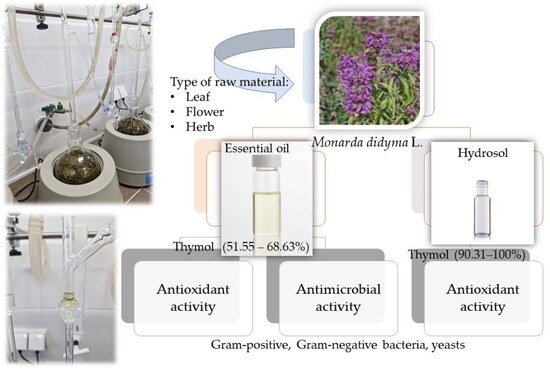
1. Introduction
2. Results
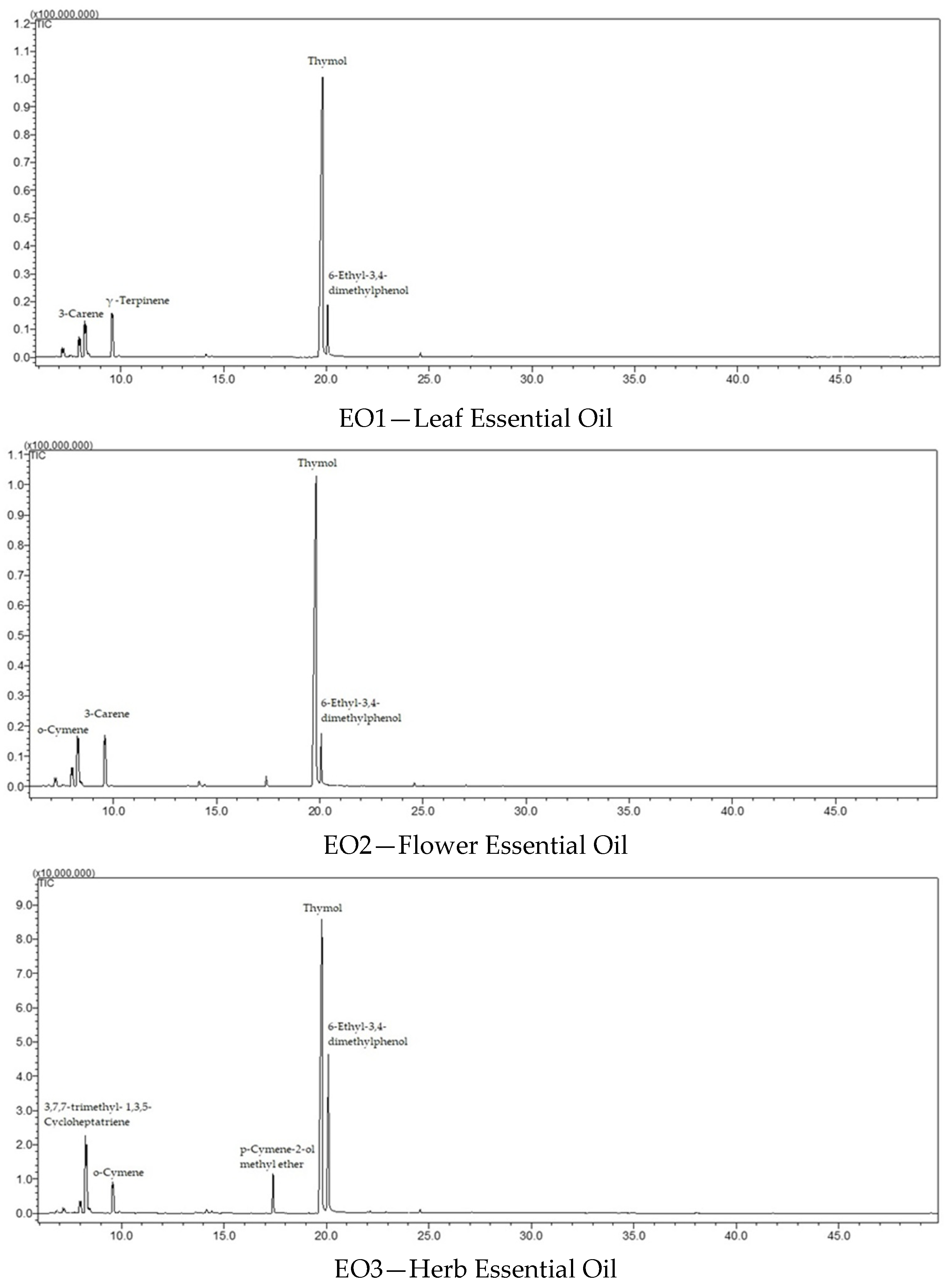
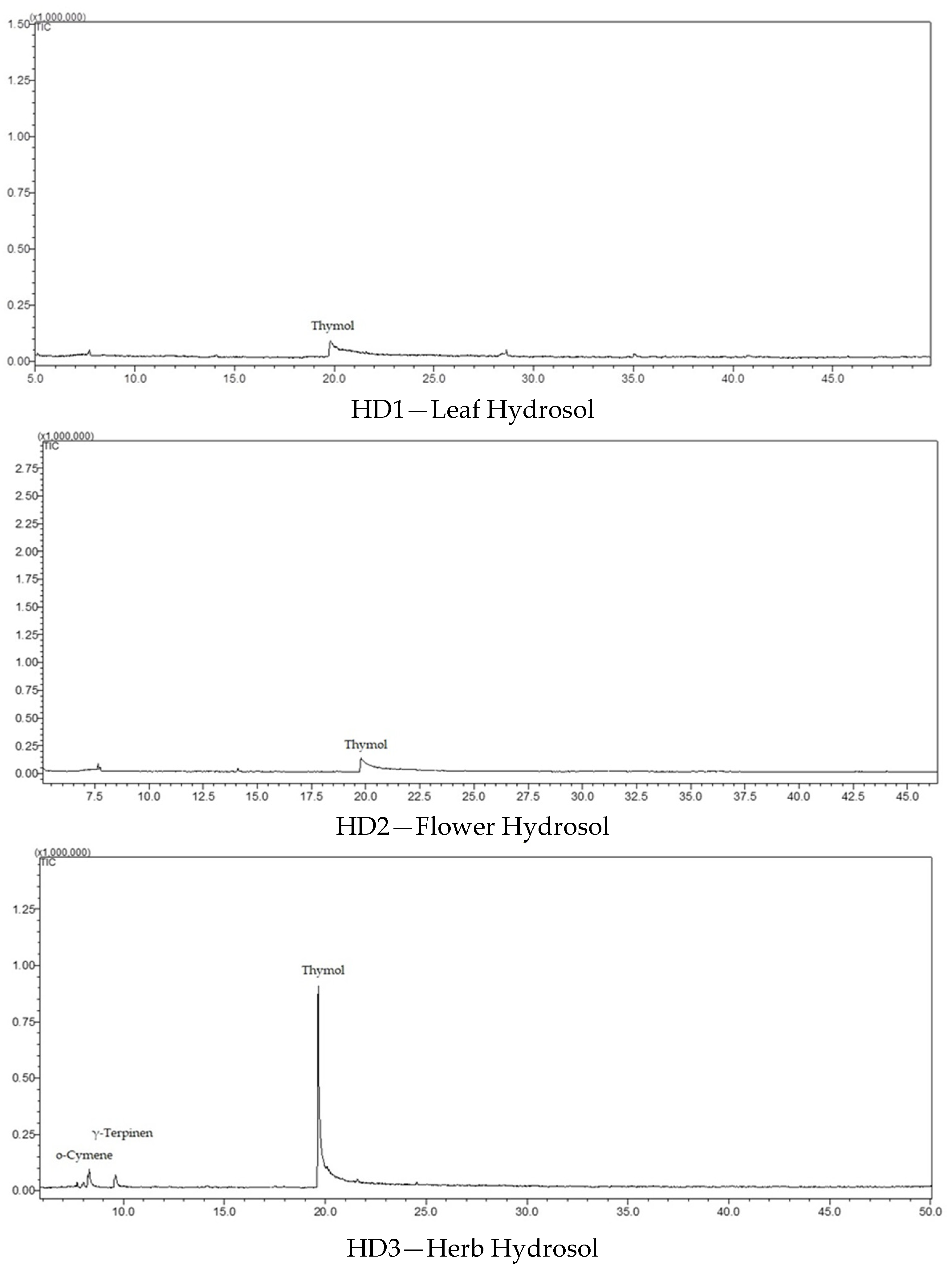
2.1. The Content, as Well as the Quantitative and Qualitative Composition, of the Essential Oil and Hydrosol Obtained from the Bee Balm, Determined by GC-MS
2.2. Antioxidant Activity of the Essential Oils and Hydrosols
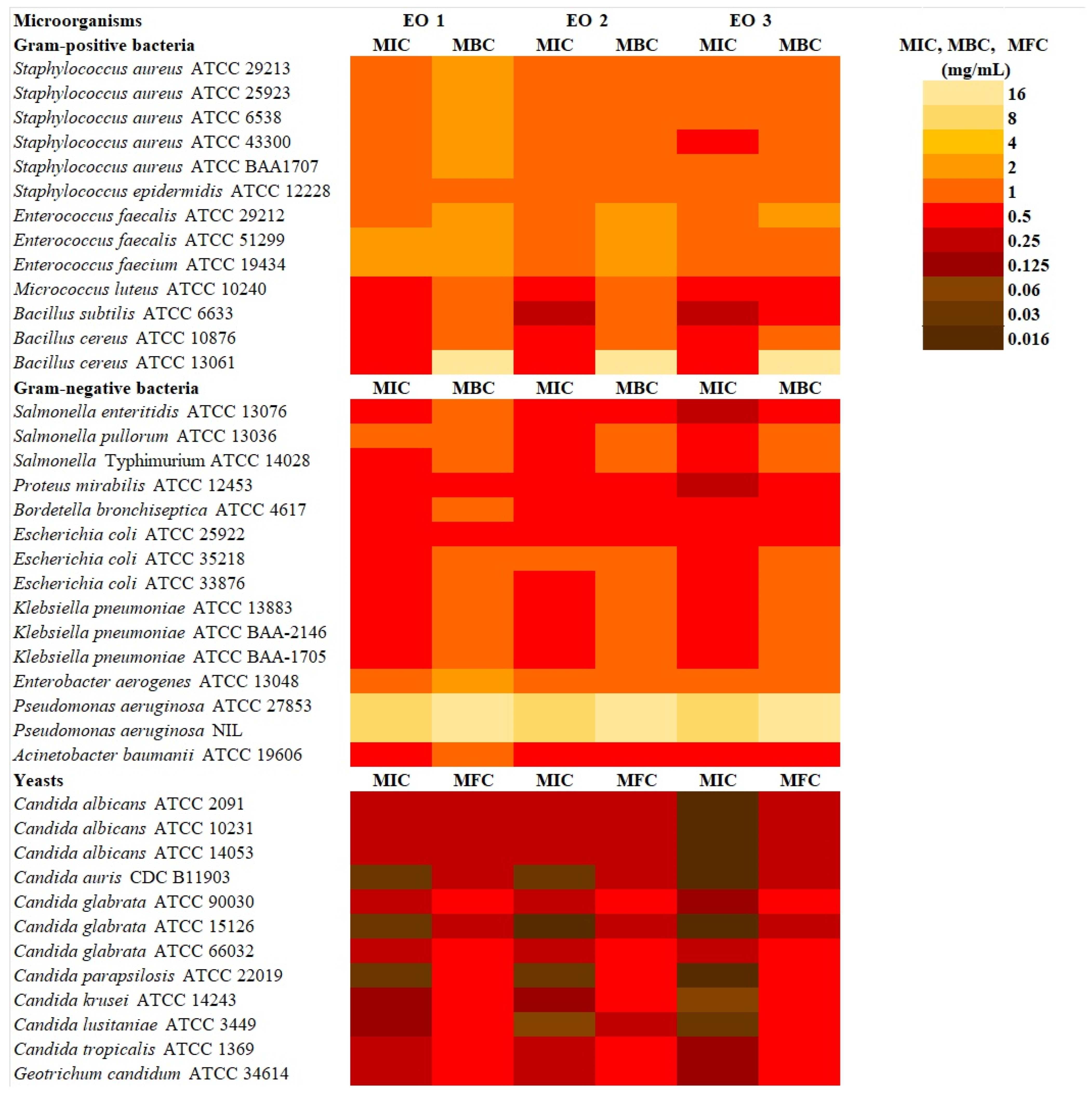
2.3. Antimicrobial Activity of the Essential Oils and Hydrosols
3. Discussion
4. Materials and Methods
4.1. Plant Material
4.2. Reagents and Reference Strains
4.3. The Distillation of Essential Oils and Hydrosols
4.4. GC-MS Analysis of Essential Oils and Hydrosols
4.5. Determination of Total Polyphenol Content (TPC)
4.6. Assessment of Antioxidant Activity (AA) Using the DPPH Method
4.7. Determination of AA Using the FRAP Method
4.8. Assessment of the Microbiological Activity
4.8.1. The Serial Microdilution Method
4.8.2. Well Diffusion Method
4.9. Statistical Analysis
5. Conclusions
Supplementary Materials
Author Contributions
Funding
Institutional Review Board Statement
Informed Consent Statement
Data Availability Statement
Acknowledgments
Conflicts of Interest
References
- Nurzyńska-Wierdak, R. Chemical diversity, yield, and quality of aromatic plants. Agronomy 2023, 13, 1614. [Google Scholar] [CrossRef] [Scilit]
- Nurzyńska-Wierdak, R.; Walasek-Janusz, M. Chemical composition, biological activity, and potential uses of oregano (Origanum vulgare L.) and oregano essential oil. Pharmaceuticals 2025, 18, 267. [Google Scholar] [CrossRef] [Scilit] [PubMed]
- Aghbash, B.N.; Pouresmaeil, M.; Dehghan, G.; Nojadeh, M.S.; Mobaiyen, H.; Maggi, F. Chemical composition, antibacterial and radical scavenging activity of essential oils from Satureja macrantha CA Mey. at different growth stages. Foods 2020, 9, 494. [Google Scholar] [CrossRef] [Scilit] [PubMed]
- Aćimović, M.; Tešević, V.; Smiljanić, K.; Cvetković, M.; Stanković, J.; Kiprovski, B.; Sikora, V. Hydrolates: By-products of essential oil distillation: Chemical composition, biological activity and potential uses. Adv. Technol. 2020, 9, 54–70. [Google Scholar] [CrossRef] [Scilit]
- Pardavella, I.; Nasiou, E.; Daferera, D.; Trigas, P.; Giannakou, I. The use of essential oil and hydrosol extracted from Satureja hellenica for the control of Meloidogyne incognita and M. javanica. Plants 2020, 9, 856. [Google Scholar] [CrossRef] [Scilit] [PubMed]
- Di Vito, M.; Smolka, A.; Proto, M.R.; Barbanti, L.; Gelmini, F.; Napoli, E.; Bellardi, M.G.; Mattarelli, P.; Beretta, G.; Sanguinetti, M.; et al. Is the antimicrobial activity of hydrolates lower than that of essential oils? Antibiotics 2021, 10, 88. [Google Scholar] [CrossRef] [Scilit] [PubMed]
- Bouftila, B.; Abdessadek, M.; Ben-Saghroune, H.; Sbihi, K.; Ouahmane, L.; Amri, O.; El Amraoui, B. Antimicrobial activities of essential oils of plants species from Morocco against some microbial strains. Rocz. Panstw. Zakl. Hig. 2024, 75, 117–123. [Google Scholar] [CrossRef] [Scilit] [PubMed]
- Khwaza, V.; Aderibigbe, B.A. Antibacterial activity of selected essential oil components and their derivatives: A review. Antibiotics 2025, 14, 68. [Google Scholar] [CrossRef] [Scilit] [PubMed]
- Walasek-Janusz, M.; Grzegorczyk, A.; Malm, A.; Nurzyńska-Wierdak, R.; Zalewski, D. Chemical composition, and antioxidant and antimicrobial activity of oregano essential oil. Molecules 2024, 29, 435. [Google Scholar] [CrossRef] [Scilit] [PubMed]
- Ramos da Silva, L.R.; Ferreira, O.O.; Cruz, J.N.; de Jesus Pereira Franco, C.; Oliveira dos Anjos, T.; Cascaes, M.M.; Almeida da Costa, W.; de Aguiar Andrade, E.H.; Santana de Oliveira, M. Lamiaceae essential oils, phytochemical profile, antioxidant, and biological activities. Evid. Based Complement. Altern. Med. 2021, 2021, 6748052. [Google Scholar] [CrossRef] [Scilit] [PubMed]
- Makaoui, A.; Talhaoui, A.; Aboukhalid, K.; Sabbahi, R.; Ouahhoud, S.; Baddaoui, S.; Essadek, A.; Maatougui, A.; Saalaoui, E.; Neffa, M. Chemical composition, antioxidant potential, and genotoxic safety of Lamiaceae essential oils from Eastern Morocco: A multimethod evaluation. Molecules 2026, 31, 400. [Google Scholar] [CrossRef] [Scilit] [PubMed]
- Florina-Nicoleta, B.; Georgeta, P. Behaviour of Monarda didyma species cultivated under the soil and climate conditions of the Didactic Station in Timişoara, Romania. Res. J. Agric. Sci. 2019, 51, 7–13. [Google Scholar]
- Smeriglio, A.; Ingegneri, M.; Germanò, M.P.; Miori, L.; Battistini, G.; Betuzzi, F.; Malaspina, P.; Trombetta, D.; Cornara, L. Pharmacognostic evaluation of Monarda didyma L. growing in Trentino (Northern Italy) for cosmeceutical applications. Plants 2024, 13, 112. [Google Scholar] [CrossRef] [Scilit] [PubMed]
- Gontar, Ł.; Geszprych, A.; Drutowska, A.; Osińska, E. Essential oil and phenolic compounds in different organs and developmental stages of Monarda didyma L., and their biological activity. Planta 2025, 261, 37. [Google Scholar] [CrossRef] [Scilit] [PubMed]
- Côté, H.; Pichette, A.; St-Gelais, A.; Legault, J. The biological activity of Monarda didyma L. essential oil and its effect as a diet supplement in mice and broiler chicken. Molecules 2021, 26, 3368. [Google Scholar] [CrossRef] [Scilit] [PubMed]
- Fraternale, D.; Dufat, H.; Albertini, M.C.; Bouzidi, C.; D’Adderio, R.; Coppari, S.; Di Giacomo, B.; Melandri, D.; Ramakrishna, S.; Colomba, M. Chemical composition, antioxidant and anti-inflammatory properties of Monarda didyma L. essential oil. PeerJ 2022, 10, e14433. [Google Scholar] [CrossRef] [Scilit] [PubMed]
- Chen, Y.; Zhao, J.; Liu, C.; Wu, D.; Wang, X. In-vitro antibacterial activity and mechanism of Monarda didyma essential oils against Carbapenem-resistant Klebsiella pneumoniae. BMC Microbiol. 2023, 23, 263. [Google Scholar] [CrossRef] [Scilit] [PubMed]
- Mattarelli, P.; Epifano, F.; Minardi, P.; Di Vito, M.; Modesto, M.; Barbanti, L.; Bellardi, M.G. Chemical composition and antimicrobial activity of essential oils from aerial parts of Monarda didyma and Monarda fistulosa cultivated in Italy. J. Essent. Oil Bear. Plants 2017, 20, 76–86. [Google Scholar] [CrossRef] [Scilit]
- Kafaltiya, M.; Lohani, H.; Haider, S.Z.; Chauhan, N.; Malik, T.; Joshi, N.; Pant, S. Phenological stage specific variations in chemical composition, antioxidant and antimicrobial properties of the essential oils of aerial parts of Monarda didyma L. cultivated under Doon Valley climatic conditions of Uttarakhand, India. J. Essent. Oil Bear. Plants 2022, 25, 1042–1053. [Google Scholar] [CrossRef] [Scilit]
- Wróblewska, K.; Szumny, A.; Żarowska, B.; Kromer, K.; Dębicz, R.; Fabian, S. Impact of mulching on growth essential oil composition and its biological activity in Monarda didyma L. Ind. Crops Prod. 2019, 129, 299–308. [Google Scholar] [CrossRef] [Scilit]
- Adebayo, O.; Bélanger, A.; Khanizadeh, S. Variable inhibitory activities of essential oils of three Monarda species on the growth of Botrytis cinerea. Can. J. Plant Sci. 2013, 93, 987–995. [Google Scholar] [CrossRef] [Scilit]
- Ricci, D.; Epifano, F.; Fraternale, D. The essential oil of Monarda didyma L. (Lamiaceae) exerts phytotoxic activity in vitro against various weed seeds. Molecules 2017, 22, 222. [Google Scholar] [CrossRef] [Scilit] [PubMed]
- Di Vito, M.; Bellardi, M.G.; Mondello, F.; Modesto, M.; Michelozzi, M.; Bugli, F.; Sanguinetti, M.; Sclocchi, M.C.; Sebastiani, M.L.; Biffi, S.; et al. Monarda citriodora hydrolate vs essential oil comparison in several anti-microbial applications. Ind. Crops Prod. 2019, 128, 206–212. [Google Scholar] [CrossRef] [Scilit]
- Dudchenko, V.V.; Svydenko, L.V.; Markovska, O.; Sydiakina, O.V. Morphobiological and biochemical characteristics of Monarda L. varieties under conditions of the southern steppe of Ukraine. J. Ecol. Eng. 2020, 21, 99–107. [Google Scholar] [CrossRef] [Scilit] [PubMed]
- Francati, S.; Gualandi, G. Side effects of essential oils of Monarda fistulosa L. and M. didyma L. on the tachinid parasitoid Exorista larvarum (L.): A preliminary study. Tachinid Times 2017, 30, 4–8. [Google Scholar]
- Aćimović, M.; Jeremić, J.S.; Todosijević, M.; Kiprovski, B.; Vidović, S.; Vladić, J.; Pezo, L. Comparative study of the essential oil and hydrosol composition of sweet wormwood (Artemisia annua L.) from Serbia. Chem. Biodivers. 2022, 19, e202100954. [Google Scholar] [CrossRef] [Scilit] [PubMed]
- da Rocha, N.B.; Rangel, E.T.; Silva, A.J.R.; Simas, D.L.R. Comparison between the chemical profiles of hydrosols and essential oils of French lavender, geranium, and basil. Braz. J. Aromather. Essent. Oil 2024, 1, iisinaroma6. [Google Scholar] [CrossRef] [Scilit]
- Hay, Y.O.M.; Abril-Sierra, M.A.; Sequeda-Castañeda, L.G.; Bonnafous, C.; Raynaud, C. Evaluation of combinations of essential oils and essential oils with hydrosols on antimicrobial and antioxidant activities. J. Pharm. Pharmacogn. Res. 2018, 6, 216–230. [Google Scholar] [CrossRef] [Scilit]
- Zhu, P.; Chen, Y.; Fang, J.; Wang, Z.; Xie, C.; Hou, B.; Chen, W.; Xu, F. Solubility and solution thermodynamics of thymol in six pure organic solvents. J. Chem. Thermodyn. 2016, 92, 198–206. [Google Scholar] [CrossRef] [Scilit]
- Ray, G.; Farhana, F.; Islam, M.A.; Bhattacharjee, S.C.; Chakraborty, D.; Das, S. Antioxidant activity of plant extracts at Chattogram Hill Tracts, Chattogram, Bangladesh. EAS J. Pharm. Pharmacol. 2024, 6, 34–39. [Google Scholar] [CrossRef] [Scilit]
- Almeida, H.H.S.; Fernandes, I.P.; Amaral, J.S.; Rodrigues, A.E.; Barreiro, M.-F. Unlocking the potential of hydrosols: Transforming essential oil byproducts into valuable resources. Molecules 2024, 29, 4660. [Google Scholar] [CrossRef] [Scilit] [PubMed]
- Popa, C.L.; Lupitu, A.; Mot, M.D.; Copolovici, L.; Moisa, C.; Copolovici, D.M. Chemical and biochemical characterization of essential oils and their corresponding hydrolats from six species of the Lamiaceae family. Plants 2021, 10, 2489. [Google Scholar] [CrossRef] [Scilit] [PubMed]
- Khan, M.; Khan, S.T.; Khan, N.A.; Mahmood, A.; Al-Kedhairy, A.A.; Alkhathlan, H.Z. The composition of the essential oil and aqueous distillate of Origanum vulgare L. growing in Saudi Arabia and evaluation of their antibacterial activity. Arab. J. Chem. 2018, 11, 1189–1200. [Google Scholar] [CrossRef] [Scilit]
- Gheisary, B.; Ashrafi-Saeidlou, S.; Hassani, A.; Fattahi, M. Enhancing antioxidant and antibacterial activities of Cuminum cyminum, Origanum vulgare, and Salvia officinalis essential oils through a synergistic perspective. Sci. Rep. 2025, 15, 26728. [Google Scholar] [CrossRef] [Scilit] [PubMed]
- Romulo, A. The principle of some in vitro antioxidant activity methods. IOP Conf. Ser. Earth Environ. Sci. 2020, 426, 012177. [Google Scholar] [CrossRef] [Scilit]
- Moharram, H.A.; Youssef, M.M. Methods for determining the antioxidant activity: A review. Alex. J. Food Sci. Technol. 2014, 11, 31–42. [Google Scholar] [CrossRef] [Scilit]
- Shahidi, F.; Samarasinghe, A. How to assess antioxidant activity? Advances, limitations, and applications of in vitro, in vivo, and ex vivo approaches. Food Prod. Process. Nutr. 2025, 7, 50. [Google Scholar] [CrossRef] [Scilit] [PubMed]
- Kiss, A.; Papp, V.A.; Pál, A.; Prokisch, J.; Mirani, S.; Toth, B.E.; Alshaal, T. Comparative study on antioxidant capacity of diverse food matrices: Applicability, suitability and inter-correlation of multiple assays to assess polyphenol and antioxidant status. Antioxidants 2025, 14, 317. [Google Scholar] [CrossRef] [Scilit] [PubMed]
- Corrêa, V.N.S.; Pina, L.T.S. Atividades farmacológicas do gama-terpineno: Uma revisão. Res. Soc. Dev. 2025, 14, e6914749261. [Google Scholar] [CrossRef] [Scilit]
- Mollica, F.; Gelabert, I.; Amorati, R. Synergic antioxidant effects of the essential oil component γ-terpinene on high-temperature oil oxidation. ACS Food Sci. Technol. 2022, 2, 180–186. [Google Scholar] [CrossRef] [Scilit]
- Nabavi, S.M.; Marchese, A.; Izadi, M.; Curti, V.; Daglia, M.; Nabavi, S.F. Plants belonging to the genus Thymus as antibacterial agents: From farm to pharmacy. Food Chem. 2015, 173, 339–347. [Google Scholar] [CrossRef] [Scilit] [PubMed]
- Marino, A.; Nostro, A.; Mandras, N.; Roana, J.; Ginestra, G.; Miceli, N.; Taviano, M.F.; Gelmini, F.; Beretta, G.; Tullio, V. Evaluation of antimicrobial activity of the hydrolate of Coridothymus capitatus (L.) Reichenb. fil. (Lamiaceae) alone and in combination with antimicrobial agents. BMC Complement. Med. Ther. 2020, 20, 89. [Google Scholar] [CrossRef] [Scilit] [PubMed]
- Finetti, L.; Civolani, S.; Mirandola, D.; Benetti, L.; Francati, S.; Albanese, F.; Menicucci, F.; Michelozzi, M.; Bellardi, M.G.; Dindo, M.L.; et al. Monarda didyma hydrolate affects the survival and the behaviour of Drosophila suzukii. Insects 2022, 13, 280. [Google Scholar] [CrossRef] [Scilit] [PubMed]
- Shanaida, M.; Hudz, N.; Białoń, M.; Kryvtsowa, M.; Svydenko, L.; Filipska, A.; Wieczorek, P.P. Chromatographic profiles and antimicrobial activity of the essential oils obtained from some species and cultivars of the Mentheae tribe (Lamiaceae). Saudi J. Biol. Sci. 2021, 28, 6145–6152. [Google Scholar] [CrossRef] [Scilit] [PubMed]
- Hsu, H.; Sheth, C.C.; Veses, V. Herbal extracts with antifungal activity against Candida albicans: A systematic review. Mini Rev. Med. Chem. 2021, 21, 90–117. [Google Scholar] [CrossRef] [Scilit] [PubMed]
- NIST/EPA/NIH Mass Spectral Library with Search Program, Data Version: NIST 08, Software Version 2.0f; National Institute of Standards and Technology: Gaithersburg, MD, USA, 2005.
- Singelton, V.L.; Rossi, J.A. Colorimetry of total phenolics with phosphomolybdic-phosphoturgstic acid reagents. Am. J. Enol. Viticult 1965, 1, 44–58. [Google Scholar]
- Turkmen, N.; Sari, F.; Velioglu, Y.S. Effects of extraction solvents on concentration and antioxidant activity of black and black mate tea polyphenols determined by ferrous tartrate and Folin–Ciocalteu methods. Food Chem. 2006, 99, 835–841. [Google Scholar] [CrossRef] [Scilit]
- Yen, G.C.; Chen, H.Y. Antioxidant activity of various tea extracts in relations to their antimutagenicity. J. Agric. Food Chem. 1995, 43, 27–32. [Google Scholar] [CrossRef] [Scilit]
- Thaipong, K.; Boonprakob, U.; Crosby, K.; Cisneros-Zevallos, L.; Byrne, D.H. Comparison of ABTS, DPPH, FRAP, and ORAC assays for estimating antioxidant activity from guava fruit extracts. J. Food Compos. Anal. 2006, 19, 669–675. [Google Scholar] [CrossRef] [Scilit]
- Mulugeta, S.M.; Gosztola, B.; Radácsi, P. Morphological and biochemical responses of selected species under drought. Herba Pol. 2022, 68, 1–10. [Google Scholar]
- Gruszecki, R.; Mysiak, B.; Walasek-Janusz, M. Effect of drying temperature on the bioactive compounds content of rose hips (Rosa canina L.). Acta Sci. Pol. Hortorum Cultus 2024, 23, 57–66. [Google Scholar] [CrossRef] [Scilit]
- EUCAST European Committee for Antimicrobial Susceptibility Testing (EUCAST) of the European Society of Clinical Microbiology and Infectious Diseases (ESCMID). Determination of minimum inhibitory concentrations (MICs) of antibacterial agents by broth dilution. Clin. Microbiol. Infect. Dis. 2003, 40, 1–7. [Google Scholar]



| Distillation Product | Plant Material | Sample Name | Content (mL·100 g−1 DM) |
|---|---|---|---|
| Essential Oil | Leaf | EO1 | 2.46 b |
| Flower | EO2 | 3.71 a | |
| Herb | EO3 | 2.84 b | |
| Hydrosol | Leaf | HD1 | 42.46 C |
| Flower | HD2 | 41.44 D | |
| Herb | HD3 | 41.84 D |
| Compound | RI | RT (min) | Content (%) | |||||
|---|---|---|---|---|---|---|---|---|
| EO1 | EO2 | EO3 | HD1 | HD2 | HD3 | |||
| α-Pinene | 939 | 5.79 | - | 0.05 | - | - | - | - |
| 2-Octen-1-ol | 968 | 6.86 | 0.17 | 0.33 | 0.28 | - | - | - |
| β-Myrcene | 987 | 7.14 | 0.81 | 0.64 | 0.35 | - | - | - |
| β-Pinene | 979 | 7.22 | 1.08 | 0.99 | 0.49 | - | - | - |
| Thujene isomer | 987 | 7.51 | 0.13 | 0.12 | - | - | - | - |
| α-Phellandrene | 1004 | 7.59 | 0.17 | 0.13 | - | - | - | - |
| β-Ocimene | 1001 | 7.71 | 0.04 | - | - | - | - | - |
| α-Ocimene | 1010 | 7.78 | 0.08 | - | - | - | - | - |
| α-Terpinolen | 1023 | 7.95 | 1.63 | 1.57 | 0.99 | - | - | - |
| 2-Carene | 1026 | 8.02 | 2.34 | 2.15 | 1.29 | - | - | - |
| 3,7,7-trimethyl-1,3,5-Cycloheptatriene | 1027 | 8.23 | 3.24 | 3.7 | 7.25 | - | - | - |
| o-Cymene | 1034 | 8.29 | 3.69 | 5.54 | 5.75 | - | - | 5.36 |
| Limonene | 1038 | 8.45 | 0.48 | 0.50 | 0.59 | - | - | - |
| β-cis-Ocimene | 1042 | 9.31 | 0.03 | 0.03 | - | - | - | - |
| γ-Terpinene | 1060 | 9.56 | 4.52 | 4.10 | 2.86 | - | - | 4.33 |
| Terpinene isomer | 1061 | 9.60 | 4.14 | 4.35 | 1.71 | - | - | - |
| trans-4-Thujanol | 1089 | 9.91 | 0.31 | 0.24 | 0.28 | - | - | - |
| Terpinolene | 1098 | 10.78 | 0.06 | 0.07 | 0.05 | - | - | - |
| 4-Thujanol | 1118 | 11.16 | 0.06 | 0.05 | 0.06 | - | - | - |
| Linalool | 1120 | 11.40 | 0.04 | 0.08 | 0.05 | - | - | - |
| Carveol | 1124 | 13.12 | 0.01 | - | - | - | - | - |
| Pinocamphone | 1143 | 13.61 | 0.16 | 0.22 | 0.20 | - | - | - |
| endo-Borneol | 1158 | 13.86 | 0.05 | 0.06 | 0.06 | - | - | - |
| Isocamphopinone | 1170 | 14.15 | 0.54 | 0.76 | 0.54 | - | - | - |
| cis-Sabinene hydrate | 1188 | 14.41 | 0.20 | 0.31 | 0.34 | - | - | - |
| α-Terpineol | 1220 | 15.09 | 0.03 | 0.04 | 0.05 | - | - | - |
| p-Cymene-2-ol methyl ether | 1248 | 17.42 | 0.15 | 1.09 | 3.87 | - | - | - |
| Thymol | 1292 | 19.82 | 68.63 | 66.5 | 51.55 | 100.00 | 100.00 | 90.31 |
| 6-Ethyl-3,4-dimethylphenol | 1310 | 20.07 | 6.03 | 5.27 | 19.98 | - | - | - |
| 3-tert-Butylated hydroxyanisole | 1348 | 22.01 | - | 0.06 | 0.10 | - | - | - |
| α-Cubebene | 1376 | 22.16 | 0.03 | 0.04 | 0.23 | - | - | - |
| α-Copaene | 1388 | 22.87 | 0.03 | 0.03 | 0.15 | - | - | - |
| β-Bourbonene | 1418 | 23.20 | 0.02 | 0.04 | 0.03 | - | - | - |
| Guaia-3,9-diene | 1432 | 24.22 | - | - | 0.01 | - | - | - |
| Caryophyllene | 1456 | 24.58 | 0.50 | 0.41 | 0.40 | - | - | - |
| β-Copaene | 1483 | 25.01 | 0.06 | 0.05 | 0.04 | - | - | - |
| Isogermacrene D | 1492 | 25.62 | 0.01 | 0.01 | - | - | - | - |
| cis-α-Bisabolene | 1494 | 25.96 | 0.03 | 0.03 | 0.03 | - | - | - |
| 4-Methylene-1-methyl-2-(2-methyl-1-propen-1-yl) -1-vinyl-cycloheptane | 1498 | 26.24 | 0.02 | 0.02 | 0.02 | - | - | - |
| γ-Amorphene | 1499 | 26.99 | 0.06 | 0.05 | 0.04 | - | - | - |
| Germacrene D | 1506 | 27.09 | 0.17 | 0.15 | 0.10 | - | - | - |
| Guaia-1(10),11-diene | 1508 | 27.71 | 0.06 | 0.06 | 0.05 | - | - | - |
| α-Muurolene | 1510 | 27.97 | - | 0.02 | - | - | - | - |
| Tau-Cadinol acetate | 1539 | 28.44 | 0.05 | 0.04 | 0.03 | - | - | - |
| Isoledene | 1546 | 28.87 | 0.10 | 0.08 | 0.06 | - | - | - |
| Elemol | 1552 | 29.88 | 0.04 | 0.02 | 0.07 | - | - | - |
| Humulen-(v1) | 1685 | 30.95 | - | - | 0.05 | - | ||
| Total | 100.00 | 100.00 | 100.00 | 100.00 | 100.00 | 100.00 | ||
| Distillation Product | Plant Material | Sample Name | TPC mg GAE·mL−1 | DPPH % | DPPH IC50 (μL) | FRAP mg Tr·g−1 DM |
|---|---|---|---|---|---|---|
| Essential Oil | Leaf | EO1 | 388.88 b | 90.63 a | 0.77 a | 43.08 a |
| Flower | EO2 | 415.84 a | 89.81 a | 0.84 a | 39.34 b | |
| Herb | EO3 | 306.82 c | 90.34 a | 0.92 a | 20.55 c | |
| Hydrosol | Leaf | HD1 | 5.97 d | 62.76 c | 408.19 c | 2.51 d |
| Flower | HD2 | 5.99 d | 61.71 c | 426.02 c | 2.94 d | |
| Herb | HD3 | 7.06 d | 72.31 b | 361.59 b | 3.19 d |
| Yeasts | Inhibition Zones [mm] | ||
|---|---|---|---|
| HD1 | HD2 | HD3 | |
| Candida albicans ATCC 2091 | 0 | 0 | 11 |
| Candida albicans ATCC 10231 | 0 | 0 | 11 |
| Candida albicans ATCC 14053 | 0 | 0 | 11 |
| Candida auris CDC B11903 | 0 | 0 | 10 |
| Candida glabrata ATCC 90030 | 0 | 0 | 0 |
| Candida glabrata ATCC 15126 | 0 | 11 | 11 |
| Candida glabrata ATCC 66032 | 0 | 0 | 0 |
| Candida parapsilosis ATCC 22019 | 0 | 0 | 11 |
| Candida krusei ATCC 14243 | 0 | 0 | 0 |
| Candida lusitaniae ATCC 3449 | 0 | 0 | 10 |
| Candida tropicalis ATCC 1369 | 0 | 0 | 0 |
| Geotrichum candidum ATCC 34614 | 0 | 0 | 0 |
| Raw Material | Harvest Period | Fresh Matter | Air-Dry Matter |
|---|---|---|---|
| kg | |||
| Leaves (folium) | Before flowering | 3.27 | 1.13 |
| Flowers (flos) | Beginning of full bloom | 1.86 | 0.46 |
| Above-ground parts—herb (herba) | Beginning of full bloom | 2.29 | 0.62 |
Disclaimer/Publisher’s Note: The statements, opinions and data contained in all publications are solely those of the individual author(s) and contributor(s) and not of MDPI and/or the editor(s). MDPI and/or the editor(s) disclaim responsibility for any injury to people or property resulting from any ideas, methods, instructions or products referred to in the content. |
© 2026 by the authors. Licensee MDPI, Basel, Switzerland. This article is an open access article distributed under the terms and conditions of the Creative Commons Attribution (CC BY) license.
Share and Cite
Cichosz, P.; Walasek-Janusz, M.; Grzegorczyk, A.; Papliński, R.; Kiczorowski, P.; Nurzyńska-Wierdak, R. Chemical Composition, and Antioxidant and Antimicrobial Properties of Monarda didyma L.’s Essential Oils and Hydrosols. Molecules 2026, 31, 2252. https://doi.org/10.3390/molecules31132252
Cichosz P, Walasek-Janusz M, Grzegorczyk A, Papliński R, Kiczorowski P, Nurzyńska-Wierdak R. Chemical Composition, and Antioxidant and Antimicrobial Properties of Monarda didyma L.’s Essential Oils and Hydrosols. Molecules. 2026; 31(13):2252. https://doi.org/10.3390/molecules31132252
Chicago/Turabian StyleCichosz, Patrycja, Magdalena Walasek-Janusz, Agnieszka Grzegorczyk, Rafał Papliński, Piotr Kiczorowski, and Renata Nurzyńska-Wierdak. 2026. "Chemical Composition, and Antioxidant and Antimicrobial Properties of Monarda didyma L.’s Essential Oils and Hydrosols" Molecules 31, no. 13: 2252. https://doi.org/10.3390/molecules31132252
APA StyleCichosz, P., Walasek-Janusz, M., Grzegorczyk, A., Papliński, R., Kiczorowski, P., & Nurzyńska-Wierdak, R. (2026). Chemical Composition, and Antioxidant and Antimicrobial Properties of Monarda didyma L.’s Essential Oils and Hydrosols. Molecules, 31(13), 2252. https://doi.org/10.3390/molecules31132252