


Composition and Bioactivity of Alentejo Calamintha nepeta Essential Oil: The Impact of Seasonality and Climatic Stress on Antioxidant Capacity and MDR Antibacterial Potential

 ,
,  and
and 
Abstract
1. Introduction
2. Results and Discussion
2.1. EOs Characterization
2.1.1. Physical Parameters and Extraction Yields
2.1.2. Chemical Composition and Seasonal Polymorphism
2.2. Antioxidant Properties of C. nepeta EOs
2.3. Antimicrobial Properties of C. nepeta EOs
3. Materials and Methods
3.1. Chemicals
3.2. Isolation of Essential Oils
3.3. Chemical Characterization of Essential Oils
3.4. Antioxidant Properties of Essential Oils
3.4.1. Lipid Peroxidation Inhibition Assay (LPO)
3.4.2. DPPH Radical Scavenging Assay
3.4.3. Iron Reducing Power Assay
3.5. Antimicrobial Properties of Essential Oils
3.5.1. Test Microorganisms
3.5.2. Antimicrobial Screening
3.5.3. Evaluation of Minimum Inhibitory Concentration (MIC) and Minimum Bactericidal Concentration (MBC)
3.6. Statistical Analysis
4. Conclusions
Author Contributions
Funding
Institutional Review Board Statement
Informed Consent Statement
Data Availability Statement
Acknowledgments
Conflicts of Interest
References
- Castroviejo, S. Flora Iberica. Plantas vasculares de la Península Ibérica e Islas Baleares; Real Jardín Botánico, CSIC; Consejo Superior de Investigaciones Científicas: Madrid, Spain, 2010; Volume XII. [Google Scholar]
- Marongiu, B.; Piras, A.; Porcedda, S.; Falconieri, D.; Maxia, A.; Gonçalves, M.J.; Cavaleiro, C.; Salgueiro, L. Chemical composition and biological assays of essential oils of Calamintha nepeta (L.) Savi subsp. nepeta (Lamiaceae). Nat. Prod. Res. 2010, 24, 1734–1742. [Google Scholar] [CrossRef]
- Negro, C.; Notarnicola, S.; De Bellis, L.; Miceli, A. Intraspecific variability of the essential oil of Calamintha nepeta subsp. nepeta from Southern Italy (Apulia). Nat. Prod. Res. 2013, 27, 331–339. [Google Scholar] [CrossRef]
- Amorati, R.; Foti, M.C.; Valgimigli, L. Antioxidant activity of essential oils. J. Agric. Food Chem. 2013, 61, 10835–10847. [Google Scholar] [CrossRef]
- Araniti, F.; Grana, E.; Reigosa, M.J.; Sanchez-Moreiras, A.M.; Abenavoli, M.R. Individual and joint activity of terpenoids, isolated from Calamintha nepeta extract, on Arabidopsis thaliana. Nat. Prod. Res. 2013, 27, 2297–2303. [Google Scholar] [CrossRef]
- Araniti, F.; Lupini, A.; Sorgona, A.; Statti, G.A.; Abenavoli, M.R. Phytotoxic activity of foliar volatiles and essential oils of Calamintha nepeta (L.) Savi. Nat. Prod. Res. 2013, 27, 1651–1656. [Google Scholar] [CrossRef] [PubMed]
- Arantes, S.; Picarra, A.; Candeias, F.; Caldeira, A.T.; Martins, M.R.; Teixeira, D. Antioxidant activity and cholinesterase inhibition studies of four flavouring herbs from Alentejo. Nat. Prod. Res. 2017, 31, 2183–2187. [Google Scholar] [CrossRef]
- Arantes, S.M.; Picarra, A.; Guerreiro, M.; Salvador, C.; Candeias, F.; Caldeira, A.T.; Martins, M.R. Toxicological and pharmacological properties of essential oils of Calamintha nepeta, Origanum virens and Thymus mastichina of Alentejo (Portugal). Food Chem. Toxicol. 2019, 133, 110747. [Google Scholar] [CrossRef] [PubMed]
- Baldovini, N.; Ristorcelli, D.; Tomi, F.; Casanova, J. Infraspecific variability of the essential oil of Calamintha nepeta from Corsica (France). Flavour Fragr. J. 2000, 15, 50–54. [Google Scholar] [CrossRef]
- Bozovic, M.; Ragno, R. Calamintha nepeta (L.) Savi and its main essential oil constituent pulegone: Biological activities and chemistry. Molecules 2017, 22, 290. [Google Scholar] [CrossRef]
- Calo, J.R.; Crandall, P.G.; O’Bryan, C.A.; Ricke, S.C. Essential oils as antimicrobials in food systems—A review. Food Control 2015, 54, 111–119. [Google Scholar] [CrossRef]
- Couladis, M.; Tzakou, O. Essential oil of Calamintha nepeta subsp. glandulosa from Greece. J. Essent. Oil Res. 2001, 13, 11–12. [Google Scholar] [CrossRef]
- Cozzolino, F.; Fellous, R.; Vernin, G.; Parkanyi, C. GC/MS analysis of the volatile constituents of Calamintha nepeta (L.) Savi ssp. nepeta from Southeastern France. J. Essent. Oil Res. 2000, 12, 481–486. [Google Scholar] [CrossRef]
- Edris, A.E. Pharmaceutical and therapeutic potentials of essential oils and their individual volatile constituents: A review. Phytother. Res. 2007, 21, 308–323. [Google Scholar] [CrossRef] [PubMed]
- Flamini, G.; Cioni, P.L.; Puleio, R.; Morelli, I.; Panizzi, L. Antimicrobial activity of the essential oil of Calamintha nepeta and its constituent pulegone against bacteria and fungi. Phytother. Res. 1999, 13, 349–351. [Google Scholar] [CrossRef]
- Formisano, C.; Oliviero, F.; Rigano, D.; Saab, A.M.; Senatore, F. Chemical composition of essential oils and in vitro antioxidant properties of extracts and essential oils of Calamintha origanifolia and Micromeria myrtifolia, two Lamiaceae from the Lebanon flora. Ind. Crops Prod. 2014, 62, 405–411. [Google Scholar] [CrossRef]
- Fraternale, D.; Giamperi, L.; Ricci, D.; Manunta, A. Composition of essential oil as a taxonomic marker for Calamintha nepeta (L.) Savi ssp. nepeta. J. Essent. Oil Res. 1998, 10, 568–570. [Google Scholar] [CrossRef]
- Hammer, K.; Laghetti, G.; Pistrick, K. Calamintha nepeta (L.) Savi and Micromeria thymifolia (Scop.) Fritsch cultivated in Italy. Genet. Resour. Crop Evol. 2005, 52, 215–219. [Google Scholar] [CrossRef]
- Kerbouche, L.; Hazzit, M.; Baaliouamer, A. Essential oil of Satureja calamintha subsp. nepeta (L.) Briq. from Algeria: Analysis, antimicrobial and antioxidant activities. J. Biol. Act. Prod. Nat. 2013, 3, 266–272. [Google Scholar]
- Kirimer, N.; Baser, K.H.C.; Özek, T.; Kürkçüoglu, M. Composition of the essential oil of Calamintha nepeta subsp. glandulosa. J. Essent. Oil Res. 1992, 4, 189–190. [Google Scholar] [CrossRef]
- Kitic, D.; Jovanovic, T.; Ristic, M.; Palic, R.; Stojanovic, G. Chemical composition and antimicrobial activity of the essential oil of Calamintha nepeta (L.) Savi ssp. glandulosa (Req.) P.W. Ball from Montenegro. J. Essent. Oil Res. 2002, 14, 150–152. [Google Scholar] [CrossRef]
- Kitic, D.; Stojanovic, G.; Palic, R.; Randjelovic, V. Chemical composition and microbial activity of the essential oil of Calamintha nepeta (L.) Savi ssp. nepeta var. subisodonda (Borb.) Hayek from Serbia. J. Essent. Oil Res. 2005, 17, 701–703. [Google Scholar] [CrossRef]
- Nostro, A.; Cannatelli, M.A.; Morelli, I.; Musolino, A.D.; Scuderi, F.; Pizzimenti, F.; Alonzo, V. Efficiency of Calamintha officinalis essential oil as preservative in two topical product types. J. Appl. Microbiol. 2004, 97, 395–401. [Google Scholar] [CrossRef]
- Pacifico, S.; Galasso, S.; Piccolella, S.; Kretschmer, N.; Pan, S.-P.; Marciano, S.; Bauer, R.; Monaco, P. Seasonal variation in phenolic composition and antioxidant and anti-inflammatory activities of Calamintha nepeta (L.) Savi. Food Res. Int. 2015, 69, 121–132. [Google Scholar] [CrossRef]
- Ristorcelli, D.; Tomi, F.; Casanova, J. Essential oils of Calamintha nepeta subsp. nepeta and subsp. glandulosa from Corsica (France). J. Essent. Oil Res. 1996, 8, 363–366. [Google Scholar] [CrossRef]
- Şarer, E.; Solakel Pançalı, S. Composition of the essential oil from Calamintha nepeta (L.) Savi ssp. glandulosa (Req.) P. W. Ball. Flavour Fragr. J. 1998, 13, 31–32. [Google Scholar] [CrossRef]
- Souleles, C.; Argyriadou, N.; Philianos, S. Constituents of the essential oil of Calamintha nepeta. J. Nat. Prod. 2004, 50, 510–522. [Google Scholar] [CrossRef]
- Zaoui, S.; Bahri, F.; Benhassaini, H.; Szumny, A.; Bentaiba, K. Chemical composition and pharmacological activities of Calamintha nepeta essential oil. Trop. J. Nat. Prod. Res. 2024, 8, 7097–7105. [Google Scholar]
- Zeynalova, S.A. Chemical composition of the essential oil from Calamintha nepeta (L.) Savi plants growing in the flora of Azerbaijan. Plant Fungal Res. 2018, 1, 62–69. [Google Scholar] [CrossRef]
- Taibi, M.; Elbouzidi, A.; Haddou, M.; Belbachir, Y.; Baraich, A.; Khalil, Z.; Bellaouchi, R.; Asehraou, A.; Addi, M.; AL-Farga, A.; et al. Phytochemical composition, antibacterial efficacy, and synergistic interactions of Clinopodium nepeta subs ascendens essential oil in combination with conventional antibiotics. CyTA-J. Food 2024, 22, 4101–4114. [Google Scholar] [CrossRef]
- Taibi, M.; Elbouzidi, A.; Haddou, M.; Baraich, A.; Gharsallaoui, A.; Mothana, R.A.; Alqahtani, A.M.; Asehraou, A.; Bellaouchi, R.; Addi, M.; et al. Evaluation of the interaction between menthol and camphor, major compounds of Clinopodium nepeta essential oil: Antioxidant, anti-inflammatory and anticancer activities against breast cancer cell lines. Chem. Biodivers. 2025, 22, e202403098. [Google Scholar] [CrossRef] [PubMed]
- Neves, J.; Martins, M.R.; Candeias, F.; Ferreira, D.; Arantes, S.; Cruz-Morais, J.; Gomes, G.; Macedo, J.; Abelha, A.; Vicente, H. Logic programming and artificial neural networks in pharmacological screening of Schinus essential oils. Int. J. Biol. Biomol. Agric. Food Biotechnol. Eng. 2015, 9, 596–601. [Google Scholar]
- Figueiredo, A.C.; Barroso, J.G.; Pedro, L.G.; Scheffer, J.J.C. Factors affecting secondary metabolite production in plants: Volatile components and essential oils. Flavour Fragr. J. 2008, 23, 213–226. [Google Scholar] [CrossRef]
- Akgül, A.; De Pooter, H.L.; De Buyck, L.F. The essential oils of Calamintha nepeta subsp. glandulosa and Ziziphora clinopodioides from Turkey. J. Essent. Oil Res. 1991, 3, 7–10. [Google Scholar] [CrossRef]
- Mastelic, J.; Milos, M.; Kustrak, D.; Radonic, A. The essential oil and glycosidically bound volatile compounds of Calamintha nepeta (L.) Savi. Croat. Chem. Acta 1998, 71, 147–154. [Google Scholar]
- Burt, S. Essential oils: Their antibacterial properties and potential applications in foods—A review. Int. J. Food Microbiol. 2004, 94, 223–253. [Google Scholar] [CrossRef] [PubMed]
- Mansinhos, I.; Goncalves, S.; Romano, A. How climate change-related abiotic factors affect the production of industrial valuable compounds in Lamiaceae plant species: A review. Front. Plant Sci. 2024, 15, 1370810. [Google Scholar] [CrossRef]
- Başer, K.H.C.; Buchbauer, G. Handbook of Essential Oils Science, Technology, and Applications; CRC: Boca Raton, FL, USA, 2010; pp. 1–994. [Google Scholar]
- Pheko-Ofitlhile, T.; Makhzoum, A. Impact of hydrodistillation and steam distillation on the yield and chemical composition of essential oils and their comparison with modern isolation techniques. J. Essent. Oil Res. 2024, 36, 105–115. [Google Scholar] [CrossRef]
- IPMA. Instituto Português do Mar e da Atmosfera: Seasonal Climatological Bulletin. Available online: https://www.ipma.pt/pt/publicacoes/boletins.jsp?ptype=climatologico (accessed on 1 April 2026).
- Babushok, V.I.; Linstrom, P.J.; Zenkevich, I.G. Retention Indices for Frequently Reported Compounds of Plant Essential Oils. J. Phys. Chem. Ref. Data 2011, 40, 043101. [Google Scholar] [CrossRef]
- Debbabi, H.; Mokni, R.E.; Chaieb, I.; Nardoni, S.; Maggi, F.; Caprioli, G.; Hammami, S. Chemical Composition, Antifungal and Insecticidal Activities of the Essential Oils from Tunisian Clinopodium nepeta subsp. nepeta and Clinopodium nepeta subsp. glandulosum. Molecules 2020, 25, 2137. [Google Scholar] [CrossRef]
- Battaile, J.; Burbott, A.J.; Loomis, W.D. Monoterpene interconversions: Metabolism of pulegone by a cell-free system from Mentha piperita. Phytochemistry 1968, 7, 1159–1163. [Google Scholar] [CrossRef]
- Liu, C.; Gao, Q.; Shang, Z.; Liu, J.; Zhou, S.; Dang, J.; Liu, L.; Lange, I.; Srividya, N.; Lange, B.M.; et al. Functional Characterization and Structural Insights Into Stereoselectivity of Pulegone Reductase in Menthol Biosynthesis. Front. Plant Sci. 2021, 12, 780970. [Google Scholar] [CrossRef]
- Laftouhi, A.; Eloutassi, N.; Ech-Chihbi, E.; Rais, Z.; Taleb, A.; Assouguem, A.; Ullah, R.; Kara, M.; Fidan, H.; Beniken, M.; et al. Impact of climate change on the chemical compositions and antioxidant activity of Mentha pulegium L. ACS Omega 2023, 8, 46598–46607. [Google Scholar] [CrossRef]
- Tóth, C.; Bodó, E.; Vigh, S.; Tóth, B. Effects of drought stress on leaf micromorphology, glandular trichomes, and the accumulation of essential oils and flavonoids in four Lamiaceae species. Horticulturae 2026, 12, 470. [Google Scholar] [CrossRef]
- Singh, S.; Chhatwal, H.; Pandey, A. Deciphering the Complexity of Terpenoid Biosynthesis and Its Multi-level Regulatory Mechanism in Plants. J. Plant Growth Regul. 2024, 43, 3320–3336. [Google Scholar] [CrossRef]
- Alan, S.; Kürkçüoglu, M.; Başer, K.H.C. Composition of Essential Oils of Calamintha nepeta (L.) Savi Subsp. nepeta and Calamintha nepeta (L.) Savi Subsp. glandulosa (Req.) P.W. Ball. Asian J. Chem. 2011, 23, 2357–2360. [Google Scholar]
- Hayani, M.; Benabbouha, T.; Nachit, W.; Byadi, S.; Chefira, K.; Aboulmouhajir, A.; Tounsi, A.; Zair, T. Unveiling the potential of Satureja calamintha nepeta: A study on its phytochemical composition and antibacterial activity. Vietnam. J. Chem. 2024, 62, 772–779. [Google Scholar] [CrossRef]
- Khalid, M.F.; Zakir, I.; Khan, R.I.; Irum, S.; Sabir, S.; Zafar, N.; Ahmad, S.; Abbas, M.; Ahmed, T.; Hussain, S. Effect of Water Stress (Drought and Waterlogging) on Medicinal Plants. In Medicinal Plants: Their Response to Abiotic Stress; Husen, A., Iqbal, M., Eds.; Springer Nature: Singapore, 2023; pp. 169–182. [Google Scholar]
- S, S.; Sah, H.; Joshi, P. Conventional Techniques for Extracting Essential Oil: Steam Distillation and Hydrodistillation. In Essential Oil Extraction from Food By-Products; Srivastav, P.P., Srivastava, B., Karunanithi, S., Eds.; Springer: New York, NY, USA, 2025; pp. 21–41. [Google Scholar]
- Palmieri, S.; Maggio, F.; Pellegrini, M.; Ricci, A.; Serio, A.; Paparella, A.; Lo Sterzo, C. Effect of the distillation time on the chemical composition, antioxidant potential and antimicrobial activity of essential oils from different Cannabis sativa L. Cultivars. Molecules 2021, 26, 4770. [Google Scholar] [CrossRef]
- Elyemni, M.; Louaste, B.; Nechad, I.; Elkamli, T.; Bouia, A.; Taleb, M.; Chaouch, M.; Eloutassi, N. Extraction of essential oils of Rosmarinus officinalis L. by two different methods: Hydrodistillation and microwave assisted hydrodistillation. Sci. World J. 2019, 2019, 3659432. [Google Scholar] [CrossRef]
- Ben Miri, Y. Essential Oils: Chemical Composition and Diverse Biological Activities: A Comprehensive Review. Nat. Prod. Commun. 2025, 20, 1934578X241311790. [Google Scholar] [CrossRef]
- Tepe, B.; Sihoglu-Tepe, A.; Daferera, D.; Polissiou, M.; Sokmen, A. Chemical composition and antioxidant activity of the essential oil of Clinopodium vulgare L. Food Chem. 2007, 103, 766–770. [Google Scholar] [CrossRef]
- Juncos, N.S.; Cravero, C.F.; Grosso, N.R.; Olmedo, R.H. Pulegone/MENT ratio as an indicator of antioxidant activity for the selection of industrial cultivars of peperina with high antioxidant potential. Ind. Crops Prod. 2024, 216, 1–9. [Google Scholar] [CrossRef]
- Martins, M.R.; Tinoco, M.T.; Almeida, A.S.; Cruz-Morais, J. Chemical composition, antioxidant and antimicrobial properties of three essential oils from Portuguese flora. J. Pharmacogn. 2012, 3, 39–44. [Google Scholar]
- Boukhebti, H.; Chaker, A.; Belhadj, H.; Sahli, F.; Ramdhani, M.; Laouer, H.; Harzallah, D. Chemical composition and antibacterial activity of Mentha pulegium L. and Mentha spicata L. essential oils. Pharm. Lett. 2011, 3, 267–275. [Google Scholar]
- Trombetta, D.; Castelli, F.; Sarpietro, M.G.; Venuti, V.; Cristani, M.; Daniele, C.; Saija, A.; Mazzanti, G.; Bisignano, G. Mechanisms of antibacterial action of three monoterpenes. Antimicrob. Agents Chemother. 2005, 49, 2474–2478. [Google Scholar] [CrossRef]
- Kamatou, G.P.; Vermaak, I.; Viljoen, A.M.; Lawrence, B.M. Menthol: A simple monoterpene with remarkable biological properties. Phytochemistry 2013, 96, 15–25. [Google Scholar] [CrossRef]
- Ju, J.; Xie, Y.; Yu, H.; Guo, Y.; Cheng, Y.; Qian, H.; Yao, W. Synergistic interactions of plant essential oils with antimicrobial agents: A new antimicrobial therapy. Crit. Rev. Food Sci. Nutr. 2022, 62, 1740–1751. [Google Scholar] [CrossRef]
- Kottek, M.; Grieser, J.; Beck, C.; Rudolf, B.; Rubel, F. World map of the Koppen-Geiger climate classification updated. Meteorol. Z. 2006, 15, 259–263. [Google Scholar] [CrossRef] [PubMed]
- CLSI. M02—Performance Standards for Antimicrobial Disk Susceptibility Tests; Clinical and Laboratory Standards Institute: Berwyn, PA, USA, 2023. [Google Scholar]
- CLSI. M07—Methods for Dilution Antimicrobial Susceptibility Tests for Bacteria That Grow Aerobically; Clinical and Laboratory Standards Institute: Berwyn, PA, USA, 2024. [Google Scholar]
- CLSI. M100—Performance Standards for Antimicrobial Susceptibility Testing; Clinical and Laboratory Standards Institute: Berwyn, PA, USA, 2026. [Google Scholar]

| EO | Extraction Yield % (v/w) | Density | EO (ηdt) |
|---|---|---|---|
| Y1S | 0.50 ± 0.05 a | 0.927 ± 0.001 a | 1.47 ± 0.01 a |
| Y1A | 0.61 ± 0.08 a | 0.989 ± 0.001 a | 1.47 ± 0.01 a |
| Y2S | 0.44 ± 0.03 b | 0.930 ± 0.010 a | 1.46 ± 0.01 a |
| Y2A | 0.80 ± 0.04 c | 0.937 ± 0.003 a | 1.47 ± 0.01 a |
| Compound | RIexp. ** | RIref *** | Area (%) * | |||
|---|---|---|---|---|---|---|
| Y1S | Y1A | Y2S | Y2A | |||
| α-Pinene | 930 | 932 [2] | 0.11 ± 0.02 a | 0.22 ± 0.01 b | 0.33 ± 0.01 c | 0.21 ± 0.01 b |
| Camphene | 942 | 945 [2] | - | 0.05 ± 0.01 a | 0.02 ± 0.00 b | 0.06 ± 0.01 a |
| Sabinene | 970 | 966 [2] | 0.09 ± 0.03 a | 0.35 ± 0.01 b | 0.37 ± 0.00 b | 0.17 ± 0.03 c |
| β-Pinene | 971 | 972 [2] | 0.15 ± 0.05 a | 0.40 ± 0.01 b | 0.71 ± 0.01 c | 0.37 ± 0.05 b |
| β-Myrcene | 990 | 983 [2] | - | 0.30 ± 0.01 a | 0.34 ± 0.01 a | 0.31 ± 0.01 a |
| α-Phellandrene | 1002 | 1004 [41] | 0.08 ± 0.01 a | 0.06 ± 0.01 b | 0.11 ± 0.00 c | 0.08 ± 0.00 a |
| δ-3-Carene | 1007 | 1011 [41] | - | - | - | 0.14 ± 0.02 |
| p-Cymene | 1021 | 1014 [2] | 0.18 ± 0.02 a | 0.17 ± 0.01 a | 0.14 ± 0.01 a | 0.51 ± 0.04 b |
| Limonene | 1026 | 1023 [2] | 0.34 ± 0.14 a | 0.37 ± 0.03 a | 0.82 ± 0.13 b | 0.13 ± 0.04 a |
| 1,8-Cineole | 1027 | 1023 [2] | 6.88 ± 0.65 a | 8.78 ± 0.26 b | 9.84 ± 0.12 c | 16.30 ± 0.23 d |
| E-β-Ocimene | 1038 | 1037 [2] | - | - | 0.05 ± 0.00 a | 0.09 ± 0.01 a |
| ϒ-Terpinene | 1044 | 1049 [2] | 0.16 ± 0.05 a | 0.06 ± 0.01 b | 0.03 ± 0.00 b | 0.03 ± 0.00 b |
| trans-Sabinene hydrate | 1064 | 1053 [2] | 0.07 ± 0.01 a | 0.18 ± 0.01 b | 0.09 ± 0.00 c | 0.16 ± 0.00 d |
| cis-Sabinene hydrate | 1083 | 1084 [2] | 0.15 ± 0.02 a | 0.27 ± 0.10 a | 0.24 ± 0.01 a | 1.51 ± 0.13 b |
| α-Terpinolene | 1086 | 1076 [2] | 0.07 ± 0.01 a | - | - | 0.03 ± 0.01 a |
| Linalool | 1100 | 1084 [2] | 0.07 ± 0.01 a | 0.13 ± 0.02 b | 0.12 ± 0.00 b | 0.43 ± 0.02 c |
| Camphor | 1139 | 1143 [42] | 0.09 ± 0.01 a | 0.19 ± 0.04 b | 0.15 ± 0.00 b | 0.18 ± 0.00 b |
| Isopulegol | 1142 | 1144 [8] | - | 0.06 ± 0.00 a | 0.04 ± 0.00 a | 0.09 ± 0.01 a |
| Menthone | 1150 | 1132 [2] | 4.63 ± 0.19 a | 3.61 ± 0.14 b | 5.50 ± 0.01 c | 2.35 ± 0.04 d |
| neo-Menthol | 1155 | 1151 [2] | - | 0.35 ± 0.03 a | 0.31 ± 0.01 a | 0.04 ± 0.00 b |
| Isomenthone | 1160 | 1159 [42] | 17.41 ± 0.11 a | 24.87 ± 0.01 b | 7.45 ± 0.03 c | 31.98 ± 0.24 d |
| neo-iso-Isopulegol | 1164 | 1161 [2] | 1.53 ± 0.18 a | 1.80 ± 0.01 a | 4.36 ± 0.02 b | - |
| Terpinen-4-ol | 1168 | 1177 [41] | 0.37 ± 0.05 a | 0.74 ± 0.08 b | 0.49 ± 0.05 a | 0.84 ± 0.08 b |
| Isopulegone | 1178 | 1177 [41] | 44.68 ± 0.76 a | 35.90 ± 2.28 b | 49.69 ± 0.04 c | 10.03 ± 0.18 d |
| Menthol | 1186 | 1178 [41] | 3.06 ± 0.11 a | 5.32 ± 0.42 b | 3.35 ± 0.07 a | 17.82 ± 0.54 c |
| α-Terpineol | 1188 | 1190 [41] | 0.32 ± 0.01 a | 0.35 ± 0.03 a | 0.51 ± 0.01 b | 0.73 ± 0.06 c |
| Piperitone | 1216 | 1254 [41] | 0.06 ± 0.00 a | - | 0.03 ± 0.01 a | - |
| trans-Piperitone oxide | 1233 | 1228 [2] | 0.11 ± 0.03 a | 0.11 ± 0.01 a | - | 0.10 ± 0.00 a |
| Pulegone | 1235 | 1234 [41] | 13.83 ± 0.17 a | 8.44 ± 0.02 b | 13.47 ± 0.03 c | 5.10 ± 0.05 d |
| Carvone | 1242 | 1242 [41] | 0.08 ± 0.01 a | 0.06 ± 0.01 a | 0.30 ± 0.01 b | 0.85 ± 0.01 c |
| Isopulegyl acetate | 1257 | 1254 [2] | 0.30 ± 0.02 a | 0.11 ± 0.02 b | 0.02 ± 0.00 c | 0.04 ± 0.00 c |
| Menthyl acetate | 1280 | 1296 [41] | 0.07 ± 0.00 a | 0.20 ± 0.01 b | 0.03 ± 0.00 c | 0.15 ± 0.01 d |
| Anethol | 1283 | 1285 [41] | 1.10 ± 0.16 a | 0.38 ± 0.10 b | 0.04 ± 0.02 b | 4.36 ± 0.23 c |
| Thymol | 1294 | 1290 [41] | 0.40 ± 0.04 a | 0.19 ± 0.04 b | 0.05 ± 0.00 c | 0.22 ± 0.01 b |
| Carvacrol | 1304 | 1300 [41] | 0.13 ± 0.02 a | 0.09 ± 0.01 a | - | 0.21 ± 0.01 b |
| Piperitenone | 1312 | 1308 [2] | 0.06 ± 0.00 a | 0.75 ± 0.07 b | - | 0.51 ± 0.01 c |
| Piperitenone oxide | 1333 | 1366 [42] | 0.12 ± 0.01 a | 0.05 ± 0.01 b | - | - |
| β-E-Caryophyllene | 1418 | 1420 [41] | 0.09 ± 0.01 a | 0.35 ± 0.02 b | 0.27 ± 0.01 c | 0.61 ± 0.01 d |
| ϒ-Elemene | 1434 | 1436 [41] | 1.20 ± 0.02 a | 0.22 ± 0.01 b | 0.12 ± 0.02 c | 0.03 ± 0.01 d |
| α-Humulene | 1452 | 1453 [41] | 0.09 ± 0.03 a | 0.09 ± 0.03 a | - | 0.03 ± 0.01 a |
| Germacrene D | 1479 | 1481 [41] | 0.11 ± 0.01 a | - | 0.02 ± 0.00 b | 0.06 ± 0.01 c |
| Bicyclogermacrene | 1495 | 1494 [41] | 0.09 ± 0.00 a | - | 0.03 ± 0.01 b | 0.10 ± 0.00 a |
| δ-Cadinene | 1528 | 1524 [42] | 0.11 ± 0.03 a | - | - | 0.04 ± 0.00 b |
| Spathulenol | 1579 | 1578 [42] | 0.29 ± 0.03 a | 0.10 ± 0.01 b | 0.08 ± 0.00 b | 0.19 ± 0.02 a |
| Caryophyllene oxide | 1582 | 1581 [41] | 0.68 ± 0.04 a | 0.74 ± 0.14 b | 0.13 ± 0.00 c | 0.15 ± 0.01 c |
| Total identified | 99.18 ± 3.13 | 96.27 ± 4.18 | 99.64 ± 0.66 | 98.45 ± 2.28 | ||
| Hydrocarbon monoterpenes | 1.03± 0.29 | 1.91 ± 0.09 | 2.90 ± 0.17 | 2.12 ± 0.24 | ||
| Oxygenated monoterpenes | 95.52 ± 2.52 | 92.85 ± 3.61 | 96.09 ± 0.43 | 95.17 ± 1.97 | ||
| Hydrocarbon sesquiterpenes | 1.66± 0.20 | 0.67 ± 0.27 | 0.44 ± 0.05 | 0.84 ± 0.03 | ||
| Oxygenated sesquiterpenes | 0.97 ± 0.07 | 0.84± 0.15 | 0.21 ± 0.00 | 0.33 ± 0.03 | ||
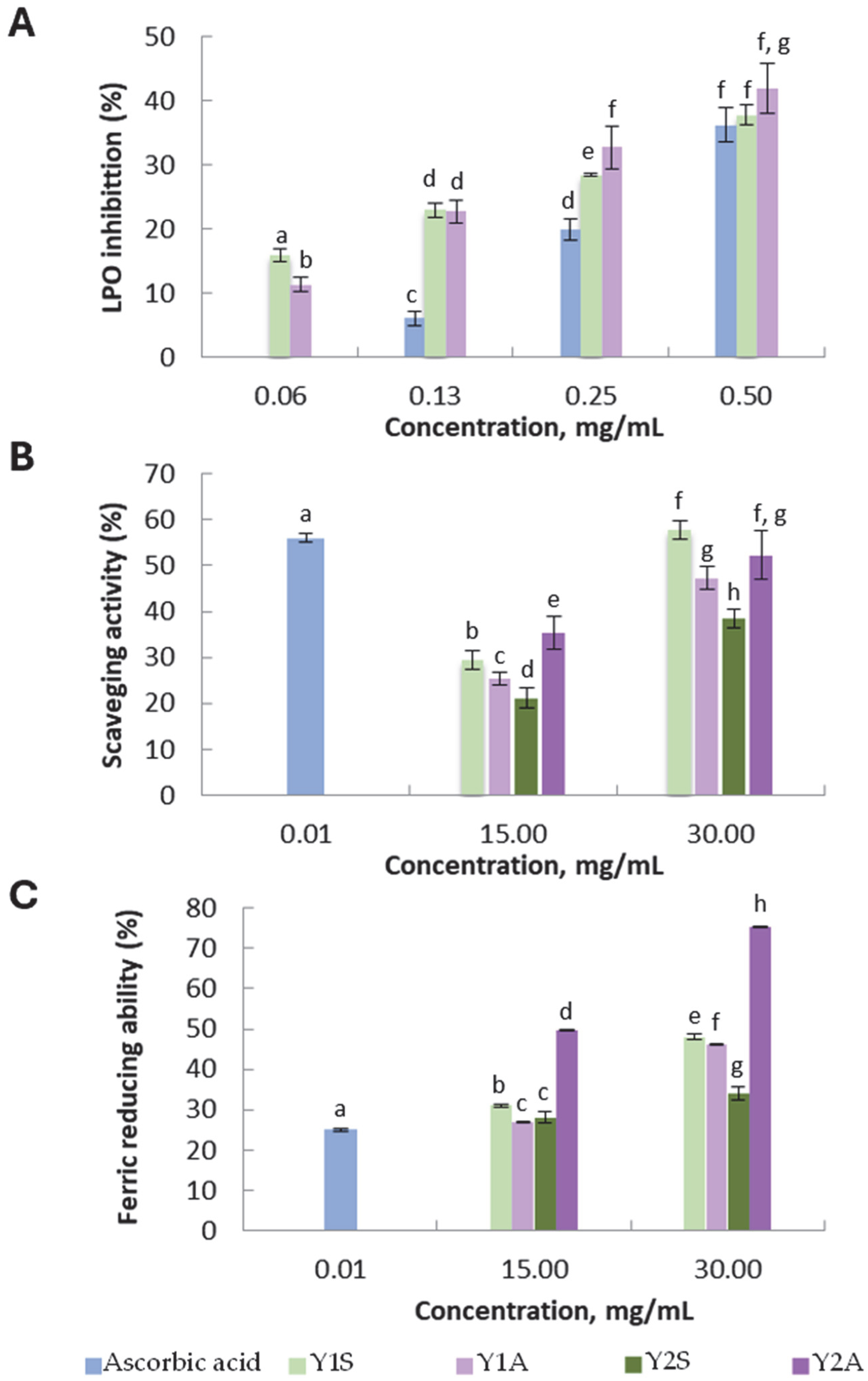
| Antioxidant Inhibitory Activity: IC50 (mg/mL) | |||
|---|---|---|---|
| LPO | DPPH Radical | Reducing Power | |
| Ascorbic acid | 1.12 ± 0.06 a | 0.006 ± 0.001 a | 0.013 ± 0.001 a |
| Y1S | 1.57 ± 0.08 b | 27.99 ± 1.40 b | 25.17 ± 1.26 b |
| Y1A | 0.85 ± 0.04 c | 36.76 ± 1.84 c | 32.16 ± 1.61 c |
| Y2S | n.d. | 38.41 ± 2.51 c | 40.88 ± 3.81 d |
| Y2A | n.d. | 26.91 ± 1.52 b | 18.31 ± 1.20 e |
| Microorganism | Inhibition Zone (mm) | ||||
|---|---|---|---|---|---|
| Y1S | Y1A | Y2S | Y2A | TE (30 μg/mL) | |
| E. faecalis ATCC 29212 | 7.5 ± 0.4 a,c | 10.2 ± 0.8 b,e | 6.4 ± 0.2 c | t. i. d | 11.7 ± 0.9 e |
| E. faecalis LFG 1001 | 8.3 ± 0.3 a | 7.8 ± 0.3 a | 8.1 ± 0.7 a | t. i. b | 11.1 ± 0.5 c |
| S. aureus ATCC 29213 | t. i. a | 8.5 ± 0.4 b | 12.9 ± 1.1 c | 26.2 ± 1.16 d | 29.2 ± 0.4 e |
| S. aureus LFG 1007 | 8.5 ± 0.5 a | 20.8 ± 2.1 b | 12.7 ± 0.9 c | t. i. d | 37.2 ± 0.5 e |
| S. epidermidis ATCC 12228 | 9.0 ± 0.5 a | 8.2 ± 0.2 a | 7.6 ± 0.5 a | t. i. b | 9.9 ± 0.5 a |
| E. coli ATCC 25922 | 16.7 ± 1.8 a | 18.3 ± 2.1 a,b | 17.3 ± 0.9 a,b | 24.0 ± 5.7 a,b | 24.7 ± 0.6 c |
| E. coli LFG 1003 | 11.7 ± 0.6 a | 12.3 ± 2.1 a | 8.4 ± 0.5 b,c | 11.2 ± 1.7 a,b | 6.7 ± 0.3 c |
| M. morganii LFG 1008 | 15.0 ± 0.9 a | 14.5 ± 1.3 a | t. i. b | 16.2 ± 1.8 a | 22.3 ± 1.8 c |
| P. mirabilis LFG 1004 | 12.3 ± 0.8 a | 12.2 ± 1.3 a | 11.0 ± 1.7 a | 11.1 ± 1.5 a | 7.3 ± 0.7 b |
| P. aeruginosa ATCC 27853 | w. i. | 7.8 ± 0.8 a | w. i. | w. i. | 36.7 ± 1.2 b |
| P. aeruginosa LFG 1002 | 7.0 ± 0.4 a | 6.0 ± 0.3 a | 7.2 ± 0.8 a | 19.7 ± 4.7 b | 17.6 ± 0.5 b |
| S. enteritidis LFG 1005 | 16.2 ± 0.3 a | 9.2 ± 0.3 b | 8.5 ± 1.0 b | 14.7 ± 1.4 a | 25.1 ± 0.5 c |
| S. typhimurium LFG 1006 | 14.5 ± 0.3 a | 8.2 ± 0.3 b | 8.0 ± 0.6 b | 12.9 ± 0.8 c | 6.7 ± 0.3 d |
| Microorganism | MIC (μg/mL) | ||||
|---|---|---|---|---|---|
| Y1S | Y1A | Y2S | Y2A | TE | |
| E. faecalis ATCC 29212 | 1767 a | >1978 | >2046 | 3640 b | 7.8 c |
| E. faecalis LFG 1001 | 837 a | >3956 | >2046 | 3640 b | 125 c |
| S. aureus ATCC 29213 | 465 a | >2967 | >2046 | 3640 b | 1.0 c |
| S. aureus LFG 1007 | 837 a | 1980 b | >2046 | 1001 a | 1.0 c |
| S. epidermidis ATCC 12228 | 651 a | >1978 | >2046 | 4550 b | 62.5 c |
| E. coli ATCC 25922 | 837 a | 990 b | 1023 b | 1456 c | 62.5 d |
| E. coli LFG 1003 | 1767 a | 1980 a,b | 2046 b | 2912 c | 500 d |
| M. morganii LFG 1008 | 837 a | 792 a | 1581 b | 3913 c | 250 d |
| P. mirabilis LFG 1004 | 837 a | 990 a | 1581 b | 3913 c | 250 d |
| P. aeruginosa ATCC 27853 | 837 a | 990 a | 1023 b | 3640 a | 125 c |
| P. aeruginosa LFG 1002 | 837 a | 990 b | 1023 b | 1365 c | 15.6 d |
| S. enteritidis LFG 1005 | 837 a | 792 a | 1581 b | 2912 c | 7.8 d |
| S. typhimurium LFG 1006 | 1767 a | 1980 a,b | 2046 b | 2912 c | 500 d |
| Sample ID | Season/ Year | Mean Temp. (°C) [Anomaly] | Total Precip. (mm) [% of Normal] | Sunshine Profile/ Radiation | Dominant Abiotic Stressor/ Climatic Events | Phenological Growth Stage |
|---|---|---|---|---|---|---|
| Y1S | Spring (Year 1) | 13.17 [−0.43] | 325.9 [154%] | Coldest spring since 1993; Late frost/2nd wettest March in mainland Portugal in the last 50 years | Cold stress (Lowest May minimum temp. in 30 years). | Vegetative/pre-flowering |
| Y1A | Autumn (Year 1) | 17.03 [+0.76] | 242.2 [97%] | 7th warmest autumn in 30 years; Normal precipitation. | Mechanical stress (Tornado F0/T1 event in the region). | Flowering |
| Y2S | Spring (Year 2) | 13.11 [−0.49] | 346.4 [164%] | Rainiest spring in 15 years; Record rainfall in the Lower Alentejo region. | Hydric stress (Extreme rainfall after meteorological drought). | Vegetative/pre-flowering |
| Y2A | Autumn (Year 2) | 17.60 [+1.40] | 449.5 [180%] | 6th warmest & 6th rainiest since 1931; Major heatwave in Oct. | Extreme Thermal stress (Most significant Oct heatwave since 1941). | Flowering |
Disclaimer/Publisher’s Note: The statements, opinions and data contained in all publications are solely those of the individual author(s) and contributor(s) and not of MDPI and/or the editor(s). MDPI and/or the editor(s) disclaim responsibility for any injury to people or property resulting from any ideas, methods, instructions or products referred to in the content. |
© 2026 by the authors. Licensee MDPI, Basel, Switzerland. This article is an open access article distributed under the terms and conditions of the Creative Commons Attribution (CC BY) license.
Share and Cite
Arantes, S.M.; Piçarra, A.; Caldeira, A.T.; Martins, M.R. Composition and Bioactivity of Alentejo Calamintha nepeta Essential Oil: The Impact of Seasonality and Climatic Stress on Antioxidant Capacity and MDR Antibacterial Potential. Molecules 2026, 31, 2100. https://doi.org/10.3390/molecules31122100
Arantes SM, Piçarra A, Caldeira AT, Martins MR. Composition and Bioactivity of Alentejo Calamintha nepeta Essential Oil: The Impact of Seasonality and Climatic Stress on Antioxidant Capacity and MDR Antibacterial Potential. Molecules. 2026; 31(12):2100. https://doi.org/10.3390/molecules31122100
Chicago/Turabian StyleArantes, Sílvia Macedo, Andreia Piçarra, A. Teresa Caldeira, and M. Rosario Martins. 2026. "Composition and Bioactivity of Alentejo Calamintha nepeta Essential Oil: The Impact of Seasonality and Climatic Stress on Antioxidant Capacity and MDR Antibacterial Potential" Molecules 31, no. 12: 2100. https://doi.org/10.3390/molecules31122100
APA StyleArantes, S. M., Piçarra, A., Caldeira, A. T., & Martins, M. R. (2026). Composition and Bioactivity of Alentejo Calamintha nepeta Essential Oil: The Impact of Seasonality and Climatic Stress on Antioxidant Capacity and MDR Antibacterial Potential. Molecules, 31(12), 2100. https://doi.org/10.3390/molecules31122100

