Article

Developmental Consequences of Early-Life Exposure and Adulticidal Effects of Siparuna Species Essential Oils in Aedes aegypti


by
Milton L. Montaño-Campaz
1,2,*,
Javier G. Mantilla Afanador
3,
Tarciza F. Nascimento
4,
Joshua S. Fernandes
5,
Mathews O. N. Novaes
5,
Juan G. Orrego Meza
2,
Beatriz Toro-Restrepo
2,
Lucimar G. Dias
2,
Patrícia F. Pinheiro
6,
Raimundo W. S. Aguiar
4 and
Eugenio E. Oliveira
4,5,*
1
Centro de Bioinformática y Biología Computacional de Colombia—BIOS, Ecoparque Los Yarumos, Manizales 170002, Caldas, Colombia
2
Grupo de Investigación Bionat, Facultad de Ciencias Exactas y Naturales, Universidad de Caldas, Manizales 170001, Caldas, Colombia
3
Research Institute in Microbiology and Agroindustrial Biotechnology, Universidad Católica de Manizales, Carrera 23, 60–63, Manizales 170002, Caldas, Colombia
4
Programa de Pós-Graduação em Biotecnologia, Universidade Federal do Tocantins, Gurupi 77402-970, TO, Brazil
5
Departamento de Entomologia, Universidade Federal de Viçosa, Viçosa 36570-900, MG, Brazil
6
Departamento de Química, Universidade Federal de Viçosa, Viçosa 36570-900, MG, Brazil
*
Authors to whom correspondence should be addressed.
Molecules 2026, 31(12), 2098; https://doi.org/10.3390/molecules31122098 (registering DOI)
Submission received: 14 March 2026 / Revised: 8 June 2026 / Accepted: 12 June 2026 / Published: 15 June 2026

Abstract

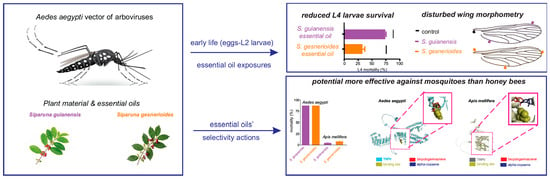
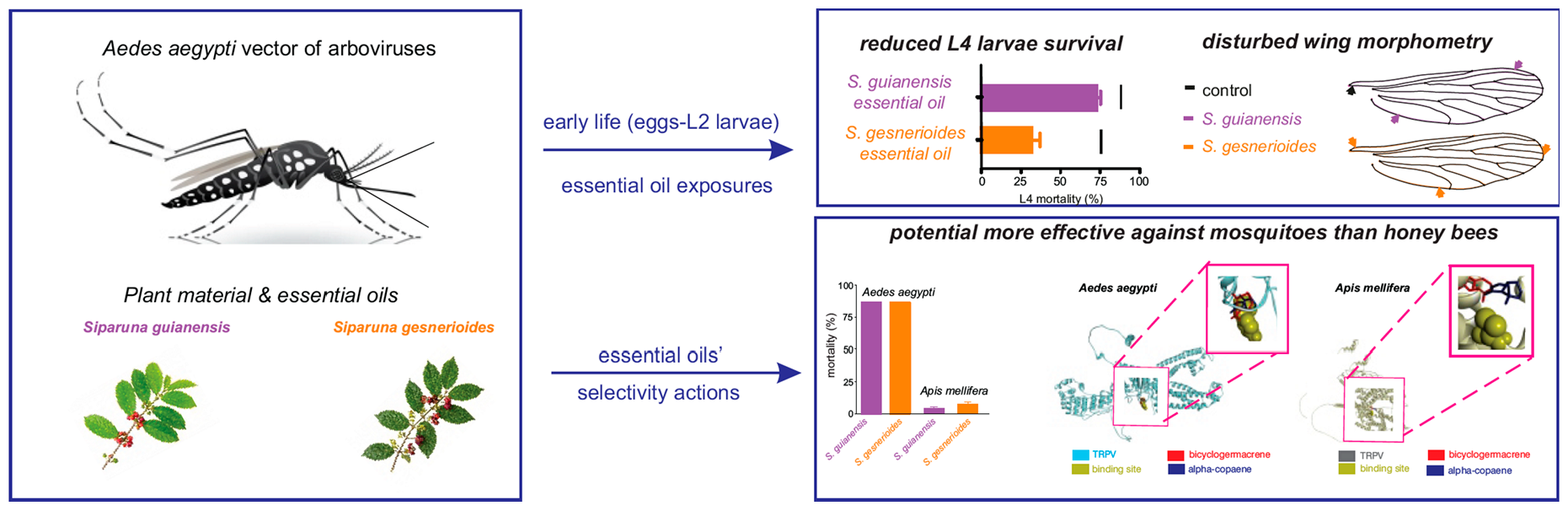
Essential oils obtained from Siparuna plants, e.g., S. guianensis and S. gesnerioides, have potential for use as biorational insecticides. However, the activities of S. gesnerioides oils remain largely unexplored compared to S. guianensis oils. Using an integrative approach combining toxicological bioassays, geometric morphometrics, and in silico modeling, we assessed the adulticidal potential, selectivity, and the effects of early-life exposure to these oils on the larval susceptibility and adult wing morphometry of Aedes aegypti. Adulticidal assays revealed high toxicity, with S. guianensis (LC50 = 15.0 nL/mL) being 15-fold more potent than S. gesnerioides (LC50 = 233.0 nL/mL). Beyond acute lethality, early-life (i.e., eggs to L2 larvae) exposure to sublethal concentrations (S. guianensis = 7.4 nL/mL and S. gesnerioides = 118.0 nL/mL) was associated with wing morphometric disruptions and increased fluctuating asymmetry in Ae. aegypti adults, especially in those exposed to S. gesnerioides essential oil. Furthermore, early-life exposure to S. gesnerioides modulated L4 larvae susceptibility, which was associated with lower mortality in subsequent exposures. Selectivity assays demonstrated low acute oral toxicity in initial laboratory screenings with Apis mellifera, while molecular docking approaches predicted higher affinity of bicyclogermacrene and α-copaene for Ae. aegypti TRPV channels. Collectively, while S. gesnerioides oil was less acutely toxic, early-life sublethal exposures reduced fourth instar larvae (L4) susceptibility, which may have contributed to developmental instability and morphological alterations in adults. Our findings highlight the potential of Siparuna essential oils in mosquito management by impacting mosquito fitness beyond acute mortality.

Graphical Abstract

1. Introduction

The global public health landscape is marked by the spread of vector-borne diseases, notably Aedes aegypti (Linnaeus, 1762) (Diptera: Culicidae), one of the transmitters of arboviruses such as dengue, Zika, yellow fever, and chikungunya in tropical and subtropical regions [1]. Control programs for this species have been based on actions and strategies that prevent the proliferation of breeding sites, biological control, and, predominantly, the massive application of synthetic chemical insecticides, including organophosphates, organochlorines, and pyrethroids [2,3,4]. Despite the efforts devoted to control programs, the historical dependence on synthetic insecticides has led to the emergence of population resistance [5,6]. This resistance, documented at the molecular and phenotypic levels for the main classes of insecticides, erodes the effectiveness of interventions and requires an urgent search for alternatives with novel modes of action [7,8,9,10].
In this context, the limitations of controlling Ae. aegypti, coupled with the development of resistance, have prompted the search for alternatives such as botanical insecticides derived from essential oils [11,12,13,14,15]. Essential oils (EOs) from aromatic plants have emerged as promising candidates due to their complex phytochemical composition, which can act on multiple molecular targets, potentially hindering the development of cross-resistance [16,17]. Their biodegradability and generally favorable safety profile for mammals and the environment position them as key components in integrated pest management strategies [18].
In the Neotropical region, the genus Siparuna (Aublet, 1775) (Siparunaceae) stands out for its phytochemical richness, being traditionally used in folk medicine [19], and for its insecticidal potential [12]. Previous studies have shown that the essential oils of species such as S. guianensis Aubl. and S. gesnerioides (Kunth) have high toxicity at all stages of vector development [20,21]. However, most of these studies have focused on acute and lethal toxicity, an approach that, while necessary to establish a baseline of activity, is insufficient to understand the real ecological and evolutionary impact of these bioinsecticides.
Although the acute toxicity of various plant essential oils on culicids is well-documented [22,23,24], the long-term biological consequences for surviving individuals remain frequently overlooked [25]. Investigating these impacts is crucial, as sublethal exposure can trigger physiological and morphological disruptions [26]. Such insecticide-mediated stresses (e.g., alterations in behaviors, morphology and development) can profoundly affect vector population dynamics and pathogen transmission, offering a more holistic view of a compound’s potential [27,28]. In this regard, geometric morphometric techniques can be used to detect alterations in wing venation and configuration, which serve as indicators of stress during development [29,30]. The geometric morphometry of the wing, an organ subjected to strong stabilizing pressure during development, acts as a sensitive sensor of environmental and physiological disturbances, allowing the quantification of stress induced by xenobiotics [31].
At the same time, in order to go beyond mere phenomenological description and move toward rational insecticide design, it is imperative to elucidate the underlying mechanisms of action. Furthermore, the application of in silico tools allows us to predict how the components of these oils interact molecularly [17,32]. In that regard, major components of Siparuna essential oils have been predicted to bind to mosquitoes’ acetylcholinesterases [21] but no other common neuronal targets have been investigated. Considering the major components of Siparuna essential oils have also been shown to interact with transient receptor potential (TRP) channels in other insect species [33], we used in silico approaches to investigate the potential interactions of these molecules with Ae. aegypti TRP channels.
Thus, this study was conducted aiming to address existing knowledge gaps through an integrative and novel approach that combines toxicological bioassays, geometric morphometrics, and in silico analysis. First, we evaluated the adulticidal potential and assessed the sublethal impacts of the essential oils of S. guianensis and S. gesnerioides on Ae. aegypti. The central hypothesis here is that exposure to sublethal doses of these Siparuna essential oils can induce developmental stress, detectable as reduced survival rates in later developmental stages and morphological disruptions (e.g., wing fluctuating asymmetry) in adults. We further assessed the selectivity potential toward the pollinator bees Apis mellifera and, by using in silico approaches, we predicted the potential molecular interactions among the essential oil major constituents and transient receptor potential (TRP) ion channels of the mosquitoes and honey bees.

2. Results

2.1. Yield and Chemical Composition of Essential Oils

The essential oil extraction provided distinct yields for the two species, with S. gesnerioides producing 0.384% and S. guianensis yielding 0.210%. Both essential oil types appeared as viscous, bright yellow liquids, characterized by a specific odor and a density below that of water. Chromatographic analysis revealed marked qualitative and quantitative divergence between the species (Table 1). We successfully characterized 94.62% of the S. gesnerioides essential oil constituents and 93.16% for S. guianensis, calculated from the relative peak areas. Regarding chemical classes, both essential oils are predominantly composed of sesquiterpene hydrocarbons (SH), accounting for 70.06% of the total composition in S. gesnerioides essential oil and 87.49% in S. guianensis essential oil.

2.2. Toxicity of Siparuna Essential Oils against Aedes aegypti Adults

Concentration–mortality results for S. guianensis (n = 500; χ2 = 4.36; p = 0.113) and S. gesnerioides (n = 600; χ2 = 6.34; p = 0.096) in adult Ae. aegypti after 24 h of exposure showed a satisfactory fit to the Probit model (Figure 1). The LC50 value for S. guianensis was 15.0 (14.0–16.0) nL/mL, while S. gesnerioides had an LC50 of 233.0 (201.0–261.0) nL/mL (Figure 1). There was no mortality in the control treatment; therefore, no correction using Abbott’s formula was required. Comparatively, S. guianensis essential oil exhibited greater toxicity against Ae. aegypti adults, with an LC50 approximately 15-fold lower than that recorded for S. gesnerioides essential oil.

2.3. Effect of Early Sublethal Exposure on Fourth-Instar Larval Susceptibility

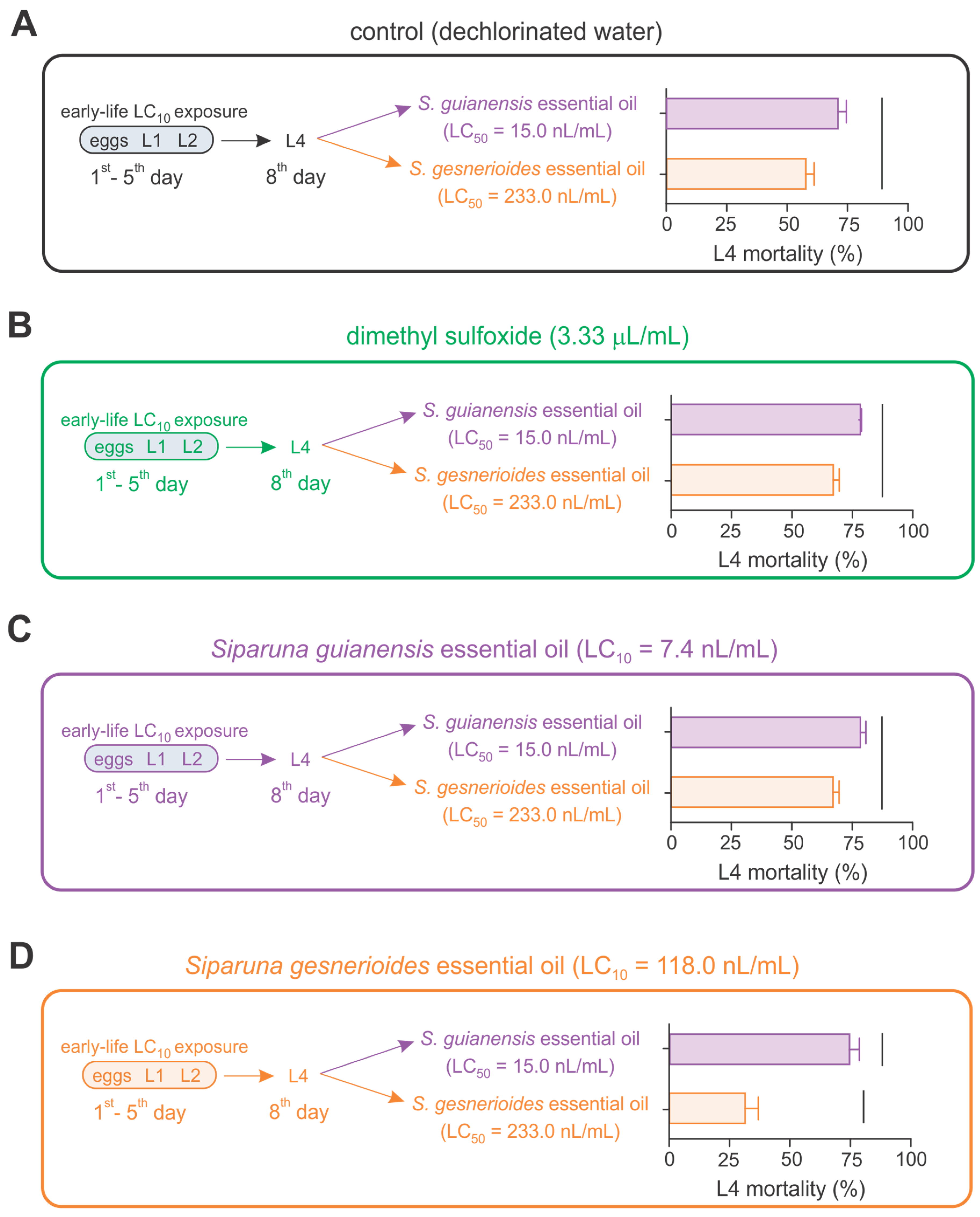
The susceptibility of fourth-instar larvae (L4) to adulticidal LC50 concentrations of Siparuna essential oils varied significantly depending on the early-life exposure history (Figure 2). The adulticidal LC50 of S. guianensis essential oil resulted in a mortality rate of approximately 75%, regardless of previous exposure (Figure 2A–D). Notably, S. gesnerioides essential oil LC50 mediated L4 larvae mortality closer to the 50% threshold in individuals that were either previously unexposed or exposed to DMSO and S. guianensis essential oil (Figure 2A–C). Furthermore, a lower mortality rate was observed in L4 larvae challenged with S. gesnerioides essential oil when they had been previously exposed to sublethal concentrations of the same oil (Figure 2D).

2.4. Geometric Morphometric Analysis

The measurement error of the morphometric data was negligible, since the mean square (MS) of the error in the Procrustes ANOVA was lower than that corresponding to the Individual × Side interaction (0.0000164683 < 0.0000537868), confirming the adequate repeatability of the measurements. Procrustes ANOVA revealed highly significant effects for the Individual × Side interaction (p < 0.0001), both in centroid size and shape, indicating the presence of fluctuating asymmetry (FA) in the total set of samples (Control, DMSO, Siparuna guianensis, and Siparuna gesnerioides). In terms of shape, FA explained 22.93% of the total variation (SS Ind × Side = 0.06663083; SS Total = 0.29062584; F = 81.73; p < 0.0001). Additionally, the effect of the Side factor was significant, evidencing directional asymmetry, while the Individual effect confirmed the existence of significant morphological variation between specimens. Independent analysis by population showed that fluctuating asymmetry was significant in all experimental groups (Table 2). Individuals exposed to S. guianensis and S. gesnerioides essential oils showed higher percentages of variation attributable to fluctuating asymmetry compared to the control and DMSO groups. In particular, individuals that faced early development exposure to S. gesnerioides essential oil recorded the highest SS value (Ind × Side), suggesting differences in the relative magnitude of developmental instability between treatments.
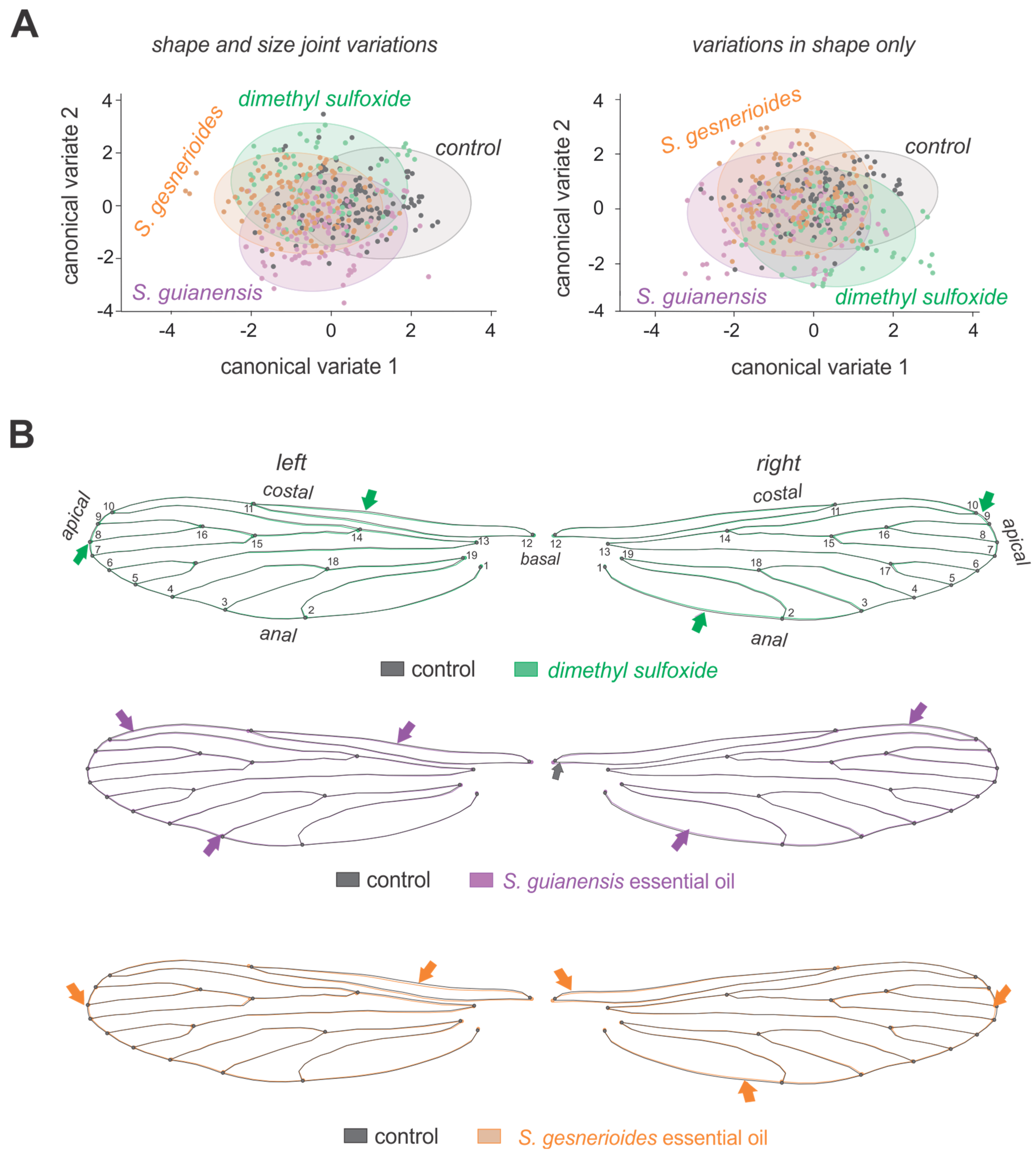
Canonical variate analysis (Figure 3A, left side) showed significant differences in wing shape between populations (F = 7.4104; p < 0.0001). The greatest morphological divergences were observed between the Control and S. gesnerioides, as indicated by both Mahalanobis (2.17) and Procrustes (0.0102) distances (Table 3). Principal component analysis (PCA) showed that this variation is multivariate, with 58% of the change distributed across the first five components (PC1 = 20.2%; PC2 = 13.5%; PC3 = 9.2%). Visually, exposure to Siparuna essential oils, particularly S. gesnerioides, resulted in a contraction of the apical, costal, and anal wing regions (Figure 3B). Similar but less intense patterns of reduction were observed in the DMSO and S. guianensis groups. These shape differences remained consistent even after eliminating size effects. The regression of shape on centroid size was statistically significant (p < 0.0001), but only explained 2.28% of the total variation in shape (predicted SS = 0.00663; residual SS = 0.28399), indicating that although there is a detectable relationship between size and shape (allometry), its relative contribution is low. Consequently, most of the observed morphological variation is independent of size.

2.5. Selectivity of Siparuna Essential Oils for Apis mellifera

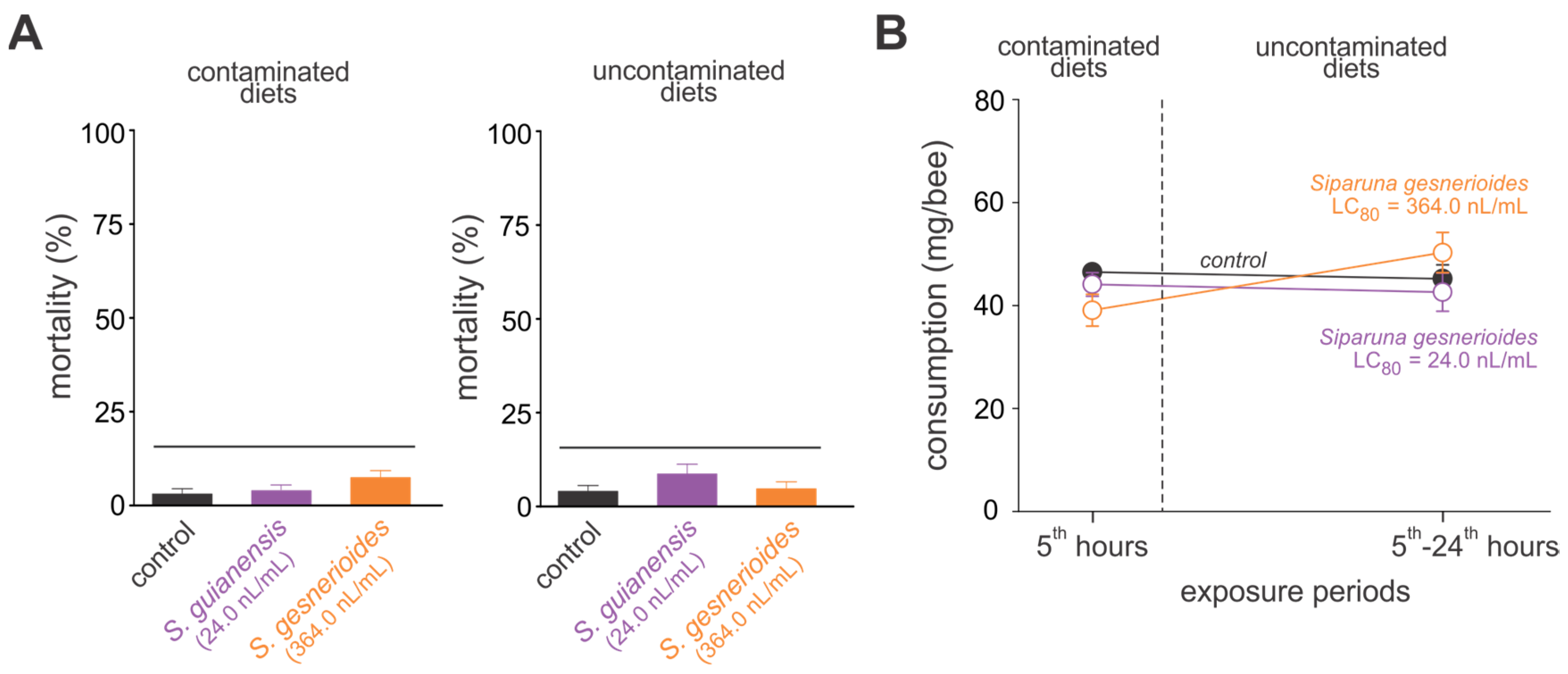
Selectivity bioassays conducted on Ap. mellifera using the LC80 concentrations of S. guianensis (24.0 nL/mL) and S. gesnerioides (364.0 nL/mL) essential oils previously determined in Ae. aegypti showed high insecticidal specificity for both essential oils (Table 4, Figure 4). While these concentrations caused 80% mortality in the target mosquito population, Ap. mellifera workers exposed to the same levels via ingestion were not significantly affected (Figure 4A). Our repeated measures analysis of variance for diet consumption showed no significant effect of time (F = 0.13; p = 0.73), and no interaction between time and the diet consumed (F = 1.9; p = 0.21) (Figure 4B).

2.6. Interaction of Bicyclogermacrene and Alpha Copaene Molecules and TRPV Channels of Aedes aegypti and Apis mellifera

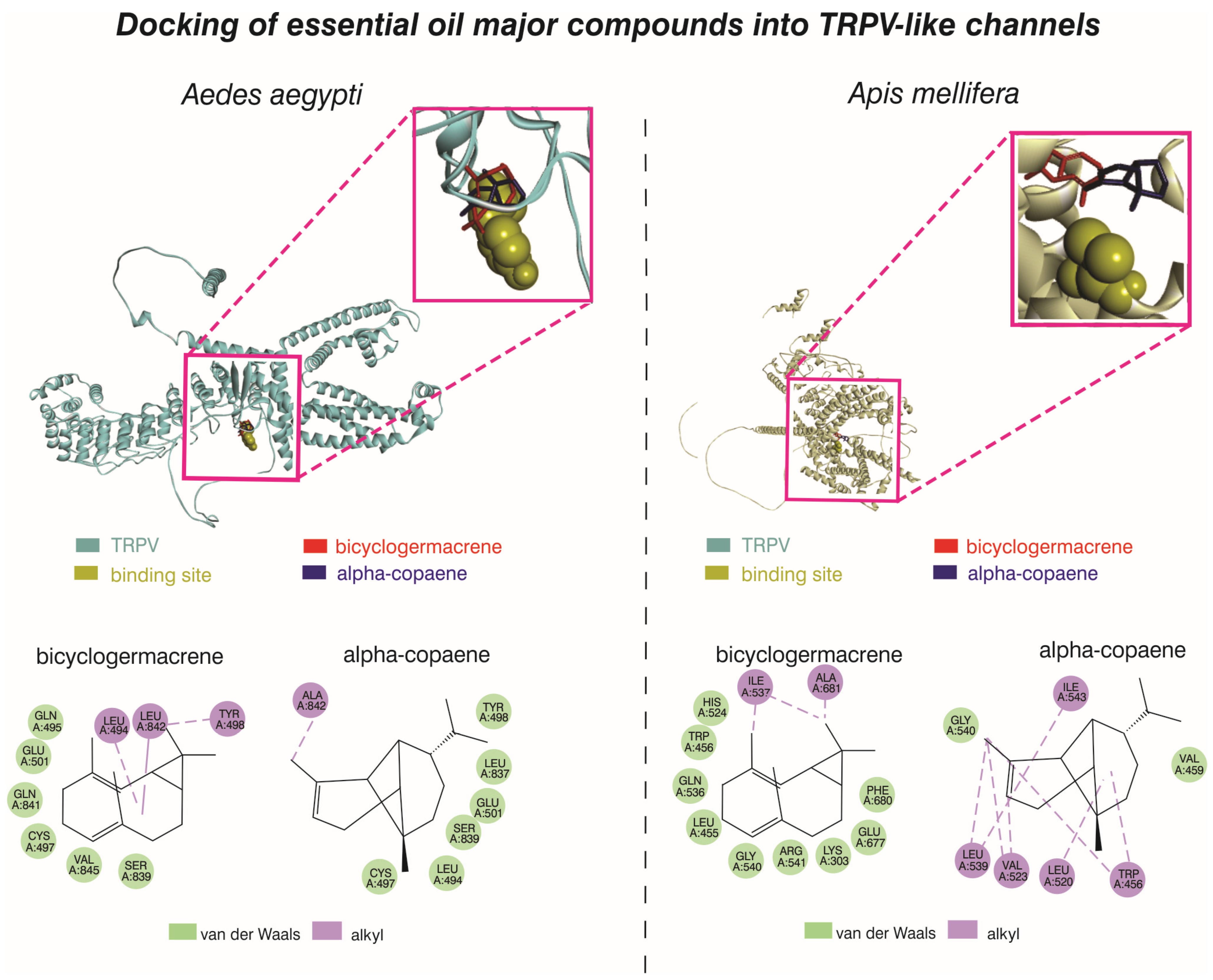
Based on our in silico computational predictions, the essential oil major constituents, bicyclogermacrene and α-copaene, can interact with TRPV channels of Ae. aegypti and Ap. mellifera through potential binding pockets. The TRPV channel from Ae. aegypti exhibited higher predicted binding affinity values (AutoDock Vina, version 1.5.7, kcal/mol) for bicyclogermacrene (−6.8) and α-copaene (−6.5) compared to the Ap. mellifera TRPV channel, which showed lower affinity values for bicyclogermacrene (−5.6) and α-copaene (−6.0) (Figure 5). The bicyclogermacrene-Ae. aegypti TRPV complex displayed predominantly hydrophobic interactions, including van der Waals contacts with GLN495, VAL845, GLN841, SER839, GLU501, and CYS497, alongside alkyl interactions with ALA842, LEU494, and TYR498. In contrast, the Ap. mellifera TRPV complex involved van der Waals contacts with TRP456, GLN536, LEU455, GLY540, ARG541, LYS303, GLU677, and PHE680, and alkyl interactions with ALA681 and ILE537 (Figure 5).
For α-copaene, the Ae. aegypti TRPV complex showed van der Waals interactions with TYR498, LEU837, GLU501, SER839, LEU494, and CYS497, and alkyl interactions with ALA842. Conversely, the Ap. mellifera TRPV complex exhibited van der Waals interactions with GLY540 and VAL459, alongside alkyl interactions with ILE543, LEU539, VAL523, LEU520, and TRP456 (Figure 5).

3. Discussion

Here, we observed that S. guianensis and S. gesnerioides essential oils possess remarkable insecticidal activity against Ae. aegypti. A striking differential toxicity was observed, with S. guianensis essential oils exhibiting significantly higher adulticidal toxicity, being approximately 15-fold more potent at the LC50 level than S. gesnerioides essential oil. Beyond acute mortality, chronic exposure to sublethal concentrations (LC10) was associated with complex physiological responses, reducing susceptibility in larvae pre-exposed to S. gesnerioides essential oil and alterations (fluctuating asymmetry) in the wing morphology of emerged adults. Furthermore, our molecular docking analyses suggest that major compounds such as bicyclogermacrene and α-copaene interact with TRPV channels, with a predictive affinity greater for the mosquito channel than for that of the honeybee Ap. mellifera, which correlates with the selectivity observed in bioassays.
The essential oil yields obtained for S. gesnerioides (0.384%) and S. guianensis (0.210%) essential oils are consistent with the typical extraction ranges reported for the Siparunaceae family [21,33,35,36,37]. Despite their variations in individual constituent percentages and overall yields, the fact that both S. gesnerioides and S. guianensis essential oil types exhibited predominance of sesquiterpene hydrocarbons (e.g., β-bourbonene, (E)-caryophyllene, and germacrene D) is consistent with literature reports showing that the secondary metabolism of Siparuna species is heavily oriented toward the synthesis of higher-molecular-weight volatile sesquiterpenes [35,37,38]. Previous studies with essential oils of S. guianensis and S. gesnerioides had already reported their larvicidal activity [12,21,39]. Here, however, we quantified the adulticidal toxicities, for the first time, of Siparuna species essential oils revealing a striking difference in potency that highlights the importance of intrageneric chemodiversity. Additionally, the choice of using adult-derived lethal concentrations for the larval stage bioassays was a deliberate experimental strategy to ensure consistency by using the same essential oil batch across all life stages, although we recognize that these concentrations do not represent biological equivalence between larvae and adults.
The differential toxicity observed between the essential oil of the two Siparuna species (LC50 of 15.0 nL/mL for S. guianensis vs 233.0 nL/mL for S. gesnerioides) may be related to their qualitatively and quantitatively distinct phytochemical profiles. While S. guianensis essential oil has a more simplified composition dominated by bicyclogermacrene (42.9%) and germacrene D (25.1%), S. gesnerioides essential oils exhibit a complex mixture of more than 30 compounds, including germacrene D (19.9%). Although synergistic actions among essential oil components are frequently reported [40], the greater potency of S. guianensis oil could potentially arise from interactions between its major constituents or the high concentration of specific active compounds, such as bicyclogermacrene. However, these specific synergistic effects remain to be experimentally confirmed through bioassays with isolated compounds. It is also worth noting that major compounds are not always responsible for the insecticidal or repellent activities of plant-based essential oils. For instance, (E)-β-farnesene, a minor component of natural pyrethrins, is of great relevance to the repellent actions of pyrethrum extracts on Ae. aegypti [41]. Given the presence of unidentified compounds (approximately 6.8% in S. guianensis essential oil and 5.4% in the S. gesnerioides essential oil) and considering that our identification relies on library matching and retention indices, our findings do not rule out their potential contribution to the adulticidal and sublethal effects observed in this study.
A particularly novel finding in our study is the differential response in larval susceptibility following early-life exposure. While larvae challenged with S. guianensis essential oil at their early developmental phases (i.e., from eggs to L2 larval instar) showed no significant change in susceptibility, those previously exposed to sublethal concentrations of S. gesnerioides essential oil exhibited significantly lower susceptibility at the L4 stage. Although further investigations are still required to disentangle the reasons for such physiological changes, it is hypothesized that the reduced susceptibility observed after exposure to S. gesnerioides essential oil may involve the activation of metabolic detoxification mechanisms, such as cytochrome P450 complex enzymes [42,43,44], glutathione S-transferases [45,46], or esterases [44,47,48]. These pathways are known to be inducible in insects after exposure to complex xenobiotics [49], and their role in the current study remains a subject for future biochemical and transcriptional validation.
The reduced susceptibility of L4 larvae following early-life exposure to S. gesnerioides essential oil appears to come at a physiological cost. This survival mechanism likely triggers a trade-off, which can be related to the wing deformations observed in emerged adults. This phenomenon occurs when energy resources are diverted from developmental stability to sustain costly detoxification mechanisms [50,51]. Despite the fact that larvae early-life exposed to DMSO alone resulted in adults with significant fluctuating asymmetry (approximately 21%), suggesting that the surfactant(solvent) itself may contribute to developmental stress, both essential oil treatments exhibited notably higher percentages of fluctuating asymmetry (approximately 25%). While the difference between the solvent control and oil treatments is narrow, it suggests a possible additive effect of the essential oils on developmental instability, beyond the baseline stress caused by the surfactant/solvent. Additionally, the substantial effect of DMSO alone represents a limitation in isolating the oil-specific developmental impact, requiring caution in this interpretation. Since the alterations were identified in functional costal and apical wing regions, these sublethal effects could translate into reduced flight capacity and host-seeking efficiency, directly impacting the biological fitness and vectorial capacity of the surviving population [52,53]. Fluctuating asymmetry is considered a sensitive biomarker of environmental and genetic stress, as it reflects an organism’s inability to maintain perfectly symmetrical development under disruptive conditions [53]. Although the current investigation has not addressed the mechanistic reasons in detail, the increase in fluctuating asymmetry in the wings of mosquitoes exposed to Siparuna essential oils indicates that these compounds, even at concentrations that do not cause mortality, may interfere with cellular and developmental processes, potentially due to their predicted neurotoxic action and the hypothesized energy cost. The alterations in the apical, costal, and basal regions of the wing (identified by ACP) could translate into functional consequences, affecting flight capacity, host seeking, and mating, which would directly impact the biological fitness of the vector [52,54,55]. While these functional impacts are hypothesized based on the literature on wing morphometrics, they remain to be empirically tested in mosquitoes surviving Siparuna essential oil exposures.
The hypothesis of a neurotoxic mode of action is supported by in silico studies. Our molecular docking predicted that bicyclogermacrene and α-copaene may interact with TRPV channels. The TRPV channel of Ae. aegypti exhibited higher predicted binding affinity values (bicyclogermacrene: −6.8 kcal/mol; α-copaene: −6.5 kcal/mol) compared to the channel of Ap. mellifera (−5.6 and −6.0 kcal/mol, respectively). The interactions were predominantly hydrophobic (van der Waals and alkyl) in both cases. Transient receptor potential vanilloid (TRPV) channels are known targets for certain insecticides and botanical compounds, and their modulation can cause hyperexcitability, paralysis, and death [36,56,57]. The higher affinity predicted by the mosquito channel suggests a molecular basis for the selectivity observed in bioassays with Ap. mellifera. Differences in the amino acid sequence of the TRPV channel binding pocket between the two species, although not explored in detail here, are the most likely cause of the differences in predicted binding energy. Our findings do not rule out that selectivity may also arise from differential susceptibility in other physiological targets, such as nicotinic acetylcholine (nAChRs), octopamine, or γ-aminobutyric acid (GABARs) receptors. Further electrophysiological assays of the essential oil major compounds and the TRPV channels are still required before firm conclusions are considered.
Selectivity tests showed that LC80 concentrations for the mosquito caused less than 20% mortality in honeybees, which was expected, as a previous study found S. guianensis essential oil to be selective against honey bees [58]. This selectivity is a crucial attribute for any new control agent, as it minimizes the impact on pollinators and other beneficial organisms [17], facilitating its integration into IPM strategies that seek a balance between pest control and biodiversity conservation [59]. Here, even when we consider the fact that the current investigation addressed a worst-scenario case by confining forager bees to small containers and allowing feeding only from a single source containing essential oil concentrations at levels of exposure significantly higher than what is typically encountered in a natural, open-field environment, our selectivity data points toward a promising preliminary safety profile compared to the target organisms (i.e., mosquito adults).
Despite the robustness of the results, certain limitations must be acknowledged. Molecular docking studies, while informative, are predictive and static. They do not consider the dynamics of protein-ligand interaction in a membrane environment, nor possible metabolisms of the compound before reaching its target [60]. Future research should employ molecular dynamics simulations to validate the stability of these complexes and perform electrophysiological assays to functionally confirm the modulation of TRPV channels by these compounds. The potential contribution of unidentified compounds to the observed effects (adulticidal toxicity and sublethal activities) remains uncertain and warrants further investigation. Similarly, toxicity tests on bees, although encouraging, considering that these bioassays were conducted under laboratory conditions with acute oral exposure, in the worst-case scenario, as they would not have the chance of evading the contaminated food source, field studies and assessments of chronic and sublethal effects (e.g., on foraging behavior) in Ap. mellifera and other native pollinators are needed to fully confirm their ecological selectivity.

4. Materials and Methods

4.1. Collection of Plant Material and Extraction of Essential Oil

The leaves of Siparuna guianensis and Siparuna gesnerioides were collected in the municipality of Norcasia (5°34′27″ N, 74°53′20″ W; 700 m above sea level), department of Caldas, Colombia. Taxonomic identification was confirmed by specialists at the Herbarium of the University of Caldas (Manizales, Colombia), where the reference specimens were deposited under the numbers JAO 957 (S. guianensis) and JASG 1522 (S. gesnerioides). For each species, young and mature leaves were collected from different individuals and positions within the plant to ensure the representativeness and randomness of the sample. The plant material was placed in properly labeled paper bags and transported to the Zoology Laboratory of the University of Caldas (Manizales, Colombia). The leaves were dried in the shade at room temperature and then stored in plastic bags until extraction. The essential oils were obtained at the Kupay Laboratory (Bogotá, Cundinamarca, Colombia) by steam distillation, using a 10 Kg distillation unit similar to those used on a commercial scale. Approximately 1600 g of dried leaves were used in each extraction, with a distillation time of four hours.

4.2. Chemical Composition of Essential Oils

For the analysis of the chemical composition of the essential oil, a solution containing 10 mg of essential oil in 1 mL of ethanol was prepared. An aliquot of 1 µL of this solution was injected into a gas chromatograph coupled to a mass spectrometer (GC–MS), model GCMS-QP2010C Ultra Mass Spectrometer (Shimadzu Corporation, Kyoto, Japan). The stationary phase used was an SPB-5 fused silica capillary column (30 m length, 0.25 mm internal diameter, and 0.25 µm film thickness), and helium was used as the carrier gas. The injector temperature was set at 220 °C and the detector at 300 °C. The initial column temperature was 40 °C, programmed to increase at a rate of 5 °C per minute until reaching a maximum temperature of 300 °C. The column flow rate was 1.60 mL/min. For compound identification, the obtained mass spectra were compared with those available in the equipment database (NIST spectral library), as well as with literature data and their respective retention indices (RI).
The retention indices (IR) were calculated according to Equation (1) for each compound and compared with literature values [34]:
I R   X = 100 P z + 100 [ ( R T x R T P z ) ( R T P z + 1 R T P z ) ]
where X = compound of interest; Pz = number of carbon atoms of the n-alkane eluting immediately before compound X; RTx = retention time of compound X; RTPz = retention time of the preceding n-alkane; and RTPz + 1 = retention time of the n-alkane eluting immediately after compound X.

4.3. Breeding Conditions for Aedes aegypti and Apis mellifera

Adult Ae. aegypti from the PPCampos insecticide-susceptible strain were used, maintained for eight years under controlled conditions and in an environment free from exposure to insecticides. The larvae were reared in dechlorinated water and fed daily with commercial turtle food under controlled environmental conditions (25 ± 2 °C; 60 ± 2% relative humidity; photoperiod 12:12 h light:dark) until adult emergence. Adulticide bioassays were performed with individuals 5 to 10 days old post-emergence, following the methodology previously described elsewhere [2,61]. The Ap. mellifera colonies used in the trials were obtained from the experimental apiary of the Federal University of Viçosa (UFV), where they are kept under health monitoring and standardized technical management. Clinically healthy colonies with young queens and active egg laying were selected, from which homogeneous experimental nuclei were established (3–5 frames with capped brood and food reserves). These microcolonies were kept in small-volume Langstroth hives under natural environmental conditions, supplemented with sucrose syrup (50%, w/v) and protein substitute when necessary. Prior to exposure to essential oils, the colonies were stabilized for at least two weeks to minimize handling stress. The treatments were applied under controlled conditions, avoiding drift between hives and cross-contamination, in order to ensure reliability in the evaluation of lethal effects.

4.4. Adulticidal Bioassays Against Aedes aegypti

The adulticidal activity of the essential oils of Siparuna guianensis and Siparuna gesnerioides against Aedes aegypti was evaluated using the methodology described by [2,6], with slight modifications. The essential oils were diluted in acetone to obtain experimental concentrations. The tested concentration ranges were 6.0–34.0 nL/mL for S. guianensis and 80.0–1000 nL/mL for S. gesnerioides essential oils. Two milliliters of each solution were dispensed into 250 mL glass bottles (internal area: 179.1 cm2) and rotated manually to ensure homogeneous distribution on the internal surface. The solvent was allowed to evaporate completely at room temperature, enabling uniform impregnation of the essential oil in the bottle walls. Then, 25 adult female Ae. aegypti (4–7 days post-emergence) were introduced. The mosquitoes were fed a 10% sucrose solution and fasted for 24 h prior to the bioassay. Mortality was recorded after 24 h of exposure. Each concentration was evaluated in four independent biological replicates, totaling 100 mosquitoes per concentration.

4.5. Effect of Early Sublethal Exposure on Fourth-Instar Larval Susceptibility in Aedes aegypti

Aedes aegypti larvae obtained from newly hatched eggs were used to evaluate the effect of early sublethal exposure on susceptibility in the fourth larval stage. The sublethal concentrations (LC10) for early-life exposure assays were specifically selected based on the adulticidal potency of the current essential oil batch. This approach was adopted to ensure absolute chemical consistency across all experimental stages, as essential oil compositions are known to vary significantly between different harvest batches [18]. Although larvicidal values for these species were previously reported [21], those referred to a distinct chemical profile. Therefore, using the current batch’s LC10 and LC50 referred values allowed for a strictly controlled assessment of how the same chemical matrix triggers distinct responses from larval development to adult morphology. Based on these analyses, 7.4 nL/mL was selected for S. guianensis essential oil and 118.0 nL/mL for S. gesnerioides. The organisms were exposed to these concentrations from the embryonic stage for five consecutive days. Additionally, a control treatment with dimethyl sulfoxide (DMSO; 3.33 μL/mL) and a negative control with uncontaminated dechlorinated water were included. The inclusion of DMSO control was fundamental to our experimental design as the hydrophobic nature of Siparuna essential oils requires a solvent carrier to ensure chemical homogeneity, stability, and bioavailability of the constituents to the larvae. This control allows for discrimination against any potential basal stress induced by the solvent from the specific toxicological effects of the essential oils. After the five-day exposure period, the treated water was replaced with contaminant-free dechlorinated water, and the larvae continued their development under standard conditions until they reached the fourth stage (L4). At this point, individuals from each previous treatment (i.e., control, DMSO, S. guianensis essential oil, and S. gesnerioides essential oil) were subjected to a susceptibility bioassay by exposure for 24 h to the LC50 concentrations previously determined for each essential oil (15.0 nL/mL for S. guianensis and 233.0 nL/mL for S. gesnerioides) in adult mosquitoes. Groups of 25 L4 larvae were formed using a Pasteur pipette and distributed into 250 mL glass vials containing 50 mL of the corresponding solution, each vial constituting an experimental unit. Specifically, each treatment consisted of four independent biological replicates, with 25 L4 larvae per replicate (totaling 100 larvae per group). Mortality was recorded 24 h after exposure, considering those larvae that did not move or respond to mechanical stimulation with a Pasteur pipette to be dead.

4.6. Analysis of Wing Fluttering Asymmetry in Aedes aegypti Exposed to Sublethal Concentrations of Siparuna Essential Oils

To evaluate the asymmetric differences induced by chronic sublethal exposures, we used Ae. aegypti individuals from four experimental sublethal exposure types: Control (dechlorinated water), DMSO (3.33 μL/mL), S. guianensis essential oil (7.4 nL/mL), and S. gesnerioides essential oil (118.0 nL/mL). Such sublethal concentrations (LC10) were previously determined from dose–response curves constructed in adults for each essential oil. The organisms were exposed to these concentrations from the embryonic stage for seven consecutive days. Subsequently, the treated water was replaced with dechlorinated water free of contaminants, and the larvae continued their development under standard conditions until the emergence of adults. In order to quantify possible alterations in wing shape associated with early exposure, fluctuating asymmetry analyses were performed using the right and left wings of adult females. The wings were carefully removed, mounted between slides and coverslips in a standardized position, and photographed with a Leica M205 C stereomicroscope equipped with a digital camera. The images were stored in JPEG format, and 19 anatomically homologous reference points per wing were digitized using tpsDIG2 v2.17 software. The criteria of positional homology, relative consistency, adequate shape coverage, and repeatability were considered during digitization.
The Cartesian coordinates (X–Y) were subjected to generalized Procrustes adjustment to extract information independent of size, position, and orientation. Measurement error was evaluated following the protocol of [51] by redigitizing a subset of samples. Fluctuating asymmetry was analyzed using Procrustes ANOVA, considering the individual effect, side effect, and individual × side interaction. The quadratic means of the interaction (MS individual × side) were used as estimators of fluctuating asymmetry. Size asymmetry was calculated as the absolute difference between the centroid sizes of the right and left wings divided by the mean centroid size. Shape asymmetry was estimated as the Procrustes distance between both wings of each individual. The data were subjected to MANOVA analysis to evaluate differences between treatments. The main patterns of morphological variation were explored using principal component analysis (PCA) based on the covariance matrix of the symmetric component of shape. Canonical variable analysis (CVA) was also performed to discriminate between treatments, and Procrustes distances between groups were calculated. Finally, the relationship between shape and centroid size (allometry) was evaluated using multivariate regression with 10,000 permutations, including 90% confidence ellipses for each group. All statistical analyses were performed using MorphoJ 2.0 software. Each treatment contained the wings (left and right) of 30 individuals that were used as independent replicates.

4.7. Selectivity Bioassays in Apis mellifera Foragers

We conducted oral toxicity bioassays with Ap. mellifera foragers to evaluate the acute oral safety of the essential oils by following procedures previously described elsewhere [62]. Briefly, we used the essential oil at concentrations equivalent to the LC80 for adult mosquitoes (364.0 nL/mL for S. gesnerioides essential oil and 24.0 nL/mL for S. guianensis essential oil). These essential oils were diluted in a 10% (m/v) sucrose solution containing DMSO (3.33 μL/mL). Foragers were collected from five different colonies to account for intercolonial genetic variation. To minimize colony effects, bees from each colony were equally distributed across all experimental groups. Bees were acclimatized in a BOD chamber at 32 °C and fasted for one hour prior to the assays to standardize food intake. The bioassays followed a completely randomized design with five replicates per treatment. Each replicate consisted of a 250 mL plastic container housing 10 bees (n = 50 per group). Treatments were offered in 2 mL microtubes, including a solvent control (10% sucrose + 3.33 mL/mL DMSO) and a negative control (10% sucrose only). Mortality was assessed at 5th and 24th h post-exposure, defined by the lack of response to gentle mechanical stimulation with a fine-bristled brush. This setup represents a conservative ‘forced-exposure’ scenario to rigorously test for acute oral toxicity.

4.8. Comparative In Silico Analysis of TRPV Channels in Aedes aegypti and Apis mellifera

Molecular docking analyses were performed to evaluate the interactions between the major sesquiterpene compounds, bicyclogermacrene and α-copaene, the major compounds of the essential oils of S. guianensis and S. gesnerioides, and the transient receptor potential vanilloid (TRPV) channels of Ae. aegypti and Ap. mellifera. The amino acid sequences of (TRPV) receptors from Ae. aegypti and Ap. mellifera were retrieved from the National Center for Biotechnology Information (NCBI) database under accession numbers QSH48591 (Ae. aegypti) and XP_026296684 (Ap. mellifera). The three-dimensional structure of the TRPV channel of Ae. aegypti was generated using the SWISS-MODEL server. During the modeling process, the platform automatically selected as a template a structure predicted by AlphaFold, corresponding to Anopheles culicifacies (accession: A0A182MF93). The resulting model showed the Ramachandran plot [63,64] analysis indicated that 94% of residues were located in favored regions, supporting good stereochemical quality, a Global Model Quality Estimation (GMQE) score of 0.76 [65]. For Ap. mellifera, the TRPV structure (accession: A0A7M7FZ19) was predicted by an AlphaFold corresponding to the insect structure. Structural validation showed a GMQE value of 0.73, with 90% of residues located in favored regions of the Ramachandran plot, indicating acceptable structural quality. Protein structures were energy-minimized using YASARA to improve stereochemical quality and reduce potential steric clashes [66]. Subsequently, proteins were prepared for docking using AutoDock Tools [67]. During this process, water molecules were removed, polar hydrogens were added, Gasteiger charges were assigned, and the prepared protein structures were then converted into PDBQT format. After that, ligand structures for bicyclogermacrene and α-copaene were obtained from the PubChem database in SDF format.
These ligand structures were converted to PDB format using PyMOL, version 2.0 [68] and prepared for docking using AutoDock Tools [67,69]. During this process, polar hydrogens were added, Gasteiger charges were assigned, and the ligands were converted into PDBQT format. Molecular docking simulations were carried out using AutoDock Vina [70]. The docking search space was defined to cover the transmembrane region of the TRPV channel. For Ae. aegypti, the grid box was centered at coordinates (center_x = 1.378, center_y = 1.286, center_z = −1.824) with dimensions of 40 × 40 × 40 Å. For Ap. mellifera, the grid box was centered at coordinates (center_x = −3.436, center_y = 0.517, center_z = 3.230) with dimensions of 40 × 40 × 40 Å. Docking simulations were performed using an exhaustiveness value of 8, generating up to 9 binding poses per ligand. The energy range was set to 4 kcal/mol. The conformation with the lowest binding free energy (kcal/mol) was selected for further analysis. The best-ranked ligand–receptor complexes were analyzed and visualized using Discovery Studio Visualizer [71], and two-dimensional interaction maps were generated to identify key molecular interactions.

4.9. Statistical Analysis

The concentration–mortality data from the Ae. aegypti adulticidal bioassays were subjected to Probit analysis using the PROBIT procedure in SAS (version 9.2, SAS Institute, Cary, NC, USA) to estimate lethal concentrations (e.g., LC10, LC50, and LC80) and their respective 95% confidence intervals. For the L4 larval susceptibility and Ap. mellifera mortality assays, data were first checked for normality (Shapiro–Wilk test) and homoscedasticity (Levene’s test). When assumptions were met, data were analyzed using one-way ANOVA, followed by Tukey’s HSD post hoc test (p < 0.05). Repeated measures ANOVA was employed for mortality and diet consumption in the selectivity bioassays of forager bees. For morphometric data, Procrustes ANOVA was performed using MorphoJ (version 1.10.08) to evaluate the significance of shape and size variation, as well as fluctuating asymmetry, considering individuals and sides as main effects. All biological replicates were treated as independent observations. General statistical analyses were performed using SigmaPlot (version 14.0) and SAS.

5. Conclusions

In conclusion, our study highlights that S. guianensis and S. gesnerioides essential oils exhibit adulticidal activity against Ae. aegypti. While S. guianensis essential oils exhibited remarkably higher adulticidal toxicity, early-life (i.e., from eggs to L2 larval phases) exposure to sublethal concentrations of S. gesnerioides essential oils was associated with reduced susceptibility at the L4 larval phase. This observed response is potentially linked to energetic reallocation that may be linked to wing deformations observed in emerged adults. Although our findings phenotypically support such a hypothesis, i.e., observed developmental instability and wing asymmetry, further mechanistic and multi-generational investigations are still required. Furthermore, in silico docking predictions indicated a potential interaction with mosquito TRPV channels, while initial laboratory screenings suggested low acute oral toxicity toward the non-target pollinator Ap. mellifera. Nevertheless, electrophysiological studies and broader ecological testing remain necessary to validate these potential mechanisms and safety profiles. Our findings provide evidence for the strategic potential of Siparuna essential oils as candidates for integrated vector management, impacting mosquito fitness beyond acute mortality.

Author Contributions

Conceptualization, M.L.M.-C., J.G.M.A., L.G.D. and E.E.O.; methodology, M.L.M.-C., J.G.M.A., T.F.N., J.S.F. and M.O.N.N.; formal analysis, J.G.O.M., B.T.-R., P.F.P., R.W.S.A., M.L.M.-C., J.G.M.A. and E.E.O.; investigation, M.L.M.-C., T.F.N., J.S.F. and M.O.N.N.; resources, M.L.M.-C., J.G.M.A., J.G.O.M., R.W.S.A., L.G.D. and E.E.O.; writing—original draft preparation M.L.M.-C., J.G.M.A., M.O.N.N. and E.E.O.; writing—review and editing, M.L.M.-C., J.G.M.A., J.S.F., M.O.N.N.; J.G.O.M. and E.E.O.; supervision, E.E.O., L.G.D., R.W.S.A. and B.T.-R.; project administration, E.E.O., M.L.M.-C., L.G.D. and B.T.-R.; and funding acquisition, E.E.O., M.L.M.-C., L.G.D. and B.T.-R. All authors have read and agreed to the published version of the manuscript.

Funding

This work was supported by the Coordenação de Aperfeiçoamento de Pessoal de Nivel Superior (CAPES, Finance Code 001), the Brazilian National Council of Scientific and Technological Development (CNPq; 309890/2022-5, 408598/2023-9), Fundação de Amparo à Pesquisa do Estado de Minas Gerais (FAPEMIG; APQ-05316-23), the Ministry of Science, Technology, and Innovation of Colombia (MinCiencias, convocatory 934-2023), the University of Caldas (project code: 0319320 for MLMC), and the Centro de Bioinformática y Biología Computacional de Colombia (BIOS).

Institutional Review Board Statement

Not applicable.

Informed Consent Statement

Not applicable.

Data Availability Statement

The original contributions presented in this study are included in the article. Further inquiries can be directed to the corresponding authors.

Conflicts of Interest

The authors declare no conflicts of interest. The funders had no role in the study’s design, data collection, analysis, interpretation, manuscript writing, or decision to publish the results.

References

  1. Powell, J.R.; Gloria-Soria, A.; Kotsakiozi, P. Recent History of Aedes aegypti: Vector Genomics and Epidemiology Records. Bioscience 2018, 68, 854–860. [Google Scholar] [CrossRef]
  2. Valbon, W.R.; Haddi, K.; Souza, R.A.; Carvalho, G.A.; Guedes, R.N.C.; Martins, G.F.; Oliveira, E.E. “Armed to the Teeth”: The Multiple Ways to Survive Insecticidal and Predatory Challenges in Aedes aegypti Larvae. Pestic. Biochem. Physiol. 2019, 156, 87–95. [Google Scholar] [CrossRef]
  3. Wang, Y.; Wang, X.; Brown, D.J.; An, M.; Xue, R.D.; Liu, N. Insecticide Resistance: Status and Potential Mechanisms in Aedes aegypti. Pestic. Biochem. Physiol. 2023, 195, 105577. [Google Scholar] [CrossRef]
  4. Brown, D.; Dub, M.; Manganaris, J.; Liu, N. Challenges in Insecticide Resistance Management: Implications of Alternating Selection in the Yellow Fever Mosquito, Aedes aegypti. Pestic. Biochem. Physiol. 2026, 217, 106832. [Google Scholar] [CrossRef] [PubMed]
  5. Hernandez, J.R.; Pietrantonio, P.V. Pyrethroid Resistance in Aedes aegypti: Genetic Mechanisms Worldwide, and Recommendations for Effective Vector Control. Parasit. Vectors 2025, 18, 409. [Google Scholar] [CrossRef] [PubMed]
  6. Haddi, K.; Tomé, H.V.V.; Du, Y.; Valbon, W.R.; Nomura, Y.; Martins, G.F.; Dong, K.; Oliveira, E.E. Detection of a New Pyrethroid Resistance Mutation (V410L) in the Sodium Channel of Aedes aegypti: A Potential Challenge for Mosquito Control. Sci. Rep. 2017, 7, 46549. [Google Scholar] [CrossRef]
  7. Alves, G.B.; Melo, F.L.; Oliveira, E.E.; Haddi, K.; Costa, L.T.M.; Dias, M.L.; Campos, F.S.; Pereira, E.J.G.; Corrêa, R.F.T.; Ascêncio, S.D.; et al. Comparative Genomic Analysis and Mosquito Larvicidal Activity of Four Bacillus thuringiensis Serovar Israelensis Strains. Sci. Rep. 2020, 10, 5518. [Google Scholar] [CrossRef]
  8. VaVasu, N.; Perumal, T.; S, V.G.R.; Suvaiyarasan, S.; G, K.; Seetharaman, P.K.; Ramalingam, K.R.; Sivapunniyam, A. Green Synthesis of ZnO–CuO Nanocomposites for Dengue Vector Control and Antibacterial Applications. Acta Trop. 2026, 274, 107981. [Google Scholar] [CrossRef] [PubMed]
  9. Kona, M.P.; Vandana, V.; Wang, J.; Dong, Q.A.; Maridaki, F.E.; Dimopoulos, G. Discovery of Novel Non-Live Bacterial Bioinsecticides for Mosquito Control through a High-Throughput Screening Pipeline. Biol. Control 2026, 214, 105987. [Google Scholar] [CrossRef]
  10. Silva, R.L.; Mello, T.R.B.; Sousa, J.P.B.; Albernaz, L.C.; Magalhães, N.M.G.; Morais, L.S.; Francisco, L.R.; Leal, W.S.; Espindola, L.S. Brazilian Cerrado Biome Essential Oils to Control the Arbovirus Vectors Aedes aegypti and Culex quinquefasciatus. Ind. Crop. Prod. 2022, 178, 114568. [Google Scholar] [CrossRef]
  11. Cruz-Castillo, A.U.; Rodríguez-Valdez, L.M.; Correa-Basurto, J.; Nogueda-Torres, B.; Andrade-Ochoa, S.; Nevárez-Moorillón, G.V. Terpenic Constituents of Essential Oils with Larvicidal Activity against Aedes aegypti: A QSAR and Docking Molecular Study. Molecules 2023, 28, 2454. [Google Scholar] [CrossRef]
  12. Aguiar, R.W.S.; dos Santos, S.F.; da Silva Morgado, F.; Ascencio, S.D.; de Mendonça Lopes, M.; Viana, K.F.; Didonet, J.; Ribeiro, B.M. Insecticidal and Repellent Activity of Siparuna guianensis Aubl. (Negramina) against Aedes aegypti and Culex Quinquefasciatus. PLoS ONE 2015, 10, e0116765. [Google Scholar] [CrossRef] [PubMed]
  13. Meier, C.J.; Nguyen, M.N.; Potter, C.J. Making Scents of Mosquito Repellents. Trends Parasitol. 2025, 41, 280–289. [Google Scholar] [CrossRef]
  14. Fernandez Triana, M.; Andreazza, F.; Melo, N.; Ignell, R.; Afify, A.; Li, Y.; Zhang, D.D.; Potter, C.J.; Dong, K.; Stensmyr, M.C. Grapefruit-Derived Nootkatone Potentiates GABAergic Signaling and Acts as a Dual-Action Mosquito Repellent and Insecticide. Curr. Biol. 2025, 35, 177–186.e6. [Google Scholar] [CrossRef]
  15. Vargas-Abasolo, R.; Aguilar-Marcelino, L.; Rodríguez-González, S.; Cime-Castillo, J.; Córdoba-Aguilar, A. Nature-Inspired Solutions: Semiochemical, Botanical, and Microbial Tools, for Mosquito Management. J. Pest Sci. 2025, 99, 21. [Google Scholar] [CrossRef]
  16. Isman, M.B. Botanical Insecticides in the Twenty-First Century—Fulfilling Their Promise? Annu. Rev. Entomol. 2020, 65, 233–249. [Google Scholar] [CrossRef]
  17. Costa, L.T.M.; Smagghe, G.; Viteri Jumbo, L.O.; Santos, G.R.; Aguiar, R.W.S.; Oliveira, E.E. Selective Actions of Plant-Based Biorational Insecticides: Molecular Mechanisms and Reduced Risks to Non-Target Organisms. Curr. Opin. Environ. Sci. Health 2025, 44, 100601. [Google Scholar] [CrossRef]
  18. Regnault-Roger, C.; Vincent, C.; Arnason, J.T. Essential Oils in Insect Control: Low-Risk Products in a High-Stakes World. Annu. Rev. Entomol. 2012, 57, 405–424. [Google Scholar] [CrossRef]
  19. Valentini, C.M.A.; Rodríguez-Ortíz, C.E.; Coelho, M.F.B. Siparuna guianensis Aublet (Negramina): Uma Revisão. Rev. Bras. Plan. Med. 2010, 12, 96–104. [Google Scholar] [CrossRef]
  20. Ferreira, T.P.; Haddi, K.; Corrêa, R.F.T.; Zapata, V.L.B.; Piau, T.B.; Souza, L.F.N.; Santos, S.M.G.; Oliveira, E.E.; Jumbo, L.O.V.; Ribeiro, B.M.; et al. Prolonged Mosquitocidal Activity of Siparuna Guianensis Essential Oil Encapsulated in Chitosan Nanoparticles. PLoS Negl. Trop. Dis. 2019, 13, e0007624. [Google Scholar] [CrossRef]
  21. Montaño-Campaz, M.L.; Oliveira, E.E.; Toro-Restrepo, B.; Bacca, T.; Feuillet-Hurtado, C.; Afanador, J.G.M.; Moreira, R.P.L.; Mendes, L.A.; Aguiar, R.W.S.; Dias, L.G. Siparuna gesnerioides and Siparuna guianensis Essential Oils in Aedes aegypti Control: Phytoanalysis, Molecular Insights for Larvicidal Activity and Selectivity to Non-Target Organisms. Plants 2025, 14, 1322. [Google Scholar] [CrossRef]
  22. Maia Filho, A.; de Oliveira, A.A.; Milfont, C.G.B.; Campos, N.B.; da Silva, C.S.; Costa, A.R.; da Silva, V.B.; da Cruz, R.P.; dos Santos, J.F.S.; Morais-Braga, M.F.B.; et al. Application of Essential Oils with Potential Larvicides in the Control of Mosquito Vectors of the Genus Culex sp.: Review. J. Nat. Pestic. Res. 2025, 11, 100108. [Google Scholar] [CrossRef]
  23. Hosseinpour, A.; Vahedi, M.; Hamedi, A.; Soltanian, N.; Kazemi, F.; Rezaee, E.; Soltani, A. Eco-Friendly Mosquito Control: Assessing the Larvicidal and Repellent Effects of Dorema Aucheri Extract on Anopheles stephensi, the Malaria Vector. Parasite Epidemiol. Control 2026, 33, e00497. [Google Scholar] [CrossRef] [PubMed]
  24. Baz, M.M.; El-Tabakh, M.A.M.; Selim, A.; Alasmari, S.M.; Alkhaibari, A.M.; Alruhaili, M.H.; Gattan, H.S.; Abdelkhalek, H.F. Chemical Composition and Bio-Efficacy of Agro-Waste Plant Extracts and Their Potential as Bioinsecticides against Culex pipiens Mosquitoes. Parasitol. Int. 2025, 104, 102968. [Google Scholar] [CrossRef] [PubMed]
  25. Hillary, V.E.; Ceasar, S.A.; Ignacimuthu, S. Efficacy of Plant Products in Controlling Disease Vector Mosquitoes, a Review. Entomol. Exp. Appl. 2024, 172, 195–214. [Google Scholar] [CrossRef]
  26. Norris, E.J.; Archevald-Cansobre, M.; Gross, A.D.; Bartholomay, L.C.; Coats, J.R. Rapid Immobilization of Adult Aedes Aegypti Caused By Plant Essential Oils At Sublethal Concentrations. J. Am. Mosq. Control Assoc. 2018, 34, 210–216. [Google Scholar] [CrossRef]
  27. Andreazza, F.; Oliveira, E.E.; Martins, G.F. Implications of Sublethal Insecticide Exposure and the Development of Resistance on Mosquito Physiology, Behavior, and Pathogen Transmission. Insects 2021, 12, 917. [Google Scholar] [CrossRef]
  28. Batool, N.; Farooq, M.A.; Jaleel, W.; Noureldeen, A.; Alghamdi, A.; Darwish, H.; Ashri, N.H.; Naqqash, M.N. Impact of Field Evolved Resistance on Biological Parameters of Non-Targeted Aedes aegypti Populations. Ecotoxicology 2024, 34, 381–391. [Google Scholar] [CrossRef]
  29. Silva, P.B.; Santos, R.B.R.; da Cruz, R.C.D.; da Silva, D.C.; Damásio da Silva, P.S. Effect of Croton Tetradenius Essential Oil on Larval Viability, Pupal Viability, and Wing Geometric Morphometrics of Aedes aegypti. Biocatal. Agric. Biotechnol. 2023, 51, 102743. [Google Scholar] [CrossRef]
  30. Stephens, C.R.; Juliano, S.A. Wing Shape as an Indicator of Larval Rearing Conditions for Aedes albopictus and Aedes aegypti (Diptera: Culicidae). J. Med. Entomol. 2012, 49, 927–938. [Google Scholar] [CrossRef]
  31. Klingenberg, C. Analyzing Fluctuating Asymmetry with Geometric Morphometrics: Concepts, Methods, and Applications. Symmetry 2015, 7, 843–934. [Google Scholar] [CrossRef]
  32. Ekins, S.; Mestres, J.; Testa, B. In Silico Pharmacology for Drug Discovery: Applications to Targets and Beyond. Br. J. Pharmacol. 2007, 152, 21–37. [Google Scholar] [CrossRef]
  33. Toledo, P.F.S.; Ferreira, T.P.; Bastos, I.M.A.S.; Rezende, S.M.; Viteri Jumbo, L.O.; Didonet, J.; Andrade, B.S.; Melo, T.S.; Smagghe, G.; Oliveira, E.E.; et al. Essential Oil from Negramina (Siparuna guianensis) Plants Controls Aphids without Impairing Survival and Predatory Abilities of Non-Target Ladybeetles. Environ. Pollut. 2019, 255, 113153. [Google Scholar] [CrossRef]
  34. Adams, R.P. Identification of Essential Oil Components by Gas Chromatography/Mass Spectroscopy, 4th ed.; Allured Publishing Corporation: Carol Stream, IL, USA, 2017. [Google Scholar]
  35. Correia, Z.A.; Barros dos Santos, E.d.J.; Menezes-Barra, I.; da Costa, L.S.; Farias, M.A.; Ferreira, O.O.; de Souza Vilhena, K.d.S.; Andrade de Aguiar Dias, A.C.; de Oliveira, M.S.; Cajueiro Gurgel, E.S. Chemical Composition and Biological Potential of Essential Oils from the Genus Siparuna (Aubl.): Advances, Limitations, and Perspectives. Nat. Prod. Commun. 2026, 21, 1934578X261436493. [Google Scholar] [CrossRef]
  36. Toledo, P.F.S.; Viteri Jumbo, L.O.; Rezende, S.M.; Haddi, K.; Silva, B.A.; Mello, T.S.; Della Lucia, T.M.C.; Aguiar, R.W.S.; Smagghe, G.; Oliveira, E.E. Disentangling the Ecotoxicological Selectivity of Clove Essential Oil against Aphids and Non-Target Ladybeetles. Sci. Total Environ. 2020, 718, 137328. [Google Scholar] [CrossRef] [PubMed]
  37. Mwithiga, G.; Maina, S.; Muturi, P.; Gitari, J. Lemongrass (Cymbopogon flexuosus) Growth Rate, Essential Oil Yield and Composition as Influenced by Different Soil Conditioners under Two Watering Regimes. Heliyon 2024, 10, e25540. [Google Scholar] [CrossRef]
  38. Varela, E.L.P.; dos Santos Pereira, C.; da Cruz, J.N.; Gomes, A.R.Q.; Ferreira, O.O.; de Aguiar Andrade, E.H.; Percário, S. Recurrent Sesquiterpenes in Siparuna Guianensis Essential Oil: Therapeutic Potential and Pharmacokinetic Insights. BioMed Res. Int. 2026, 2026, 9131963. [Google Scholar] [CrossRef]
  39. Ferreira, R.M.d.A.; D’haveloose, N.P.; Cruz, R.A.S.; Araújo, R.S.; Carvalho, J.C.T.; Rocha, L.; Fernandes, L.P.; Da Costa, T.S.; Fernandes, C.P.; Souto, R.N.P. Nano-Emulsification Enhances the Larvicidal Potential of the Essential Oil of Siparuna guianensis (Laurales: Siparunaceae) Against Aedes (Stegomyia) Aegypti (Diptera: Culicidae). J. Med. Entomol. 2020, 57, 788–796. [Google Scholar] [CrossRef] [PubMed]
  40. Viteri Jumbo, L.O.; Moura, W.S.; Possel, R.D.; Herrera, O.M.; Fidelis, R.R.; Andrade, B.S.; Smagghe, G.; Santos, G.R.; Oliveira, E.E.; Aguiar, R.W.S. Phytochemistry, Mode of Action Predictions, and Synergistic Potential of Hypenia Irregularis Essential Oil Mixtures for Controlling Aedes aegypti. Toxins 2025, 17, 402. [Google Scholar] [CrossRef]
  41. Liu, F.; Wang, Q.; Xu, P.; Andreazza, F.; Valbon, W.R.; Bandason, E.; Chen, M.; Yan, R.; Feng, B.; Smith, L.B.; et al. A Dual-Target Molecular Mechanism of Pyrethrum Repellency against Mosquitoes. Nat. Commun. 2021, 12, 2553. [Google Scholar] [CrossRef] [PubMed]
  42. Liu, N.; Li, M.; Gong, Y.; Liu, F.; Li, T. Cytochrome P450s—Their Expression, Regulation, and Role in Insecticide Resistance. Pestic. Biochem. Physiol. 2015, 120, 77–81. [Google Scholar] [CrossRef]
  43. Guo, Y.A.; Si, F.L.; Han, B.Z.; Qiao, L.; Chen, B. Identification and Functional Validation of P450 Genes Associated with Pyrethroid Resistance in the Malaria Vector Anopheles sinensis (Diptera Culicidae). Acta Trop. 2024, 260, 107413. [Google Scholar] [CrossRef] [PubMed]
  44. Vivekanandhan, P. Cytochrome P450 and Esterase Genes Associated with Permethrin Resistance in Aedes aegypti (Linnaeus, 1762). Mol. Biol. Rep. 2025, 52, 562. [Google Scholar] [CrossRef] [PubMed]
  45. Pavlidi, N.; Vontas, J.; Van Leeuwen, T. The Role of Glutathione S-Transferases (GSTs) in Insecticide Resistance in Crop Pests and Disease Vectors. Curr. Opin. Insect Sci. 2018, 27, 97–102. [Google Scholar] [CrossRef]
  46. Kouamo, M.F.M.; Ibrahim, S.S.; Muhammad, A.; Gadji, M.; Hearn, J.; Wondji, C.S. Allelic Variation in a Cluster of Epsilon Glutathione S-Transferase Genes Contributes to DDT and Pyrethroid Resistance in the Major African Malaria Vector Anopheles funestus. BMC Genom. 2025, 26, 452. [Google Scholar] [CrossRef]
  47. Montella, I.R.; Schama, R.; Valle, D. The Classification of Esterases: An Important Gene Family Involved in Insecticide Resistance—A Review. Mem. Inst. Oswaldo Cruz 2012, 107, 437–449. [Google Scholar] [CrossRef] [PubMed]
  48. Saha, A.; Das, P.; Das, S.; Saha, D. Overexpression of Cytochrome P450 and Esterase Genes in Pyrethroid-Resistant Wild Culex quinquefasciatus Populations from Sub-Himalayan West Bengal, India. Parasitol. Res. 2025, 124, 68. [Google Scholar] [CrossRef]
  49. Feyereisen, R. Insect CYP Genes and P450 Enzymes. In Insect Molecular Biology and Biochemistry; Elsevier: Amsterdam, The Netherlands, 2012; pp. 236–316. [Google Scholar]
  50. Montaño-Campaz, M.L.; Gomes-Dias, L.; Restrepo, B.E.T.; García-Merchán, V.H. Incidence of Deformities and Variation in Shape of Mentum and Wing of Chironomus columbiensis (Diptera, Chironomidae) as Tools to Assess Aquatic Contamination. PLoS ONE 2019, 14, e0210348. [Google Scholar] [CrossRef]
  51. Palmer, A.R.; Strobeck, C. Fluctuating Asymmetry: Measurement, Analysis, Patterns. Annu. Rev. Ecol. Syst. 1986, 17, 391–421. [Google Scholar] [CrossRef]
  52. Zilio, G.; Kaltz, O.; Koella, J.C. Resource Availability for the Mosquito Aedes aegypti Affects the Transmission Mode Evolution of a Microsporidian Parasite. Evol. Ecol. 2022, 37, 31–51. [Google Scholar] [CrossRef]
  53. Graham, J.H.; Raz, S.; Hel-Or, H.; Nevo, E. Fluctuating Asymmetry: Methods, Theory, and Applications. Symmetry 2010, 2, 466–540. [Google Scholar] [CrossRef]
  54. Consoli, R.A.G.B.; de Oliveira, R.L. Principais Mosquitos de Importância Sanitária No Brasil; Editora FIOCRUZ: Rio de Janeiro, Brazil, 1994. [Google Scholar]
  55. Mpho, M.; Holloway, G.J.; Callaghan, A. A Comparison of the Effects of Organophosphate Insecticide Exposure and Temperature Stress on Fluctuating Asymmetry and Life History Traits in Culex quinquefasciatus. Chemosphere 2001, 45, 713–720. [Google Scholar] [CrossRef]
  56. Nesterov, A.; Spalthoff, C.; Kandasamy, R.; Katana, R.; Rankl, N.B.; Andrés, M.; Jähde, P.; Dorsch, J.A.; Stam, L.F.; Braun, F.J.; et al. TRP Channels in Insect Stretch Receptors as Insecticide Targets. Neuron 2015, 86, 665–671. [Google Scholar] [CrossRef]
  57. Toledo, P.F.S.; da Cruz Araujo, S.H.; Mantilla Afanador, J.G.; Silva, A.C.F.; Machado, F.P.; Rocha, L.M.; Oliveira, E.E. Potential of Ocotea Indecora Essential Oil for Controlling Drosophila suzukii: Molecular Predictions for Toxicity and Selectivity to Beneficial Arthropods. Neotrop. Entomol. 2024, 53, 189–199. [Google Scholar] [CrossRef]
  58. Ferreira, T.P.; Oliveira, E.E.; Tschoeke, P.H.; Pinheiro, R.G.; Maia, A.M.S.; Aguiar, R.W.S. Potential Use of Negramina (Siparuna guianensis Aubl.) Essential Oil to Control Wax Moths and Its Selectivity in Relation to Honey Bees. Ind. Crop. Prod. 2017, 109, 151–157. [Google Scholar] [CrossRef]
  59. Phan, N.T.; Biddinger, D.J.; Rajotte, E.G.; Smagghe, G.; Reddy, G.V.P.; Ren, Z.X.; Joshi, N.K. Pesticide Use in Integrated Pest and Pollinator Management Framework to Protect Pollinator Health. Pest Manag. Sci. 2025, 81, 1691–1696. [Google Scholar] [CrossRef]
  60. Sahu, M.K.; Nayak, A.K.; Hailemeskel, B.; Eyupoglu, O.E. Exploring Recent Updates on Molecular Docking: Types, Method, Application, Limitation & Future Prospects. Int. J. Pharm. Res. Allied Sci. 2024, 13, 24–40. [Google Scholar] [CrossRef]
  61. Mendes-Sousa, A.F.; Barros, V.C.; Ibiapina, A.B.; Silva, M.C.M.; Mendonça, V.J.; Aguiar, B.G.A.; Biruel, E.; Abdala, C.V.M.; Catenacci, L.S. Evidence Map of Strategies for Preventing and Controlling Aedes aegypti Infestation and Related Viral Infections. Rev. Panam. Salud Pública 2025, 49, e63. [Google Scholar] [CrossRef]
  62. Britto, I.O.; Araújo, S.H.C.; Toledo, P.F.S.; Lima, G.D.A.; Salustiano, I.V.; Alves, J.R.; Mantilla-Afanador, J.G.; Kohlhoff, M.; Oliveira, E.E.; Leite, J.P.V. Potential of Ficus carica Extracts against Euschistus heros: Toxicity of Major Active Compounds and Selectivity against Beneficial Insects. Pest Manag. Sci. 2021, 77, 4638–4647. [Google Scholar] [CrossRef]
  63. Haas, J.; Barbato, A.; Behringer, D.; Studer, G.; Roth, S.; Bertoni, M.; Mostaguir, K.; Gumienny, R.; Schwede, T. Continuous Automated Model EvaluatiOn (CAMEO) Complementing the Critical Assessment of Structure Prediction in CASP12. Proteins Struct. Funct. Bioinform. 2018, 86, 387–398. [Google Scholar] [CrossRef]
  64. Ramachandran, G.N.; Sasisekharan, V. Conformation of Polypeptides and Proteins. Adv. Protein Chem. 1968, 23, 283–437. [Google Scholar] [CrossRef]
  65. Benkert, P.; Biasini, M.; Schwede, T. Toward the Estimation of the Absolute Quality of Individual Protein Structure Models. Bioinformatics 2011, 27, 343–350. [Google Scholar] [CrossRef]
  66. Waterhouse, A.; Bertoni, M.; Bienert, S.; Studer, G.; Tauriello, G.; Gumienny, R.; Heer, F.T.; De Beer, T.A.P.; Rempfer, C.; Bordoli, L.; et al. SWISS-MODEL: Homology Modelling of Protein Structures and Complexes. Nucleic Acids Res. 2018, 46, W296–W303. [Google Scholar] [CrossRef]
  67. Sanner, M.F. PYTHON: A Programming Language for Software Integration and Development. J. Mol. Graph. Model. 1999, 17, 57–61. [Google Scholar]
  68. Schrödinger, LLC. The PyMOL Molecular Graphics System; Version 1.8; Schrödinger, LLC: New York, NY, USA, 2015. [Google Scholar]
  69. Morris, G.M.; Ruth, H.; Lindstrom, W.; Sanner, M.F.; Belew, R.K.; Goodsell, D.S.; Olson, A.J. Software News and Updates AutoDock4 and AutoDockTools4: Automated Docking with Selective Receptor Flexibility. J. Comput. Chem. 2009, 30, 2785–2791. [Google Scholar] [CrossRef]
  70. Trott, O.; Olson, A.J. AutoDock Vina: Improving the Speed and Accuracy of Docking with a New Scoring Function, Efficient Optimization, and Multithreading. J. Comput. Chem. 2010, 31, 455–461. [Google Scholar] [CrossRef]
  71. BIOVIA DS. Comprehensive Modeling and Simulations; Biovia Discov Studio 2016; BIOVIA DS: San Diego, CA, USA, 2017. [Google Scholar]
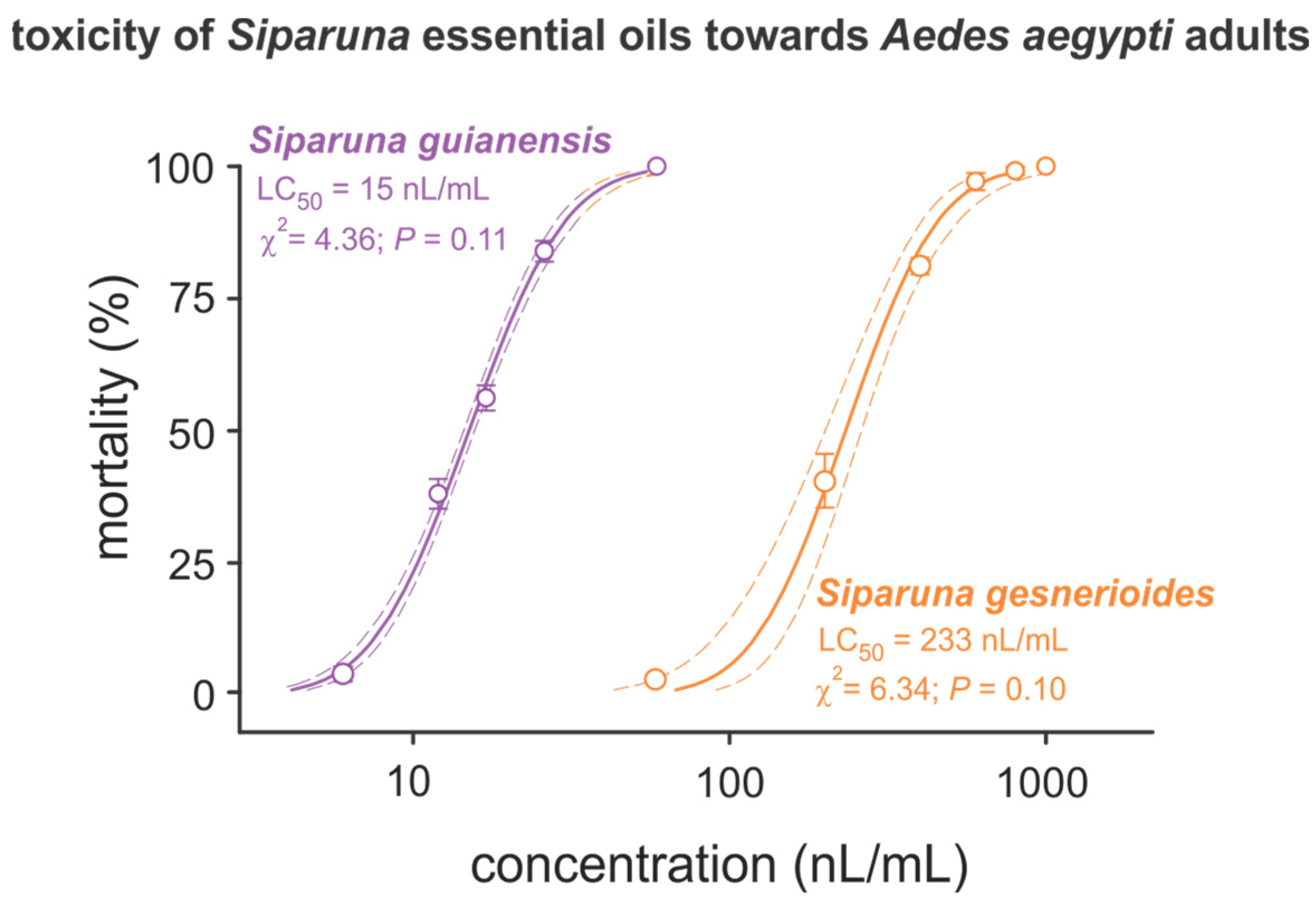
Figure 1. Adulticidal toxicity of dried residues of Siparuna guianensis and Siparuna gesnerioides essential oils against Aedes aegypti. The exposure period was 24 h. Solid lines represent mortality values estimated by the Probit model, with dotted lines indicating 95% confidence intervals. Symbols represent the mean mortality (±SEM) of four independent replicates.
Molecules 31 02098 g001
Figure 2. Susceptibility of Aedes aegypti fourth instar (L4) larvae following early-life exposure to Siparuna essential oils. Mortality was recorded in unexposed (A) larvae; larvae exposed to dimethyl sulfoxide (DMSO; 3.33 μL/mL) (B), and larvae exposed to the adulticidal LC50 (15.0 nL/mL) of S. guianensis (C) or LC50 (233.0 nL/mL) of S. gesnerioides (D) essential oils. LC10 values for early-life exposure were 7.4 nL/mL for S. guianensis essential oil (C) and 118.0 nL/mL for the essential oil of S. gesnerioides (D). Horizontal histograms represent the mean mortality (±SEM) of four independent replicates. Histograms grouped by the same horizontal lines across panels (AD) do not differ (p > 0.05) by Tukey HSD post hoc comparisons.
Molecules 31 02098 g002
Figure 3. Morphometric analysis of Aedes aegypti wings following early-life exposure to Siparuna guianensis (LC10 = 7.4 nL/mL) and Siparuna gesnerioides (LC10 = 118.0 nL/mL) essential oils. (A) Canonical Variate Analysis (CVA) of wing shape and size (left) and wing shape independent of size (right), showing the discrimination of female adults surviving early exposure to the essential oils. Each point represents an individual, with ellipses indicating 95% confidence intervals for control (black), DMSO (green), S. guianensis (purple), and S. gesnerioides (orange) groups. (B) Visual representation of wing shape variations through wireframe diagrams. Arrows emphasize specific wing regions that underwent significant deformation.
Molecules 31 02098 g003
Figure 4. Selectivity profiles of Siparuna essential oils to Apis mellifera. (A) Mortality (%) of honey bee workers after 24 h of exposure to contaminated and uncontaminated diets. The essential oil concentrations used correspond to the LC80 values (24.0 nL/mL for S. guianensis and 364.0 nL/mL for S. gesnerioides) previously estimated for Aedes aegypti. Mortality levels in essential oil-treated groups did not differ significantly from the control. Histograms grouped by the same horizontal lines do not differ (p > 0.05) by Tukey HSD post hoc comparisons (B). Diet consumption (mg/bee) when the bees were exposed to contaminated (first five exposure hours) and uncontaminated diets (the next 19 consecutive hours). Symbols represent the average diet consumption of five biological replicates. Data are presented as mean ± standard error.
Molecules 31 02098 g004
Figure 5. Molecular docking of Siparuna essential oils’ major compounds into TRPV-like ion channels of Aedes aegypti and Apis mellifera. The top panels display the 3D protein-ligand complexes for each insect species, highlighting the binding site cavities (yellow) and the spatial orientation of bicyclogermacrene (red) and α-copaene (dark blue). Insects provide a detailed view of the ligands within the receptor pockets. The bottom panels show 2D interaction diagrams for both major compounds across the two species. Intermolecular forces are categorized by color: green circles represent van der Waals interactions, while purple circles indicate alkyl or pi-alkyl bonds.
Molecules 31 02098 g005
Table 1. Chemical composition, concentrations (%), and terpene classification for the essential oil of Siparuna guianensis and Siparuna gesnerioides.
CompoundRIcalRIlitClass of CompoundSiparuna guianensisSiparuna gesnerioides
Arel (%)Arel (%)
1α-Pinene916932MH-1.11
2α-Thujene924924MH5.67-
3β-Pinene957974MH-1.81
4Limonene10111024MH-0.58
5(Z)-Tagetone11281148MO-4.22
6(E)-Tagetone11361139MO-6.16
7Verbenone12121204MO-0.81
8Undecan-2-one12741293K-1.11
9U1333--2.70-
10α-Ylangene13501373SH-0.86
11α-Copaene13591374SH8.335.66
12β-Bourbonene13681387SH6.210.74
13(E)-Caryophyllene14011417SH4.924.24
14α-Bergamotene14141411SH-7.46
15α-Himachalene14261449SH-1.41
16α-Humulene14311452SH-2.85
17U1457---5.38
18Germacrene D14631484SH25.1019.90
19β-Selinene14651489SH-1.37
20α-Acoradiene14731464SH-5.24
21α-Amorphene14781483SH-2.06
22Bicyclogermacrene14791500SH42.93-
23β-Bisabolene14871505SH-2.80
24γ-Muurolene14911478SH-3.95
25δ-Cadinene15011522SH-7.92
26U1505--4.14-
27Valencene15121496SH-1.65
28Selina-3,7(11)-diene15191545SH-3.38
29Elemol15261548SO-2.02
30Germacrene B15331559SH-1.87
31Caryophyllene oxide15581582SO-0.68
32α-Muurolol16221644SO-0.97
33β-Eudesmol16251649SO-0.31
34Guaiol16281600SO-1.48
Classes of compounds
Monoterpene hydrocarbons (MH)5.673.50
Oxygenated monoterpenes (MO)-11.19
Ketone (K)-1.11
Sesquiterpene hydrocarbons (SH)87.4970.06
Oxygenated sesquiterpenes (SO)-7.33
Total identified93.1694.62
U = unidentified; RIcal = calculated retention index; and RIlit = literature retention index [34].
Table 2. Fluctuating asymmetry (shape) by population. Results of Procrustes ANOVA performed independently for each experimental group (Control, DMSO, Siparuna guianensis essential oil; Siparuna gesnerioides essential oil). SS (Ind × Side) corresponds to the fluctuating asymmetry component; SS Total represents the total sum of squares for shape; FA Variation (%) indicates the percentage of variation attributable to fluctuating asymmetry; F (shape) corresponds to the F statistic of the Individual × Side term. All effects were statistically significant (p < 0.0001).
GroupsSS (Ind × Side)SS TotalFA Variation (%)F (Shape)p-Value
control0.01380.066720.68%73.97<0.0001
DMSO0.01400.066121.15%105.27<0.0001
Siparuna guianensis essential oil0.01650.063725.84%87.82<0.0001
Siparuna gesnerioides essential oil0.02060.081125.35%71.43<0.0001
Table 3. Mahalanobis distances and Procrustes distances between populations. Mahalanobis distances are derived from canonical variation analysis (CVA) and reflect multivariate differentiation in shape space. Procrustes distances represent absolute divergence in configuration after generalized Procrustes superimposition.
CompactionDistance of MahalanobisDistance of Procrustes
Control–DMSO1.93630.0091
Control–Siparuna guianensis essential oil1.96830.0073
Control–S. gesnerioides essential oil2.17660.0102
DMSO–S. guianensis essential oil1.84800.0089
DMSO–S. gesnerioides essential oil1.50890.0079
Siparuna guianensis essential oil–S. gesnerioides essential oil1.63960.0072
Table 4. Repeated measures analysis of variance for mortality and dietary intake of Apis mellifera exposed to essential oil of Siparuna guianensis (24.0 nL/mL) and Siparuna gesnerioides (364.0 nL/mL).
Sources of VariationDiet ConsumptionMortality
dfFPFP
Between samples
Essential oils (ET)20.430.662.280.16
Error9----
dfden/dfnumWilks’ lambdaFapproxPWilks’ lambdaFapproxP
Within Samples
Time (T)9/10.85311.550.250.98610.130.73
ET x T 9/20.75411.470.280.70341.900.20
Disclaimer/Publisher’s Note: The statements, opinions and data contained in all publications are solely those of the individual author(s) and contributor(s) and not of MDPI and/or the editor(s). MDPI and/or the editor(s) disclaim responsibility for any injury to people or property resulting from any ideas, methods, instructions or products referred to in the content.