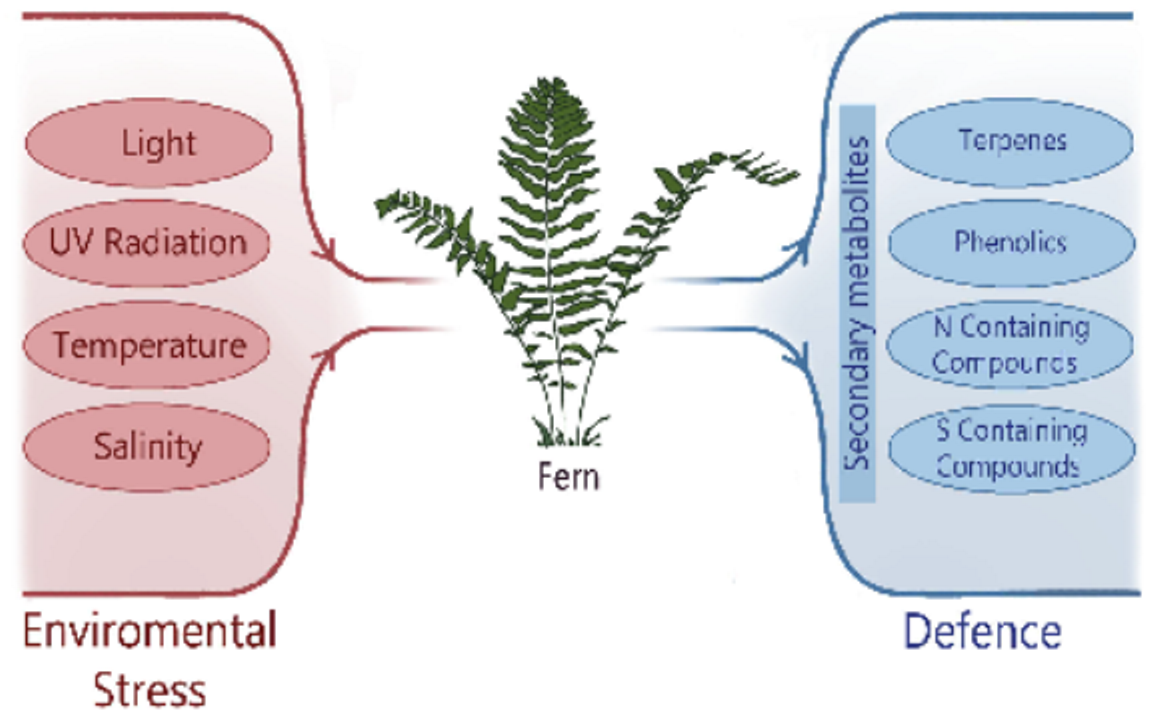
Unique Bioactive Secondary Metabolites of Ferns and Their Enhancement by Abiotic Stress: Medicinal Potential and Future Perspectives


Abstract
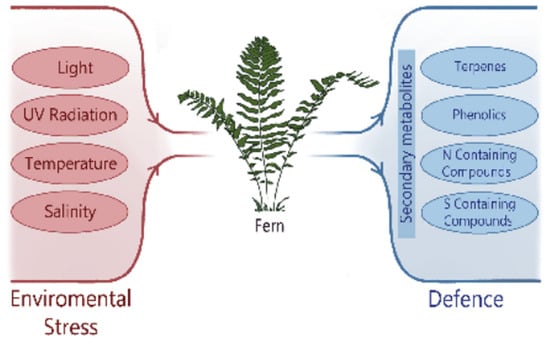
1. Introduction
2. Literature Search and Selection
3. Secondary Metabolites in Ferns

| No. | Compound | Species | Activity | Mode of Action | References |
|---|---|---|---|---|---|
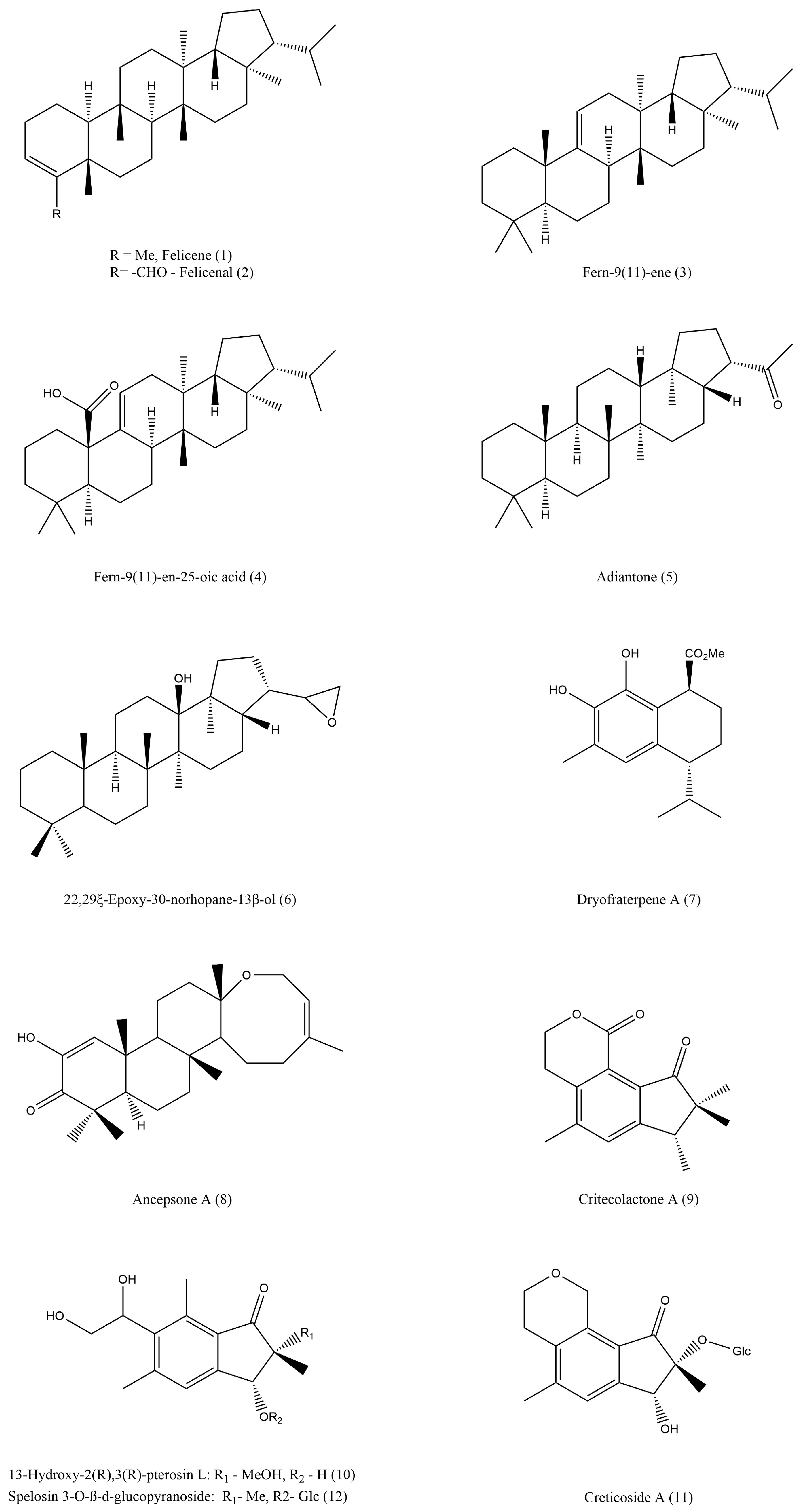
| Terpenes and terpene glycosides | |||||
| 1 | Filicene | Adiantum cuneatum | Analgesic | No data available | [33] |
| 2 | Filicenal | Adiantum cuneatum | Analgesic | No data available | [33] |
| 3 | fern-9(11)-ene | Adiantum lunulatum | Antibacterial | No data available | [30] |
| 4 | fern-9(11)-en-25-oic acid | Adiantum lunulatum | Antibacterial | No data available | [30] |
| 5 | Adiantone | Adiantum lunulatum | Antibacterial | No data available | [30] |
| 6 | 22,29ξ-epoxy-30-norhopane-13β-ol | Adiantum lunulatum | Antibacterial | No data available | [30] |
| 7 | Dryofraterpene A | Dryopteris fragrans (L.) Schott | Anticancer | No data available | [34] |
| 8 | Ancepsone A | Aleuritopteris anceps | Anticancer activity | No data available | [35] |
| 9 | Creticolacton A | Pteris cretica | Exhibit cytotoxicity against colon cancer cell line | No data available | [36] |
| 10 | 13-hydroxy-2(R),3(R)-pterosin L | Pteris cretica | No data available | [36] | |
| 11 | Creticoside A | Pteris cretica | No data available | [36] | |
| 12 | Spelosin 3-O-β-d-glucopyranoside | Pteris cretica | No data available | [36] | |
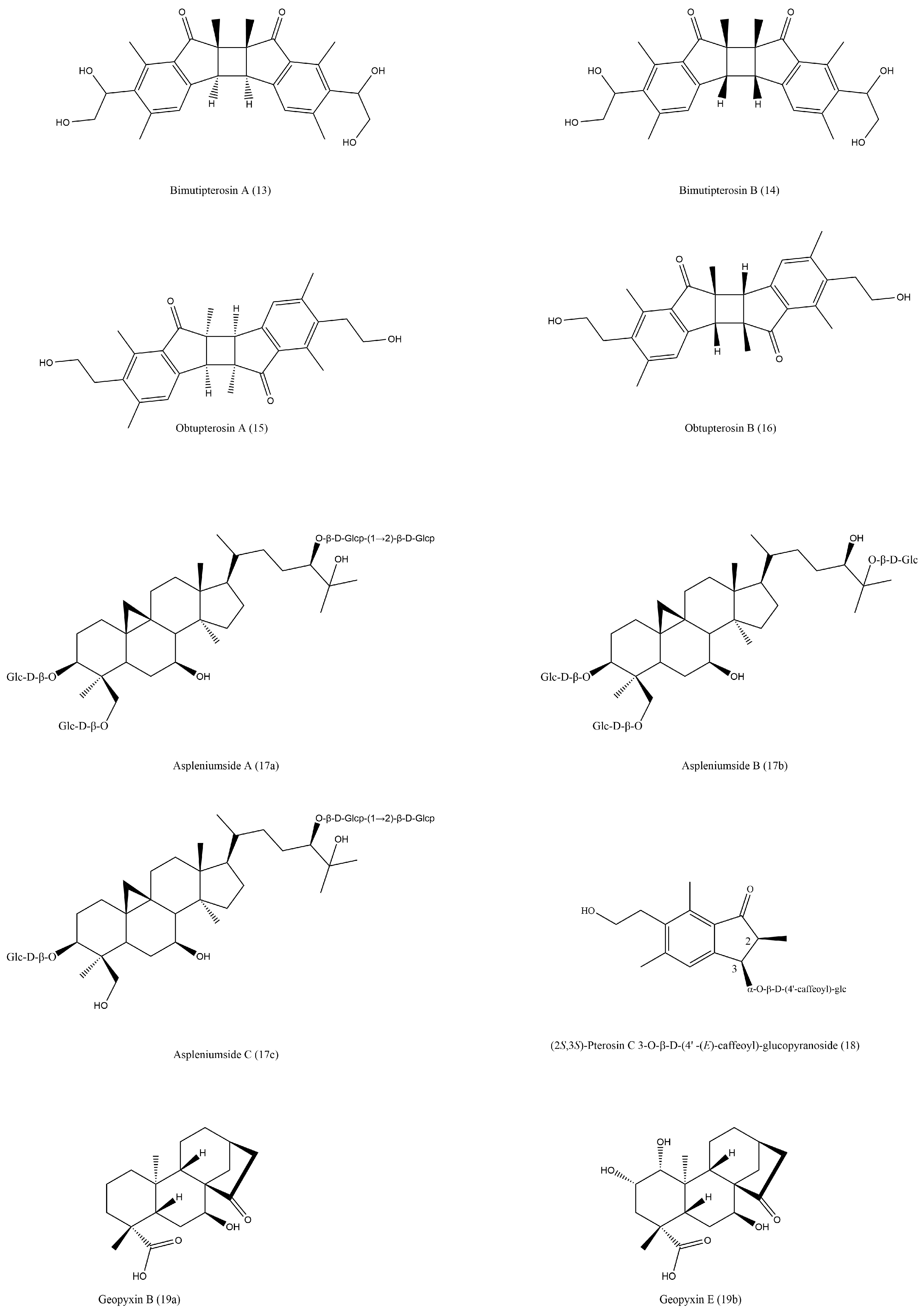
| 13 | Bimutipterosin A | Pteris mutifida Poir | Cytotoxicity against human leucocythemia carcinoma HL-60 cells | No data available | [37] |
| 14 | Bimutipterosin B | Pteris mutifida Poir | Cytotoxicity against human leucocythemia carcinoma HL-60 cells | No data available | [37] |
| 15 | Obtupterosin A-C | Pteris obtusiloba | Cytotoxic activity against cancer cell line | No data available | [38] |
| 16 | Decrescensin A | Pteris decrescens | Cytotoxic activity against cancer cell line | No data available | [39] |
| 17 | Aspleniumside A-C | Asplenium ruprechtii Sa. Kurata | Cytotoxic activity against cancer cell line | No data available | [40] |
| 18 | (2S,3S)-pterosin C 3-O-b-D-(4′-(E)-caffeoyl)-glucopyranoside | Pteris multifida | Cytotoxic activity against cancer cell | Upregulates pro-apoptotic proteins-caspase-9 and procaspase-9 | [41] |
| 19 | Geopyxin B&E | Pteris dispar | Anti-tumor activity | [42] | |
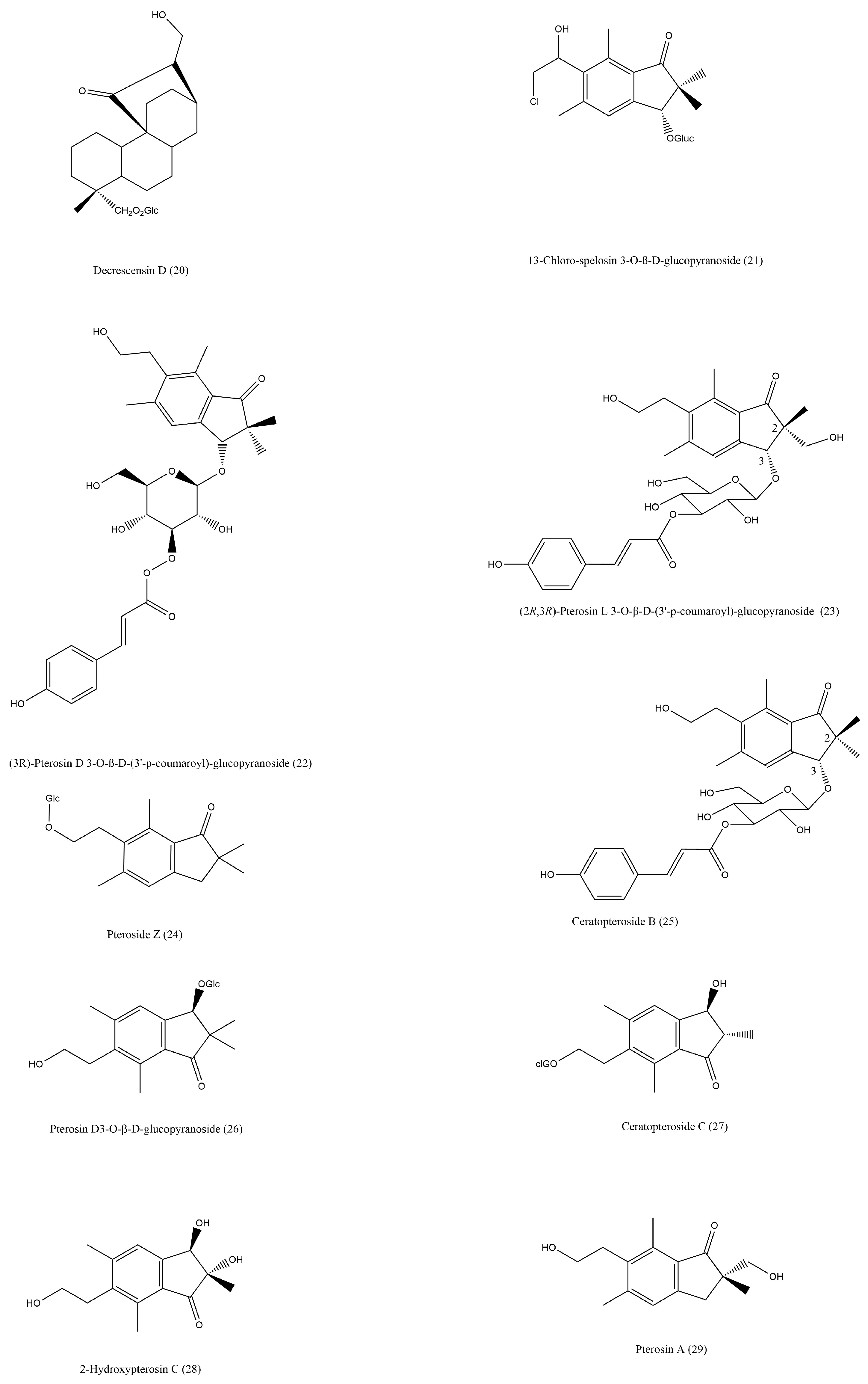
| 20 | Decrescensin D | Pteris decrescens | Anticoagulative activity | No data available | [39] |
| 21 | 13-chloro-spelosin 3-O-β-d-glucopyranoside | Ceratopteris thalictroides, Hypolepis punctata, Nephrolepis multiflora, and Pteridium revolutum | Antidiabetic | No data available | [43] |
| 22 | (3R)-Pterosin D 3-O-β-d-(3′-p-coumaroyl)-glucopyranoside | Ceratopteris thalictroides, Hypolepis punctata, Nephrolepis multiflora, and Pteridium revolutum | Antidiabetic | No data available | [43] |
| 23 | (2R,3R)-Pterosin L 3-O-β-d-(3′-p-coumaroyl)-glucopyranoside | Ceratopteris thalictroides, Hypolepis punctata, Nephrolepis multiflora, and Pteridium revolutum | Antidiabetic | No data available | [43] |
| 24 | Pteroside Z | Dennstaedtia scandens, Histiopteris incisa, Microlepia speluncae, Pteridium aquilinum var. latiusculum, Pteridium revolutum, Hypolepis punctata, Cer atopteris thalictroides, Pteris fauriei, Pteris dimidiata, and Pteris ensiformis. | Antidiabetic activity | No data available | [44] |
| 25 | Ceratopteroside B | ||||
| 26 | Pterosin D3-O-B-D-glucopyranoside | ||||
| 27 | Ceratopteroside C | ||||
| 28 | 2-Hydroxypterosin C | ||||
| 29 | Pterosin A | ||||
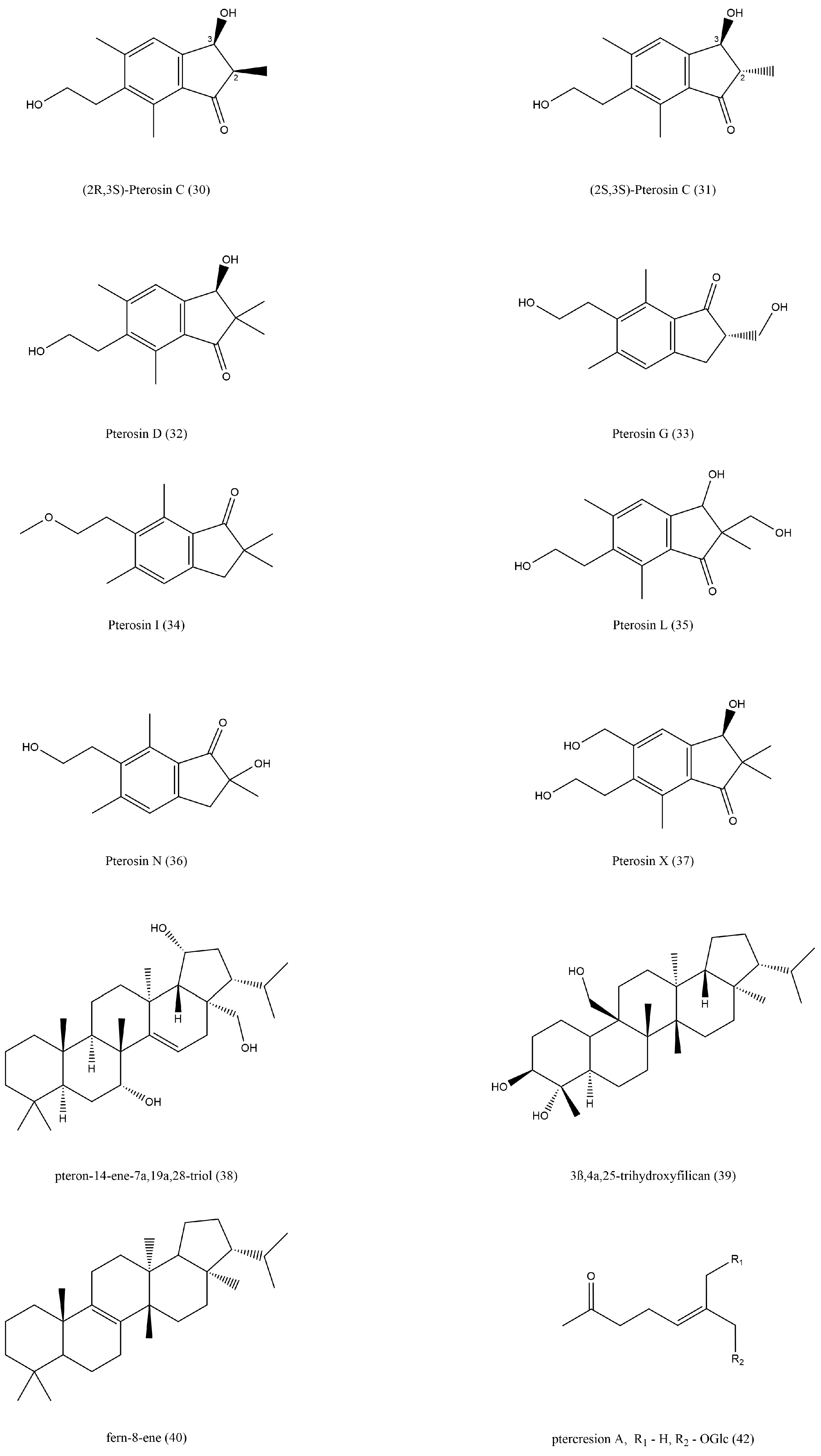
| 30 | (2R,3S)-Pterosin C | ||||
| 31 | (2S,3S)-Pterosin C | ||||
| 32 | Pterosin D | ||||
| 33 | Pterosin G | ||||
| 34 | Pterosin I | ||||
| 35 | Pterosin L | ||||
| 36 | Pterosin N | ||||
| 37 | Pterosin X | ||||
| 38 | pteron-14-ene-7α,19α,28-triol | Adiantum capillus-veneris | Antifungal activity | No data available | [45] |
| 39 | 3β,4α,25-trihydroxyfilican | Adiantum capillus-veneris | Antifungal activity | No data available | [45] |
| 40 | fern-8-ene | Blechnum orientale, Dicranopteris linearis (Burm.f) Underw., Marattia fraxinea Sm., and Microlepia speluncae (L.) Moore * | Antitrematodal activity | No data available | [31] |
| 41 | fern-9(11)-ene | Blechnum orientale, Dicranopteris linearis (Burm.f) Underw., Marattia fraxinea Sm., and Microlepia speluncae (L.) Moore | Antitrematodal activity | No data available | [31] |
| 42 | Ptercresion A | Pteris cretica L. | Hepatoprotective | No data available | [46] |
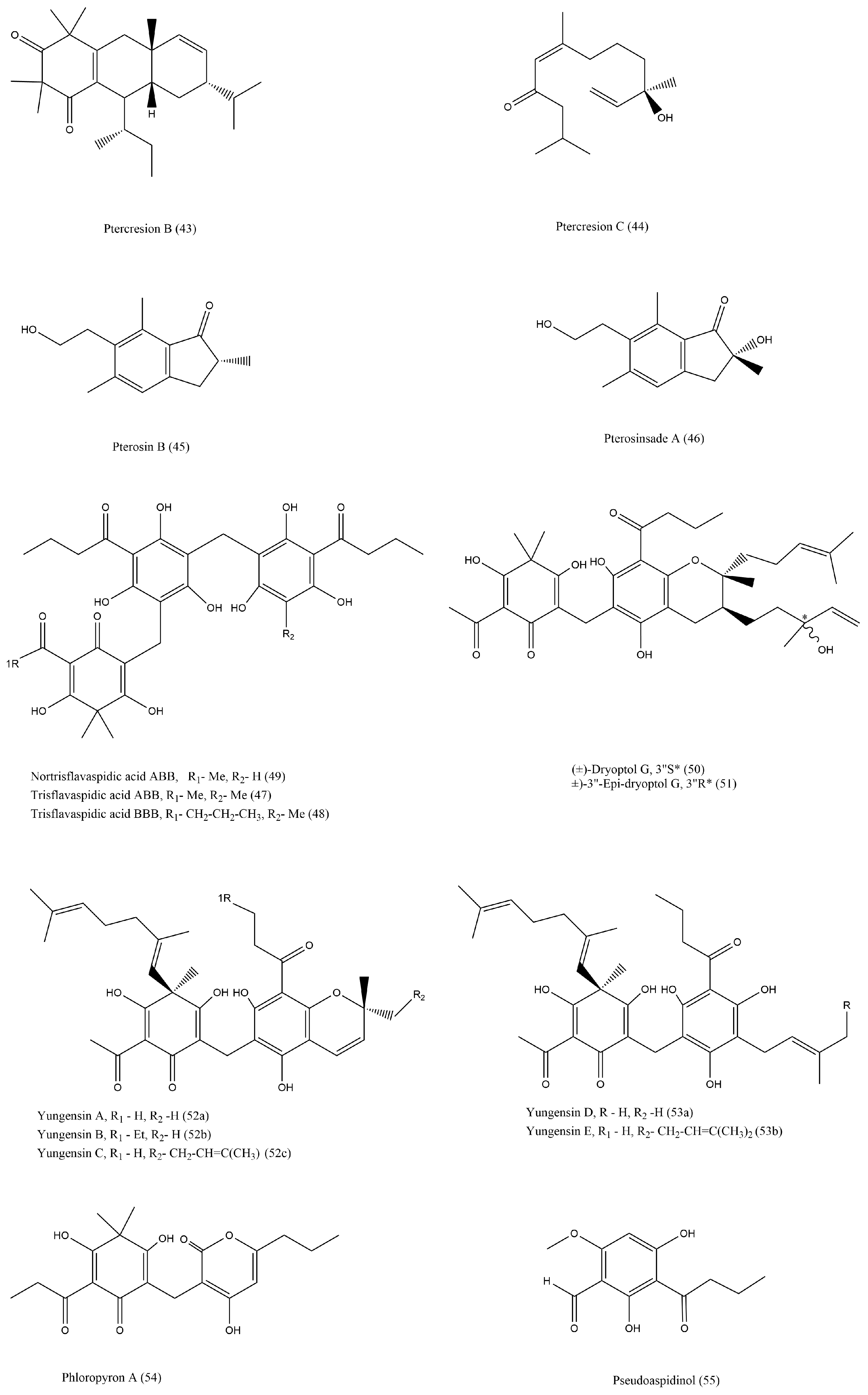
| 43 | Ptercresion B | Pteris cretica L. | Hepatoprotective | No data available | [46] |
| 44 | Ptercresion C | Pteris cretica L. | Hepatoprotective | No data available | [46] |
| 45 | Pterosin B | Pteris laeta Wall. ex Ettingsh. | Neuroprotective activity | Targets the downstream mitochondrial signals; upregulates the expression of nuclear factor-erythroid factor 2-related factor 2 (NRF2) and heme oxygenase-1 (HO-1) | [47] |
| 46 | Pterosinsade A | Pteris laeta Wall. | Neuroprotective activity | Reduces apoptosis of amyloid precursor protein (APP)-overexpressing neural stem cells; promotes their proliferation and neuronal differentiation; promotes hippocampal neurogenesis, associated with activating the Wnt signaling pathway | [48] |
| Phloroglucinol derivatives | |||||
| 47 | Trisflavaspidic acid ABB | Dryopteris crassirhizoma | Antidiabetic activity | Competitive inhibitor against PTP1B enzyme | [49] |
| 48 | Trisflavaspidic acid BBB | Dryopteris crassirhizoma | Antidiabetic activity | Competitive inhibitor against PTP1B enzyme | [49] |
| 49 | Nortrisflavaspidic acid ABB | Dryopteris crassirhizoma | Antidiabetic activity | Competitive inhibitor against PTP1B enzyme | [49] |
| 50 | (±)-Dryoptol G | Dryopteris crassirhizoma Nakai | Anti-inflammatory | Blocks the formation of inflammasome (suppresses the expression of IL-1β and IL-18; inhibits the expression of NLRP3 and cleaved caspase-1) | [50] |
| 51 | (±)-3″-Epi-dryoptol G | Dryopteris crassirhizoma Nakai | Anti-inflammatory | Blocks the formation of inflammasome (suppresses the expression of IL-1β and IL-18; inhibits the expression of NLRP3 and cleaved caspase-1) | [50] |
| 52 | Yungensins A–E | Elaphoglossum yungense | Antibacterial activity | No data available | [51] |
| 53 | Lindbergins A–D | Elaphoglossum lindbergii (Mett. ex Kuhn) Rosenst. | Antibacterial activity | No data available | [52] |
| 54 | Phloropyron A | Dryopteris championii | Antibacterial activity | No data available | [53] |
| 55 | Pseudoaspidinol A | Dryopteris championii | Antibacterial activity | No data available | [53] |
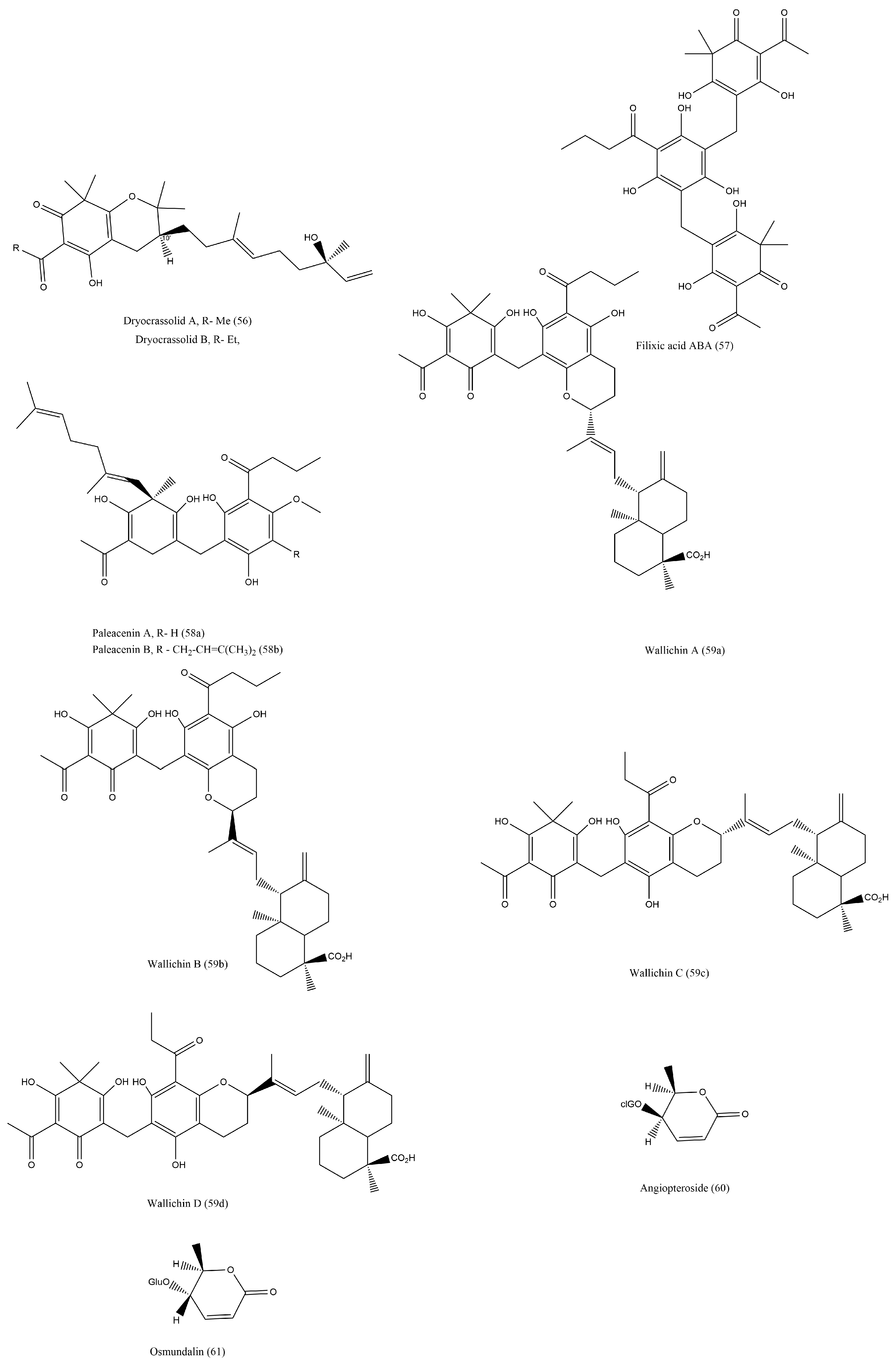
| 56 | Dryocrassoid A–J | Dryopteris crassirhizoma Nakai | Antiviral activity | No data available | [54] |
| 57 | Filixic acid ABA | Dryopteris crassirhizoma Nakai | Antiviral activity | No data available | [50] |
| 58 | Paleacenins A&B | Elaphoglossum paleaceum (Hook. & Grev.) Sledge | Cytotoxic activity against cancer cell line | No data available | [55] |
| 59 | Wallichins A–D | Dryopteris wallichiana (Spreng.) Hyl. | Nematocidal activity | No data available | [56] |
| δ-Lactone Glycosides | |||||
| 60 | Angiopteroside | Angiopteris helferiana C.Presl, Angiopteris evecta Hoffm. | Anti-adipogenic and cytotoxicity against lung cancer cell | No data available | [57,58] |
| 61 | Osmundalin | Todea Barbara (L.) T. Moore, Osmunda japonica Thunb., Angiopteris caudatiformis | Antifeedant | Activation of R receptor cells | [59,60] |
| Flavonoids and flavonoid glycosides | |||||
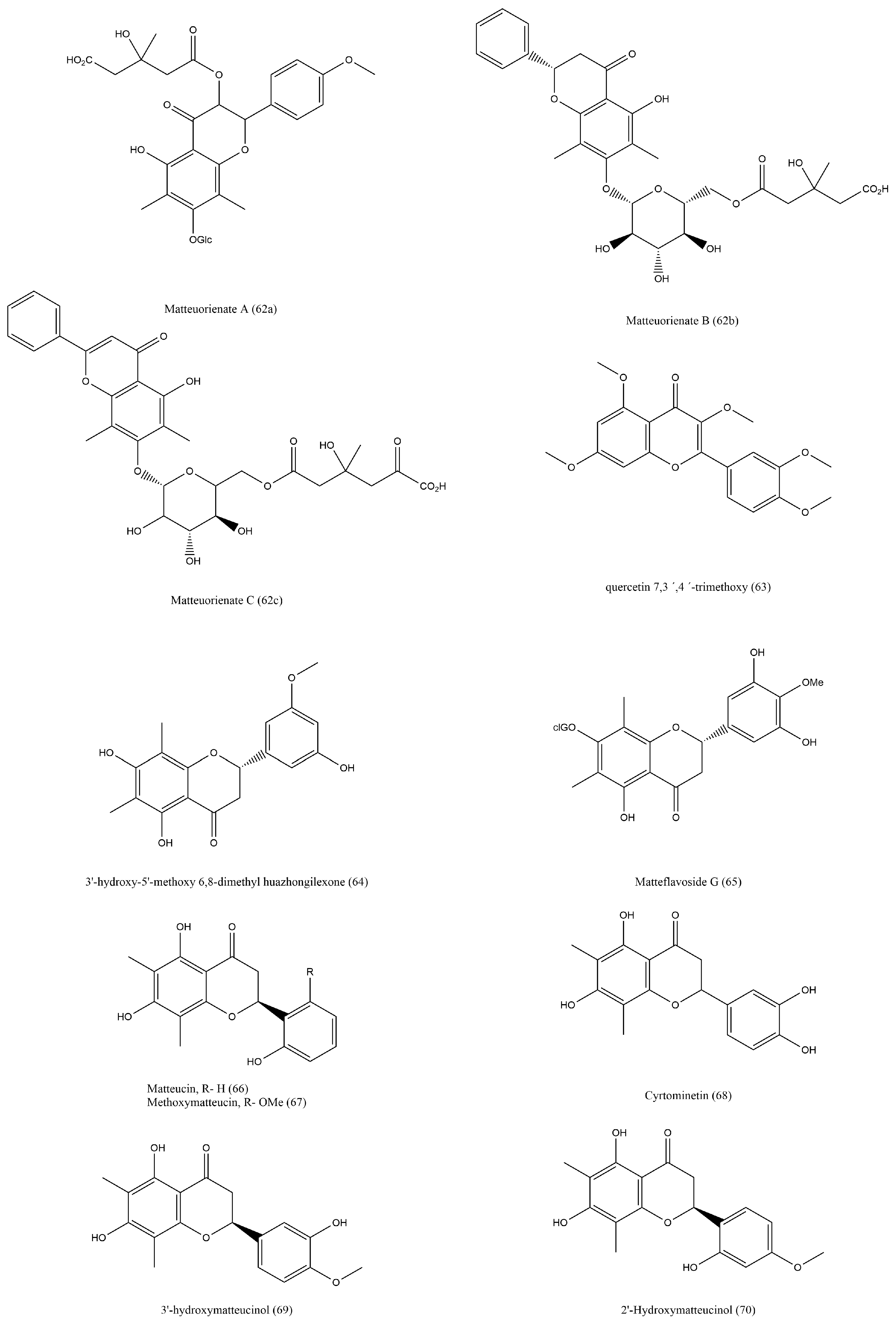
| 62 | Matteuorienates A–C | Matteuccia orientalis Trev. | Aldose reductase inhibition | No data available | [61] |
| 63 | Quercetin 7,3′,4′-trimethoxy | Blechnum orientale, Dicranopteris linearis (Burm.f) Underw., Marattia fraxinea Sm., and Microlepia speluncae (L.) Moore | Antitrematodal activity | No data available | [31] |
| 64 | 3′-Hydroxy-5′-methoxy 6,8-dimethyl huazhongilexone | Pentarhizidium orientale (Hook.) Hayata | Antiviral activity | Neuraminidase (NA) inhibition of H1N1 influenza virus | [62] |
| 65 | Matteflavoside G | Matteuccia struthiopteris (L.) Todar | Antiviral activity | Neuraminidase (NA) inhibition of H1N1 influenza virus | [63] |
| 66 | Matteucin | Pentarhizidium orientale (Hook.) Hayata; Matteuccia intermedia C.Chr | Antiviral activity and hypoglycemic effect | Neuraminidase (NA) inhibition of H1N1 influenza virus and α-Glucosidase inhibitory activity | [62,64] |
| 67 | Methoxymatteucin | Pentarhizidium orientale (Hook.) Hayata; Matteuccia intermedia C.Chr | Antiviral activity and hypoglycemic activity | Neuraminidase (NA) inhibition of H1N1 influenza virus and α-Glucosidase inhibitory activity | [62,64] |
| 68 | Cyrtominetin | Matteuccia intermedia C.Chr | Hypoglycemic activity | α-Glucosidase inhibitory activity | [64] |
| 69 | 3′-hydroxymatteucinol | Matteuccia intermedia C.Chr | Hypoglycemic activity | α-Glucosidase inhibitory activity | [64] |
| 70 | 2′-hydroxymatteucinol | Matteuccia orientalis Trev. | Hypoglycemic activity | No data available | [65] |
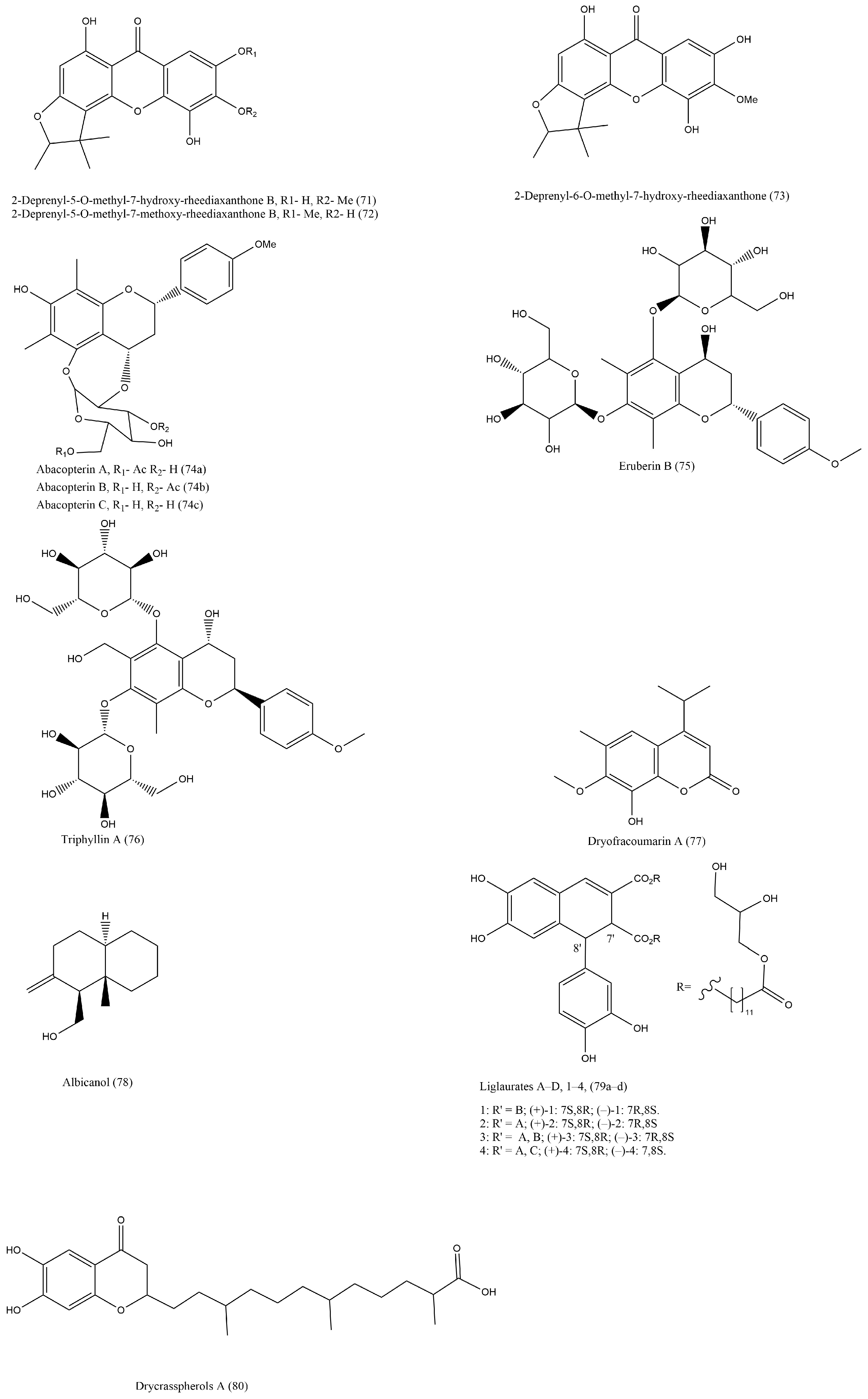
| 71 | 2-deprenyl-5-O-methyl-7-hydroxy-rheediaxanthone B | Metaxya rostrata (Kunth) C. Presl | Cytotoxic activity against cancer cell line | No data available | [66] |
| 72 | 2-deprenyl-5-O-methyl-7- methoxy-rheediaxanthone B | Metaxya rostrata (Kunth) C. Presl | Cytotoxic activity against cancer cell line | No data available | [66] |
| 73 | 2-deprenyl-6-O-methyl-7-hydroxy-rheediaxanthone B | Metaxya rostrata (Kunth) C. Presl | Cytotoxic activity against cancer cell line | No data available | [66] |
| 74 | Abacopterins A and C | Pronephrium penangianum (Hook.) Holtt | Cytotoxic activity against tumor cell line | No data available | [67] |
| 75 | Eruberin B | Pronephrium penangianum (Hook.) Holtt | Cytotoxic activity against tumor cell line | No data available | [67] |
| 76 | Triphyllin A | Pronephrium penangianum (Hook.) Holtt | Cytotoxic activity against tumor cell line | No data available | [67] |
| Other Phenolic | |||||
| 77 | Dryofracoumarin A | Dryopteris fragrans (L.) Schott | Anticancer activity | No data available | [68] |
| 78 | Albicanol | Dryopteris fragrans (L.) Schott | Anti-tumor activity | No data available | [69] |
| 79 | Liglaurates A–D | Drynaria roosii Nakaike | Cytotoxic activity against tumor cell line | No data available | [70] |
| 80 | Drycrasspherols A | Dryopteris crassirhizoma Nakai | Antiviral activity | No data available | [71] |
| 81 | Cibotiumbaroside D | Cibotium barometz (L.) J. Sm. | Hepatoprotective activity | No data available | [72] |
| Sr. No. | Family | Species | Traditional Medicinal Use | References | |
|---|---|---|---|---|---|
| 1 | Aspleniaceae | Asplenium ruprechtii | Hemiplegia, promote blood circulation, uterine bleeding, traumatic bleeding, anti-inflammatory, and hemostasis | Northern Provinces of China | [73,74] |
| 2 | Blechnaceae | Blechnum orientale | Boils, reproductive control agent, antihelmintic, typhoid, intestinal worms, and bladder complaints | Kadazan/Dusun communities in Sabah, Malaysia; Papua New Guinea | [75,76,77] |
| 3 | Dennstaedtiaceae | Hypolepis punctata | Infection, digestive disorders | Traditional Chinese Medicine | [78] |
| Pteridium revolutum | Antipyretic and insect repellent | Traditional Chinese Medicine | [79] | ||
| Pteridium aquilinum | Antibacterial, diuretic | Kosovar, Albanian Alps | [80] | ||
| 4 | Dryopteridaceae | Dryopteris championii | Cold, asthma, hemafecia, dysmenorrhea | Traditional Chinese Medicine | [53] |
| Dryopteris crassirhizoma | Tapeworm infestation and mumps | Traditional Korean Herbal Medicines | [81] | ||
| Dryopteris fragrans | Psoriasis, arthritis, rash, dermatitis, barbiers, antimicrobial, and anticancer | Traditional Chinese Medicine | [82] | ||
| 5 | Gleicheniaceae | Dicranopteris linearis | Fever, asthma, external wound, and ulcers | Traditional Chinese Medicine | [83] |
| 6 | Marattiaceae | Angiopteris helferiana | Scabies | China, India (Ayurveda), Nepal | [84] |
| Angiopteris evecta | Snake bite, diuretic, antipyretic, analgesic, and antidiarrheal | ‘Tangsa’ an ethnic Sino-Burmese community, Arunachal Pradesh, India | [58,85] | ||
| 7 | Metaxyaceae | Metaxya rostrata | Gastrointestinal disorders | Corcovado Parque National in Costa Rica | [86,87] |
| 8 | Onocleaceae | Matteuccia orientalis | Hemostasis and relieving ostalgia | Traditional Chinese Medicine | [88] |
| Pentarhizidium orientale (Synonymous with Matteuccia orientalis) | Diuretic and helminthic | Korean Folk Medicine | [62] | ||
| Matteuccia struthiopteris | Dysentery and prevention of influenza | Traditional Chinese Medicine | [63] | ||
| 9 | Osmundaceae | Osmunda japonica | Antiviral, antiherpetic, hemostasis, and pesticidal | Traditional Chinese Medicine | [89] |
| 10 | Pteridaceae | Adiantum capillus-veneris | Astringent, expectorant, emmenagogue, catarrhal and menstrual problems, cough, cold, and bronchial diseases | Ayurveda (traditional medicine system of India), Italy, Peru, Palestine, Pakistan, Portugal, Spain, Greece, and China | [77,90] |
| Adiantum cuneatum | Diuretic, expectorant, emollient, used for coughs, urinary disorders, alopecia, and menstrual difficulties | Argentina, Peru (Quechua speaking communities in Ancash region), Brazil (Atlantic Forest region) | [33,90] | ||
| Adiantum lunulatum | Snake bite, bronchitis, and asthma | Ethnomedicine of Garhwal Region, Uttarakhand, India | [82] | ||
| Pteris cretica | Jaundice, hepatitis, enteritis, bacillary dysentery, turbid conditions, vomiting, bleeding, hematochezia, hematuria, tonsillitis, mumps, carbuncle, and eczema | Traditional Chinese Medicine | [91,92] | ||
| Pteris decrescens | Enteritis, jaundice, hepatitis, bloated sores, and epistaxis | Miao Traditional Medicine | [39] | ||
| Pteris laeta | Inflammation, dysentery, relaxing tendons and activating collaterals, promoting the union of fracture healing, and relieving spasms, rheumatism, chronic hepatitis, dysentery, and nervous system diseases | Miao Medicine | [47] | ||
| Pteris mutifida | Tonsillitis, parotitis hepatitis, eczema, hematemesis, enteritis, and diarrhea | Traditional Chinese Medicine | [92,93] | ||
| 11 | Thelypteridaceae | Pronephrium penangianum | Rheumatoid arthritis, strain injury, traumatic injury upper respiratory tract infections, dysentery, and edema | Tujia Ethnomedicine | [67] |
4. Influence of Abiotic Stress Factors on Secondary Metabolite Production in Ferns
4.1. Light
4.1.1. Light Spectrum
4.1.2. UV Radiation
4.2. Temperature
4.3. Drought
4.4. Nutrients
4.5. NaCl Concentration
4.6. Interactive Effects of Combined Abiotic Stresses on Secondary Metabolite Production, Hormone Regulation, and the Role of ROS and Ca2+ Signaling
5. Future Scope and Conclusions
Author Contributions
Funding
Data Availability Statement
Conflicts of Interest
References
- Kopecká, R.; Kameniarová, M.; Černý, M.; Brzobohatý, B.; Novák, J. Abiotic Stress in Crop Production. Int. J. Mol. Sci. 2023, 24, 6603. [Google Scholar] [CrossRef]
- Imran, Q.M.; Falak, N.; Hussain, A.; Mun, B.G.; Yun, B.W. Abiotic Stress in Plants, Stress Perception to Molecular Response and Role of Biotechnological Tools in Stress Resistance. Agronomy 2021, 11, 1579. [Google Scholar] [CrossRef]
- Zhang, H.; Zhu, J.; Gong, Z.; Zhu, J.K. Abiotic Stress Responses in Plants. Nat. Rev. Genet. 2022, 23, 104–119. [Google Scholar] [CrossRef]
- Brazaitytė, A.; Viršilė, A.; Samuolienė, G.; Vaštakaitė-Kairienė, V.; Jankauskienė, J.; Miliauskienė, J.; Novičkovas, A.; Duchovskis, P. Response of Mustard Microgreens to Different Wavelengths and Durations of UV-A LEDs. Front. Plant Sci. 2019, 10, 1153. [Google Scholar] [CrossRef]
- Li, X.; Zhang, L.; Ahammed, G.J.; Li, Z.X.; Wei, J.P.; Shen, C.; Yan, P.; Zhang, L.P.; Han, W.Y. Stimulation in Primary and Secondary Metabolism by Elevated Carbon Dioxide Alters Green Tea Quality in Camellia sinensis L. Sci. Rep. 2017, 7, 7937. [Google Scholar] [CrossRef] [PubMed]
- Jochum, G.M.; Mudge, K.W.; Thomas, R.B. Elevated Temperatures Increase Leaf Senescence and Root Secondary Metabolite Concentrations in the Understory Herb Panax quinquefolius (Araliaceae). Am. J. Bot. 2007, 94, 819–826. [Google Scholar] [CrossRef]
- Cao, H.; Chai, T.T.; Wang, X.; Morais-Braga, M.F.B.; Yang, J.H.; Wong, F.C.; Wang, R.; Yao, H.; Cao, J.; Cornara, L.; et al. Phytochemicals from Fern Species: Potential for Medicine Applications. Phytochem. Rev. 2017, 16, 379–440. [Google Scholar] [CrossRef]
- Yeshi, K.; Crayn, D.; Ritmejerytė, E.; Wangchuk, P. Plant Secondary Metabolites Produced in Response to Abiotic Stresses Has Potential Application in Pharmaceutical Product Development. Molecules 2022, 27, 313. [Google Scholar] [CrossRef] [PubMed]
- Bánki, O.; Roskov, Y.; Döring, M.; Ower, G.; Hernández-Robles, D.R.; Plata-Corredor, C.A.; Stjernegaard Jeppesen, T.; Örn, A.; Pape, T.; Hobern, D.; et al. Catalogue of Life (Version 2025-05-13). Available online: https://www.checklistbank.org/dataset/309796/metadata (accessed on 25 May 2025).
- Mehltreter, K. Diversity of Ferns and Lycophytes at Different Spatial Scales, along Environmental Gradients, and in the Anthropogenic Landscape. In Ferns: Biotechnology, Propagation, Medicinal Uses and Environmental Regulation; Marimuthu, J., Fernández, H., Kumar, A., Thangaiah, S., Eds.; Springer Nature: Singapore, 2022; pp. 603–625. [Google Scholar] [CrossRef]
- Krishnan, A.; K., R. Diversity of Pteridophytes in Western Ghats—A Review. Plant Arch. 2021, 21, 1115–1129. [Google Scholar] [CrossRef]
- Funk, J.L.; Amatangelo, K.L. Physiological Mechanisms Drive Differing Foliar Calcium Content in Ferns and Angiosperms. Oecologia 2013, 173, 23–32. [Google Scholar] [CrossRef]
- Brodribb, T.J.; Feild, T.S.; Jordan, G.J. Leaf Maximum Photosynthetic Rate and Venation Are Linked by Hydraulics. Plant Physiol. 2007, 144, 1890–1898. [Google Scholar] [CrossRef]
- Brodersen, C.R.; Roark, L.C.; Pittermann, J. The Physiological Implications of Primary Xylem Organization in Two Ferns. Plant Cell Environ. 2012, 35, 1898–1911. [Google Scholar] [CrossRef]
- Boyce, C.K.; Brodribb, T.J.; Feild, T.S.; Zwieniecki, M.A. Angiosperm Leaf Vein Evolution Was Physiologically and Environmentally Transformative. Proc. R. Soc. B Biol. Sci. 2009, 276, 1771–1776. [Google Scholar] [CrossRef]
- Cândido-Sobrinho, S.A.; Lima, V.F.; Freire, F.B.S.; de Souza, L.P.; Gago, J.; Fernie, A.R.; Daloso, D.M. Metabolism-Mediated Mechanisms Underpin the Differential Stomatal Speediness Regulation among Ferns and Angiosperms. Plant Cell Environ. 2022, 45, 296–311. [Google Scholar] [CrossRef] [PubMed]
- Lima, V.F.; Anjos, L.d.; Medeiros, D.B.; Cândido-Sobrinho, S.A.; Souza, L.P.; Gago, J.; Fernie, A.R.; Daloso, D.M. The Sucrose-to-Malate Ratio Correlates with the Faster CO2 and Light Stomatal Responses of Angiosperms Compared to Ferns. New Phytol. 2019, 223, 1873–1887. [Google Scholar] [CrossRef]
- Büntgen, U.; Tegel, W.; Nicolussi, K.; McCormick, M.; Frank, D.; Trouet, V.; Kaplan, J.O.; Herzig, F.; Heussner, K.U.; Wanner, H.; et al. 2500 Years of European Climate Variability and Human Susceptibility. Science 2011, 31, 578–582. [Google Scholar] [CrossRef] [PubMed]
- Salachna, P.; Piechocki, R. Salinity Tolerance of Four Hardy Ferns from the Genus Dryopteris Adans. Grown under Different Light Conditions. Agronomy 2021, 11, 49. [Google Scholar] [CrossRef]
- Lima, V.F.; Gago, J.; Aranjuelo, I.; Brotman, Y.; Burgos, A.; Carriquí, M.; Fernie, A.R.; Figueroa, C.M.; Irigoyen, J.J.; Jáuregui, I.; et al. The Fern Nephrolepis exaltata is Largely Unresponsive to Climate Change Conditions at Both Physiological and Metabolic Levels. Plant J. 2025, 123, e70397. [Google Scholar] [CrossRef]
- Piatkowski, B.T.; Imwattana, K.; Tripp, E.A.; Weston, D.J.; Healey, A.; Schmutz, J.; Shaw, A.J. Phylogenomics Reveals Convergent Evolution of Red-Violet Coloration in Land Plants and the Origins of the Anthocyanin Biosynthetic Pathway. Mol. Phylogenet. Evol. 2020, 151, 106904. [Google Scholar] [CrossRef]
- Ali, Z.M.; Tan, Q.W.; Lim, P.K.; Chen, H.; Pfeifer, L.; Julca, I.; Lee, J.M.; Classen, B.; de Vries, S.; de Vries, J.; et al. Comparative Transcriptomics in Ferns Reveals Key Innovations and Divergent Evolution of the Secondary Cell Walls. Nat. Plants 2025, 11, 1028–1048. [Google Scholar] [CrossRef]
- Espinosa-Leal, C.A.; Mora-Vásquez, S.; Puente-Garza, C.A.; Alvarez-Sosa, D.S.; García-Lara, S. Recent Advances on the Use of Abiotic Stress (Water, UV Radiation, Atmospheric Gases, and Temperature Stress) for the Enhanced Production of Secondary Metabolites on in Vitro Plant Tissue Culture. Plant Growth Regul. 2022, 97, 1–20. [Google Scholar] [CrossRef]
- Jan, R.; Asaf, S.; Numan, M.; Lubna; Kim, K.M. Plant Secondary Metabolite Biosynthesis and Transcriptional Regulation in Response to Biotic and Abiotic Stress Conditions. Agronomy 2021, 11, 968. [Google Scholar] [CrossRef]
- Bandyopadhyay, A.; Dey, A. Medicinal Pteridophytes: Ethnopharmacological, Phytochemical, and Clinical Attributes. Beni. Suef. Univ. J. Basic Appl. Sci. 2022, 11, 113. [Google Scholar] [CrossRef]
- Lima, G.P.; Santos, M.G.; de Paiva, S.R. Terpenoid Composition of Fern and Lycophyte Essential Oils: A Chemosystematic Approach. N. Z. J. Bot. 2024, 63, 2853–2876. [Google Scholar] [CrossRef]
- Moussa, A.Y.; Luo, J.; Xu, B. Insights into Chemical Diversity and Potential Health-Promoting Effects of Ferns. Plants 2024, 13, 2668. [Google Scholar] [CrossRef]
- Viral, D.; Shivanand, P.; Jivani, N.P. Anticancer Evaluation of Adiantum venustum Don. J. Young Pharm. 2011, 3, 48–54. [Google Scholar] [CrossRef]
- Kumar, V.; Charde, V.; Prasad, S.B.; Gandhi, Y.; Mishra, S.K.; Rawat, H.; Thakur, A.; Shakya, S.K.; Ansari, T.; Babu, G.; et al. Therapeutic Potential of Evergreen Maiden Hair Fern Adiantum venustum D. Don: A Comprehensive Review. Food Chem. Adv. 2023, 3, 100439. [Google Scholar] [CrossRef]
- Niranjan Reddy, V.L.; Ravikanth, V.; Prabhakar Rao, T.; Diwan, P.V.; Venkateswarlu, Y. A New Triterpenoid from the Fern Adiantum lunulatum and Evaluation of Antibacterial Activity. Phytochemistry 2001, 56, 173–175. [Google Scholar] [CrossRef]
- Kalpana, D.R.; Rajesh, N.V.; Vasantha, S.; Jeyathilakan, N. Screening of in Vitro Antitrematodal Activities of Compounds and Secondary Metabolites Isolated from Selected Pteridophytes. Vet. Ital. 2020, 56, 271–287. [Google Scholar] [CrossRef]
- Karati, D.; Sen, D.; Mahanti, B.; Roy, S.; Mukherjee, S. Indanone derivatives: Emerging frontiers in cancer therapy. Synth. Commun. 2025, 55, 1501–1522. [Google Scholar] [CrossRef]
- Bresciani, L.F.V.; De Campos, F.; Yunes, R.A.; Dal Magro, J.; De Souza, M.M.; Delle Monache, F.; Priebe, J.P.; Cechinel-Filho, V. Pharmacological and Phytochemical Evaluation of Adiantum cuneatum Growing in Brazil. Z. Naturforsch. C J. Biosci. 2003, 58, 191–194. [Google Scholar] [CrossRef]
- Zhong, Z.C.; Zhao, D.D.; Liu, Z.D.; Jiang, S.; Zhang, Y.L. A New Human Cancer Cell Proliferation Inhibition Sesquiterpene, Dryofraterpene a, from Medicinal Plant Dryopteris fragrans (L.) Schott. Molecules 2017, 22, 180. [Google Scholar] [CrossRef]
- Jiang, T.; Dai, X.; Gao, T.; Wang, L.; Yang, F.; Zhang, Y.; Wang, N.; Huang, G.; Cao, J. Ancepsone A, a New Cheilanthane Sesterterpene from Aleuritopteris anceps. Tetrahedron Lett. 2022, 100, 153869. [Google Scholar] [CrossRef]
- Lu, J.; Peng, C.; Liu, J.; Cheng, S.; Shu, J.; Ma, Q. Four New Pterosins from Pteris Cretica and Their Cytotoxic Activities. Molecules 2019, 24, 2767. [Google Scholar] [CrossRef]
- Liu, J.; Shu, J.; Zhang, R.; Zhang, W. Two New Pterosin Dimers from Pteris Mutifida Poir. Fitoterapia 2011, 82, 1181–1184. [Google Scholar] [CrossRef] [PubMed]
- Peng, C.; Lu, J.; Liu, J.; Huang, H.; Zhu, Y.; Shu, J. Three Novel Pterosin Dimers Form Pteris obtusiloba. Fitoterapia 2020, 146, 104713. [Google Scholar] [CrossRef]
- Zhao, C.; Yang, Y.; Al Mamun, A.; Wang, L.; Li, G.; Ye, J.; Zhang, J.; Pan, L.; He, K.; Zou, J.; et al. Cytotoxic and Anticoagulative Diterpenoid Glycosides from Pteris decrescens. Phytochemistry 2025, 240, 114643. [Google Scholar] [CrossRef]
- Wang, F.; Jiang, Z.B.; Wu, X.L.; Liang, D.L.; Zhang, N.; Li, M.; Shi, L.; Duan, C.G.; Ma, X.L.; Zhang, D.Z. Structural Determination and in Vitro Tumor Cytotoxicity Evaluation of Five New Cycloartane Glycosides from Asplenium ruprechtii Sa. Kurata. Bioorg. Chem. 2020, 102, 104085. [Google Scholar] [CrossRef]
- Kim, J.W.; Kim, H.P.; Sung, S.H. Cytotoxic Pterosins from Pteris multifida Roots against HCT116 Human Colon Cancer Cells. Bioorg. Med. Chem. Lett. 2017, 27, 3144–3147. [Google Scholar] [CrossRef] [PubMed]
- Wang, J.N.; Zhang, Y.; Song, L.Y.; Peng, Y.B.; Li, W.J. Chemical Constituents from Pteris Dispar and Their Anti-Tumor Activity in Vitro. Zhongguo Zhongyao Zazhi 2017, 42, 4159–4164. [Google Scholar] [CrossRef] [PubMed]
- Chen, C.-Y.; Chiu, F.-Y.; Lin, Y.; Huang, W.-J.; Hsieh, P.-S.; Hsu, F.-L. Chemical Constituents Analysis and Antidiabetic Activity Validation of Four Fern Species from Taiwan. Int. J. Mol. Sci. 2015, 16, 2497–2516. [Google Scholar] [CrossRef] [PubMed]
- Hsu, F.-L.; Liu, S.-H.; Uang, B.-J. Use of Pterosin Compounds for Treating Diabetes and Obesity. U.S. Patent 8,633,252, 21 January 2014. [Google Scholar]
- Zhang, X.; Chen, H.L.; Hong, L.; Xu, L.L.; Gong, X.W.; Zhu, D.L.; Xu, X.H.; Zhao, W.; Wang, F.; Yang, X.L. Three New Hopane-Type Triterpenoids from the Aerial Part of Adiantum capillus-veneris and Their Antimicrobial Activities. Fitoterapia 2019, 133, 146–149. [Google Scholar] [CrossRef]
- Hu, J.; Liu, S.; Long, Y.; Tao, N.; Yang, B.; Zhang, L. Ptercresions A-C: Three New Terpenes with Hepatoprotective Activity from Pteris cretica L. Nat. Prod. Res. 2022, 36, 6252–6258. [Google Scholar] [CrossRef]
- Cheng, A.; Lam, H.; Ye, W.; Wu, C.; Qian, P.-Y.; Zhang, Y.; Sun, J.; Huang, X.; Wu, L.; Shi, Y.; et al. Pterosin Sesquiterpenoids from Pteris Laeta Wall. Ex Ettingsh. Protect Cells from Glutamate Excitotoxicity by Modulating Mitochondrial Signals. J. Ethnopharmacol. 2023, 308, 116308. [Google Scholar] [CrossRef] [PubMed]
- Shi, Y.-S.; Li, S.; Lin, B.-H.; Zhang, X.-F.; Chen, J.-C.; Zhao, J.; Wang, R.-N.; Zhang, Y. Pteris Laeta Wall. and Its New Phytochemical, Pterosinsade A, Promote Hippocampal Neurogenesis via Activating the Wnt Signaling Pathway. J. Agric. Food Chem. 2023, 71, 4586–4598. [Google Scholar] [CrossRef]
- Phong, N.V.; Oanh, V.T.; Yang, S.Y.; Choi, J.S.; Min, B.S.; Kim, J.A. PTP1B Inhibition Studies of Biological Active Phloroglucinols from the Rhizomes of Dryopteris crassirhizoma: Kinetic Properties and Molecular Docking Simulation. Int. J. Biol. Macromol. 2021, 188, 719–728. [Google Scholar] [CrossRef]
- Hai, P.; Rao, K.; Jiang, N.; Liu, D.; Wang, R.; Gao, Y.; Liu, X.; Deng, S.; Zhou, Y.; Chen, X.; et al. Structure Elucidation, Biogenesis, and Bioactivities of Acylphloroglucinol-Derived Meroterpenoid Enantiomers from Dryopteris crassirhizoma. Bioorg. Chem. 2022, 119, 105567. [Google Scholar] [CrossRef]
- Socolsky, C.; Arena, M.E.; Asakawa, Y.; Bardón, A. Antibacterial Prenylated Acylphloroglucinols from the Fern Elaphoglossum yungense. J. Nat. Prod. 2010, 73, 1751–1755. [Google Scholar] [CrossRef]
- Socolsky, C.; Bardón, A.; Asakawa, Y.; Cartagena, E. Acylphloroglucinols from the Fern Elaphoglossum lindbergii. Arkivoc 2011, 2011, 450–460. [Google Scholar] [CrossRef]
- Chen, N.H.; Qian, Y.R.; Li, W.; Zhang, Y.B.; Zhou, Y.D.; Li, G.Q.; Li, Y.L.; Wang, G.C. Six New Acylphloroglucinols from Dryopteris championii. Chem. Biodivers. 2017, 14, e1700001. [Google Scholar] [CrossRef] [PubMed]
- Chen, N.; Wu, Z.; Li, W.; Li, Y.; Luo, D.; Chen, L.; Zhang, X.; Zhang, Y.; Wang, G.; Li, Y. Acylphloroglucinols-Based Meroterpenoid Enantiomers with Antiviral Activities from Dryopteris crassirhizoma. Ind. Crops Prod. 2020, 150, 112415. [Google Scholar] [CrossRef]
- Arvizu-Espinosa, M.G.; Von Poser, G.L.; Henriques, A.T.; Mendoza-Ruiz, A.; Cardador-Martínez, A.; Gesto-Borroto, R.; Núnez-Aragón, P.N.; Villarreal-Ortega, M.L.; Sharma, A.; Cardoso-Taketa, A. Bioactive Dimeric Acylphloroglucinols from the Mexican Fern Elaphoglossum Paleaceum. J. Nat. Prod. 2019, 82, 785–791. [Google Scholar] [CrossRef]
- Socolsky, C.; Domínguez, L.; Asakawa, Y.; Bardón, A. Unusual Terpenylated Acylphloroglucinols from Dryopteris Wallichiana. Phytochemistry 2012, 80, 115–122. [Google Scholar] [CrossRef]
- Lamichhane, R.; Devkota, H.P.; Pandeya, P.R.; Kim, S.-G.; Jung, H.-J.; Lee, K.-H. Anti-Adipogenic and Anti-Inflammatory Activities of (-)-Epi-Osmundalactone and Angiopteroside from Angiopteris helferiana C.Presl. Molecules 2020, 25, 1337. [Google Scholar] [CrossRef]
- Taveepanich, S.; Kamthong, N.; Sawasdipuksa, N.; Roengsumran, S. Inhibitory Activities of Angiopteroside for HIV1 Reverse Transcriptase and Lung Cancer Cell-Line. J. Sci. Res. Chulalongkorn Univ. 2005, 30, 187–192. [Google Scholar]
- Gyeltshen, T.; Smith, J.A.; Bissember, A.C. Natural Products Isolation Studies of Native Australian Fern Species. Aust. J. Chem. 2022, 75, 422–437. [Google Scholar] [CrossRef]
- Shimizu, T.; Asaoka, K.; Numata, A. Notes: Osmundalin (Lactone Glucoside) Stimulates Receptor Cells, Associated with Deterrency, of Bombyx Mori. Z. Naturforschung C 1995, 50, 463–466. [Google Scholar] [CrossRef]
- Basnet, P.; Kadota, S.; Hase, K.; Namba, T. Five New C-Methyl Flavonoids, the Potent Aldose Reductase Inhibitors from Matteuccia orientalis Trev. Chem. Pharm. Bull. 1995, 43, 1558–1564. [Google Scholar] [CrossRef]
- Huh, J.; Ha, T.K.Q.; Kang, K.B.; Kim, K.H.; Oh, W.K.; Kim, J.; Sung, S.H. C-Methylated Flavonoid Glycosides from Pentarhizidium Orientale Rhizomes and Their Inhibitory Effects on the H1N1 Influenza Virus. J. Nat. Prod. 2017, 80, 2818–2824. [Google Scholar] [CrossRef] [PubMed]
- Li, B.; Zhu, L.-J.; Wu, F.-B.; Yan, F.; Zhang, X.; Ni, Y.; Yao, X.-S. Flavonoids from Matteuccia Struthiopteris and Their Anti-Influenza Virus (H1N1) Activity. J. Nat. Prod. 2015, 78, 987–995. [Google Scholar] [CrossRef]
- Li, X.; Zhu, L.-J.; Chen, J.-P.; Shi, C.-Y.; Niu, L.-T.; Zhang, X.; Yao, X.-S. C-Methylated Flavanones from the Rhizomes of Matteuccia Intermedia and Their α-Glucosidase Inhibitory Activity. Fitoterapia 2019, 136, 104147. [Google Scholar] [CrossRef] [PubMed]
- Basnet, P.; Kadota, S.; Xu, H.-X.; Shimizu, M.; Namba, T. 2’-Hydroxymatteucinol, a New C-Methyl Flavanone Derivative from Matteccia Orientalis; Potent Hypoglycemic Activity in Streptozotocin (STZ)-Induced Diabetic Rat. Chem. Pharm. Bull. 1993, 41, 1790–1795. [Google Scholar] [CrossRef]
- Mittermair, E.; Kählig, H.; Tahir, A.; Rindler, S.; Hudec, X.; Schueff, H.; Heffeter, P.; Marian, B.; Krenn, L. Methylated Xanthones from the Rootlets of Metaxya rostrata Display Cytotoxic Activity in Colorectal Cancer Cells. Molecules 2020, 25, 4449. [Google Scholar] [CrossRef]
- Shen, B.; Chen, S.; Zhou, Q.; Jian, Y.; Daniyal, M.; Sheng, W.; Gong, L.; Luo, D.; Liu, B.; Xu, G.; et al. Flavonoid Glycosides from the Rhizomes of Pronephrium penangianum. Phytochemistry 2020, 179, 112500. [Google Scholar] [CrossRef]
- Zhao, D.D.; Zhao, Q.S.; Liu, L.; Chen, Z.Q.; Zeng, W.M.; Lei, H.; Zhang, Y.L. Compounds from Dryopteris fragrans (L.) Schott with Cytotoxic Activity. Molecules 2014, 19, 3345–3355. [Google Scholar] [CrossRef] [PubMed]
- Zhang, T.; Wang, L.; Duan, D.H.; Zhang, Y.H.; Huang, S.X.; Chang, Y. Cytotoxicity-Guided Isolation of Two New Phenolic Derivatives from Dryopteris fragrans (L.) Schott. Molecules 2018, 23, 1652. [Google Scholar] [CrossRef]
- Wufuer, H.; Xu, Y.; Wu, D.; He, W.; Wang, D.; Zhu, W.; Wang, L. Liglaurates A–E, Cytotoxic Bis (Lauric Acid-12yl) Lignanoates from the Rhizomes of Drynaria roosii Nakaike. Phytochemistry 2022, 198, 113143. [Google Scholar] [CrossRef]
- Chen, N.; Li, W.; Zhang, J.; Xu, W.; Wu, Z.; Li, Y.; Zhang, Y.; Zhang, Q.; Wang, G. Isolation and Structural Elucidation of β-Tocopherol Derivatives from Dryopteris crassirhizoma. Ind. Crops Prod. 2021, 172, 114010. [Google Scholar] [CrossRef]
- Li, L.; Xie, M.P.; Sun, H.; Lu, A.Q.; Zhang, B.; Zhang, D.; Wang, S.J. Bioactive Phenolic Acid-Substituted Glycoses and Glycosides from Rhizomes of Cibotium Barometz. J. Asian Nat. Prod. Res. 2019, 21, 947–953. [Google Scholar] [CrossRef]
- Ma, X.; Ding, F.; Jiang, G.; Hu, Y.; Nan, Z.; Jiang, Z. Chemical Constituents and Pharmacological Studies of Asplenium ruprechtii Sa. Kurata: A Review of Research Progress. Russ. J. Bioorg. Chem. 2022, 488, S9–S22. [Google Scholar] [CrossRef]
- Jiang, Z.B.; Liu, X.X.; Chen, J.Z.; Guo, H.H.; Hu, Y.Q.; Guo, X.; Ma, X.L.; Wang, F.; Zhang, D.Z.; Wu, X.L. Structural Determination of a New Cycloartane Glycoside from Asplenium ruprechtii. Chem. Biodivers. 2020, 17, e2000500. [Google Scholar] [CrossRef]
- Nick, A.; Rali, T.; Sticher, O. Biological Screening of Traditional Medicinal Plants from Papua New Guinea. J. Ethnopharmacol. 1995, 49, 147–156. [Google Scholar] [CrossRef]
- Ahmad, F.B.; Holdsworth, D.K. Medicinal Plants of Sabah, East Malaysia—Part I. Pharm. Biol. 2003, 41, 340–346. [Google Scholar] [CrossRef]
- Goswami, H.K.; Sen, K.; Mukhopadhyay, R. Pteridophytes: Evolutionary Boon as Medicinal Plants. Plant Genet. Resour. Characterisation Util. 2016, 14, 328–355. [Google Scholar] [CrossRef]
- Shen, L.; Mu, W.; Wang, P.; Ren, M.; Jia, Y.; Min, X.; He, J.; Huang, G.; Shen, H.; Cao, J. New Pterosins from Hypolepis punctata. J. Nat. Med. 2025, 79, 1404–1412. [Google Scholar] [CrossRef]
- Wang, K.W.; Sheng, X.Y.; Wu, B.; Wang, H.; Chen, J.B.; Wang, S.W. Structure Characterization of Novel Heteropolysaccharides from Pteridium revolutum with Antioxidant and Antiglycated Activities. Food Chem. X 2023, 19, 100826. [Google Scholar] [CrossRef]
- Mustafa, B.; Hajdari, A.; Krasniqi, F.; Hoxha, E.; Ademi, H.; Quave, C.L.; Pieroni, A. Medical Ethnobotany of the Albanian Alps in Kosovo. J. Ethnobiol. Ethnomed. 2012, 8, 6. [Google Scholar] [CrossRef]
- Ha, H.; Shim, K.S.; Kim, T.; An, H.; Ma, J.Y. Water Extract of Dryopteris crassirhizoma Attenuates Bone Loss by Suppressing Osteoclast Differentiation and Function. Evid.-Based Complement. Altern. Med. 2013, 2013, 852648. [Google Scholar] [CrossRef]
- Semwal, A.; Jaiswal, D.; Kumar, S. Ethnomedicinal Uses of Pteridophytes of Garhwal Region, Uttarakhand. J. Appl. Pharm. 2021, 13, 322. [Google Scholar]
- Chen, J.; Chen, J.-J.; Gao, K. Chemical Constituents And Biological Activities of Dicranopteris Linearis. Chem. Nat. Compd. 2014, 49, 1129–1131. [Google Scholar] [CrossRef]
- Lamichhane, R.; Pandeya, P.; Lee, K.-H.; Kim, S.-G.; Kandel, D.; Jung, H.-J. Angiopteris helferiana, a Fern with Great Potential Medicinal Value: Antiadipogenic, Anti-Inflammatory, and Anti-Diabetic Activity. Pharmacogn. Mag. 2019, 15, 423. [Google Scholar] [CrossRef]
- Lungphi, P.; Laishram, P.; Gogoi, P.; Das, A.P.; Ayam, V.S. Traditional Uses Of Threatened Angiopteris evecta (G.Forst.) Hoffm. (Marattiaceae) As An Antidote To Snake Bites And Insect Stings By The Tangsa Tribe Of Arunachal Pradesh, India. Explor. Anim. Med. Res. 2023, 13, 119–123. [Google Scholar] [CrossRef]
- Virtbauer, J.; Krenn, L.; Kählig, H.; Hüfner, A.; Donath, O.; Marian, B. Chemical and Pharmacological Investigations of Metaxya rostrata. Z. Naturforsch. C J. Biosci. 2008, 63, 469–475. [Google Scholar] [CrossRef]
- Kainz, K.; Zehl, M.; Bleier, J.; Merkinger, B.; Pemmer, T.; Schmidt, N.; Winkler, J.; Kählig, H.; Krenn, L. New Compounds from the Tree Fern Metaxya rostrata C. Presl. Rec. Nat. Prod. 2014, 8, 348–353. [Google Scholar] [CrossRef]
- Shao, P.; Zhang, X.; Li, B.; Jiao, W.-H.; Wu, L.-J.; Yao, X.-S. New Isocourmarin and Phthalide Derivatives from the Rhizomes of Matteuccia orientalis. Chem. Pharm. Bull. 2010, 58, 1650–1654. [Google Scholar] [CrossRef]
- Bowen, L.; Li, C.; Bin, L.; Ying, T.; Shijun, L.; Junxing, D. Chemical Constituents, Cytotoxic and Antioxidant Activities of Extract from the Rhizomes of Osmunda Japonica Thunb. Nat. Prod. Res. 2020, 34, 847–850. [Google Scholar] [CrossRef]
- Rastogi, S.; Pandey, M.M.; Rawat, A.K.S. Ethnopharmacological Uses, Phytochemistry and Pharmacology of Genus Adiantum: A Comprehensive Review. J. Ethnopharmacol. 2018, 215, 101–119. [Google Scholar] [CrossRef]
- Manan, F.; Ahmad, I.; Asad, F.; Shakir, L.; Ullah, S. Pharmacognosy, Phytochemistry, and Antimicrobial Potential of Pteris L. Collected from Dir (Lower), Khyber Pakhtunkhwa. Pak. J. Weed Sci. Res. 2025, 31, 117–131. [Google Scholar]
- Guan, Y.; Cheng, J.; Lv, Q.; Wei, X.; Jiang, B.; Xiao, P. Exploring New Therapeutic Potential of Five Commonly Used Pteris Medicinal Plants through Pharmaphylogenomics and Network Pharmacology. Chin. Herb. Med. 2025, 17, 808–821. [Google Scholar] [CrossRef]
- Dai, G.-C.; Hu, B.; Zhang, W.-F.; Peng, F.; Wang, R.; Liu, Z.-Y.; Xue, B.-X.; Liu, J.-Y.; Shan, Y.-X. Chemical Characterization, Anti-Benign Prostatic Hyperplasia Effect and Subchronic Toxicity Study of Total Flavonoid Extract of Pteris multifida. Food Chem. Toxicol. 2016, 108, 524–531. [Google Scholar] [CrossRef]
- Casal, J.J. Phytochromes, Cryptochromes, Phototropin: Photoreceptor Interactions in Plants. Photochem. Photobiol. 2007, 71, 1–11. [Google Scholar] [CrossRef]
- Murthy, H.N.; Joseph, K.S.; Paek, K.Y.; Park, S.Y. Light as an Elicitor for Enhanced Production of Secondary Metabolites in Plant Cell, Tissue, and Organ Cultures. Plant Growth Regul. 2024, 104, 31–49. [Google Scholar] [CrossRef]
- Hashim, M.; Ahmad, B.; Drouet, S.; Hano, C.; Abbasi, B.H.; Anjum, S. Comparative Effects of Different Light Sources on the Production of Key Secondary Metabolites in Plants in Vitro Cultures. Plants 2021, 10, 1521. [Google Scholar] [CrossRef]
- Pietrak, A.; Salachna, P.; Łopusiewicz, Ł. Changes in Growth, Ionic Status, Metabolites Content and Antioxidant Activity of Two Ferns Exposed to Shade, Full Sunlight, and Salinity. Int. J. Mol. Sci. 2023, 24, 296. [Google Scholar] [CrossRef]
- Wang, Y.; Gao, S.; He, X.; Li, Y.; Zhang, Y.; Chen, W. Response of Total Phenols, Flavonoids, Minerals, and Amino Acids of Four Edible Fern Species to Four Shading Treatments. PeerJ 2020, 8, e8354. [Google Scholar] [CrossRef]
- Tomaszewicz, W.; Cioć, M.; Szewczyk, K.D.S.; Grzyb, M.; Pietrzak, W.; Pawłowska, B.; Mikuła, A. Enhancing In Vitro Production of the Tree Fern Cyathea delgadii and Modifying Secondary Metabolite Profiles by LED Lighting. Cells 2022, 11, 486. [Google Scholar] [CrossRef]
- Volkova, L.; Tausz, M.; Bennett, L.T.; Dreyer, E. Interactive Effects of High Irradiance and Moderate Heat on Photosynthesis, Pigments, and Tocopherol in the Tree-Fern Dicksonia Antarctica. Funct. Plant Biol. 2009, 36, 1046–1056. [Google Scholar] [CrossRef]
- Tingey, T.D.; Evans, C.R.; Bates, H.E.; Gumpertz, L.M. Isoprene Emissions and Photosynthesis in Three Ferns—The Influence of Light and Temperature. Physiol. Plant. 1987, 69, 609–616. [Google Scholar] [CrossRef]
- Pietrak, A.; Łopusiewicz, Ł.; Gałczyńska, M.; Salachna, P. Morpho-Physiological Responses of Shade-Loving Fern Polystichum spp. to Single and Combined Lead and Light Stress. Agronomy 2024, 14, 2981. [Google Scholar] [CrossRef]
- Randi, A.M.; Freitas, M.C.A.; Rodrigues, A.C.; Maraschin, M.; Torres, M.A. Acclimation and Photoprotection of Young Gametophytes of Acrostichum danaeifolium to UV-B Stress. Photosynthetica 2014, 52, 50–56. [Google Scholar] [CrossRef]
- Jaykumar, M.; Eyini, M.; Selvinthangadurai, P.; Lingakumar, K.; Premkumar, A.; Kulandaivelu, G. Changes in Pigment Composition and Photosynthetic Activity of Aquatic Fern (Azolla Microphylla Kaulf.) Exposed to Low Doses of UV-C(254nm) Radiation. Photosynthetica 1999, 37, 33–38. [Google Scholar] [CrossRef]
- Bogdanović, M.; Ilić, M.; Živković, S.; Sabovljević, A.; Grubišić, D.; Sabovljević, M. Comparative Study on the Effects of NaCl on Selected Moss and Fern Representatives. Aust. J. Bot. 2011, 59, 734–740. [Google Scholar] [CrossRef]
- Pietrak, A.; Salachna, P.; Łopusiewicz, Ł. Morphological and Physiological Differences in Fern Athyrium nipponicum Exposed to Drought, Salinity and Depolymerized Sodium Alginate. J. Ecol. Eng. 2025, 26, 28–39. [Google Scholar] [CrossRef] [PubMed]
- Wang, Y.; Gao, S.; He, X.; Li, Y.; Li, P.; Zhang, Y.; Chen, W. Growth, Secondary Metabolites and Enzyme Activity Responses of Two Edible Fern Species to Drought Stress and Rehydration in Northeast China. Agronomy 2019, 9, 137. [Google Scholar] [CrossRef]
- Bagniewska-Zadworna, A.; Zenkteler, E.; Karolewski, P.; Zadworny, M. Phenolic Compound Localisation in Polypodium Vulgare L. Rhizomes after Mannitol-Induced Dehydration and Controlled Desiccation. Plant Cell Rep. 2008, 27, 1251–1259. [Google Scholar] [CrossRef]
- Liang, Q.; Dun, B.; Li, L.; Ma, X.; Zhang, H.; Su, Y.; Wu, D. Metabolomic and Transcriptomic Responses of Adiantum (Adiantum Nelumboides) Leaves under Drought, Half-Waterlogging, and Rewater Conditions. Front. Genet. 2023, 14, 1113470. [Google Scholar] [CrossRef]
- Sareen, B.; Thapa, P.; Joshi, R.; Bhattacharya, A. Proteome Analysis of the Gametophytes of a Western Himalayan Fern Diplazium Maximum Reveals Their Adaptive Responses to Changes in Their Micro-Environment. Front. Plant Sci. 2019, 10, 1623. [Google Scholar] [CrossRef]
- Ahmad, N.; Ahmad, N.; Rab, A. Light-Induced Biochemical Variations in Secondary Metabolite Production and Antioxidant Activity in Callus Cultures of Stevia rebaudiana (Bert). J. Photochem. Photobiol. B 2016, 154, 51–56. [Google Scholar] [CrossRef]
- Grzyb, M.; Tomaszewicz, W.; Cioć, M.; Pawłowska, B.; Mikuła, A. Temperature and LED Lightning Affect the Regeneration of Somatic Embryo-Derived Sporophytes on the Internode Explants of the Tree Fern Cyathea delgadii Sternb. Plant Cell Tissue Organ Cult. 2024, 158, 20. [Google Scholar] [CrossRef]
- Suo, J.; Chen, S.; Zhao, Q.; Shi, L.; Dai, S. Fern Spore Germination in Response to Environmental Factors. Front. Biol. 2015, 10, 358–376. [Google Scholar] [CrossRef]
- Miller, J.H.; Miller, P.M. The Effect of Different Light Conditions and Sucrose on the Growth and Development of the Gametophyte of the Fern Onoclea sensibilis. Am. J. Bot. 1961, 48, 154–159. [Google Scholar] [CrossRef]
- Imaizumi, T.; Kanegae, T.; Wada, M. Cryptochrome Nucleocytoplasmic Distribution and Gene Expression Are Regulated by Light Quality in the Fern Adiantum capillus-veneris. Plant Cell 2000, 12, 81–95. [Google Scholar] [CrossRef] [PubMed]
- Parihar, P.; Singh, S.; Singh, R.; Singh, V.P.; Prasad, S.M. Changing Scenario in Plant UV-B Research:UV-B from a Generic Stressor to a Specific Regulator. J. Photochem. Photobiol. B 2015, 153, 334–343. [Google Scholar] [CrossRef]
- Kato, Y. Consequences Of Ultraviolet Radiation On The Differentiation And Growth Of Fern Gametophytes. New Phytol. 1964, 63, 21–27. [Google Scholar] [CrossRef]
- Steiner, A.M. Red Light Interactions With Blue And Ultraviolet Light In Polarotropism O F Germlings Of A Fern And A Liverwort. Photochem. Photobiol. 1970, 12, 169–174. [Google Scholar] [CrossRef]
- Qian, Z.; He, L.; Li, F. Understanding Cold Stress Response Mechanisms in Plants: An Overview. Front. Plant Sci. 2024, 15, 1443317. [Google Scholar] [CrossRef]
- Zhu, J.K. Abiotic Stress Signaling and Responses in Plants. Cell 2016, 167, 313–324. [Google Scholar] [CrossRef]
- Srikanth, P.; Maxton, A.; Masih, S.A.; Sofo, A.; Khan, N.A. Isoprene: An Antioxidant to Guard Plants against Stress. Int. J. Plant Biol. 2024, 15, 161–174. [Google Scholar] [CrossRef]
- Yáñez-Serrano, A.M.; Mahlau, L.; Fasbender, L.; Byron, J.; Williams, J.; Kreuzwieser, J.; Werner, C. Heat Stress Increases the Use of Cytosolic Pyruvate for Isoprene Biosynthesis. J. Exp. Bot. 2019, 70, 5827–5838. [Google Scholar] [CrossRef]
- Zahra, N.; Hafeez, M.B.; Ghaffar, A.; Kausar, A.; Zeidi, M.A.; Siddique, K.H.M.; Farooq, M. Plant Photosynthesis under Heat Stress: Effects and Management. Environ. Exp. Bot. 2023, 206, 105178. [Google Scholar] [CrossRef]
- Austen, N.; Walker, H.J.; Lake, J.A.; Phoenix, G.K.; Cameron, D.D. The Regulation of Plant Secondary Metabolism in Response to Abiotic Stress: Interactions Between Heat Shock and Elevated CO2. Front. Plant Sci. 2019, 10, 1463. [Google Scholar] [CrossRef] [PubMed]
- Wilson, A.; Ferrandino, A.; Giacosa, S.; Novello, V.; Guidoni, S. The Effect of Temperature and UV Manipulation on Anthocyanins, Flavonols, and Hydroxycinnamoyl-Tartrates in Cv Nebbiolo Grapes (Vitis vinifera L.). Plants 2024, 13, 3158. [Google Scholar] [CrossRef]
- Gouot, J.C.; Smith, J.P.; Holzapfel, B.P.; Barril, C. Grape Berry Flavonoid Responses to High Bunch Temperatures Post Véraison: Effect of Intensity and Duration of Exposure. Molecules 2019, 24, 4341. [Google Scholar] [CrossRef]
- Behnke, K.; Kaiser, A.; Zimmer, I.; Brüggemann, N.; Janz, D.; Polle, A.; Hampp, R.; Hänsch, R.; Popko, J.; Schmitt-Kopplin, P.; et al. RNAi-Mediated Suppression of Isoprene Emission in Poplar Transiently Impacts Phenolic Metabolism under High Temperature and High Light Intensities: A Transcriptomic and Metabolomic Analysis. Plant Mol. Biol. 2010, 74, 61–75. [Google Scholar] [CrossRef]
- Stamps, R.H.; Nell, T.A.; Barrett, J.E. Production Temperatures Influence Growth and Physiology of Leatherleaf Fern. HortScience 1994, 29, 67–70. [Google Scholar] [CrossRef]
- Selmar, D.; Kleinwächter, M. Influencing the Product Quality by Deliberately Applying Drought Stress during the Cultivation of Medicinal Plants. Ind. Crops Prod. 2013, 42, 558–566. [Google Scholar] [CrossRef]
- Wu, H.; Liu, X.Q.; Ji, H.; Chen, L.Q. Effects of Light, Macronutrients, and Sucrose on Germination and Development of the Endangered Fern Adiantum reniforme var. sinense (Adiantaceae). Sci. Hortic. 2010, 125, 417–421. [Google Scholar] [CrossRef]
- Fernández, H.; Bertrand, A.M.; Sánchez-Tamés, R. Biological and Nutritional Aspects Involved in Fern Multiplication. Plant Cell Tissue Organ Cult. 1999, 56, 211–214. [Google Scholar] [CrossRef]
- Conway, E.; Stephens, R. Sporeling Establishment in Pteridium aquilinum: Effects of Mineral Nutrients. J. Ecol. 1957, 45, 389–399. [Google Scholar] [CrossRef]
- Kuriyama, A.; Kobayashi, T.; Hayashi, S.; Maeda, M. Medium Composition for the Production of Sporophytes of the Fern Adiantum capillus-veneris. J. Jpn. Soc. Hortic. Sci. 2004, 73, 580–582. [Google Scholar] [CrossRef]
- Pietrak, A.; Salachna, P.; Łopusiewicz, Ł. Growth, Leaf Pigment Content, and Antioxidant Potential of Ferns Grown in Peat Substrate Amended with Camelina Press Cake. Agronomy 2022, 12, 3100. [Google Scholar] [CrossRef]
- Jan, R.; Khan, M.A.; Asaf, S.; Lee, I.J.; Kim, K.M. Modulation of Sugar and Nitrogen in Callus Induction Media Alter PAL Pathway, SA and Biomass Accumulation in Rice Callus. Plant Cell Tissue Organ Cult. 2020, 143, 517–530. [Google Scholar] [CrossRef]
- Olsen, K.M.; Lea, U.S.; Slimestad, R.; Verheul, M.; Lillo, C. Differential Expression of Four Arabidopsis PAL Genes; PAL1 and PAL2 Have Functional Specialization in Abiotic Environmental-Triggered Flavonoid Synthesis. J. Plant Physiol. 2008, 165, 1491–1499. [Google Scholar] [CrossRef] [PubMed]
- Pei, L.; Liu, J.; Zhou, Y.; Jiang, Y.; Li, H. Transcriptomic and Metabolomic Profiling Reveals the Protective Role of Anthocyanins in Alleviating Low Phosphate Stress in Maize. Physiol. Mol. Biol. Plants 2021, 27, 889–905. [Google Scholar] [CrossRef]
- Li, H.; He, K.; Zhang, Z.Q.; Hu, Y. Molecular Mechanism of Phosphorous Signaling Inducing Anthocyanin Accumulation in Arabidopsis. Plant Physiol. Biochem. 2023, 196, 121–129. [Google Scholar] [CrossRef] [PubMed]
- Liu, X.; Liu, Y.; Zhou, Y.; Hu, C.; Tan, Q.; Sun, X.; Wu, S. Magnesium Accelerates Changes in the Fruit Ripening and Carotenoid Accumulation in Satsuma Mandarin Pulp. Plant Physiol. Biochem. 2023, 204, 108082. [Google Scholar] [CrossRef]
- Ze, Y.; Yin, S.; Ji, Z.; Luo, L.; Liu, C.; Hong, F. Influences of Magnesium Deficiency and Cerium on Antioxidant System of Spinach Chloroplasts. BioMetals 2009, 22, 941–949. [Google Scholar] [CrossRef]
- Tewari, R.K.; Kumar, P.; Nand Sharma, P. Magnesium Deficiency Induced Oxidative Stress and Antioxidant Responses in Mulberry Plants. Sci. Hortic. 2006, 108, 7–14. [Google Scholar] [CrossRef]
- Park, Y.J.; Kim, N.S.; Sathasivam, R.; Chung, Y.S.; Park, S.U. Impact of Copper Treatment on Phenylpropanoid Biosynthesis in Adventitious Root Culture of Althaea Officinalis L. Prep. Biochem. Biotechnol. 2022, 52, 283–291. [Google Scholar] [CrossRef]
- Cona, A.; Rea, G.; Angelini, R.; Federico, R.; Tavladoraki, P. Functions of Amine Oxidases in Plant Development and Defence. Trends Plant Sci. 2006, 11, 80–88. [Google Scholar] [CrossRef]
- Gao, Y.; Dong, X.; Wang, R.; Hao, F.; Zhang, H.; Zhang, Y.; Lin, G. Exogenous Calcium Alleviates Oxidative Stress Caused by Salt Stress in Peanut Seedling Roots by Regulating the Antioxidant Enzyme System and Flavonoid Biosynthesis. Antioxidants 2024, 13, 233. [Google Scholar] [CrossRef] [PubMed]
- Shoresh, M.; Spivak, M.; Bernstein, N. Involvement of Calcium-Mediated Effects on ROS Metabolism in the Regulation of Growth Improvement under Salinity. Free Radic. Biol. Med. 2011, 51, 1221–1234. [Google Scholar] [CrossRef]
- Qari, S.H.; Tarbiyyah, I. The Genetic Regulation of Secondary Metabolic Pathways in Response to Salinity and Drought as Abiotic Stresses. Appl. Sci. 2021, 11, 6668. [Google Scholar] [CrossRef]
- Allwood, E.G.; Davies, D.R.; Gerrish, C.; Ellis, B.E.; Paul Bolwell, G. Phosphorylation of Phenylalanine Ammonia-Lyase: Evidence for a Novel Protein Kinase and Identification of the Phosphorylated Residue. FEBS Lett. 1999, 457, 47–52. [Google Scholar] [CrossRef]
- Begum, K.; Das, A.; Ahmed, R.; Akhtar, S.; Kulkarni, R.; Banu, S. Genome-Wide Analysis of Respiratory Burst Oxidase Homolog (Rboh) Genes in Aquilaria Species and Insight into ROS-Mediated Metabolites Biosynthesis and Resin Deposition. Front. Plant Sci. 2024, 14, 1326080. [Google Scholar] [CrossRef]
- Lv, F.; Li, S.; Feng, J.; Liu, P.; Gao, Z.; Yang, Y.; Xu, Y.; Wei, J. Hydrogen Peroxide Burst Triggers Accumulation of Jasmonates and Salicylic Acid Inducing Sesquiterpene Biosynthesis in Wounded Aquilaria sinesis. J. Plant Physiol. 2019, 234–235, 167–175. [Google Scholar] [CrossRef]
- Zemanová, V.; Pavlíková, D.; Dobrev, P.I.; Motyka, V.; Pavlik, M. Endogenous phytohormone profiles in Pteris fern species differing in arsenic accumulating ability. Environ. Exp. Bot. 2019, 166, 103822. [Google Scholar] [CrossRef]
- Soriano, K.; Clavijo-McCormick, A. Volatile emissions of six New Zealand fern species in response to physical damage and herbivory. N. Z. J. Ecol. 2020, 44, 3395. [Google Scholar] [CrossRef]
- Rybczyński, J.J.; Marczak, Ł.; Stobiecki, M.; Strugała, A.; Mikuła, A. The metabolite content of the post-culture medium of the tree fern Cyathea delgadii Sternb. cell suspension cultured in the presence of 2,4-D and BAP. Int. J. Mol. Sci. 2022, 23, 11783. [Google Scholar] [CrossRef] [PubMed]
- Mittler, R. ROS Are Good. Trends Plant Sci. 2017, 22, 11–19. [Google Scholar] [CrossRef]
- Baxter, A.; Mittler, R.; Suzuki, N. ROS as Key Players in Plant Stress Signalling. J. Exp. Bot. 2014, 65, 1229–1240. [Google Scholar] [CrossRef]
- Pratyusha, D.S.; Sarada, D.V. MYB transcription factors—Master regulators of phenylpropanoid biosynthesis and diverse developmental and stress responses. Plant Cell Rep. 2022, 41, 2245–2260. [Google Scholar] [CrossRef]


| Sr. No. | Family | Species | Growth Conditions | Stress Factor | Metabolite Production Under Stress | References |
|---|---|---|---|---|---|---|
| Light | ||||||
| 1 | Athyriaceae | Athyrium nipponicum | Outdoor pot experiment | Full sunlight (3-month mean 551.9–890.1 µmol m−2 s−1) | (-) Flavonoids and (-) total polyphenols | [97] |
| 2 | Athyriaceae | Athyrium multidentatum (Doll.) Ching | Outdoor pot experiment | 35% full sunlight | ↑ Flavonoids, and ↑ total phenols | [98] |
| 3 | Athyriaceae | 4% full sunlight | ↓ Flavonoids, and ↓ total phenols | [98] | ||
| 4 | Cyatheaceae | Cyathea delgadii Sternb. | In vitro | Fluorescent lamps | ↑ Protocatechuic acid, ↑ cis-5-O-caffeoylquinic acid, ↑ caffeic acid, ↑ quercitrin, and ↑ naringenin 7-O-glucoside | [99] |
| 5 | Cyatheaceae | In vitro | 100% blue LED light (430 nm) | ↑ Rutin, ↑ isoquercetin, ↑ nicotiflorin, and ↑ astragalin | [99] | |
| 6 | Cyatheaceae | In vitro | Combination of red and blue LED light (70%/30%) | ↑ trans-5-O-caffeoylquinic acid | [99] | |
| 7 | Dennstaedtiaceae | Pteridium aquilinum (L.) Kuhn var. latiusculum (Desy.) Underw. ex Heller | Outdoor pot experiment | 13% full sunlight | ↑ Total phenols | [98] |
| 8 | Dennstaedtiaceae | 4% full sunlight | ↑ Flavonoids | [98] | ||
| 9 | Dicksoniaceae | Dicksonia antarctica | Glasshouse | 900 mmol photons m−2 s −1 (high irradiance) | ↑ Violaxanthin, ↑ antheraxanthin, ↑ zeaxanthin, ↑ neoxanthin, ↑ lutein, and ↑ α-tocopherol | [100] |
| 10 | Dicksoniaceae | Dicksonia antarctica Labill., | Climate chamber | 130 to 500 µmol m−2 s−1 | ↑ Isoprene | [101] |
| 11 | Dryopteridaceae | Dryopteris erythrosora | Outdoor pot experiment | Full sunlight (3-month mean 551.9–890.1 µmol m−2 s−1) | ↑ Flavonoids and (-) total polyphenols | [97] |
| 12 | Dryopteridaceae | Polystichum setiferum | Greenhouse | (100% full sunlight) ~525 μmol m−2 s−1 PPFD | ↓ Carotenoids, ↓ polyphenols, and ↓ flavonoids | [102] |
| 13 | Onocleaceae | Matteuccia struthiopteris (L.) Todar. * | Outdoor pot experiment | 35% full sunlight | ↑ Flavonoids and ↑ total phenols | [98] |
| 14 | Onocleaceae | 4% full sunlight | ↓ Total phenols | [98] | ||
| 15 | Osmundaceae | Osmunda cinnamomea (L.) var. asiatica Fernald | Outdoor pot experiment | 35% full sunlight | ↑ Flavonoids and ↑ total phenols | [98] |
| 16 | Osmundaceae | 8% full sunlight | ↓ Flavonoids and ↓ total phenols | [98] | ||
| 17 | Pteridaceae | Acrostichum danaeifolium | In vitro | Ultraviolet B radiation (UV-B) | ↓ Lutein, ↓ zeaxanthin, ↑ trans-β-carotene, and ↑ total polyphenols | [103] |
| 18 | Salviniaceae | Azolla microphylla Kaulf. | Greenhouse | Ultraviolet C radiation (UV-C) | ↑ Anthocyanin, ↑ flavonoids, and ↓ carotenoids | [104] |
| 19 | Thelypteridaceae | Thelypteris kunthii (Desv,) Morto | Climate chamber | 130 to 500 µmol m−2 s−1 | ↑ Isoprene | [101] |
| 20 | Thelypteridaceae | Thelypteris decursive-pinnata (Van Hall) Ching | Climate chamber | 130 to 500 µmol m−2 s−1 | ↑ Isoprene | [101] |
| Temperature | ||||||
| 21 | Dicksoniaceae | Dicksonia antarctica Labill., | Climate chamber | 35 and 39 °C | ↑ Isoprene | [101] |
| 22 | Dicksoniaceae | Dicksonia antarctica | Glasshouse | 35 °C | (-) Zeaxanthin, (-) α-tocopherol, (-) violaxanthin, (-) antheraxanthin, (-) neoxanthin, (-) lutein, and ↑ β-carotene | [100] |
| 23 | Thelypteridaceae | Thelypteris kunthii (Desv,) Morto | Climate chamber | 35 and 39 °C | ↑ Isoprene | [101] |
| 24 | Thelypteridaceae | Thelypteris decursive-pinnata (Van Hall) Ching | Climate chamber | 35 and 39 °C | ↑ Isoprene | [101] |
| Salt | ||||||
| 25 | Aspleniaceae | Asplenium viride Britton | In vitro | 100 mM NaCl | ↑ Total phenolic content | [105] |
| 26 | Aspleniaceae | Ceterach officinarum DC | In vitro | 100 mM NaCl | ↑ Total phenolic content | [105] |
| 27 | Aspleniaceae | Phyllitis scolopendrium (L.) Newman | In vitro | 100 mM NaCl | ↑ Total phenolic content | [105] |
| 28 | Athyriaceae | Athyrium nipponicum | Outdoor pot experiment | 100 mmol dm−3 NaCl | ↑ Flavonoids | [97] |
| 29 | Athyriaceae | Athyrium nipponicum | Unheated plastic tunnel with shades installed | 100 mmol dm−3 CaCl2 | ↑ carotenoids, ↑ total polyphenols, and ↑ total flavonoids | [106] |
| 30 | Dryopteridaceae | Dryopteris erythrosora | Outdoor pot experiment | 101 mmol dm−3 NaCl | ↑ Flavonoids | [97] |
| Drought | ||||||
| 31 | Athyriaceae | Athyrium multidentatum (Doll.) Ching | Outdoor pot experiment | 5% soil moisture | ↑ Total phenolics | [107] |
| 32 | Athyriaceae | Outdoor pot experiment | 5% soil moisture | ↑ Proanthocyanidin content | [107] | |
| 33 | Athyriaceae | Athyrium nipponicum | Unheated plastic tunnel with shades installed | −400 hPa substrate water potential | ↑ Carotenoids, ↓ total polyphenols, and ↓ total flavonoids | [106] |
| 34 | Polypodiaceae | Polypodium vulgare | Grown in wild | Dehydrated in mannitol | ↑ Total phenols | [108] |
| 35 | Pteridaceae | Adiantum nelumboides | Outdoor pot experiment | 30% soil moisture | ↑ Phenolic acids, ↑ alkaloids, ↑ flavonoids, and ↓ terpenoids | [109] |
| 36 | Onocleaceae | Matteuccia struthiopteris (L.) Todar. | Outdoor pot experiment | 17% soil moisture | ↑ Flavonoids | [107] |
| 37 | Onocleaceae | Outdoor pot experiment | 2% soil moisture | ↑ Total phenolics | [107] | |
| 38 | Onocleaceae | Outdoor pot experiment | 5% soil moisture | ↑ Proanthocyanidin content | [107] | |
| Nutrient Composition | ||||||
| 39 | Athyriaceae | Diplazium maximum | In vitro | 3% sucrose | ↑ Proline, ↑ superoxide dismutase, ↑ ascorbate peroxidase, and ↑ glutathione reductase | [110] |
Disclaimer/Publisher’s Note: The statements, opinions and data contained in all publications are solely those of the individual author(s) and contributor(s) and not of MDPI and/or the editor(s). MDPI and/or the editor(s) disclaim responsibility for any injury to people or property resulting from any ideas, methods, instructions or products referred to in the content. |
© 2026 by the authors. Licensee MDPI, Basel, Switzerland. This article is an open access article distributed under the terms and conditions of the Creative Commons Attribution (CC BY) license.
Share and Cite
Soneji, K.; Szumny, A.; Wróblewska, K. Unique Bioactive Secondary Metabolites of Ferns and Their Enhancement by Abiotic Stress: Medicinal Potential and Future Perspectives. Molecules 2026, 31, 2029. https://doi.org/10.3390/molecules31122029
Soneji K, Szumny A, Wróblewska K. Unique Bioactive Secondary Metabolites of Ferns and Their Enhancement by Abiotic Stress: Medicinal Potential and Future Perspectives. Molecules. 2026; 31(12):2029. https://doi.org/10.3390/molecules31122029
Chicago/Turabian StyleSoneji, Kanchan, Antoni Szumny, and Katarzyna Wróblewska. 2026. "Unique Bioactive Secondary Metabolites of Ferns and Their Enhancement by Abiotic Stress: Medicinal Potential and Future Perspectives" Molecules 31, no. 12: 2029. https://doi.org/10.3390/molecules31122029
APA StyleSoneji, K., Szumny, A., & Wróblewska, K. (2026). Unique Bioactive Secondary Metabolites of Ferns and Their Enhancement by Abiotic Stress: Medicinal Potential and Future Perspectives. Molecules, 31(12), 2029. https://doi.org/10.3390/molecules31122029