Monitoring Ethylene Oxide Residues in Food: A Simplified QuEChERS-Based GC-MS/MS Method for Routine Analysis

 , , ,
, , ,
Abstract
1. Introduction
2. Results and Discussion
2.1. Method Validation Performance
2.1.1. Linearity and Limit of Quantification (LOQ)
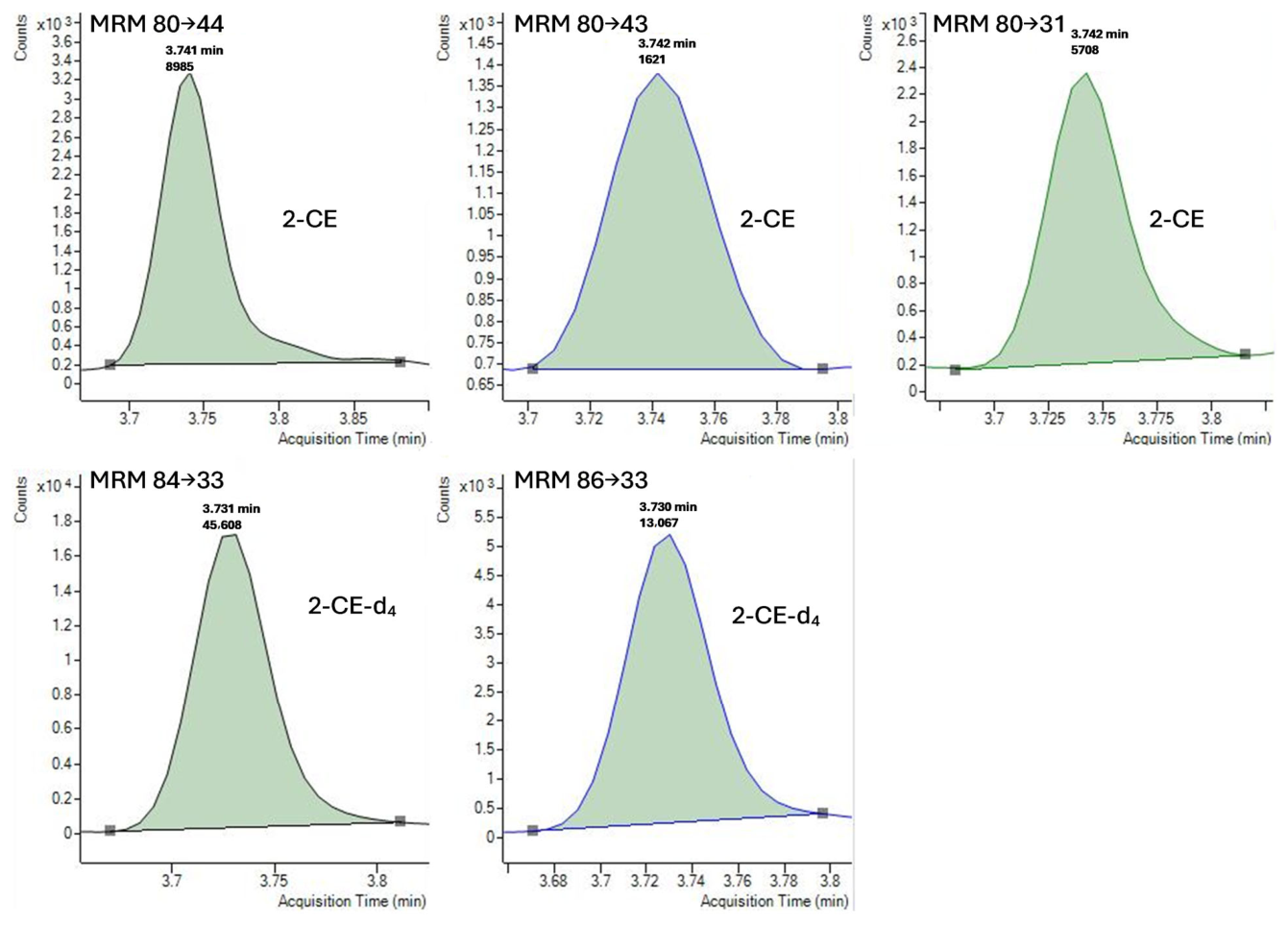
2.1.2. Specificity and Selectivity
2.1.3. Precision and Accuracy
2.1.4. Ongoing Validation
2.1.5. Measurement Uncertainty
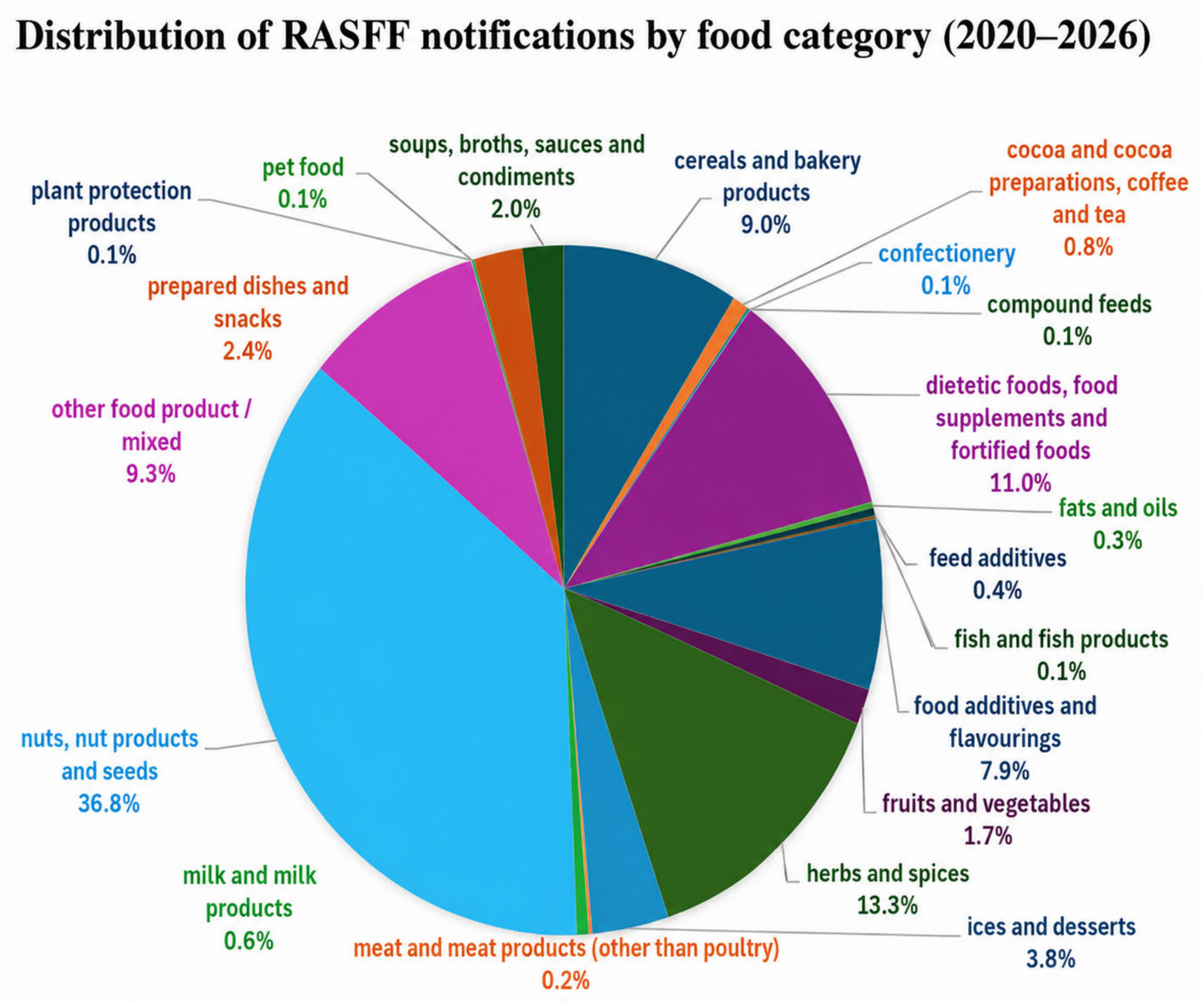
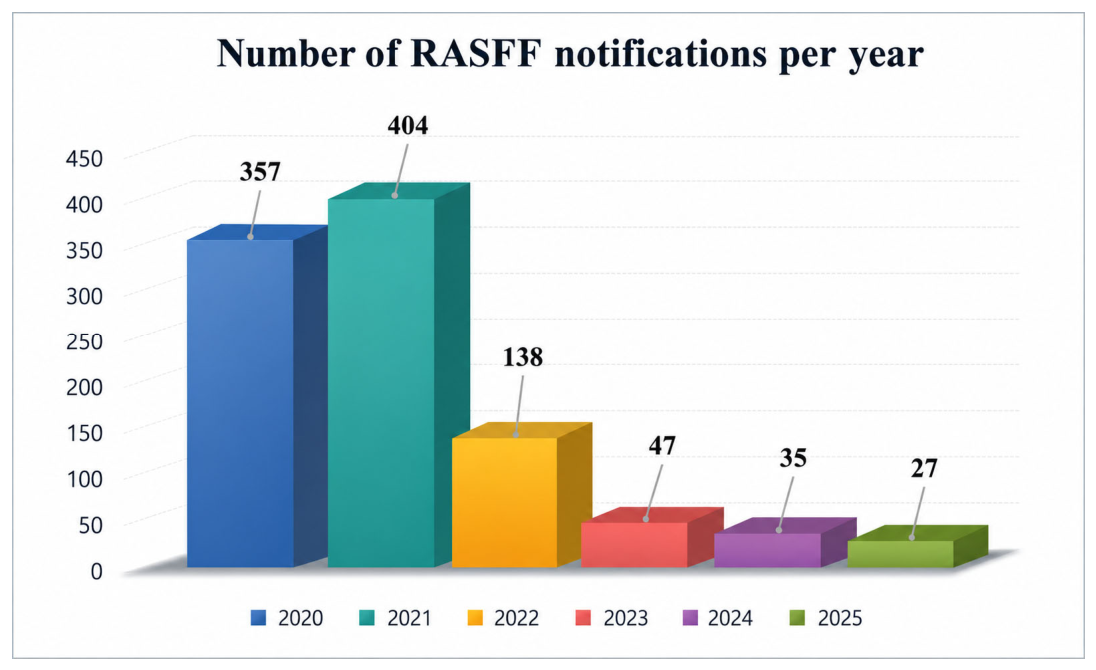
2.2. Real Samples
3. Materials and Methods
3.1. Chemicals and Reagents
3.2. Apparatus
3.3. Standard Solution Preparation
3.4. Sample Collection
3.5. Sample Preparation
4. Conclusions
Author Contributions
Funding
Institutional Review Board Statement
Informed Consent Statement
Data Availability Statement
Conflicts of Interest
References
- Wang, Z.; Ren, P.; Lai, K.; Liu, S.; Miao, J. The reaction mechanisms of ethylene oxide and propylene oxide with food Simulants: Based on experiments and computational analysis. Food Res. Int. 2025, 201, 115575. [Google Scholar] [CrossRef] [PubMed]
- Bessaire, T.; Eriksen, B.; Laborie, S.; Mujahid, C.; Mottier, P.; Delatour, T.; Panchaud, A.; Stadler, R.H.; Stroheker, T. Confirmation of the full conversion of ethylene oxide to 2-chloroethanol in fumigated foodstuffs: Possible implications for risk assessment. Food Addit. Contam. Part A 2023, 40, 81–95. [Google Scholar] [CrossRef] [PubMed]
- Kirman, C.R.; Li, A.A.; Sheehan, P.J.; Bus, J.S.; Lewis, R.C.; Hays, S.M. Ethylene oxide review: Characterization of total exposure via endogenous and exogenous pathways and their implications to risk assessment and risk management. J. Toxicol. Environ. Health Part B 2021, 24, 1–29. [Google Scholar] [CrossRef] [PubMed]
- Wenio, I.; Bartosiewicz, I.; Derewiaka, D.; Dewiszek, K.; Karniłowicz, K. A Fast Method for Determination of Ethylene Oxide Using Gas Chromatography Coupled with Mass Spectrometry GC-MS/MS. Appl. Sci. 2023, 13, 7480. [Google Scholar] [CrossRef]
- EURL EU Reference Laboratories for Residues of Pesticides SRM. Community Reference Laboratory for Single Residue Methods. Analytical Observations Report, Analysis of Ethylene Oxide and Its Metabolite 2-Chloroethanol by the QuOil or the QuEChERS Method and GC-MS/MS. Version 1.1. 2020. Available online: https://www.eurl-pesticides.eu/library/docs/srm/EurlSrm_Observation_EO_V1.pdf (accessed on 6 January 2026).
- Agency for Toxic Substances and Disease Registry. Toxicological Profile for Ethylene Oxide; Agency for Toxic Substances and Disease Registry: Atlanta, GA, USA, 2022. Available online: https://www.ncbi.nlm.nih.gov/books/NBK589517/ (accessed on 6 January 2026).
- Patil, R.; Langade, N.; Nerpagar, A.; Anastassiades, M.; Banerjee, K. Development and Validation of a Residue Analysis Method for Ethylene Oxide and 2-Chloroethanol in Foods by Gas Chromatography Tandem Mass Spectrometry. ACS Agric. Sci. Technol. 2023, 3, 287−295. [Google Scholar] [CrossRef]
- Bessaire, T.; Stroheker, T.; Eriksen, B.; Mujahid, C.; Hammel, Y.A.; Varela, J.; Delatour, T.; Panchaud, A.; Mottier, P.; Stadler, R.H. Analysis of ethylene oxide in ice creams manufactured with contaminated carob bean gum (E410). Food Addit. Contam. Part A 2021, 38, 2116–2127. [Google Scholar] [CrossRef] [PubMed]
- European Commission. Commission Implementing Regulation (EU) 2020/1540 of 22 October 2020 amending Implementing Regulation (EU) 2019/1793 as regards sesamum seeds originating in India. Off. J. Eur. Union 2020, 353, 4–7. [Google Scholar]
- European Commission. Commission Regulation (EU) 2015/868 of 26 May 2015 amending Annexes II, III and V to Regulation (EC) No 396/2005 of the European Parliament and of the Council as regards maximum residue levels for 2,4,5-T, barban, binapacryl, bromophos-ethyl, camphechlor (toxaphene), chlorbufam, chloroxuron, chlozolinate, DNOC, di-allate, dinoseb, dinoterb, dioxathion, ethylene oxide, fentin acetate, fentin hydroxide, flucycloxuron, flucythrinate, formothion, mecarbam, methacrifos, monolinuron, phenothrin, propham, pyrazophos, quinalphos, resmethrin, tecnazene and vinclozolin in or on certain products. Off. J. Eur. Union 2015, 145, 1–71. [Google Scholar]
- European Commission. Commission Regulation (EU) 2022/1396 of 11 August 2022 amending the Annex to Regulation (EU) No 231/2012 laying down specifications for food additives listed in Annexes II and III to Regulation (EC) No 1333/2008 of the European Parliament and of the Council as regards the presence of ethylene oxide in food additives. Off. J. Eur. Union 2022, 211, 182–184. [Google Scholar]
- RASFF Window—Food and Feed Safety Alerts. European Commission. Available online: https://webgate.ec.europa.eu/rasff-window/screen/search (accessed on 6 January 2026).
- Lee, N.Y.; Lingg Lee, J.W.; Lee Shin Wong, M.; Wee, S.; Shen, P.; Wu, Y.; Chng, K.R.; Chan, J.S.H. Ethylene oxide residues in spices, herbs, and related processed foods. Food Addit. Contam. Part B 2025, 18, 245–251. [Google Scholar] [CrossRef] [PubMed]
- Hearn, L.; Szafnauer, R.; Cole, R.; Green, B.; Mayser, J.P.; Tomar, V.; Amin, P. Automated, cryogen-free headspace-trap with gas chromatography-mass spectrometry analysis of ethylene oxide and 2-chloroethanol as residual fumigants in foods. J. Environ. Sci. Health Part B 2024, 59, 81–87. [Google Scholar] [CrossRef] [PubMed]
- Nerpagar, A.; Langade, N.; Patil, R.; Chiplunkar, S.; Kelkar, J.; Banerjee, K. Dynamic headspace GC-MS/MS analysis of ethylene oxide and 2-chloroethanol in dry food commodities: A novel approach. J. Environ. Sci. Health Part B 2023, 58, 659–670. [Google Scholar] [CrossRef] [PubMed]
- Madsen, R.B.; Termansen, M.; Mintert, M.; Huettermann, C.; Serr, B. Trace-level quantification of ethylene oxide and 2-chloroethanol in low-viscosity hydroxypropyl methylcellulose with solid phase microextraction and GC-MS. Food Addit. Contam. Part A 2022, 39, 1893–1905. [Google Scholar] [CrossRef] [PubMed]
- Pihlström, T.; Fernández-Alba, A.R.; Ferrer Amate, C.; Erecius Poulsen, M.; Hardebusch, B.; Anastassiades, M.; Lippold, R.; Carrasco Cabrera, L.; De Kok, A.; O’Regan, F.; et al. Analytical Quality Control and Method Validation Procedures for Pesticide Residues Analysis in Food and Feed SANTE 11312/2021. 2021. Available online: https://food.ec.europa.eu/system/files/2023-11/pesticides_mrl_guidelines_wrkdoc_2021-11312.pdf (accessed on 6 January 2026).
- European Commission. Regulation (EC) No 396/2005 of the European Parliament and of the Council of 23 February 2005 on maximum residue levels of pesticides in or on food and feed of plant and animal origin and amending Council Directive 91/414/EEC. Off. J. Eur. Union 2005, 70, 1–16. [Google Scholar]
- EFSA (European Food Safety Authority); Borroto, J.; Castoldi, A.F.; Chiusolo, A.; Colagiorgi, A.; Colas, M.; Crivellente, F.; De Lentdecker, C.; Istace, F.; Kardassi, D.; et al. Statement on the BfR opinion regarding the toxicity of 2- chloroethanol. EFSA J. 2022, 20, e07147. [Google Scholar] [CrossRef] [PubMed]
- ISO/IEC 17025:2017; General Requirements for the Competence of Testing and Calibration Laboratories. International Organization for Standardization (ISO); International Electrotechnical Commission (IEC): Geneva, Switzerland, 2017.



| Reference | Column | Analytical Method | Matrices |
|---|---|---|---|
| Lee et al., 2025 [13] | SupelcoWax (10, 30 m × 0.25 mm × 0.25 μm) | QuEChERS extraction and GC-MS/MS | spices, herbs, processed foods |
| Hearn et al., 2024 [14] | VF-624 GC column (60 m × 0.25 mm × 1.4 μm) | MSE-HS-trap extraction technique | sesame seeds, guar gum |
| Bessaire et al., 2023 [2] | DB-624 UI (30 m × 0.25 mm × 1.4 µm) or HP-VOC (30 m × 0.20 mm × 1.12 mm) | QuEChERS extraction and GC-MS/MS | herbs, spices, fruits and vegetables, stabilisers |
| Nerpagar et al., 2023 [15] | Rtx-vmS Gc column (60 m × 0.45 mm, 2.55 μm) | dynamic headspace-GC-MS/MS | cumin, ashwagandha, chilli powder, turmeric powder, guar gum, locust bean gum, and ginger powder |
| Patil et al., 2023 [7] | HP-Wax column (30 m × 0.25 mm × 0.25 μm) | QuEChERS extraction and GC-MS/MS | sesame, cumin, wheat, tea, spices, herbs, dehydrated fruits, food additives, grapes, tomatoes |
| Madsen et al., 2022 [16] | CP-Sil 8CB (30 m × 0.32 mm × 1 mm) | SPME-GC-MS | low viscous hydroxypropyl methylcellulose |
| Bessaire et al., 2021 [8] | DB-624 UI; 30 m × 0.25 mm × 1.4 µm | QuEChERS extraction and GC-MS/MS | ice cream |
| Compound Name | Precursor Ion (m/z) | Product Ion (m/z) | Dwell (ms) | Collision Energy (eV) |
|---|---|---|---|---|
| EtO | 44 | 29 | 79.2 | 5 |
| EtO | 44 | 28 | 79.2 | 5 |
| EtO | 44 | 14 | 79.2 | 20 |
| EtO-d4 | 48 | 30 | 79.2 | 5 |
| EtO-d4 | 48 | 16 | 79.2 | 20 |
| 2-CE | 82 | 44 | 65.8 | 5 |
| 2-CE | 82 | 31 | 65.8 | 5 |
| 2-CE | 80 | 44 | 65.8 | 5 |
| 2-CE | 80 | 43 | 65.8 | 5 |
| 2-CE | 80 | 31 | 65.8 | 5 |
| 2-CE-d4 | 86 | 33 | 65.8 | 5 |
| 2-CE-d4 | 84 | 33 | 65.8 | 5 |
| Commodity Groups | High Water Content | Difficult or Unique Commodities | High Oil/Fat Content and Very Low Water Content | ||||||
|---|---|---|---|---|---|---|---|---|---|
| Levels mg/kg | Mean Recovery (%) | RSD% | Levels mg/kg | Mean Recovery (%) | RSD% | Levels mg/kg | Mean Recovery (%) | RSD% | |
| EtO (detected as 2-CE) | 0.010 (LOQ) | 118 | 2.87 | 0.100 (LOQ) | 111 | 3.62 | 0.025 (LOQ) | 97 | 8.20 |
| 0.100 | 106 | 6.06 | 1.00 | 110 | 8.01 | 0.250 | 94 | 2.90 | |
| 2-CE | 0.018 (LOQ) | 107 | 2.27 | 0.180 (LOQ) | 119 | 5.97 | 0.045 (LOQ) | 100 | 9.09 |
| 0.180 | 101 | 2.70 | 1.80 | 111 | 7.99 | 0.450 | 92 | 3.60 | |
| Commodities | Compound | Spiking Levels (mg/Kg) | Measurement Uncertainty a | Measurement Uncertainty b |
|---|---|---|---|---|
| High water content | EtO | 0.010 | 13% | 50% |
| 0.100 | 15% | |||
| 2-CE | 0.018 | 12% | 50% | |
| 0.180 | 12% | |||
| Difficult or unique commodities | EtO | 0.100 | 46% | 50% |
| 1.00 | 17% | |||
| 2-CE | 0.180 | 15% | 50% | |
| 1.80 | 17% | |||
| High oil/fat content and very low water content | EtO | 0.025 | 36% | 50% |
| 0.250 | 13% | |||
| 2-CE | 0.045 | 24% | 50% | |
| 0.450 | 12% |
| Food Category | Matrix | Count (N) | Percentage (%) |
|---|---|---|---|
| Dietetic Foods, Food Supplements and fortified foods | Dietary Supplements | 1 | 1.2% |
| Herbal Supplements | 10 | 12% | |
| Foods for special medical purposes | 3 | 3.6% | |
| Vitamin-Mineral Supplements | 1 | 1.2% | |
| Fruits and Vegetables | Drumstick | 1 | 1.2% |
| Okra | 39 | 46% | |
| Papaya | 1 | 1.2% | |
| Herbs and Spices | Black Pepper | 2 | 2.4% |
| Chamomile | 1 | 1.2% | |
| Dried Bay Laurel | 1 | 1.2% | |
| Dried Chilli | 7 | 8.3% | |
| Fenugreek Seeds | 1 | 1.2% | |
| Turmeric powder | 4 | 4.8% | |
| Turmeric (Root) | 1 | 1.2% | |
| Nuts, nut products and seeds | Cumin Seeds | 3 | 3.6% |
| Mustard Seeds | 1 | 1.2% | |
| Sesame Seed | 4 | 4.8% | |
| Other food products/ mixed | Bulk Liquid Herbal Extracts | 1 | 1.2% |
| Pharmaceutical products | 2 | 2.4% |
| Matrix | Country of Origin | Positive Samples | Sum of EtO and 2-CE, Expressed as EtO (mg/kg) |
|---|---|---|---|
| Black Pepper | India | 0 | <LOQ |
| Bulk Liquid Herbal Extracts | India | 0 | <LOQ |
| Chamomile | United Kingdom | 1 (Suspected) | >0.1 * |
| Cumin Seeds | India | 0 | <LOQ |
| Dietary Supplements | India | 0 | <LOQ |
| Dried Bay Laurel | India | 1 | 0.160 |
| Dried Chilli | India | 0 | <LOQ |
| Drumstick | India | 0 | <LOQ |
| Fenugreek Seeds | India | 0 | <LOQ |
| Foods for Special Medical Purposes | India | 1 | 0.140 |
| Herbal Supplements | India | 1 | 0.212 |
| Mustard Seeds | India | 0 | <LOQ |
| Okra | India | 0 | <LOQ |
| Papaya | Brazil | 0 | <LOQ |
| Pharmaceutical Products | India | 0 | <LOQ |
| Sesame Seeds | India/Argentina | 0 | <LOQ |
| Turmeric (Root) | India | 0 | <LOQ |
| Turmeric Powder | India | 0 | <LOQ |
| Vitamin–Mineral Supplements | India | 0 | <LOQ |
Disclaimer/Publisher’s Note: The statements, opinions and data contained in all publications are solely those of the individual author(s) and contributor(s) and not of MDPI and/or the editor(s). MDPI and/or the editor(s) disclaim responsibility for any injury to people or property resulting from any ideas, methods, instructions or products referred to in the content. |
© 2026 by the authors. Licensee MDPI, Basel, Switzerland. This article is an open access article distributed under the terms and conditions of the Creative Commons Attribution (CC BY) license.
Share and Cite
Mauti, T.; Delfino, D.; Nicolini, V.; Droghei, B.; Colangelo, D.; Triolone, D.; Fiorucci, F.; Di Giustino, P.; Mancuso, M.; Leo, M.; et al. Monitoring Ethylene Oxide Residues in Food: A Simplified QuEChERS-Based GC-MS/MS Method for Routine Analysis. Molecules 2026, 31, 1978. https://doi.org/10.3390/molecules31111978
Mauti T, Delfino D, Nicolini V, Droghei B, Colangelo D, Triolone D, Fiorucci F, Di Giustino P, Mancuso M, Leo M, et al. Monitoring Ethylene Oxide Residues in Food: A Simplified QuEChERS-Based GC-MS/MS Method for Routine Analysis. Molecules. 2026; 31(11):1978. https://doi.org/10.3390/molecules31111978
Chicago/Turabian StyleMauti, Tabita, Daniela Delfino, Valentina Nicolini, Barbara Droghei, Daniele Colangelo, Daniela Triolone, Fulvia Fiorucci, Paolo Di Giustino, Marta Mancuso, Marianna Leo, and et al. 2026. "Monitoring Ethylene Oxide Residues in Food: A Simplified QuEChERS-Based GC-MS/MS Method for Routine Analysis" Molecules 31, no. 11: 1978. https://doi.org/10.3390/molecules31111978
APA StyleMauti, T., Delfino, D., Nicolini, V., Droghei, B., Colangelo, D., Triolone, D., Fiorucci, F., Di Giustino, P., Mancuso, M., Leo, M., D’Onofrio, F., Ubaldi, A., & Russo, K. (2026). Monitoring Ethylene Oxide Residues in Food: A Simplified QuEChERS-Based GC-MS/MS Method for Routine Analysis. Molecules, 31(11), 1978. https://doi.org/10.3390/molecules31111978