Urine-to-Blood Partitioning of Per- and Polyfluoroalkyl Substances in Human Biomonitoring: Implications for Environmental Exposure Analysis and Bioaccumulation Assessment


Abstract
1. Introduction
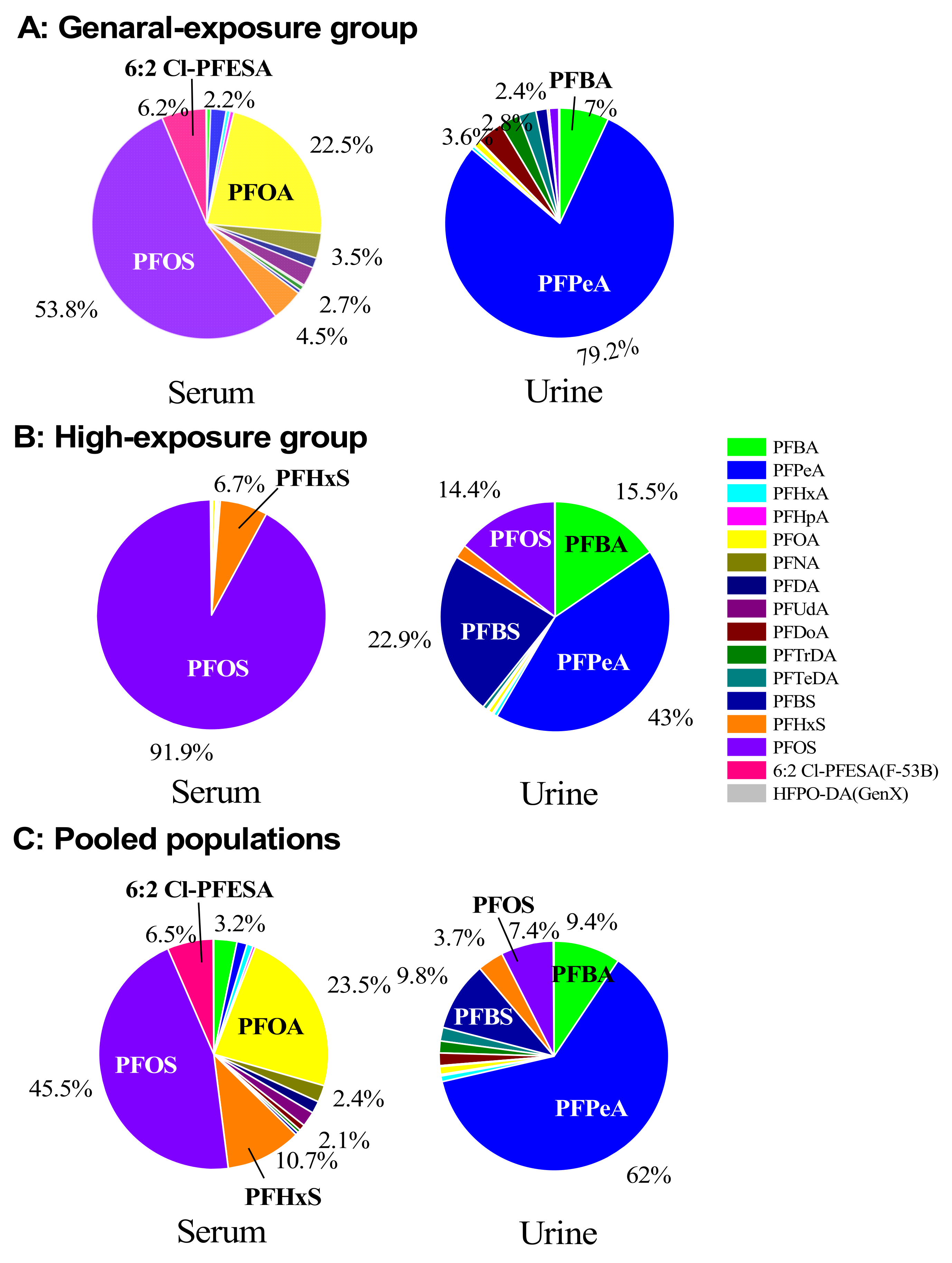
2. Profiles of Commonly Detected PFASs in Human Serum
2.1. Global Baseline: The Legacy Quartet (PFOS, PFOA, PFHxS, PFNA)
2.2. Global Consistency and Regional Heterogeneity of PFAS Exposure
2.3. PFAS Substitution Transition and Trends in Blood Exposure Profiles
2.4. Characterization of Short-Chain and Emerging PFAS by Blood Biomonitoring and Associated Challenges
2.5. Sex and Age Differences in Serum PFAS Concentrations
3. Profiles of Commonly Detected PFASs in Human Urine
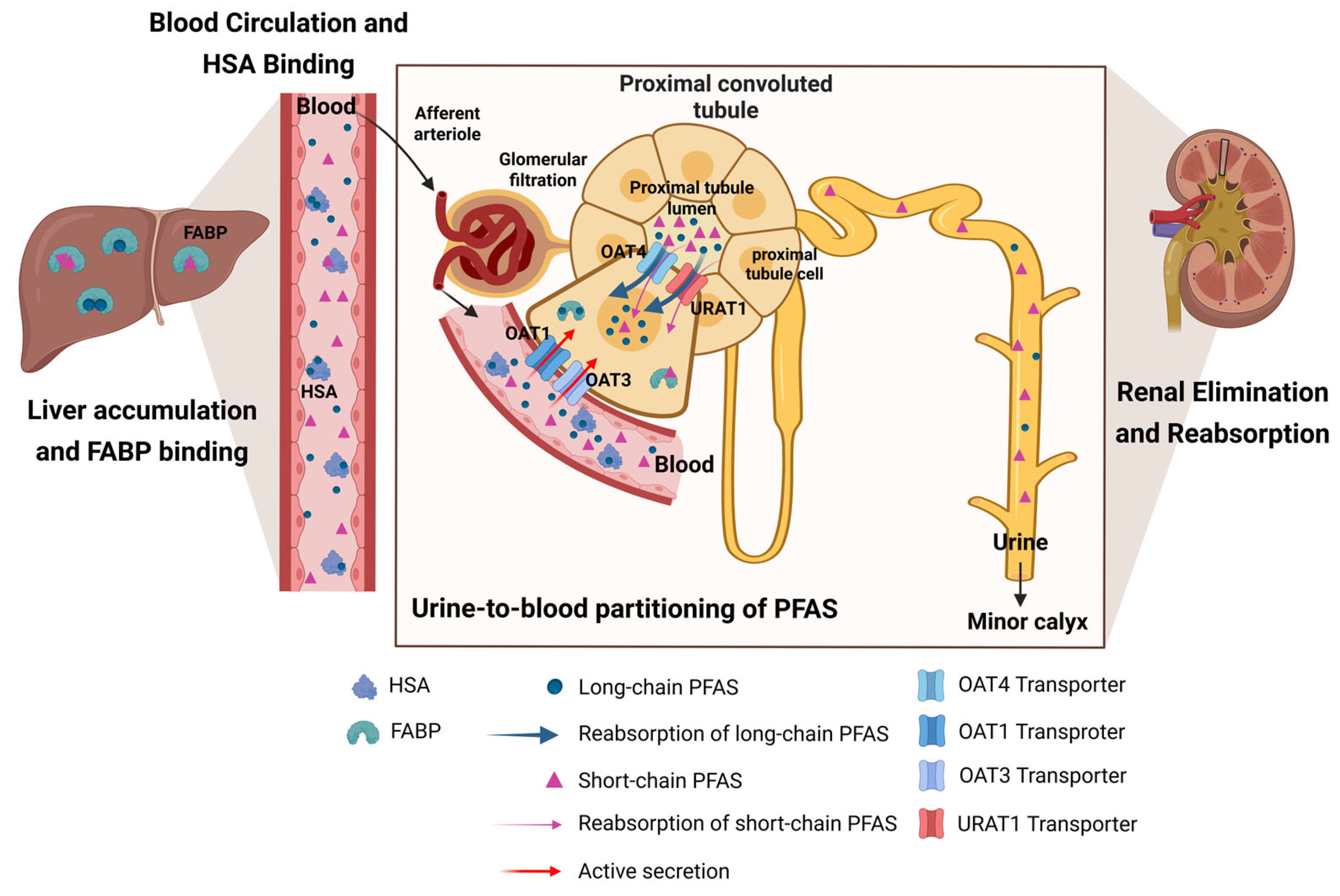
4. Linking the Urine-to-Blood Concentration Ratio to Protein Binding, Renal Transport, and Biological Half-Life
4.1. Pairwise Correlation Analysis
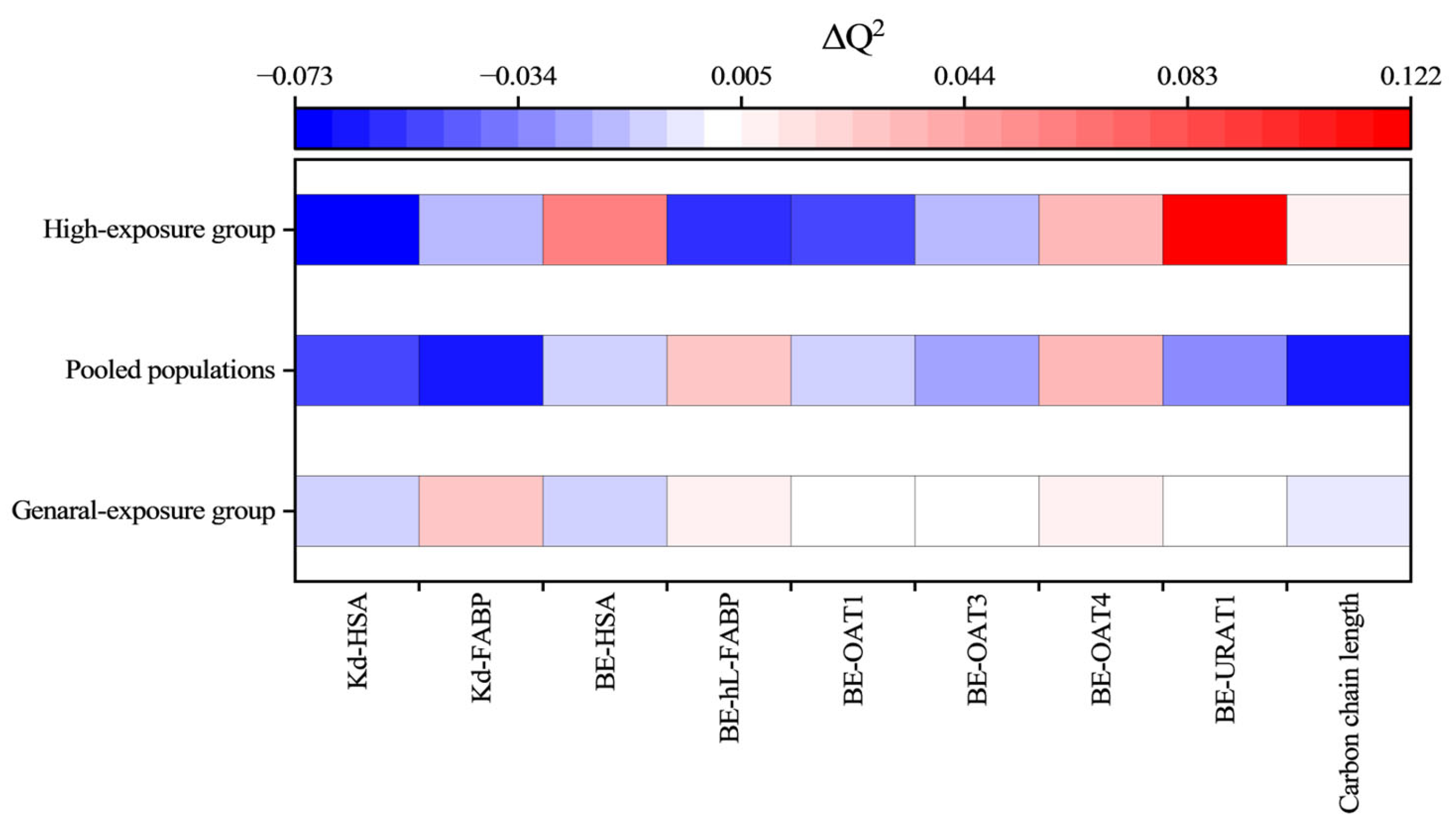
4.2. Partial Least Squares Regression (PLSR) Analysis
5. Discussion and Conclusions
6. Limitations
Supplementary Materials
Author Contributions
Funding
Institutional Review Board Statement
Informed Consent Statement
Data Availability Statement
Conflicts of Interest
References
- Evich, M.G.; Davis, M.J.B.; McCord, J.P.; Acrey, B.; Awkerman, J.A.; Knappe, D.R.U.; Lindstrom, A.B.; Speth, T.F.; Tebes-Stevens, C.; Strynar, M.J.; et al. Per- and polyfluoroalkyl substances in the environment. Science 2022, 375, eabg9065. [Google Scholar] [CrossRef] [Scilit] [PubMed]
- Garrett, K.K.; Say, V.; Ciaranca, S.; Brown, P.; Haberlack, E.; Hopkins, C.; Lengefeld, M.; Cordner, A. The Landscape of PFAS Contamination in the United States: Sources and Spatial Patterns. Environ. Sci. Technol. 2025, 59, 18795–18807. [Google Scholar] [CrossRef] [Scilit] [PubMed]
- OECD. Toward a New Comprehensive Global Database of Per-And Polyfluoroalkyl Substances (PFASs): Summary Report on Updating the OECD 2007 List of Per-And Polyfluoroalkyl Substances (PFASs); Organisation for Economic Cooperation and Development (OECD): Paris, France, 2018. [Google Scholar]
- United States Environmental Protection Agency (US EPA). CompTox Chemicals Dashboard v2.6.0: Navigation Panel to PFAS Structure Lists. Available online: https://comptox.epa.gov/dashboard/chemical-lists/PFASSTRUCT (accessed on 25 May 2026).
- United States Environmental Protection Agency (US EPA). CompTox Chemicals Dashboard v2.6.0: PFAS|EPA PFAS Chemicals Without Explicit Structures. Available online: https://comptox.epa.gov/dashboard/chemical-lists/PFASDEV (accessed on 25 May 2026).
- Ji, C.; Pavuk, M.; Ruiz, P. Global Serum Per- and Polyfluoroalkyl Substances Exposures and Their Correlation with Lipids: A Systematic Review and Meta-Analysis. Environ. Sci. Technol. 2025, 59, 19611–19629. [Google Scholar] [CrossRef] [Scilit] [PubMed]
- He, A.; Liang, Y.; Li, J.; Zhou, Z.; Li, F.; Li, Z.; Wang, Y.; Jiang, G. A Critical Review of Populations with Occupational Exposure to Per- and Polyfluoroalkyl Substances: External Exposome, Internal Exposure Levels, and Health Effects. Environ. Sci. Technol. 2025, 59, 10715–10733. [Google Scholar] [CrossRef] [Scilit]
- Xu, P.; Xu, D.; Wang, X.; Chen, Z.; Dong, F.; Xiang, J.; Cheng, P.; Xu, D.; Chen, Y.; Lou, X.; et al. Associations of Serum Per- and Polyfluoroalkyl Substances with Genotoxic Biomarkers: New Insights from Cross-Sectional and In Vivo Evidence. Environ. Sci. Technol. 2025, 59, 9955–9967. [Google Scholar] [CrossRef] [Scilit]
- Xu, D.; Xiang, J.; Qin, R.; Chen, Z.; Wang, X.; Xu, P.; Pan, Y.; Zhang, X.; Wang, Y.; Cheng, P.; et al. Per- and polyfluoroalkyl substances and platelet-related hematotoxicity: An integrated study of in silico, toxicological, and population evidence. J. Hazard. Mater. 2025, 498, 139882. [Google Scholar] [CrossRef] [Scilit]
- Cheng, L.; Teagle, S.; Enders, J.R.; Weed, R.A.; Nichols, H.B.; Knappe, D.R.U.; Hoppin, J.A. Historical Blood Serum Samples from Wilmington, North Carolina: The Importance of Ultrashort-Chain Per- and Polyfluoroalkyl Substances. Environ. Sci. Technol. 2025, 59, 23125–23135. [Google Scholar] [CrossRef] [Scilit]
- Buck, R.C.; Franklin, J.; Berger, U.; Conder, J.M.; Cousins, I.T.; de Voogt, P.; Jensen, A.A.; Kannan, K.; Mabury, S.A.; van Leeuwen, S.P. Perfluoroalkyl and polyfluoroalkyl substances in the environment: Terminology, classification, and origins. Integr. Environ. Assess. Manag. 2011, 7, 513–541. [Google Scholar] [CrossRef] [Scilit]
- Wang, Z.; DeWitt, J.C.; Higgins, C.P.; Cousins, I.T. A Never-Ending Story of Per- and Polyfluoroalkyl Substances (PFASs)? Environ. Sci. Technol. 2017, 51, 2508–2518. [Google Scholar] [CrossRef] [Scilit]
- Rosato, I.; Bonato, T.; Fletcher, T.; Batzella, E.; Canova, C. Estimation of per- and polyfluoroalkyl substances (PFAS) half-lives in human studies: A systematic review and meta-analysis. Environ. Res. 2024, 242, 117743. [Google Scholar] [CrossRef] [Scilit]
- Nielsen, F.; Fischer, F.C.; Leth, P.M.; Grandjean, P. Occurrence of Major Perfluorinated Alkylate Substances in Human Blood and Target Organs. Environ. Sci. Technol. 2023, 58, 143–149. [Google Scholar] [CrossRef] [Scilit]
- Domingo, J.L. A review of the occurrence and distribution of Per- and polyfluoroalkyl substances (PFAS) in human organs and fetal tissues. Environ. Res. 2025, 272, 121181. [Google Scholar] [CrossRef] [Scilit]
- Ji, D.; Pan, Y.; Qiu, X.; Gong, J.; Li, X.; Niu, C.; Yao, J.; Luo, S.; Zhang, Z.; Wang, Q.; et al. Unveiling Distribution of Per- and Polyfluoroalkyl Substances in Matched Placenta-Serum Tetrads: Novel Implications for Birth Outcome Mediated by Placental Vascular Disruption. Environ. Sci. Technol. 2023, 57, 5782–5793. [Google Scholar] [CrossRef] [Scilit]
- Costello, E.; Rock, S.; Stratakis, N.; Eckel, S.P.; Walker, D.I.; Valvi, D.; Cserbik, D.; Jenkins, T.; Xanthakos, S.A.; Kohli, R.; et al. Exposure to per- and Polyfluoroalkyl Substances and Markers of Liver Injury: A Systematic Review and Meta-Analysis. Environ. Health Perspect. 2022, 130, 46001. [Google Scholar] [CrossRef] [Scilit]
- Sen, P.; Qadri, S.; Luukkonen, P.K.; Ragnarsdottir, O.; McGlinchey, A.; Jäntti, S.; Juuti, A.; Arola, J.; Schlezinger, J.J.; Webster, T.F.; et al. Exposure to environmental contaminants is associated with altered hepatic lipid metabolism in non-alcoholic fatty liver disease. J. Hepatol. 2022, 76, 283–293. [Google Scholar] [CrossRef] [Scilit]
- Zhang, X.Y.; Zhao, L.G.; Ducatman, A.; Deng, C.J.; von Stackelberg, K.E.; Danford, C.J.; Zhang, X.H. Association of per- and polyfluoroalkyl substance exposure with fatty liver disease risk in US adults. JHEP Rep. 2023, 5, 100694. [Google Scholar] [CrossRef] [Scilit] [PubMed]
- Chen, Y.R.; Lin, S.B.; Lv, J.Y.; Wu, Y.; Feng, W.R. Dissect the association between per- and polyfluoroalkyl substances (PFAS) and kidney function from the perspective of lipid molecules. Environ. Pollut. 2024, 361, 124865. [Google Scholar] [CrossRef] [Scilit] [PubMed]
- Bline, A.P.; DeWitt, J.C.; Kwiatkowski, C.F.; Pelch, K.E.; Reade, A.; Varshavsky, J.R. Public Health Risks of PFAS-Related Immunotoxicity Are Real. Curr. Environ. Health Rep. 2024, 11, 118–127. [Google Scholar] [CrossRef] [Scilit]
- Ehrlich, V.; Bil, W.; Vandebriel, R.; Granum, B.; Luijten, M.; Lindeman, B.; Grandjean, P.; Kaiser, A.M.; Hauzenberger, I.; Hartmann, C.; et al. Consideration of pathways for immunotoxicity of per- and polyfluoroalkyl substances (PFAS). Environ. Health 2023, 22, 19. [Google Scholar] [CrossRef] [Scilit] [PubMed]
- Gaillard, L.; Barouki, R.; Blanc, E.; Coumoul, X.; Andreau, K. Per- and polyfluoroalkyl substances as persistent pollutants with metabolic and endocrine-disrupting impacts. Trends Endocrinol. Met. 2025, 36, 249–261. [Google Scholar] [CrossRef] [Scilit]
- Coperchini, F.; Croce, L.; Ricci, G.; Magri, F.; Rotondi, M.; Imbriani, M.; Chiovato, L. Thyroid Disrupting Effects of Old and New Generation PFAS. Front. Endocrinol. 2021, 11, 612320. [Google Scholar] [CrossRef] [Scilit]
- Shi, W.S.; Zhang, Z.L.; Li, M.; Dong, H.Y.; Li, J.F. Reproductive toxicity of PFOA, PFOS and their substitutes: A review based on epidemiological and toxicological evidence. Environ. Res. 2024, 250, 118485. [Google Scholar] [CrossRef] [Scilit]
- Schlezinger, J.J.; Gokce, N. Perfluoroalkyl/Polyfluoroalkyl Substances: Links to Cardiovascular Disease Risk. Circ. Res. 2024, 134, 1136–1159. [Google Scholar] [CrossRef] [Scilit] [PubMed]
- Liu, B.K.; Zhu, L.; Wang, M.L.; Sun, Q. Associations between Per- and Polyfluoroalkyl Substances Exposures and Blood Lipid Levels among Adults-A Meta-Analysis. Environ. Health Perspect. 2023, 131, 56001. [Google Scholar] [CrossRef] [Scilit]
- Zahm, S.; Bonde, J.P.; Chiu, W.A.; Hoppin, J.; Kanno, J.; Abdallah, M.; Blystone, C.R.; Calkins, M.M.; Dong, G.-H.; Dorman, D.C.; et al. Carcinogenicity of perfluorooctanoic acid and perfluorooctanesulfonic acid. Lancet Oncol. 2024, 25, 16–17. [Google Scholar] [CrossRef] [Scilit]
- IARC Working Group on the Identification of Carcinogenic Hazards to Humans. Perfluorooctanoic Acid (PFOA) and Perfluorooctanesulfonic Acid (PFOS) Volume 135; International Agency for Research on Cancer: Lyon, France, 2025. [Google Scholar]
- Hong, Y.G.; Wang, D.Q.; Liu, Z.Y.; Chen, Y.X.; Wang, Y.; Li, J.J. Decoding per- and polyfluoroalkyl substances (PFAS) in hepatocellular carcinoma: A multi-omics and computational toxicology approach. J. Transl. Med. 2025, 23, 504. [Google Scholar] [CrossRef] [Scilit]
- Goodrich, J.A.; Walker, D.; Lin, X.P.; Wang, H.X.; Lim, T.; McConnell, R.; Conti, D.V.; Chatzi, L.; Setiawan, V.W. Exposure to perfluoroalkyl substances and risk of hepatocellular carcinoma in a multiethnic cohort. JHEP Rep. 2022, 4, 100550. [Google Scholar] [CrossRef] [Scilit] [PubMed]
- Rosenfeld, P.E.; Spaeth, K.R.; Remy, L.L.; Byers, V.; Muerth, S.A.; Hallman, R.C.; Summers-Evans, J.; Barker, S. Perfluoroalkyl substances exposure in firefighters: Sources and implications. Environ. Res. 2023, 220, 115164. [Google Scholar] [CrossRef] [Scilit]
- Zhao, L.H.; Teng, M.M.; Zhao, X.L.; Li, Y.X.; Sun, J.Q.; Zhao, W.T.; Ruan, Y.F.; Leung, K.M.Y.; Wu, F.C. Insight into the binding model of per- and polyfluoroalkyl substances to proteins and membranes. Environ. Int. 2023, 175, 107951. [Google Scholar] [CrossRef] [Scilit]
- Fischer, F.C.; Ludtke, S.; Thackray, C.; Pickard, H.M.; Haque, F.; Dassuncao, C.; Endo, S.; Schaider, L.; Sunderland, E.M. Binding of Per- and Polyfluoroalkyl Substances (PFAS) to Serum Proteins: Implications for Toxicokinetics in Humans. Environ. Sci. Technol. 2024, 58, 1055–1063. [Google Scholar] [CrossRef] [Scilit] [PubMed]
- Jia, Y.; Zhu, Y.; Xu, D.; Feng, X.; Yu, X.; Shan, G.; Zhu, L. Insights into the Competitive Mechanisms of Per- and Polyfluoroalkyl Substances Partition in Liver and Blood. Environ. Sci. Technol. 2022, 56, 6192–6200. [Google Scholar] [CrossRef] [Scilit] [PubMed]
- Ng, C.A.; Hungerbühler, K. Bioconcentration of Perfluorinated Alkyl Acids: How Important Is Specific Binding? Environ. Sci. Technol. 2013, 47, 7214–7223. [Google Scholar] [CrossRef] [Scilit] [PubMed]
- Fischer, F.C.; Thackray, C.; Ferguson, N.; Chicoine, C.; Skende, O.; Hu, Z.; Zhu, Y.; Slitt, A.; Sunderland, E.M. Understanding Mechanisms of PFAS Absorption, Distribution, and Elimination Using a Physiologically Based Toxicokinetic Model. Environ. Sci. Technol. 2025, 59, 13240–13250. [Google Scholar] [CrossRef] [Scilit] [PubMed]
- Andersson, A.G.; Fletcher, T.; Xu, Y.; Kärrman, A.; Pineda, D.; Nilsson, C.A.; Lindh, C.H.; Jakobsson, K.; Li, Y. The relative importance of fecal and urinary excretion of perfluorooctane sulfonic acid and perfluorooctanoic acid after high exposure—An observational study in Ronneby, Sweden. Environ. Res. 2025, 285, 122487. [Google Scholar] [CrossRef] [Scilit]
- Zhang, Y.; Beesoon, S.; Zhu, L.; Martin, J.W. Biomonitoring of Perfluoroalkyl Acids in Human Urine and Estimates of Biological Half-Life. Environ. Sci. Technol. 2013, 47, 10619–10627. [Google Scholar] [CrossRef] [Scilit]
- Xu, Y.; Fletcher, T.; Pineda, D.; Lindh, C.H.; Nilsson, C.; Glynn, A.; Vogs, C.; Norstrom, K.; Lilja, K.; Jakobsson, K.; et al. Serum Half-Lives for Short- and Long-Chain Perfluoroalkyl Acids after Ceasing Exposure from Drinking Water Contaminated by Firefighting Foam. Environ. Health Perspect. 2020, 128, 77004. [Google Scholar] [CrossRef] [Scilit]
- Li, Y.; Fletcher, T.; Mucs, D.; Scott, K.; Lindh, C.H.; Tallving, P.; Jakobsson, K. Half-lives of PFOS, PFHxS and PFOA after end of exposure to contaminated drinking water. Occup. Environ. Med. 2018, 75, 46–51. [Google Scholar] [CrossRef] [Scilit]
- Li, Y.; Andersson, A.; Xu, Y.; Pineda, D.; Nilsson, C.A.; Lindh, C.H.; Jakobsson, K.; Fletcher, T. Determinants of serum half-lives for linear and branched perfluoroalkyl substances after long-term high exposure—A study in Ronneby, Sweden. Environ. Int. 2022, 163, 107198. [Google Scholar] [CrossRef] [Scilit]
- Cheng, X.; Wang, Y.; Zhang, J.; Guo, H.; Liu, L.; Liu, L.; Gao, J.; He, M. Trends in serum levels of emerging and legacy per- and polyfluoroalkyl substances from 2008 to 2018: A longitudinal study in China. Environ. Health Perspect. 2025. [Google Scholar] [CrossRef] [Scilit]
- Worley, R.R.; Moore, S.M.; Tierney, B.C.; Ye, X.; Calafat, A.M.; Campbell, S.; Woudneh, M.B.; Fisher, J. Per- and polyfluoroalkyl substances in human serum and urine samples from a residentially exposed community. Environ. Int. 2017, 106, 135–143. [Google Scholar] [CrossRef] [Scilit]
- Zheng, G.; Eick, S.M.; Salamova, A. Elevated Levels of Ultrashort- and Short-Chain Perfluoroalkyl Acids in US Homes and People. Environ. Sci. Technol. 2023, 57, 15782–15793. [Google Scholar] [CrossRef] [Scilit]
- Yu, T.; Campbell, S.C.; Stockmann, C.; Tak, C.; Schoen, K.; Clark, E.A.; Varner, M.W.; Spigarelli, M.G.; Sherwin, C.M. Pregnancy-induced changes in the pharmacokinetics of caffeine and its metabolites. J. Clin. Pharmacol. 2016, 56, 590–596. [Google Scholar] [CrossRef] [Scilit]
- Nikhil, M.; Das, P.; Rathod, G.; Sampath, S.; Bhongir, A.V. Association Between Serum Fluoride and Urine Fluoride Levels and Hemoglobin Levels in Pregnant Women: A Cross-Sectional Study in Rural Telangana, India. Cureus 2026, 18, e103839. [Google Scholar] [CrossRef] [Scilit]
- Botelho, J.C.; Kato, K.; Wong, L.Y.; Calafat, A.M. Per- and polyfluoroalkyl substances (PFAS) exposure in the U.S. population: NHANES 1999-March 2020. Environ. Res. 2025, 270, 120916. [Google Scholar] [CrossRef] [Scilit]
- Duffek, A.; Conrad, A.; Kolossa-Gehring, M.; Lange, R.; Rucic, E.; Schulte, C.; Wellmitz, J. Per- and polyfluoroalkyl substances in blood plasma—Results of the German Environmental Survey for children and adolescents 2014-2017 (GerES V). Int. J. Hyg. Environ. Health 2020, 228, 113549. [Google Scholar] [CrossRef] [Scilit]
- Paulsen, M.M.; Iszatt, N.; Sakhi, A.K.; Karimi, M.; Broadwell, S.L.; Papadopoulou, E.; Meltzer, H.M.; Granum, B.; Brantsaeter, A.L.; Thomsen, C.; et al. Environmental contaminants, heavy metals, and essential elements in Norwegian children and adolescents: Data from the Norwegian environmental biobank. Environ. Int. 2025, 202, 109633. [Google Scholar] [CrossRef] [Scilit]
- Uhl, M.; Schoeters, G.; Govarts, E.; Bil, W.; Fletcher, T.; Haug, L.S.; Hoogenboom, R.; Gundacker, C.; Trier, X.; Fernandez, M.F.; et al. PFASs: What can we learn from the European Human Biomonitoring Initiative HBM4EU. Int. J. Hyg. Environ. Health 2023, 250, 114168. [Google Scholar] [CrossRef] [Scilit] [PubMed]
- Fábelová, L.; Beneito, A.; Casas, M.; Colles, A.; Dalsager, L.; Den Hond, E.; Dereumeaux, C.; Ferguson, K.; Gilles, L.; Govarts, E.; et al. PFAS levels and exposure determinants in sensitive population groups. Chemosphere 2023, 313, 137530. [Google Scholar] [CrossRef] [Scilit] [PubMed]
- Government of Canada. State of Per- and Polyfluoroalkyl Substances (PFAS) Report; Government of Canada: Gatineau, QC, Canada, 2025. [Google Scholar]
- Taucare, G.; Chan, G.; Nilsson, S.; Toms, L.-M.L.; Zhang, X.; Mueller, J.F.; Jolliet, O. Temporal trends of per- and polyfluoroalkyl substances concentrations: Insights from Australian human biomonitoring 2002–2021 and the U.S. NHANES programs 2003–2018. Environ. Res. 2024, 262, 119777. [Google Scholar] [CrossRef] [Scilit] [PubMed]
- Richterová, D.; Govarts, E.; Fábelová, L.; Rausová, K.; Rodriguez Martin, L.; Gilles, L.; Remy, S.; Colles, A.; Rambaud, L.; Riou, M.; et al. PFAS levels and determinants of variability in exposure in European teenagers—Results from the HBM4EU aligned studies (2014–2021). Int. J. Hyg. Environ. Health 2023, 247, 114057. [Google Scholar] [CrossRef] [Scilit]
- Zheng, X.; Pan, Y.; Qu, Y.; Ji, S.; Wang, J.; Li, Z.; Zhao, F.; Wu, B.; Xie, L.; Li, Y.; et al. Associations of Serum Per- and Polyfluoroalkyl Substances with Hyperuricemia in Adults: A Nationwide Cross-Sectional Study. Environ. Sci. Technol. 2024, 58, 12875–12887. [Google Scholar] [CrossRef] [Scilit]
- Xing, Y.; Li, Z.; Wang, J.; Qu, Y.; Hu, Q.; Ji, S.; Chang, X.; Zhao, F.; Lv, Y.; Pan, Y.; et al. Associations between serum per- and polyfluoroalkyl substances and thyroid hormones in Chinese adults: A nationally representative cross-sectional study. Environ. Int. 2024, 184, 108459. [Google Scholar] [CrossRef] [Scilit] [PubMed]
- Xu, X.; Hu, K.; Qu, Y.; Dong, F.; Du, Y.; Wang, D.; Li, Z.; Zhao, F.; Shi, W.; Li, Y.; et al. Structure–dependent association between Perfluoroalkyl and polyfluoroalkyl substances and hemoglobin in the Chinese population: Insights from epidemiological analysis and molecular simulations. Environ. Int. 2026, 208, 110091. [Google Scholar] [CrossRef] [Scilit]
- Wu, B.; Pan, Y.; Li, Z.; Wang, J.; Ji, S.; Zhao, F.; Chang, X.; Qu, Y.; Zhu, Y.; Xie, L.; et al. Serum per- and polyfluoroalkyl substances and abnormal lipid metabolism: A nationally representative cross-sectional study. Environ. Int. 2023, 172, 107779. [Google Scholar] [CrossRef] [Scilit] [PubMed]
- Jin, Q.; Ma, J.; Shi, Y.; Chen, C.; Wang, Y.; Zhao, E.; Cai, Y.; Qu, G. Biomonitoring of chlorinated polyfluoroalkyl ether sulfonic acid in the general population in central and eastern China: Occurrence and associations with age/sex. Environ. Int. 2020, 144, 106043. [Google Scholar] [CrossRef] [Scilit]
- Pan, Y.; Zhu, Y.; Zheng, T.; Cui, Q.; Buka, S.L.; Zhang, B.; Guo, Y.; Xia, W.; Yeung, L.W.Y.; Li, Y.; et al. Novel Chlorinated Polyfluorinated Ether Sulfonates and Legacy Per-/Polyfluoroalkyl Substances: Placental Transfer and Relationship with Serum Albumin and Glomerular Filtration Rate. Environ. Sci. Technol. 2017, 51, 634–644. [Google Scholar] [CrossRef] [Scilit]
- Pan, Y.; Zhang, H.; Cui, Q.; Sheng, N.; Yeung, L.W.Y.; Guo, Y.; Sun, Y.; Dai, J. First Report on the Occurrence and Bioaccumulation of Hexafluoropropylene Oxide Trimer Acid: An Emerging Concern. Environ. Sci. Technol. 2017, 51, 9553–9560. [Google Scholar] [CrossRef] [Scilit]
- Brendel, S.; Fetter, E.; Staude, C.; Vierke, L.; Biegel-Engler, A. Short-chain perfluoroalkyl acids: Environmental concerns and a regulatory strategy under REACH. Environ. Sci. Eur. 2018, 30, 9. [Google Scholar] [CrossRef] [Scilit]
- Hamid, N.; Junaid, M.; Sultan, M.; Yoganandham, S.T.; Chuan, O.M. The untold story of PFAS alternatives: Insights into the occurrence, ecotoxicological impacts, and removal strategies in the aquatic environment. Water Res. 2024, 250, 121044. [Google Scholar] [CrossRef] [Scilit]
- Hull, S.D.; Deen, L.; Petersen, K.U.; Jensen, T.K.; Hammer, P.; Wils, R.S.; Frankel, H.N.; Ostrowski, S.R.; Tøttenborg, S.S. Time trends in per- and polyfluoroalkyl substances (PFAS) concentrations in the Danish population: A review based on published and newly analyzed data. Environ. Res. 2023, 237, 117036. [Google Scholar] [CrossRef] [Scilit] [PubMed]
- Göckener, B.; Weber, T.; Rüdel, H.; Bücking, M.; Kolossa-Gehring, M. Human biomonitoring of per- and polyfluoroalkyl substances in German blood plasma samples from 1982 to 2019. Environ. Int. 2020, 145, 106123. [Google Scholar] [CrossRef] [Scilit]
- Li, J.; Duan, W.; An, Z.; Jiang, Z.; Li, L.; Guo, M.; Tan, Z.; Zeng, X.; Liu, X.; Liu, Y.; et al. Legacy and alternative per- and polyfluoroalkyl substances spatiotemporal distribution in China: Human exposure, environmental media, and risk assessment. J. Hazard. Mater. 2024, 480, 135795. [Google Scholar] [CrossRef] [Scilit]
- Arp, H.P.H.; Gredelj, A.; Glüge, J.; Scheringer, M.; Cousins, I.T. The Global Threat from the Irreversible Accumulation of Trifluoroacetic Acid (TFA). Environ. Sci. Technol. 2024, 58, 19925–19935. [Google Scholar] [CrossRef] [Scilit]
- Kharasch, E.D.; Hankins, D.C.; Cox, K. Clinical isoflurane metabolism by cytochrome P450 2E1. Anesthesiology 1999, 90, 766–771. [Google Scholar] [CrossRef] [Scilit] [PubMed]
- Joerss, H.; Freeling, F.; van Leeuwen, S.; Hollender, J.; Liu, X.; Nödler, K.; Wang, Z.; Yu, B.; Zahn, D.; Sigmund, G. Pesticides can be a substantial source of trifluoroacetate (TFA) to water resources. Environ. Int. 2024, 193, 109061. [Google Scholar] [CrossRef] [Scilit]
- Zhang, Y.; Mustieles, V.; Wang, Y.-X.; Sun, Y.; Agudelo, J.; Bibi, Z.; Torres, N.; Oulhote, Y.; Slitt, A.; Messerlian, C. Folate concentrations and serum perfluoroalkyl and polyfluoroalkyl substance concentrations in adolescents and adults in the USA (National Health and Nutrition Examination Study 2003–16): An observational study. Lancet Planet. Health 2023, 7, e449–e458. [Google Scholar] [CrossRef] [Scilit] [PubMed]
- Siebenaler, R.; Cameron, R.; Butt, C.M.; Hoffman, K.; Higgins, C.P.; Stapleton, H.M. Serum perfluoroalkyl acids (PFAAs) and associations with behavioral attributes. Chemosphere 2017, 184, 687–693. [Google Scholar] [CrossRef] [Scilit] [PubMed]
- Jain, R.B.; Ducatman, A. Serum concentrations of selected perfluoroalkyl substances for US females compared to males as they age. Sci. Total Environ. 2022, 842, 156891. [Google Scholar] [CrossRef] [Scilit]
- Nilsson, S.; Bräunig, J.; Mueller, A.; Sontag, N.-J.; Langguth, D.; Kennedy, C.; Hobson, P.; Thomas, K.V.; Mueller, J.F.; Toms, L.-M. Identifying Populations with Elevated PFAS Exposure by Targeted Serum Sample Pooling. Expo. Health 2025, 17, 1083–1094. [Google Scholar] [CrossRef] [Scilit]
- Shin, M.W.; Kang, H.; Kim, S.H. Concentrations of Serum Per- and Polyfluoroalkyl Substances and Lipid Health in Adolescents: A Cross-Sectional Study from the Korean National Environmental Health Survey 2018–2020. Toxics 2025, 13, 91. [Google Scholar] [CrossRef] [Scilit]
- Sonnenberg, N.K.; Ojewole, A.E.; Ojewole, C.O.; Lucky, O.P.; Kusi, J. Trends in Serum Per- and Polyfluoroalkyl Substance (PFAS) Concentrations in Teenagers and Adults, 1999-2018 NHANES. Int. J. Environ. Res. Public Health 2023, 20, 6984. [Google Scholar] [CrossRef] [Scilit] [PubMed]
- Zhang, Y.-T.; Zeeshan, M.; Su, F.; Qian, Z.-M.; Dee Geiger, S.; Edward McMillin, S.; Wang, Z.-B.; Dong, P.-X.; Ou, Y.-Q.; Xiong, S.-M.; et al. Associations between both legacy and alternative per- and polyfluoroalkyl substances and glucose-homeostasis: The Isomers of C8 health project in China. Environ. Int. 2022, 158, 106913. [Google Scholar] [CrossRef] [Scilit] [PubMed]
- Gao, C.; Quan, F.; Qiu, W.; Zheng, Y. Assessing the Impact of Serum Per- and Polyfluoroalkyl Substance Concentrations on Immune Function in an Industrialized Region of China. Environ. Health 2025, 3, 352–362. [Google Scholar] [CrossRef] [Scilit]
- Pavuk, M.; Adgate, J.L.; Bartell, S.M.; Bell, E.; Brown, L.M.; Laumbach, R.J.; Schaider, L.A.; van t’ Erve, T.J.; Bailey, J.M.; Botelho, J.C.; et al. Multi-site study of communities with PFAS-contaminated drinking water: Methods, demographics, and PFAS serum concentrations. Environ. Int. 2025, 202, 109589. [Google Scholar] [CrossRef] [Scilit]
- Agency for Toxic Substances and Disease Registry (ATSDR). Toxicological Profiles. In Toxicological Profile for Perfluoroalkyls; Agency for Toxic Substances and Disease Registry (US): Atlanta, GA, USA, 2021. [Google Scholar]
- Upson, K.; Shearston, J.A.; Kioumourtzoglou, M.A. An Epidemiologic Review of Menstrual Blood Loss as an Excretion Route for Per- and Polyfluoroalkyl Substances. Curr. Environ. Health Rep. 2022, 9, 29–37. [Google Scholar] [CrossRef] [Scilit] [PubMed]
- Gao, K.; Zhuang, T.; Liu, X.; Fu, J.; Zhang, J.; Fu, J.; Wang, L.; Zhang, A.; Liang, Y.; Song, M.; et al. Prenatal Exposure to Per- and Polyfluoroalkyl Substances (PFASs) and Association between the Placental Transfer Efficiencies and Dissociation Constant of Serum Proteins-PFAS Complexes. Environ. Sci. Technol. 2019, 53, 6529–6538. [Google Scholar] [CrossRef] [Scilit]
- Zheng, G.; Schreder, E.; Dempsey, J.C.; Uding, N.; Chu, V.; Andres, G.; Sathyanarayana, S.; Salamova, A. Per- and Polyfluoroalkyl Substances (PFAS) in Breast Milk: Concerning Trends for Current-Use PFAS. Environ. Sci. Technol. 2021, 55, 7510–7520. [Google Scholar] [CrossRef] [Scilit]
- Nyström, J.; Benskin, J.P.; Plassmann, M.; Sandblom, O.; Glynn, A.; Lampa, E.; Gyllenhammar, I.; Moraeus, L.; Lignell, S. Demographic, life-style and physiological determinants of serum per- and polyfluoroalkyl substance (PFAS) concentrations in a national cross-sectional survey of Swedish adolescents. Environ. Res. 2022, 208, 112674. [Google Scholar] [CrossRef] [Scilit]
- Zhang, T.; Sun, H.; Qin, X.; Gan, Z.; Kannan, K. PFOS and PFOA in paired urine and blood from general adults and pregnant women: Assessment of urinary elimination. Environ. Sci. Pollut. Res. Int. 2015, 22, 5572–5579. [Google Scholar] [CrossRef] [Scilit]
- Zhang, L.; Du, J.; Guo, Q.; Xu, X.; Li, H.; Zhong, N.; Zhang, J.; Li, G.; Shao, B. Serum levels of per- and poly-fluoroalkyl substances among middle-aged and elderly populations in Beijing and their association with dyslipidemia. Food Chem. Toxicol. 2024, 193, 115066. [Google Scholar] [CrossRef] [Scilit]
- Jia, X.; Jin, Q.; Fang, J.; Shi, Y.; Hou, M.; Dong, H.; Liu, Y.; Deng, F.; Zhou, Y.; Godri Pollitt, K.J.; et al. Emerging and Legacy Per- and Polyfluoroalkyl Substances in an Elderly Population in Jinan, China: The Exposure Level, Short-Term Variation, and Intake Assessment. Environ. Sci. Technol. 2022, 56, 7905–7916. [Google Scholar] [CrossRef] [Scilit]
- Lee, J.H.; Lee, C.K.; Suh, C.H.; Kang, H.S.; Hong, C.P.; Choi, S.N. Serum concentrations of per- and poly-fluoroalkyl substances and factors associated with exposure in the general adult population in South Korea. Int. J. Hyg. Environ. Health 2017, 220, 1046–1054. [Google Scholar] [CrossRef] [Scilit] [PubMed]
- Taylor, K.W.; Hoffman, K.; Thayer, K.A.; Daniels, J.L. Polyfluoroalkyl chemicals and menopause among women 20-65 years of age (NHANES). Environ. Health Perspect. 2014, 122, 145–150. [Google Scholar] [CrossRef] [Scilit]
- Smurthwaite, K.; Lazarevic, N.; Bräunig, J.; Mueller, J.; Nilsson, S.; D’Este, C.; Lucas, R.; Armstrong, B.; Lal, A.; Trevenar, S.; et al. PFAS Health Study Component Two: Blood Serum Study of PFAS Exposure, Related Risk Factors and Biochemical Markers of Health; The Australian National University: Canberra, Australia, 2021. [Google Scholar]
- Duan, Y.; Sun, H.; Yao, Y.; Meng, Y.; Li, Y. Distribution of novel and legacy per-/polyfluoroalkyl substances in serum and its associations with two glycemic biomarkers among Chinese adult men and women with normal blood glucose levels. Environ. Int. 2020, 134, 105295. [Google Scholar] [CrossRef] [Scilit] [PubMed]
- Oh, J.; Shin, H.M.; Kannan, K.; Calafat, A.M.; Schmidt, R.J.; Hertz-Picciotto, I.; Bennett, D.H. Per- and Polyfluoroalkyl Substances (PFAS) in Serum of 2 to 5 year-Old Children: Temporal Trends, Determinants, and Correlations with Maternal PFAS Concentrations. Environ. Sci. Technol. 2024, 58, 3151–3162. [Google Scholar] [CrossRef] [Scilit]
- Timmermann, C.A.G.; Andersen, M.S.; Budtz-Jørgensen, E.; Boye, H.; Nielsen, F.; Jensen, R.C.; Bruun, S.; Husby, S.; Grandjean, P.; Jensen, T.K. Pregnancy Exposure to Perfluoroalkyl Substances and Associations With Prolactin Concentrations and Breastfeeding in the Odense Child Cohort. J. Clin. Endocrinol. Metab. 2022, 107, e631–e642. [Google Scholar] [CrossRef] [Scilit]
- Burdette, T.; Yakimavets, V.; Panuwet, P.; Ryan, P.B.; Barr, D.B.; Salamova, A. Per- and polyfluoroalkyl substances (PFAS) in senior care facilities and older adult residents. Sci. Total Environ. 2024, 928, 172316. [Google Scholar] [CrossRef] [Scilit]
- Sørensen, M.M.; Fisker, A.B.; Dalgård, C.; Jensen, K.J.; Nielsen, F.; Benn, C.S.; Grandjean, P.; Timmermann, A. Predictors of serum- per- and polyfluoroalkyl substance (PFAS) concentrations among infants in Guinea-Bissau, West Africa. Environ. Res. 2023, 228, 115784. [Google Scholar] [CrossRef] [Scilit]
- Pitter, G.; Da Re, F.; Canova, C.; Barbieri, G.; Zare Jeddi, M.; Daprà, F.; Manea, F.; Zolin, R.; Bettega, A.M.; Stopazzolo, G.; et al. Serum Levels of Perfluoroalkyl Substances (PFAS) in Adolescents and Young Adults Exposed to Contaminated Drinking Water in the Veneto Region, Italy: A Cross-Sectional Study Based on a Health Surveillance Program. Environ. Health Perspect. 2020, 128, 27007. [Google Scholar] [CrossRef] [Scilit] [PubMed]
- Andersen, H.R.; Grandjean, P.; Main, K.M.; Jensen, T.K.; Nielsen, F. Higher serum concentrations of PFAS among pesticide exposed female greenhouse workers. Int. J. Hyg. Environ. Health 2024, 255, 114292. [Google Scholar] [CrossRef] [Scilit]
- Barton, K.E.; Starling, A.P.; Higgins, C.P.; McDonough, C.A.; Calafat, A.M.; Adgate, J.L. Sociodemographic and behavioral determinants of serum concentrations of per- and polyfluoroalkyl substances in a community highly exposed to aqueous film-forming foam contaminants in drinking water. Int. J. Hyg. Environ. Health 2020, 223, 256–266. [Google Scholar] [CrossRef] [Scilit]
- Liew, Z.; Ritz, B.; Bach, C.C.; Asarnow, R.F.; Bech, B.H.; Nohr, E.A.; Bossi, R.; Henriksen, T.B.; Bonefeld-Jørgensen, E.C.; Olsen, J. Prenatal Exposure to Perfluoroalkyl Substances and IQ Scores at Age 5; a Study in the Danish National Birth Cohort. Environ. Health Perspect. 2018, 126, 067004. [Google Scholar] [CrossRef] [Scilit]
- He, A.; Li, J.; Li, Z.; Lu, Y.; Liang, Y.; Zhou, Z.; Man, Z.; Lv, J.; Wang, Y.; Jiang, G. Novel Insights into the Adverse Health Effects of per- and Polyfluoroalkyl Substances on the Kidney via Human Urine Metabolomics. Environ. Sci. Technol. 2023, 57, 16244–16254. [Google Scholar] [CrossRef] [Scilit]
- Pomazal, R.; Malecki, K.; Stanton, N.; Shelton, B.; Lange, M.; Irving, R.; Meiman, J.; Remucal, C.K.; Cochran, A.; Schultz, A.A. Determinants of per- and polyfluoroalkyl substances (PFAS) exposure among Wisconsin residents. Environ. Res. 2024, 254, 119131. [Google Scholar] [CrossRef] [Scilit]
- Babayev, M.; Capozzi, S.L.; Miller, P.; McLaughlin, K.R.; Medina, S.S.; Byrne, S.; Zheng, G.; Salamova, A. PFAS in drinking water and serum of the people of a southeast Alaska community: A pilot study. Environ. Pollut. 2022, 305, 119246. [Google Scholar] [CrossRef] [Scilit]
- Lazarevic, N.; Smurthwaite, K.S.; D’Este, C.; Lucas, R.M.; Armstrong, B.; Clements, A.C.; Trevenar, S.M.; Gad, I.; Hosking, R.; Law, H.D.; et al. Liver and cardiometabolic markers and conditions in a cross-sectional study of three Australian communities living with environmental per- and polyfluoroalkyl substances contamination. Environ. Res. 2023, 226, 115621. [Google Scholar] [CrossRef] [Scilit] [PubMed]
- Zhang, Y.; Chen, R.; Gao, Y.; Qu, J.; Wang, Z.; Zhao, M.; Bai, X.; Jin, H. Human serum poly- and perfluoroalkyl substance concentrations and their associations with gestational diabetes mellitus. Environ. Pollut. 2023, 317, 120833. [Google Scholar] [CrossRef] [Scilit]
- Park, S.K.; Peng, Q.; Ding, N.; Mukherjee, B.; Harlow, S.D. Determinants of per- and polyfluoroalkyl substances (PFAS) in midlife women: Evidence of racial/ethnic and geographic differences in PFAS exposure. Environ. Res. 2019, 175, 186–199. [Google Scholar] [CrossRef] [Scilit] [PubMed]
- Bartolomé, M.; Gallego-Picó, A.; Cutanda, F.; Huetos, O.; Esteban, M.; Pérez-Gómez, B.; Castaño, A. Perfluorinated alkyl substances in Spanish adults: Geographical distribution and determinants of exposure. Sci. Total Environ. 2017, 603–604, 352–360. [Google Scholar] [CrossRef] [Scilit]
- Batzella, E.; Girardi, P.; Russo, F.; Pitter, G.; Da Re, F.; Fletcher, T.; Canova, C. Perfluoroalkyl substance mixtures and cardio-metabolic outcomes in highly exposed male workers in the Veneto Region: A mixture-based approach. Environ. Res. 2022, 212, 113225. [Google Scholar] [CrossRef] [Scilit] [PubMed]
- Zhang, Y.; Mustieles, V.; Korevaar, T.I.M.; Martin, L.; Sun, Y.; Bibi, Z.; Torres, N.; Coburn-Sanderson, A.; First, O.; Souter, I.; et al. Association between per- and polyfluoroalkyl substances exposure and thyroid function biomarkers among females attending a fertility clinic. Environ. Pollut. 2024, 346, 123513. [Google Scholar] [CrossRef] [Scilit]
- Blomberg, A.J.; Shih, Y.H.; Messerlian, C.; Jørgensen, L.H.; Weihe, P.; Grandjean, P. Early-life associations between per- and polyfluoroalkyl substances and serum lipids in a longitudinal birth cohort. Environ. Res. 2021, 200, 111400. [Google Scholar] [CrossRef] [Scilit]
- Oulhote, Y.; Steuerwald, U.; Debes, F.; Weihe, P.; Grandjean, P. Behavioral difficulties in 7-year old children in relation to developmental exposure to perfluorinated alkyl substances. Environ. Int. 2016, 97, 237–245. [Google Scholar] [CrossRef] [Scilit]
- Liu, J.; Song, L.; Zhan, J.; Zhong, Y.; Shi, Z. Occurrence of legacy and alternative per- and polyfluoroalkyl substances in serum from high exposure population and their disrupting effects on serum lipids and thyroid function. Sci. Total Environ. 2023, 878, 162988. [Google Scholar] [CrossRef] [Scilit]
- Zhang, T.; Zhang, B.; Bai, X.; Yao, Y.; Wang, L.; Shu, Y.; Kannan, K.; Huang, X.; Sun, H. Health status of elderly people living near e-waste recycling sites: Association of e-waste dismantling activities with legacy perfluoroalkyl substances (PFASs). Environ. Sci. Tech. Lett. 2019, 6, 133–140. [Google Scholar] [CrossRef] [Scilit]
- Kim, H.Y.; Kim, S.K.; Kang, D.M.; Hwang, Y.S.; Oh, J.E. The relationships between sixteen perfluorinated compound concentrations in blood serum and food, and other parameters, in the general population of South Korea with proportionate stratified sampling method. Sci. Total Environ. 2014, 470–471, 1390–1400. [Google Scholar] [CrossRef] [Scilit]
- Canova, C.; Di Nisio, A.; Barbieri, G.; Russo, F.; Fletcher, T.; Batzella, E.; Dalla Zuanna, T.; Pitter, G. PFAS Concentrations and Cardiometabolic Traits in Highly Exposed Children and Adolescents. Int. J. Environ. Res. Public Health 2021, 18, 12881. [Google Scholar] [CrossRef] [Scilit] [PubMed]
- Wu, M.; Sun, R.; Wang, M.; Liang, H.; Ma, S.; Han, T.; Xia, X.; Ma, J.; Tang, L.; Sun, Y.; et al. Analysis of perfluorinated compounds in human serum from the general population in Shanghai by liquid chromatography-tandem mass spectrometry (LC-MS/MS). Chemosphere 2017, 168, 100–105. [Google Scholar] [CrossRef] [Scilit]
- Li, Y.; Cheng, Y.; Xie, Z.; Zeng, F. Perfluorinated alkyl substances in serum of the southern Chinese general population and potential impact on thyroid hormones. Sci. Rep. 2017, 7, 43380. [Google Scholar] [CrossRef] [Scilit] [PubMed]
- Graber, J.M.; Black, T.M.; Shah, N.N.; Caban-Martinez, A.J.; Lu, S.E.; Brancard, T.; Yu, C.H.; Turyk, M.E.; Black, K.; Steinberg, M.B.; et al. Prevalence and Predictors of Per- and Polyfluoroalkyl Substances (PFAS) Serum Levels among Members of a Suburban US Volunteer Fire Department. Int. J. Environ. Res. Public Health 2021, 18, 3730. [Google Scholar] [CrossRef] [Scilit] [PubMed]
- Pálešová, N.; Maitre, L.; Stratakis, N.; Řiháčková, K.; Pindur, A.; Kohoutek, J.; Šenk, P.; Bartošková Polcrová, A.; Gregor, P.; Vrijheid, M.; et al. Firefighters and the liver: Exposure to PFAS and PAHs in relation to liver function and serum lipids (CELSPAC-FIREexpo study). Int. J. Hyg. Environ. Health 2023, 252, 114215. [Google Scholar] [CrossRef] [Scilit]
- Xie, L.N.; Wang, X.C.; Su, L.Q.; Ji, S.S.; Dong, X.J.; Zhu, H.J.; Hou, S.S.; Wang, C.; Li, Z.H.; Dong, B.; et al. Serum concentrations of per-/polyfluoroalkyl substances and its association with renal function parameters among teenagers near a Chinese fluorochemical industrial plant: A cross-sectional study. Environ. Pollut. 2022, 302, 119020. [Google Scholar] [CrossRef] [Scilit]
- Peng, L.; Xu, W.; Zeng, Q.; Sun, F.; Guo, Y.; Zhong, S.; Wang, F.; Chen, D. Exposure to perfluoroalkyl substances in waste recycling workers: Distributions in paired human serum and urine. Environ. Int. 2022, 158, 106963. [Google Scholar] [CrossRef] [Scilit] [PubMed]
- Chen, X.; Feng, X.; Sun, X.; Li, Y.; Yang, Y.; Shan, G.; Zhu, L. Quantifying Indirect Contribution from Precursors to Human Body Burden of Legacy PFASs Based on Paired Blood and One-Week Duplicate Diet. Environ. Sci. Technol. 2022, 56, 5632–5640. [Google Scholar] [CrossRef] [Scilit] [PubMed]
- Kim, D.H.; Lee, M.Y.; Oh, J.E. Perfluorinated compounds in serum and urine samples from children aged 5-13 years in South Korea. Environ. Pollut. 2014, 192, 171–178. [Google Scholar] [CrossRef] [Scilit]
- Kim, D.H.; Lee, J.H.; Oh, J.E. Perfluoroalkyl acids in paired serum, urine, and hair samples: Correlations with demographic factors and dietary habits. Environ. Pollut. 2019, 248, 175–182. [Google Scholar] [CrossRef] [Scilit]
- Wang, Y.; Zhong, Y.; Li, J.; Zhang, J.; Lyu, B.; Zhao, Y.; Wu, Y. Occurrence of perfluoroalkyl substances in matched human serum, urine, hair and nail. J. Environ. Sci. 2018, 67, 191–197. [Google Scholar] [CrossRef] [Scilit]
- Li, J.; Guo, F.; Wang, Y.; Zhang, J.; Zhong, Y.; Zhao, Y.; Wu, Y. Can nail, hair and urine be used for biomonitoring of human exposure to perfluorooctane sulfonate and perfluorooctanoic acid? Environ. Int. 2013, 53, 47–52. [Google Scholar] [CrossRef] [Scilit]
- Wang, Y.; Shi, Y.; Vestergren, R.; Zhou, Z.; Liang, Y.; Cai, Y. Using hair, nail and urine samples for human exposure assessment of legacy and emerging per- and polyfluoroalkyl substances. Sci. Total Environ. 2018, 636, 383–391. [Google Scholar] [CrossRef] [Scilit] [PubMed]
- Zhou, Z.; Shi, Y.; Vestergren, R.; Wang, T.; Liang, Y.; Cai, Y. Highly elevated serum concentrations of perfluoroalkyl substances in fishery employees from Tangxun lake, china. Environ. Sci. Technol. 2014, 48, 3864–3874. [Google Scholar] [CrossRef] [Scilit]
- Gao, Y.; Fu, J.; Cao, H.; Wang, Y.; Zhang, A.; Liang, Y.; Wang, T.; Zhao, C.; Jiang, G. Differential accumulation and elimination behavior of perfluoroalkyl Acid isomers in occupational workers in a manufactory in China. Environ. Sci. Technol. 2015, 49, 6953–6962. [Google Scholar] [CrossRef] [Scilit]
- Kato, K.; Kalathil, A.A.; Patel, A.M.; Ye, X.; Calafat, A.M. Per- and polyfluoroalkyl substances and fluorinated alternatives in urine and serum by on-line solid phase extraction–liquid chromatography–tandem mass spectrometry. Chemosphere 2018, 209, 338–345. [Google Scholar] [CrossRef] [Scilit]
- Harada, K.; Inoue, K.; Morikawa, A.; Yoshinaga, T.; Saito, N.; Koizumi, A. Renal clearance of perfluorooctane sulfonate and perfluorooctanoate in humans and their species-specific excretion. Environ. Res. 2005, 99, 253–261. [Google Scholar] [CrossRef] [Scilit]
- Yao, J.; Dong, Z.; Jiang, L.; Pan, Y.; Zhao, M.; Bai, X.; Dai, J. Emerging and Legacy Perfluoroalkyl Substances in Breastfed Chinese Infants: Renal Clearance, Body Burden, and Implications. Environ. Health Perspect. 2023, 131, 37003. [Google Scholar] [CrossRef] [Scilit]
- Fu, J.; Gao, Y.; Cui, L.; Wang, T.; Liang, Y.; Qu, G.; Yuan, B.; Wang, Y.; Zhang, A.; Jiang, G. Occurrence, temporal trends, and half-lives of perfluoroalkyl acids (PFAAs) in occupational workers in China. Sci. Rep. 2016, 6, 38039. [Google Scholar] [CrossRef] [Scilit]
- Liao, Q.; Tang, P.; Pan, D.; Song, Y.; Lei, L.; Liang, J.; Liu, B.; Lin, M.; Huang, H.; Mo, M.; et al. Association of serum per- and polyfluoroalkyl substances and gestational anemia during different trimesters in Zhuang ethnic pregnancy women of Guangxi, China. Chemosphere 2022, 309, 136798. [Google Scholar] [CrossRef] [Scilit]
- Aker, A.; Ayotte, P.; Caron-Beaudoin, E.; De Silva, A.; Ricard, S.; Gaudreau, É.; Lemire, M. Plasma concentrations of perfluoroalkyl acids and their determinants in youth and adults from Nunavik, Canada. Chemosphere 2023, 310, 136797. [Google Scholar] [CrossRef] [Scilit] [PubMed]
- Long, M.; Sonne, C.; Dietz, R.; Bossi, R.; Jørgensen, N.; Olsen, T.I.; Bonefeld-Jørgensen, E.C. Diet, lifestyle and contaminants in three east Greenland Inuit municipalities. Chemosphere 2023, 344, 140368. [Google Scholar] [CrossRef] [Scilit] [PubMed]
- Gu, J. The Investigations of Human Exposure Characteristic and Health Risk of Typical Merging Contaminants. Master’s Thesis, Shanghai Jiao Tong University, Shanghai, China, 2018. [Google Scholar]
- Liu, S. Distribution Characteristics of Per- and Polyfluoroalkyl Substances (PFASs) in Leachate, Fly Ash and Bottom Ash in Waste Incineration Plants and Exposure Analysis of PFASs to Waste Recycling Workers. Master’s Thesis, Jinan University, Guangzhou, China, 2021. [Google Scholar]
- Tao, L. Pollution Characteristics and Human Exposure of Per- and Polyfluoroalkyl Substances (PFAS) in Petrochemical Parks; Chinese Research Academy of Environmental Sciences: Beijing, China, 2023. [Google Scholar]
- Muir, D.C.G.; Freeling, F.; Nilsson, S.; Bugsel, B.; Bowles, K.; Hobson, P.; Toms, L.M.; Mueller, J.F. Trifluoroacetic Acid in Australian Human Urine Samples. Environ. Sci. Tech. Lett. 2025, 12, 1411–1417. [Google Scholar] [CrossRef] [Scilit]
- Jia, J.; Duan, L.; Dong, B.; Dong, Q. Perfluoroalkyl and polyfluoroalkyl substances in cord serum of newborns and their potential factors. Chemosphere 2023, 313, 137525. [Google Scholar] [CrossRef] [Scilit]
- Chang, C.J.; Young, A.S.; Keil, A.; Mullins, C.E. Novel and legacy per- and polyfluoroalkyl substances in humans: Long-term temporal variability and metabolic perturbations. Environ. Int. 2025, 201, 109590. [Google Scholar] [CrossRef] [Scilit] [PubMed]
- Louisse, J.; Dellafiora, L.; van den Heuvel, J.; Rijkers, D.; Leenders, L.; Dorne, J.C.M.; Punt, A.; Russel, F.G.M.; Koenderink, J.B. Perfluoroalkyl substances (PFASs) are substrates of the renal human organic anion transporter 4 (OAT4). Arch. Toxicol. 2023, 97, 685–696. [Google Scholar] [CrossRef] [Scilit]
- Niu, S.; Cao, Y.; Chen, R.; Bedi, M.; Sanders, A.P.; Ducatman, A.; Ng, C. A State-of-the-Science Review of Interactions of Per- and Polyfluoroalkyl Substances (PFAS) with Renal Transporters in Health and Disease: Implications for Population Variability in PFAS Toxicokinetics. Environ. Health Perspect. 2023, 131, 76002. [Google Scholar] [CrossRef] [Scilit] [PubMed]
- Han, X.; Nabb, D.L.; Russell, M.H.; Kennedy, G.L.; Rickard, R.W. Renal Elimination of Perfluorocarboxylates (PFCAs). Chem. Res. Toxicol. 2012, 25, 35–46. [Google Scholar] [CrossRef] [Scilit] [PubMed]
- Pachoulide, C.; Vogs, C.; Ratier, A.; Koster, J.; Husøy, T.; Vrijheid, M.; Xu, Y.; Georgelis, A.; Forsell, K.; Westerhout, J.; et al. A human next generation PBK model for PFOA. Environ. Int. 2026, 209, 110161. [Google Scholar] [CrossRef] [Scilit]
- Nadal, M.; Domingo, J.L. Non-Invasive Matrices for the Human Biomonitoring of PFAS: An Updated Review of the Scientific Literature. Toxics 2025, 13, 134. [Google Scholar] [CrossRef] [Scilit]
- Beesoon, S.; Genuis, S.J.; Benskin, J.P.; Martin, J.W. Exceptionally high serum concentrations of perfluorohexanesulfonate in a Canadian family are linked to home carpet treatment applications. Environ. Sci. Technol. 2012, 46, 12960–12967. [Google Scholar] [CrossRef] [Scilit]
- Calafat, A.M.; Kato, K.; Hubbard, K.; Jia, T.; Botelho, J.C.; Wong, L.Y. Legacy and alternative per- and polyfluoroalkyl substances in the U.S. general population: Paired serum-urine data from the 2013-2014 National Health and Nutrition Examination Survey. Environ. Int. 2019, 131, 105048. [Google Scholar] [CrossRef] [Scilit]
- Dai, C.; Peng, L.; Li, Y.; Li, Z.; Chen, D.; Wang, F.; Lin, N. Distribution of per- and polyfluoroalkyl substances in blood, serum, and urine of patients with liver cancer and associations with liver function biomarkers. J. Environ. Sci. 2024, 139, 418–427. [Google Scholar] [CrossRef] [Scilit]
- Perez, F.; Llorca, M.; Farre, M.; Barcelo, D. Automated analysis of perfluorinated compounds in human hair and urine samples by turbulent flow chromatography coupled to tandem mass spectrometry. Anal. Bioanal. Chem. 2012, 402, 2369–2378. [Google Scholar] [CrossRef] [Scilit]
- Peng, L.; Xu, W.; Zeng, Q.; Cheng, Y.; Zhang, Y.; Guo, Y.; Chen, D.; Jiang, C.; Wang, F. Distribution characteristics of per- and polyfluoroalkyl substances (PFASs) in human urines of acrylic fiber plant and chemical plant. Environ. Sci. Pollut. Res. Int. 2021, 28, 69181–69189. [Google Scholar] [CrossRef] [Scilit]
- Hartmann, C.; Jamnik, T.; Weiss, S.; Göß, M.; Fareed, Y.; Satrapa, V.; Braun, D.; Flasch, M.; Warth, B.; Uhl, M. Results of the Austrian Children’s Biomonitoring Survey 2020 part A: Per- and polyfluorinated alkylated substances, bisphenols, parabens and other xenobiotics. Int. J. Hyg. Environ. Health 2023, 249, 114123. [Google Scholar] [CrossRef] [Scilit]
- Jiang, T.T.; Lei, L.M.; Zhang, X.Y.; Li, Y.L.; Yan, L.M.; Lu, Z.S.; Liu, Z.Y.; Liu, B.L.; Dou, L.J.; Zhang, A.H.; et al. The relationship between prenatal perfluorine and polyfluoroalkyl substances (PFAS) exposure and infant neurodevelopment: Modifying effects of DHA revised. Ecotoxicol. Environ. Saf. 2025, 302, 118558. [Google Scholar] [CrossRef] [Scilit] [PubMed]
- He, L.; Liu, C.; Zhao, H.; Yang, Z.; Zhou, E.; Chen, H.; Wei, H.; Luo, B. Unveiling the Hidden Threat: Per- and Polyfluoroalkyl Substance Pollution’s Distinct Traits and Crucial Impacts on Lung Function in Chinese Plateau Populations. Environ. Health 2025, 3, 605–615. [Google Scholar] [CrossRef] [Scilit]
- Sun, Z.; Liu, B.; Ding, R.; Wang, X.; Chen, Y.; Wang, Y. Environmental exposure to mixtures of per- and polyfluoroalkyl substances in Northeast China: Exploring links to nodular goiter and papillary thyroid carcinoma. Environ. Health 2025, 24, 38. [Google Scholar] [CrossRef] [Scilit]
- Wu, N.; Cai, D.; Guo, M.; Li, M.; Li, X. Per- and polyfluorinated compounds in saleswomen’s urine linked to indoor dust in clothing shops. Sci. Total Environ. 2019, 667, 594–600. [Google Scholar] [CrossRef] [Scilit]
- Andersen, M.E.; Clewell, H.J.; Tan, Y.-M.; Butenhoff, J.L.; Olsen, G.W. Pharmacokinetic modeling of saturable, renal resorption of perfluoroalkylacids in monkeys—Probing the determinants of long plasma half-lives. Toxicology 2006, 227, 156–164. [Google Scholar] [CrossRef] [Scilit]
- Loccisano, A.E.; Campbell, J.L.; Andersen, M.E.; Clewell, H.J. Evaluation and prediction of pharmacokinetics of PFOA and PFOS in the monkey and human using a PBPK model. Regul. Toxicol. Pharmacol. 2011, 59, 157–175. [Google Scholar] [CrossRef] [Scilit] [PubMed]
- German Environment Agency (UBA). Reducing the Input of Chemicals into Waters: Trifluoroacetate (TFA) as a Persistent and Mobile Substance with Many Sources; German Environment Agency (UBA): Dessau-Roßlau, Germany, 2022. [Google Scholar]
- National Institute for Public Health and the Environment (RIVM). Appendix to RIVM Letter to ILT: “Advice Indicative Drinking Water Guideline Value Trifluoroacetic Acid (TFA)”; National Institute for Public Health and the Environment (RIVM): Bilthoven, The Netherlands, 2023. [Google Scholar]
- Witte, L.; Nau, H.; Fuhrhop, J.-H.; Doenicke, A.; Grote, B. Quantitative analysis of trifluoroacetic acid in body fluids of patients treated with halothane. J. Chromatogr. B Biomed. Sci. Appl. 1977, 143, 329–334. [Google Scholar] [CrossRef] [Scilit]
- Dallmeier, E.; Henschler, D. Halothane hazards for the team in the operation theatre (author’s transl). Dtsch. Med. Wochenschr. 1981, 106, 324–328. [Google Scholar] [CrossRef] [Scilit] [PubMed]
- Johnson, B.M.; Shu, Y.-Z.; Zhuo, X.; Meanwell, N.A. Metabolic and Pharmaceutical Aspects of Fluorinated Compounds. J. Med. Chem. 2020, 63, 6315–6386. [Google Scholar] [CrossRef] [Scilit] [PubMed]
- Inoue, M.; Sumii, Y.; Shibata, N. Contribution of Organofluorine Compounds to Pharmaceuticals. ACS Omega 2020, 5, 10633–10640. [Google Scholar] [CrossRef] [Scilit] [PubMed]
- Khan, M.F.; Murphy, C.D. Bacterial degradation of the anti-depressant drug fluoxetine produces trifluoroacetic acid and fluoride ion. Appl. Microbiol. Biotechnol. 2021, 105, 9359–9369. [Google Scholar] [CrossRef] [Scilit]
- Fustinoni, S.; Mercadante, R.; Lainati, G.; Cafagna, S.; Consonni, D. Kinetics of Excretion of the Perfluoroalkyl Surfactant cC6O4 in Humans. Toxics 2023, 11, 284. [Google Scholar] [CrossRef] [Scilit]
- Li, N.; Ying, G.G.; Hong, H.; Deng, W.J. Perfluoroalkyl substances in the urine and hair of preschool children, airborne particles in kindergartens, and drinking water in Hong Kong. Environ. Pollut. 2021, 270, 116219. [Google Scholar] [CrossRef] [Scilit]
- Zhang, L.; Ren, X.M.; Guo, L.H. Structure-based investigation on the interaction of perfluorinated compounds with human liver fatty acid binding protein. Environ. Sci. Technol. 2013, 47, 11293–11301. [Google Scholar] [CrossRef] [Scilit]
- Ng, C.A.; Hungerbühler, K. Bioaccumulation of Perfluorinated Alkyl Acids: Observations and Models. Environ. Sci. Technol. 2014, 48, 4637–4648. [Google Scholar] [CrossRef] [Scilit] [PubMed]
- Sheng, N.; Cui, R.; Wang, J.; Guo, Y.; Wang, J.; Dai, J. Cytotoxicity of novel fluorinated alternatives to long-chain perfluoroalkyl substances to human liver cell line and their binding capacity to human liver fatty acid binding protein. Arch. Toxicol. 2018, 92, 359–369. [Google Scholar] [CrossRef] [Scilit]
- Lu, Y.; Guan, R.N.; Zhu, N.L.; Hao, J.H.; Peng, H.Y.; He, A.E.; Zhao, C.Y.; Wang, Y.W.; Jiang, G.B. A critical review on the bioaccumulation, transportation, and elimination of per- and polyfluoroalkyl substances in human beings. Crit. Rev. Environ. Sci. Tec. 2024, 54, 95–116. [Google Scholar] [CrossRef] [Scilit]
- Tansel, B. Noncovalent interactions as key modulators of PFAS translocation, lipid-protein affinity, and tissue partitioning. J. Hazard. Mater. 2026, 501, 140933. [Google Scholar] [CrossRef] [Scilit]
- Tiburtini, G.A.; Bertarini, L.; Bersani, M.; Dragani, T.A.; Rolando, B.; Binello, A.; Barge, A.; Spyrakis, F. In silico prediction of the interaction of legacy and novel per- and poly-fluoroalkyl substances (PFAS) with selected human transporters and of their possible accumulation in the human body. Arch. Toxicol. 2024, 98, 3035–3047. [Google Scholar] [CrossRef] [Scilit]
- Abraham, K.; Mertens, H.; Richter, L.; Mielke, H.; Schwerdtle, T.; Monien, B.H. Kinetics of 15 per- and polyfluoroalkyl substances (PFAS) after single oral application as a mixture—A pilot investigation in a male volunteer. Environ. Int. 2024, 193, 109047. [Google Scholar] [CrossRef] [Scilit]
- Khazaee, M.; Christie, E.; Cheng, W.; Michalsen, M.; Field, J.; Ng, C. Perfluoroalkyl Acid Binding with Peroxisome Proliferator-Activated Receptors α, γ, and δ, and Fatty Acid Binding Proteins by Equilibrium Dialysis with a Comparison of Methods. Toxics 2021, 9, 45. [Google Scholar] [CrossRef] [Scilit]
- Yang, D.; Han, J.; Hall, D.R.; Sun, J.; Fu, J.; Kutarna, S.; Houck, K.A.; LaLone, C.A.; Doering, J.A.; Ng, C.A.; et al. Nontarget Screening of Per- and Polyfluoroalkyl Substances Binding to Human Liver Fatty Acid Binding Protein. Environ. Sci. Technol. 2020, 54, 5676–5686. [Google Scholar] [CrossRef] [Scilit]
- Starnes, H.M.; Jackson, T.W.; Rock, K.D.; Belcher, S.M. Quantitative cross-species comparison of serum albumin binding of per- and polyfluoroalkyl substances from five structural classes. Toxicol. Sci. 2024, 199, 132–149. [Google Scholar] [CrossRef] [Scilit]
- Beesoon, S.; Martin, J.W. Isomer-Specific Binding Affinity of Perfluorooctanesulfonate (PFOS) and Perfluorooctanoate (PFOA) to Serum Proteins. Environ. Sci. Technol. 2015, 49, 5722–5731. [Google Scholar] [CrossRef] [Scilit]
- Peng, M.; Xu, Y.; Wu, Y.; Cai, X.; Zhang, W.; Zheng, L.; Du, E.; Fu, J. Binding Affinity and Mechanism of Six PFAS with Human Serum Albumin: Insights from Multi-Spectroscopy, DFT and Molecular Dynamics Approaches. Toxics 2024, 12, 43. [Google Scholar] [CrossRef] [Scilit] [PubMed]
- Jackson, T.W.; Scheibly, C.M.; Polera, M.E.; Belcher, S.M. Rapid Characterization of Human Serum Albumin Binding for Per- and Polyfluoroalkyl Substances Using Differential Scanning Fluorimetry. Environ. Sci. Technol. 2021, 55, 12291–12301. [Google Scholar] [CrossRef] [Scilit] [PubMed]
- Hebert, P.C.; MacManus-Spencer, L.A. Development of a fluorescence model for the binding of medium- to long-chain perfluoroalkyl acids to human serum albumin through a mechanistic evaluation of spectroscopic evidence. Anal. Chem. 2010, 82, 6463–6471. [Google Scholar] [CrossRef] [Scilit] [PubMed]
- Gao, K.; Fu, J.; Xue, Q.; Fu, J.; Fu, K.; Zhang, A.; Jiang, G. Direct determination of free state low molecular weight compounds in serum by online TurboFlow SPE HPLC-MS/MS and its application. Talanta 2019, 194, 960–968. [Google Scholar] [CrossRef] [Scilit]
- Li, W.; Hu, Y.; Bischel, H.N. In-Vitro and In-Silico Assessment of Per- and Polyfluoroalkyl Substances (PFAS) in Aqueous Film-Forming Foam (AFFF) Binding to Human Serum Albumin. Toxics 2021, 9, 63. [Google Scholar] [CrossRef] [Scilit]
- Sheng, N.; Wang, J.; Guo, Y.; Wang, J.; Dai, J. Interactions of Perfluorooctanesulfonate and 6:2 Chlorinated Polyfluorinated Ether Sulfonate with Human Serum Albumin: A Comparative Study. Chem. Res. Toxicol. 2020, 33, 1478–1486. [Google Scholar] [CrossRef] [Scilit]
- Wu, Y.; Bao, J.; Liu, Y.; Wang, X.; Lu, X.; Wang, K. In Vitro and In Silico Analysis of the Bindings between Legacy and Novel Per- and Polyfluoroalkyl Substances and Human Serum Albumin. Toxics 2024, 12, 46. [Google Scholar] [CrossRef] [Scilit] [PubMed]
- Cui, L.; Liao, C.Y.; Zhou, Q.F.; Xia, T.M.; Yun, Z.J.; Jiang, G.B. Excretion of PFOA and PFOS in male rats during a subchronic exposure. Arch. Environ. Contam. Toxicol. 2010, 58, 205–213. [Google Scholar] [CrossRef] [Scilit] [PubMed]
- Chang, S.C.; Das, K.; Ehresman, D.J.; Ellefson, M.E.; Gorman, G.S.; Hart, J.A.; Noker, P.E.; Tan, Y.M.; Lieder, P.H.; Lau, C.; et al. Comparative pharmacokinetics of perfluorobutyrate in rats, mice, monkeys, and humans and relevance to human exposure via drinking water. Toxicol. Sci. 2008, 104, 40–53. [Google Scholar] [CrossRef] [Scilit] [PubMed]
- Butenhoff, J.L.; Kennedy, G.L., Jr.; Hinderliter, P.M.; Lieder, P.H.; Jung, R.; Hansen, K.J.; Gorman, G.S.; Noker, P.E.; Thomford, P.J. Pharmacokinetics of perfluorooctanoate in cynomolgus monkeys. Toxicol. Sci. 2004, 82, 394–406. [Google Scholar] [CrossRef] [Scilit]
- Zhu, Y.; Qu, Z.; Yang, L.; Jia, Y.; Zhang, Y.; Zhu, L. Hexafluoropropylene Oxide Trimer Acid Is an Unsafe Substitute to Perfluorooctanoic Acid Due to Its Remarkable Liver Accumulation in Mice Disclosed by Comprehensive Toxicokinetic Models. Environ. Sci. Technol. 2025, 59, 245–255. [Google Scholar] [CrossRef] [Scilit]
- Argoul, C.M.L.; Toutain, P.L.; Picard-Hagen, N.; Mselli-Lakhal, L.; Dauwe, Y.; Roques, B.B.; Lacroix, M.Z.; Gayrard, V. Nonlinear Mixed-Effects modeling of the intravenous and oral kinetics of eleven perfluoroalkyl substances in female mice. Environ. Res. 2026, 303, 124802. [Google Scholar] [CrossRef] [Scilit]
- Cao, H.; Zhou, Z.; Wang, L.; Liu, G.; Sun, Y.; Wang, Y.; Wang, T.; Liang, Y. Screening of Potential PFOS Alternatives To Decrease Liver Bioaccumulation: Experimental and Computational Approaches. Environ. Sci. Technol. 2019, 53, 2811–2819. [Google Scholar] [CrossRef] [Scilit]
- Fan, X.; Li, X.; Li, T.; Shao, B.; Niu, S.; Fan, W.; Wang, Q.; Zhong, L.; Wang, X.; Wang, Z.; et al. Binding of per- and polyfluoroalkyl substances with liver and serum proteins in rats: Implications for physiologically based pharmacokinetic modelling. Environ. Int. 2025, 201, 109591. [Google Scholar] [CrossRef] [Scilit]
- Zhao, J.; Shi, X.; Wang, Z.; Xiong, S.; Lin, Y.; Wei, X.; Li, Y.; Tang, X. Hepatotoxicity assessment investigations on PFASs targeting L-FABP using binding affinity data and machine learning-based QSAR model. Ecotoxicol. Environ. Saf. 2023, 262, 115310. [Google Scholar] [CrossRef] [Scilit]
- Vujic, E.; Ferguson, S.S.; Brouwer, K.L.R. Effects of PFAS on human liver transporters: Implications for health outcomes. Toxicol. Sci. 2024, 200, 213–227. [Google Scholar] [CrossRef] [Scilit] [PubMed]
- Harada, K.H.; Hashida, S.; Kaneko, T.; Takenaka, K.; Minata, M.; Inoue, K.; Saito, N.; Koizumi, A. Biliary excretion and cerebrospinal fluid partition of perfluorooctanoate and perfluorooctane sulfonate in humans. Environ. Toxicol. Pharmacol. 2007, 24, 134–139. [Google Scholar] [CrossRef] [Scilit]
- Barr, D.B.; Wilder, L.C.; Caudill, S.P.; Gonzalez, A.J.; Needham, L.L.; Pirkle, J.L. Urinary creatinine concentrations in the U.S. population: Implications for urinary biologic monitoring measurements. Environ. Health Perspect. 2005, 113, 192–200. [Google Scholar] [CrossRef] [Scilit]
- O’Brien, K.M.; Upson, K.; Cook, N.R.; Weinberg, C.R. Environmental Chemicals in Urine and Blood: Improving Methods for Creatinine and Lipid Adjustment. Environ. Health Perspect. 2016, 124, 220–227. [Google Scholar] [CrossRef] [Scilit]
- Calafat, A.M.; Longnecker, M.P.; Koch, H.M.; Swan, S.H.; Hauser, R.; Goldman, L.R.; Lanphear, B.P.; Rudel, R.A.; Engel, S.M.; Teitelbaum, S.L.; et al. Optimal Exposure Biomarkers for Nonpersistent Chemicals in Environmental Epidemiology. Environ. Health Perspect. 2015, 123, A166–A168. [Google Scholar] [CrossRef] [Scilit]
- Hays, S.M.; Aylward, L.L.; LaKind, J.S.; Bartels, M.J.; Barton, H.A.; Boogaard, P.J.; Brunk, C.; DiZio, S.; Dourson, M.; Goldstein, D.A.; et al. Guidelines for the derivation of Biomonitoring Equivalents: Report from the Biomonitoring Equivalents Expert Workshop. Regul. Toxicol. Pharmacol. 2008, 51, S4–S15. [Google Scholar] [CrossRef] [Scilit]
- Aylward, L.L.; Hays, S.M.; Smolders, R.; Koch, H.M.; Cocker, J.; Jones, K.; Warren, N.; Levy, L.; Bevan, R. Sources of variability in biomarker concentrations. J. Toxicol. Environ. Health B Crit. Rev. 2014, 17, 45–61. [Google Scholar] [CrossRef] [Scilit]
- Yang, C.H.; Glover, K.P.; Han, X. Organic anion transporting polypeptide (Oatp) 1a1-mediated perfluorooctanoate transport and evidence for a renal reabsorption mechanism of Oatp1a1 in renal elimination of perfluorocarboxylates in rats. Toxicol. Lett. 2009, 190, 163–171. [Google Scholar] [CrossRef] [Scilit]
- Stanifer, J.W.; Stapleton, H.M.; Souma, T.; Wittmer, A.; Zhao, X.; Boulware, L.E. Perfluorinated Chemicals as Emerging Environmental Threats to Kidney Health: A Scoping Review. Clin. J. Am. Soc. Nephrol. 2018, 13, 1479–1492. [Google Scholar] [CrossRef] [Scilit]
- Blake, B.E.; Pinney, S.M.; Hines, E.P.; Fenton, S.E.; Ferguson, K.K. Associations between longitudinal serum perfluoroalkyl substance (PFAS) levels and measures of thyroid hormone, kidney function, and body mass index in the Fernald Community Cohort. Environ. Pollut. 2018, 242, 894–904. [Google Scholar] [CrossRef] [Scilit] [PubMed]
- Kataria, A.; Trachtman, H.; Malaga-Dieguez, L.; Trasande, L. Association between perfluoroalkyl acids and kidney function in a cross-sectional study of adolescents. Environ. Health 2015, 14, 89. [Google Scholar] [CrossRef] [Scilit] [PubMed]
- Dhingra, R.; Winquist, A.; Darrow, L.A.; Klein, M.; Steenland, K. A Study of Reverse Causation: Examining the Associations of Perfluorooctanoic Acid Serum Levels with Two Outcomes. Environ. Health Perspect. 2017, 125, 416–421. [Google Scholar] [CrossRef] [Scilit] [PubMed]
- Glassock, R.J.; Winearls, C. Ageing and the glomerular filtration rate: Truths and consequences. Trans. Am. Clin. Climatol. Assoc. 2009, 120, 419–428. [Google Scholar]
- Denic, A.; Glassock, R.J.; Rule, A.D. Structural and Functional Changes With the Aging Kidney. Adv. Chronic Kidney Dis. 2016, 23, 19–28. [Google Scholar] [CrossRef] [Scilit]


| Country/Region | Reference | Study/Cohort Name | Legacy PFAS Detected | Emerging PFAS Detected | Temporal Rend |
|---|---|---|---|---|---|
| USA | [48] | NHANES | PFOA, PFOS, PFHxS, PFNA | PFOS, PFOA, PFHxS, and PFNA geometric mean concentrations decreased from 1999–2000 to March 2020 | |
| Indiana, USA | [45] | Human Biomonitoring Study | TFA | Detection rate = 74%, contributed 57% to the total serum PFAA concentration | |
| Canada | [53] | CHMS | PFOA, PFOS, PFHxS, PFNA | PFOA and PFOS concentrations decreased | |
| Australia | [54] | Australian HBM | PFOA, PFOS, PFHxS, PFNA | PFOA and PFOS concentrations decreased | |
| Denmark | [65] | 1990–2021: PFOA and PFOS concentrations decreased | |||
| Europe | [51] | HBM4EU | PFOA, PFOS, PFHxS, PFNA | ||
| Germany | [49] | GerES | PFOA, PFOS, PFHxS, PFNA | ||
| [66] | 1982–2010: PFOA and PFOS concentrations decreased | ||||
| Norway | [50] | MoBa | PFOA, PFOS, PFHxS, PFNA | ||
| China | [56,57,58,59] | CNHBM | PFOA, PFOS, PFNA, PFDA, PFHxS | 6:2 Cl-PFESA | Concentrations: PFOA, PFOS > 6:2 Cl-PFESA > PFNA > PFDA > PFHxS |
| [67] | 1996–2022 concentrations: PFOA, 6:2, and 8:2 Cl-PFESA increased, while PFOS decreased | ||||
| Shandong, China | [62] | PFOS, PFOA, PFHpA, PFNA, PFDA, PFUnDA, PFDoDA, PFTriDA, PFHxS | HFPO-TA, 4:2/6:2/8:2 Cl-PFESA | Detection rate and concentrations of alternative 4:2, 6:2, 8:2 Cl-PFESAs were higher than CHBM | |
| Hubei, China | [43] | Dongfeng–Tongji cohort | PFOA, L-PFOS, PFHpA | PFBA | 2008–2018: media concentrations: PFOA increased; L-PFOS decreased; detection rate: PFBA, PFHpA increased |
| General Exposure Min–Max (ng/mL) | High Exposure Min–Max (ng/mL) | ||
|---|---|---|---|
| PFCA | TFA | <LOD-77 | |
| PFBA | <LOD-2.5 | <LOD-23.9 | |
| PFPrA | <LOD-6.1 | ||
| PFPeA | <LOD-2.9 | <LOD-3.882 | |
| PFHxA | <LOD-2.7 | <LOD-15.5 | |
| PFHpA | <LOD-4.3 | <LOD-884 | |
| PFOA | <LOD-40.52 | <LOD-32000 | |
| PFNA | <LOD-5.8 | <LOD-39.7 | |
| PFDA | <LOD-6.9 | <LOD-32.4 | |
| PFUnA | <LOD-5.8 | <LOD-21.8 | |
| PFDoA | <LOD-0.5 | <LOD-11.06 | |
| PFTrA | <LOD-0.627 | <LOD-0.8 | |
| PFTeA | <LOD-0.21 | <LOD-3.388 | |
| PFSA | PFBS | <LOD-2.6 | <LOD-5967 |
| PFPeS | <LOD-0.034 | <LOD-1873 | |
| PFHxS | <LOD-16 | <LOD-19837 | |
| PFHpS | <LOD-0.73 | <LOD-1113 | |
| PFOS | <LOD-180 | <LOD-62898 | |
| PFNS | <LOD-0.0031 | <LOD-754 | |
| PFDS | <LOD-0.019 | <LOD-19.3 | |
| PFESA | 6:2 Cl-PFESA | <LOD-11.06 | <LOD-173.1 |
| 8:2 Cl-PFESA | <LOD-0.09 | <LOD-4.6 | |
| FTSA | 4:2 FTS | <LOD-3.96 | |
| 6:2 FTS | <LOD-152 | ||
| 8:2 FTS | <LOD-0.22 | ||
| 10:2 FTS | <LOD-0.11 | ||
| FASA | FOSA | <LOD-0.36 | <LOD-0.9 |
| FASAA | MeFOSAA | <LOD-4.5 | <LOD-0.42 |
| EtFOSAA | <LOD-6 | <LOD-1.28 |
| General Exposure Min–Max (ng/mL) | High Exposure Min–Max (ng/mL) | ||
|---|---|---|---|
| PFCA | TFA | <LOD-300 | |
| PFBA | <LOD-26 | <LOD-449.90 | |
| PFPeA | <LOD-34 | <LOD-290.88 | |
| PFHxA | <LOD-2.34 | <LOD-189 | |
| PFHpA | <LOD-11 | <LOD-181 | |
| PFOA | <LOD-21.5 | <LOD-53.6 | |
| PFNA | <LOD-7.118 | <LOD-0.75 | |
| PFDA | <LOD-30 | <LOD-0.43 | |
| PFUnA | <LOD-0.125 | <LOD-0.13 | |
| PFDoA | <LOD-0.166 | <LOD-1.09 | |
| PFTrA | <LOD-4.2 | ||
| PFTeA | <LOD-8.49 | ||
| PFSA | PFBS | <LOD-2.13 | <LOD-1800 |
| PFPeS | <LOD-0.022 | <LOD-42.3 | |
| PFHxS | <LOD-10.345 | <OD-297.4 | |
| PFHpS | <LOD-0.077 | <LOD-1.97 | |
| PFOS | <LOD-10.5 | <LOD-81.5 | |
| PFNS | <LOD-0.007 | ||
| PFDS | <LOD-0.34 | <LOD-0.082 | |
| PFESA | 6:2 Cl-PFESA | <LOD-0.000572 | <LOD-0.03 |
| FTSA | 4:2 FTS | <LOD-5.42 | |
| 6:2 FTS | <LOD-21 | ||
| 8:2 FTS | <LOD-0.007 | ||
| 10:2 FTS | <LOD-0.017 | ||
| FASA | FOSA | <LOD-2 |
| Kd-HSA (μM) | Kd-FABP (μM) | |
|---|---|---|
| PFBA | 546.6 | 879 |
| PFPeA | 286.0 | 685 |
| PFHxA | 195.0 | 443.0 |
| PFHpA | 0.22 | 346.8 |
| PFOA | 9.7 | 18.3 |
| PFNA | 1.7 | 10.4 |
| PFDA | 1.3 | 31.5 |
| PFUnA | 1.4 | 23.9 |
| PFDoA | 103.0 | 12.3 |
| PFTrA | 3.64 | 317 |
| PFTeA | 14.0 | 60.5 |
| PFBS | 287.8 | 436.0 |
| PFHxS | 6.3 | 85.7 |
| PFOS | 32.8 | 11.5 |
| 6:2 FTSA | 67.0 | 12.5 |
| 6:2 Cl-PFESA | 1347.0 | 64.1 |
| PFO3DA | 546.6 | 879.0 |
| Pooled Populations UtBCR | High-Exposure UtBCR | General-Exposure UtBCR | Carbon Chain Length | Half-Life | |
|---|---|---|---|---|---|
| BE-FABP | 0.937 ** | 0.653 * | 0.978 ** | −0.968 ** | −0.685 * |
| BE-HSA | 0.853 ** | 0.565 * | 0.934 ** | −0.976 ** | −0.566 |
| BE-OAT1 | 0.888 ** | 0.578 * | 0.962 ** | −0.977 ** | −0.657 * |
| BE-OAT3 | 0.928 ** | 0.636 * | 0.960 ** | −0.951 ** | −0.608 * |
| BE-OAT4 | 0.902 ** | 0.631 * | 0.940 ** | −0.961 ** | −0.65 * |
| BE-URAT1 | 0.909 ** | 0.679 ** | 0.973 ** | −0.945 ** | −0.643 * |
| Kd-HSA | 0.571 | 0.367 | 0.670 * | −0.588 * | −0.636 * |
| Kd-FABP | 0.804 ** | 0.807 ** | 0.802 ** | −0.626 ** | −0.72 ** |
| Carbon chain length | −0.821 ** | −0.527 | −0.937 ** | 1 | 0.569 |
| Half-life | −0.697 * | −0.733 * | −0.745 ** | 0.569 | 1 |
Disclaimer/Publisher’s Note: The statements, opinions and data contained in all publications are solely those of the individual author(s) and contributor(s) and not of MDPI and/or the editor(s). MDPI and/or the editor(s) disclaim responsibility for any injury to people or property resulting from any ideas, methods, instructions or products referred to in the content. |
© 2026 by the authors. Licensee MDPI, Basel, Switzerland. This article is an open access article distributed under the terms and conditions of the Creative Commons Attribution (CC BY) license.
Share and Cite
Ye, P.; Bai, H.; Shi, J.; Dong, Z.; Luo, K. Urine-to-Blood Partitioning of Per- and Polyfluoroalkyl Substances in Human Biomonitoring: Implications for Environmental Exposure Analysis and Bioaccumulation Assessment. Molecules 2026, 31, 1880. https://doi.org/10.3390/molecules31111880
Ye P, Bai H, Shi J, Dong Z, Luo K. Urine-to-Blood Partitioning of Per- and Polyfluoroalkyl Substances in Human Biomonitoring: Implications for Environmental Exposure Analysis and Bioaccumulation Assessment. Molecules. 2026; 31(11):1880. https://doi.org/10.3390/molecules31111880
Chicago/Turabian StyleYe, Peiyao, Hexiang Bai, Jing Shi, Zhaomin Dong, and Kai Luo. 2026. "Urine-to-Blood Partitioning of Per- and Polyfluoroalkyl Substances in Human Biomonitoring: Implications for Environmental Exposure Analysis and Bioaccumulation Assessment" Molecules 31, no. 11: 1880. https://doi.org/10.3390/molecules31111880
APA StyleYe, P., Bai, H., Shi, J., Dong, Z., & Luo, K. (2026). Urine-to-Blood Partitioning of Per- and Polyfluoroalkyl Substances in Human Biomonitoring: Implications for Environmental Exposure Analysis and Bioaccumulation Assessment. Molecules, 31(11), 1880. https://doi.org/10.3390/molecules31111880