Botanical Origin-Dependent Phytochemical Profiles and Pharmaceutical Properties of Medical-Grade Honeys: Transdermal Delivery and Antibacterial Efficacy in a Wound Fluid Model

 ,
,  ,
,  , , , ,
  ,
, 
Abstract
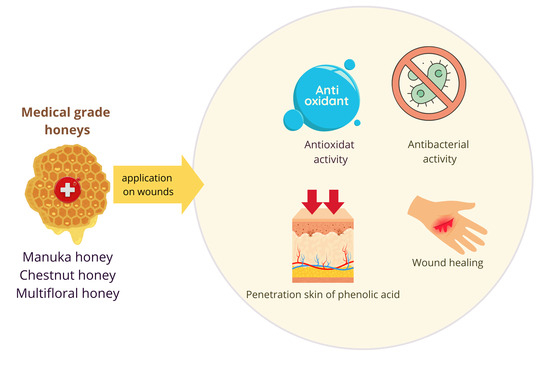
1. Introduction
2. Results
2.1. Antioxidant Activity of MGHs
2.2. HPLC Analysis of MGHs
2.3. GC–MS Analysis of MGHs
2.4. Mineral, Sugar, and Lactic Acid Content in MGHs
2.5. Cytotoxicity of MGHs
2.6. Wound Healing Properties of MGHs
2.7. Transdermal Penetration Capacity of Selected MGH Polyphenols
2.8. Antibacterial Activity of MGHs Against Wound Pathogens in the Presence of Wound Fluid
2.9. H2O2 Accumulation in MGHs in the Presence of Wound Fluid
3. Discussion
4. Materials and Methods
4.1. MGH Wound Care Products
4.2. Identification and Quantification of Phenolic Acids in MGHs
4.3. Gas Chromatography Coupled with Mass Spectrometry (GC–MS)
4.4. Determination of Mineral, Sugar, and Lactic Acid Contents
4.5. Determination of Antioxidant Activity (DPPH, ABTS) and Total Phenolic Content (TPC) of MGHs
4.6. Determination of H2O2 Content in Diluted MGHs
4.7. Determination of Antibacterial Activity of MGHs
4.8. Determination of MGHs Cytotoxicity
4.9. Wound Healing Assay
4.10. Skin Permeation Studies
4.11. Fluorescent Microscopy
4.12. Statistical Analysis
5. Conclusions
Supplementary Materials
Author Contributions
Funding
Institutional Review Board Statement
Data Availability Statement
Conflicts of Interest
References
- Ahmed, A.; Tul-Noor, Z.; Lee, D.; Bajwah, S.; Ahmed, Z.; Zafar, S.; Syeda, M.; Jamil, F.; Qureshi, F.; Zia, F.; et al. Effect of honey on cardiometabolic risk factors: A systematic review and meta-analysis. Nutr. Rev. 2023, 81, 758–774. [Google Scholar] [CrossRef] [Scilit] [PubMed]
- Gholami, Z.; Sohrabi, Z.; Zare, M.; Pourrajab, B.; Nasimi, N. The effect of honey on lipid profiles: A systematic review and meta-analysis of controlled clinical trials. Br. J. Nutr. 2022, 127, 1482–1496. [Google Scholar] [CrossRef] [Scilit]
- Yildiz Karadeniz, E.; Kaplan Serin, E. Use of honey in diabetic foot ulcer: Systematic review and meta-analysis. J. Tissue Viability 2023, 32, 270–278. [Google Scholar] [CrossRef] [Scilit] [PubMed]
- Tang, Y.; Chen, L.; Ran, X. Efficacy and safety of honey dressings in the management of chronic wounds: An updated systematic review and meta-analysis. Nutrients 2024, 16, 2455. [Google Scholar] [CrossRef] [Scilit]
- Ferraz Barbosa, B.; de Moraes, F.C.A.; Araujo Alves da Silva, B.; Bordignon Barbosa, C.; Pereira da Silva, I.; da Silva, E.R.; Barros, J.C.M.; Rebouças, L.W.C.; Dos Santos, N.P.C.; Fernandes, M.R. The use of honey for cicatrization and pain control of obstetric wounds: A systematic review and meta-analysis of randomized controlled trials. Nutrients 2024, 16, 185. [Google Scholar] [CrossRef] [Scilit]
- Peters, L.J.; Majtan, J.; Mossialos, D.; Szweda, P.; Mateescu, C.; Ozturk, F.; Wagener, F.A.; Cremers, N.A. Medical-grade honey: Its definition and refined standards. J. Wound Care 2025, 34, 412–423. [Google Scholar] [CrossRef] [Scilit]
- Majtan, J. Honey: An immunomodulator in wound healing. Wound Repair Regen. 2014, 22, 187–192. [Google Scholar] [CrossRef] [Scilit]
- Navaei-Alipour, N.; Mastali, M.; Ferns, G.A.; Saberi-Karimian, M.; Ghayour-Mobarhan, M. The effects of honey on pro-and anti-inflammatory cytokines: A narrative review. Phytother. Res. 2021, 35, 3690–3701. [Google Scholar] [CrossRef] [Scilit]
- Ahmad, A.; Khan, R.A.; Mesaik, M.A. Anti-inflammatory effect of natural honey on bovine thrombin-induced oxidative burst in phagocytes. Phytother. Res. 2009, 23, 801–808. [Google Scholar] [CrossRef] [Scilit]
- Mesaik, M.A.; Azim, M.K.; Mohiuddin, S. Honey modulates oxidative burst of professional phagocytes. Phytother. Res. 2008, 22, 1404–1408. [Google Scholar] [CrossRef] [Scilit] [PubMed]
- Atrott, J.; Henle, T. Methylglyoxal in manuka honey—Correlation with antibacterial properties. Czech J. Food Sci. 2009, 27, S163–S165. [Google Scholar] [CrossRef] [Scilit]
- Mavric, E.; Wittmann, S.; Barth, G.; Henle, T. Identification and quantification of methylglyoxal as the dominant antibacterial constituent of Manuka (Leptospermum scoparium) honeys from New Zealand. Mol. Nutr. Food Res. 2008, 52, 483–489. [Google Scholar] [CrossRef] [Scilit] [PubMed]
- Majtan, J.; Klaudiny, J.; Bohova, J.; Kohutova, L.; Dzurova, M.; Sediva, M.; Bartosova, M.; Majtan, V. Methylglyoxal-induced modifications of significant honeybee proteinous components in manuka honey: Possible therapeutic implications. Fitoterapia 2012, 83, 671–677. [Google Scholar] [CrossRef] [Scilit]
- Majtan, J.; Bohova, J.; Prochazka, E.; Klaudiny, J. Methylglyoxal may affect hydrogen peroxide accumulation in manuka honey through the inhibition of glucose oxidase. J. Med. Food 2014, 17, 290–293. [Google Scholar] [CrossRef] [Scilit] [PubMed]
- Brudzynski, K. A current perspective on hydrogen peroxide production in honey. A review. Food Chem. 2020, 332, 127229. [Google Scholar] [CrossRef] [Scilit]
- Martinotti, S.; Laforenza, U.; Patrone, M.; Moccia, F.; Ranzato, E. Honey-mediated wound healing: H2O2 entry through AQP3 determines extracellular Ca2+ Influx. Int. J. Mol. Sci. 2019, 20, 764. [Google Scholar] [CrossRef] [Scilit] [PubMed]
- Ranzato, E.; Bonsignore, G.; Patrone, M.; Martinotti, S. Endothelial and vascular health: A tale of honey, H2O2 and calcium. Cells 2021, 10, 1071. [Google Scholar] [CrossRef] [Scilit]
- Nowak, A.; Muzykiewicz-Szymańska, A.; Perużyńska, M.; Kucharska, E.; Kucharski, Ł.; Jakubczyk, K.; Niedźwiedzka-Rystwej, P.; Stefanowicz-Hajduk, J.; Droździk, M.; Majtan, J. Assessment of in vitro skin permeation and accumulation of phenolic acids from honey and honey-based pharmaceutical formulations. BMC Complement. Med. Ther. 2025, 25, 43. [Google Scholar] [CrossRef] [Scilit]
- Działo, M.; Mierziak, J.; Korzun, U.; Preisner, M.; Szopa, J.; Kulma, A. The potential of plant phenolics in prevention and therapy of skin disorders. Int. J. Mol. Sci. 2016, 17, 160. [Google Scholar] [CrossRef] [Scilit]
- Mphande, A.N.; Killowe, C.; Phalira, S.; Jones, H.W.; Harrison, W.J. Effects of honey and sugar dressings on wound healing. J. Wound Care 2007, 16, 317–319. [Google Scholar] [CrossRef] [Scilit] [PubMed]
- ISO 10993-5:2009; Biological Evaluation of Medical Devices—Part 5: Tests for In Vitro Cytotoxicity. International Organization for Standardization: Geneva, Switzerland, 2009; p. 34.
- Tlak Gajger, I.; Dar, S.A.; Ahmed, M.M.M.; Aly, M.M.; Vlainić, J. Antioxidant capacity and therapeutic applications of honey: Health benefits, antimicrobial activity and food processing roles. Antioxidants 2025, 14, 959. [Google Scholar] [CrossRef] [Scilit] [PubMed]
- Nakai, K.; Tsuruta, D. What are reactive oxygen species, free radicals, and oxidative stress in skin diseases? Int. J. Mol. Sci. 2021, 22, 10799. [Google Scholar] [CrossRef] [Scilit] [PubMed]
- Gośliński, M.; Nowak, D.; Kłębukowska, L. Antioxidant properties and antimicrobial activity of manuka honey versus Polish honeys. J. Food Sci. Technol. 2020, 57, 1269–1277. [Google Scholar] [CrossRef] [Scilit]
- Anand, S.; Pang, E.; Livanos, G.; Mantri, N. Characterization of physico-chemical properties and antioxidant capacities of bioactive honey produced from Australian grown Agastache rugosa and its correlation with colour and poly-phenol content. Molecules 2018, 23, 108. [Google Scholar] [CrossRef] [Scilit] [PubMed]
- Alvarez-Suarez, J.M.; Gasparrini, M.; Forbes-Hernández, T.Y.; Mazzoni, L.; Giampieri, F. The composition and biological activity of honey: A focus on manuka honey. Foods 2014, 3, 420–432. [Google Scholar] [CrossRef] [Scilit]
- Pentoś, K.; Łuczycka, D.; Oszmiański, J.; Lachowicz, S.; Pasternak, G. Polish honey as a source of antioxidants—A comparison with Manuka honey. J. Apic. Res. 2020, 59, 939–945. [Google Scholar] [CrossRef] [Scilit]
- Alvarez-Suarez, J.M.; Giampieri, F.; Cordero, M.; Gasparrini, M.; Forbes-Hernández, T.Y.; Mazzoni, L.; Afrin, S.; Beltrán-Ayala, P.; González-Paramás, A.M.; Santos-Buelga, C.; et al. Activation of AMPK/Nrf2 signalling by Manuka honey protects human dermal fibroblasts against oxidative damage by improving antioxidant response and mitochondrial function promoting wound healing. J. Funct. Foods 2016, 25, 38–49. [Google Scholar] [CrossRef] [Scilit]
- Deng, J.; Liu, R.; Lu, Q.; Hao, P.; Xu, A.; Zhang, J.; Tan, J. Biochemical properties, antibacterial and cellular antioxidant activities of buckwheat honey in comparison to manuka honey. Food Chem. 2018, 252, 243–249. [Google Scholar] [CrossRef] [Scilit]
- Majewska, E.; Drużyńska, B.; Derewiaka, D.; Ciecierska, M.; Pakosz, P. Comparison of antioxidant properties and color of selected Polish honeys and manuka honey. Foods 2024, 13, 2666. [Google Scholar] [CrossRef] [Scilit]
- Afrin, S.; Gasparrini, M.; Forbes-Hernández, T.Y.; Cianciosi, D.; Reboredo-Rodriguez, P.; Manna, P.P.; Battino, M.; Giampieri, F. Protective effects of Manuka honey on LPS-treated RAW 264.7 macrophages. Part 1: Enhancement of cellular viability, regulation of cellular apoptosis and improvement of mitochondrial functionality. Food Chem. Toxicol. 2018, 121, 203–213. [Google Scholar] [CrossRef] [Scilit]
- Yao, L.; Datta, N.; Tomás-Barberán, F.A.; Ferreres, F.; Martos, I.; Singanusong, R. Flavonoids, phenolic acids and abscisic acid in Australian and New Zealand Leptospermum honeys. Food Chem. 2003, 81, 159–168. [Google Scholar] [CrossRef] [Scilit]
- Yang, D.J.; Moh, S.H.; Son, D.H.; You, S.; Kinyua, A.W.; Ko, C.M.; Song, M.; Yeo, J.; Choi, Y.H.; Kim, K.W. Gallic acid promotes wound healing in normal and hyperglucidic conditions. Molecules 2016, 21, 899. [Google Scholar] [CrossRef] [Scilit]
- Yang, C.; Zhang, Y.; Zhang, X.; Tang, P.; Zheng, T.; Ran, R.; Li, G. An injectable, self-healing, and antioxidant collagen- and hyaluronic acid-based hydrogel mediated with gallic acid and dopamine for wound repair. Carbohydr. Polym. 2023, 320, 121231. [Google Scholar]
- Chitra, G.; Selvi, M.S.; Franklin, D.S.; Sudarsan, S.; Sakthivel, M.; Guhanathan, S. pH-sensitive biopolymeric hydrogel-based on indole-3-acetic acid for wound healing and anti-cancer applications. SN Appl. Sci. 2019, 1, 1641. [Google Scholar] [CrossRef] [Scilit]
- Zi Yun, C.; Mohd Nor, N.; Berahim, Z.; Thirumulu Ponnuraj, K. Cytotoxic evaluation of Malaysian kelulut honey on human gingival fibroblast cell line using MTT assay. J. Dent. Indones. 2021, 28, 88–93. [Google Scholar]
- Liang, C.C.; Park, A.Y.; Guan, J.L. In vitro scratch assay: A convenient and inexpensive method for analysis of cell migration in vitro. Nat. Protoc. 2007, 2, 329–333. [Google Scholar] [CrossRef] [Scilit] [PubMed]
- Ranzato, E.; Martinotti, S.; Burlando, B. Epithelial mesenchymal transition traits in honey-driven keratinocyte wound healing: Comparison among different honeys. Wound Repair Regen. 2012, 20, 778–785. [Google Scholar] [PubMed]
- Ranzato, E.; Martinotti, S.; Burlando, B. Honey exposure stimulates wound repair of human dermal fibroblasts. Burn. Trauma 2013, 1, 2321–3868. [Google Scholar] [CrossRef] [Scilit]
- Nurul Syazana, M.S.; Halim, A.S.; Gan, S.H.; Shamsuddin, S. Antiproliferative effect of methanolic extraction of tualang honey on human keloid fibroblasts. BMC Complement. Altern. Med. 2011, 11, 82. [Google Scholar] [CrossRef] [Scilit] [PubMed]
- Yoshino, Y.; Teruya, T.; Miyamoto, C.; Hirose, M.; Endo, S.; Ikari, A. Unraveling the mechanisms involved in the beneficial effects of magnesium treatment on skin wound healing. Int. J. Mol. Sci. 2024, 25, 4994. [Google Scholar] [CrossRef] [Scilit]
- Marunaka, K.; Shu, S.; Kobayashi, M.; Goto, M.; Katsuta, Y.; Yoshino, Y.; Ikari, A. Elevation of hyaluronan synthase by magnesium supplementation mediated through the activation of GSK3 and CREB in human keratinocyte-derived HaCaT cells. Int. J. Mol. Sci. 2021, 23, 71. [Google Scholar] [CrossRef] [Scilit] [PubMed]
- Shaikh-Kader, A.; Houreld, N.N.; Rajendran, N.K.; Abrahamse, H. The link between advanced glycation end products and apoptosis in delayed wound healing. Cell Biochem. Funct. 2019, 37, 432–442. [Google Scholar] [CrossRef] [Scilit]
- Sassi-Gaha, S.; Loughlin, D.T.; Kappler, F.; Schwartz, M.L.; Su, B.; Tobia, A.M.; Artlett, C.M. Two dicarbonyl compounds, 3-deoxyglucosone and methylglyoxal, differentially modulate dermal fibroblast. Matrix Biol. 2010, 29, 127–134. [Google Scholar] [CrossRef] [Scilit]
- Majtan, J. Methylglyoxal-a potential risk factor of manuka honey in healing of diabetic ulcers. Evid. Based Complement. Alternat. Med. 2011, 2011, 295494. [Google Scholar] [CrossRef] [Scilit]
- Butkeviciute, A.; Ramanauskiene, K.; Kurapkiene, V.; Janulis, V. Dermal penetration studies of potential phenolic compounds ex vivo and their antioxidant activity in vitro. Plants 2022, 11, 1901. [Google Scholar] [CrossRef] [Scilit] [PubMed]
- Zilius, M.; Ramanauskienė, K.; Briedis, V. Release of propolis phenolic acids from semisolid formulations and their penetration into the human skin in vitro. Evid. Based Complement. Alternat. Med. 2013, 2013, 958717. [Google Scholar] [CrossRef] [Scilit]
- Ibrahim, S.A.; Li, S.K. Efficiency of fatty acids as chemical penetration enhancers: Mechanisms and structure enhancement relationship. Pharm. Res. 2010, 27, 115–125. [Google Scholar] [CrossRef] [Scilit]
- Kim, M.-J.; Doh, H.-J.; Choi, M.-K.; Chung, S.-J.; Shim, C.-K.; Kim, D.-D.; Kim, J.S.; Yong, C.-S.; Choi, H.-G. Skin permeation enhancement of diclofenac by fatty acids. Drug Deliv. 2008, 15, 373–379. [Google Scholar] [CrossRef] [Scilit] [PubMed]
- Žilius, M.; Ramanauskienė, K.; Juškaitė, V.; Briedis, V. Formulation of propolis phenolic acids containing microemulsions and their biopharmaceutical characterization. Evid. Based Complement. Alternat. Med. 2016, 2016, 8175265. [Google Scholar] [CrossRef] [Scilit]
- Lindsay, S.; Oates, A.; Bourdillon, K. The detrimental impact of extracellular bacterial proteases on wound healing. Int. Wound J. 2017, 14, 1237–1247. [Google Scholar] [CrossRef] [Scilit]
- Nowak, A.; Ossowicz-Rupniewska, P.; Rakoczy, R.; Konopacki, M.; Perużyńska, M.; Droździk, M.; Makuch, E.; Duchnik, W.; Kucharski, Ł.; Wenelska, K.; et al. Bacterial cellulose membrane containing Epilobium angustifolium L. extract as a promising material for the topical delivery of antioxidants to the skin. Int. J. Mol. Sci. 2021, 22, 6269. [Google Scholar] [CrossRef] [Scilit]
- Bucekova, M.; Godocikova, J.; Kohutova, L.; Danchenko, M.; Barath, P.; Majtan, J. Antibacterial activity and bee-derived protein content of honey as important and suitable complementary tools for the assessment of honey quality. J. Food Compost. Anal. 2023, 123, 105610. [Google Scholar] [CrossRef] [Scilit]
- Vukašinović, E.L.; Kebert, M.; Radišić, P.; Đorđievski, S.; Čelić, T.V.; Pihler, I.; Kojić, D.; Purać, J. Polyamine profiling in honey bee products: A contribution to functional nutrition. J. Food Compost. Anal. 2024, 125, 105856. [Google Scholar] [CrossRef] [Scilit]
- PN-88/A-77626; Miód Pszczeli. Dziennik Norm i Miar nr 8. Wydawnictwo Normalizacyjne Alfa: Warszawa, Poland, 1998.
- Kika, J.; Jakubczyk, K.; Ligenza, A.; Maciejewska-Markiewicz, D.; Szymczykowska, K.; Janda-Milczarek, K. Matcha green tea: Chemical composition, phenolic acids, caffeine and fatty acid profile. Foods 2024, 13, 1167. [Google Scholar] [CrossRef] [Scilit]
- Jakubczyk, K.; Melkis, K.; Maciejewska-Markiewicz, D.; Muzykiewicz-Szymańska, A.; Nowak, A.; Skonieczna-Żydecka, K. Innovative approaches to enhancing kombucha through flavour additives: A phytochemical and antioxidant analysis. Food Funct. 2025, 16, 1442–1457. [Google Scholar] [CrossRef] [Scilit] [PubMed]
- Van Den Dool, H.; Kratz, P.A. A generalization of the retention index system including linear temperature programmed gas—Liquid partition chromatography. J. Chromatogr. 1963, 11, 463–471. [Google Scholar] [CrossRef] [Scilit]
- Linstrom, J.; Mallard, W.G. NIST Chemistry WebBook NIST Standard Reference Database Number 69; NIST: Gaithersburg, MD, USA, 1997. [Google Scholar]
- Jacobi, U.; Kaiser, M.; Toll, R.; Mangelsdorf, S.; Audring, H.; Otberg, N.; Sterry, W.; Lademann, J. Porcine ear skin: An in vitro model for human skin. Skin Res. Technol. 2007, 13, 19–24. [Google Scholar] [CrossRef] [Scilit]
- Khiao In, M.; Richardson, K.C.; Loewa, A.; Hedtrich, S.; Kaessmeyer, S.; Plendl, J. Histological and functional comparisons of four anatomical regions of porcine skin with human abdominal skin. Anat. Histol. Embryol. 2019, 48, 207–217. [Google Scholar] [CrossRef] [Scilit]
- Nowak, A.; Zagórska-Dziok, M.; Ossowicz-Rupniewska, P.; Makuch, E.; Duchnik, W.; Kucharski, Ł.; Adamiak-Giera, U.; Prowans, P.; Czapla, N.; Bargiel, P.; et al. Epilobium angustifolium L. extracts as valuable ingredients in cosmetic and dermatological products. Molecules 2021, 26, 3456. [Google Scholar] [CrossRef] [Scilit] [PubMed]
- Ossowicz-Rupniewska, P.; Bednarczyk, P.; Nowak, M.; Nowak, A.; Duchnik, W.; Kucharski, Ł.; Klebeko, J.; Świątek, E.; Bilska, K.; Rokicka, J.; et al. Evaluation of the structural modification of ibuprofen on the penetration release of ibuprofen from a drug-in-adhesive matrix type transdermal patch. Int. J. Mol. Sci. 2022, 23, 7752. [Google Scholar] [CrossRef] [Scilit] [PubMed]
- Marti-Mestres, G.; Mestres, J.P.; Bres, J.; Martin, S.; Ramos, J.; Vian, L. The “in vitro” percutaneous penetration of three antioxidant compounds. Int. J. Pharm. 2007, 331, 139–144. [Google Scholar] [CrossRef] [Scilit]



| Method | MGH Type | AH | |||
|---|---|---|---|---|---|
| MH | ChH | MFH | |||
| DPPH | % | 86.74 ± 1.13 a | 84.67 ± 0.41 a | 76.20 ± 1.13 b | 3.95 ± 0.46 c |
| mg TE/g | 3.72 ± 0.08 | 3.63 ± 0.06 | 3.26 ± 0.01 | 0.12 ± 0.02 | |
| ABTS | % | 77.84 ± 1.07 a | 69.11 ± 0.65 b | 63.99 ± 1.19 c | 1.97 ± 1.36 d |
| mg TE/g | 16.45 ± 0.23 | 14.51 ± 0.14 | 13.37 ± 0.26 | 0.00 ± 0.00 | |
| PC (mg/L) | 332.56 ± 1.74 a | 358.37 ± 3.53 a | 149.93 ± 6.38 b | nd | |
| Compound (µg/g) | MGH Type | ||
|---|---|---|---|
| MH | ChH | MFH | |
| gallic acid | 101.09 ± 5.82 a | 54.21 ± 2.20 b | 8.53 ± 0.31 c |
| ellagic acid | 10.51 ± 1.41 a | 5.76 ± 0.65 b | 9.03 ± 0.63 a |
| ferulic acid | 6.41 ± 0.13 a | 3.91 ± 0.87 b | 2.93 ± 0.25 b |
| chlorogenic acid | 6.93 ± 1.64 | nd | nd |
| vanillic acid | 9.68 ± 0.44 | nd | nd |
| protocatechuic acid | 13.05 ± 0.91 b | 26.66 ± 2.40 a | 14.21 ± 2.28 b |
| gentistic acid | 6.70 ± 1.54 a | 7.23 ± 1.55 a | nd |
| caffeic acid | 4.73 ± 1.39 a | 3.30 ± 0.87 a | nd |
| p-hydroxybenzoic acid | 7.82 ± 0.58 | nd | nd |
| m-hydroxybenzoic acid | 12.59 ± 0.52 a | 13.11 ± 0.69 a | 5.72 ± 0.26 b |
| rutin | 11.77 ± 1.62 b | 16.26 ± 0.95 a | 5.91 ± 0.51 c |
| quercetin | nd | 1.95 ± 0.40 a | 2.17 ± 0.20 a |
| Time (h) | Phenolic Compound (µg/cm2) | |||||||||||
|---|---|---|---|---|---|---|---|---|---|---|---|---|
| GA | EA | FA | ChA | VA | PrA | GeA | CA | PaA | mA | Rut | Qe | |
| Manuka honey-based medical-grade honey (MH) | ||||||||||||
| 3 | 3.07 ± 0.38 | nd | nd | nd | nd | nd | 0.44 ± 0.07 | nd | nd | nd | nd | nd |
| 5 | 4.26 ± 0.60 | nd | 1.73 ± 0.16 | 3.85 ± 0.81 | nd | 1.01 ± 0.09 | 0.65 ± 0.13 | nd | nd | nd | nd | nd |
| 8 | 5.32 ± 0.74 | nd | 2.57 ± 0.26 | 9.17 ± 2.74 | nd | 1.15 ± 0.13 | 0.94 ± 0.11 | nd | nd | nd | nd | nd |
| 24 | 17.58 ± 2.16 | 4.70 ± 0.17 | 3.58 ± 0.30 | 20.35 ± 0.85 | 0.33 ± 0.04 | 5.30 ± 1.00 | 4.64 ± 0.50 | nd | 48.17 ± 2.68 | 12.28 ± 0.33 | 5.30 ± 1.00 | nd |
| Chestnut honey-based medical-grade honey (ChH) | ||||||||||||
| 3 | nd | nd | nd | nd | nd | nd | nd | nd | nd | nd | nd | nd |
| 5 | 0.78 ± 0.15 | nd | nd | nd | nd | nd | nd | nd | nd | nd | nd | nd |
| 8 | 1.57 ± 0.11 | 4.91 ± 0.33 | 2.98 ± 0.44 | nd | nd | nd | nd | nd | nd | nd | nd | nd |
| 24 | 1.90 ± 0.15 | 11.07 ± 0.45 | 4.89 ± 0.68 | nd | nd | 1.45 ± 0.32 | 2.17 ± 0.60 | nd | nd | 11.51 ± 0.28 | nd | nd |
| Multifloral honey-based medical-grade honey (MFH) | ||||||||||||
| 3 | nd | nd | nd | nd | nd | nd | nd | nd | nd | nd | nd | nd |
| 5 | nd | nd | nd | nd | nd | nd | nd | nd | nd | nd | nd | nd |
| 8 | nd | nd | nd | nd | nd | nd | nd | nd | nd | nd | nd | nd |
| 24 | nd | 6.05 ± 0.31 | 2.03 ± 0.22 | nd | nd | 0.85 ± 0.02 | nd | nd | nd | 11.25 ± 0.39 | nd | nd |
| MGH | Content of Phenolic Compounds in the Skin (µg/g of skin) | |||||||||||
|---|---|---|---|---|---|---|---|---|---|---|---|---|
| GA | EA | FA | ChA | VA | PrA | GeA | CA | PaA | mA | Rut | Qe | |
| MH | 77.50 ± 6.40 | 17.09 ± 3.22 | 7.37± 2.01 | 31.39 ± 5.46 | 0.71 ± 0.20 | 20.46 ± 1.98 | 4.13 ± 2.31 | 2.73 ± 0.76 | 39.92 ± 5.10 | 24.82 ± 1.19 | 34.68 ± 2.42 | nd |
| ChH | 7.83 ± 0.68 | 17.29 ± 1.44 | 17.46 ± 2.61 | nd | nd | 13.01 ± 1.05 | 3.73 ± 1.21 | nd | nd | 53.28 ± 6.80 | 29.23 ± 1.94 | nd |
| MFH | 3.47 ± 0.30 | 12.40 ± 1.35 | 6.83 ± 1.13 | nd | nd | 5.22 ± 0.71 | nd | nd | nd | 31.43 ± 1.00 | nd | nd |
Disclaimer/Publisher’s Note: The statements, opinions and data contained in all publications are solely those of the individual author(s) and contributor(s) and not of MDPI and/or the editor(s). MDPI and/or the editor(s) disclaim responsibility for any injury to people or property resulting from any ideas, methods, instructions or products referred to in the content. |
© 2026 by the authors. Licensee MDPI, Basel, Switzerland. This article is an open access article distributed under the terms and conditions of the Creative Commons Attribution (CC BY) license.
Share and Cite
Nowak, A.; Żwierełło, W.; Gutowska, I.; Muzykiewicz-Szymańska, A.; Kucharska, E.; Godocikova, J.; Chirkova, V.; Kucharski, Ł.; Piotrowska, K.; Jakubczyk, K.; et al. Botanical Origin-Dependent Phytochemical Profiles and Pharmaceutical Properties of Medical-Grade Honeys: Transdermal Delivery and Antibacterial Efficacy in a Wound Fluid Model. Molecules 2026, 31, 1863. https://doi.org/10.3390/molecules31111863
Nowak A, Żwierełło W, Gutowska I, Muzykiewicz-Szymańska A, Kucharska E, Godocikova J, Chirkova V, Kucharski Ł, Piotrowska K, Jakubczyk K, et al. Botanical Origin-Dependent Phytochemical Profiles and Pharmaceutical Properties of Medical-Grade Honeys: Transdermal Delivery and Antibacterial Efficacy in a Wound Fluid Model. Molecules. 2026; 31(11):1863. https://doi.org/10.3390/molecules31111863
Chicago/Turabian StyleNowak, Anna, Wojciech Żwierełło, Izabela Gutowska, Anna Muzykiewicz-Szymańska, Edyta Kucharska, Jana Godocikova, Viktoriia Chirkova, Łukasz Kucharski, Katarzyna Piotrowska, Karolina Jakubczyk, and et al. 2026. "Botanical Origin-Dependent Phytochemical Profiles and Pharmaceutical Properties of Medical-Grade Honeys: Transdermal Delivery and Antibacterial Efficacy in a Wound Fluid Model" Molecules 31, no. 11: 1863. https://doi.org/10.3390/molecules31111863
APA StyleNowak, A., Żwierełło, W., Gutowska, I., Muzykiewicz-Szymańska, A., Kucharska, E., Godocikova, J., Chirkova, V., Kucharski, Ł., Piotrowska, K., Jakubczyk, K., Szymczykowska, K., & Majtan, J. (2026). Botanical Origin-Dependent Phytochemical Profiles and Pharmaceutical Properties of Medical-Grade Honeys: Transdermal Delivery and Antibacterial Efficacy in a Wound Fluid Model. Molecules, 31(11), 1863. https://doi.org/10.3390/molecules31111863