Enhanced Removal of Erythrosine B Dye Using Chemically Modified Chitosan Beads: A Comparative Evaluation

 , , , ,
Abstract
1. Introduction
2. Results and Discussion
2.1. Characterisation of CB, CT and CS Beads
2.2. Batch Adsorption Studies on the Adsorption of ER
2.2.1. Effect of Initial pH of ER Solution
2.2.2. Effect of Agitation Period
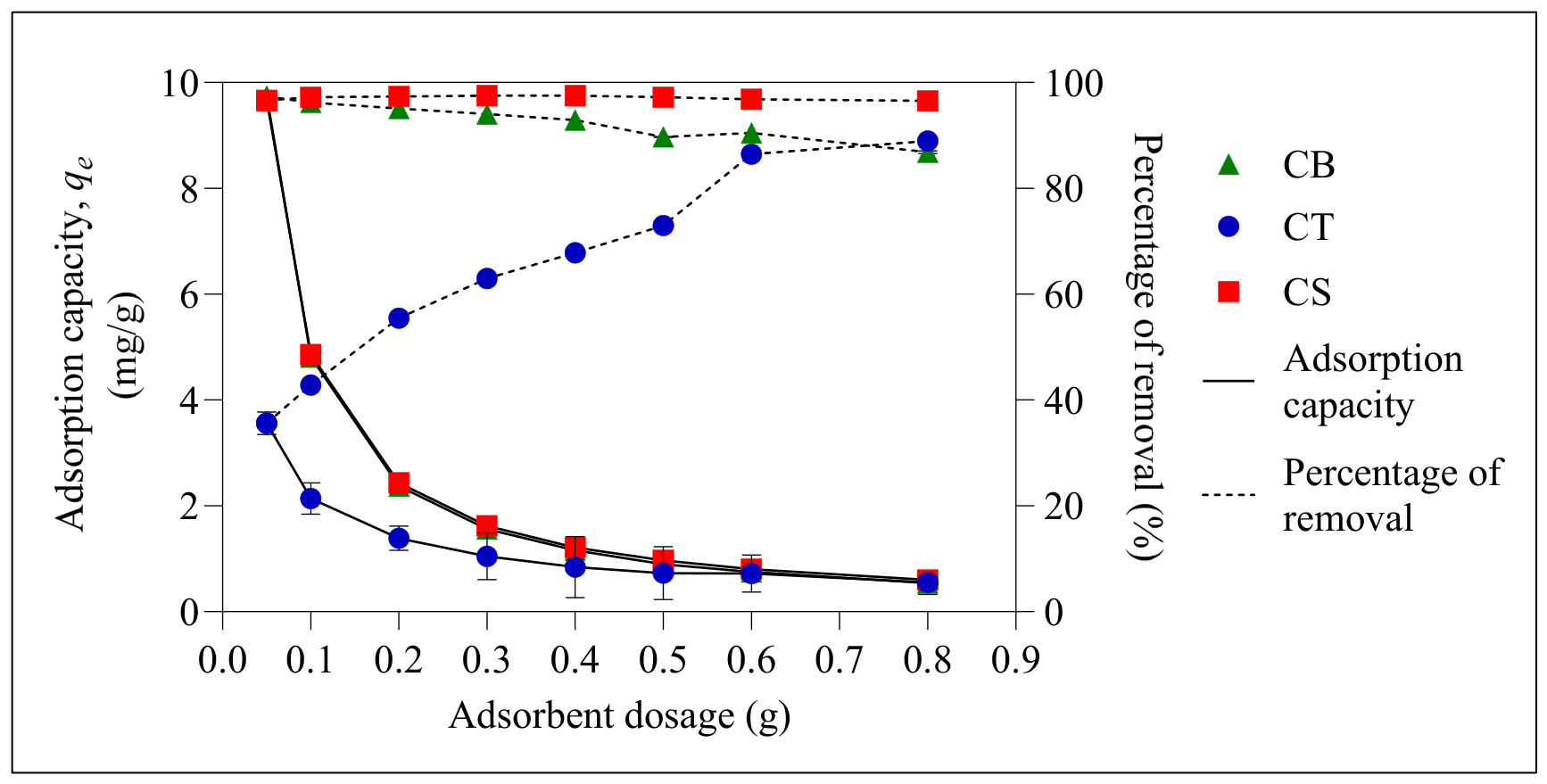
2.2.3. Effect of Adsorbent Dosage
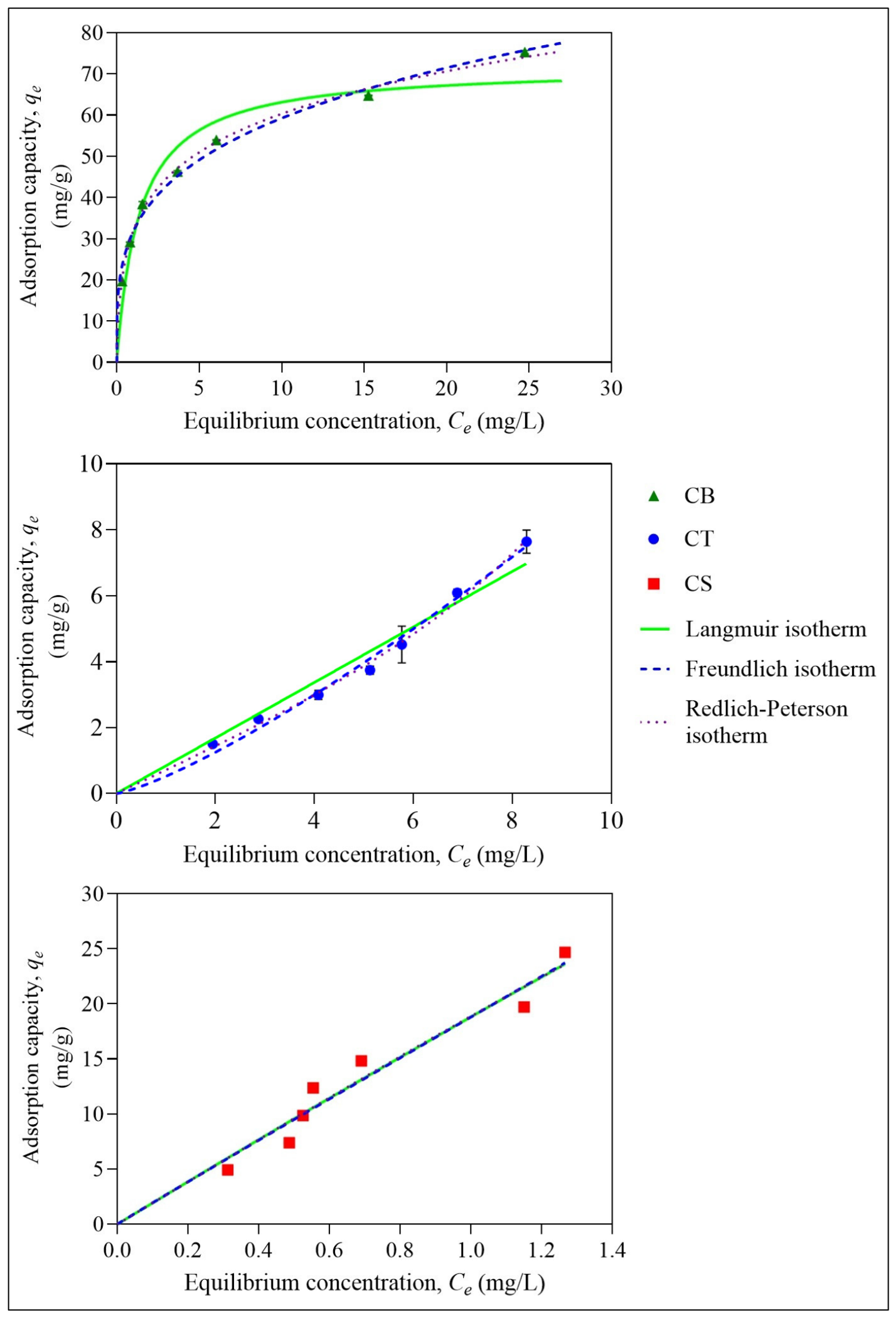
2.3. Adsorption Isotherm
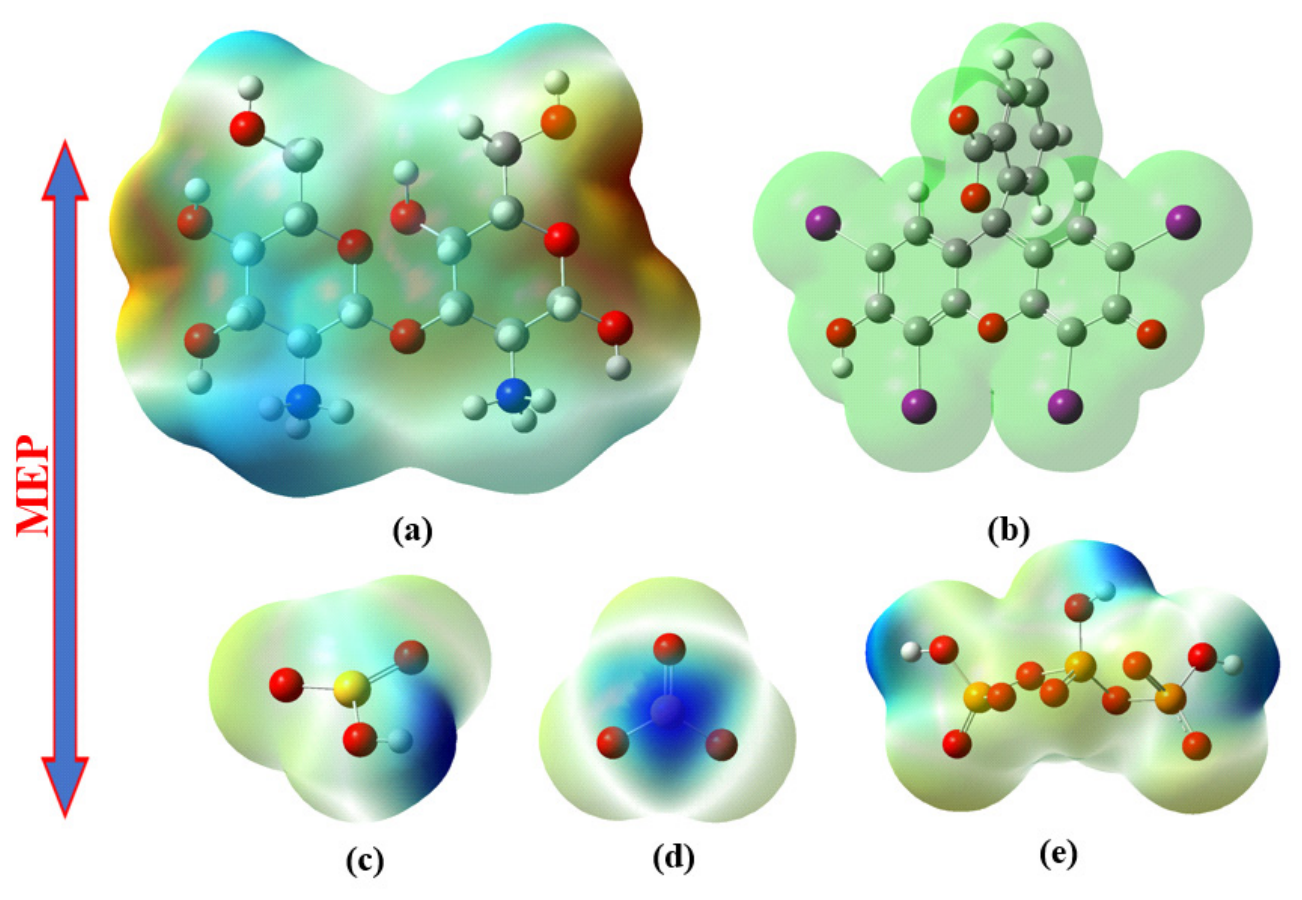
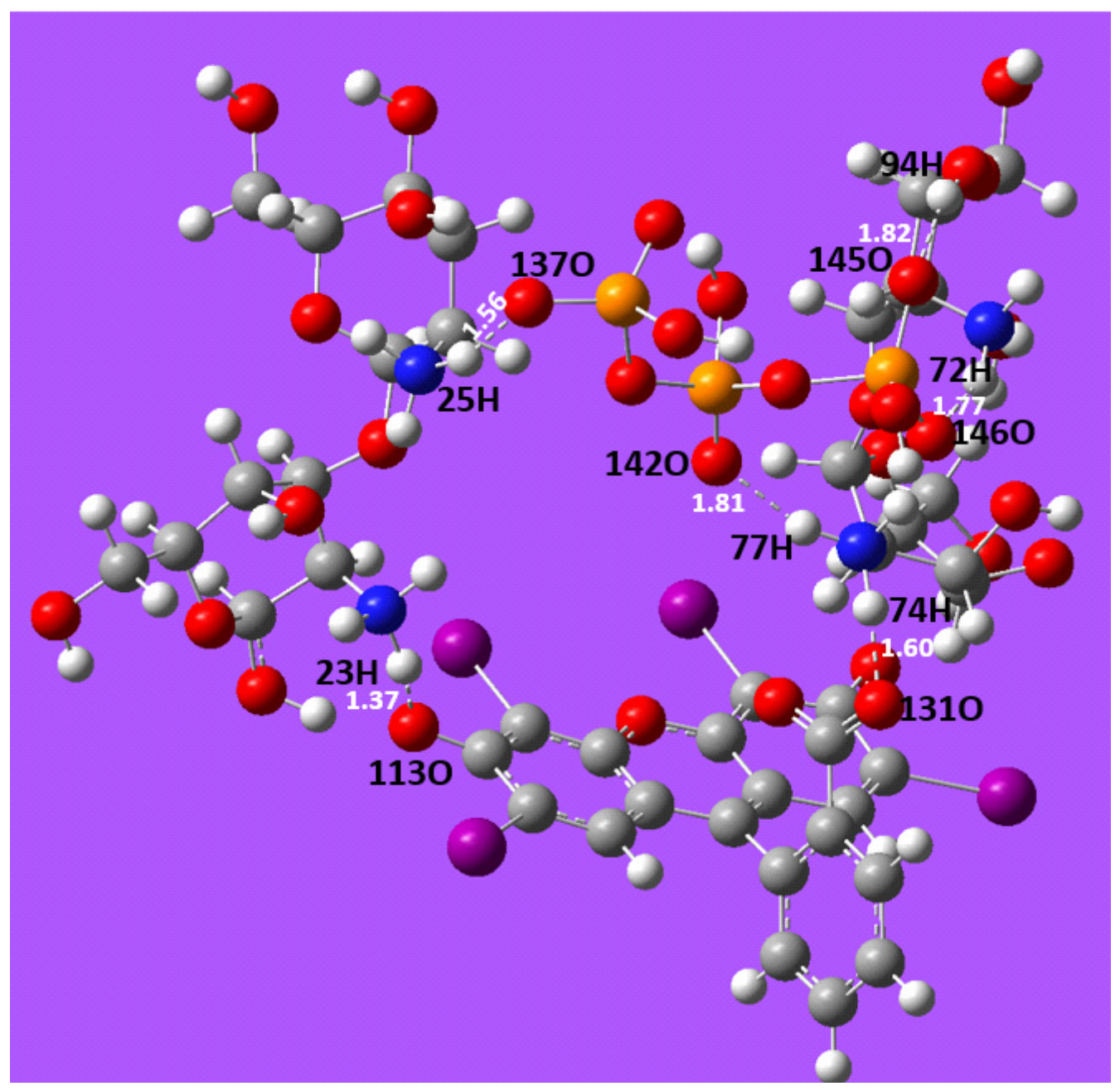
2.4. Mechanism of Adsorption
3. Materials and Methods
3.1. Materials
3.2. Preparation of Chitosan (CB) Beads
3.3. Preparation of Chitosan–Tripolyphosphate (CT) Beads
3.4. Preparation of Chitosan–Sulphite (CS) Beads
3.5. Analytical Instrumental Analyses of CB, CT and CS Beads
3.6. Batch Adsorption Experiments
4. Conclusions
Author Contributions
Funding
Institutional Review Board Statement
Informed Consent Statement
Data Availability Statement
Conflicts of Interest
References
- Zheng, S.; Bai, M.; Li, Y.; He, R.; Wang, W.; Feng, Y.; Wang, H.; Liu, F.; Fang, Z. Enhanced adsorption of xylenol orange by CTAB-functionalized tomato-derived biochar: Mechanisms and performance evaluation. Molecules 2026, 31, 708. [Google Scholar] [CrossRef]
- Uwaya, G.E.; Bisetty, K. Eco-friendly nickel-ferrite/chitosan composite for electrochemical sensing of Erythrosine B. Inorg. Chem. Commun. 2025, 178, 114512. [Google Scholar] [CrossRef]
- Parven, N.; Almani, K.F.; Bhatti, M.A.; Tahira, A.; Shah, A.A.; Nafady, A.; Tonezzer, M.; Ibupoto, Z.H. Moringa oleifera leaves extract-mediated synthesis of ZnO nanostructures for the enhanced photocatalytic oxidation of erythrosine. RSC Adv. 2025, 15, 2810. [Google Scholar] [CrossRef]
- Amchova, P.; Siska, F.; Ruda-Kucerova, J. Food safety and health concerns of synthetic food colors: An update. Toxics 2024, 12, 466. [Google Scholar] [CrossRef]
- FD&C Red No. 3, 15/01/2025. Available online: https://www.fda.gov/industry/color-additives/fdc-red-no-3 (accessed on 5 January 2026).
- Singh, M.; Chadha, P. Gastrointestinal toxicity following sub-acute exposure of erythrosine in rats: Biochemical, oxidative stress, DNA damage and histopathological studies. J. Biochem. Mol. Toxicol. 2024, 38, e70007. [Google Scholar] [CrossRef] [PubMed]
- Jennings, A.S.; Schwartz, S.L.; Balter, N.J.; Gardner, D.; Witorsch, R.J. Effects of oral erythrosine (2′,4′,5′,7′-tetraiodofluorescein) on the pituitary-thyroid axis in rats. Toxicol. Appl. Pharmacol. 1990, 103, 549. [Google Scholar] [CrossRef] [PubMed]
- Li, G.; Hsu, M.; Zhou, Y. Re-evaluation on the safety of erythrosine as a food additive: Structural mechanism comparison of the phased-out Red No. 3 and natural colorants as alternatives. Adv. Eng. Technol. Res. 2025, 15, 1844. [Google Scholar] [CrossRef]
- Kato, S.; Kansha, Y. Comprehensive review of industrial wastewater treatment techniques. Environ. Sci. Pollut. Res. 2024, 3, 51064. [Google Scholar] [CrossRef]
- Liu, C.; Crini, G.; Lichtfouse, E.; Wilson, L.D.; Picos-Corrales, L.A.; Balasubramanian, P.; Li, F. Chitosan-based materials for emerging contaminants removal: Bibliometric analysis, research progress, and directions. J. Water Process Eng. 2025, 71, 07327. [Google Scholar] [CrossRef]
- Mohanrasu, K.; Manivannan, A.C.; Rengarajan, H.J.R.; Kandaiah, R.; Ravindran, A.; Panneerselvan, L.; Palanisami, T.; Sathish, C.I. Eco-friendly biopolymers and composites: A sustainable development of adsorbents for the removal of pollutants from wastewater. NPJ Mater. Sustain. 2025, 3, 13. [Google Scholar] [CrossRef]
- Rashtbari, Y.; Afshin, S.; Hamzezadeh, A.; Gholizadeh, A.; Ansari, F.J.; Poureshgh, Y.; Fazlzadeh, M. Green synthesis of zinc oxide nanoparticles loaded on activated carbon prepared from walnut peel extract for the removal of Eosin Y and Erythrosine B dyes from aqueous solution: Experimental approaches, kinetics models, and thermodynamic studies. Environ. Sci. Pollut. Res. 2022, 29, 5194–5206. [Google Scholar] [CrossRef]
- Raheem, M.A.; Abdulnabi, Z.A.; Al-Shawi, A.A. Synthesis and characterization of multiwalled carbon nanotubes decorated by ZnO and Ag2O for using to remove Methyl Green and Erythrosin B dyes from their aqueous solutions. Ann. Chim.-Sci. Mat. 2025, 49, 83. [Google Scholar] [CrossRef]
- Pipíška, M.; Krajčíková, E.K.; Hvostik, M.; Frišták, V.; Ďuriška, L.; Černičková, I.; Kaňuchová, M.; Conte, P.; Soja, G. Biochar from wood chips and corn cobs for adsorption of Thioflavin T and Erythrosine B. Materials 2022, 15, 1492. [Google Scholar] [CrossRef]
- Umar, M.; Kadir, H.A.; Doho, A.; Mela, Y.; Garba, M.; Aliyu, A. Application of date stones on the process of removing Erythrosine dye from industrial effluents. Int. J. Environ. Chem. 2022, 6, 36–41. [Google Scholar] [CrossRef]
- Mohammadi, M.K.; Kakesh, N.; Ramtinfard, S. Adsorptive removal of Carmoisine and Erythrosine from aqueous media by Fe-Co-V nanostructure supported on zeolite. Iran. J. Chem. Eng. 2024, 4, 3596–3609. [Google Scholar]
- Mnyango, J.I.; Nyoni, B.; Phiri, C.; Fouda-Mbanga, B.G.; Amusat, S.O.; Maringa, A.; Yalala-Ndlovu, B.; Hlabano-Moyo, B.; Tywabi-Ngeva, Z.; Hlangothi, S.P. Sustainable wastewater treatment: Mechanistic, environmental, and economic insights into biochar for synthetic dye removal. Next Mater. 2025, 9, 100974. [Google Scholar] [CrossRef]
- Abd-Alla, M.H.; Hassan, E.A.; Mohammed, E.A.; Bashandy, S.R. A novel composite of chitosan and Bacillus subtilis exopolysaccharide for the removal of Methylene Blue from aqueous solutions. Sci. Rep. 2026, 16, 6349. [Google Scholar] [CrossRef]
- Karimlar, S.; Pirbalouti, A.G.; Teymuori, Z.; Moslehishad, M.; Hamidi-Esfahani, Z. Applications of chitosan, an eco-friendly biopolymer in agricultural systems, herbal products, and functional foods: A review. Food Sci. Nutr. 2026, 14, e71367. [Google Scholar] [CrossRef] [PubMed]
- Iqbal, F.; Upadhyay, A.; Tehrani, R.; Rowles, L.S. Evaluating environmental and economic sustainability of engineered chitosan particles for water treatment. Clean. Mater. 2025, 16, 100319. [Google Scholar] [CrossRef]
- Pandey, R.; Mathur, G. Current trends in chitosan functionalization methods and their applications. Starch-Stärke 2025, 77, 2300248. [Google Scholar] [CrossRef]
- Ehsanizadeh, S.A.; Ahmadi-Kashani, M.; Salavati-Niasari, M.; Alsultany, F.H.; Hamza, H.H. Synthesis and characterization of magnetically separable ZnFe2O4/Fe2O3/chitosan ternary nanocomposites and their application as visible nano-photocatalyst for degradation of water-soluble organic pollutants. Appl. Water Sci. 2025, 15, 144. [Google Scholar] [CrossRef]
- Şenol, Z.M.; Keskin, Z.S. Application of chitosan-alginate biocomposite for adsorption of Erythrosine B dye from wastewater: Isotherm and kinetic study. Bull. Biotechnol. 2025, 6, 1. [Google Scholar] [CrossRef]
- Agha, H.M.; Jawad, A.H. A review on the influence of crosslinking and grafting processes on the adsorptive performance of chitosan biopolymer for dyes removal. Next Bioeng. 2025, 1, 100007. [Google Scholar] [CrossRef]
- Çetinkaya, H.F.; Cebeci, M.S.; Kaya, S.; Jalbani, N.S.; Maslov, M.M.; Marzouki, R. Removal of erythrosine B dye from wastewater using chitosan boric acid composite material: Experimental and density functional theory findings. J. Phys. Org. Chem. 2023, 36, e4400. [Google Scholar] [CrossRef]
- Eser, A.; Aydemir, T.; Becerik, S.; Dinçer, A. Removal of erythrosine dye from aqueous solutions using magnetic chitosan with erythrosine as imprinted molecules. Desalin. Water Treat. 2016, 57, 17002–17010. [Google Scholar] [CrossRef]
- Babakhani, A.; Sartaj, M. Optimization of Nickel(II) adsorption by sodium tripolyphosphate crosslinked chitosan using response surface methodology (RSM). SCENV 2023, 2, 100019. [Google Scholar] [CrossRef]
- Hardi, J.; Tijsseling, T.; Takase, H.; Yoshida, M.; Shiomori, K.; Matsune, H. Chitosan-tripolyphosphate-tannic acid cryogels as a biocompatible adsorbent for the removal of Cu2+ ions. R. Soc. Open Sci. 2025, 12, 242274. [Google Scholar] [CrossRef]
- Kim, Y.H.; Kim, G.H.; Yoon, K.S.; Shankar, S.; Rhim, J.W. Comparative antibacterial and antifungal activities of sulfur nanoparticles capped with chitosan. Microb. Pathog. 2020, 144, 104178. [Google Scholar] [CrossRef] [PubMed]
- Yong, S.K.; Bolan, N.S.; Lombi, E.; Skinner, W.; Guibal, E. Sulfur-containing chitin and chitosan derivatives as trace metal adsorbents: A Review. Crit. Rev. Environ. Sci. Technol. 2013, 43, 1741. [Google Scholar] [CrossRef]
- Branca, C.; D’Angelo, G.; Crupi, C.; Khouzami, K.; Rifici, S.; Ruello, G.; Wanderlingh, U. Role of the OH and NH vibrational groups in polysaccharide-nanocomposite interactions: A FTIR-ATR study on chitosan and chitosan/clay films. Polymer 2016, 99, 614–622. [Google Scholar] [CrossRef]
- Ostrowska-Czubenko, J.; Gierszewska-Drużyńska, M. Effect of ionic crosslinking on the water state in hydrogel chitosan membranes. Carbohydr. Polym. 2009, 77, 590–598. [Google Scholar] [CrossRef]
- Sathiyabama, M.; Boomija, R.V.; Muthukumar, S.; Gandhi, M.; Salma, S.; Prinsha, T.K.; Rengasamy, B. Green synthesis of chitosan nanoparticles using tea extract and its antimicrobial activity against economically important phytopathogens of rice. Sci. Rep. 2024, 14, 7381. [Google Scholar] [CrossRef]
- Li, N.; Bai, R. Copper adsorption on chitosan–cellulose hydrogel beads: Behaviors and mechanisms. Sep. Purif. Technol. 2005, 42, 237–247. [Google Scholar] [CrossRef]
- Mamand, D.M.; Muhammad, D.S.; Aziz, S.B.; Hama, P.O.; Al-Asbahi, B.A.; Ahmed, A.A.; Hassan, J. Enhanced optical properties of chitosan polymer doped with orange peel dye investigated via UV–Vis and FTIR analysis. Sci. Rep. 2025, 15, 3232. [Google Scholar] [CrossRef]
- Pistone, A.; de Gaetano, A.; Piperopoulos, E.; Abate, C. Effect of sodium hydroxide and tripolyphosphate on curcumin release from chitosan-based macroparticles. Materials 2023, 16, 5850. [Google Scholar] [CrossRef]
- Tian, B.; Qiao, X.; Guo, S.; Li, A.; Xu, Y.; Cao, J.; Zhang, X.; Ma, D. Synthesis of β-acids loaded chitosan-sodium tripolyphosphate nanoparticle towards controlled release, antibacterial and anticancer activity. Int. J. Biol. Macromol. 2024, 257, 128719. [Google Scholar] [CrossRef]
- Sureshkumar, M.K.; Das, D.; Mallia, M.B.; Gupta, P.C. Adsorption of uranium from aqueous solution using chitosan-tripolyphosphate (CTPP) beads. J. Hazard. Mater. 2010, 184, 65–72. [Google Scholar] [CrossRef]
- Yang, S.; Dai, L.; Mao, L.; Liu, J.; Yuan, F.; Li, Z.; Gao, Y. Effect of sodium tripolyphosphate incorporation on physical, structural, morphological and stability characteristics of zein and gliadin nanoparticles. Int. J. Biol. Macromol. 2019, 136, 653–660. [Google Scholar] [CrossRef]
- Latupeirissa, J.; Tanasale, M.F.; Fransina, E.G.; Hattu, N.; Pada, S.S.; Sopamena, H.L. Synthesis and characterization of tripolyphosphate chitosans through a crosslinking process from high chemical weight chitosans. J. Penelit. Pendidik. IPA 2025, 11, 263. [Google Scholar] [CrossRef]
- Shankar, S.; Pangeni, R.; Park, J.W.; Rhim, J.-W. Preparation of sulfur nanoparticles and their antibacterial activity and cytotoxic effect. Mater. Sci. Eng. C 2018, 92, 508. [Google Scholar] [CrossRef]
- Ji, X.; Guo, M.; Zhu, L.; Du, W.; Wang, H. Synthesis mechanism of an environment-friendly sodium lignosulfonate/chitosan medium-density fiberboard adhesive and response of bonding performance to synthesis mechanism. Materials 2020, 13, 5697. [Google Scholar] [CrossRef]
- Ngamsurach, P.; Namwongsa, N.; Praipipat, P. Synthesis of powdered and beaded chitosan materials modified with ZnO for removing lead (II) ions. Sci. Rep. 2022, 12, 17184. [Google Scholar] [CrossRef]
- Salih, S.J.; Kareem, A.S.A.; Anwer, S.S. Adsorption of anionic dyes from textile wastewater utilizing raw corncob. Heliyon 2022, 8, e10092. [Google Scholar] [CrossRef] [PubMed]
- Salem, H.; Abdelaziz, A.; Saied, O.; Amir, M.; Sadik, M.M.; Khalid, N.; Mohsen, N.; Mazen, D.Z. Utility of green chemistry for spectrofluorometric and spectrophotometric analysis of vericiguat via reaction with erythrocin B. BMC Chem. 2025, 19, 118. [Google Scholar] [CrossRef]
- Groeneveld, I.; Kanelli, M.; Ariese, F.; van Bommel, M.R. Parameters that affect the photodegradation of dyes and pigments in solution and on substrate–An overview. Dyes Pigm. 2023, 210, 110999. [Google Scholar] [CrossRef]
- Wang, Y.; Zheng, X.; Wang, Z.; Shi, Z.; Kong, Z.; Zhong, M.; Xue, J.; Zhang, Y. Effects of –COOH and –NH2 on adsorptive polysaccharide fouling under varying pH conditions: Contributing factors and underlying mechanisms. J. Membr. Sci. 2021, 621, 118933. [Google Scholar] [CrossRef]
- Rohindra, D.R.; Nand, A.V.; Khurma, J.R. Swelling properties of chitosan hydrogels. SPJNS 2004, 22, 32–35. [Google Scholar] [CrossRef]
- Behroozi, A.H.; Champagne, P.; Mekonnen, T.H.; Koupaie, E. Selective removal of anionic contaminants via porous polyethylene glycol-templated chitosan aerogel beads. Sep. Purif. Technol. 2025, 387, 136657. [Google Scholar] [CrossRef]
- Lee, H.; Fiore, S.; Berruti, F. Adsorption of methyl orange and methylene blue on activated biocarbon derived from birchwood pellets. Biomass Bioenerg. 2024, 191, 107446. [Google Scholar] [CrossRef]
- Al-Musawi, T.J.; Almajidi, Y.Q.; Al-Essa, E.M.; Romero-Parra, R.M.; Alwaily, E.R.; Mengelizadeh, N.; Ganji, F.; Balarak, D. Levofloxacin adsorption onto MWCNTs/CoFe2O4 nanocomposites: Mechanism, and modeling using non-linear kinetics and isotherm equations. Magnetochemistry 2022, 9, 9. [Google Scholar] [CrossRef]
- Markandeya; Singh, A.; Shukla, S.P.; Mohan, D.; Singh, N.B.; Bhargava, D.S.; Shukla, R.; Pandey, G.; Yadav, V.P.; Kisku, G.C. Adsorptive capacity of sawdust for the adsorption of MB dye and designing of two-stage batch adsorber. Cogent Environ. Sci. 2015, 1, 1075856. [Google Scholar] [CrossRef]
- Revellame, E.D.; Fortela, D.L.; Sharp, W.; Hernandez, R.; Zappi, M.E. Adsorption kinetic modeling using pseudo-first order and pseudo-second order rate laws: A review. Clean. Eng. Technol. 2020, 1, 100032. [Google Scholar] [CrossRef]
- Sangoremi, A.A. Adsorption kinetic models and their applications: A critical review. Int. J. Res. Sci. Innov. 2025, 12, 245–258. [Google Scholar] [CrossRef]
- Karimifard, S.; Moghaddam, M.R.A. Removal of an anionic reactive dye from aqueous solution using functionalized multi-walled carbon nanotubes: Isotherm and kinetic studies. Desalin. Water Treat. 2016, 57, 16643–16652. [Google Scholar] [CrossRef]
- Msimango, N.M.; Makhanya, F.M.; Ntola, P.; Qwabe, L.Q. Remediation of Ni (II) using sugarcane bagasse and its chemically modified derivatives: A comparison of linear and non-linear kinetic and isotherm models. Sep. Sci. Technol. 2025, 60, 899. [Google Scholar] [CrossRef]
- Mouhamadou, S.; Dalhatou, S.; Dobe, N.; Djakba, R.; Fasanya, O.O.; Bansod, N.D.; Fita, G.; Ngayam, C.H.; Tejeogue, J.P.; Harouna, M. Linear and non-linear modelling of kinetics and equilibrium data for Cr (VI) adsorption by activated carbon prepared from Piliostigma reticulatum. Chem. Afr. 2023, 6, 719. [Google Scholar] [CrossRef]
- Huang, Y.; Lee, X.; Grattieri, M.; Macazo, F.C.; Cai, R.; Minteer, S.D. A sustainable adsorbent for phosphate removal: Modifying multi-walled carbon nanotubes with chitosan. J. Mater. Sci. 2018, 53, 12641–12649. [Google Scholar] [CrossRef]
- Kaur, S.; Rani, S.; Mahajan, R.K.; Asif, M.; Gupta, V.K. Synthesis and adsorption properties of mesoporous material for the removal of dye safranin: Kinetics, equilibrium, and thermodynamics. J. Ind. Eng. Chem. 2015, 22, 19–27. [Google Scholar] [CrossRef]
- Sahoo, T.R.; Prelot, B. Adsorption processes for the removal of contaminants from wastewater: The perspective role of nanomaterials and nanotechnology. In Nanomaterials for the Detection and Removal of Wastewater Pollutants; Bonelli, B., Freyria, F.S., Rossetti, I., Sethi, R., Eds.; Elsevier: Amsterdam, The Netherlands, 2020; pp. 161–222. [Google Scholar]
- Nagpal, M.; Sharma, N.; Mittal, A. Selective adsorptive removal and separation of harmful anionic dyes using mesoporous magnesium oxide-chitosan composite. Hybrid Adv. 2025, 9, 100393. [Google Scholar] [CrossRef]
- Tigalana, D.; Alunda, B.O.; Ondiaka, M.N.; Nibikora, I.; Bongomin, O.; Lwanyaga, J.D. Lead (II) adsorption by KOH-modified rice straw biochar from battery wastewater: Adsorption optimization, isotherm, kinetic and thermodynamic studies. Environ. Chall. 2025, 21, 101371. [Google Scholar] [CrossRef]
- Bakhtaoui, Y.; Ali, M.B.; Ouakki, M.; El Khattabi, O.; El Azzouzi, N.; Srhir, B. Efficient adsorption of methylene blue onto raw olive pomace from Moroccan industrial oil mills: Linear and nonlinear isotherm and kinetic modeling with error analysis. Next Mater. 2025, 9, 101072. [Google Scholar] [CrossRef]
- Wang, L.; Wang, S.; Pang, Y.; Guo, L.; Huang, J.; Xue, P.; Kong, L. Insights into the enhanced tetracycline adsorption by two-dimensional Cu-based metal–organic framework. Molecules 2026, 31, 911. [Google Scholar] [CrossRef] [PubMed]
- Kefas, H.M.; Luka, Y.; Abubakar, A.M.; Egbeji, A.O. Removal of iron and copper ions from water using cashew nut shell adsorbent: Langmuir, Freundlich, Redlich-Peterson and Harkin-Jura Isotherms. Indochin. Appl. Sci. 2025, 14, 255590. [Google Scholar] [CrossRef]
- Bbumba, S.; Karume, I.; Nsamba, H.K.; Kigozi, M.; Kato, M. An insight into isotherm models in physical characterization of adsorption studies. Eur. J. Appl. Sci. 2024, 12, 115–134. [Google Scholar] [CrossRef]
- Ismail, U.M.; Onaizi, S.A.; Vohra, M.S. Crystal violet removal using ZIF-60: Batch adsorption studies, mechanistic & machine learning modeling. Environ. Technol. Innov. 2024, 33, 103456. [Google Scholar] [CrossRef]
- Haroonian, P.; Ghaedi, M.; Javadian, H.; Belviso, C.; Abbasi, M. Simultaneous removal of Tartrazine and Erythrosine B using MnFe-layered double hydroxide nanoparticles modified PVDF polymer membrane. Microporous Mesoporous Mater. 2025, 389, 113569. [Google Scholar] [CrossRef]
- Mousavi, S.M.; Hashemi, S.A.; Arjmand, O.; Amani, A.M.; Babapoor, A.; Fateh, M.; Fateh, H.; Mojoudi, F.; Esmaeili, H.; Jahandideh, S. Erythrosine adsorption from aqueous solution via decorated graphene oxide with magnetic iron oxide nano particles: Kinetic and equilibrium studies. Acta Chim. Slov. 2018, 65, 882–894. [Google Scholar] [CrossRef]
- Ganthavee, V.; Trzcinski, A.P. Removal of reactive black 5 in water using adsorption and electrochemical oxidation technology: Kinetics, isotherms and mechanisms. Int. J. Environ. Sci. Technol. 2025, 22, 1083. [Google Scholar] [CrossRef]
- Guerle-Cavero, R.; Lleal-Fontàs, B.; Balfagón-Costa, A. Creation of ionically crosslinked tri-layered chitosan membranes to simulate different human skin properties. Materials 2021, 14, 1807. [Google Scholar] [CrossRef] [PubMed]
- Koukaras, E.N.; Papadimitriou, S.A.; Bikiaris, D.N.; Froudakis, G.E. Properties and energetics for design and characterization of chitosan nanoparticles used for drug encapsulation. RSC Adv. 2014, 4, 12653. [Google Scholar] [CrossRef]
- Vieira, H.H.; Toledo, J.C., Jr.; Catelan, A.; Gouveia, T.H.N.; Aguiar, F.H.B.; Lovadino, J.R.; Lima, D.A.N.L. Effect of sodium metabisulfite gel on the bond strength of dentin of bleached teeth. Eur. J. Dent. 2018, 12, 163. [Google Scholar] [CrossRef]
- Murray, J.S.; Politzer, P. The electrostatic potential: An overview. Wiley Interdiscip. Rev. Comput. Mol. Sci. 2011, 1, 153. [Google Scholar] [CrossRef]
- Snigur, D.; Fizer, M.; Chebotarev, A.; Lukianova, O.; Zhukovetska, O. Spectroscopic and computational studies of erythrosine food dye protonation in aqueous solution. Dyes Pigm. 2022, 198, 110028. [Google Scholar] [CrossRef]
- Mishra, P.C.; Kumar, A. Molecular electrostatic potentials and fields: Hydrogen bonding, recognition, reactivity and modelling. In Theoretical and Computational Chemistry; Elsevier: Amsterdam, The Netherlands, 1996; Volume 3, pp. 257–296. [Google Scholar]
- Et-tanteny, R.; Allaoui, I.; Haloui, R.; Elkhattabi, S.; Draoui, K.; El Khadiri, K. Mechanistic insights into dye adsorption on chitosan-functionalized bentonite: Synergizing experiments and computational study. Chem. Phys. Impact. 2025, 11, 100919. [Google Scholar] [CrossRef]
- Aarab, N.; Hsini, A.; Essekri, A.; Laabd, M.; Lakhmiri, R.; Albourine, A. Removal of an emerging pharmaceutical pollutant (metronidazole) using PPY-PANi copolymer: Kinetics, equilibrium and DFT identification of adsorption mechanism. Groundw. Sustain. Dev. 2020, 11, 100416. [Google Scholar] [CrossRef]
- Ye, H.L.; Liu, Y.F.; Zhang, X.H.; Di, D.L. DFT study on hydrogen-bonding adsorption mechanism of rutin onto macroporous adsorption resins functionalized with amino, hydroxyl, and carboxyl groups. Struct. Chem. 2013, 24, 1443–1449. [Google Scholar] [CrossRef]
- Guo, F.; Li, D.; Fein, J.B.; Xu, J.; Wang, Y.; Huang, Q.; Rong, X. Roles of hydrogen bond and ion bridge in adsorption of two bisphenols onto montmorillonite: An experimental and DFT study. Appl. Clay Sci. 2022, 217, 106406. [Google Scholar] [CrossRef]
- Jensen, F. Introduction to Computational Chemistry; John Wiley & Sons: Hoboken, NJ, USA, 2017. [Google Scholar]
- Hohenstein, E.G.; Sherrill, C.D. Wavefunction methods for noncovalent interactions. Wiley Interdiscip. Rev. Comput. Mol. Sci. 2012, 2, 304. [Google Scholar] [CrossRef]
- Kim, K.S.; Tarakeshwar, P.; Lee, J.Y. Molecular clusters of π-systems: Theoretical studies of structures, spectra, and origin of interaction energies. Chem. Rev. 2000, 100, 4145. [Google Scholar] [CrossRef]
- Fanaee, S.; Filiaggi, M.J. Macro bead formation based on polyelectrolyte complexation between long-chain polyphosphates and chitosan. Mater. Adv. 2023, 4, 1678–1686. [Google Scholar] [CrossRef]
- Awang Chee, D.N.; Kamaludin, N.A.; Supian, N.A.A.; Mohamad Arif, M.A.; Mohamed Amin, M.A. Sustainable synthesis of CQD-modified ZIF-8 from sago hampas for improved methylene blue dye removal. Discov. Water. 2025, 6, 13. [Google Scholar] [CrossRef]



| Adsorbents | CB | CT | CS |
|---|---|---|---|
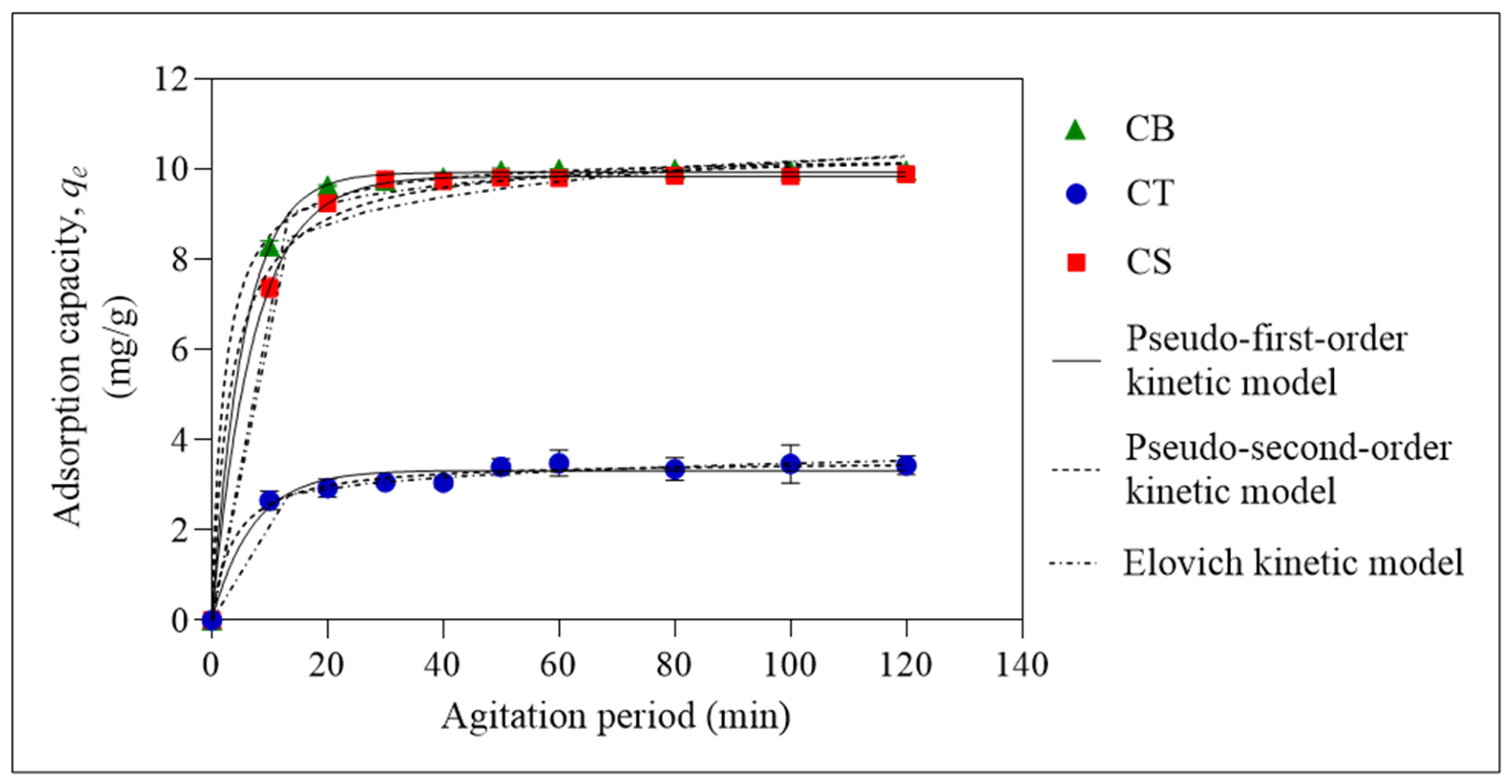
| qe,exp (mg/g) | 9.97 | 3.49 | 9.80 |
| Pseudo-first-order | |||
| qe,cal (mg/g) | 9.93 | 3.32 | 9.84 |
| k1 (min−1) | 1.79 × 10⁻¹ | 1.41 × 10⁻¹ | 1.39 × 10⁻¹ |
| R2 | 1.000 | 0.976 | 1.000 |
| RMSE | 7.221 × 10⁻² | 1.73 × 10⁻¹ | 4.59 × 10⁻² |
| Pseudo-second-order | |||
| qe,cal (mg/g) | 10.29 | 3.55 | 10.39 |
| k2 (g/mg min) | 4.70 × 10⁻² | 7.43 × 10⁻² | 2.86 × 10⁻² |
| R2 | 0.998 | 0.991 | 0.993 |
| RMSE | 1.64 × 10⁻¹ | 9.99 × 10⁻² | 2.59 × 10⁻¹ |
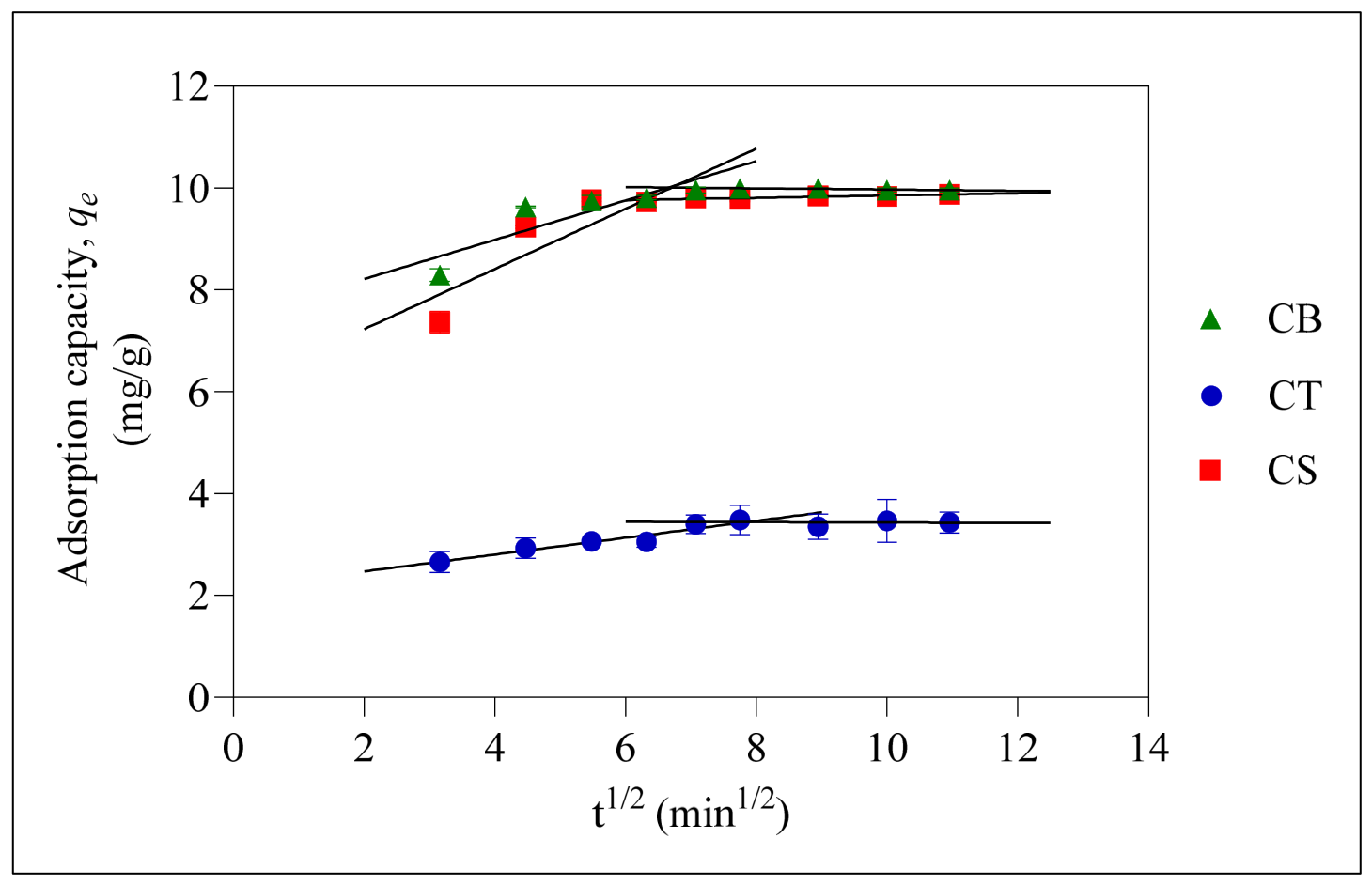
| Intraparticle diffusion | |||
| kint,1 (mg/g min½) | 3.86 × 10⁻¹ | 1.66 × 10⁻¹ | 5.92 × 10⁻¹ |
| c (mg/g) | 7.44 | 2.14 | 6.05 |
| R2 | 0.761 | 0.898 | 0.766 |
| kint,2 (mg/g min½) | −1.25 × 10⁻² | −3.80 × 10⁻³ | 2.24 × 10⁻² |
| c (mg/g) | 10.10 | 3.47 | 9.63 |
| R2 | 0.781 | 0.008 | 0.816 |
| Elovich | |||
| α (mg/g min) | 83.99 | 91.68 | 87.86 |
| β (g/mg) | 8.33 × 10⁻¹ | 2.93 | 8.59 × 10⁻¹ |
| R2 | 0.967 | 0.991 | 0.973 |
| RMSE | 5.96 × 10⁻¹ | 1.04 × 10⁻¹ | 5.43 × 10⁻¹ |
| Parameter | CB | CT | CS |
|---|---|---|---|
| Langmuir | |||
| Vm (mg/g) | 71.80 | 89.33 | 120.3 |
| bL (L/mg) | 7.28 × 10⁻¹ | 9.99 × 10⁻³ | 1.84 × 10⁻¹ |
| R2 | 0.933 | 0.943 | 0.938 |
| RMSE | 4.80 | 0.57 | 1.90 |
| Freundlich | |||
| KF (mg/g) | 31.78 | 5.22 × 10⁻¹ | 18.81 |
| n | 3.70 | 7.93 × 10⁻¹ | 1.02 |
| R2 | 0.987 | 0.986 | 0.947 |
| RMSE | 2.16 | 0.28 | 1.77 |
| Redlich–Peterson | |||
| A (L/g) | 180.20 | 22.11 | 19.27 |
| B (L/mg)1/n | 4.66 | 23.20 | 2.05 × 10⁻² |
| g | 7.93 × 10⁻¹ | 3.88 × 10⁻² | 2.32 |
| R2 | 0.996 | 0.947 | 0.947 |
| RMSE | 1.53 | 0.61 | 1.96 |
| Adsorbent | Adsorption Capacity (mg/g) | Experimental Conditions | Ref. | |
|---|---|---|---|---|
| Optimum pH | Concentration Studied (mg/L) | |||
| Fe-Co-V supported on zeolite nanostructure | 1.82 | 9 | 10–40 mg/L | [16] |
| PVDF modified with MnFe-layered double hydroxides | 6.14 | 5 | 7–19 mg/L | [68] |
| Corn cob | 7.50 | 6 | 13 to 309 mg/L | [14] |
| Carbonised dates | 9.09 | 7 | 20–300 mg/L | [15] |
| Wood chip | 25.2 | 6 | 13 to 309 mg/L | [14] |
| Chitosan without ER imprinting | 39.06 | 6 | Not provided | [26] |
| CB beads | 71.80 | 6 | 10–100 mg/L | This study |
| CT beads | 89.33 | 6 | 10–100 mg/L | This study |
| ER-imprinted magnetic chitosan | 116.27 | 6 | Not provided | [26] |
| CS beads | 120.30 | 6 | 10–100 mg/L | This study |
| Activated carbon loaded with zinc oxide | 144.92 | 3 | 50–200 mg/L | [12] |
| Decorated graphene oxide with magnetic iron oxide nanoparticles | 149.25 | 7 | 30, 35 and 40 µg/mL | [69] |
| Multiwalled carbon nanotubes decorated with zinc oxide and silver oxide | 184.94 | 3 | 100–250 mg/L | [13] |
| Chitosan–alginate biocomposite crosslinked with ECH and STPP | 319.00 | 6.5 | 10–1000 mg/L | [23] |
Disclaimer/Publisher’s Note: The statements, opinions and data contained in all publications are solely those of the individual author(s) and contributor(s) and not of MDPI and/or the editor(s). MDPI and/or the editor(s) disclaim responsibility for any injury to people or property resulting from any ideas, methods, instructions or products referred to in the content. |
© 2026 by the authors. Licensee MDPI, Basel, Switzerland. This article is an open access article distributed under the terms and conditions of the Creative Commons Attribution (CC BY) license.
Share and Cite
Mohd Nasir, F.A.; Mohd Ariff, N.R.A.; Mohd Kamal, Z.; Iqbal, M.A.; Khalid, M.; Jamil, F.; Perumal, V.; Selvarajoo, P.D.; Balan, T.; Fatinathan, S. Enhanced Removal of Erythrosine B Dye Using Chemically Modified Chitosan Beads: A Comparative Evaluation. Molecules 2026, 31, 1765. https://doi.org/10.3390/molecules31101765
Mohd Nasir FA, Mohd Ariff NRA, Mohd Kamal Z, Iqbal MA, Khalid M, Jamil F, Perumal V, Selvarajoo PD, Balan T, Fatinathan S. Enhanced Removal of Erythrosine B Dye Using Chemically Modified Chitosan Beads: A Comparative Evaluation. Molecules. 2026; 31(10):1765. https://doi.org/10.3390/molecules31101765
Chicago/Turabian StyleMohd Nasir, Fatin Aqilah, Nur Rabiatul Amierah Mohd Ariff, Zulaikha Mohd Kamal, Muhammad Adnan Iqbal, Maria Khalid, Faisal Jamil, Vikneswari Perumal, Puvana Devi Selvarajoo, Tavamani Balan, and Sharon Fatinathan. 2026. "Enhanced Removal of Erythrosine B Dye Using Chemically Modified Chitosan Beads: A Comparative Evaluation" Molecules 31, no. 10: 1765. https://doi.org/10.3390/molecules31101765
APA StyleMohd Nasir, F. A., Mohd Ariff, N. R. A., Mohd Kamal, Z., Iqbal, M. A., Khalid, M., Jamil, F., Perumal, V., Selvarajoo, P. D., Balan, T., & Fatinathan, S. (2026). Enhanced Removal of Erythrosine B Dye Using Chemically Modified Chitosan Beads: A Comparative Evaluation. Molecules, 31(10), 1765. https://doi.org/10.3390/molecules31101765