Benzyl-Modified Quinolone-Aminopyrimidine Hybrids with Potent Anti-MRSA Activity and a High Barrier to Resistance

Abstract
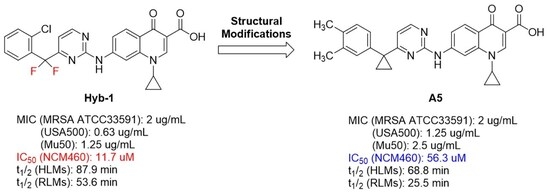
1. Introduction
Design and Chemistry
2. Results and Discussion
2.1. In Vitro Antibacterial Activities
2.1.1. Antibacterial Activities Against MRSA ATCC33591 and E. coli ATCC25922
2.1.2. Antibacterial Activities Against MRSA Strains USA500 and Mu50
2.2. Mammalian Cytotoxicity
2.3. Propensity to Induce Bacterial Resistance
2.4. Liver Microsome Lability
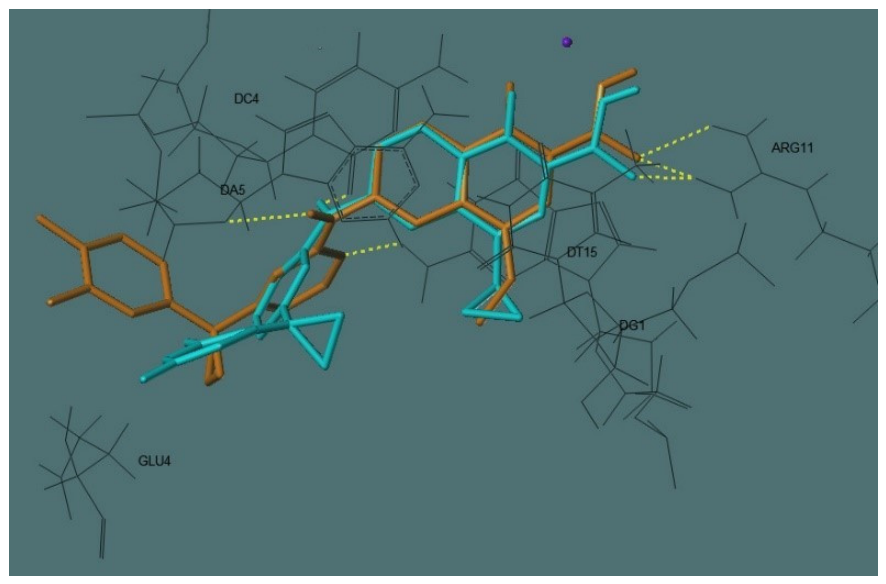
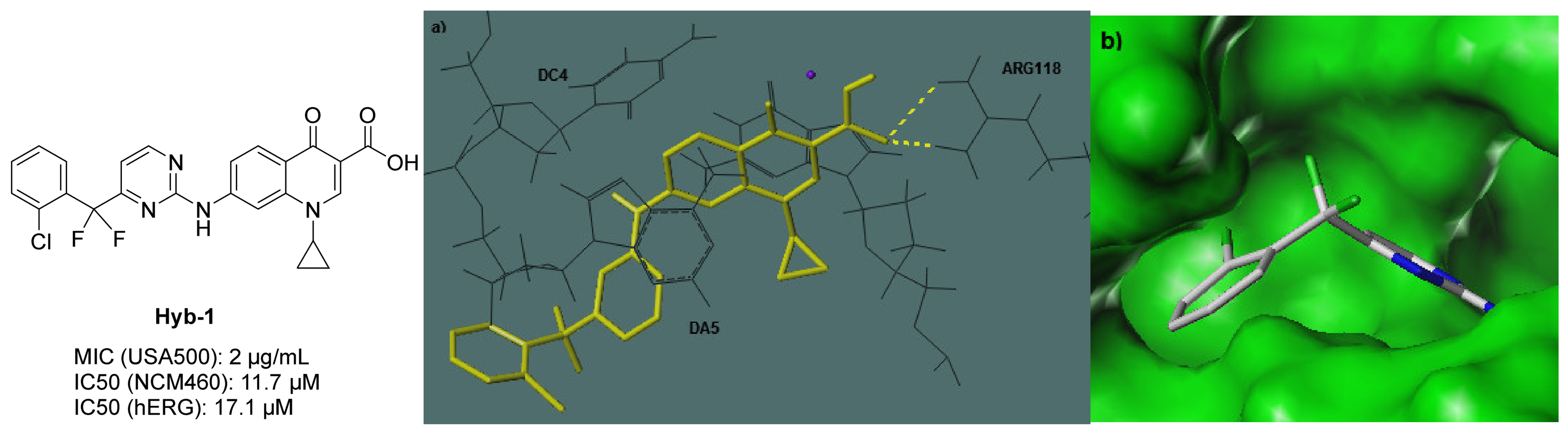
2.5. Molecular Simulation
3. Experimental Section
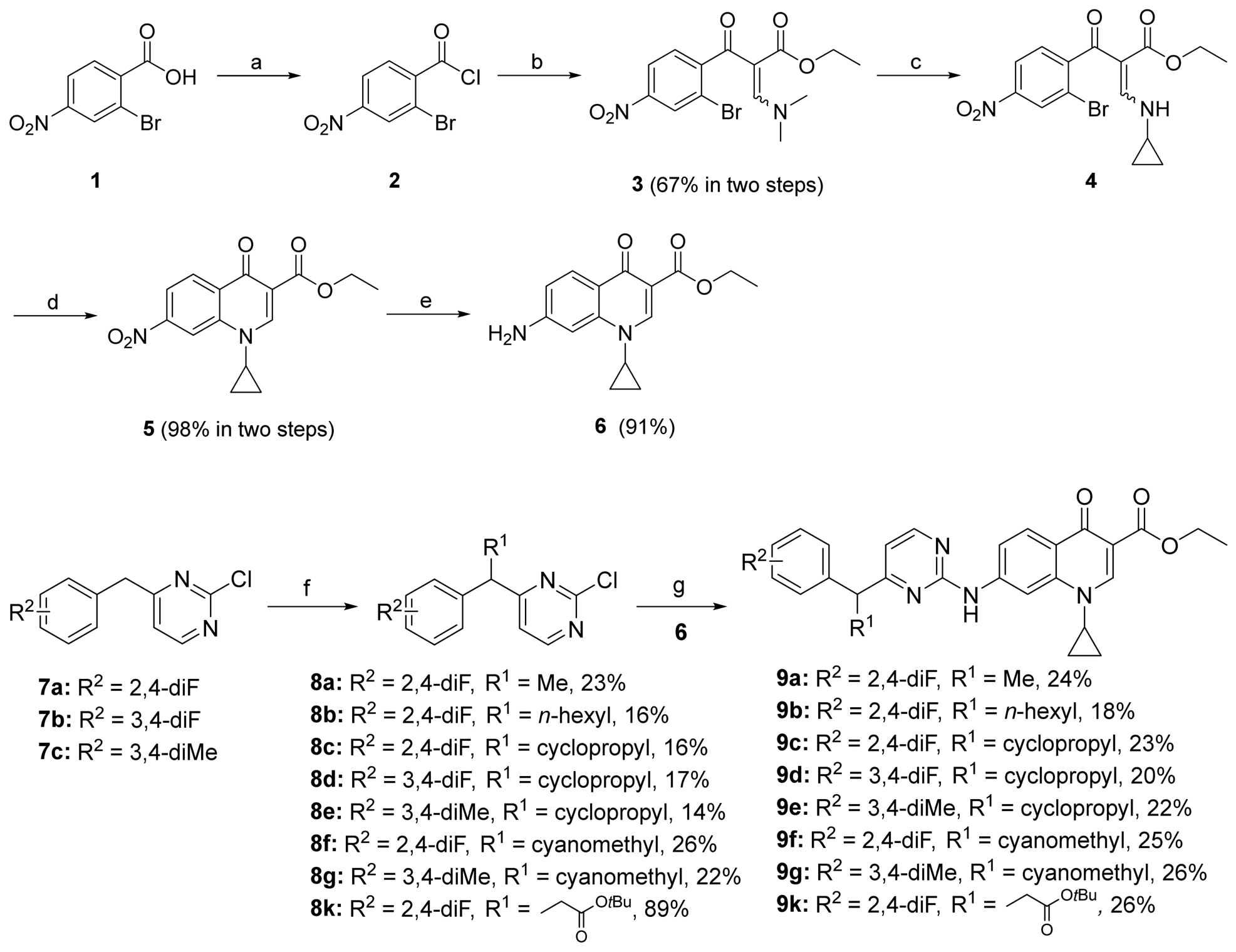
3.1. Chemistry
3.1.1. Procedure for the Synthesis of 2-Bromo-4-Nitrobenzoyl Chloride (2)
3.1.2. Procedure for the Synthesis of Ethyl 2-(2-Bromo-4-Nitrobenzoyl)-3-(Dimethylamino)acrylate (3)
3.1.3. Procedure for the Synthesis of Ethyl 1-Cyclopropyl-7-Nitro-4-Oxo-1,4-Dihydroquinoline-3-Carboxylate (5)
3.1.4. Procedure for the Synthesis of Ethyl 7-Amino-1-Cyclopropyl-4-Oxo-1,4-Dihydroquinoline-3-Carboxylate (6)
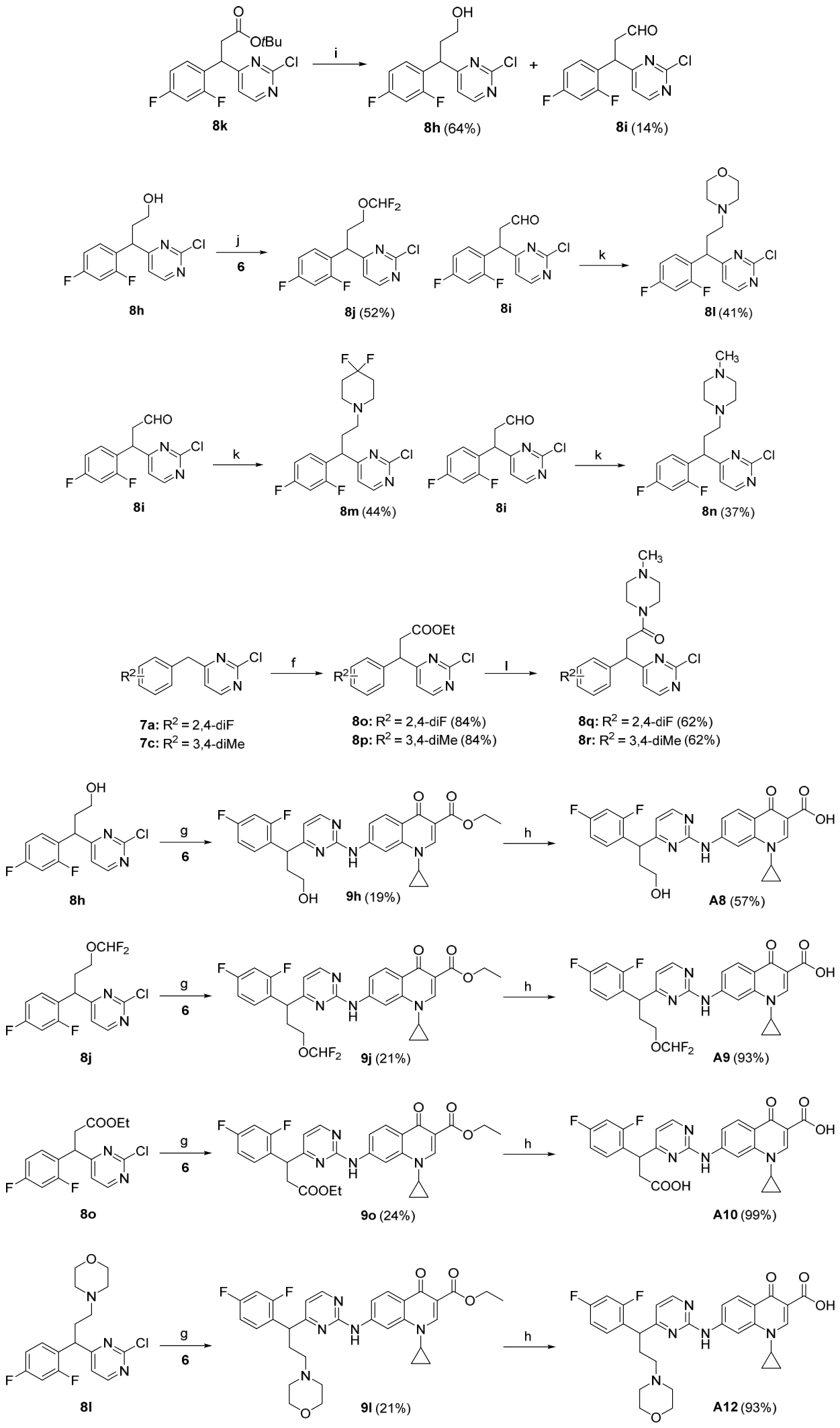
3.1.5. Procedure for the Synthesis of Benzyl-Substituted Arylpyrimidines (8a–g, 8k, 8o, 8p)
- 2-Chloro-4-(1-(2,4-difluorophenyl)ethyl)pyrimidine (8a): Yield 23%; Yellow oil; 1H NMR (400 MHz, Chloroform-d) δ 8.49 (d, J = 5.0 Hz, 1H), 7.16–7.09 (m, 2H), 7.05–7.00 (m, 2H), 4.18 (q, J = 7.2 Hz, 1H), 1.68 (d, J = 7.2 Hz, 3H).
- 2-Chloro-4-(1-(2,4-difluorophenyl)heptyl)pyrimidine (8b): Yield 16%; Colorless oil; 1H NMR (400 MHz, Chloroform-d) δ 8.50 (d, J = 5.0 Hz, 1H), 7.44–7.38 (m, 1H), 7.13 (d, J = 5.0 Hz, 1H), 6.91–6.85 (m, 1H), 6.84–6.78 (m, 1H), 4.31 (t, J = 7.2 Hz, 1H), 2.28–2.19 (m, 1H), 2.06–1.99 (m, 1H), 1.37–1.23 (m, 12H), 0.88 (t, J = 6.8 Hz, 3H).
- 2-Chloro-4-(1-(2,4-difluorophenyl)cyclopropyl)pyrimidine (8c): Yield 16%;White solid; 1H NMR (400 MHz, Chloroform-d) δ 8.29 (d, J = 5.2 Hz, 1H), 7.38–7.32 (m, 1H), 6.96–6.80 (m, 2H), 6.69 (d, J = 5.2 Hz, 2H), 1.93–1.90 (m, 2H), 1.44–1.42 (m, 2H).
- 2-Chloro-4-(1-(3,4-difluorophenyl)cyclopropyl)pyrimidine (8d): Yield 17%; White solid; 1H NMR (400 MHz, Chloroform-d) δ 8.31 (d, J = 5.2 Hz, 1H), 7.25–7.18 (m, 2H), 7.15–7.11 (m, 1H), 6.69 (d, J = 5.2 Hz, 1H), 1.89–1.87 (m, 2H), 1.47–1.44 (m, 2H).
- 2-Chloro-4-(1-(3,4-dimethylphenyl)cyclopropyl)pyrimidine (8e): Yield 14%; White solid; 1H NMR (400 MHz, Chloroform-d) δ 8.24 (d, J = 5.0 Hz, 1H), 7.19–7.10 (m, 3H), 6.74 (d, J = 5.0 Hz, 1H), 2.31 (s, 3H), 2.30 (s, 3H), 1.86–1.81 (m, 2H), 1.48–1.44 (m, 2H).
- 3-(2-chloropyrimidin-4-yl)-3-(2,4-difluorophenyl)propanenitrile (8f): Yield 26%; Orange oil; 1H NMR (400 MHz, Chloroform-d) δ 8.53 (d, J = 5.0 Hz, 1H), 7.39–7.33 (m, 1H), 7.15 (d, J = 5.0 Hz, 1H), 6.95–6.84 (m, 2H), 4.50 (t, J = 7.2 Hz, 1H), 2.77–2.67 (m, 1H), 2.45–2.34 (m, 3H).
- 4-(2-Chloropyrimidin-4-yl)-4-(3,4-dimethylphenyl)butanenitrile (8g): Yield 22%; Orange oil; 1H NMR (400 MHz, Chloroform-d) δ 8.40 (d, J = 5.0 Hz, 1H), 7.16 (d, J = 5.0 Hz, 1H), 7.09–7.01 (m, 3H), 4.10 (t, J = 7.2 Hz, 1H), 2.73–2.62 (m, 1H), 2.43–2.34 (m, 3H), 2.31 (s, 3H), 2.30 (s, 3H).
- tert-Butyl 3-(2-chloropyrimidin-4-yl)-3-(2,4-difluorophenyl) propanoate (8k): Yield 89%; Yellow oil; 1H NMR (400 MHz, Chloroform-d) δ 8.47 (d, J = 5.0 Hz, 1H), 7.31–7.22 (m, 1H), 7.11 (d, J = 5.2 Hz, 1H), 6.88–6.78 (m, 2H), 4.81 (t, J = 7.4 Hz, 1H), 3.37–3.31 (m, 1H), 2.87–2.81 (m, 1H), 1.34 (s, 9H).
- Ethyl 3-(2-chloropyrimidin-4-yl)-3-(2,4-difluorophenyl)propanoate (8o): Yield 84%; Yellow oil; 1H NMR (400 MHz, Chloroform-d) δ 8.49 (d, J = 5.0 Hz, 1H), 7.35–7.29 (m, 1H), 7.14 (d, J = 5.0 Hz, 1H), 6.90–6.78 (m, 2H), 4.90–4.86 (m, 3H), 3.51–3.44 (m, 1H), 2.96–2.90 (m, 1H), 1.20 (t, J = 7.1 Hz, 3H).
- Ethyl 3-(2-chloropyrimidin-4-yl)-3-(3,4-dimethylphenyl)propanoate (8p): Yield 84%; Yellow oil; 1H NMR (400 MHz, Chloroform-d) δ 8.44 (d, J = 5.0 Hz, 1H), 7.11–7.08 (m, 2H), 7.04–7.01 (m, 2H), 4.52 (m, 1H), 4.15 (q, J = 7.1 Hz, 2H), 3.50–3.44 (m, 1H), 2.93–2.87 (m, 1H), 2.25 (s, 3H), 2.24 (s, 3H), 1.28 (t, J = 7.1 Hz, 3H).
3.1.6. Procedure for the Synthesis of 8h and 8i
- 3-(2-Chloropyrimidin-4-yl)-3-(2,4-difluorophenyl)propan-1-ol (8h): Yield 64%; Yellow oil; 1H NMR (400 MHz, Chloroform-d) δ 8.50 (d, J = 5.0 Hz, 1H), 7.44–7.38 (m, 1H), 7.15 (d, J = 5.0 Hz, 1H), 6.93–6.89 (m, 1H), 6.85–6.80 (m, 1H), 4.62 (t, J = 7.6 Hz, 1H), 3.65 (t, J = 6.4 Hz, 2H), 2.60–2.51 (m, 1H), 2.32–2.23 (m, 1H).
- 3-(2-Chloropyrimidin-4-yl)-3-(2,4-difluorophenyl)propanal (8i): Yield 14%; colorless oil; 9.84 (s, 1H), 8.49 (d, J = 5.0 Hz, 1H), 7.31–7.25 (m, 1H), 7.14 (d, J = 5.0 Hz, 1H), 6.93–6.78 (m, 2H), 4.96 (dd, J = 9.7, 4.6 Hz, 1H), 3.81–3.74 (m, 1H), 3.06–3.00 (m, 1H).
3.1.7. Procedure for the Synthesis of 8j
- 2-Chloro-4-(3-(difluoromethoxy)-1-(2,4-difluorophenyl)propyl) pyrimidine (8j): Yield 52%; Yellow oil; 1H NMR (400 MHz, Chloroform-d) δ 8.52 (d, J = 5.2 Hz, 1H), 7.44–7.39 (m, 1H), 7.16 (d, J = 5.2 Hz, 1H), 6.92 (dt, J = 7.7, 2.7 Hz, 1H), 6.86–6.81 (m, 1H), 6.18 (t, J = 74.5 Hz, 1H), 4.57 (t, J = 7.6 Hz, 1H), 3.88–3.78 (m, 2H), 2.74–2.65 (m, 1H), 2.41–2.32 (m, 4H).
3.1.8. Procedure for the Synthesis of 8l–n
- 4-(3-(2-Chloropyrimidin-4-yl)-3-(2,4-difluorophenyl)propyl) morpholine (8l): Yield 41%; White solid; 1H NMR (400 MHz, Chloroform-d) δ 8.48 (d, J = 5.0 Hz, 1H), 7.45–7.39 (m, 1H), 7.13 (d, J = 5.0 Hz, 1H), 6.90–6.77 (m, 2H), 4.48 (t, J = 7.6 Hz, 1H), 3.72–3.69 (m, 4H), 2.61–2.52 (m, 1H), 2.48–2.40 (m, 4H), 2.38 (t, J = 7.1 Hz), 2.26–2.18 (m, 1H).
- 2-Chloro-4-(1-(2,4-difluorophenyl)-3-(4,4-difluoropiperidin-1-yl)propyl)pyrimidine (8m): Yield 44%; White solid; 1H NMR (400 MHz, Chloroform-d) δ 8.49 (d, J = 5.0 Hz, 1H), 7.45–7.39 (m, 1H), 7.13 (d, J = 5.0 Hz, 1H), 6.93–6.88 (m, 1H), 6.82 (ddd, J = 10.3, 8.8, 2.6 Hz, 1H), 4.48 (t, J = 7.1 Hz, 1H), 2.57–2.45 (m, 5H), 2.36 (m, 1H), 1.34 (t, J = 6.4 Hz, 2H), 2.20–2.12 (m, 1H), 1.99–1.90 (m, 4H).
- 2-Chloro-4-(1-(2,4-difluorophenyl)-3-(4-methylpiperazin-1-yl)propyl)pyrimidine (8n): Yield 37%; Colorless oil; 1H NMR (400 MHz, Chloroform-d) δ 8.47 (d, J = 5.0 Hz, 1H), 7.46–7.40 (m, 1H), 7.13 (d, J = 5.0 Hz, 1H), 6.93–6.88 (m, 1H), 6.79 (ddd, J = 10.3, 8.7, 5.2 Hz, 1H), 4.44 (t, J = 7.2 Hz, 1H), 2.54–2.32 (m, 9H), 2.31 (t, J = 6.7 Hz, 2H) 2.27 (s, 3H), 2.19–2.12 (m, 1H).
3.1.9. Procedure for the Synthesis of 8q and 8r
- 3-(2-chloropyrimidin-4-yl)-3-(2,4-difluorophenyl)-1-(4-methylpiperazin-1-yl)propan-1-one (8q): Yield 62%; Colorless oil; 1H NMR (400 MHz, Chloroform-d) δ 8.47 (d, J = 5.0 Hz, 1H), 7.35–7.31 (m, 1H), 7.21 (d, J = 5.0 Hz, 1H), 6.88–6.79 (m, 2H), 5.05 (dd, J = 9.0, 4.7 Hz, 1H), 3.68–3.61 (m, 3H), 3.55–3.49 (m, 2H), 2.80–2.75 (m, 1H), 2.49–2.40 (m, 2H), 2.38–2.30 (m, 5H).
- 3-(2-chloropyrimidin-4-yl)-3-(3,4-dimethylphenyl)-1-(4-methylpiperazin-1-yl)propan-1-one (8r): Yield 62%; Yellow oil; 1H NMR (400 MHz, Chloroform-d) δ 8.40 (d, J = 5.0 Hz, 1H), 7.17 (d, J = 5.0 Hz, 1H), 7.09–7.02 (m, 3H), 4.66 (dd, J = 9.8, 4.7 Hz, 1H), 3.67–3.56 (m, 4H), 2.78–2.72 (m, 1H), 2.47–2.41 (m, 1H), 2.35–2.30 (m, 4H), 2.29 (s, 3H), 2.23 (s, 3H), 2.21 (s, 3H).
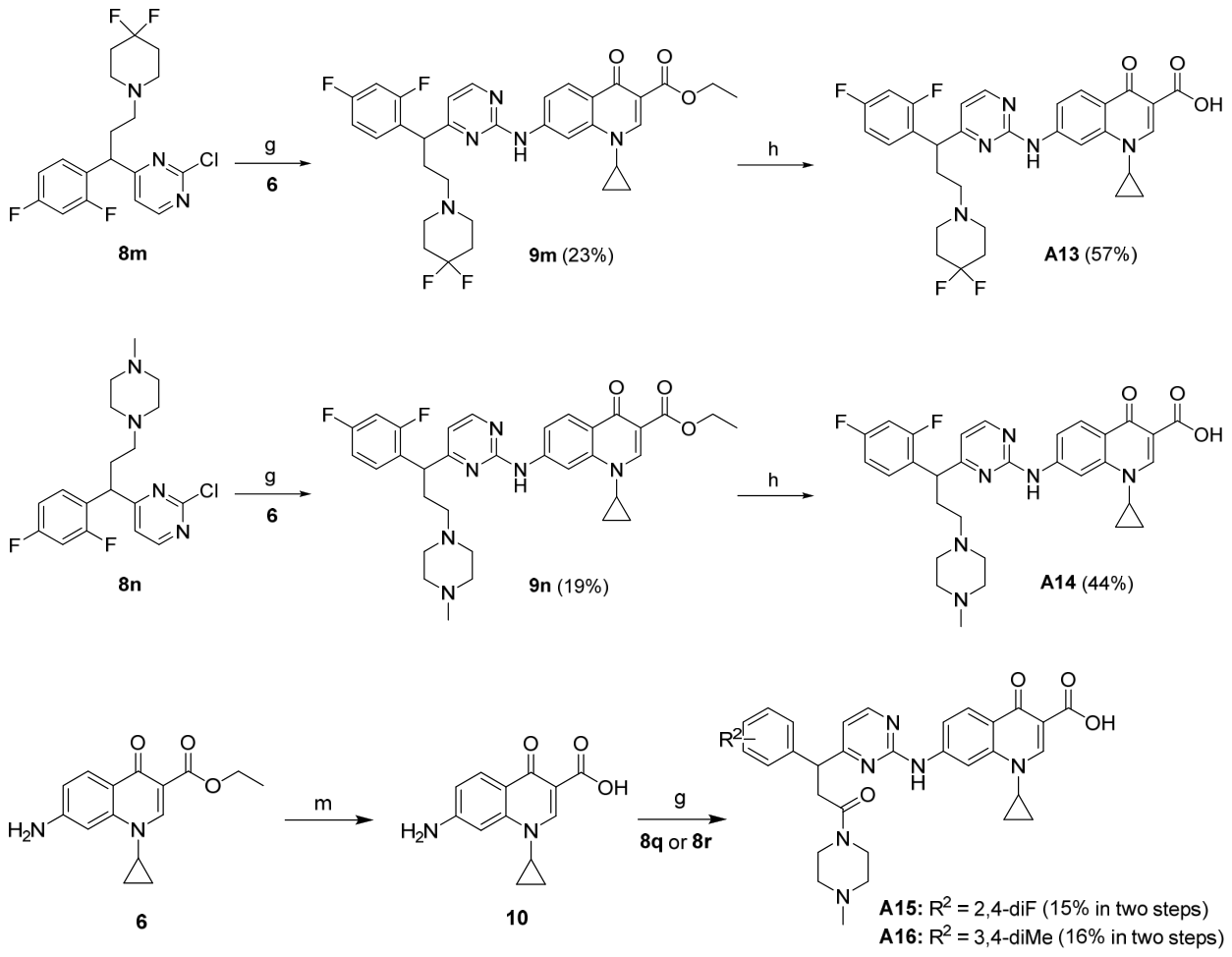
3.1.10. Procedure for the Synthesis of the Intermediate 9
- Ethyl 1-cyclopropyl-7-((4-(1-(2,4-difluorophenyl)ethyl)pyrimidin-2-yl)amino)-4-oxo-1,4-dihydroq uinoline-3-carboxylate (9a): Yield 24%; White solid; 1H NMR (400 MHz, Chloroform-d) δ 9.17 (s, 1H), 8.69 (d, J = 2.0 Hz, 1H), 8.58 (s, 1H), 8.43 (d, J = 9.0 Hz, 1H), 8.41 (d, J = 5.0 Hz, 1H), 7.64 (s, 1H), 7.45 (dd, J = 8.6, 2.0 Hz, 1H), 7.16–7.09 (m, 2H), 7.05–7.01 (m, 1H), 6.68 (d, J = 5.0 Hz, 1H), 4.41 (q, J = 7.1 Hz, 2H), 4.17–4.08 (m, 1H), 3.48–3.42 (m, 1H), 1.68 (d, J = 8.7 Hz, 3H), 1.42 (t, J = 7.1 Hz), 1.31–1.29 (m, 2H), 1.18–1.14 (m, 2H).
- Ethyl 1-cyclopropyl-7-((4-(1-(2,4-difluorophenyl)heptyl)pyrimidin-2-yl)amino)-4-oxo-1,4-dihydro quinoline-3-carboxylate (9b): Yield 18%; White solid; 1H NMR (400 MHz, Chloroform-d) 8.67 (s, 1H), 8.58 (s, 1H), 8.42 (d, J = 8.9 Hz, 1H), 8.38 (d, J = 5.2 Hz, 1H), 7.73 (s, 1H), 7.46 (dd, J = 8.8, 2.2 Hz, 1H), 7.41–7.36 (m, 1H), 6.90–6.86 (m, 1H), 6.84–6.78 (m, 1H), 6.74 (d, J = 5.0 Hz, 1H), 4.40 (q, J = 7.1 Hz, 2H), 4.26 (t, J = 7.8 Hz, 1H), 3.48–3.46 (m, 1H), 2.27–2.20 (m, 1H), 2.03–1.98 (m, 1H), 1.42 (t, J = 7.1 Hz, 3H), 1.35–1.27 (m, 10H), 1.17–1.13 (m, 2H), 0.87 (t, J = 6.9 Hz, 3H).
- Ethyl 1-cyclopropyl-7-((4-(1-(2,4-difluorophenyl)cyclopropyl)pyrimidin-2-yl)amin o)-4-oxo-1,4-di hydroquinoline-3-carboxylate (9c): Yield 23%; White solid; 1H NMR (400 MHz, Chloroform-d) δ 9.15 (s, 1H), 9.05 (s, 1H), 8.79 (d, J = 5.0 Hz, 1H), 8.51 (s, 1H), 8.30 (s, 1H), 7.94–7.88 (m, 1H), 7.27 (d, J = 5.0 Hz, 1H), 7.10–7.05 (m, 1H), 6.95–6.90 (m, 1H), 4.40 (t, J = 7.7 Hz, 2H), 3.08–3.02 (m, 1H), 1.43 (t, J = 7.7 Hz, 4H), 1.22–1.15 (m, 4H), 1.13–1.07 (m, 2H), 1.05–1.00 (m, 2H).
- Ethyl 1-cyclopropyl-7-((4-(1-(3,4-difluorophenyl)cyclopropyl)pyrimidin-2-yl)amin o)-4-oxo-1,4-di hydroquinoline-3-carboxylate (9d): Yield 20%; White solid; 1H NMR (400 MHz, Chloroform-d) δ 10.13 (s, 1H), 8.56 (s, 1H), 8.44 (s, 1H), 8.37 (d, J = 5.2 Hz, 1H), 8.07 (d, J = 8.9 Hz, 1H), 8.33 (s, 1H), 7.82 (dd, J = 9.0, 2.1 Hz, 1H), 7.53–7.43 (m, 2H), 7.29–7.26 (m, 2H), 6.38 (d, J = 5.2 Hz, 1H), 4.22 (q, J = 7.1 Hz, 2H), 3.59–3.53 (m, 1H), 1.73–1.71 (m, 2H), 1.44–1.41 (m, 2H), 1.30–1.22 (m, 5H), 1.13–1.08 (m, 2H).
- Ethyl 1-cyclopropyl-7-((4-(1-(3,4-dimethylphenyl)cyclopropyl)pyrimidin-2-yl)ami no)-4-oxo-1,4-dihydroquinoline-3-carboxylate (9e): Yield 22%; Yellow solid; 1H NMR (400 MHz, Chloroform-d) δ 8.58 (s, 1H), 8.42 (d, J = 8.8 Hz, 1H), 8.19 (d, J = 5.0 Hz, 1H), 7.61 (s, 1H), 7.42 (dd, J = 9.0, 2.2 Hz, 1H), 7.18−7.12 (m, 3H) 6.39 (d, J = 5.0 Hz, 1H), 7.11 (s, 2H), 6.98 (d, J = 4.9 Hz, 1H), 4.41 (q, J = 7.0 Hz, 2H), 3.54−3.49 (m, 1H), 2.32 (s, 3H), 2.30 (s, 3H), 2.34−2.30 (m, 1H), 2.31 (s, 3H), 2.30 (s, 3H), 1.79−1.76 (m, 2H), 1.43 (t, J = 7.0 Hz, 3H), 1.40−1.34 (m, 4H), 1.18−1.13 (m, 2H).
- Ethyl 7-((4-(3-cyano-1-(2,4-difluorophenyl)propyl)pyrimidin-2-yl)amino)-1-cyclop ropyl-4-oxo-1,4-dihydroquinoline-3-carboxylate (9f): Yield 25%; White solid; 1H NMR (400 MHz, Chloroform-d) δ 8.67 (d, J = 2.0 Hz, 1H), 8.57 (s, 1H), 8.43 (d, J = 5.0 Hz, 1H), 8.41 (s, 1H), 7.91 (s, 1H), 7.50 (dd, J = 9.0, 2.0 Hz, 1H), 7.36−7.30 (m, 1H), 6.92−6.83 (m, 2H), 6.71 (d, J = 5.0 Hz, 1H), 4.43−4.36 (m, 3H), 3.53−3.48 (m, 1H), 2.70−2.63 (m, 1H), 2.41−2.31 (m, 3H), 1.40 (t, J = 7.0 Hz, 3H), 1.37−1.32 (m, 2H), 1.18−1.12 (m, 2H).
- Ethyl 7-((4-(3-cyano-1-(3,4-dimethylphenyl)propyl)pyrimidin-2-yl)amino)-1-cyclo propyl-4-oxo-1,4-dihydroquinoline-3-carboxylate (9g): Yield 26%; White solid; 1H NMR (400 MHz, Chloroform-d) δ 8.56 (s, 1H), 8.42 (d, J = 8.8 Hz, 1H), 8.19 (d, J = 5.0 Hz, 1H), 7.59 (s, 1H), 7.41 (d, J = 9.0Hz, 1H), 7.18−7.12 (m, 3H), 6.39 (d, J = 5.0 Hz, 1H), 6.96 (d, J = 4.9 Hz, 1H), 4.41 (q, J = 7.4 Hz, 2H), 4.15 (t, J = 6.8 Hz, 1H), 3.78−3.72 (m, 1H), 2.60−2.56 (m, 1H), 2.45−2.40 (m, 2H), 2.34−2.30 (m, 1H), 2.25 (s, 3H), 2.24 (s, 3H), 1.39−1.31 (m, 5H), 1.21−1.17 (m, 2H).
- Ethyl 1-cyclopropyl-7-((4-(1-(2,4-difluorophenyl)-3-hydroxypropyl)pyrimidin-2-yl) amino)-4-oxo-1,4-dihydroquinoline-3-carboxylate (9h): Yield 19%; White solid; 1H NMR (400 MHz, Chloroform-d) δ 8.71 (s, 1H), 8.56 (s, 1H), 8.40−8.38 (m, 2H), 7.66 (s, 1H), 7.41−7.35 (m, 2H), 6.92−6.81 (m, 2H), 6.72 (d, J = 4.9 Hz, 1H), 4.56 (t, J = 7.5 Hz, 2H), 4.40 (q, J = 7.2 Hz, 2H), 3.68 (t, J = 6.2 Hz, 2H), 3.55−3.50 (m, 1H), 2.61−2.54 (m, 1H), 2.32−2.25 (m, 1H), 1.43 (t, J = 6.2 Hz, 3H), 1.37−1.33 (m, 2H), 1.16−1.12 (m, 2H).
- Ethyl 1-cyclopropyl-7-((4-(3-(difluoromethoxy)-1-(2,4-difluorophenyl)propyl)pyrimidin-2-yl)amino)-4-oxo-1,4-dihydroquinoline-3-carboxylate (9j): Yield 21%; White solid; 1H NMR (400 MHz, Chloroform-d) δ 8.91 (s, 1H), 8.65 (s, 1H), 8.56 (d, J = 5.6 Hz, 2H), 8.48 (d, J = 8.9 Hz, 1H), 8.16 (d, J = 9.0 Hz, 1H), 7.57−7.51 (m, 1H), 7.05 (d, J = 5.6 Hz, 1H), 7.01−6.98 (m, 1H), 6.90–6.84 (m, 1H), 6.22 (t, J = 76.4 Hz, 1H), 4.68 (t, J = 7.5 Hz, 1H), 4.52 (q, J = 7.1 Hz, 2H), 3.98−3.92 (m, 2H), 3.87−3.81 (m, 1H), 2.82−2.73 (m, 1H), 2.53−2.43 (m, 2H), 1.62−1.55 (m, 2H) 1.48 (t, J = 7.1 Hz, 3H), 1.27−1.23 (m, 2H).
- Ethyl 7-((4-(3-(tert-butoxy)-1-(2,4-difluorophenyl)-3-oxopropyl)pyrimidin-2-yl)amino)-1-cyclopr opyl-4-oxo-1,4-dihydroquinoline-3-carboxylate (9k): Yield 26%; Yellow oil; 1H NMR (400 MHz, Chloroform-d) δ 8.69 (s, 1H), 8.57 (s, 1H), 8.42 (d, J = 8.8 Hz, 1H), 8.37 (d, J = 5.0 Hz, 1H), 7.91 (s, 1H), 7.45 (d, J = 8.9 Hz, 1H), 7.31−7.26 (m, 1H), 6.86−6.80 (m, 2H), 6.70 (d, J = 5.0 Hz, 1H), 4.77 (t, J = 8.0 Hz, 1H), 4.38 (q, J = 7.7 Hz, 2H), 3.56−3.51 (m, 1H), 3.34−3.28 (m, 1H), 2.91−2.85 (m, 1H), 1.40 (t, J = 7.7 Hz, 1H), 1.34−1.29 (m, 11H), 1.17−1.12 (m, 2H).
- Ethyl 1-cyclopropyl-7-((4-(1-(2,4-difluorophenyl)-3-morpholinopropyl)pyramidin-2-yl)amino)-4-oxo-1,4-dihydroquinoline-3-carboxylate (9l): Yield 21%; White solid; 1H NMR (400 MHz, Chloroform-d) δ 8.63 (s, 1H), 8.57 (s, 1H), 8.42−8.39 (m, 2H), 7.75 (s, 1H), 7.48 (dd, J = 8.9, 2.1 Hz, 1H), 7.42−7.36 (m, 1H), 6.89−6.78 (m, 2H), 6.75 (d, J = 5.0 Hz, 1H), 4.42−4.37 (m, 3H), 3.68 (t, J = 4.7 Hz, 4H), 2.53−2.46 (m, 1H), 2.42−2.39 (m, 2H), 2.31 (t, J = 4.6 Hz, 4H), 2.21−2.12 (m, 1H) 1.41 (t, J = 7.1 Hz, 3H), 1.35−1.30 (m, 2H), 1.17−1.13 (m, 2H).
- Ethyl 1-cyclopropyl-7-((4-(1-(2,4-difluorophenyl)-3-(4,4-difluoropiperidin-1-yl)pro pyl)pyrimidin-2-yl)amino)-4-oxo-1,4-dihydroquinoline-3-carboxylate (9m): Yield 23%; White solid; 1H NMR (400 MHz, Chloroform-d) δ 8.63 (d, J = 2.2 Hz, 1H), 8.60 (s, 1H), 8.45 (d, J = 9.0 Hz, 1H), 8.41 (d, J =5.0 Hz, 1H), 7.57−7.46 (m, 2H), 7.42−7.35 (m, 1H), 6.91−6.80 (m, 2H), 6.76 (d, J = 5.0 Hz, 1H), 4.45−4.39 (m, 3H), 3.51−3.45 (m, 1H), 2.58−2.45 (m, 5H), 2.41−2.35 (m, 2H), 2.22−2.13 (m, 1H), 2.04−1.91 (m, 4H), 1.44 (t, J = 7.1 Hz, 3H), 1.37−1.33 (m, 2H), 1.19−1.15 (m, 2H).
- Ethyl 1-cyclopropyl-7-((4-(1-(2,4-difluorophenyl)-3-(4-methylpiperazin-1-yl)propy l)pyrimidin-2-yl)amino)-4-oxo-1,4-dihydroquinoline-3-carboxylate (9n): Yield 19%; White solid; 1H NMR (400 MHz, Chloroform-d) δ 8.64 (s, 1H), 8.59 (s, 1H), 8.44 (d, J = 8.9 Hz 1H), 8.39 (d, J = 5.0 Hz, 1H), 7.51 (d, J = 9.0 Hz, 1H), 7.40−7.34 (m, 1H), 6.90−6.74 (m, 2H), 6.75 (d, J = 5.0 Hz, 1H), 4.44−4.35 (m, 3H), 3.49−3.47 (m, 1H), 2.61−2.45 (m, 9H), 2.45−2.37 (m, 2H), 2.34 (s, 3H), 2.22−2.13 (m, 1H), 1.43 (t, J = 7.1 Hz, 3H), 1.37−1.32 (m, 2H), 1.18−1.14 (m, 2H).
- Ethyl 1-cyclopropyl-7-((4-(1-(2,4-difluorophenyl)-3-ethoxy-3-oxopropyl)pyramidin-2-yl) amino)-4-oxo-1,4-dihydroquinoline-3-carboxylate (9o): Yield 24%; White solid; 1H NMR (400 MHz, Chloroform-d) δ 8.68–8.66 (m, 1H), 8.59 (s, 1H), 8.43 (d, J = 8.8 Hz, 1H), 8.38 (d, J = 5.0 Hz, 1H), 7.70 (s, 1H), 7.45 (dd, J = 9.0, 2.2 Hz, 2H), 7.32−7.26 (m, 1H), 6.89−6.82 (m, 2H), 6.73 (d, J = 5.0 Hz, 1H), 4.36 (q, J = 6.8 Hz, 2H), 4.09 (q, J = 7.1 Hz, 2H), 3.55−3.49 (m, 1H), 3.47−3.41 (m, 1H), 2.98−2.92 (m, 1H), 1.42 (t, J = 7.1 Hz, 3H), 1.38−1.33 (m, 2H), 1.18−1.15 (m, 5H).
3.1.11. Procedure for the Synthesis of the Target Compounds A1−14
- 1-Cyclopropyl-7-((4-(1-(2,4-difluorophenyl)ethyl)pyrimidin-2-yl)amino)-4-oxo-1,4-dihydroquinoline-3-carboxylic acid (A1): Yield 97%; White solid; M.p. 256.2−256.7 °C; 1H NMR (400 MHz, DMSO-d6) δ 10.47 (s, 1H), 8.94 (s, 1H), 8.69 (s, 1H), 8.57 (d, J =5.0 Hz, 1H), 8.24 (d, J = 9.0 Hz, 1H), 7.99 (d, J = 8.8 Hz, 1H), 7.49−7.44 (m, 1H), 7.41−7.37 (m, 1H), 7.23−7.18 (m, 1H), 6.98 (d, J = 5.0 Hz, 1H), 4.28 (q, J = 7.1 Hz, 1H), 3.75−3.69 (m, 1H), 1.65 (d, J = 7.0 Hz, 3H), 1.33−1.27 (m, 2H), 1.22−1.17 (m, 2H); 13C NMR (101 MHz, DMSO-d6) δ 177.47, 173.65, 166.69, 159.75, 159.12, 149.81 (dd, J = 257.3, 11.1 Hz), 148.84, 148.72 (dd, J = 245.4, 13.2 Hz), 146.44, 142.96, 141.81 (dd, J = 5.1, 4.0 Hz), 126.78, 124.96 (dd, J = 6.1, 3.0 Hz), 119.05, 118.38, 117.91 (d, J = 17.2 Hz), 117.15 (d, J = 17.3 Hz), 112.61, 107.29, 105.01, 45.65, 36.13, 20.26, 8.10; HRMS m/z calcd for C25H24N4O3F2 [M + H]+: 463.1582, found 463.1573.
- 1-Cyclopropyl-7-((4-(1-(2,4-difluorophenyl)heptyl)pyrimidin-2-yl)amino)-4-oxo-1,4-dihydroquinoline-3-carboxylic acid (A2): Yield 96%; White solid; M.p. 215.2−216.0 °C; 1H NMR (400 MHz, DMSO-d6) δ 10.46 (s, 1H), 8.91 (s, 1H), 8.69 (s, 1H), 8.56 (d, J = 5.0 Hz, 1H), 8.23 (d, J = 9.0 Hz, 1H), 8.00 (d, J = 8.9 Hz, 1H), 7.60−7.54 (m, 1H), 7.23 (ddd, J = 10.7, 9.2, 2.6 Hz 1H), 7.14−7.09 (m, 1H), 6.97 (d, J = 5.0 Hz, 1H), 4.28 (t, J = 7.7 Hz, 1H), 3.76−3.69 (m, 1H), 2.26−2.18 (m, 1H), 2.06−1.97 (m, 1H), 1.35−1.28 (m, 4H), 1.26−1.17 (m, 8H), 0.83 (t, J = 6.8 Hz, 1H); 13C NMR (101 MHz, DMSO-d6) δ 177.47, 172.39, 166.70, 161.56 (dd, J = 246.2, 12.1 Hz), 160.70 (dd, J = 247.4, 12.1 Hz), 159.76, 159.04, 148.87, 146.43, 142.93, 130.94 (dd, J = 10.2, 6.1 Hz), 125.68, 119.06, 118.32, 112.91, 112.21 (dd, J = 20.2, 3.0 Hz), 107.28, 105.03, 104.30 (t, J = 25.6 Hz), 44.86, 36.11, 33.27, 31.52, 28.88, 27.52, 22.47, 14.34, 8.10; HRMS m/z calcd for C30H30N4O3F2 [M + H]+: 533.2365, found 533.2363.
- 1-Cyclopropyl-7-((4-(1-(2,4-difluorophenyl)cyclopropyl)pyrimidin-2-yl)amino)-4-oxo-1,4-dihydroquinoline-3-carboxylic acid (A3): Yield 97%; White solid; M.p. 156.8−157.6 °C; 1H NMR (400 MHz, DMSO-d6) δ 10.35 (s, 1H), 8.73 (s, 1H), 8.68 (s, 1H), 8.40 (d, J = 5.0 Hz, 1H), 8.19 (d, J = 8.6 Hz, 1H), 7.98 (dd, J = 8.2, 2.8 Hz, 1H), 7.59−7.53 (m, 1H), 7.33 (dt, J = 9.6, 2.7 Hz, 1H), 7.20−7.15 (m, 1H), 6.41 (d, J = 5.0 Hz, 1H), 3.77−3.72 (m, 1H), 1.80−1.78 (m, 2H), 1.45−1.42 (m, 2H), 1.36−1.31 (m, 2H), 1.23−1.19 (m, 2H); 13C NMR (101 MHz, DMSO-d6) δ 177.47, 172.98, 166.70, 162.62 (dd, J = 248.4, 13.6 Hz), 162.37 (dd, J = 245.3, 11.6 Hz), 159.69, 158.32, 148.84, 146.52, 142.88, 134.14 (dd, J = 9.2, 5.1 Hz), 126.74, 125.10 (dd, J = 15.2, 4.1 Hz), 119.03, 118.21, 112.14 (d, J = 22.2 Hz), 110.55, 107.24, 105.08, 104.68 (t, J = 26.3 Hz), 36.15, 25.96, 18.93, 8.15; HRMS m/z calcd for C26H20N4O3F2 [M + H]+: 457.1582, found 457.1583.
- 1-Cyclopropyl-7-((4-(1-(3,4-difluorophenyl)cyclopropyl)pyrimidin-2-yl)amino)-4-oxo-1,4-dihydroquinoline-3-carboxylic acid (A4): Yield 95%; White solid; M.p. 153.5−154.2 °C; 1H NMR (400 MHz, DMSO-d6) δ 10.35 (s, 1H), 8.70 (s, 1H), 8.68 (s, H), 8.40 (d, J = 4.8 Hz, 1H), 8.20 (d, J = 9.0 Hz, 1H), 7.98 (d, J = 8.8 Hz, 1H), 7.54−7.44 (m, 2H), 6.42 (d, J = 5.0 Hz, 1H), 3.79−3.69 (m, 1H), 1.77−1.69 (m, 2H), 1.48−1.41 (m, 2H), 1.36−1.30 (m, 2H), 1.22−1.16 (m, 2H); 13C NMR (101 MHz, DMSO-d6) δ 177.45, 173.54, 166.68, 159.67, 158.21, 149.76 (dd, J = 247.3, 12.2 Hz), 149.20 (dd, J = 246.5, 14.1 Hz), 148.81, 146.91, 142.89, 139.54, 128.02 (dd, J = 6.1, 3.0 Hz), 126.75, 120.19 (d, J = 16.2 Hz), 119.02, 118.20 (d, J = 11.1 Hz), 117.98, 111.76, 107.26, 104.98, 36.14, 31.01, 19.14, 8.15; HRMS m/z calcd for C26H20N4O3F2 [M + H]+: 475.1582, found 475.1583.
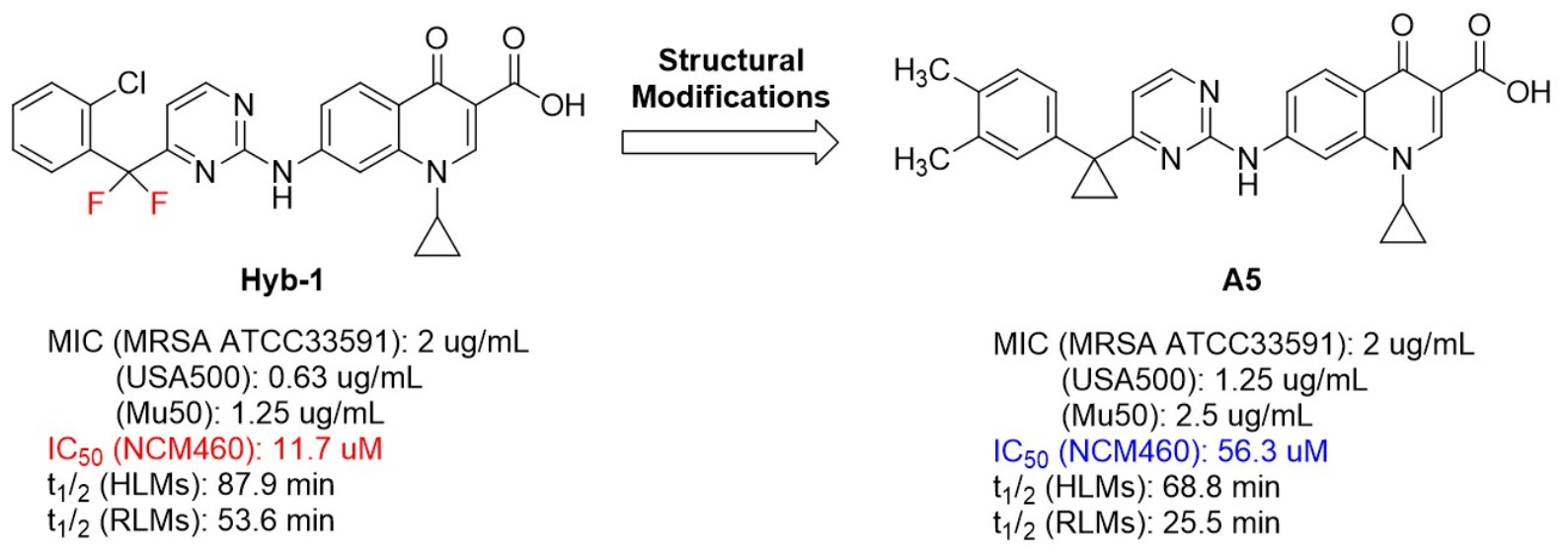
- 1-Cyclopropyl-7-((4-(1-(3,4-dimethylphenyl)cyclopropyl)pyrimidin-2-yl)amino)-4-oxo-1,4-dihydroquinoline-3-carboxylic acid (A5): Yield 87%; Yellow solid; M.p. 150.6−151.3 °C; 1H NMR (400 MHz, DMSO-d6) δ 10.09 (s, 1H), 8.72 (s, 1H), 8.63 (s, H), 8.32 (d, J = 5.1 Hz, 1H), 8.17 (d, J = 9.0 Hz, 1H), 7.81 (d, J = 8.8 Hz, 1H), 7.18−7.16 (m, 2H), 7.12 (d, J = 7.6 Hz, 1H), 6.32 (d, J = 5.2 Hz, 1H), 3.62−3.56 (m, 1H), 2.24 (s, 6H), 1.72–1.69 (m, 2H), 1.35−1.27 (m, 4H), 1.10−1.04 (m, 2H); 13C NMR (101 MHz, DMSO-d6) δ 176.81, 174.46, 166.83, 159.94, 157.87, 149.01, 144.82, 142.25, 139.18, 136.90, 135.65, 132.15, 130.21, 128.39, 127.12, 121.73, 117.13, 116.70, 111.73, 104.23, 34.72, 31.27, 19.90, 19.54, 18.69, 8.15; HRMS m/z calcd for C28H26N4O3 [M + H]+: 467.2083, found 467.2087.
- 7-((4-(3-Cyano-1-(2,4-difluorophenyl)propyl)pyrimidin-2-yl)amino)-1-cyclopropyl-4-oxo-1,4-dihydroquinoline-3-carboxylic acid (A6): Yield 77%; White solid; M.p. 231.6−232.3 °C; 1H NMR (400 MHz, DMSO-d6) δ 10.53 (s, 1H), 8.93 (d, J = 2.1 Hz, 1H), 8.70 (s, 1H), 8.59 (d, J = 5.0 Hz, 1H), 8.25 (d, J = 9.0 Hz, 1H), 8.00 (dd, J = 8.9, 2.0 Hz, 1H), 7.60–7.54 (m, 1H), 7.28 (ddd, J = 10.8, 9.2, 2.7 Hz, 1H), 7.17–7.12 (m, 1H), 6.96 (d, J = 5.0 Hz, 1H), 4.41 (t, J = 7.6 Hz, 1H), 3.78−3.72 (m, 1H), 2.64−2.54 (m, 3H), 2.39−2.30 (m, 1H), 1.36−1.31 (m, 2H), 1.23−1.18 (m, 2H); 13C NMR (101 MHz, DMSO-d6) δ 177.47, 170.67, 166.70, 161.94 (dd, J = 247.2, 13.1 Hz), 160.66 (dd, J = 247.3, 13.2 Hz), 159.77, 159.35, 148.88, 146.30, 142.93, 131.09 (dd, J = 10.1, 6.0 Hz), 126.84, 124.21 (dd, J = 13.1, 3.0 Hz), 120.41, 119.15, 118.37, 112.96, 112.48 (dd, J = 21.1, 3.0 Hz), 105.10, 104.62 (t, J = 26.3 Hz), 43.92, 36.11, 28.53, 15.30, 8.12; HRMS m/z calcd for C27H21N5O3F2 [M + H]+: 502.1691, found 502.1689.
- 1-Cyclopropyl-7-((4-(1-(3,4-difluorophenyl)cyclopropyl)pyrimidin-2-yl)amino)-6-(dimethylamino)-4-oxo-1,4-dihydroquinoline-3-carboxylic acid (A7): Yield 74%; Yellow solid; M.p. 227.5−228.1 °C; 1H NMR (400 MHz, DMSO-d6) δ 10.49 (s, 1H), 8.96 (d, J = 2.0 Hz, 1H), 8.70 (s, 1H), 8.54 (d, J = 5.0 Hz, 1H), 8.26 (d, J = 8.8 Hz, 1H), 8.01 (dd, J = 8.9, 2.2 Hz, 1H), 7.16 (s, 1H), 7.11 (s, 2H), 6.98 (d, J = 4.9 Hz, 1H), 4.05 (t, J = 7.8 Hz, 1H), 3.78−3.72 (m, 1H), 2.59−2.56 (m, 1H), 2.47−2.42 (m, 2H), 2.38−2.33 (m, 1H), 2.20 (s, 3H), 2.18 (s, 3H), 1.34−1.32 (m, 2H), 1.22−1.19 (m, 2H); 13C NMR (101 MHz, DMSO-d6) δ 177.47, 172.23, 166.69, 159.72 158.92, 148.86, 146.44, 142.99, 138.49, 137.06, 135.59, 130.34, 129.49, 126.82, 125.68, 120.62, 119.06, 118.44, 113.19, 107.31, 104.98, 51.25, 36.15, 29.27, 19.96, 19.42, 15.38, 8.16; HRMS m/z calcd for C29H27N5O3 [M + H]+: 494.2192, found 494.2197.
- 1-Cyclopropyl-7-((4-(1-(2,4-difluorophenyl)-3-hydroxypropyl) pyrimidin-2-yl)ami no)-4-oxo-1,4-dihydroquinoline-3-carboxylic acid (A8): Yield 57%; Yellow solid; M.p. 229.1−229.6 °C; 1H NMR (400 MHz, DMSO-d6) δ 10.48 (s, 1H), 8.97 (s, 1H), 8.70 (s, 1H), 8.56 (d, J = 5.0 Hz, 1H), 8.23 (d, J = 9.0 Hz, 1H), 7.96 (dd, 9.0, 1.8 Hz, 1H), 7.60−7.54 (m, 1H), 7.26−7.20 (m, 1H),7.15−7.10 (m, 1H), 6.94 (d, J = 5.0 Hz, 1H), 4.61 (t, J = 5.0 Hz, 1H), 4.51 (t, J = 7.7 Hz, 1H), 3.77−3.72 (m, 1H), 3.43−3.35 (m, 2H), 2.44−2.37 (m, 1H), 2.21−2.13 (m, 1H), 1.37−1.31 (m, 2H), 1.22−1.17 (m, 2H); 13C NMR (101 MHz, DMSO-d6) δ 177.47, 172.33, 166.70, 161.12 (dd, J = 246.4, 13.6 Hz), 160.68 (dd, J = 246.2, 13.2 Hz), 159.77, 159.07, 148.83, 146.43, 142.98, 131.16 (dd, J = 9.1, 5.1 Hz), 126.79, 125.48 (dd, J = 14.1, 4.0 Hz), 119.07, 118.39, 112.94, 112.16 (d, J = 19.3 Hz), 107.29, 105.01, 104.38 (t, J = 26.3 Hz), 58.74, 41.39, 36.19, 36.18, 8.89; HRMS m/z calcd for C26H22N4O4F2 [M + H]+: 493.1687, found 493.1687.
- 1-Cyclopropyl-7-((4-(3-(difluoromethoxy)-1-(2,4-difluorophenyl)propyl)pyrimidin-2-yl)amino)-4-oxo-1,4-dihydroquinoline-3-carboxylic acid (A9): Yield 93%; Yellow solid; M.p. 219.3−219.8 °C; 1H NMR (400 MHz, DMSO-d6) δ 10.52 (s, 1H), 8.93(s, 1H), 8.69 (s, 1H), 8.57 (d, J = 5.2 Hz, 1H), 8.05–8.00 (d, J = 9.0 Hz, 1H), 7.99 (dd, J = 9.0, 1.9 Hz, 1H), 7.61−7.55 (m, 1H), 7.28−7.22 (m, 1H), 7.16−7.11 (m, 1H), 6.95 (d, J = 5.2 Hz, 1H), 6.64 (t, J = 80.3 Hz, 1H), 4.48 (t, J = 8.0 Hz, 1H), 2.87−3.71 (m, 3H), 2.65−2.57 (m, 1H), 2.40−2.32 (m, 1H), 1.36−1.29 (m, 2H), 1.22−1.17 (m, 2H); 13C NMR (101 MHz, DMSO-d6) δ 177.47, 171.32, 166.74, 161.80 (dd, J = 245.6, 14.3 Hz), 160.76 (dd, J = 246.2, 12.6 Hz), 159.75, 159.28, 148.87, 146.38, 142.93, 131.16 (dd, J = 10.3, 7.2 Hz), 126.79, 124.65 (dd, J = 15.6, 4.4 Hz), 131.83, 128.93, 119.09, 118.40, 117.40 (t, J = 255.3 Hz), 112.37 (dd, J = 22.3, 4.5 Hz), 107.27, 105.09, 104.52 (t, J = 25.1 Hz) 62.81, 41.20, 36.14, 32.38, 8.09; HRMS m/z calcd for C27H22N4O4F4 [M + H]+: 543.1655, found 543.1656.
- 1-Cyclopropyl-7-((4-(3,4-difluorophenoxy)pyrimidin-2-yl)amino)-6-fluoro-4-oxo-1,4-dihydroquinoline-3-carboxylic acid (A10): Yield 99%; White solid; M.p. 186.2−186.7 °C; 1H NMR (400 MHz, DMSO-d6) δ 10.50 (s, 1H), 8.91 (d, J = 2.0 Hz, 1H), 8.70 (s, 1H), 8.56 (d, J = 5.0 Hz, 1H), 8.24 (d, J = 9.0 Hz, 1H), 7.99 (dd, J = 8.4, 2.0 Hz, 1H), 7.54−7.48 (m, 1H), 7.25 (ddd, J = 10.8, 9.2, 2.1 Hz, 1H), 7.13−7.08 (m, 1H), 4.74 (t, J = 7.7 Hz, 1H), 3.79−3.73 (m, 1H), 3.35−3.33 (m, 1H), 3.04−2.98 (m, 1H), 1.36−1.30 (m, 2H), 1.24−1.19 (m, 2H); 13C NMR (101 MHz, DMSO-d6) δ 177.48, 172.79, 171.10, 166.70, 161.81 (dd, J = 245.4, 12.6 Hz), 160.45 (dd, J = 254.5, 14.8 Hz), 159.65, 159.16, 148.85, 146.33, 142.93, 131.08 (dd, J = 9.1, 5.4 Hz), 126.80 (d, J = 7.2 Hz), 125.95 (dd, J = 14.3, 3.6 Hz), 107.29, 105.12, 104.52 (t, J = 26.2 Hz), 112.23 (d, J = 20.5 Hz), 41.30, 37.51, 36.14, 8.11; HRMS m/z calcd for C26H20F2N4O5 [M + H]+: 507.1481, found 507.1480.
- 7-((4-(3-(tert-Butoxy)-1-(2,4-difluorophenyl)-3-oxopropyl)pyrimidin-2-yl)amino)-1-cyclopropyl-4-oxo-1,4-dihydroquinoline-3-carboxylic acid (A11): Yield 93%; Yellow solid; M.p. 169.4−170.3 °C; 1H NMR (400 MHz, DMSO-d6) δ 10.51 (s, 1H), 8.92 (s, 1H), 8.71 (s, 1H), 8.56 (d, J = 5.0 Hz, 1H), 8.25 (d, J = 8.9 Hz, 1H), 7.99 (dd, J = 8.9, 2 Hz, 1H), 7.56−7.50 (m, 1H), 7.30−7.24 (m, 1H), 7.15−7.09 (m, 1H), 6.95 (d, J = 5.0 Hz, 1H), 4.72 (t, 7.6 Hz, 1H), 3.80–3.74 (m, 1H), 3.30–3.27 (m, 1H), 3.04−2.98 (m, 1H), 1.36−1.13 (m, 13H); 13C NMR (101 MHz, DMSO-d6) δ 177.49, 172.79, 170.81, 170.38, 166.68, 164.16 (dd, J = 213.3, 13.2 Hz), 160.17 (dd, J = 253.6, 16.1 Hz), 159.66, 159.22, 148.92, 146.32, 142.96, 131.17 (dd, J = 16.4, 7.3 Hz), 126.83, 119.15, 118.46, 112.85, 112.17 (d, J = 8.5 Hz), 107.32, 105.11, 104.50 (t, J = 26.2 Hz), 80.61, 41.53, 38.73, 27.92, 8.10; HRMS m/z calcd for C30H28N4O5F2 [M + H]+: 563.2106, found 563.2104.
- 1-Cyclopropyl-7-((4-(1-(2,4-difluorophenyl)-3-morpholinopropyl)pyrimidin-2-yl)amino)-4-oxo-1,4-dihydroquinoline-3-carboxylic acid (A12): Yield 67%; White solid; M.p. 240.9–241.4 °C; 1H NMR (400 MHz, DMSO-d6) δ 10.47 (s, 1H), 8.92 (s, 1H), 8.70 (s, 1H), 8.56 (d, J = 5.0 Hz, 1H), 8.23 (d, J = 9.2 Hz, 1H), 7.99 (d, J = 8.0 Hz, 1H), 7.60−7.54 (m, 1H), 7.22 (ddd, J = 10.7, 9.2, 2.8 Hz, 1H), 7.14−7.09 (m, 1H), 6.99 (d, J = 4.9 Hz, 1H), 4.42 (t, J = 7.7 Hz, 1H), 3.76−3.72 (m, 1H), 3.52 (t, J = 4.6 Hz), 2.47−2.40 (m, 1H), 2.34−2.29 (m, 6H), 2.20−2.13 (m, 1H), 1.35−1.30 (m, 2H), 1.23−1.19 (m, 2H); 13C NMR (101 MHz, DMSO-d6) δ 177.47, 172.23, 166.69, 166.01 (dd, J = 198.2, 19.4 Hz), 160.64 (dd, J = 247.3, 13.6 Hz), 159.75, 158.99, 148.88, 146.42, 142.95, 131.07 (dd, J = 10.4, 6.2 Hz), 126.79, 125.75 (dd, 15.3, 4.6 Hz), 119.08, 118.34, 113.04, 112.17 (dd, J = 20.5, 3.2 Hz), 105.01, 104.59, 104.33, 66.66, 56.55, 53.79, 42.91, 36.12, 30.19, 8.10; HRMS m/z calcd for C30H29N5O4F2 [M + H]+: 562.2266, found 562.2267.
- 1-Cyclopropyl-7-((4-(1-(2,4-difluorophenyl)-3-(4,4-difluoropiperidin-1-yl)propyl) pyrimidin-2-yl)amino)-4-oxo-1,4-dihydroquinoline-3-carboxylic acid (A13): Yield 57%; White solid; M.p. 243.7–244.3 °C; 1H NMR (400 MHz, DMSO-d6) δ 11.39 (s, 1H), 10.51 (s, 1H), 8.91 (s, 1H), 8.68 (s, 1H), 8.57 (d, J = 5.0 Hz, 1H), 8.22 (d, J = 9.0 Hz, 1H), 7.62−7.56 (m, 1H), 7.27−7.20 (m, 1H), 7.16−7.09 (m, 1H), 7.00 (d, J = 5.0 Hz, 1H), 4.39 (t, J = 7.7 Hz, 1H), 3.77−3.70 (m, 1H), 3.66−3.57 (m, 2H), 3.20−3.05 (m, 4H), 2.80−2.69 (m, 1H), 2.48−2.27 (m, 5H), 1.36–1.30 (m, 2H), 1.23–1.17 (m, 2H); 13C NMR (101 MHz, DMSO-d6) δ 177.47, 166.72, 165.53 (dd, J = 256.4, 11.3 Hz), 160.56 (dd, J = 243.3, 11.2 Hz), 159.74, 159.27, 148.85, 146.44, 142.91, 140.73, 134.07, 131.13 (dd, J = 8.6, 4.4 Hz), 126.80, 125.70, 119.05, 118.35, 113.05, 112.25 (d, J = 25.3 Hz), 107.26, 105.10, 104.37, 54.99, 49.91, 42.83, 36.14, 30.81, 29.29, 8.13; HRMS m/z calcd for C31H29N5O3F4 [M + H]+: 596.2285, found 596.2283.
- 1-Cyclopropyl-7-((4-(1-(2,4-difluorophenyl)-3-(4-methylpiperazin-1-yl)propyl) pyrimidin-2-yl)amino)-4-oxo-1,4-dihydroquinoline-3-carboxylic acid (A14): Yield 44%; Yellow solid; M.p. 271.6−271.9 °C; 1H NMR (400 MHz, DMSO-d6) δ 11.40 (br, 1H), 10.55 (s, 1H), 8.86 (s, 1H), 8.70 (s, 1H), 8.61 (d, J = 5.0 Hz, 1H), 8.26 (d, J = 8.9 Hz, 1H), 8.07 (dd, J = 9.0, 2.0 Hz, 1H), 7.64−7.58 (m, 1H), 7.31−7.25 (m, 1H), 7.19−7.14 (m, 1H), 7.01 (d, J = 5.0 Hz, 1H), 4.39 (t, J = 4.1 Hz, 1H), 3.76−3.71 (m, 1H), 3.68−3.57 (m, 2H), 3.21−3.07 (m, 4H), 2.78−2.73 (m, 1H), 2.50 (s, 3H), 2.46−2.40 (m, 1H), 2.36−2.27 (m, 2H), 1.34−1.32 (m, 2H), 1.22–1.18 (m, 2H); HRMS m/z calcd for C31H32N6O3F2 [M + H]+: 575.2582, found 575.2582.
3.1.12. Procedure for the Synthesis of the Target Compounds A15 and A16
- 1-Cyclopropyl-7-((4-(1-(2,4-difluorophenyl)-3-(4-methylpiperazin-1-yl)-3-oxopropyl) pyrimidin-2-yl)amino)-4-oxo-1,4-dihydroquinoline-3-carboxylic acid (A15): Yield 15%; Yellow solid; M.p. 257.6–258.3 °C; 1H NMR (400 MHz, DMSO-d6) δ 10.47 (s, 1H), 8.90 (s, 1H), 8.70 (s, 1H), 8.55 (d, J = 5.1 Hz, 1H), 8.25 (d, J = 9.0 Hz, 1H), 8.01 (dd, J = 8.2, 2.0 Hz, 1H), 7.52−7.46 (m, 1H), 7.27−7.22 (m, 1H), 7.12−7.08 (m, 1H), 6.95 (d, J = 5.2 Hz, 1H), 4.82 (t, J = 7.4 Hz, 1H), 3.75−3.70 (m, 1H), 3.54−3.42 (m, 5H), 3.09−3.04 (m, 1H), 2.27−2.13 (m, 7H), 1.34–1.30 (m, 2H), 1.23–1.18 (m, 2H); HRMS m/z calcd for C31H30N6O4F2 ([M + H]+): 589.2375, found 589.2375.
- 1-Cyclopropyl-7-((4-(1-(3,4-dimethylphenyl)-3-(4-methylpiperazin-1-yl)-3-oxo propyl)pyrimidin-2-yl)amino)-4-oxo-1,4-dihydroquinoline-3-carboxylic acid (A16): Yield 16%; Yellow solid; M.p. 251.8–252.6 °C; 1H NMR (400 MHz, DMSO-d6) δ 10.43 (s, 1H), 8.93 (s, 1H), 8.69 (s, 1H), 8.50 (d, J = 5.0 Hz, 1H), 8.56 (d, J = 8.9 Hz, 1H), 8.03 (dd, J = 9.0, 0.9 Hz, 1H) 7.81 (d, J = 2.1 Hz,1H), 7.74 (dd, J =7.9, 1 Hz, 1H), 7.14 (s, 1H), 7.09−7.05 (m, 2H), 7.00 (d, J = 5.0 Hz, 1H), 4.48 (t, J = 6.2 Hz, 1H), 3.76−3.70 (m, 1H), 3.53−3.40 (m, 5H), 2.99−2.94 (m, 1H), 2.26−2.12 (m, 13H), 1.35−1.29 (m, 2H), 1.22−1.18 (m, 2H); 13C NMR (101 MHz, DMSO-d6) δ 177.48, 173.47, 169.13, 166.71, 159.54, 158.43, 148.86, 146.55, 142.98, 139.78, 136.66, 135.06, 130.03, 129.63, 126.83, 125.78, 118.99, 118.34, 113.26, 107.27, 104.99, 55.20, 54.81, 48.74, 46.08, 45.29, 41.53, 36.97, 36.15, 19.97, 19.38, 8.11; HRMS m/z calcd for C33H36N6O4 ([M + H]+): 581.2877, found 581.2880.
3.2. In Vitro Antibacterial Assay [24,25]
3.3. Propensity to Induce Bacterial Resistance [24]
3.4. Cytotoxicity Assay [24]
3.5. Syncropatch 384 Automated Patch-Clamp Herg Assay
4. Conclusions
Supplementary Materials
Author Contributions
Funding
Institutional Review Board Statement
Informed Consent Statement
Data Availability Statement
Acknowledgments
Conflicts of Interest
References
- Antimicrobial Resistance Collaborators. Global burden of bacterial antimicrobial resistance in 2019: A systematic analysis. Lancet 2022, 399, 629–655. [Google Scholar] [CrossRef] [Scilit]
- World Health Organization. Global Action Plan on Antimicrobial Resistance; World Health Organization: Geneva, Switzerland, 2015. [Google Scholar]
- Dadgostar, P. Antimicrobial Resistance: Implications and costs. Infect. Drug Resist. 2019, 12, 3903–3910. [Google Scholar] [CrossRef] [Scilit]
- Turner, N.A.; Sharma-Kuinkel, B.K.; Maskarinec, S.A.; Eichenberger, E.M.; Shah, P.P.; Carugati, M.; Holland, T.L.; Fowler, V.G. Methicillin-resistant Staphylococcus aureus: An overview of basic and clinical research. Nat. Rev. Microbiol. 2019, 17, 203–218. [Google Scholar] [CrossRef] [Scilit]
- Fridkin, S.K.; Hageman, J.C.; Morrison, M.; Sanza, L.T.; Como-Sabetti, K.; Jernigan, J.A.; Harriman, K.; Harrison, L.H.; Lynfield, R.; Farley, M.M. Methicillin-resistant Staphylococcus aureus disease in three communities. N. Engl. J. Med. 2005, 352, 1436–1444. [Google Scholar] [CrossRef] [Scilit]
- Lee, A.S.; de Lencastre, H.; Garau, J.; Kluytmans, J.; Malhotra-Kumar, S.; Peschel, A.; Harbarth, S. Methicillin-resistant Staphylococcus aureus. Nat. Rev. Dis. Primers 2018, 4, 18033. [Google Scholar] [CrossRef] [Scilit] [PubMed]
- Frazee, B.W.; Lynn, J.; Charlebois, E.D.; Lambert, L.; Lowery, D.; Perdreau-Remington, F. High prevalence of methicillin-resistant Staphylococcus aureus in emergency department skin and soft tissue infections. Ann. Emerg. Med. 2005, 45, 311–320. [Google Scholar] [CrossRef] [Scilit] [PubMed]
- World Health Organization. WHO Bacterial Priority Pathogens List, 2024; World Health Organization: Geneva, Switzerland, 2024. [Google Scholar]
- Chambers, H.F. Community-associated MRSA-resistance and virulence converge. N. Engl. J. Med. 2005, 352, 1485–1487. [Google Scholar] [CrossRef] [Scilit] [PubMed]
- Moran, G.J.; Krishnadasan, A.; Gorwitz, R.J.; Fosheim, G.E.; McDougal, L.K.; Carey, R.B.; Talan, D.A. Methicillin-resistant S. aureus infections among patients in the emergency department. N. Engl. J. Med. 2006, 355, 666–674. [Google Scholar] [CrossRef] [Scilit]
- Wilson, J.A.P.; Andrews, P.; Charlesworth, R.; Walesby, R.; Singer, M.; Farrell, D.J.; Robbins, M. Linezolid resistance in clinical isolates of Staphylococcus aureus. J. Antimicrob. Chemother. 2003, 51, 186–188. [Google Scholar]
- Hiramatsu, K.; Hanaki, H.; Ino, T.; Yabuta, K.; Oguri, T.; Tenover, F.C. Methicillin-resistant S. aureus clinical strain with reduced vancomycin susceptibility. J. Antimicrob. Chemother. 1997, 40, 135–138. [Google Scholar] [CrossRef] [Scilit]
- McDonald, L.C.; Hageman, J.C. Vancomycin intermediate and resistant S. aureus: What infectious disease specialists need to know. Nephrol. News Issues 2004, 18, 63–64, 66–67, 71–72. [Google Scholar]
- Hiramatsu, K. Vancomycin-resistant Staphylococcus aureus: A new model of antibiotic resistance. Lancet Infect. Dis. 2001, 1, 147–155. [Google Scholar] [CrossRef] [Scilit]
- Miethke, M.; Pieroni, M.; Weber, T.; Brönstrup, M.; Hammann, P.; Halby, L.; Arimondo, P.B.; Glaser, P.; Aigle, B.; Bode, H.B.; et al. Towards the sustainable discovery and development of new antibiotics. Nat. Rev. Microbiol. 2021, 5, 726–749. [Google Scholar] [CrossRef] [Scilit]
- Butler, M.S.; Henderson, I.R.; Capon, R.J.; Blaskovich, M.A.T. Antibiotics in the clinical pipeline as of December 2022. J. Antibiot. 2023, 76, 431–473. [Google Scholar] [CrossRef] [Scilit]
- Martins, A.; Judák, F.; Farkas, Z.; Szili, P.; Grézal, G.; Csörgő, B.; Czikkely, M.S.; Maharramov, E.; Daruka, L.; Spohn, R.; et al. Antibiotic candidates for Gram-positive bacterial infections induce multidrug resistance. Sci. Transl. Med. 2025, 17, eadl2103. [Google Scholar] [CrossRef] [Scilit] [PubMed]
- Du, H.; Yang, Q.; Li, L.; Chen, L.; Liang, H.; Sui, H.; Wei, J.; Li, P.; Wang, H.; Fu, Y.; et al. Design, synthesis and biological evaluation of novel fluoroquinolone-uracil hybrids against methicillin-resistant Staphylococcus Epidermidis (MRSE) infections. Bioorg. Chem. 2026, 173, 109657. [Google Scholar] [CrossRef] [Scilit]
- Jamwal, V.; Palmo, T.; Sharma, M.; Patel, S.K.; Moorthy, N.; Karthikeyan, C.; Singh, K. Novel isatin-chalcone molecular hybrids endowed with potent antistaphylococcal properties: In vitro and mechanistic insights. Bioorg. Chem. 2026, 173, 109676. [Google Scholar] [CrossRef] [Scilit] [PubMed]
- Butler, M.S.; Vollmer, W.; Goodall, E.C.A.; Capon, R.J.; Henderson, I.R.; Blaskovich, M.A.T. A review of antibacterial candidates with new modes of action. ACS Infect. Dis. 2024, 10, 3440−3474. [Google Scholar] [CrossRef] [Scilit] [PubMed]
- Robertson, G.T.; Bonventre, E.J.; Doyle, T.B.; Du, Q.; Duncan, L.; Morris, T.W.; Roche, E.D.; Yan, D.; Lynch, A.S. In vitro evaluation of CBR-2092, a novel rifamycin-quinolone hybrid antibiotic: Studies of the mode of action in Staphylococcus aureus. Antimicrob. Agents Chemother. 2008, 52, 2313−2323. [Google Scholar] [CrossRef] [Scilit]
- Song, R.; Wang, Y.; Wang, M.; Gao, R.; Yang, T.; Yang, S.; Yang, C.-G.; Jin, Y.; Zou, S.; Cai, J.; et al. Design and synthesis of novel desfluoroquinolone-aminopyrimidine hybrids as potent anti-MRSA agents with low hERG activity. Bioorg. Chem. 2020, 103, 104176. [Google Scholar] [CrossRef] [Scilit] [PubMed]
- Dai, H.; Hu, Y.; Zhang, Y.; Zhu, Q.; Xu, T.; Cui, P.; Fan, R.; He, Q. Identification of CH2-linked quinolone-aminopyrimidine hybrids as potent anti-MRSA agents: Low resistance potential and lack of cross-resistance with fluoroquinolone antibiotics. Eur. J. Med. Chem. 2024, 271, 116399. [Google Scholar] [CrossRef] [Scilit] [PubMed]
- Hu, Y.; Xu, X.; Chen, J.; Xu, T.; Cui, P.; Fan, R.; He, Q. Identification of CH2-linker modified desfluoroquinolone-aminopyrimidine hybrids to combat antibiotic-resistant gram-positive bacteria. Bioorg. Chem. 2025, 161, 108496. [Google Scholar] [CrossRef] [Scilit] [PubMed]
- Agarwal, A.; Singh, P.; Maurya, A.; Patel, U.K.; Singh, A.; Nath, G. Ciprofloxacin-tethered 1,2,3-triazole conjugates: New quinolone family compounds to upgrade our antiquated approach against bacterial infections. ACS Omega 2022, 7, 2725–2736. [Google Scholar] [CrossRef] [Scilit]






 | ||||
|---|---|---|---|---|
| Compd | R1 | R2 | MIC (μg/mL) | |
| MRSA (ATCC33591) | E. coli (ATCC25922) | |||
| A1 | Methyl | 2,4-diFluoro | 4 | >64 |
| A2 | n-Hexyl | 2,4-diFluoro | 8 | >64 |
| A3 |  | 2,4-diFluoro | 2 | >64 |
| A4 |  | 3,4-diFluoro | 32 | >64 |
| A5 |  | 3,4-diMethyl | 2 | >64 |
| A6 |  | 2,4-diFluoro | 8 | >64 |
| A7 |  | 3,4-diMethyl | 4 | >64 |
| A8 | 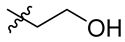 | 2,4-diFluoro | 16 | >64 |
| A9 | 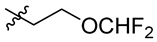 | 2,4-diFluoro | 8 | >64 |
| A10 |  | 2,4-diFluoro | 32 | >64 |
| A11 |  | 2,4-diFluoro | 4 | >64 |
| A12 |  | 2,4-diFluoro | >64 | >64 |
| A13 |  | 2,4-diFluoro | 4 | >64 |
| A14 | 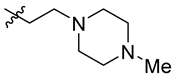 | 2,4-diFluoro | >32 | >64 |
| A15 | 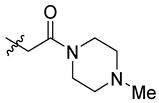 | 2,4-diFluoro | >64 | >64 |
| A16 | 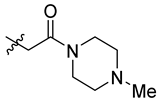 | 3,4-diMethyl | 64 | >64 |
| Hyb-1 | 2 | >64 | ||
| Cip.b | 0.5 | 0.015 | ||
| Van.b | 2 | >64 | ||
| Compd | MIC (μg/mL) | |
|---|---|---|
| USA500 | Mu50 | |
| A1 | 5 | 5 |
| A3 | 1.25 | 1.25 |
| A5 | 1.25 | 2.5 |
| A7 | 5 | 5 |
| A11 | 10 | 20 |
| A13 | 5 | 5 |
| Hyb-1 | 0.63 | 1.25 |
| Cip. | 1.25 | >20 |
| Van. | 1.25 | 5 |
| Compd. | Species | k a | T1/2 b (min) | Clint(mic) c (μL/min/mg) | Clint(liver) d (mL/min/kg) | % Remaining (T = 60 min) |
|---|---|---|---|---|---|---|
| A3 | human | 0.0000703 | 9863 | 0.141 | 0.133 | 97.1% |
| rat | 0.000724 | 983 | 1.45 | 2.61 | 86.1% | |
| A5 | human | 0.0101 | 68.8 | 20.2 | 19.0 | 56.6% |
| rat | 0.0271 | 25.5 | 54.3 | 97.7 | 18.9% | |
| Hyb-1 | human | 0.00795 | 87.9 | 15.9 | 15.0 | 61.6% |
| rat | 0.0129 | 53.6 | 25.9 | 46.6 | 44.7% | |
| Midazolam | 0.0948 | 7.31 | 474 | 448 | 15.3% |
Disclaimer/Publisher’s Note: The statements, opinions and data contained in all publications are solely those of the individual author(s) and contributor(s) and not of MDPI and/or the editor(s). MDPI and/or the editor(s) disclaim responsibility for any injury to people or property resulting from any ideas, methods, instructions or products referred to in the content. |
© 2026 by the authors. Licensee MDPI, Basel, Switzerland. This article is an open access article distributed under the terms and conditions of the Creative Commons Attribution (CC BY) license.
Share and Cite
Xu, X.; Fan, R.; He, Q. Benzyl-Modified Quinolone-Aminopyrimidine Hybrids with Potent Anti-MRSA Activity and a High Barrier to Resistance. Molecules 2026, 31, 1633. https://doi.org/10.3390/molecules31101633
Xu X, Fan R, He Q. Benzyl-Modified Quinolone-Aminopyrimidine Hybrids with Potent Anti-MRSA Activity and a High Barrier to Resistance. Molecules. 2026; 31(10):1633. https://doi.org/10.3390/molecules31101633
Chicago/Turabian StyleXu, Xinghua, Renhua Fan, and Qiuqin He. 2026. "Benzyl-Modified Quinolone-Aminopyrimidine Hybrids with Potent Anti-MRSA Activity and a High Barrier to Resistance" Molecules 31, no. 10: 1633. https://doi.org/10.3390/molecules31101633
APA StyleXu, X., Fan, R., & He, Q. (2026). Benzyl-Modified Quinolone-Aminopyrimidine Hybrids with Potent Anti-MRSA Activity and a High Barrier to Resistance. Molecules, 31(10), 1633. https://doi.org/10.3390/molecules31101633