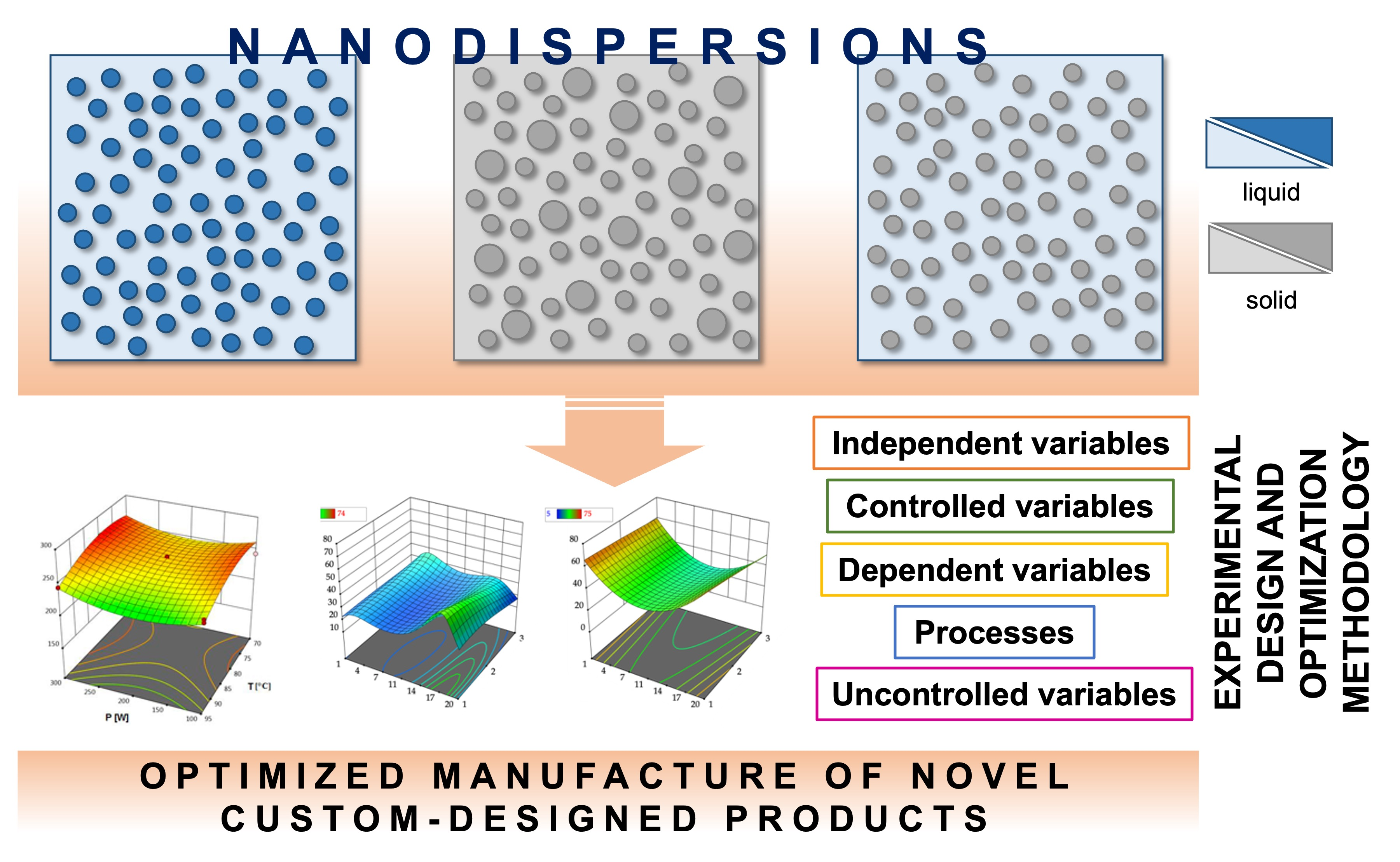
Experimental Design and Optimization of Dispersion Systems in Fine and Specialty Chemical Fabrication

 ,
,  , ,
, ,  and
and
Abstract
1. Introduction
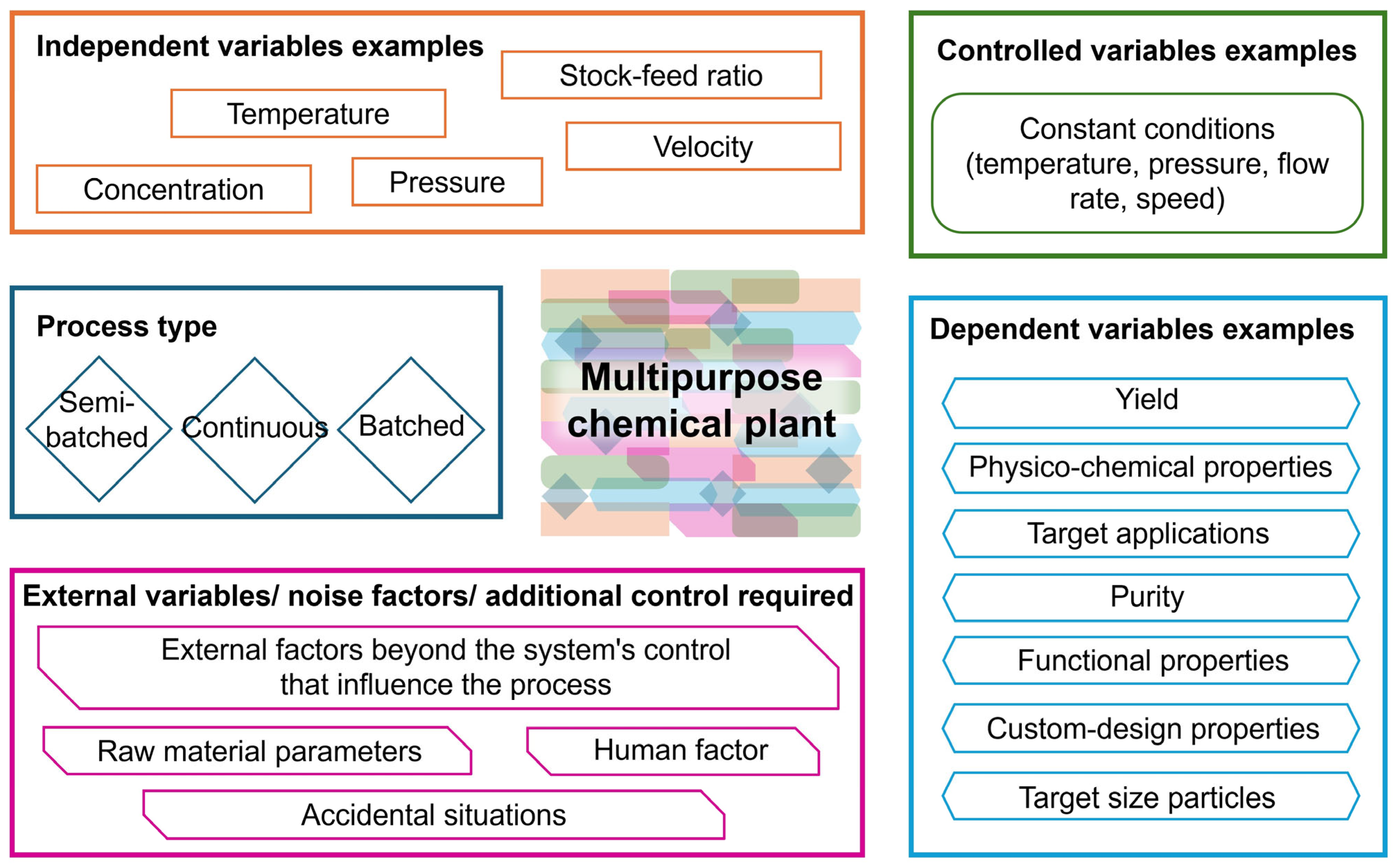
2. Concept of Experimental Design

| Chemical or Physical Process | Details of the Experiment | Variables | Applied Computational Method | Ref. |
|---|---|---|---|---|
| Reactive extraction of gallic acid from aqueous solution with tri-n-octylamine in oleyl alcohol, a recovery from waste waters | The optimal conditions for extraction of HGA were CHGA,o = 0.0588 4 mol/L, C¯TOA,o = 0.2762 mol/L, pH = 2.0, and temperature T = 25.0 °C. 90.09% extraction yield is predicted by the RSM model, validated one 87.17%. | Independent: initial gallic acid concentration (A); tri-n-octylamine concentration (B); pH of aqueous phase (C); temperature (D). Dependent: extraction yield (%) | Statistical analysis and optimization by RSM-Rotatable Central Composite Design (RSM-RCCD) model, followed by multiple regression analysis | [36] |
| Lycopene green ultrasound-assisted extraction using edible oil, a processing of tomato wastes | UAE reached its maximum yield (lycopene of 91.49 mg/100 g) in 10 min, while conventional solvent extraction using hexane and mixture (hexane: acetone: methanol at 2:1:1 v/v) gave lycopene concentrations of 63.66 mg/100 g and 74.89 mg/100 g after 1 h, respectively. | Independent: Ratio of dried tomato waste to oil (A); extraction time (B); ultrasonic intensity (C). Dependent: total lycopene yield (mg/g) | Statistical analysis and optimization by RSM-Central Composite Design (RSM-CCD) model, followed by multiple regression analysis | [37] |
| Microwave-assisted extraction of polysaccharides from the marshmallow roots | The maximum MRPs extracted experimentally were found to be 14.51 ± 0.06%, after 26 min, using microwaves. Conventional and ultrasound extraction gave 10.96 and 12.15%, after 12.01 h and 36.86 min of process time, respectively. | Independent: microwave power (A); time (B); temperature (C). Dependent: extraction yield (%) | Statistical analysis and optimization by RSM-Central Composite Rotatable Design (RSM-CCRD), followed by multiple regression analysis | [38] |
| Microwave-assisted extraction of cocoa bean shell waste as a potential antioxidant source | Optimal MAE conditions were determined as 5 min, pH 12, 97 °C, and S/L 0.04 g/mL, showing a better outcome than conventional solvent extraction performed at 90 min and 100 °C and 0.045 g/mL ratio. | Independent: time (A); pH (B); temperature (C); solid to liquid ratio (D). Dependent: yield (%); uronic acid content (mg GlcA/g); total phenolic content (mg GAE/g); antioxidant activity (mg TE/g) | Statistical analysis and optimization by RSM-Box-Behnken Design (RSM-BBD), followed by multiple regression analysis | [40] |
| Extraction of capsaicin from Capsicum annum L. | The higher CAP content (0.0163 mg/g DW) was recorded with the following conditions: 90 °C drying temperature, 54 g/L concentration, and 48.75 min of extraction with acetonitrile. ANN prediction was more accurate than RSM and Simulink with a higher coefficient of determination (R2) (0.9901 vs. 0.9602 and 0.9607, respectively). | Independent: drying temperature (A); sample to solvent ratio (B); extraction time (C). Dependent: capsaicin yield (mg/g); dihydrocapsaicin yield (mg/g); total capsaicinoids yield (mg/g) | Statistical analysis and optimization by RSM-I-optimal Randomized (Custom) Design (RSM-I-optimal), followed by multiple regression analysis; Artificial Neural Network (ANN), A feed-forward model was created utilizing a hyperbolic tangent sigmoid transfer function in the hidden layer, along with a linear transfer function in the output layer. The network underwent training utilizing the Levenberg–Marquardt back-propagation algorithm; Simulink, a MATLAB mathematical software extension for modeling and simulation of systems. The numerical model was developed based on equations resulting from multiple regression analysis done by RSM | [41] |
| Revalorization of waste cooking oil by esterification and deacidification for biodiesel production | The optimum conditions of the ratio of methanol to oil ratio (8), H2SO4 catalysis concentration (5 wt%), reaction temperature (60 °C), and reaction time (108 min) were obtained and an acid value of 0.42 was achieved. | Independent: reaction time (A); temperature (B); catalyst concentration (C); molar ratio of methanol to oil (D). Dependent: acid values (mg KOH/g) | Statistical analysis and optimization by RSM-Box-Behnken Design (RSM-BBD), followed by multiple regression analysis | [39] |
| Optimization of the synthesis conditions of TiO2/biochar composites | Central-Hybrid Experimental Design revealed that biochar produced at 280 °C with 4.1% v/v oxygen and a TiO2 /biochar weight ratio of 1.5 yielded the best results. | Independent: pyrolysis temperature (A); oxygen content in pyrolysis (B); TiO2 to biochar ratio (C); calcination temperature (D). Dependent: degradation percentage of polymeric matrix | Numerical optimization by 416B-type central-hybrid experimental design, followed by statistical analysis | [30] |
| Synthesis for the 4-Pyridone Intermediate of Baloxavir Marboxil | The optimized process was successfully scaled up to 135 g in the laboratory, yielding the monohydrate form of the compound with a purity of 98.3% and an overall yield improved from 78.6% to 85.1%. | Independent: screening: addition time of tert-butyl carbazate (A1); triethylamine (TEA) catalyst equivalent (B1); temperature (C1); solvent volume (D1); optimization: triethylamine (TEA) catalyst equivalent (A2); temperature (B2); solvent volume (C2). Dependent: both screening and optimization: content of product; combined content of degradation impurities; content of hydrazone impurities—analyzed through HPLC. | Statistical analysis and optimization by combining stage one: Definitive Screen Design (DSD), followed by the second stage: RSM-Central Composite Design (RSM-CCD), followed by multiple regression analysis | [42] |
| Optimization of Eudragit RS100 nanocapsule formulation for encapsulating perillyl alcohol and temozolomide | The optimized nanocapsules demonstrated a mean diameter of 253 ± 52 nm and a polydispersity index of 0.145 ± 0.037. Formulation achieved an average particle size under 300 nm, a PDI indicating homogeneity, and a stable zeta potential, which is favorable for intranasal delivery | Independent: Eudragit RS100 concentration (A); perillyl alcohol concentration (B); drip rate of drops (C); organic to aqueous phase ratio (D). Dependent: average diameter of particles; polydispersity index; zeta potential; encapsulation efficiency | Statistical analysis and optimization by RSM-Factorial Design (RSM-FD), followed by multiple regression analysis | [23] |
| Synthesis of alginate hydrogel functionalized by cationic surfactant for efficient perfluorooctanoic acid adsorption | The optimal hydrogel exhibited an average PFOA removal efficiency of 94.8 ± 2.1% at a 50 mg/L PFOA. The experimental data for the hydrogel closely align with the pseudo-second-order rate kinetic model, with a maximum possible adsorption capacity of 382.1 mg/g | Independent: cetyltrimethylammonium bromide (CTABr) concentration (A); calcium concentration (B); sodium alginate concentration (C). Dependent: perfluorooctanoic acid removal (%) | Statistical analysis and optimization by RSM-I-optimal Randomized (Custom) Design (RSM-I-optimal), followed by multiple regression analysis | [11] |
| Process development and optimization of apalutamide synthesis, aided by the Design of Experiments (DoE) | The overall process yield for apalutamide reached 70% with an HPLC purity of 99.97%, after implementation of DoE/RSM optimization. | Multi-step organic synthesis of apalutamide. Step 1, independent: temperature (A); time (B); 1-aminocyclobutane-1-carboxylic acid amount (C); K2CO3 amount (D); CuI amount (E); H2O amount (F). Dependent: impurity concentrations; quality of semi-product 1-((3-fluoro-4-(methylcarbamoyl)phenyl)amino) cyclobutane-1-carboxylic acid. Step 2, independent: temperature (A); 1′-carbonyldiimidazole (CDI) amount (B); intermediate 5 amount (C); time (D); 1,8-diazabicyclo [5.4.0]undec-7-ene (DBU) amount. Dependent: impurity concentrations; quality of semi-product 4-((1-((6-cyano-5-(trifluoromethyl)pyridin-3-yl) carbamoyl)cyclobutyl)amino)-2-fluoro-N-methylbenzamide. Step 3, independent: temperature (A); time (B); intermediate 15 amount (C); 4-dimethylaminopyridine (DMAP) amount (D); N,N-dimethylacetamide (DMAc) solvent amount (E). Dependent: impurity concentrations; quality of final product apalutamide 1 | Definitive Screening Designs and Custom Designs were employed to sieve and optimize the significant factors to establish the experimental ranges for each reaction step | [43] |
| Biohydrogen gas synthesis from food waste hydrolysate | The modified Gompertz model revealed a maximum bioH2 production rate of 185.34 mL/L·h for ANN-GA conditions as compared to 153.74 mL/L·h for RSM-CCD predicted conditions. | Independent: total reducing sugars (TRS) concentration (A); pH (B); temperature (C). Dependent: cumulative hydrogen production (CHP) | The physicochemical parameters for bioH2 production were optimized using the Response Surface Methodology (RSM) based on 5-level-3-factor Central Composite Design (CCD), followed by ANOVA and multiple regression analysis. Results from CCD served as data set for an Artificial Neural Network (ANN) in decision-making for nonlinear systems | [44] |
| Bovine serum albumin nanoparticles | Full factorial design experiments systematically evaluated the effects of PGPR amount (5–20 wt%), TDI amount (50–100 mg), and co-emulsifier (PG3DIS) use in formulations. | Independent: Emulsifier (PGPR) amount (A); Crosslinker (TDI) amount (B); Co-emulsifier Ratio (PG3DIS:PGPR) (C). Dependent: mean particle size, mean polydispersity index (PDI) | The OFAT (one factor at a time) approach based on 2-level-3-factor Full Factorial Design, followed by reduced ANOVA and multiple regression analysis. | [45] |
| Dispersion of calcium phosphate nanoparticles for cellular studies | Optimization using a second-order CCD yielded a set of quadratic regression equations that were used to predict the hydrodynamic size or zeta potential of ceramic nanoparticles with high accuracy (R2, 0.88–0.92) | 1st stage (screening), Independent: concentration (A); ethanol pre-wetting (B); BSA additive (C); sonication type (D); pH (E); dispersion medium (F). Dependent: particle size, zeta potential. 2nd stage (optimization), Independent: concentration (A); pH (B); BSA additive (C). Dependent: particle size, zeta potential. | The particle size and zeta potential of nanoparticles were optimized in two stages. In the first one, a Placket-Burman 2-level-6-factor Design allowed for the screening of variables contributing to the particle size and zeta potential. The second stage was based on a 3-level-3-factor second-order Central Composite Design (CCD) response surface methodology (RSM) followed by ANOVA and multiple regression analysis. | [46] |
| Production of itraconazole (ITZ) amorphous solid dispersions (ASDs) by extrusion process | Validation studies confirmed optimal process robustness across multiple days, with stable in-line UV–Vis spectra and consistent product quality using 30% ITZ, 300 rpm, 150 °C, and 7 g/min | 1st stage (screening), Independent: ITZ concentration (A); die temperature (B); screw speed (C); feed rate (D). Dependent: absorbance at 370 and 390 nm, 2nd stage (optimization, Independent: screw speed (A); feed rate (B). Dependent: absorbance at 370 and 390 nm, L* (function of ITZ concentration). | The parameters for the manufacture of ITZ solid dispersions were optimized in two stages. The screening stage was based on a 3-level-4-factor Fractional Factorial Design. While the optimization stage was based on a 3-level-2-factor Central Composite Design (CCD). Both stages were followed by statistical analysis employing ANOVA, main effects, and two-factor interactions modeling. | [47] |
3. Ecological Nanodetergents for the Removal of Graffiti—Optimization of the Method and the Formulation
4. Approach to the Production of Cement Composites
| Material | Details of the Experiment | Independent Variables | Dependent Variables | Significance | Presentation | Ref. |
|---|---|---|---|---|---|---|
| TiO2-SiO2/lignin hybrid materials | Cement mortars were prepared using Portland cement CEM I 42.5R, quartz sand, distilled water, and the following admixtures: TiO2-SiO2, TiO2-SiO2/lignin (5:1), TiO2-SiO2/lignin (1:1), TiO2-SiO2/lignin (1:5), or lignin in amounts of 0.5, 1.0, or 1.5 wt.% | (i) the type of admixture, the quantity of admixture; (ii) the influence of the admixture type | (i) compressive strength, flexural strength, plasticity; (ii) compressive strength, microbial purity CM, microbial purity OD 600, heat of hydration, plasticity, total open porosity | The major objective was to acquire a cement composite with necessary physical and functional characteristics, i.e., optimum strength and flexibility, followed by enhanced antibacterial and structural capabilities | A quadratic D-Optimal design, RSM, ANOVA | [79] |
| High-performance cement composites (HPCCs) with industrial by-products such as fly ash, silica fume, and colloidal silica | HPCC mix was performed with Portland cement CEM I 42.5N, three types of fine sand, diabase crushed stone, fly ash, silica fume, nanosilica, and different amounts of superplasticizer (0–2.5 wt.% with a 0.5 step) | Fly ash content, nanosilica content, superplasticizer amount, water, and cement amount | Compressive strength (after 28 and 90 days), concrete mix workability parameters (e.g., cone pouring time, cone flow diameter), mix stability in terms of segregation, and raw material cost | Compromise between strength and workability | 1st, 2nd, and 3rd order polynomial models, RSM | [80] |
| Different ZnO oxides | Cement mortars were prepared using Portland cement CEM I 42.5R, quartz sand, distilled water, and the following admixtures: commercially available ZnO oxides (ZnO-CH, ZnO-AA, or ZnO-SA) or synthesized (ZnO-H or ZnO-M) in amounts of 0.1 wt.% | Admixture type (pure cement, ZnO-CH, ZnO-AA, ZnO-SA, ZnO-H, ZnO-M) | Compressive strength; microbial purity; initial setting time; plasticity; cost | The best compressive strength, high microbial purity, and finally, the cost of the ZnO doping agent | I-Optimal model, RSM, ANOVA | [74] |
| ZnO/lignin hybrid materials | Cement mortars were prepared using Portland cement CEM I 42.5R, quartz sand, distilled water, and the following admixtures: ZnO, lignin or ZnO-lignin hybrid materials in amounts of 0.1 wt.% | Admixture type (pure cement, ZnO, ZnO/lignin (5:1), ZnO/lignin (1:1), ZnO/lignin (1:5)) | Compressive strength, microbial purity, porosity, plasticity, and heat of hydration | The best microbial purity, the smallest total pore volume, and satisfactory physical properties | I-Optimal model, RSM, ANOVA | [74] |
| Deep eutectic solvent with ZnO (DES-ZnO) | Cement mortars were prepared using Portland cement CEM I 42.5R, quartz sand, distilled water, and DES-ZnO admixture in amounts of 0.125, 0.25, or 0.5 wt.% | Concentration of DES-ZnO | Compressive strength (28 days), compressive strength (90 days), microbial purity (CM), microbial purity (OD), porosity, plasticity, heat of hydration | A high level of microbiological purity, the highest values of compressive strength, increased plasticity, and a satisfactory level of porosity | A modified 41 full square I-Optimal design, RSM, ANOVA | [75] |
| ZnO selection of mixing methods | Cement mortars were prepared using Portland cement CEM I 42.5R, quartz sand, and distilled water in two configurations: (i) with 0.1 wt.% ZnO admixture, and (ii) with 0.1 wt.% ZnO admixture and 0.5 wt.% superplasticizer | The absence/presence of admixture, mixing method, the presence/absence of superplasticizer | Compressive strength, microbial purity, OD method microbial purity, porosity < 2.0 mm, total porosity, plasticity | High microbial purity and satisfactory physical properties, including compressive strength, porosity, and plasticity | The 2FI D-Optimal design, RSM, ANOVA | [72] |
| CuO | Cement mortars were prepared using Portland cement CEM I 42.5R, quartz sand, distilled water, and CuO admixture in amounts of 0.25, 0.50 or 1.00 wt.% | Concentration of CuO | Compressive strength, microbial purity (CM), microbial purity (OD), porosity (MP), porosity (CT), plasticity | A high level of microbiological purity, with the highest values of compressive strength, increased plasticity, and a satisfactory level of porosity | A randomized quadratic D-Optimal design, RSM, ANOVA | [81] |
| Various forms of TiO2 | Cement mortars were prepared using Portland cement CEM I 42.5R, quartz sand, distilled water, and the following admixtures: commercially available TiO2 oxides (AN, RdH, TP, P25) or synthesized (TT, TS) in amounts of 0.5, 1.0, or 1.5 wt.% | Concentration and type of TiO2 (TT, RdH, TP, TS, P25, AN) | (i) the compressive strength and plasticity; (ii) microbial purity, OD microbial purity, photocatalytic properties, and porosity | (i) the medium value of the concentration of the admixture led to a cement composite with satisfactory compressive strength and plasticity; (ii) maximized strength and plasticity, followed by excellent antimicrobial and photocatalytic properties | (i) An altered 3–62 full factorial D-Optimal design, RSM, ANOVA; (ii) modified 61 full factorial D-Optimal design, RSM, ANOVA | [82] |
| Hybrid fiber engineered cementitious composite (ECC) | ECC mixes were prepared with cement, class F fly ash, slag, dolomite, dune sand, high-range water reducer, PE and steel fibers | Total cement replacement level, dolomite to binder ratio, slag-to-fly ash ratio, fiber proportions, water-to-binder ratio | Compressive strength, peak compressive strain, elastic modulus, tensile strength, ultimate tensile strain | Total binder content and slag-to-fly ash ratio are key factors influencing the properties of the mixture | Taguchi-Grey relational analysis (GRA) and Taguchi method with utility concept (UC), ANOVA | [83] |
| Self-compacting cement mortar | Mortars were prepared using two powders (cement CEM I 42.5R and limestone), two PCE-based superplasticizers, sand, and distilled water | Ratios: Water/Cement, Superplasticizer/Powder, Water/Powder, Sand/Mortar; Superplasticiser A or Superplasticiser B | The D-flow and the t-funnel, the compressive strength | Increasing the water/cement ratio improves workability but may negatively affect compressive strength. Superplasticizer A and B affect fluidity and strength differently; a higher sand/mortar ratio may impair self-compacting properties but increase mechanical strength | Central Composite Design (CCD) | [84] |
| Self-compacting cement mortar | Mortars were prepared using two powders (cement CEM I 42.5R and limestone), two sands (medium sand and fine sand), PCE-based superplasticizer, and distilled water | Ratios: Water/Cement, Superplasticizer/Powder, Water/Powder, Sand/Mortar, Fine Sand/Sand | Workability (the D-flow, the t-funnel), mechanical properties (the tensile and compressive strength) | The correct fine sand/sand ratio allows for an optimal balance between workability and strength. Increasing the water/cement ratio leads to improved workability (higher D-flow), but reduces mechanical strength | CCD | [85] |
| Self-compacting cement mortar (SCM) | SCM mix were prepared with cement type II, class F fly ash, slag, colloidal nanosilica, superplasticizer, and sand | (i) Water/binder (w/b) ratio, superplasticizer (SP), limestone powder (LSP), binder content (BC); (ii) fly ash (FA), slag (S), nanosilica (NS) | (i) Rheology (slump flow diameter, v-tunnel time); (ii) rheology and compressive strength | Increasing the slag and fly ash content improves the mechanical properties, but may slightly deteriorate the rheology. The optimal ratio of superplasticizer improves mortar flow and mixture stability | Taguchi method, ANOVA | [55] |
| Concrete containing metakaolin (MK) | Concrete mix was performed with type GU Canadian Portland cement, metakaolin, superplasticizer, natural sand, and stone | Total binder content, percentage of MK, and water-to-binder ratio (W/B) | Rapid chloride permeability test (RCPT), chloride diffusion test, compressive strength, modulus of elasticity, splitting tensile strength, flexural strength, and cost of mixture per cubic meter | To obtain an optimum mixture that achieves a balance between high mechanical/durability properties and lower cost | The developed CCD model, ANOVA, RSM | [86] |
| Cement mortar with silica fume and nanosilica particles | Mortars mix was prepared with cement CEM I 42.5N, silica fume, nanosilica, natural sand, high-range water reducing admixture, and hydrated lime | Cement mix ingredients and proportions (cement, silica fume (SF), nanosilica (NS)) | Compressive strength, flexural strength, splitting strength, absorption, and capillary water | The interactions of CEM × NS and SF × NS indicate that their combination leads to a decrease in water absorption values | A multi-regression analysis using the least-squares method, first and second-order linear models, and ANOVA | [87] |
| Self-consolidating concrete (SCC) incorporating metakaolin (MK) | SCC mixes were obtained with type GU Canadian Portland cement, metakaolin, slag, class F fly ash, silica fume, high-range water reducer, fine and coarse aggregates | Total binder content, percentage of MK, water-to-binder ratio, and curing conditions | Chloride permeability, fresh and hardened properties of mixes, | To determine the most significant factors affecting the chloride permeability and the expected service life | The Box–Wilson Central Composite Design (CCD) method, ANOVA | [77] |
| Geopolymer mortar | Geopolymer mortars were prepared with class C and F fly ashes, fine sand, sodium silicate, and sodium hydroxide | Activator to fly ash ratio (AS/FA), fly ash particle size distribution (PSD), silicon and aluminum oxides to calcium ratio ((S + A)/C) | Compressive strength, porosity, microstructure | The compressive strength as a function of (S + A)/C and PSD at respective levels of AS/FA ratio | Second-order regression models, RSM, ANOVA | [76] |
| High-strength self-consolidating concrete (SCC) incorporating metakaolin (MK) | SCC mixes were obtained with type GU Canadian Portland cement, metakaolin, slag, class F fly ash, silica fume, high-range water reducer, fine and coarse aggregates | Total binder content, percentage of MK in the mixture, and water-to-binder ratio | Flow ability, low segregation factor, superior passing ability, compressive strength | To determine the most significant factors affecting the properties of SCC and the optimum level of each variable | Linear or nonlinear regression analysis, ANOVA | [77] |
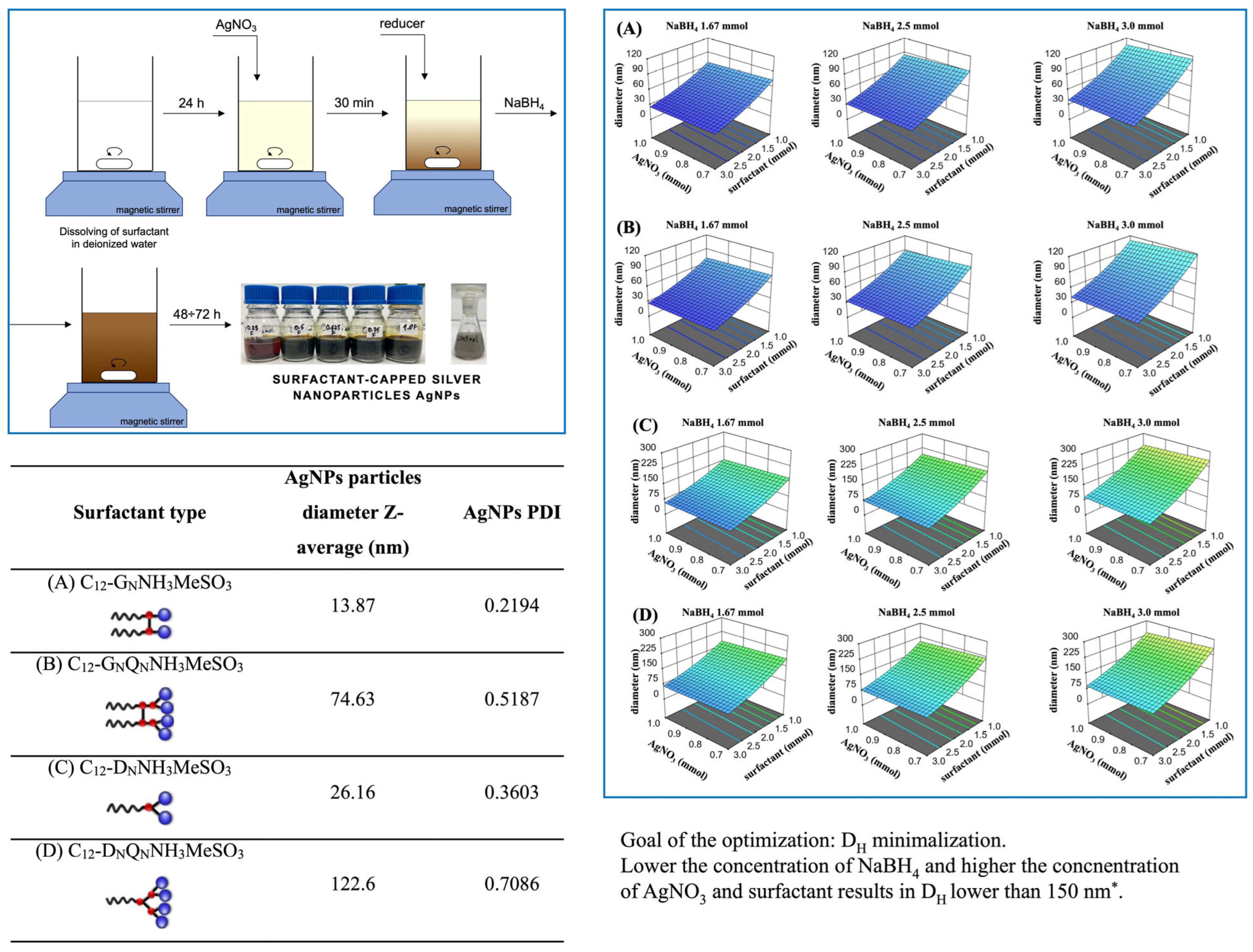
5. Multicharge Cationic Surfactant-Capped Silver Nanoparticles: DoE and RSM in Optimization of Unit Synthetic Process
R2 = 0.8921, Adjusted R2 = 0.8694, Predicted R2 = 0.7572
6. Conclusions
Author Contributions
Funding
Institutional Review Board Statement
Informed Consent Statement
Data Availability Statement
Conflicts of Interest
Abbreviations
| 6R | Refuse, Reduce, Reuse, Recover, Recycle, Rethink |
| AAS | Amino acid surfactant |
| AgNPs | Silver nanopartic |
| ANN | Artificial neural network |
| ANOVA | Analysis of variance |
| APG | Alkylpolyglucoside |
| API | Active pharmaceutical ingredients |
| BBD | Box-Behnken design |
| CCD | Central composite design |
| CCs | Commodity chemicals |
| CMC | Critical micelle concentration |
| DH | Hydrodynamic diameter |
| DLS | Dynamic light scattering |
| DoE | Design of experiments |
| EL | Ethyl lactate |
| FCs | Fine chemicals |
| FD | Factorial Design |
| GMP | Good manufacturing practice |
| HPH | High-pressure homogenization |
| LIM | D-limonen |
| MP | Melting point |
| ND | Nanodispersions |
| PDI | Polydispersity Index |
| QbD | Quality-by-design |
| REACH | Registration, Evaluation, Authorization and Restriction of Chemicals |
| RO | Rapeseed oil |
| RSM | Response surface methodology |
| SCG | Sodium cocoyl glycinate |
| SCs | Specialty chemicals |
| SMCT | Sodium methyl cocoyl taurate |
| UCO | Used cooking oil |
| w/o | Water-in-oil |
References
- Cybulski, A.; Moulijn, J.A.; Sharma, M.M.; Sheldon, R.A. Fine Chemicals Manufacture: Technology and Engineering; Science, B.V., Ed.; Elsevier: Amsterdam, The Netherlands, 2001; ISBN 9780444540898. [Google Scholar]
- Pollak, P. Fine chemicals. In The Industry and the Business, 2nd ed.; Wiley: Hoboken, NJ, USA, 2011; ISBN 978-0-470-62767-9. [Google Scholar]
- Tickner, J.; Geiser, K.; Baima, S. Transitioning the Chemical Industry: The Case for Addressing the Climate, Toxics, and Plastics Crises. Environ. Sci. Policy Sustain. Dev. 2021, 63, 4–15. [Google Scholar] [CrossRef]
- Stokes, R. Chemical industries: Changes in products, processes, actors. In The Oxford Handbook of Industry Dynamics; Series: Oxford Handbooks; Kipping, M., Kurosawa, T., Westney, E., Eds.; Oxford University Press: Oxford, NY, USA, 2022; ISBN 9780190933463. [Google Scholar] [CrossRef]
- Lantos, J.; Kumar, N.; Saha, B. A Comprehensive Review of Fine Chemical Production Using Metal-Modified and Acidic Microporous and Mesoporous Catalytic Materials. Catalysts 2024, 14, 317. [Google Scholar] [CrossRef]
- Ciriminna, R.; Della Pina, C.; Luque, R.; Pagliaro, M. Reshoring Fine Chemical and Pharmaceutical Productions. Org. Process Res. Dev. 2024, 28, 3026–3034. [Google Scholar] [CrossRef]
- Mrowiec-Białoń, J.; Ciemięga, A.; Maresz, K.; Szymańska, K.; Pudło, W.; Jarzębski, A.B. Review on hierarchically microstructured monolithic reactors for high yield continuous production of fine chemicals. Chem. Proc. Eng. 2018, 39, 367–375. [Google Scholar] [CrossRef]
- Szczęsna, W.; Ciejka, J.; Szyk-Warszyńska, L.; Jarek, E.; Wilk, K.A.; Warszyński, P. Customizing polyelectrolytes through hydrophobic grafting. Adv. Colloid Interface Sci. 2022, 306, 102721. [Google Scholar] [CrossRef]
- Nagtode, V.C.; Cardoza, C.; Yasin, H.K.A.; Mali, S.J.; Srushti, M.; Tambe, S.M.; Roy, P.; Singh, K.; Goel, A.; Amin, P.D.; et al. Green Surfactants (Biosurfactants): A Petroleum-Free Substitute for Sustainability—Comparison, Applications, Market, and Future Prospects. ACS Omega 2023, 8, 11674−11699. [Google Scholar] [CrossRef]
- Lamch, Ł.; Szczęsna, W.; Balicki, S.J.; Bartman, M.; Szyk-Warszyńska, L.; Warszyński, P.; Wilk, K.A. Multiheaded cationic surfactants with dedicated functionalities: Design, synthetic strategies, self-assembly and performance. Molecules 2023, 28, 5806. [Google Scholar] [CrossRef]
- Shaikh, M.A.N.; Nawat, T. Highly Efficient Cationic Surfactant Functionalized Alginate Hydrogel for Perfluorooctanoic Acid Adsorption: Optimization through Response Surface Methodology and Performance Evaluation for Aqueous Media. ACS EST. Water 2024, 4, 3078–3088. [Google Scholar] [CrossRef]
- Qin, S.; Omolabake, S.; Diaby, A.; Li, J.; González, L.D.; Holland, C.M.; Zavala, V.M.; Stahl, S.S.; Van Lehn, R.C. Identifying Green Solvent Mixtures for Bioproduct Separation Using Bayesian Experimental Design. ACS Sustain. Chem. Eng. 2024, 12, 18634–18647. [Google Scholar] [CrossRef]
- Bensebaa, F. Chapter 5—Clean Energy. In Interface Science and Technology; Bensebaa, F., Ed.; Elsevier: Amsterdam, The Netherlands, 2013; Volume 19, pp. 279–383. [Google Scholar] [CrossRef]
- Panizza, M. Chapter 13—Fine Chemical Industry, Pulp and Paper Industry, Petrochemical Industry and Pharmaceutical Industry. In Electrochemical Water and Wastewater Treatment; Butterworth-Heinemann, Martínez-Huitle, C.A., Rodrigo, M.A., Scialdone, O., Eds.; Elsevier: Oxford, UK, 2018; pp. 335–364. [Google Scholar] [CrossRef]
- Ciriminna, R.; Della Pina, C.; Luque, R.; Pagliaro, M. The Fine Chemical Industry, 2000−2024. Org. Process Res. Dev. 2025, 29, 1191–1196. [Google Scholar] [CrossRef]
- Ledakowicz, S.; Antecka, A.; Gluszcz, P.; Klepacz-Smolka, A.; Pietrzyk, D.; Szelag, R.; Slezak, R.; Daroch, M. From 3G biofuels to high-value-added bioproducts. Chem. Proc. Eng. New Front. 2024, 45, e59. [Google Scholar] [CrossRef]
- Wang, S.; Li, X.; Ma, R.; Song, G. Catalytic hydrogenolysis of lignin into serviceable products. Acc. Chem. Res. 2025, 58, 529−542. [Google Scholar] [CrossRef]
- Zhang, Y.; Gao, F.; Fu, M.-L. Composite of Au-Pd nanoalloys/reduced graphene oxide toward catalytic selective organic transformation to fine chemicals. Chem. Phys. Lett. 2018, 691, 61–67. [Google Scholar] [CrossRef]
- Landge, S.; Melvin, C.; Pence, A. Microwave-Assisted Synthesis of Fine Chemicals—Triazoles. In Encyclopedia of Green Chemistry, 1st ed.; Török, B., Ed.; Elsevier: Amsterdam, The Netherlands, 2025; p. 270. [Google Scholar] [CrossRef]
- Thompson, B.; Machas, M.; Nielsen, D.R. Creating pathways towards aromatic building blocks and fine chemicals. Curr. Opin. Biotechnol. 2015, 36, 1–7. [Google Scholar] [CrossRef] [PubMed]
- Ash, M. Specialty Chemicals Source Book, 4th ed.; Ash, M., Ash, I., Eds.; Synapse Information Resources, Incorporated: Endicott, NY, USA, 2009; ISBN 9781934764176. [Google Scholar]
- Zhou, J.; Metivier, P. Science—An important lever to tackle sustainability in the specialty chemical industry. Nat. Sci. Rev. 2023, 10, 193. [Google Scholar] [CrossRef] [PubMed]
- Lorenzett, A.K.P.; Babinski, T.P.; de Lima, V.A.; Mainardes, R.M. Optimization of Eudragit RS100 Nanocapsule Formulation for Encapsulating Perillyl Alcohol and Temozolomide Using Design of Experiments. ACS Nanosci. Au 2025, 5, 70–83. [Google Scholar] [CrossRef]
- Manda, A.; Komati, S.K.; Nariyam, S.M.; Annapurna, S.C.V.; Senadi, G.C.; Maruthapillai, A.; Bandichhor, R. Olaparib Process Development Employing Quality by Design (QbD) Principles. ACS Omega 2024, 9, 30327–30349. [Google Scholar] [CrossRef]
- Chen, H.; Li, Q.; Deng, S. Fast QoI-Oriented Bayesian Experimental Design with Unified Neural Response Surfaces for Kinetic Uncertainty Reduction. Energy Fuels 2024, 38, 15630–15641. [Google Scholar] [CrossRef]
- Kiraly, L.M.; Friedler, F.; Szoboszlai, L. Optimal design of multi-purpose batch chemical plants. Comput. Chem. Eng. 1989, 13, 527–534. [Google Scholar] [CrossRef]
- Jaryal, V.B.; Villa, A.; Gupta, N. Metal-Free Carbon-Based Nanomaterials: Insights from Synthesis to Applications in Sustainable Catalysis. ACS Sustain. Chem. Eng. 2023, 11, 14841–14865. [Google Scholar] [CrossRef]
- Rezaee, M.; Feyzi, F.; Javanshir, S. Application of Response Surface Methodology for Selective Extraction of Lithium Using a Hydrophobic Deep Eutectic Solvent. Ind. Eng. Chem. Res. 2025, 64, 2294–2308. [Google Scholar] [CrossRef]
- Tan, J.D.; Ramalingam, B.; Chellappan, V.; Gupta, N.K.; Dillard, L.; Khan, S.A.; Galvin, C.; Hippalgaonkar, K. Generative Design and Experimental Validation of Non-Fullerene Acceptors for Photovoltaics. ACS Energy Lett. 2024, 9, 5240–5250. [Google Scholar] [CrossRef]
- Castilla-Caballero, D.; Medina-Guerrero, A.; Hernandez-Ramirez, A.; Vazquez-Rodriguez, S.; Colina-Márquez, J.; Martínez, F.M.; Barraza-Burgos, J.; Roa-Espinosa, A.; Gunasekaran, S. Use of a 416B-type central-hybrid experimental design to evaluate the synthesis conditions of TiO2/biochar composites on the solid-state photocatalytic degradation of polypropylene-plastic films. Appl. Catal. A Gen. 2025, 697, 120196. [Google Scholar] [CrossRef]
- Melikhova, E.Y.; Smith, D.A.; Moseley, J.D. Application of Experimental Design (DoE) to Improve a Very Dilute Workup Procedure. Org. Process Res. Dev. 2024, 28, 3594–3600. [Google Scholar] [CrossRef]
- Zhang, Y.; An, M.; Han, B.; Wang, J.; Wang, Y. Multi-parameter mix proportion design and optimization of manufactured sand concrete based on RSM. Structures 2025, 73, 108321. [Google Scholar] [CrossRef]
- Jakowluk, W.; Świercz, M. Application-oriented experiment design for model predictive control. Bull. Pol. Acad. Sci. Tech. Sci. 2020, 68, 883–891. [Google Scholar] [CrossRef]
- Zou, Y.; Ma, X.; Yang, Y.; Li, S. An overview of chemical process operation-optimization under complex operating conditions. Digit. Chem. Eng. 2025, 16, 100249. [Google Scholar] [CrossRef]
- Web of Science. Available online: www.webofscience.com (accessed on 29 January 2026).
- Pandey, S.; Kumar, S. Reactive extraction of gallic acid from aqueous solution with Tri-n-octylamine in oleyl alcohol: Equilibrium, Thermodynamics and optimization using RSM-rCCD. Sep. Purif. Technol. 2020, 231, 115904. [Google Scholar] [CrossRef]
- Rahimi, S.; Mikani, M. Lycopene green ultrasound-assisted extraction using edible oil accompany with response surface methodology (RSM) optimization performance: Application in tomato processing wastes. Microchem. J. 2019, 146, 1033–1042. [Google Scholar] [CrossRef]
- Hashemifesharaki, R.; Xanthakis, E.; Altintas, Z.; Guo, Y.; Gharibzahedi, S.M.T. Microwave-assisted extraction of polysaccharides from the marshmallow roots: Optimization, purification, structure, and bioactivity. Carbohydr. Polym. 2020, 240, 116301. [Google Scholar] [CrossRef] [PubMed]
- Bai, H.; Tian, J.; Talifu, D.; Okitsu, K.; Abulizi, A. Process optimization of esterification for deacidification in waste cooking oil: RSM approach and for biodiesel production assisted with ultrasonic and solvent. Fuel 2022, 318, 123697. [Google Scholar] [CrossRef]
- Lu, J.; Shi, Y.; Huang, K.; Liu, Y.; Yuan, S.; Yang, X.; Xu, Y.; Sun, X.; Wu, T. Improved Synthesis for the 4-Pyridone Intermediate of Baloxavir Marboxil: Elimination of Polar Aprotic Solvents and Optimization Through Design of Experiments (DoE). Org. Process Res. Dev. 2025, 29, 723–734. [Google Scholar] [CrossRef]
- Gammoudi, N.; Mabrouk, M.; Bouhemda, T.; Nagaz, K.; Ferchichi, A. Modeling and optimization of capsaicin extraction from Capsicum annuum L. using response surface methodology (RSM), artificial neural network (ANN), and Simulink simulation. Ind. Crops Prod. 2021, 171, 113869. [Google Scholar] [CrossRef]
- Mellinas, A.C.; Jiménez, A.; Garrigós, M.C. Optimization of microwave-assisted extraction of cocoa bean shell waste and evaluation of its antioxidant, physicochemical and functional properties. LWT 2020, 127, 109361. [Google Scholar] [CrossRef]
- Wang, H.; Li, L.; Yang, F.; Li, D.; Wu, S.; Yan, W.; Sun, G.; Tan, J.; Li, Y.; Yang, H.; et al. Process development and optimization of apalutamide synthesis aided by the Design of Experiments (DoE). Tetrahedron 2025, 184, 134725. [Google Scholar] [CrossRef]
- Anand, A.; Mahata, C.; Moholkar, V.S. Biohydrogen synthesis from food waste hydrolysate: Optimization using statistical design of experiments (DoE) and artificial neural network (ANN). Biomass Bioenergy 2024, 191, 107452. [Google Scholar] [CrossRef]
- Avşar, D.; Özcan, Z.I.; Iyisan, B. Optimizing the synthesis of bovine serum albumin nanoparticles using full factorial design of experiments. Mater. Res. Express 2025, 12, 115014. [Google Scholar] [CrossRef]
- Onder, A.C.; Tomak, A.; Karakus, C.O. Optimizing the dispersion of calcium phosphate nanoparticles for cellular studies using statistical design of experiments. Ceram. Int. 2023, 49, 26890–26899. [Google Scholar] [CrossRef]
- Triboandas, H.; Bezerra, M.; Almeida, J.; de Castro, M.; Santos, B.A.M.C.; Schlindwein, W. Optimizing extrusion processes and understanding conformational changes in itraconazole amorphous solid dispersions using in-line UV-Vis spectroscopy and QbD principles. Int. J. Pharm. X 2024, 8, 100308. [Google Scholar] [CrossRef]
- Sanmartín, P.; Cappitelli, F.; Mitchell, R. Current Methods of Graffiti Removal: A Review. Constr. Build. Mater. 2014, 71, 363–374. [Google Scholar] [CrossRef]
- Melquiades, F.L.; Appoloni, C.S.; Andrello, A.C.; Spagnuolo, E. Non-destructive analytical techniques for the evaluation of cleaning and protection processes on white marble surfaces. J. Cult. Herit. 2019, 37, 54–62. [Google Scholar] [CrossRef]
- Gomes, V.; Dionísio, A.; Pozo-Antonio, J.S. Conservation strategies against graffiti vandalism on Cultural Heritage stones:Protective coatings and cleaning methods. Prog. Org. Coat. 2017, 113, 90–109. [Google Scholar] [CrossRef]
- Baglioni, M.; Raudino, M.; Berti, D.; Keiderling, U.; Bordes, R.; Holmberg, K.; Baglioni, P. Nanostructured fluids from degradable nonionic surfactants for the cleaning of works of art from polymer contaminants. Soft Matter 2014, 10, 6798–6809. [Google Scholar] [CrossRef]
- Baglioni, M.; Poggi, G.; Benavides, Y.J.; Martínez Camacho, F.; Giorgi, R.; Baglioni, P. Nanostructured fluids for the removal of graffiti—A survey on 17 commercial spray-can paints. J. Cult. Herit. 2018, 34, 218–226. [Google Scholar] [CrossRef]
- Baglioni, M.; Poggi, G.; Giorgi, R.; Rivella, P.; Ogura, T.; Baglioni, P. Selective removal of over-paintings from “Street Art” using an environmentally friendly nanostructured fluid loaded in highly retentive hydrogels. J. Colloid Interface Sci. 2021, 595, 187–201. [Google Scholar] [CrossRef] [PubMed]
- Chen, S.; Hu, S.; Song, J.; Chen, T.; Xing, H.; Kong, C. Hydrogels for the cleaning of cultural heritage: A review of mechanisms, applications, and future perspectives. J. Cult. Herit. 2026, 77, 325–340. [Google Scholar] [CrossRef]
- Jalal, M.; Teimortashlu, E.; Grasley, Z. Performance-Based Design and Optimization of Rheological and Strength Properties of Self-Compacting Cement Composite Incorporating Micro/Nano Admixtures. Compos. Part B Eng. 2019, 163, 497–510. [Google Scholar] [CrossRef]
- Baglioni, M.; Giorgi, R.; Berti, D.; Baglioni, P. Smart Cleaning of Cultural Heritage: A New Challenge for Soft Nanoscience. Nanoscale 2012, 4, 42–53. [Google Scholar] [CrossRef]
- Chelazzi, D.; Bordes, R.; Casini, A.; Mastrangelo, R.; Holmberg, K.; Baglioni, P. New perspectives on green sustainable wet cleaning systems for art conservation. Soft Matter 2025, 21, 4165–4176. [Google Scholar] [CrossRef] [PubMed]
- Bartman, M.; Balicki, S.; Hołysz, L.; Wilk, K.A. Benefits of using nonionic saccharide surfactant-based detergents for nanostructured fluids as stubborn graffiti paint remover. J. Surfactants Deterg. 2024, 27, 79–92. [Google Scholar] [CrossRef]
- Carretti, E.; Dei, L.; Baglioni, P. Solubilization of Acrylic and Vinyl Polymers in Nanocontainer Solutions. Appl. Microemulsions Micelles Cult. Herit. Conserv. Langmuir 2003, 19, 7867–7872. [Google Scholar] [CrossRef]
- Lettieri, M.; Masieri, M.; Pipoli, M.; Morelli, A.; Frigione, M. Anti-Graffiti Behavior of Oleo/Hydrophobic Nano-Filled Coatings Applied on Natural Stone Materials. Coatings 2019, 9, 740. [Google Scholar] [CrossRef]
- Anastas, P.T.; Zimmerman, J.B. The Periodic Table of the Elements of Green and Sustainable Chemistry. Green. Chem. 2019, 21, 6545–6566. [Google Scholar] [CrossRef]
- Bartman, M.; Balicki, S.; Hołysz, L.; Wilk, K.A. Graffiti coating eco-remover developed for sensitive surfaces by using an optimized high-pressure homogenization process. Colloids Surf. A Physicochem. Eng. Asp. 2023, 659, 130792. [Google Scholar] [CrossRef]
- Bartman, M.; Balicki, S.; Wilk, K.A. Formulation of environmentally safe graffiti remover containing esterified plant oils and sugar surfactant. Molecules 2021, 26, 4706. [Google Scholar] [CrossRef]
- Bartman, M.; Hołysz, L.; Balicki, S.; Szczęsna-Górniak, W.; Wilk, K.A. Wettability of Graffiti Coatings by Green Nanostructured Fluids. ChemPhysChem 2024, 25, e202300771. [Google Scholar] [CrossRef]
- Bartman, M.; Balicki, S.; Hołysz, L.; Wilk, K.A. Surface properties of graffiti coatings on sensitive surfaces concerning their removal with formulations based on the amino-acid type surfactants. Molecules 2023, 26, 1986. [Google Scholar] [CrossRef]
- Voicu, G.; Tiuca, G.-A.; Badanoiu, A.-I.; Holban, A.-M. Nano and mesoscopic SiO2 and ZnO powders to modulate hydration, hardening and antibacterial properties of Portland cements. J. Build. Eng. 2022, 57, 104862. [Google Scholar] [CrossRef]
- Chen, J.; Kou, S.; Poon, C. Hydration and properties of nano-TiO2 blended cement composites. Cem. Concr. Compos. 2012, 34, 642–649. [Google Scholar] [CrossRef]
- Amor, F.; Baudys, M.; Racova, Z.; Scheinherrová, L.; Ingrisova, L.; Hajek, P. Contribution of TiO2 and ZnO nanoparticles to the hydration of Portland cement and photocatalytic properties of High Performance Concrete. Case Stud. Constr. Mater. 2022, 16, e00965. [Google Scholar] [CrossRef]
- Najafi Kani, E.; Rafiean, A.H.; Alishah, A.; Hojjati Astani, S.; Ghaffar, S.H. The effects of nano-Fe2O3 on the mechanical, physical and microstructure of cementitious composites. Constr. Build. Mater. 2021, 266, 121137. [Google Scholar] [CrossRef]
- Sikora, P.; Augustyniak, A.; Cendrowski, K.; Nawrotek, P.; Mijowska, E. Antimicrobial Activity of Al2O3, CuO, Fe3O4, and ZnO Nanoparticles in Scope of Their Further Application in Cement-Based Building Materials. Nanomaterials 2018, 8, 212. [Google Scholar] [CrossRef]
- Horszczaruk, E.; Łukowski, P.; Seul, C. Influence of dispersing method on the quality of nano-admixtures homogenization in cement matrix. Materials 2020, 13, 4865. [Google Scholar] [CrossRef]
- Klapiszewska, I.; Ławniczak, Ł.; Balicki, S.; Gapiński, B.; Wieczorowski, M.; Wilk, K.A.; Jesionowski, T.; Klapiszewski, Ł.; Ślosarczyk, A. Influence of zinc oxide particles dispersion on the functional and antimicrobial properties of cementitious composites. J. Mater. Res. Technol. 2023, 24, 2239–2264. [Google Scholar] [CrossRef]
- Ślosarczyk, A.; Klapiszewska, I.; Jędrzejczak, P.; Klapiszewski, Ł.; Jesionowski, T. Biopolymer-based hybrids as effective admixtures for cement composites. Polymers 2020, 12, 1180. [Google Scholar] [CrossRef]
- Klapiszewska, I.; Balicki, S.; Wilk, K.A.; Klapiszewski, Ł.; Ślosarczyk, A. Statistical approach to the production of cement composites doped with ZnO and ZnO-based materials. Physicochem. Probl. Miner. Process. 2023, 58, 168352. [Google Scholar] [CrossRef]
- Klapiszewska, I.; Latos, P.; Parus, A.; Balicki, S.; Lodowski, P.; Wilk, K.A.; Jesionowski, T.; Chrobok, A.; Klapiszewski, Ł.; Ślosarczyk, A. New insights into sustainable cementitious composites doped with a hybrid system based on zinc oxide and a designable deep eutectic solvent. J. Mater. Res. Technol. 2023, 27, 542–563. [Google Scholar] [CrossRef]
- Dhakal, M.; Kupwade-Patil, K.; Allouche, E.N.; la Baume Johnson, C.C.; Ham, K. Optimization and characterization of geopolymer mortars using response surface methodology. In Developments in Strategic Materials and Computational Design IV, The American Ceramic Society; Kriven, W.M., Wang, J., Zhou, Y., Gyekenyesi, A.L., Eds.; John Wiley & Sons Inc.: Hoboken, NJ, USA, 2014. [Google Scholar] [CrossRef]
- Abouhussien, A.A.; Hassan, A.A. Application of statistical analysis for mixture design of high-strength self-consolidating concrete containing metakaolin. J. Mater. Civ. Eng. 2014, 26, 04014016. [Google Scholar] [CrossRef]
- Li, Z.; Lu, D.; Gao, X. Optimization of mixture proportions by statistical experimental design using response surface method—A review. J. Build. Eng. 2021, 36, 102101. [Google Scholar] [CrossRef]
- Jędrzejczak, P.; Parus, A.; Mildner, M.; Klapiszewska, I.; Balicki, S.; Kołodziejczak-Radzimska, A.; Siwińska-Ciesielczyk, K.; Fiala, L.; Wilk, K.A.; Černý, R.; et al. The novel incorporation of lignin-based systems for the preparation of antimicrobial cement composites. Int. J. Biol. Macromol. 2024, 28, 136721. [Google Scholar] [CrossRef] [PubMed]
- Sahmenko, G.; Rucevskis, S.; Lusis, V.; Spure, L.; Korjakins, A.; Annamaneni, K.K.; Bajare, D. Elaboration mix design methodology for obtaining defined properties of cement composite with fly ash, silica fume and colloidal silica. Mech. Compos. Mater. 2024, 60, 919–938. [Google Scholar] [CrossRef]
- Ślosarczyk, A.; Klapiszewska, I.; Parus, A.; Balicki, S.; Kornaus, K.; Gapiński, B.; Wieczorowski, M.; Wilk, K.A.; Jesionowski, T.; Klapiszewski, Ł. Antimicrobial action and chemical and physical properties of CuO-doped engineered cementitious composites. Sci. Rep. 2023, 13, 10404. [Google Scholar] [CrossRef]
- Jędrzejczak, P.; Parus, A.; Balicki, S.; Kornaus, K.; Janczarek, M.; Wilk, K.A.; Jesionowski, T.; Ślosarczyk, A.; Klapiszewski, Ł. The influence of various forms of titanium dioxide on the performance of resultant cement composites with photocatalytic and antibacterial functions. Mater. Res. Bull. 2023, 160, 112139. [Google Scholar] [CrossRef]
- Rawat, S.; Zhang, Y.X.; Lee, C.K. Multi-response optimization of hybrid fibre engineered cementitious composite using Grey-Taguchi method and utility concept. Constr. Build. Mater. 2022, 319, 126040. [Google Scholar] [CrossRef]
- Maia, L. Experimental dataset from a central composite design with two qualitative independent variables to develop high strength mortars with self-compacting properties. Data Brief. 2022, 40, 107738. [Google Scholar] [CrossRef] [PubMed]
- Maia, L. Experimental dataset from a central composite design to develop mortars with self-compacting properties and high early age strength. Data Brief. 2021, 39, 107563. [Google Scholar] [CrossRef] [PubMed]
- Al-alaily, H.S.; Hassan, A.A.A. Refined statistical modeling for chloride permaeability and strength of concrete containing metakaolin. Constr. Build. Mater. 2016, 114, 564–579. [Google Scholar] [CrossRef]
- Hameed, M.F.A.E.; Ghazy, M.F.; Elaty, M.A.A.A. Cement mortar with nanosilica: Experiments with mixture design method. ACI Mater. J. 2016, 113, 43–53. [Google Scholar] [CrossRef]
- Restrepo, C.V.; Villa, C.C. Synthesis of silver nanoparticles, influence of capping agents, and dependence on size and shape: A review. Environ. Nanotechnol. Monit. Manag. 2021, 15, 100428. [Google Scholar] [CrossRef]
- Shrestha, S.; Wang, B.; Dutta, P. Nanoparticle processing: Understanding and controlling aggregation. Adv. Colloid Interface Sci. 2020, 279, 102162. [Google Scholar] [CrossRef]
- Cardellini, A.; Alberghini, M.; Govind Rajan, A.; Misra, R.P.; Blankschtein, D.; Asinari, P. Multi-scale approach for modeling stability, aggregation, and network formation of nanoparticles suspended in aqueous solutions. Nanoscale 2019, 11, 3925–3932. [Google Scholar] [CrossRef]
- Heuer-Jungemann, A.; Feliu, N.; Bakaimi, I.; Hamaly, M.; Alkilany, A.; Chakraborty, I.; Masood, A.; Casula, M.F.; Kostopoulou, A.; Oh, E.; et al. The role of ligands in the chemical synthesis and applications of inorganic nanoparticles. Chem. Rev. 2019, 119, 4819–4880. [Google Scholar] [CrossRef]
- Shehzad, F.; Hussain, S.M.S.; Adewunmi, A.A.; Mahboob, A.; Murtaza, M.; Kamal, M.S. Magnetic surfactants: A review of recent progress in synthesis and applications. Adv. Colloid Interface Sci. 2021, 293, 102441. [Google Scholar] [CrossRef] [PubMed]
- Polarz, S.; Kunkel, M.; Donner, A.; Schlötter, M. Added-value surfactants. Chem. Eur. J. 2018, 24, 18842–18856. [Google Scholar] [CrossRef] [PubMed]
- Warszyński, P.; Szyk-Warszyńska, L.; Wilk, K.A.; Lamch, Ł. Adsorption of cationic multicharged surfactants at liquid/gas interface. Curr. Opin. Colloid Interface Sci. 2022, 59, 101577. [Google Scholar] [CrossRef]
- Ahmady, R.; Hosseinzadeh, P.; Solouk, A.; Akbari, S.; Szulc, A.M.; Brycki, B.E. Cationic gemini surfactant properties, its potential as a promising bioapplication candidate, and strategies for improving its biocompatibility: A review. Adv. Colloid Interface Sci. 2022, 299, 102581. [Google Scholar] [CrossRef]
- Brycki, B.; Szulc, A.; Babkova, M. Synthesis of silver nanoparticles with gemini surfactants as efficient capping and stabilizing agents. Appl. Sci. 2021, 11, 154. [Google Scholar] [CrossRef]
- Song, T.; Gao, F.; Guo, S.; Zhang, Y.; Li, S.; You, H.; Du, Y. A review of the role and mechanism of surfactants in the morphology control of metal nanoparticles. Nanoscale 2021, 13, 3895–3910. [Google Scholar] [CrossRef]
- Pisárčik, M.; Záteková, M.; Oláhová, K.; Lukáč, M.; Jampílek, J.; Bilková, A.; Bilka, F.; Devínsky, F.; Bezina, M.; Brezani, V.; et al. Role of gemini surfactants with biodegradable spacer as efficient capping agents of silver nanoparticles. J. Drug. Deliv. Sci. Technol. 2024, 101, 106162. [Google Scholar] [CrossRef]
- Giráldez-Pérez, R.M.; Grueso, E.; Lhamyani, S.; Perez-Tejeda, P.; Gentile, A.-M.; Kuliszewska, E.; Roman-Perez, J.; El Bekay, R. miR-21/Gemini surfactant-capped gold nanoparticles as potential therapeutic complexes: Synthesis, characterization and in vivo nanotoxicity probes. J. Mol. Liq. 2020, 313, 113577. [Google Scholar] [CrossRef]
- Petersen, J.B.; Meruga, J.; Randle, J.S.; Cross, W.M.; Kellar, J.J. Hansen Solubility Parameters of Surfactant-Capped Silver Nanoparticles for Ink and Printing Technologies. Langmuir 2014, 30, 15514–15519. [Google Scholar] [CrossRef]
- Mahmood, M.; Abid, M.; Nazar, M.F.; Zafar, M.N.; Raza, M.A.; Ashfaq, M.; Khan, A.M.; Sumrra, S.H.; Zubair, M. The wet chemical synthesis of surfactant-capped quasi-spherical silver nanoparticles with enhanced antibacterial activity. Mater. Adv. 2020, 1, 2332–2338. [Google Scholar] [CrossRef]
- Riahi, K.; Dirba, I.; Ablets, Y.; Filatova, A.; Sultana, S.N.; Adabifiroozjaei, E.; Molina-Luna, L.; Number, U.A.; Gutfleisch, O. Surfactant-driven optimization of iron-based nanoparticle synthesis: A study on magnetic hyperthermia and endothelial cell uptake. Nanoscale Adv. 2023, 5, 5859–5869. [Google Scholar] [CrossRef]
- Nguyen, A.L.; Griffin, Q.J.; Wang, A.; Zou, S.; Jing, H. Optimization of the Surfactant Ratio in the Formation of Penta-Twinned Seeds for Precision Synthesis of Gold Nanobipyramids with Tunable Plasmon Resonances. J. Phys. Chem. C 2025, 129, 4303–4312. [Google Scholar] [CrossRef] [PubMed]
- Wang, Y.; Zhang, Y.; Liu, X.; Wang, J.; Wei, L.; Feng, Y. Effect of a Hydrophilic Head Group on Krafft Temperature, Surface Activities and Rheological Behaviors of Erucyl Amidobetaines. J. Surfactants Deterg. 2014, 17, 295–301. [Google Scholar] [CrossRef]
- Sokołowski, A.; Wilk, K.A.; Komorek, U.; Rutkowski, B.; Syper, L. Aggregation properties of cationic gemini surfactants in aqueous solution. Physicochem. Probl. Miner. Process. 2002, 36, 51–64. [Google Scholar]
- Wilk, K.A.; Syper, L.; Domagalska, B.W.; Komorek, U.; Maliszewska, I.; Gancarz, R. Aldonamide-type gemini surfactants: Synthesis, structural analysis, and biological properties. J. Surfactants Deterg. 2002, 5, 235–244. [Google Scholar] [CrossRef]
- Wilk, K.A.; Syper, L.; Burczyk, B.; Sokołowski, A.; Domagalska, B.W. Synthesis and Surface Properties of New Dicephalic Saccharide-Derived Surfactants. J. Surfactants Deterg. 2002, 3, 185–192. [Google Scholar] [CrossRef]
- Balicki, S. Unit processes optimization in the organic technology. Przem. Chem. 2021, 100, 490–497. [Google Scholar] [CrossRef]
- Baş, D.; Boyacı, I.H. Modeling and optimization I: Usability of response surface methodology. J. Food Eng. 2007, 78, 836–845. [Google Scholar] [CrossRef]
- Pietraszek, J.; Radek, N.; Goroshko, A.V. Challenges for the DOE methodology related to the introduction of Industry 4.0. Prod. Eng. Arch. 2020, 26, 190–194. [Google Scholar] [CrossRef]
- Deaconu, S.; Coleman, H.W. Limitations of Statistical Design of Experiments Approaches in Engineering Testing. J. Fluids Eng. 2000, 122, 254–259. [Google Scholar] [CrossRef]
- Wu, C.F.J.; Hamada, M.S. Experiments: Planning, Analysis and Optimization, 3rd ed.; Wiley: Los Alamos, NM, USA, 2021; ISBN 9781119470106. [Google Scholar]



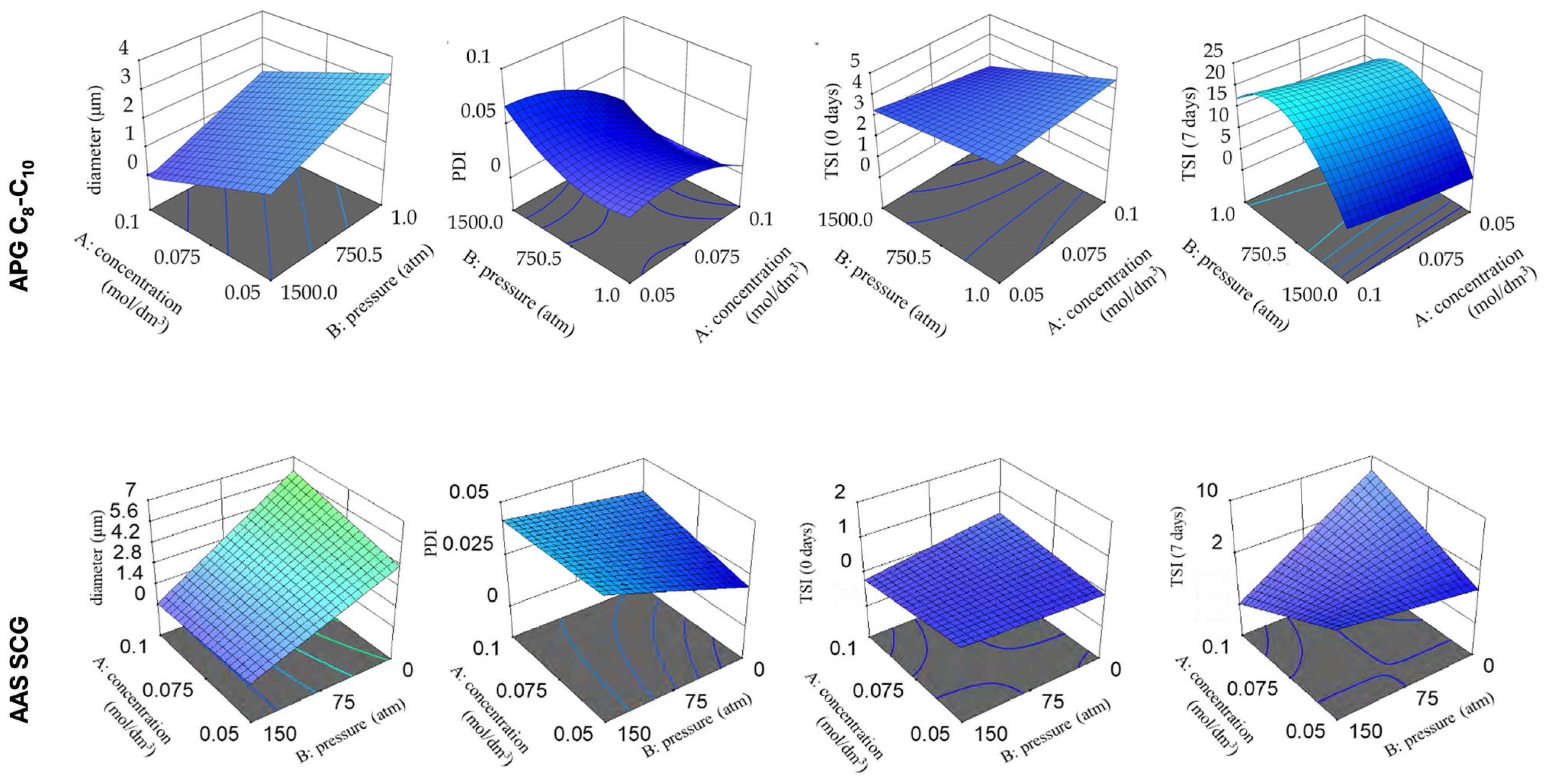
| Process Parameters | Values |
|---|---|
| Constant parameters | |
| Oil-PEG 8 content (%wt.) | 38.5 |
| Biosolvent content (%wt.) | 45.0 |
| Water content (%wt.) | 14.0 |
| Temperature (°C) a | 25.0 |
| Independent variables | |
| Type of surfactant | APG; AAS |
| Concentration of surfactant (mol) | 0.050; 0.075; 0.100 |
| Pressure Homogenization (MPa) | 0.1; 100; 150 |
| Dependent variables | Goal of optimization |
| Particles diameter (nm) | 100–500 |
| PDI | <1 |
| TSI | <5 (The value of the parameter should not change by more than 5 units within a 90-day interval) |
| NE No. 1 [64] | NE No. 2 [64] | NE No. 3 [65] | NE No. 4 [59] | NE No. 5 [59] | |
|---|---|---|---|---|---|
| Ecological surfactant | a APG C8-C10 | SCG | SCMT | a APG C8-C10 | a APG C8-C10 |
| Concentration | 0.1 | 0.05 | 0.05 | 0.1 | 0.1 |
| Green solvents | EL | EL | EL | LIM | MMB |
| UCO-PEG 8 | |||||
| Water | |||||
| Particle diameter—DH (µm) | 0.175 ± 0.05 | 0.186 ± 0.04 | 0.508 ± 0.11 | 0.270 ± 0.42 | 399 ± 0.62 |
| Polydispersity index—PDI | 0.030 | 0.037 | 0.044 | 0.024 | 0.024 |
| Turbiscan stability index—TSI | 2.14 ± 0.05 | 0.06 ± 0.04 | 1.51 ± 0.05 | 1.76 ± 0.04 | 3.54 ± 0.05 |
| Type of Surface | WA | WS |
|---|---|---|
| mJ/m2 | ||
| Paint without additives | 84.5 ± 2.0 | −62.9 ± 2.8 |
| Paint with nitrocellulose | 78.4 ± 1.1 | −62.3 ± 18.0 |
| Paint with bitumen | 82.4 ± 2.8 | −58.8 ± 17.1 |
| Glass | 134.1 ± 2.3 | −11.5 ± 2.4 |
| Aluminum | 88.6 ± 3.2 | −20.6 ± 2.8 |
| Marble | 125.0 ± 5.2 | −42.2 ± 4.7 |
| Stone | 103.4 ± 4.7 | −57.0 ± 5.3 |
| Structure, Name and Abbreviation | 1H NMR a, DMSO-d6 d (ppm) | 13C NMR a, DMSO-d6 d (ppm) | ESI-MS b (M+) | Elementary Analyses c (Theoretical Values) | MP d (°C) | CMC e (mM) | TK f (°C) | ||
|---|---|---|---|---|---|---|---|---|---|
| C (%) | H (%) | N (%) | |||||||
 N,N’-bisdodecyl-N,N’-bis(3-aminopropyl)ethylenediamine dimethanesulfonate C12-GNNH3MeSO3 (gemini) | 0.89–0.92 [t, 6H, CH3(CH2)10CH2N<]; 1.25–1.50 [m, 40H, CH3(CH2)10CH2N<]; 2.10–2.14 [m, 4H, >NCH2CH2CH2NH3+]; 2.36–2.47 [m, 18H, N(CH2-)3]; 2.85 [s, 6H, CH3SO3−]; 3.32 [m, 4H, >NCH2CH2CH2NH3+]; 6.92–7.14 [m, 6H, -NCH2CH2CH2NH3+] | 14 [-(CH2)10CH3]; 20–30 [-(CH2)10CH3, >NCH2CH2-]; 38 [-CH2NH3+]; 41 [CH3SO3−]; 50–55 [N(CH2-)3] | 607.55 (M+) | 57.96 (58.07) | 11.11 (11.20) | 10.03 (7.97) | 168.0–169.5 | 2.1 (2.0 g) | <0 |
 N,N’-bisdodecyl-N,N’-bis(N’-(3-aminopropyl)-N’-1,3-diamine)ethylenediamine tetramethanesulfonate C12-GNQNNH3MeSO3 (gemini-quadruple) | 0.89–0.92 [t, 6H, CH3(CH2)10CH2N<]; 1.25–1.50 [m, 44H, CH3(CH2)10CH2N<, >NCH2CH2CH2N<]; 2.13–2.15 [m, 8H, >NCH2CH2CH2NH3+]; 2.35–2.47 [m, 36H, N(CH2-)3]; 2.85 [s, 12H, CH3SO3−]; 3.33 [m, 8H, >NCH2CH2CH2NH3+]; 6.90–7.10 [m, 12H, -NCH2CH2CH2NH3+] | 14 [-(CH2)10CH3]; 20–30 [-(CH2)10CH3, >NCH2CH2-]; 38 [-CH2NH3+]; 41 [CH3SO3−]; 52–55 [N(CH2-)3] | 442.39 (M2+) | 51.45 (51.30) | 10.38 (10.25) | 9.87 (9.97) | 174.5–175.0 | 2.88 | <0 |
 N’-(3-aminopropyl)-N’-dodecylpropane-1,3-diamine dimethanesulfonate C12-DNNH3MeSO3 (dicephalic) | 0.92–0.94 [t, 3H, CH3(CH2)10CH2N<]; 1.26–1.40 [m, 20H, CH3(CH2)10CH2N<]; 2.10–2.14 [m, 8H, >NCH2CH2CH2NH3+]; 2.35–2.37 [m, 8H, N(CH2-)3]; 2.84 [s, 6H, CH3SO3−]; 3.33 [m, 8H, >NCH2CH2CH2NH3+]; 6.95–7.12 [m, 6H, -NCH2CH2CH2NH3+] | 14 [-(CH2)10CH3]; 20–30 [-(CH2)10CH3, >NCH2CH2-]; 38 [-CH2NH3+]; 41 [CH3SO3−]; 52–55 [N(CH2-)3] | 396.33 (M+) | 48.61 (48.85) | 9.91 (10.06) | 8.58 (8.55) | 152–153 | 30.0 | <0 |
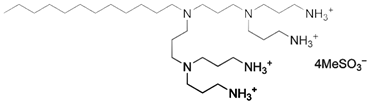 N’-(3-aminopropyl)-N’-[3-[3-[bis(3-aminopropyl)amino]propyl-dodecylamino]propyl]propane-1,3-diamine tetramethanesulfonate C12-DNQNNH3MeSO3 (dicephalic-quadruple) | 0.91–0.93 [t, 3H, CH3(CH2)10CH2N<]; 1.25–1.50 [m, 24H, CH3(CH2)10CH2N<, >NCH2CH2CH2N<]; 2.11–2.14 [m, 8H, >NCH2CH2CH2NH3+]; 2.35–2.38 [m, 36H, N(CH2-)3]; 2.83 [s, 12H, CH3SO3−]; 3.33 [m, 8H, >NCH2CH2CH2NH3+]; 6.98–7.15 [m, 12H, -NCH2CH2CH2NH3+] | 14 [-(CH2)10CH3]; 20–30 [-(CH2)10CH3, >NCH2CH2-]; 38 [-CH2NH3+]; 41 [CH3SO3−]; 51–55 [N(CH2-)3] | 360.78 (M2+) | 44.79 (44.76) | 9.59 (9.41) | 10.61 (10.75) | 155–168 | 35.0 | <0 |
| Independent Variables | Levels | |||||
|---|---|---|---|---|---|---|
| A: AgNO3 (mmol) | L1 | L2 | L3 | |||
| B: type of surfactant | L1 | L2 | L3 | L4 | ||
| C: surfactant concentration | <CMC | CMC | >CMC | |||
| D: NaBH4 (mmol) | L1 | L2 | L3 | |||
| Dependent variables | Goal | |||||
| Y1 = average particle diameter | Minimization | |||||
| Y2 = PDI | Minimization | |||||
| Source | Sum of Squares | df | Mean Square | F-value | p-value | |
| Model | 9.34 | 5 | 1.87 | 6.39 | 0.0008 | |
| A-AgNO3 | 0.0216 | 1 | 0.0216 | 0.0737 | 0.7885 | |
| B-Surfactant | 4.28 | 1 | 4.28 | 14.64 | a 0.0009 | |
| C-NaBH4 | 0.7853 | 1 | 0.7853 | 2.69 | 0.1154 | |
| D-Surfactant type | 4.05 | 2 | 2.02 | 6.93 | a 0.0046 | |
| Residual | 6.43 | 22 | 0.2923 | |||
| Lack of Fit | 6.43 | 17 | 0.3783 | |||
| Pure Error | 0.0000 | 5 | 0.0000 | |||
| Cor Total | 15.77 | 27 | ||||
Disclaimer/Publisher’s Note: The statements, opinions and data contained in all publications are solely those of the individual author(s) and contributor(s) and not of MDPI and/or the editor(s). MDPI and/or the editor(s) disclaim responsibility for any injury to people or property resulting from any ideas, methods, instructions or products referred to in the content. |
© 2026 by the authors. Licensee MDPI, Basel, Switzerland. This article is an open access article distributed under the terms and conditions of the Creative Commons Attribution (CC BY) license.
Share and Cite
Balicki, S.J.; Klapiszewska, I.; Lamch, Ł.; Bartman, M.; Klapiszewski, Ł.; Wilk, K.A. Experimental Design and Optimization of Dispersion Systems in Fine and Specialty Chemical Fabrication. Molecules 2026, 31, 1617. https://doi.org/10.3390/molecules31101617
Balicki SJ, Klapiszewska I, Lamch Ł, Bartman M, Klapiszewski Ł, Wilk KA. Experimental Design and Optimization of Dispersion Systems in Fine and Specialty Chemical Fabrication. Molecules. 2026; 31(10):1617. https://doi.org/10.3390/molecules31101617
Chicago/Turabian StyleBalicki, Sebastian J., Izabela Klapiszewska, Łukasz Lamch, Marcin Bartman, Łukasz Klapiszewski, and Kazimiera A. Wilk. 2026. "Experimental Design and Optimization of Dispersion Systems in Fine and Specialty Chemical Fabrication" Molecules 31, no. 10: 1617. https://doi.org/10.3390/molecules31101617
APA StyleBalicki, S. J., Klapiszewska, I., Lamch, Ł., Bartman, M., Klapiszewski, Ł., & Wilk, K. A. (2026). Experimental Design and Optimization of Dispersion Systems in Fine and Specialty Chemical Fabrication. Molecules, 31(10), 1617. https://doi.org/10.3390/molecules31101617