Article

The Evaluation of Eutectic Solvents as Catalysts for Mediating the Greener Synthesis of Poly(alkylene 2,5-furandicarboxylate)s


by
Beatriz Agostinho
,
Vinícius de Paula
,
Armando J. D. Silvestre
and
Andreia F. Sousa
*
CICECO—Aveiro Institute of Materials, Department of Chemistry, University of Aveiro, 3810-193 Aveiro, Portugal
*
Author to whom correspondence should be addressed.
Molecules 2026, 31(1), 77; https://doi.org/10.3390/molecules31010077
Submission received: 13 November 2025 / Revised: 4 December 2025 / Accepted: 12 December 2025 / Published: 24 December 2025

Abstract

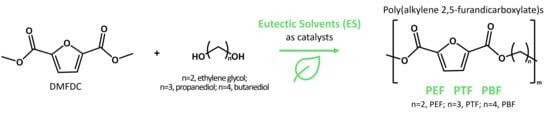
In a quest to develop more sustainable polymers, decoupling their production from fuel-based resources and searching for alternative greener synthetic pathways are important priorities. Among the numerous polymers that fall into this category are furan-based polyesters. Besides the origin of polymers, their synthesis is another critical topic to consider regarding the overall greenness of the final product. However, despite several studies focusing on bio-based alternatives, such as poly(alkylene 2,5-furandicarboxylate)s, their synthesis still relies on air- and water-sensitive metal-based catalysts and is typically carried out under harsh conditions. This study explores an alternative approach with the application of eutectic solvents (ES) as catalysts for a more sustainable approach for synthesising furan-based polyesters, specifically poly(ethylene 2,5-furandicarboxylate) (PEF), as well as poly(trimethylene furandicarboxylate) (PTF) and poly(butylene furandicarboxylate) (PBF). Two different ES were evaluated as catalysts; the best results were obtained with urea and zinc acetate ES (U:Zn(OAc)2, 4:1 mol:mol). The resulting polymers were analysed for their structure, molecular weight, and thermal properties.

Graphical Abstract

1. Introduction

Polymers have become an indispensable and valuable resource for our society, due to their unique properties, with global polymer production exceeding 410 Mt in 2023 [1]. The vast majority of these polymers (over 90%) are derived from fossil resources [1]. Therefore, redesigning polymers and decoupling them from non-renewable resources is an established priority in the pursuit of developing greener options, which has led to the current demand for bio-based polymers.
Among the numerous polymers that fit into this category, furan-based polyesters, such as those derived from 2,5-furandicarboxylic acid (FDCA), are among the most extensively studied [2], with poly(ethylene 2,5-furandicarboxylate) (PEF) being undoubtedly the most recognised [3]. This bio-based polymer is highlighted by its similarities to widely established fossil-based poly(ethylene terephthalate) (PET). Other FDCA-based polymers synthesised with longer-chain diols, such as poly(trimethylene 2,5-furandicarboxylate) (PTF) and poly(butylene 2,5-furandicarboxylate) (PBF), have also been attracting attention [4], due to their outstanding barrier properties, with PEF and PTF, for example, having a gas transmission rates of 0.03 and 0.17 cm3/m2·d·atm, respectively, in comparison with the 1.37 cm3/m2·d·atm rate observed for PET [5]. As a result, these polymers are being considered for future carbonated drink bottles [6,7].
Besides their origin, polymer synthesis is another critical topic to consider regarding the overall greenness of the final product. Indeed, the traditional synthesis of furan-based polyesters, typically through bulk polyesterification reactions, still relies on air- and water-sensitive metal-based catalysts, in addition to being carried out under harsh conditions, such as high temperatures (180–220 °C) [8,9]. Consequently, developing greener synthetic approaches is another requirement towards greener polymers. In the case of PEF, it is usually synthesised by a two-stage bulk polyesterification using 2,5-furandicarboxylic acid (FDCA) or its dimethyl ester derivative (DMFDC) and an excess of ethylene glycol at temperatures up to 220 °C and catalysed by metal catalysts such as antimony(III) oxide and titanium(IV) isopropoxide [9,10].
Alternative and greener approaches for synthesising PEF can include bulk polymerisation using organic non-metallic catalysts, like 1,8-diazabicylo[5.4.0]undec-7-ene (DBU) [11], which was used by Wu et al. to obtain PEF with an intrinsic viscosity of 0.54 dL·g−1, although at high temperatures of 170–240 °C and long reaction times of 11–13 h.
On the other hand, alternative and greener solvents, such as eutectic solvents (ES) [12], have been applied in different fields, including as catalysts for polymer synthesis [13,14]. ES are generally described as a mixture of two or more compounds that have a lower melting temperature than those of their individual components [15,16]. They are simple to prepare and do not require purification steps. ES have been reported to be used as alternative solvents, for example, in enzymatic polymerisation to enhance the enzyme’s activity and stability [17]. In furanic polyester synthesis, they can also be a greener alternative to organic solvents such as toluene or diphenyl ether [18]. Silvianti et al. [19] reported on two choline chloride-based ES as solvents for the enzymatic synthesis of furanic aliphatic polyesters with varying diol chain lengths (6 to 12). The best results were reported using choline chloride:urea (1:2 mol:mol) for the synthesis of poly(dodecamethylene-2,5-furanoate) (PDOF) with 41% yield and a molecular weight (Mw) of 2700 g/mol.
In a different vein, and more recently, a urea:zinc acetate (U:Zn(OAc)2, 4:1 mol:mol) ES has been used as a catalyst for polyester depolymerisation, instead of only as a reaction solvent medium as previously mentioned [20,21,22], and particularly in our recent study on PEF chemical recycling [23]. This last study demonstrated the potential of ES to serve as catalysts in a closed-loop repolymerisation stage, leading to recycled PEF (rPEF) with a global yield of 69%.
Encouraged by the progress achieved, the present study aims to go beyond and explore, for the first time, the use of ES as catalysts for an eco-friendlier approach for the synthesis of FDCA-based polyesters and particularly of PEF, but also PTF and PBF. Two ES were assessed as catalysts, and the polymers’ structure, molecular weight, and thermal properties were investigated.

2. Results and Discussion

The first step of this study was dedicated to assessing the possibility of using a simple ES as the catalyst for the synthesis of PEF. Urea:zinc acetate (U:Zn(OAc)2, 4:1 mol:mol) was selected from previous evidence [23], and choline chloride:ethylene glycol (ChCl:EG, 1:2 mol:mol) was chosen due to the possibility of EG also acting as the monomer in polymer synthesis in the polyesterification reaction yielding PEF [24]. Reactions were carried out at 190 °C for 5 h, followed by 2 additional hours under vacuum at 220 °C. The obtained reaction isolation yield, the intrinsic viscosity of the isolated PEF ([η]), and the number-average degree of polymerisation (DPn) are summarised in Table 1. Based on 1H NMR analysis (Figure 1), it is possible to calculate the DPn by considering the area of the proton resonances of the furan ring (a) and of the terminal group (d) [25].
From Table 1, it can be observed that both ES were able to mediate a polytransesterification reaction of PEF. The best ES in terms of PEF isolation yield, [η], and DPn is U:Zn(OAc)2, with 77%, 0.2 dL·g−1, and 25, respectively. On the other hand, ChCl:EG did not perform as well, with only a 53% PEF isolation yield and low [η] and DPn of 0.1 dL·g−1 and 10, respectively. Furthermore, control reactions were performed with each of the best ES components, namely urea and zinc acetate, with yields ranging from 16 to 66% and an average [η] of 0.15 dL·g−1.
For comparison, the results obtained with the standard metal-based catalyst used for PEF synthesis (titanium(IV) tert-butoxide, TBT) under the same reaction conditions show that the obtained yield is higher, around 87%, with an IV of 0.3 dL·g−1 and 75 DPn, which translates into a higher molecular weight overall. To evaluate the polymers’ chemical structure, the ATR FTIR, 1H, and 13C NMR spectra for PEF synthesised with the two different ES can be observed in Figure 1 and Figures S1–S3 in the Supplementary Information.
In Figure 1, 1H NMR resonances corresponding to the protons of the furan ring (a, 7.3 ppm) and to the methylene protons (b, 4.7 ppm) can be observed in both spectra, confirming PEF synthesis in both ES media. For PEF-synthesised ChCl:EG ES, two additional resonances corresponding to end-groups CH2CH2OH at 4.56 and 4.13 ppm (c and d, respectively), and an additional resonance around 3.99 ppm (e) attributed to the methoxy (OCH3) terminal group can be observed, which is in agreement with the obtained lower isolation yield and [η], which confirms the presence of an oligomer. Additionally, based on the 1H NMR analysis (Figure 1), it is also possible to calculate the number of repeating units of the depolymerisation product [25]: considering the area of the proton resonances of the furan ring (a) and of the OCH3 terminal group (e), it is possible to calculate a DPn of 25 for PEF prepared in U:Zn(OAc)2 and only 10 for PEF oligomer prepared in ChCl:EG, which corroborates the obtained isolation yield and [η] values. The 13C NMR spectra (Figure S3, Supplementary Information) are in accordance with the expected chemical structure.
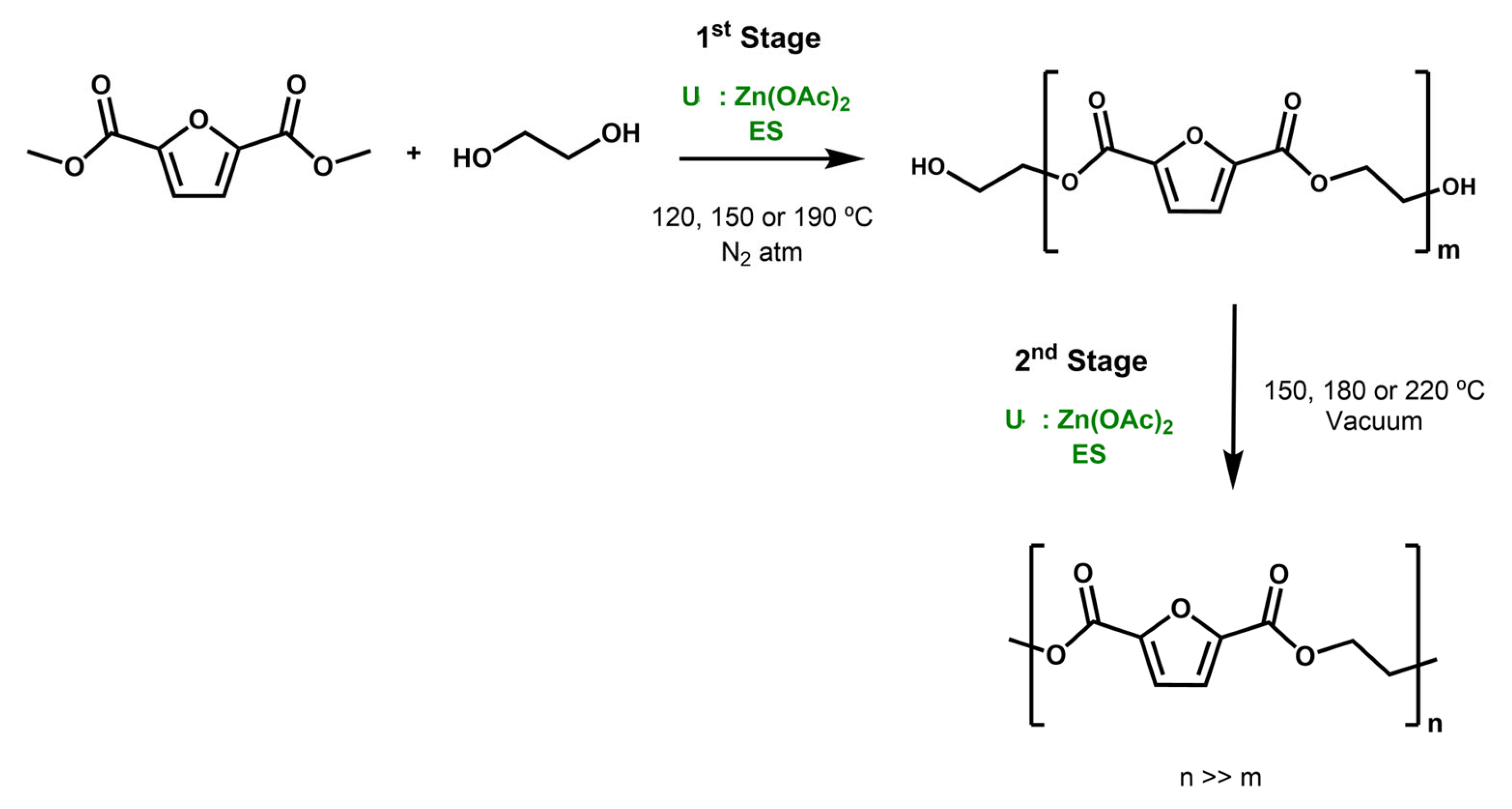
After the catalyst screening, U:Zn(OAc)2 media were selected for further optimisation of PEF synthesis conditions following Scheme 1.
Aiming to use milder synthesis conditions, lower reaction temperatures, ranging from 120 to 180 °C, were tested. The minimum temperature was set at 120 °C, as the DMFDC melting point is approximately 112 °C. Reaction temperature variation was investigated. In addition to the standard conditions (190–220 °C), two lower sets of temperatures (150–180 °C and 120–150 °C) were also tested. The applied conditions and the obtained results are summarised in Table 2.
As expected, a trend can be observed whereby there is a lower yield and [η] for lower reaction temperatures. The lowest yield of 55%, an [η] of 0.1 dL·g−1, and a DPn of only 9 were obtained for PEF synthesised at 120–150 °C. Under intermediate conditions of 150–180 °C, there is a slightly lower yield than under standard conditions (63% compared to 71%, respectively), an [η] of 0.2 dL·g−1, and a DPn of 10. To evaluate their chemical structure, the 1H NMR of the obtained polymers can be seen in Figure 2.
In Figure 2, the 1H NMR resonances corresponding to the protons of the furan ring (a, 7.3 ppm) and to the methylene protons (b, 4.7 ppm) can be observed in the corresponding spectra. For lower temperatures (namely, 150–180 °C and 120–150 °C), an additional resonance around 3.99 ppm (e) attributed to the methoxy (OCH3) terminal group can be observed. For the lowest temperatures (120–150 °C), two additional resonances corresponding to PEF end-groups CH2CH2OH at 4.58 and 4.14 ppm, respectively, were also observed. This is in agreement with previous results, where lower temperatures correspond to the lowest yield, [η], and DPn. For that reason, the PEF synthesised with the lowest set of temperatures (120–150 °C) was not further investigated.
Additionally, thermal analyses (DSC and TGA) were conducted to assess the thermal properties of the resulting polymers, and the results obtained can be seen in Table 3 and in Figure S4 in the Supplementary Information.
In Table 3, for milder synthesis temperatures of 150–180 °C, the obtained PEF has a Tg of 73.4 °C, which is slightly lower than the Tg reported for PEF (75–80 °C) [26]. The same happens to the crystallisation temperature of 140 °C compared to 165 °C. The melting point of 211 °C is within the reported range for PEF (210–215 °C) synthesised with higher temperatures and metal-based catalysts [26]. Regarding the decomposition behaviour, the PEF synthesised with milder temperatures has both higher Td,5% and Td,max (327 and 383 °C compared to 310 and 373 °C for 180–220 °C). When the synthesis temperature rises to standard values (190–220 °C), the thermal properties generally improve, showing higher Tg and Tc (80.6 and 170 °C, respectively). For synthesis using a metal-based catalyst (TBT) at a temperature range of 190–220 °C, the Tg of 82 °C, crystallisation at 162 °C, and melting around 214 °C are all within the values obtained using U:Zn(OAc)2. On the other hand, regarding the decomposition behaviour, Td,5% and Td,max are higher at 355 °C and 403 °C, respectively.
After proving its potential for catalysing PEF synthesis with comparable properties to a metal-based catalyst (TBT), U:Zn(OAc)2 was also tested for the synthesis of other furanic polyesters, namely PTF and PBF, under the standard conditions originally used for PEF (190–220 °C, for a total of 7 h). The obtained isolation yield, intrinsic viscosity, and DPn for all polymers can be seen in Table 4.
As can be seen in Table 4, U:Zn(OAc)2 was also able to mediate the synthesis of both PTF and PBF, yielding isolation yields above 74%. The final PTF’s intrinsic viscosity is 0.4 dL·g−1 and it has a DPn of 75. For PBF, these values are slightly lower at 0.2 dL·g−1 and 10, indicating that an oligomer was obtained. This preliminary data shows that the U:Zn(OAc)2 can catalyse the synthesis of furanic-based polyesters, although there is still room for specific improvement, especially in the case of PBF. For the synthesis of PTF and PBF, the longer-chain diols need higher temperatures to support excess diol removal, which could be achieved by increasing the reaction’s temperature during the vacuum stage.
Furthermore, the structure of the resulting polymers was confirmed by ATR FTIR (Figure S5, Supplementary Information), 1H NMR (Figure 3 and Figure S6, Supplementary Information), and 13C NMR (Figure S7, Supplementary Information).
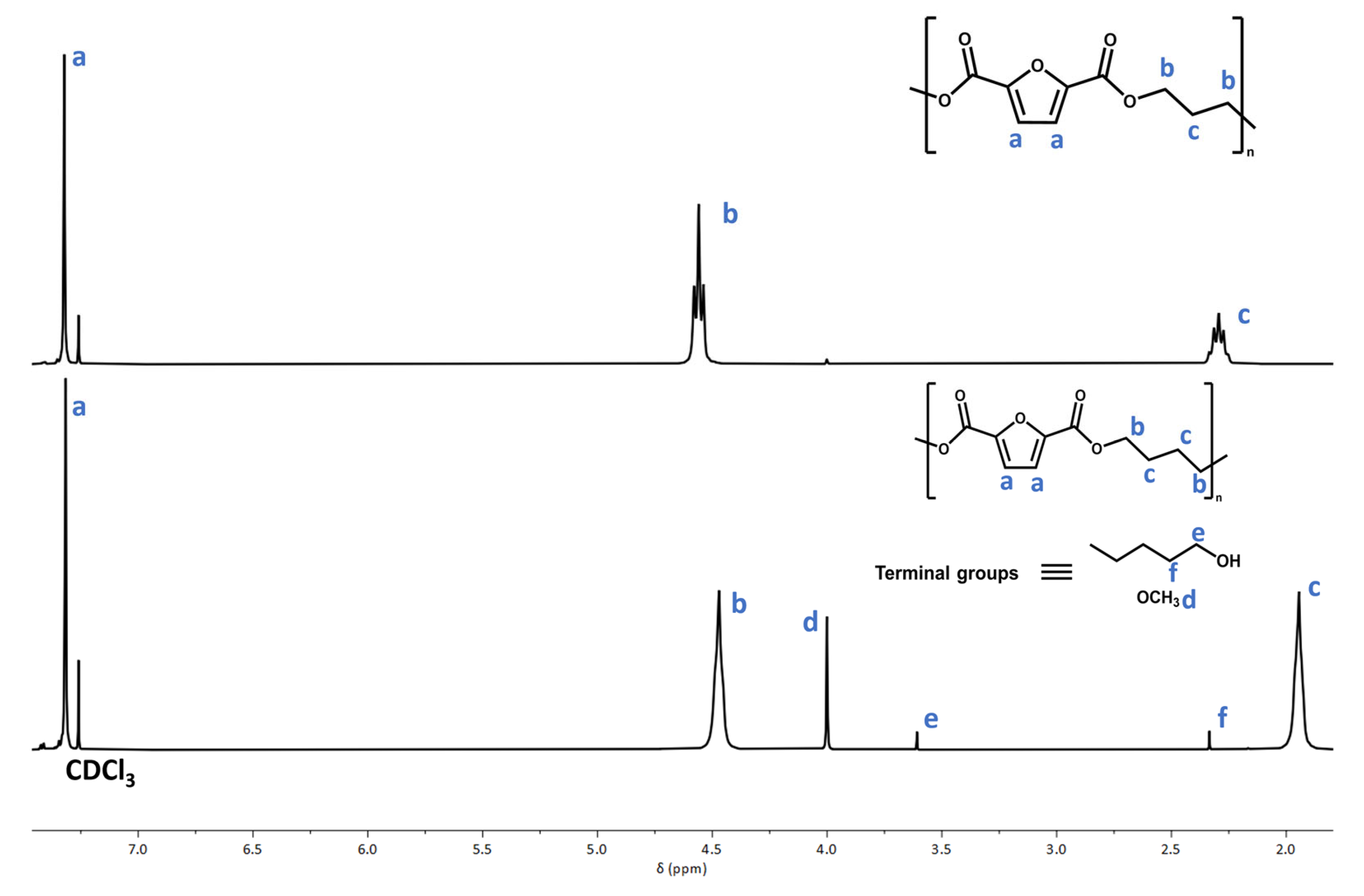
Observing Figure 3, in both spectra, the resonances corresponding to the protons of the furan ring (a, around 7.2 ppm) can be observed. For PTF, the methylene protons can be seen around 4.49 and 2.25 ppm (b and c, respectively), and for PBF, around 4.39 and 1.90 ppm (b and c). The terminal groups of PTF can also be seen around 3.78 and 2.01 ppm. These proton resonance assignments are in agreement with the reported 1H NMR data for PTF and PBF [5]. Similarly to PEF, the appearance of the DMFDC terminal group OCH3 around 3.99 ppm (d) can be observed for both polymers, which is consistent with the lower DPn obtained for these polymers. Further characterisation is summarised in Table 5 and can be seen in Figure S8 in the Supplementary Information.
Analysing the obtained polymers’ thermal properties, for PTF, the glass transition temperature of 55 °C is in line with literature values (52 °C) [5]. The melting temperature is also within the reported values, with a slightly higher Tm of 174 °C compared to 169 °C [5,27]. In the case of PBF, the Tg of 26 °C is slightly lower than the one reported at around 37 °C. Similarly, the melting point is around 163 °C (170 °C in the literature), but the crystallisation temperature for PBF is similar, at 109 and 102 °C [5,27]. Regarding their degradation behaviour, for PTF, the maximum decomposition of 382 °C is within the reported range of around 386 °C, while for PBF, it is slightly lower at 389 °C compared to 407 °C [5].

3. Materials and Methods

3.1. Materials

Dimethyl furan 2,5-dicarboxylate (DMFDC, 99.9%) was purchased from Sarchem Laboratories (Farmingdale, NJ, USA). Urea (U, 99.0–100.5%), zinc acetate (Zn(OAc)2, 99.99%), choline chloride (ChCl, ≥99%), ethylene glycol (EG, 99.8%), 1,3-propanediol (PDO, 98%), 1,4-butanediol (BDO,), methanol (≥99.8%), chloroform (CHCl3, analytical grade), trifluoracetic acid (TFA, 99%), deuterated chloroform (CDCl3, 99.8 atom%D), deuterated trifluoracetic acid (CF3COOD, 99.5 atom%D), phenol (99%), 1,1,2,2-tetrachloroethane (TCE, ≥98%), and titanium(IV) tert-butoxide (TBT, 97%) were all purchased from Sigma Aldrich (St. Louis, MO, USA).

3.2. Eutectic Solvent Preparation

The different ES, urea:zinc acetate (U:Zn(OAc)2, 4:1 mol:mol) and choline chloride: ethylene glycol (ChCl:EG, 1:2), were prepared as described in the literature [21,23,24]. The ES components were briefly mixed according to the corresponding molar ratio at 70–100 °C for 2–8 h until they formed a clear, homogeneous liquid. The as-prepared ES were promptly used.

3.3. Polymer Synthesis Procedure

Poly(ethylene 2,5-furandicarboxylate) (PEF) was synthesised by a bulk polyesterification reaction adapted from elsewhere, using dimethyl 2,5-furandicarboxylate (DMFDC), an excess of ethylene glycol (molar ratio DMFDC:EG = 1:2.2), and the respective catalyst (ES) [27]. In the first stage, the temperature was gradually raised to 190 °C and kept at that temperature for 5 h. In the second stage, the reaction proceeded under vacuum, and the temperature increased to 220 °C in 2 h to remove excess ethylene glycol. Then, the reaction mixture was dissolved in chloroform (ca. 25 mL) with some drops of trifluoroacetic acid, and the polymer was precipitated by pouring the solution into an excess of cold methanol (ca. 500 mL), filtered, and dried. Control reactions were performed with each of the best ES components. Poly(trimethylene 2,5-furandicarboxylate) (PTF) and poly(butylene 2,5-furandicarboxylate) (PBF) synthesis was similarly carried out using 1,3-propanediol and 1,4-butanediol, respectively, with a molar ratio of DMFDC/diol = 1/1.2 [28].

3.4. Polymer Synthesis Optimisation

Polymer synthesis optimisation was performed for two additional sets of temperatures, 150–180 °C and 120–150 °C, for the reaction’s first and second stages, respectively. The remaining reaction conditions were kept constant as previously described (reaction time, catalyst, and DMFDC:EG molar ratio)

3.5. Polymer Characterisation

Attenuated total reflection Fourier transform infrared (ATR FTIR) spectra of the main products were obtained using a PARAGON 1000 Perkin Elmer FTIR spectrophotometer (Waltham, MA, USA) equipped with a single horizontal Golden Gate ATR cell. The resolution was 8 cm−1 at 64 scans, in the range 500–4000 cm−1. The ATR FTIR spectra are available in the Supplementary Information.
1H and 13C nuclear magnetic resonance spectroscopy (NMR) analyses of samples dissolved in CDCl3 with a few drops of CF3COOD were recorded using a Bruker AMX 300 Spectrometer (Billerica, MA, USA) operating at 300.13 MHz and 75.47 MHz, respectively. All chemical shifts were expressed as parts per million (ppm) downfield from tetramethylsilane used as the internal standard. Complete 1H and 13C NMR spectra are available in the Supplementary Information.
Intrinsic viscosity ([η]) measurements were carried out on an Ubbelohde-type viscometer maintained at 25 °C in a mixture of phenol/1,1,2,2-tetrachloroethane (50/50) (wt%/wt%). PEF was dissolved in that solvent mixture (0.1 g per 20 mL). The intrinsic viscosity was determined by the ratio of specific viscosity to PEF solution concentration (ηsp/c, where ηsp = (t1t0) t0 and t0 and t1 are the solvent mixture elution time of the solvent mixture and polyester solution, respectively).
Differential Scanning Calorimetry (DSC) thermograms were obtained with a Netzsch Caliris 300 (Selb, Germany), and the thermograms were recorded following a heating rate of 2 °C/min (1st cycle), 20 °C/min (2nd cycle), and cooling rate of 20 °C/min under a nitrogen flow of 40 mL/min in a temperature range from 0 to 200 °C. Two heating/cooling cycles were repeated.
Thermogravimetric analyses (TGA) were carried out by a METTLER TOLEDO TGA 2 analyser (Columbus, OH, USA) equipped with a platinum cell using platinum pans to encapsulate the samples (ca. 5 mg). Thermograms were recorded under a nitrogen flow (50 mL/min) and heated at a constant rate of 20 °C/min from room temperature up to 800 °C.

4. Conclusions

This study demonstrates the potential of eutectic solvents (ES), especially urea and zinc acetate (U:Zn(OAc)2), as sustainable catalysts for synthesising furan-based polyesters such as PEF, PTF, and PBF. The results show that milder synthesis conditions with reaction temperatures from 150 to 180 °C can effectively produce PEF with desirable thermal properties. Additionally, PEF produced under milder conditions exhibited improved thermal stability, indicated by higher decomposition temperatures, although elevated synthesis temperatures (190–220 °C) further enhanced thermal characteristics, aligning with properties achieved using metal-based catalysts like TBT. The use of U:Zn(OAc)2 ES also proved efficient for synthesising furan-based polyesters with longer-chain diols, such as PTF and PBF, attaining yields above 74% and comparable intrinsic viscosities and molecular weights. These results highlight the possibility of eutectic solvents as environmentally friendly catalysts, enabling an alternative, efficient, lower-temperature production of furanic polyesters with promising thermal stability. Further studies expanding the range of both hydrogen bond donors and acceptors would be an important future step.

Supplementary Materials

The following supporting information can be downloaded at: https://www.mdpi.com/article/10.3390/molecules31010077/s1. Figure S1: Complete 1H NMR spectra of PEF synthesised with different ES, U:Zn(OAc2) and ChCl:EG; Figure S2: FTIR spectra of PEF synthesised with different ES; Figure S3: 13C NMR spectra of PEF synthesised with different ES, U:Zn(OAc2) and ChCl:EG; Figure S4: TGA traces of PEF synthesised with U:Zn(OAc)2 ES at different reaction temperatures; Figure S5: FTIR spectra of PTF and PBF synthesised with ES.; Figure S6: Complete 1H NMR spectra of PTF and PBF synthesised with ES; Figure S7: 13C NMR of PTF and PBF synthesised with ES. Figure S8: TGA traces of PTF and PBF synthesized with ES.

Author Contributions

B.A.: Conceptualization, Data curation, Formal analysis, Investigation, Methodology, Visualisation, Writing—review and editing; V.d.P.: Data curation, Formal analysis; A.J.D.S.: Methodology, Supervision, Validation, Visualisation, Writing—review and editing; A.F.S.: Conceptualization, Funding acquisition, Methodology, Project administration, Resources, Supervision, Validation, Visualisation, Writing—review and editing. All authors have read and agreed to the published version of the manuscript.

Funding

This work was supported by COST Action FUR4Sustain, CA18220, supported by COST (European Cooperation in Science and Technology). This work was developed within the scope of the project CICECO–Aveiro Institute of Materials, UID/50011/2025 and LA/P/0006/2020 (DOI 10.54499/LA/P/0006/2020), financed by national funds through the FCT/MCTES (PIDDAC).

Institutional Review Board Statement

Not applicable.

Informed Consent Statement

Not applicable.

Data Availability Statement

The raw data supporting the conclusions of this article will be made available by the authors on request.

Acknowledgments

The FCT is acknowledged for the research contract to AFS (CEECINSTLA/00002/2022) and a doctorate grant to BA 2020.04495.BD (DOI 10.54499/2020.04495.BD).

Conflicts of Interest

The authors declare no conflicts of interest.

References

  1. Plastics Europe. Plastics Europe Plastics—The Fast Facts 2024; Plastics Europe: Brussels, Belgium, 2024. [Google Scholar]
  2. Sousa, A.F.; Vilela, C.; Fonseca, A.C.; Matos, M.; Freire, C.S.R.; Gruter, G.J.M.; Coelho, J.F.J.; Silvestre, A.J.D. Biobased Polyesters and Other Polymers from 2,5-Furandicarboxylic Acid: A Tribute to Furan Excellency. Polym. Chem. 2015, 6, 5961–5983. [Google Scholar] [CrossRef]
  3. Loos, K.; Zhang, R.; Pereira, I.; Agostinho, B.; Hu, H.; Maniar, D.; Sbirrazzuoli, N.; Silvestre, A.J.D.D.; Guigo, N.; Sousa, A.F. A Perspective on PEF Synthesis, Properties, and End-Life. Front. Chem. 2020, 8, 585. [Google Scholar] [CrossRef] [PubMed]
  4. Sousa, A.F.; Patrício, R.; Terzopoulou, Z.; Bikiaris, D.N.; Stern, T.; Wenger, J.; Loos, K.; Lotti, N.; Siracusa, V.; Szymczyk, A.; et al. Recommendations for Replacing PET on Packaging, Fiber, and Film Materials with Biobased Counterparts. Green Chem. 2021, 23, 8795–8820. [Google Scholar] [CrossRef]
  5. Guidotti, G.; Soccio, M.; García-Gutiérrez, M.C.; Ezquerra, T.; Siracusa, V.; Gutiérrez-Fernández, E.; Munari, A.; Lotti, N. Fully Biobased Superpolymers of 2,5-Furandicarboxylic Acid with Different Functional Properties: From Rigid to Flexible, High Performant Packaging Materials. ACS Sustain. Chem. Eng. 2020, 8, 9558–9568. [Google Scholar] [CrossRef]
  6. Avantium YXY® Technology. Available online: https://www.avantium.com/technologies/yxy/ (accessed on 8 January 2024).
  7. Avantium Avantium and Carlsberg Sign Offtake Agreement on PEF. Available online: https://newsroom.avantium.com/avantium-and-carlsberg-sign-offtake-agreement-on-pef/ (accessed on 11 December 2025).
  8. Jiang, M.; Liu, Q.; Zhang, Q.; Ye, C.; Zhou, G. A Series of Furan-Aromatic Polyesters Synthesized via Direct Esterification Method Based on Renewable Resources. J. Polym. Sci. Part A Polym. Chem. 2012, 50, 1026–1036. [Google Scholar] [CrossRef]
  9. Gandini, A.; Silvestre, A.J.D.; Neto, C.P.; Sousa, A.F.; Gomes, M. The Furan Counterpart of Poly(Ethylene Terephthalate): An Alternative Material Based on Renewable Resources. J. Polym. Sci. Part A Polym. Chem. 2009, 47, 295–298. [Google Scholar] [CrossRef]
  10. PubChem Antimony Trioxide. Available online: https://pubchem.ncbi.nlm.nih.gov/compound/Antimony-trioxide (accessed on 11 March 2025).
  11. Wu, J.; Xie, H.; Wu, L.; Li, B.G.; Dubois, P. DBU-Catalyzed Biobased Poly(Ethylene 2,5-Furandicarboxylate) Polyester with Rapid Melt Crystallization: Synthesis, Crystallization Kinetics and Melting Behavior. RSC Adv. 2016, 6, 101578–101586. [Google Scholar] [CrossRef]
  12. Qu, X.-L.; Jiang, M.; Wang, B.; Deng, J.; Wang, R.; Zhang, Q.; Zhou, G.-Y.; Tang, J. A Brønsted Acidic Ionic Liquid as an Efficient and Selective Catalyst System for Bioderived High Molecular Weight Poly(Ethylene 2,5-Furandicarboxylate). ChemSusChem 2019, 12, 4927–4935. [Google Scholar] [CrossRef]
  13. Weerasinghe, U.A.; Wu, T.; Chee, P.L.; Yew, P.Y.M.; Lee, H.K.; Loh, X.J.; Dan, K. Deep Eutectic Solvents towards Green Polymeric Materials. Green Chem. 2024, 26, 8497–8527. [Google Scholar] [CrossRef]
  14. Liu, P.; Hao, J.W.; Mo, L.P.; Zhang, Z.H. Recent Advances in the Application of Deep Eutectic Solvents as Sustainable Media as Well as Catalysts in Organic Reactions. RSC Adv. 2015, 5, 48675–48704. [Google Scholar] [CrossRef]
  15. Abranches, D.O.; Coutinho, J.A.P. Everything You Wanted to Know about Deep Eutectic Solvents but Were Afraid to Be Told. Annu. Rev. Chem. Biomol. Eng. 2023, 14, 141–163. [Google Scholar] [CrossRef] [PubMed]
  16. Martins, M.A.R.; Pinho, S.P.; Coutinho, J.A.P. Insights into the Nature of Eutectic and Deep Eutectic Mixtures. J. Solution Chem. 2019, 48, 962–982. [Google Scholar] [CrossRef]
  17. Pätzold, M.; Siebenhaller, S.; Kara, S.; Liese, A.; Syldatk, C.; Holtmann, D. Deep Eutectic Solvents as Efficient Solvents in Biocatalysis. Trends Biotechnol. 2019, 37, 943–959. [Google Scholar] [CrossRef]
  18. Silvianti, F.; Maniar, D.; Boetje, L.; Loos, K. Green Pathways for the Enzymatic Synthesis of Furan-Based Polyesters and Polyamides. ACS Symp. Ser. 2020, 1373, 3–29. [Google Scholar] [CrossRef]
  19. Silvianti, F.; Maniar, D.; Boetje, L.; Woortman, A.J.J.; van Dijken, J.; Loos, K. Greener Synthesis Route for Furanic-Aliphatic Polyester: Enzymatic Polymerization in Ionic Liquids and Deep Eutectic Solvents. ACS Polym. Au 2023, 3, 82–95. [Google Scholar] [CrossRef]
  20. De Paula, V.; Pandeirada, S.V.; Ribeiro-Claro, P.J.A.; Silvestre, A.J.D.; Sousa, A.F. Closing the Loop: Greener and Efficient Hydrolytic Depolymerization for the Recycling of Polyesters Using Biobased Eutectic Solvents. ACS Sustain. Chem. Eng. 2025, 13, 3577–3587. [Google Scholar] [CrossRef]
  21. Wang, Q.; Yao, X.; Geng, Y.; Zhou, Q.; Lu, X.; Zhang, S. Deep Eutectic Solvents as Highly Active Catalysts for the Fast and Mild Glycolysis of Poly(Ethylene Terephthalate)(PET). Green Chem. 2015, 17, 2473–2479. [Google Scholar] [CrossRef]
  22. Paparella, A.N.; Perrone, S.; Salomone, A.; Messa, F.; Cicco, L.; Capriati, V.; Perna, F.M.; Vitale, P. Use of Deep Eutectic Solvents in Plastic Depolymerization. Catalysts 2023, 13, 1035. [Google Scholar] [CrossRef]
  23. Agostinho, B.; Silvestre, A.J.D.; Sousa, A.F. From PEF to RPEF: Disclosing the Potential of Deep Eutectic Solvents in Continuous de-/Re-Polymerization Recycling of Biobased Polyesters. Green Chem. 2022, 24, 3115–3119. [Google Scholar] [CrossRef]
  24. Ibrahim, R.K.; Hayyan, M.; AlSaadi, M.A.; Ibrahim, S.; Hayyan, A.; Hashim, M.A. Physical Properties of Ethylene Glycol-Based Deep Eutectic Solvents. J. Mol. Liq. 2019, 276, 794–800. [Google Scholar] [CrossRef]
  25. Izunobi, J.U.; Higginbotham, C.L. Polymer Molecular Weight Analysis by 1H NMR Spectroscopy. J. Chem. Educ. 2011, 88, 1098–1104. [Google Scholar] [CrossRef]
  26. Zubkiewicz, A.; Paszkiewicz, S.; Szymczyk, A. The Effect of Annealing on Tensile Properties of Injection Molded Biopolyesters Based on 2,5-Furandicarboxylic Acid. Polym. Eng. Sci. 2021, 61, 1536–1545. [Google Scholar] [CrossRef]
  27. Zaidi, S.; Thiyagarajan, S.; Bougarech, A.; Sebti, F.; Abid, S.; Majdi, A.; Silvestre, A.J.D.; Sousa, A.F. Highly Transparent Films of New Copolyesters Derived from Terephthalic and 2,4-Furandicarboxylic Acids. Polym. Chem. 2019, 10, 5324–5332. [Google Scholar] [CrossRef]
  28. Matos, M.; Sousa, A.F.; Silva, N.H.C.S.; Freire, C.S.R.; Andrade, M.; Mendes, A.; Silvestre, A.J.D. Furanoate-Based Nanocomposites: A Case Study Using Poly(Butylene 2,5-Furanoate) and Poly(Butylene 2,5-Furanoate)-Co-(Butylene Diglycolate) and Bacterial Cellulose. Polymers 2018, 10, 810. [Google Scholar] [CrossRef]
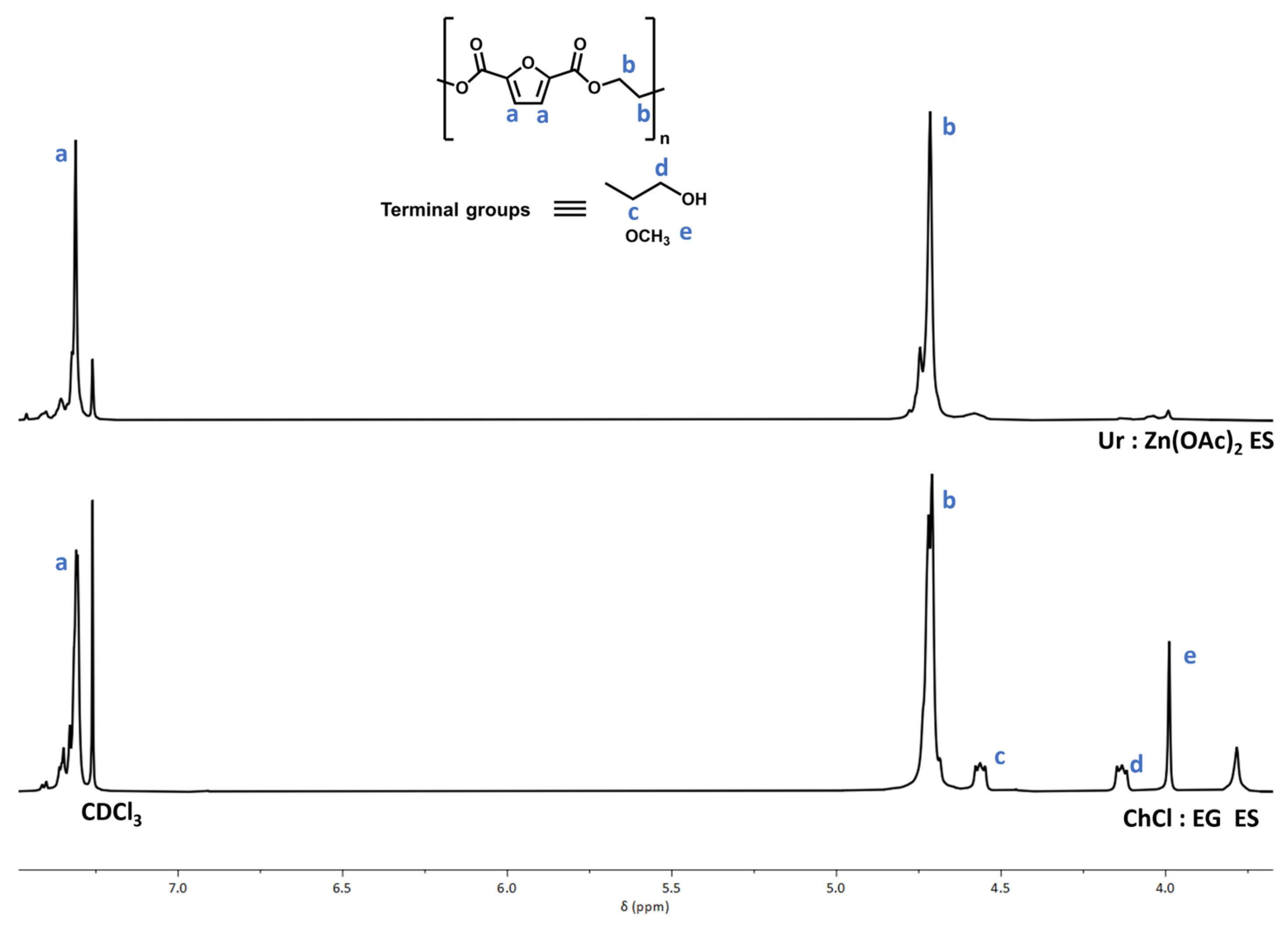
Figure 1. 1H NMR spectra of PEF synthesised with different ES, U:Zn(OAc2) and ChCl:EG.
Molecules 31 00077 g001
Scheme 1. Reaction scheme of PEF synthesis using U:Zn(OAc)2 ES as a catalyst.
Molecules 31 00077 sch001
Figure 2. 1H NMR spectra of PEF synthetized with U:Zn(OAc)2 ES (4:1) at different temperatures.
Molecules 31 00077 g002
Figure 3. 1H NMR of PTF and PBF synthesised with ES.
Molecules 31 00077 g003
Table 1. ES screening for PEF synthesis: polymer isolation yield and intrinsic viscosity.
ESIsolation Yield (%)[η]/dL·g−1DPn 1
U:Zn(OAc)2
(4:1 mol:mol)
710.225
ChCl:EG
(1:2 mol:mol)
530.110
1 DPn calculated through 1H NMR [25].
Table 2. PEF synthesis using U:Zn(OAc)2 (4:1) and different reaction temperatures.
CatalystTemperature/°CIsolation Yield (%)[η]/dL·g−1DPn 1
1st Stage2nd Stage
U:Zn(OAc)2 ES190220710.225
150180630.210
120150550.19
1 DPn calculated through 1H NMR [25].
Table 3. Thermal data (obtained by DSC and TGA analyses) for PEF synthesised with U:Zn(OAc)2 ES at different reaction temperatures.
Tsynthesis/°CTg/°CTc/°CTm/°CTd,5%/°CTd,max/°C
150–18073.4140211327383
190–22080.6170206310373
Table 4. PTF and PBF synthesis using U:Zn(OAc)2 ES as a catalyst, reaction yield, intrinsic viscosity, and DPn.
PolymerIsolation Yield (%)[η]/dL·g−1DPn 1
PTF830.475
PBF740.210
1 DPn calculated through 1H NMR [25].
Table 5. Thermal data (DSC and TGA) of the different furanic polyesters synthesised with U:Zn(OAc)2 ES.
PolymerTg/°CTc/°CTm/°CTd,5%/°CTd,max/°C
PTF55-174339382
PBF26109163332389
Disclaimer/Publisher’s Note: The statements, opinions and data contained in all publications are solely those of the individual author(s) and contributor(s) and not of MDPI and/or the editor(s). MDPI and/or the editor(s) disclaim responsibility for any injury to people or property resulting from any ideas, methods, instructions or products referred to in the content.