
Flavonoids in Plants and Human Health: From Biosynthesis to Neurodevelopmental and Neurodegenerative Disorders

 , ,
, ,
Abstract
1. Introduction
2. Biological Activity of Flavonoids
3. Flavonoids in Food and Nutrition
3.1. Flavonoid Content in Foods and Dietary Intake
3.2. Bioavailability, Processing, and Storage
3.3. Health Effects of Flavonoids
4. Flavonoids in the Prevention and Treatment of Neurodevelopmental and Neurodegenerative Disorders
4.1. Oxidative Stress and Mitochondrial Dysfunction
4.2. Neuroinflammatory Cytokines and Immune Modulation
4.3. Gut-Brain Axis in Neurodevelopmental and Neurodegenerative Diseases
5. Conclusions
Author Contributions
Funding
Institutional Review Board Statement
Informed Consent Statement
Data Availability Statement
Conflicts of Interest
References
- Roy, A.; Khan, A.; Ahmad, I.; Alghamdi, S.; Rajab, B.S.; Babalghith, A.O.; Alshahrani, M.Y.; Islam, S.; Islam, M.R. Flavonoids a bioactive compound from medicinal plants and its therapeutic applications. Biomed. Res. Int. 2022, 2022, 5445291. [Google Scholar] [CrossRef] [PubMed]
- Hasnat, H.; Shompa, S.A.; Islam, M.M.; Alam, S.; Richi, F.T.; Emon, N.U.; Ashrafi, S.; Ahmed, N.U.; Chowdhury, M.N.R.; Fatema, N.; et al. Flavonoids: A treasure house of prospective pharmacological potentials. Heliyon 2024, 10, e27533. [Google Scholar] [CrossRef]
- Stachelska, M.A.; Karpiński, P.; Kruszewski, B. A Comprehensive review of biological properties of flavonoids and their role in the prevention of metabolic, cancer and neurodegenerative diseases. Appl. Sci. 2025, 15, 10840. [Google Scholar] [CrossRef]
- Parcheta, M.; Świsłocka, R.; Orzechowska, S.; Akimowicz, M.; Choińska, R.; Lewandowski, W. Recent developments in effective antioxidants: The structure and antioxidant properties. Materials 2021, 14, 1984. [Google Scholar] [CrossRef]
- Okoye, C.O.; Jiang, H.; Wu, Y.; Li, X.; Gao, L.; Wang, Y.; Jiang, J. Bacterial biosynthesis of flavonoids: Overview, current biotechnology applications, challenges, and prospects. J. Cell. Physiol. 2023, 239, e31006. [Google Scholar] [CrossRef]
- Savino, R.; Medoro, A.; Ali, S.; Scapagnini, G.; Maes, M.; Davinelli, S. The emerging role of flavonoids in autism spectrum disorder: A systematic review. J. Clin. Med. 2023, 12, 3520. [Google Scholar] [CrossRef]
- Wu, R.; Zhu, X.; Guan, G.; Cui, Q.; Zhu, L.; Xing, Y.; Zhao, J. Association of dietary flavonoid intakes with prevalence of chronic respiratory diseases in adults. J. Transl. Med. 2024, 22, 205. [Google Scholar] [CrossRef]
- Kumar, S.; Pandey, A.K. Chemistry and biological activities of flavonoids: An overview. Sci. World J. 2013, 1, 162750. [Google Scholar] [CrossRef]
- Perez-Vizcaino, F.; Fraga, C.G. Research trends in flavonoids and health. Arch. Biochem. Biophys. 2018, 646, 107–112. [Google Scholar] [CrossRef] [PubMed]
- Krishna, P.; Subhan, A.; Gupta, K.; Biharee, A.; Thareja, S. Natural products in the 21st Century: Revolutionizing therapeutics with flavonoids as key phytometabolites. Phytother. Res. 2025, 39, 3833–3867. [Google Scholar] [CrossRef] [PubMed]
- Sun, C.; Zhang, M.; Dong, H.; Liu, W.; Guo, L.; Wang, X. A spatially-resolved approach to visualize the distribution and biosynthesis of flavones in Scutellaria baicalensis Georgi. J. Pharm. Biomed. Anal. 2020, 179, 113014. [Google Scholar] [CrossRef]
- Dias, M.C.; Pinto, D.C.G.A.; Silva, A.M.S. Plant flavonoids: Chemical characteristics and biological activity. Molecules 2021, 26, 5377. [Google Scholar] [CrossRef]
- Seto, H.; Sasaki, S.; Mitobe, Y.; Ota, T.; Tatsuzawa, F. Flower colors and flavonoids in the cultivars of Verbena hybrida. J. Hortic. 2023, 92, 3. [Google Scholar] [CrossRef]
- Gupta, T.; Kataria, R.; Sardana, S.A. Comprehensive review on current perspectives of flavonoids as antimicrobial agent. Curr. Top. Med. Chem. 2022, 22, 425–434. [Google Scholar] [CrossRef] [PubMed]
- Chagas, M.D.S.S.; Behrens, M.D.; Moragas-Tellis, C.J.; Penedo, G.X.M.; Silva, A.R.; Gonçalves-de-Albuquerque, C.F. Flavonols and flavones as potential anti-inflammatory, antioxidant, and antibacterial compounds. Oxidative Med. Cell Longev. 2022, 6, 9966750. [Google Scholar] [CrossRef]
- Hao, B.; Yang, Z.; Liu, H.; Liu, Y.; Wang, S. Advances in flavonoid research: Sources, biological activities, and developmental prospectives. Curr. Issues Mol. Biol. 2024, 46, 2884–2925. [Google Scholar] [CrossRef] [PubMed]
- Xiao, J. Dietary flavonoid aglycones and their glycosides: Which show better biological significance? Crit. Rev. Food Sci. Nutr. 2017, 57, 1874–1905. [Google Scholar] [CrossRef]
- Kotik, M.; Kulik, N.; Valentová, K. Flavonoids as aglycones in retaining glycosidase-catalyzed reactions: Prospects for green chemistry. J. Agric. Food Chem. 2023, 71, 14890–14910. [Google Scholar] [CrossRef] [PubMed]
- Cassidy, A.; Minihane, A.M. The role of metabolism (and the microbiome) in defining the clinical efficacy of dietary flavonoids. Am. J. Clin. Nutr. 2017, 105, 10–22. [Google Scholar] [CrossRef]
- Chen, S.; Wang, X.; Cheng, Y.; Gao, H.; Chen, X. A Review of classification, biosynthesis, biological activities and potential applications of flavonoids. Molecules 2023, 28, 4982. [Google Scholar] [CrossRef]
- Hrubša, M.; Tvrdý, V.; Kutý, M.; Valentová, K.; Křen, V.; Mladěnka, P. Interaction of flavonoids with zinc and zinc-containing enzymes. J. Agric. Food Chem. 2022, 70, 6134–6144. [Google Scholar] [CrossRef] [PubMed]
- Hassanpour, S.H.; Doroudi, A. Review of the antioxidant potential of flavonoids as a subgroup of polyphenols and partial substitute for synthetic antioxidants. Avicenna J. Phytomed. 2023, 13, 354–376. [Google Scholar] [CrossRef] [PubMed]
- Ribeiro, D.; Freitas, M.; Tomé, S.M.; Silva, A.M.; Laufer, S.; Lima, J.; Fernandes, E. Flavonoids inhibit COX-1 and COX-2 enzymes and cytokine/chemokine production in human whole blood. Inflammation 2015, 38, 858–870. [Google Scholar] [CrossRef]
- Grijalva-Guiza, R.; Jiménez-Garduño, A.; Hernández, L.R. Potential Benefits of flavonoids on the progression of atherosclerosis by their effect on vascular smooth muscle excitability. Molecules 2021, 26, 3557. [Google Scholar] [CrossRef]
- Cazaubon, M.; Benigni, J.P.; Steinbruch, M.; Jabbour, V.; Gouhier-Kodas, C. Is there a difference in the clinical efficacy of diosmin and micronized purified flavonoid fraction for the treatment of chronic venous disorders? Review of available evidence. Vasc. Health Risk Manag. 2021, 16, 591–600. [Google Scholar] [CrossRef] [PubMed]
- Wang, B.; Wu, L.; Chen, J.; Dong, L.; Chen, C.; Wen, Z.; Hu, J.; Fleming, I.; Wang, D.W. Metabolism pathways of arachidonic acids: Mechanisms and potential therapeutic targets. Sig. Transduct. Target. Ther. 2021, 6, 94. [Google Scholar] [CrossRef]
- Grin, P.M.; Dwivedi, D.J.; Chathely, K.M.; Trigatti, B.L.; Prat, A.; Seidah, N.G.; Liaw, P.C.; Fox-Robichaud, A.E. Low-density lipoprotein (LDL)-dependent uptake of Gram-positive lipoteichoic acid and Gram-negative lipopolysaccharide occurs through LDL receptor. Sci. Rep. 2018, 8, 10496. [Google Scholar] [CrossRef]
- Pandey, P.; Lakhanpal, S.; Mahmood, D.; Kang, H.N.; Kim, B.; Kang, S.; Choi, J.; Choi, M.; Pandey, S.; Bhat, M.; et al. An updated review summarizing the anticancer potential of flavonoids via targeting NF-kB pathway. Front. Pharmacol. 2025, 15, 1513422. [Google Scholar] [CrossRef]
- Jin, J.; Zhou, Q.; Guo, B.; Jia, Z. Discovery of dietary plant flavonols as novel potent inhibitors targeting DYRK1A kinase. Biomolecules 2025, 15, 934. [Google Scholar] [CrossRef]
- Lam, T.P.; Tran, N.V.N.; Pham, L.H.D.; Lai, N.V.-T.; Dang, B.-T.N.; Truong, N.-L.N.; Nguyen-Vo, S.-K.; Hoang, T.-L.; Mai, T.T.; Tran, T.-D. Flavonoids as dual-target inhibitors against α-glucosidase and α-amylase: A systematic review of in vitro studies. Nat. Prod. Bioprospect 2024, 14, 4. [Google Scholar] [CrossRef]
- Leyva-López, N.; Gutierrez-Grijalva, E.P.; Ambriz-Perez, D.L.; Heredia, J.B. Flavonoids as cytokine modulators: A possible therapy for inflammation-related diseases. Int. J. Mol. Sci. 2016, 17, 921. [Google Scholar] [CrossRef] [PubMed]
- Kicinska, A.; Jarmuszkiewicz, W. Flavonoids and mitochondria: Activation of cytoprotective pathways? Molecules 2020, 25, 3060. [Google Scholar] [CrossRef] [PubMed]
- Pourcel, L.; Routaboul, J.M.; Cheynier, V.; Lepiniec, L.; Debeaujon, I. Flavonoid oxidation in plants: From biochemical properties to physiological functions. Trends Plant Sci. 2007, 12, 29–36. [Google Scholar] [CrossRef]
- Lamparski, R.; Balcerek, M.; Kotwica, K.; Modnicki, D. Response of Rhopalosiphum padi L. (Hemiptera: Aphididae) to the content of flavonoids in winter wheat treated with a biostimulant and beneficial microorganisms. Acta Sci. Pol. Agric. 2019, 18, 85–94. [Google Scholar] [CrossRef]
- Mao, Y.; Luo, J.; Cai, Z. Biosynthesis and regulatory mechanisms of plant flavonoids: A Review. Plants 2025, 14, 1847. [Google Scholar] [CrossRef]
- Ye, J.-H.; Lv, Y.-Q.; Liu, S.-R.; Jin, J.; Wang, Y.-F.; Wei, C.-L.; Zhao, S.-Q. Effects of light intensity and spectral composition on the transcriptome profiles of leaves in shade grown tea plants (Camellia sinensis L.) and regulatory network of flavonoid biosynthesis. Molecules 2021, 26, 5836. [Google Scholar] [CrossRef]
- Kim, S.; Hwang, G.; Lee, S.; Zhu, J.-Y.; Paik, I.; Nguyen, T.T.; Kim, J.; Oh, E. High ambient temperature represses anthocyanin biosynthesis through degradation of HY5. Front. Plant Sci. 2017, 8, 1787. [Google Scholar] [CrossRef]
- Lv, Z.; Zhang, C.; Shao, C.; Liu, B.; Shen, C. Research progress on the response of tea catechins to drought stress. J. Sci. Food Agric. 2021, 101, 5305–5313. [Google Scholar] [CrossRef]
- Schulz, E.; Tohge, T.; Zuther, E.; Fernie, A.R.; Hincha, D.K. Flavonoids are determinants of freezing tolerance and cold acclimation in Arabidopsis thaliana. Sci. Rep. 2016, 6, 34027. [Google Scholar] [CrossRef] [PubMed]
- Patil, J.R.; Mhatre, K.J.; Yadav, K.; Yadav, L.S.; Srivastava, S.; Nikalje, G.C. Flavonoids in plant-environment interactions and stress responses. Discov. Plants 2024, 1, 68. [Google Scholar] [CrossRef]
- Lamparski, R. Entomological and Biochemical Effects of the Application of Pro-Ecological Agrotechnical Treatments in Spring Barley. Ph.D. Thesis, UTP University of Science and Technology, Bydgoszcz, Poland, 2016; p. 106. [Google Scholar]
- Pandey, A.; Agrawal, M.; Agrawal, S.B. Ultraviolet-B and heavy metal-induced regulation of secondary metabolites in medicinal plants: A Review. Metabolites 2023, 13, 341. [Google Scholar] [CrossRef]
- Yu, K.; Yang, Y.; Duan, Y.; You, J.; Guo, J. Integrated multi-omics reveals flavonoid-dominated defense strategies in Coptis chinensis under Fusarium root rot infection. BMC Plant Biol. 2025, 25, 842. [Google Scholar] [CrossRef]
- Nabavi, S.M.; Šamec, D.; Tomczyk, M.; Milella, L.; Russo, D.; Habtemariam, S.; Suntar, I.; Rastrelli, L.; Daglia, M.; Xiao, J.; et al. Flavonoid biosynthetic pathways in plants: Versatile targets for metabolic engineering. Biotechnol. Adv. 2020, 38, 107316. [Google Scholar] [CrossRef]
- Tariq, H.; Asif, S.; Andleeb, A.; Hano, C.; Abbasi, B.H. Flavonoid production: Current trends in plant metabolic engineering and de novo microbial production. Metabolites 2023, 13, 124. [Google Scholar] [CrossRef] [PubMed]
- Tohge, T.; Watanabe, M.; Hoefgen, R.; Fernie, A.R. Shikimate and phenylalanine biosynthesis in the green lineage. Front. Plant Sci. 2013, 4, 62. [Google Scholar] [CrossRef]
- Liga, S.; Paul, C.; Péter, F. Flavonoids: Overview of biosynthesis, biological activity, and current extraction techniques. Plants 2023, 12, 2732. [Google Scholar] [CrossRef]
- Li, Y.; Wu, Y.; Pu, R.; Li, X.; Bai, T.; Li, N.; Zhou, Y.; Zhang, J. Metabolomic and transcriptomic analyses of flavonoid biosynthesis in Dendrobium devonianum flowers. Genes 2025, 16, 264. [Google Scholar] [CrossRef]
- Liu, W.; Feng, Y.; Yu, S.; Fan, Z.; Li, X.; Li, J.; Yin, H. The Flavonoid biosynthesis network in plants. Int. J. Mol. Sci. 2021, 22, 12824. [Google Scholar] [CrossRef] [PubMed]
- Leitão, A.E.; Roschel, H.; Oliveira-Júnior, G.; Genario, R.; Franco, T.; Monteiro, C.A.; Martinez-Steele, E. Association between ultra-processed food and flavonoid intakes in a nationally representative sample of the US population. Br. J. Nutr. 2024, 131, 1074–1083. [Google Scholar] [CrossRef] [PubMed]
- Rębas, E. Role of flavonoids in protecting against neurodegenerative diseases—Possible mechanisms of action. Int. J. Mol. Sci. 2025, 26, 4763. [Google Scholar] [CrossRef]
- Păcularu-Burada, B.; Cîrîc, A.-I.; Begea, M. Anti-aging effects of flavonoids from plant extracts. Foods 2024, 13, 2441. [Google Scholar] [CrossRef]
- Bondonno, N.P.; Murray, K.; Bondonno, C.P.; Lewis, J.R.; Croft, K.D.; Kyrø, C.; Gislason, G.; Tjønneland, A.; Scalbert, A.; Cassidy, A.; et al. Flavonoid intake and its association with atrial fibrillation. Clin. Nutr. 2020, 39, 3821–3828. [Google Scholar] [CrossRef]
- Thompson, A.S.; Jennings, A.; Bondonno, N.P.; Tresserra-Rimbau, A.; Parmenter, B.H.; Hill, C.; Perez-Cornago, A.; Kühn, T.; Cassidy, A. Higher habitual intakes of flavonoids and flavonoid-rich foods are associated with a lower incidence of type 2 diabetes in the UK Biobank cohort. Nutr. Diabetes 2024, 14, 32. [Google Scholar] [CrossRef] [PubMed]
- Manach, C.; Scalbert, A.; Morand, C.; Rémésy, C.; Jiménez, L. Polyphenols: Food sources and bioavailability. Am. J. Clin. Nutr. 2004, 79, 727–747. [Google Scholar] [CrossRef]
- Del Rio, D.; Rodriguez-Mateos, A.; Spencer, J.P.; Tognolini, M.; Borges, G.; Crozier, A. Dietary (poly)phenolics in human health: Structures, bioavailability, and evidence of protective effects against chronic diseases. Antioxid. Redox Signal. 2013, 18, 1818–1892. [Google Scholar] [CrossRef]
- Manach, C.; Williamson, G.; Morand, C.; Scalbert, A.; Rémésy, C. Bioavailability and bioefficacy of polyphenols in humans. Am. J. Clin. Nutr. 2005, 81, 230S–242S. [Google Scholar] [CrossRef]
- Bhagwat, S.; Haytowitz, D.B.; Holden, J.M. USDA Database for the Flavonoid Content of Selected Foods, Release 3.1; U.S. Department of Agriculture, Agricultural Research Service, Nutrient Data Laboratory: Beltsville, MD, USA, 2013. [CrossRef]
- Williamson, G.; Clifford, M.N. Role of the small intestine, colon and microbiota in determining the metabolic fate of polyphenols. Biochem. Pharmacol. 2017, 139, 24–39. [Google Scholar] [CrossRef]
- Cardona, F.; Andrés-Lacueva, C.; Tulipani, S.; Tinahones, F.J.; Queipo-Ortuño, M.I. Benefits of polyphenols on gut microbiota and implications in human health. J. Nutr. Biochem. 2013, 24, 1415–1422. [Google Scholar] [CrossRef] [PubMed]
- Crozier, A.; Jaganath, I.B.; Clifford, M.N. Dietary phenolics: Chemistry, bioavailability and effects on health. Nat. Prod. Rep. 2009, 26, 1001–1043. [Google Scholar] [CrossRef] [PubMed]
- Koutsos, A.; Tuohy, K.; Lovegrove, J.A. Apples and cardiovascular health–is the gut microbiota a core consideration? Nutrients 2018, 10, 1525. [Google Scholar] [CrossRef]
- Scalbert, A.; Williamson, G. Dietary intake and bioavailability of polyphenols. J. Nutr. 2000, 130, 2073S–2085S. [Google Scholar] [CrossRef] [PubMed]
- Nicoli, M.C.; Anese, M.; Parpinel, M. Influence of processing on the antioxidant properties of fruit and vegetables. Trends Food Sci. Technol. 1999, 10, 94–100. [Google Scholar] [CrossRef]
- Dewanto, V.; Wu, X.; Adom, K.K.; Liu, R.H. Thermal processing enhances the nutritional value of tomatoes by increasing total antioxidant activity. J. Agric. Food Chem. 2002, 50, 3010–3014. [Google Scholar] [CrossRef]
- Fang, Z.; Bhandari, B. Encapsulation of polyphenols—A review. Trends Food Sci. Technol. 2010, 21, 510–523. [Google Scholar] [CrossRef]
- Vauzour, D.; Vafeiadou, K.; Rodriguez-Mateos, A.; Rendeiro, C.; Spencer, J.P.E. The neuroprotective potential of flavonoids: A multiplicity of effects. Genes Nutr. 2008, 3, 115–126. [Google Scholar] [CrossRef]
- Dobrachinski, F.; Ribeiro, K.A.; Bezerra, I.C.; da Silva, A.J.; Macedo, P.M.; Vellasques, K.; Padilha, H.A.; Haas, S.E.; Ávila, D.S. Nutraceutical approaches for autism spectrum disorder treatment. Behav. Brain Res. 2025, 492, 115653. [Google Scholar] [CrossRef]
- Chen, L.; Li, Z.; Fan, Y. Neurodevelopmental disorders and gut–brain interactions: Exploring the therapeutic potential of Pycnogenol through microbial-metabolic-neural networks. Front. Cell. Infect. Microbiol. 2025, 15, 1601888. [Google Scholar] [CrossRef]
- Bakoyiannis, I.; Daskalopoulou, A.; Pergialiotis, V.; Perrea, D. Phytochemicals and cognitive health: Are flavonoids doing the trick? Biomed. Pharmacother. 2019, 111, 646–654. [Google Scholar] [CrossRef]
- Ayaz, M.; Sadiq, A.; Junaid, M.; Ullah, F.; Ovais, M.; Ullah, I.; Ahmed, J.; Shahid, M. Flavonoids as prospective neuroprotectants and their therapeutic propensity in aging-associated neurological disorders. Front. Aging Neurosci. 2019, 11, 155. [Google Scholar] [CrossRef]
- Mahto, R.; Kumar, V.; Singh, R. Oxidative stress and antioxidant dysfunction in neurodevelopmental and neurodegenerative disorders: Mechanisms and therapeutic insights. Antioxidants 2025, 14, 1234. [Google Scholar] [CrossRef]
- Koklesova, L.; Liskova, A.; Samec, M.; Zhai, K.; Al-Ishaq, R.K.; Bugos, O.; Šudomová, M.; Biringer, K.; Pec, M.; Adamkov, M.; et al. Protective effects of flavonoids against mitochondriopathies and associated pathologies: Focus on the predictive approach and personalized prevention. Int. J. Mol. Sci. 2021, 22, 8649. [Google Scholar] [CrossRef] [PubMed]
- Saha, S.; Buttari, B.; Profumo, E.; Tucci, P.; Saso, L. A Perspective on Nrf2 signaling pathway for neuroinflammation: A potential therapeutic target in Alzheimer’s and Parkinson’s diseases. Front. Cell. Neurosci. 2022, 15, 787258. [Google Scholar] [CrossRef]
- Moratilla-Rivera, I.; Sánchez, M.; Valdés-González, J.A.; Gómez-Serranillos, M.P. natural products as modulators of Nrf2 signaling pathway in neuroprotection. Int. J. Mol. Sci. 2023, 24, 3748. [Google Scholar] [CrossRef]
- Evans, D.; Mendonça, A.; Soliman, K.F.A. Involvement of Nrf2 activation and NF-κB pathway Inhibition in the antioxidant and anti-inflammatory effects of hesperetin in activated BV-2 Microglial Cells. Brain Sci. 2023, 13, 1144. [Google Scholar] [CrossRef]
- Mehdar, A.; Alqahtani, M. Protective effects of luteolin on a rat model of autism: Analysis of luteolin flavonoid’s effects on rat behaviour, histology and cerebellar pathology. Int. J. Pharmacol. 2024, 20, 942–955. [Google Scholar] [CrossRef]
- Cichon, N.; Szelenberger, R.; Stela, M.; Podogrocki, M.; Gorniak, L.; Bijak, M. flavanones as modulators of gut microbiota and cognitive function. Molecules 2025, 30, 2203. [Google Scholar] [CrossRef]
- Kou, J.-j.; Shi, J.-z.; He, Y.-y.; Hao, J.-j.; Zhang, H.-y.; Luo, D.-m.; Song, J.-k.; Yan, Y.; Xie, X.-m.; Du, G.-h.; et al. Luteolin alleviates cognitive impairment in Alzheimer’s disease mouse model via inhibiting endoplasmic reticulum stress-dependent neuroinflammation. Acta Pharmacol. Sin. 2022, 43, 840–849. [Google Scholar] [CrossRef] [PubMed]
- Chen, Y.; Peng, F.; Xing, Z.; Chen, J.; Peng, C.; Li, D. Beneficial effects of natural flavonoids on neuroinflammation. Front Immunol. 2022, 24, 1006434. [Google Scholar] [CrossRef] [PubMed]
- Kılıç, K.D.; Garipoğlu, G.; Çakar, B.; Uyanıkgil, Y.; Erbaş, O. Antioxidant-effective quercetin through modulation of brain interleukin-13 mitigates autistic-like behaviors in the propionic acid-induced autism model in rats. J. Neuroimmune Pharmacol. 2025, 20, 36. [Google Scholar] [CrossRef]
- Cryan, J.F.; O’Riordan, K.J.; Cowan, C.S.M.; Sandhu, K.V.; Bastiaanssen, T.F.S.; Boehme, M.; Codagnone, M.G.; Cussotto, S.; Fulling, C.; Golubeva, A.V.; et al. The microbiota-gut-brain axis. Physiol. Rev. 2019, 99, 1877–2013. [Google Scholar] [CrossRef]
- Wang, H.; Zhao, T.; Liu, Z.; Danzengquzhen; Cisangzhuoma; Ma, J.; Li, X.; Huang, X.; Li, B. The neuromodulatory effects of flavonoids and gut microbiota through the gut–brain axis. Front. Cell. Infect. Microbiol. 2023, 13, 1197646. [Google Scholar] [CrossRef]
- Zhang, T.; Park, S. Network pharmacology-guided discovery of traditional chinese medicine extracts for alzheimer’s disease: Targeting neuroinflammation and gut–brain axis dysfunction. Int. J. Mol. Sci. 2025, 26, 8545. [Google Scholar] [CrossRef]
- Abdulmalik, A.I.; Alabdali, A.N.; Alonazi, M.; Alzahrani, A.A.; Al-Shehri, E.; Ben Bacha, A. Luteolin mitigates oxidative stress and multi-organ impairment in a propionic acid-induced rodent model of autism. Front. Nutr. 2025, 12, 1583119. [Google Scholar] [CrossRef]
- Cheatham, R.A.; Nieman, D.C.; Neilson, A.P. Enhancing the cognitive effects of flavonoids with physical activity: Is there a case for the gut microbiome? Nutrients 2022, 14, 1894. [Google Scholar] [CrossRef] [PubMed]
- Jennings, A.; Steves, C.J.; Macgregor, A.; Spector, T.; Cassidy, A. Increased habitual flavonoid intake predicts attenuation of cognitive ageing in twins. BMC Med. 2021, 19, 185. [Google Scholar] [CrossRef]
- USDA Agricultural Research Service. USDA Database for the Flavonoid Content of Selected Foods, Release 3.1; U.S. Department of Agriculture: Beltsville, MD, USA, 2014. Available online: https://www.ars.usda.gov/ARSUserFiles/80400535/Data/Flav/Flav_R03-1.pdf (accessed on 19 November 2025).
- Hügel, H.M. Brain Food for Alzheimer-Free Ageing: Focus on Herbal Medicines. In Natural Compounds as Therapeutic Agents for Amyloidogenic Diseases; Vassallo, N., Ed.; Advances in Experimental Medicine and Biology; Springer: Cham, Switzerland, 2015; Volume 863. [Google Scholar] [CrossRef]
- Baranowska-Wójcik, E.; Gajowniczek-Ałasa, D.; Pawlikowska-Pawlęga, B.; Szwajgier, D. The potential role of phytochemicals in alzheimer’s disease. Nutrients 2025, 17, 653. [Google Scholar] [CrossRef] [PubMed]
- Li, Q.; Yang, X.; Li, T. Natural flavonoids from herbs and nutraceuticals as ferroptosis inhibitors in central nervous system diseases: Current preclinical evidence and future perspectives. Front. Pharmacol. 2025, 16, 1570069. [Google Scholar] [CrossRef]
- Jin, X.; Liu, M.Y.; Zhang, D.F.; Zhong, X.; Du, K.; Qian, P.; Yao, W.F.; Gao, H.; Wei, M.J. Baicalin mitigates cognitive impairment and protects neurons from microglia-mediated neuroinflammation via suppressing NLRP 3 inflammasomes and TLR 4/NF-κB signaling pathway. CNS Neurosci. Ther. 2019, 25, 575–590. [Google Scholar] [CrossRef] [PubMed]
- Ye, X.-S.; Tian, W.-J.; Wang, G.-H.; Lin, K.; Zhu, S.-X.; Xia, Y.-Y.; Sun, B.-L.; Shu, X.-J.; Liu, W.; Chen, H. The food and medicine homologous Chinese Medicine from Leguminosae species: A comprehensive review on bioactive constituents with neuroprotective effects on nervous system. Food Med. Homol. 2025, 2, 9420033. [Google Scholar] [CrossRef]
- Fan, Y.; Lian, X.; Ren, X.; Ren, L.; Liu, C.; Meng, Y.; Zhang, L. The multi-pathway treatment of flavonoids as natural compounds in neurological diseases: Achievements, limitations, and prospects. Front. Neurosci. 2025, 19, 1690170. [Google Scholar] [CrossRef]
- Parida, I.S.; Rahmania, H.; Nakagawa, K. The therapeutic potential of plant-derived flavonoids in neurological disorders through modulation of brain insulin signaling. Food Sci. Technol. Res. 2025, 31, 75–89. [Google Scholar] [CrossRef]
- Ortiz-Andrade, R.; Araujo-León, J.A.; Sánchez-Recillas, A.; Navarrete-Vazquez, G.; González-Sánchez, A.A.; Hidalgo-Figueroa, S.; Alonso-Castro, Á.J.; Aranda-González, I.; Hernández-Núñez, E.; Coral-Martínez, T.I.; et al. Toxicological Screening of Four Bioactive Citroflavonoids: In Vitro, In Vivo, and In Silico Approaches. Molecules 2020, 25, 5959. [Google Scholar] [CrossRef] [PubMed]



| Class | Skeletons Structure | Flavonoid | Source |
|---|---|---|---|
| Flavones |  |
|
|
| Flavonols |  |
|
|
| Flavanones |  |
|
|
| Flavanols |  |
|
|
| Flavan-3-ols |  |
|
|
| Anthocyanidins |  |
|
|
| Chalcones |  |
|
|
| Isoflavones |  |
|
|
| Isoflavonones |  |
|
|
| Flavan-3,4-diols |  |
|
|
| Aurones |  |
|
|
| Xanthones |  |
|
|
| Biflavonoids |  |
|
|
| Homoisoflavones |  |
|
|
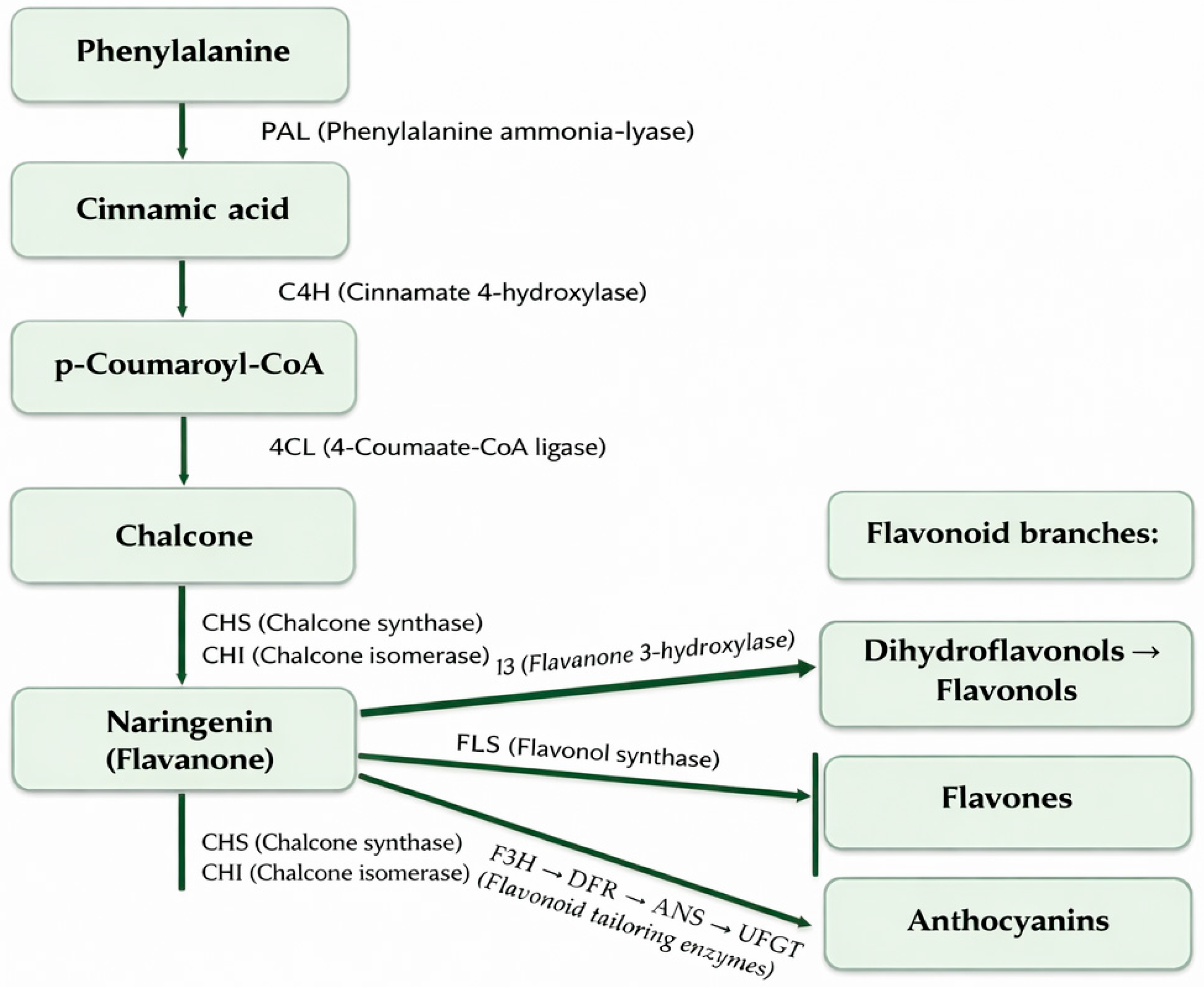
| Pathway | Key Enzymes | Enzymes Main Function |
|---|---|---|
| Shikimate/ Phenylpropanoid | 1. PAL | 1. Converts phenylalanine to cinnamic acid |
| 2. C4H | 2. Hydroxylates cinnamic acid to p-coumaric acid | |
| 3. 4CL | 3. Activates p-coumaric acid to p-coumaroyl-CoA | |
| Polyketide/ Chalcone | 1. CHS | 1. Condenses p-coumaroyl-CoA with malonyl-CoA units to chalcone |
| 2. CHI | 2. Converts chalcone to flavanone | |
| 3. F3H | 3. Hydroxylates flavanones to dihydroflavonols | |
| 4. FLS | 4. Converts dihydroflavonols to flavonols | |
| 5. OMT | 5. Adds methyl groups to hydroxyl groups on flavonoids | |
| 6. UGT | 6. Adds sugar moieties to flavonoids | |
| 7. PKS | 7. Catalyzes formation of chalcone in polyketide pathway |
| Food Item | Flavonoid Subclass | Representative Flavonoid | Mean Content (mg 100 g−1) |
|---|---|---|---|
| Red onion, raw | Flavonols | Quercetin | 39.21 |
| Grapefruit, raw | Flavanones | Naringenin | 53 |
| Grapefruit, raw | Flavanones | Hesperetin | 1.5 |
| Grapefruit, raw | Flavonols | Kaempferol | 0.4 |
| Red onion, raw | Flavones | Apigenin | 0.24 |
| Red onion, raw | Flavones | Luteolin | 0.16 |
| Red onion, raw | Flavonols | Myricetin | 2.16 |
| Cacao beans | Flavan-3-ols | (+)-Catechin | 88.45 |
| Cacao beans | Flavan-3-ols | (−)-Epicatechin | 99.18 |
| Tea, green, brewed | Flavan-3-ols | EGCG | 26.05 |
| Tea, black, brewed | Flavan-3-ols | (+)-Catechin | 1.51 |
| Blueberries, raw | Anthocyanidins | Pelargonidin | 45.51 |
| Strawberries, raw | Anthocyanidins | Cyanidin | 32 |
| Broccoli, cooked | Flavonols | Myricetin | 2.6 |
| Parsley, raw | Flavonols | Kaempferol | 12.3 |
| Flavonoid Subclass | Representative Sources | Potential Health Benefits | Key Mechanisms of Action |
|---|---|---|---|
| Flavan-3-ols | Tea (green, black), cocoa, apples, grapes | Cardiovascular health improvement; enhanced insulin sensitivity | Antioxidant activity, improved endothelial function, lipid modulation, blood pressure reduction |
| Anthocyanidins | Berries, cherries, red cabbage, berry fruits | Neuroprotection; reduced risk of cardiovascular disease | Anti-inflammatory, antioxidant, support of cognitive function |
| Flavanones | Citrus fruits (oranges, grapefruits), orange juice, limes | Cardiovascular protection, anti-diabetic effects | Lipid regulation, improved insulin sensitivity |
| Flavonols | Onion, broccoli, parsley, apples | Cancer prevention, neuroprotection, reduced mortality | Apoptosis modulation, anti-inflammatory, antioxidant |
| Flavones | Parsley, celery, thyme | Anti-inflammatory, anticancer | Cellular signaling modulation, antioxidant |
| Biological Function | Example Signaling Pathways | Role in Neurodevelopmental/Neurodegenerative Disorders |
|---|---|---|
| Anti-inflammatory | NF-κB, STAT3, MAPK (p38, JNK) | Reduction of neuroinflammatory processes in Alzheimer’s and Parkinson’s |
| Antioxidant | Nrf2/ARE, Keap1–Nrf2 | Protection against oxidative stress in neurons |
| Cell survival/proliferation | PI3K/Akt/mTOR, Wnt/β-catenin | Supporting neuron survival and neurogenesis |
| Apoptosis-related | MAPK/ERK, p53, caspase-dependent pathways | Inhibition of excessive neuronal apoptosis |
| Oxidative stress | Nrf2/ARE, Keap1–Nrf2, SOD, CAT, GPx, ROS | Protection from ROS-induced neuronal damage |
| Mitochondrial function | AMPK, PGC-1α, mitochondrial biogenesis, ROS | Limiting mitochondrial dysfunction in aging and NDD |
| Gut–Brain Axis regulation | Microbiota, SCFAs, vagus, tryptophan–kynurenine | Microbiota-immune-brain interactions |
Disclaimer/Publisher’s Note: The statements, opinions and data contained in all publications are solely those of the individual author(s) and contributor(s) and not of MDPI and/or the editor(s). MDPI and/or the editor(s) disclaim responsibility for any injury to people or property resulting from any ideas, methods, instructions or products referred to in the content. |
© 2025 by the authors. Licensee MDPI, Basel, Switzerland. This article is an open access article distributed under the terms and conditions of the Creative Commons Attribution (CC BY) license.
Share and Cite
Lemanowicz, J.; Gawlińska, K.; Jaskulska, I.; Jaskulski, D.; Sar, M. Flavonoids in Plants and Human Health: From Biosynthesis to Neurodevelopmental and Neurodegenerative Disorders. Molecules 2026, 31, 66. https://doi.org/10.3390/molecules31010066
Lemanowicz J, Gawlińska K, Jaskulska I, Jaskulski D, Sar M. Flavonoids in Plants and Human Health: From Biosynthesis to Neurodevelopmental and Neurodegenerative Disorders. Molecules. 2026; 31(1):66. https://doi.org/10.3390/molecules31010066
Chicago/Turabian StyleLemanowicz, Joanna, Kinga Gawlińska, Iwona Jaskulska, Dariusz Jaskulski, and Mateusz Sar. 2026. "Flavonoids in Plants and Human Health: From Biosynthesis to Neurodevelopmental and Neurodegenerative Disorders" Molecules 31, no. 1: 66. https://doi.org/10.3390/molecules31010066
APA StyleLemanowicz, J., Gawlińska, K., Jaskulska, I., Jaskulski, D., & Sar, M. (2026). Flavonoids in Plants and Human Health: From Biosynthesis to Neurodevelopmental and Neurodegenerative Disorders. Molecules, 31(1), 66. https://doi.org/10.3390/molecules31010066