Exploring the Volatile Fingerprinting of Young Portuguese Monovarietal Red Wines by HS-SPME-GC×GC-TOFMS: A Five-Year Study

Abstract
1. Introduction
2. Results and Discussion
2.1. Overview by Chemical Classes (HS-SPME-GC×GC-ToFMS)
2.2. Canonical Discriminant Analysis (CDA)
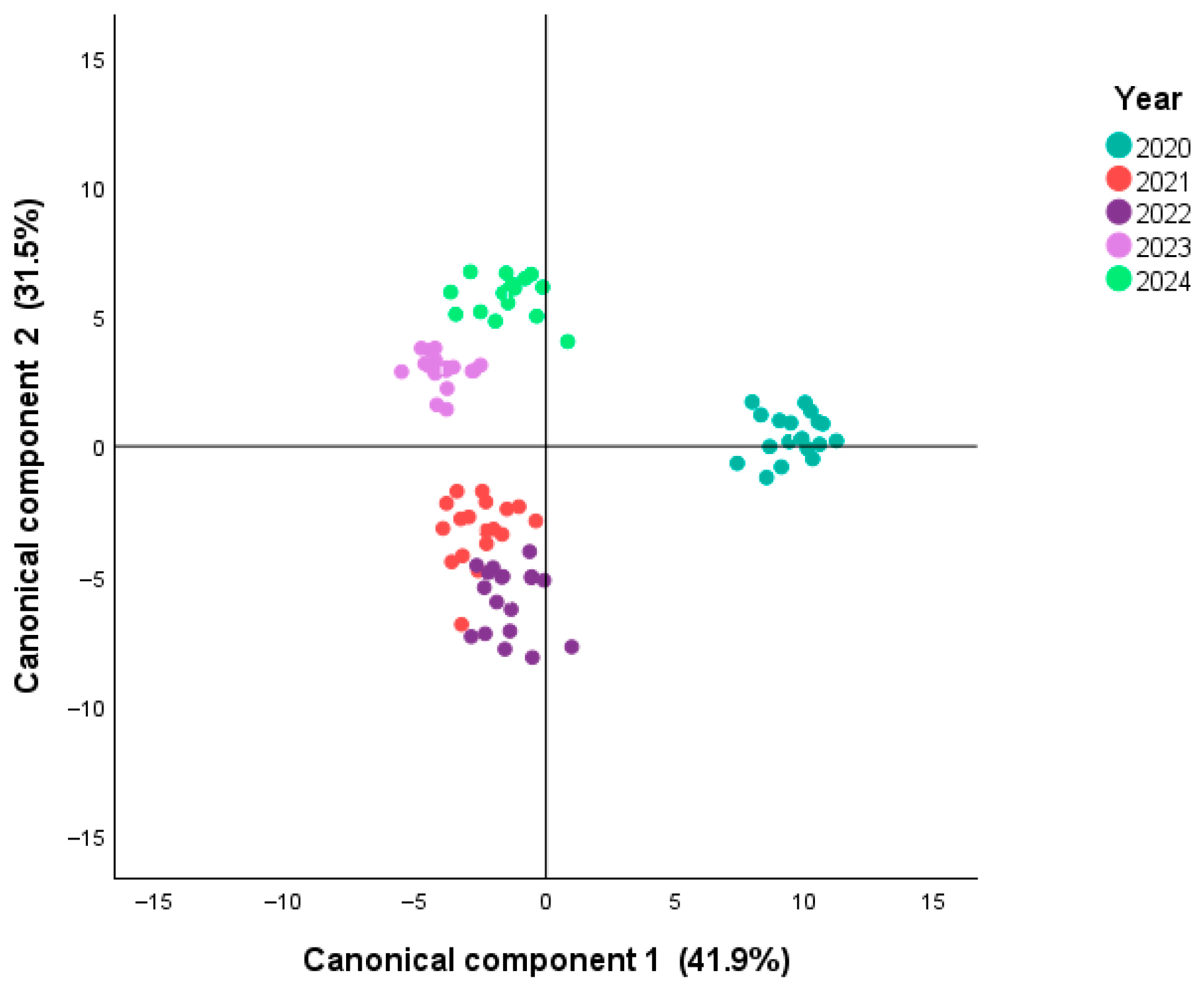
2.2.1. Effect of Vintage Year
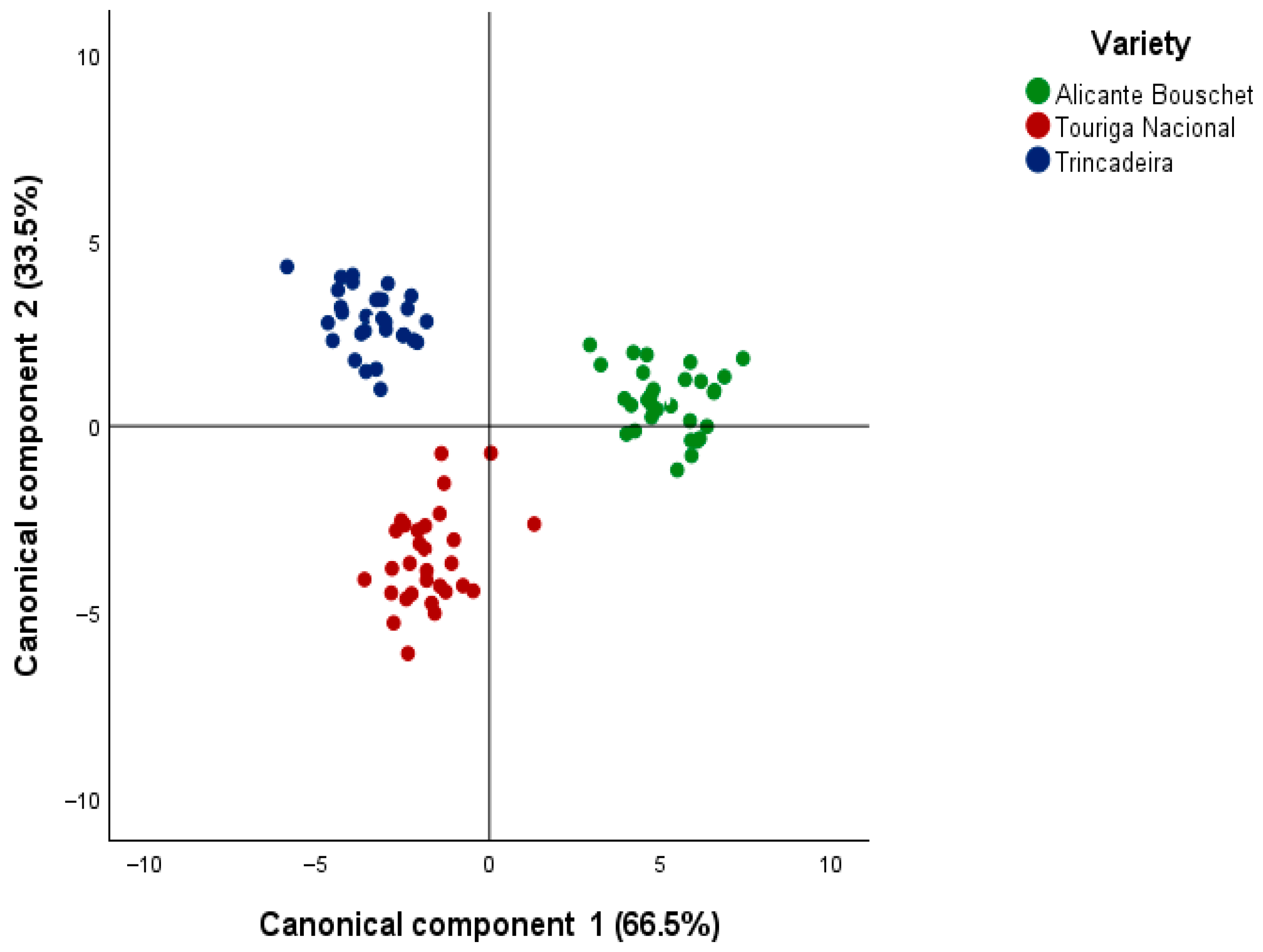
2.2.2. Effect of Variety
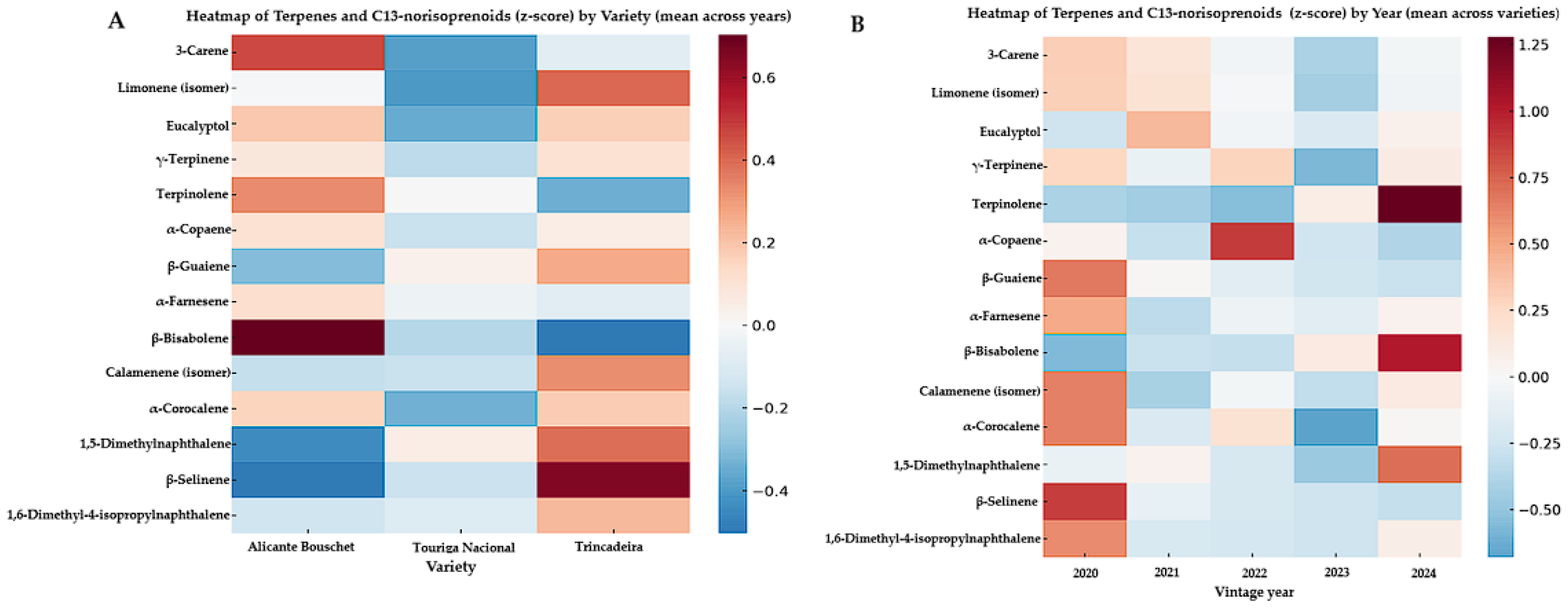
2.3. Terpenes and C13-Norisoprenoids as Varietal and Vintage Differentiators
3. Materials and Methods
3.1. Wine Samples
3.2. Oenological Parameters
3.3. HS-SPME Methodology
3.4. GC×GC-TOFMS Analysis
3.5. Statistical Analysis
4. Conclusions
Supplementary Materials
Author Contributions
Funding
Institutional Review Board Statement
Informed Consent Statement
Data Availability Statement
Acknowledgments
Conflicts of Interest
References
- Styger, G.; Prior, B.; Bauer, F.F. Wine Flavor and Aroma. J. Ind. Microbiol. Biotechnol. 2011, 38, 1145. [Google Scholar] [CrossRef]
- Luo, J.; Zhang, P.; Loo, Y.T.; Ma, J.; Wu, S.; Marriott, P.J.; Howell, K. Can Wine Quality Be Predicted by Small Volatile Compounds? A Study Based on Performance of Wine Show Entries and Their Volatile Profiles. Flavour Fragr. J. 2022, 37, 354–363. [Google Scholar] [CrossRef]
- Tufariello, M.; Pati, S.; Palombi, L.; Grieco, F.; Losito, I. Use of Multivariate Statistics in the Processing of Data on Wine Volatile Compounds Obtained by HS-SPME-GC-MS. Foods 2022, 11, 910. [Google Scholar] [CrossRef]
- Karabagias, I.K.; Karabagias, V.K.; Badeka, A.V. Volatilome of White Wines as an Indicator of Authenticity and Adulteration Control Using Statistical Analysis. Aust. J. Grape Wine Res. 2021, 27, 269–279. [Google Scholar] [CrossRef]
- Fonseca, D.; Martins, N.; Garcia, R.; Cabrita, M.J. Comprehensive Two-Dimensional Gas Chromatography with a TOF MS Detector—An Effective Tool to Trace the Signature of Grape Varieties. Molecules 2024, 29, 1989. [Google Scholar] [CrossRef] [PubMed]
- López, R.; Aznar, M.; Cacho, J.; Ferreira, V. Determination of Minor and Trace Volatile Compounds in Wine by Solid-Phase Extraction and Gas Chromatography with Mass Spectrometric Detection. J. Chromatogr. A 2002, 966, 167–177. [Google Scholar] [CrossRef]
- Fernández De Simón, B.; Martínez, J.; Sanz, M.; Cadahía, E.; Esteruelas, E.; Muñoz, A.M. Volatile Compounds and Sensorial Characterisation of Red Wine Aged in Cherry, Chestnut, False Acacia, Ash and Oak Wood Barrels. Food Chem. 2014, 147, 346–356. [Google Scholar] [CrossRef] [PubMed]
- Šuklje, K.; Carlin, S.; Stanstrup, J.; Antalick, G.; Blackman, J.W.; Meeks, C.; Deloire, A.; Schmidtke, L.M.; Vrhovsek, U. Unravelling Wine Volatile Evolution during Shiraz Grape Ripening by Untargeted HS-SPME-GC × GC-TOFMS. Food Chem. 2019, 277, 753–765. [Google Scholar] [CrossRef] [PubMed]
- Cabrita, M.J.; Costa Freitas, A.M.; Laureano, O.; Borsa, D.; Di Stefano, R. Aroma Compounds in Varietal Wines from Alentejo, Portugal. J. Food Compos. Anal. 2007, 20, 375–390. [Google Scholar] [CrossRef]
- Welke, J.E.; Manfroi, V.; Zanus, M.; Lazzarotto, M.; Alcaraz Zini, C. Differentiation of Wines According to Grape Variety Using Multivariate Analysis of Comprehensive Two-Dimensional Gas Chromatography with Time-of-Flight Mass Spectrometric Detection Data. Food Chem. 2013, 141, 3897–3905. [Google Scholar] [CrossRef]
- Sagratini, G.; Maggi, F.; Caprioli, G.; Cristalli, G.; Ricciutelli, M.; Torregiani, E.; Vittori, S. Comparative Study of Aroma Profile and Phenolic Content of Montepulciano Monovarietal Red Wines from the Marches and Abruzzo Regions of Italy Using HS-SPME–GC–MS and HPLC–MS. Food Chem. 2012, 132, 1592–1599. [Google Scholar] [CrossRef]
- Petronilho, S.; Lopez, R.; Ferreira, V.; Coimbra, M.A.; Rocha, S.M. Revealing the Usefulness of Aroma Networks to Explain Wine Aroma Properties: A Case Study of Portuguese Wines. Molecules 2020, 25, 272. [Google Scholar] [CrossRef]
- Pietra Torres, M.; Cabrita, M.J.; Gomes Da Silva, M.D.R.; Palma, V.; Costa Freitas, A.M. The Impact of Malolactic Fermentation on the Volatile Composition of the Trincadeira Wine Variety: Impact of Mlf on Trincadeira Wine Volatile Composition. J. Food Biochem. 2011, 35, 898–913. [Google Scholar] [CrossRef]
- Cosme, F.; Milheiro, J.; Pires, J.; Guerra-Gomes, F.I.; Filipe-Ribeiro, L.; Nunes, F.M. Authentication of Douro DO Monovarietal Red Wines Based on Anthocyanin Profile: Comparison of Partial Least Squares—Discriminant Analysis, Decision Trees and Artificial Neural Networks. Food Control 2021, 125, 107979. [Google Scholar] [CrossRef]
- Barreto De Oliveira, J.; Lemos Faria, D.; Fernandes Duarte, D.; Egipto, R.; Laureano, O.; De Castro, R.; Pereira, G.E.; Ricardo-da-Silva, J.M. Effect of the Harvest Season on Phenolic Composition and Oenological Parameters of Grapes and Wines Cv. ‘Touriga Nacional’ (Vitis vinifera L.) Produced under Tropical Semi-Arid Climate, in the State of Pernambuco, Brazil. Ciência Téc. Vitiv. 2018, 33, 145–166. [Google Scholar] [CrossRef]
- Câmara, J.S.; Alves, M.A.; Marques, J.C. Changes in Volatile Composition of Madeira Wines during Their Oxidative Ageing. Anal. Chim. Acta 2006, 563, 188–197. [Google Scholar] [CrossRef]
- Rogerson, F.S.S.; Grande, H.J.; Silva, M.C.M. Free and Enzyme Enhanced Monoterpenol Content of Portuguese Red Wines from the Douro Contenido en Monoterpenos Libres e Hidrolizados Por Enzimas de Vinos Tintos Portugueses del Duero Contido en Monoterpenos Libres e Hidrolizados Por Enzimas de Viños Tintos Portugueses Do Douro. Cienc. Y Tecnol. Aliment. 1999, 2, 169–173. [Google Scholar] [CrossRef]
- Botelho, G.; Mendes-Faia, A.; Clímaco, M.C. Differences in Odor-Active Compounds of Trincadeira Wines Obtained from Five Different Clones. J. Agric. Food Chem. 2008, 56, 7393–7398. [Google Scholar] [CrossRef] [PubMed]
- Furdíková, K.; Machyňáková, A.; Drtilová, T.; Špánik, I. Comparison of Different Categories of Slovak Tokaj Wines in Terms of Profiles of Volatile Organic Compounds. Molecules 2020, 25, 669. [Google Scholar] [CrossRef] [PubMed]
- del Barrio Galán, R.; Bueno-Herrera, M.; de la Cuesta, P.L.; Pérez-Magariño, S. Volatile Composition of Spanish Red Wines: Effect of Origin and Aging Time. Eur. Food Res. Technol. 2022, 248, 1903–1916. [Google Scholar] [CrossRef]
- Feher, I.; Magdas, D.A.; Dehelean, A.; Sârbu, C. Characterization and Classification of Wines According to Geographical Origin, Vintage and Specific Variety Based on Elemental Content: A New Chemometric Approach. J. Food Sci. Technol. 2019, 56, 5225–5233. [Google Scholar] [CrossRef]
- Minnaar, P.P.; Booyse, M. Differentiation among Young and Market-Ready Cabernet Sauvignon, Pinotage and Shiraz Wines: Application of Canonical Discriminant Analysis Using Flavonoid and Non-Flavonoid Compositional Data. S. Afr. J. Enol. Vitic. 2016, 32, 251–261. [Google Scholar] [CrossRef][Green Version]
- Leder, R.; Petric, I.V.; Jusup, J.; Banović, M. Geographical Discrimination of Croatian Wines by Stable Isotope Ratios and Multielemental Composition Analysis. Front. Nutr. 2021, 8, 625613. [Google Scholar] [CrossRef]
- Vilanova, M.; Genisheva, Z.; Masa, A.; Oliveira, J.M. Correlation between Volatile Composition and Sensory Properties in Spanish Albariño Wines. Microchem. J. 2010, 95, 240–246. [Google Scholar] [CrossRef]
- Chen, K.; Xue, H.; Shi, Q.; Zhang, F.; Ma, Q.; Sun, J.; Liu, Y.; Tang, Y.; Wang, W. Geographical identification of Chinese wine based on chemometrics combined with mineral elements, volatile components and untargeted metabonomics. Food Chem. X 2024, 22, 101412. [Google Scholar] [CrossRef]
- Slaghenaufi, D.; Ugliano, M. Norisoprenoids, Sesquiterpenes and Terpenoids Content of Valpolicella Wines During Aging: Investigating Aroma Potential in Relationship to Evolution of Tobacco and Balsamic Aroma in Aged Wine. Front. Chem. 2018, 6, 66. [Google Scholar] [CrossRef] [PubMed]
- Mendes-Pinto, M.M. Carotenoid Breakdown Products the—Norisoprenoids—In Wine Aroma. Arch. Biochem. Biophys. 2009, 483, 236–245. [Google Scholar] [CrossRef]
- Li, Z.; Howell, K.; Fang, Z.; Zhang, P. Sesquiterpenes in Grapes and Wines: Occurrence, Biosynthesis, Functionality, and Influence of Winemaking Processes. Compr. Rev. Food Sci. Food Saf. 2020, 19, 247–281. [Google Scholar] [CrossRef] [PubMed]
- Mele, M.A.; Kang, H.-M.; Lee, Y.-T.; Islam, M.Z. Grape Terpenoids: Flavor Importance, Genetic Regulation, and Future Potential. Crit. Rev. Food Sci. Nutr. 2021, 61, 1429–1447. [Google Scholar] [CrossRef] [PubMed]
- Black, C.A.; Parker, M.; Siebert, T.E.; Capone, D.L.; Francis, I.L. Terpenoids and Their Role in Wine Flavour: Recent Advances: Terpenoids: Role in Wine Flavour. Aust. J. Grape Wine Res. 2015, 21, 582–600. [Google Scholar] [CrossRef]
- Van Leeuwen, C.; Barbe, J.-C.; Darriet, P.; Destrac-Irvine, A.; Gowdy, M.; Lytra, G.; Marchal, A.; Marchand, S.; Plantevin, M.; Poitou, X.; et al. Aromatic Maturity Is a Cornerstone of Terroir Expression in Red Wine: This Article Is Published in Cooperation with Terclim 2022 (XIVth International Terroir Congress and 2nd ClimWine Symposium), 3–8 July 2022, Bordeaux, France. OENO One 2022, 56, 335–351. [Google Scholar] [CrossRef]
- Ilc, T.; Werck-Reichhart, D.; Navrot, N. Meta-Analysis of the Core Aroma Components of Grape and Wine Aroma. Front. Plant Sci. 2016, 7, 1472. [Google Scholar] [CrossRef]
- Garbay, J.; Cameleyre, M.; Le Menn, N.; Riquier, L.; Barbe, J.-C.; Lytra, G. Study of the Fruity Aroma of Red Wines Made from Grape Varieties Potentially Adapted to Climate Change Using a Semi-Preparative HPLC Method. LWT 2024, 204, 116481. [Google Scholar] [CrossRef]
- Lin, J.; Massonnet, M.; Cantu, D. The Genetic Basis of Grape and Wine Aroma. Hortic. Res. 2019, 6, 81. [Google Scholar] [CrossRef] [PubMed]
- Wedler, H.; Pemberton, R.; Tantillo, D. Carbocations and the Complex Flavor and Bouquet of Wine: Mechanistic Aspects of Terpene Biosynthesis in Wine Grapes. Molecules 2015, 20, 10781–10792. [Google Scholar] [CrossRef] [PubMed]
- OIV. Compendium of International Methods of Wine and Must Analysis. Available online: https://www.oiv.int/standards/compendium-of-international-methods-of-wine-and-must-analysis (accessed on 24 October 2025).



| Compound Name | 1tR (min) a | 2tR (secs) b | LRI lit c | LRI calc d | Ions m/z e | MANOVA | |||
|---|---|---|---|---|---|---|---|---|---|
| Compound No. | Esters | Y | V | Y × V | |||||
| 1 | Acetic acid, 2-methylpropyl ester | 10.0537 | 2.9067 | 755 | - | 43/56/73 | * | * | * |
| 2 | Butanoic acid, ethyl ester | 11.0833 | 2.9684 | 784 | - | 71/43/88 | *** | *** | *** |
| 3 | Propanoic acid, 2-hydroxy-, ethyl ester | 11.7749 | 3.2479 | 799 | - | 45/75 | ** | ** | *** |
| 4 | Butanoic acid, 2-methyl-, ethyl ester | 13.4325 | 2.9758 | 837 | - | 57/102/85 | *** | *** | *** |
| 5 | Butanoic acid, 3-methyl-, ethyl ester | 13.638 | 3.0022 | 838 | - | 88/85/57 | *** | *** | *** |
| 6 | Hexanoic acid, methyl ester | 17.3661 | 3.1 | 907 | - | 74/87/99 | *** | *** | ** |
| 7 | 3-Hexenoic acid, ethyl ester | 20.7199 | 3.2081 | 986 | 993 | 68/88/41 | n.s. | n.s. | ** |
| 8 | Hexanoic acid, ethyl ester | 21.2749 | 3.043 | 999 | 1001 | 88/60/41 | *** | n.s. | ** |
| 9 | Acetic acid, hexyl ester | 22.0117 | 3.0209 | 1000 | 1016 | 43/56 | *** | *** | *** |
| 10 | 2-Hexenoic acid, ethyl ester | 22.6897 | 3.012 | 1019 | 1030 | 88/115/55 | n.s. | *** | n.s. |
| 11 | 2-Hexenoic acid, ethyl ester, (isomer) | 23.8555 | 2.7693 | 1038 | 1053 | 97/99/55/73 | * | n.s. | n.s. |
| 12 | Butanoic acid, pentyl ester | 24.3037 | 2.9986 | 1078 | 1062 | 71/43/55 | ** | n.s. | * |
| 13 | Hexanoic acid, propyl ester | 26.25 | 3.0241 | 1080 | 1100 | 43/99/117 | *** | *** | *** |
| 14 | Acetic acid, heptyl ester | 27.1871 | 3.0121 | 1094 | 1119 | 43/56/70 | *** | *** | *** |
| 15 | Octanoic acid, methyl ester | 27.8138 | 3.0376 | 1107 | 1131 | 74/87/55/43 | *** | *** | *** |
| 16 | Hexanoic acid, 2-methylpropyl ester | 29.1082 | 2.9377 | 1138 | 1156 | 99/56/117/71 | * | n.s. | *** |
| 17 | Butanedioic acid, diethyl ester | 30.7758 | 3.6011 | 1191 | 1189 | 101/129/45 | *** | ** | ** |
| 18 | 7-Octenoic acid, ethyl ester | 30.9981 | 3.0956 | 1187 | 1193 | 88/55 | *** | * | *** |
| 19 | Octanoic acid, ethyl ester | 31.4556 | 2.9959 | 1193 | 1203 | 88/101/57/41 | ** | ** | *** |
| 20 | Benzeneacetic acid, ethyl ester | 33.7091 | 3.0513 | 1218 | 1250 | 91/164/65/43 | ** | ** | *** |
| 21 | 2-Hexenoic acid, ethyl ester, (isomer) | 33.9751 | 2.9463 | 1234 | 1256 | 70/43/55/99 | *** | ** | * |
| 22 | Acetic acid, 2-phenylethyl ester | 34.6467 | 3.8479 | 1250 | 1270 | 104/91/43 | *** | ** | *** |
| 23 | 2-Propenoic acid. octyl ester | 35.3333 | 2.9842 | 1273 | 1284 | 56/70/43 | * | n.s. | ** |
| 24 | Octanoic acid, propyl ester | 35.9167 | 2.968 | 1277 | 1297 | 145/127/61/43/73 | n.s. | n.s. | n.s. |
| 25 | Nonanoic acid, ethyl ester | 36.75 | 2.9274 | 1279 | 1315 | 88/101/141/73 | *** | *** | *** |
| 26 | Decanoic acid, methyl ester | 37.3986 | 2.9831 | 1308 | 1329 | 74/87/143 | n.s. | n.s. | n.s. |
| 27 | Caprylic acid isobutyl ester | 38.395 | 2.8964 | 1334 | 1352 | 57/127/41 | *** | *** | ** |
| 28 | Decanoic acid, ethyl ester | 38.8993 | 2.9118 | 1379 | 1363 | 88/101/73/55 | n.s. | n.s. | n.s. |
| 29 | Decanoic acid, ethyl ester | 40.5641 | 2.918 | 1381 | 1400 | 88/101/43/55 | *** | n.s. | ** |
| 30 | Butanedioic acid, ethyl 3-methylbutyl ester | 42.1006 | 3.2639 | 1422 | 1439 | 101/129/55/43 | *** | n.s. | n.s. |
| 31 | Octanoic acid, 3-methylbutyl ester | 42.6818 | 2.8371 | 1450 | 1453 | 70/127/55 | *** | *** | *** |
| 32 | Undecanoic acid, ethyl ester | 43.119 | 2.8092 | 1479 | 1464 | 88/101/55/43 | n.s. | n.s. | n.s. |
| 33 | n-Capric acid isobutyl ester | 46.2815 | 2.709 | 1531 | 1550 | 56/155/173 | ** | n.s. | n.s. |
| 34 | Dodecanoic acid, ethyl ester | 46.6511 | 2.6258 | 1578 | 1560 | 88/101/83/55 | n.s. | n.s. | n.s. |
| 35 | Octanoic acid, hexyl ester | 47.5833 | 2.7529 | 1579 | 1587 | 145/85/43/127 | *** | ** | *** |
| 36 | Pentadecanoic acid, 3-methylbutyl ester | 49.6095 | 2.6785 | 1630 | 1651 | 70/43/155 | *** | *** | *** |
| 37 | Tridecanoic acid ethyl ester | 50.1809 | 2.6639 | 1677 | 1669 | 88/101/55/43 | n.s. | n.s. | * |
| 38 | Tetradecanoic acid, ethyl ester | 53.8074 | 2.4483 | 1778 | 1797 | 88/101/73/55/43 | n.s. | * | ** |
| 39 | Tetradecanoic acid, isopropyl ester | 54.4262 | 2.3287 | 1813 | 1826 | 43/60/102/129 | n.s. | * | ** |
| 40 | Dodecanoic acid, 3-methylbutyl ester | 54.9399 | 2.3473 | 1829 | 1852 | 70/55/43/60/85 | ** | n.s. | *** |
| 41 | Pentadecanoic acid, ethyl ester | 55.4842 | 2.943 | 1879 | 1879 | 88/101/43 | n.s. | * | *** |
| 42 | 9-Hexadecenoic acid, ethyl ester | 57.2039 | 2.2213 | 1955 | 1982 | 55/69/88/41 | n.s. | n.s. | n.s. |
| 43 | Hexadecanoic acid, ethyl ester | 57.4167 | 2.1617 | 1979 | 1995 | 88/101/43/115 | *** | ** | *** |
| 44 | Linoleic acid ethyl ester | 59.5966 | 2.943 | 2141 | - | 67/55/81/41 | * | ** | * |
| 45 | Octadecanoic acid, ethyl ester | 60.1667 | 2.2752 | 2180 | - | 88/101/43/55 | n.s. | n.s. | n.s. |
| Alcohols | |||||||||
| 46 | 1-pentanol | 10.758 | 2.7464 | 756 | - | 55/43/70 | n.s. | n.s. | n.s. |
| 47 | 1-Hexanol | 14.6197 | 3.1059 | 854 | - | 56/69/43 | ** | *** | *** |
| 48 | 1-Butanol, 3-methyl-, acetate | 14.7989 | 3.0016 | 859 | - | 43/55/70 | ** | n.s. | *** |
| 49 | 1-Butanol, 3-methyl-, propanoate | 19.6807 | 2.9914 | 952 | 979 | 57/70/43 | n.s. | n.s. | n.s. |
| 50 | 1-Heptanol | 19.9474 | 3.0821 | 953 | 982 | 70/56/41 | *** | *** | *** |
| 51 | 1-Propanol, 3-(methylthio) | 20.8656 | 3.9684 | 982 | 995 | 106/61/47 | *** | *** | *** |
| 52 | 1-Octanol | 25.2056 | 3.0561 | 1057 | 1080 | 56/41/70/85 | *** | n.s. | *** |
| 53 | Linalool-I | 26.6667 | 3.0547 | 1086 | 1109 | 93/55/41 | *** | *** | *** |
| 54 | Phenylethyl Alcohol | 27.8923 | 4.002 | 1110 | 1133 | 91/122/77 | *** | *** | *** |
| 55 | Citronellol | 33.0 | 3.1438 | 1211 | 1235 | 69/67/55/41/81 | *** | * | *** |
| 56 | 1-Decanol | 35.3333 | 3.783 | 1274 | 1284 | 70/55/43/83/97 | n.s. | n.s. | n.s. |
| Aldehydes | |||||||||
| 57 | Benzaldehyde | 20.0358 | 4.002 | 961 | 984 | 106/77/51 | *** | *** | *** |
| 58 | Benzeneacetaldehyde | 24.3638 | 4.0795 | 1050 | 1063 | 91/120/65 | n.s. | *** | *** |
| 59 | Nonanal | 27.0 | 3.0509 | 1090 | 1115 | 57/41/70/82 | *** | ** | ** |
| Carboxylic acids | |||||||||
| 60 | Heptanoic acid | 20.4092 | 3.037 | 982 | 989 | 60/73/41 | ** | n.s. | *** |
| 61 | Oleic Acid | 59.8254 | 2.3165 | 2116 | - | 55/43/69/83 | ** | *** | n.s. |
| Ketones | |||||||||
| 62 | Butyrolactone | 17.6889 | 5.3841 | 908 | - | 42/86/85 | *** | *** | *** |
| 63 | Cyclohexanone, 2,2,6-trimethyl- | 34.6467 | 3.8479 | 1036 | 1046 | 82/69/56 | *** | *** | *** |
| Terpenes | |||||||||
| 64 | 3-Carene-I | 22.6337 | 4.4006 | 1006 | 1029 | 93/91/121/136 | *** | *** | *** |
| 65 | Limonene-I | 22.9578 | 2.8899 | 1020 | 1035 | 68/93/136 | n.s. | n.s. | n.s. |
| 66 | Eucalyptol | 23.25 | 3.04781 | 1022 | 1041 | 43/71/91/93/139 | n.s. | *** | *** |
| 67 | γ-Terpinene-I | 24.5 | 2.990 | 1050 | 1066 | 93/77/121/136 | ** | n.s. | *** |
| 68 | Terpinolene-I | 5.9494 | 3.0399 | 1079 | 1094 | 121/93/136/79 | ** | ** | ** |
| 69 | α-Copaene | 39.75 | 2.957 | 1380 | 1382 | 105/119/93/161 | * | n.s. | ** |
| 70 | β-Guaiene | 44.5833 | 2.9528 | 1494 | 1501 | 161/105/119 | n.s. | n.s. | ** |
| 71 | α-Farnesene | 44.8955 | 2.8158 | 1496 | 1510 | 93/55/79/69/107/119 | * | *** | *** |
| 72 | β-Bisabolene | 45.1488 | 2.8428 | 1500 | 1517 | 69/93/41 | n.s. | n.s. | ** |
| 73 | Calamenene (isomer) | 45.9424 | 3.0622 | 1512 | 1540 | 159/129/105 | * | n.s. | ** |
| 74 | α-Corocalene | 49.2314 | 3.2469 | 1607 | 1638 | 185/157/143/128 | n.s. | n.s. | n.s. |
| C13-Norisoprenoids | |||||||||
| 75 | 1,5-Dimethylnaphthalene | 42.5833 | 3.703 | 1439 | 1451 | 156/141/70 | n.s. | n.s. | n.s. |
| 76 | β-Selinene | 44.0721 | 3.6475 | 1482 | 1488 | 93/79/55/67/107 | n.s. | n.s. | n.s. |
| 77 | 1,6-Dimethyl-4-isopropylnaphthalene | 51.1347 | 3.3451 | 1682 | 1700 | 181/198 | *** | ** | *** |
Disclaimer/Publisher’s Note: The statements, opinions and data contained in all publications are solely those of the individual author(s) and contributor(s) and not of MDPI and/or the editor(s). MDPI and/or the editor(s) disclaim responsibility for any injury to people or property resulting from any ideas, methods, instructions or products referred to in the content. |
© 2025 by the authors. Licensee MDPI, Basel, Switzerland. This article is an open access article distributed under the terms and conditions of the Creative Commons Attribution (CC BY) license (https://creativecommons.org/licenses/by/4.0/).
Share and Cite
Gastão-Muchecha, S.; Martins, N.; Garcia, R.; Cabrita, M.J. Exploring the Volatile Fingerprinting of Young Portuguese Monovarietal Red Wines by HS-SPME-GC×GC-TOFMS: A Five-Year Study. Molecules 2025, 30, 4814. https://doi.org/10.3390/molecules30244814
Gastão-Muchecha S, Martins N, Garcia R, Cabrita MJ. Exploring the Volatile Fingerprinting of Young Portuguese Monovarietal Red Wines by HS-SPME-GC×GC-TOFMS: A Five-Year Study. Molecules. 2025; 30(24):4814. https://doi.org/10.3390/molecules30244814
Chicago/Turabian StyleGastão-Muchecha, Sousa, Nuno Martins, Raquel Garcia, and Maria João Cabrita. 2025. "Exploring the Volatile Fingerprinting of Young Portuguese Monovarietal Red Wines by HS-SPME-GC×GC-TOFMS: A Five-Year Study" Molecules 30, no. 24: 4814. https://doi.org/10.3390/molecules30244814
APA StyleGastão-Muchecha, S., Martins, N., Garcia, R., & Cabrita, M. J. (2025). Exploring the Volatile Fingerprinting of Young Portuguese Monovarietal Red Wines by HS-SPME-GC×GC-TOFMS: A Five-Year Study. Molecules, 30(24), 4814. https://doi.org/10.3390/molecules30244814