
Article

Microwave-Assisted Synthesis of Visible Light-Driven BiVO4 Nanoparticles: Effects of Eu3+ Ions on the Luminescent, Structural, and Photocatalytic Properties


by
Dragana Marinković
1,*,
Bojana Vasiljević
1,
Nataša Tot
1,
Tanja Barudžija
1,
Sudha Maria Lis Scaria
2,
Stefano Varas
2,
Rossana Dell’Anna
2,3,
Alessandro Chiasera
2,
Bernhard Fickl
4,
Bernhard C. Bayer
4,
Giancarlo C. Righini
5 and
Maurizio Ferrari
2,*
1
Vinča Institute of Nuclear Sciences, National Institute of the Republic of Serbia, University of Belgrade, P.O. Box 522, 11001 Belgrade, Serbia
2
Institute of Photonics and Nanotechnologies (IFN CNR, CSMFO Laboratory) and FBK Photonics Unit, Via alla Cascata 56/C, Povo, 38123 Trento, Italy
3
Fondazione Bruno Kessler, Center for Sensors and Devices (FBK-SD), Via Sommarive, 18, Povo, 38123 Trento, Italy
4
Institute of Materials Chemistry, Technische Universität Wien (TU Wien), Getreidemarkt 9/165, A-1060 Vienna, Austria
5
Nello Carrara Institute of Applied Physics (IFAC CNR), Sesto Fiorentino, 50019 Firenze, Italy
*
Authors to whom correspondence should be addressed.
Molecules 2025, 30(24), 4757; https://doi.org/10.3390/molecules30244757
Submission received: 5 November 2025 / Revised: 30 November 2025 / Accepted: 9 December 2025 / Published: 12 December 2025
(This article belongs to the Special Issue Chemiluminescence and Photoluminescence of Advanced Compounds)

Abstract

The optimization of BiVO4-based structures significantly contributes to the development of a global system towards clean, renewable, and sustainable energies. Enhanced photocatalytic performance has been reported for numerous doped BiVO4 materials. Bi3+-based compounds can be easily doped with rare earth (RE3+) ions due to their equal valence and similar ionic radius. This means that RE3+ ions could be regarded as active co-catalysts and dopants to enhance the photocatalytic activity of BiVO4. In this study, a simple microwave-assisted approach was used for preparing nanostructured Bi1−xEuxVO4 (x = 0, 0.03, 0.06, 0.09, and 0.12) samples. Microwave heating at 170 °C yields a bright yellow powder after 10 min of radiation. The materials are characterized through X-ray diffraction (XRD), transmission electron microscopy (TEM), ultraviolet–visible–near-infrared diffuse reflectance spectroscopy (UV-Vis-NIR DRS), photoluminescence spectroscopy (PL), and micro-Raman techniques. The effects of the different Eu3+ ion concentrations incorporated into the BiVO4 matrix on the formation of the monoclinic scheelite (ms-) or tetragonal zircon-type (tz-) BiVO4 structure, on the photoluminescent intensity, on the decay dynamics of europium emission, and on photocatalytic efficiency in the degradation of Rhodamine B (RhB) were studied in detail. Additionally, microwave chemistry proved to be beneficial in the synthesis of the tz-BiVO4 nanostructure and Eu3+ ion doping, leading to an enhanced luminescent and photocatalytic performance.

1. Introduction

Recent advances in modern technology indicate an intense acceleration in the nanomaterials research area. In their ongoing effort to expand the boundaries of what is now possible, scientists are increasingly focusing on developing valuable semiconducting nanomaterials [1,2]. Their involvement in photocatalysis applications, such as self-cleaning coatings, H2 production, CO2 conversion, antibacterial treatments, and water remediation, has garnered significant attention over the past decade. However, a number of crucial factors, including light absorption efficiency, charge carrier recombination, photocatalyst stability, and scalability, need to be optimized to improve photocatalytic activity. To overcome this restriction, researchers have looked into doping photocatalysts, especially TiO2, with metals or non-metals [3] and creating hybrid materials with ferrites, Metal–Organic Frameworks (MOFs), and perovskites, which show enhanced light absorption throughout the visible spectrum [4,5,6]. In the case of rapid electron–hole recombination, methods to improve photocatalytic efficiency include coupling semiconductor materials to form heterojunctions, incorporating co-catalysts, and designing Z-scheme photocatalysts [7,8]. Additionally, certain photocatalytic materials, particularly some metal oxides, are inappropriate for use due to their potential toxicity and environmental persistence [9,10]. However, the negative environmental impact could be reduced by employing eco-friendly techniques, such as the creation of bio-based photocatalysts or the utilization of non-toxic materials [11,12]. Nevertheless, improvements in economical synthesis techniques are crucial for the large-scale manufacturing of photocatalysts.
One of the finest bismuth-based semiconducting materials is bismuth vanadate (BiVO4) due to its non-toxic nature, distinct physical and chemical properties, and good response to visible light excitation [13,14,15,16,17]. Additionally, various morphologies of BiVO4 have been developed, exhibiting an excellent visible light photocatalytic efficiency in degrading wastewater contaminants [4,5,6,7]. However, the limited separation (higher recombination rate) and transport capabilities of photogenerated electron–hole pairs severely restrict the commercial-scale application of BiVO4. Overcoming these limitations through surface modification, morphology control, or doping elements can enhance the photocatalytic performance of this valuable nanomaterial [18,19,20].
Rare earth ions are crucial in several applications in nanotechnology [21] and photonics, for instance, as a luminescent thermometer [22,23,24] or as a bioimaging contrast agent [25,26]. Doping rare earth metals into Bi-based photocatalysts has been demonstrated to enhance their photocatalytic activity effectively [20]. In fact, the lanthanide elements, with their partially filled 4f electronic orbits, can participate in the electronic structure, effectively capturing photogenerated electrons (e) or holes (h+), further blocking carrier recombination. Additionally, rare earth ions possess remarkable upconversion properties, enabling the transformation of near-infrared light into visible light [27]. In the case of BiVO4, several studies have reported substituting Bi3+ with Nd [23,28] or Gd [29,30], or co-doping with trivalent lanthanide ions such as Yb/Tm [31], Nd/Er [32], Yb/Er [22], Er/Tm/Yb [33,34], or Tm/Er, Yb, Y [35]. Rare earth doping, such as Eu3+ ions in BiVO4, has emerged as a promising strategy to enhance the photocatalytic performance of this material [36]. Using the hydrothermal approach, Zhang et al. produced Eu-doped BiVO4 with a maximum Eu-doping concentration of 7.30 wt%, resulting in the maximum degradation of methyl orange (MO) [37]. Additionally, Shan et al. confirmed that Eu-doped BiVO4 showed a higher photocatalytic performance in degrading RhB and methylene blue (MB) compared to bare BiVO4 [38]. On the other hand, BiVO4 co-doped with Eu/B [39] and KCl [40] exhibited synergistic effects, attributed to an increased surface area and enhanced separation efficiency of photogenerated charge carriers. Some tri-modified BiVO4 photocatalysts (co-doped with Ag, B, and Eu) have also shown an enhanced catalytic performance in degrading methyl orange (MO) and tetracycline (TC) [41]. Worthy of note, such improved semiconducting materials exhibit a noticeable phase modification, as demonstrated by Dhakal et al. In the case of Yb3+/Tm3+ co-doped BiVO4, studies have shown that doping promotes a high proportion of the tz-phase, approximately 80%, resulting in a marked enhancement of photocatalytic efficiency compared to undoped ms-BiVO4 [42]. The electronic structure of the Eu3+ ions is defined by its 4f–4f electron transitions, which result in sharp, characteristic peaks with red luminescence. The Eu3+ ions’ local environment and its interactions with the BiVO4 material significantly influence its photocatalytic performance. The Eu3+ ions can act as an electron trap to separate photogenerated electrons and holes in a BiVO4 material due to enhanced charge carrier dynamics. The different pollutants’ interactions with Eu3+ ions in BiVO4 via f-orbitals increase its ability to absorb the pollutant molecules and enhance photocatalytic efficiency [15].
The hydrothermal method is widely employed for synthesizing rare earth-doped Bi-based photocatalysts, and the microwave-assisted synthesis of these nanomaterials has been reported only in a limited number of studies [34,42,43]. There are several advantages in the use of microwave-assisted synthesis. Microwave irradiation plays a crucial role by accelerating reaction kinetics, enabling rapid initial heating and ultimately increasing reaction rates. This approach yields cleaner products, promotes the faster consumption of starting materials, and enhances the overall yield [44,45]. Furthermore, uniform heating and a better control over process parameters contribute to a greater reproducibility of reaction conditions and constitute another pro of this technique [46,47]. However, in the synthesis of nanomaterials, the microwave heating method is a novel and uniform heating synthesis technique whose advancement should be pursued, as the use of greener reaction media significantly reduces chemical waste and reaction times [48,49].
In this study, we employed a simple microwave-assisted approach to prepare nanostructured Bi1−xEuxVO4 (x = 0, 0.03, 0.06, 0.09, and 0.12) samples. The combined effects of nanostructure and Eu3+ ion doping enhanced luminescent and photocatalytic performance. This approach not only optimizes the photocatalytic activity in the degradation of RhB and deepens the understanding of the role of Eu3+ doping in improving optical properties, but also induces the formation of both ms- and/or tz-type BiVO4 structures. Both obtained structures are of great importance in terms of their photocatalytic performances and applications for the degradation of organic contaminants [14,15].

2. Results

2.1. Structural and Morphological Properties of the Bi1−xEuxVO4 (x = 0, 0.03, 0.06, 0.09, and 0.12) Samples

2.1.1. X-Ray Diffraction (XRD) Analysis

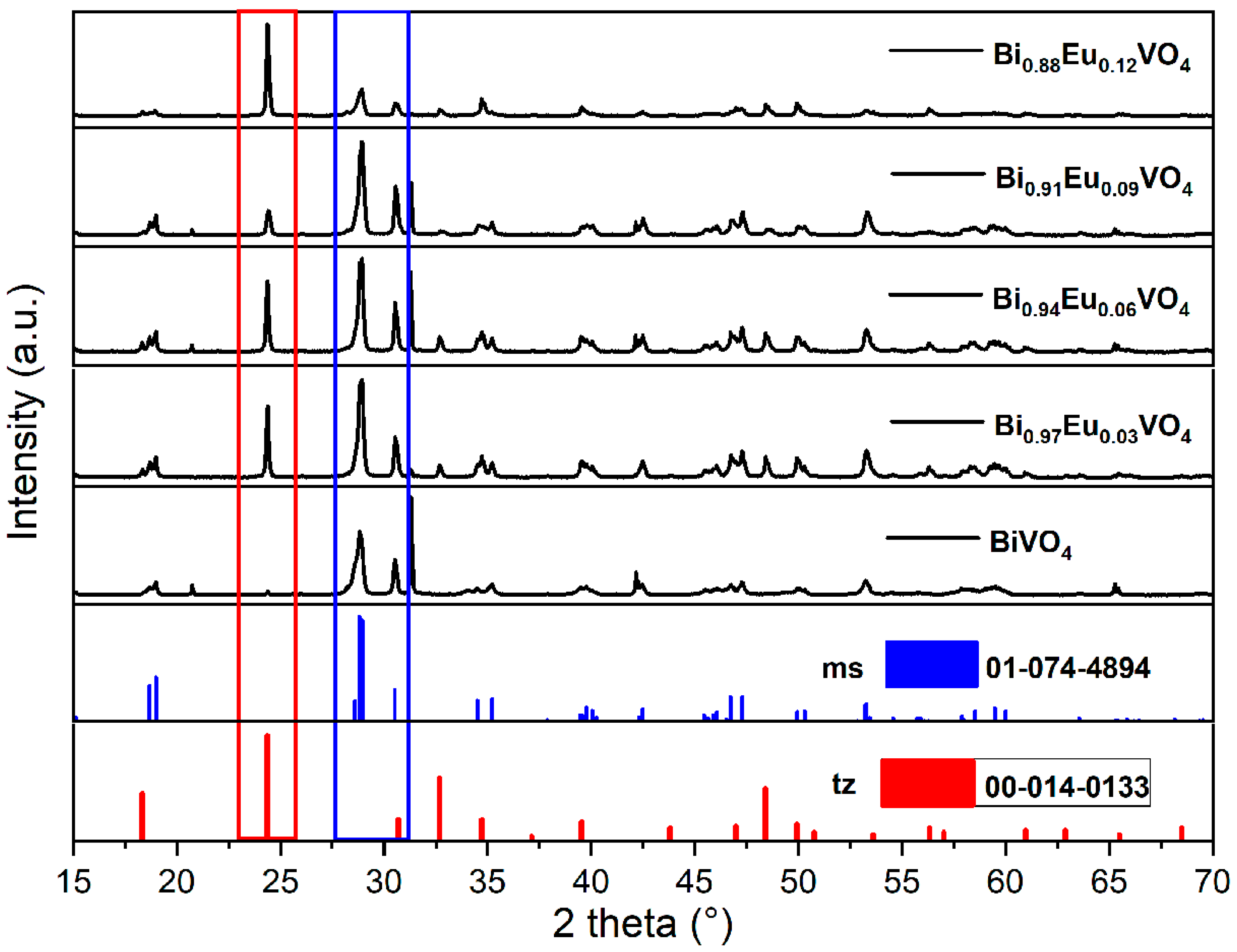
The powder samples were yellow; their crystalline structures were identified through XRD analysis. The XRD patterns, together with card references (JCPDS Card No. 01-074-4894) for ms-BiVO4 and (JCPDS Card No. 00-014-0133) for tz-BiVO4, are presented in Figure 1.
The XRD pattern of undoped BiVO4 (Bi1−xEuxVO4 (x = 0)) synthesized via microwave-assisted synthesis matches well with that of the standard bulk monoclinic clinobisvanite crystalline system (space group: I2/b; a = 5.1935, b = 5.0898, c = 11.6972 Å, and β = 90.3871°). The peaks at approximately 2θ = 18.9°, 29.1°, 30.5°, 35.2°, and 39.7° are assigned to the (011), (112), (004), (020), and (211) crystal planes, respectively, confirming the high crystallinity of the microwave-prepared ms-BiVO4 powder.
In the case of Eu3+-doped BiVO4 samples, Bi1−xEuxVO4 (x = 0.03, 0.06, 0.09, and 0.12), the XRD patterns show the presence of a mixture of ms-BiVO4, (JCPDS Card No. 01-074-4894), and tz-BiVO4 (JCPDS Card No. 14–00133) phases. The main peaks at approximately 2θ = 29.1° and 2θ = 24.3° are characteristic peaks of the ms- and tz-phases, respectively. In addition, the relative intensity of the ms-related peak at approximately 29.1° decreases with an increasing content of the Eu3+ ions. In contrast, the relative intensity of the tz-related peak at approximately 24.3° increases with increases in the content of the Eu3+ ions, so that the tz-type structure becomes dominant in the sample Bi1−xEuxVO4 (x = 0.12). This phase transition may be attributed to the stability of the lattice constant of BiVO4 when Bi3+ ions (ionic radius = 1.17 Å, coordination VIII) are substituted with Eu3+ ions (ionic radius = 1.066 Å, coordination VIII). The literature overview of the formation of the ms- or tz-crystalline phase in the Bi1−xEuxVO4 samples in comparison with the results obtained in this work is given later in the Section on “The Formation of ms- or tz-Crystalline Phase in Bi1−xEuxVO4 (x = 0, 0.03, 0.06, 0.09, and 0.12) Samples”.
The crystallite size was determined using Scherrer’s equation (Equation (1)), applied to the most intense peak in the XRD pattern [50]:
D = k λ β c o s θ
where D is the crystallite size, k represents the shape factor constant with value of 0.9, λ is the wavelength of the X-ray radiation (0.15406 nm), β is the full-width half-maximum (FWHM), and θ is Bragg’s angle of reflection. With reference to the peak of maximum intensity at the 2θ diffraction angle of 29.1°, the average crystallite size for microwave-synthesized ms-BiVO4 was found to be 16 nm according to this equation. The crystallite size increases with the Eu3+ ion content, reaching up to 55 nm for Bi0.88Eu0.12VO4, as determined at a 2θ diffraction angle of 24.3°, corresponding to the dominant tz-BiVO4 phase. The main aim was to obtain an optimized tz-BiVO4 nanostructure, which was recently presented in published papers as a structure exhibiting better photocatalytic performance than ms-BiVO4 with respect to pollutant removal [14,15].

2.1.2. Transmission Electron Microscopy (TEM)

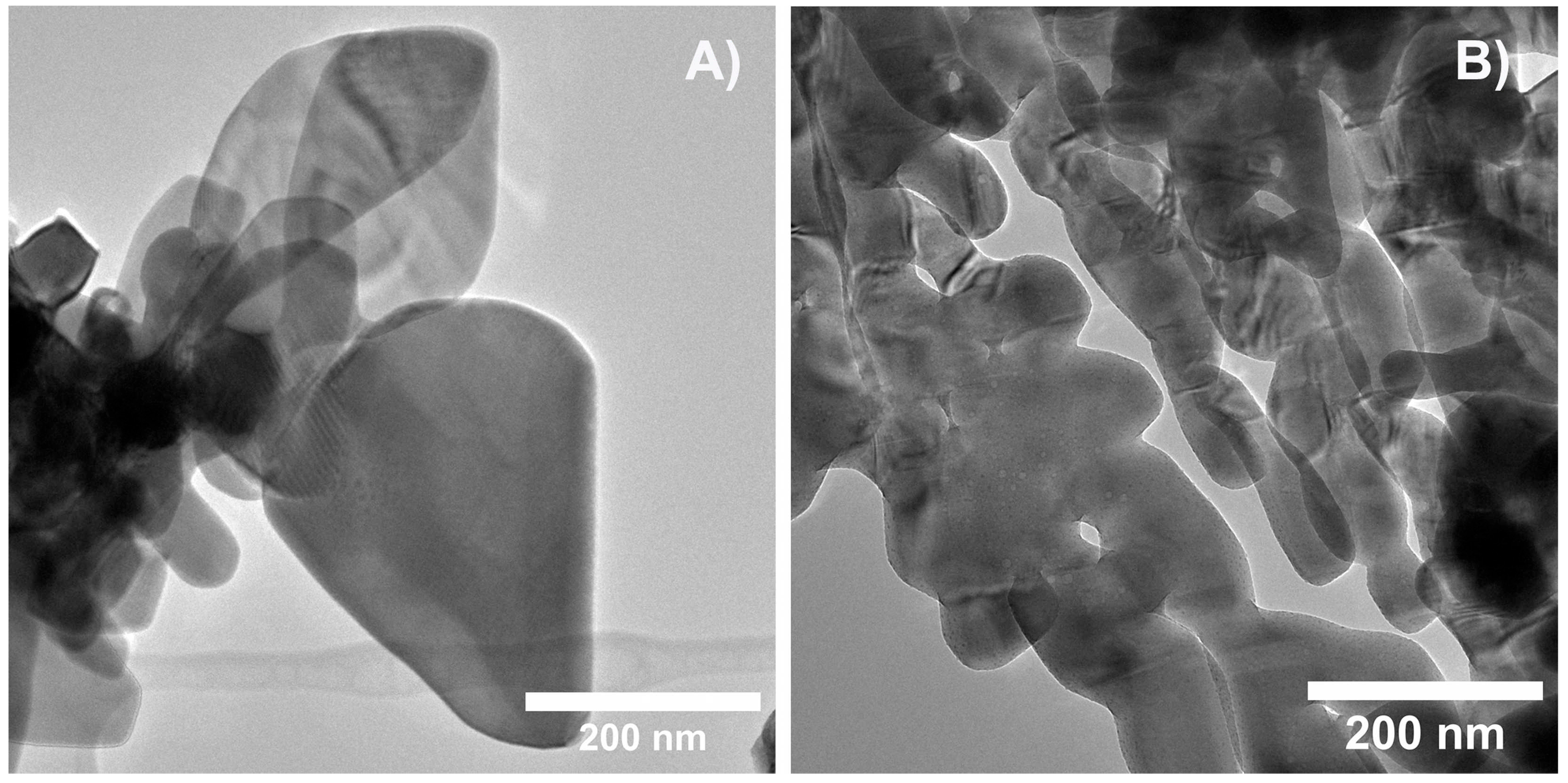
Representative TEM images for BiVO4 and Bi0.88Eu0.12VO4 samples are given in Figure 2A,B, respectively. Both samples consist of well-crystallized irregular spheroidal nanoparticles with a size of approximately 20–50 nm. The particle size assessed using TEM is compatible with the crystallite size obtained from XRD measurements, suggesting that each particle comprises a single crystallite. Additionally, the majority of the synthesized nanoparticles show some degree of aggregation, creating large nanoparticles with an average diameter of about 100 nm, which is frequently seen for BiVO4 nanoparticles because of their high surface energy [16,51]. For microwave-synthesized processes, it was found that the morphology and size of nanostructures were strongly dependent on the heating method and temperature. Under intensive microwave heating, nanoparticles subsequently self-assembled to form aggregated nanostructures from the aqueous solution [52].

2.2. Optical Properties of the Bi1−xEuxVO4 (x = 0, 0.03, 0.06, 0.09, and 0.12) Samples

2.2.1. Fourier Transform Infrared Spectroscopy (FTIR)

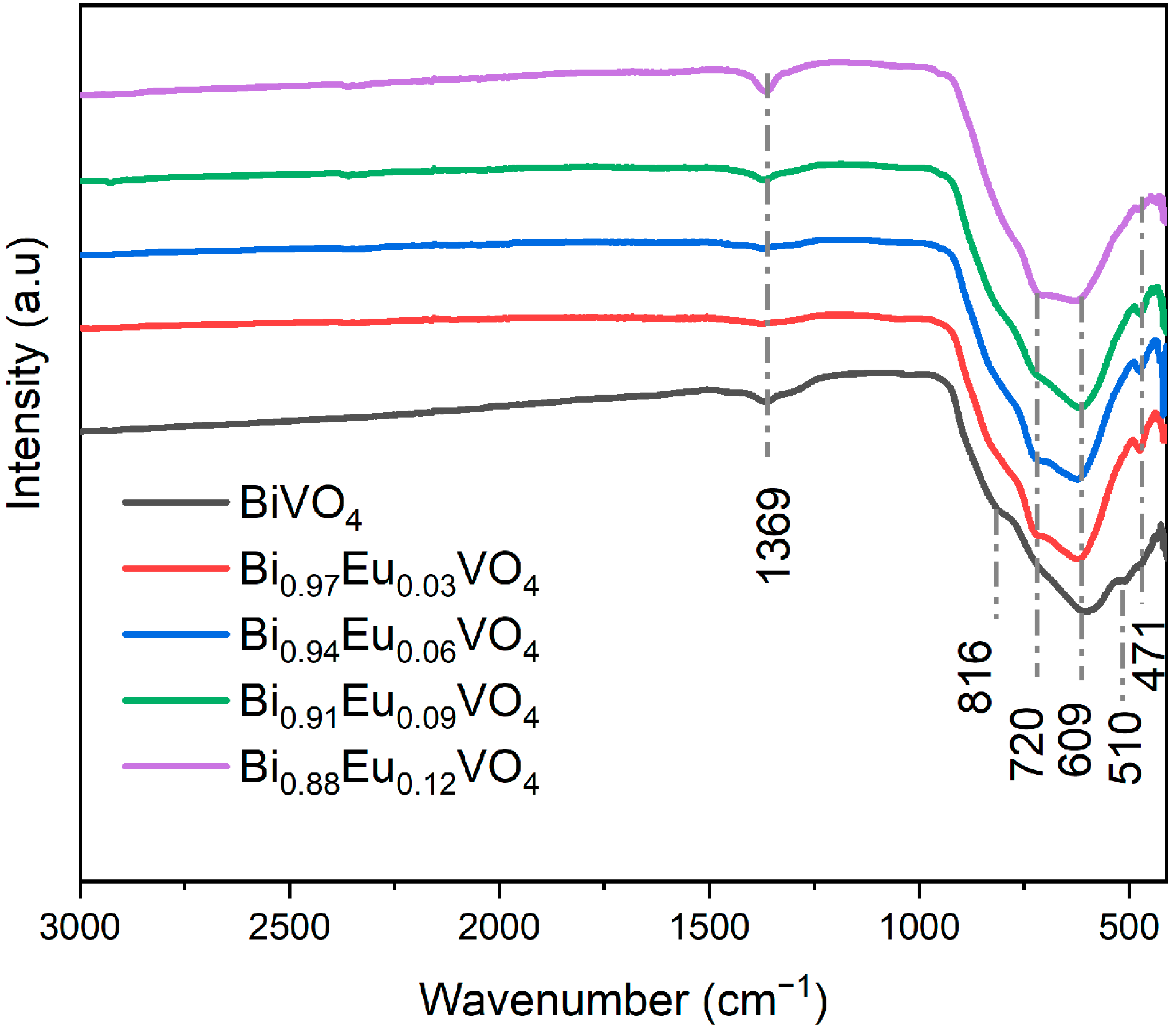
To identify the functional groups in the prepared Bi1−xEuxVO4 (x = 0, 0.03, 0.06, 0.09, and 0.12) samples, the FTIR spectra were measured, and are presented in Figure 3.
The FTIR analysis of undoped BiVO4 shows the characteristic peaks of BiVO4 in the range of around 500–820 cm−1. A strong absorption band at 609 cm−1 with a shoulder at 816 cm−1 is associated with the asymmetric and symmetric stretching vibrations of the VO43− tetrahedron, respectively. Additionally, the peak observed at 510 cm−1 is assigned to the Bi–O bond stretching vibrations.
On the other side, the FTIR analysis of Bi1−xEuxVO4 (x = 0.03, 0.06, 0.09, and 0.12) samples shows the same characteristic peaks as undoped BiVO4 in the range 500–820 cm−1, while two new peaks appear at 471 cm−1 and 720 cm−1 assigned to Eu-O stretching vibrations. A small peak observed in all samples at 1369 cm−1 can be assigned to nitrates from the nitric acid used during the synthesis or from Bi(NO3)3. These results are also in agreement with the previously reported literature [53].

2.2.2. Diffuse Reflectance Spectroscopy (DRS)

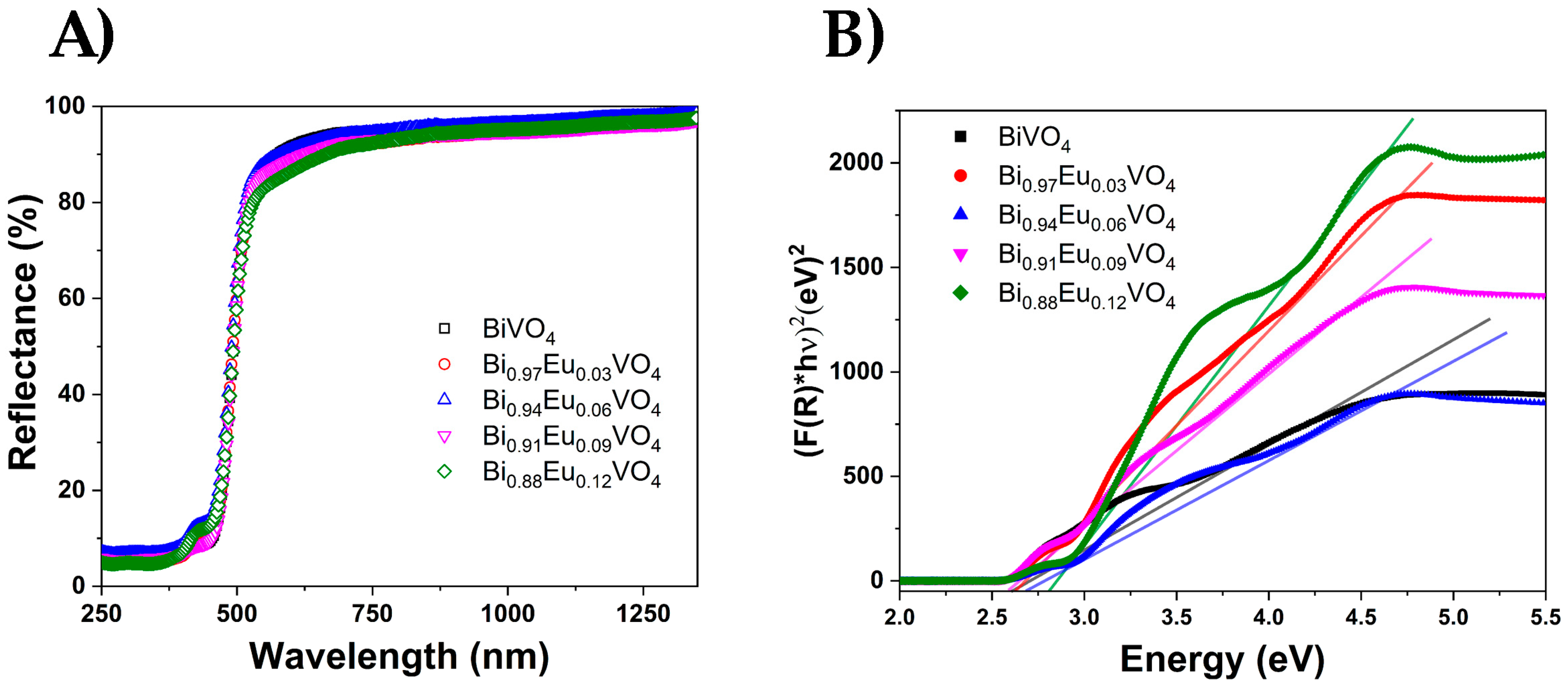
The diffuse reflectance spectra of Bi1−xEuxVO4 samples presented in Figure 4A are used to estimate energy band gaps through Tauc’s plot method (Figure 4B). The absorption observed below 350 nm for all studied samples is assigned to the absorption of vanadate groups. An additional weak peak observed at approximately 424 nm in the Bi1−xEuxVO4 samples is attributed to the electronic transitions of Eu3+ ions. Figure 4B presents the energy dependence of (FKM(R)hν)2 for Bi1−xEuxVO4 samples.
The band gap, Eg, was estimated from the absorption edge wavelength of the inter-band transition according to the following equation:
( F K M R   ×   h ν ) n = A   ( h ν E g )
where FKM(R) is the Kubelka–Munk function, with FKM(R) = (1 − R)2/2R; R is the observed reflectance in the UV–vis spectra; n = 2 for a direct allowed transition and n = 1/2 for an indirect allowed transition; A is a proportionality constant; and hν is the photon energy. BiVO4 is a direct gap semiconductor; therefore, n = 2 [54,55]. According to Equation (2), the Eg values were determined by extrapolating the linear portion of the (FKM(R)hν)2 curve to the intersection with the X-axis. As can be seen in Figure 4B, the optical band gap shifts to a higher energy with increasing Eu3+ contents. The Eg values, ranging from approximately 2.55 to 2.80 eV, are in full agreement with recently published results [56].

2.2.3. Optical Absorption

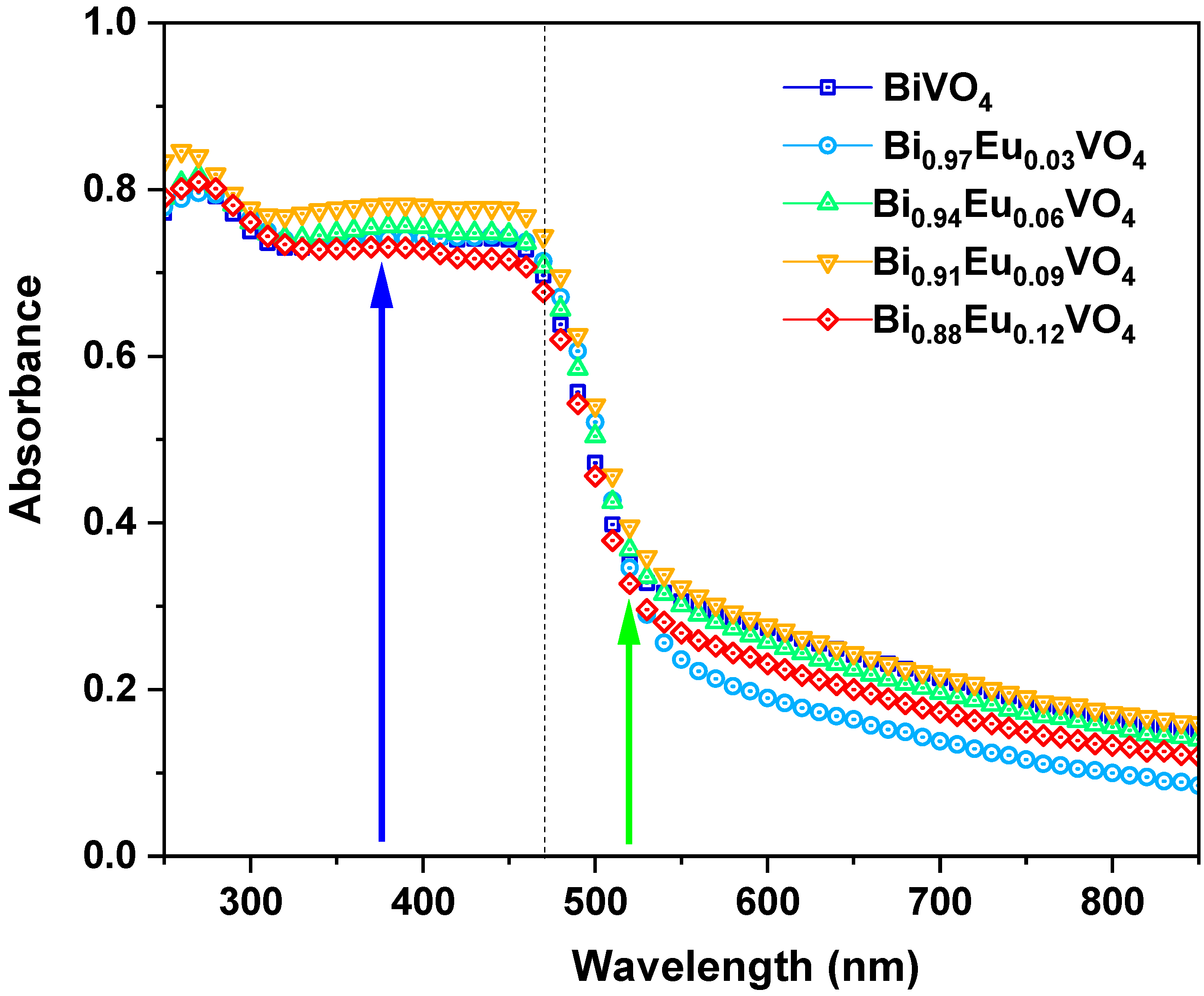
The UV–visible absorption spectra of Bi1−xEuxVO4 (x = 0, 0.03, 0.06, 0.09, and 0.12) powder samples are shown in Figure 5. The arrows indicate 375 nm (blue) and 518 nm (green). The samples exhibit an absorption band in the UV and visible light range, with the absorption edge at 470 nm. The absorption is stronger in the ultraviolet (UV) region, with an absorption tail extending up to 800 nm. The absorption curves display a sharp decrease in absorbance at the transition region between UV and visible wavelengths, as highlighted by the dashed line in Figure 5. The Eu3+-doped samples exhibit a slight reduction in absorption within the visible region (>500 nm) compared to the undoped BiVO4.

2.2.4. Photoluminescence (PL) Emission Measurements Using Continuous-Wave Lasers

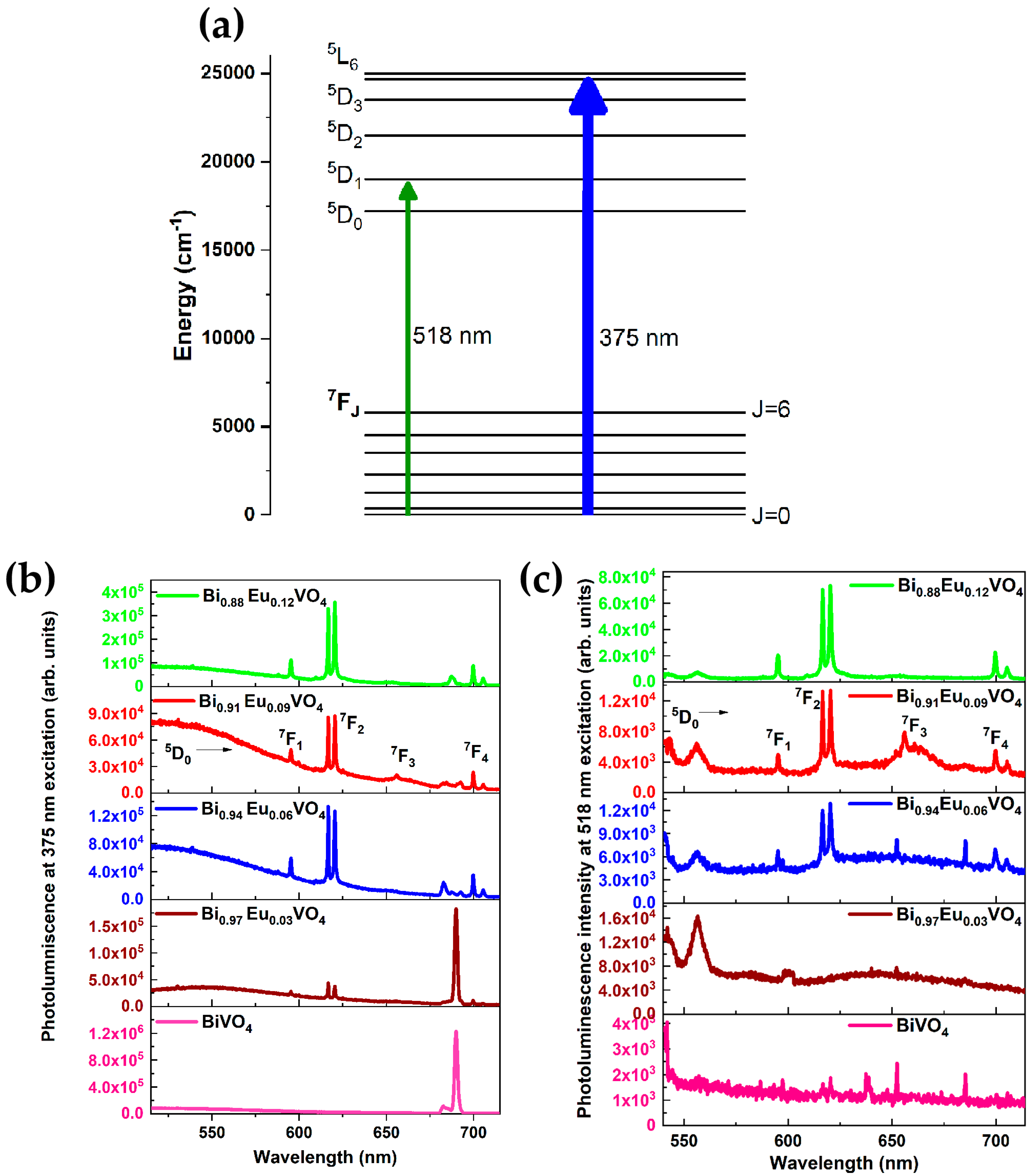
Figure 6a shows the energy level of the Eu3+ ion. The two excitations at 375 nm and 518 nm are indicated by the blue and green arrows, respectively. The photoluminescence (PL) emission spectra of the undoped and Eu3+-doped BiVO4 samples for the excitation wavelengths of 375 nm and 518 nm are presented in Figure 6b,c, respectively. For Eu3+-doped BiVO4 samples, peaks corresponding to typical europium emission, i.e., 5D07FJ (J = 1–4) transitions, are present, with the 5D07F2 transition being the dominant one for both 375 nm and 518 nm excitation wavelengths. The emission spectrum shows a gradual increase in the intensity value with the increase in Eu3+ doping. These sharp spectral features of the typical Eu3+ emission plot indicate that the europium ions are uniformly doped in the BiVO4 matrix [57]. For Eu3+-doped BiVO4 samples under both 375 nm and 518 nm excitation, a peak is present at ~595.5 nm: this indicates the 5D07F1 transition corresponding to magnetic dipole (MD) transition. Intense and clearly resolved peaks at 616 nm indicate a 5D07F2 transition corresponding to an electric dipole (ED) transition. In addition to this, 5D07F3,4 transition peaks are also present. When the samples are excited, in addition to the charge transfers of orbitals O 2p, V 3d, and Bi 6s, the transfer of energy to Eu3+ ions results in the PL emission [58]. The narrow peak at 690 nm for 375 nm excitation is a spurious structure; similarly, the broad emission after 550 nm is due to the background emission from the cuvette. The f-f transitions in europium involve electron jumps within the shielded 4f subshell of the Eu3+ ion, leading to sharp, characteristic UV-Vis absorption and emission spectra. While f-f transitions are formally “forbidden” by spin and parity selection rules, their intensities can be significantly enhanced by the ligand environment, especially through asymmetry in the coordination sphere [36,59,60].

2.2.5. Time-Resolved Fluorescence Spectroscopy (TRS)

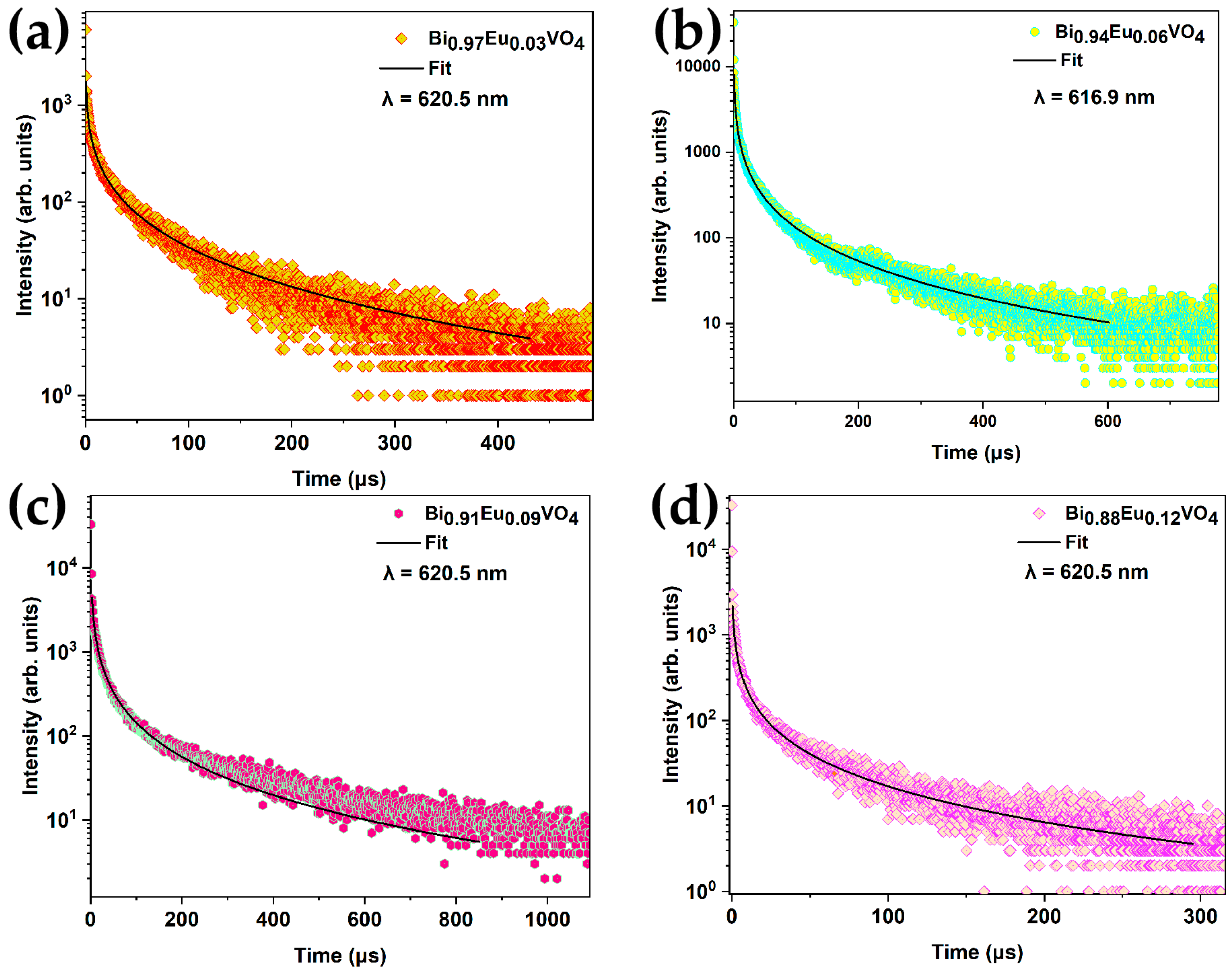
Time-resolved photoluminescence measurements were performed to study the decay dynamics of europium emission in the BiVO4 matrix. For this purpose, the sample was excited using the second harmonic (355 nm) of a Nd:YAG pulsed laser (repetition rate ~10 Hz, pulse width ~8 ns), and the PL emission was collected using a home-built collection geometry configured with a time-resolved setup and multi-channel counters [58]. The PL spectra obtained for Bi1−xEuxVO4 samples display dominant emissions corresponding to the 5D07F2 transition, whereas BiVO4 does not show any emissions. The measured and fitted time-resolved PL decay curves corresponding to the 5D07F2 transition for all Eu3+ samples are shown in Figure 7. In general, the decay curves follow stretched exponential decay characteristics because of the local environment of Eu3+ in the BiVO4 matrix [61]. Here, relaxation refers to the active non-radiative channels, such as quenching centers in the lattice, possible energy migration among the activators, and surface localization. Hence, the stretched exponential or Kohlrausch model [57,61,62] is used to fit the decay curves as given by the following equation:
φ t =   φ 0 e x p [ t τ β ]
where 0 < β < 1 is the stretching parameter and τ is the radiative lifetime.
The radiative lifetime τ for Eu3+-doped samples corresponding to the 5D07F2 transition is obtained from the fit of the decay curves in Figure 7a–d using Equation (3) and is reported in Table 1. The decay curves of Eu3+ exhibit a non-single exponential behavior. Evaluating the lifetime is particularly challenging when systems display such behavior, as it often arises from multiple, competing relaxation processes [63,64]. Table 1 presents both the 1/e lifetime, defined as the time after the excitation pulse at which the light intensity decreases to 1/e of its initial value, and the so-called average lifetime, given by the following equation:
0 t   I t d t 0 I t d t
The 1/e lifetime is especially useful in photonic engineering applications, as it enables a direct comparison among different hosts and systems. It should be noted, however, that the average lifetime is strongly influenced by the long-time decay behavior and has limited significance in cases involving multiple competitive relaxation processes, such as in the present study [64].
The lifetime τ can be evaluated correctly only for the sample with the lowest Eu3+ content. As Eu3+ doping increases, the lifetime drops quickly with a very fast decay; similar behavior has been observed in BiVO4 nanoparticles activated by Eu3+ ions [65]. This deviation is attributed to the nonradiative energy transfer from the excited states to quenching centers within the lattice, as well as possible energy migration among activator ions. These energy losses introduce additional decay pathways, resulting in the observed nonexponential decay profiles that are correctly fitted by a stretched exponential. The contribution from surface-localized Eu3+ in BiVO4 should also be considered. In fact, the lifetime of surface-localized Eu3+ in BiVO4 is notably shorter than the typical millisecond-scale lifetime of Eu3+ ions in host lattices [65]. As above, the deviation is attributed to a nonradiative energy transfer to some quenching centers in the lattices or possible energy migrations among the activators [51]. The excitation energy losses provide some extra decay channels, inducing the nonexponential decay natures.

2.2.6. Micro-Raman Spectroscopy Measurements

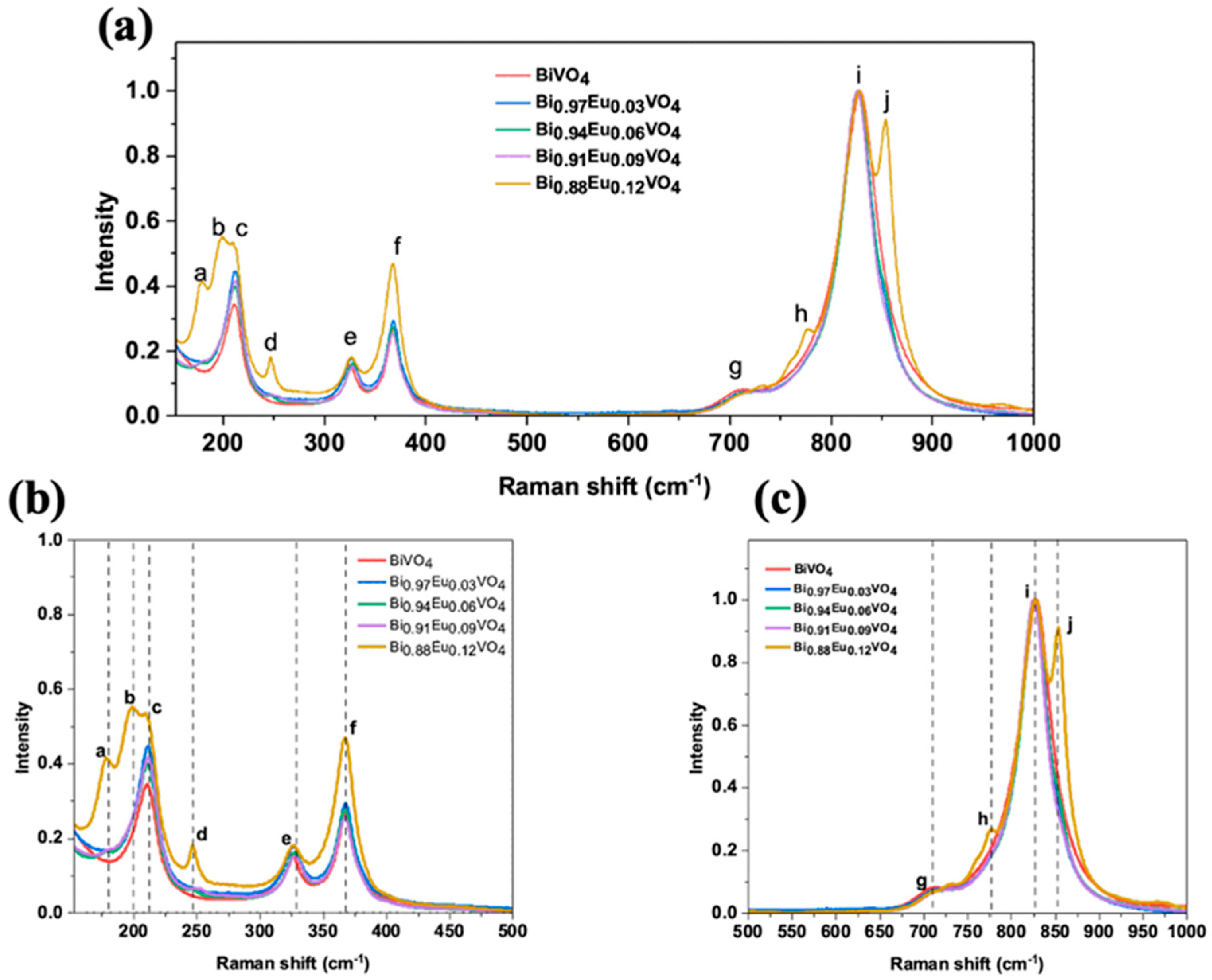
The Raman spectra of undoped and Eu3+-doped BiVO4 exhibit characteristic peaks, labeled with letters as shown in Figure 8a and marked with vertical lines in the magnified section views of Figure 8b,c for clarity. The assigned letters correspond to the following wavenumbers: (a) 179 cm−1; (b) 197 cm−1; (c) 211 cm−1; (d) 247 cm−1; (e) 327 cm−1; (f) 367 cm−1; (g) 708 cm−1; (h) 778 cm−1; (i) 829 cm−1; and (j) 854 cm−1. The XRD analysis confirms that the samples comprise a mixture of ms-BiVO4 and tz-BiVO4 phases. Consequently, Raman modes corresponding to both phases are present, as summarized in Table 2.
Figure 8 further highlights Raman peaks that track the structural phase evolution with increasing Eu doping. The peak at ~211 cm−1 (c in the Figures), present across all samples, including the undoped one, corresponds to an external lattice mode common to both phases. In contrast, the two peaks at 179 cm−1 (a) and 197 cm−1 (b), which appear predominantly at higher Eu concentrations (especially at x = 0.12), are characteristic of monoclinic distortions or phase coexistence. The increasing intensity of these lower-frequency peaks with Eu content indicates enhanced lattice distortion and possibly the persistence of local monoclinic-like environments, despite overall doping-induced structural changes. The 247 cm−1 peak (d), primarily associated with Bi–O stretching vibrations in the tetragonal phase, is absent in the undoped sample but becomes prominent at higher doping, confirming the phase transition. The peak shifts near 254 cm−1 at x = 0.06 suggest lattice distortion linked to coexistence with a dominant monoclinic phase and strain.
Monoclinic phase signatures include peaks at 708 cm−1 (g) and 829 cm−1 (i) corresponding to antisymmetric and symmetric V–O stretching modes, respectively. These peaks decrease in intensity at x = 0.12, while tetragonal-phase peaks at 778 cm−1 (h) and 854 cm−1 (j) increase, marking the phase transition. Intermediate doping levels (x = 0.06 and 0.09) exhibit a coexistence of both phases, as evidenced by the simultaneous presence of monoclinic and tetragonal peaks with varying intensities.
Several peaks display doping-dependent shifts. The 327 cm−1 peak (e), related to the asymmetric deformation of the VO43− tetrahedron, shifts to higher wavenumbers up to x = 0.09, likely due to the substitution of Bi by smaller Eu ions, causing lattice contraction. This shift diminishes at x = 0.12, possibly due to lattice softening as the monoclinic phase diminishes. The 367 cm−1 (f) and 829 cm−1 (j) peaks also show a variable red shift indicative of doping-induced strain or disorder [59,62,66,67]. The shifts observed at (b) and (c) in the Raman spectra (together with the XRD results) confirm that the dopants caused distortions in the BiVO4 crystal lattice. These distortions likely happened by replacing Bi3+ with Eu3+ ions [59]. On the other hand, if Eu3+ were replacing V5+ instead, a shift toward lower wavenumbers should be expected, as Eu3+ has a greater atomic mass than V5+, according to [66,68].
Overall, the Raman spectral evolution clearly demonstrates a doping-driven structural transition from monoclinic to tetragonal BiVO4, with associated shifts reflecting changes in lattice dynamics and phase (Table 2).

2.3. Photocatalytic Activity of Bi1−xEuxVO4 (x = 0, 0.03, 0.06, 0.09, 0.12) Samples

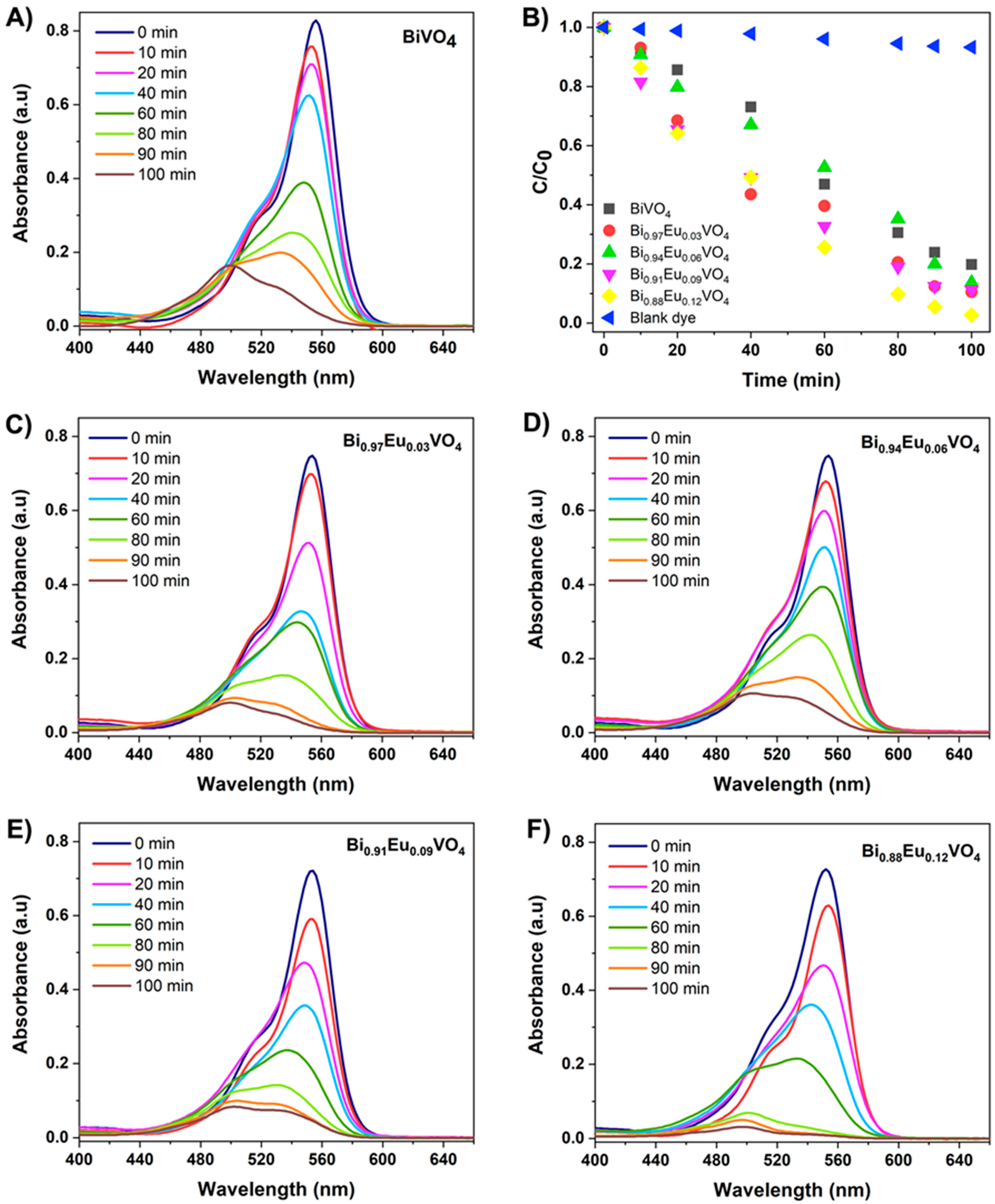
The photodegradation of RhB was employed to evaluate the photocatalytic activities of all microwave-synthesized Bi1−xEuxVO4 samples. UV-Vis absorption spectra over irradiation time for the photocatalytic degradation of 5 ppm RhB in the presence of 40 mg of the appropriate Bi1−xEuxVO4 photocatalyst are presented in Figure 9. The change in the absorption spectra of the RhB solution during the photodegradation process at different irradiation times is presented in Figure 9A for the undoped BiVO4 photocatalyst. The absorbance of RhB at 554 nm decreased gradually after 100 min of irradiation in the presence of undoped BiVO4, indicating that microwave-synthesized catalysts are effective for dye removal in wastewater treatment. Compared with the undoped BiVO4, the RhB photocatalytic degradation shows lower absorbance intensities as the concentration of the Eu3+-dopant increases (Figure 9C–F). The removal efficiency curves presented in Figure 9B illustrate the relative concentration of the RhB solution over irradiation time for blank dye (RhB) and all microwave-synthesized Bi1−xEuxVO4 (x = 0, 0.03, 0.06, 0.09, and 0.12) photocatalysts. In contrast to the undoped BiVO4, with a removal efficiency of 81% within 100 min of irradiation, Eu3+-doped BiVO4 samples exhibited higher efficiencies of 89%, 87%, and 91% for Bi0.97Eu0.03VO4, Bi0.94Eu0.06VO4, and Bi0.91Eu0.09VO4, respectively. The degradation rate of 97% for RhB dye was observed in the highest Eu3+-doped BiVO4 sample, Bi0.88Eu0.12VO4.
It can be noted that, in comparison with the undoped BiVO4, the Eu3+-doped BiVO4 photocatalysts exhibit a much higher photocatalytic activity in the degradation of RhB under visible light irradiation. There are two different possibilities for the enhanced photocatalytic performances with increasing concentrations of Eu3+ ions in the BiVO4 matrix: (i) an appropriate amount of Eu3+ ions can improve the separation efficiency of photogenerated electron–hole pairs and hinder their recombination, and (ii) the dominant tz-BiVO4 structure exhibited a better photocatalytic performance than ms-BiVO4 with respect to RhB removal.
To gain a deeper insight into the photocatalytic behavior, the kinetics of RhB degradation were analyzed using the Langmuir–Hinshelwood pseudo-first-order model. The calculated kinetic parameters are summarized in Table 3.
Pristine BiVO4 shows a rate constant of 1.67 × 10⁻² min−1, while Eu3+-doped samples exhibit enhanced performance, reaching 3.46 × 10⁻² min−1 for Bi0.88Eu0.12VO4, which is more than twice the value obtained for undoped BiVO4. This increase in the kinetic constant follows the same trend as the removal efficiencies, confirming that Eu3+ ions accelerate the photocatalytic reaction. A similar relationship between structural modification and kinetic enhancement has been reported in the literature. Ren et al. demonstrated that a 3 wt% N-CQDs/UBWO composite achieves a kinetic constant of 0.0409 min−1, almost four times higher than pristine Bi2WO6 (0.01628 min−1) under visible light irradiation [69]. In RhB degradation systems, Ag-modified BiVO4 containing 5 wt% Ag showed a kinetic constant of 0.023 min−1, considerably higher than that of pure BiVO4 [70]. These examples support the trend observed in our Bi1−xEuxVO4 series, where Eu3+ incorporation improves phase composition, enhances charge carrier separation, and ultimately increases the reaction rate during RhB degradation.

3. Discussion

The Formation of ms- or tz-Crystalline Phase in Bi1−xEuxVO4 (x = 0, 0.03, 0.06, 0.09, and 0.12) Samples

Recently, control over the crystalline phases, i.e., transformation from the tz-type to the ms-type, and the morphology of BiVO4 samples has been successfully obtained using microwave hydrothermal (MWHT) conditions without any template/surfactant, doping of metal ions, or pH change in the reaction solution [71]. Also, doping with RE ions such as Er3+, Yr3+, Gd3+, Sm3+, Tb3+, Nd3+, and Ce3+ resulted in phase transitions in BiVO4 and the significant improvement of photocatalytic properties [28,67,72,73,74,75,76,77,78,79]. A comparison of the literature on the formation of either ms- or tz-crystalline phases, as well as luminescent and photocatalytic properties as a function of the Eu3+/Bi3+ molar ratio in Bi1−xEuxVO4 samples, is presented alongside our results in Table 4.

4. Materials and Methods

4.1. Materials

The following chemicals were used as received: bismuth nitrate pentahydrate, (Bi(NO3)3·5H2O (99%, Merck, Darmstadt, Germany), ammonium metavanadate, NH4VO3 (99%, Merck, Darmstadt, Germany), Europium (III) acetate hydrate, Eu(CH3COO)3·H2O (99.9%, Alfa Aesar, Haverhill, MA, USA), nitric acid, HNO3 (99%, Merck, Darmstadt, Germany), sodium hydroxide, NaOH (95%, Merck, Darmstadt, Germany), Rhodamine B, C28H31CIN2O3, and RhB (95%, Merck, Darmstadt, Germany).

4.2. Synthesis of Bi1−xEuxVO4 (x = 0.03, 0.06, 0.09, and 0.12) Samples

In a typical microwave-assisted synthesis method, the aqueous solutions of ammonium metavanadate, NH4VO3 (6 mL, 0.05 M), bismuth(III) nitrate pentahydrate, and Bi(NO3)3·5H2O (5 mL, 0.05 M) were uniformly mixed in a 20 mL process vial equipped with a stirring bar. Additionally, the appropriate amount (0.03, 0.06, 0.09, and 0.12 mmol) of the respective europium (III) acetate hydrate, Eu(CH3COO)3·H2O, was added to the starting Bi(NO3)3 for each (of four) prepared solution individually. The reaction mixtures were heated in a closed vessel system of a microwave reactor at 170 °C for a duration of 10 min. The reaction mixtures were cooled down before being transferred to centrifugal tubes and then centrifuged for 20 min at 12,000 rpm to produce a light-yellow powder, which was washed three times using deionized water. Powder samples were finally obtained upon drying them in the air at 70 °C for three hours. The obtained powder samples in yellow color will be denoted through the text as Bi0.97Eu0.03VO4, Bi0.94Eu0.06VO4, Bi0.91Eu0.09VO4, and Bi0.88Eu0.12VO4, corresponding to 3 mmol, 6 mmol, 9 mmol, and 12 mmol of added Eu3+ ions in starting (Bi3+) solutions, respectively.

4.3. Synthesis of BiVO4 4samples

An undoped BiVO4 sample was prepared by applying identical reaction procedures of microwave synthesis as in the absence of Eu3+ precursors, Eu(CH3COO)3·H2O. Briefly, the reaction mixture containing aqueous solutions of NH4VO3 (6 mL, 0.05 M) and Bi(NO3)3·5H2O (5 mL, 0.05 M) was transferred into microwave reactor vial equipped with a stirring bar; it was heated in a closed vessel system at 170 °C for during 10 min, then cooled down to room temperature and centrifuged for 20 min to produce a light yellow powder that was washed three times using deionized water. A powder sample was finally obtained after drying at 70 °C for 3 h. The light-yellow powder of the BiVO4 sample has been denoted simply as BiVO4.

4.4. Characterization Instrumentation

A high-density microwave field chemical synthesis reactor, the Monowave 300 from Anton Paar GmbH (Graz, Austria), with a maximum magnetron output power of 850 W, was used for the microwave heating studies. With a working temperature of up to 300 °C, an integrated infrared temperature sensor was used to monitor the reaction temperature. PEEK snap caps and conventional silicone septa covered with polytetrafluoroethylene (PTFE) are used to seal the reusable 20 mL Pyrex vials (G30). Every experiment was conducted at a maximum pressure of 30 bar and a stirring rate of 600 rpm. The powder X-ray diffraction (XRD) analysis was performed using a BRUKER AXS GMBH A24A10 X-ray diffractometer (Bruker AXS GmbH, Karlsruhe, Germany). Patterns were collected at room temperature over a 2θ range of 15–70°, with a scan rate of 3°/min and a divergent slit of 0.5 mm, operating at 40 kV and 30 mA. Attenuated total reflectance Fourier transform infrared (ATR-FTIR) measurements were conducted in the 400–4000 cm−1 range, with a spectral resolution of 4 cm−1 at room temperature, using a Thermo Scientific Nicolet iS50 FT-IR spectrometer (Thermo Fisher Scientific, Waltham, MA, USA) equipped with a built-in all-reflective ATR diamond. In the 200–800 nm range, the Shimadzu 1800 UV–Vis spectrophotometer (Shimadzu Corporation, Kyoto, Japan) with a temperature controller was used to record the ultraviolet–visible (UV–Vis) absorption spectra. The Spectrophotometer Shimadzu UV–Visible UV-2600 (Shimadzu Corporation, Tokyo, Japan) with an integrated sphere (ISR-2600 Plus (for UV-2600)), with a 300–800 nm range and a 1 nm step, was used to quantify diffuse reflection. The morphology of the obtained samples was studied using a Tecnai F20 TEM/STEM microscope (FEI Company, now Thermo Fisher Scientific) at 200 kV electron acceleration voltage after the dry-transfer of the sample material on lacey carbon TEM grids. The UV–visible absorption spectrum was recorded using the spectrometer Quantaurus-QY, C11347 series, Hamamatsu (Hamamatsu Photonics, Hamamatsu City, Japan). Luminescence measurements were recorded using a Jobin Yvon (HORIBA Jobin Yvon, Edison, NJ, USA), Spex mod 1401, double grating monochromator with resolution in the visible region of 5 cm−1, in the photon counting measurement regime, exciting the samples with 375 nm laser diode oxxius mod. LBX-375-70-CSB-PP and 518 nm laser diode oxxius mod. LBX-515-150-CSB-PPA. Luminescence decay measurements were performed after excitation with the third harmonic of a pulsed Nd-YAG laser. The visible emission was collected using a double monochromator with a resolution of 5 cm−1, and the signal was analyzed using a photon-counting system. Decay curves were obtained by recording the signal with a multi-channel analyzer Stanford SR430 (Stanford Research Systems, Sunnyvale, CA, USA). A LabRAM HR Evolution confocal Raman microscope (Horiba France SAS, Palaiseau, France) was used to investigate the influence of Eu3+ doping on the crystal structure of BiVO4 samples. Raman spectra were recorded in backscattering configuration using a 532 nm continuous-wave (CW) laser operated at low power (1 mW). The laser was focused on the sample through a 100× microscope objective (NA = 0.9), and the scattered light was analyzed with a diffraction grating of 1800 lines/mm.

4.5. Photocatalytic Test

Photocatalytic activities of the as-prepared samples were determined through the decolorization of RhB under visible light irradiation. The experiments were conducted in a 100 mL glass reactor equipped with a 300 W lamp as the light source, positioned 30 cm from the reaction mixture. An Osram Vitalux lamp, OSRAM GmbH, Munich, Germany (300 W, white light: UVB radiated power from 280 to 315 nm 3.0 W; UVA radiated power 315–400 nm 13.6 W; the rest is visible light and IR) was used as the simulated sunlight source. Optical power was measured using an R-752 Universal Radiometer read-out with sensor model PH-30, DIGIRAD, and it was ∼30 mWcm−2.
In a standard experiment, 50 mL of RhB solution with a 5 ppm concentration was mixed with 40 mg of the appropriate Bi1−xEuxVO4 (x = 0, 0.03, 0.06, 0.09, and 0.12) sample. Before illumination, the mixture was treated with an ultrasonic bath for 15 min and then left in the dark for one hour to reach adsorption–desorption equilibrium between RhB and the appropriate Bi1−xEuxVO4 sample. At given time intervals, the collected mixture samples (1 mL) were centrifuged at 12,000 rpm for 20 min to remove the catalyst. The sample concentration was determined by recording the absorbance at 554 nm using a UV-1800 spectrophotometer (Shimadzu). The degradation efficiency (D) was calculated using Equation (4):
D % = C 0 C t C 0 × 100
where C0 is the initial concentration of the dye solution, and Ct is the concentration of the dye solution after a certain time of illumination (t).

5. Conclusions

In this manuscript, a highly effective, controlled, and eco-friendly microwave-assisted approach was developed for preparing nanostructured Bi1−xEuxVO4 (x = 0, 0.03, 0.06, 0.09, and 0.12) with enhanced photoluminescent and photocatalytic properties. The effects of the concentration of Eu3+ ions integrated into the BiVO4 matrix on the formation of the ms- or tz-type BiVO4 structure, photoluminescent intensity, decay dynamics of europium emission, and photocatalytic effectiveness in RhB degradation were thoroughly examined. The main aim was to obtain the optimized tz-BiVO4 nanostructure, which had been presented in our recently published papers as a structure exhibiting better photocatalytic performance than ms-BiVO4 with respect to pollutant removal.
The FTIR analysis of Bi1−xEuxVO4 (x = 0.03, 0.06, 0.09, and 0.12) samples showed the characteristic peaks as undoped BiVO4 in the range of around 500–820 cm−1, while two new peaks appeared at 471 cm−1 and 720 cm−1, assigned to Eu-O stretching vibrations. The band gap, Eg, estimated from the absorption edge wavelength of the inter-band transition, shifted to higher energy with increasing Eu3+ contents and ranged from approximately 2.55 to 2.80 eV. The PL spectra of samples that contained Eu3+ ions displayed dominant emissions corresponding to the 5D07F2 transition, whereas BiVO4 does not show any emissions. Also, the Eu3+-doped BiVO4 exhibited a much higher photocatalytic activity in the degradation of RhB than undoped BiVO4.
In our future works, research will be focused on the photocatalytic degradation of other organic pollutants when using the Eu3+-doped BiVO4 photocatalyst and different rare earth/dopant ions in a wide range of their concentrations.

Author Contributions

Conceptualization, D.M. and M.F.; methodology, B.V., N.T. and A.C.; software, N.T., S.V., B.C.B. and B.F.; validation, D.M., T.B. and M.F.; formal analysis, B.V., S.M.L.S. and R.D.; investigation, D.M., S.V. and M.F.; resources, D.M., A.C. and M.F.; data curation, T.B., B.C.B. and B.F.; writing—original draft preparation, D.M., B.V., G.C.R., S.M.L.S., R.D. and M.F.; writing—review and editing, D.M., G.C.R. and M.F.; visualization, D.M., A.C., G.C.R. and M.F.; supervision, D.M. and M.F.; project administration D.M. and M.F.; funding acquisition, D.M. and M.F. All authors have read and agreed to the published version of the manuscript.

Funding

This research was funded by the Ministry of Science, Technological Development and Innovation of the Republic of Serbia, grant number 451-03-136/2025-03/200017. Author A.C. thank Project PNRR “Nano Foundries and Fine Analysis—Digital Infrastructure (NFFA-DI)” IR0000015. The research was supported by the National Research Council of Italy (CNR) through the Short Term Mobility Program (STM 2025) during the research stay of Dr. Dragana Marinković.

Institutional Review Board Statement

Not applicable.

Informed Consent Statement

Not applicable.

Data Availability Statement

The original contributions presented in this study are included in the article. Further inquiries can be directed to the corresponding authors.

Acknowledgments

The authors are grateful to Dušan Mijin for FTIR measurements, and Nadica Abazović and Milica Carević for DRS measurements. The use of facilities at the University Service Facility for Transmission Electron Microscopy (USTEM) of TU Wien for parts of this work is acknowledged. This work is dedicated to the memory of Dragana Marinković’s husband.

Conflicts of Interest

The authors declare no conflicts of interest.

References

  1. Jabbar, Z.H.; Graimed, B.H.; Ammar, S.H.; Sabit, D.A.; Najim, A.A.; Radeef, A.Y.; Taher, A.G. The Latest Progress in the Design and Application of Semiconductor Photocatalysis Systems for Degradation of Environmental Pollutants in Wastewater: Mechanism Insight and Theoretical Calculations. Mater. Sci. Semicond. Process. 2024, 173, 108153. [Google Scholar] [CrossRef]
  2. Ahmad, I.; Zou, Y.; Yan, J.; Liu, Y.; Shukrullah, S.; Naz, M.Y.; Hussain, H.; Khan, W.Q.; Khalid, N.R. Semiconductor Photocatalysts: A Critical Review Highlighting the Various Strategies to Boost the Photocatalytic Performances for Diverse Applications. Adv. Colloid Interface Sci. 2023, 311, 102830. [Google Scholar] [CrossRef] [PubMed]
  3. Basavarajappa, P.S.; Patil, S.B.; Ganganagappa, N.; Raghava, K.; Raghu, A.V.; Venkata, C. ScienceDirect Recent Progress in Metal-Doped TiO2, Non-Metal Doped/Codoped TiO2 and TiO2 Nanostructured Hybrids for Enhanced Photocatalysis. Int. J. Hydrogen Energy 2020, 45, 7764–7778. [Google Scholar] [CrossRef]
  4. Sohail, M.; Rauf, S.; Irfan, M.; Hayat, A. Recent Developments, Advances and Strategies in Heterogeneous Photocatalysts for Water Splitting. Nanoscale Adv. 2024, 6, 1286–1330. [Google Scholar] [CrossRef]
  5. Wafi, A.; Aji, D.; Mansoob, M. Results in Chemistry Recent Advances in Photocatalysis: From Laboratory to Market. Results Chem. 2025, 18, 102672. [Google Scholar] [CrossRef]
  6. Huang, Z.; Jia, S.; Wei, J. A visible light active, carbon–nitrogen–sulfur co- doped TiO2/g-C3N4 Z-scheme heterojunction as an effective photocatalyst to remove dye pollutants. RSC Adv. 2021, 11, 16747–16754. [Google Scholar] [CrossRef]
  7. Schumacher, L.; Marschall, R. Recent Advances in Semiconductor Heterojunctions and Z-Schemes for Photocatalytic Hydrogen Generation; Springer International Publishing: Cham, Switzerland, 2022; Volume 380, ISBN 0123456789. [Google Scholar]
  8. Lin, L.; Ma, Y.; Vequizo, J.J.M.; Nakabayashi, M.; Gu, C.; Tao, X.; Yoshida, H.; Pihosh, Y.; Nishina, Y.; Yamakata, A.; et al. Efficient and Stable Visible-Light-Driven Z-Scheme Overall Water Splitting Using an Oxysulfide H2 Evolution Photocatalyst. Nat. Comm. 2024, 15, 397. [Google Scholar] [CrossRef]
  9. Hu, X.; Cook, S.; Wang, P.; Hwang, H. Science of the Total Environment In Vitro Evaluation of Cytotoxicity of Engineered Metal Oxide Nanoparticles. Sci. Total Environ. 2009, 407, 3070–3072. [Google Scholar] [CrossRef]
  10. Shivaji, K.; Sridharan, K.; Kirubakaran, D.D.; Velusamy, J.; Emadian, S.S.; Krishnamurthy, S.; Devadoss, A.; Nagarajan, S.; Das, S.; Pitchaimuthu, S. Biofunctionalized CdS Quantum Dots: A Case Study on Nanomaterial Toxicity in the Photocatalytic Wastewater Treatment Process. ACS Omega 2023, 22, 19413–19424. [Google Scholar] [CrossRef]
  11. Kumar, A.; Sharma, G.; Naushad, M.; Al-muhtaseb, A.H.; García-peñas, A.; Tessema, G.; Si, C.; Stadler, F.J. Bio-Inspired and Biomaterials-Based Hybrid Photocatalysts for Environmental Detoxification: A Review. Chem. Eng. J. 2020, 382, 122937. [Google Scholar] [CrossRef]
  12. Pradiprao, A.; Bobade, R.G.; Doong, R.; Pandit, B.; Minh, N.; Ambare, R.C.; Hoang, T.; Jashvant, K. Bio-Based Nanomaterials as Effective, Friendly Solutions and Their Applications for Protecting Water, Soil, and Air. Mater. Today Chem. 2025, 46, 102688. [Google Scholar] [CrossRef]
  13. Q. Alijani, H.; Iravani, S.; Varma, R.S. Bismuth Vanadate (BiVO4) Nanostructures: Eco-Friendly Synthesis and Their Photocatalytic Applications. Catalysts 2023, 13, 59. [Google Scholar] [CrossRef]
  14. Marinković, D.; Righini, G.C.; Ferrari, M. Synthesis, Optical, and Photocatalytic Properties of the BiVO4 Semiconductor Nanoparticles with Tetragonal Zircon-Type Structure. Photonics 2025, 12, 438. [Google Scholar] [CrossRef]
  15. Marinković, D.; Righini, G.C.; Ferrari, M. Advances in Synthesis and Applications of Bismuth Vanadate-Based Structures. Inorganics 2025, 13, 268. [Google Scholar] [CrossRef]
  16. Bulut, D.T. Exploring the Dual Role of BiVO4 Nanoparticles: Unveiling Enhanced Antimicrobial Efficacy and Photocatalytic Performance. J. Sol-Gel Sci. Technol. 2025, 114, 198–222. [Google Scholar] [CrossRef]
  17. Tot, N.; Vasiljević, B.; Davidović, S.; Pustak, A.; Marić, I.; Prekodravac Filipović, J.; Marinković, D. Facile Microwave Production and Photocatalytic Activity of Bismuth Vanadate Nanoparticles over the Acid Orange 7. Processes 2025, 13, 3485. [Google Scholar] [CrossRef]
  18. Lalrindiki, F.; Premjit Singh, N.; Mohondas Singh, N. A Review of Synthesis, Photocatalytic, Photoluminescence and Antibacterial Properties of Bismuth Vanadate-Based Nanomaterial. Inorg. Chem. Commun. 2024, 168, 112846. [Google Scholar] [CrossRef]
  19. Kamble, G.S.; Natarajan, T.S.; Patil, S.S.; Thomas, M.; Chougale, R.K.; Sanadi, P.D.; Siddharth, U.S.; Ling, Y.C. BiVO4 As a Sustainable and Emerging Photocatalyst: Synthesis Methodologies, Engineering Properties, and Its Volatile Organic Compounds Degradation Efficiency. Nanomaterials 2023, 13, 1528. [Google Scholar] [CrossRef]
  20. Ding, H.; Peng, B.; Wang, Z.; Han, Q. Advances in Metal or Nonmetal Modification of Bismuth-Based Photocatalysts. Wuli Huaxue Xuebao/Acta Phys.-Chim. Sin. 2024, 40, 2305048. [Google Scholar] [CrossRef]
  21. Mohamed, N.A.; Kiong, T.S.; Ismail, A.F. Pioneering Sustainable Energy Solutions with Rare-Earth Nanomaterials: Exploring Pathways for Energy Conversion and Storage. Int. J. Hydrogen Energy 2024, 93, 607–649. [Google Scholar] [CrossRef]
  22. Sun, J.; Zhang, Z.; Suo, H.; Chen, Y.; Xiang, J.; Guo, C. Temperature Self-Monitoring Photothermal Nano-Particles of Er3+/Yb3+ Co-Doped Zircon-Tetragonal BiVO4. Ceram. Int. 2021, 47, 409–415. [Google Scholar] [CrossRef]
  23. Gschwend, P.M.; Starsich, F.H.L.; Keitel, R.C.; Pratsinis, S.E. Nd3+-Doped BiVO4 Luminescent Nanothermometers of High Sensitivity. Chem. Commun. 2019, 55, 7147–7150. [Google Scholar] [CrossRef]
  24. Nexha, A.; Carvajal, J.J.; Pujol, M.C.; Díaz, F.; Aguiló, M. Lanthanide Doped Luminescence Nanothermometers in the Biological Windows: Strategies and Applications. Nanoscale 2021, 13, 7913–7987. [Google Scholar] [CrossRef]
  25. Starsich, F.H.L.; Gschwend, P.; Sergeyev, A.; Grange, R.; Pratsinis, S.E. Deep Tissue Imaging with Highly Fluorescent Near-Infrared Nanocrystals after Systematic Host Screening. Chem. Mater. 2017, 29, 8158–8166. [Google Scholar] [CrossRef]
  26. Jurga, N.; Runowski, M.; Grzyb, T. Lanthanide-Based Nanothermometers for Bioapplications: Excitation and Temperature Sensing in Optical Transparency Windows. J. Mater. Chem. C 2024, 12, 12218–12248. [Google Scholar] [CrossRef]
  27. Richards, B.S.; Hudry, D.; Busko, D.; Turshatov, A.; Howard, I.A. Photon Upconversion for Photovoltaics and Photocatalysis: A Critical Review. Chem. Rev. 2021, 121, 9165–9195. [Google Scholar] [CrossRef] [PubMed]
  28. Tian, K.; Wu, L.; Han, T.; Gao, L.; Wang, P.; Chai, H.; Jin, J. Dual Modification of BiVO4 Photoanode by Rare Earth Element Neodymium Doping and Further NiFe2O4 Co-Catalyst Deposition for Efficient Photoelectrochemical Water Oxidation. J. Alloys Compd. 2022, 923, 166352. [Google Scholar] [CrossRef]
  29. Bashir, S.; Jamil, A.; Khan, M.S.; Alazmi, A.; Abuilaiwi, F.A.; Shahid, M. Gd-Doped BiVO4 Microstructure and Its Composite with a Flat Carbonaceous Matrix to Boost Photocatalytic Performance. J. Alloys Compd. 2022, 913, 165214. [Google Scholar] [CrossRef]
  30. Orona-Návar, C.; Park, Y.; Srivastava, V.; Hernández, N.; Mahlknecht, J.; Sillanpää, M.; Ornelas-Soto, N. Gd3+ Doped BiVO4 and Visible Light-Emitting Diodes (LED) for Photocatalytic Decomposition of Bisphenol A, Bisphenol S and Bisphenol AF in Water. J. Environ. Chem. Eng. 2021, 9, 105842. [Google Scholar] [CrossRef]
  31. Liu, Y.; Yin, X.; Zhao, H.; Shu, W.; Xin, F.; Wang, H.; Luo, X.; Gong, N.; Xue, X.; Pang, Q.; et al. Near-Infrared-Emitting Upconverting BiVO4 Nanoprobes for in Vivo Fluorescent Imaging. Spectrochim. Acta-Part. A Mol. Biomol. Spectrosc. 2022, 270, 120811. [Google Scholar] [CrossRef]
  32. Liu, T.; Tan, G.; Zhao, C.; Xu, C.; Su, Y.; Wang, Y.; Ren, H.; Xia, A.; Shao, D.; Yan, S. Enhanced Photocatalytic Mechanism of the Nd-Er Co-Doped Tetragonal BiVO4 Photocatalysts. Appl. Catal. B Environ. 2017, 213, 87–96. [Google Scholar] [CrossRef]
  33. Regmi, C.; Kshetri, Y.K.; Jeong, S.H.; Lee, S.W. BiVO4 as Highly Efficient Host for Near-Infrared to Visible Upconversion. J. Appl. Phys. 2019, 125, 43101. [Google Scholar] [CrossRef]
  34. Regmi, C.; Kshetri, Y.K.; Ray, S.K.; Pandey, R.P.; Lee, S.W. Utilization of Visible to NIR Light Energy by Yb+3, Er+3 and Tm+3 Doped BiVO4 for the Photocatalytic Degradation of Methylene Blue. Appl. Surf. Sci. 2017, 392, 61–70. [Google Scholar] [CrossRef]
  35. Obregón, S.; Colón, G. On the Origin of the Photocatalytic Activity Improvement of BiVO4 through Rare Earth Tridoping. Appl. Catal. A Gen. 2015, 501, 56–62. [Google Scholar] [CrossRef]
  36. Pei, Z.; Jia, H.; Zhang, Y.; Wang, P.; Liu, Y.; Cui, W.; Xu, J.; Xie, J. A One-Pot Hydrothermal Synthesis of Eu/BiVO4 Enhanced Visible-Light-Driven Photocatalyst for Degradation of Tetracycline. J. Nanosci. Nanotechnol. 2019, 20, 3053–3059. [Google Scholar] [CrossRef]
  37. Zhang, A.; Zhang, J. Effects of Europium Doping on the Photocatalytic Behavior of BiVO4. J. Hazard. Mater. 2010, 173, 265–272. [Google Scholar] [CrossRef]
  38. Shan, L.; Ding, J.; Sun, W.; Han, Z.; Jin, L. Core–Shell Heterostructured BiVO4/BiVO4:Eu3+ with Improved Photocatalytic Activity. J. Inorg. Organomet. Polym. Mater. 2017, 27, 1750–1759. [Google Scholar] [CrossRef]
  39. Wang, M.; Che, Y.; Niu, C.; Dang, M.; Dong, D. Effective Visible Light-Active Boron and Europium Co-Doped BiVO4 Synthesized by Sol-Gel Method for Photodegradion of Methyl Orange. J. Hazard. Mater. 2013, 262, 447–455. [Google Scholar] [CrossRef]
  40. Praxmair, J.; Creazzo, F.; Tang, D.; Zalesak, J.; Hörndl, J.; Luber, S.; Pokrant, S. Hydrothermally Synthesized BiVO4: The Role of KCl as Additive for Improved Photoelectrochemical and Photocatalytic Oxygen Evolution Activity. ChemElectroChem 2025, 12, 202500280. [Google Scholar] [CrossRef]
  41. Wang, M.; Han, J.; Lv, C.; Zhang, Y.; You, M.; Liu, T.; Li, S.; Zhu, T. Ag, B, and Eu Tri-Modified BiVO4 Photocatalysts with Enhanced Photocatalytic Performance under Visible-Light Irradiation. J. Alloys Compd. 2018, 753, 465–474. [Google Scholar] [CrossRef]
  42. Dhakal, D.R.; Kshetri, Y.K.; Chaudhary, B.; Choi, J.-h.; Murali, G.; Kim, T.H. Enhancement of Upconversion Luminescence in Yb3+/Er3+-Doped BiVO4 through Calcination. Mater. Today Commun. 2023, 37, 107258. [Google Scholar] [CrossRef]
  43. Lenczewska, K.; Szymański, D.; Hreniak, D. Control of Optical Properties of Luminescent BiVO4:Tm3+ by Adjusting the Synthesis Parameters of Microwave-Assisted Hydrothermal Method. Mater. Res. Bull. 2022, 154, 111940. [Google Scholar] [CrossRef]
  44. Kumar, A.; Kuang, Y.; Liang, Z.; Sun, X. Microwave Chemistry, Recent Advancements, and Eco-Friendly Microwave-Assisted Synthesis of Nanoarchitectures and Their Applications: A Review. Mater. Today Nano 2020, 11, 100076. [Google Scholar] [CrossRef]
  45. Krishnan, R.; Shibu, S.N.; Poelman, D.; Badyal, A.K.; Kunti, A.K.; Swart, H.C.; Menon, S.G. Recent Advances in Microwave Synthesis for Photoluminescence and Photocatalysis. Mater. Today Commun. 2022, 32, 103890. [Google Scholar] [CrossRef]
  46. Devi, N.; Sahoo, S.; Kumar, R.; Singh, R.K. A Review of the Microwave-Assisted Synthesis of Carbon Nanomaterials, Metal Oxides/Hydroxides and Their Composites for Energy Storage Applications. Nanoscale 2021, 13, 11679–11711. [Google Scholar] [CrossRef]
  47. Saleem, Q.; Torabfam, M.; Fidan, T.; Kurt, H.; Yüce, M.; Clarke, N.; Bayazit, M.K. Microwave-Promoted Continuous Flow Systems in Nanoparticle Synthesis—A Perspective. ACS Sustain. Chem. Eng. 2021, 9, 9988–10015. [Google Scholar] [CrossRef]
  48. Dhaffouli, A. Eco-Friendly Nanomaterials Synthesized Greenly for Electrochemical Sensors and Biosensors. Microchem. J. 2025, 217, 115051. [Google Scholar] [CrossRef]
  49. Reda, A.T.; Park, Y.T. Sustainable Synthesis of Functional Nanomaterials: Renewable Resources, Energy-Efficient Methods, Environmental Impact and Circular Economy Approaches. Chem. Eng. J. 2025, 516, 163894. [Google Scholar] [CrossRef]
  50. Fatimah, S.; Ragadhita, R.; Al Husaeni, D.F.; Nandiyanto, A.B.D. How to Calculate Crystallite Size from X-Ray Diffraction (XRD) Using Scherrer Method. ASEAN J. Sci. Eng. 2022, 2, 65–76. [Google Scholar] [CrossRef]
  51. Jeli, S.T.; Podlogar, M.; Mitri, J.; Brankovi, G.; Brankovi, Z. High Efficiency Solar Light Photocatalytic Degradation of Mordant Blue 9 by Monoclinic BiVO4 Nanopowder. Mater. Chem. Phys. 2025, 333, 130341. [Google Scholar] [CrossRef]
  52. Zhu, Y.; Chen, F. Microwave-Assisted Preparation of Inorganic Nanostructures in Liquid Phase. Chem. Rev. 2014, 114, 6462–6555. [Google Scholar] [CrossRef]
  53. Longchin, P.; Pookmanee, P.; Satienperakul, S.; Sangsrichan, S.; Puntharod, R.; Kruefu, V.; Kangwansupamonkon, W.; Phanichphant, S. Characterization of Bismuth Vanadate (BiVO4) Nanoparticle Prepared by Solvothermal Method. Integr. Ferroelectr. 2016, 175, 18–24. [Google Scholar] [CrossRef]
  54. Dolić, S.D.; Jovanović, D.J.; Štrbac, D.; Far, L.Đ.; Dramićanin, M.D. Improved Coloristic Properties and High NIR Reflectance of Environment-Friendly Yellow Pigments Based on Bismuth Vanadate. Ceram. Int. 2018, 44, 22731–22737. [Google Scholar] [CrossRef]
  55. Dolić, S.D.; Jovanović, D.J.; Smits, K.; Babić, B.; Marinović-Cincović, M.; Porobić, S.; Dramićanin, M.D. A Comparative Study of Photocatalytically Active Nanocrystalline Tetragonal Zyrcon-Type and Monoclinic Scheelite-Type Bismuth Vanadate. Ceram. Int. 2018, 44, 17953–17961. [Google Scholar] [CrossRef]
  56. Xie, M.; Zhang, Z.; Han, W.; Cheng, X.; Li, X.; Xie, E. Efficient Hydrogen Evolution under Visible Light Irradiation over BiVO4 Quantum Dot Decorated Screw-like SnO2 Nanostructures. J. Mater. Chem. A 2017, 5, 10338–10346. [Google Scholar] [CrossRef]
  57. Lukowiak, A.; Chiasera, A.; Chiappini, A.; Righini, G.C.; Ferrari, M. Active Sol-Gel Materials, Fluorescence Spectra, and Lifetimes. In Handbook of Sol-Gel Science and Technology: Processing, Characterization and Applications; Klein, L., Aparicio, M., Jitianu, A., Eds.; Springer International Publishing: Cham, Switzerland, 2018; pp. 1607–1649. ISBN 9783319321011. [Google Scholar]
  58. Duverger, C.; Ferrari, M.; Mazzoleni, C.; Montagna, M.; Pucker, G.; Turrell, S. Optical Spectroscopy of Pr3+ Ions in Sol-Gel Derived GeO2-SiO2 Planar Waveguides. J. Non-Cryst. Solids 1999, 245, 129–134. [Google Scholar] [CrossRef]
  59. de Matos Rodrigues, M.H.; Borges, K.C.M.; de Fátima Gonçalves, R.; Carreno, N.L.V.; Alano, J.H.; Teodoro, M.D.; Godinho Junior, M. Exposed (040) Facets of BiVO4 Modified with Pr3+ and Eu3+: Photoluminescence Emission and Enhanced Photocatalytic Performance. J. Alloys Compd. 2023, 934, 167925. [Google Scholar] [CrossRef]
  60. Kaczkan, M.; Kowalczyk, M.; Szostak, S.; Majchrowski, A.; Malinowski, M. Transition Intensity Analysis and Emission Properties of Eu3+: Bi2ZnOB2O6 Acentric Biaxial Single Crystal. Opt. Mater. 2020, 107, 110045. [Google Scholar] [CrossRef]
  61. Huber, D.L.; Vlad, M.O. Statistical Model for Stretched Exponential Relaxation with Backtransfer and Leakage. Phys. A Stat. Mech. Its Appl. 1997, 242, 81–89. [Google Scholar] [CrossRef]
  62. Huber, D.L. Stretched Exponential Relaxation and Optical Phenomena in Glasses. Mol. Cryst. Liq. Cryst. Sci. Technol. Sect. A Mol. Cryst. Liq. Cryst. 1996, 291, 17–21. [Google Scholar] [CrossRef]
  63. Zatryb, G.; Klak, M.M. On the Choice of Proper Average Lifetime Formula for an Ensemble of Emitters Showing Non-Single Exponential Photoluminescence Decay. J. Phys. Condens. Matter. 2020, 32, 415902. [Google Scholar] [CrossRef]
  64. Thor, W.; Bünzli, J.-C.G.; Wong, K.-L.; Tanner, P.A. Shedding Light on Luminescence Lifetime Measurement and Associated Data Treatment. Adv. Photonics Res. 2025, 6, 2400081. [Google Scholar] [CrossRef]
  65. Wei, D.; Huang, Y.; Bai, J.; Seo, H.J. Manipulating Luminescence and Photocatalytic Activities of BiVO4 by Eu3+ Ions Incorporation. J. Phys. Chem. C 2020, 124, 11767–11779. [Google Scholar] [CrossRef]
  66. Gu, S.; Li, W.; Wang, F.; Li, H.; Zhou, H. Substitution of Ce(III,IV) Ions for Bi in BiVO4 and Its Enhanced Impact on Visible Light-Driven Photocatalytic Activities. Catal. Sci. Technol. 2016, 6, 1870–1881. [Google Scholar] [CrossRef]
  67. Xue, S.; He, H.; Wu, Z.; Yu, C.; Fan, Q.; Peng, G.; Yang, K. An Interesting Eu,F-Codoped BiVO4 microsphere with Enhanced Photocatalytic Performance. J. Alloys Compd. 2017, 694, 989–997. [Google Scholar] [CrossRef]
  68. Regmi, C.; Kim, T.H.; Ray, S.K.; Yamaguchi, T.; Lee, S.W. Cobalt-Doped BiVO4 (Co-BiVO4) as a Visible-Light-Driven Photocatalyst for the Degradation of Malachite Green and Inactivation of Harmful Microorganisms in Wastewater. Res. Chem. Intermed. 2017, 43, 5203–5216. [Google Scholar] [CrossRef]
  69. Ren, H.; Qi, F.; Zhao, K.; Lv, D.; Ma, H.; Ma, C.; Padervand, M. Enhanced Degradation of Oxytetracycline Antibiotic Under Visible Light over Bi2WO6 Coupled with Carbon Quantum Dots Derived from Waste Biomass. Molecules 2024, 29, 5725. [Google Scholar] [CrossRef] [PubMed]
  70. Bakhtiarnia, S.; Sheibani, S.; Aubry, E.; Sun, H.; Briois, P. Applied Surface Science One-Step Preparation of Ag-Incorporated BiVO4 Thin Films: Plasmon-Heterostructure Effect in Photocatalytic Activity Enhancement. Appl. Surf. Sci. 2022, 580, 152253. [Google Scholar] [CrossRef]
  71. Dabodiya, T.S.; Selvarasu, P.; Murugan, A.V. Tetragonal to Monoclinic Crystalline Phases Change of BiVO4 via Microwave-Hydrothermal Reaction: In Correlation with Visible-Light-Driven Photocatalytic Performance. Inorg. Chem. 2019, 58, 5096–5110. [Google Scholar] [CrossRef] [PubMed]
  72. Obregón, S.; Lee, S.W.; Colón, G. Exalted Photocatalytic Activity of Tetragonal BiVO4 by Er3+ Doping through a Luminescence Cooperative Mechanism. Dalt. Trans. 2014, 43, 311–316. [Google Scholar] [CrossRef]
  73. Usai, S.; Obregón, S.; Becerro, A.I.; Colón, G. Monoclinic-Tetragonal Heterostructured BiVO4 by Yttrium Doping with Improved Photocatalytic Activity. J. Phys. Chem. C 2013, 117, 24479–24484. [Google Scholar] [CrossRef]
  74. Wang, M.; Wu, L.; Zhang, F.; Gao, L.; Geng, L.; Ge, J.; Tian, K.; Chai, H.; Niu, H.; Liu, Y.; et al. Doping with Rare Earth Elements and Loading Cocatalysts to Improve the Solar Water Splitting Performance of BiVO4. Inorganics 2023, 11, 203. [Google Scholar] [CrossRef]
  75. Zhao, K.; Liu, X.; He, Q.; Zhou, W.; Yang, K.; Tao, L.; Li, F.; Yu, C. Preparation and Characterization of Sm3+/Tm3+ Co-Doped BiVO4 Micro-Squares and Their Photocatalytic Performance for CO2 Reduction. J. Taiwan Inst. Chem. Eng. 2023, 144, 104737. [Google Scholar] [CrossRef]
  76. Chen, W.S.; Wu, M.H.; Wu, J.Y. Effects of Tb-Doped BiVO4 on Degradation of Methylene Blue. Sustainbility 2023, 15, 6994. [Google Scholar] [CrossRef]
  77. Wang, Y.; Liu, F.; Hua, Y.; Wang, C.; Zhao, X.; Liu, X.; Li, H. Microwave Synthesis and Photocatalytic Activity of Tb3+ Doped BiVO4 Microcrystals. J. Colloid Interface Sci. 2016, 483, 307–313. [Google Scholar] [CrossRef]
  78. Dai, D.; Bao, X.; Zhang, Q.; Wang, Z.; Zheng, Z.; Liu, Y.; Cheng, H.; Dai, Y.; Huang, B.; Wang, P. Construction of Y-Doped BiVO4 Photocatalysts for Efficient Two-Electron O2 Reduction to H2O2. Chem.-Eur. J. 2023, 29, e202203765. [Google Scholar] [CrossRef] [PubMed]
  79. Guardiano, M.G.; Ribeiro, L.K.; Gonzaga, I.M.D.; Mascaro, L.H. Effect of Cerium Precursors on Ce-Doped BiVO4 Nanoscale-Thick Films as Photoanodes: Implications for Water Splitting. ACS Appl. Nano Mater. 2024, 7, 19569–19578. [Google Scholar] [CrossRef]
  80. Ghamri, J.; Baussart, H.; Le Bras, M.; Leroy, J.-M. Spectroscopic Study of BixEu1−xVO4 and BiyGd1−yVO Mixed Oxides. J. Phys. Chem. Solids 1989, 50, 1237–1244. [Google Scholar] [CrossRef]
  81. Blin, J.L.; Lorriaux-Rubbens, A.; Wallart, F.; Wignacourt, J.P. Synthesis and Structural Investigation of the Eu1−XBixVO4 Scheelite Phase: X-Ray Diffraction, Raman Scattering and Eu3+ Luminescence. J. Mater. Chem. 1996, 6, 385–389. [Google Scholar] [CrossRef]
  82. Yi, J.; Zhao, Z.; Wang, Y.; Zhou, D.; Ma, C.; Cao, Y.; Qiu, J. Monophasic Zircon-Type Tetragonal Eu1−XBixVO4 Solid-Solution: Synthesis, Characterization, and Optical Properties. Mater. Res. Bull. 2014, 57, 306–310. [Google Scholar] [CrossRef]
  83. Zhang, L.Y.; Gao, D.M.; Xu, Z.Z.; Gao, Y. Synthesis, Characterization, and Photocatalytic Activities of Eu3+-Doped BiVO4 Catalysts. Dig. J. Nanomater. Biostruct. 2025, 20, 179–189. [Google Scholar] [CrossRef]
  84. Yadav, R.S.; Rai, S.B. Structural Analysis and Enhanced Photoluminescence via Host Sensitization from a Lanthanide Doped BiVO4 Nano-Phosphor. J. Phys. Chem. Solids 2017, 110, 211–217. [Google Scholar] [CrossRef]
Figure 1. XRD patterns for Bi1−xEuxVO4 (x = 0, 0.03, 0.06, 0.09, and 0.12) samples together with vertical bars from card references (No. 01-074-4894) for ms-BiVO4 and (No. 00-014-0133) for tz-BiVO4.
Molecules 30 04757 g001
Figure 2. Representative TEM images for (A) BiVO4 and (B) Bi0.88Eu0.12VO4 samples.
Molecules 30 04757 g002
Figure 3. FTIR spectra for the Bi1−xEuxVO4 (x = 0, 0.03, 0.06, 0.09, and 0.12) samples.
Molecules 30 04757 g003
Figure 4. (A) The diffuse reflectance spectra and (B) energy dependence of (FKM(R)hν)2 for Bi1−xEuxVO4 (x = 0, 0.03, 0.06, 0.09, and 0.12) samples.
Molecules 30 04757 g004
Figure 5. Absorption spectra of Bi1−x EuxVO4 (x = 0, 0.03, 0.06, 0.09, and 0.12) powder samples. Arrows indicate 375 nm (blue) and 518 nm (green).
Molecules 30 04757 g005
Figure 6. (a) Energy level diagram of Eu3+. The blue and green arrows indicate the excitation wavelengths at 375 nm and 518 nm, respectively. PL emission spectra of Bi1−xEuxVO4 (x = 0, 0.03, 0.06, 0.09, 0.12) samples at (b) 375 nm and (c) 518 nm excitation wavelength. For the 0.09 mol.% of Eu3+ in the BiVO4 sample, 5D07FJ (J = 1–4) transitions are labeled for easy identification.
Molecules 30 04757 g006
Figure 7. Measured and fitted the time-resolved PL decay curves corresponding to 5D07F2 transition (620.5 nm) for (a) Bi0.97Eu0.03VO4, (b) Bi0.94Eu0.06VO4, (c) Bi0.91Eu0.09VO4, and (d) Bi0.88Eu0.12VO4 samples. Pulsed excitation was at 355 nm.
Molecules 30 04757 g007
Figure 8. (a) Raman spectra of Bi1−xEuxVO4 (x = 0.0, 0.03, 0.06, 0.09, and 0.12) samples. For more clarity, the zoomed-in views of the spectra are shown as (b,c).
Molecules 30 04757 g008
Figure 9. UV-Vis absorption spectra over irradiation time for photocatalytic degradation of 5 ppm RhB in the presence of 40 mg of (A) BiVO4, (C) Bi0.97Eu0.03VO4, (D) Bi0.94Eu0.06VO4, (E) Bi0.91Eu0.09VO4, and (F) Bi0.88Eu0.12VO4 photocatalyst and (B) the corresponding photocatalytic degradation rate curves for blank dye (RhB) and all microwave-synthesized Bi1−xEuxVO4 (x = 0, 0.03, 0.06, 0.09, 0.12) photocatalysts.
Molecules 30 04757 g009
Table 1. Recorded fluorescence decays corresponding to the 5D07F2 transition for Bi1−xEuxVO4 (x = 0.03, 0.06, 0.09, 0.12) samples under 355 nm pulsed excitation.
Sampleτ Lifetime [ns]1/e Lifetime
[ns]
Average
Lifetime [µs]
Bi0.97Eu0.03VO480286860
Bi0.94Eu0.06VO4<102675100
Bi0.91Eu0.09VO4<10128030
Bi0.88Eu0.12VO4<10163836
Table 2. Raman peak positions and vibrational mode assignments in Bi1−xEuxVO4 samples, showing contributions from monoclinic (ms) and tetragonal (tz) phases.
Wavelength [cm−1]DescriptionAttribution
(a) 179External lattice modems-BiVO4 distortions
(b) 197External lattice modems-BiVO4 distortions
(c) 211External lattice modems/tz-BiVO4
(d) 247Bi–O stretching modetz-BiVO4
(e) 327Symmetric bending mode of VO43ms/tz-BiVO4
(f) 367Asymmetric bending mode of VO43ms/tz-BiVO4
(g) 708Asymmetric stretching mode of
V-O bond
ms-BiVO4
(h) 778Antisymmetric stretching mode
V-O bond
tz-BiVO4
(i) 829Symmetric stretching mode of V-Oms-BiVO4
(j) 854Symmetric stretching mode V-O bondtz-BiVO4
Table 3. Apparent pseudo-first-order rate constants k app and correlation coefficients R2 for RhB photodegradation over Bi1−xEuxVO4 photocatalysts under visible light irradiation.
Sample k app (min−1)R2 k app / k BiVO 4
BiVO41.67 × 10−20.96781.00
Bi0.97Eu0.03VO42.26 × 10−20.96841.35
Bi0.94Eu0.06VO41.84 × 10−20.95111.10
Bi0.91Eu0.09VO42.21 × 10−20.98631.33
Bi0.88Eu0.12VO43.46 × 10−20.95082.07
Table 4. Literature comparison of the formation of ms- or tz-crystalline phase and luminescent and photocatalytic properties of Bi1−xEuxVO4 samples with results of this work.
Sample/
Method of
Synthesis
xEu3+
x = conc.(Eu3+)
(mmol)
Crystalline
Phase
Luminescent and Photocatalytic
Properties
Ref.
Eu3+-uniformly-doped BiVO4
NPs *
x = 0.0–0.5ms5D07F0,1,2,3,4 PL quenched;
cutoff edge 530 nm and ~518 nm.
x = 0.6–0.9Mixture ms-tzBlue shift appears of the absorption edges.[65]
x = 0.9–1.0tz5D07F0,1,2,3,4 PL observed.Blue shift appears of the absorption edges.
Eu3+-surface-
localized BiVO4 NPs
x = 0~0.6msEnhanced Eu3+-PL and improved photocatalysis.[65]
BixEu1−xVO40 < x < 0.60tzDRS: The broad bands attributed to charge transfer processes. The sharp peaks are ascribed to intra-configurational 4f–4f transitions of the Eu3+ ion in BixEu1−xVO4.[80]
0.94 < x < 1ms
EuVO4–BiVO40.35 < x < 0.70tz-[81]
0.75 < x < 0.90Mixture ms-tz-
Eu1−xBixVO4/Px = 0.05tzPL: The energy transfer and modification of the lifetime of the electron/hole pair formation of the Eu1−xBixVO4; higher photocatalytic degradation efficiency of MB compared to the undoped material.[59]
Eu1−xBixVO4/MWHTx = 0.05ms
Eu1−xBixVO4/P-HT0 < x < 1tzStrong red emission under both near-UV and Vis excitation.[82]
BixEu1−xVO4/SGx = 0, 0.01, 0.03, 0.05, 0.07 and 0.10msDRS: Reduction in Eg from 2.43 to 2.38 eV with Eu3+ doping, indicating the formation of new low-energy-level transitions within the band gap;
Eu3+ doping significantly improved photocatalytic efficiency.
[83]
BixEu1−xVO4/NPss/SCx = 0.5, 1.0 and 1.5msPL: An intense red emission at 615 nm under
excitation wavelength with 266 and 355 nm.
[84]
BixEu1−xVO4/MWx = 0msPL: The Bi1−xEuxVO4 samples display
dominant emission corresponding to 5D07F2 transition; the BiVO4 does not show any emission.
Photocalysis: The Bi1−xEuxVO4 samples exhibit much higher photocatalytic activity in the
degradation of RhB than undoped BiVO4.
This work
x = 0.3, 0.06, 0.09Mixture ms-tz
x = 0.12Dominant tz
* ms—monoclinic scheelite structure; tz—tetragonal zircon structure; NPs—nanoparticles; PL—photoluminescence; DRS—diffuse reflectance spectroscopy; P—precipitation; MWHT—microwave-assisted hydrothermal; P-HT—precipitation–hydrothermal; MB—methylene blue; SG—sol–gel; UV—ultraviolet; Vis—visible; Eg—energy gap; SC—solution combustion; MW—microwave.
Disclaimer/Publisher’s Note: The statements, opinions and data contained in all publications are solely those of the individual author(s) and contributor(s) and not of MDPI and/or the editor(s). MDPI and/or the editor(s) disclaim responsibility for any injury to people or property resulting from any ideas, methods, instructions or products referred to in the content.