You are currently viewing a new version of our website. To view the old version click .
Molecules
  • Article
  • Open Access

10 November 2025

Phytochemical Characterisation and Antioxidant and Anti-Inflammatory Potential of Muscari neglectum (Asparagaceae) Bulbs


,
and
1
Department of Analytical Chemistry, University of Granada, 18071 Granada, Spain
2
Department of Botany, University of Granada, 18071 Granada, Spain
*
Authors to whom correspondence should be addressed.
This article belongs to the Special Issue Bioactive Phenolic and Polyphenolic Compounds, 3rd Edition

Abstract

Muscari neglectum is a Mediterranean geophyte with a long tradition of ethnomedicinal use, yet the phytochemistry of its bulbs remains underexplored compared with aerial parts. This study aimed to characterise the metabolite profile of M. neglectum bulbs and to assess their antioxidant and radical scavenging potential, and anti-inflammatory potential. Bulb extracts were obtained by hydroethanolic extraction and analysed through HPLC-ESI-qTOF-MS, leading to the annotation of 72 compounds spanning diverse chemical families, including flavonoids, hydroxycinnamic acids, terpenoids, fatty acids, and triterpenoid saponins. Flavonoids constituted the most abundant group, with homoisoflavanones representing a characteristic class of metabolites in the Muscari genus and reflecting its distinctive secondary metabolism. Quantitative analyses revealed a high total phenolic content (65.5 mg GAE/g DE) and total flavonoid content (14.3 mg Epi/g DE). Antioxidant assays demonstrated measurable reducing power (FRAP: 0.26 mmol Fe2+/g DE; TEAC: 0.45 mmol TE/g DE), while radical scavenging assays indicated activity against superoxide anion (IC50 = 848 mg/L) and hypochlorous acid (IC50 = 9.2 mg/L). Additionally, the extract inhibited xanthine oxidase (IC50 = 20.6 mg/L). Furthermore, the extract exhibited significant anti-inflammatory activity, effectively scavenging nitric oxide radicals (IC50 = 78 ± 3 mg/L) and inhibiting lipoxygenase (IC50 = 66 ± 2 mg/L), suggesting that phenolic compounds and triterpenoid saponins contribute to the modulation of oxidative and enzymatic inflammatory pathways. These findings highlight M. neglectum bulbs as a rich source of structurally diverse bioactive compounds with antioxidant and anti-inflammatory capacity. The results provide a chemical basis for their traditional use and reinforce the value of bulb-specific studies within the Asparagaceae family.

1. Introduction

The genus Muscari Mill. (family Asparagaceae, subfamily Scilloideae), the grape hyacinths, comprises perennial bulbous herbs widely distributed across Europe, the Mediterranean basin, and parts of Western and Central Asia. Species of this genus are characterised by underground storage organs (bulbs), basal linear leaves, and small, spherical or urn-shaped flowers arranged in racemose inflorescences, commonly blue, violet, or white [1,2]. Beyond their ornamental value, Muscari species are recognised for their content of bioactive secondary metabolites, including flavonoids, homoisoflavanones, and saponins, which contribute to their ecological roles and potential pharmacological properties [3].
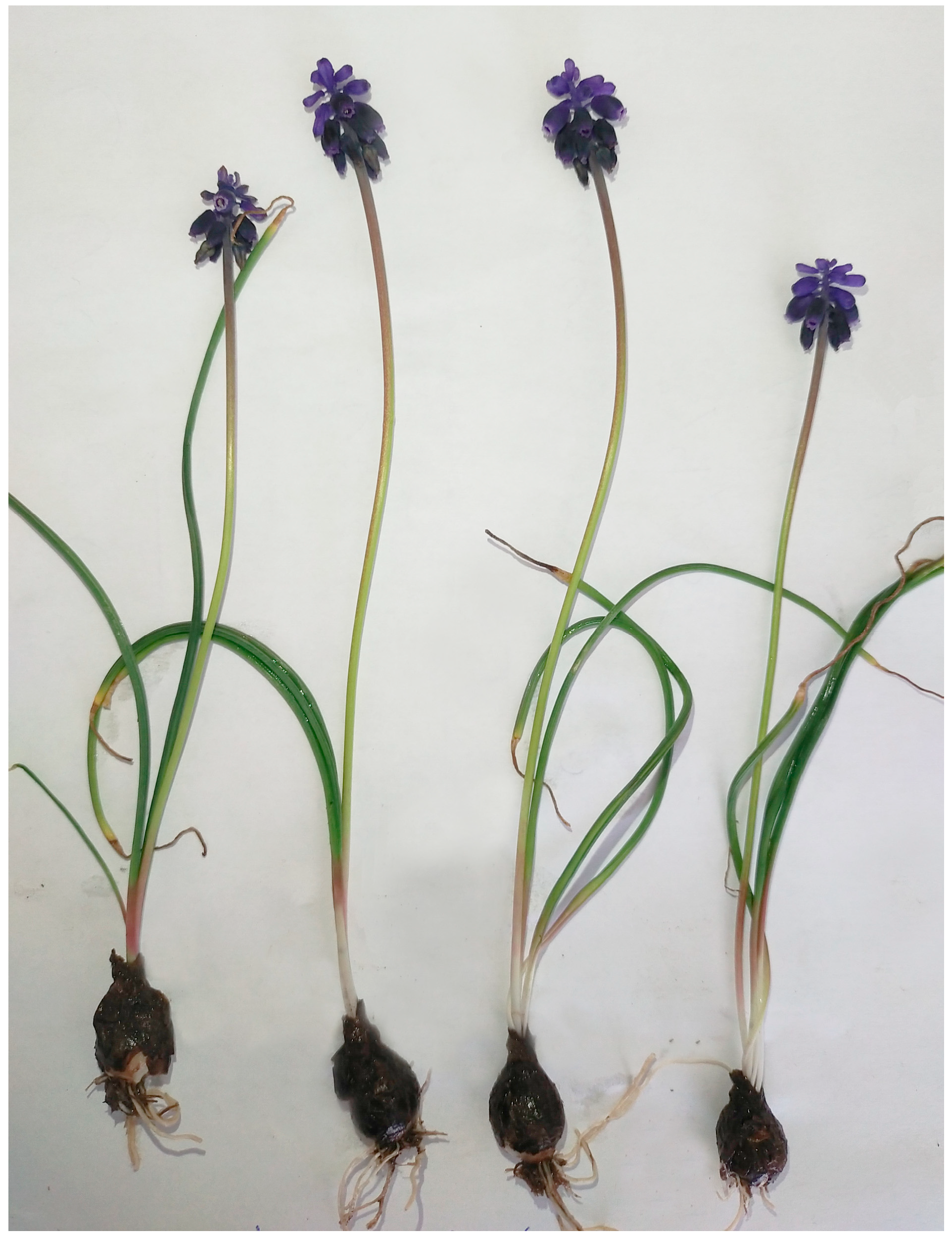
Plants of the genus Muscari have a longstanding history of use in Mediterranean and Balkan traditional medicine, where various species have been employed for their diuretic, anti-inflammatory, and digestive properties [4]. For instance, Muscari neglectum Guss. ex Ten. & Sangiovanni (Figure 1) and related species have been used in Turkish ethnomedicine for centuries to make decoctions that treat kidney diseases, ease gastrointestinal discomfort and aid detoxification [4]. Furthermore, Muscari comosum (L.) Mill. has a long history of use in the Mediterranean region, where its bulbs have been employed in folk medicine as remedies for toothache, as well as for their anti-inflammatory, diuretic, and aphrodisiac properties [5].
Figure 1. Complete specimens of Muscari neglectum.
Although much of the ethnobotanical knowledge regarding Muscari species remains rooted in oral tradition, recent phytochemical studies have confirmed the presence of significant levels of phenolic compounds and flavonoids, supported their historical medicinal uses, and suggested promising antioxidant and anti-inflammatory potential. For instance, Evidence demonstrates the presence of flavonoids and homoisoflavonoids in M. comosum [6]. Similarly, extracts of M. neglectum display significant phenolic and flavonoid contents, which have been associated with antioxidant potential [7].
Despite the phytochemical characterisation available for M. comosum bulbs [6], detailed studies focusing specifically on the bulbs of M. neglectum remain scarce. Most previous research on M. neglectum has analysed flowers, aerial parts, or whole-plant extracts, potentially overlooking tissue-specific metabolite accumulation [8,9]. Bulbs, as storage organs, are known to concentrate distinct classes of secondary metabolites, including flavonoids and saponins, which may not be represented in aerial tissues [6]. Therefore, a targeted characterisation of bulb phytochemistry is essential to fully understand the bioactive potential of this species.
In addition to their antioxidant properties, Muscari species are also reported to exhibit anti-inflammatory effects, which may be mediated through the modulation of reactive nitrogen species and inflammatory enzymes [6]. Nitric oxide (NO) plays a dual role in inflammation, acting both as a signaling molecule and as a mediator of oxidative stress [10], while the enzyme lipoxygenase (LOX) catalyzes the oxidation of polyunsaturated fatty acids to pro-inflammatory lipid mediators [11]. Therefore, evaluating the NO radical scavenging capacity and the inhibition of LOX activity provides valuable insights into the potential anti-inflammatory mechanisms of M. neglectum bulb extracts.
In this context, the present study aims to provide a comprehensive characterisation of the phytochemical composition of M. neglectum bulbs and to evaluate their antioxidant, radical scavenging, and anti-inflammatory activities, thereby filling an important gap in the knowledge of this traditionally used medicinal plant.

2. Results

2.1. Preliminary Extraction Optimization

To optimize the extraction of phenolic compounds from M. neglectum bulbs, preliminary extractions were performed using different ethanol–water ratios (100:0, 80:20, 50:50, 20:80, 0:100, v/v) under the same extraction conditions. The total phenolic content (TPC) of the resulting extracts was determined using the Folin–Ciocalteu assay (Table 1). Absolute ethanol (100:0) yielded the highest TPC (96.3 ± 0.8 mg GAE/g DE). However, the 80:20 ethanol–water mixture was selected for all subsequent experiments, as it provides a substantial fraction of total phenolics (~70% of the 100:0 value) while favouring the extraction of more polar phenolic compounds, which are often biologically relevant. Moreover, hydroalcoholic extracts exhibit better solubility in aqueous assay media and are compatible with HPLC sample preparation, facilitating reproducible quantification and bioactivity testing. Practical considerations (safety, cost, and ease of solvent removal) further support the choice of 80:20 as the optimal extraction solvent. This selected 80:20 extract was subsequently employed for all further analyses, including antioxidant and anti-inflammatory assays, as well as for the comprehensive phytochemical characterization of M. neglectum bulbs using HPLC–ESI-qTOF-MS.
Table 1. Effect of ethanol–water ratio on the total phenolic content of M. neglectum bulb extracts.

2.2. Phytochemical Characterization

The HPLC-ESI-qTOF-MS analysis of M. neglectum bulb extract revealed 72 molecular features after data processing. Most compounds could be tentatively annotated based on accurate mass, molecular formula, MS/MS fragmentation patterns, and database comparison, while a subset remained unidentified (Level 4). The base peak chromatogram (Figure S1) illustrates the chemical complexity of the extract, and Table 2 summarizes the identified and tentatively annotated compounds along with their retention times, proposed structures, and chemical families.
Table 2. Identification of phytochemical compounds in M. neglectum bulbs extract by HPLC-ESI-qTOF-MS.
The annotated compounds belonged to a wide range of phytochemical families, including vitamins (e.g., pantothenic acid), amino acids (asparagine), organic acids (malic acid isomers, 3-hydroxysuberic acid), hydroxycinnamic acids (caffeic acid, dihydroferulic acid), coumarins (fraxin), flavonoids (homoisoflavanones, flavanones, flavonols, highly methoxylated flavones, glycosylated flavonoids), lignans (sesaminol 2-O-triglucoside), iridoid glycosides (torososide B, jasminoside S), fatty acids and oxylipin derivatives (linoleic acid, eicosapentaenoic acid, 9,12,13-trihydroxyoctadec-10-enoic acid), terpenoids (monoterpene derivatives), and triterpenoid saponins (ginsenosides Rh2 and Rh4, officinin A isomers, cucurbitacin P).
Officinin A isomers and ginsenoside Rh4 were annotated as MSI Level 2 compounds (HR-MS/MS matching), while cucurbitacin P and ginsenoside Rh2 were assigned as MSI Level 3 (accurate-mass-based). These metabolites have not been previously reported in Muscari and will be confirmed with authentic standards in future work.
Flavonoids were the most abundant class, including methoxylated and glycosylated derivatives such as dimethylquercetin, luteolin derivatives, hesperetin isomers, kaempferol 3-(2G-apiosylrobinobioside), and highly methoxylated flavones. Homoisoflavanones (muscomin and muscomosin isomers, 3′-hydroxy-3,9-dihydroeucomin) were also prevalent, reflecting the characteristic secondary metabolism of M. neglectum bulbs within the Asparagaceae family. Besides flavonoids, other bioactive metabolites were characterised, including hydroxycinnamic acids (caffeic acid, dihydroferulic acid), organic acids (malic acid isomers, 3-hydroxysuberic acid), coumarins (fraxin), and phenolic ketones (gingerol). Several fatty acids and derivatives, such as linoleic acid, eicosapentaenoic acid, and oxylipins (9,12,13-trihydroxyoctadec-10-enoic acid), were also identified. Iridoid glycosides (e.g., torososide B and jasminoside S) and triterpenoid saponins (e.g., ginsenosides Rh2 and Rh4, officinin A isomers, and cucurbitacin P) were annotated, further highlighting the chemical diversity of the extract.
A total of 18 signals remained unidentified, representing a subset of the detected features and emphasizing the complexity of the phytochemical composition of M. neglectum bulbs. Notably, several oxylipin derivatives were detected here for the first time in M. neglectum bulbs. The chemical diversity observed in the bulb extract prompted further evaluation of its antioxidant and radical scavenging properties, which are described in the following section.

2.3. Evaluation of Antioxidant and Antiradical Activities

TPC and total flavonoid content (TFC) of M. neglectum bulb extract were determined at 65.5 ± 0.3 mg GAE/g DE and 14.3 ± 0.3 mg Epi/g DE, respectively, with TPC approximately 4.5 times higher than TFC, indicating that non-flavonoid phenolics constitute a significant portion of the extract (Table 3). Antioxidant capacity assessed by FRAP and TEAC assays reached 0.26 ± 0.02 mmol Fe2+/g DE and 0.45 ± 0.02 mmol TE/g DE, respectively, reflecting measurable reducing and radical scavenging activity. Radical scavenging assays showed IC50 values of 848 ± 20 mg/L for superoxide anion (·O2) and 9.2 ± 0.9 mg/L for hypochlorous acid (HOCl), while gallic acid and epicatechin, used as positive controls, displayed IC50 values of 50 ± 3 mg/L and 60 ± 1 mg/L for ·O2, and 3.8 ± 0.3 mg/L and 0.18 ± 0.01 mg/L for HOCl, respectively (Table 4). The bulb extract also inhibited xanthine oxidase activity with an IC50 of 20.6 ± 0.4 mg/L, compared with 9 ± 1 mg/L for epicatechin (Table 5). Overall, these results provide a comprehensive quantitative description of the phenolic and flavonoid contents, as well as the antioxidant, antiradical, and enzymatic activities of the M. neglectum bulb extract, measured through multiple complementary assays.
Table 3. Evaluation of total phenolic content, total flavonoid content, and antioxidant capacity.
Table 4. Evaluation of radical scavenging.
Table 5. Evaluation of xanthine oxidase assay.

2.4. Evaluation of Anti-Inflammatory Activity

The anti-inflammatory potential of the M. neglectum bulb extract was evaluated through its ability to scavenge ·NO radicals and to inhibit the enzyme LOX.
As shown in Table 6, the extract exhibited a moderate ·NO scavenging activity, with an IC50 value of 78 ± 3 mg/L, when compared to the reference antioxidants gallic acid (14.2 ± 0.8 mg/L) and epicatechin (8.7 ± 0.2 mg/L). Although the activity of the bulb extract was lower than that of the pure phenolic standards, these results demonstrate a relevant ability to neutralize reactive nitrogen species, suggesting that phenolic and saponin constituents may contribute synergistically to this effect.
Table 6. Evaluation of radical scavenging.
Regarding LOX inhibition (Table 7), the M. neglectum bulb extract showed an IC50 value of 66 ± 2 mg/L, indicating a significant inhibitory effect on the lipoxygenase pathway. In comparison, the positive control nordihydroguaiaretic acid (NDGA) exhibited an IC50 of 3.63 ± 0.02 mg/L. Although the extract’s potency was lower than that of the standard inhibitor, it still indicates a meaningful capacity to modulate enzyme-mediated lipid peroxidation and inflammation.
Table 7. Evaluation of lipoxygenase inhibitor assay.

3. Discussion

Previous phytochemical investigations on M. neglectum have been limited in scope. Early reports described the isolation of homoisoflavanones [15], while other studies analyzed the volatile fractions of bulbs and aerial parts by GC–MS, mainly identifying fatty acids and terpenoid constituents [8]. More recently, LC–MS/MS analyses of ethanolic extracts from whole plants or aerial tissues collected in Turkey reported the presence of a few phenolic acids (such as quinic, caffeic, and chlorogenic acids) and flavonoids (including apigenin, kaempferol, and hesperidin) [16]. However, these approaches yielded only a restricted set of metabolites and did not provide an in-depth characterization of the bulb phytochemistry.
To the best of our knowledge, the present work constitutes the first comprehensive phytochemical characterization focused specifically on the bulbs of M. neglectum using HPLC-ESI-qTOF-MS. A total of 72 compounds were annotated, spanning multiple chemical families such as flavonoids, hydroxycinnamic acids, terpenoids, fatty acids, and triterpenoid saponins, thus considerably expanding the current phytochemical knowledge of this species.
The detection of homoisoflavanones and triterpenoid saponins in M. neglectum bulbs may also represent chemotaxonomic markers within the Asparagaceae family. These flavonoids—such as muscomin, muscomosin, 3′-Hydroxy-3,9-dihydroeucomin and their isomers—have been reported in previous studies of M. comosum [15] and M. neglectum [17], reinforcing the phytochemical distinctiveness of the genus Muscari and highlighting its relevance for comparative metabolomic work. The presence of homoisoflavanones is a shared derived character of the entire tribe to which Muscari belongs (tribe Hyacintheae), distinguishing it from other tribes within the subfamily Scilloideae [18].
When compared with previous studies on M. neglectum, the phenolic and flavonoid contents determined in the present work are considerably higher. For instance, previous studies reported a total phenolic content of approximately 18.2% and a flavonoid content of 0.94% in ethanol extracts of M. neglectum flowers [7]. By contrast, the bulb extract analysed here reached 65.5 mg GAE/g DE and 14.3 mg Epi/g DE, respectively. Such differences may be attributed to multiple factors, including the plant part used, as bulbs act as storage organs where secondary metabolites often accumulate more extensively than in aerial tissues. In addition, variations in extraction solvent, methodological approaches, and environmental or geographical conditions may also influence the phytochemical yield. These findings suggest that the bulb of M. neglectum represents a particularly rich source of phenolics and flavonoids, underscoring the importance of organ-specific analyses in the phytochemical characterisation of this species.
Most phytochemical and bioactivity studies on M. neglectum have focused on flowers, aerial parts, or whole-plant extracts, whereas specific investigations of the bulb remain scarce. This distinction is important, as bulb tissues generally function as storage organs and are therefore expected to accumulate distinct classes of metabolites compared to aerial parts. For instance, extracts from both aerial parts (MAPs) and bulbs (MBs) have been evaluated in rodent models, revealing compositional differences between the two tissues, which were mirrored by variations in their biological effects [8]. In this context, our study provides the first in-depth chemical characterisation of M. neglectum bulbs, offering a more targeted view of the metabolite composition of this organ and complementing existing data obtained from other plant parts.
In contrast to earlier studies that have predominantly assessed the antioxidant activity of M. neglectum extracts using general assays such as DPPH, ABTS, or FRAP, the present work provides more detailed insights by evaluating activity against specific radical species and enzymatic pathways. Other authors, for example, reported that flower extracts exhibited lower DPPH scavenging capacity compared with the synthetic antioxidant BHT [7]. More recently, a study demonstrated that M. neglectum extracts exerted gastroprotective effects in vivo, partly attributed to the presence of phenolic compounds such as caffeic acid, kaempferol, and apigenin [8]. Our findings extend these observations by showing that the bulb extract can scavenge superoxide anion (IC50 = 848 mg/L) and hypochlorous acid (IC50 = 9.2 mg/L), as well as inhibit xanthine oxidase (IC50 = 20.6 mg/L), thereby targeting both free radicals and a key enzyme in oxidative stress pathways. Such activities are likely related to the abundance of flavonoids and hydroxycinnamic acids identified in the extract, suggesting that the bulb represents a distinct and potent source of bioactive antioxidants within the species.
Beyond antioxidant activity, several of the compounds identified—such as flavonoids, hydroxycinnamic acids, and triterpenoid saponins—are known for their anti-inflammatory, gastroprotective, and even neuroprotective properties [19,20,21,22]. This supports the potential pharmacological value of M. neglectum bulbs, aligning with their traditional medicinal uses in Mediterranean ethnomedicine.
The compositional profile of M. neglectum bulbs reported here provides a plausible chemical basis for the antioxidant and antiradical activities observed. Flavonoids—particularly methoxylated and glycosylated derivatives—are well known for their electron-donating and radical-stabilising properties and therefore likely contribute substantially to both the reducing capacity measured by FRAP/TEAC and the scavenging of reactive species such as superoxide and hypochlorous acid [23,24]. Hydroxycinnamic acids (e.g., caffeic and dihydroferulic acids) are additional contributors to radical scavenging owing to their conjugated phenolic structures, while oxylipin derivatives and certain polyunsaturated fatty acids may also modulate reactivity toward oxygen-derived radicals [25]. Correlations between total phenolic/flavonoid content and antioxidant capacity have been documented in Muscari species [7], supporting the proposal that the high TPC/TFC measured in our bulbs underpins at least part of the activity profile. Nonetheless, while these associations are consistent with the literature, definitive attribution of specific activities to individual compounds requires targeted fractionation and bioactivity-guided isolation, as well as quantitative correlation (e.g., Pearson/Spearman analysis) between compound abundance and assay outcomes.
The observed differences among the antioxidant and radical scavenging assays may reflect the distinct reaction mechanisms and selectivity of each method toward different reactive species. The FRAP and TEAC assays, based on single-electron transfer (SET) reactions, evaluate the overall reducing power of the extract. ·O2 and HOCl assays involve radical-specific mechanisms that depend more strongly on the structure, polarity, and substitution pattern of the antioxidant molecules.
Phenolic acids and flavonoids bearing ortho-dihydroxyl or methoxy groups on the aromatic ring are particularly effective against oxygen-centered radicals, while more hydrophobic or glycosylated derivatives may exhibit stronger reactivity toward chlorine-based oxidants such as HOCl [26,27]. These structural features modulate hydrogen-donating ability and electron transfer, explaining the disparity observed among the different radical scavenging assays.
To better understand these relationships, a correlation analysis was performed between TPC, TFC, and the various antioxidant parameters. Strong positive correlations were observed between TPC/TFC and both FRAP (r = 0.91) and TEAC (r = 0.88), indicating that phenolic compounds largely account for the reducing capacity of the extract, consistent with previous reports in medicinal and aromatic plants [28,29]. In contrast, weaker correlations were found between TPC/TFC and radical-specific assays (r = 0.63 for ·O2 and r = 0.58 for HOCl), suggesting that other non-phenolic metabolites such as saponins, fatty acids, or oxylipins may also contribute to the overall antioxidant performance [26,27].
These results highlight the complexity of antioxidant mechanisms and the complementary nature of different in vitro assays when evaluating the biological relevance of plant extracts.
Beyond their antioxidant potential, the M. neglectum bulb extracts also exhibited anti-inflammatory activity, as evidenced by their ability to scavenge ·NO radicals and inhibit LOX. The ·NO radical plays a pivotal role in inflammatory processes by modulating vasodilation and oxidative stress, while LOX catalyzes the oxidation of polyunsaturated fatty acids to generate pro-inflammatory leukotrienes. In the present study, the extract showed moderate ·NO scavenging capacity (IC50 = 78 ± 3 mg/L) and LOX inhibition (IC50 = 66 ± 2 mg/L), confirming its potential to interfere with both reactive nitrogen species and enzymatic inflammatory pathways. These results are consistent with previous reports demonstrating that phenolic acids and flavonoids, particularly those with ortho-dihydroxyl or methoxy substituents, can attenuate inflammation through ·NO suppression and LOX inhibition [11,30]. Moreover, triterpenoid saponins, which were also detected in the extract, are known to exert anti-inflammatory effects by modulating eicosanoid biosynthesis and reducing the activity of lipoxygenase and cyclooxygenase enzymes [31,32]. Together, these findings suggest that the anti-inflammatory effects of M. neglectum bulbs arise from a synergistic interplay between phenolic compounds, flavonoids, and saponins, complementing their antioxidant mechanisms and providing a chemical rationale for the traditional use of this plant in inflammatory disorders.
Collectively, the pharmacological properties of M. neglectum bulbs can be attributed mainly to the combined action of phenolic acids, flavonoids, and triterpenoid saponins. Phenolic acids and flavonoids are primarily responsible for the antioxidant and radical scavenging effects through electron transfer and hydrogen donation mechanisms, whereas triterpenoid saponins contribute to anti-inflammatory activity by modulating eicosanoid biosynthesis and inhibiting LOX-mediated pathways. This synergistic interaction among chemical classes provides a coherent explanation for the observed bioactivities and supports the traditional medicinal uses of M. neglectum.
In this study, we intentionally focused on the untargeted analysis of the complete M. neglectum bulb extract to capture potential synergistic interactions among its compounds, which likely contribute to the observed pharmacological effects. While targeted fractionation could provide detailed information on individual metabolites, our approach prioritizes the bioactivity of the whole extract, which is directly relevant for phytopharmaceutical applications. This strategy allows us to assess the combined effect of all bioactive constituents, reflecting a more holistic view of the extract’s therapeutic potential, and highlights the value of untargeted metabolomics in revealing chemical diversity and functional synergy in plant storage organs. Targeted fractionation may nonetheless represent a valuable future direction, and we note this as a potential avenue for further research.
Importantly, the use of HPLC-ESI-qTOF-MS enabled the detection of minor metabolites, including oxylipins and highly glycosylated saponins, which would likely remain undetected with GC–MS or conventional phytochemical screening methods. This highlights the value of high-resolution untargeted metabolomics for capturing the chemical diversity of storage organs such as bulbs [33].
A subset of the detected molecular features in the M. neglectum bulb extract remained unidentified, highlighting the presence of potentially novel metabolites or structurally modified derivatives. While the current study provided a comprehensive annotation of 72 compounds, quantitative profiling of individual constituents was not performed, limiting the ability to directly link specific metabolites to the observed antioxidant and enzyme-inhibitory activities. Moreover, variations in phytochemical composition may arise from factors such as geographic origin, harvest season, and environmental conditions [34,35,36], which could partly account for differences compared with previous reports on M. neglectum.
These findings underscore the potential of M. neglectum bulbs as a valuable source of bioactive metabolites within the Asparagaceae family. Future studies should employ quantitative targeted analyses of key metabolites, bioactivity-guided fractionation to pinpoint active constituents, and comparative organ-specific investigations across tissues and related Muscari species. In vivo models assessing antioxidant, anti-inflammatory, and gastroprotective effects will also be essential to clarify the contributions of specific compounds, explore novel metabolites within the bulb extract, and translate these findings into pharmacological relevance.

4. Materials and Methods

4.1. Chemicals

All chemicals employed in this study were of analytical reagent grade and utilised as supplied. Acetonitrile and formic acid of LC-MS grade, intended for use in mobile phases, were obtained from Riedel-de-Haën (Honeywell, Charlotte, NC, USA). Ultrapure water for solution preparation was produced using a Milli-Q system (Millipore, Bedford, MA, USA), and absolute ethanol was procured from VWR Chemicals (Radnor, PA, USA).
Acetic acid, sodium carbonate, sodium hydroxide, sodium nitrite, TPTZ (2,4,6-tris(2-pyridyl)-s-triazine and hydrochloric acid were purchased from Fluka (Honeywell, NC, USA). Folin reagent, gallic acid (GA), sodium phosphate monobasic and dibasic, potassium persulfate, ABTS (2,2-azinobis (3-ethylbenzothiazoline-6-sulphonate)), Trolox (6-hydroxy-2,5,7,8-tetramethylchroman-2-carboxylic acid), Tris (tri(hydroxymethyl)aminomethane), sodium acetate, heptahydrate ferrous sulphate, aluminium chloride hexahydrate, ferric chloride, DHR (dihydrorhodamine), potassium dihydrogen phosphate anhydrous, NBT (nitrotetrazolium blue chloride), DAF-2 (diaminofluorescein diacetate) and Cayman’s xanthine oxidase fluorometric assay kit were purchased from Sigma-Aldrich (St. Louis, MO, USA). NOC-5 was purchased from Chemcruz (Santa Cruz Biotechnology, Dallas, TX, USA).

4.2. Extraction Process of Plant Bulbs

Specimens of M. neglectum were collected from a wild population in the northern part of the city of Granada, southern Spain, in October 2024, at an early developmental stage when bulbs were beginning to germinate (as illustrated in Figure S6). The bulbs were subsequently isolated, peeled, and thoroughly washed with distilled water. To accelerate the drying process, the bulbs were then manually fragmented. Air-drying was carried out in a cool, dark, and well-ventilated environment for seven days at a constant temperature of 25 °C. Following desiccation, the dried bulbs were ground using a basic mill A 10 (IKA-Werke GmbH & Co., Staufen, Germany) until a fine, homogeneous powder with a particle size of less than 1 mm was obtained, thereby facilitating subsequent extraction procedures.
The extraction process was performed using a solid–liquid extraction technique. Precisely 2 g of the powdered plant material was weighed into dark glass vials, to which 20 mL of an ethanol–water mixture (80:20, v/v) was added. The vials were then placed in an incubator with orbital shaking, set at 45 °C and 150 rpm, for a period of 2 h to ensure adequate mixing and solvent penetration.
Preliminary extractions were performed using different ethanol–water ratios (100:0, 80:20, 50:50, 20:80, 0:100, v/v) under the same solid–liquid extraction conditions. The TPC of the resulting extracts was determined using the Folin–Ciocalteu assay to assess the efficiency of phenolic compound recovery. Based on these results, the 80:20 ethanol–water mixture was selected for all subsequent experiments, as it preserves a substantial fraction of total phenolics while favouring the extraction of polar phenolic compounds of biological relevance. This extract was then used for all further phytochemical characterization and bioactivity analyses.
The conditions employed for obtaining the extract proved suitable, preserving the integrity of the target compounds. The extraction protocol was based on previously established methodologies, with targeted modifications implemented to optimise its application to this particular plant matrix.

4.3. HPLC-ESI-qTOF-MS Analysis

Chromatographic analysis was conducted in reversed-phase mode using a C18 ACQUITY UPLC BEH column (1.7 µm, 2.1 mm × 150 mm, 130 Å; Waters Corporation, Milford, MA, USA). The column temperature was maintained at 60 °C throughout the analysis. The mobile phases consisted of (A) water acidified with 0.1% formic acid (v/v) and (B) acetonitrile. The optimised mobile phase gradient applied for compound separation was as follows: 0.00 min [A:B 100:0], 5.00 min [A:B 90:10], 18.00 min [A:B 15:85], 24.00 min [A:B 0:100], 25.50 min [A:B 0:100], 26.50 min [A:B 95:5], and 32.50 min [A:B 95:5]. A constant mobile phase flow rate of 0.4 mL/min was employed, with an injection volume of 5 µL.
Mass spectrometric data acquisition was performed in electrospray ionisation (ESI) negative mode over a mass range of 50–1200 m/z. The instrument parameters were set as follows: drying gas flow rate, 10 L/min; drying gas temperature, 200 °C; nebuliser pressure, 20 psig; sheath gas temperature, 350 °C; sheath gas flow rate, 12 L/min; capillary voltage (VCap), 4000 V; and nozzle voltage, 500 V.
Chromatographic and mass spectrometric conditions and parameters were applied in accordance with a previously optimised method. The acquired raw data were initially converted using MSConvertGUI software and subsequently processed in MZmine version 4.3.0. This data processing workflow comprised several sequential steps, including background noise detection, ADAP chromatogram builder, ADAP chromatogram deconvolution, isotope grouping, and alignment. The specific parameters employed during data processing have been detailed in a previous publication [37].
Subsequent prediction of molecular formulae and chemical structures was performed using Sirius version 5.8.1. The information generated by Sirius was compared against various databases, including the Human Metabolome Database (HMDB), MassBank of North America, and CEU Mass Mediator for compound annotation purposes. Identified compounds were classified according to four confidence levels: Level 1 identification was achieved through comparison with commercial standards; Level 2 was based on the comparison of experimental MS/MS spectra with those available in the referenced databases; Level 3 involved molecular formula prediction and MS1 spectrum comparison; and Level 4 comprised features that could not be annotated and were thus considered unknown [38].

4.4. In Vitro Assays

The assays detailed in the following sections were adapted for implementation in a 96-well polystyrene microplate format, enabling the simultaneous processing of multiple replicates and experimental conditions. Absorbance and fluorescence measurements were subsequently performed using a Synergy H1 monochromator-based multimode microplate reader (BioTek Instruments Inc., Winooski, VT, USA). This instrument allows for high-sensitivity detection and flexible wavelength selection, thereby ensuring precise and reliable acquisition of optical density and fluorescence emission data under the specified assay conditions.

4.4.1. Total Phenolic Content, Total Flavonoid Content and Antioxidant Capacity Measurements

The total phenolic content (TPC) in extracts obtained from M. neglectum bulbs was quantified utilising the Folin–Ciocalteu reagent assay, with gallic acid serving as the calibration standard [39]. Results are reported as milligrams of gallic acid equivalents per gram of dry extract (mg GAE/g DE). Each determination was performed in triplicate to guarantee precision and reproducibility. The determination of Total Flavonoid Content (TFC) was conducted following a previously described protocol with minor modifications [40]. Epicatechin was employed as the reference standard, and absorbance readings were recorded at 510 nm. The results were expressed as milligrams of epicatechin equivalents per gram of dry extract (mg EE/g DE).
The antioxidant potential of these bulb extracts was evaluated through two complementary assays: ferric reducing antioxidant power (FRAP) and trolox equivalent antioxidant capacity (TEAC). The FRAP assay followed the protocol established by [41], expressing antioxidant capacity as millimoles of ferrous sulphate equivalents per gram of dry extract (mmol FeSO4/g DE). The TEAC assay, which measures the ability to quench the ABTS radical cation, was conducted as described by [42], with outcomes expressed in micromoles of Trolox equivalents per gram of dry extract (μmol Trolox/g DE).

4.4.2. Evaluation of Free Radical and ROS Scavenging Potential

The inhibitory capacity of M. neglectum bulb extract against reactive species, including ·O2, HOCl and ·NO, was investigated. The assays were conducted following previously established protocols, with minor adaptations [13]. The superoxide radical scavenging activity was evaluated colorimetrically by monitoring the reduction in nitroblue tetrazolium (NBT) to diformazan purple. Inhibition of HOCl was assessed by measuring the oxidation of dihydrorhodamine (DHR) to rhodamine. Nitric-oxide anions were generated by the presence of NOC-5, and 4,5-diaminofluorescein (DAF-2) was used as the fluorescent probe applied. Epicatechin (EPI) and gallic acid (GA) served as positive controls for the inhibition of ·O2, HOCl and ·NO radicals. Results were expressed as IC50 values, calculated from concentration-response curves of the M. neglectum bulb extract, with all experiments performed in triplicate to ensure reproducibility.

4.4.3. Xanthine Oxidase Assay

The inhibitory effect of the M. neglectum bulb extract on xanthine oxidase (XO) activity was assessed using the Cayman Xanthine Oxidase Fluorometric Assay Kit (Cayman Chemical, Ann Arbor, MI, USA). Briefly, 50 μL of the test extract at various concentrations (10–500 μg/mL) was mixed with 50 μL of XO enzyme solution in a 96-well microplate. The reaction was initiated by adding 50 μL of the xanthine substrate and incubating at 25 °C for 30 min. Fluorescence intensity, corresponding to uric acid formation, was measured at excitation/emission wavelengths of 535/587 nm using a Synergy H1 multimode microplate reader (BioTek Instruments Inc., Winooski, VT, USA). Inhibition (%) was calculated using the formula:
I n h i b i t i o n %   =   A c o n t r o l     A s a m p l e A c o n t r o l   ×   100  
where Acontrol is the fluorescence of the enzyme without inhibitor and Asample is the fluorescence in the presence of the extract. Epicatechin (EPI) was used as the positive control to validate the assay.
Standard xanthine oxidase inhibitors such as allopurinol were not included in this study because the primary objective was to evaluate the inhibitory potential of novel natural extracts. Future studies will include well-characterized inhibitors to allow direct comparison and better contextualization of biological significance.

4.4.4. Evaluation of Lipoxygenase Inhibitor Assay

The LOX inhibitory activity of the M. neglectum bulb extract was evaluated using the LOX Inhibitor Screening Assay Kit (Cayman Chemical, Ann Arbor, MI, USA), following the manufacturer’s instructions.
The assay is based on the spectrophotometric detection of hydroperoxides formed during the LOX-catalyzed oxidation of arachidonic acid, which serves as the enzyme substrate. Briefly, the reaction mixture contained 10 µL of sample solution (dissolved in assay buffer), 90 µL of lipoxygenase enzyme solution, and 100 µL of arachidonic acid substrate solution. The formation of the hydroperoxide product was monitored by measuring absorbance at 490 nm using a microplate reader (BioTek Synergy HTX, Winooski, VT, USA). The M. neglectum bulb extract was tested at concentrations ranging from 10 to 200 mg/L to obtain the inhibition curve. NDGA, a well-known lipoxygenase inhibitor, was used as a positive control, while the assay buffer served as a negative control.
The percentage of inhibition was calculated according to the equation:
I n h i b i t i o n %   =   1     A s a m p l e     A b l a n k A c o n t r o l     A b l a n k   ×   100  
where Asample represents the absorbance of the sample reaction, Acontrol represents the absorbance of the control reaction without inhibitor, and Ablank represents the background absorbance. The concentration of extract required to inhibit 50% of enzyme activity (IC50) was determined by non-linear regression

4.4.5. Statistical Analysis

All experiments were carried out in triplicate (n = 3), and results are expressed as mean ± standard deviation (SD). The correlation between total phenolic content (TPC), total flavonoid content (TFC), and antioxidant activities was analyzed using Pearson’s correlation coefficient (r). Statistical significance was set at p < 0.05. All analyses were performed using GraphPad Prism 9.0 (GraphPad Software Inc., San Diego, CA, USA).

5. Conclusions

This study offers the first thorough phytochemical characterisation of M. neglectum bulbs using HPLC-ESI-qTOF-MS. A total of 72 compounds were identified, including fatty acids, iridoid glycosides, triterpenoid saponins, hydroxycinnamic acids, and flavonoids. Notably, several homoisoflavanones such as muscomin and muscomosin isomers, together with related derivatives, were detected; these metabolites are considered characteristic of the Muscari genus and reinforce its chemotaxonomic distinctiveness within the Asparagaceae family, subfamily Scilloideae. Due in large part to the abundance of flavonoids and hydroxycinnamic acids, the bulb extract demonstrated significant antioxidant and radical scavenging activities, including superoxide and hypochlorous acid scavenging, as well as xanthine oxidase inhibition. The significance of organ-specific analyses was highlighted by the bulbs′ higher total phenolic and flavonoid contents when compared to earlier research on flowers or aerial tissues. A subset of molecular features remained unidentified, indicating the presence of potentially novel metabolites that warrant further investigation. In addition, the extract exhibited measurable anti-inflammatory activity, as evidenced by its ability to scavenge nitric oxide radicals and inhibit lipoxygenase activity. These findings suggest that both phenolic compounds and triterpenoid saponins contribute to the modulation of oxidative and enzymatic inflammatory pathways, providing a biochemical basis for the traditional use of Muscari species in the treatment of inflammatory disorders. Overall, these findings establish M. neglectum bulbs as a rich reservoir of bioactive compounds and underscore their potential relevance for future pharmacological and functional studies within the Asparagaceae family.

Supplementary Materials

The following supporting information can be downloaded at: https://www.mdpi.com/article/10.3390/molecules30224351/s1, Figure S1: Base peak chromatogram from the Muscari neglectum bulb extract. Figure S2: Mass fragmentation spectrum of Dimethylquercetin (m/z: 329.0645). A: collision energies: 10 eV. B: collision energies: 20 eV. C: collision energies: 40 eV. Figure S3: Mass fragmentation spectrum of Muscomin isomer 1 (m/z: 345.0983). A: collision energies: 10 eV. B: collision energies: 20 eV. C: collision energies: 40 eV. Figure S4: Mass fragmentation spectrum of Muscomosin isomer 1 (m/z: 313.0722). A: collision energies: 10 eV. B: collision energies: 20 eV. C: collision energies: 40 eV. Figure S5: Mass fragmentation spectrum of Ginsenoside Rh4 isomer 1 (m/z: 619.4217). A: collision energies: 10 eV. B: collision energies: 20 eV. C: collision energies: 40 eV.Figure S6: Developmental stage of Muscari neglectum bulbs at the time of collection.

Author Contributions

Conceptualization, M.d.C.V.-A. and V.N.S.-S.; methodology, M.d.C.V.-A. and V.N.S.-S.; software, M.d.C.V.-A. and V.N.S.-S.; validation, M.d.C.V.-A. and V.N.S.-S.; formal analysis, M.d.C.V.-A. and V.N.S.-S.; investigation, M.d.C.V.-A.; resources, A.S.-C. and V.N.S.-S.; data curation, M.d.C.V.-A. and V.N.S.-S.; writing—original draft preparation, M.d.C.V.-A.; writing—review and editing, V.N.S.-S.; visualization, M.d.C.V.-A. and V.N.S.-S.; supervision, V.N.S.-S.; project administration, A.S.-C. and V.N.S.-S.; funding acquisition, A.S.-C. and V.N.S.-S. All authors have read and agreed to the published version of the manuscript.

Funding

This research received no external funding.

Institutional Review Board Statement

Not applicable.

Data Availability Statement

The data presented in this study are available on request from the corresponding author.

Acknowledgments

The authors gratefully acknowledge the support of the P17 Programme—Scientific Instrumentation Centre, within the Research Support Plan of the University of Granada, for providing access to the equipment required for this study.

Conflicts of Interest

The authors declare no conflicts of interest.

References

  1. The Angiosperm Phylogeny Group; Chase, M.W.; Christenhusz, M.J.M.; Fay, M.F.; Byng, J.W.; Judd, W.S.; Soltis, D.E.; Mabberley, D.J.; Sennikov, A.N.; Soltis, P.S.; et al. An Update of the Angiosperm Phylogeny Group Classification for the Orders and Families of Flowering Plants: APG IV. Bot. J. Linn. Soc. 2016, 181, 1–20. [Google Scholar] [CrossRef]
  2. Böhnert, T.; Neumann, M.; Quandt, D.; Weigend, M. Phylogeny based generic reclassification of Muscari sensu lato (Asparagaceae) using plastid and genomic DNA. Taxon 2023, 72, 261–277. [Google Scholar] [CrossRef]
  3. Bokov, D.O. Muscari armeniacum Leichtlin (grape hyacinth): Phytochemistry and biological activities review. Asian J. Pharm. Clin. Res. 2019, 12, 68–72. [Google Scholar] [CrossRef]
  4. Alkhamaiseh, S.I. A traditional Jordanian medicinal plant with promising antioxidant and cytotoxic effects: Muscari neglectum. Int. J. Complement. Alt. Med. 2024, 17, 107–110. [Google Scholar] [CrossRef]
  5. Giglio, F.; Castiglione Morelli, M.A.; Matera, I.; Sinisgalli, C.; Rossano, R.; Ostuni, A. Muscari comosum L. Bulb Extracts Modulate Oxidative Stress and Redox Signaling in HepG2 Cells. Molecules 2021, 26, 416. [Google Scholar] [CrossRef]
  6. Jaiswal, V.; Lee, H.-J. The Bioactivity and Phytochemicals of Muscari comosum (Leopoldia comosa), a Plant of Multiple Pharmacological Activities. Int. J. Mol. Sci. 2024, 25, 2592. [Google Scholar] [CrossRef]
  7. Mahboubi, M.; Taghizadeh, M. The antimicrobial and antioxidant activity of Muscari neglectum flower ethanol extract. Herba Pol. 2016, 62, 39–48. [Google Scholar] [CrossRef]
  8. Eroglu, A.; Dogan, A. Investigation of the phytochemical composition and remedial effects of southern grape hyacinth (Muscari neglectum Guss. ex Ten.) plant extract against carbon tetrachloride-induced oxidative stress in rats. Drug Chem. Toxicol. 2022, 46, 491–502. [Google Scholar] [CrossRef]
  9. Nasrabadi, M.; Halimi, M.; Nadaf, M. Phytochemical Screening and Chemical Composition of Extract of Muscari neglectum. Middle-East J. Sci. Res. 2013, 14, 566–569. [Google Scholar]
  10. Sharma, J.N.; Al-Omran, A.; Parvathy, S.S. Role of nitric oxide in inflammatory diseases. Inflammopharmacology 2007, 15, 252–259. [Google Scholar] [CrossRef]
  11. Christie, W.W.; Harwood, J.L. Oxidation of polyunsaturated fatty acids to produce lipid mediators. Essays Biochem. 2020, 64, 401–421. [Google Scholar] [CrossRef]
  12. Villegas-Aguilar, M.d.C.; Sánchez-Marzo, N.; Fernández-Ochoa, Á.; Del Río, C.; Montaner, J.; Micol, V.; Herranz-López, M.; Barrajón-Catalán, E.; Arráez-Román, D.; Cádiz-Gurrea, M.d.l.L.; et al. Evaluation of Bioactive Effects of Five Plant Extracts with Different Phenolic Compositions against Different Therapeutic Targets. Antioxidants 2024, 13, 217. [Google Scholar] [CrossRef]
  13. Sterneder, S.; Seitz, J.; Kiefl, J.; Rottmann, E.; Liebig, M.; Blings, M.; Seilwind, S.; Zhou, Y.; Wei, J.; Guan, H.; et al. Identification of 4′-Demethyl-3,9-dihydroeucomin as a Bitter-Masking Compound from the Resin of Daemonorops draco. J. Agric. Food Chem. 2024, 72, 20991–20999. [Google Scholar] [CrossRef]
  14. Heo, M.; Lee, B.; Sishtla, K.; Fei, X.; Lee, S.; Park, S.; Yuan, Y.; Lee, S.; Kwon, S.; Lee, J.; et al. Enantioselective Synthesis of Homoisoflavanones by Asymmetric Transfer Hydrogenation and Their Biological Evaluation for Antiangiogenic Activity. J. Org. Chem. 2019, 84, 9995–10011. [Google Scholar] [CrossRef]
  15. Barone, G.; Corsaro, M.M.; Lanzetta, R.; Parrilli, M. Homoisoflavanones from Muscari neglectum. Phytochemistry 1988, 27, 921–923. [Google Scholar] [CrossRef]
  16. Mahomoodally, M.F.; Zengin, G.; Sinan, K.I.; Yıldıztugay, E.; Lobine, D.; Ouelbani, R.; Bensari, S.; Ak, G.; Yılmaz, M.A.; Gallo, M.; et al. A comprehensive evaluation of the chemical profiles and biological properties of six geophytes from Turkey: Sources of bioactive compounds for novel nutraceuticals. Food Res. Int. 2021, 140, 110068. [Google Scholar] [CrossRef]
  17. Adinolfi, M.; Barone, G.; Belardini, M.; Lanzetta, R.; Laonigro, G.; Parrilli, M. Homoisoflavanones from Muscari comosum bulbs. Phytochemistry 1985, 24, 2423–2426. [Google Scholar] [CrossRef]
  18. Mulholland, D.A.; Schwikkard, S.L.; Crouch, N.R. The chemistry and biological activity of the Hyacinthaceae. Nat. Prod. Rep. 2013, 30, 1165–1210. [Google Scholar] [CrossRef]
  19. Zhou, Y.; Ren, Y.; Li, X.; Cai, M.; Li, H.; Ding, W.; Wu, Y.; Guo, H.; Tang, Z.; Sun, F.; et al. MS/MS molecular networking-guided in-depth profiling of triterpenoid saponins from the fruit of Eleutherococcus senticosus and their neuroprotectivity evaluation. Phytochem. Anal. 2022, 34, 209–224. [Google Scholar] [CrossRef]
  20. Spagnuolo, C.; Moccia, S.; Russo, G.L. Anti-inflammatory effects of flavonoids in neurodegenerative disorders. Eur. J. Med. Chem. 2018, 153, 105–115. [Google Scholar] [CrossRef]
  21. Li, D.; Liu, D.; Lv, M.; Gao, P.; Liu, X. Isolation of triterpenoid saponins from Medicago sativa L. with neuroprotective activities. Bioorg. Med. Chem. Lett. 2020, 30, 126956. [Google Scholar] [CrossRef]
  22. Boudebbaz, K.; Brouk, M.; Laalem, R.; Zabaiou, N. Gastroprotective properties of flavonoid-rich extract of Pulicaria odora against ethanol-induced gastric ulcer in mice. Heliyon 2025, 11, e41625. [Google Scholar] [CrossRef]
  23. Gulcin, I. Antioxidants: A comprehensive review. Arch. Toxicol. 2025, 99, 1893–1997. [Google Scholar] [CrossRef] [PubMed]
  24. Parcheta, M.; Świsłocka, R.; Orzechowska, S.; Akimowicz, M.; Choińska, R.; Lewandowski, W. Recent Developments in Effective Antioxidants: The Structure and Antioxidant Properties. Materials 2021, 14, 1984. [Google Scholar] [CrossRef]
  25. Mathew, S.; Abraham, T.E.; Zakaria, Z.A. Reactivity of phenolic compounds towards free radicals under in vitro conditions. J. Food Sci. Technol. 2015, 52, 5790–5798. [Google Scholar] [CrossRef] [PubMed]
  26. Cao, G.; Sofic, E.; Prior, R.L. Antioxidant and Prooxidant Behavior of Flavonoids: Structure-Activity Relationships. Free Radic. Biol. Med. 1997, 22, 749–760. [Google Scholar] [CrossRef] [PubMed]
  27. Krych-Madej, J.; Stawowska, K.; Gebicka, L. Oxidation of flavonoids by hypochlorous acid: Reaction kinetics and antioxidant activity studies. Free. Radic. Res. 2016, 50, 898–908. [Google Scholar] [CrossRef]
  28. Meng, X.; Tang, G.-Y.; Liu, P.-H.; Zhao, C.-J.; Liu, Q.; Li, H.-B. Antioxidant activity and hepatoprotective effect of 10 medicinal herbs on CCl4-induced liver injury in mice. World J. Gastroenterol. 2020, 26, 5629–5645. [Google Scholar] [CrossRef]
  29. Kiss, A.; Papp, V.A.; Pál, A.; Prokisch, J.; Mirani, S.; Toth, B.E.; Alshaal, T. Comparative Study on Antioxidant Capacity of Diverse Food Matrices: Applicability, Suitability and Inter-Correlation of Multiple Assays to Assess Polyphenol and Antioxidant Status. Antioxidants 2025, 14, 317. [Google Scholar] [CrossRef]
  30. Jomova, K.; Alomar, S.Y.; Valko, R.; Liska, J.; Nepovimova, E.; Kuca, K.; Valko, M. Flavonoids and their role in oxidative stress, inflammation, and human diseases. Chem.-Biol. Interact. 2025, 413, 111489. [Google Scholar] [CrossRef]
  31. Wijesekara, T.; Luo, J.; Xu, B. Critical review on anti-inflammation effects of saponins and their molecular mechanisms. Phytother. Res. 2024, 38, 2007–2022. [Google Scholar] [CrossRef]
  32. Bildziukevich, U.; Wimmerová, M.; Wimmer, Z. Saponins of Selected Triterpenoids as Potential Therapeutic Agents: A Review. Pharmaceuticals 2023, 16, 386. [Google Scholar] [CrossRef] [PubMed]
  33. Zhou, L.; Xu, J.-D.; Zhou, S.-S.; Mao, Q.; Kong, M.; Shen, H.; Li, X.-Y.; Duan, S.-M.; Xu, J.; Li, S.-L. Integrating targeted glycomics and untargeted metabolomics to investigate the processing chemistry of herbal medicines, a case study on Rehmanniae Radix. J. Chromatogr. A 2016, 1472, 74–87. [Google Scholar] [CrossRef] [PubMed]
  34. Mwamatope, B.; Tembo, D.; Kampira, E.; Maliwichi-Nyirenda, C.; Ndolo, V. Seasonal Variation of Phytochemicals in Four Selected Medicinal Plants. Pharmacogn. Res. 2021, 13, 218–226. [Google Scholar] [CrossRef]
  35. Giupponi, L.; Leoni, V.; Pavlovic, R.; Giorgi, A. Influence of Altitude on Phytochemical Composition of Hemp Inflorescence: A Metabolomic Approach. Molecules 2020, 25, 1381. [Google Scholar] [CrossRef]
  36. Rawat, P.; Dasila, K.; Singh, M.; Kuniyal, J.C. Influence of environmental factors on phytochemical compositions and antioxidant activity of Juniperus communis L. Discov. Environ. 2025, 3, 11. [Google Scholar] [CrossRef]
  37. García-Villegas, A.; Rojas-García, A.; Villegas-Aguilar, M.d.C.; Fernández-Moreno, P.; Fernández-Ochoa, Á.; Cádiz-Gurrea, M.d.l.L.; Arráez-Román, D.; Segura-Carretero, A. Cosmeceutical Potential of Major Tropical and Subtropical Fruit By-Products for a Sustainable Revalorization. Antioxidants 2022, 11, 203. [Google Scholar] [CrossRef]
  38. Sumner, L.W.; Amberg, A.; Barrett, D.; Beale, M.H.; Beger, R.; Daykin, C.A.; Fan, T.W.-M.; Fiehn, O.; Goodacre, R.; Griffin, J.L.; et al. Proposed minimum reporting standards for chemical analysis. Chemical Analysis Working Group (CAWG) Metabolomics Standards Initiative (MSI). Metabolomics 2007, 3, 211–221. [Google Scholar] [CrossRef]
  39. Blainski, A.; Lopes, G.C.; De Mello, J.C.P. Application and Analysis of the Folin Ciocalteu Method for the Determination of the Total Phenolic Content from Limonium brasiliense L. Molecules 2013, 18, 6852–6865. [Google Scholar] [CrossRef]
  40. Shraim, A.M.; Ahmed, T.A.; Rahman, M.; Hijji, Y.M. Determination of total flavonoid content by aluminum chloride assay: A critical evaluation. LWT 2021, 150, 111932. [Google Scholar] [CrossRef]
  41. Benzie, I.F.F.; Strain, J.J. The ferric reducing ability of plasma (FRAP) as a measure of “antioxidant power”: The FRAP assay. Anal. Biochem. 1996, 239, 70–76. [Google Scholar] [CrossRef] [PubMed]
  42. Zulueta, A.; Esteve, M.J.; Frígola, A. ORAC and TEAC assays comparison to measure the antioxidant capacity of food products. Food Chem. 2009, 114, 310–316. [Google Scholar] [CrossRef]
Disclaimer/Publisher’s Note: The statements, opinions and data contained in all publications are solely those of the individual author(s) and contributor(s) and not of MDPI and/or the editor(s). MDPI and/or the editor(s) disclaim responsibility for any injury to people or property resulting from any ideas, methods, instructions or products referred to in the content.

Article Metrics

Citations

Article Access Statistics

Multiple requests from the same IP address are counted as one view.