Article

Liquid Phase Catalytic Transfer Hydrogenation of Crotonaldehyde over ReOx-Supported Catalysts Using Formic Acid as In Situ Hydrogen Donor

by
Carlos Esteban Aristizábal-Alzate
1,
Verónica Naharro-Ovejero
2,
Manuel Romero-Sáez
1,* and
Ana Belén Dongil
2,*
1
Grupo Química Básica, Aplicada y Ambiente-Alquimia, Facultad de Ciencias Exactas y Aplicadas, Instituto Tecnológico Metropolitano (ITM), Medellín 050034, Colombia
2
Grupo de Química Verde y Catálisis, Instituto de Catálisis y Petroleoquímica, Consejo Superior de Investigaciones Científicas (CSIC), Cantoblanco, 28049 Madrid, Spain
*
Authors to whom correspondence should be addressed.
Molecules 2025, 30(21), 4307; https://doi.org/10.3390/molecules30214307
Submission received: 1 October 2025 / Revised: 30 October 2025 / Accepted: 3 November 2025 / Published: 5 November 2025

Abstract

The selective hydrogenation of the C=O bond over the C=C bond in α,β-unsaturated aldehydes remains a well-known challenge. This work investigates the liquid-phase catalytic transfer hydrogenation of crotonaldehyde to crotyl alcohol over ReOx-based catalysts, using formic acid (FA) as an in situ hydrogen donor. A series of 10 wt% Re catalysts supported on G200, g-C3N4, TiO2, and ZrO2 were synthesized and tested in a batch reactor at 20 bar and temperatures of 140–180 °C. Catalysts were characterized by XRD, BET, NH3-TPD, and XPS to correlate their physicochemical properties with catalytic behavior. Among the studied materials, ReOx/ZrO2 and ReOx/g-C3N4 exhibited the highest crotyl alcohol selectivity above 57% for all reaction temperatures, evaluated at crotonaldehyde conversion of 25%. The nature of the support strongly influenced the dispersion and oxidation state of Re species, as well as the surface acidity, which governed the activation of both the carbonyl group and the FA decomposition. Compared with molecular hydrogen, FA improved both conversion and selectivity due to its superior hydrogen-donating ability in the aqueous phase. These findings demonstrate that tailoring the acid–base characteristics of ReOx catalysts and employing biomass-derived hydrogen donors represent an effective strategy for selective hydrogenation of α,β-unsaturated aldehydes.

1. Introduction

The hydrogenation of unsaturated aldehydes, such as crotonaldehyde, into unsaturated alcohols using heterogeneous catalysts has attracted great interest because these compounds serve as key intermediates in the industrial synthesis of fragrances, flavoring agents, and pharmaceutical products [1,2]. Among these chemoselective hydrogenation processes, the reduction in α,β-unsaturated aldehydes to allyl alcohols stands out as particularly challenging. The formation of saturated aldehyde is both thermodynamically and kinetically favored over the hydrogenation to the unsaturated alcohol due to the higher susceptibility of the C=C bond to hydrogenation (578.8 kJ mol−1) compared to the C=O bond (705.8 kJ mol−1) [3,4]. Therefore, heterogeneous catalysts that are selective towards the C=O bond in crotonaldehyde must be employed to improve the selectivity of allyl alcohol. In the present research, crotonaldehyde is selected as the substrate molecule to study its liquid phase hydrogenation over oxidized rhenium species (ReOx) supported catalysts. Rhenium has been selected because it exhibits remarkable versatility, as it can assume various roles depending on its oxidation state and the nature of the support, such as an active phase, promoter, or electronic modifier [5,6,7]. The predominant effects attributed to ReOx as promoters in catalysts are based on their acidity and affinity for oxygen, which facilitate the operation of bifunctional reaction mechanisms and additional interactions with functional groups of adsorbed substrate molecules [7]. Therefore, it is expected that Re oxides are well-suited for enhancing selectivity towards crotyl alcohol.
Previous studies have evaluated the liquid-phase reaction of crotonaldehyde using noble metals more expensive than rhenium, such as Rh, Pt, or Ir, achieving selectivity to crotyl alcohol of 80–90% [8,9]. Tamura et al. [6]. evaluated Ir–ReOx catalysts supported on SiO2, TiO2, and ZrO2 for crotonaldehyde hydrogenation under mild conditions (3.0 mmol of crotonaldehyde, 3.0 g of H2O, 50 mg catalyst with Re/Ir = 1, 30 °C, 1 h, 8 bar H2). The catalytic results revealed that the support influenced selectivity and conversion. Thus, with SiO2, the reaction achieved 43.3% conversion and 95% selectivity toward crotyl alcohol, while TiO2 provided the same conversion (43.2%) but a lower selectivity (85.3%), and ZrO2 yielded 38.7% conversion and an intermediate selectivity (89.6%). These findings show that the support nature modulates the Re–Ir interface and, consequently, the hydrogenation pathway. On the other hand, the study mentions a pretreatment of the catalysts within the batch reactor at 200 °C and H2 at 80 bar per hour, and they utilized Ir, which, as previously mentioned, is more expensive than Re. In addition, carbon-supported noble-metal catalysts (Pt/C, Ru/C, Rh/C, Pd/C) and M-ReOx/SiO2 (where M = Pt, Ru, Rh, Pd; Re/M = 0.5) were applied to the reaction at a high H2 pressure of 8 MPa, resulting in low selectivity to crotyl alcohol of less than 10% and 35%, respectively [5].
The production of molecular hydrogen is highly energy-consuming, and it results in significant carbon dioxide emissions into the atmosphere [10,11]. This issue has prompted the use of alternative hydrogen sources. Moreover, hydrogen donors can increase the selectivity towards unsaturated alcohol, and in situ liberated hydrogen is more reactive than ex situ H2 sources [12]. Therefore, it is highly desirable to develop new strategies that can reduce the reliance on externally generated hydrogen for these processes [13,14,15]. For instance, Ye et al. [10]. reported that the hydrogenation of furfural to furfuryl alcohol using H2 achieves a selectivity of 4.7%, whereas using an in situ hydrogen donor, such as isopropanol, resulted in a selectivity of 89.6%. Nevertheless, the use of alcohol leads to an undesirable side effect: the formation of acetals and hemiacetals [16]. In gas-phase furfural hydrogenation, both furfural conversion and furfuryl alcohol selectivity are significantly higher when formic acid (FA) is used as the hydrogen donor instead of 2-propanol [12,17,18,19]. On the other hand, Du et al. [20]. reported 100% furfural conversion and 98.1% furfuryl alcohol selectivity in the liquid phase using FA as a hydrogen donor.
Despite the limited research on the hydrogenation of crotonaldehyde using FA as a hydrogen donor in aqueous phase, it has been demonstrated that the gas-phase process and the use of a rhenium-supported catalyst achieve medium-high conversion (35–95%) and selectivity toward unsaturated alcohol between 60 and 80% at 140 and 180 °C [21]. We selected FA as an in situ hydrogen donor since it is a biomass-derived product. Additionally, the reduction of the carbonyl group by using this organic acid facilitates the operability, reduces the cost of the process, and addresses safety concerns about handling high-pressure hydrogen gas [12,20,22]. For these reasons, this study analyzes the impact of FA as a hydrogen donor on crotonaldehyde hydrogenation in the liquid phase.

2. Results and Discussion

2.1. Catalysts Characterization

Table 1 displays the BET area for supports and catalysts, and the crystal size for ReOx synthesized catalysts.
Two distinct trends were observed in the BET surface area after Re impregnation and thermal treatment. For metal oxide supports (TiO2 and ZrO2), the surface area remained nearly unchanged, indicating that ReOx species were well dispersed without significant pore blockage or structural collapse. This behavior is consistent with the results reported by Bassi et al. [23], who observed that the high thermal stability of these supports preserves their textural properties after Re loading. Conversely, carbon-based supports (G200 and g-C3N4) exhibited a marked loss in surface area after impregnation and thermal treatment, more pronounced for g-C3N4, probably due to partial pore blockage [24,25].
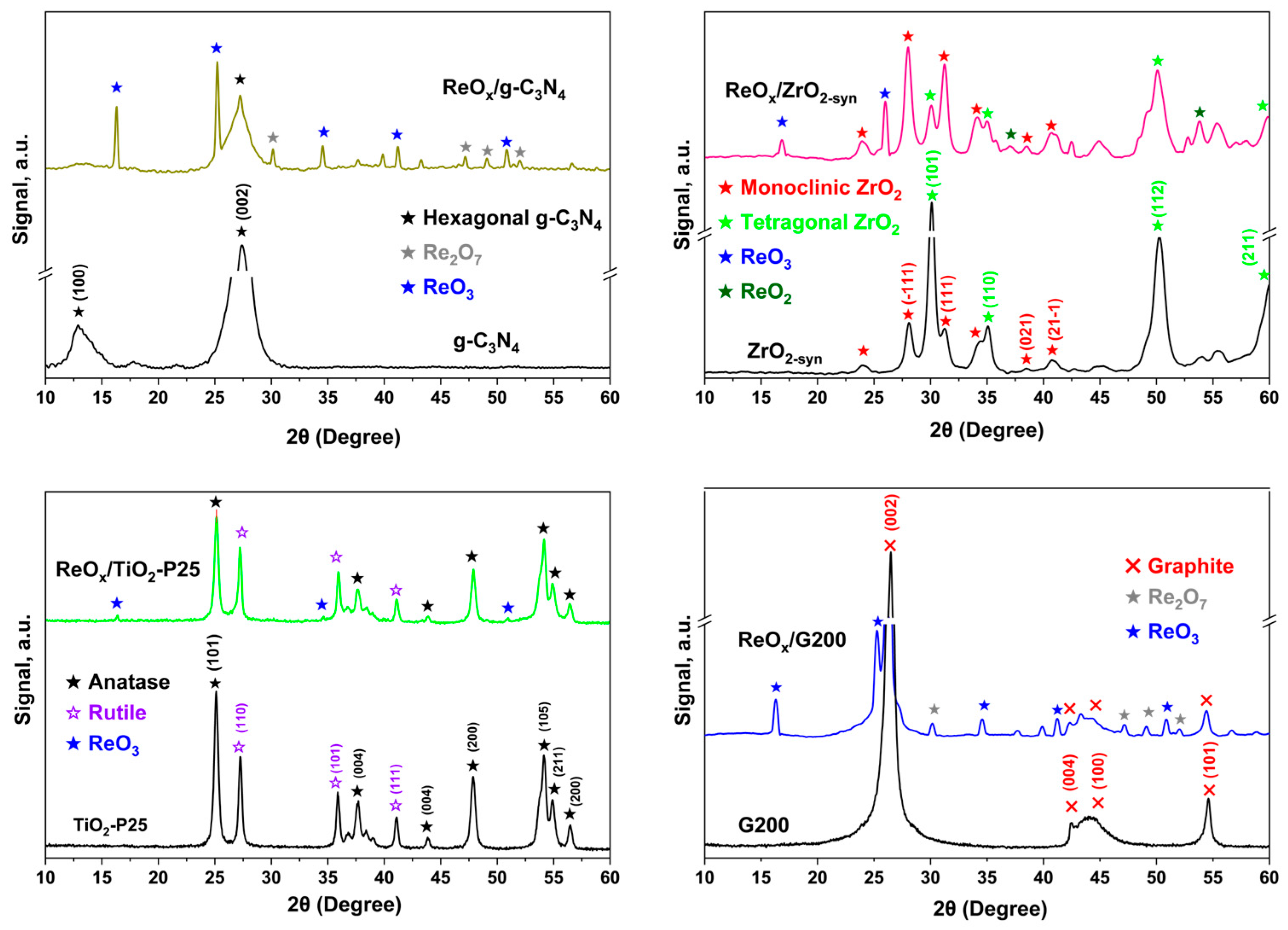
Figure 1 shows the XRD for each ReOx catalyst and its respective support. The pattern of g-C3N4 displayed a diffraction peak at 27.3°, ascribed to the hexagonal phase of g-C3N4, associated with the stacking of the conjugated aromatic system, identified as the (002) peak for graphitic materials and aligning with the interlayer d-spacing (0.336 nm) of g-C3N4, confirming the formation of g-C3N4. A weaker diffraction peak at 13.04° is indexed as (100) and corresponds to the tri-s-triazine units in the same plane [26,27]. The pattern obtained for ZrO2 includes diffractions at 24.07°, 28.06° (111), 31.2° (111), 34.1°, 38.4° (021), and 40.7° (211) for the monoclinic phase [28,29,30]. The ZrO2 tetragonal phase is also identified with peaks at 30.1° (101), 35.0° (110), 50.3° (112), and 59.8° (211). For TiO2-P25, XRD peaks at 25.1°, 37.7°, 43.8°, 47.8°, 54.1°, 54.9°, and 56.4° match with (101), (004), (004), (200), (105), (211), and (200) diffraction planes of anatase, respectively [31,32]. On the other hand, those located at 27.2°, 35.8°, and 41.06° are assigned to (110), (101), and (111) rutile diffraction planes. G200 support presents main diffractions at 2θ = 26.4°, 42.6°, 44.4°, and 54.6°, corresponding to the (002), (004), (100), and (101) planes of graphite [33,34].
Moreover, Figure 1 displays an evident XRD pattern difference between synthesized ReOx/g-C3N4 and g-C3N4, ReOx/ZrO2 and ZrO2, and ReOx/G200 and G200. For all synthetized catalysts, 2 theta values near 16.6°, 25.5°, 27.6°, 34.8°, 41.5°, 51°, corresponding to crystal planes (110), (210), (003), (310), (303), and (330), respectively, can be observed [23,35]. Although the diffractions of the precursor NH4ReO4 and ReO3 appear at similar angles, the absence of any contribution in the N1s region (videinfra), on the XPS of the catalysts ReOx/ZrO2 and ReOx/TiO2, points to the presence of ReO3. These results agree with previous studies [36]. For ReOx/TiO2, the diffraction peaks related to ReO3 species are barely visible, the main diffraction at 25.5° being probably masked by anatase. This suggests that ReOx sizes are below the equipment detection limit [23,33,34]. Furthermore, ReOx/g-C3N4 and ReOx/G200 also displayed weak diffractions at 2θ of 30.4°, 47.2°, 49.2° and 52.2° which could be due to Re2O7 [37], as also the XPS showed [23]. Only, ReOx/ZrO2 showed orthorhombic β-ReO2 phase near to 37.3° (200) and 53.9° (221) [38,39].
The XRD confirmed that ReO3 is the primary crystalline phase of rhenium on these supports, in agreement with previous results by Bassi et al. [23] over ReOx supported on SiO2 and ZrO2. Mitra et al. [40] emphasized the importance of rhenium reductions in catalytic performance, particularly in reactions like hydrogenation, where lower oxidation states of rhenium can play a crucial role since not all of the rhenium species are catalytically active [36].
The crystal size of ReO3 was estimated using the Scherrer equation, and the results are shown in Table 1, except for ReOx/TiO2, whose diffractions are too weak. The crystal size for ReOx over carbonaceous support is higher for ReOx/g-C3N4 than for ReOx/G200. This could be related to the lower BET area of g-C3N4. On the other hand, ReOx/ZrO2 showed crystal sizes closer to those of ReOx/G200.
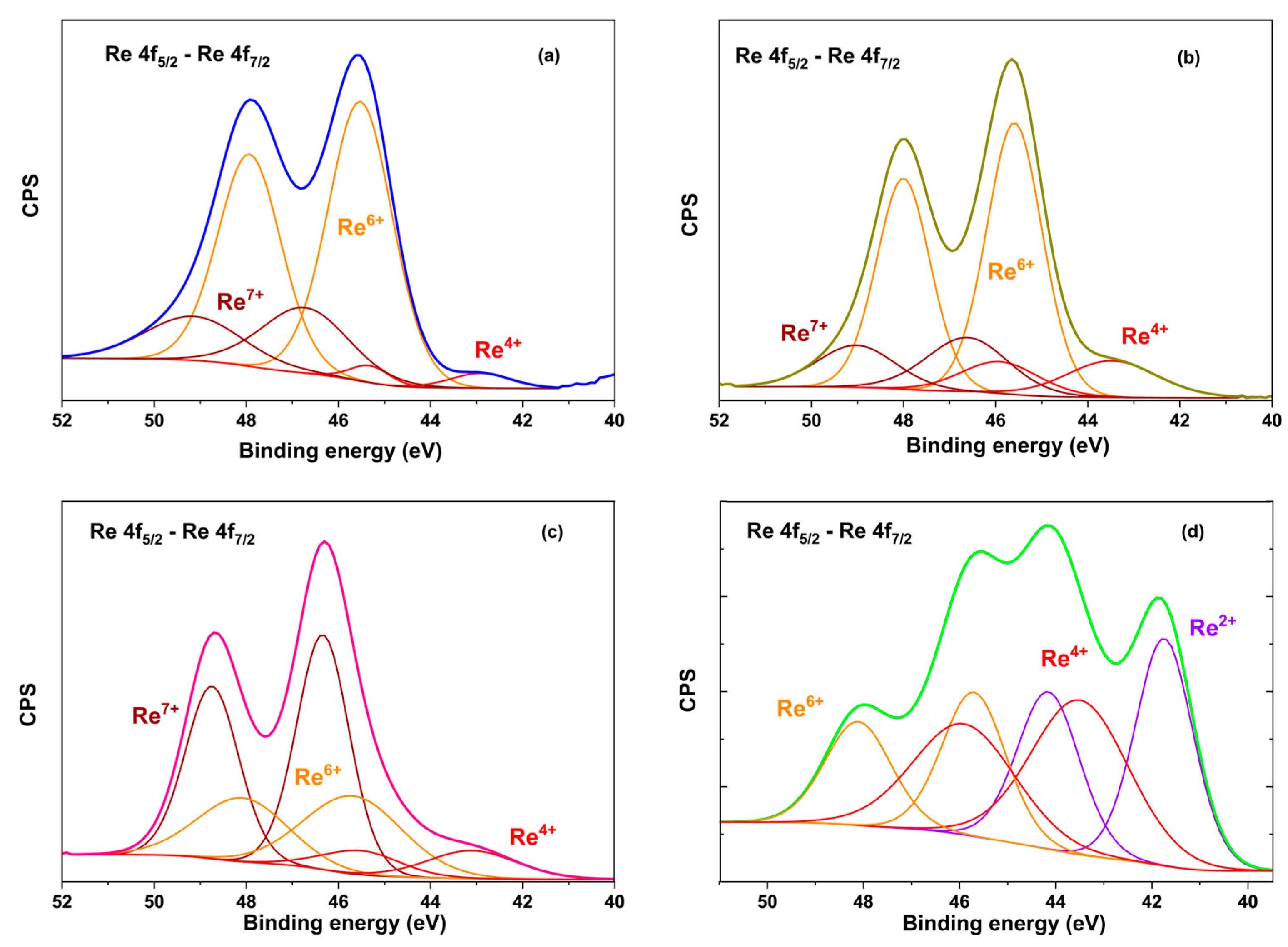
XPS was used to evaluate the surface composition of the catalysts. The Zr 3d, Ti 2p, C 1s, and N 1s regions are included in the Supplementary Materials (Figure S1). Figure 2 shows the XPS spectra for the Re 4f core-levels of rhenium oxide-based catalysts characterized by the 4f5/2 and 4f7/2 orbitals split by 2.4 eV.
The catalysts ReOx/g-C3N4, ReOx/G200, and ReOx/ZrO2 displayed contributions at 46.5–46.7 eV, 45.5–45.7 eV, and 42.9–43.5 eV in the Re 4f 7/2 region, which are ascribed to oxides of Re+7, Re+6, and Re+4, respectively [41]. In contrast, the XPS spectrum for ReOx/TiO2 displayed contributions at 41.7, 43.5, and 45.7 eV, which are due to Re+2, Re+4, and Re+6, respectively. This suggests that TiO2 promotes reduced rhenium species, in line with the findings of Mitra et al. [40] and Okal et al. [42], who observed similar behavior in rhenium catalysts supported on reducible oxides.
The survey spectrum of the ReOx/ZrO2 and ReOx/TiO2 catalysts did not display any contribution in the N1s region, implying that the ammonium salt fully decomposed in the near-surface region during the thermal treatment process. Therefore, the Re+7 identified species corresponds to Re2O7. Table 2 displays BE, Re specie relative atomic percentage, and Re surface atomic ratio for ReOx-supported catalysts in the 4f region.
The area of the different contributions was used to estimate the surface atomic ratios, which can be related to the relative concentration of accessible Re sites [36]. In the present study, this parameter decreases in the following order: ReOx/TiO2~ReOx/ZrO2 > ReOx/g-C3N4 > ReOx/G200. Therefore, ReOx/TiO2 and ReOx/ZrO2 have the highest Re apparent dispersion among the evaluated catalysts in agreement with the XRD patterns. On the contrary, ReOx/g-C3N4 and ReOx/G200 showed lower dispersion than the reducible supports, and among them, g-C3N4 provided better Re dispersion, likely due to the nitrogen functionalities of the support [43].
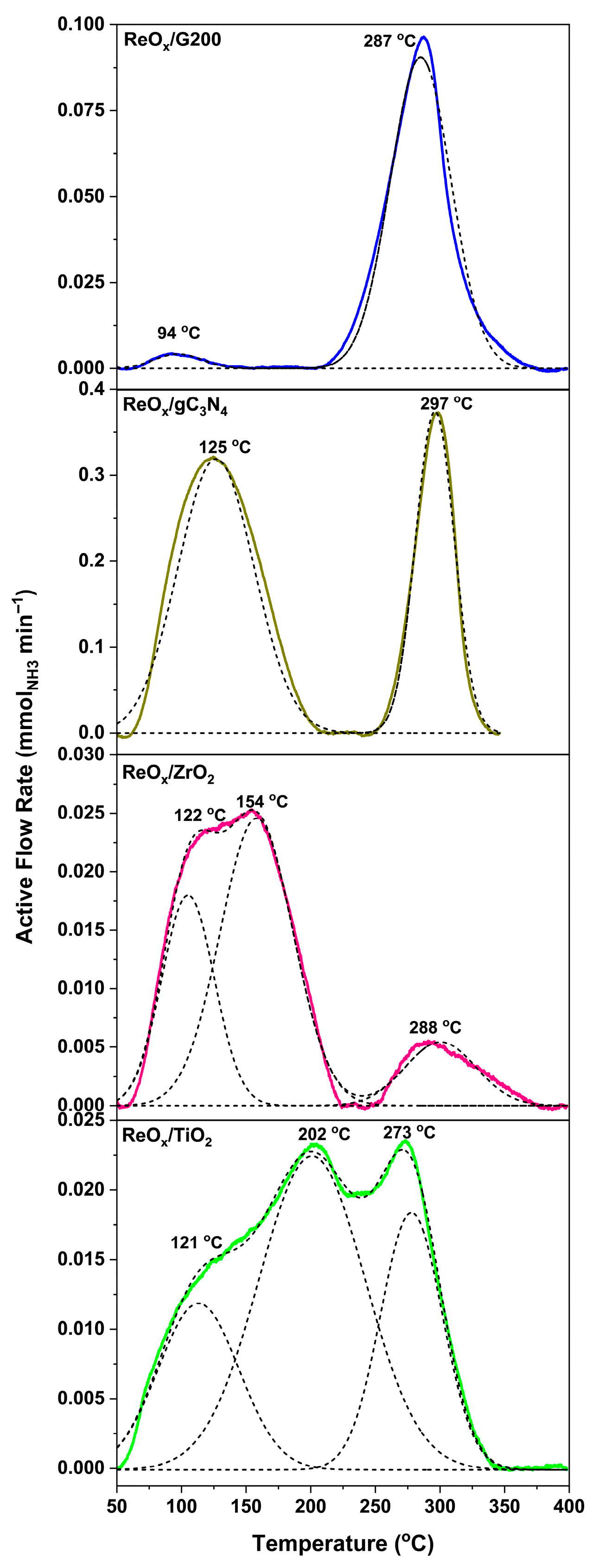
Figure 3 presents the NH3-TPD of ReOx catalysts. All the samples exhibit desorption signals between 50 and 400 °C, evidencing the presence of different strengths of acid sites. Thus, weak sites desorb below 200 °C, while medium-strong ones do so between 200 and 400 °C [44,45]. ReOx/G200 shows two very distinct signals corresponding to weak (94 °C) and strong (287 °C) acidity, the latter being much more intense. ReOx/g-C3N4 also shows two very well-differentiated signals of weak and strong acidity (at 125 °C and 297 °C, respectively), but in this case, the intensity of both signals is much more similar. On the other hand, catalysts with metal oxide supports show three desorption signals. Thus, ReOx/ZrO2 shows two intense signals centered at 122 and 154 °C and a small one at 288 °C, indicating that weak acid sites dominate with only a minor contribution from medium-strong sites. Similarly, ReOx/TiO2 displays two desorptions around in the weak acidity region (121 and 202 °C), and a peak at 223 °C related to medium-strong acidity, showing greater relative intensity than that observed in the catalyst supported on ZrO2. These results demonstrate that the support nature directly determines both the density and strength of acid sites, in agreement with previous findings [46].
Table 3 shows the weak, medium-strong, and total acidity for each catalyst. The total acidity decreased in the order ReOx/g-C3N4 > ReOx/G200 > ReOx/TiO2 ≈ ReOx/ZrO2.
It is important to note that the weakest acidity was shown by ReOx/ZrO2 (88/12) and ReOx/g-C3N4 (63/37). Additionally, ReOx/TiO2 (25/75) and ReOx/G200 (4/96) showed more medium-strong acid sites. The values in brackets correspond to the percentage ratio of weak to medium-strong acid sites derived from the deconvoluted NH3-TPD profiles. According to A. Jia et al. [45] and B. Li et al. [47], strong acid sites promote the adsorption of the C=O bond in crotonaldehyde and enhance catalytic activity over Ir/TiO2 and Ru/ZnO using H2, respectively. However, in the present study, catalysts with high medium-strong acidity showed low crotonaldehyde conversion and crotyl alcohol selectivity. On the other hand, some studies pointed out that weak acid sites promote FA adsorption and decomposition to provide molecular hydrogen. This was corroborated by X. Li et al. [48], who reported that FA decomposition over Au/CexZr1−xO2 catalysts was favored by weak and moderate acidic sites, even without CO formation, and improved the yield of the target product using this acid as a hydrogen donor. Additionally, Z. Yu et al. [49] showed that FA decomposition is preferentially converted to H2 and CO2 over γ-Mo2N supported on nitrogen-doped carbon. This improved selectivity was linked to the higher concentration of weak and moderate acid sites compared to bulk γ-Mo2N, which exhibited more strong acid sites and H2 selectivity below 1.23% in the whole evaluated temperature range. These two acidity effects may explain the activity and selectivity results obtained in this work. As mentioned above, ReOx/ZrO2 and ReOx/g-C3N4 catalysts presented a greater weak acidity compared to medium-strong acidity and were also those that showed the best catalytic results, since strong acidity would help the adsorption of crotonaldehyde and high weak acidity would contribute to the decomposition of FA so that it can carry out hydrogenation.

2.2. Catalytic Activity

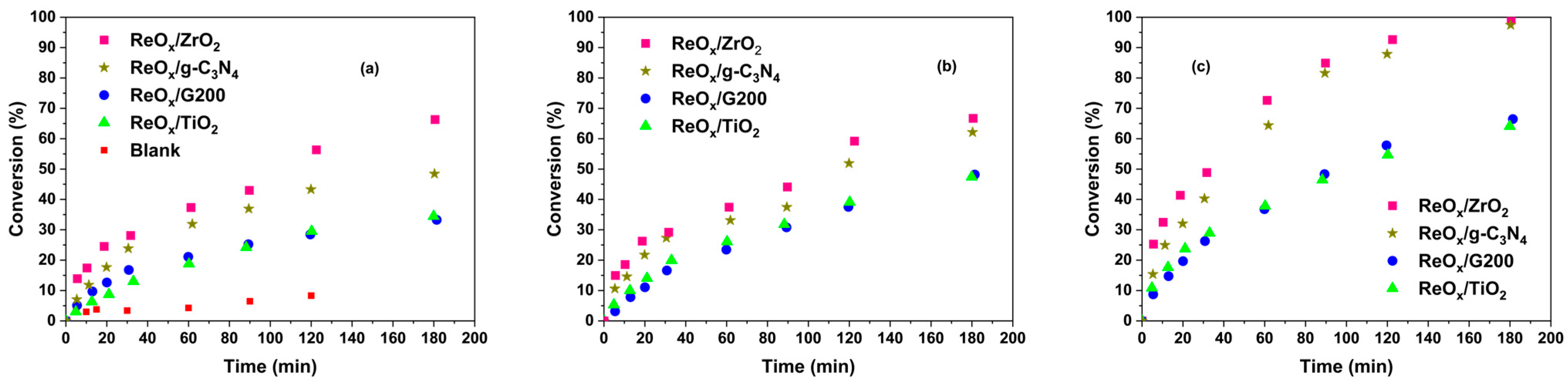
Figure 4 shows crotonaldehyde conversion vs. reaction time of blank and ReOx-supported catalysts for all evaluated reaction temperatures, using FA as hydrogen donor. The blank experiment did not show significant crotonaldehyde conversion and selectivity to unsaturated alcohol, confirming that all observed activity arises from the catalytic systems. As shown in Figure 4, all ReOx-based catalysts were active within the temperature range of 140–180 °C, and the conversion increased progressively with temperature and reaction time. At 140 °C (Figure 4a and Figures S2–S5), crotonaldehyde conversion remained below 35% (ReOx/G200 and ReOx/TiO2), 50% (ReOx/g-C3N4), and 70% (ReOx/ZrO2) for all evaluated reaction times. Increasing the temperature to 160 °C (Figure 4b) led to a similar conversion performance to that presented at 140 °C for times less than 60 min and moderate enhancement for longer times. At 180 °C (Figure 4c), the catalytic conversion markedly improved: ReOx/ZrO2 achieved the highest conversion at 180 min (around 99%), followed by ReOx/g-C3N4 (near 97%), whereas ReOx/TiO2 and ReOx/G200 exhibited lower conversions (≈65%).
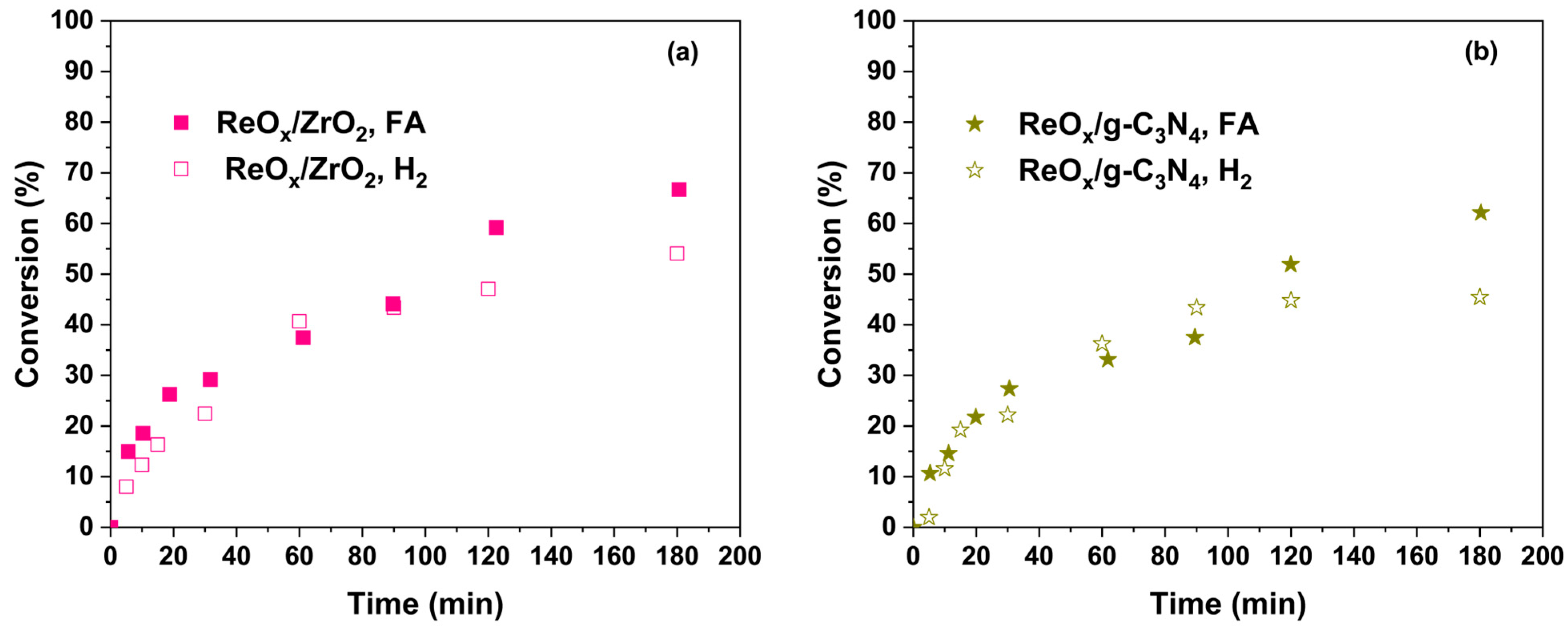
Figure 5 shows a comparison between crotonaldehyde conversion for the most active and selective catalysts: ReOx/ZrO2 (Figure 5a) and ReOx/g-C3N4 (Figure 5b) at 20 bar and 160 °C, varying the hydrogen source. Both catalysts displayed similar conversion profiles under the two conditions for times below 90 min. For ReOx/ZrO2, conversion reached roughly 66% with FA and 54% with H2 after 180 min, while for ReOx/g-C3N4 the final conversions were around 62% for FA and 45%for H2. This evidence confirms that FA effectively serves as an in situ hydrogen donor, providing active crotonaldehyde hydrogenation without the need for external H2.
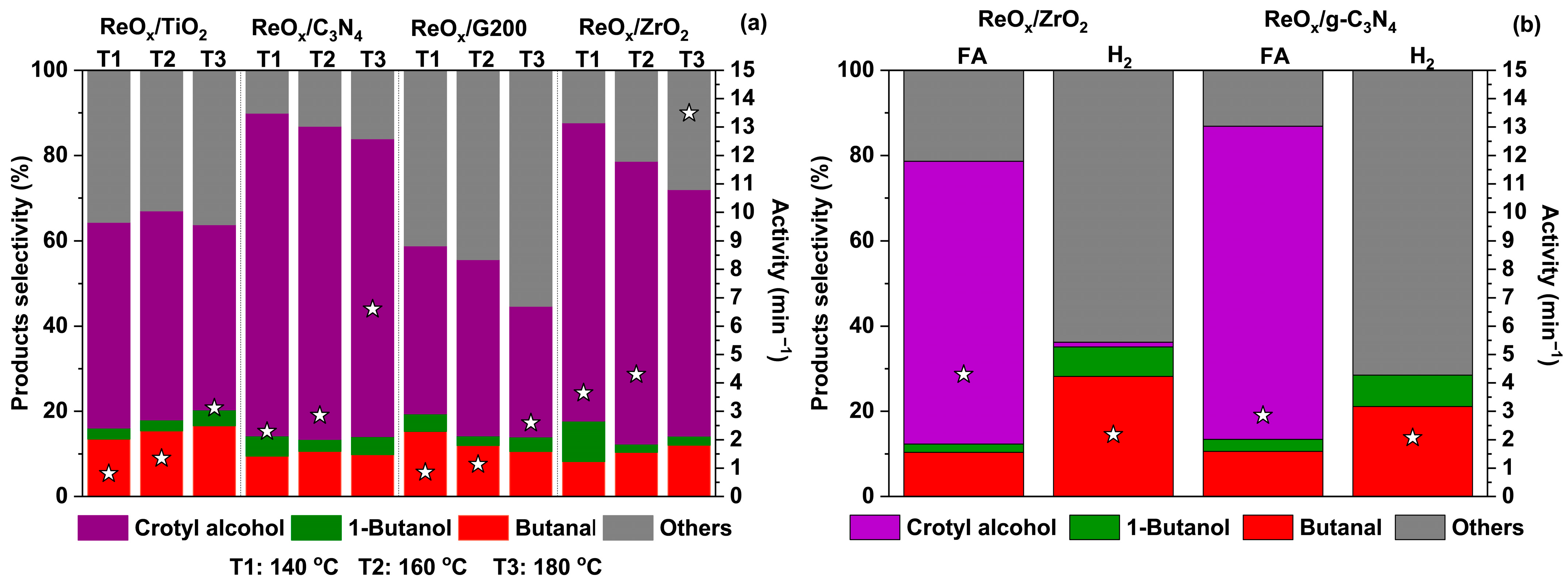
Figure 6 displays the product selectivity distribution and catalytic activity for all prepared catalysts and reaction temperatures at 25% of crotonaldehyde conversion. According to Figure 6a, it can be observed that the main product for the tested ReOx catalysts is crotyl alcohol when FA is used, except for ReOx/G200. The most selective catalysts were ReOx/g-C3N4 and ReOx/ZrO2, which reached selectivity to crotyl alcohol of 75.7% and 69.9% at 140 °C. Then, ReOx/TiO2 and ReOx/G200 provided a selectivity of 48.2% and 39.4% at 140 °C.
In addition to hydrogenation products, various condensation compounds have been detected, such as butyraldehyde and crotonic acid. They are collectively categorized as “Others”. These condensation products could be directly catalyzed by the large amount of H+ ionized from water and FA [50]. Finally, 1-butanol was the product with the lowest selectivity for all catalysts.
ReOx/ZrO2 and ReOx/g-C3N4 are more selective for C=O hydrogenation than ReOx/G200 and ReOx/TiO2. The effect of nitrogen atoms on the adsorption of carbonyl groups has been previously studied. For instance, in the hydrogenation of cinnamaldehyde, improved selectivity towards cinnamyl alcohol was observed when nitrogen was incorporated into carbon-based supports [51]. This effect appears to be related to the interaction between C=O groups and nitrogen atoms, which favors the cleavage of the C-O bond. In this context, molybdenum nitride has also been investigated as a catalyst in the hydrogenation of crotonaldehyde, yielding good selectivity results in the liquid phase [52].
On the other hand, most of the catalysts have a decrease in unsaturated alcohol selectivity with an increase in reaction temperature. Crotyl alcohol selectivity decreased by 2.9–5.2% when increasing the reaction temperature from 140 to 160 °C, and by 4.9–25.7% from 160 to 180 °C. Among all catalysts, only ReOx/TiO2 maintained a relatively stable selectivity across the evaluated temperature range. The overall increase in selectivity toward other products with rising temperature occurred at the expense of crotyl alcohol formation. Additionally, catalysts supported on reducible oxides exhibited a notable increase in butanal selectivity, likely due to the preferential adsorption of the C=C bond on active sites [21]. According to Mironenko et al. [53], the aqueous-phase hydrogenation of furfural at 50 or 100 °C and a total pressure of 3.0 MPa mainly showed unsaturated alcohol, while selectivity depended on the used catalyst. At 150 or 200 °C, these authors observed that the products of furfural catalytic transformations were mainly cyclopentanone, 4-oxo-pentanal, and 5-hydroxypentan-2-one.
Figure 6a displayed that catalyst activity was more pronounced at 180 °C, and for all reactions, temperatures followed the decreasing catalyst order ReOx/ZrO2 > ReOx/g-C3N4 > ReOx/TiO2 > ReOx/G200. Furthermore, Figure 6b shows that the use of FA as a hydrogen donor led to higher activities compared to the use of H2. In addition, it shows that the production of crotyl alcohol was very low or did not exist when H2 was used, and the most prominent selectivity was “Others”. According to Naharro et al. [21], gas-phase crotonaldehyde hydrogenation using H2 instead of FA as a hydrogen source showed that butanal and butanol were the main products. Therefore, it was proved that the change in the supports and hydrogenating agents would have a high incidence on crotonaldehyde conversion and crotyl alcohol selectivity. In addition, it corroborated that the use of FA as a hydrogen donor allowed for achieving higher unsaturated alcohol selectivity (Figure 6b). On the other hand, Lan and Wang [14] reported catalyst activity of crotonaldehyde hydrogenation on the liquid phase and using H2O as solvent (T: 30 °C, PH2: 8 bar) for Ir-ReOx/SiO2 and Ir-MoOx/SiO2. The values were 1.1 and 2.0 min−1, respectively. Although this last reference develops a reaction in mild conditions and uses H2, this work showed that ReOx/TiO2 and ReOx/G200 had similar activities at 140 and 160 °C, with those reported by the mentioned reference. At the same temperatures, ReOx/ZrO2 and ReOx/g-C3N4 showed activities above reference values. On the other hand, at 180 °C, the activity for all catalysts was above the reported values. Several works in crotonaldehyde hydrogenation report the sacrifice of activity to obtain high selectivity [5]. The same trend is observed in this work with the increase in temperature.
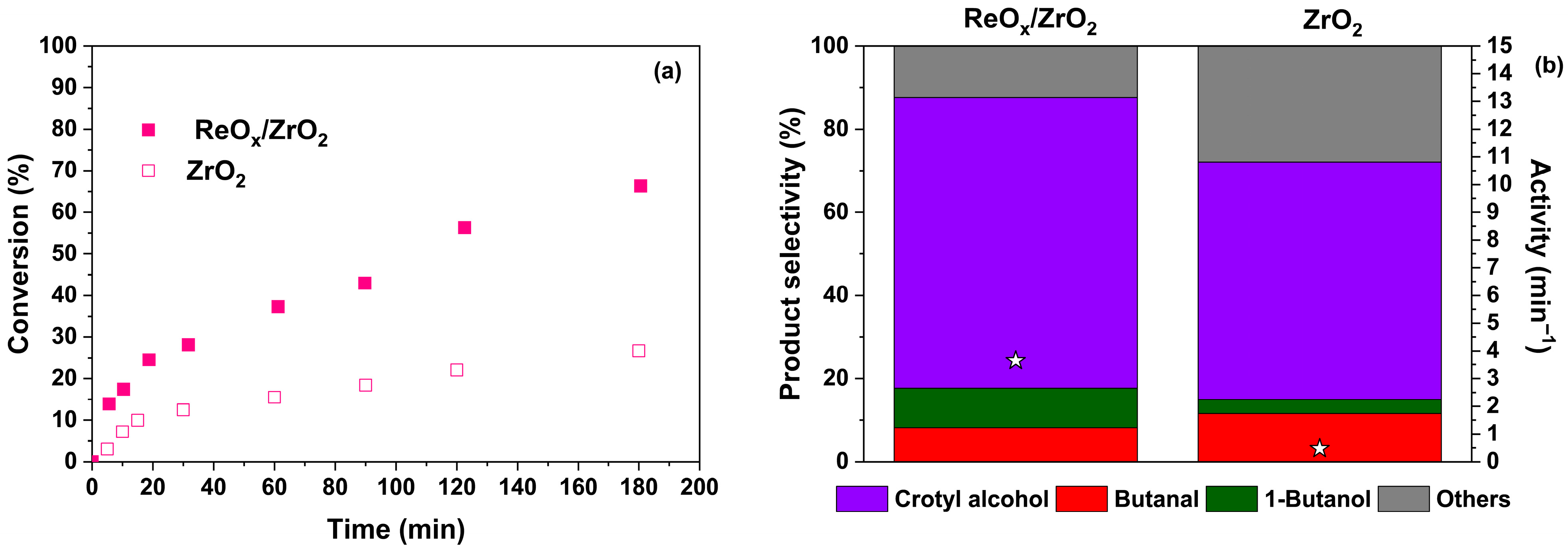
Furthermore, to evaluate the effect of rhenium impregnation on support, Figure 7 displays the comparison of crotonaldehyde conversion, product selectivity, and catalyst activity for ReOx/ZrO2 and ZrO2 at 140 °C, using FA as hydrogen donor.
According to Figure 7, the conversion and catalyst activity are harnessed by rhenium impregnation over reducible support (ZrO2). The crotonaldehyde conversion behavior over time of ZrO2 is like ReOx/TiO2 and ReOx/G200 at 140 °C (Figure 4a). Moreover, the selectivity of crotyl alcohol and catalyst activity is improved by ReOx species addition (Figure 7b). Therefore, rhenium oxides over ZrO2 and the use of FA are a good option for the catalytic transfer hydrogenation (CTH) process in crotonaldehyde hydrogenation and the C=O bond selectivity to obtain crotyl alcohol. Additionally, it has been reported that ZrO2 is a good material for FA decomposition. However, H2 selectivity depends on the synthesis preparation method and reaction conditions [54].
The hydrogenation of crotonaldehyde can follow two distinct reaction pathways. Selective hydrogenation of the carbonyl (C=O) bond results in the formation of crotyl alcohol, whereas hydrogenation of the C=C bond leads to butanal. Subsequent hydrogenation of the remaining functional group, whether C=C or C=O, ultimately yields butanol as the fully hydrogenated product [6]. Low conversion levels may be associated with the strong and competitive adsorption of C=O groups from both FA and crotonaldehyde on the active sites [21]. In this work, a clear dependence of conversion and selectivity on the nature of the support was observed, mainly attributed to the ratio of weak and medium-strength acid sites. Furthermore, support also influences the distribution of rhenium species in the catalysts, an important factor influencing their performance. ReOx catalysts supported on ZrO2 and g-C3N4 appear to mitigate this adsorption competition, potentially by generating new or more accessible active sites through specific interactions between ReOx species and the support surface. On the other hand, these supports may facilitate FA decomposition without interfering with the active sites responsible for crotonaldehyde adsorption, while simultaneously promoting selective activation of the C=O bond. This is supported by the results shown in Figure 7, where crotonaldehyde conversion and crotyl alcohol selectivity are reported using FA as a hydrogen donor and bare ZrO2 (without ReOx species) as the heterogeneous catalyst.
Figures S2–S5 present the evolution of crotonaldehyde conversion and product selectivity over time for all evaluated catalysts, following the graphical structure reported by S. Ojwach et al. [55]. As shown in the Supplementary Materials, crotonaldehyde conversion increases with time, while product selectivity varies depending on the reaction time, temperature, and used catalyst. Most of the catalysts showed that crotyl alcohol selectivity tends to a maximum and stable value at higher reaction time.

2.3. Kinetic Analysis

Table 4 shows the kinetic parameters for all prepared catalysts. These parameters are activation energy, pre-exponential factor, and first-order kinetic constant for each evaluated reaction temperature. The Ea of supported carbonaceous catalysts is lower than for metal oxide-supported catalysts. Kinetic constants increase with temperature, as expected.
According to Table 4, ReOx/G200 has the lowest Ea. Nevertheless, its kinetic constants present lower values, if compared with ReOx/ZrO2. Therefore, a preexponential factor (A) has a high incidence in catalytic crotonaldehyde conversion, and, therefore, a catalyst with the lower Ea is not the best for crotonaldehyde conversion and crotyl alcohol selectivity. Moreover, the initial kinetic rate was calculated for all reaction temperatures and ReOx catalysts. The results are shown in Table 5.
The initial reaction rates increase with temperature. Nevertheless, this kinetic parameter does not change significantly between 140 and 160 °C. The maximum initial rate value for all catalysts was at 180 °C. According to the initial rate, the order of this parameter is: ReOx/ZrO2, ReOx/g-C3N4, ReOx/TiO2, and ReOx/G200. On the other hand, Table 6 shows intrinsic kinetic rates at reaction temperatures for all evaluated catalysts.
The intrinsic kinetic rate is enhanced by increasing temperature for all catalysts. The intrinsic kinetic rate of catalysts follows the trend: ReOx/g-C3N4 > ReOx/G200 > ReOx/ZrO2 > ReOx/TiO2. Although/ReOx/g-C3N4 shows a better intrinsic kinetic rate, this catalyst presents a lower crotonaldehyde conversion than ZrO2 for all evaluated reaction temperatures. This behavior could be explained by the differences in the surface area and nature of the supports [23,25,36]. On the other hand, a fraction of the exposed Re species on TiO2 and on G200 constitutes inactive Re species for crotonaldehyde conversion, leading to the lower activity of ReOx/TiO2 and ReOx/G200 catalysts compared to ReOx/g-C3N4 and ReOx/ZrO2 [36].

2.4. Reaction Mechanism over ReOx Supported Catalyst

The efficiency of heterogeneous catalytic processes, including both activity and selectivity, is largely determined by the adsorption, activation, and mechanism of interaction of reactants on the catalyst surface [45,56]. Based on experimental data and literature evidence, crotonaldehyde hydrogenation mechanisms are proposed, both using FA as a hydrogen donor and directly H2. In these mechanisms, only α,β-unsaturated aldehyde adsorption to produce the unsaturated alcohol was considered, in the same way that previous works [6,8,10,56].
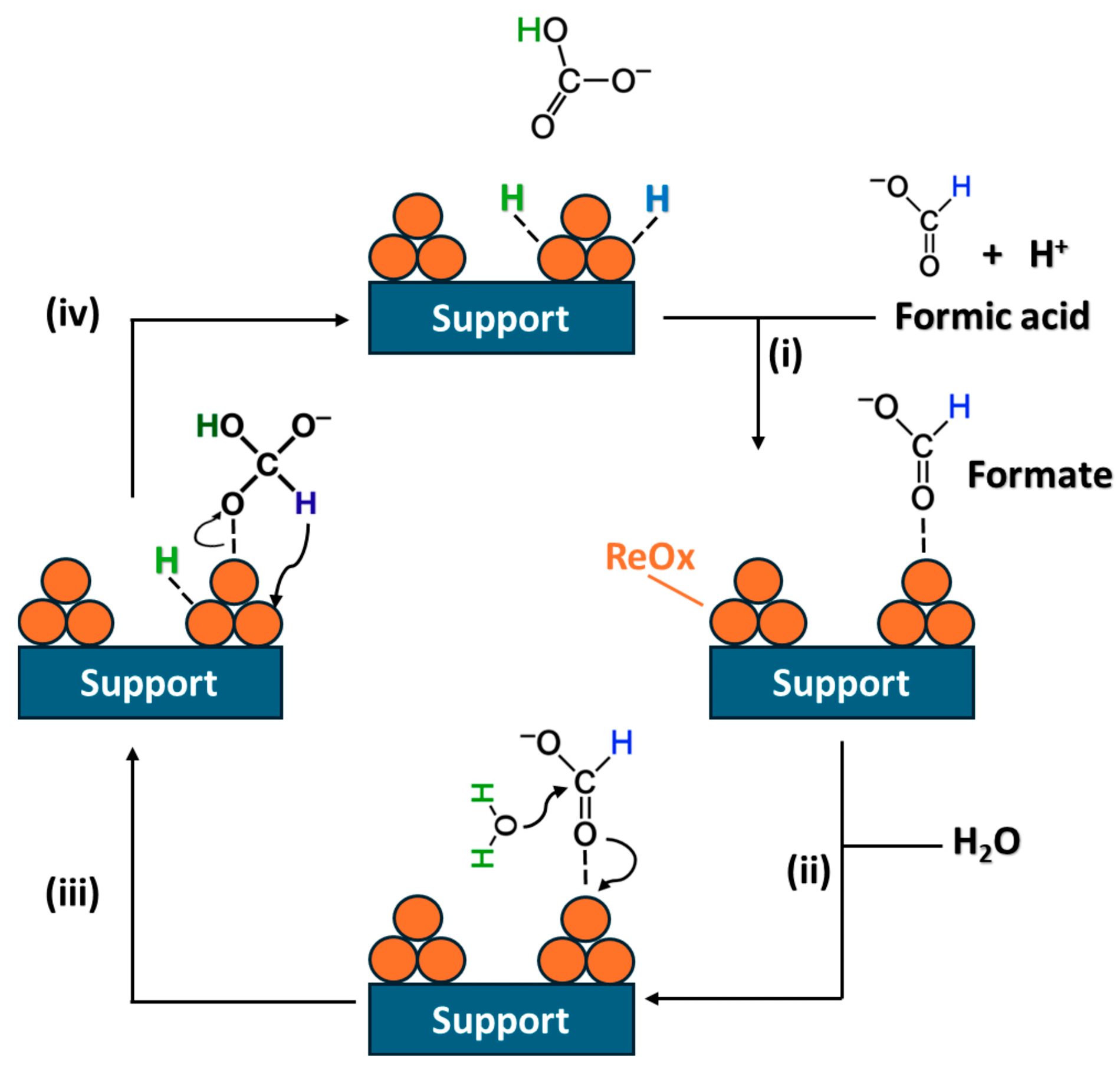
The coexistence of the crotonaldehyde and hydrogen donors can induce competitive adsorption between them on the catalyst surface, thus leading to different dehydrogenation degrees of the hydrogen donor [56]. Therefore, the mechanism discussion starts with the activation of FA on the catalyst surface in the absence of crotonaldehyde. There are several routes of the FA activation mechanism: FA dehydrogenation, FA dehydration, and the dehydrogenation of formate water-involved route [57,58,59,60]. Due to in this work, water is used as a solvent, dehydrogenation of formate is the appropriate mechanism to consider for FA activation [56,58,59]. According to Nie et al. [61], several studies report that formic acid ionizes in aqueous media, and water acts as a proton donor, facilitating the formation of surface H+ species that participate in the hydrogenation pathway. The water-involved formate dehydrogenation was proposed as follows in Figure 8.
Formate dehydrogenation was proposed to proceed via the following sequence of steps: (i) the formate ion adsorbs linearly onto ReOx species through coordination of the carbonyl oxygen lone pair; (ii) a water molecule attacks the carbon center of the adsorbed formate, generating a carbonic acid as an intermediate and releasing a surface-bound hydrogen atom; (iii) subsequent cleavage of the C–H bond in this intermediate produces an additional hydrogen atom adsorbed on the surface; (iv) two H atoms on the catalyst surface remain adsorbed and bicarbonate ion molecule is desorbed. Isotope-labeling experiments with deuterated water (D2O) and deuterated sodium formate (DCOONa) provide strong evidence that the water insertion step into the adsorbed formate species constitutes the rate-determining step of the reaction [56].
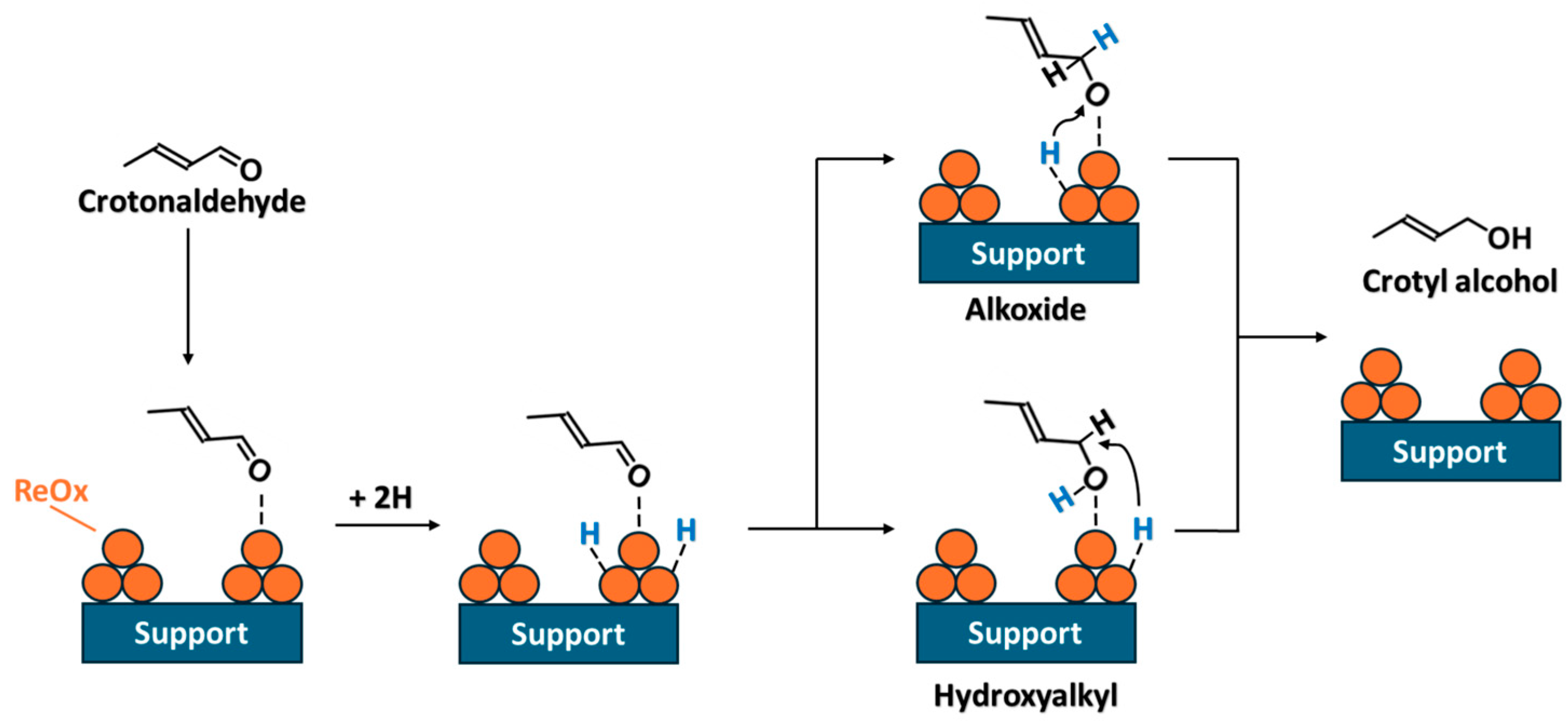
To continue with the entire process, Figure 9 shows the reaction mechanism of crotonaldehyde activation on the ReOx-based catalyst surface with weak affinity for C=C bonds in the presence of surface hydrogen atoms.
First, a crotonaldehyde molecule is adsorbed on the ReOx species over the catalyst surface. Then, the surface H atom derived from the hydrogen donor attacks the carbonyl group of crotonaldehyde, leading to the formation of either an alkoxide intermediate, through bonding to the oxygen atom, or a hydroxyalkyl intermediate, through bonding to the carbon atom, which subsequently hydrogenates crotonaldehyde to crotyl alcohol. Computational studies indicate that the pathway proceeding via the hydroxyalkyl intermediate, where the surface hydrogen initially attacks the carbonyl oxygen of adsorbed α,β-unsaturated aldehyde, requires a lower activation energy than the route involving the alkoxide intermediate [62].
According to the characterization and catalytic test results, medium-strong acid properties of the catalysts play a crucial role in the adsorption of the C=O bond in crotonaldehyde and subsequent crotyl alcohol selectivity [45]. Additionally, weak acid sites may promote hydrogen source production from FA decomposition, as described previously [48,49].
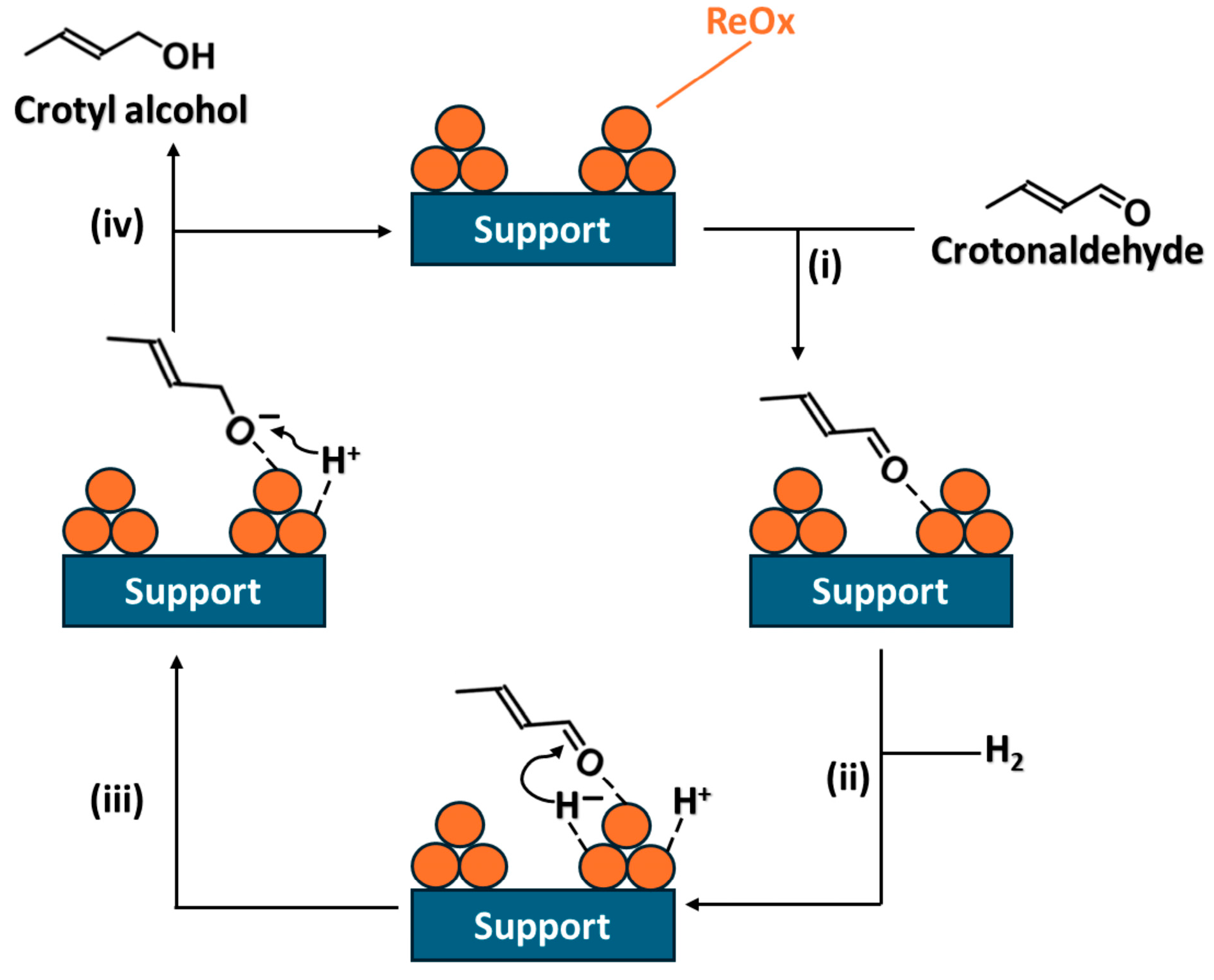
On the other hand, the plausible reaction mechanism for crotonaldehyde hydrogenation to crotyl alcohol is proposed in Figure 10, using H2 and over ReOx-supported catalysts.
This reaction mechanism proceeds in four main steps [6,8]: (i) Crotonaldehyde adsorbs onto the catalyst surface via the aldehyde group, which is subsequently activated by ReOx. Then, (ii) hydrogen is heterolytically dissociated at the ReOx-support interface to generate hydride (H) and proton (H+) species. The hydride species attack the carbonyl carbon of the adsorbed crotonaldehyde (iii), forming an alkoxide intermediate. Ionic hydrogenation with hydride (H) species is generally effective for the hydrogenation of polar double bonds in organic synthesis [63,64,65]. Additionally, the notably high selectivity to crotyl alcohol observed over some of the ReOx-supported catalysts can be mainly attributed to the generation of H+ and H species on the catalyst surface [6]. However, low H2 solubility in water could be unfavorable to produce enough hydrogen ionic species [56]. Finally, (iv) the alkoxide intermediate is protonated to yield crotyl alcohol. The rate-determining step is the hydride attack on the carbonyl carbon (step iii) [6,8,65]. The high selectivity arises from the generation of hydride species at the ReOx-support interface and activation of the aldehyde group on ReOx, enabling ionic hydrogenation. On the other hand, high catalytic activity is attributed to efficient aldehyde activation and the proximity of crotonaldehyde to active hydride species due to adsorption on ReOx.
In this work, when molecular hydrogen is used, butanal and butanol were the main products, and crotyl alcohol was too low or absent. Therefore, the H2 cleavage is achieved into H+ and H species by ReOx/ZrO2 and ReOx/g-C3N4. Nevertheless, these ionic species attack preferably the C=C bond on crotonaldehyde to produce butanal or favor the over-hydrogenation of unsaturated bonds to produce 1-butanol derived from butanal or crotyl alcohol.
Currently, the detailed structure of the evaluated catalysts remains unclear. Future work will focus on advanced characterization to elucidate the role of rhenium oxides and the structural features of the catalysts.

3. Materials and Methods

3.1. Catalysts’ Synthesis

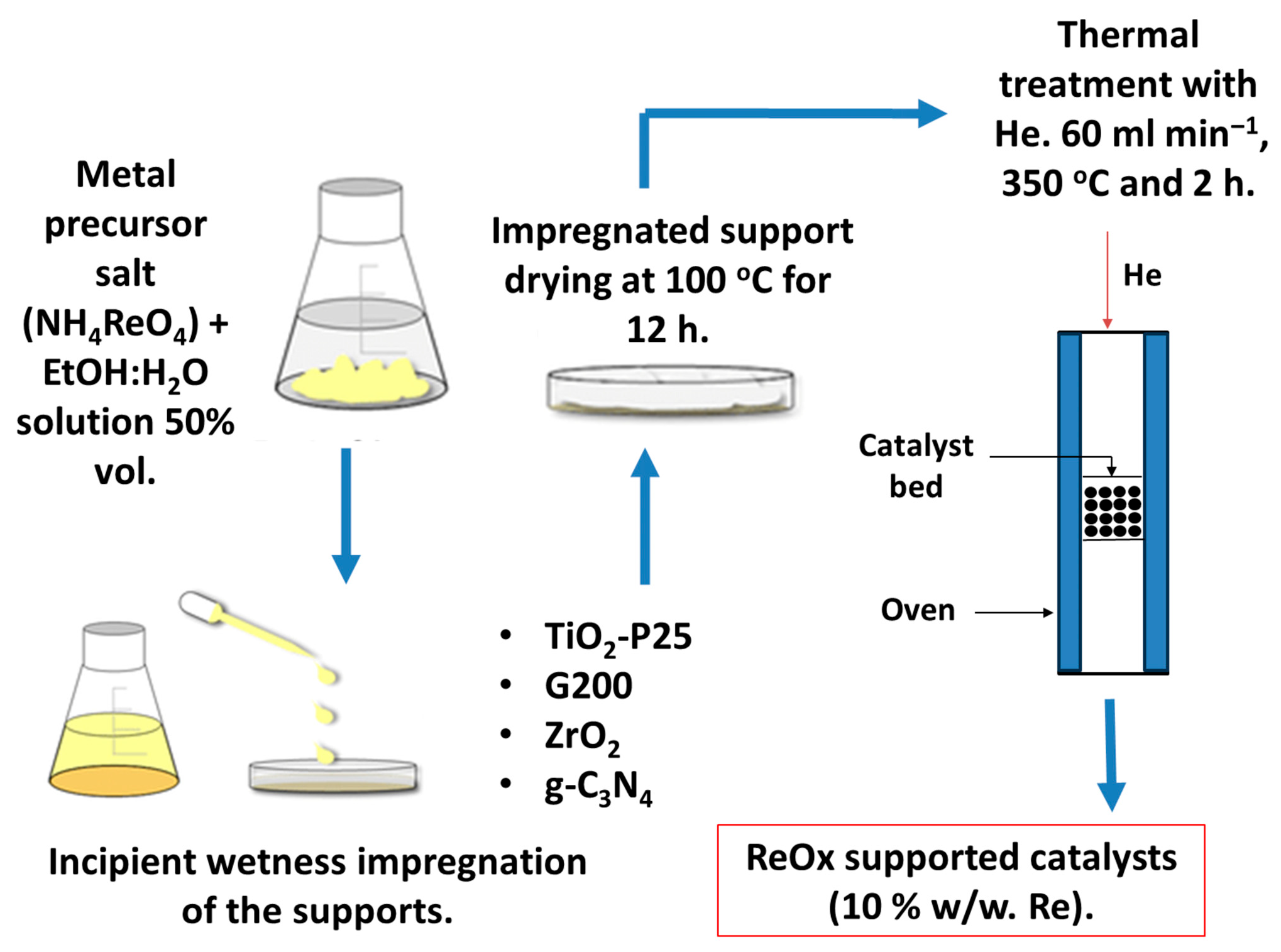
The ZrO2 support was prepared in the laboratory through precipitation, using ZrO(NO3)2·xH2O as a precursor salt and calcined at 500 °C for 3 h. The g-C3N4 support was obtained by thermal treatment of urea at 450 °C for 4 h in a muffle furnace inside a closed recipient at a heating rate of 15 °C min−1. Additionally, two commercial supports were considered: G200 (High surface area graphite, Timcal, Bodio, Switzerland) and TiO2-P25. Then, rhenium catalysts were prepared by incipient wetness impregnation to achieve a 10 wt%. loading of this metal on the supports. The precursor salt used was NH4ReO4 (Sigma-Aldrich, St. Louis, MO, USA. ≥99%), which was dissolved in a 50/50 EtOH/H2O (% vol.) solution. Following the impregnation step, the catalysts were dried at 100 °C for 12 h. Finally, they were treated with He (60 mL min−1) for 2 h at 350 °C to obtain ReOx on the supports. The support selection is based on previous works that report differences in acid-base properties and acid medium stability on catalytic reactions [66,67,68,69,70,71,72]. ZrO2 and TiO2 were included as reducible oxides with different metal–support interactions, while g-C3N4 and G200 were chosen as carbon-based materials with contrasting surface nature. This diversity seeks to compare and correlate the physicochemical properties of the supports with catalytic activity and selectivity. Figure 11 shows the flow diagram for catalysts synthesis. It describes all synthesis stages from incipient wetness impregnation to thermal treatment with He.

3.2. Catalyst Characterization

3.2.1. Surface Area and Textural Properties

Apparent surface area (m2 g−1) of ZrO2, TiO2, g-C3N4, and all ReOx supported catalysts were obtained from N2 adsorption isotherms at 77 K. These measurements were developed using a Micromeritics ASAP-2000 automatic apparatus (Norcross, GA, USA).

3.2.2. X-Ray Diffraction (XRD)

XRD patterns of the samples were recorded on a Polycristal X′ Pert Pro PANalytical diffractometer (Malvern, UK) via Ni-filtered Cu Kα radiation (λ = 1.54 Å). All the supports and catalysts were analyzed under the conditions of 45 kV and 40 mA, using a 2θ range from 4° to 85° and a step of 0.04° s−1. The Scherrer equation is used to calculate the particle sizes in the catalyst sample [25,28,73]. It is represented by Equation (1).
β 2 θ = K · λ L · c o s ( 2 θ )
where β(2θ) is the peak width in radians at the value of 2θ. θ is the diffraction angle in radians, λ is the X-ray wavelength (1.5406 Å or 0.15406 nm), and L is the crystallite size (nm). The constant K is a function of the crystallite shape but is generally approximated as 1.0 for spherical particles [73]. Nevertheless, there are reports that set K constant at 0.9 [28,74]. In this study, K is set as 0.9, and the most intense peaks are used to select 2θ.

3.2.3. X-Ray Photoelectron Spectroscopy (XPS)

The XPS spectra were obtained by using non-monochromatic Al radiation (200 W, 1486.61 eV) through SPECS GmbH (Specs Group, Berlin, Germany) with a UHV system and with an energy analyzer PHOIBOS 150 9MCD (Specs Group, Berlin, Germany). The survey spectra were obtained with a 50 eV pass energy, and region spectra were obtained at 20 eV pass energy. The binding energy (BE) was calibrated taking as a reference the C 1s peak of graphitic carbon at 284.6 eV, and the equipment error was considered as less than ±0.01 eV for the determination of energies.
The Re/Support ratio was determined using XPS by integrating the areas under the peaks corresponding to rhenium and the support element on the spectra (e.g., Ti 2p for TiO2 or Zr 3d for ZrO2). Each peak area was corrected by applying the appropriate relative sensitivity factor (RSF) to account for the differing photoemission cross-sections.

3.2.4. Ammonia Temperature-Programmed Desorption (NH3-TPD)

Initially, the samples were pretreated at 350 °C for 30 min with a He flow of 25 mL min−1. Then, the system was cooled to 50 °C and the sample was ammonia saturated at this same temperature for 60 min using a 25 mL min−1 flow of NH3 (5% vol.). After adsorption, physically adsorbed ammonia was removed by purging the system with He for 30 min. Subsequently, desorption was performed under He flow (25 mL min−1) with a ramp of 10 °C min−1 up to 400 °C. The desorbed species were monitored using a mass spectrometer by tracking the m/z = 17 fragment corresponding to NH3.

3.2.5. Catalytic Test

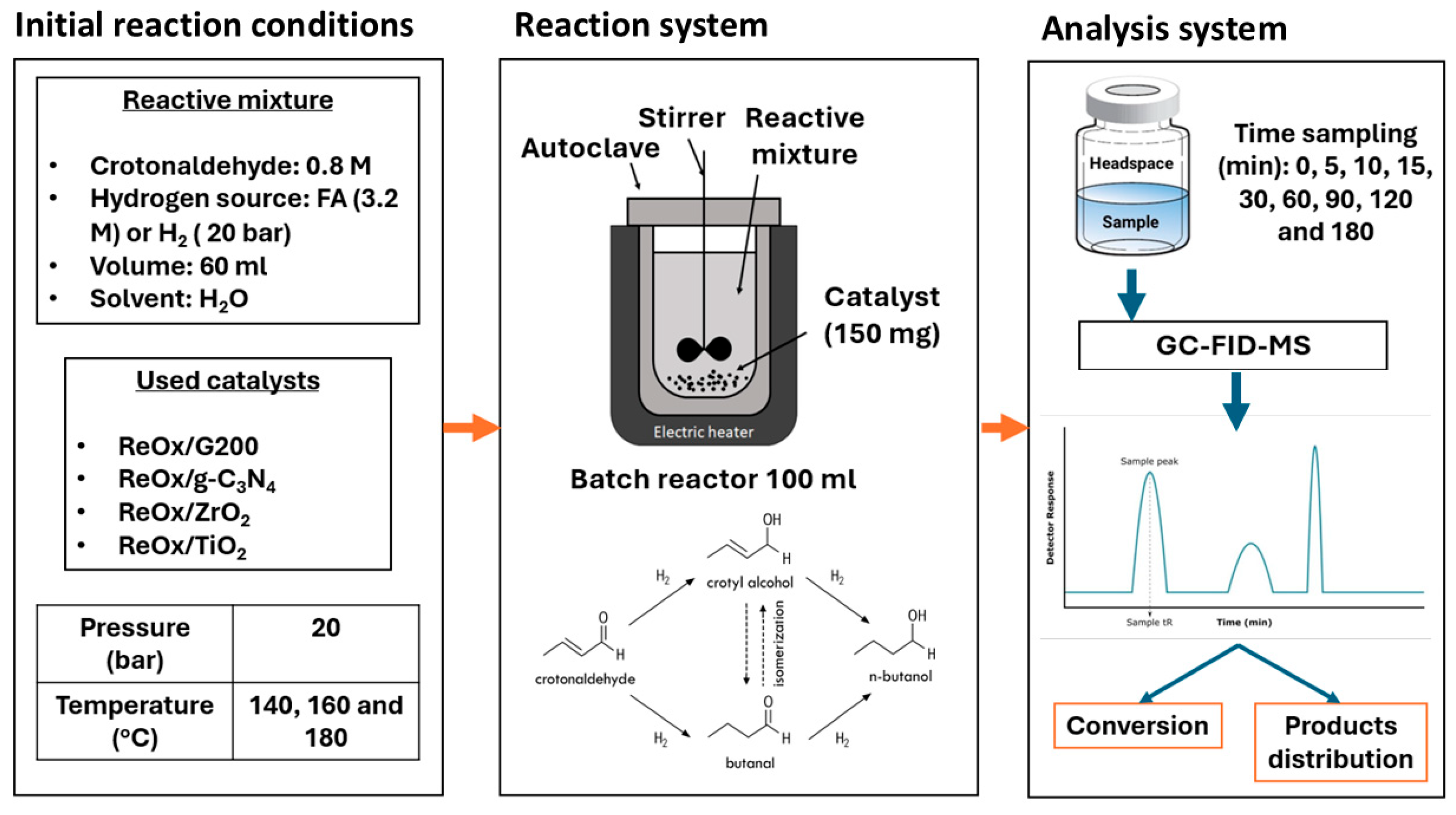
The hydrogenation experiments were conducted in a 100 mL batch reactor from Parr Instruments (St, Moline, IL, USA), operated in discontinuous mode. The reactive mixture was an aqueous solution of 60 mL, 0.4 M crotonaldehyde (Sigma-Aldrich, ≥99%) and 3.2 M FA (Sigma-Aldrich, ≥96%). Once the reactive mixture was introduced into the reactor with 150 mg of catalyst (reactant-to-catalyst molar ratio of 315), the reactor was purged three times with N2, then pressurized to 20 bar with the same inert gas. The reaction temperatures studied were 140, 160, and 180 °C. Additionally, a blank test without catalyst and ZrO2 (150 mg) was performed at 140 °C with the same initial conditions described above. On the other hand, to probe the incidence of hydrogenating agent, H2 was employed at 20 bar and 160 °C over ReOx/ZrO2 and ReOx/g-C3N4. In this case, 200 mg of catalyst was used, and the reactive solution was 80 mL with the same crotonaldehyde concentration and water as solvent. For each experiment, small aliquots of the reaction mixture were collected periodically, and the samples were analyzed using an Agilent 8860 GC-FID (Agilent, Santa Clara, CA, USA) with a mass detector to measure and identify the concentrations of reactants and reaction products. Figure 12 shows the flow diagram for catalytic tests, including initial reaction conditions, reaction system, and analysis system.
Equation (2) is used to determine the conversion of crotonaldehyde, while Equation (3) is used to calculate the selectivity for each reaction product. Additionally, catalytic activity is considered using Equation (4) at a conversion of 25%.
X c r o t o n = C C r o t o n o C C r o t o n t C C r o t o n o · 100 %
S i = # C i · C i t 1 j # C j · C j t · 100 %
a = n C r o t o n t · n R e
In Equation (2), XCroton represents the conversion percentage (%) of crotonaldehyde, where C C r o t o n o and C C r o t o n t denote the initial concentration and the concentration at time (t) of this α, β-unsaturated aldehyde, respectively, in molarity (M). Meanwhile, in Equation (3), Si indicates the selectivity of component i in percentage (%), #Ci is the number of carbon atoms present in molecule i, C i t is the concentration in molarity (M) of component i at time t, and 1 j # C j C j t is the summation of the product of carbon atoms and the concentrations (M) for each reaction product at time t. In Equation (4), a denotes the catalytic activity in min−1, ΔnCroton is the moles of crotonaldehyde converted, Δt is the required time for the specified conversion of crotonaldehyde (in minutes), and nRe is the moles of rhenium present in the amount of catalyst used for the reaction.

3.2.6. Kinetic Evaluation

To further analyze insight into the CTH of crotonaldehyde to crotyl alcohol over the ReOx supported catalyst, its kinetics were investigated at three different reaction temperatures (140, 160, and 180 °C), assuming that the conversion of crotonaldehyde follows first-order reaction kinetics (Equation (5)), as it is proposed by He et al. [11] and Ren et al. [15] for furfural hydrogenation to obtain furfuryl alcohol with the CTH process. Additionally, the assumption is feasible since FA is added in excess ([FA] = 8∙[Crotonaldehyde]).
r C R O = k · C C R O
where −rCRO is the rate of consumption of crotonaldehyde (mol L−1 min−1), CCRO is the crotonaldehyde concentration (M), and k is the rate constant (min−1). To calculate the activation energy (Ea) and pre-exponential factor (A), the following expression is used: k = A · exp(−Ea · (RT)−1). The initial reaction rate (mol min−1 gcat−1) is calculated from the initial slope of the conversion vs. time plot, according to Equation (6). The same math expression is used by Leiva et al. [75] and Díaz et al. [33] to determine this parameter.
r C R O o = n · b C R O g c a t
To assess the intrinsic rate, the initial reaction rates are normalized by the exposed Re surface species, determined from the XPS surface atomic ratio [25]. The intrinsic rate is expressed as the number of crotonaldehyde molecules converted per exposed surface Re atom per minute (moleculesCRO atoms Re−1 min−1), is calculated by Equation (7).
r i = r s · M W s u p p o r t 1 W t R e · ( R e / M ) X P S
where ri is the intrinsic rate, rs is the initial reaction rate (molCro g−1 min−1), MWSupport is the molar mass of the support, WtRe is the Re loading (wt%), and (Re/M)XPS is the XPS surface atomic Re/Support ratio (atom atom−1).

4. Conclusions

Catalytic hydrogenation of crotonaldehyde was effectively accomplished using ReOx catalysts supported on G200, g-C3N4, TiO2, and ZrO2, employing FA as an in situ hydrogen donor. The catalytic performance significantly depended on the nature of the support and reaction temperature. Increasing the reaction temperature (140–180 °C) enhanced crotonaldehyde conversion but negatively impacted selectivity toward crotyl alcohol.
Among the tested catalysts, ReOx/ZrO2 and ReOx/g-C3N4 demonstrated superior catalytic activities and higher selectivity toward crotyl alcohol, emphasizing the critical role of the support’s physicochemical properties in determining catalyst performance. FA proved to be a more effective hydrogen donor compared to molecular hydrogen (H2, 20 bar), yielding improved crotyl alcohol production.
Characterization studies confirmed the presence of distinct Re species influenced by support. Carbonaceous supports predominantly stabilized higher oxidation states of Re (mainly Re6+ and Re7+), whereas TiO2 favored the formation of more reduced species. The ZrO2-based catalyst presented the highest proportion of Re7+. Additionally, carbonaceous materials exhibited greater susceptibility to pore blockage after Re impregnation and thermal treatment, unlike reducible oxide supports, which maintained their textural properties. Additionally, catalysts with more weak acid sites showed the best activity and crotyl alcohol selectivity, using FA as hydrogen donor.
Overall, this study underlines that selecting appropriate supports and hydrogen-donor molecules significantly influences catalytic efficiency, offering valuable insights for the optimization of ReOx-based catalytic systems toward the sustainable production of crotyl alcohol from crotonaldehyde.

Supplementary Materials

The following supporting information can be downloaded at: https://www.mdpi.com/article/10.3390/molecules30214307/s1, Figure S1: XPS regions for, ReOx/TiO2 (a) Ti 2p, ReOx/ZrO2: (a) Zr 3d, ReOx/G200 (c) C 1s and ReOx/g-C3N4 (d) C 1s and (e) N 1s; Figure S2: Crotonaldehyde conversion and products selectivity over time for ReOx/ZrO2 and ZrO2; Figure S3: Crotonaldehyde conversion and products selectivity over time for ReOx/g-C3N4; Figure S4: Crotonaldehyde conversion and products selectivity evolution with time for ReOx/TiO2; Figure S5: Crotonaldehyde conversion and products selectivity over time for ReOx/G200; Figure S6: XPS survey spectrums for: (a) ReOx/ZrO2, (b) ReOx/TiO2, (c) ReOx/g-C3N4, and (d) ReOx/G200; Table S1: XPS parameters for all ReOx-supported catalysts.

Author Contributions

C.E.A.-A. and V.N.-O. conducted experiments, characterizations, and kinetic calculus; C.E.A.-A., M.R.-S., and A.B.D. wrote the article; C.E.A.-A. analyzed the data and discussed with A.B.D. and M.R.-S.; A.B.D. and M.R.-S. provided supervision and valuable critical feedback and played a crucial role in finalizing the article. It is important to note that all authors made substantial contributions to the manuscript, collectively enriching its content. All authors have read and agreed to the published version of the manuscript.

Funding

The authors are thankful for the financial support given by the European Commission through the H2020-MSCA-RISE-2020 BIOALL project (Grant Agreement: 101008058), Instituto Tecnológico Metropolitano de Medellín, and Instituto de Catálisis y Petroleoquímica—CSIC (20228AT002).

Institutional Review Board Statement

Not applicable.

Informed Consent Statement

Not applicable.

Data Availability Statement

The raw data supporting the conclusions of this article will be made available by the authors on request.

Conflicts of Interest

The authors declare no conflicts of interest.

Abbreviations

The following abbreviations are used in this manuscript:
BET areaBrunauer–Emmett–Teller area
CTHCatalytic transfer hydrogenation
FAFormic acid
NH3-TPDAmmonia temperature-programmed desorption
RSFRelative sensitivity factor
XPSX-ray photoelectron spectroscopy
XRDX-ray diffraction

References

  1. Hidalgo-Carrillo, J.; Aramendía, M.A.; Marinas, A.; Marinas, J.M.; Urbano, F.J. Support and Solvent Effects on the Liquid-Phase Chemoselective Hydrogenation of Crotonaldehyde over Pt Catalysts. Appl. Catal. A Gen. 2010, 385, 190–200. [Google Scholar] [CrossRef] [Scilit]
  2. Segawa, A.; Taniya, K.; Ichihashi, Y.; Nishiyama, S.; Yoshida, N.; Okamoto, M. Meerwein-Ponndorf-Verley Reduction of Crotonaldehyde over Supported Zirconium Oxide Catalysts Using Batch and Tubular Flow Reactors. Ind. Eng. Chem. Res. 2018, 57, 70–78. [Google Scholar] [CrossRef] [Scilit]
  3. Xu, Y.M.; Zheng, W.B.; Hu, Y.M.; Tang, C.; Jia, A.P.; Lu, J.Q. The Effects of MoOx Decoration on the Selective Hydrogenation of Crotonaldehyde over MoOx-Promoted Ir/TUD-1 Catalysts. J. Catal. 2020, 381, 222–233. [Google Scholar] [CrossRef] [Scilit]
  4. Yamanaka, N.; Shimazu, S. Selective Hydrogenation Properties of Ni-Based Bimetallic Catalysts. Eng 2022, 3, 60–77. [Google Scholar] [CrossRef] [Scilit]
  5. Tamura, M.; Tokonami, K.; Nakagawa, Y.; Tomishige, K. Rapid Synthesis of Unsaturated Alcohols under Mild Conditions by Highly Selective Hydrogenation. Chem. Commun. 2013, 49, 7034–7036. [Google Scholar] [CrossRef] [Scilit]
  6. Tamura, M.; Tokonami, K.; Nakagawa, Y.; Tomishige, K. Selective Hydrogenation of Crotonaldehyde to Crotyl Alcohol over Metal Oxide Modified Ir Catalysts and Mechanistic Insight. ACS Catal. 2016, 6, 3600–3609. [Google Scholar] [CrossRef] [Scilit]
  7. Harth, F.M.; Likozar, B.; Grilc, M. Stability of Solid Rhenium Catalysts for Liquid-Phase Biomass Valorization–Various Facets of Catalyst Deactivation and Rhenium Leaching. Mater. Today Chem. 2022, 26, 101191. [Google Scholar] [CrossRef] [Scilit]
  8. Tamura, M.; Tokonami, K.; Nakagawa, Y.; Tomishige, K. Effective NbOx-Modified Ir/SiO2 Catalyst for Selective Gas-Phase Hydrogenation of Crotonaldehyde to Crotyl Alcohol. ACS Sustain. Chem. Eng. 2017, 5, 3685–3697. [Google Scholar] [CrossRef] [Scilit]
  9. Budroni, G.; Kondrat, S.A.; Taylor, S.H.; Morgan, D.J.; Carley, A.F.; Williams, P.B.; Hutchings, G.J. Selective Deposition of Palladium onto Supported Nickel-Bimetallic Catalysts for the Hydrogenation of Crotonaldehyde. Catal. Sci. Technol. 2013, 3, 2746–2754. [Google Scholar] [CrossRef] [Scilit]
  10. Ye, H.; Zhao, H.; Jiang, Y.; Liu, H.; Hou, Z. Catalytic Transfer Hydrogenation of the CO Bond in Unsaturated Aldehydes over Pt Nanoparticles Embedded in Porous UiO-66 Nanoparticles. ACS Appl. Nano Mater. 2020, 3, 12260–12268. [Google Scholar] [CrossRef] [Scilit]
  11. He, J.; Li, H.; Riisager, A.; Yang, S. Catalytic Transfer Hydrogenation of Furfural to Furfuryl Alcohol with Recyclable Al–Zr@Fe Mixed Oxides. ChemCatChem 2018, 10, 430–438. [Google Scholar] [CrossRef] [Scilit]
  12. Nagaiah, P.; Gidyonu, P.; Ashokraju, M.; Rao, M.V.; Challa, P.; Burri, D.R.; Kamaraju, S.R.R. Magnesium Aluminate Supported Cu Catalyst for Selective Transfer Hydrogenation of Biomass Derived Furfural to Furfuryl Alcohol with Formic Acid as Hydrogen Donor. ChemistrySelect 2019, 4, 145–151. [Google Scholar] [CrossRef] [Scilit]
  13. Valekar, A.H.; Lee, M.; Yoon, J.W.; Kwak, J.; Hong, D.Y.; Oh, K.R.; Cha, G.Y.; Kwon, Y.U.; Jung, J.; Chang, J.S.; et al. Catalytic Transfer Hydrogenation of Furfural to Furfuryl Alcohol under Mild Conditions over Zr-MOFs: Exploring the Role of Metal Node Coordination and Modification. ACS Catal. 2020, 10, 3720–3732. [Google Scholar] [CrossRef] [Scilit]
  14. Lan, X.; Wang, T. Highly Selective Catalysts for the Hydrogenation of Unsaturated Aldehydes: A Review. ACS Catal. 2020, 10, 2764–2790. [Google Scholar] [CrossRef] [Scilit]
  15. Ren, Y.; Zhang, M.; Pang, D.; Feng, H.; Zhang, X.; Shao, M.; Shen, C.; Yang, Y.; Wei, M. Acid-Base Synergistic Effect towards Catalytic Transfer Hydrogenation Reactions. Chem. Eng. J. 2024, 495, 153618. [Google Scholar] [CrossRef] [Scilit]
  16. O’Driscoll, Á.; Leahy, J.J.; Curtin, T. The Influence of Metal Selection on Catalyst Activity for the Liquid Phase Hydrogenation of Furfural to Furfuryl Alcohol. Catal. Today 2017, 279, 194–201. [Google Scholar] [CrossRef] [Scilit]
  17. Ramos, R.; Peixoto, A.F.; Arias-Serrano, B.I.; Soares, O.S.G.P.; Pereira, M.F.R.; Kubička, D.; Freire, C. Catalytic Transfer Hydrogenation of Furfural over Co3O4−Al2O3 Hydrotalcite-Derived Catalyst. ChemCatChem 2020, 12, 1467–1475. [Google Scholar] [CrossRef] [Scilit]
  18. Wang, T.; Hu, A.; Wang, H.; Xia, Y. Catalytic Transfer Hydrogenation of Furfural into Furfuryl Alcohol over Ni–Fe-layered Double Hydroxide Catalysts. J. Chin. Chem. Soc. 2019, 66, 1610–1618. [Google Scholar] [CrossRef] [Scilit]
  19. Wang, T.; Du, J.; Sun, Y.; Tang, X.; Wei, Z.J.; Zeng, X.; Liu, S.J.; Lin, L. Catalytic Transfer Hydrogenation of Biomass-Derived Furfural to Furfuryl Alcohol with Formic Acid as Hydrogen Donor over CuCs-MCM Catalyst. Chin. Chem. Lett. 2021, 32, 1186–1190. [Google Scholar] [CrossRef] [Scilit]
  20. Du, J.; Zhang, J.; Sun, Y.; Jia, W.; Si, Z.; Gao, H.; Tang, X.; Zeng, X.; Lei, T.; Liu, S.; et al. Catalytic Transfer Hydrogenation of Biomass-Derived Furfural to Furfuryl Alcohol over in-Situ Prepared Nano Cu-Pd/C Catalyst Using Formic Acid as Hydrogen Source. J. Catal. 2018, 368, 69–78. [Google Scholar] [CrossRef] [Scilit]
  21. Naharro-Ovejero, V.; Pascual, L.; Zarate, X.; Saavedra-torres, M.; Schott, E.; Guerrero-Ruiz, A.; Rodríguez-Ramos, I.; Dongil, A.B. Environment and Energy Gas Phase Hydrogenation of Crotonaldehyde Using Formic Acid as Hydrogen Source over Cu and Re Supported on Graphite. Appl. Catal. B Environ. Energy 2025, 377, 125517. [Google Scholar] [CrossRef] [Scilit]
  22. Chen, M.; Wang, Y.; Jiang, L.; Cheng, Y.; Liu, Y.; Wei, Z. Highly Efficient Selective Hydrogenation of Cinnamaldehyde to Cinnamyl Alcohol over CoRe/TiO2 Catalyst. Molecules 2023, 28, 3336. [Google Scholar] [CrossRef] [Scilit]
  23. Bassi, R.; Villarroel, M.; Gil-Llambias, F.J.; Baeza, P.; García-Fierro, J.L.; Martínez, N.; Olivera, P.; Leiva, K.; Escalona, N. Support Effect on Conversion of Quinoline over ReS2 Catalyst. J. Chil. Chem. Soc. 2016, 61, 3170–3176. [Google Scholar] [CrossRef] [Scilit]
  24. Leiva, K.; Martinez, N.; Sepulveda, C.; García, R.; Jiménez, C.A.; Laurenti, D.; Vrinat, M.; Geantet, C.; Fierro, J.L.G.; Ghampson, I.T.; et al. Hydrodeoxygenation of 2-Methoxyphenol over Different Re Active Phases Supported on SiO2 Catalysts. Appl. Catal. A Gen. 2015, 490, 71–79. [Google Scholar] [CrossRef] [Scilit]
  25. Bassi, R.; Baeza, P.; Sepulveda, C.; Ghampson, I.T.; Camu, E.; Brückner, A.; Bentrup, U.; Fierro, J.L.G.; Escalona, N. Conversion of Levulinic Acid over Rhenium Oxide Catalysts: Effect of Metal Content. Appl. Catal. A Gen. 2021, 625, 118328. [Google Scholar] [CrossRef] [Scilit]
  26. Pieta, I.S.; Gieroba, B.; Kalisz, G.; Pieta, P.; Nowakowski, R.; Naushad, M.; Rathi, A.; Gawande, M.B.; Sroka-Bartnick, A.; Zboril, R. Developing Benign Ni/g-C3N4Catalysts for CO2 Hydrogenation: Activity and Toxicity Study. Ind. Eng. Chem. Res. 2022, 61, 10496–10510. [Google Scholar] [CrossRef] [Scilit]
  27. Ge, L. Synthesis and Photocatalytic Performance of Novel Metal-Free g-C3N4 Photocatalysts. Mater. Lett. 2011, 65, 2652–2654. [Google Scholar] [CrossRef] [Scilit]
  28. Kumar, S.; Bhunia, S.; Ojha, A.K. Effect of Calcination Temperature on Phase Transformation, Structural and Optical Properties of Sol-Gel Derived ZrO2 Nanostructures. Phys. E Low-Dimens. Syst. Nanostructures 2015, 66, 74–80. [Google Scholar] [CrossRef] [Scilit]
  29. Jafarpour, M.; Rezapour, E.; Ghahramaninezhad, M.; Rezaeifard, A. A Novel Protocol for Selective Synthesis of Monoclinic Zirconia Nanoparticles as a Heterogeneous Catalyst for Condensation of 1,2-Diamines with 1,2-Dicarbonyl Compounds. New J. Chem. 2014, 38, 676–682. [Google Scholar] [CrossRef] [Scilit]
  30. Li, W.; Huang, H.; Li, H.; Zhang, W.; Liu, H. Facile Synthesis of Pure Monoclinic and Tetragonal Zirconia Nanoparticles and Their Phase Effects on the Behavior of Supported Molybdena Catalysts for Methanol-Selective Oxidation. Langmuir 2008, 24, 8358–8366. [Google Scholar] [CrossRef] [Scilit]
  31. Han, E.; Vijayarangamuthu, K.; Youn, J.S.; Park, Y.K.; Jung, S.C.; Jeon, K.J. Degussa P25 TiO2 Modified with H2O2 under Microwave Treatment to Enhance Photocatalytic Properties. Catal. Today 2018, 303, 305–312. [Google Scholar] [CrossRef] [Scilit]
  32. Uddin, M.J.; Cesano, F.; Chowdhury, A.R.; Trad, T.; Cravanzola, S.; Martra, G.; Mino, L.; Zecchina, A.; Scarano, D. Surface Structure and Phase Composition of TiO2 P25 Particles After Thermal Treatments and HF Etching. Front. Mater. 2020, 7, 192. [Google Scholar] [CrossRef] [Scilit]
  33. Díaz, C.I.C.; Araya-López, C.; Dongil, A.B.; Escalona, N. Aqueous Phase Hydrogenation of 4-(2-Furyl)-3-Buten-2-One over Different Re Phases. Molecules 2024, 29, 3853. [Google Scholar] [CrossRef] [Scilit] [PubMed]
  34. Blanco, E.; Cabeza, P.; Naharro Ovejero, V.; Contreras, C.; Dongil, A.B.; Ghampson, I.T.; Escalona, N. Effect of Carbon Support and Functionalization on the Synthesis of Rhenium Carbide and Its Use on HDO of Guaiacol. Catal. Today 2023, 420, 114031. [Google Scholar] [CrossRef] [Scilit]
  35. Manna, S.; Kumar, S.; Sharma, A.; Sahoo, S.; Dey, M.K.; Mishra, P.K.; Satpati, A.K. RGO/ReO3 Nano Composite Modified Electrode for the Ultra-Sensitive Determination of Dopamine and Uric Acid. Biosens. Bioelectron. X 2022, 11, 100156. [Google Scholar] [CrossRef] [Scilit]
  36. Toledo, F.; Ghampson, I.T.; Sepúlveda, C.; García, R.; Fierro, J.L.G.; Videla, A.; Serpell, R.; Escalona, N. Effect of Re Content and Support in the Liquid Phase Conversion of Furfural to Furfuryl Alcohol and 2-Methyl Furan over ReOx Catalysts. Fuel 2019, 242, 532–544. [Google Scholar] [CrossRef] [Scilit]
  37. Jeong, Y.; Park, C.W.; Park, Y.K.; Ha, J.M.; Jeong, Y.; Lee, K.Y.; Jae, J. Investigation of the Activity and Selectivity of Supported Rhenium Catalysts for the Hydrodeoxygenation of 2-Methoxyphenol. Catal. Today 2021, 375, 164–173. [Google Scholar] [CrossRef] [Scilit]
  38. Yuan, Y.; Iwasawa, Y. Performance and Characterization of Supported Rhenium Oxide Catalysts for Selective Oxidation of Methanol to Methylal. J. Phys. Chem. B 2002, 106, 4441–4449. [Google Scholar] [CrossRef] [Scilit]
  39. Zubkins, M.; Sarakovskis, A.; Strods, E.; Bikse, L.; Polyakov, B.; Kuzmin, A.; Vibornijs, V.; Purans, J. Tailoring of Rhenium Oxidation State in ReOx Thin Films during Reactive HiPIMS Deposition Process and Following Annealing. Mater. Chem. Phys. 2022, 289, 126399. [Google Scholar] [CrossRef] [Scilit]
  40. Mitra, B.; Gao, X.; Wachs, I.E.; Hirt, A.M.; Deo, G. Characterization of Supported Rhenium Oxide Catalysts: Effect of Loading, Support and Additives. Phys. Chem. Chem. Phys. 2001, 3, 1144–1152. [Google Scholar] [CrossRef] [Scilit]
  41. Tysoe, W.T.; Zaera, F.; Somorjai, G.A. An XPS Study of the Oxidation and Reduction of the Rhenium-Platinum System under Atmospheric Conditions. Surf. Sci. 1988, 200, 1–14. [Google Scholar] [CrossRef] [Scilit]
  42. Okal, J.; Tylus, W.; Kȩpiński, L. XPS Study of Oxidation of Rhenium Metal on γ-Al2O3 Support. J. Catal. 2004, 225, 498–509. [Google Scholar] [CrossRef] [Scilit]
  43. Zou, W.; Deng, B.; Hu, X.; Zhou, Y.; Pu, Y.; Yu, S.; Ma, K.; Sun, J.; Wan, H.; Dong, L. Crystal-Plane-Dependent Metal Oxide-Support Interaction in CeO2/g-C3N4 for Photocatalytic Hydrogen Evolution. Appl. Catal. B Environ. 2018, 238, 111–118. [Google Scholar] [CrossRef] [Scilit]
  44. Phongsawat, W.; Netiworaruksa, B.; Suriye, K.; Dokjampa, S.; Praserthdam, P.; Panpranot, J. Role of Support Nature (γ-Al2O3 and SiO2-Al2O3) on the Performances of Rhenium Oxide Catalysts in the Metathesis of Ethylene and 2-Pentene. J. Nat. Gas Chem. 2012, 21, 158–164. [Google Scholar] [CrossRef] [Scilit]
  45. Jia, A.; Zhang, W.; Peng, H.; Zhang, Y.; Song, T.; Li, L.; Ye, Y.; Wang, Y.; Luo, M.; Chen, D.L.; et al. Selective Hydrogenation of Crotonaldehyde over Ir/TiO2 Catalysts: Unraveling the Metal-Support Interface Related Reaction Mechanism. J. Catal. 2023, 425, 57–69. [Google Scholar] [CrossRef] [Scilit]
  46. Alvarez, C.; Cruces, K.; Garcia, R.; Sepulveda, C.; Fierro, J.L.G.; Ghampson, I.T.; Escalona, N. Conversion of Guaiacol over Different Re Active Phases Supported on CeO2-Al2O3. Appl. Catal. A Gen. 2017, 547, 256–264. [Google Scholar] [CrossRef] [Scilit]
  47. Li, B.; Hu, G.S.; Jin, L.Y.; Hong, X.; Lu, J.Q.; Luo, M.F. Characterizations of Ru/ZnO Catalysts with Different Ru Contents for Selective Hydrogenation of Crotonaldehyde. J. Ind. Eng. Chem. 2013, 19, 250–255. [Google Scholar] [CrossRef] [Scilit]
  48. Li, X.; Li, J.; Liu, X.; Tian, Q.; Hu, C. The Promoting Effect of Ce on the Performance of Au/CexZr1−xO2 for γ-Valerolactone Production from Biomass-Based Levulinic Acid and Formic Acid. Catalysts 2018, 8, 241. [Google Scholar] [CrossRef] [Scilit]
  49. Yu, Z.; An, X.; Kurnia, I.; Yoshida, A.; Yang, Y.; Hao, X.; Abudula, A.; Fang, Y.; Guan, G. Full Spectrum Decomposition of Formic Acid over γ-Mo2N-Based Catalysts: From Dehydration to Dehydrogenation. ACS Catal. 2020, 10, 5353–5361. [Google Scholar] [CrossRef] [Scilit]
  50. Fu, Z.; Wang, Z.; Lin, W.; Song, W.; Li, S. High Efficient Conversion of Furfural to 2-Methylfuran over Ni-Cu/Al2O3 Catalyst with Formic Acid as a Hydrogen Donor. Appl. Catal. A Gen. 2017, 547, 248–255. [Google Scholar] [CrossRef] [Scilit]
  51. Dongil, A.B.; Bachiller-Baeza, B.; Guerrero-Ruiz, A.; Rodríguez-Ramos, I. Chemoselective Hydrogenation of Cinnamaldehyde: A Comparison of the Immobilization of Ru-Phosphine Complex on Graphite Oxide and on Graphitic Surfaces. J. Catal. 2011, 282, 299–309. [Google Scholar] [CrossRef] [Scilit]
  52. Wyvratt, B.M.; Gaudet, J.R.; Pardue, D.B.; Marton, A.; Rudić, S.; Mader, E.A.; Cundari, T.R.; Mayer, J.M.; Thompson, L.T. Reactivity of Hydrogen on and in Nanostructured Molybdenum Nitride: Crotonaldehyde Hydrogenation. ACS Catal. 2016, 6, 5797–5806. [Google Scholar] [CrossRef] [Scilit]
  53. Mironenko, R.M.; Belskaya, O.B.; Likholobov, V.A. Aqueous-Phase Hydrogenation of Furfural in the Presence of Supported Metal Catalysts of Different Types. A Review. Dokl. Phys. Chem. 2023, 509, 33–50. [Google Scholar] [CrossRef] [Scilit]
  54. Lee, H.J.; Kang, D.C.; Pyen, S.H.; Shin, M.; Suh, Y.W.; Han, H.; Shin, C.H. Production of H2-Free CO by Decomposition of Formic Acid over ZrO2 Catalysts. Appl. Catal. A Gen. 2017, 531, 13–20. [Google Scholar] [CrossRef] [Scilit]
  55. Ojwach, S.O.; Ogweno, A.O.; Akerman, M.P. (Pyridyl)Benzoazole Palladium(II) Complexes as Homogeneous Catalysts in Hydrogenation of Alkenes and Alkynes. Catal. Sci. Technol. 2016, 6, 5069–5078. [Google Scholar] [CrossRef] [Scilit]
  56. Mudhulu, S.; Gong, Z.J.; Ku, H.C.; Lu, Y.H.; Yu, W.Y. Recent Advances in Heterogeneous Catalytic Hydrodeoxygenation of Biomass-Derived Oxygenated Furanics Mediated by Formic Acid. Mater. Today Sustain. 2022, 19, 100199. [Google Scholar] [CrossRef] [Scilit]
  57. Navlani-García, M.; Salinas-Torres, D.; Mori, K.; Kuwahara, Y.; Yamashita, H. Enhanced Formic Acid Dehydrogenation by the Synergistic Alloying Effect of PdCo Catalysts Supported on Graphitic Carbon Nitride. Int. J. Hydrogen Energy 2019, 44, 28483–28493. [Google Scholar] [CrossRef] [Scilit]
  58. Masuda, S.; Shimoji, Y.; Mori, K.; Kuwahara, Y.; Yamashita, H. Interconversion of Formate/Bicarbonate for Hydrogen Storage/Release: Improved Activity Following Sacrificial Surface Modification of a Ag@Pd/TiO2Catalyst with a TiO XShell. ACS Appl. Energy Mater. 2020, 3, 5819–5829. [Google Scholar] [CrossRef] [Scilit]
  59. Nakajima, K.; Tominaga, M.; Waseda, M.; Miura, H.; Shishido, T. Highly Efficient Supported Palladium-Gold Alloy Catalysts for Hydrogen Storage Based on Ammonium Bicarbonate/Formate Redox Cycle. ACS Sustain. Chem. Eng. 2019, 7, 6522–6530. [Google Scholar] [CrossRef] [Scilit]
  60. Kwon, S.; Lin, T.C.; Iglesia, E. Elementary Steps and Site Requirements in Formic Acid Dehydration Reactions on Anatase and Rutile TiO2 Surfaces. J. Catal. 2020, 383, 60–76. [Google Scholar] [CrossRef] [Scilit]
  61. Nie, R.; Tao, Y.; Nie, Y.; Lu, T.; Wang, J.; Zhang, Y.; Lu, X.; Xu, C.C. Recent Advances in Catalytic Transfer Hydrogenation with Formic Acid over Heterogeneous Transition Metal Catalysts. ACS Catal. 2021, 11, 1071–1095. [Google Scholar] [CrossRef] [Scilit]
  62. Li, X.; Jia, P.; Wang, T. Furfural: A Promising Platform Compound for Sustainable Production of C4 and C5 Chemicals. ACS Catal. 2016, 6, 7621–7640. [Google Scholar] [CrossRef] [Scilit]
  63. Fagan, P.J.; Voges, M.H.; Morris Bullock, R. Catalytic Ionic Hydrogenation of Ketones by {[Cp*Ru(CO)2]2(μ-H)}+. Organometallics 2010, 29, 1045–1048. [Google Scholar] [CrossRef] [Scilit]
  64. Fujita, S.I.; Sano, Y.; Bhanage, B.M.; Arai, M. Supported Liquid-Phase Catalysts Containing Ruthenium Complexes for Selective Hydrogenation of α,β-Unsaturated Aldehyde: Importance of Interfaces between Liquid Film, Solvent, and Support for the Control of Product Selectivity. J. Catal. 2004, 225, 95–104. [Google Scholar] [CrossRef] [Scilit]
  65. Zhang, Z.; Wang, Z.Q.; Li, Z.; Zheng, W.B.; Fan, L.; Zhang, J.; Hu, Y.M.; Luo, M.F.; Wu, X.P.; Gong, X.Q.; et al. Metal-Free Ceria Catalysis for Selective Hydrogenation of Crotonaldehyde. ACS Catal. 2020, 10, 14560–14566. [Google Scholar] [CrossRef] [Scilit]
  66. Li, Y.; He, D.; Zhu, Q.; Zhang, X.; Xu, B. Effects of Redox Properties and Acid-Base Properties on Isosynthesis over ZrO2-Based Catalysts. J. Catal. 2004, 221, 584–593. [Google Scholar] [CrossRef] [Scilit]
  67. Hernández-Cortez, J.G.; López-Salinas, E.; Manríquez, M.; Toledo, J.A.; Cortes-Jacome, M.A. Acid and Base Properties of Molybdophosphoric Acid Supported on Zirconia: Characterized by IR Spectroscopy, TPD and Catalytic Activity. Fuel 2012, 100, 144–151. [Google Scholar] [CrossRef] [Scilit]
  68. Besson, M.; Gallezot, P. Stability of Ruthenium Catalysts Supported on TiO2 or ZrO2 in Catalytic Wet Air Oxidation. Top. Catal. 2005, 33, 101–108. [Google Scholar] [CrossRef] [Scilit]
  69. Krishnakumar, B.; Swaminathan, M. A Convenient Method for the N-Formylation of Amines at Room Temperature Using TiO2-P25 or Sulfated Titania. J. Mol. Catal. A Chem. 2011, 334, 98–102. [Google Scholar] [CrossRef] [Scilit]
  70. Samanta, S.; Srivastava, R. A Novel Method to Introduce Acidic and Basic Bi-Functional Sites in Graphitic Carbon Nitride for Sustainable Catalysis: Cycloaddition, Esterification, and Transesterification Reactions. Sustain. Energy Fuels 2017, 1, 1390–1404. [Google Scholar] [CrossRef] [Scilit]
  71. Su, D.S.; Qi, W.; Wen, G. Carbon and Graphite for Catalysis. In Industrial Carbon and Graphite Materials; John Wiley & Sons: Hoboken, NJ, USA, 2021; Volume 1, pp. 457–490. [Google Scholar] [CrossRef] [Scilit]
  72. Devthade, V.; Kamble, G.; Ghugal, S.G.; Chikhalia, K.H.; Umare, S.S. Visible Light-Driven Biginelli Reaction over Mesoporous g-C3N4 Lewis-Base Catalyst. ChemistrySelect 2018, 3, 4009–4014. [Google Scholar] [CrossRef] [Scilit]
  73. Ross, J.R.H. Chapter 5-Catalyst Characterization. In Contemporary Catalysis; Ross, J.R.H., Ed.; Elsevier: Amsterdam, The Netherlands, 2019; pp. 121–132. ISBN 978-0-444-63474-0. [Google Scholar]
  74. Veerakumar, P.; Thanasekaran, P.; Lin, K.C.; Liu, S.B. Well-Dispersed Rhenium Nanoparticles on Three-Dimensional Carbon Nanostructures: Efficient Catalysts for the Reduction of Aromatic Nitro Compounds. J. Colloid Interface Sci. 2017, 506, 271–282. [Google Scholar] [CrossRef] [Scilit] [PubMed]
  75. Leiva, K.; Sepulveda, C.; García, R.; Laurenti, D.; Vrinat, M.; Geantet, C.; Escalona, N. Kinetic Study of the Conversion of 2-Methoxyphenol over Supported Re Catalysts: Sulfide and Oxide State. Appl. Catal. A Gen. 2015, 505, 302–308. [Google Scholar] [CrossRef] [Scilit]
Figure 1. XRD patterns for ReOx-supported catalysts and supports.
Molecules 30 04307 g001
Figure 2. XPS of the Re4f region of fresh ReOx-supported catalysts: (a) ReOx/G200, (b) ReOx/g-C3N4, (c) ReOx/ZrO2, and (d) ReOx/TiO2.
Molecules 30 04307 g002
Figure 3. NH3 temperature-programmed desorption from ReOx supported catalysts.
Molecules 30 04307 g003
Figure 4. Crotonaldehyde conversion over ReOx catalysts and blank for different reaction temperatures: (a) 140 °C, (b) 160 °C, and (c) 180 °C.
Molecules 30 04307 g004
Figure 5. Crotonaldehyde conversion over ReOx catalysts supported on (a) ZrO2 and (b) g-C3N4 at 160 °C, varying the hydrogen source (FA and H2).
Molecules 30 04307 g005
Figure 6. Products selectivity distribution (bars) and catalyst activity (stars), at 25% of crotonaldehyde conversion: (a) for all supported ReOx catalysts, using FA as hydrogen donor for all evaluated temperatures, and (b) for ReOx/g-C3N4 and ReOx/ZrO2 at 160 °C, comparing the hydrogen source (H2 and FA).
Molecules 30 04307 g006
Figure 7. Crotonaldehyde conversion at 140 °C (a) and product selectivity (bars) and activity (stars) at 25% of conversion (b) for ReOx/ZrO2 and ZrO2.
Molecules 30 04307 g007
Figure 8. Proposed reaction mechanism for FA activation by formate dehydrogenation with H2O over ReOx supported catalysts. (i) formate adsorption; (ii) water attack; (iii) cleavage of the C–H bond and (iv) bicarbonate ion desorption.
Molecules 30 04307 g008
Figure 9. Proposed reaction mechanism of crotonaldehyde activation on the ReOx-based catalyst surface.
Molecules 30 04307 g009
Figure 10. Proposed reaction mechanism of crotonaldehyde hydrogenation to crotyl alcohol using H2 and over ReOx supported catalysts. (i) crotonaldehyde adsorption; (ii) hydrogen heterolytic dissociation; (iii) hydride species attack and (iv) protonation of alkoxide intermediate.
Molecules 30 04307 g010
Figure 11. Flow diagram for ReOx-supported catalysts synthesis.
Molecules 30 04307 g011
Figure 12. Catalytic test scheme, including initial reaction conditions, reaction system and analysis system.
Molecules 30 04307 g012
Table 1. Textural characteristics of supports and synthesized ReOx catalysts.
MaterialBET Area (m2 g−1)ReO3 Crystal Size 1 (nm)
TiO253-
ZrO252-
g-C3N4202
G200200-
ReOx/TiO249-
ReOx/ZrO25221
ReOx/g-C3N43435
ReOx/G2009622
1 Calculated using 2θ ≈ 16.6°.
Table 2. BE (eV), rhenium specie relative atomic percentage, and rhenium surface atomic ratio for ReOx supported catalysts in the 4f region.
CatalystRe 4f7/2 BE, eV (%)Re/X
Re2+Re4+Re6+Re7+
ReOx/ZrO2-43.5 (11.5)45.7 (38.7)46.5 (49.8)0.38 1
ReOx/TiO241.7 (35.1)43.5 (40.4)45.7 (24.5)-0.38 2
ReOx/g-C3N4-43.5 (14.5)45.6 (66.2)46.6 (19.3)0.027 3 0.026 4
ReOx/G200-42.9 (3.6)45.5 (73.0)46.7 (23.3)0.007 3
1 X: Zr, 2 X: Ti, 3 X: C, and 4 X: N.
Table 3. Surface acid sites of different ReOx catalysts.
CatalystAcidity (µmol NH3 gcat−1)
WeakMedium-StrongTotal
ReOx/G20024649673
ReOx/g-C3N4483289772
ReOx/ZrO230343346
ReOx/TiO289264353
Table 4. Kinetic parameters for ReOx catalysts in crotonaldehyde hydrogenation, using FA as in situ hydrogen donor.
CatalystEa (kJ mol−1)A (min−1)k140 (min−1)k160 (min−1)k180 (min−1)
ReOx/ZrO238.06925.750.014270.015450.0385
ReOx/g-C3N441.50279.080.008660.009940.0255
ReOx/TiO250.027102.480.003390.006480.0123
ReOx/G20023.114.400.005800.005880.0106
Table 5. Initial kinetic rates (mol min−1 gcat−1) for ReOx supported catalysts.
Catalyst140 °C160 °C180 °C
ReOx/ZrO20.3950.4231.020
ReOx/TiO20.1220.1850.341
ReOx/g-C3N40.2410.2690.708
ReOx/G2000.1690.1720.304
Table 6. Intrinsic kinetic rate (moleculescroton min−1 atomsRe−1) for ReOx supported catalysts at evaluated reaction temperatures.
Catalyst140 °C160 °C180 °C
ReOx/ZrO2 1142.57152.54367.59
ReOx/TiO2 228.3943.2579.71
ReOx/g-C3N4 3912.841020.032682.16
ReOx/G200 3308.85314.74555.05
1 X: Zr, 2 X: Ti, and 3 X: C.
Disclaimer/Publisher’s Note: The statements, opinions and data contained in all publications are solely those of the individual author(s) and contributor(s) and not of MDPI and/or the editor(s). MDPI and/or the editor(s) disclaim responsibility for any injury to people or property resulting from any ideas, methods, instructions or products referred to in the content.