Review

The Role of the PTEN Tumor Suppressor Gene and Its Anti-Angiogenic Activity in Melanoma and Other Cancers

by
Jacqueline Maphutha
1,*,
Danielle Twilley
1 and
Namrita Lall
1,2,3,*
1
Department of Plant and Soil Sciences, University of Pretoria, Pretoria 0002, South Africa
2
School of Natural Resources, University of Missouri, Columbia, MO 65211, USA
3
College of Pharmacy, JSS Academy of Higher Education and Research, Mysuru 570015, India
*
Authors to whom correspondence should be addressed.
Molecules 2024, 29(3), 721; https://doi.org/10.3390/molecules29030721

Submission received: 4 December 2023 / Revised: 29 January 2024 / Accepted: 1 February 2024 / Published: 4 February 2024
(This article belongs to the Special Issue Molecular Targets and Mechanisms of Action of Anti-cancer Agents)

Abstract

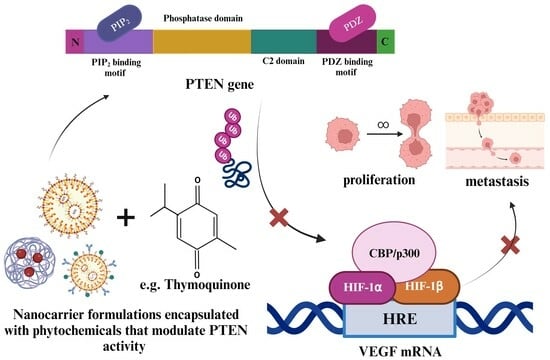
Human malignant melanoma and other solid cancers are largely driven by the inactivation of tumor suppressor genes and angiogenesis. Conventional treatments for cancer (surgery, radiation therapy, and chemotherapy) are employed as first-line treatments for solid cancers but are often ineffective as monotherapies due to resistance and toxicity. Thus, targeted therapies, such as bevacizumab, which targets vascular endothelial growth factor, have been approved by the US Food and Drug Administration (FDA) as angiogenesis inhibitors. The downregulation of the tumor suppressor, phosphatase tensin homolog (PTEN), occurs in 30–40% of human malignant melanomas, thereby elucidating the importance of the upregulation of PTEN activity. Phosphatase tensin homolog (PTEN) is modulated at the transcriptional, translational, and post-translational levels and regulates key signaling pathways such as the phosphoinositide 3-kinase (PI3K)/protein kinase B (Akt) and mitogen-activated protein kinase (MAPK) pathways, which also drive angiogenesis. This review discusses the inhibition of angiogenesis through the upregulation of PTEN and the inhibition of hypoxia-inducible factor 1 alpha (HIF-1-α) in human malignant melanoma, as no targeted therapies have been approved by the FDA for the inhibition of angiogenesis in human malignant melanoma. The emergence of nanocarrier formulations to enhance the pharmacokinetic profile of phytochemicals that upregulate PTEN activity and improve the upregulation of PTEN has also been discussed.
Keywords: cancer; melanoma; angiogenesis; vascular endothelial growth factor; phosphatase tensin homolog; nanocarrier formulations cancer; melanoma; angiogenesis; vascular endothelial growth factor; phosphatase tensin homolog; nanocarrier formulations
Graphical Abstract