


Making Sense of the Growth Behavior of Ultra-High Magnetic Gd2-Doped Silicon Clusters

 ,
,
Abstract
1. Introduction
2. Results and Discussion
2.1. Geometric Structures
2.1.1. Si5-8− and Gd2Si3-6−
2.1.2. Si9-14− and Gd2Si7-12−
2.2. The Growth Behavior of Gd2Sin−
2.3. Simulated Photoelectron Spectrum
2.4. Relative Stability
2.4.1. Average Binding Energy
- (1)
- The binding energy of pure Sin+2− and mixed Gd2Sin− clusters both rise monotonically with increasing dimensions of growing size; however, the binding energy per atom for Sin+2− is slightly higher than Gd2Sin−, suggesting that the stability of two Gd atoms doping is smaller than Sin+2−.
- (2)
- It is interesting to find that Gd2Si5− and Gd2Si8− have a relatively steep upward trend along with increasing dimensions of growing size, signifying that Gd2Si5− and Gd2Si8− are the most stable clusters in the range researched here.
2.4.2. Second Order Difference Energy
- (1)
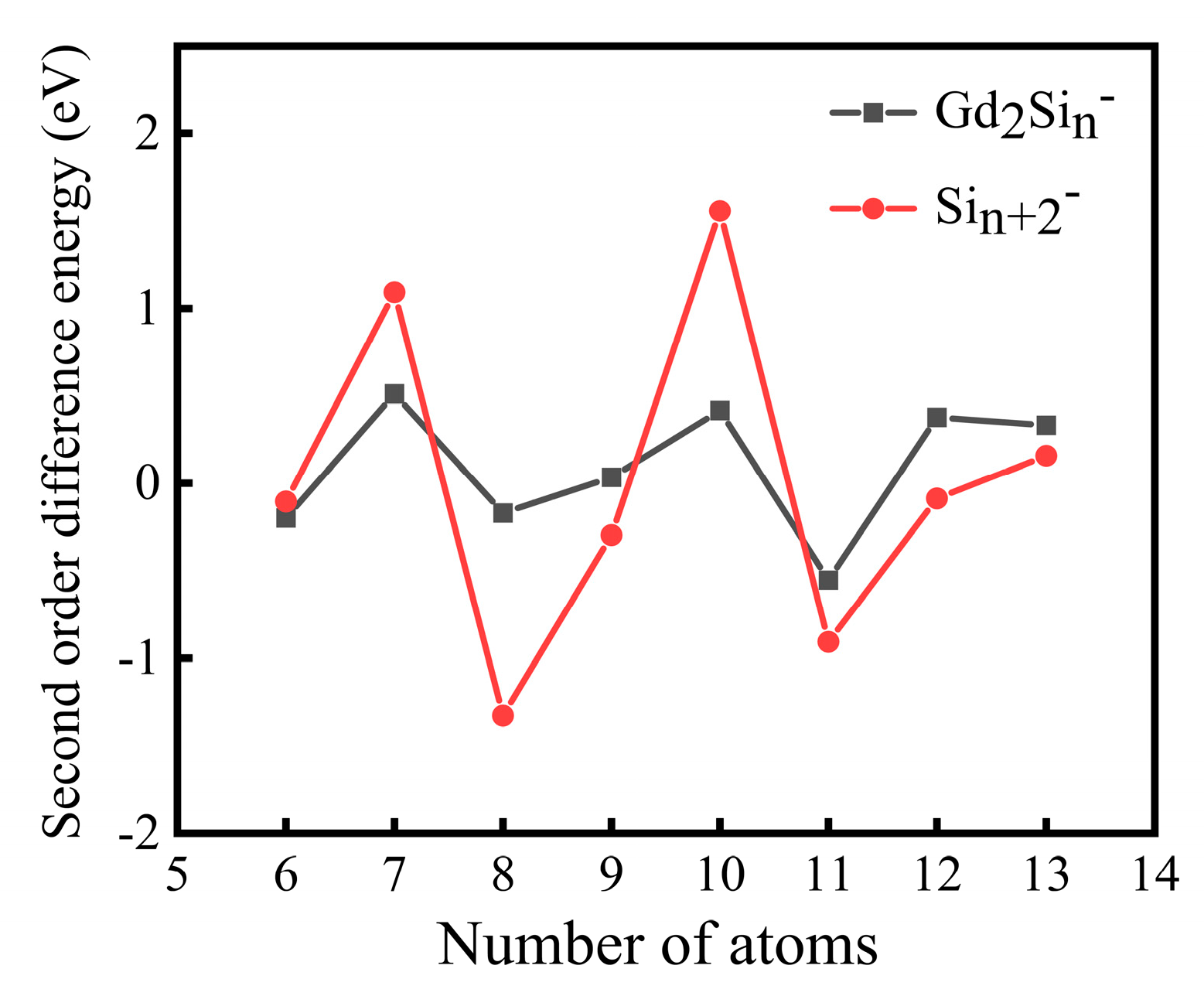
- The second difference energy of Sin+2− and Gd2Sin− as a function of the cluster size exhibits a pronounced even–odd alternation phenomenon.
- (2)
- The relative stabilities of Gd2Si5− and Gd2Si8− are quite strong among all the clusters in terms of second order difference energy.
- (3)
- We could easily screen out the magic clusters (Gd2Si5−) with the help of results of second order difference energy.
2.5. Magnetic Properties and Natural Atomic Orbital
2.6. Bonding Analysis
3. Computational Methods
4. Conclusions
- (1)
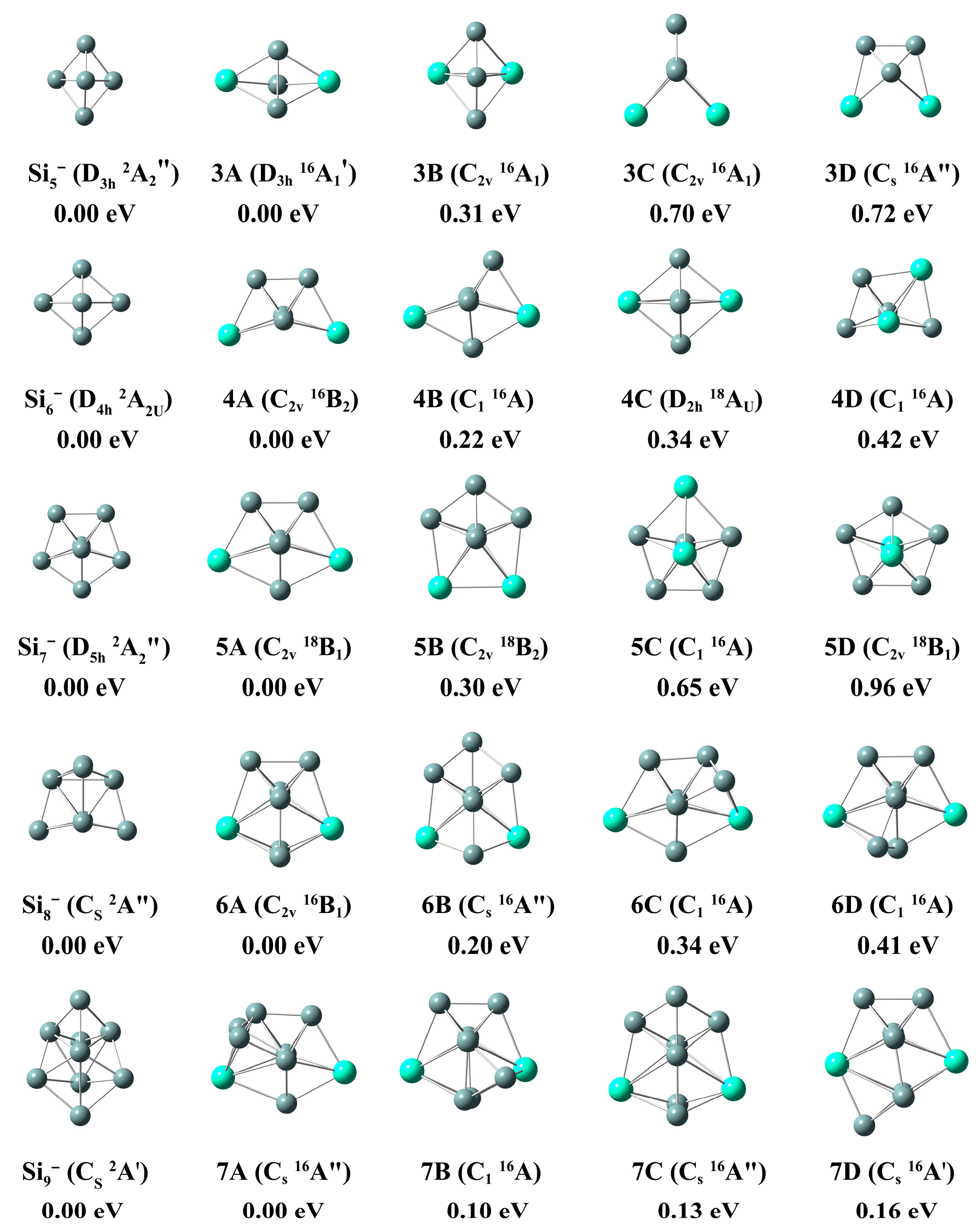
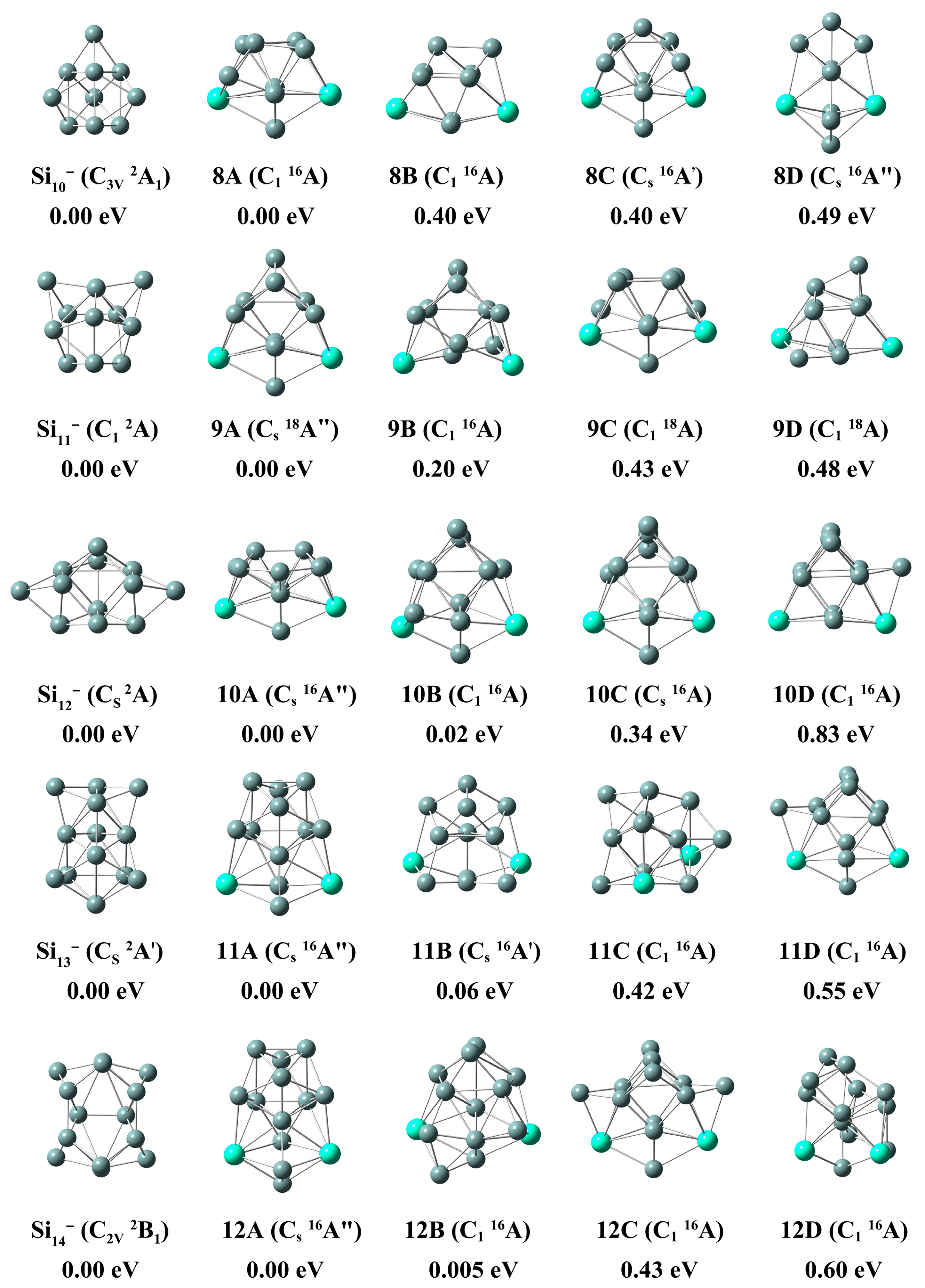
- The doped double Gd atoms do not play an important role in geometric structures in small clusters Sin− (n ≤ 6), but they contribute largely to the equilibrium structures from n = 7 to n = 12. More interestingly, the PB can be observed in the basic framework for the growth process of Gd2Sin− (n = 5–12).
- (2)
- The result of NAO reveals that the induction of bimetallic Gd2 atoms provides great magnetic moments, which suggests that it may assemble magnetic semiconductor materials by using double Gd-atom-doped Si-based clusters as building blocks.
- (3)
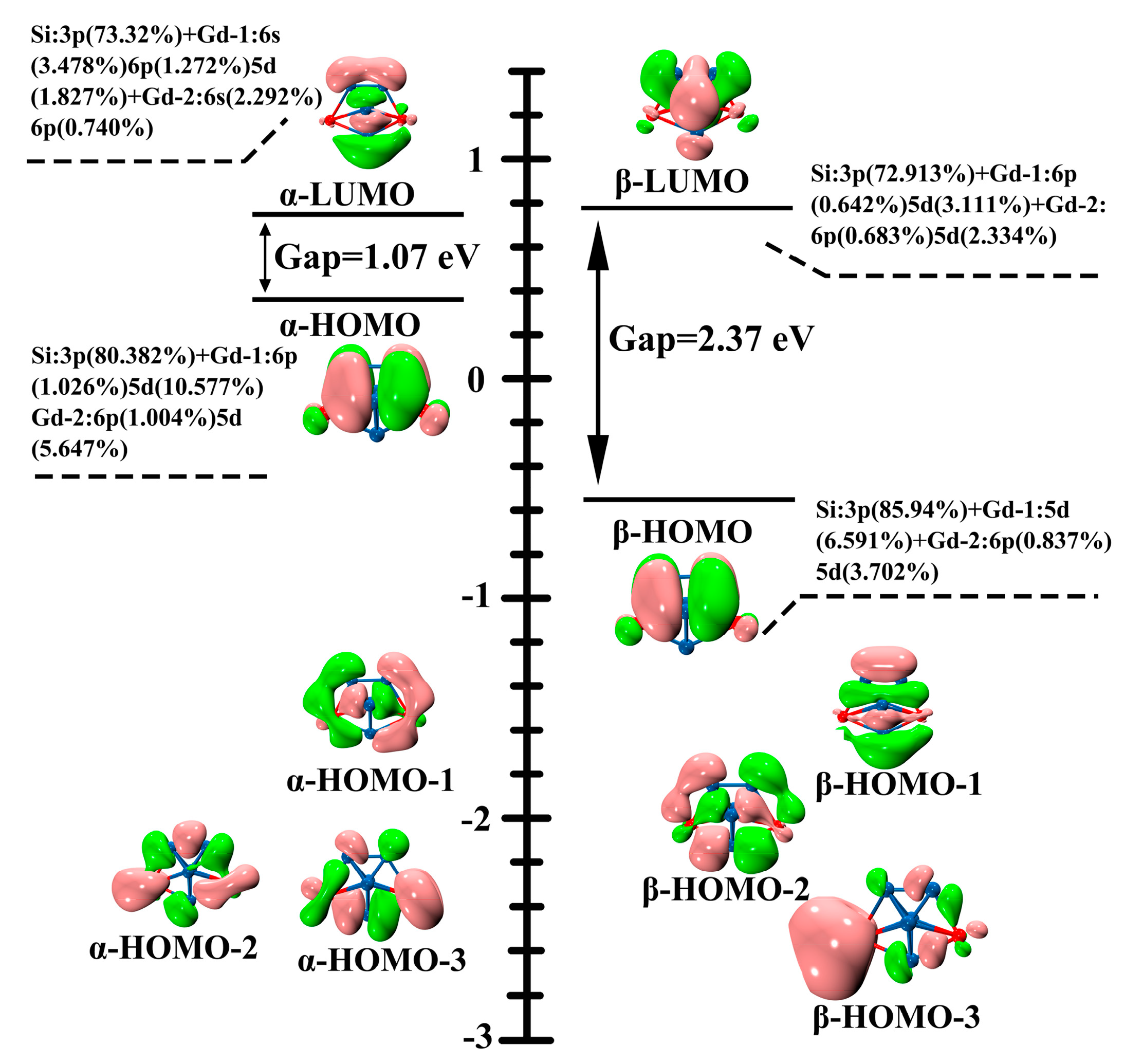
- According to the energetic stability, Gd2Si5− is determined to the most stable cluster among the size n = 3–12. The frontier molecular orbitals also illustrate the high stability.
- (4)
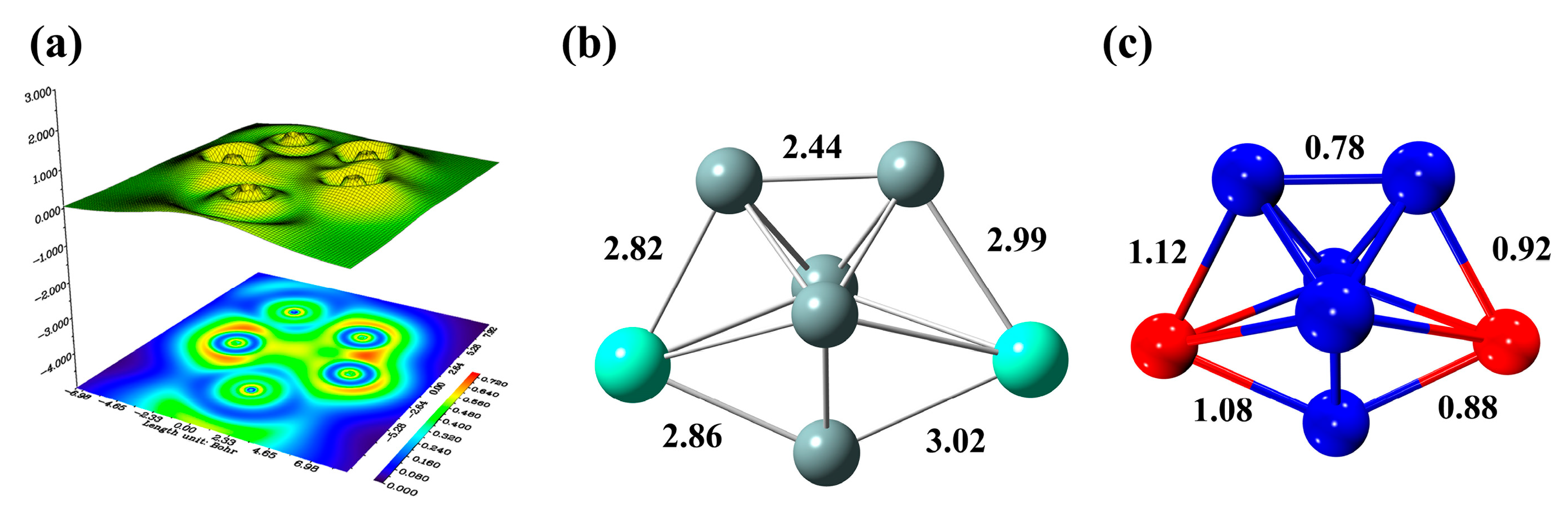
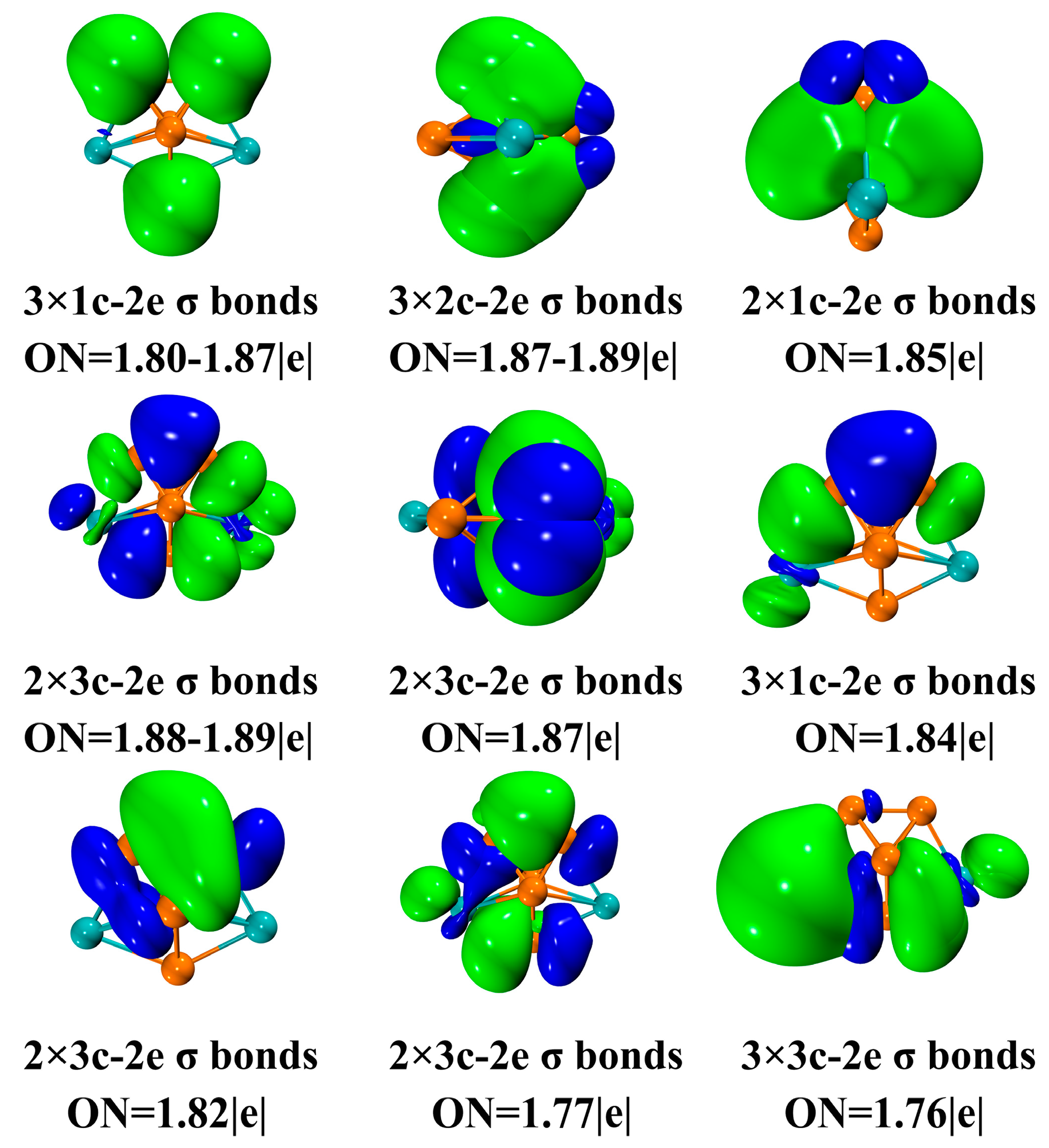
- The LOL and AdNDP reveal that the stabilization mechanism of Gd2Si5− is due to strong covalent bonding interactions between Gd and Si atoms.
Supplementary Materials
Author Contributions
Funding
Institutional Review Board Statement
Informed Consent Statement
Data Availability Statement
Acknowledgments
Conflicts of Interest
Sample Availability
References
- Uchiyama, T.; Nakamura, T.; Hiyama, M.; Kudo, T. Theoretical study of Si/C equally mixed dodecahedrane analogues. Molecules 2023, 28, 2769. [Google Scholar] [CrossRef] [Scilit] [PubMed]
- Khanna, V.; McGrady, J.E. Mn-2 dimers encapsulated in silicon cages: A complex challenge to MC-SCF theory. Molecules 2022, 27, 7544. [Google Scholar] [CrossRef] [Scilit] [PubMed]
- Duan, X.F.F.; Burggraf, L.W.; Huang, L.Y. Searching for stable SinCn clusters: Combination of stochastic potential surface search and pseudopotential Plane-Wave Car-Parinello simulated annealing simulations. Molecules 2013, 18, 8591–8606. [Google Scholar] [CrossRef] [Scilit]
- Lu, C.; Kuang, X.Y.; Lu, Z.W.; Mao, A.J.; Ma, Y.M. Determination of structures, stabilities, and electronic properties for bimetallic cesium-doped gold clusters. J. Phys. Chem. A 2011, 115, 9273–9281. [Google Scholar]
- Chen, Y.; Deng, J.-J.; Yao, W.-W.; Gurti, J.I.; Li, W.; Wang, W.-J.; Yao, J.-X.; Ding, X.-L. Non-stoichiometric molybdenum sulfide clusters and their reactions with the hydrogen molecule. Phys. Chem. Chem. Phys. 2021, 23, 347–355. [Google Scholar] [CrossRef] [Scilit]
- Farooq, U.; Naz, S.; Xu, H.G.; Yang, B.; Xu, X.L.; Zheng, W.J. Recent progress in theoretical and experimental studies of metal-doped silicon clusters: Trend among elements of periodic table. Coord. Chem. Rev. 2020, 403, 213095. [Google Scholar] [CrossRef] [Scilit]
- Kawaguchi, T.; Tanigaki, K.; Yasukawa, M. Silicon clathrate with an f-electron system. Phys. Rev. Lett. 2000, 85, 3189–3192. [Google Scholar] [CrossRef] [Scilit]
- Ohara, M.; Miyajima, K.; Pramann, A.; Nakajima, A.; Kaya, K. Geometric and electronic structures of terbium-silicon mixed clusters (TbSin; 6 ≤ n ≤ 16). J. Phys. Chem. A 2002, 106, 3702–3705. [Google Scholar] [CrossRef] [Scilit]
- Ohara, M.; Koyasu, K.; Nakajima, A.; Kaya, K. Geometric and electronic structures of metal (M)-doped silicon clusters (M = Ti, Hf, Mo and W). Chem. Phys. Lett. 2003, 371, 490–497. [Google Scholar] [CrossRef] [Scilit]
- Koyasu, K.; Atobe, J.; Furuse, S.; Nakajima, A. Anion photoelectron spectroscopy of transition metal- and lanthanide metal-silicon clusters: MSin− (n = 6–20). J. Chem. Phys. 2008, 129, 214301. [Google Scholar] [CrossRef] [Scilit]
- Kumar, V.; Kawazoe, Y. Metal-encapsulated fullerenelike and cubic caged clusters of silicon. Phys. Rev. Lett. 2001, 87, 045503. [Google Scholar] [CrossRef] [Scilit]
- Kumar, V. Predictions of novel nanostructures of silicon by metal encapsulation. Comput. Mater. Sci. 2004, 30, 260–268. [Google Scholar] [CrossRef] [Scilit]
- Kumar, V. Alchemy at the nanoscale: Magic heteroatom clusters and assemblies. Comput. Mater. Sci. 2006, 36, 1–11. [Google Scholar] [CrossRef] [Scilit]
- Zheng, W.J.; Nilles, J.M.; Radisic, D.; Bowen, K.H. Photoelectron spectroscopy of chromium-doped silicon cluster anions. J. Chem. Phys. 2005, 122, 71101. [Google Scholar] [CrossRef] [Scilit]
- Hiura, H.; Miyazaki, T.; Kanayama, T. Formation of metal-encapsulating Si cage clusters. Phys. Rev. Lett. 2001, 86, 1733–1736. [Google Scholar] [CrossRef] [Scilit]
- Ishimaru, M. Molecular-dynamics study on atomistic structures of amorphous silicon. J. Phys. Condens. Matter 2001, 13, 4181–4189. [Google Scholar] [CrossRef] [Scilit]
- De Padova, P.; Quaresima, C.; Olivieri, B.; Perfetti, P.; Le, L.G. sp2-like hybridization of silicon valence orbitals in silicene nanoribbons. Appl. Phys. Lett. 2011, 98, 081909. [Google Scholar] [CrossRef] [Scilit]
- Chen, Y.Q.; Yang, J.C.; Dong, C.X. Structural and electronic properties of nanosize semiconductor CeSin0/− (n = 4–20) material: A double-hybrid density functional theory investigation. Comput. Theor. Chem. 2019, 1170, 112635. [Google Scholar] [CrossRef] [Scilit]
- Grubisic, A.; Ko, Y.J.; Wang, H.; Bowen, K.H. Photoelectron spectroscopy of lanthanide-silicon cluster anions LnSin− (3 ≤ n ≤13; Ln = Ho, Gd, Pr, Sm, Eu, Yb): Prospect for magnetic silicon-based clusters. J. Am. Chem. Soc. 2009, 131, 10783–10790. [Google Scholar] [CrossRef] [Scilit]
- Janssens, E.; Gruene, P.; Meijer, G.; Woste, L.; Lievens, P.; Fielicke, A. Argon physisorption as structural probe for endohedrally doped silicon clusters. Phys. Rev. Lett. 2007, 99, 063401. [Google Scholar] [CrossRef] [Scilit]
- Zhao, J.; Du, Q.; Zhou, S.; Kumar, V. Endohedrally doped cage clusters. Chem. Rev. 2020, 120, 9021–9163. [Google Scholar] [CrossRef] [Scilit] [PubMed]
- Liu, Y.; Yang, J.C.; Cheng, L. Structural stability and evolution of scandium-doped silicon clusters: Evolution of linked to encapsulated structures and its influence on the prediction of electron affinities for ScSin (n = 4–16) clusters. Inorg. Chem. 2018, 57, 12934–12940. [Google Scholar] [CrossRef] [Scilit] [PubMed]
- Zhang, S.; Wu, J.H.; Cui, J.W.; Lu, C.; Zhou, P.P.; Lu, Z.W.; Li, G.Q. Geometries, Stabilities and electronic properties of beryllium-silicon Be2Sin clusters. J. Mol. Model. 2014, 20, 2242. [Google Scholar] [CrossRef] [Scilit] [PubMed]
- Lu, S.J.; Cao, G.J.; Xu, X.L.; Xu, H.G.; Zheng, W.J. The structural and electronic properties of NbSin−/0 (n = 3–12) clusters: Anion photoelectron spectroscopy and ab initio calculations. Nanoscale 2016, 8, 19769–19778. [Google Scholar] [CrossRef] [Scilit] [PubMed]
- Beck, S.M. Studies of silicon cluster–metal atom compound formation in a supersonic molecular beam. J. Chem. Phys. 1987, 87, 4233–4234. [Google Scholar] [CrossRef] [Scilit]
- Dolg, M.; Stoll, H.; Preuss, H. Energy-adjusted ab initio pseudopotentials for the rare earth elements. J. Chem. Phys. 1989, 90, 1730–1734. [Google Scholar] [CrossRef] [Scilit]
- Gu, M.; Tang, T.B.; Feng, D. C60 with complete pentagon orientational ordering: A dielectric and 13C NMR study of solid C60 charged with NO. Phys. Rev. B 2002, 66, 073404. [Google Scholar] [CrossRef] [Scilit]
- Huang, X.M.; Xu, H.G.; Lu, S.J.; Su, Y.; King, R.B.; Zhao, J.J.; Zheng, W.J. Discovery of a silicon-based ferrimagnetic wheel structure in VxSi12− (x = 1–3) clusters: Photoelectron spectroscopy and density functional theory investigation. Nanoscale 2014, 6, 14617–14621. [Google Scholar] [CrossRef] [Scilit]
- Li, Y.J.; Tam, N.M.; Claes, P.; Woodham, A.P.; Lyon, J.T.; Ngan, V.T.; Nguyen, M.T.; Lievens, P.; Fielicke, A.; Janssens, E. Structure assignment, electronic properties, and magnetism quenching of endohedrally doped neutral silicon clusters, SinCo (n = 10–12). J. Phys. Chem. A 2014, 118, 8198–8203. [Google Scholar] [CrossRef] [Scilit]
- Yang, B.; Xu, X.L.; Xu, H.G.; Farooq, U.; Zheng, W.J. Structural evolution and electronic properties of CoSin− (n = 3–12) clusters: Mass-selected anion photoelectron spectroscopy and quantum chemistry calculations. Phys. Chem. Chem. Phys. 2019, 21, 6207–6215. [Google Scholar] [CrossRef] [Scilit]
- Zwijnenburg, M.A.; Bromley, S.T.; van Alsenoy, C.; Maschmeyer, T. Factors affecting ionicity in all-silica materials: A density functional cluster study. J. Phys. Chem. A 2002, 106, 12376–12385. [Google Scholar] [CrossRef] [Scilit]
- Yang, J.C.; Feng, Y.; Xie, X.; Wu, H.; Liu, Y. Gadolinium-doped silicon clusters GdSin (n = 2–9) and their anions: Structures, thermochemistry, electron affinities, and magnetic moments. Theor. Chem. Acc. 2016, 135, 204. [Google Scholar] [CrossRef] [Scilit]
- Peng, Q.; Shen, J. Growth behavior of La@Sin (n = 1–21) metal-encapsulated clusters. J. Chem. Phys. 2008, 128, 084711. [Google Scholar] [CrossRef] [Scilit]
- Grubisic, A.; Wang, H.; Ko, Y.J.; Bowen, K.H. Photoelectron spectroscopy of europium-silicon cluster anions, EuSin− (3≤ n ≤17). J. Chem. Phys. 2008, 129, 054302. [Google Scholar] [CrossRef] [Scilit]
- Hang, D.; Hung, M.; Nguyen, M.T. Structural assignment, and electronic and magnetic properties of lanthanide metal doped silicon heptamers Si7M0/− with M = Pr, Gd and Ho. Phys. Chem. Chem. Phys. 2016, 18, 31054–31063. [Google Scholar] [CrossRef] [Scilit]
- Raghavachari, K.; Rohlfing, C.M. Bonding and stabilities of small silicon clusters: A theoretical study of Si7–Si1. J. Chem. Phys. 1988, 89, 2219–2234. [Google Scholar] [CrossRef] [Scilit]
- Lyon, J.T.; Gruene, P.; Fielicke, A.; Meijer, G.; Janssens, E.; Claes, P.; Lievens, P. Structures of silicon cluster cations in the gas phase. J. Am. Chem. Soc. 2009, 131, 1115–1121. [Google Scholar] [CrossRef] [Scilit]
- Zhao, L.Z.; Lu, W.C.; Qin, W.; Zang, Q.J.; Ho, K.M.; Wang, C.Z. Theoretical prediction of Si2–Si33 absorption spectra. J. Phys. Chem. A 2017, 121, 6388–6397. [Google Scholar] [CrossRef] [Scilit]
- Robles, R.; Khanna, S.N. Stable T2Sin (T = Fe, Co, Ni, 1 ≤ n ≤ 8) cluster motifs. J. Chem. Phys. 2009, 130, 164313. [Google Scholar] [CrossRef] [Scilit]
- Robles, R.; Khanna, S.N.; Castleman, A.W. Stability and magnetic properties of T2Sin (T = Cr, Mn, 1 ≤ n ≤ 8) clusters. Phys. Rev. B 2008, 77, 235441. [Google Scholar] [CrossRef] [Scilit]
- Lu, S.J.; Xu, X.L.; Xu, H.G.; Zheng, W.J. Structural evolution and bonding properties of Au2Sin−/0 (n = 1–7) clusters: Anion photoelectron spectroscopy and theoretical calculations. J. Chem. Phys. 2018, 148, 244306. [Google Scholar] [CrossRef] [Scilit] [PubMed]
- Lu, S.J.; Xu, H.G.; Xu, X.L.; Zheng, W.J. Anion photoelectron spectroscopy and theoretical investigation on Nb2Sin−/0 (n = 2–12) clusters. J. Phys. Chem. C 2017, 121, 11851–11861. [Google Scholar] [CrossRef] [Scilit]
- Han, J.G.; Zhao, R.N.; Duan, Y.H. Geometries, stabilities, and growth patterns of the bimetal Mo2-doped Sin (n = 9–16) clusters: A density functional investigation. J. Phys. Chem. A 2007, 111, 2148–2155. [Google Scholar] [CrossRef] [Scilit]
- Bista, D.; Reber, A.C.; Chauhan, V.; Khanna, S.N. Electronic and magnetic properties of Fe2Sin (1 ≤ n ≤ 12)+/0/− clusters. Chem. Phys. Lett. 2018, 706, 113–119. [Google Scholar] [CrossRef] [Scilit]
- Tozer, D.J.; Handy, N.C. Improving virtual Kohn–Sham orbitals and eigenvalues: Application to excitation energies and static polarizabilities. J. Chem. Phys. 1998, 109, 10180–10189. [Google Scholar] [CrossRef] [Scilit]
- Adamo, C.; Barone, V. Toward reliable density functional methods without adjustable parameters: The PBE0 model. J. Chem. Phys. 1999, 110, 6158–6170. [Google Scholar] [CrossRef] [Scilit]
- Frisch, M.J.; Trucks, G.W.; Schlegel, H.B.; Scuseria, G.E.; Robb, M.A.; Cheeseman, J.R.; Scalmani, G.; Barone, V.; Mennucci, B.; Petersson, G.A.; et al. Gaussian 09, Revision C.01; Gaussian Inc.: Wallingford, CT, USA, 2010. [Google Scholar]
- Saunders, M. Stochastic search for isomers on a quantum mechanical surface. J. Comput. Chem. 2004, 25, 621–626. [Google Scholar] [CrossRef] [Scilit]
- Wang, H.Q.; Li, H.F. Probing the structural and electronic properties of al-doped small niobium clusters. Chem. Phys. Lett. 2012, 554, 231–235. [Google Scholar] [CrossRef] [Scilit]
- Zhang, J.; Dolg, M. Abcluster: The artificial bee colony algorithm for cluster global optimization. Phys. Chem. Chem. Phys. 2015, 17, 24173–24181. [Google Scholar] [CrossRef] [Scilit]
- Li, H.F.; Wang, H.Q. Stabilization of golden cages by encapsulation of a single transition metal atom. R. Soc. Open Sci. 2018, 5, 171019. [Google Scholar] [CrossRef] [Scilit]
- Fan, Y.W.; Wang, H.Q.; Li, H.F. Probing the structural and electronic properties of anionic europium-doped silicon clusters by density functional theory and comparison of experimental photoelectron spectroscopy. Chem. Phys. 2020, 538, 110918. [Google Scholar] [CrossRef] [Scilit]
- Fan, Y.W.; Wang, H.Q.; Li, H.F. Structural and electronic properties of exohedrally doped neutral silicon clusters LnSin (n = 5, 10; Ln = Sm, Eu, Yb). Phys. Chem. Chem. Phys. 2020, 22, 20545–20552. [Google Scholar] [CrossRef] [Scilit]
- Fan, Y.W.; Kong, X.Y.; Zhao, L.J.; Wang, H.Q.; Li, H.F.; Zhan, Q.; Xie, B.; Xu, H.G.; Zheng, W.J. A joint experimental and theoretical study on structural, electronic, and magnetic properties of MnGen− (n = 3–14) clusters. J. Chem. Phys. 2021, 154, 204302. [Google Scholar] [CrossRef] [Scilit]
- Xie, B.; Wang, H.Q.; Li, H.F.; Zeng, J.K. Structural and electronic properties of Ln2Si6q: (Sm, Eu, Yb; q = 0, −1) clusters. Chem. Phys. 2023, 566, 111782. [Google Scholar] [CrossRef] [Scilit]
- Dolg, M.; Stoll, H.; Preuss, H. A combination of quasirelativistic pseudopotential and ligand field calculations for lanthanoid compounds. Theor. Chim. Acta 1993, 85, 441–450. [Google Scholar] [CrossRef] [Scilit]
- McLean, A.; Chandler, G. Contracted gaussian basis sets for molecular calculations. I. Second row atoms, z = 11–18. J. Chem. Phys. 1980, 72, 5639–5648. [Google Scholar] [CrossRef] [Scilit]
- Cao, X.; Dolg, M. Segmented contraction scheme for small-core lanthanide pseudopotential basis sets. J. Molec. Struct. Theochem. 2002, 581, 139–147. [Google Scholar] [CrossRef] [Scilit]
- Lee, C.; Yang, W.; Parr, R.G. Development of the Colle-Salvetti correlation-energy into a function of the electron density. Phys. Rev. B Condens. Matter 1988, 37, 785–789. [Google Scholar] [CrossRef] [Scilit]
- Perdew, J.P.; Burke, K.; Ernzerhof, M. Generalized gradient approximation made simple. Phys. Rev. Lett. 1996, 77, 3865–3868. [Google Scholar] [CrossRef] [Scilit]
- Staroverov, V.N.; Scuseria, G.E.; Tao, J.; Perdew, J.P. Erratum: Comparative assessment of a new nonempirical density functional: Molecules and hydrogen-bonded complexes. J. Chem. Phys. 2004, 121, 11507. [Google Scholar] [CrossRef] [Scilit]
- Becke, A.D. Density-functional exchange-energy approximation with correct asymptotic behavior. Phys. Rev. A Gen. Phys. 1988, 38, 3098–3100. [Google Scholar] [CrossRef] [Scilit] [PubMed]
- Bandyopadhyay, D. Architectures, electronic structures, and stabilities of Cu-doped Gen clusters: Density functional modeling. J. Mol. Model. 2012, 18, 3887–3902. [Google Scholar] [CrossRef] [Scilit]
- Schmider, H.L.; Becke, A.D. Chemical content of the kinetic energy density. J. Mol. Struct. THEOCHEM 2000, 527, 51–61. [Google Scholar] [CrossRef] [Scilit]
- Zubarev, D.Y.; Boldyrev, A.I. Developing paradigms of chemical bonding: Adaptive natural density partitioning. Phys. Chem. Chem. Phys. 2008, 10, 5207–5217. [Google Scholar] [CrossRef] [Scilit] [PubMed]
- Lu, T.; Chen, F.W. Comparison of computational methods for atomic charges. Acta Phys. Chim. Sin. 2012, 28, 1–18. [Google Scholar]
- Lu, T.; Chen, F.W. Meaning and Functional Form of the Electron Localization Function. Acta Phys. Chim. Sin. 2011, 27, 2786–2792. [Google Scholar]
- Humphrey, W.; Dalke, A.; Schulten, K. VMD: Visual molecular dynamics. J. Mol. Graph. 1996, 14, 33–38. [Google Scholar] [CrossRef] [Scilit]
Disclaimer/Publisher’s Note: The statements, opinions and data contained in all publications are solely those of the individual author(s) and contributor(s) and not of MDPI and/or the editor(s). MDPI and/or the editor(s) disclaim responsibility for any injury to people or property resulting from any ideas, methods, instructions or products referred to in the content. |
© 2023 by the authors. Licensee MDPI, Basel, Switzerland. This article is an open access article distributed under the terms and conditions of the Creative Commons Attribution (CC BY) license (https://creativecommons.org/licenses/by/4.0/).
Share and Cite
Xie, B.; Wang, H.-Q.; Li, H.-F.; Zhang, J.-M.; Zeng, J.-K.; Mei, X.-J.; Zhang, Y.-H.; Zheng, H.; Qin, L.-X. Making Sense of the Growth Behavior of Ultra-High Magnetic Gd2-Doped Silicon Clusters. Molecules 2023, 28, 5071. https://doi.org/10.3390/molecules28135071
Xie B, Wang H-Q, Li H-F, Zhang J-M, Zeng J-K, Mei X-J, Zhang Y-H, Zheng H, Qin L-X. Making Sense of the Growth Behavior of Ultra-High Magnetic Gd2-Doped Silicon Clusters. Molecules. 2023; 28(13):5071. https://doi.org/10.3390/molecules28135071
Chicago/Turabian StyleXie, Biao, Huai-Qian Wang, Hui-Fang Li, Jia-Ming Zhang, Jin-Kun Zeng, Xun-Jie Mei, Yong-Hang Zhang, Hao Zheng, and Lan-Xin Qin. 2023. "Making Sense of the Growth Behavior of Ultra-High Magnetic Gd2-Doped Silicon Clusters" Molecules 28, no. 13: 5071. https://doi.org/10.3390/molecules28135071
APA StyleXie, B., Wang, H.-Q., Li, H.-F., Zhang, J.-M., Zeng, J.-K., Mei, X.-J., Zhang, Y.-H., Zheng, H., & Qin, L.-X. (2023). Making Sense of the Growth Behavior of Ultra-High Magnetic Gd2-Doped Silicon Clusters. Molecules, 28(13), 5071. https://doi.org/10.3390/molecules28135071

