


Untargeted Phytochemical Profile, Antioxidant Capacity and Enzyme Inhibitory Activity of Cultivated and Wild Lupin Seeds from Tunisia

 , , ,
, , ,  , , , ,
  and
and
Abstract
1. Introduction
2. Results and Discussion
2.1. Semi-Quantitative Analysis of Phenolics, Flavonoids and Anthocyanins Contents
2.2. In Vitro Antioxidant Capacity
2.3. In Vitro Enzyme Inhibition Assays
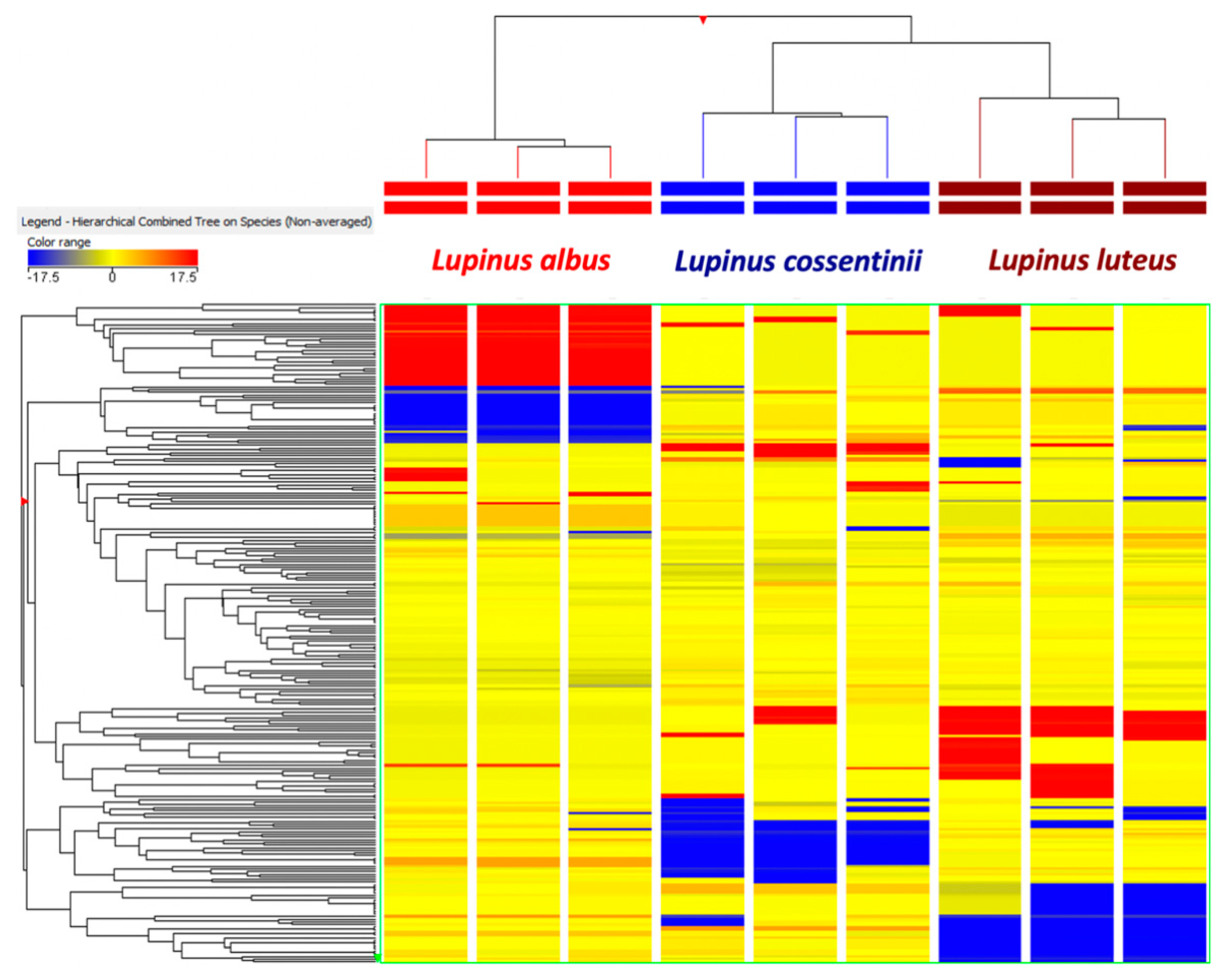
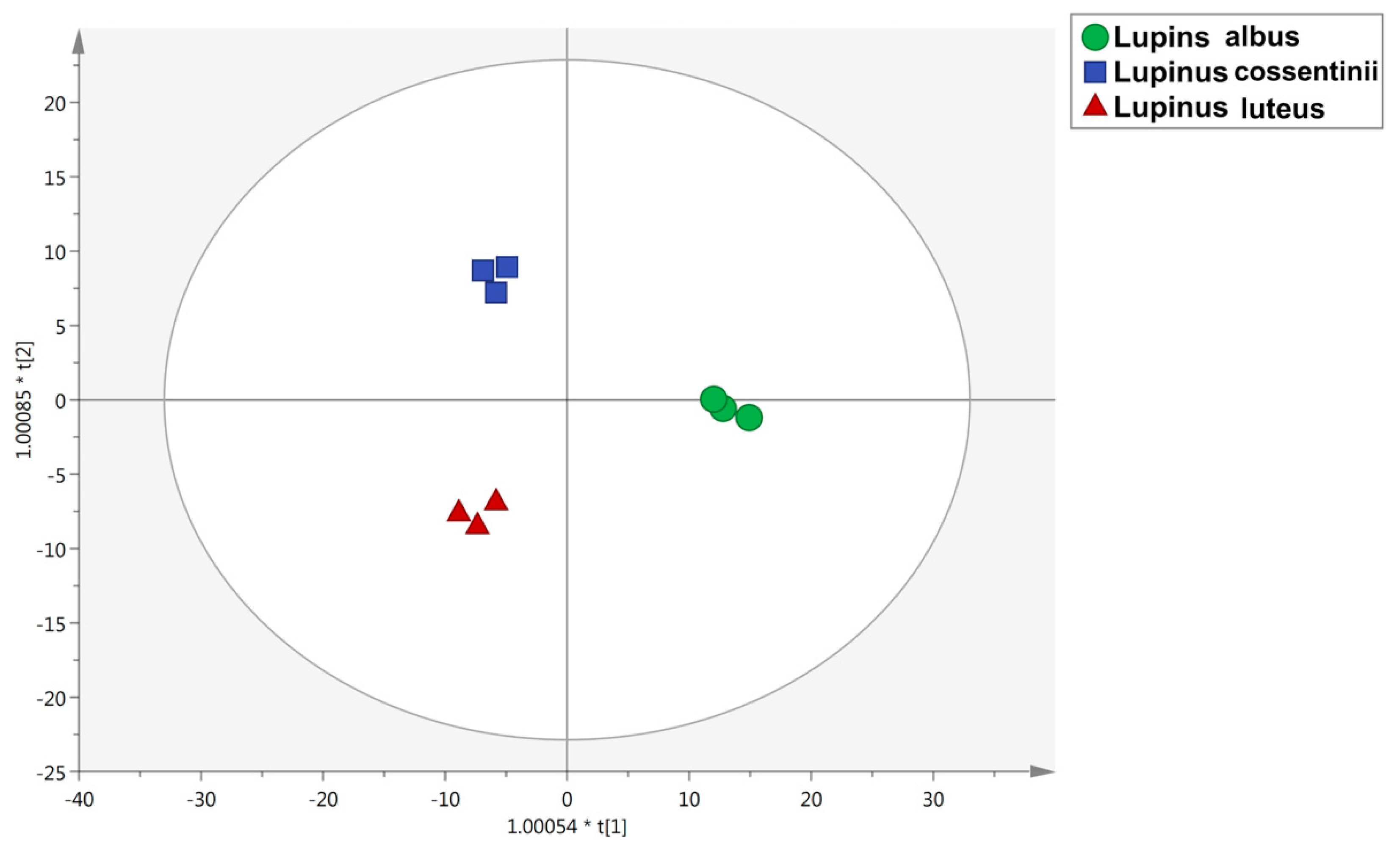
2.4. Untargeted Metabolomic Profile and Discrimination of the Different Lupinus Species
2.5. Pearson Correlations
3. Materials and Methods
3.1. Plant Material
3.2. Extraction of Phytochemicals and Untargeted Profiling by UHPLC-QTOF-Mass Spectrometry
3.3. In Vitro Antioxidant Capacity
3.4. In Vitro Enzyme Inhibitory Assays
3.5. Statistical Analysis
4. Conclusions
Supplementary Materials
Author Contributions
Funding
Institutional Review Board Statement
Informed Consent Statement
Data Availability Statement
Acknowledgments
Conflicts of Interest
Sample Availability
References
- Small, E. 38. Lupins—Benefit and harm potentials. Biodiversity 2012, 13, 54–64. [Google Scholar] [CrossRef] [Scilit]
- Nelson, P.; Hawthorne, W.A. Development of lupins as a crop in Australia. In Linking Research and Marketing Opportunities for Pulses in the 21st Century; Knight, R., Ed.; Springer: Amsterdam, The Netherlands, 2000; pp. 549–559. [Google Scholar]
- White, C.L.; Staines, V.E.; Staines, M.H. A review of the nutritional value of lupins for dairy cows. Aust. J. Agric. Res. 2007, 58, 185–202. [Google Scholar] [CrossRef] [Scilit]
- Guemes-Vera, N.; Martinez-Herrera, J.; Hernandez-Chavez, J.F.; Yanez-Fernandez, J.; Totosaus, A. Comparison of chemical composition and protein digestibility, carotenoids, tanins and alkaloids content of wild lupinus varieties flour. Pak. J. Nutr. 2012, 11, 676–682. [Google Scholar] [CrossRef] [Scilit]
- Górecka, D.; Lampart-Szczapa, E.; Janitz, W.; Sokolowska, B. Composition of fractional and functional properties of dietary fiber of lupines (L. luteus and L. albus). Nahrung 2000, 44, 229–232. [Google Scholar] [CrossRef] [Scilit]
- Boschin, G.; Resta, D. Alkaloids Derived from Lysine: Quinolizidine (a Focus on Lupin Alkaloids). In Natural Products: Phytochemistry, Botany and Metabolism of Alkaloids, Phenolics and Terpenes; Ramawat, K.G., Mérillon, J.-M., Eds.; Springer: Berlin/Heidelberg, Germany, 2013; pp. 381–403. [Google Scholar] [CrossRef] [Scilit]
- Khang, D.T.; Dung, T.N.; Elzaawely, A.A.; Xuan, T.D. Phenolic profiles and antioxidant activity of germinated legumes. Foods 2016, 5, 27. [Google Scholar] [CrossRef] [Scilit] [PubMed]
- Falleh, H.R.; Ksouri, M.; Lucchessi, C.; Abdelly, C.; Magné, C. Ultrasound-assisted extraction: Effect of extraction time and solvent power on the levels of polyphenols and antioxidant activity of Mesembryanthemum edule L. Aizoaceae shoot. Trop. J. Pharm. Res. 2012, 11, 243–249. [Google Scholar] [CrossRef] [Scilit]
- Macheix, J.J.; Fleuriet, A.; Sarni-Manchado, P. Composés phénoliques dans la plante structure, biosynthèse, répartition et rôles. In Les Polyphénols en Agroalimentaire; Sarni-Manchado, P., Cheynier, V., Eds.; Lavoisier: Paris, France, 2006; pp. 1–28. [Google Scholar] [CrossRef] [Scilit]
- Rauf, S.; Ortiz, R.; Shehzad, M.; Haider, W.; Ahmed, I. The exploitation of sunflower (Helianthus annuus L.) seed and other parts for human nutrition, medicine and the industry. Helia 2020, 43, 167–184. [Google Scholar] [CrossRef] [Scilit]
- Sebai, H.; Ben-Attia, M.; Sani, M.; Aouani, E.; Ghanem-Boughanmi, N. Protective effect of resveratrol in endotoxemia-induced acute phase response in rats. Arch. Toxicol. 2009, 83, 335–340. [Google Scholar] [CrossRef] [Scilit] [PubMed]
- Nderitu, A.M.; Dykes, L.; Awika, J.M.; Minnaar, A.; Duodu, K.G. Phenolic composition and inhibitory effect against oxidative DNA damage of cooked cowpeas as affected by simulated in vitro gastrointestinal digestion. Food Chem. 2013, 141, 1763–1771. [Google Scholar] [CrossRef] [Scilit]
- Saadaoui, N.; Weslati, A.; Barkaoui, T.; Khemiri, I.; Gadacha, W.; Souli, A.; Mokni, M.; Harbi, M.; Ben-Attia, M. Gastroprotective effect of leaf extract of two varieties grapevine (Vitis vinifera L.) native wild and cultivar grown in North of Tunisia against the oxidative stress induced by ethanol in rats. Biomarkers 2020, 25, 48–61. [Google Scholar] [CrossRef] [Scilit] [PubMed]
- Sebai, H.; Sani, M.; Yacoubi, M.T.; Aouani, E.; Ghanem-Boughanmi, N.; Ben-Attia, M. Resveratrol, a red wine polyphenol, attenuates lipopolysaccharide-induced oxidative stress in rat liver. Ecotoxicol. Environ. Saf. 2010, 73, 1078–1083. [Google Scholar] [CrossRef] [Scilit] [PubMed]
- Ruiz-López, M.; Barrientos-Ramírez, L.; García-López, P.M.; Valdés-Miramontes, E.; Zamora-Natera, J.F.; Rodríguez-Macías, R.; Salcedo-Pérez, E.; Bañuelos-Pineda, J.; Vargas-Radillo, J.J. Nutritional and bioactive compounds in mexican lupin beans species: A mini-review. Nutrients 2019, 11, 1785. [Google Scholar] [CrossRef] [Scilit] [PubMed]
- Frías, J.; Miranda-Zárate, M.L.; Vidal-Valverde, C. Effect of germination and fermentation in the antioxidant vitamin content and antioxidant capacity of Lupinus albus L., var. Multolupa. Food Chem. 2005, 92, 211–220. [Google Scholar] [CrossRef] [Scilit]
- García-López, P.M.; Kachlicki, P.; Zamora-Natera, F.; Ruiz-Moreno, J.; Stobiecki, M. Profiling isoflavone conjugates in different organs of Lupinus exaltatus Zucc. Phytochem. Anal. 2006, 17, 184–191. [Google Scholar] [CrossRef] [Scilit] [PubMed]
- Kuiper, G.G.; Carlsson, B.; Grandien, K.; Enmark, E.; Haggblad, J.; Nilsson, S.; Gustafsson, J.A. Comparison of the ligand binding specificity and transcript tissue distribution of estrogen receptors alpha and beta. Endocrinology 1997, 138, 863–870. [Google Scholar] [CrossRef] [PubMed]
- Kuiper, G.G.; Lemmen, J.G.; Carlsson, B.; Corton, J.C.; Safe, S.H.; Van Der Saag, P.T.; Van Der Burg, B.; Gustafsson, J.A. Interaction of estrogenic chemicals and phytoestrogens with estrogen receptor beta. Endocrinology 1998, 139, 4252–4263. [Google Scholar] [CrossRef] [PubMed]
- Greig, N.H.; Lahiri, D.K.; Sambamurti, K. Butyrylcholinesterase: An important new target in Alzheimer’s disease therapy. Int. Psychogeriatr. 2002, 14 (Suppl. 1), 77–91. [Google Scholar] [CrossRef] [Scilit]
- Dueñas, M.; Hernández, T.; Estrella, I.; Fernández, D. Germination as a process to increase the polyphenol content and antioxidant activity of lupin seeds (Lupinus angustifolius L.). Food Chem. 2009, 117, 599–607. [Google Scholar] [CrossRef] [Scilit]
- Bojilov, D.; Petkova, Z.; Manolov, S.; Antova, G.; Angelova-Romova, M. Impact of the duration of ultrasound-assisted extraction on total phenolics content and antioxidant activity of lupin seeds. Bulg. Chem. Commun. 2020, 52, 222–226. [Google Scholar]
- Ohadoma, S.C.; Eban, L.K. Antioxidant and free radical scavenger effects of methanol leaf extract of Lupinus arboreus. Eur. J. Biomed. Pharm. Sci. 2018, 5, 70–73. [Google Scholar]
- Papoutsis, K.; Zhang, J.; Bowyer, M.C.; Brunton, N.; Gibney, E.R.; Lyng, J. Fruit, vegetables, and mushrooms for the preparation of extracts with α-amylase and α-glucosidase inhibition properties: A review. Food Chem. 2021, 338, 128119. [Google Scholar] [CrossRef] [Scilit]
- Llorach, R.; Favari, C.; Alonso, D.; Garcia-Aloy, M.; Andres-Lacueva, C.; Urpi-Sarda, M. Comparative metabolite fingerprinting of legumes using LC-MS-based untargeted metabolomics. Food Res. Int. 2019, 126, 108666. [Google Scholar] [CrossRef] [Scilit] [PubMed]
- Sengbusch, R. Von. 1942. Susslupinen und Ollupinen. Die Entstehungsgeschichte einiger neuen Kulturpflanzen. Landw. Jahrb. 1942, 91, 723–880. [Google Scholar]
- Rocchetti, G.; Lucini, L.; Chiodelli, G.; Giuberti, G.; Montesano, D.; Masoero, F.; Trevisan, M. Impact of boiling on free and bound phenolic profile and antioxidant activity of commercial gluten-free pasta. Food Res. Int. 2017, 100, 69–77. [Google Scholar] [CrossRef] [Scilit] [PubMed]
- Gremigni, P.; Wong, M.T.F.; Edwards, N.K.; Harris, D.; Hamblin, J. Potassium nutrition effects on seed alkaloid concentrations, yield and mineral content of lupins (Lupinus angustifolius). Plant Soil 2001, 234, 131–142. [Google Scholar] [CrossRef] [Scilit]
- Jansen, G.; Jürgens, H.U.; Ordon, F. Effects of temperature on the alkaloid content of seeds of Lupinus angustifolius cultivars. J. Agron. Crop Sci. 2009, 195, 172–177. [Google Scholar] [CrossRef] [Scilit]
- Miège, E. La Production des «Lupins doux» Essais entrepris au Maroc. Rev. Bot. Appl. Agric. Colon. 1940, 221, 16–24. [Google Scholar] [CrossRef] [Scilit]
- Siger, A.; Czubinski, J.; Kachlicki, P.; Dwiecki, K.; Lampart-Szczapa, E.; Nogala-Kalucka, M. Antioxidant activity and phenolic content in three lupin species. J. Food Compos. Anal. 2012, 25, 190–197. [Google Scholar] [CrossRef] [Scilit]
- Kim, Y.J.; Uyama, H. Tyrosinase inhibitors from natural and synthetic sources: Structure, inhibition mechanism and perspective for the future. Cell. Mol. Life Sci. 2005, 62, 1707–1723. [Google Scholar] [CrossRef] [Scilit] [PubMed]
- Farzaei, F.; Morovati, M.R.; Farjadmand, F.; Farzaei, M.H. A mechanistic review on medicinal plants used for diabetes mellitus in traditional persian medicine. J. Evid. Based Complement. Altern. Med. 2017, 22, 944–955. [Google Scholar] [CrossRef] [Scilit]
- Stobiecki, M.; Blaszczyk, B.; Kowalczyk-Bronisz, S.H.; Gulewicz, K. The toxicity of seed extracts and their fractions from Lupinus angustifolius L. and Lupinus albus L. J. Appl. Toxicol. 1993, 13, 347–352. [Google Scholar] [CrossRef] [Scilit] [PubMed]
- Karamać, M.; Orak, H.H.; Amarowicz, R.; Orak, A.; Piekoszewski, W. Phenolic contents and antioxidant capacities of wild and cultivated white lupin (Lupinus albus L.) seeds. Food Chem. 2018, 258, 1–7. [Google Scholar] [CrossRef] [Scilit] [PubMed]
- Aryal, S.; Baniya, M.K.; Danekhu, K.; Kunwar, P.; Gurung, R.; Koirala, N. Total phenolic content, flavonoid content and antioxidant potential of wild vegetables from Western Nepal. Plants 2019, 8, 96. [Google Scholar] [CrossRef] [Scilit] [PubMed]
- Bose, B.; Tripathy, D.; Chatterjee, A.; Tandon, P.; Kumaria, S. Secondary metabolite profiling, cytotoxicity, anti-inflammatory potential and in vitro inhibitory activities of Nardostachys jatamansi on key enzymes linked to hyperglycemia, hypertension and cognitive disorders. Phytomedicine 2019, 55, 58–69. [Google Scholar] [CrossRef] [Scilit] [PubMed]
- Mokrani, A.; Cluzet, S.; Madani, K.; Pakina, E.; Gadzhikurbanov, A.; Mesnil, M.; Monvoisin, A.; Richard, T. HPLC-DAD-MS/MS profiling of phenolics from different varieties of peach leaves and evaluation of their antioxidant activity: A comparative study. Int. J. Mass Spectrom. 2019, 445, 116–192. [Google Scholar] [CrossRef] [Scilit]
- Giuberti, G.; Rocchetti, G.; Lucini, L. Interactions between phenolic compounds, amylolytic enzymes and starch: An updated overview. Curr. Opin. Food Sci. 2020, 31, 102–113. [Google Scholar] [CrossRef] [Scilit]
- Verma, A.K.; Pratap, R. The biological potential of flavones. Nat. Prod. Rep. 2010, 27, 1571–1593. [Google Scholar] [CrossRef] [Scilit]
- Senizza, A.; Rocchetti, G.; Mosele, J.I.; Patrone, V.; Callegari, M.L.; Morelli, L.; Lucini, L. Lignans and Gut Microbiota: An Interplay Revealing Potential Health Implications. Molecules 2020, 25, 5709. [Google Scholar] [CrossRef] [Scilit] [PubMed]
- Köse, L.P.; Gulcin, I. Inhibition effects of some lignans on carbonic anhydrase, acetylcholinesterase and butyrylcholinesterase enzymes. Rec. Nat. Prod. 2017, 11, 558–561. [Google Scholar] [CrossRef] [Scilit]
- Cuong, T.D.; Hung, T.M.; Han, H.Y.; Roh, H.S.; Seok, J.H.; Lee, J.K.; Jeong, J.Y.; Choi, J.S.; Kim, J.A.; Min, B.S. Potent acetylcholinesterase inhibitory compounds from Myristica fragrans. Nat. Prod. Commun. 2014, 9, 499–502. [Google Scholar] [CrossRef] [Scilit]
- Tian, S.; Sun, Y.; Chen, Z.; Zhao, R. Bioavailability and bioactivity of alkylresorcinols from different cereal products. J. Food Qual. 2020, 2020, 5781356. [Google Scholar] [CrossRef] [Scilit]
- Parikka, K.; Rowland, I.R.; Welch, R.W.; Wähälä, K. In vitro antioxidant activity and antigenotoxicity of 5-n-alkylresorcinols. J. Agric. Food Chem. 2006, 54, 1646–1650. [Google Scholar] [CrossRef] [Scilit]
- Stasiuk, M.; Bartosiewicz, D.; Kozubek, A. Inhibitory effect of some natural and semisynthetic phenolic lipids upon acetylcholinesterase activity. Food Chem. 2008, 108, 996–1001. [Google Scholar] [CrossRef] [Scilit]
- Lucini, L.; Miras-Moreno, B.; Rouphael, Y.; Cardarelli, M.; Colla, G. Combining molecular weight fractionation and metabolomics to elucidate the bioactivity of vegetal protein hydrolysates in tomato plants. Front. Plant Sci. 2020, 11, 976. [Google Scholar] [CrossRef] [Scilit]
- Rocchetti, G.; Lucini, L.; Corrado, G.; Colla, G.; Cardarelli, M.; Pascale, S.D.; Rouphael, Y. Phytochemical Profile, Mineral Content, and Bioactive Compounds in Leaves of Seed-Propagated Artichoke Hybrid Cultivars. Molecules 2020, 25, 3795. [Google Scholar] [CrossRef] [Scilit] [PubMed]
- Salek, R.M.; Steinbeck, C.; Viant, M.R.; Goodacre, R.; Dunn, W.B. The role of reporting standards for metabolite annotation and identification in metabolomic studies. GigaScience 2013, 2, 13. [Google Scholar] [CrossRef] [Scilit] [PubMed]
- Tsugawa, H.; Cajka, T.; Kind, T.; Ma, Y.; Higgins, B.; Ikeda, K.; Kanazawa, M.; VanderGheynst, J.; Fiehn, O.; Arita, M. MS-DIAL: Data-independent MS/MS deconvolution for comprehensive metabolome analysis. Nat. Methods 2015, 12, 523–526. [Google Scholar] [CrossRef] [Scilit]
- Tsugawa, H.; Kind, T.; Nakabayashi, R.; Yukihira, D.; Tanaka, W.; Cajka, T.; Saito, K.; Fiehn, O.; Arita, M. Hydrogen Rearrangement Rules: Computational MS/MS fragmentation and structure elucidation using MS-FINDER Software. Anal. Chem. 2016, 88, 7946–7958. [Google Scholar] [CrossRef] [Scilit] [PubMed]
- Frick, K.M.; Kamphuis, L.G.; Siddique, K.H.M.; Singh, K.B.; Foley, R.C. Quinolizidine alkaloid biosynthesis in lupins and prospects for grain quality improvement. Front. Plant Sci. 2017, 8, 87. [Google Scholar] [CrossRef] [Scilit] [PubMed]
- Hama, J.R.; Strobel, B.W. Natural alkaloids from narrow-leaf and yellow lupins transfer to soil and soil solution in agricultural fields. Environ. Sci. Eur. 2020, 32, 126–138. [Google Scholar] [CrossRef] [Scilit]
- Grochowski, D.M.; Uysal, S.; Aktumsek, A.; Granica, S.; Zengin, G.; Ceylan, R.; Locatelli, M.; Tomczyk, M. In vitro enzyme inhibitory properties, antioxidant activities, and phytochemical profile of Potentilla thuringiaca. Phytochem. Lett. 2017, 20, 365–372. [Google Scholar] [CrossRef] [Scilit]
- Zengin, G. A study on in vitro enzyme inhibitory properties of Asphodeline anatolica: New sources of natural inhibitors for public health problems. Ind. Crop. Prod. 2016, 83, 39–43. [Google Scholar] [CrossRef] [Scilit]
- Zengin, G.; Sarikurkcu, C.; Aktumsek, A.; Ceylan, R.; Ceylan, O. A comprehensive study on phytochemical characterization of Haplophyllum myrtifolium Boiss. endemic to Turkey and its inhibitory potential against key enzymes involved in Alzheimer, skin diseases and type II diabetes. Ind. Crop. Prod. 2014, 53, 244–251. [Google Scholar] [CrossRef] [Scilit]

| Class | L. albus | L. cossentinii | L. luteus |
|---|---|---|---|
| Anthocyanins | 0.11 ± 0.01 b | 0.13 ± 0.03 b | 0.26 ± 0.08 a |
| Other flavonoids | 0.06 ± 0.005 | 0.13 ± 0.08 | 0.09 ± 0.02 |
| Flavonols | 0.29 ± 0.02 | 0.31 ± 0.13 | 0.30 ± 0.22 |
| Lignans | 0.26 ± 0.04 a | 0.04 ± 0.02 b | 0.10 ± 0.01 b |
| Other phenolics | 0.27 ± 0.03 b | 5.82 ± 0.47 a | 0.79 ± 0.14 b |
| Phenolic acids | 0.15 ± 0.06 | 0.11 ± 0.04 | 0.06 ± 0.01 |
| Total alkaloids | 4.42 ± 0.26 a | 0.84 ± 0.39 b | 3.66 ± 0.73 a |
| Sample | DPPH (mg TE/g) | ABTS (mg TE/g) | CUPRAC (mg TE/g) | FRAP (mg TE/g) | Phosphomolybdenum (mmol TE/g) | Metal Chelating (mg EDTAE/g) |
|---|---|---|---|---|---|---|
| L. albus | 1.92 ± 0.05 b | 17.58 ± 2.51 a | 7.20 ± 0.62 b | 4.44 ± 0.28 ab | 0.47 ± 0.03 a | 3.38 ± 0.04 b |
| L. cossentinii | 3.50 ± 0.22 a | 10.17 ± 1.70 b | 8.95 ± 1.16 a | 5.75 ± 0.65 a | 0.44 ± 0.06 a | 3.55 ± 0.53 b |
| L. luteus | 0.39 ± 0.04 c | 4.67 ± 0.42 c | 7.51 ± 0.07 ab | 4.11 ± 0.04 b | 0.41 ± 0.07 a | 4.68 ± 0.62 a |
| Sample | ACHE Inhibition (mg GALAE/g) | BCHE Inhibition (mg GALAE/g) | Tyrosinase Inhibition (mg KAE/g) | Amylase Inhibition (mmol ACAE/g) |
|---|---|---|---|---|
| L. albus | 0.90 ± 0.09 a | 1.74 ± 0.07 a | 14.48 ± 0.28 b | 0.15 ± 0.01 a |
| L. cossentinii | 1.04 ± 0.02 a | 0.99 ± 0.08 b | 16.27 ± 0.46 a | 0.16 ± 0.01 a |
| L. luteus | 0.93 ± 0.06 a | 0.47 ± 0.10 c | 15.65 ± 0.74 a | 0.16 ± 0.01 a |
Publisher’s Note: MDPI stays neutral with regard to jurisdictional claims in published maps and institutional affiliations. |
© 2021 by the authors. Licensee MDPI, Basel, Switzerland. This article is an open access article distributed under the terms and conditions of the Creative Commons Attribution (CC BY) license (https://creativecommons.org/licenses/by/4.0/).
Share and Cite
Ben Hassine, A.; Rocchetti, G.; Zhang, L.; Senizza, B.; Zengin, G.; Mahomoodally, M.F.; Ben-Attia, M.; Rouphael, Y.; Lucini, L.; El-Bok, S. Untargeted Phytochemical Profile, Antioxidant Capacity and Enzyme Inhibitory Activity of Cultivated and Wild Lupin Seeds from Tunisia. Molecules 2021, 26, 3452. https://doi.org/10.3390/molecules26113452
Ben Hassine A, Rocchetti G, Zhang L, Senizza B, Zengin G, Mahomoodally MF, Ben-Attia M, Rouphael Y, Lucini L, El-Bok S. Untargeted Phytochemical Profile, Antioxidant Capacity and Enzyme Inhibitory Activity of Cultivated and Wild Lupin Seeds from Tunisia. Molecules. 2021; 26(11):3452. https://doi.org/10.3390/molecules26113452
Chicago/Turabian StyleBen Hassine, Amna, Gabriele Rocchetti, Leilei Zhang, Biancamaria Senizza, Gökhan Zengin, Mohamad Fawzi Mahomoodally, Mossadok Ben-Attia, Youssef Rouphael, Luigi Lucini, and Safia El-Bok. 2021. "Untargeted Phytochemical Profile, Antioxidant Capacity and Enzyme Inhibitory Activity of Cultivated and Wild Lupin Seeds from Tunisia" Molecules 26, no. 11: 3452. https://doi.org/10.3390/molecules26113452
APA StyleBen Hassine, A., Rocchetti, G., Zhang, L., Senizza, B., Zengin, G., Mahomoodally, M. F., Ben-Attia, M., Rouphael, Y., Lucini, L., & El-Bok, S. (2021). Untargeted Phytochemical Profile, Antioxidant Capacity and Enzyme Inhibitory Activity of Cultivated and Wild Lupin Seeds from Tunisia. Molecules, 26(11), 3452. https://doi.org/10.3390/molecules26113452

