Review

Study of Antioxidant Properties of Agents from the Perspective of Their Action Mechanisms

Chemical Technological Institute, Ural Federal University Named after the First President of Russia B. N. Yeltsin, 620002 Ekaterinburg, Russia
*
Author to whom correspondence should be addressed.
Molecules 2020, 25(18), 4251; https://doi.org/10.3390/molecules25184251

Submission received: 12 August 2020 / Revised: 13 September 2020 / Accepted: 15 September 2020 / Published: 16 September 2020
(This article belongs to the Special Issue Antioxidant Activity of Natural Compounds)

Abstract

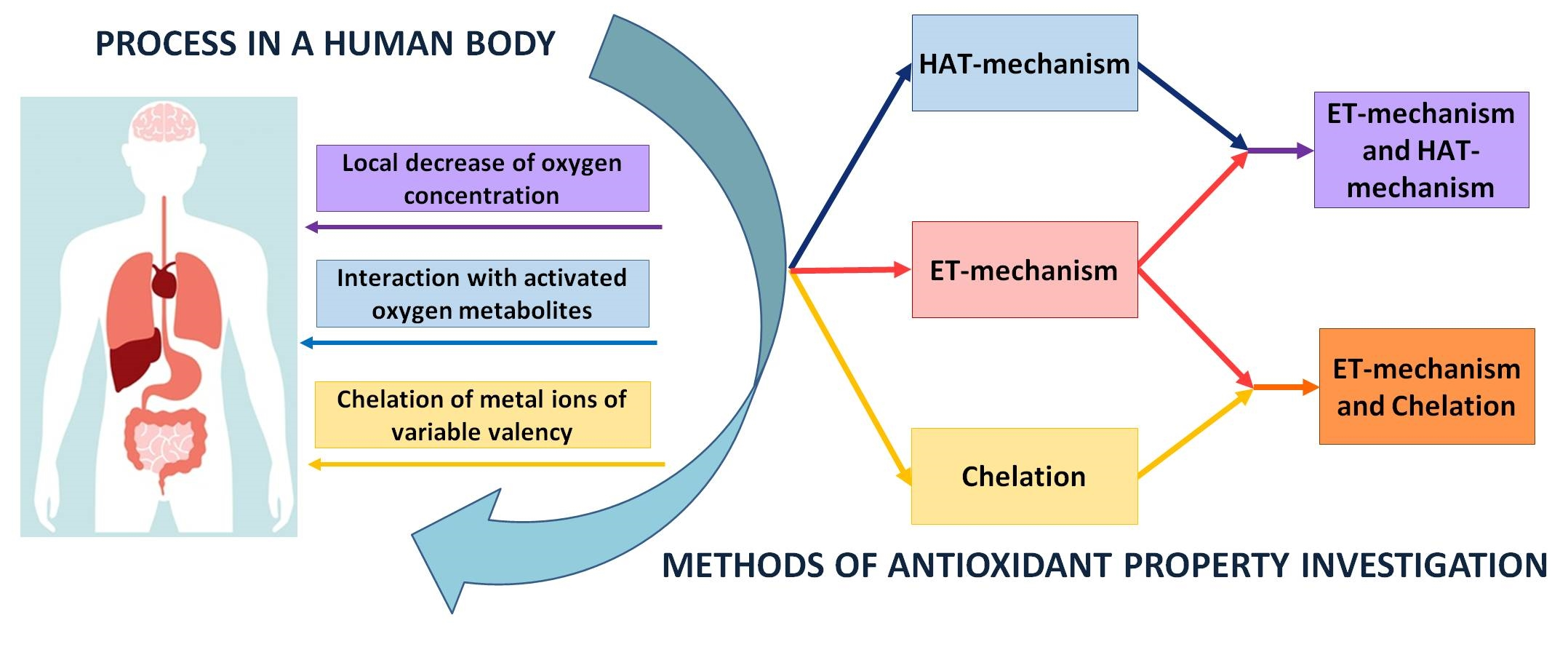
The creation and analysis of a large variety of existing methods for the evaluation of integrated antioxidant properties are quite relevant in connection with a range of biological mechanisms of the antioxidants (AO) action. In this work, the existing methods are correlated with mechanisms of antioxidant action. It is shown that the results obtained by various methods are mainly incomparable. This can be connected with the implementation of various mechanisms of antioxidant action in methods. The analysis of the literature data presented in this review indicates the difficulty of creating a universal method and the feasibility of using integrated approaches based on the use of several methods that implement and combine various mechanisms of the chemical conversion of antioxidants. This review describes methods for studying the chelating ability of antioxidants, except for methods based on electron and hydrogen atom transfer reactions, which are currently not widely covered in modern literature. With the description of each mechanism, special attention is paid to electrochemical methods, as the interaction of active oxygen metabolites of radical and non-radical nature with antioxidants has an electron/proton/donor-acceptor nature, which corresponds to the nature of electrochemical methods and suggests that they can be used to study the interaction.
Keywords: antioxidant capacity; electron-transfer-based assays; hydrogen atom transfer-based assays; chelating-based assays; electrochemical methods antioxidant capacity; electron-transfer-based assays; hydrogen atom transfer-based assays; chelating-based assays; electrochemical methods
Graphical Abstract