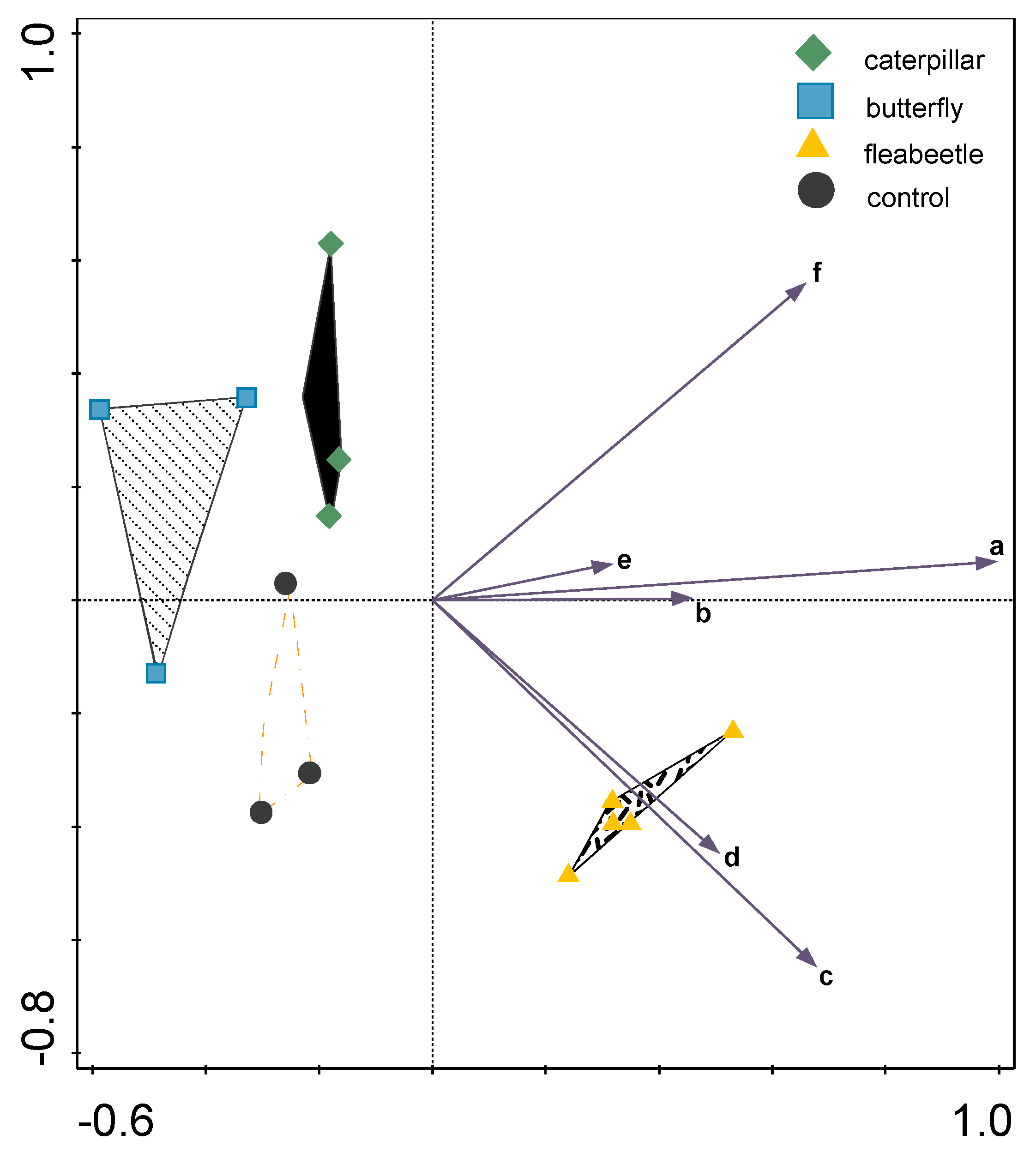
Changes in Content of Polyphenols and Ascorbic Acid in Leaves of White Cabbage after Pest Infestation

 ,
,  , and
, and Abstract
Share and Cite
Kovalikova, Z.; Kubes, J.; Skalicky, M.; Kuchtickova, N.; Maskova, L.; Tuma, J.; Vachova, P.; Hejnak, V. Changes in Content of Polyphenols and Ascorbic Acid in Leaves of White Cabbage after Pest Infestation. Molecules 2019, 24, 2622. https://doi.org/10.3390/molecules24142622
Kovalikova Z, Kubes J, Skalicky M, Kuchtickova N, Maskova L, Tuma J, Vachova P, Hejnak V. Changes in Content of Polyphenols and Ascorbic Acid in Leaves of White Cabbage after Pest Infestation. Molecules. 2019; 24(14):2622. https://doi.org/10.3390/molecules24142622
Chicago/Turabian StyleKovalikova, Zuzana, Jan Kubes, Milan Skalicky, Nikola Kuchtickova, Lucie Maskova, Jiri Tuma, Pavla Vachova, and Vaclav Hejnak. 2019. "Changes in Content of Polyphenols and Ascorbic Acid in Leaves of White Cabbage after Pest Infestation" Molecules 24, no. 14: 2622. https://doi.org/10.3390/molecules24142622
APA StyleKovalikova, Z., Kubes, J., Skalicky, M., Kuchtickova, N., Maskova, L., Tuma, J., Vachova, P., & Hejnak, V. (2019). Changes in Content of Polyphenols and Ascorbic Acid in Leaves of White Cabbage after Pest Infestation. Molecules, 24(14), 2622. https://doi.org/10.3390/molecules24142622