Metabolomics Provides Quality Characterization of Commercial Gochujang (Fermented Pepper Paste)

Abstract
:
1. Introduction
2. Results
2.1. Metabolite Profiling of Commercial Gochujang Samples
2.2. Comparisons of Metabolites, Physicochemical Characteristics, and Antioxidant Activity According to Different Cereal Grains Used in Gochujang
2.3. Metabolite Variations and Antioxidant Activity According to Species of Hot Pepper Used in Gochujang
3. Discussion
4. Materials and Methods
4.1. Chemicals and Reagents
4.2. Sample Preparation
4.2.1. Sample Information
4.2.2. Sample Extraction and Derivatization for Metabolite Profiling
4.3. GC-TOF-MS Analysis
4.4. UHPLC-LTQ-ESI-IT-MS/MS Analysis
4.5. Data Processing and Multivariate Analysis
4.6. Determination of Antioxidant Activity (by ABTS), Total Polyphenol Content (TPC), and Total Flavonoid Content (TFC)
4.7. Analysis of Salinity, pH, Total Acidity, Amino Type Nitrogen, and Reducing Sugar Contents
5. Conclusions
Supplementary Materials
Acknowledgments
Author Contributions
Conflicts of Interest
Abbreviations
| PCA | principal component analysis |
| PLS-DA | partial least squares discriminant analysis |
| OPLS-DA | orthogonal partial least squares discriminant analysis |
| VIP | variable importance in projection |
| MS | mass spectrometry |
| GC-TOF-MS | gas chromatography-time of flight-mass spectrometry |
| UHPLC-LTQ-ESI-IT-MS/MS | ultrahigh performance liquid chromatography-linear trap quadrupole-electrospray ionization-ion trap-MS/MS |
| MSTFA | N-methyl-N-(trimethylsilyl) trifluoroacetamide |
| DNS | dinitrosalicylic acid |
| Trolox | 6-hydroxy-2,5,7,8-tetramethylchroman-2-carboxylic acid |
| ABTS | 2,2′-azinobis(3-ethylbenzothiazoline-6-sulfonic acid)diammonium salt |
| TFC | total flavonoid content |
| TPC | total polyphenolic content |
| TEAC | Trolox equivalent activity concentration |
| NE | naringin equivalent |
| GAE | gallic acid equivalent |
| CA | C. annuum |
| CAY | C. annuum cv. Chung-yang |
| CF | C. frutescens |
| WG | wheat gochujang |
| RG | rice gochujang |
| RbG | brown rice gochujang |
| RwG | white rice gochujang |
| RbG-CA | brown rice gochujang containing C. annuum |
| RbG-CAY | brown rice gochujang containing C. annuum cv. Chung-yang |
| RwG-CA | white rice gochujang containing C. annuum |
| RwG-CF | white rice gochujang containing C. frutescens |
References
- Roberfroid, M.B. Concepts and strategy of functional food science: The European perspective. Am. J. Clin. Nutr. 2000, 71, 1660s–1664s. [Google Scholar] [PubMed]
- Oms-Oliu, G.; Odriozola-Serrano, I.; Martín-Belloso, O. Metabolomics for assessing safety and quality of plant-derived food. Food Res. Int. 2013, 54, 1172–1183. [Google Scholar] [CrossRef]
- Cho, J.Y.; Lee, H.J.; Shin, H.C.; Lee, J.M.; Park, K.H.; Moon, J.H. Behavior of flavonoid glycosides contained in Korean red pepper paste (gochujang) during fermentation: Participation of a β-glucosidase inhibitor. Food Sci. Biotechnol. 2013, 22. [Google Scholar] [CrossRef]
- Ahn, I.S.; Do, M.S.; Kim, S.O.; Jung, H.S.; Kim, Y.I.; Kim, H.J.; Park, K.Y. Antiobesity effect of Kochujang (Korean fermented red pepper paste) extract in 3T3-L1 adipocytes. J. Med. Food. 2006, 9, 15–21. [Google Scholar] [CrossRef] [PubMed]
- Shin, H.W.; Jang, E.S.; Moon, B.S.; Lee, J.J.; Lee, D.E.; Lee, C.H.; Shin, C.S. Anti-obesity effects of gochujang products prepared using rice koji and soybean meju in rats. J. Food Sci. Technol. 2015. [Google Scholar] [CrossRef] [PubMed]
- Park, K.Y.; Kong, K.R.; Jung, K.O.; Rhee, S.H. Inhibitory effects of Kochujang extracts on the tumor formation and lung metastasis in mice. Prev. Nutr. Food Sci. 2001, 6, 187–191. [Google Scholar]
- Kim, J.Y.; Park, K.W.; Yang, H.S.; Cho, Y.S.; Jeong, C.H.; Shim, K.H.; Yee, S.T.; Seo, K.I. Anticancer and immuno-activity of methanol extract from onion Kochujang. Korean J. Food Preserv. 2005, 12, 173–178. [Google Scholar]
- Beckonert, O.; Keun, H.C.; Ebbels, T.M.; Bundy, J.; Holmes, E.; Lindon, J.C.; Nicholson, J.K. Metabolic profiling, metabolomic and metabonomic procedures for NMR spectroscopy of urine, plasma, serum and tissue extracts. Nat. Protoc. 2007, 2, 2692–2703. [Google Scholar] [CrossRef] [PubMed]
- Nicholson, J.K.; Connelly, J.; Lindon, J.C.; Holmes, E. Metabonomics: A platform for studying drug toxicity and gene function. Nat. Rev. Drug Discov. 2002, 1, 153–161. [Google Scholar] [CrossRef] [PubMed]
- Jung, E.S.; Lee, S.; Lim, S.H.; Ha, S.H.; Liu, K.H.; Lee, C.H. Metabolite profiling of the short-term responses of rice leaves (Oryza sativa cv. Ilmi) cultivated under different LED lights and its correlations with antioxidant activities. Plant Sci. 2013, 210, 61–69. [Google Scholar] [CrossRef] [PubMed]
- Solanky, K.S.; Bailey, N.J.; Beckwith-Hall, B.M.; Bingham, S.; Davis, A.; Holmes, E.; Nicholson, J.K.; Cassidy, A. Biofluid 1H-NMR-based metabonomic techniques in nutrition research—Metabolic effects of dietary isoflavones in humans. J. Nutr. Biochem. 2005, 16, 236–244. [Google Scholar] [CrossRef] [PubMed]
- Castro-Puyana, M.; Herrero, M. Metabolomics approaches based on mass spectrometry for food safety, quality and traceability. TrAC Trends Anal. Chem. 2013, 52, 74–87. [Google Scholar] [CrossRef]
- Warth, B.; Parich, A.; Atehnkeng, J.; Bandyopadhyay, R.; Schuhmacher, R.; Sulyok, M.; Krska, R. Quantitation of mycotoxins in food and feed from Burkina Faso and Mozambique using a modern LC-MS/MS multitoxin method. J. Agric. Food Chem. 2012, 60, 9352–9363. [Google Scholar] [CrossRef] [PubMed]
- Vrhovsek, U.; Masuero, D.; Gasperotti, M.; Franceschi, P.; Caputi, L.; Viola, R.; Mattivi, F. A versatile targeted metabolomics method for the rapid quantification of multiple classes of phenolics in fruits and beverages. J. Agric. Food Chem. 2012, 60, 8831–8840. [Google Scholar] [CrossRef] [PubMed]
- Summo, C.; Caponio, F.; Pasqualone, A.; Gomes, T. Vacuum-packed ripened sausages: Evolution of volatile compounds during storage. J. Sci. Food Agric. 2011, 91, 950–955. [Google Scholar] [CrossRef] [PubMed]
- Lee, S.Y.; Lee, S.; Lee, S.; Oh, J.Y.; Jeon, E.J.; Ryu, H.S.; Lee, C.H. Primary and secondary metabolite profiling of doenjang, a fermented soybean paste during industrial processing. Food Chem. 2014, 165, 157–166. [Google Scholar] [CrossRef] [PubMed]
- Mozzi, F.; Ortiz, M.E.; Bleckwedel, J.; de Vuyst, L.; Pescuma, M. Metabolomics as a tool for the comprehensive understanding of fermented and functional foods with lactic acid bacteria. Food Res. Int. 2013, 54, 1152–1161. [Google Scholar] [CrossRef]
- Weiss, E.A. Spice Crops; CABI: New York, NY, USA, 2002; p. 411. [Google Scholar]
- Kang, H.J.; Yang, H.J.; Kim, M.J.; Han, E.S.; Kim, H.J.; Kwon, D.Y. Metabolomic analysis of meju during fermentation by ultra performance liquid chromatography-quadrupole-time of flight mass spectrometry (UPLC-Q-TOF MS). Food Chem. 2011, 127, 1056–1064. [Google Scholar] [CrossRef] [PubMed]
- Shiga, K.; Yamamoto, S.; Nakajima, A.; Kodama, Y.; Imamura, M.; Sato, T.; Uchida, R.; Obata, A.; Fukusaki, E. Metabolic profiling approach to explore compounds related to the umami intensity of soy sauce. J. Agric. Food Chem. 2014, 62, 7317–7322. [Google Scholar] [CrossRef] [PubMed]
- Martínez-Tomé, M.; García-Carmona, F.; Murcia, M.A. Comparison of the antioxidant and pro-oxidant activities of broccoli amino acids with those of common food additives. J. Sci. Food Agric. 2001, 81, 1019–1026. [Google Scholar] [CrossRef]
- Shewry, P.R.; Halford, N.G. Cereal seed storage proteins: Structures, properties and role in grain utilization. J. Exp. Bot. 2002, 53, 947–958. [Google Scholar] [CrossRef] [PubMed]
- Duan, M.; Sun, S.S. Profiling the expression of genes controlling rice grain quality. Plant Mol. Biol. 2005, 59, 165–178. [Google Scholar] [CrossRef] [PubMed]
- Papagianni, M. Advances in citric acid fermentation by Aspergillus niger: Biochemical aspects, membrane transport and modeling. Biotechnol. Adv. 2007, 25, 244–263. [Google Scholar] [CrossRef] [PubMed]
- Tian, S.; Nakamura, K.; Kayahara, H. Analysis of phenolic compounds in white rice, brown rice, and germinated brown rice. J. Agric. Food Chem. 2004, 52, 4808–4813. [Google Scholar] [PubMed]
- Zaima, N.; Yoshimura, Y.; Kawamura, Y.; Moriyama, T. Distribution of lysophosphatidylcholine in the endosperm of Oryza sativa rice. Rapid Commun. Mass Spectrom. 2014, 28, 1515–1520. [Google Scholar] [CrossRef] [PubMed]
- Liu, L.; Waters, D.L.; Rose, T.J.; Bao, J.; King, G.J. Phospholipids in rice: Significance in grain quality and health benefits: A review. Food Chem. 2013, 139, 1133–1145. [Google Scholar] [CrossRef] [PubMed]
- Tran, T.U.; Suzuki, K.; Okadome, H.; Homma, S.; Ohtsubo, K.I. Analysis of the tastes of brown rice and milled rice with different milling yields using a taste sensing system. Food Chem. 2004, 88, 557–566. [Google Scholar] [CrossRef]
- Kusano, M.; Fukushima, A.; Fujita, N.; Okazaki, Y.; Kobayashi, M.; Oitome, N.F.; Ebana, K.; Saito, K. Deciphering starch quality of rice kernels using metabolite profiling and pedigree network analysis. Mol. Plant. 2012, 5, 442–451. [Google Scholar] [CrossRef] [PubMed]
- Shu, X.; Jia, L.; Ye, H.; Li, C.; Wu, D. Slow digestion properties of rice different in resistant starch. J. Agric. Food Chem. 2009, 57, 7552–7559. [Google Scholar] [CrossRef] [PubMed]
- Rosa, A.; Deiana, M.; Casu, V.; Paccagnini, S.; Appendino, G.; Ballero, M.; Dessí, M.A. Antioxidant activity of capsinoids. J. Agric. Food Chem. 2002, 50, 7396–7401. [Google Scholar] [CrossRef] [PubMed]
- Wangcharoen, W.; Morasuk, W. Antioxidant capacity changes of bird chili (Capsicum frutescens Linn) during hot air drying. Kasetsart J. Nat. Sci. 2009, 43, 12–20. [Google Scholar]
- Choi, S.H.; Suh, B.S.; Kozukue, E.; Kozukue, N.; Levin, C.E.; Friedman, M. Analysis of the contents of pungent compounds in fresh Korean red peppers and in pepper-containing foods. J. Agric. Food Chem. 2006, 54, 9024–9031. [Google Scholar] [CrossRef] [PubMed]
- Wahyuni, Y.; Ballester, A.R.; Sudarmonowati, E.; Bino, R.J.; Bovy, A.G. Metabolite biodiversity in pepper (Capsicum) fruits of thirty-two diverse accessions: Variation in health-related compounds and implications for breeding. Phytochem. 2011, 72, 1358–1370. [Google Scholar] [CrossRef] [PubMed]
- Wageningen. Available online: http://www.metalign.nl (accessed on 13 July 2016).
- Microarray Software Suite. Available online: http://www.tm4.org (accessed on 13 July 2016).
- Kim, H.E.; Han, S.Y.; Kim, Y.S. Quality characteristics of gochujang meju prepared with different fermentation tools and inoculation time of Aspergillus oryzae. Food Sci. Biotechnol. 2010, 19, 1579–1585. [Google Scholar] [CrossRef]
- Miller, G.L. Use of dinitrosalicylic acid reagent for determination of reducing sugar. Anal. Chem. 1959, 31, 426–428. [Google Scholar] [CrossRef]
- Sample Availability: Samples are available from the authors.
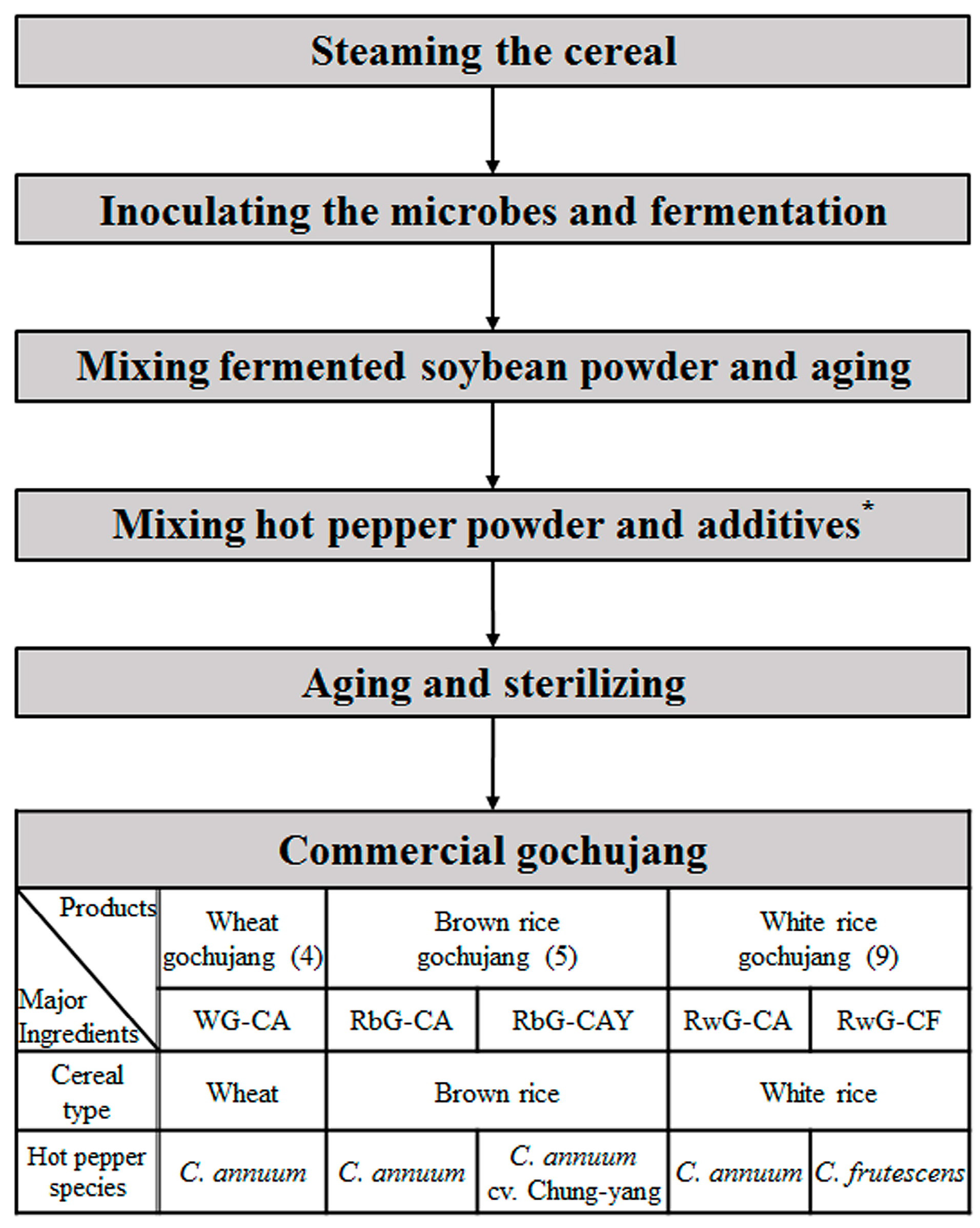
 RbG-CAY, brown rice gochujang containing C. annuum cv. Chung-yang; RwG-CA, white rice gochujang containing C. annuum; RwG-CF, white rice gochujang containing C. frutescens. Relative pungency levels of hot peppers classified by Scoville heat units (SHU);
  mildly pungent (700–3000 SHU),
  moderately pungent (3000–25,000 SHU), and
  highly pungent (25,000–70,000 SHU) [18]. The metabolite numbers are identical to those in Table S2. Different letters in the bar graph indicate significant differences by ANOVA followed by Duncan’s multiple-range test (p-value < 0.05). The red pepper diagram is the relative pungency levels of hot pepper.
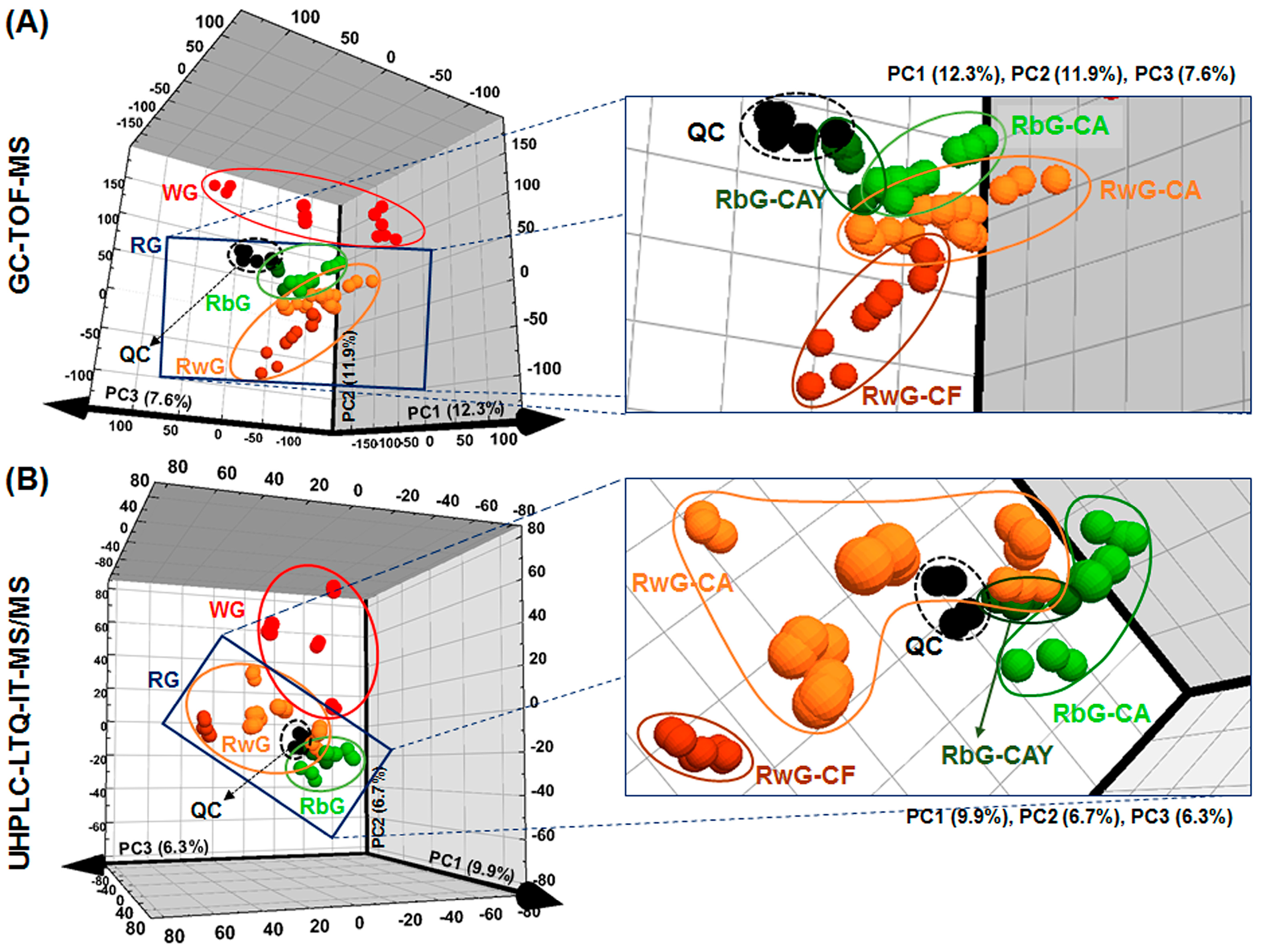
RbG-CAY, brown rice gochujang containing C. annuum cv. Chung-yang; RwG-CA, white rice gochujang containing C. annuum; RwG-CF, white rice gochujang containing C. frutescens. Relative pungency levels of hot peppers classified by Scoville heat units (SHU); mildly pungent (700–3000 SHU), moderately pungent (3000–25,000 SHU), and highly pungent (25,000–70,000 SHU) [18]. The metabolite numbers are identical to those in Table S2. Different letters in the bar graph indicate significant differences by ANOVA followed by Duncan’s multiple-range test (p-value < 0.05). The red pepper diagram is the relative pungency levels of hot pepper.
highly pungent (25,000–70,000 SHU) [18]. The metabolite numbers are identical to those in Table S2. Different letters in the bar graph indicate significant differences by ANOVA followed by Duncan’s multiple-range test (p-value < 0.05). The red pepper diagram is the relative pungency levels of hot pepper.
RbG-CAY, brown rice gochujang containing C. annuum cv. Chung-yang; RwG-CA, white rice gochujang containing C. annuum; RwG-CF, white rice gochujang containing C. frutescens. Relative pungency levels of hot peppers classified by Scoville heat units (SHU); mildly pungent (700–3000 SHU), moderately pungent (3000–25,000 SHU), and highly pungent (25,000–70,000 SHU) [18]. The metabolite numbers are identical to those in Table S2. Different letters in the bar graph indicate significant differences by ANOVA followed by Duncan’s multiple-range test (p-value < 0.05). The red pepper diagram is the relative pungency levels of hot pepper.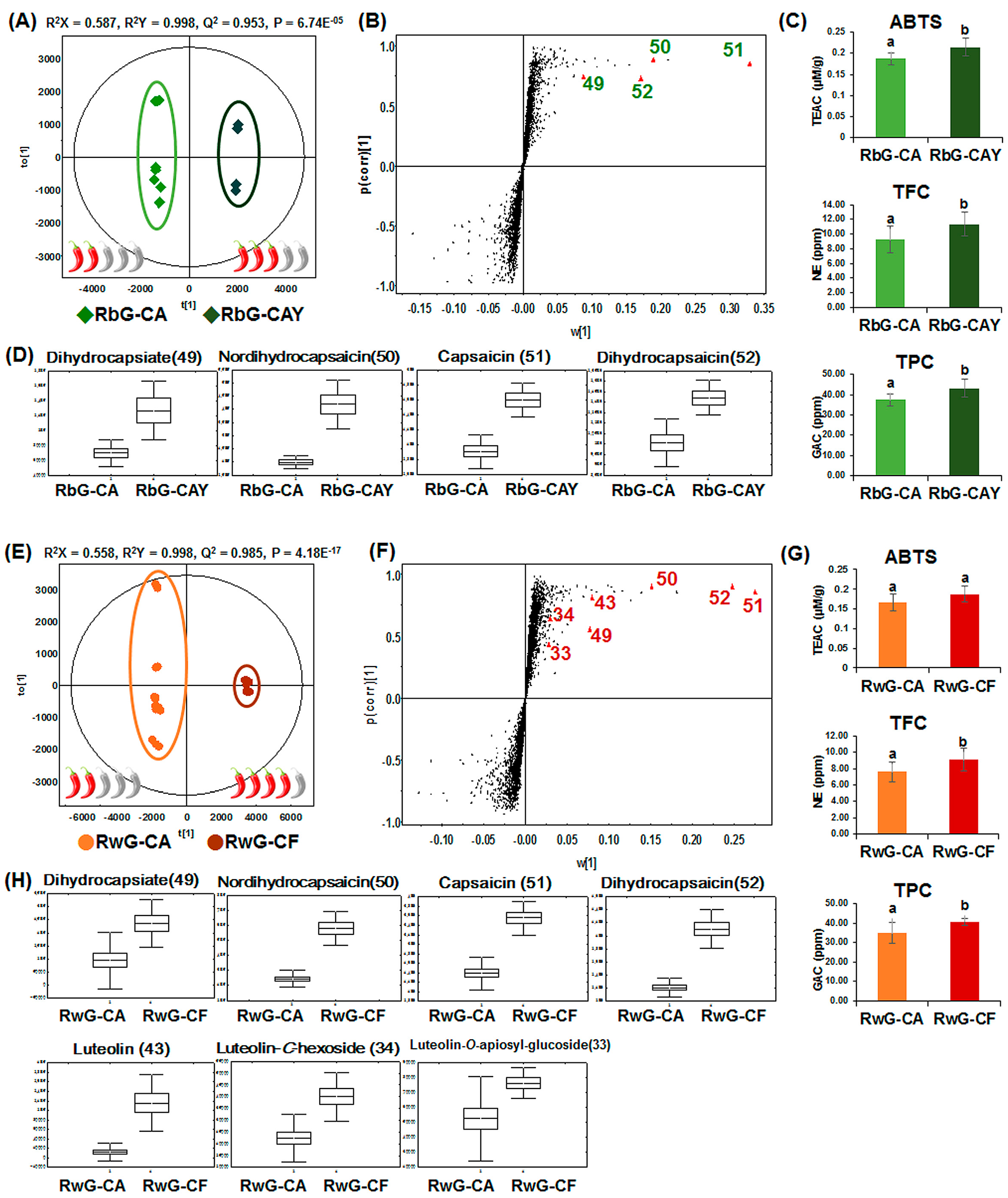

| Sample No. | Type of Cereal | Species of Hot Pepper a | Pungency b | Abbreviation c |
|---|---|---|---|---|
| 1 | Wheat gochujang (WG) | Capsicum annuum | | WG-CA |
| 2 | ||||
| 3 | ||||
| 4 | ||||
| 5 | Brown rice gochujang (RbG) | Capsicum annuum | | RbG-CA |
| 6 | ||||
| 7 | ||||
| 8 | Capsicum annuum cv. Chung-yang | | RbG-CAY | |
| 9 | ||||
| 10 | White rice gochujang (RwG) | Capsicum annuum | | RwG-CA |
| 11 | ||||
| 12 | ||||
| 13 | ||||
| 14 | ||||
| 15 | ||||
| 16 | Capsicum frutescens | | RwG-CF | |
| 17 | ||||
| 18 |
mildly pungent (700–3000 SHU); moderately pungent (3000–25,000 SHU); and highly pungent (25,000–70,000 SHU) [18]. c Abbreviation of total samples used in the text; WG, wheat gochujang; RG, rice gochujang; RbG, brown rice gochujang; RwG, white rice gochujang; RbG-CA, brown rice gochujang containing C. annuum; RbG-CAY, brown rice gochujang containing C. annuum cv. Chung-yang; RwG-CA, white rice gochujang containing C. annuum; RwG-CF, white rice gochujang containing C. frutescens.© 2016 by the authors. Licensee MDPI, Basel, Switzerland. This article is an open access article distributed under the terms and conditions of the Creative Commons Attribution (CC-BY) license ( http://creativecommons.org/licenses/by/4.0/).
Share and Cite
Lee, G.M.; Suh, D.H.; Jung, E.S.; Lee, C.H. Metabolomics Provides Quality Characterization of Commercial Gochujang (Fermented Pepper Paste). Molecules 2016, 21, 921. https://doi.org/10.3390/molecules21070921
Lee GM, Suh DH, Jung ES, Lee CH. Metabolomics Provides Quality Characterization of Commercial Gochujang (Fermented Pepper Paste). Molecules. 2016; 21(7):921. https://doi.org/10.3390/molecules21070921
Chicago/Turabian StyleLee, Gyu Min, Dong Ho Suh, Eun Sung Jung, and Choong Hwan Lee. 2016. "Metabolomics Provides Quality Characterization of Commercial Gochujang (Fermented Pepper Paste)" Molecules 21, no. 7: 921. https://doi.org/10.3390/molecules21070921
APA StyleLee, G. M., Suh, D. H., Jung, E. S., & Lee, C. H. (2016). Metabolomics Provides Quality Characterization of Commercial Gochujang (Fermented Pepper Paste). Molecules, 21(7), 921. https://doi.org/10.3390/molecules21070921