Article

Pharmacokinetics of Maleic Acid as a Food Adulterant Determined by Microdialysis in Rat Blood and Kidney Cortex
1
Institute of Traditional Medicine, School of Medicine, National Yang-Ming University, No. 155, Section 2, Li-Nong Street, Beitou District, Taipei 11221, Taiwan
2
Institute of Microbiology and Immunology, National Yang-Ming University, No. 155, Section 2, Li-Nong Street, Beitou District, Taipei 11221, Taiwan
3
National Research Institute of Chinese Medicine, Ministry of Health and Welfare, No. 155-1, Section 2, Li-Nong Street, Beitou District, Taipei 11221, Taiwan
4
Graduate Institute of Acupuncture Science, China Medical University, No. 91, Hsueh-Shih Road, Taichung 40402, Taiwan
5
School of Pharmacy, College of Pharmacy, Kaohsiung Medical University, 100, Shih-Chuan 1st Road, Kaohsiung 80708, Taiwan
6
Department of Education and Research, Taipei City Hospital, No. 145, Zhengzhou Road, Datong District, Taipei 103, Taiwan
*
Author to whom correspondence should be addressed.
Molecules 2016, 21(3), 367; https://doi.org/10.3390/molecules21030367

Submission received: 28 January 2016 / Revised: 4 March 2016 / Accepted: 11 March 2016 / Published: 17 March 2016

Abstract

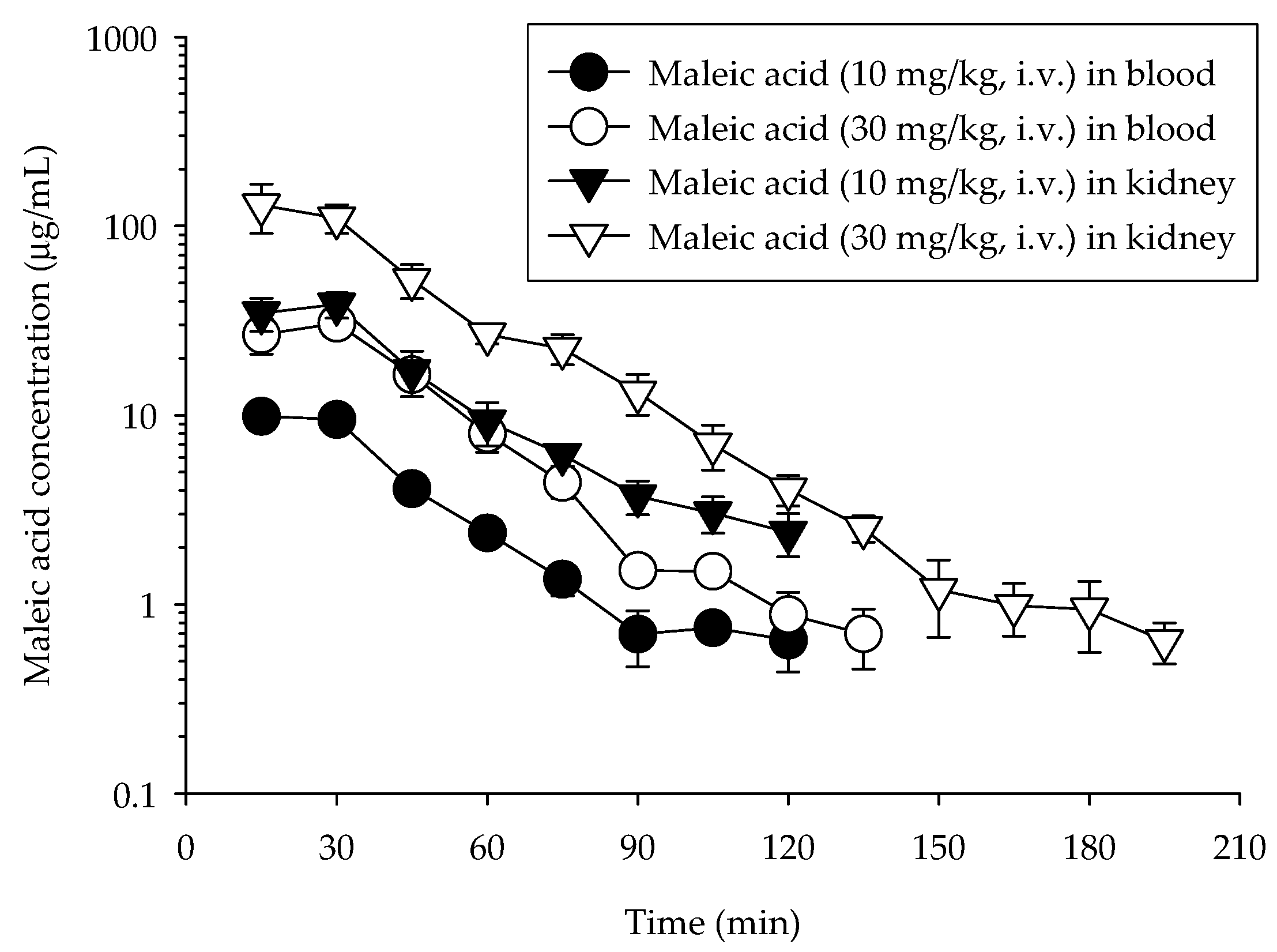
Maleic acid has been shown to be used as a food adulterant in the production of modified starch by the Taiwan Food and Drug Administration. Due to the potential toxicity of maleic acid to the kidneys, this study aimed to develop an analytical method to investigate the pharmacokinetics of maleic acid in rat blood and kidney cortex. Multiple microdialysis probes were simultaneously inserted into the jugular vein and the kidney cortex for sampling after maleic acid administration (10 or 30 mg/kg, i.v., respectively). The pharmacokinetic results demonstrated that maleic acid produced a linear pharmacokinetic phenomenon within the doses of 10 and 30 mg/kg. The area under concentration versus time curve (AUC) of the maleic acid in kidney cortex was 5-fold higher than that in the blood after maleic acid administration (10 and 30 mg/kg, i.v., respectively), indicating that greater accumulation of maleic acid occurred in the rat kidney.
Keywords: maleic acid; food adulterant; pharmacokinetics; microdialysis; liquid chromatography; kidney distribution maleic acid; food adulterant; pharmacokinetics; microdialysis; liquid chromatography; kidney distribution