Abstract
Treatment of 1,4,4-trimethyl-3,4-dihydroquinolin-2(1H)-one (2) with lithium diisopropylamide (LDA) followed by a wide range of electrophiles give the corresponding 4,4-dimethyl-3-substituted-3,4-dihydroquinolin-2-ones 3-13, providing a very mild electrophilic substitution of the 4,4-dimethyl-1,2,3,4-tetrahydroquinoline core.
1. Introduction
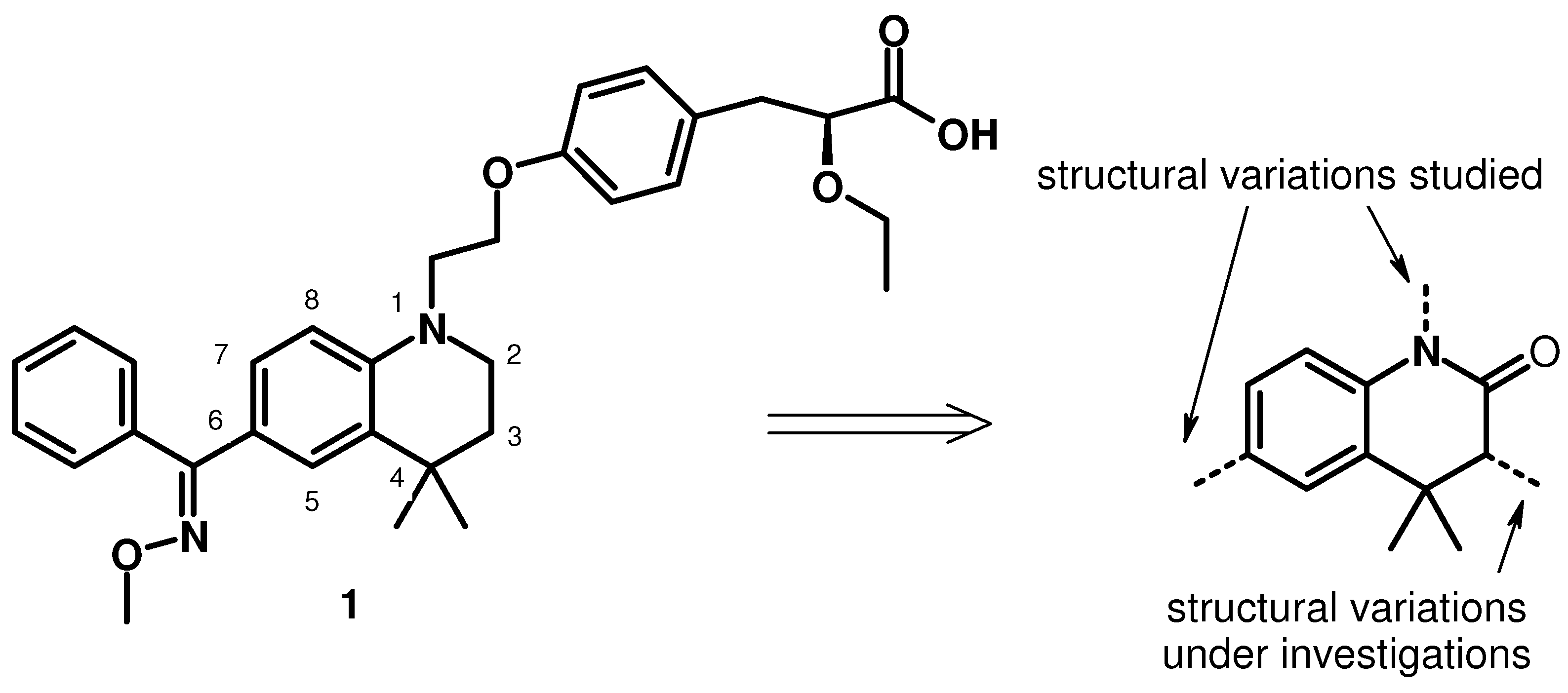
The chemistry of 4,4-dimethyl-3,4-dihydroquinolin-2-one has been the focus of interest of many investigations during recent years. This growing interest can be explained because quinolinone derivatives are an important class of natural product exhibiting a broad spectrum of biological activities. Moreover, substituted or reduced 4,4-dimethyl-3,4-dihydroquinolin-2-ones are the core structures of many pharmacological agents and drug molecules such as anti-cancer drugs [,], anti-diabetic [,,] or cardiovascular agents [], pesticides [,] and active components of various dyes [,,]. Consequently, synthetic methodologies for preparing dihydroquinolin-2-one derivatives have attracted considerable interest, and several methods offering good results have been reported [,,,,,,,,,]. The nature, number and relative location of the substituents are the key parameters to consider before choosing a particular method, however, few methods have been investigated with the aim of obtaining 4,4-dimethyl-3-substituted-3,4-dihydroquinolin-2-ones. We have recently reported the design, synthesis and biological data of a novel 4,4-dimethyl-1,2,3,4-tetrahydroquinoline-based series of PPARγ partial agonists and PPARα/γ dual agonists [,]. This study has led to the identification and optimization of our lead compound 1 (Figure 1), which has noteworthy dual-activity on both subtypes.
Figure 1.
Lead compound 1.
Our lead compound 1 possesses an acid head, α-ethoxy-β-phenylpropionic acid moiety, which is a potent binding moiety for both PPARα and PPARγ, and a cyclic tail, consisting of the 4,4-dimethyl-1,2,3,4-tetrahydroquinoline skeleton that tolerates more polar substituents. In order to investigate the impact of changes on the transactivation activity, we decided to substitute position 3 of this cyclic tail.
2. Results and Discussion
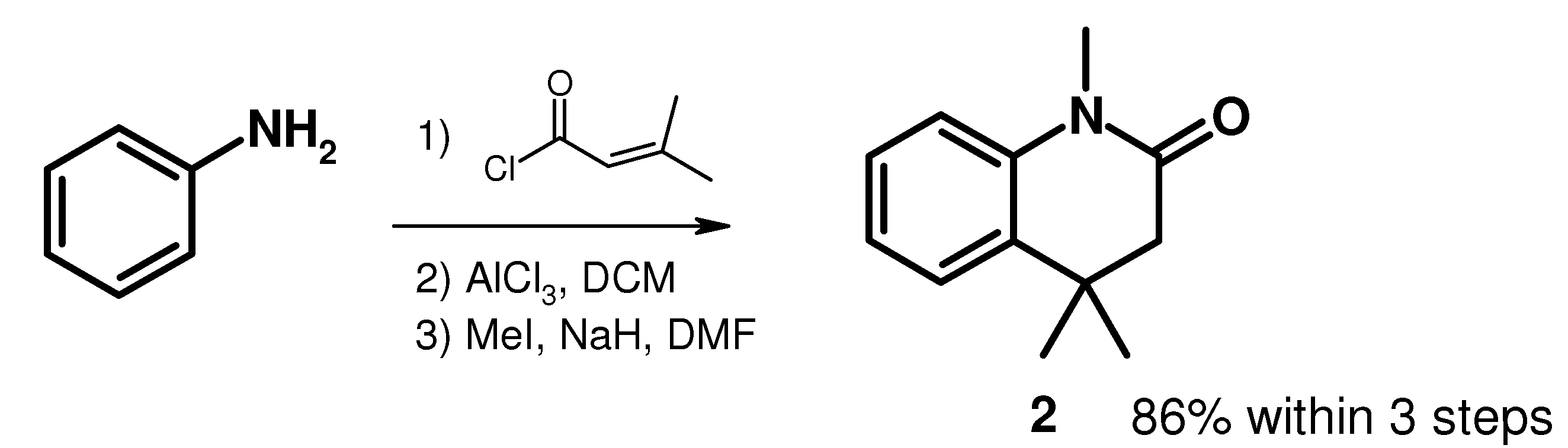
Thus, our strategy was to carry out an α-lithiation and an electrophilic substitution on 1,4,4-trimethyl-3,4-dihydroquinolin-2-one (2). This compound was prepared according to the synthetic sequence outlined in Scheme 1 []. Aniline was treated with 3,3-dimethylacryloyl chloride to give the corresponding amide, which was cyclized under Friedel-Crafts conditions and then methylated.
Scheme 1.
Synthesis of 4,4-trimethyl-3,4-dihydroquinolin-2(1H)-one (2).
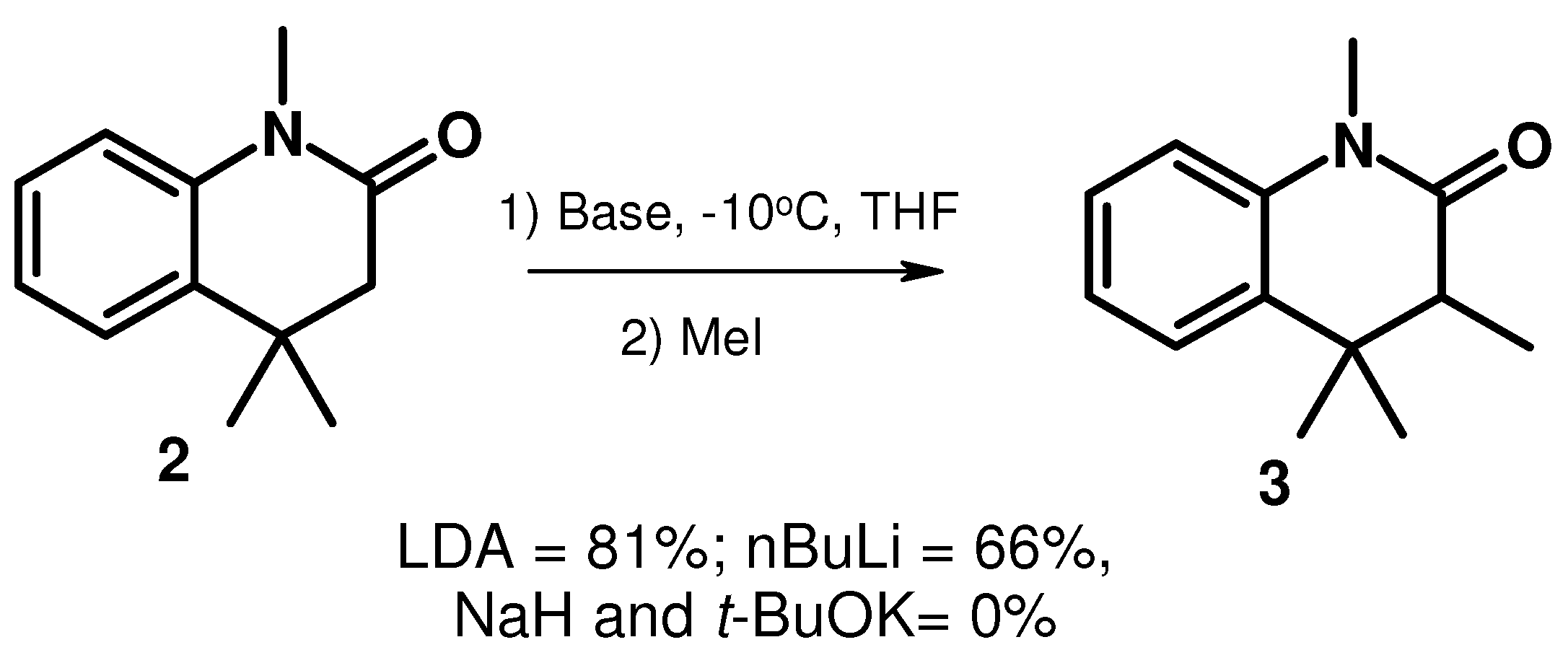
We then tried to lithiate 1,4,4-trimethyl-3,4-dihydroquinolin-2(1H)-one with 1 equiv of n-BuLi or LDA in THF at −10 °C (Scheme 2). The α-anion thus obtained was condensed with methyl iodide, providing the 3-methyl product in yields of 66% and 81%, respectively. When sodium hydride or potassium tert-butoxide was used as the strong base, no reaction was observed.
Scheme 2.
Synthesis of compound 3.
Consequently a wide range of electrophiles have been assayed in this reaction, and the resulting products are summarized in Table 1. Most of these electrophilic substitutions gave good yields with no detectable secondary substitution.
Table 1.
Lithiation and Electrophilic Substitution of 2.
| Entry | E+ | E | Producta | Yieldb (%) |
|---|---|---|---|---|
| 1 | EtI | Et | 4 | 94 |
| 2 | BnBr | Bn | 5 | 99 |
| 3 | Allyl-Br | Allyl | 6 | 93 |
| 4 | Br(CH2)5-Br | (CH2)5-Br | 7 | 60 |
| 5 | PhCHO | CH(OH)Ph | 8 | 99 |
| 6 | CH3-CO-Ph | CH3-CH(OH)-Ph | -c | |
| 7 | I2 | I | 9 | 88 |
| 8 | Ac2O | Ac | 10 | 68 |
| 9 | PhSO2Cl | Cl | 11 | 90d |
| 10 | PhSO2F | PhSO2 | 12 | 46 |
| 11 | CO2 | COOH | 13 | 75 |
| 12 | B(O- iPr)3 | B(OH)2 | -c |
a: all compounds were characterized by IR, NMR and GCMS. b: Yield of isolated material. c: no reaction. d: only chlorinated product was isolated.
Reactions with halogenoalkanes (entries 1-4) provide an access to alkyl derivatives with excellent yields. Alkylation using dibromoalkane provided a moderate yield of the target product and a cross-coupling product. In the case of carbonyl derivatives (entries 5, 6, 8 and 11), only ketone did not react with lithiated species. With sulfonyl compounds as the electrophile, we obtained two different products, depending on the nature of the anion in the sulfonyl group. The target chlorinated product 11 (entry 9) was synthesized using benzenesulfonyl chloride [,,]. However, using benzenesulfonyl fluoride provided the corresponding sulfonyl product 12 with moderate yield, and unreacted starting compound 2.
3. Experimental
3.1. General
All reactions requiring anhydrous conditions were conducted in flame dried apparatus under an atmosphere of argon. THF was freshly distilled from benzophenone-sodium. All reagents and starting materials were purchased from commercial sources and used as received. All lithiations were carried out using 2.0 M LDA in tetrahydrofuran/heptane/ethylbenzene (Sigma-Aldrich). Analytical TLC was carried out on silica gel F254 plates. Visualization was achieved by UV light (254 nm). Flash column chromatography was carried using Sigma-Aldrich Versaflash silica gel (particle size 20–45 µm). Melting points (m.p.) were measured on a Büchi B-540 capillary melting point apparatus and are uncorrected. 1H- and 13C-NMR spectra were recorded in CDCl3 using a Bruker Avance 300 (operating frequencies: 1H, 300.13 MHz; 13C, 75.47 MHz) FT spectrometer at ambient temperature. The chemical shifts (δ, ppm) for all compounds are listed in parts per million downfield from tetramethylsilane using the NMR solvent as an internal reference. The reference values used for deuterated chloroform (CDCl3) were 7.26 and 77.00 ppm for 1H- and 13C-NMR spectra, respectively. Multiplicities are given as: s (singlet), brs (broad singlet), d (doublet), t (triplet), dd (doublet of doublets), td (triplet of doublets) or m (multiplet). Low-resolution mass (MS) were recorded on a Shimadzu GCMS-QP 2010 Gas Chromatograph Mass Spectrometer and reported in units of mass to charge (m/z). The mode of ionization used was electron-impact (EI).
3.2. General procedure
To a stirring solution of 2 (0.1 g, 0.53 mmol) in THF (5 mL) cooled at −10 °C under an argon atmosphere was added 0.275 mL of LDA (1.3 equiv., 0.689 mmol, 2.0 M in tetrahydrofuran/heptane/ ethylbenzene). After completion of the addition, the mixture was stirred for 30 min at −10 °C, and then the appropriate electrophile (1.2 equiv, 0.636 mmol) was added. The reaction mixture was stirred at −10 °C for 2h and allowed to warm slowly to room temperature before being added dropwise to a saturated aqueous solution of ammonium chloride (80 mL) and extracted with ethyl acetate (3 × 40 mL), the combined organic layers were dried over anhydrous magnesium sulfate, and concentrated in vacuo to afford the crude products, which were purified by column chromatography with cyclohexane-ethyl acetate as the eluant.
1,3,4,4-Tetramethyl-3,4-dihydroquinolin-2(1H)-one (3): Yield 86%; white oil; 1H-NMR (CDCl3) δ: 1.04 (3H, d, J = 7.2 Hz, CH3), 1.22 (3H, s, CH3), 1.25 (3H, s, CH3), 2.44 (1H, q, J = 7.2 Hz, CH), 3.38 (3H, s, NCH3), 7.01 (1H, d, J = 8.1 Hz, Har), 7.07 (1H, td, J = 7.5, 1.2 Hz, Har), 7.26–7.30 (2H, m, 2 × Har); 13C-NMR (CDCl3) δ: 11.4 (CH3), 22.8 (CH3), 27.6 (CH3), 29.6 (CH3), 35.8 (C), 47.3 (CH), 114.8 (CH), 123.3 (CH), 124.8 (CH), 127.3 (CH), 133.9 (C), 138.8 (C), 173.1 (C); MS (EI) m/z 188, 100% [M-CH3+], 203, 55% [M+]; Calcd for C13H17NO: C, 76.81; H, 8.43; N, 6.89. Found: C, 76.26; H, 8.41; N, 6.82.
3-Ethyl-1,4,4-trimethyl-3,4-dihydroquinolin-2(1H)-one (4): Yield 94%; whitish solid; Mp 72–77 °C; 1H-NMR (CDCl3) δ: 0.92 (3H, t, J = 7.2 Hz, CH3), 1.07–1.18 (1H, m, CH), 1.21 (3H, s, CH3), 1.35 (3H, s, CH3), 1.49-1.63 (1H, m, CH), 2.24 (1H, dd, J = 10.8, 4.5 Hz, CH2), 3.40 (3H, s, NCH3), 7.00 (1H, d, J = 8.4 Hz, Har), 7.07 (1H, td, J = 7.5, 1.2 Hz, Har), 7.25 (2H, m, 2 × Har); 13C-NMR (CDCl3) δ: 12.5 (CH3), 19.7 (CH2), 23.4 (CH3), 28.9 (CH3), 29.4 (CH3), 36.1 (C), 55.3 (CH), 114.7 (CH), 123.2 (CH), 124.8 (CH), 127.2 (CH), 133.9 (C), 138.9 (C), 172.1 (C); MS (EI): m/z 174, 100% [M-CH3-CH2CH3+], 217, 62% [M+]; Calcd for C14H19NO: C, 77.38; H, 8.81; N, 6.45. Found: C, 77.90; H, 8.61; N, 6.52.
3-Benzyl-1,4,4-trimethyl-3,4-dihydroquinolin-2(1H)-one (5): Yield 99%; yellowish solid; Mp 46–51 °C; 1H-NMR (CDCl3) δ: 1.32 (3H, s, CH3), 1.42 (3H, s, CH3), 2.64 (1H, dd, J = 12.8, 8.9 Hz, CH), 2.73 (1H, dd, J = 8.9, 4.5 Hz, CHaHbPh), 2.86 (1H, dd, J = 12.9, 4.5 Hz, CHaHbPh), 3.37 (3H, s, NCH3), 7.03 (1H, d, J = 8.1 Hz, Har), 7.1–7.35 (8H, m, 8 × Har); 13C-NMR (CDCl3) δ: 23.6 (CH3), 28.4 (CH3), 29.6 (CH3), 33.1 (CH2), 36.6 (C), 55.2 (CH), 114.9 (CH), 123.3 (CH), 124.9 (CH), 126.2 (CH), 127.5 (CH), 128.2 (2xCH), 128.9 (2xCH), 133.8 (C), 139.0 (C), 139.8 (C), 171.2 (C); MS (EI): m/z 91, 100% [C6H5CH2+], 279, 21% [M+]; Calcd for C19H21NO: C, 81.68; H, 7.58; N, 5.01. Found: C, 81.90; H, 7.61; N, 5.10.
3-Allyl-1,4,4-trimethyl-3,4-dihydroquinolin-2(1H)-one (6): Yield 93%; yellowish solid; Mp 55–58 °C; 1H-NMR (CDCl3) δ: 1.24 (3H, s, CH3), 1.35 (3H, s, CH3), 1.96–2.01 (1H, m, CH), 2.27–2.32 (1H, m, CH), 2.44 (1H, dd, J = 10.2, 4.8 Hz, CH), 3.39 (3H, s, NCH3), 4.90–4.96 (2H, m, CH=CH2), 5.76–5.84 (1H, m, CH=CH2), 7.01 (1H, d, J = 7.2 Hz, Har), 7.08 (1H, t, J = 7.5 Hz, Har), 7.26–7.30 (2H, m, 2 × Har); 13C-NMR (CDCl3) δ: 23.4 (CH3), 28.6 (CH3), 29.4 (CH2), 31.4 (CH2), 36.1 (C), 53.7 (CH), 114.8 (CH), 116.1 (CH2), 123.3 (CH), 124.8 (CH), 127.3 (CH), 133.6 (C), 136.2 (CH), 138.8 (C), 171.4 (C); MS (EI): m/z 214, 100% [M-CH3+], 229, 73% [M+]; Calcd for C15H19NO: C, 78.56; H, 8.35; N, 6.11. Found: C, 78.66; H, 8.41; N, 6.02.
3-(5-Bromopentyl)-1,4,4-trimethyl-3,4-dihydroquinolin-2(1H)-one (7): Yield 60%; yellowish oil; 1H- NMR (CDCl3) δ: 1.21 (3H, s, CH3), 1.34 (3H, s, CH3), 1.30-1.50 (6H, m, 3 × CH2), 1.80 (2H, m, CH2), 2.30 (1H, dd, J = 7.8, 3.9 Hz, CH), 3.37 (2H, t, J = 6.8 Hz, CH2), 3.40 (3H, s, NCH3), 7.00 (1H, d, J = 8.1 Hz, Har), 7.08 (1H, td, J = 7.5, 1.2 Hz, Har), 7.24-7.30 (2H, m, 2 × Har); 13C-NMR (CDCl3) δ: 23.4 (CH3), 26.4 (CH2), 27.2 (CH2), 28.3 (CH2), 28.7 (CH3), 29.5 (CH3), 32.6 (CH2), 33.9 (CH2), 36.1 (C), 53.5 (CH), 114.8 (CH), 123.3 (CH), 124.8 (CH), 127.2 (CH), 133.8 (C), 138.9 (C), 172.1 (C); MS (EI): m/z 174, 100% [M-(CH2)5Br-CH3+], 337, 4% [M(Br79) +], 339, 4% [M(Br81) +]; Calcd for C17H25BrNO: C, 60.36; H, 7.15; N, 4.14. Found: C, 59.98; H, 7.21; N, 4.32.
3-(Hydroxy(phenyl)methyl)-1,4,4-trimethyl-3,4-dihydroquinolin2(1H)-one (8): Yield 99%; white solid; Mp 143–146 °C; 1H-NMR (CDCl3) δ: 1.11 (3H, s, CH3), 1.54 (3H, s, CH3), 2.80 (1H, d, J = 4.5 Hz, CH), 2.90 (3H, s, NCH3), 3.26 (1H, brs, OH), 4.75 (1H, d, J = 4.5 Hz, CH), 6.42 (1H, dd, J = 8.1, 1.5 Hz, Har), 6.77–6.80 (2H, m, 2 × Har), 6.87–6.98 (5H, m, 5 × Har), 7.09 (1H, dd, J = 7.2, 1.8 Hz, Har); 13C-NMR (CDCl3) δ: 24.1 (CH3), 29.1 (CH3), 30.5 (CH3), 35.5 (C), 61.2 (CH), 72.3 (CH), 114.4 (CH), 123.4 (CH), 124.3 (CH), 126.0 (2xCH), 127.1 (CH), 127.2 (2 × CH), 127.6 (CH), 132.9 (C), 138.2 (C), 140.9 (C), 171.1 (C); MS (EI, DI): m/z = 174, 100% [M-CH3-C6H5CHOH+], 295, 13% [M+] ; Calcd for C19H21NO2: C, 77.26; H, 7.17; N, 4.74. Found: C, 78.02; H, 7.23; N, 4.75.
3-Iodo-1,4,4-trimethyl-3,4-dihydroquinolin-2(1H)-one (9): Yield 88%; beige solid; Mp 128–136 °C; 1H-NMR (CDCl3) δ: 1.27 (3H, s, CH3), 1.47 (3H, s, CH3), 3.30 (3H, s, NCH3), 4.50 (1H, s, CH), 7.00 (1H, dd, J = 8.1, 0.9 Hz, Har), 7.07 (1H, td, J = 7.2, 0.9 Hz, Har), 7.18 (1H, dd, J = 7.8, 1.5 Hz, Har), 7.25 (1H, td, J = 7.5, 1.8 Hz, Har); 13C-NMR (CDCl3) δ: 23.2 (CH3), 28.3 (CH3), 30.1 (CH3), 37.4 (CH), 37.8 (C), 115.1 (CH), 123.9 (CH), 124.6 (CH), 127.9 (CH), 132.1 (C), 138.7 (C), 167.3 (C); MS (EI): m/z 144, 100% [M-I-CH3-NCH3+], 315, 74% [M+]; Calcd for C12H14INO: C, 45.73; H, 4.48; N, 4.44. Found: C, 46.03; H, 4.51; N, 4.47.
3-Acetyl-1,4,4-trimethyl-3,4-dihydroquinolin-2(1H)-one (10): Yield 68%; white solid; Mp 97–99 °C; 1H-NMR (CDCl3) δ: 1.29 (3H, s, CH3), 1.43 (3H, s, CH3), 2.17 (3H, s, COCH3), 3.43 (3H, s, NCH3), 3.59 (1H, s, CH), 7.03 (1H, dd, J = 8.4, 1.2 Hz, Har), 7.11 (1H, td, J = 7.8, 1.2 Hz, Har), 7.29 (2H, m, 2 × Har). 13C-NMR (CDCl3) δ: 23.6 (CH3), 28.6 (CH3), 29.9 (CH3), 31.9 (CH3), 36.1 (C), 66.2 (CH), 115.0 (CH), 123.9 (CH), 124.0 (CH), 127.5 (CH), 133.4 (C), 138.5 (C), 166.2 (C), 203.0 (C); MS (EI): m/z 174, 100% [M-COCH3-CH3+], 231, 32% [M+]; Calcd for C14H17NO2: C, 72.70; H, 7.41; N, 6.06. Found: C, 72.43; H, 7.39; N, 6.11.
3-Chloro-1,4,4-trimethyl-3,4-dihydroquinolin-2(1H)-one (11): Yield 90%; yellowish solid; Mp 90–93 °C; 1H-NMR (CDCl3) δ: 1.20 (3H, s, CH3), 1.39 (3H, s, CH3), 3.35 (3H, s, NCH3), 4.17 (1H, s, CH), 6.98 (1H, dd, J = 8.1, 1.5 Hz, Har), 7.06 (1H, td, J = 7.8, 1.2 Hz, Har), 7.21–7.27 (2H, m, 2 × Har); 13C-NMR (CDCl3) δ: 23.1 (CH3), 26.2 (CH3), 30.1 (CH3), 38.5 (C), 64.7 (CH), 115.2 (CH), 124.0 (CH), 125.3 (CH), 127.9 (CH), 131.2 (CH), 138.0 (C), 165.3 (C); MS (EI): m/z 208, 100% [M-CH3+], 223, 92% [M(Cl35) +], 225, 31% [M(Cl37) +]; Calcd for C12H14ClNO: C, 64.43; H, 6.31; N, 6.26. Found: C, 64.72; H, 6.49; N, 6.30.
1,4,4-Trimethyl-3-(phenylsulfonyl)-3,4-dihydroquinolin-2(1H)-one (12): Yield 46%; yellowish solid; Mp 110–114 °C; 1H-NMR (CDCl3) δ: 1.26 (3H, s, CH3), 1.90 (3H, s, CH3), 3.22 (3H, s, NCH3), 4.04 (1H, s, CH), 6.80 (1H, dd, J = 7.8, 0.9 Hz, Har), 7.12 (1H, td, J = 7.5, 1.2 Hz, Har), 7.21 (1H, td, J = 7.8, 1.5 Hz, Har), 7.32 (1H, dd, J = 7.5, 1.5 Hz, Har), 7.40 (2H, t, J = 7.8 Hz, 2 × Har), 7.55 (1H, t, J = 7.5 Hz, Har), 7.60–7.63 (2H, m, 2 × Har); 13C-NMR (CDCl3) δ: 23.9 (CH3), 30.1 (CH3), 31.1 (CH3), 37.0 (C), 77.6 (CH), 115.1 (CH), 124.3 (CH), 124.4 (CH), 127.9 (CH), 128.6 (2 × CH), 128.7 (2 × CH), 131.3 (C), 133.9 (CH), 138.1 (C), 138.6 (C), 161.8 (C); MS (EI): m/z 250, 100%, 329, 57% [M+]; Calcd for C18H19NO3S: C, 65.63; H, 5.81; N, 4.25. Found: C, 64.84; H, 5.89; N, 4.20.
1,4,4-Trimethyl-2-oxo-1,2,3,4-tetrahydroquinoline-3-carboxylic acid (13): Yield 75%; Brown solid; Mp 138–140 °C; 1H-NMR (CDCl3) δ: 1.31 (3H, s, CH3), 1.35 (3H, s, CH3), 3.35 (3H, s, NCH3), 3.36 (1H, s, CH), 6.95 (1H, d, J = 8.1 Hz, Har), 7.03 (1H, t, J = 7.2 Hz, Har), 7.19–7.27 (2H, m, 2 × Har), 10.25 (1H, brs, COOH); 13C-NMR (CDCl3) δ: 23.7 (CH3), 27.5 (CH3), 30.1 (CH3), 36.3 (C), 58.8 (CH), 115.3 (CH), 124.0 (CH), 124.1 (CH), 127.7 (CH), 133.3 (C), 138.4 (C), 166.2 (C), 172.7 (C); MS (EI, DI): m/z 174, 100% [M-CH3-COOH+], 233, 19% [M+]; Calcd for C13H15NO3: C, 66.94; H, 6.48; N, 6.00. Found: C, 66.87; H, 6.41; N, 6.13.
4. Conclusions
In summary, we have described in this paper the lithiation and electrophilic substitution of 1,4,4-trimethyl-3,4-dihydroquinolin-2(1H)-one in position 3 and the unexpected reaction with different sulfonyl derivatives under the same conditions, providing either a chlorinated or sulfonyl compound. The enantioselective substitution of this position is currently under investigation in our laboratory. The biological evaluation of these new compounds is also now under investigation.
Acknowledgements
We thank the Comité du Cher de la Ligue National Contre le Cancer for financial support and the Department of Analytical Chemistry of University of Tours François Rabelais for technical support. We thank also Monika Ghosh for her translation assistance.
- Samples Availability: Contact the authors.
References and Notes
- Reitmair, A.; Shurland, D.-L.; Tsang, K.-Y.; Chandraratna, R.A.S.; Brown, G. Retinoid-related molecule AGN193198 potently induces G2M arrest and apoptosis in bladder cancer cells. Int. J. Cancer 2005, 115, 917–923. [Google Scholar] [CrossRef]
- Keedwell, R.G.; Zhao, Y.; Hammond, L.A.; Qin, S.; Tsang, K.-Y.; Reitmair, A.; Molina, Y.; Okawa, Y.; Atangan, L.I.; Shurland, D.-L.; Wen, K.; Wallace, D.M.A.; Bird, R.; Chandraratna, R.A.S.; Brown, G. A Retinoid-Related Molecule that Does Not Bind to Classical Retinoid Receptors Potently Induces Apoptosis in Human Prostate Cancer Cells through Rapid Caspase Activation. Cancer Res. 2004, 64, 3302–3312. [Google Scholar]
- Parmenon, C.; Guillard, J.; Caignard, D.-H.; Hennuyer, N.; Staels, B.; Audinot-Bouchez, V.; Boutin, J.-A.; Dacquet, C.; Ktorza, A.; Viaud-Massuard, M.-C. 4,4-Dimethyl-1,2,3,4-tetrahydroquinoline-based PPARα/γ agonists. Part. II: Synthesis and pharmacological evaluation of oxime and acidic head group structural variations. Bioorg. Med. Chem. Lett. 2009, 19, 2683–2687. [Google Scholar]
- Parmenon, C.; Guillard, J.; Caignard, D.-H.; Hennuyer, N.; Staels, B.; Audinot-Bouchez, V.; Boutin, J.-A.; Dacquet, C.; Ktorza, A.; Viaud-Massuard, M.-C. 4,4-Dimethyl-1,2,3,4-tetrahydroquinoline-based PPARα/γ agonists. Part I: Synthesis and pharmacological evaluation. Bioorg. Med. Chem. Lett. 2008, 18, 1617–1622. [Google Scholar]
- Lagu, B.; Lebedev, R.; Pio, B.; Yang, M.; Pelton, P.D. Dihydro-[1H]-quinolin-2-ones as retinoid X receptor (RXR) agonists for potential treatment of dyslipidemia. Bioorg.Med. Chem. Lett. 2007, 17, 3491–3496. [Google Scholar] [CrossRef]
- Sato, T.; Ishida, S.; Ishibashi, H.; Ikeda, M. Regiochemistry of radical cyclisations (6-exo/7-endo and 7-exo/8-endo) of N-(o-alkenylphenyl)-2,2-dichloroacetamides. J. Chem. Soc. Perkin Trans. 1 1991, 2, 353–361. [Google Scholar]
- Mitani, A.; Kuwahara, R. Preparation of nitrogen-containing heterocyclic compounds as fungicides for agricultural and horticultural use. WO2009081579, 2009. [Google Scholar]
- Ito, H.; Morimoto, S.; Tanaka, H.; Tamagawa, Y. Preparation of 3,4-dihydro-1,3’-biquinolin-2-ones and their use as pesticides. JP2007001944, 2007. [Google Scholar]
- Mizukawa, H.; Fujimori, T. Radiation-sensitive resists containing heterocyclic dyes, color filters using them, and manufacture of color filters. JP2007277357, 2007. [Google Scholar]
- Vidal, L.; Lagrange, A. Hair dye compositions comprising an acylaminophenol coupler. EP1438949 2004. [Google Scholar]
- Suzuki, T.; Ikesu, S.; Takahashi, M.; Ikemizu, H. Azo dye compounds for black coloring compositions; ink-jet inks and thermal transfert printing materials using them and method of use. JP2004285223, 2004. [Google Scholar]
- Singer, J.M.; Barr, B.M.; Coughenour, L.L.; Gregory, T.F.; Walters, M.A. 8-Substituted 3,4-dihydroquinolinones as a novel scaffold for atypical antipsychotic activity. Bioorg. Med. Chem. Lett. 2005, 15, 4560–4563. [Google Scholar] [CrossRef]
- Wender, P.A.; Holt, D.A. Macroexpansion methodology. 3. Eight-step synthesis of (-)-(3Z)-cembrene A. J. Am. Chem. Soc. 1985, 107, 7771–7772. [Google Scholar] [CrossRef]
- Gribble, G.W.; Allison, B.D.; Conway, S.C.; Saulnier, M.G. Synthesis of 2,3-dihalo-1-(phenylsulfonyl)indoles. Org. Prep. Proced. Int. 1992, 24, 649. [Google Scholar] [CrossRef]
- Brummond, K.M.; Gesenberg, K.D. α-hlorination of ketones using p-toluenesulfonyl chloride. Tetrahedron Lett. 1990, 40, 2231–2234. [Google Scholar]
© 2010 by the authors; licensee MDPI, Basel, Switzerland. This article is an open access article distributed under the terms and conditions of the Creative Commons Attribution license (http://creativecommons.org/licenses/by/3.0/).