1. Introduction
According to their computational granularity, contemporary fully homomorphic encryption (FHE) schemes can be grouped into two classes. The first is word-wise (word-level) FHE, such as BGV [
1], BFV [
2,
3], and CKKS [
4]. These schemes excel at efficient word-level linear operations (e.g., matrix multiplication) and use Single Instruction Multiple Data (SIMD) packing [
5] to embed many plaintexts into one ciphertext. The second is bit-wise (bit-level) FHE, such as FHEW [
6] and TFHE [
7], which focus on nonlinear logical operations and support arbitrary functions via Boolean circuit evaluation; each bit is encrypted independently, enabling flexible computation of complex nonlinear functions [
8].
By contrast, word-wise FHE encounters substantial difficulties when evaluating nonlinear functions. A common strategy is to approximate these functions with polynomial surrogates, such as the polynomial approximations used in CKKS [
9,
10,
11]. However, such methods are reliable only over narrow domains, such as [−1, 1], and can incur significant errors, especially in the vicinity of 0. Consequently, they are unsuitable for error-sensitive applications such as genomics [
12] and finance [
13]. Moreover, because CKKS handles nonlinearities via polynomial approximation, it typically incurs additional computational overhead and thus exhibits comparatively lower performance.
The nonlinearity of activation functions constitutes their fundamental rationale and primary design objective, as it enables neural networks to learn and represent complex patterns. Early activation functions, most notably the sigmoid and hyperbolic tangent (tanh) functions, are smooth and everywhere differentiable. These properties are essential for gradient-based backpropagation, and such functions crudely emulate neuronal “on/off” behavior. However, practical use quickly exposed limitations: for inputs of large magnitude, these S-shaped functions saturate, driving gradients toward zero. In deep architectures, such saturation accumulates across layers, impeding parameter updates and producing the well-documented vanishing-gradient problem. The rectified linear unit (ReLU) was subsequently introduced to address these deficiencies.
The ReLU is a pivotal function in machine learning. Building on the scheme of Lee et al., a multiplexed parallel-convolution approach combined with minimax polynomial approximations was implemented to realize an approximate homomorphic ReLU capable of supporting high-precision bootstrapping [
14]. This design allows direct reuse of parameters pretrained on plaintext data, obviating any retraining. Furthermore, Lee et al. constructed low-degree minimax polynomials for both ReLU and max-pooling, thereby enabling deep-learning workloads under word-wise fully homomorphic encryption [
15].
Beyond using approximation polynomials for nonlinear evaluation, several studies employ polynomial interpolation over the finite field
Zp to enable exact nonlinear computation under BGV/BFV with zero approximation error [
16,
17]. By contrast, outputs produced by conventional CKKS are typically non-discrete. For example, in homomorphic ReLU, the result should ideally be
x or 0, yet polynomial approximations often yield intermediate values. This behavior is intrinsic to approximation and is difficult to eliminate, making such methods unsuitable for error-critical applications. Given CKKS’s stronger ciphertext-packing capability relative to BGV/BFV, a natural question arises: can interpolation-based homomorphic evaluation of nonlinear functions be realized within CKKS?
Classical CKKS operates on approximate(non-integer) arithmetic, which precludes interpolation-style computation. Recently, however, “discrete CKKS” has been introduced [
18,
19], in which computations are performed over discrete data. In certain settings, operating in the discrete domain can be more efficient than operating in the approximate domain because interpolation can be used instead of polynomial approximation. Nonlinear functions are notoriously difficult to evaluate homomorphically due to the absence of low-cost, effective mechanisms, whereas interpolation enables evaluation via lookup tables (LUTs) [
20] whose computational cost is largely independent of the target function’s complexity. Consequently, by combining discretization with interpolation, one can efficiently handle discontinuities in target functions.
This paper proposes two non-interactive, strictly discrete ReLU schemes for the CKKS FHE framework, built on interpolation-based lookup tables (LUTs) and bootstrapping. The first scheme employs trigonometric Hermite interpolation to construct a periodic function [
21], uses functional bootstrapping to perform an approximate LUT evaluation of the Step function, and combines it with homomorphic multiplication to obtain a strictly discrete ReLU output. It features a simple architecture, linear-size LUTs, and is well-suited to lightweight models. The second scheme leverages an iterative MSB bootstrapping technique to progressively extract the high bits of the plaintext, thereby achieving multi-precision ReLU outputs and accommodating scenarios with stricter accuracy requirements. The paper [
21] provides a general trigonometric-Hermite functional bootstrapping framework, while our paper specializes it to a strictly discrete ReLU over CKKS by combining modulus-switch discretization, Step/LUT-based sign extraction, and an iterative MSB variant for multi-precision.
Both schemes admit non-interactive realization, yield exact discrete outputs, and substantially curb ciphertext-noise growth and computational complexity. Experimental results show that, across multiple precision settings, our methods maintain high lookup-table (LUT) accuracy, low computational overhead, and strong inference performance, making them well-suited for deployment in privacy-preserving deep neural networks and underscoring their practical significance.
Our contribution is not a fundamentally new homomorphic primitive, but a task-specific construction for non-interactive discrete ReLU evaluation in CKKS. Building on recent advances in discrete CKKS bootstrapping [
19], general functional bootstrapping over CKKS [
21], and iterative MSB bootstrapping [
22], we specialize these tools to the ReLU setting through a modulus-switch-based discretization step, LUT-based sign extraction, and conditional activation. More specifically, we provide: (i) a functional-bootstrapping-based scheme aimed at compact deployment in lightweight settings, (ii) an iterative MSB-based scheme for larger plaintext moduli and higher-precision regimes, and (iii) an end-to-end evaluation in encrypted neural-network inference. We therefore position the contribution of this paper as a task-specific algorithmic and applied construction rather than as a fundamentally new cryptographic primitive.
2. Preliminaries
Let N be a power-of-two integer and Q > 0 an integer. Define R = Z[X]/(XN + 1) and RQ = ZQ[X]/(XN + 1). We represent Zt in the centered interval [−t/2, t/2). In CKKS, a complex message (in CN/2) is first encoded as a plaintext (an element of R), and then encrypted as a ciphertext (an element of ).
To relate
CN/2 and
R, the CKKS scheme uses the discrete Fourier transform (DFT) and its inverse (iDFT). The
is defined by
where
and
is a primitive 2
N-th root of unity. The choice
reflects that the automorphism group of the ring
Z[
X]/(
XN + 1) is generated by −1 and 5.
The inverse transform (iDFT), i.e., is defined as the inverse mapping of the DFT.
The CKKS encoding is defined as follows. Let
be a complex vector. The encoding map
is given by
where
is a scaling factor used to preserve precision.
The decoding map
is the approximate inverse of the encoding, defined by
This work constructs its schemes using discrete bootstrapping for CKKS. Since discrete bootstrapping need not act on the entire message space over the complex field but only on a prescribed discrete set, one can devise bootstrapping procedures that are more efficient than conventional ones (for example, by using interpolation rather than approximation). We next give a brief overview of the current state-of-the-art implementation of discrete bootstrapping [
19].
Slots-to-Coefficients (StC). Given a slot-encoded ciphertext ct_slot that encrypts a discrete slot vector z, apply the StC transformation to obtain a coefficient-encoded ciphertext ctcoeff that encrypts the polynomial whose coefficients represent the entries of z. This step changes the representation from slot form to coefficient form.
Modulus Raising (ModRaise). Given a coefficient-encoded ciphertext ct under modulus q0, apply ModRaise to obtain a ciphertext ctup under a larger modulus Qtop. The resulting ciphertext continues to encrypt the same discrete message up to the small perturbation term introduced by modulus raising.
Coefficients-to-Slots (CtS). Given a coefficient-encoded ciphertext ctcoeff, apply CtS to obtain a slot-encoded ciphertext ctslot. This step repacks the coefficient information into SIMD slots while adjusting the scaling factor.
Homomorphic Exponential (EvalExp). Given a slot-encoded ciphertext ct encrypting a discrete integer message m, apply the homomorphic exponential map to obtain a ciphertext ctexp that encrypts in each slot i.
Homomorphic Look-Up Table (LUT). Given a ciphertext ct and a lookup function f defined on the target discrete domain, apply the interpolation-based LUT procedure to obtain a ciphertext ctf that encrypts f(mi) in each slot i.
For the reader’s convenience,
Table A1 summarizes the main notation and parameters used throughout the scheme descriptions, algorithms, and theorem statements.
Security considerations. The proposed discretization, bootstrapping, and LUT-evaluation procedures are public homomorphic transformations applied to ciphertexts under the standard CKKS/RLWE setting. The LUTs used for Step/sign extraction are public functions, and their homomorphic evaluation does not require decrypting intermediate values or introducing data-dependent plaintext control flow. Modulus switching changes the ciphertext modulus and induces the discretized plaintext representation analyzed above, but it does not, by itself, reveal the encrypted value to the evaluator. Similarly, functional bootstrapping and iterative MSB bootstrapping are evaluated using public evaluation keys generated under the usual CKKS key-generation procedure. Therefore, the proposed operations do not change the underlying security assumption of the encryption scheme; the security continues to rely on the hardness assumptions and parameter choices of CKKS. The main additional effect of discretization is numerical rather than cryptographic: it introduces the bounded discretization error discussed in Lemma 1. As in standard homomorphic inference, plaintext information is revealed only to an authorized party that decrypts the final output, while implementation-level side channels are outside the scope of this work.
3. Trigonometric-Hermite Interpolation–Based ReLU Scheme Design
Building on the general functional-bootstrapping framework of ref. [
21], this section specifies the machinery for a compact discrete ReLU construction over CKKS. This section presents an efficient, non-interactive, and strictly discrete realization of ReLU. The central idea is to apply a modulus-switching–based quantization that maps floating-point inputs to discrete integers, followed by ciphertext-domain sign extraction and table-driven activation, thereby avoiding approximation error and additional multiplicative depth. The scheme is designed for deployment under the CKKS FHE framework. It is particularly well-suited to lightweight inference networks, striking a balance among LUT footprint, ciphertext-precision control, and noise growth, and can serve as a drop-in replacement for ReLU layers, sign layers, or more general conditional activation functions in encrypted inference.
3.1. Core Idea and Overall Workflow
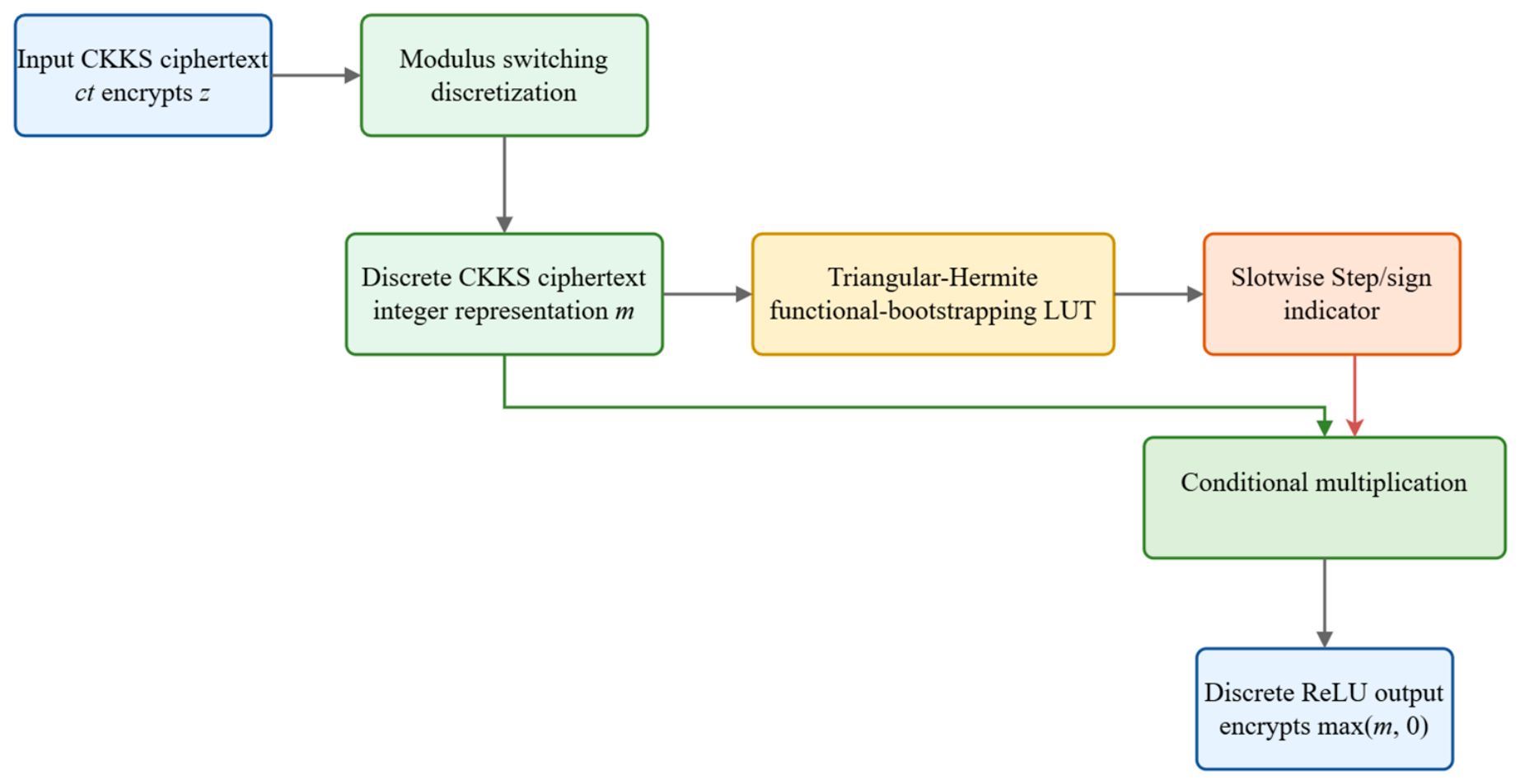
Given a CKKS ciphertext encrypting a vector z, we first apply modulus-switch-based discretization to map the approximate plaintext to a finite integer representation. This step converts the input into a form that can be processed by interpolation-based lookup tables while keeping the overall workflow non-interactive. The resulting discretized ciphertext is then passed to a functional-bootstrapping procedure that evaluates a Step function over the discrete domain and returns a binary sign indicator for each slot. Importantly, the binary object produced at this stage is not the ReLU value itself, but an indicator specifying whether the corresponding discretized input is nonnegative.
The ReLU output is obtained in a final conditional-multiplication step. Once the sign indicator has been computed, we multiply it by the encrypted input, or equivalently by its discretized representative, depending on the implementation level, so that negative slots are mapped to 0, and nonnegative slots retain their corresponding discrete value. Scheme 1 should therefore be understood as a compact three-stage pipeline: discretization, Step/sign evaluation via functional bootstrapping, and conditional activation.
Figure 1 summarizes this workflow. Unlike the iterative precision-reduction strategy used in
Section 4, the present scheme does not rely on repeated digit extraction and is intended for lower-complexity deployment scenarios.
3.2. Modulus Switching and Input Discretization
To enable efficient, non-interactive homomorphic lookups on floating-point inputs (e.g., Step and ReLU activations), we introduce an input-discretization mechanism based on modulus switching. By switching from the current modulus to a smaller one, this mechanism converts a CKKS ciphertext into a discrete-CKKS ciphertext. The ciphertext is then refreshed via a most-significant-bit (MSB) bootstrapping procedure; when functional bootstrapping is employed, it further applies a specified function to the encrypted plaintext.
Lemma 1. Let ct = (a,b)∈ be a CKKS ciphertext (coefficient-encoded) encrypting a vector z∈(−1, 1)N under secret key sk. Set the base scaling factor Δ
0 = q0. Let q1 be another modulus, and define the discretization procedure bywhere rounding is coefficientwise. The output encrypts a plaintext m∈Rq1 with m ≈ q·z; the corresponding scaling factor is . In particular,where e is the error introduced by discretization and satisfies , with h the Hamming weight of the secret key. Proof. Since ct encrypts a vector z∈(−1, 1)N with base scaling Δ0 = q0, multiplying (a,b) by q1/q0 is equivalent to performing one modulus switch, yielding a ciphertext under modulus q1. Applying a second modulus switch gives which corresponds to an encryption (under modulus q0) of a plaintext m∈Rq1 that is approximately m ≈ . The associated scaling factor is q0/q1.
The error introduced by discretizing the ciphertext polynomial is essentially due to rounding, hence each coefficient error is of order O(1). When decrypting with a secret key of Hamming weight h, the decryption error in a plaintext coefficient can be viewed as the sum of up to h independent rounding errors, each of size O(1). Consequently, in practice, we obtain the bound . This completes the proof. □
Note that the discretization output is in fact an RLWE ciphertext, which can subsequently be refreshed using the MSB bootstrapping method. In addition, in the sequel, exactness refers to exact evaluation over the discretized plaintext representation unless stated otherwise.
3.3. Trigonometric-Hermite Interpolants for the Step and Mod Functions
To implement the conditional logic of ReLU, we must extract the sign of the encrypted input—that is, determine whether the underlying plaintext exceeds zero. To avoid explicit comparison operations, we construct the following Step and Mod functions via trigonometric Hermite interpolation [
21].
Construction of the Step function. For
k∈[
p]:
Discretized lookup table as below,
We then employ the trigonometric Hermite interpolation method of Alexandru et al. [
21] to construct the periodic interpolant:
where
.
Construction of the Mod function. For
k∈[
p]:
Discretized lookup tables:
3.4. Trigonometric-Hermite Interpolation–Based Functional Bootstrapping Algorithm
We adopt the trigonometric-Hermite interpolation–based functional bootstrapping algorithm of Alexandru et al. The input is the ciphertext discretized via modulus switching as described above. The Algorithm 1 proceeds as follows:
| Algorithm 1: |
Input: ct, a discretized CKKS (or RLWE) ciphertext with ciphertext modulus q and plaintext modulus p; LUT, the target lookup function on the discrete domain
Output: ct′, a bootstrapped ciphertext under modulus Q encrypting the slotwise LUT evaluation |
1. ct1 ← ModSwitch (ct, )
2. ct2 ←
3. ct3 ← ModRaise(ct2, )
4. ct4 ← CtS(ct3)
5. ct5 ← EvalLUT(ct4, LUT)
6. ct6 ← StC(ct5)
7. ct′ ← ModSwitch(ct6, Q) |
The input ciphertext ct to FuncBT is a discretized CKKS ciphertext (it may also be an RLWE ciphertext) with ciphertext modulus q and plaintext modulus p. This work chiefly bootstraps discretized CKKS ciphertexts.
To bootstrap, first switch the modulus of ct from q to (line 1), then adjust the scaling to obtain a CKKS ciphertext whose encoding has the form (line 2). To allow more homomorphic operations while accommodating noise, raise the ciphertext modulus to (line 3). Next, convert the encoding of ct3 from coefficient representation to slot representation (line 4). Then homomorphically evaluate the trigonometric-Hermite interpolation polynomial LUT (line 5). Finally, adjust the ciphertext modulus (lines 6 and 7).
The output ciphertext has ciphertext modulus Q and plaintext modulus P.
3.5. A Multi-Precision Homomorphic ReLU Scheme
In conventional FHE systems, available methods for nonlinear operations support only very low precision. For example, sign-function evaluation based on FHEW/TFHE bootstrapping is typically limited to about 4–5 bits in practice [
8]. When higher precision is required, the running time grows roughly linearly with the plaintext/ciphertext modulus (i.e., exponentially in the modulus bit-width). Our ReLU algorithm reduces this dependence to logarithmic complexity, thereby enabling high-precision computation in practice.
Our homomorphic multi-precision ReLU algorithm is as follows. The input ct∈ is a CKKS ciphertext (coefficient-encoded) encrypting a vector z∈(−1, 1)N.
Theorem 1. Let ct = (a,b)∈ be a CKKS ciphertext (coefficient encoding) encrypting a vector z∈(−1, 1)N under secret key sk. In the following theorem, all comparisons involving the encrypted vector z are interpreted slotwise. Let m denote the discretized plaintext representation associated with z after the modulus-switching step of Lemma 1. After applying Algorithm 2, the output ciphertext encrypts the slotwise discrete ReLU of m. More precisely, for each slot j, let zj and mj denote the j-th components of z and of its discretized plaintext representation m, respectively. If zj < 0, the j-th output slot encrypts 0; if zj ≥ 0, the j-th output slot encrypts the corresponding discretized value mj ≈ . Algorithm 2 invokes FuncBT at most times.
| Algorithm 2: HomReLU1(ct∈RQ2) |
Input: ct, a coefficient-encoded CKKS ciphertext encrypting a vector z
Output: ct′, a ciphertext encrypting the slotwise discrete ReLU of the discretized representation of z |
1. ct* ←
2. While Q > q do
3. ct1 ← ct* mod q
4. ct2 ←
5. ct3 ←ct* − ct2
6. ct* ← ModSwitch(ct3, Q/p)
7. Q ← Q/p, P ← P/p
8. cts ←
9. ct′ ← cts · ct
10. return ct′ |
Proof. The encoding of ct* is , where m∈RP and m ≈ . After executing line 3 of Algorithm 2, we obtain a ciphertext ct1 whose encoding is . Applying the bootstrapping procedure FuncBT (line 4) yields a ciphertext ct2 with encoding , where m’ = m mod p. After line 5, we get ct3 whose encoding is . Note that m-m mod p amounts to discarding the lowest log p bits of m while keeping its higher bits. We then modulus-switch the ciphertext modulus from Q to Q/p, and iterate this loop until the modulus is reduced so that Q ≤ q. Finally, one more call to FuncBT recovers the most significant bit (the sign) of the plaintext: if z < 0, the output is an encryption of 0; if z ≥ 0, the output is an encryption of some m∈RP with m ≈ . Since each iteration updates P ← P/p, Algorithm 2 invokes FuncBT at most times. □
4. Design of an Interpolation-Based ReLU Scheme via Iterative MSB Bootstrapping
This section presents a discrete interpolation-based ReLU scheme built on iterative MSB bootstrapping. The core idea is to first use an MSB-bootstrapping primitive to extract the least significant base-p digit (with p = t), and then repeat this procedure l times, thereby supporting a plaintext space of size P = tl (the key to multi-precision ReLU). This process enables ciphertext-domain sign extraction, which in turn yields the desired ReLU evaluation.
4.1. Core Idea and Overall Workflow
We employ the iterative most-significant-bit (MSB) bootstrapping method of Kim et al. [
22], which extends the MSB bootstrapping scheme of Bae et al. [
19]. Its chief advantage is that, through iteration, it attains arbitrary-precision bootstrapping—an ability that is crucial for our ReLU framework.
Assume
is a coefficient-encoded discrete CKKS ciphertext whose plaintext
is embedded in the most significant digits. More precisely, for the secret key sk, we have
. We extract the least significant digit iteratively as follows. First, multiply the ciphertext by
tl−1 to obtain a CKKS ciphertext whose most significant digits encrypt [
m]
t. Next, bootstrap this ciphertext (using the integer-to-integer bootstrapping method of [
19]) to get an encryption of [
m]
t. Then apply StC to convert this result to coefficient encoding and subtract it from the original ciphertext ct. At this point, we obtain (i) a slot-encoded CKKS ciphertext encrypting the least significant digit of
m, and simultaneously (ii) a coefficient-encoded discrete CKKS ciphertext encrypting the remaining high-order part (
m − [
m]
t/
t), which is still positioned in the most significant digits. Repeating this procedure finally yields the sign bit, thereby realizing homomorphic ReLU.
4.2. Iterative MSB Bootstrapping Algorithm
We adopt the MSB bootstrapping algorithm of Bae et al. [
19]. The input is the ciphertext discretized via modulus switching as described earlier. Algorithm 3 is as follows:
| Algorithm 3: |
Input: ct, a discrete CKKS ciphertext encrypting an integer message over Z_t
Output: ct′, a bootstrapped ciphertext encrypting the decoded integer or the requested LUT output |
1. ct1 ← ModRaise(ct, )
2. ct2 ← CtS(ct1)
3. ct3 ← EvalExp(ct2, ψ = x → e2πix/t)
4. ct′ ← LUT(ct3, ψ−1) |
The input ciphertext ct to Algorithm 3 is a discrete CKKS ciphertext (coefficient encoding) encrypting a plaintext , i.e., for the secret key sk, . Let ψ:Zt → CN/2 be the mapping defined by ψ(x) → e2πix/t, which is associated with roots-of-unity encoding. Line 1 of Algorithm 3 raises the ciphertext modulus from q0 to a larger to provide computational headroom for the subsequent bootstrapping. Line 2 converts the ciphertext from coefficient encoding to slot encoding. Line 3 is one of the core steps. It maps the encrypted integer to its corresponding root of unity on the unit circle, enabling the following LUT interpolation to be carried out more stably and compactly on the unit circle. Line 4 decodes the root of unity back to an integer.
4.3. Using the Step Function as a Look-Up Table (LUT)
To realize the Step function, simply replace the LUT in line 4 of Algorithm 3, i.e., LUT(ct
3,
ψ−1), with the LUT for the Step function. Concretely, first map the input message
x to a root of unity on the complex unit circle:
e2πix/t →
x. Then perform the table lookup that maps this complex root of unity to the Step output:
Chung et al. proposed an efficient LUT evaluation method that represents the table with a low-degree polynomial, thereby mapping roots of unity to integers [
20]. Concretely, define an interpolation polynomial
, where
u =
e2πix/t is the input root of unity and
f(
u) = Step(
x). The coefficients
ai are obtained by interpolation. Specifically, construct the Vandermonde matrix
U whose entries are powers of a primitive
t-th root of unity:
Interpolation coefficients can be determined by:
That is, by solving the above linear system, we obtain the polynomial interpolation coefficients ai. Once the interpolating polynomial is obtained, evaluate f(u) homomorphically in the ciphertext domain; fast exponentiation techniques (e.g., the Paterson–Stockmeyer method) can be used to reduce the homomorphic multiplicative depth.
4.4. Homomorphic ReLU with Arbitrary Precision
Below, we construct a homomorphic multi-precision ReLU algorithm based on the MSB bootstrapping method. The input ct is a coefficient-encoded CKKS ciphertext encrypting a vector z∈(−1, 1)N. Here, P = tl and p = t denote the plaintext moduli for multi-precision and single-precision, respectively, and their corresponding ciphertext moduli are Q and q.
The core of Algorithm 4 is a loop over
i = 0, …,
l − 1. In each iteration, it invokes IntBoot to extract the least significant base-
t digit; repeating this
l times progressively reveals the most significant base-
t digit. Finally, one additional bootstrapping recovers the sign bit of that most significant digit, thereby completing the ReLU evaluation.
| Algorithm 4: HomReLU2 (ct∈RQ2) |
Input: ct, a coefficient-encoded CKKS ciphertext encrypting a vector z, with plaintext modulus P = t^l
Output: ct′, a ciphertext encrypting the slotwise discrete ReLU of the discretized representation of z |
1. ct* ← ;
2. P = tl, p = t;
3. for i = 0 to i = l − 1
4. ct1 ← IntBoott(tl−1-i · ct*);
5. if i < l − 1 then
6. ct* ← ct* − ti · StC(ct1);
7. end if
8. ct* ← ModSwitch (ct*, Q/t);
9. Q ← Q/t, P ←P/t;
10. end for
11. cts ← IntBoott(ct*, LUT(1−);
12. ct′ ← cts · ct;
13. return ct′ |
Theorem 2. Let ct = (a,b)∈ be a CKKS ciphertext (coefficient encoding) encrypting a vector z∈(−1, 1)N under secret key sk, and let m denote the discretized plaintext representation associated with z under the parameters of Algorithm 4. As in Theorem 1, all comparisons involving the encrypted vector z are interpreted slotwise. After applying Algorithm 4, the output ciphertext encrypts the slotwise discrete ReLU of m. More precisely, for each slot j, let zj and mj denote the j-th components of z and of its discretized plaintext representation m, respectively. If zj < 0, the j-th output slot encrypts 0; if zj ≥ 0, the j-th output slot encrypts the corresponding discretized value mj ≈ . Algorithm 4 invokes IntBoot at most l + 1 times.
Proof. Assume
is a coefficient-encoded discrete CKKS ciphertext whose plaintext
is embedded in the most significant digits. More precisely, for the secret key sk,
. We now illustrate one iteration of the loop. When
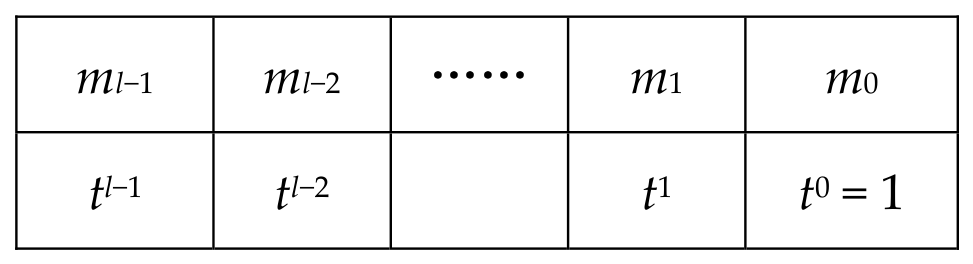
i = 0 (before executing line 4), the plaintext form of ct* is as shown in
Figure 2.
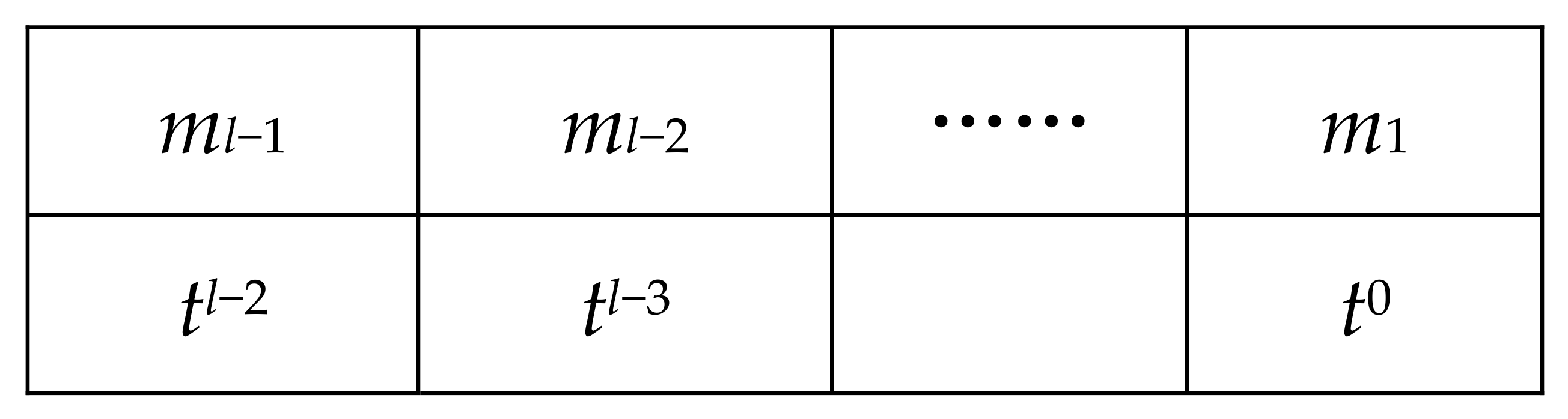
After performing the operation
tl−1 · ct*, which corresponds to shifting the plaintext right by
l − 1 digits, the plaintext takes the form shown in
Figure 3.
Thus, we obtain a CKKS ciphertext whose most significant digit encodes
m0 = [
m]
t. The reason is that ct* encrypts
; after applying
tl−1 · ct*, the underlying plaintext changes from
to
, and
. Bootstrapping this ciphertext (line 4) yields a ciphertext ct
1 encrypting
. Subtracting it from the original ciphertext ct* (line 6) gives a new ciphertext ct* whose plaintext is
, as shown in
Figure 4.
Then reduce both the ciphertext modulus and the plaintext modulus (lines 8–9). After exiting the loop, the result is a single-precision ciphertext; one final bootstrapping recovers the sign bit of the most significant digit, thereby completing the ReLU computation. From the number of iterations, Algorithm 4 invokes IntBoott at most l + 1 times. This completes the proof. □
5. Experiments and Discussion
To validate the effectiveness of the proposed interpolation-based, non-interactive, strictly discrete ReLU schemes under fully homomorphic encryption, this section presents a comprehensive experimental evaluation, including detailed setup, performance analysis, and comparative studies. The results demonstrate clear advantages in practical deployment scenarios—most notably, high efficiency and exactness in encrypted model inference.
5.1. Experimental Environment and Parameter Settings
All experiments were conducted on a workstation equipped with an Intel Core i9-10900K (3.70 GHz) CPU and 512 GB RAM, running Ubuntu 20.04.3 LTS. The software stack uses the HEAAN fully homomorphic encryption library, with implementations in C++. The specific parameter settings used in our experiments are summarized in
Table 1.
In
Table 1, N denotes the polynomial ring dimension of CKKS ciphertexts;
are the Hamming weights of the dense and sparse secret-key variants, respectively. “CKKS max ciphertext modulus” gives the bit-length of the largest modulus. “Multiplicative depth” indicates the remaining multiplicative depth after bootstrapping (i.e., the number of further multiplications that can still be performed).
5.2. Performance Analysis
We profiled the runtime of the two proposed schemes; the measurements are summarized in
Table 2.
It is evident that bootstrapping is the primary time consumer in both schemes; however, the trigonometric-Hermite interpolation–based design achieves superior overall runtime compared with the iterative-MSB bootstrapped interpolation ReLU scheme.
5.3. Precision and Accuracy Analysis
Because both schemes operate on a discretized CKKS representation, our precision analysis distinguishes the discretization step from the subsequent LUT evaluation. The experiments show that, once the input has been discretized, the proposed procedures produce ReLU outputs that are exact with respect to the resulting discrete representation. Accordingly, when a slot corresponds to a negative discretized input, the output slot is 0; when it corresponds to a nonnegative discretized input, the output slot retains the corresponding discrete value. The remaining deviation from the original approximate CKKS plaintext is inherited from the discretization error analyzed in Lemma 1.
5.4. Comparative Experimental Analysis
We further compare the two schemes proposed in this work with mainstream homomorphic ReLU methods; the detailed results are reported in
Table 3.
Table 3 compares the proposed schemes with representative CKKS polynomial and TFHE/FHEW-style approaches. This comparison should be interpreted carefully: TFHE-based sign evaluation may achieve lower single-operation wall-clock time, whereas the advantage of the proposed CKKS-based schemes lies in their compatibility with SIMD-packed inference and in the resulting amortized per-slot throughput. Relative to CKKS polynomial approximation, our methods provide exact evaluation over the discretized representation and operate with lower multiplicative-depth overhead for the target activation task. Relative to TFHE/FHEW, the proposed schemes target a different operating point, emphasizing packed CKKS deployment and support for larger precision regimes rather than direct wall-clock superiority for a single operation.
To quantify the auxiliary storage required by the proposed LUT-based activation,
Table 4 reports the ReLU-specific LUT/interpolation storage cost under the reported plaintext setting. The table counts only auxiliary lookup values or interpolation coefficients associated with the ReLU evaluation; shared bootstrapping and evaluation keys are not included.
For Scheme 1, the Step and Mod lookup tables contain p entries each, so the auxiliary LUT footprint is linear in p. With the 8-bit setting p = 256, this corresponds to 2p = 512 interpolation coefficients, or about 8 KiB if each coefficient is stored as a double-precision complex value. For Scheme 2, the distinct LUTs are determined by the radix t and can be reused across iterative rounds; thus, the ReLU-specific storage is linear in t, not in the full plaintext modulus P = t^l. For example, if P = 256 is represented as t = 16 and l = 2, the distinct LUT footprint is 2t = 32 coefficients, or about 512B under the same coefficient-storage convention. Even under a conservative implementation that materializes the digit-decoding LUT separately for each round, the footprint would be at most (l + 1)t = 48 coefficients, or about 768B.
Reference [
14] employs a combination of widely used low-degree minimax polynomials to approximate ReLU. Compared with CKKS polynomial-approximation approaches, our schemes markedly improve computational accuracy, effectively suppress noise growth, and achieve higher efficiency. Relative to TFHE/FHEW methods—although both produce exact outputs—our schemes support higher precision and a larger plaintext space (modulus), while also being more efficient, making them better suited to more complex application scenarios.
Synthesizing the above results, we conclude:
Both proposed schemes perform ReLU evaluation exactly with respect to the discretized representation, thereby avoiding the approximation residuals inherent in polynomial-surrogate CKKS methods.
Between the two proposed constructions, the trigonometric-Hermite functional-bootstrapping variant offers a more compact activation pipeline, while the iterative MSB variant is better suited to larger precision regimes.
Compared with TFHE/FHEW-based sign evaluation, the proposed schemes target a different operating point: they are more naturally integrated with SIMD-packed CKKS inference and can support larger precision settings, but they should not be interpreted as universally superior in single-operation wall-clock runtime.
6. Evaluating ReLU Inference in Encrypted Neural Networks
To further validate the applicability and feasibility of the proposed non-interactive, strictly discrete ReLU schemes in practical deep-learning tasks, we adopt the canonical MNIST image-classification dataset and construct a lightweight convolutional network (a LeNet variant). The proposed ReLU schemes are embedded into the homomorphic inference pipeline, and we evaluate inference accuracy, homomorphic computation performance, and scalability under realistic deployment settings.
We use the following three-layer convolutional architecture (simplified LeNet) as the base model:
Input layer: 28 × 28 grayscale images.
Convolution 1: 5 × 5 kernels, 8 output channels, ReLU activation.
Convolution 2: 5 × 5 kernels, 16 output channels, ReLU activation.
Fully connected: outputs probabilities for 10 classes via softmax.
All ReLU activations are replaced by the proposed non-interactive, strictly discrete ReLU, so they execute directly on CKKS ciphertexts. The ciphertext parameterization is summarized in
Table 5.
We evaluated the encrypted inference pipeline on five independent random subsamples of the MNIST test set, each containing 1000 images sampled without replacement within each subsample. For each method, we report the mean and standard deviation of classification accuracy across the five subsamples. The results are summarized in
Table 6, where accuracy is reported as mean ± standard deviation.
Intervention F From
Table 6, the two proposed ReLU schemes achieve mean encrypted classification accuracies above 96% under the five-subsample evaluation protocol, while maintaining practical inference latency under the reported parameter setting. Compared with the CKKS polynomial-approximation baseline, both schemes show higher mean accuracy and produce exact outputs with respect to the discretized representation. Scheme 1 has lower inference latency, whereas Scheme 2 achieves a slightly higher mean accuracy at the cost of additional computation. The gap to plaintext inference is 2.1 percentage points for Scheme 1 and 1.4 percentage points for Scheme 2, suggesting that the proposed discrete activations preserve competitive inference quality in this experimental setting.
These experiments show that the interpolation-based ReLU is not only theoretically sound but also practically applicable to real neural-network inference. Under ciphertext-level security, it preserves the discreteness and exactness of ReLU while balancing performance and accuracy—appropriate for privacy-preserving image recognition, encrypted medical analytics, and related HE inference scenarios. Our schemes achieve efficiency through three key mechanisms. First, they require significantly fewer bootstrapping operations—Scheme 1 performs only one bootstrap per ReLU activation, and Scheme 2 requires l + 1 bootstraps for arbitrary precision, whereas polynomial approximation methods necessitate frequent re-bootstrapping in deep networks to recover computational precision. Second, our LUT-based approach performs function evaluation in a single pass, eliminating the iterative refinement procedures typically required by polynomial methods to achieve acceptable approximation accuracy. Third, discrete ReLU computation consumes minimal multiplicative depth (just one level for the conditional multiplication), avoiding the depth overhead of high-degree polynomial evaluations, which enables the use of larger scaling factors and reduces overall precision loss throughout the network.
Scalability and parameter sensitivity. The dominant cost in both proposed schemes is bootstrapping. In Scheme 1, the main activation cost is one functional-bootstrapping call for Step/sign extraction, followed by one conditional multiplication. Its LUT footprint grows linearly with the single-precision LUT domain size p. In Scheme 2, higher precision is supported by representing the plaintext modulus as P = t^l; increasing the precision mainly increases the number of iterative bootstrapping rounds, while the distinct LUT footprint is governed by the radix t. Thus, Scheme 1 is more compact and suitable for lightweight settings, whereas Scheme 2 trades additional bootstrapping rounds for support of larger plaintext moduli. In both schemes, SIMD packing can improve amortized per-slot throughput, but the wall-clock latency remains dominated by bootstrapping. These trade-offs should be considered when selecting parameters for larger networks or higher-precision inference tasks.
Overall, the results suggest that interpolation-based discrete activation is a promising alternative to polynomial approximation for CKKS-based encrypted inference. The two constructions provide different trade-offs between compactness and precision, and the experiments indicate that both can be integrated into encrypted neural-network pipelines under the reported parameter settings. Future work will focus on broader empirical validation, tighter quantitative analysis of auxiliary storage, and extension of the approach to other nonlinearities and larger architectures.
7. Conclusions
This paper presented two non-interactive constructions for discrete ReLU evaluation over CKKS by combining modulus-switch-based discretization with interpolation-based LUT evaluation. The first construction uses trigonometric-Hermite functional bootstrapping to compute a slotwise Step/sign indicator and then obtains the ReLU output through conditional multiplication. The second construction uses iterative MSB bootstrapping to support larger plaintext moduli and higher-precision settings. In both cases, exactness refers to the evaluation over the discretized plaintext representation, while the deviation from the original CKKS plaintext is governed by the discretization step.
The experimental results indicate that the proposed schemes can be integrated into encrypted neural-network inference and can preserve competitive accuracy relative to polynomial-approximation baselines under the reported parameter settings. The two schemes offer different trade-offs: the trigonometric-Hermite variant provides a more compact activation pipeline, whereas the iterative MSB variant is more suitable for higher-precision regimes. Future work will focus on broader empirical validation, tighter storage and runtime analysis, and extensions to other nonlinear activation functions and larger neural-network architectures.