
Near-Optimal Decoding Algorithm for Color Codes Using Population Annealing

Abstract
1. Introduction
Contributions
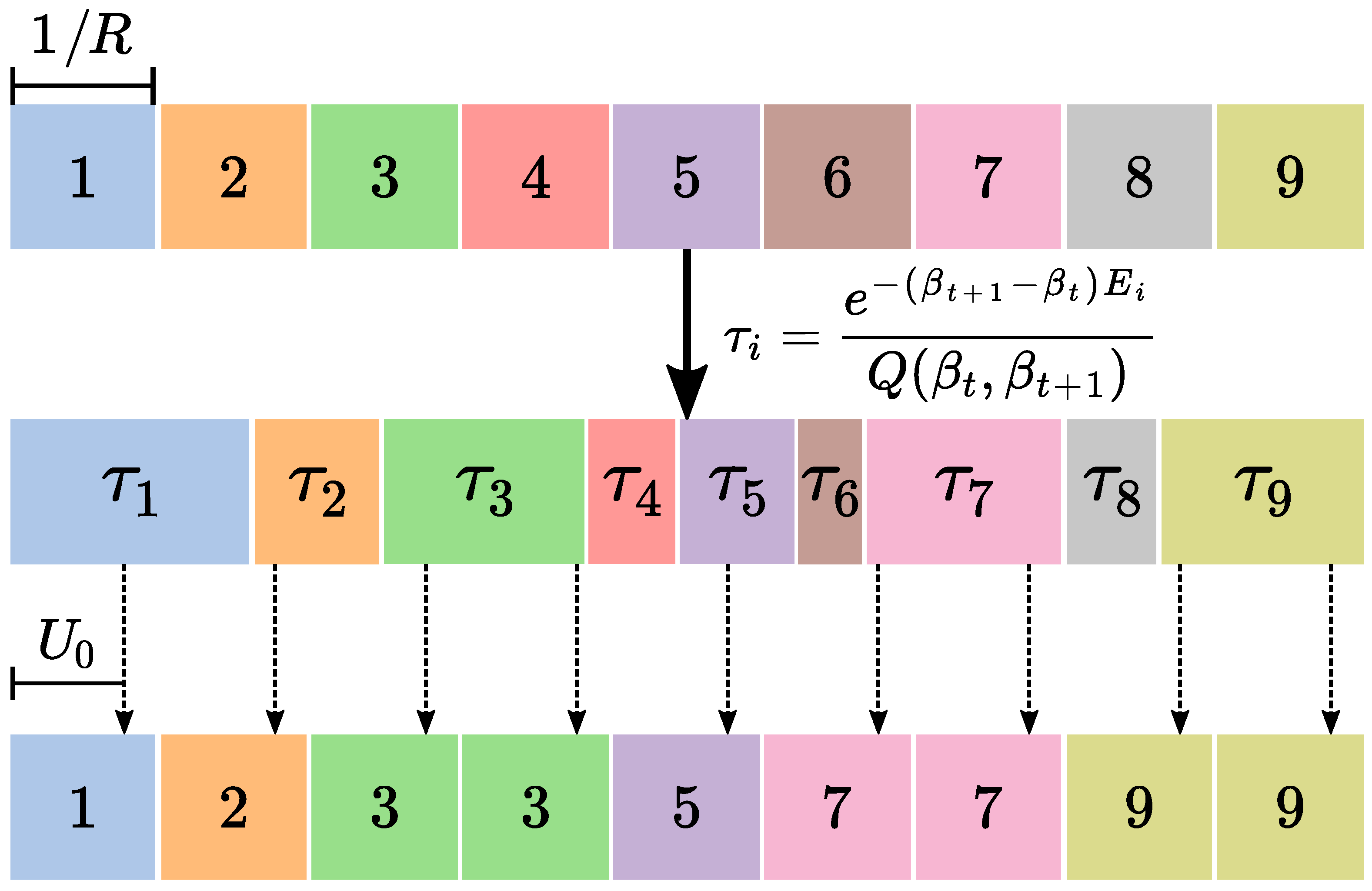
- We introduce the first application of Population Annealing (PA) to quantum error correction, a modified simulated annealing algorithm that incorporates resampling steps to avoid local minima and enables free energy estimation for maximum-likelihood decoding. The algorithm is applicable to CSS codes under bit-flip, depolarizing and phenomenological noise models.
- Unlike previous SA-based decoders that minimize error weights (most likely error), our PA decoder finds recovery operations with maximum success probability (most likely error class). This leads to an increase in decoding accuracy with a comparable computational cost.
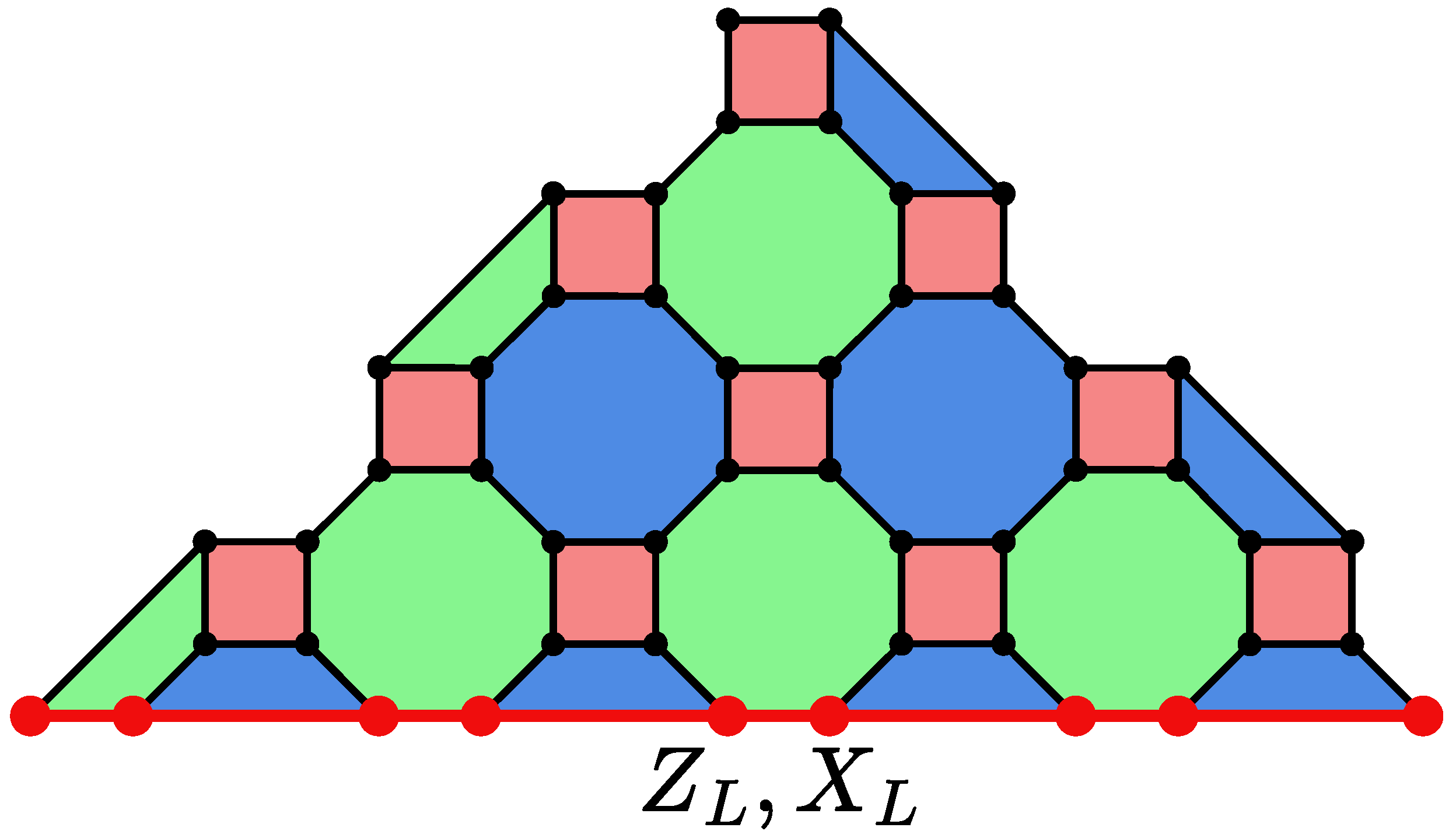
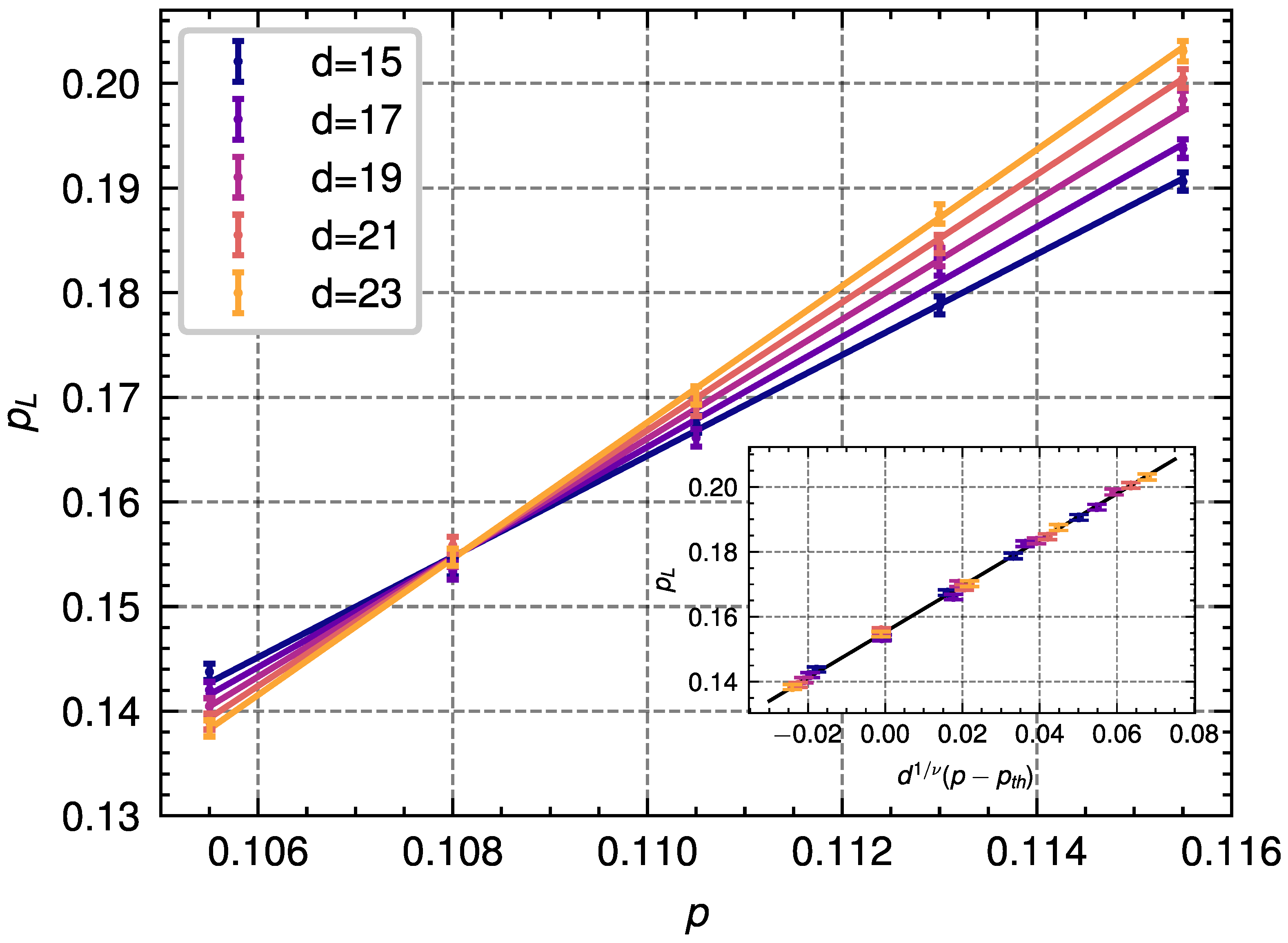
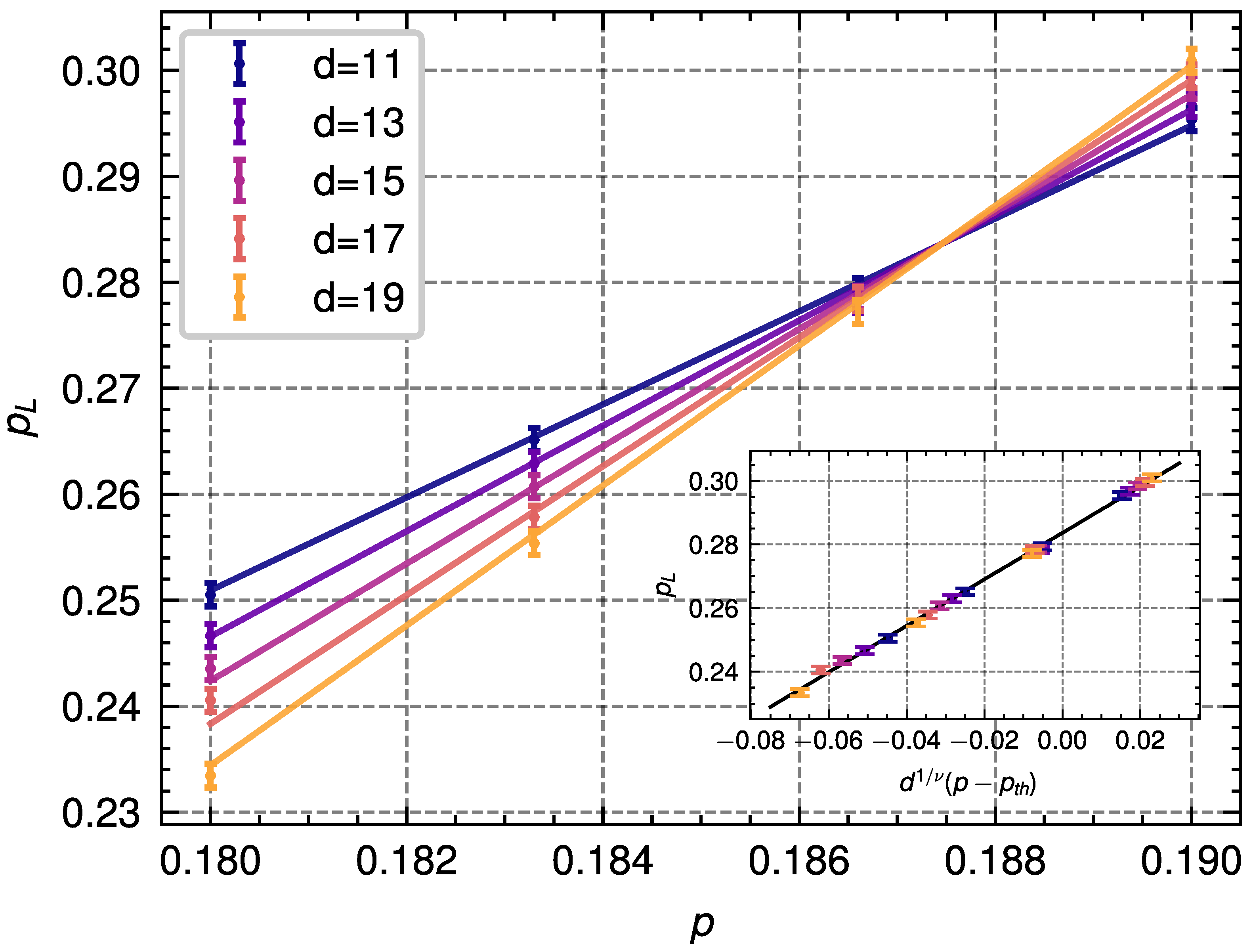
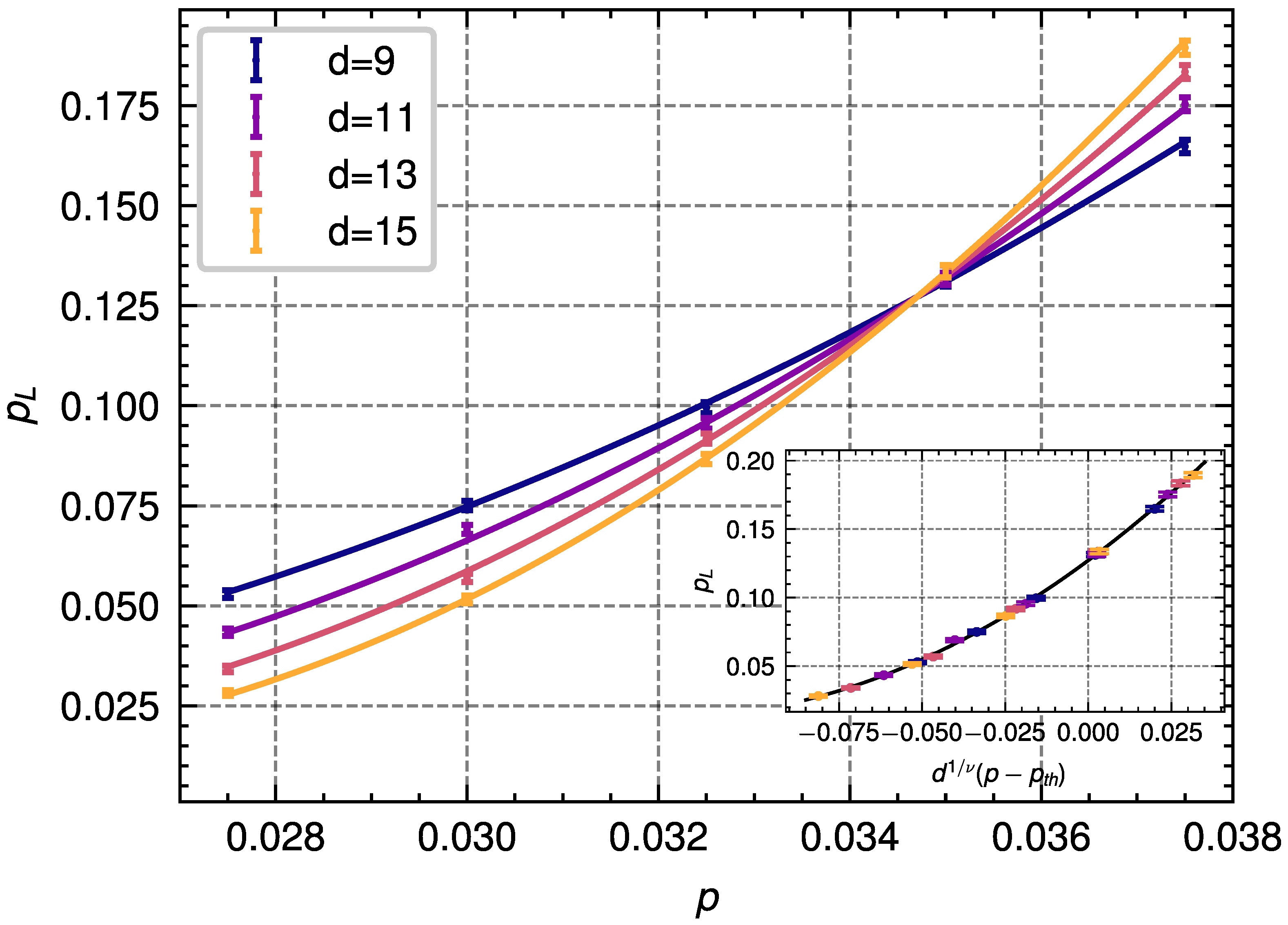
- We demonstrate significant threshold improvements over existing methods on the triangular color code with the square-octagon lattice: 10.81% for bit-flip noise (vs. 10.36% with SA [56], 10.2% with restriction + MWPM [47]), 18.75% for depolarizing noise (vs. 18.47% with SA [56], 17.5% with neural networks [42]), and 3.47% for phenomenological noise (vs. 2.9% with SA [56], 2.08% with graph matching [41]).
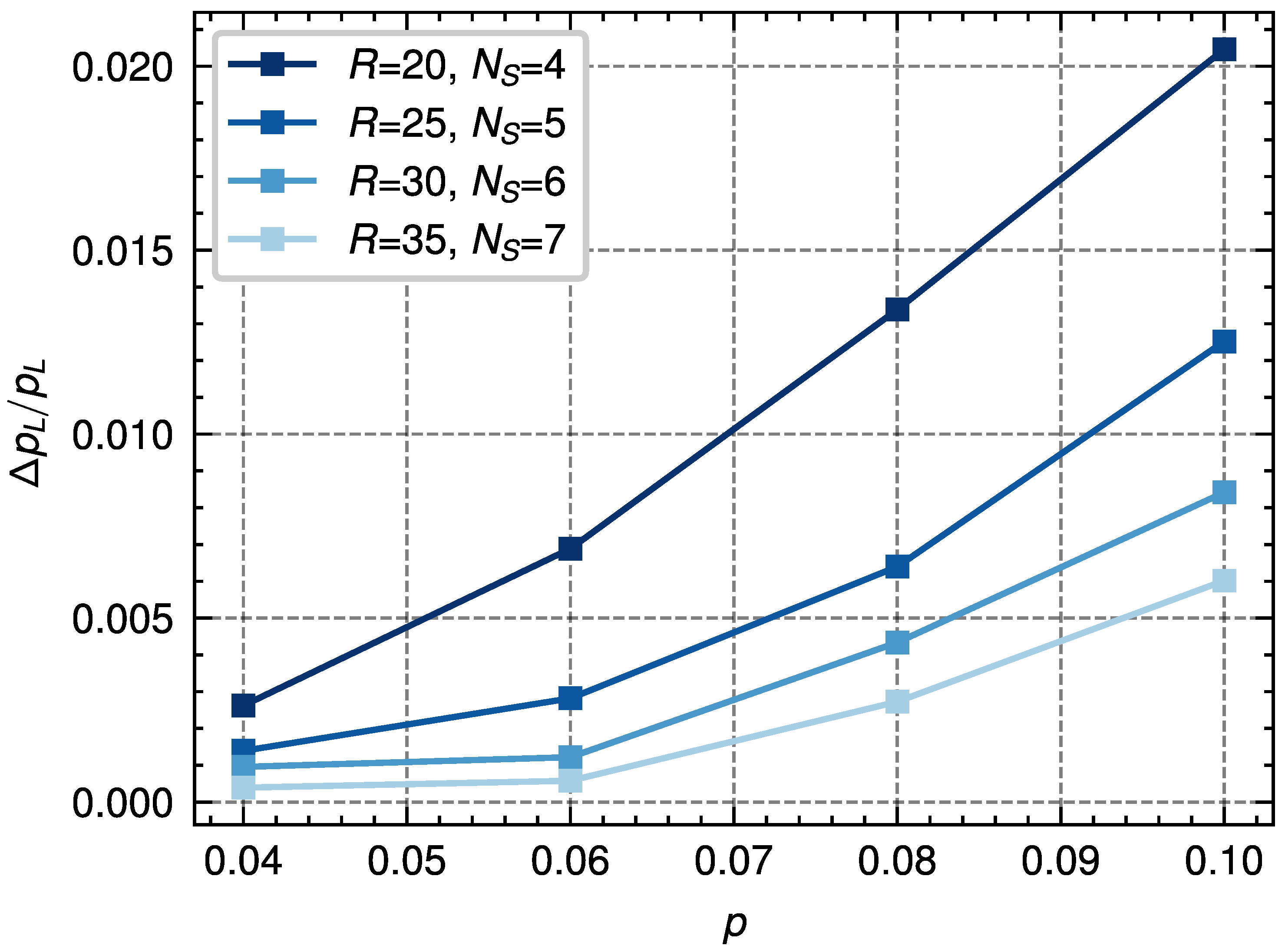
- We provide methods for hyperparameter optimization to balance decoding performance and computational cost, and suggest avenues for further reduction in decoding time.
2. Background
2.1. Color Codes
2.2. Mapping the Code to a Spin System
2.3. Optimal Decoding
3. Population Annealing
4. Numerical Results
4.1. Simulation Details
4.2. Bit-Flip Noise
4.3. Depolarizing Noise
4.4. Phenomenological Noise
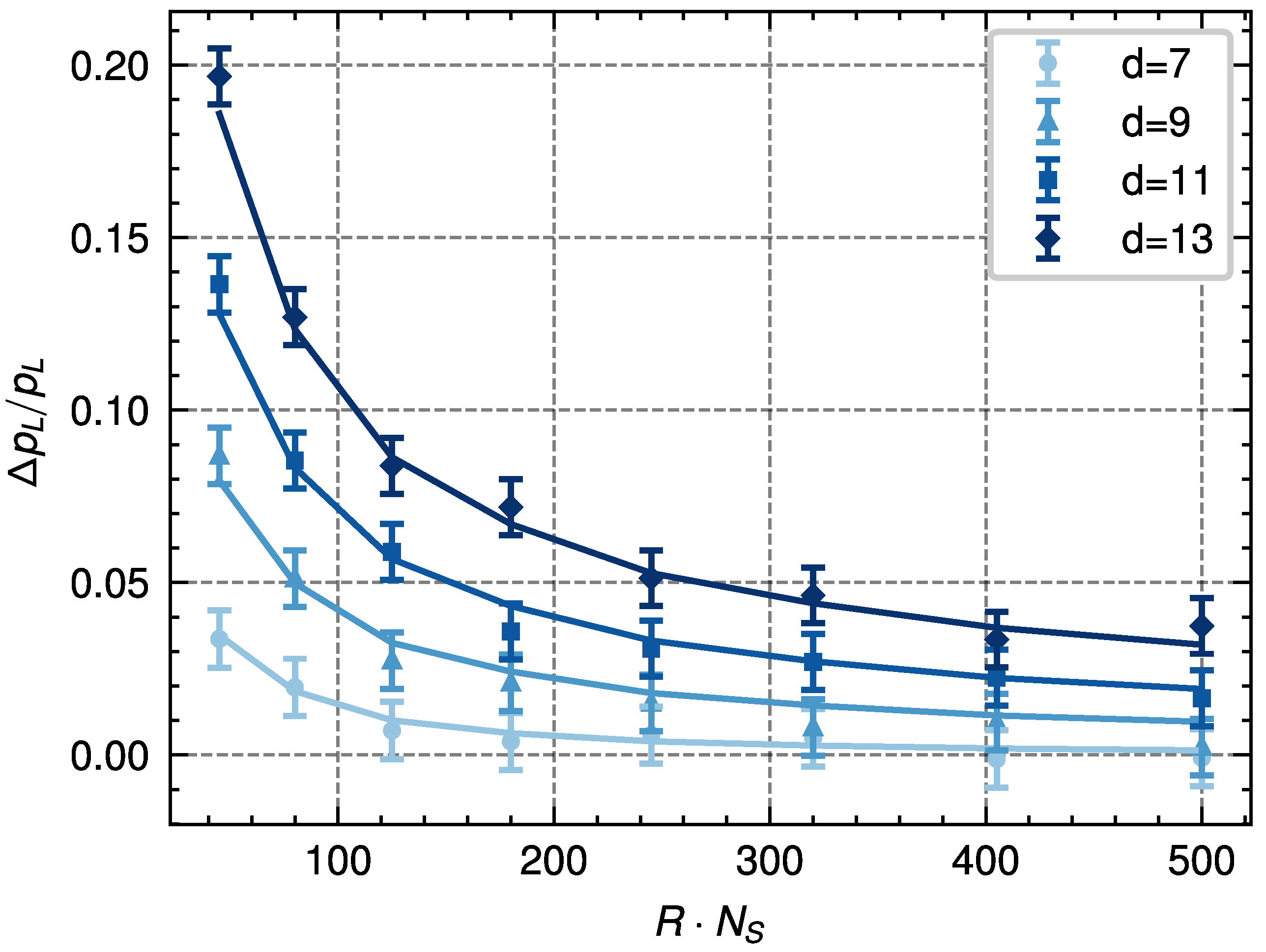
5. Resource Optimization
6. Conclusions and Outlook
Author Contributions
Funding
Institutional Review Board Statement
Informed Consent Statement
Data Availability Statement
Acknowledgments
Conflicts of Interest
References
- Clarke, J.; Wilhelm, F.K. Superconducting quantum bits. Nature 2008, 453, 1031–1042. [Google Scholar] [CrossRef]
- Paraoanu, G.S. Recent Progress in Quantum Simulation Using Superconducting Circuits. J. Low Temp. Phys. 2014, 175, 633. [Google Scholar] [CrossRef]
- Wendin, G. Quantum information processing with superconducting circuits: A review. Rep. Prog. Phys. 2017, 80, 106001. [Google Scholar] [CrossRef]
- Kjaergaard, M.; Schwartz, M.E.; Braumüller, J.; Krantz, P.; Wang, J.I.J.; Gustavsson, S.; Oliver, W.D. Superconducting qubits: Current state of play. Annu. Rev. Condens. Matter Phys. 2020, 11, 369–395. [Google Scholar] [CrossRef]
- Cirac, J.I.; Zoller, P. Quantum computations with cold trapped ions. Phys. Rev. Lett. 1995, 74, 4091. [Google Scholar] [CrossRef]
- Häffner, H.; Roos, C.F.; Blatt, R. Quantum computing with trapped ions. Phys. Rep. 2008, 469, 155–203. [Google Scholar] [CrossRef]
- Barreiro, J.; Müller, M.; Schindler, P.; Nigg, D.; Monz, T.; Chwalla, M.; Hennrich, M.; Roos, C.F.; Zoller, P.; Blatt, R. An open-system quantum simulator with trapped ions. Nature 2011, 470, 486. [Google Scholar] [CrossRef]
- Lanyon, B.P.; Hempel, C.; Nigg, D.; Müller, M.; Gerritsma, R.; Zähringer, F.; Schindler, P.; Barreiro, J.T.; Rambach, M.; Kirchmair, G.; et al. Universal Digital Quantum Simulation with Trapped Ions. Science 2011, 334, 57. [Google Scholar] [CrossRef]
- Brown, K.R.; Kim, J.; Monroe, C. Co-designing a scalable quantum computer with trapped atomic ions. npj Quantum Inf. 2016, 2, 16034. [Google Scholar] [CrossRef]
- Bruzewicz, C.D.; Chiaverini, J.; McConnell, R.; Sage, J.M. Trapped-ion quantum computing: Progress and challenges. Appl. Phys. Rev. 2019, 6, 021314. [Google Scholar] [CrossRef]
- Jaksch, D.; Cirac, J.I.; Zoller, P.; Rolston, S.L.; Côté, R.; Lukin, M.D. Fast quantum gates for neutral atoms. Phys. Rev. Lett. 2000, 85, 2208. [Google Scholar] [CrossRef]
- Saffman, M.; Walker, T.G.; Mølmer, K. Quantum information with Rydberg atoms. Rev. Mod. Phys. 2010, 82, 2313. [Google Scholar] [CrossRef]
- Anderson, S.E.; Younge, K.; Raithel, G. Trapping Rydberg atoms in an optical lattice. Phys. Rev. Lett. 2011, 107, 263001. [Google Scholar] [CrossRef]
- Bluvstein, D.; Levine, H.; Semeghini, G.; Wang, T.T.; Ebadi, S.; Kalinowski, M.; Keesling, A.; Maskara, N.; Pichler, H.; Greiner, M.; et al. A quantum processor based on coherent transport of entangled atom arrays. Nature 2022, 604, 451–456. [Google Scholar] [CrossRef]
- Bluvstein, D.; Evered, S.J.; Geim, A.A.; Li, S.H.; Zhou, H.; Manovitz, T.; Ebadi, S.; Cain, M.; Kalinowski, M.; Hangleiter, D.; et al. Logical quantum processor based on reconfigurable atom arrays. Nature 2024, 626, 58–65. [Google Scholar] [CrossRef]
- Barz, S. Quantum computing with photons: Introduction to the circuit model, the one-way quantum computer, and the fundamental principles of photonic experiments. J. Phys. B At. Mol. Opt. Phys. 2015, 48, 083001. [Google Scholar] [CrossRef]
- Nielsen, M.A.; Chuang, I.L. Quantum Computation and Quantum Information; Cambridge University Press: Cambridge, UK, 2000. [Google Scholar] [CrossRef]
- Almudever, C.G.; Lao, L.; Fu, X.; Khammassi, N.; Ashraf, I.; Iorga, D.; Varsamopoulos, S.; Eichler, C.; Wallraff, A.; Geck, L.; et al. The engineering challenges in quantum computing. In Proceedings of the Design, Automation Test in Europe Conference Exhibition (DATE), Lausanne, Switzerland, 27–31 March 2017; p. 836. [Google Scholar] [CrossRef]
- Ratcliff, L.E.; Mohr, S.; Huhs, G.; Deutsch, T.; Masella, M.; Genovese, L. Challenges in large scale quantum mechanical calculations. Wires Comput. Mol. Sci. 2017, 7, e1290. [Google Scholar] [CrossRef]
- Terhal, B.M. Quantum error correction for quantum memories. Rev. Mod. Phys. 2015, 87, 307. [Google Scholar] [CrossRef]
- Gottesman, D. Stabilizer Codes and Quantum Error Correction; California Institute of Technology: Pasadena, CA, USA, 1997. [Google Scholar] [CrossRef]
- Kitaev, A.Y. Quantum Error Correction with Imperfect Gates. In Quantum Communication, Computing, and Measurement; Springer: Boston, MA, USA, 1997; p. 181. [Google Scholar] [CrossRef]
- Kitaev, A. Fault-tolerant quantum computation by anyons. Ann. Phys. 2003, 303, 2. [Google Scholar] [CrossRef]
- Dennis, E.; Kitaev, A.; Landahl, A.; Preskill, J. Topological quantum memory. J. Math. Phys. 2002, 43, 4452–4505. [Google Scholar] [CrossRef]
- Bombin, H.; Martin-Delgado, M.A. Topological quantum distillation. Phys. Rev. Lett. 2006, 97, 180501. [Google Scholar] [CrossRef]
- Bombin, H.; Martin-Delgado, M.A. Topological Computation without Braiding. Phys. Rev. Lett. 2007, 98, 160502. [Google Scholar] [CrossRef] [PubMed]
- Gottesman, D. Fault-Tolerant Quantum Computation with Constant Overhead. arXiv 2014, arXiv:1310.2984. [Google Scholar] [CrossRef]
- Kovalev, A.A.; Pryadko, L.P. Fault tolerance of quantum low-density parity check codes with sublinear distance scaling. Phys. Rev. A 2013, 87, 020304. [Google Scholar] [CrossRef]
- Breuckmann, N.P.; Eberhardt, J.N. Quantum Low-Density Parity-Check Codes. PRX Quantum 2021, 2, 040101. [Google Scholar] [CrossRef]
- Viszlai, J.; Yang, W.; Lin, S.F.; Liu, J.; Nottingham, N.; Baker, J.M.; Chong, F.T. Matching Generalized-Bicycle Codes to Neutral Atoms for Low-Overhead Fault-Tolerance. arXiv 2023, arXiv:2311.16980. [Google Scholar] [CrossRef]
- Koukoulekidis, N.; Šimkovic, F., IV; Leib, M.; Pereira, F.R.F. Small Quantum Codes from Algebraic Extensions of Generalized Bicycle Codes. arXiv 2024, arXiv:2401.07583. [Google Scholar] [CrossRef]
- Bravyi, S.; Cross, A.W.; Gambetta, J.M.; Maslov, D.; Rall, P.; Yoder, T.J. High-threshold and low-overhead fault-tolerant quantum memory. arXiv 2023, arXiv:2308.07915. [Google Scholar] [CrossRef]
- Aharonov, D.; Ben-Or, M. Fault-tolerant quantum computation with constant error rate. SIAM J. Comput. 2008, 38, 1207. [Google Scholar] [CrossRef]
- Shor, P.W. Fault-tolerant quantum computation. In Proceedings of the 37th Conference on Foundations of Computer Science, Burlington, VT, USA, 14–16 October 1996; IEEE: New York, NY, USA, 1996; p. 56. [Google Scholar] [CrossRef]
- Preskill, J. Reliable quantum computers. Proc. R. Soc. Lond. A 1998, 454, 385. [Google Scholar] [CrossRef]
- Katzgraber, H.G.; Bombín, H.; Martin-Delgado, M.A. Error threshold for color codes and random three-body Ising models. Phys. Rev. Lett. 2009, 103, 090501. [Google Scholar] [CrossRef]
- Bombin, H.; Andrist, R.S.; Ohzeki, M.; Katzgraber, H.G.; Martin-Delgado, M.A. Strong resilience of topological codes to depolarization. Phys. Rev. X 2012, 2, 021004. [Google Scholar] [CrossRef]
- Andrist, R.S.; Katzgraber, H.G.; Bombin, H.; Martin-Delgado, M.A. Tricolored lattice gauge theory with randomness: Fault tolerance in topological color codes. New J. Phys. 2011, 13, 083006. [Google Scholar] [CrossRef]
- Sarvepalli, P.; Raussendorf, R. Efficient decoding of topological color codes. Phys. Rev. A 2012, 85, 022317. [Google Scholar] [CrossRef]
- Wang, D.; Fowler, A.; Hill, C.; Hollenberg, L. Graphical algorithms and threshold error rates for the 2D color code. Quantum Inf. Comput. 2009, 10, 780. [Google Scholar] [CrossRef]
- Stephens, A.M. Efficient fault-tolerant decoding of topological color codes. arXiv 2014, arXiv:1402.3037. [Google Scholar] [CrossRef]
- Maskara, N.; Kubica, A.; Jochym-O’Connor, T. Advantages of versatile neural-network decoding for topological codes. Phys. Rev. A 2019, 99, 052351. [Google Scholar] [CrossRef]
- Delfosse, N. Decoding color codes by projection onto surface codes. Phys. Rev. A 2014, 89, 012317. [Google Scholar] [CrossRef]
- Delfosse, N.; Nickerson, N.H. Almost-linear time decoding algorithm for topological codes. Quantum 2021, 5, 595. [Google Scholar] [CrossRef]
- Delfosse, N.; Zémor, G. Linear-time maximum likelihood decoding of surface codes over the quantum erasure channel. Phys. Rev. Res. 2020, 2, 033042. [Google Scholar] [CrossRef]
- Kubica, A.; Preskill, J. Cellular-Automaton Decoders with Provable Thresholds for Topological Codes. Phys. Rev. Lett. 2019, 123, 020501. [Google Scholar] [CrossRef]
- Kubica, A.; Delfosse, N. Efficient color code decoders in d≥2 dimensions from toric code decoders. Quantum 2023, 7, 929. [Google Scholar] [CrossRef]
- Baireuther, P.; Caio, M.D.; Criger, B.; Beenakker, C.W.J.; O’Brien, T.E. Neural network decoder for topological color codes with circuit level noise. New J. Phys. 2019, 21, 013003. [Google Scholar] [CrossRef]
- Chamberland, C.; Ronagh, P. Deep neural decoders for near term fault-tolerant experiments. Quantum Sci. Technol. 2018, 3, 044002. [Google Scholar] [CrossRef]
- Davaasuren, A.; Suzuki, Y.; Fujii, K.; Koashi, M. General framework for constructing fast and near-optimal machine-learning-based decoder of the topological stabilizer codes. Phys. Rev. Res. 2020, 2, 033399. [Google Scholar] [CrossRef]
- Chubb, C.T. General tensor network decoding of 2D Pauli codes. arXiv 2021, arXiv:2101.04125. [Google Scholar] [CrossRef]
- Parrado-Rodríguez, P.; Rispler, M.; Müller, M. Rescaling decoder for two-dimensional topological quantum color codes on 4.8.8 lattices. Phys. Rev. A 2022, 106, 032431. [Google Scholar] [CrossRef]
- deMarti iOlius, A.; Fuentes, P.; Orús, R.; Crespo, P.M.; Martinez, J.E. Decoding algorithms for surface codes. arXiv 2023, arXiv:2307.14989. [Google Scholar] [CrossRef]
- Berent, L.; Burgholzer, L.; Derks, P.J.H.; Eisert, J.; Wille, R. Decoding quantum color codes with MaxSAT. arXiv 2023, arXiv:2303.14237. [Google Scholar] [CrossRef]
- Kirkpatrick, S.; Gelatt, C.D., Jr.; Vecchi, M.P. Optimization by simulated annealing. Science 1983, 220, 671–680. [Google Scholar] [CrossRef] [PubMed]
- Takada, Y.; Takeuchi, Y.; Fujii, K. Ising model formulation for highly accurate topological color codes decoding. Phys. Rev. Res. 2024, 6, 013092. [Google Scholar] [CrossRef]
- Takeuchi, Y.; Takada, Y.; Sakashita, T.; Fujisaki, J.; Oshima, H.; Sato, S.; Fujii, K. Comparative study of decoding the surface code using simulated annealing under depolarizing noise. arXiv 2023, arXiv:2311.07973. [Google Scholar] [CrossRef]
- Ohzeki, M. Locations of multicritical points for spin glasses on regular lattices. Phys. Rev. E 2009, 79, 021129. [Google Scholar] [CrossRef][Green Version]
- Ohzeki, M. Accuracy thresholds of topological color codes on the hexagonal and square-octagonal lattices. Phys. Rev. E 2009, 80, 011141. [Google Scholar] [CrossRef][Green Version]
- Hukushima, K.; Iba, Y. Population annealing and its application to a spin glass. In Proceedings of the AIP Conference Proceedings, Los Alamos, NM, USA, 9–11 May 2003; American Institute of Physics: College Park, MD, USA; Volume 690, pp. 200–206. [Google Scholar] [CrossRef]
- Machta, J. Population annealing with weighted averages: A Monte Carlo method for rough free-energy landscapes. Phys. Rev. E 2010, 82, 026704. [Google Scholar] [CrossRef]
- Ohno, T.; Arakawa, G.; Ichinose, I.; Matsui, T. Phase structure of the random-plaquette Z2 gauge model: Accuracy threshold for a toric quantum memory. Nucl. Phys. B 2004, 697, 462. [Google Scholar] [CrossRef]
- Andrist, R.S.; Katzgraber, H.G.; Bombin, H.; Martin-Delgado, M. Error tolerance of topological codes with independent bit-flip and measurement errors. Phys. Rev. A 2016, 94, 012318. [Google Scholar] [CrossRef]
- Aaronson, S.; Gottesman, D. Improved simulation of stabilizer circuits. Phys. Rev. A 2004, 70, 052328. [Google Scholar] [CrossRef]
- Vodola, D.; Rispler, M.; Kim, S.; Müller, M. Fundamental thresholds of realistic quantum error correction circuits from classical spin models. Quantum 2022, 6, 618. [Google Scholar] [CrossRef]
- Rispler, M.; Vodola, D.; Müller, M.; Kim, S. The random coupled-plaquette gauge model and the surface code under circuit-level noise. arXiv 2024, arXiv:2412.14004. [Google Scholar] [CrossRef]
- Robert, C.P.; Casella, G.; Casella, G. Monte Carlo Statistical Methods; Springer: Berlin/Heidelberg, Germany, 1999; Volume 2. [Google Scholar] [CrossRef]
- Gessert, D.; Janke, W.; Weigel, M. Resampling schemes in population annealing: Numerical and theoretical results. Phys. Rev. E 2023, 108, 065309. [Google Scholar] [CrossRef] [PubMed]
- Wang, W.; Machta, J.; Katzgraber, H.G. Comparing Monte Carlo methods for finding ground states of Ising spin glasses: Population annealing, simulated annealing, and parallel tempering. Phys. Rev. E 2015, 92, 013303. [Google Scholar] [CrossRef]
- Martínez-García, F.; Porras, D. Problem hardness of diluted Ising models: Population annealing versus simulated annealing. Phys. Rev. E 2025, 112, 035314. [Google Scholar] [CrossRef] [PubMed]
- Google Quantum AI. Quantum error correction below the surface code threshold. Nature 2025, 638, 920–926. [Google Scholar] [CrossRef]
- Weigel, M. Performance potential for simulating spin models on GPU. J. Comput. Phys. 2012, 231, 3064–3082. [Google Scholar] [CrossRef]
- Barash, L.Y.; Weigel, M.; Borovskỳ, M.; Janke, W.; Shchur, L.N. GPU accelerated population annealing algorithm. Comput. Phys. Commun. 2017, 220, 341. [Google Scholar] [CrossRef]
- Skoric, L.; Browne, D.E.; Barnes, K.M.; Gillespie, N.I.; Campbell, E.T. Parallel window decoding enables scalable fault tolerant quantum computation. Nat. Commun. 2023, 14, 7040. [Google Scholar] [CrossRef]
- Ebert, P.L.; Gessert, D.; Weigel, M. Weighted averages in population annealing: Analysis and general framework. Phys. Rev. E 2022, 106, 045303. [Google Scholar] [CrossRef]
- Houdayer, J. A cluster Monte Carlo algorithm for 2-dimensional spin glasses. Eur. Phys. J. B-Condens. Matter Complex Syst. 2001, 22, 479–484. [Google Scholar] [CrossRef]
- Zhu, Z.; Ochoa, A.J.; Katzgraber, H.G. Efficient cluster algorithm for spin glasses in any space dimension. Phys. Rev. Lett. 2015, 115, 077201. [Google Scholar] [CrossRef]
- Steffan, V.; Choe, S.H.; Breuckmann, N.; Pereira, F.R.F.; Eberhardt, J. Tile Codes: High-Efficiency Quantum Codes on a Lattice with Boundary. Phys. Rev. Lett. 2025, 135, 170601. [Google Scholar] [CrossRef] [PubMed]




Disclaimer/Publisher’s Note: The statements, opinions and data contained in all publications are solely those of the individual author(s) and contributor(s) and not of MDPI and/or the editor(s). MDPI and/or the editor(s) disclaim responsibility for any injury to people or property resulting from any ideas, methods, instructions or products referred to in the content. |
© 2026 by the authors. Licensee MDPI, Basel, Switzerland. This article is an open access article distributed under the terms and conditions of the Creative Commons Attribution (CC BY) license.
Share and Cite
Martínez-García, F.; F. Pereira, F.R.; Parrado-Rodríguez, P. Near-Optimal Decoding Algorithm for Color Codes Using Population Annealing. Entropy 2026, 28, 91. https://doi.org/10.3390/e28010091
Martínez-García F, F. Pereira FR, Parrado-Rodríguez P. Near-Optimal Decoding Algorithm for Color Codes Using Population Annealing. Entropy. 2026; 28(1):91. https://doi.org/10.3390/e28010091
Chicago/Turabian StyleMartínez-García, Fernando, Francisco Revson F. Pereira, and Pedro Parrado-Rodríguez. 2026. "Near-Optimal Decoding Algorithm for Color Codes Using Population Annealing" Entropy 28, no. 1: 91. https://doi.org/10.3390/e28010091
APA StyleMartínez-García, F., F. Pereira, F. R., & Parrado-Rodríguez, P. (2026). Near-Optimal Decoding Algorithm for Color Codes Using Population Annealing. Entropy, 28(1), 91. https://doi.org/10.3390/e28010091