DiCo-EXT: Diversity and Consistency-Guided Framework for Extractive Summarization
Abstract
1. Introduction
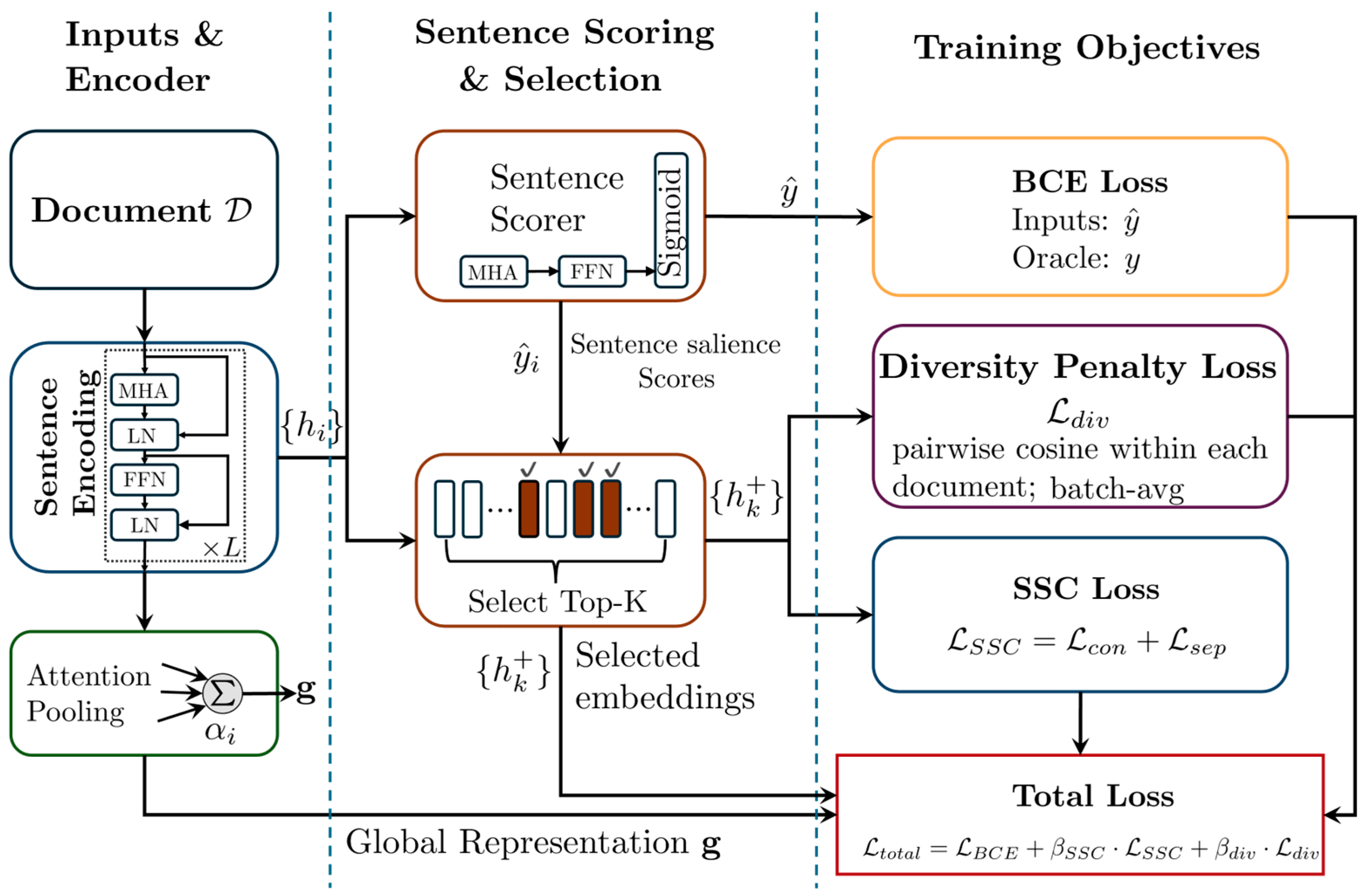
- We propose DiCo-EXT, a unified training framework that jointly optimizes informativeness and diversity through differentiable objectives, addressing the redundancy issue inherent in ROUGE-based extractive summarization.
- We design an SSC module together with a Diversity Penalty to jointly preserve semantic faithfulness and reduce redundancy in extractive summarization.
- We validate DiCo-EXT on CNN/DailyMail, XSum, and WikiHow, showing improved diversity and reduced redundancy while maintaining competitive ROUGE scores.
2. Related Work
3. Methodology
3.1. Overview
3.2. Problem Formulation
3.3. Sentence Encoding
3.4. Semantic Similarity Consistency (SSC) Module
3.4.1. Document Representation
3.4.2. SSC Loss Formulation
- Consistency Term (): This term minimizes the average distance between the summary sentence embeddings and the global document vector ensuring the summary remains on-topic:
- Separation Term (): This term maximizes the average pairwise distance between all selected sentences, encouraging semantic diversity within the summary.
3.5. Diversity Penalty
3.6. Optimization
4. Experiments and Analysis
4.1. Experimental Setup
4.1.1. Datasets and Evaluation Metrics
- ROUGE-1/2/L [5]: Measures content coverage through n-gram overlap with reference summaries and remains the community standard for evaluating extractive summarization. Although ROUGE focuses on surface-level similarity, it provides a reliable proxy for overall informativeness and comparability with prior work.
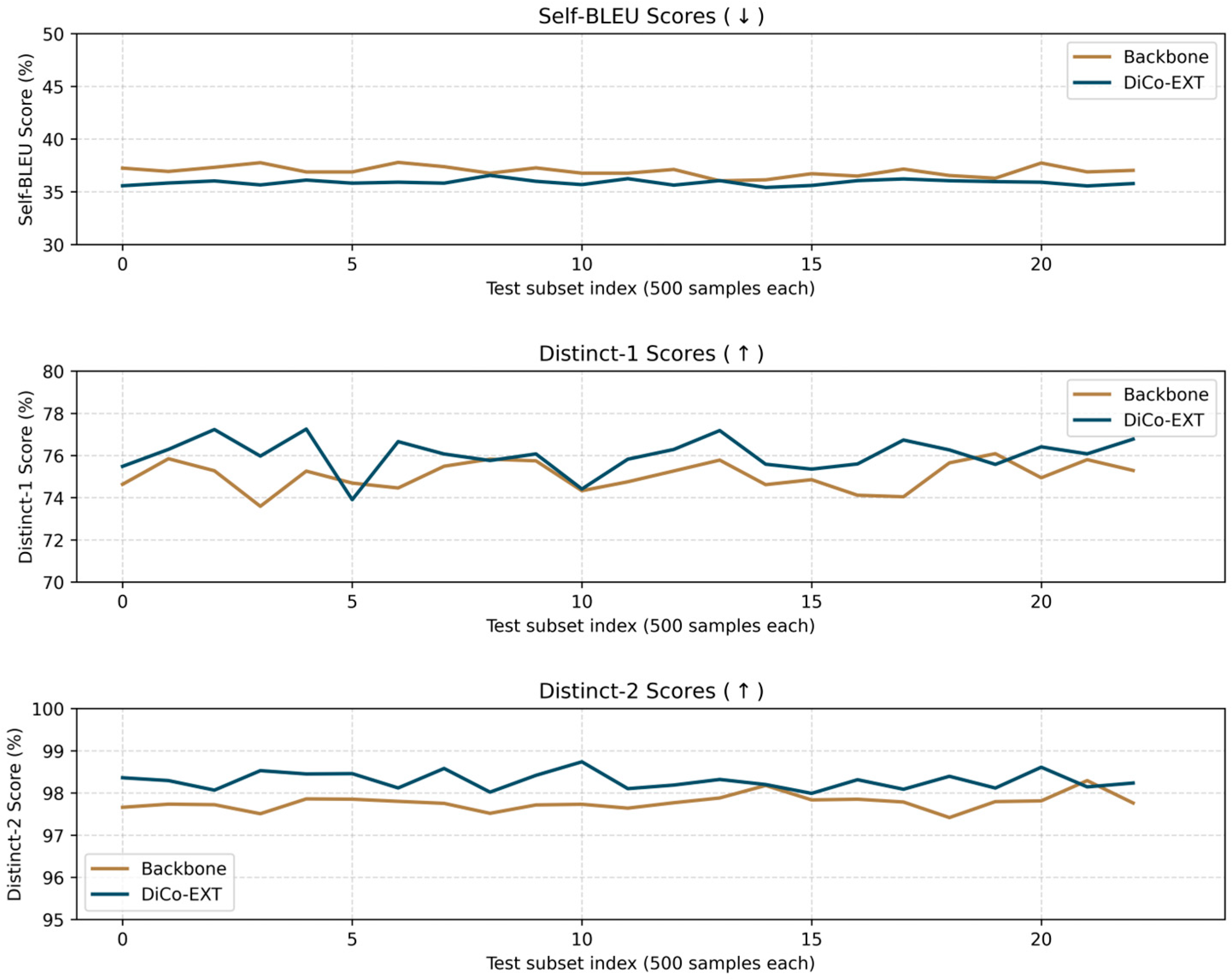
- Self-BLEU [34]: Quantifies intra-summary redundancy by computing the average BLEU score of each selected sentence against all others. Lower values indicate less semantic repetition and higher diversity of information within the generated summary.
- Distinct-1/2 [35]: Calculates the proportion of unique unigrams and bigrams to assess lexical diversity. Higher Distinct scores imply broader vocabulary usage and reduced lexical overlap.
4.1.2. Implementation Details
4.2. Overall Performance Comparison
4.2.1. Baseline Analysis
4.2.2. Diversity Analysis
4.3. Component Ablation Study
4.4. Hyperparameter Sensitivity Analysis
4.5. Case Study
5. Conclusions
Author Contributions
Funding
Data Availability Statement
Acknowledgments
Conflicts of Interest
References
- Gu, Z.; Arawjo, I.; Li, K.; Kummerfeld, J.K.; Glassman, E.L. An AI-Resilient Text Rendering Technique for Reading and Skimming Documents. In Proceedings of the 2024 CHI Conference on Human Factors in Computing Systems, Honolulu, HI, USA, 11–16 May 2024; pp. 1–22. [Google Scholar]
- Sengupta, S.; Heaton, C.; Ghosh, S.; Yin, W.; Nakov, P.; Wang, S. TOP-Training: Target-Oriented Pretraining for Medical Extractive Question Answering. In Proceedings of the 31st International Conference on Computational Linguistics, Abu Dhabi, United Arab Emirates, 19–24 January 2025; pp. 7035–7054. [Google Scholar]
- AbdelAziz, N.M.; Ali, A.A.; Naguib, S.M.; Fayed, L.S. Clustering-Based Topic Modeling for Biomedical Documents Extractive Text Summarization. J. Supercomput. 2025, 81, 171. [Google Scholar] [CrossRef]
- Dong, X.; Li, W.; Le, Y.; Jiang, Z.; Zhong, J.; Wang, Z. TermDiffuSum: A Term-Guided Diffusion Model for Extractive Summarization of Legal Documents. In Proceedings of the 31st International Conference on Computational Linguistics, Abu Dhabi, United Arab Emirates, 19–24 January 2025; pp. 3222–3235. [Google Scholar]
- Lin, C. Rouge: A Package for Automatic Evaluation of Summaries. In Text Summarization Branches Out; Association for Computational Linguistics: Stroudsburg, PA, USA, 2004; pp. 74–81. [Google Scholar]
- Liu, Y.; Lapata, M. Text Summarization with Pretrained Encoders. In Processing and the 2019 Conference on Empirical Methods in Natural Language Processing and the 9th International Joint Conference on Natural Language Processing (EMNLP-IJCNLP), Hong Kong, China, 3–7 November 2019; pp. 3730–3740. [Google Scholar]
- Zhong, M.; Liu, P.; Chen, Y.; Wang, D.; Qiu, X.; Huang, X.-J. Extractive Summarization as Text Matching. In Proceedings of the 58th Annual Meeting of the Association for Computational Linguistics, Online, 5–10 July 2020; pp. 6197–6208. [Google Scholar]
- Cardenas, R.; Gallé, M.; Cohen, S.B. On the Trade-Off Between Redundancy and Cohesiveness in Extractive Summarization. J. Artif. Intell. Res. 2024, 80, 273–326. [Google Scholar] [CrossRef]
- Davoodijam, E.; Alambardar Meybodi, M. Evaluation Metrics on Text Summarization: Comprehensive Survey. Knowl. Inf. Syst. 2024, 66, 7717–7738. [Google Scholar] [CrossRef]
- Zhou, Q.; Yang, N.; Wei, F.; Huang, S.; Zhou, M.; Zhao, T. Neural Document Summarization by Jointly Learning to Score and Select Sentences. In Proceedings of the 56th Annual Meeting of the Association for Computational Linguistics (Volume 1: Long Papers), Melbourne, Australia, 15–20 July 2018; pp. 654–663. [Google Scholar]
- Karo, I.M.K.; Dewi, S.; Perdana, A. Implementasi Text Summarization Pada Review Aplikasi Digital Library System Menggunakan Metode Maximum Marginal Relevance. JEKIN-J. Tek. Inform. 2024, 4, 25–31. [Google Scholar] [CrossRef]
- Chen, J. An Entity-Guided Text Summarization Framework with Relational Heterogeneous Graph Neural Network. Neural Comput. Appl. 2024, 36, 3613–3630. [Google Scholar] [CrossRef]
- Yadav, A.K.; Ranvijay; Yadav, R.S.; Maurya, A.K. Graph-Based Extractive Text Summarization Based on Single Document. Multimed. Tools Appl. 2024, 83, 18987–19013. [Google Scholar] [CrossRef]
- Jain, D.; Borah, M.D.; Biswas, A. Automatic Summarization of Legal Bills: A Comparative Analysis of Classical Extractive Approaches. In Proceedings of the 2021 International Conference on Computing, Communication, and Intelligent Systems (ICCCIS), Greater Noida, India, 19–20 February 2021; IEEE: New York, NY, USA, 2021; pp. 394–400. [Google Scholar]
- Belwal, R.C.; Rai, S.; Gupta, A. A New Graph-Based Extractive Text Summarization Using Keywords or Topic Modeling. J. Ambient. Intell. Humaniz. Comput. 2021, 12, 8975–8990. [Google Scholar] [CrossRef]
- Dai, Z.; Huang, R. A Joint Model for Structure-Based News Genre Classification with Application to Text Summarization. In Findings of the Association for Computational Linguistics: ACL-IJCNLP 2021, Online, 1–6 August 2021; Association for Computational Linguistics: Stroudsburg, PA, USA, 2021; pp. 3332–3342. [Google Scholar]
- Wang, Y.; Zhang, J.; Yang, Z.; Wang, B.; Jin, J.; Liu, Y. Improving Extractive Summarization with Semantic Enhancement Through Topic-Injection Based BERT Model. Inf. Process. Manag. 2024, 61, 103677. [Google Scholar] [CrossRef]
- Akter, M.; Bansal, N.; Karmaker, S.K. Revisiting Automatic Evaluation of Extractive Summarization Task: Can We Do Better Than ROUGE? In Findings of the Association for Computational Linguistics: ACL 2022, Dublin, Ireland, 22–27 May 2022; Association for Computational Linguistics: Stroudsburg, PA, USA, 2022; pp. 1547–1560. [Google Scholar]
- López-Úbeda, P.; Martín-Noguerol, T.; Díaz-Angulo, C.; Luna, A. Evaluation of Large Language Models Performance Against Humans for Summarizing MRI Knee Radiology Reports: A Feasibility Study. Int. J. Med. Inform. 2024, 187, 105443. [Google Scholar] [CrossRef] [PubMed]
- Subbiah, M.; Zhang, S.; Chilton, L.B.; McKeown, K. Reading Subtext: Evaluating Large Language Models on Short Story Summarization with Writers. Trans. Assoc. Comput. Linguist. 2024, 12, 1290–1310. [Google Scholar] [CrossRef]
- Xia, L.; Xu, J.; Lan, Y.; Guo, J.; Cheng, X. Learning Maximal Marginal Relevance Model via Directly Optimizing Diversity Evaluation Measures. In Proceedings of the 38th International ACM SIGIR Conference on Research and Development in Information Retrieval, Santiago, Chile, 9–13 August 2015; pp. 113–122. [Google Scholar]
- Wu, J.; Ning, L.; Liu, L.; Lee, H.; Wu, N.; Wang, C.; Prakash, S.; O’Banion, S.; Green, B.; Xie, J. RLPF: Reinforcement Learning from Prediction Feedback for User Summarization with LLMS. In Proceedings of the AAAI Conference on Artificial Intelligence, Philadelphia, PA, USA, 25 February–4 March 2025; Volume 39, pp. 25488–25496. [Google Scholar]
- Chen, Y.; Mao, J.; Zhang, Y.; Ma, D.; Xia, L.; Fan, J.; Shi, D.; Cheng, Z.; Gu, S.; Yin, D. Ma4div: Multi-Agent Reinforcement Learning for Search Result Diversification. ACM Web Conf. 2025, 2025, 1703–1715. [Google Scholar]
- Cunha, W.; Moreo Fernández, A.; Esuli, A.; Sebastiani, F.; Rocha, L.; Gonçalves, M.A. A Noise-Oriented and Redundancy-Aware Instance Selection Framework. ACM Trans. Inf. Syst. 2025, 43, 1–33. [Google Scholar] [CrossRef]
- Ji, Z.; Su, Y.; Zhang, Y.; Hou, J.; Pang, Y.; Han, J. Raformer: Redundancy-Aware Transformer for Video Wire Inpainting. IEEE Trans. Image Process. 2025, 34, 1795–1809. [Google Scholar] [CrossRef] [PubMed]
- Kim, H.-S.; Kang, J.-W.; Choi, S.-Y. ChatGPT Vs. Human Journalists: Analyzing News Summaries Through BERTScore and Moderation Standards. Electronics 2025, 14, 2115. [Google Scholar] [CrossRef]
- Luo, Z.; Jiang, Z.; Wang, M.; Cai, X.; Gao, D.; Yang, L. ChatGPT Based Contrastive Learning for Radiology Report Summarization. Expert Syst. Appl. 2025, 267, 125827. [Google Scholar] [CrossRef]
- Zhang, Y.; Lai, Y.; Wang, Z.; Zhou, D. DimSum: Disentangling Representation with Automatically Generated Multi-Category Summary Templates for Fine-Grained Opinion Summarization. Expert Syst. Appl. 2025, 290, 128369. [Google Scholar] [CrossRef]
- Gambhir, M.; Gupta, V. Improved Hybrid Text Summarization System Using Deep Contextualized Embeddings and Statistical Features. Multimed. Tools Appl. 2025, 84, 13929–13958. [Google Scholar] [CrossRef]
- Zhao, C.; Zhou, X.; Xie, X.; Zhang, Y. Hierarchical Attention Graph for Scientific Document Summarization in Global and Local Level. In Proceedings of the Findings of the Association for Computational Linguistics: NAACL 2024, Mexico City, Mexico, 16–21 June 2024; pp. 714–726. [Google Scholar]
- See, A.; Liu, P.J.; Manning, C.D. Get to the Point: Summarization with Pointer-Generator Networks. In Proceedings of the 55th Annual Meeting of the Association for Computational Linguistics (Volume 1: Long Papers), Vancouver, BC, Canada, 30 July–4 August 2017; pp. 1073–1083. [Google Scholar]
- Narayan, S.; Cohen, S.B.; Lapata, M. Don’t Give Me the Details, Just the Summary! Topic-Aware Convolutional Neural Networks for Extreme Summarization. In Proceedings of the 2018 Conference on Empirical Methods in Natural Language Processing, Brussels, Belgium, 31 October–4 November 2018; pp. 1797–1807. [Google Scholar]
- Koupaee, M.; Wang, W.Y. Wikihow: A Large Scale Text Summarization Dataset. arXiv 2018, arXiv:1810.09305. [Google Scholar] [CrossRef]
- Zhu, Y.; Lu, S.; Zheng, L.; Guo, J.; Zhang, W.; Wang, J.; Yu, Y. Texygen: A Benchmarking Platform for Text Generation Models. In Proceedings of the 41st International ACM SIGIR Conference on Research & Development in Information Retrieval, Ann Arbor, MI, USA, 8–12 July 2018; pp. 1097–1100. [Google Scholar]
- Li, J.; Galley, M.; Brockett, C.; Gao, J.; Dolan, W.B. A Diversity-Promoting Objective Function for Neural Conversation Models. In Proceedings of the 2016 Conference of the North American Chapter of the Association for Computational Linguistics: Human Language Technologies, San Diego, CA, USA, 12–17 June 2016; pp. 110–119. [Google Scholar]
- Liang, X.; Li, J.; Wu, S.; Li, M.; Li, Z. Improving Unsupervised Extractive Summarization by Jointly Modeling Facet and Redundancy. IEEE/ACM Trans. Audio Speech Lang. Process. 2021, 30, 1546–1557. [Google Scholar] [CrossRef]
- Zheng, H.; Lapata, M. Sentence Centrality Revisited for Unsupervised Summarization. In Proceedings of the 57th Annual Meeting of the Association for Computational Linguistics, Florence, Italy, 28 July–2 August 2019; pp. 6236–6247. [Google Scholar]
- Jie, R.; Meng, X.; Jiang, X.; Liu, Q. Unsupervised Extractive Summarization with Learnable Length Control Strategies. In Proceedings of the AAAI Conference on Artificial Intelligence, Vancouver, BC, Canada, 20–27 February 2024; Volume 38, pp. 18372–18380. [Google Scholar]
- Zhang, H.; Liu, X.; Zhang, J. Extractive Summarization via ChatGPT for Faithful Summary Generation. In Proceedings of the Findings of the Association for Computational Linguistics: EMNLP 2023, Singapore, 6–10 December 2023; pp. 3270–3278. [Google Scholar]
- Zhu, T.; Hua, W.; Qu, J.; Hosseini, S.; Zhou, X. Auto-Regressive Extractive Summarization with Replacement. World Wide Web 2023, 26, 2003–2026. [Google Scholar] [CrossRef]



| Symbol | Description |
|---|---|
| The input document. | |
| The -th sentence in the document. | |
| Semantic embedding vector of sentence . | |
| The final extracted summary, a set of sentences. | |
| Set of embeddings of sentences selected for the summary. | |
| Global semantic representation vector of the entire document. | |
| Semantic Similarity Consistency loss. | |
| Consistency term of , pulls summary towards . | |
| Separation term of , pushes selected sentences apart. | |
| Diversity Penalty loss, minimizes cosine similarity within . | |
| Binary Cross-Entropy loss for sentence selection. |
| CNNDM | WikiHow | XSum | |||||||
|---|---|---|---|---|---|---|---|---|---|
| Model | R-1 | R-2 | R-L | R-1 | R-2 | R-L | R-1 | R-2 | R-L |
| Oracle | 52.59 | 31.24 | 48.87 | 39.80 | 14.85 | 36.90 | 29.79 | 8.81 | 22.66 |
| RFAR [36] | 40.64 | 17.49 | 36.01 | 27.38 | 6.02 | 25.37 | - | - | - |
| FAR [36] | 40.83 | 17.85 | 36.91 | 27.54 | 6.17 | 25.46 | - | - | - |
| PACSUM [37] | 40.7 | 17.8 | 36.9 | - | - | - | - | - | - |
| LLCS [38] | 40.92 | 17.88 | 37.27 | - | - | - | - | - | - |
| ChatGPT-EXT (gpt-3.5-turbo) [39] | 39.25 | 17.09 | 25.64 | - | - | - | 19.85 | 2.96 | 13.29 |
| AES-REP [40] | 43.21 | 19.90 | 39.38 | 29.46 | 7.75 | 27.23 | - | - | - |
| BackBone [17] | 43.11 | 20.23 | 39.54 | 29.91 | 8.32 | 27.76 | 25.05 | 5.17 | 21.03 |
| DiCo-EXT | 43.32 | 20.45 | 39.75 | 30.18 | 8.48 | 27.95 | 25.38 | 5.25 | 21.29 |
| Model | Self-BLEU | Distinct-1 | Distinct-2 | Diversity Gain |
|---|---|---|---|---|
| Backbone | 0.86 | 0.38 | 0.61 | - |
| DiCo-EXT (Ours) | 0.72 | 0.52 | 0.78 | +27.9% |
| Model Variant | R-1 | R-2 | R-L | Self-BLEU | Distinct-1 | Distinct-2 |
|---|---|---|---|---|---|---|
| Backbone (BCE only) | 43.11 | 20.23 | 39.54 | 0.86 | 0.38 | 0.61 |
| + only | 43.19 | 20.31 | 39.62 | 0.79 | 0.45 | 0.69 |
| + only | 43.15 | 20.27 | 39.58 | 0.81 | 0.43 | 0.66 |
| DiCo-EXT (Full) | 43.32 | 20.45 | 39.75 | 0.72 | 0.52 | 0.78 |
| R-1 | R-2 | R-L | Self-BLEU | Distinct-2 | ||
|---|---|---|---|---|---|---|
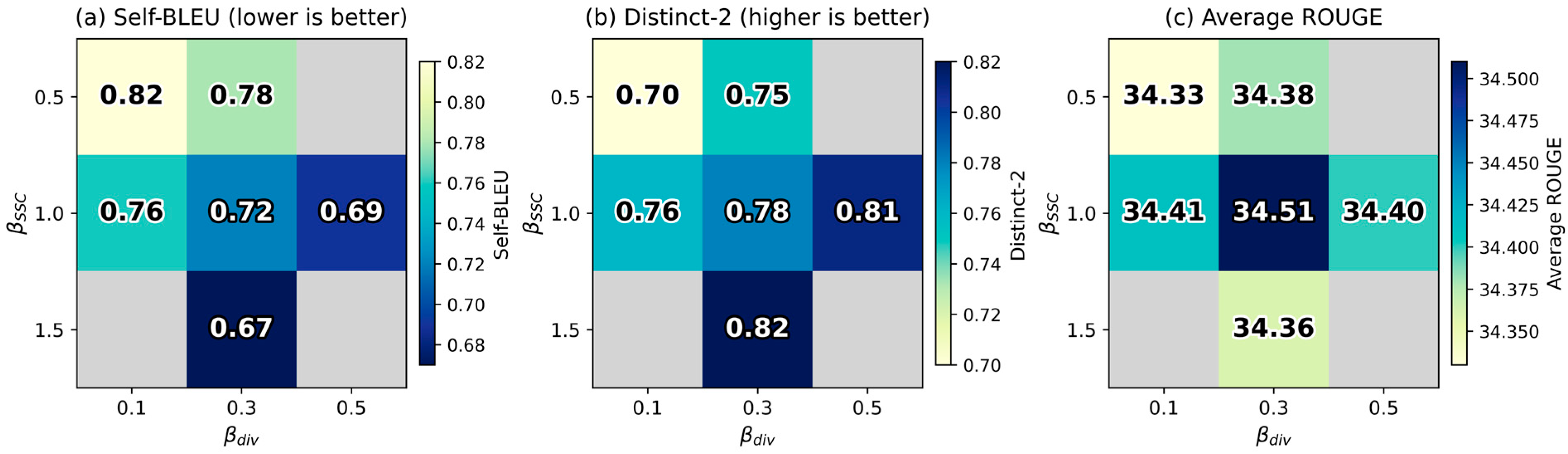
| 0.5 | 0.1 | 43.15 | 20.26 | 39.57 | 0.82 | 0.70 |
| 0.5 | 0.3 | 43.20 | 20.32 | 39.63 | 0.78 | 0.75 |
| 1.0 | 0.1 | 43.22 | 20.35 | 39.65 | 0.76 | 0.76 |
| 1.0 | 0.3 | 43.32 | 20.45 | 39.75 | 0.72 | 0.78 |
| 1.0 | 0.5 | 43.23 | 20.34 | 39.64 | 0.69 | 0.81 |
| 1.5 | 0.3 | 43.18 | 20.30 | 39.60 | 0.67 | 0.82 |
| Source Document (Excerpt): |
| “(1) The company announced a new environmental initiative on Monday. (2) The initiative aims to reduce carbon emissions by 50% by 2030. (3) CEO John Smith emphasized the company’s commitment to sustainability. (4) The plan includes investments in renewable energy and electric vehicle infrastructure. (5) Smith stated that this initiative represents their most ambitious climate goal to date. (6) Analysts have praised the move but question the feasibility of the timeline.” |
| Backbone Model Summary: |
| (1) The company announced a new environmental initiative on Monday. |
| (2) The initiative aims to reduce carbon emissions by 50% by 2030. |
| (5) Smith stated that this initiative represents their most ambitious climate goal to date. |
| ROUGE-1: 43.20, Self-BLEU: 0.84 |
| Analysis: Selected sentences focus on announcement details but lack breadth, resulting in redundancy. |
| DiCo-EXT Summary: |
| (2) The initiative aims to reduce carbon emissions by 50% by 2030. |
| (4) The plan includes investments in renewable energy and electric vehicle infrastructure. |
| (6) Analysts have praised the move but question the feasibility of the timeline. |
| ROUGE-1: 41.8, Self-BLEU: 0.71 |
| Analysis: Covers diverse aspects including the goal, specific implementation plans, and expert analysis, providing a more comprehensive summary. |
Disclaimer/Publisher’s Note: The statements, opinions and data contained in all publications are solely those of the individual author(s) and contributor(s) and not of MDPI and/or the editor(s). MDPI and/or the editor(s) disclaim responsibility for any injury to people or property resulting from any ideas, methods, instructions or products referred to in the content. |
© 2026 by the authors. Licensee MDPI, Basel, Switzerland. This article is an open access article distributed under the terms and conditions of the Creative Commons Attribution (CC BY) license.
Share and Cite
Wang, Y.; Zhang, J. DiCo-EXT: Diversity and Consistency-Guided Framework for Extractive Summarization. Entropy 2026, 28, 88. https://doi.org/10.3390/e28010088
Wang Y, Zhang J. DiCo-EXT: Diversity and Consistency-Guided Framework for Extractive Summarization. Entropy. 2026; 28(1):88. https://doi.org/10.3390/e28010088
Chicago/Turabian StyleWang, Yiming, and Jindong Zhang. 2026. "DiCo-EXT: Diversity and Consistency-Guided Framework for Extractive Summarization" Entropy 28, no. 1: 88. https://doi.org/10.3390/e28010088
APA StyleWang, Y., & Zhang, J. (2026). DiCo-EXT: Diversity and Consistency-Guided Framework for Extractive Summarization. Entropy, 28(1), 88. https://doi.org/10.3390/e28010088