Logarithmic-Size Post-Quantum Linkable Ring Signatures Based on Aggregation Operations

Abstract
1. Introduction
2. Literature Review
- Ring signatures based on the Short Integer Solution (SIS) problem: Kumar et al. have conducted a series of explorations in this direction. They proposed a ring signature scheme that supports the gradual revelation of signers [9], and later designed a convertible, quantum-secure ring signature scheme [10]. These schemes represent beneficial attempts to control the growth of signature sizes, though there remains room for improvement in balancing efficiency and security;
- Ring signatures based on coding theory: Musa et al. [11] proposed a comprehensive post-quantum signature scheme using matrix groups, demonstrating the potential of multivariate mathematical tools in constructing signatures. However, its efficiency in specialized ring signature scenarios remains moderate;
- Ring signatures based on lattices: As a mainstream direction in post-quantum cryptography, lattice-based schemes have garnered significant attention due to their solid theoretical foundations and relatively high efficiency. Wen et al. [12] proposed a lattice-based revocable ring signature scheme (LaRRS) tailored for the dynamic characteristics of Vehicular Ad-hoc Networks (VANETs), incorporating a practical member revocation mechanism while ensuring post-quantum security. Gao et al. [13] proposed the first lattice-based linkable ring signature scheme for blockchain privacy protection, achieving quantum security through the hardness of the LWE/SIS problems. Le et al. [14] further designed an identity-based linkable ring signature on lattices, using identity attributes as public keys and achieving strong security under the SIS and Ring-SIS assumptions. Xiong et al. [15] proposed an efficient certificateless signature scheme based on NTRU lattices, which not only resists quantum attacks but also addresses certificate management and key escrow issues. Liu et al. [16] proposed a traceable ring signature scheme based on the NIST-standardized algorithm Dilithium [17], optimizing both signing time and signature size compared to traditional lattice-based schemes. However, in most of the above schemes, signature size and computational overhead still grow linearly with the ring size, limiting their applicability in large-scale ring scenarios.
- A novel logarithmic construction paradigm based on an aggregation signature primitive is proposed for the first time: unlike existing logarithmic schemes that rely on zero-knowledge proofs, this paper designs the first Dilithium-based aggregation signature primitive, LAPQ, and innovatively combines it with a Merkle tree. In this scheme, the public keys of ring members are aggregated layer-by-layer along the Merkle tree path, and the aggregated signature generated by LAPQ itself serves as a valid “membership proof”. As a result, logarithmic growth in signature size is achieved without using any post-quantum zero-knowledge proofs. By incorporating rejection sampling and the Number Theoretic Transform (NTT), the scheme significantly improves computational efficiency while maintaining post-quantum security.
- Scheme analysis demonstrates the correctness of both the LAPQ and LAPQ-LRS schemes. Furthermore, under the quantum random oracle model, the security of the LAPQ aggregation operation is formally proven. The analysis confirms that the LAPQ-LRS scheme satisfies the essential security properties of ring signatures and linkable ring signatures, including unforgeability, unconditional anonymity, and linkability.
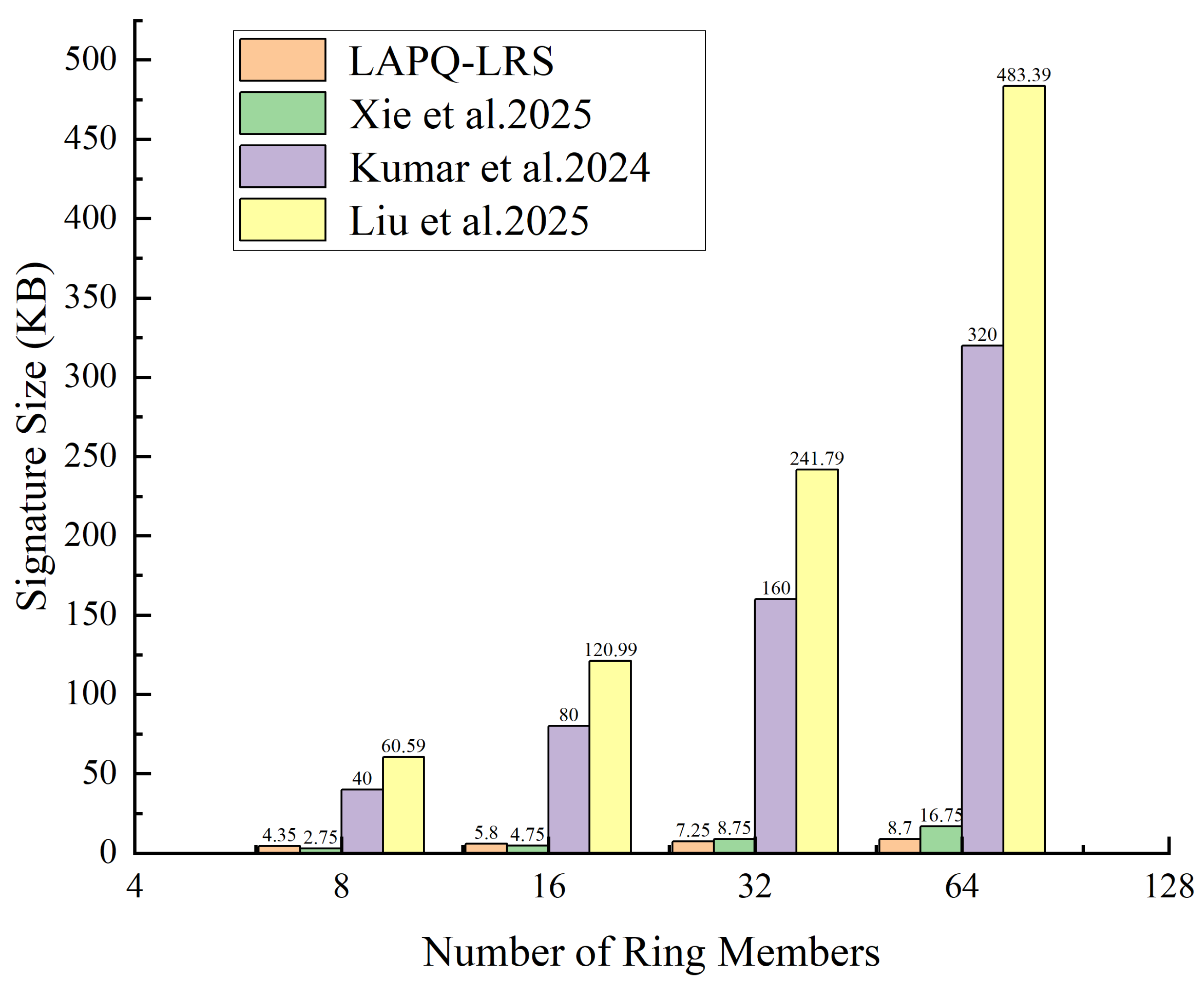
- Through performance analysis and simulation experiments, the signing time, verification time, and signature size of the proposed LAPQ-LRS scheme were compared with other quantum-attack-resistant ring signature schemes, demonstrating the superior efficiency of our algorithm.
3. Design of the LAPQ-LRS Scheme
3.1. Parameter Definitions
3.2. Scheme Design Philosophy and Architectural Rationale
3.2.1. Design Philosophy Based on Dilithium
- Efficiency and Compactness: Dilithium performs signature and verification operations in the NTT domain, offering high computational efficiency and small signature size, making it suitable for constructing large-scale ring signature systems;
- Avoiding Complex Zero-Knowledge Proof Circuits: Traditional post-quantum ring signatures often rely on zero-knowledge proof protocols to achieve signer anonymity, leading to complex circuits and high overhead. LAPQ-LRS introduces the Dilithium-based aggregation signature operation LAPQ, which directly conceals the signer’s identity during the signing process without constructing zero-knowledge proof circuits. The detailed design of how the LAPQ algorithm is constructed based on Dilithium is shown in Section 3.3;
- Inheriting Post-Quantum Security: The security of Dilithium is based on the Module Learning With Errors (MLWE) and Module Short Integer Solution (MSIS) problems. Since LAPQ-LRS is built upon this foundation, it inherently possesses post-quantum security.
3.2.2. Role and Design Considerations of the Merkle Tree Structure
- Achieving Logarithmic Complexity: By constructing a Merkle tree with ring members’ public keys as leaf nodes, the signing and verification processes involve only nodes along the path from the leaf to the root, resulting in logarithmic complexity and avoiding linear growth;
- Supporting Hierarchical Aggregation: The parent nodes in the Merkle tree are generated by aggregating the public keys of their child nodes through LAPQ, which naturally aligns with the hierarchical concealment requirements of ring signatures;
- Enhancing Privacy Protection: The public key of each node in the tree is the aggregated result of its child nodes’ public keys, and the aggregation process does not leak signer information, providing strong anonymity.
3.2.3. Summary of the Overall Construction Approach
- (1)
- The public keys of the n ring members are taken as leaf nodes of the Merkle tree.
- (2)
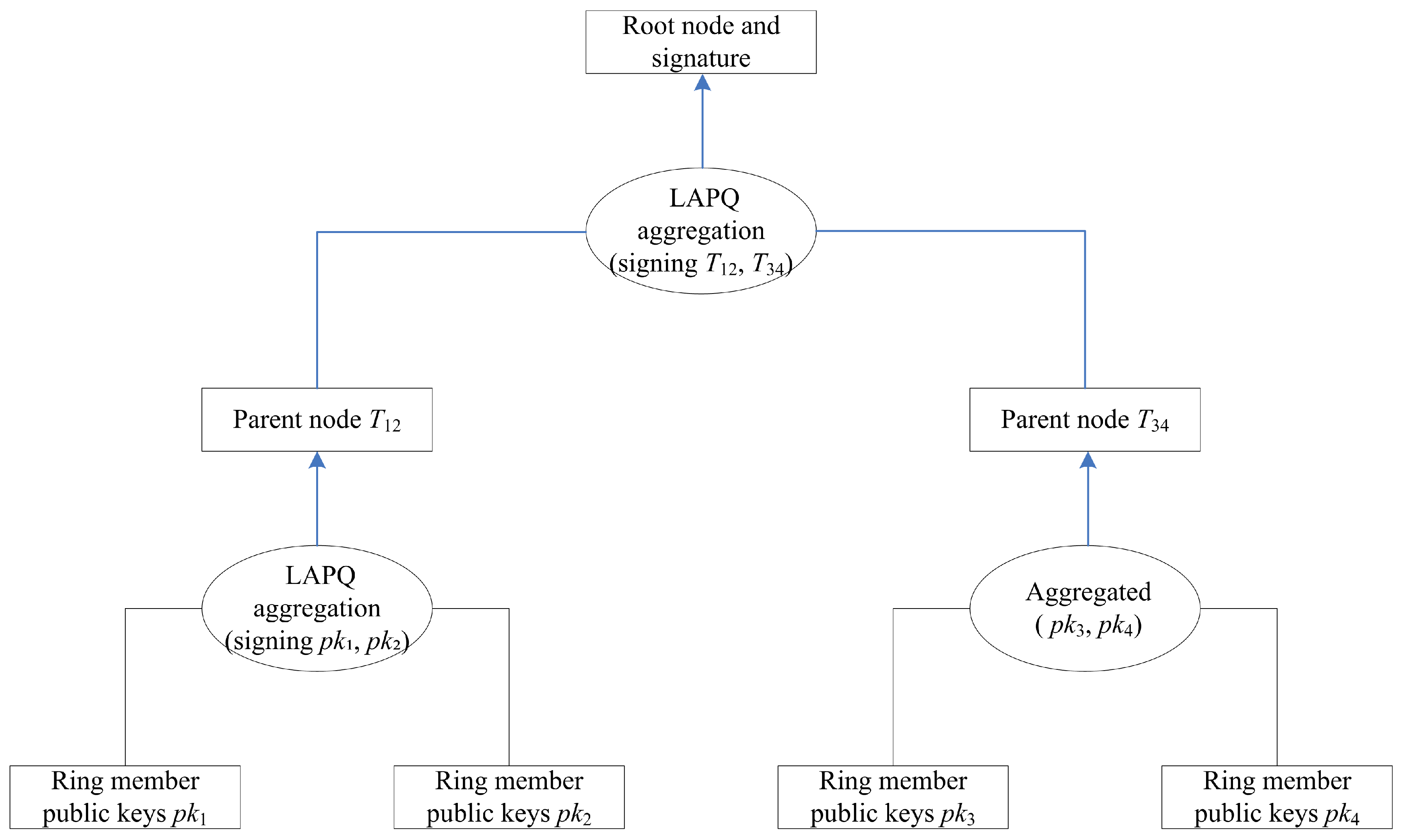
- Layer-wise aggregation along the signer’s path: at each layer of the Merkle tree, the signer employs the LAPQ aggregation operation to combine the signing node (or the aggregated result from the previous layer) with its sibling node into a parent node, while generating a signature for this aggregation.
- (3)
- Root node generation: the final step yields a root node signature that encompasses the information of all members.
- (4)
- Signature verification: a verifier can validate the correctness of the signature using the corresponding Merkle tree path.
3.3. Detailed Design of the LAPQ Scheme
- (1)
- System Initialization : By inputting the security parameter , the public parameter set common is output.
- (2)
- Key Generation : Using the security parameter and the public parameter set common, the system generates a private key ; then, the user’s public key is derived by inputting . All matrix computations are performed in the NTT domain. The NTT transforms convolution operations over the ring into pointwise multiplications, reducing the complexity of matrix-vector multiplication from to . In the concrete implementation, all polynomial sampling, expansion, and linear operations are conducted in the NTT representation, with inverse NTT applied only before output to restore the standard coefficient representation. This optimization is inherited from the CRYSTALS-Dilithium algorithm [17], ensuring that the practical efficiency of the scheme aligns with that of the standardized algorithm. The detailed computation is shown in Algorithm 1.
| Algorithm 1 key |
Input: , common Output: , Step 1: Step 2: Step 3: Step 4: Step 5: return |
- (3)
- Aggregate Signature Generation (): Assume the signer is and the aggregator is v, where subscripts are used to distinguish which node’s public or private key belongs to which party (e.g., and ). Since the public key generated in the key generation phase is split into high and low bits, and the private key also contains distinct values , the notation appends “1” or “2” after the assumed member symbols (such as and v) to represent the separated high/low-bit values and the corresponding different components in the private key. For example, the value represented by (denoted as ) corresponds to the high-order bits of the original public key generated by signer .
- (4)
- Aggregate Signature Verification : The verifier takes the message to be signed M and signature fragments as inputs and uses Algorithm 3 to verify whether the signature constitutes a valid ring signature for the message. If the verification passes, the output is True, indicating a valid signature; otherwise, the output is False, indicating an invalid signature.
| Algorithm 2 LAPQsign |
Input: , , , M Output: Step 1:
Step 2: , Step 3: , Step 4: , Step 5: , Step 6: , Step 7:
Step 8: , Step 9: return |
| Algorithm 3 LAPQverify |
Input: M, Output: True/False Step 1: Check whether holds. If true, proceed to Step 2; otherwise, return False. Step 2:
Step 3: , Step 4: Check whether is correct. If correct, return True; otherwise, return False. |
3.4. Detailed Design of the LAPQ-LRS Scheme
- Level 0 → Level 1: Perform LAPQ aggregation on the leaf-node pair , generating the parent node and the corresponding aggregated signature .
- Level 1 → Level 2: Perform LAPQ aggregation on the leaf-node pair , generating the parent node and the corresponding aggregated signature .
- Level 2 → Level 3: , generating the parent node and the corresponding aggregated signature .
- (1)
- System Initialization (): By inputting the security parameter , the public parameter set is output. Here , and .
- (2)
- Key Generation (): This process is identical to that in Dilithium, i.e., it follows the same key generation algorithm as LAPQ. The detailed computation is shown in Algorithm 1.
- (3)
- Aggregate Signature Generation (): The scheme employs the LAPQ aggregate signature operation, with detailed design shown in Algorithm 2. The LAPQ aggregation operation completes the sibling node signing phase, where sibling nodes act as aggregators in the LAPQ operation. The resulting aggregated node in LAPQ becomes the parent node at the next level in the LAPQ-LRS scheme.
- (4)
- Signature Verification : To verify the signed message generated in LAPQ-LRS, the verifier takes the message to be signed M, the set of public key vectors P, and the ring signature as inputs. In response to the application of the LAPQ aggregate signature in Algorithm 4, the aggregate verification in LAPQ is modified from Algorithm 3 to Algorithm 5 to verify whether the signature constitutes a valid ring signature for the message. First, check whether the following condition holds . If the verification is successful, proceed to check whether condition is satisfied, where represents the aggregated vector of ring members. If both conditions are met, execute Algorithm 5. Output True to indicate a valid signature; otherwise, output False to indicate an invalid signature.
| Algorithm 4 sign |
Input: , P, M Output: Step 1: , , , Step 2: while len(P) : |
//Parent Node Public Key Generation Step 3: , Step 4: , , Step 5: , //Sibling Node Signing Step 6: , Step 7: Step 8: , Step 9: Step 10: , |
//Merkle Tree Construction Step 11: next_level ← [] Step 12: for j from 0 to length(P)-1 with step 2: Step 13: if j + 1 < length(P): Step 14: if j = v or j + 1 = v: Step 15: append to next_level Step 16: else: append to next_level Step 17: else: append to next_level Step 18: , next_level, |
return: |
| Algorithm 5 verify |
Input: M, P, Output: True/False Step 1: for do Step 2: Compute matrices and , and calculate Step 3: , Step 4: Check whether is correct. If correct, then return True else return False |
4. Algorithm Analysis
- 1.
- .
- 2.
- Let . Then . Furthermore, if the number of 1’s in h is ω, then all except at most ω coefficients of will have magnitude at most after centered reduction modulo q.
- 3.
- For any , if , then .
4.1. Correctness and Security Analysis of the LAPQ Aggregation Signature
4.1.1. Correctness Analysis of LAPQ
4.1.2. Security Game Model of LAPQ
- Join Oracle : generates a new user key pair , returns the public key to the adversary, and secretly stores the private key by the challenger;
- Corruption Oracle : takes a public key as input and outputs the corresponding private key . In the security game, at least one honest user must be retained for the security challenge;
- Aggregation Signature Oracle : takes as input and outputs an aggregated signature , where is the signer’s key pair, is the public key to be aggregated, and M is the message to be signed.
- (1)
- For any signature fragment of a signed message M, the adversary E may query the oracles , , and multiple times. It randomly assigns the correct .
- (2)
- With probability , the adversary E outputs any signature fragment of the forged signature message along with the forged signature , .
- (3)
- If holds, the adversary E wins.
- (1)
- The adversary E chooses two sets of public keys and .
- (2)
- The challenger C randomly selects .
- (3)
- The challenger C computes .
- (4)
- After receiving , the adversary E guesses . If holds, the adversary wins.
4.2. Correctness and Security Analysis of the LAPQ-LRS Ring Signature
4.2.1. Correctness Analysis of LAPQ-LRS
- (1)
- Whether the signature message in the LAPQ-LRS scheme satisfies the same computational domain, as follows.
- (2)
- Whether the root public key in the LAPQ-LRS scheme is generated with the participation of ring members.
- (3)
- Whether the commitment value generated at each layer of the LAPQ-LRS scheme equals the commitment value produced during the signing phase.
4.2.2. Security Game Model of LAPQ-LRS
- Join Oracle : generates a new user key pair , returns the public key to the adversary, and secretly stores the private key by the challenger;
- Corruption Oracle : takes a public key as input and outputs the corresponding private key . In the unforgeability security game, all users on the target ring R cannot be corrupted. In the anonymity security game, the honest challenge user(s) cannot be corrupted. In the linkability security game, at least two distinct honest users must be preserved;
- Ring Signature Oracle : takes as input and outputs a ring signature , where is the signer’s private key, P is the set of public keys, and M is the message to be signed.
- (1)
- For any signature fragment of a signed message M, adversary can query oracles , , and multiple times. It randomly assigns the correct .
- (2)
- With probability , adversary outputs any signature fragment of the message M to be signed, along with a forged signature
- 1.
- Game 0 (Real Anonymity Game):
- 2.
- Game 1 (Simulated Signature Game):
- (1)
- Randomly choose ;
- (2)
- Compute ;
- (3)
- Set and ;
- (4)
- Use rejection sampling so that the distribution of is statistically close to that of a real signature.
- 3.
- Game 2 (MLWE Replacement Game):
- 4.
- Game 3 (Ideal Anonymity Game): All signature components are uniformly random values. At this point, the distribution of the signature is completely independent of the signer’s identity, and the adversary can only guess randomly:
- (1)
- The challenger generates the system parameters common and sends them to the adversary .
- (2)
- The adversary repeatedly queries the oracle using the system parameters common to obtain the public key set . By querying the corruption oracles and , it acquires the private key corresponding to . The adversary then sends the public key set P, the message to be signed M, and the private key to the challenger to generate the signature .
- (3)
- outputs a valid signature that differs from by querying the oracle.
4.3. Security Characteristics and Threat Mitigation
4.3.1. Core Security Characteristics
- Aggregation Unforgeability: Under the assumption that the MLWE/MSIS problems are hard, even if the adversary obtains aggregated signatures of multiple users on multiple sets of messages, it cannot forge a new, valid aggregated signature. This guarantees the authenticity and non-tamperability of each parent-node public key (generated by aggregation) in the Merkle tree;
- Aggregation Indistinguishability: Given an aggregation result, any polynomial-time adversary cannot distinguish which specific pair of original keys produced the result. This property is the basis for achieving Theorem 6; it ensures that during the construction of the Merkle tree, the aggregated parent-node public key does not leak information that allows tracing back to or inferring the identity of its child nodes (i.e., specific ring members), thereby structurally concealing the signer’s identity.
4.3.2. Mitigation of Network Security Threats
- Mitigation of Long-Term Threats from Quantum Attacks: Compared to ring signature schemes based on traditional number-theoretic hard problems (e.g., large integer factorization, discrete logarithm), LAPQ-LRS can resist quantum attacks such as Shor’s algorithm. This ensures that after quantum computers mature, anonymous systems relying on this scheme (e.g., privacy-oriented cryptocurrencies, anonymous voting) will not suddenly lose confidentiality and integrity, thereby achieving forward-looking security for the system;
- Prevention of “Double-Spending/Voting” Attacks in Anonymous Systems: This is the core problem addressed by linkable ring signatures. Through the linkability property, the system can publicly detect multiple signatures generated by the same private key on the same message without revealing the signer’s identity. This effectively prevents malicious users from double-spending the same currency in anonymous payment systems or casting multiple votes in anonymous voting systems, thereby preserving the fairness and consistency of the system;
- Resistance to Tracking and De-anonymization Attacks Targeting Signer Identity: The scheme’s unconditional anonymity and the aggregation structure based on the Merkle tree—particularly the security guarantee provided by aggregation indistinguishability—ensure that even if an adversary can monitor all network communications and obtain the entire set of public keys, it cannot link different signatures or infer the signer’s identity by analyzing signature content or intermediate aggregated public keys. This protects user identity security during participation in sensitive activities (e.g., whistleblowing, political voting, private transactions).
5. Performance Analysis and Simulation Experiments
5.1. Performance Analysis
5.2. Comparative Analysis
- No need to construct complex circuits: The scheme completely avoids the most complex step of designing ZKP circuits for specific lattice problems. The entire signing process is composed of a standard Dilithium signing, verification steps, and deterministic aggregation operations, resulting in a clear, modular structure;
- Significantly reduced implementation complexity and risk: Building secure and efficient post-quantum ZKP circuits is highly challenging and prone to introducing implementation vulnerabilities. LAPQ-LRS is built on mature, NIST-standardized algorithms, and all its operations (including the newly added aggregation) can be implemented using existing, widely reviewed cryptographic libraries, greatly lowering engineering difficulty and security auditing costs;
- Predictable performance and ease of optimization: The performance of the scheme is directly determined by the efficiency of the underlying Dilithium algorithm and the simple algebraic operations of the aggregation, avoiding the unpredictable performance overhead caused by circuit complexity in ZKP protocols and making system-level performance analysis and optimization more straightforward.
- Data dependency: The aggregation process of the scheme requires synchronous acquisition of the public-key information of sibling nodes, which implies a strong requirement for the immediate availability of public-key data when constructing the signing path. This makes the scheme more suitable for scenarios where the public-key set is stable and easily accessible (e.g., registered blockchain addresses). In contrast, ZKP-based schemes may exhibit lower dependence on online data during signature generation;
- Concentration of security assumptions: The security of the scheme is entirely attributed to the MLWE/MSIS assumptions of the underlying Dilithium algorithm and the security proof of the LAPQ aggregation primitive. This simplicity means that its security boundaries are very clear, but it also places all security reliance on the robustness of this primitive, necessitating ongoing rigorous auditing.
5.3. Experimental Testing
6. Conclusions
Author Contributions
Funding
Data Availability Statement
Conflicts of Interest
References
- Rivest, R.L.; Shamir, A.; Tauman, Y. How to Leak a Secret. In Proceedings of the Advances in Cryptology—ASIACRYPT, Gold Coast, Australia, 9–13 December 2001; Springer: Berlin/Heidelberg, Germany, 2001; pp. 552–565. [Google Scholar]
- Chaum, D.; Van Heyst, E. Group Signatures. In Proceedings of the Workshop on the Theory and Application of Cryptographic Techniques, Brighton, UK, 8–11 April 1991; Springer: Berlin/Heidelberg, Germany, 1991; pp. 257–265. [Google Scholar]
- Liu, J.K.; Wei, V.K.; Wong, D.S. Linkable Spontaneous Anonymous Group Signature for Ad Hoc Groups. In Proceedings of the Information Security and Privacy—ACISP 2004, Sydney, Australia, 13–15 July 2004; Springer: Berlin/Heidelberg, Germany, 2004; pp. 325–335. [Google Scholar]
- Jivanyan, A. Lelantus: A new design for anonymous and confidential cryptocurrencies. Cryptology. Eprint Arch. 2019, 373. Available online: https://eprint.iacr.org/2019/373 (accessed on 11 December 2025).
- Noether, S.; Goodell, B. Triptych: Logarithmic-Sized Linkable Ring Sign Signatures with Applications. In Proceedings of the International Workshop on Data Privacy Management, Guildford, UK, 17–18 September 2020; Springer: Cham, Switzerland, 2020; pp. 337–354. [Google Scholar]
- Xie, Z.J.; Zhang, Y.; Yang, Q.C. Ring Signature Scheme Based on SM9 Algorithm. Comput. Sci. 2025, 1–9. Available online: https://link.cnki.net/urlid/50.1075.tp.20250226.1734.008 (accessed on 28 September 2025).
- Lanyon, B.P.; Weinhold, T.J.; Langford, N.K. Experimental Demonstration of a Compiled Version of Shor’s Algorithm with Quantum Entanglement. Phys. Rev. Lett. 2007, 99, 250505. [Google Scholar] [CrossRef] [Scilit] [PubMed]
- Long, G.L. Grover Algorithm with Zero Theoretical Failure Rate. Phys. Rev. 2001, 64, 022307. [Google Scholar] [CrossRef] [Scilit]
- Kumar, R.; Padhye, S. A lattice-based ring signature scheme with gradual revelation of non-signers. Int. J. Inf. Technol. 2025, 17, 567–574. [Google Scholar]
- Kumar, R.; Padhye, S. A Quantum Secure Convertible Ring Signature Scheme Over SIS Problem. Int. J. Found. Computer. Sci. 2025. [Google Scholar] [CrossRef] [Scilit]
- Musa, A. Enhanced Security in Post-Quantum Cryptography: A Comprehensive Lattice-Based Signature Scheme Using Matrix Groups. Asian J. Math. Comput. Res. 2024, 31, 33–39. [Google Scholar] [CrossRef] [Scilit]
- Wen, J.; Bai, L.; Yang, Z.; Zhang, H.; Wang, H.; He, D. LaRRS: Lattice-based revocable ring signature and its application for VANETs. IEEE Trans. Veh. Technol. 2023, 73, 739–753. [Google Scholar] [CrossRef] [Scilit]
- Gao, Y.; Chen, X.; Shang, W. A lattice-based linkable ring signature scheme for blockchain privacy protection. In Proceedings of the 2024 IEEE/ACIS 27th International Conference on Software Engineering, Artificial Intelligence, Networking and Parallel/Distributed Computing (SNPD), Xi’an, China, 1–3 August 2024; IEEE: Piscataway, NJ, USA, 2024; pp. 76–80. [Google Scholar]
- Le, Q.H.; Vo, B.; Duong, H.D. Identity-Based Linkable Ring Signatures From Lattices. IEEE Access 2021, 9, 84739–84755. [Google Scholar] [CrossRef] [Scilit]
- Xiong, W.; Wang, Y.; Wei, Y. NTRU-CLS: Efficient quantum-resistant NTRU lattice-based certificateless signature scheme for VANETs. Comput. Netw. 2025, 256, 110885. [Google Scholar] [CrossRef] [Scilit]
- Liu, J.; Wang, Y.T.; Yan, Y. A Traceable Ring Signature Scheme Based on Dilithium. Netw. Secur. Data Gov. 2025, 44, 20–27. [Google Scholar]
- Ducas, L.; Kiltz, E.; Lepoint, T.; Lyubashevsky, V.; Schwabe, P.; Seiler, G.; Stehlé, D. CRYSTALS-Dilithium: A lattice-based digital signature scheme. Iacr Trans. Cryptogr. Hardw. Embed. Syst. 2018, 2018, 238–268. [Google Scholar] [CrossRef]
- Xue, Y.; Lu, X.; Au, M.H. Efficient linkable ring signatures: New framework and post-quantum instantiations. In Proceedings of the European Symposium on Research in Computer Security, The Hague, The Netherlands, 16–20 September 2024; Springer: Cham, Switzerland, 2024; pp. 435–456. [Google Scholar]
- Zhuang, L.S.; Chen, J.; Wang, Q.Y. Lattice-based linkable threshold ring signature for electronic voting protocol. J. Cryptologic Res. 2021, 8, 402–416. [Google Scholar]
- Huiwen, J.; Chunming, T.; Yanhua, Z. Lattice-Based Logarithmic-Size Non-Interactive Deniable Ring Signatures. Entropy 2021, 23, 980. [Google Scholar]
- Tang, J.Y.; Huang, X.F.; Wang, L.C. Identity-based linkable ring signcryption on NTRU lattice. Comput. Sci. 2025, 52, 396–404. [Google Scholar]



| Scheme | Methodology | Main Contribution | Limitation |
|---|---|---|---|
| [13] | Lattice-based construction | First on-chain linkable scheme | Linear complexity inefficient |
| [14] | Identity-based lattice construction | Identity-based key simplification | linear growth |
| [16] | Dilithium-based approach | Traceable scheme optimization | Large signature size |
| [19] | Zero-knowledge proof (ZKP) | Logarithmic threshold ring signature | Complex circuit construction |
| [20] | Merkle tree + ZKP | Logarithmic deniable signature | High proof generation overhead |
| [21] | NTRU lattice + ZKP | Identity-based ring signcryption | Dependent on ZKP protocols |
| Parameters | Definitions |
|---|---|
| R | Polynomial ring |
| Polynomial ring modulo q | |
| g | Ring dimension: 256 |
| n | Ring size |
| q | Modulus = 8,380,417 |
| d | High/low-bit separation precision d: 13 |
| Matrix dimensions in Dilithium2: | |
| Secret coefficient bound | |
| Challenge weight | |
| , | |
| Rejection bound | |
| Element in a ring |
| Scheme | Signature Generation Time | Hardness Assumption |
|---|---|---|
| [6] | Bilinear Diffie-Hellman Inversion | |
| [9] | SIS | |
| [16] | MLWE/SIS | |
| LAPQ-LRS | MLWE/SIS |
| Scheme | Signature Verification Time | Hardness Assumption |
|---|---|---|
| [6] | Bilinear Diffie-Hellman Inversion | |
| [9] | SIS | |
| [16] | MLWE/SIS | |
| LAPQ-LRS | MLWE/SIS |
| Scheme | Signature Size | Hardness Assumption |
|---|---|---|
| [6] | Bilinear Diffie-Hellman Inversion | |
| [9] | SIS | |
| [16] | MLWE/SIS | |
| LAPQ-LRS | MLWE/SIS |
| Comparison Dimension | [19] | [20] | [21] | LAPQ-LRS |
| Signature Type | Linkable Threshold Ring Signature | Non-interactive Deniable Ring Signature | Identity-Based Linkable Ring Signcryption | Linkable Ring Signature |
| Underlying Hard Problem | SIS/LWE | SIS/LWE | NTRU-SIS | MLWE/MSIS (Dilithium) |
| Logarithmic Realization Technique | Merkle Tree + Stern-like ZKP | Merkle Tree + ZKP | Merkle Tree + ZKP & Commitments | Merkle Tree + Aggregation Signature (LAPQ) |
| Dependence on ZKP/Circuits | Yes (requires ZKP circuit) | Yes (requires ZKP circuit) | Yes (requires ZKP circuit) | No |
| Main Technical Contribution | Threshold integration, logarithmic size | Achieves deniability | Identity-based and signcryption | “Aggregation-instead-of-proof” paradigm |
| Implementation Complexity & Risk | High (complex ZKP circuits) | High (complex ZKP circuits) | High (NTRU + ZKP circuits) | Low (extends standard primitives) |
| Primary Performance Determinant | ZKP circuit efficiency, rounds | ZKP proof generation | NTRU operations and ZKP circuits | Base signature efficiency and aggregation |
| Scheme | 8 | 16 | 32 | 64 | 128 | 256 | 512 | 1024 |
|---|---|---|---|---|---|---|---|---|
| [6] | 106.32 | 217.87 | 440.88 | 887.06 | 1776.46 | 3550.24 | 7105.37 | 14,207.96 |
| [9] | 50.32 | 98.56 | 194.05 | 392.47 | 786.41 | 1574.38 | 3147.23 | 6293.34 |
| [16] | 84.68 | 168.12 | 335.27 | 668.76 | 1335.56 | 2672.76 | 5348.58 | 10,699.39 |
| LAPQ-LRS | 54.79 | 73.34 | 90.61 | 110.42 | 128.99 | 147.52 | 166.09 | 184.64 |
| Scheme | 8 | 16 | 32 | 64 | 128 | 256 | 512 | 1024 |
|---|---|---|---|---|---|---|---|---|
| [6] | 151.78 | 264.03 | 588.26 | 1077.46 | 2151.94 | 4307.85 | 8615.76 | 17,241.17 |
| [9] | 43.92 | 85.74 | 166.67 | 341.49 | 687.82 | 1361.52 | 2733.72 | 5461.84 |
| [16] | 78.41 | 156.25 | 311.93 | 623.29 | 1244.67 | 2485.08 | 4972.51 | 9946.79 |
| LAPQ-LRS | 30.69 | 41.75 | 54.37 | 66.43 | 77.12 | 87.35 | 98.74 | 109.26 |
| Ring Size | Signing Time Reduction | Verification Time Reduction | Signature Size Reduction (Theoretical) |
|---|---|---|---|
| 8 | 35.33% | 60.86% | 51.38% |
| 16 | 56.36% | 73.28% | 67.64% |
| 32 | 72.98% | 82.57% | 77.48% |
| 64 | 83.49% | 89.34% | 83.58% |
| 128 | 90.34% | 93.80% | 88.28% |
| 256 | 94.48% | 96.49% | 91.60% |
| 512 | 96.90% | 98.02% | 94.04% |
| 1024 | 98.25% | 98.90% | 99.81% |
Disclaimer/Publisher’s Note: The statements, opinions and data contained in all publications are solely those of the individual author(s) and contributor(s) and not of MDPI and/or the editor(s). MDPI and/or the editor(s) disclaim responsibility for any injury to people or property resulting from any ideas, methods, instructions or products referred to in the content. |
© 2026 by the authors. Licensee MDPI, Basel, Switzerland. This article is an open access article distributed under the terms and conditions of the Creative Commons Attribution (CC BY) license.
Share and Cite
Zheng, M.; Huang, S.; Kong, D.; Fu, X.; Yao, Q.; Hou, W. Logarithmic-Size Post-Quantum Linkable Ring Signatures Based on Aggregation Operations. Entropy 2026, 28, 130. https://doi.org/10.3390/e28010130
Zheng M, Huang S, Kong D, Fu X, Yao Q, Hou W. Logarithmic-Size Post-Quantum Linkable Ring Signatures Based on Aggregation Operations. Entropy. 2026; 28(1):130. https://doi.org/10.3390/e28010130
Chicago/Turabian StyleZheng, Minghui, Shicheng Huang, Deju Kong, Xing Fu, Qiancheng Yao, and Wenyi Hou. 2026. "Logarithmic-Size Post-Quantum Linkable Ring Signatures Based on Aggregation Operations" Entropy 28, no. 1: 130. https://doi.org/10.3390/e28010130
APA StyleZheng, M., Huang, S., Kong, D., Fu, X., Yao, Q., & Hou, W. (2026). Logarithmic-Size Post-Quantum Linkable Ring Signatures Based on Aggregation Operations. Entropy, 28(1), 130. https://doi.org/10.3390/e28010130