Activity Detection and Channel Estimation Based on Correlated Hybrid Message Passing for Grant-Free Massive Random Access


Abstract
1. Introduction
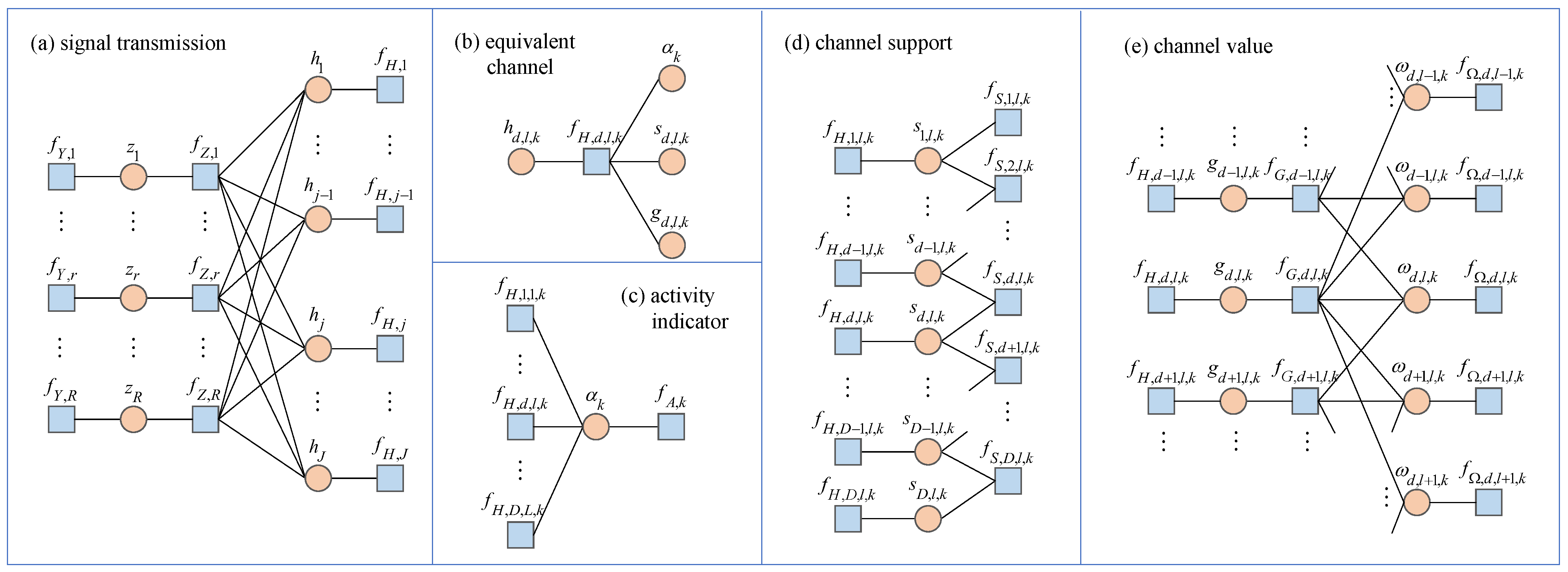
- To characterize the sparse properties of the channel in the user–angle–delay domain, we construct a novel hierarchical probabilistic structure that includes three state variables: active indication, channel supports, and channel values. The innovation of this model lies in its layered structure, which provides a principled way to factorize the joint prior distribution and cohesively model sparsity at different levels. This model accurately captures the user-domain sparsity through the active indication variable and, critically, utilizes the channel support and channel values variables to enable the modeling of what we term the dual correlation of user channels. This dual correlation refers to the modeling of two distinct statistical phenomena under a unified prior: the structural correlation, which captures the clustered nature of non-zero channel paths using a Markov chain, and the value correlation, which describes the statistical dependency between the gains of adjacent patterns using a coupled Gaussian distribution.
- Based on the proposed system and probability model, the joint active user detection and channel estimation problem is formulated as a Bethe free energy (BFE) minimization problem under hybrid constraints. Through the optimization and reconstruction of the constraint conditions, we propose the correlated hybrid message passing (CHMP) algorithm. The hybrid nature of the algorithm lies in its tailored message passing schedule, which applies exact inference for discrete state variables (active indication, channel supports) and efficient, moment-based approximate inference for continuous variables (channel values). This approach, derived rigorously under our hybrid constraint framework, achieves a favorable balance between estimation accuracy and computational complexity. Furthermore, this algorithm can adaptively update model parameters without prior knowledge of user sparsity or channel prior information.
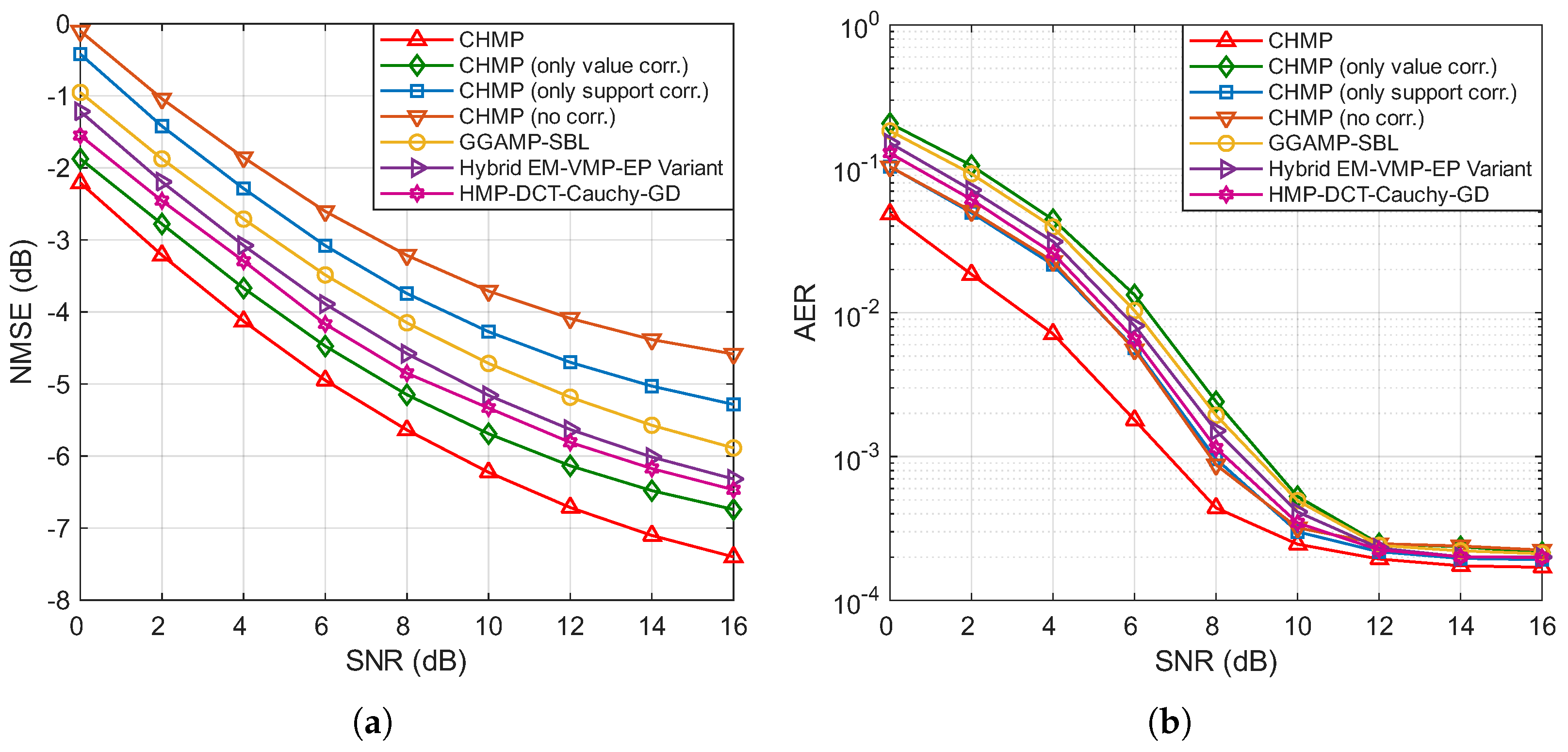
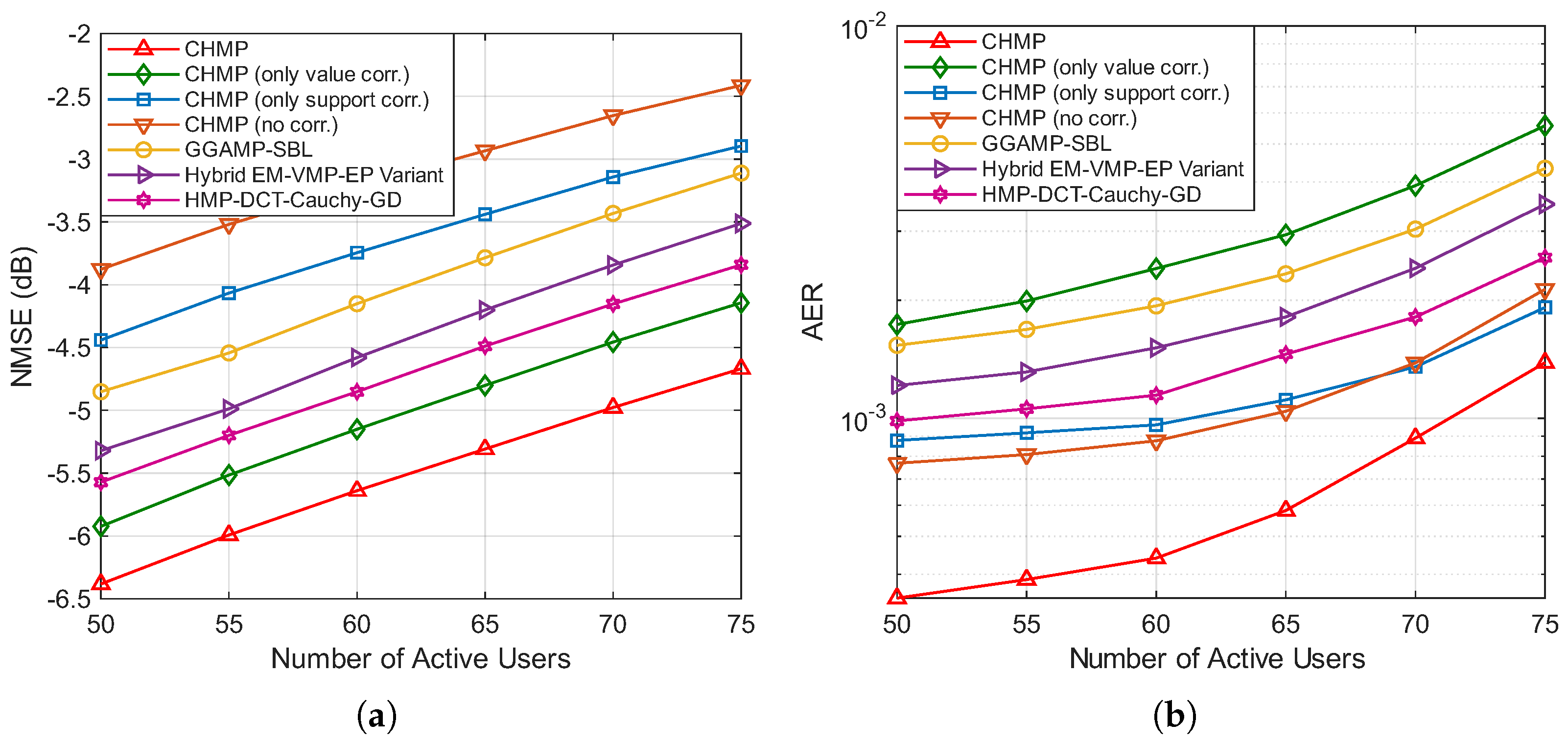
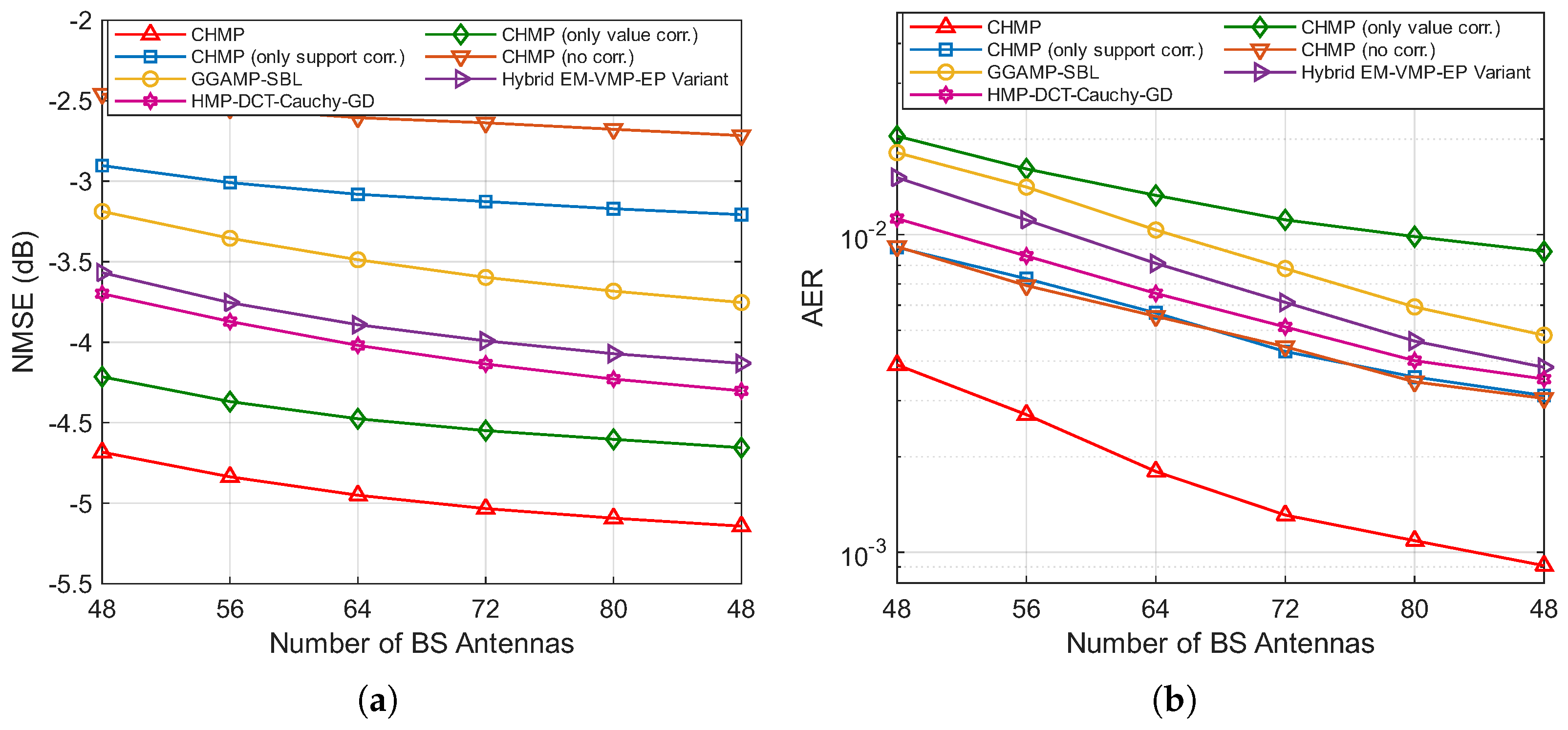
- Numerical simulations demonstrate that the proposed joint correlation modeling significantly enhances performance. The reason is that, by exploiting these dual correlations, our algorithm gains powerful prior information that regularizes the ill-posed estimation problem. The structural correlation helps to more accurately locate clusters of active channel taps, while the value correlation helps to refine their coefficient estimates, leading to more robust and precise joint detection and estimation.
2. System Model
2.1. Channel Model
2.2. Received Signal Model
3. Probability Model
3.1. Received Signal Probability Formulation
3.2. Prior Model of the Equivalent Channel
3.3. Probability Representation of the Target Problem
4. Constrained BFE Minimization Problem
4.1. Free Energy and Bethe Approximation
4.2. Constraint Reconstruction
5. Theoretical Foundation of Correlated Hybrid Message Passing
5.1. Lagrangian Function Construction
5.2. Belief Representation
5.3. Signal Transmission Module
5.4. Equivalent Channel Module
5.5. Activity Indicator Module
5.6. Channel Support Module
5.7. Channel Value Module
5.8. Active User Detection Strategy
6. Algorithm Description
6.1. Procedure Details
6.2. Computational Complexity
| Algorithm 1 CHMP |
|
7. Simulation Results
7.1. Impact of SNR
7.2. Impact of the Number of Active Users
7.3. Impact of the Number of BS Antennas
8. Conclusions
Author Contributions
Funding
Institutional Review Board Statement
Informed Consent Statement
Data Availability Statement
Conflicts of Interest
References
- Sun, G.; Li, Y.; Yi, X.; Wang, W.; Gao, X.; Wang, L.; Wei, F.; Chen, Y. Massive grant-free OFDMA with timing and frequency offsets. IEEE Trans. Wirel. Commun. 2021, 21, 3365–3380. [Google Scholar] [CrossRef]
- Di Renna, R.B.; de Lamare, R.C. Joint channel estimation, activity detection and data decoding based on dynamic message-scheduling strategies for mMTC. IEEE Trans. Commun. 2022, 70, 2464–2479. [Google Scholar] [CrossRef]
- Wu, Y.; Gao, X.; Zhou, S.; Yang, W.; Polyanskiy, Y.; Caire, G. Massive access for future wireless communication systems. IEEE Wirel. Commun. 2020, 27, 148–156. [Google Scholar] [CrossRef]
- Wang, B.; Dai, L.; Zhang, Y.; Mir, T.; Li, J. Dynamic compressive sensing-based multi-user detection for uplink grant-free NOMA. IEEE Wirel. Commun. Lett. 2016, 20, 2320–2323. [Google Scholar] [CrossRef]
- Jiang, J.C.; Wang, H.M.; Poor, H.V. Performance analysis of joint active user detection and channel estimation for massive connectivity. IEEE Trans. Signal Process. 2022, 70, 3647–3662. [Google Scholar] [CrossRef]
- Zhang, W.; Li, J.; Zhang, X.; Zhou, S. A joint user activity detection and channel estimation scheme for packet-asynchronous grant-free access. IEEE Wirel. Commun. Lett. 2021, 11, 338–342. [Google Scholar] [CrossRef]
- Guo, Y.; Liu, Z.; Sun, Y. Low complexity joint activity detection and channel estimation with partially orthogonal pilot for asynchronous massive access. IEEE Internet Things J. 2024, 11, 1773–1783. [Google Scholar] [CrossRef]
- Ahn, J.; Shim, B.; Lee, K.B. EP-based joint active user detection and channel estimation for massive machine-type communications. IEEE Trans. Commun. 2019, 67, 5178–5189. [Google Scholar] [CrossRef]
- Rajoriya, A.; Budhiraja, R. Joint AMP-SBL algorithms for device activity detection and channel estimation in massive MIMO mMTC systems. IEEE Trans. Commun. 2023, 71, 2136–2152. [Google Scholar] [CrossRef]
- Chen, J.; Chen, C.; Li, Y. Low-complexity belief propagation for joint user activity detection and channel estimation in massive access. IEEE Trans. Commun. 2022, 70, 5246–5261. [Google Scholar]
- Zhu, W.; Tao, M.; Yuan, X.; Guan, Y. Message passing-based joint user activity detection and channel estimation for temporally-correlated massive access. IEEE Trans. Commun. 2023, 71, 3576–3591. [Google Scholar] [CrossRef]
- Song, Y.; Zhu, Y.; Chen-Hu, K.; Lu, X.; Sun, P.; Wang, Z. Hybrid message passing-based detectors for uplink grant-free NOMA systems. arXiv 2024, arXiv:2401.14611. [Google Scholar]
- Zhu, Y.; Sun, G.; Wang, W.; You, L.; Wei, F.; Wang, L.; Chen, Y. OFDM-based massive grant-free transmission over frequency-selective fading channels. IEEE Trans. Commun. 2022, 70, 4543–4558. [Google Scholar] [CrossRef]
- Djelouat, H.; Leinonen, M.; Juntti, M. Spatial correlation aware compressed sensing for user activity detection and channel estimation in massive MTC. IEEE Trans. Wirel. Commun. 2022, 21, 6402–6416. [Google Scholar] [CrossRef]
- Xie, X.; Wu, Y.; An, J.; Gao, J.; Zhang, W.; Xing, C.; Wong, K.K.; Xiao, C. Massive unsourced random access: Exploiting angular domain sparsity. IEEE Trans. Commun. 2022, 70, 2480–2498. [Google Scholar] [CrossRef]
- Wang, Y.; Mei, Y.; Gao, Z.; Wan, Z.; Ning, B.; Mi, D.; Muhaidat, S. Pre-equalization aided grant-free massive access in massive MIMO system. IEEE Trans. Veh. Technol. 2025, 74, 9979–9984. [Google Scholar] [CrossRef]
- Guo, M.; Gursoy, M.C. Joint activity detection and channel estimation in cell-free massive MIMO networks with massive connectivity. IEEE Trans. Commun. 2021, 70, 317–331. [Google Scholar] [CrossRef]
- Yu, H.; Fei, Z.; Zheng, Z.; Ye, N.; Han, Z. Deep learning-based user activity detection and channel estimation in grant-free NOMA. IEEE Trans. Wirel. Commun. 2022, 22, 2202–2214. [Google Scholar] [CrossRef]
- Kang, Z.; He, D.; Wang, H.; Wang, Z.; Han, Z. Tensor-based unified joint channel estimation and active device detection scheme for high-mobility grant-free random access scenarios. IEEE Internet Things J. 2025, 12, 26415–26429. [Google Scholar] [CrossRef]
- Bian, X.; Mao, Y.; Zhang, J. Joint activity detection, channel estimation, and data decoding for grant-free massive random access. IEEE Internet Things J. 2023, 10, 14042–14057. [Google Scholar] [CrossRef]
- Zhang, Y.; Yuan, Z.; Guo, Q.; Wang, Z.; Xi, J.; Yu, Y.; Li, Y. Grant-free MIMO-NOMA with differential modulation for machine-type communications. IEEE Internet Things J. 2024, 11, 30676–30689. [Google Scholar] [CrossRef]
- Yuan, Z.; Liu, F.; Guo, Q.; Yuan, X.; Wang, Z.; Li, Y. Blind grant-free random access with message-passing-based matrix factorization in mmWave MIMO mMTC. IEEE Internet Things J. 2023, 11, 4815–4825. [Google Scholar] [CrossRef]
- Wang, Y.; Wang, Y.; Wang, T.; Cheng, J. Multi-service oriented joint channel estimation and multi-user detection scheme for grant-free massive MTC networks. IEEE Trans. Commun. 2023, 71, 6416–6434. [Google Scholar] [CrossRef]
- Shao, X.; Chen, X.; Jia, R. A dimension reduction-based joint activity detection and channel estimation algorithm for massive access. IEEE Trans. Signal Process. 2019, 68, 420–435. [Google Scholar] [CrossRef]
- Ding, J.; Choi, J. Triangular non-orthogonal random access in mMIMO systems. IEEE Trans. Commun. 2020, 68, 6918–6931. [Google Scholar] [CrossRef]
- Ding, J.; Qu, D.; Jiang, H.; Jiang, T. Success probability of grant-free random access with massive MIMO. IEEE Internet Things J. 2018, 6, 506–516. [Google Scholar] [CrossRef]
- Iimori, H.; Takahashi, T.; Ishibashi, K.; de Abreu, G.T.F.; Yu, W. Grant-free access via bilinear inference for cell-free MIMO with low-coherence pilots. IEEE Trans. Wirel. Commun. 2021, 20, 7694–7710. [Google Scholar] [CrossRef]
- Tipping, M.E. Sparse Bayesian learning and the relevance vector machine. J. Mach. Learn. Res. 2001, 1, 211–244. [Google Scholar]
- Krzakala, F.; Manoel, A.; Tramel, E.W.; Zdeborová, L. Variational free energies for compressed sensing. In Proceedings of the 2014 IEEE International Symposium on Information Theory, Honolulu, HI, USA, 29 June–4 July 2014; pp. 1499–1503. [Google Scholar]
- Wu, D.; Wang, L.; Zhang, P. Solving statistical mechanics using variational autoregressive networks. Phys. Rev. Lett. 2019, 122, 080602. [Google Scholar] [CrossRef]
- Zhu, Y.; Zhuang, J.; Sun, G.; Hou, H.; You, L.; Wang, W. Joint channel estimation and prediction for massive MIMO with frequency hopping sounding. IEEE Trans. Commun. 2025, 73, 5139–5154. [Google Scholar] [CrossRef]
- Cheng, Y.; Liu, L.; Ping, L. Orthogonal AMP for massive access in channels with spatial and temporal correlations. IEEE J. Sel. Areas Commun. 2020, 39, 726–740. [Google Scholar] [CrossRef]
- Zou, Q.; Zhang, H.; Cai, D.; Yang, H. A low-complexity joint user activity, channel and data estimation for grant-free massive MIMO systems. IEEE Signal Process Lett. 2020, 27, 1290–1294. [Google Scholar] [CrossRef]
- Liu, T.; Jin, S.; Wen, C.K.; Matthaiou, M.; You, X. Generalized channel estimation and user detection for massive connectivity with mixed-ADC massive MIMO. IEEE Trans. Wirel. Commun. 2019, 18, 3236–3250. [Google Scholar] [CrossRef]
- Liu, S.; Zhang, H.; Zou, Q. Decentralized channel estimation for the uplink of grant-free massive machine-type communications. IEEE Trans. Commun. 2021, 70, 967–979. [Google Scholar] [CrossRef]
- Zhou, L.; Dai, J.; Xu, W.; Chang, C. Sparse channel estimation for intelligent reflecting surface assisted massive MIMO systems. IEEE Trans. Green Commun. Netw. 2022, 6, 208–220. [Google Scholar] [CrossRef]
- Cai, C.; Yang, J.; Yang, F.; Gao, X. Expectation-maximization-based information geometry approach for massive MIMO-OFDM channel estimation. IEEE Trans. Commun. 2025, 73, 6366–6378. [Google Scholar] [CrossRef]
- Wu, S.; Kuang, L.; Ni, Z.; Huang, D.; Guo, Q.; Lu, J. Message-passing receiver for joint channel estimation and decoding in 3D massive MIMO-OFDM systems. IEEE Trans. Wirel. Commun. 2016, 15, 8122–8138. [Google Scholar] [CrossRef]
- Wang, J.; Jiang, C.; Kuang, L. Turbo iterative DSSS acquisition in satellite high-mobility communications. IEEE Trans. Veh. Technol. 2021, 70, 12998–13009. [Google Scholar] [CrossRef]
- Jaeckel, S.; Raschkowski, L.; Börner, K.; Thiele, L. QuaDRiGa: A 3-D multi-cell channel model with time evolution for enabling virtual field trials. IEEE Trans. Antennas Propag. 2014, 62, 3242–3256. [Google Scholar] [CrossRef]
- 3GPP. Study on Channel Model for Frequencies from 0.5 to 100 GHz; Technical Report, 3rd Generation Partnership Project (3GPP), Global Initiative, 3GPP TR 38.901 Version 16.1.0 Release 16; 3GPP: Sophia Antipolis, France, 2019. [Google Scholar]
- Al-Shoukairi, M.; Schniter, P.; Rao, B.D. A GAMP-based low complexity sparse Bayesian learning algorithm. IEEE Trans. Signal Process. 2017, 66, 294–308. [Google Scholar] [CrossRef]
- Zhang, D.; Song, X.; Wang, W.; Fettweis, G.; Gao, X. Unifying message passing algorithms under the framework of constrained Bethe free energy minimization. IEEE Trans. Wirel. Commun. 2021, 20, 4144–4158. [Google Scholar] [CrossRef]



| Symbol | Definition |
|---|---|
| System Parameters | |
| M | Number of antennas at the BS |
| K | Number of potential users |
| Number of active users | |
| N | Number of effective subcarriers |
| G | Number of OFDM symbols for access |
| P | Number of pilot subcarriers |
| Number of grid points in angle and delay domains | |
| Channel and Signal Representations | |
| Activity indicator for user k | |
| Space–frequency domain channel vector for user k on subcarrier n | |
| Space–frequency domain channel matrix for user k | |
| Angle–delay domain channel matrix for user k | |
| Equivalent channels (multiplied by activity indicator ) | |
| Received vectorized signal and matrix signal | |
| Vectorized equivalent angle–delay domain channel for all users | |
| Sensing matrix | |
| Probabilistic Model Variables | |
| Binary channel support matrix for user k | |
| Channel value matrix for user k | |
| Activity probability of user k | |
| Transition probabilities of the Markov chain for channel support | |
| Latent precision of the coupled Gaussian distribution | |
| Latent precision matrix for user k | |
| Lagrange multipliers for different constraints | |
| Factor Function | Factor Belief | Variable | Variable Belief |
|---|---|---|---|
| Parameter | Value | Parameter | Value |
|---|---|---|---|
| Carrier Frequency | 2.6 GHz | OFDM Symbols G | 3 |
| Subcarrier Spacing | 15 kHz | CP Length | 36 |
| Subcarriers | 512 | Delay Grids L | 36 |
| Active Subcarriers N | 300 | Angle Grids D | 2 |
| Pilot Subcarriers P | 50 | Potential Users K | 500 |
Disclaimer/Publisher’s Note: The statements, opinions and data contained in all publications are solely those of the individual author(s) and contributor(s) and not of MDPI and/or the editor(s). MDPI and/or the editor(s) disclaim responsibility for any injury to people or property resulting from any ideas, methods, instructions or products referred to in the content. |
© 2025 by the authors. Licensee MDPI, Basel, Switzerland. This article is an open access article distributed under the terms and conditions of the Creative Commons Attribution (CC BY) license (https://creativecommons.org/licenses/by/4.0/).
Share and Cite
Liu, X.; Gong, X.; Fu, X. Activity Detection and Channel Estimation Based on Correlated Hybrid Message Passing for Grant-Free Massive Random Access. Entropy 2025, 27, 1111. https://doi.org/10.3390/e27111111
Liu X, Gong X, Fu X. Activity Detection and Channel Estimation Based on Correlated Hybrid Message Passing for Grant-Free Massive Random Access. Entropy. 2025; 27(11):1111. https://doi.org/10.3390/e27111111
Chicago/Turabian StyleLiu, Xiaofeng, Xinrui Gong, and Xiao Fu. 2025. "Activity Detection and Channel Estimation Based on Correlated Hybrid Message Passing for Grant-Free Massive Random Access" Entropy 27, no. 11: 1111. https://doi.org/10.3390/e27111111
APA StyleLiu, X., Gong, X., & Fu, X. (2025). Activity Detection and Channel Estimation Based on Correlated Hybrid Message Passing for Grant-Free Massive Random Access. Entropy, 27(11), 1111. https://doi.org/10.3390/e27111111