1. Introduction
We study the difference between the differential entropy rate of a random process
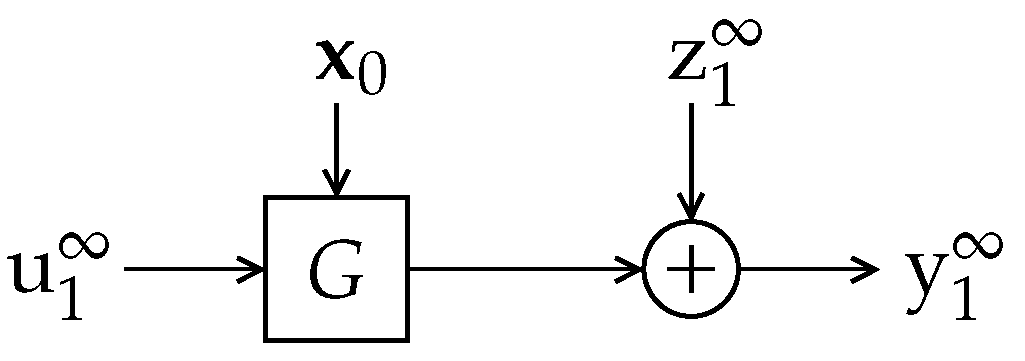
entering a discrete-time
linear time-invariant (LTI) system
G and the differential entropy rate of its (possibly noisy) output
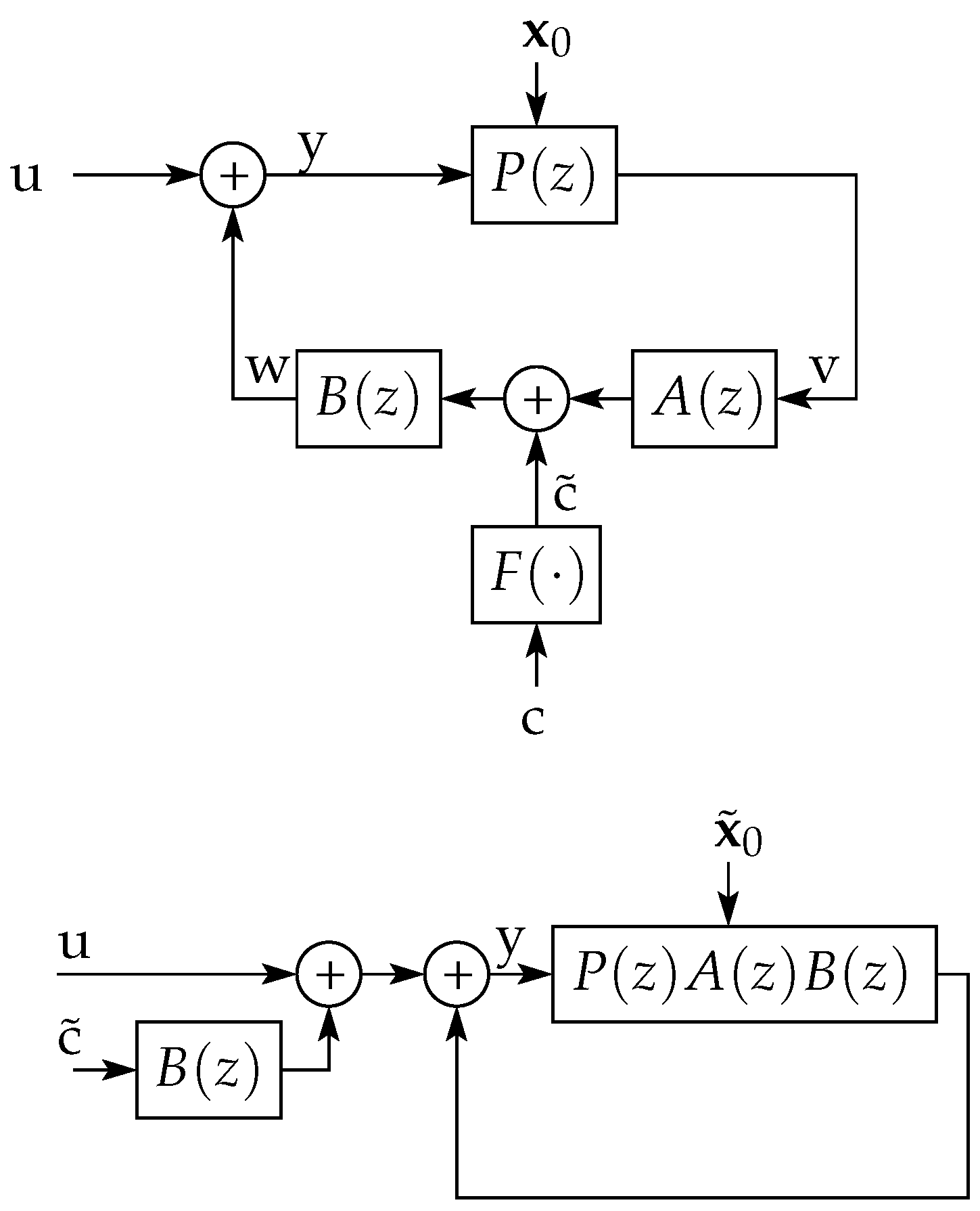
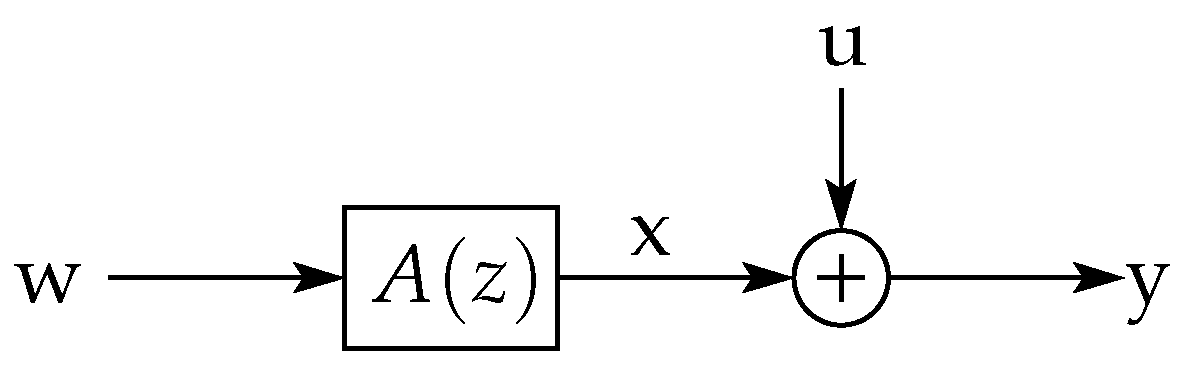
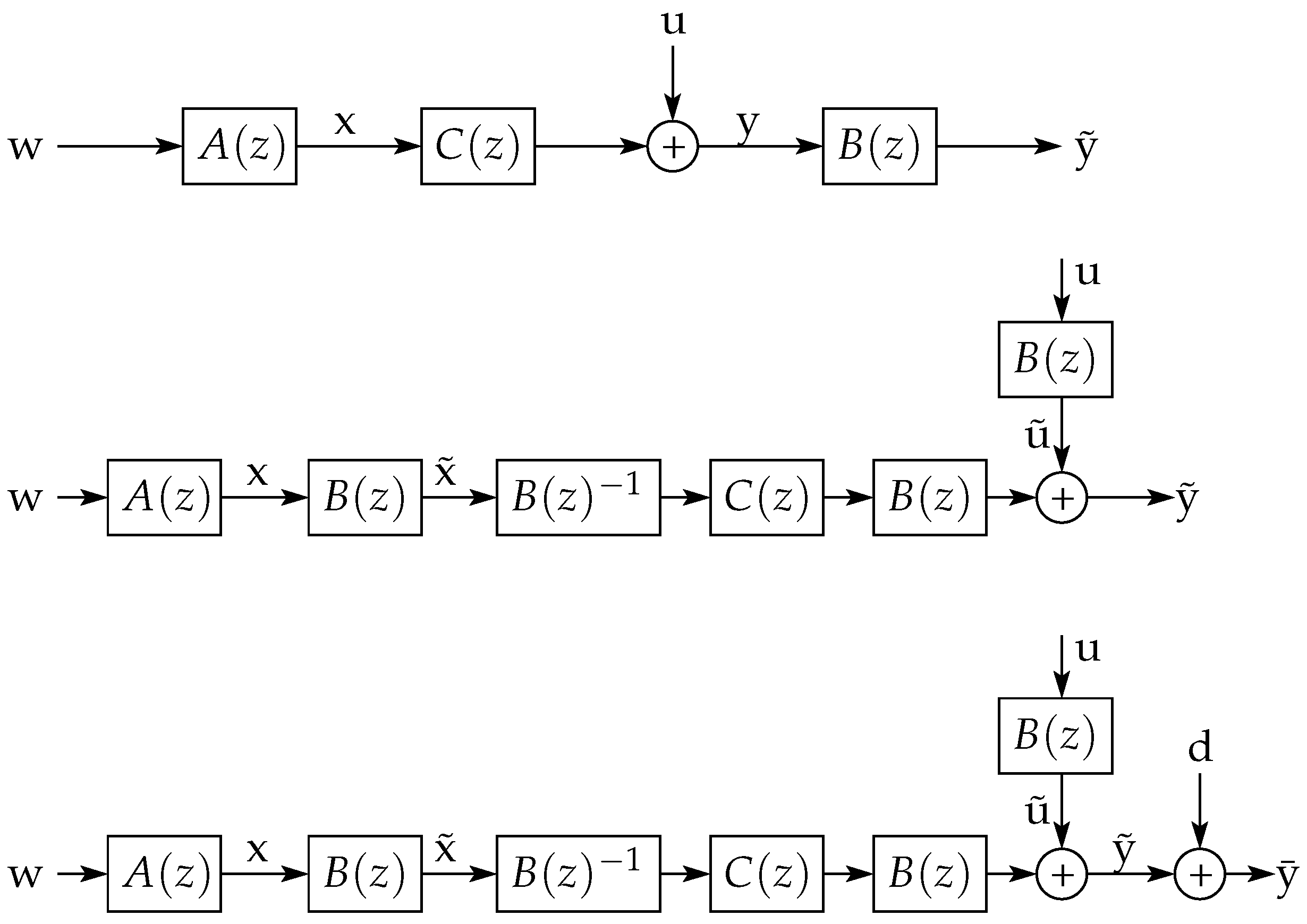
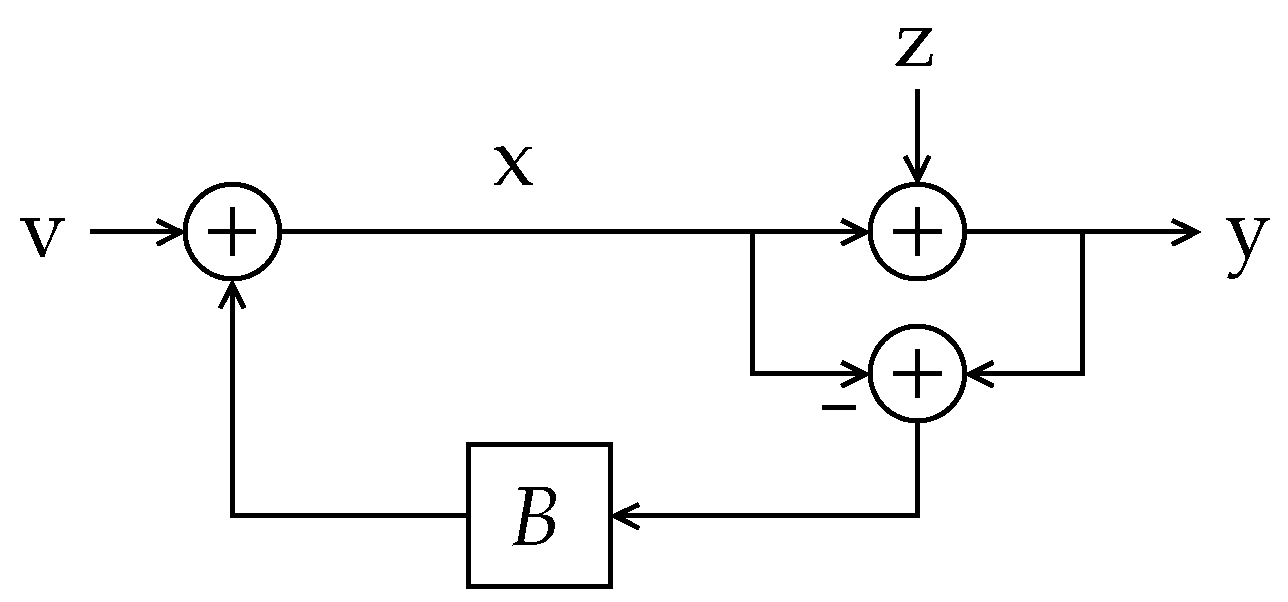
, as depicted in
Figure 1.
Recall that the differential entropy rate of a random process
is given by
, provided the limit exists, where
is the differential entropy of the ensemble
with
probability density function (PDF)
f [
1]. The system
G is supposed to satisfy the following:
Assumption 1. The LTI system G in Figure 1 is causal and stable and such that - 1.
G has a rational p-th order transfer function with m zeros outside the unit circle, i.e., non-minimum-phase (NMP) zeros, where , indexed in non-increasing magnitude order, i.e., .
- 2.
The unit-impulse response of G, say, satisfies .
In this general setup,
G may have a random initial state vector
,
, and a real-valued random output disturbance
. Our main purpose is to characterize the limit
evaluating the possible effect produced by
and
. This difference can be interpreted as the
entropy gain (entropy amplification or entropy boost) introduced by the filter
G and (as apparent from the other variables in the argument of
) the statistics of
. We shall refer to the special case in which
and
are both zero (or deterministic) as the noise-less case, and write
accordingly.
The earliest reference related to this problem corresponds to a noise-less continuous-time counterpart considered by Shannon. In his seminal 1948 paper [
2], Shannon gave a formula for the change in differential entropy per degree of freedom that a continuous-time random process
, band-limited to a frequency range
(in Hz), experiences after passing through an LTI continuous-time filter
(without considering a random initial state or an output disturbance). Such entropy per degree of freedom is defined in terms of uniformly taken samples as
with
. In this formula, if the LTI filter has frequency response
(with
in Hz), then the resulting differential entropy rate of the output process
is given by the following theorem:
Theorem 1 (Reference [
2], Theorem 14)
. If an ensemble having an entropy per degree of freedom in band B is passed through a filter with characteristic the output ensemble has an entropy Shannon arrived at (
3) by arguing that an LTI filter can be seen as a linear operator that selectively scales its input signal along infinitely many frequencies, each of them representing an orthogonal component of the source. He then obtained the result by writing down the determinant of the Jacobian of this operator as the product of the squared frequency response magnitude of the filter over
n frequency bands, applying logarithm, dividing by
n, and then taking the limit as
n tends to infinity.
Remark 1. There is a factor of two in excess in the integral on the right-hand side
(RHS) of (3). To see this, consider a filter with a constant gain a over (i.e., a simple multiplicative factor). In such case, the entropy rate of should exceed that of by [1]. However, (3) yields an entropy gain equal to . This error arises because the determinant of the Jacobian of the transformation is actually the product of over the n frequency bands considered in Shannon’s argument. Such excess factor of two is also present in the entropy losses appearing in Reference [2], Table 1. Theorem 14 in Reference [
2] has found application in works ranging from traditional themes, such as linear prediction [
3] and source coding [
4], to molecular communication systems [
5,
6].
The available literature treating the phenomenon itself of the entropy gain (loss, boost, or amplification) induced by LTI systems seems to be rather scarce. This is not surprising given that (
3) was published in Reference [
2], Theorem 14, the work which gave birth to Information Theory.
The following publication concerned with this problem is Reference [
7], following a time-domain analysis for the corresponding discrete-time problem. In this approach, one can obtain
as a function of
, for every
, and evaluate the difference between the limits
and
, obtained by letting
. More precisely, for an LTI discrete-time filter
G with impulse response
, we can write
where we adopt the notation
for column vectors to avoid the abuse of notation incurred by treating the sequence
as a vector, and because, by writing
, it is easier to remember that its samples are ordered from top to bottom.
and the random vector
is defined likewise. From this, it is clear (see, e.g., the corollary after Theorem 8.6.4 in Reference [
1]) that
where
(or simply
) stands for the determinant of
. This result is utilized in Reference [
7] to show that no entropy gain is produced by a stable minimum phase LTI system
G if and only if the first sample in its impulse response has unit magnitude.
In Reference [
8], p. 568, the entropy gain of a discrete-time LTI system
G (the noise-less version of the setup depicted in
Figure 1) is found to be
where
is the filter’s discrete-time output process (without the effect of random initial state or an output disturbance) and
This result was obtained starting from the fact that, for a Gaussian stationary process
with
power spectral density (PSD)
,
. If
enters a discrete-time LTI system with frequency response
, then the PSD of its output
is
; thus, it is argued that (
6) follows for Gaussian stationary inputs. Then, Reference [
8] extends the result for non-Gaussian inputs with a proof sketch which uses a time-domain relation, like (
4), to point out that the filter is a linear operator and, as such, the differential entropy of its output exceeds that of its input by a quantity that is independent of the input distribution. (It is worth noting that (
6) is the discrete-time equivalent of (
3) (without its wrong factor of 2), which follows directly from the correspondence between sampled band-limited continuous-time systems and discrete-time systems.)
It is in Reference [
9], Section II-C, where, for the first time, it is shown that, for a stationary Gaussian input
, the full entropy gain predicted by (
6) takes place if the system output
is contaminated by an additive output disturbance of length
p and positive definite covariance matrix, where
p is the order of
.
The integral
can be related to the structure of the filter
G. It is well known (from Jensen’s formula) that if
G has a causal and stable rational transfer function
and an impulse response with its first sample
, then
where
are the zeros of
(see, e.g., References [
10,
11]). This provides a straightforward formula to evaluate
of a given LTI filter with rational transfer function
. When combined with (
6), this equation also reveals that if the entropy gain
is negative (i.e., if it corresponds to an entropy loss), then
(with the corresponding change of variables, this is the case in all the examples given by Shannon in Reference [
2], Table 1). More importantly, (
8) allows us to concentrate, without loss of generality, on LTI systems
, whose first impulse-response sample has unit magnitude, as required by Assumption 1. Under the latter condition, (
8) shows that the entropy gain is greater than zero if and only if
has zeros outside the unit disk
. A system with the latter property is said to be
non-minimum phase (NMP); conversely, a system with all its zeros inside
is said to be
minimum phase (MP) [
11].
1.1. Main Contributions of this Paper
The main contributions of this paper can be summarized as follows:
Our first main result is showing that (
6) and (
3) do not hold for a large class of continuous-time filters and inputs. To see this, notice that
which, in view of (
5), is equivalent to
. In turn, this implies that
, regardless of whether
(i.e., the polynomial
) has zeros with magnitude greater than one (choose, for example,
, and
for
). This reveals that (4) holds if and only
is MP. But (
6) and (
3) are equivalent (correcting for the in excess factor of 2 discussed in Remark 1); thus, Theorem 14 in Reference [
2] also does not hold for a class of continuous-time filters. However, the transfer function
of a band-limited continuous-time filter
is defined only for imaginary values of
s (because the bilateral Laplace transform of
converges only on the imaginary axis), so one cannot classify such filters as MP or NMP. Instead, we consider a class of continuous-time filters limited to the frequencies in the band
, where
is in [Hz], defined by having a unit-impulse response of the form
for some absolutely summable sequence of real-valued coefficients
,
, where the sinc functions
Since every such
g satisfies
for
, it makes sense to refer to such filters as “sample-wise causal”. For this class of band-limited filters, we show that Theorem 14 holds if and only if the
z-transform of
is MP:
Theorem 2. Suppose is a low-pass continuous-time filter with unit-impulse response as in (10). Let the continuous-time random input of befor some random sequence , with as in (11), and denote its output as . Then,with equality in if and only if the polynomial has no roots outside the unit circle. - 2.
We show that
actually corresponds to the entropy gain introduced by
G but considering the new notion of effective differential entropy rate of
proposed in this paper, defined next.
Definition 1 (The Effective Differential Entropy)
. Let be a random vector. If can be written as a linear transformation , for some () with bounded differential entropy, , then the effective differential entropy of is defined as where is an SVD for , with . We can now state our second main result, the proof of which is in
Appendix A:
Theorem 3. Let be the input of an LTI system G with transfer function without zeros on the unit circle and with an absolutely summable unit impulse response , with if G has an infinite impulse response. Denote the output of G as . Suppose for every finite n. Then,where denotes the entire response of G to the input . Theorem 3 states that, when considering the full-length output of a system, the effective entropy gain is introduced by the system itself.
Section 4 provides a geometrical description of the phenomenon behind Definition 1 and Theorem 3.
- 2.
We show that
is a tight upper bound to the entropy gain of
G (as defined in (
1)), when the output is contaminated by some additional additive signal, such as a random initial state (represented by
in
Figure 1) or an output disturbance (such as
in
Figure 1), with sufficiently many degrees of freedom (a condition formally stated in Assumption 2 below). Moreover, we show that an entropy gain equal to the latter upper bound can appear even when these disturbances or random initial state have infinitesimally small variances. To the best of our knowledge, the latter phenomenon has been discussed in the literature first (and only) in Reference [
9], Section II-C, for Gaussian stationary inputs and an LTI filter. We go beyond the latter result by explicitly and fully characterizing the entropy gain of LTI systems for a large class of not necessarily Gaussian nor stationary random input. We refer to this class as
entropy-balanced processes, formally specified in the following definition:
Definition 2. A random process is said to be entropy balanced if the following two conditions are satisfied:
- (i)
Its sample variances are finite for finite n and - (ii)
For every and for every sequence of matrices , with orthonormal rows,
The second condition guarantees that projecting an entropy-balanced process onto any subspace having finitely fewer dimensions yields a process with the same differential entropy rate.
The entropy gain induced by finite-length output disturbances is characterized by our next theorem.
Theorem 4. In the system of Figure 1, let G satisfy Assumption 1 and suppose that is entropy balanced. Suppose the random output disturbance is such that , and that . Let , where m is the number of NMP zeros of . Then,with equality in if and only if . The proof is presented in
Section 6.4, and we provide geometrical insight explaining the phenomenon underlying Definition 2 and Theorem 4 in
Section 5.1.
- 2.
We illustrate the relevance of the results summarized above by applying them to three problems in three areas, namely:
- (a)
Networked Control: We show that equality holds in the inequality stated in Reference [
12], Lemma 3.2 (a fundamental piece for the performance limitation results further developed in Reference [
13]), under very general conditions. In addition, we extend the validity of a related equality for the perfect-feedback case, given by Reference [
14], Theorem 14, for Gaussian signals, to the much larger class of entropy-balanced processes.
- (b)
The rate-distortion function for non-stationary Gaussian sources: This problem has been previously solved in References [
15,
16,
17]. We provide a simpler proof based upon the results described above. This proof extends the result stated in References [
16,
17] to a broader class of non-stationary sources.
- (c)
Gaussian channel capacity with feedback: We show that capacity results based on using a short random sequence as channel input and relying on a feedback filter which boosts the entropy rate of the end-to-end channel noise (such as the one proposed in Reference [
9]), crucially depend upon the complete absence of any additional disturbance anywhere in the system. Specifically, we show that the information rate of such capacity-achieving schemes drops to zero in the presence of any such additional disturbance. As a consequence, the relevance of characterizing the robust (i.e., in the presence of disturbances) feedback capacity of Gaussian channels, which appears to be a fairly unexplored problem, becomes evident.
1.2. Paper Outline
The remainder of this paper begins with some necessary definitions and preliminary results in
Section 2. It continues with our detailed exposition in
Section 3 of why Shannon’s reasoning fails to yield the right expression for the entropy gain. We present an intuitive discussion leading to the definition of effective differential entropy in
Section 4, which is ended by the proof of Theorem 3.
Section 5 gives a geometric interpretation of how an arbitrarily small additive perturbation is able to boost the differential entropy rate of the process coming out of an NMP LTI filter. This exposition helps understanding and justifies the introduction of
entropy-balanced random processes, which are also characterized there.
Section 6 and
Section 7 contain our results for the entropy gain produced by an output disturbance and a random initial state, respectively. Our illustrative application results are presented in
Section 8, followed by our conclusions in
Section 9. Except when presented right after a statement or in its own section, all proofs are given in
Appendix B.
2. Preliminaries
2.1. Notation
The sets of natural, real and complex numbers are denoted , , and , respectively. For a complex x, is the real part of x. For a set , the indicator function equals 1 if and 0 otherwise. For any LTI system G, the transfer function corresponds to the z-transform of the impulse response , i.e., . For a transfer function , we denote by the lower triangular Toeplitz matrix having as its first column. We write as a shorthand for the sequence , and, when convenient, we write in vector form as , where denotes transposition. Random scalars (vectors) are denoted using non-italic characters, such as x (non-italic and boldface characters, such as ). The notation means and y are independent. If x and z are conditionally independent given y, we write . For matrices, we use upper-case boldface symbols, such as . We write to denote the i-th eigenvalue of sorted in increasing magnitude. If , is its conjugate transpose, and , if , and , if . We define and . The term denotes the entry in the intersection between the i-th row and the j-th column. If , then and denote the transpose and conjugate transpose of , respectively. We write , with , to refer to the matrix formed by selecting the rows to of . Likewise, for , is the matrix built with columns to of . The expression corresponds to the square sub-matrix along the main diagonal of , with its top-left and bottom-right corners on and , respectively. A diagonal matrix whose entries are the elements in a set (wherein elements may be repeated) is denoted as . If and , we write to denote the augmented matrix built by placing the columns of followed by those of .
2.2. Mutual Information and Differential Entropy
Let , y, and z be random variables with joint PDF , and marginal PDFs , , and , respectively. The mutual information between x and y is defined as . The conditional mutual information between x and y given z is defined as , where is the joint PDF of x and y given z, and , are defined likewise. The conditional differential entropy of x given y is defined as .
From these definitions, it is easy to verify the following properties Reference [
1], Sections 2.4–2.6 and 8.4–8.6:
Shift invariance: for every deterministic function
f,
Non-negativity:
with equality if and only if x and y are independent.
Relationship with entropy:
2.3. System Model and Assumptions
Consider the discrete-time system depicted in
Figure 1. In this setup, the block
G satisfies Assumption 1.
It is worth noting that there is no loss of generality in considering
, since one can otherwise write
as
; thus, the entropy gain introduced by
would be
plus the entropy gain due to
(in agreement with (
6)), which has an impulse response with its first sample equal to 1.
The following assumption is made about the output disturbance :
Assumption 2. The disturbance is independent of and belongs to a κ-dimensional linear subspace, for some finite . This subspace is spanned by the κ orthonormal columns of a matrix (where stands for the countably infinite size of ), such that . Moreover, , where the random vector has finite differential entropy, its covariance matrix satisfies , and it is independent of .
4. The Effective Differential Entropy
Theorem 3 establishes that the effective differential entropy rate of the entire or complete output of an LTI system exceeds that of the (shorter) input sequence by the RHS of (
15). This section provides a geometrical interpretation of this problem and intuition about the
effective differential entropy already introduced in Definition 1.
Consider the random vectors
and
related via
Suppose
is uniformly distributed over
. Applying the conventional definition of differential entropy of a random sequence, we would have that
because
is a deterministic function of
and
:
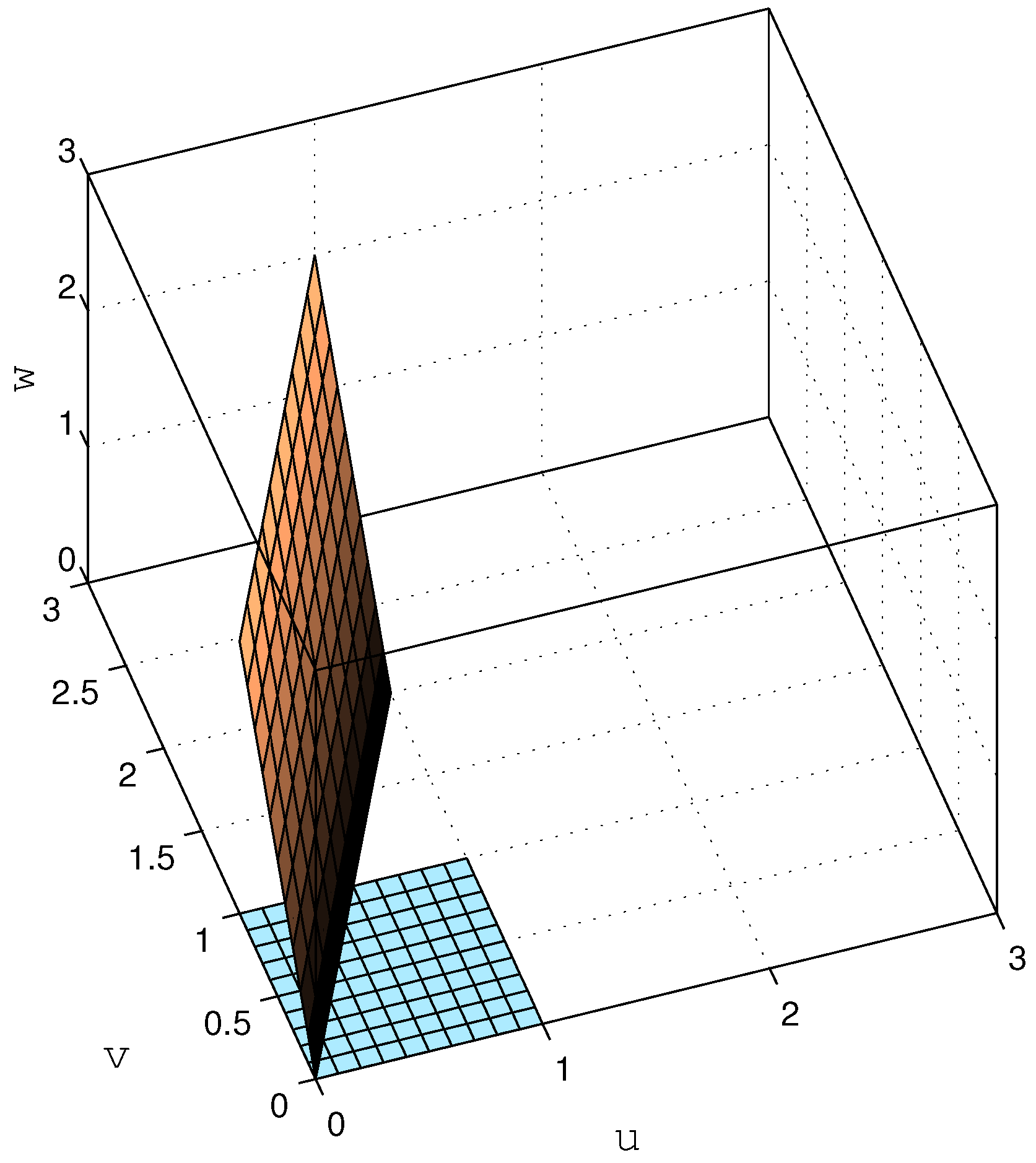
In other words, the problem lies in that, although the output is a three-dimensional vector, it only has two degrees of freedom, i.e., it is restricted to a 2-dimensional subspace of
. This is illustrated in
Figure 2, where the set
is shown (coinciding with the u-v plane), together with its image through
(as defined in (
40)).
As can be seen in this figure, the image of the square through is a 2-dimensional rhombus over which distributes uniformly. Since the intuitive notion of differential entropy of an ensemble of random variables relates to the size of the region spanned by the associated random vector (and determines how difficult it is to compress it in a lossy fashion with a given precision), one could argue that the differential entropy of , far from being , should be somewhat larger than that of (since the rhombus has a larger area than ). So, what does it mean that (and why should) ? Simply put, the differential entropy relates to the volume spanned by the support of the probability density function. For in our example, the latter (three-dimensional) volume is clearly zero.
From the above discussion, the comparison between the differential entries of
and
of our previous example should take into account that
actually lives in a two-dimensional subspace of
. Indeed, since the multiplication by a unitary matrix does not alter differential entries, we could consider the differential entropy of
where
is the
matrix with orthonormal rows in the SVD of
and
is a unit-norm vector orthogonal to the rows of
(and thus orthogonal to
, as well). We are now able to compute the differential entropy in
for
, corresponding to the rotated version of
such that its support is now aligned with
.
The preceding discussion motivates the use of a modified version of the notion of differential entropy for a random vector which considers the number of dimensions actually spanned by instead of its length.
It is worth mentioning that Shannon’s differential entropy of a vector
, whose support’s
ℓ-volume is greater than zero, arises from considering it as the difference between its (absolute) entropy and that of a random variable uniformly distributed over an
ℓ-dimensional, unit-volume region of
. More precisely, if in this case the
probability density function (PDF) of
is Riemann integrable, then [
1], Thm. 9.3.1,
where
is the discrete-valued random vector resulting when
is quantized using an
ℓ-dimensional uniform quantizer with
ℓ-cubic quantization cells with volume
. However, if we consider a variable
whose support belongs to an
n-dimensional subspace of
,
(i.e.,
, as in Definition 1), then the entropy of its quantized version in
, say
, is distinct from
, the entropy of
in
. Moreover, it turns out that, in general,
despite the fact that
has orthonormal rows. Thus, the definition given by (
44) does not yield consistent results for the case wherein a random vector has a support’s dimension (i.e., its number of degrees of freedom) smaller that its length (The mentioned inconsistency refers to (
45).), which reveals that the asymptotic behavior
changes if
is rotated. (If this were not the case, then we could redefine (
44) replacing
ℓ by
n, in a spirit similar to the one behind Renyi’s
d-dimensional entropy [
19].) To see this, consider the case in which
distributes uniformly over
and
. Clearly,
distributes uniformly over the unit-length segment connecting the origin with the point
. Then,
On the other hand, since, in this case,
, we have that
Thus, the
d-dimensional entropy would not generally be equal to the effective differential entropy, that is:
The latter example further illustrates why the notion of effective entropy is appropriate in the setup considered in this section, where the effective dimension of the random sequences does not coincide with their length (it is easy to verify that the effective entropy of does not change if one rotates in ).
We finish this section with an example to illustrate the usefulness of the notion of effective differential entropy beyond the context of entropy gain.
Application Example: Shannon Lower Bound
The rate-distortion function (RDF)
is the infimum, among all codes, of the expected number of bits per sample necessary to reconstruct a given random source with distortion not greater than
D [
1]. Let the source and reconstruction be the vectors
and
, respectively, and suppose the distortion is assessed using the
mean-squared error (MSE)
. Then, restricting our attention to uniquely-decodable codes Reference [
1], p. 105), the
Shannon Lower Bound (SLB) [
20] establishes that
provided
is bounded. Therefore, if
is the entire forced response of an FIR filter
G of order
p to an input
, then
and
is minus infinity, which precludes one from using (
49). We will show next that, in this case, the SLB can still be stated by using the effective differential entropy
instead of
. Following Definition 1, we can write the source vector as
, where
has orthonormal rows,
is diagonal with non-negative entries, and
is unitary. Let
be a unitary matrix, which means that
. Then,
where
stems from Reference [
1], Theorems 5.4.1 and 5.5.1 and Equations (10).58-10.61,
holds because conditioning does not increase entropy and
is from the definition of effective differential entropy.
5. Entropy-Balanced Processes: Geometric Interpretation and Properties
In the first part of this section, we provide a geometric interpretation of the effect that a non-minimum phase LTI system has on its input random process. This will give an intuitive meaning to the notion of an entropy-balanced random process (introduced in Definition 2 above) and provide insights into why and how the entropy gain defined in (
1) arises as a consequence of an output random disturbance or a random initial state (the themes of
Section 6 and
Section 7, respectively).
The second part of this section identifies several entropy-balanced processes and establishes two properties satisfied by this class of processes.
5.1. Geometric Interpretation
We begin our discussion with a simple example.
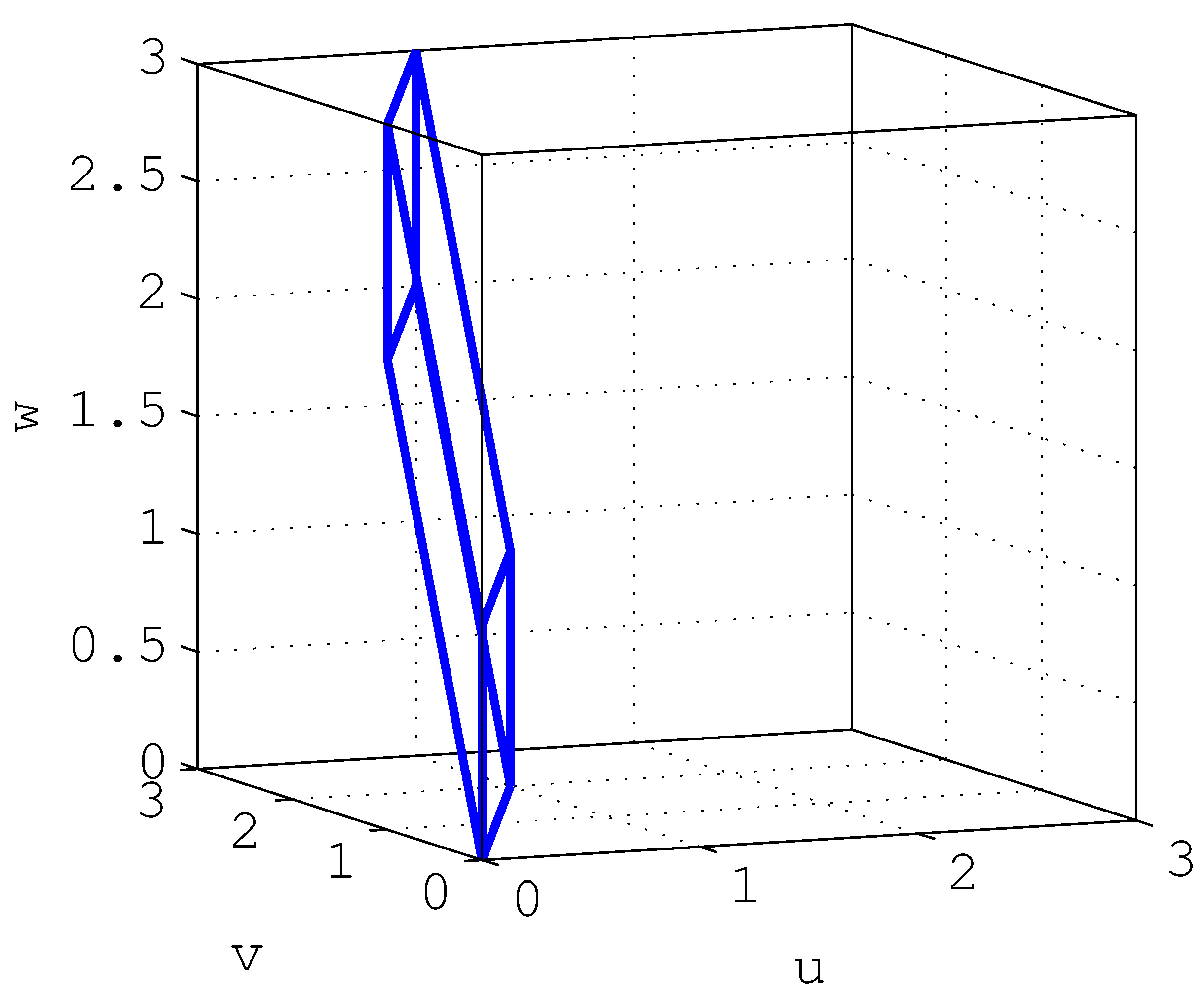
Example 1. Suppose that G in Figure 1 is a finite impulse response (FIR) filter with impulse response . Notice that this choice yields ; thus, has one non-minimum phase zero, at . The associated matrix for iswhose determinant is clearly one (indeed, all its eigenvalues are 1). Hence, as discussed in the introduction, ; thus, (and , in general) does not introduce an entropy gain by itself. However, an interesting phenomenon becomes evident by looking at the SVD of , given by , where and are unitary matrices, and . In this case, ; thus, one of the singular values of is much smaller than the others (although the product of all singular values yields 1, as expected). As will be shown in Section 6, for a stable , such uneven distribution of singular values arises only when has non-minimum phase zeros. The effect of this can be visualized by looking at the image of the cube through , shown in Figure 3. If the input were uniformly distributed over this cube (of unit volume), then would distribute uniformly over the unit-volume parallelepiped depicted in Figure 3; hence, . Now, if we add to a disturbance , with scalar s uniformly distributed over independent of , and with , the effect would be to “thicken” the support over which the resulting random vector is distributed, along the direction pointed by . If is aligned with the direction along which the support of is thinnest (given by , the first row of ), then the resulting support would have its volume significantly increased, which can be associated with a large increase in the differential entropy of with respect to . Indeed, a relatively small variance of s and an approximately aligned would still produce a significant entropy gain.
The above example suggests that the entropy gain from to appears as a combination of two factors. The first of these is the uneven way in which the random vector is distributed over . The second factor is the alignment of the disturbance vector with respect to the span of the subset of columns of , associated with the smallest singular values of , indexed by the elements in the set . As we shall discuss in the next section, if G has m non-minimum phase zeros, then, as n increases, there will be m singular values of going to zero exponentially. Since the product of the singular values of equals 1 for all n, it follows that must grow exponentially with n, where is the i-th diagonal entry of . This implies that expands with n along the span of , compensating its shrinkage along the span of , thus keeping for all n. Thus, as n grows, any small disturbance distributed over the span of , added to , will keep the support of the resulting distribution from shrinking along this subspace. Consequently, the expansion of with n along the span of is no longer compensated, yielding an entropy increase proportional to .
The above analysis allows one to anticipate a situation in which no entropy gain would take place even when some singular values of tend to zero as . Since the increase in entropy is made possible by the fact that, as n grows, the support of the distribution of shrinks along the span of , no such entropy gain should arise if the support of the distribution of the input expands accordingly along the directions pointed by the rows of .
An example of such situation can be easily constructed as follows: Let
in
Figure 1 have non-minimum phase zeros and suppose that
is generated as
, where
is an i.i.d. random process with bounded entropy rate. Since the determinant of
equals 1 for all
n, we have that
, for all
n. On the other hand,
. Since
for some finite
(recall Assumption 2), it is easy to show that
; thus, no entropy gain appears.
The preceding discussion reveals that the entropy gain produced by
G in the situation shown in
Figure 1 depends on the distribution of the input and on the support and distribution of the disturbance. This stands in stark contrast with the well known fact that the increase in differential entropy produced by an invertible linear operator depends only on its Jacobian, and not on the statistics of the input [
2]. We have also seen that the distribution of a random process along the different directions within the Euclidean space which contains it plays a key role, as well. This motivates the need to specify a class of random processes which distribute more or less evenly over all directions. This is precisely the intuitive meaning of an entropy-balanced process.
The following section identifies a large family of processes belonging to this class, as well as two properties which greatly expands this family.
5.2. Characterization of Entropy-Balanced Processes
We have defined the notion of an “entropy-balanced” process in
Section 1.1. In words, the first condition in this definition allows one to guarantee that the orthogonal projection of an entropy-balanced process onto any
-dimensional linear subspace has a differential entropy whose magnitude remains bounded or grows at most sub-linearly with
n. The second condition states that the projection of an entropy-balanced process
onto any linear subspaces having
fewer dimensions has the same differential entropy rate as the original process. This condition is equivalent to requiring that every unitary transformation on
yields a random sequence
such that
. This property of the resulting random sequence
means that one cannot predict its last
samples with arbitrary accuracy by using its previous
samples, even if
n goes to infinity.
We now characterize a large family of entropy-balanced random processes and establish some of their properties. Although intuition may suggest that most random processes (such as i.i.d. or stationary processes) should be entropy balanced, that statement seems rather difficult to prove. In the following, we show that the entropy-balanced condition is met by i.i.d. processes with per-sample
probability density function (PDF) being uniform, piece-wise constant or Gaussian. It is also shown that adding to an entropy-balanced process an independent random processes independent of the former yields another entropy-balanced process, and that filtering an entropy-balanced process by a stable and minimum phase filter yields an entropy-balanced process, as well. The proofs can be found in
Appendix B.
Lemma 1. Let be a Gaussian random process with independent elements having positive and bounded variance, i.e., there exist such that , . Then, is entropy balanced.
Lemma 2. Let be a random process with independent elements satisfying Condition i) in Definition 2, in which each is distributed according to a (possibly different) piece-wise constant PDF such that each interval where this PDF is constant has measure less than θ and greater than ϵ, for some constants . Then, is entropy balanced.
Lemma 3. Let and be mutually independent random processes. If is entropy balanced, and satisfies for finite n and , then is also entropy balanced.
The proof of Lemma 3 is on page 33. The working behind this lemma can be interpreted intuitively by noting that adding to a random process another independent random process can only increase the “spread” of the distribution of the former, which tends to balance the entropy of the resulting process along all dimensions in Euclidean space. In addition, it follows from Lemma 3 that all i.i.d. processes having a per-sample PDF which can be constructed by convolving uniform, piece-wise constant or Gaussian PDFs as many times as required are entropy balanced. It also implies that one can have non-stationary processes which are entropy balanced, since Lemma 3 imposes no requirements for the process .
The next lemma related to the properties of entropy-balanced processes shows that filtering by a stable and minimum phase LTI filter preserves the entropy balanced condition of its input.
Lemma 4. Let be an entropy-balanced process and G an LTI stable and minimum-phase filter. Then, the output is also an entropy-balanced process.
This result implies that any stable moving-average auto-regressive process constructed from entropy-balanced innovations is also entropy balanced, provided the coefficients of the averaging and regression correspond to a stable MP filter.
The last lemma of this section states a crucial property of entropy-balanced processes (the proof is in
Appendix B, page 34).
Lemma 5. Let be an entropy balanced process. Consider a disturbance satisfying Assumption 2 and define . Then, .
We finish this section by pointing out two examples of processes which are non-entropy-balanced, namely the output of a NMP-filter to an entropy-balanced input and the output of an unstable filter to an entropy-balanced input. The first of these cases plays a central role in the next section.
7. Entropy Gain Due to a Random Initial State
Here, we analyze the scenario illustrated by
Figure 1 for the case in which there exists a random initial state
independent of the input
, and zero (or deterministic) output disturbance.
The treatment of an initial state of the LTI system
G requires one to first define an internal model for it. For this purpose, in this section, we consider the state-space realization of
G in the Kalman canonical form, given by
(see, e.g., Reference [
21] or Reference [
22], Chapter 6) where the column state vectors
,
,
,
are, respectively,
controllable and observable,
non-controllable and observable,
controllable and non-observable, and
non-controllable and non-observable. There is no loss of generality in choosing this state-space representation, because every state-space representation consistent with a rational transfer function
can be written in this form (Reference [
22], Theorem 6.7).
Since our interest is on the effect of the random initial state of
G on its output, we only need to consider the observable subsystem within (76) and without its input, given by
where
is the natural response of
G to its initial state
and
and
. We shall decompose
as
where
and
are the natural responses of
G to initial states
and
, respectively. The natural response component
can be generated by the following minimal state-space representation of
, without the effect of its input u:
Now, we can state and prove the main result of this section:
Theorem 7. Suppose G satisfies Assumption 1 and is entropy balanced. Assume that (the observable part of the initial state of G) is independent of the input , and that . Then, Proof. Both G and satisfy the conditions of Theorem 6. Thus, as in its statement, we write , where is stable and minimum phase and is a stable FIR transfer function with only the m non-minimum-phase zeros of .
Defining
, we have
and
. In addition, the fact that
G is stable guarantees that the sample second moment of
decays exponentially, which means that
satisfies Assumption 2. Thus, the conditions of Lemma 6 are met considering
, where now
is the SVD for
, and
. Consequently, the proof would be completed if we can show that
. But all the involved variables have bounded variance, while
is unitary,
has orthonormal rows and the entries of
decay exponentially with
n. This implies that
. Therefore, it is only left to prove that
Recalling (78), let us decompose
so that
where
, the sequences
and
, respectively, are the natural responses of
and
F to the controllable and observable initial state
, and
is the natural response of
G to the non-controllable and observable initial state
. Then,
where
is from the entropy-power inequality [
1] and
holds because conditioning does not increase entropy and
is a deterministic function of
. Let the SVD of
be
where
is unitary,
holds the singular values of
and
has orthonormal rows. Substituting this SVD into (87) we obtain
This last differential entropy is bounded because
and
, which implies (thanks to Proposition A1) that
, and by the chain rule of entropy,
so
because
(again from Proposition A1). Thus, in view of (89) and (84), all that remains to prove is that
For that purpose, notice that
. Therefore, from Lemma A4 (in
Appendix C), it follows that (91) holds if
and
To prove (93), recall that the entries in the diagonal matrix decay exponentially with n. On the other hand, the rows of are orthonormal. Finally, the fact that is stable implies that the columns of have norms which are bounded for all n. These three observations readily yield that (93) holds.
To prove that (92) holds, write the rational transfer function of
G (described by (80)) as
where
. The coefficients in the numerator of
are related to those of
and
by the convolution
where
.
Denote the natural response of
F (up to time
n) to its initial state
(which is a linear function of
) as
Let
be the natural response of
to its initial state
. Following the structure of (80),
can be written as
where
satisfies (79). Considering the following minimal state-space representation of
F
it can be seen that the natural response of
F to its own initial state
can be written as
But, from (80) and (95),
where
, and
therefore,
with
for
. Therefore,
where
and
is a lower anti-triangular Toeplitz matrix with
along its main anti diagonal.
This implies that
and
Thus, resuming the reasoning before (94), we have that
It then follows from (110) and Lemma 8 that
Hence, (91) is satisfied. Substituting (91) into (89) and the latter into (84) yields
The proof is completed by invoking Lemma (6). □
Theorem 7 allows us to formalize the effect that the presence or absence of a random initial state has on the entropy gain using arguments similar to those utilized in
Section 6.
9. Conclusions
We have provided an intuitive explanation and a rigorous characterization of the entropy gain of a linear time-invariant (LTI) system, defined as the difference between the differential entropy rates of its output and input random signals. The continuous-time version of this problem, considered by Shannon in Theorem 14 of his 1948 landmark paper, involves an LTI system band limited to B [Hz]. For this scenario, we restricted our attention to systems such that the samples of its unit-impulse response, taken seconds apart, correspond to the unit-impulse response of a causal and stable discrete-time system G. We show that the entropy gain in this case is , which implies that, for this class of systems, Shannon’s Theorem 14 holds if and only if has a corresponding discrete-time G that is minimum phase (MP).
For the discrete-time case, we introduced a new notion referred to as effective differential entropy, which quantifies the amount of uncertainty in vector signals that are confined to subspaces of lower dimensionality than that of the signals themselves. (Note that this is not possible by the conventional notion of differential entropy, which simply diverges to minus infinity.) It turns out that the difference in effective differential entropy rate between an n-length input to an LTI discrete-time system with frequency response , and its full length output, as n tends to infinity, equals .
When comparing input and output sequences of equal length, our analysis revealed that, in the absence of external random disturbances, the entropy gain of a discrete-time LTI system G with unit-impulse response is simply . An entropy gain greater than can be obtained only if a random signal is added to the output of G and if such output process has statistical properties that make it susceptible to the added random signal. In order to characterize the role of G, its input has been assumed to be entropy balanced (EB), a notion introduced herein. Crucially, the differential entropy rate of an EB process is not susceptible to random signals. EB processes constitute a large family that includes Gaussian processes with bounded, non-vanishing variance. We also show that (i) the sum of an EB process and any bounded variance process is EB, too, and (ii) passing an EB process by a stable MP filter yields an EB process. When the input is EB, we show that if G has NMP zeros , then the largest possible entropy gain is , which equals . This upper bound is achieved by adding a finite-length output disturbance with finite variance and bounded differential entropy if and only if its length is at least m, no matter how tiny its variance may be. The same entropy gain is also obtained if G has a random initial state with bounded differential entropy and finite variance.
We used these fundamental insights about when the entropy gain occurs in order to establish a new and more general proof of the quadratic rate-distortion function for non-stationary Gaussian sources. Moreover, we demonstrated that the information rate of the capacity-achieving scheme proposed in Reference [
9] for the auto regressive Gaussian channel with feedback drops to zero in the presence of any additive disturbance in the channel input or output of sufficient (finite) length, no matter how small it may be. This has crucial implications in any physical setup, where noise is unavoidable.