A Review on Machine Learning Approaches for Network Malicious Behavior Detection in Emerging Technologies
Abstract
1. Introduction
- Packet decoder: this module receives raw network traffic packets and transfers suitable information to the pre-processing module.
- Pre-processing: this module receives a portion of network traffic features and prepares corresponding normalized feature vectors, which is necessary for learning-based systems in the detection module.
- Classifier system: the responsibility of this module is to build a model on top of the prepared data which discriminates malicious instances against normal ones.
- Detection and recognition: two phases are defined in this module—(i) detects the malicious instances as a binary decision problem (e.g., 0 for normal and 1 for malicious) and transmits an alert to a system administrator for making a reaction; and (ii) after any malicious behavior detection, the system can recognize various types of abnormality (attack classification).
1.1. Related Surveys
- A systematic architecture for network anomaly detection and recognition systems is proposed from a user’s behavior point of view followed by the properties of intrusion detection systems and applications.
- The recent network data pre-processing tools for feature extraction comprising of feature creation, reduction, conversion and normalization are discussed.
- A comprehensive discussion on various shallow and deep learning techniques, such as supervised, unsupervised, new ensemble, and deep learning approaches are discussed followed by the challenges of designing an efficacious NADS.
- A detailed discussion of evaluation criteria, including evaluation metrics and several contemporary datasets applicable for NADSs, is provided.
1.2. Review Methodology
2. The Background of Intrusion Detection Systems and Properties
2.1. Intrusion Detection Methods
2.2. Applications and Deployments
2.3. Contemporary Malicious Behaviors (Network Attacks)
- Trojan is a malware often disguised as normal software but carrying out abnormal activities in the backend. Trojan malware are usually utilized by cybercriminals to penetrate victims’ systems and the users are mostly cheated by hackers to execute the Trojan malware on target computers [26].
- Scareware is a new sort of malware created to deceive users to buy and download useless and potentially dangerous software—for instance, fake protection programs that cause many financial and security-related perils to the users [3].
- Rootkits are malware created to hack particular processes and enable continued privileged access to victims’ machines. Rootkit malware can be executed at various levels such as application programming interface (API) calls, at the user level or interfere with OS at the device level [27].
- Analysis contains different types of port scanner attacks such as spam and .html file penetrations [14].
- Ransomware attack is a malicious software from cryptovirology that threatens to reveal the victim’s sensitive information unless a ransom is paid [3].
- Zero-day attack is a computer-software vulnerability that exploits a significant security infirmity without the creator’s awareness. Until the vulnerability is identified by the system, hackers can exploit it to negatively affect the computer programs and data [13].
- A Botnet occurs when the number of hijacked systems remotely controlled via malware operators perform malicious activities. Cybercriminals infiltrate targeted devices by using typical Trojan viruses to penetrate the computers’ security systems. Some example of these malicious activities are DDoS attacks, credential-stuffing attacks and Web application attacks [13].
- Brute force happens when an attacker submits massive pairs of username and passwords or passphrases with the hope of finally guessing correctly. The attacker systematically checks all possible passwords to find the correct one [28].
- Backdoors are the techniques that attacker uses to remotely gain access and control of the victim’s computer by normally responding to client applications. Many of these techniques utilize the IRC backbone and often obtain commands from IRC users’ chats [14].
- Denial-of-service (DoS) is a malicious activity which tries to make a computer, OS or server unavailable to its client by temporarily or permanently interrupting the host services connected to the Internet [2].
- Exploits can be represented as a series of comments or a peace of code that often enable cybercriminals to discover a security-related issue in an OS to remotely control the whole machine [14].
- Distributed denial-of-service (DDoS) happens when multiple computers flood the bandwidth or resources of a targeted system, generally one or more web servers [29].
- Fuzzers is a black box malicious software testing technique that tries to create a program or network to interrupt the target machine by injecting randomly generated data such as numbers, chars, metadata or pure binary sequence [14].
- Generic is initially a collision attempt on the private keys of ciphers. For example, if a cipher takes an N bit key, in response, the generic attack gets a ciphertext and tries to decrypt the original cipher with all possible keys [14].
- Reconnaissance is a kind of data collection from networks or other services trough illegal ways. In this sort of attack, cybercriminals try to obtain information about the victim’s network or computer to use in an unauthorized investigation [29].
- Shellcode is basically the payload of another attack. The malicious orientation provides a command-line to the attacker in order to give access to a computer, all with the benefits of the procedure being abused. When an exploit builds up a connection to the vulnerable procedure which is not already closed, the shellcode can later re-utilize this connection to negotiate with the attacker [14].
- Shellshock attacks usually breach the command-line shell of OSs such as, Apple, Linux, and UNIX. The attacks were discovered in 2014 and at the time, many computer systems had been penetrated by a remote code execution which had achieved full access and control [3].
- Worms duplicate their own code in order to spread it to other computers. These often employ a network environment to propagate themselves and occur when there are security failures on the target computers [14].
3. Data Pre-Processing and Feature Extraction
3.1. Feature Creation
3.2. Feature Reduction
- Subset generation: is an informed (heuristic) search strategy that generates subset candidates from the original search space. For instance, in a dataset including f features, there are possible subsets of features.
- Subset evaluation: every generated subset needs to be evaluated based on appropriated metrics. These metrics can be applied to the selected subsets based on learning techniques, dependently or independently [14].
- Stopping criterion: is a conditional step to finish the feature selection process, with common rules, such as the maximum number of iterations or the minimum selected features.
- Result validation: in this step, the result can be evaluated based on estimating the output of reduced features using a priori information.
3.3. Feature Conversion
3.4. Feature Normalization
4. Machine Learning Techniques for Network Malicious Behavior Detection and Recognition
4.1. Supervised Learning Approaches
4.1.1. Regression Techniques
- Regression: is a set of statistical processes that specify the relationship between one dependent value and one or more than one independent values. This method is divided into two main regression techniques, linear, and polynomial [38].
- Decision Tree (DT) learning: is a classifier technique based on tree structure. Every node in this structure is correlated to a specific feature in the dataset and the cost (weight) of the connected edges are feature values. Each leaf node of the tree structure represents a malicious behavior in a DT-based detection system [39]. Generally, decision trees fall into two main categories: regression tree analysis and classification tree analysis. Regression tree analysis is when the predicted outcome can be considered a real number, whereas classification tree analysis is when the predicted outcome is the class (discrete) to which the data belong.Narouei et al. [40] proposed a malware detection technique based on structural mining. The behavioral features have were extracted from a dynamic-link library dependency tree. In the detection phase, similar measurements such as Cosine (M1), Jaccard (M2), Pearson (M3) were used to detect the similar variants or to obfuscate the versions of a malware, so the drawback of this paper is the identification of only Malware and benign programs with the known tree’s string encoding format.Singh et al. [41] proposed a random forest-based decision tree technique. The authors reported that the random forest method utilized for Botnet detection achieves a high accuracy of prediction. This technique is also capable of processing various bots and further characterizes the data by a large number of multiple types of descriptors, though only peer-to-peer (P2P)-based Botnet anomalies were studied in this research work, which could be a limitation in new computing technologies. Jabbar et al. [42] designed an ensemble classifier scheme based on two learning algorithms, namely random forest and average one-dependence estimator (AODE). The AODE overcomes the feature dependency problem in naïve Bayes classifier and the RF technique enhances the overall accuracy while it reduces the misdetection rates, while one of the main limitations of the proposed technique is the necessity of labeling the attack data patterns.
4.1.2. Classification Techniques
- Classification tree: is a test design technique which is used in various areas of software development. The classification tree methodology includes two main phases: identification and combination. The first phase is the identification of test-relevant aspects, called classifications in pattern recognition domains, and their corresponding values, called classes. The second phase is the combination of different classes from all classifications into test cases.
- Support vector machine (SVM): is a successful maximum margin linear classifier system. A typical SVM classifier contains two main steps to classify network data instances.Firstly, the training dataset is transferred to a higher dimensional feature space and then, using a kernel function, the linear non-separable problem converts into a linearly dividable problem. In anomaly detection problems, all normal instances are placed in one class and different malicious land in another class. Afterwards, the network observations are over a hyperplane with the highest margins at the closest spots on every sector. Only the patterns that are very close to the margin, affect the computation of these margins. The remaining patterns could be eliminated without influencing the final results.Ambusaidi et al. [43] proposed an IDS named the least square support vector machine (LSSVM-IDS), which has the capability to handle both linear and non-linearly dependent data instances. By using LS-SVM, the network attacks are classified into DoS, Probe, R2L, and U2L. Moreover, the performance classification for these attacks evaluated based on three datasets (KDD CUP 99, Kyoto 2006, NSL-KDD), labeling the patterns to train the detection system, is one of the main challenging gaps in this study.Kang et al. [34] described a one-class classification method to enhance the performance of intrusion detection for harmful attacks. The outcome results was evaluated based on artificially generated instances in a two dimensional space. In the detection phase, the authors followed a simple logic, the center of the normal patterns was located at (0, 0), and two malicious class centers were at (1, 1) and (−1, −1), respectively. Experimental results over simulated data show better performance and then extracted data in the DARPA dataset. Perdisci et al. [35] presented several one-class SVM methods for ADSs based on the Harden Payload. The authors constructed several SVM classifiers and each classifier was applied on a various observation from the payload. The experimental analyses showed that the combination of the obtained classifiers improves both the detection accuracy and the hardness of evasion, the main gap of this study is the complexity of feature selection and labeling process of the features. Some other works for malicious detection using a one-class support vector machine are reported in [44,45,46,47].
- K-nearest neighbors (KNN): is a supervised machine learning technique that uses a pattern and classifies new neighborhood patterns by considering a similar measure based on various distance functions. In malicious detection applications, the classification is performed by a majority vote for its nearest neighbors to the object and classifying malware, while if it is benign then it is based on the closest training instants in the Windows API calls [48].Alazab [48] proposed a profile-based classification technique to analyze the behavior of malicious observations based on KNN. The authors statically and dynamically extracted various features from the malware to represent the behavioral type of its code, such as Windows Application Programming Interface calls. KNN techniques have been used to profile malware behaviors and to categorize them into malicious and normal classes [48]. One of the main gaps in this paper is only using API calls to reflect the behavior of user, therefore, it would be very hard to identify contemporary malware. KNN-based NADSs first establish a normal network profile, and like other binary classification problems, any deviation from the normal profile is considered malicious. KNN is a strong anomaly detection technique since adapting parameters is not required in the training phase. Nevertheless, these techniques are mostly time-consuming and need a large storage space for the classification of high-speed traffic data, though some other similar works can be found in [49,50].
- Bayesian networks (BNs): are graphical models, with evidence propagation controlled by the Bayesian theorem. BNs are inherently sturdy for missing information, and are better adapted to categorical information compared to distance-based classifiers [51]. The structure of BNs and its representation is understandable for human operators, in comparison with other machine learning approaches. This structure allows modeling the flow of information through the network and traces the causes of malicious instances [51].Xu et al. [52] designed an intrusion detection model by proposing a hierarchical continuous time Bayesian network (CTBN). The system traces the network packets and applies the Rao-Blackwellized bit filtering to learn the parameters, the combination of system calls and network events in feature selection and extraction phase provided strong abilities to identify anomalies. Altwaijry [53] developed a Bayesian-based intrusion detection system to detect anomaly activities over network traffic. First, the different sub-attacks were detected, then they were classified into four main attacks: including DOS, Probe, R2L and U2R. Initially, the system was developed to recognize intrusions by using a naïve Bayesian classifier; eventually, the technique extended to a multi-layer Bayesian-based intrusion detection.Moustafa et al. [54] proposed a malicious behavior classification approach using a correntropy-variation technique. The authors believe that modern network attacks can mimic normal activities and make it very complicated for the network to trace the malicious observations. The authors designed a network forensic technique for investigating network-based attacks. In the first step, network traffic data were captured; afterwards, the authors extracted significant features using the chi-square statistic. Finally, malicious instances were detected by applying the correntropy-variation technique, and the proposed statistical technique that the authors proposed was not a learning-based technique as well as not applicable to Cloud and Fog computing environments—which are gaps we identified in this research study. [54]. Another research study into anomaly-based IDS using kernel density estimation can be found in [55].
- Fuzzy logic (FL): FL has been applied in IDSs for two main concerns [56]. Firstly, there are plenty of quantitative network parameters related to network packets and other environmental properties. The parameters involved in the network anomaly detection systems, such as CPU usage time, protocol type, connection interval, etc., could potentially be represented as fuzzy variables and equivalent rules. Secondly, as described by Bridges et al. [56], the concept of security itself is fuzzy. That is to say, fuzzy rules smooth out the unexpected deviation of normal instances against the malicious ones [56].Dickerson et al. [57] introduced the fuzzy intrusion recognition engine (FIRE) by applying the fuzzy rules and fuzzy sets. This technique employed different data mining methods for processing network packages and created fuzzy sets for network data instances. Later, the fuzzy sets were applied to make fuzzy rules for detecting malicious instances against normal ones, [58], and the main gap in this research work was that the feature extraction was not properly done in the pre-processing phase.Haider et al. [59] provided a dataset used for intrusion detection by trying fuzzy qualitative modeling. The issues of realistic assessment and systematic metric for evaluating different types of IDS datasets were investigated. Practically, it is difficult to access and obtain real-world network traffic data due to business stability and integrity issues. In order to achieve this, in the first step, the authors established a metric based on fuzzy logic to assess the quality of the realism of existing intrusion detection datasets. Afterwords, a synthetically realistic intrusion detection dataset was developed using the presented metric results. In this study, only DoS and DDoS attacks were investigated, which is the main limitation of the proposed detection system.
4.1.3. Challenges and Future Directions for Supervised Learning Techniques
4.2. Unsupervised Learning Approaches
4.2.1. Clustering Techniques
- Hierarchical clustering: is a cluster analysis method that attempts to generate a hierarchy of clusters and technically falls into two main categories: agglomerative clustering, which is a bottom–up modeling approach, and the other one, divisive, is top–down clustering. Horng et al. [60] introduced an SVM-IDS based on hierarchical clustering. The clustering method provided a classifier with higher-qualified training patterns which were extracted from the training dataset, and one of the limitations of this technique was that despite its high performance in two attacks in the KDD Cup 1999 dataset (DoS and Probe), it was not acceptable for the U2R and R2L attacks.
- K-means clustering: is a famous unsupervised learning approach applied to clustering problems. The technique follows a simple strategy to classify a given number of patterns in a dataset through a predefined number of clusters. A standard type of K-means algorithm (naïve K-means) can be created by repeating two steps. The first step is assigning each observation to the cluster whose mean has the least squared Euclidean distance. The second step is updating and calculating the new means (centroids) of the observations in the new clusters [61]. Figure 5 shows a pictorial representation of K-means clustering.Lee et al. [62] proposed a proactive detection technique for DDoS attacks using cluster analyses. The cluster algorithm that the authors used, contains two main types of clustering algorithms; hierarchical clustering and partitioning clustering, to pre-determine the number of clusters, the limitation of this work is the weakness of the system to identify other attacks such as R2L, U2R and probing, with the exception of DoS and DDoS attacks. Similarly, Li [61] implemented an anomaly detection model based on clustering analysis using the K-mean clustering algorithm. In this research, the author reported some limitations, such as the sensitivity of the algorithm to initial conditions, outliers, and noise. Even if an object is quite far away from the centroid of the cluster, it is still directed into a cluster. Thus, it re-curves the cluster shapes.Costa et al. [63] designed an optimum-path forest clustering technique to estimate the probability density function (pdf) employed in clustering algorithms. The authors applied this clustering technique for intrusion detection systems by speeding up the optimum-path in forest clustering. The feature selection and extraction process is not clearly explained in this study and this can be the main gap of this research work. Jadhav et al. [64] proposed a scheme for a network anomaly detection system based on packet signature clustering and network analysis. The clustering technique follows a simple rule; whenever the input network instances match one of the intrusion signatures, the system reacts to the security administrator concerning the possible threat in details, one of the limitations of proposed system is the paucity of extracted features, which is a lot less compared to the features in popular datasets such as UNSW-NB15, KDD99, and NSL-KDD datasets.Although various clustering techniques have been used for NADSs, the most utilized techniques for malicious detection are regular and co-clustering techniques using different strategies and processing methods [9,65,66]. For example, the K-means, as a regular clustering method, assembles features from the dataset instances, but co-clustering techniques concurrently consider both features and instances in the dataset to make clusters.
- Gaussian Mixture Models (GMM): is a technique of probabilistically representing normally distributed sub-sets throughout a dataset. A finite mixture mechanism is presented as a convex collection of two or more PDFs, and the joint attributes of these PDF functions can predict any random distribution [67].Moustafa et al. [67] introduced an outlier Gaussian mixture (OGM) model for discovering zero-day attacks based on the concept of network abnormal behaviors. The authors collected the Web application data and extracted the related features. After preparing significant features, the normal model was created by using the outlier Gaussian mixture (OGM) technique based on GMM. Some other techniques for anomaly detection using GMM have been reported in [20,68,69,70].
4.2.2. Dimensionality Reduction Techniques
- Principal component analysis (PCA): is the main linear technique and a well known unsupervised dimensionality reduction method, which determines the principal directions of the data distribution. In order to acquire these principal directions, one needs to create the co-variance matrix of data and calculate its conquered eigenvectors [72].Han et al. [73] developed a naïve Bayesian NADS based on PCA. The system calculates the attribute value of the original network dataset, then extracts the essential properties using PCA. With the aim of improving the traditional naïve Bayesian classification method, the authors took the main properties as the new features and the corresponding principal component contribution rate as weights, though a drawback of the proposed technique is the complexity of labeling attack data. Bhagoji et al. [74] introduced a dimensionality reduction method to protect the networks against evasion attacks on machine learning classification techniques. The authors incorporated PCA to increase the flexibility of machine learning techniques, targeting both the classification and the training phases, though there are two limitations in this work, insufficient on its own and a lack of universality, where it falls short of being a comprehensive defense mechanism against evasion attacks, the authors suggested using other dimensionality reduction techniques for addressing these limitations. Ding et al. [75] proposed a PCA subspace model for anomaly detection in high-dimensional data space. The authors introduced a model of compressed PCA subspace projection and characterized key theoretical quantities, relating to its usage as a tool in malicious detection. In addition, the technique and application implemented for identifying IP-level volume anomalies in network traffics, the important phase of an IDS which is pre-processing and feature extraction was not covered in this paper and the evaluation criteria to assess the technique is missing.
- Independent component analysis (ICA): obtains the independent variables by maximizing the statistical independence of the estimated components. As an example for this technique in network anomaly detection, Palmieri et al. [31] proposed an approach based on ICA. The authors created a two-phase anomaly detection scheme using various distributed sensors located in the entire network. By using this dimensionality reduction technique, the authors modeled the anomaly detection as a blind source separation problem, and the gap identified in this research work is that analyzing fundamental independent traffic is time-consuming and predicts a weak performance in high-speed network traffic data.
4.2.3. Association Analyses Techniques (Hidden Markov Models (HMMs))
4.2.4. Artificial Neural Network (ANN) Techniques
4.2.5. Genetic Algorithm (GA) Techniques
4.2.6. Challenges and Future Directions for Unsupervised Learning Techniques
4.3. Deep Learning-Based Anomaly Detection Techniques
4.3.1. Discriminative Deep Architectures
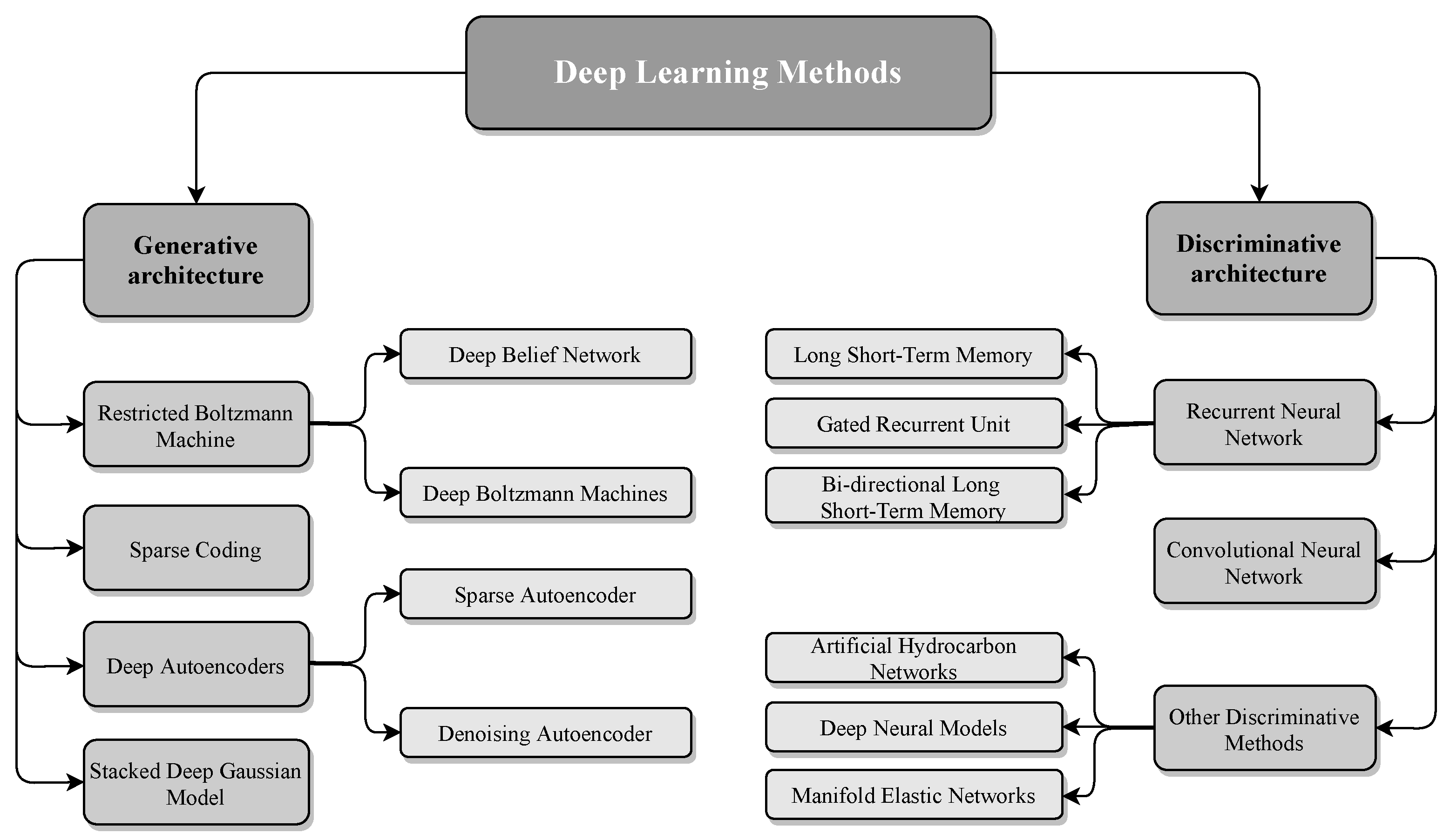
- The recurrent neural network (RNN) is a model of deep learning techniques where connections between nodes (neurons) form a directed graph along with a temporal sequence and allows the network to expose temporal dynamic behavior. In this architecture of the neural network, the input data are linked in long sequences via a layer-by-layer connection with a feedback loop [89].Based on the connection between layers, RNN consists of two types: Elman and Jordan. The Elman type includes three main layers (input, hidden, and output) and also one context layer. The hidden layer has a connection to the context layer and after every feed-forward training progress, a copy of the previously hidden units are stored at the nodes of context layer. Jordan networks perform similar to Elman but the context nodes are directly fed from the nodes in the output layer [89].Bontemps et al. [90] proposed an anomaly detection model based on long short-term memory recurrent neural network (LSTM RNN). In this technique, the LSTM RNN is firstly employed as a time series anomaly detection model and the prediction of a current observation depends on both the current and its previous observations. Secondly, the technique was adapted to detect aggregate malicious patterns by generating a circular array. The circular array includes previous prediction errors which were stored from a specified number of the latest time steps. If the prediction errors were greater than the predefined threshold and lasted for certain time steps, these will be detected as anomalies. The model was created on a time series version of the KDD 1999 dataset.Shone et al. [91] proposed a deep neural network(DNN) that consisted of 100 hidden units. The model incorporated the rectified linear unit activation function and the ADAM optimizer for network anomaly detection. This technique was implemented on a GPU using TensorFlow, and the performance of the method was evaluated using the KDD99 dataset with the average accuracy rate of 99. Moreover, for any future works, the authors suggest the improvement of the method by using RNN and long short-term memory (LSTM) models [91]. Maya et al. [92] proposed an RNN model based on delayed long short-term memory (dLSTM) for network malicious pattern detection on the time-series data. In the first step, a predictive model was generated from normal traffic instances, then identified malicious patterns based on the prediction error for observed data. To deal with the various states in the waveforms of normal traffic data, which reduces the prediction accuracy, the authors applied multiple prediction techniques based on LSTM for malicious detection, pre-processing phase, feature selection and evaluation criteria are missing gaps in this survey.An overall graphical RNN model is represented in Figure 7a, which includes two parts: (a1) qnet and (a2) pnet. At time t, is the input network data and is the reconstruction of . and are memory variables in GRU cells which are deterministic. is a z-space variable which is stochastic, and the edges represent the dependence between variables [93]. In Figure 7b, an example of the multivariate time series snippet with two detected malicious regions (highlighted in red) is demonstrated.
- Convolutional neural network (CNN) is a multi-layer perceptron ANN consisting of many hidden layers. The structure of CNN typically includes two operations: convolution and pooling. In addition, it contains fully connected layers and normalization layer. Convolution transforms input patterns via a sequence of filters to an output (usually called a feature map) that highlights the input features. Subsequently, the convolution output is processed by an activation function and then down-sampled by pooling to trim off the noisy and irrelevant data. The pooling process helps eliminate glitches in the data to improve the learning process [94,95]. The convolutional layers share multiple weights that have a few parameters which facilitates the CNN architecture’s training progress compared with other neural network models with the same number of hidden units [89].Wu et al. [96] proposed a CNN-based intrusion detection system. The authors used spatial and temporal network traffic features and designed a hierarchical CNN + RNN network named LuNet. The proposed system was composed of a combination of CNN and RNN models to learn from the input traffic data in synchronization with a gradually increasing granularity. Therefore, both spatial and temporal network features can be simultaneously extracted. This proposed technique does not perform well to classify attacks from Backdoors and Worms due to insufficient samples in the training dataset.To apply deep learning in multiple network anomaly detection datasets such as NSL-KDD, UNSW-NB15, Kyoto, WSN-DS, and CICIDS 2017, as well as provide the benchmark dataset, Vinayakumar et al. [97] proposed a framework by using a distributed deep learning model. This technique uses DNNs for handling and analyzing very large scale data in real-time network traffic. In this study, the authors provided a comparison between the deep and classical machine learning classifiers on various benchmark IDS datasets; one of the drawbacks of this research work is the time complexity of the proposed detection system which is associated with complex DNN architectures.
4.3.2. Generative Deep Architectures
- Deep auto-encoder (DAE) is basically for training efficacious coding in an unsupervised fashion and typically consists of an input layer, one (or more) hidden layer(s) and an output layer [89]. The outcome achieved in the output layer is a reconstruction of the input layer after the input nodes have been ‘squished’ via the smaller hidden layer. Therefore, DAE performs similarly to dimensionality reduction techniques such as PCA. In the case of anomaly detection, the network features which are extracted through the hidden layer could be used for training feedforward layers. The overall training of the network happens by training each autoencoder in an unsupervised manner, followed by the fine-tuning step whereby the last layer is trained by supervised network data [98].Muna et al. [89] proposed a detection system for network malicious activities based on auto-encoder and deep feed forward neural network. The required information and network features have been collected from TCP/IP network packets. The combination of the deep forward neural network and auto-encoder have made a solid learning algorithm to deal with both the labeled and unlabeled network features, along with both the training and testing for the evaluation process which used two popular network anomaly datasets—NSL-KDD and UNSW-NB 15. A disadvantage of this technique is the complexity of selecting appropriate parameters for the training phase while facing real-time network traffic data with a fast transmission rate. Ludwing et al. [98] proposed an intrusion detection system based on the autoencoder (AE) to classify different types of attacks. The attacks in the NSL-KDD dataset such as R2L, U2R, DoS and Probing have been classified with a total accuracy of 0.92.
- Restricted Boltzmann machine (RBM) is a popular deep learning technique among generative models which consist of two main architectures: deep Boltzmann machines (DBM) and the deep belief network (DBN). RBM techniques are basically applied to diminish hidden layers in the network and do not accept intra-layer connections between hidden neurons. To construct a DBN architecture, a stack of DBM should be trained by using the unlabeled data as inputs of the next layer and concatenating another layer for discrimination [89].Alom et al. [99] developed a deep belief network to interpret the intrusion attempts in incoming network traffic. The authors discovered the capabilities of DBN performing intrusion detection through series of experiments after training it with the NSL-KDD dataset. The trained DBN was able to detect all types of unknown attacks in the dataset and classified them into five different categories; however, in the case of unknown malicious attacks beyond those in the dataset (DoS, U2L R2L, Prode), the proposed technique would fail to identify them.
- A deep belief network (DBN) is a generative graphical model consisting of multiple hidden layers, with connections between the layers but not between the units within each layer. This type of deep learning architecture is a hybrid model of supervised and unsupervised learning networks. The unsupervised section was trained based on one greedy layer-by-layer connection at a time, in which the layers act as feature detectors and perform the expected classification, whereas the supervised section is one or more layers linked for classification [89].
4.3.3. Challenges and Future Directions for Deep Learning Techniques
4.4. Ensemble Learning Approaches
- Bagging (bootstrap aggregation): mostly considers homogeneous weak classifiers, trains all classifiers parallelly and independently; thereafter, it combines them based on a deterministic averaging process [1].
- Boosting: employs the weighted averages to construct weak classifiers into a powerful classifier. As opposed to the bagging strategy in which every classifier is run independently, boosting is all about “teamwork”. Each model that runs dictates what features the next model will focus on [1].
- Stack generalization: achieves the supreme overall accuracy by applying the probabilities of every model based on the specific classification method [1].
Challenges and Future Directions for Ensemble Learning Approaches
5. Evaluation Criteria
5.1. Datasets
- The UNSW-NB15 dataset [121] was generated in 2015 at Cyber Range Lab of the Australian Center for Cyber Security (ACCS) in the University of New South Wales [121]. The UNSW-NB15 has been collected via IXIA PerfectStorm tool and consists of a hybrid of normal and synthetic contemporary attack observations, in the form of numerous patterns with normal evidences and nine groups of attacks. Backdoors, DoS, Analysis, Fuzzers, Generic, Worms, Shellcode, Reconnaissance, and Exploits are the types of attacks which are meaningfully characterized by 47 features for every attack and normal ones. A closer look at the dataset shows that 2,540,044 numbers of records (100 GB) of the raw network traffic observations were collected via different devices. This dataset consists of 700,000 samples (in total) including 677,789 normal and 22,211 malicious behaviors, respectively [122]. In the UNSW-NB15 dataset, IXIA traffic creators were connected to three different servers: servers 1 and 3 were allocated to generate normal instances and server 2 for malicious instances, while all servers are connected to two routers, and router 1 is the main router. Using router 1, all pcap files are captured to extract feature vectors. All the attack categories and the number of patterns in the training and testing subsets for each attacks are listed in Table 7b.
- The KDD99 and NSL-KDD datasets: the KDD99 is a benchmark dataset [123] developed in the Lincoln Laboratories of the Massachusetts Institute of Technology. The authors created a simulation involving a large variety of normal and malicious samples in the Air Force LAN environment of the US military. The analysis of the KDD99 datasets revealed some important issues that need to be addressed, so that they could negatively effect the assessment of malicious detection techniques. To settle these problems, a new benchmark dataset named NSL-KDD [124], contains the extracted records of KDD dataset was developed and has the following advantages over the first version of KDD99. The dataset is free of duplicated instances, though also the features in bot testing and training datasets are extracted from various parts of the original version of previous dataset. However, neither KDD99 nor NSL-KDD datasets are able to accurately represent network traffic data as normal and malicious instances are significantly different from contemporary network traffic [1]. All attack categories and the number of patterns in the training and testing subsets for each attack are displayed in Table 7a for the NSL-KDD dataset.
- LITNET-2020 [125] is an annotated real-world network flow dataset for network intrusion detection and presents instances of normal and under-attack network traffic observation. The dataset consists of 85 different features utilized to classify 12 types of network attacks. The experimental analysis of this dataset conducted by two classical and four modern datasets by key features and described its advantages and limitations. The network traffic data captured over 10 months and this type of network data acquisition provides an advantage compared to the other artificial synthetically generated datasets.
- The CAIDA dataset [126] is a benchmark dataset which contains various types of malicious events to evaluate anomaly detection systems, particularly DoS and DDoS attacks with the footprint of the packet headers. The CAIDA DDoS 2007 dataset is more familiar in anomaly detection which contains an hour of anonymous network traffic data exclusively for DDoS attacks. However, this dataset has some disadvantages; the first one is that it does not have a ground truth for the attack observations and the second one is its pcap files which were not correctly examined to extract informative features.
- The DEFCON dataset [127] is another well-known dataset for the evaluation of anomaly detection systems. It consists of network traffic data generated during the capture the flag (CTF) hacking and information security competition. In CTF, students were distributed into two categories: attackers and defenders. The generated traffic during competition is very different from the actual network traffic instances, since it includes only intrusive traffic without normal traffic observations; thus, the DEFCON dataset is appropriate for assessing alert correlation techniques.
- The UNIBS dataset, [128] which is a real life dataset for IDSs, was obtained from the network router during 3 days at the University of Brescia, Italy. The network instances were captured from 20 different workstations using the tcpdump tool.
- The Kyoto dataset was conducted at Kyoto University. The dataset contains a portion of network traffic packages extracted from honeypot devices. Feature creation tools were used to extract 24 different features from the KDD99 datasets. Thereafter, the extracted features were classified into 14 conventional and 10 additional features to accurately represent network data properties. However, the main disadvantage of this dataset is the lack of labeling and describing attack behaviors.
- The DARPA 2009 dataset and DARPA 2000 dataset [129] are benchmark datasets which synthetically created the assessment of the network traffic data between the Internet and 16 sub-networks accumulated during ten days in November 2009. The dataset consists of SMTP, DNS, and HTTP background traffic instances and involves DoS and DDoS attack observations.
- The CICIDS2017 dataset [130] was created at the Canadian Institute for Cybersecurity. The CICIDS2017 consists of contemporary attack scenarios that was generated based on data profiling, which is the same as the ISCX dataset. The network traffic packages were processed using CICFlowMeter tools to extract significant features such as time stamp, protocol types, and IP addresses.
- The ISCX-UNB dataset [131] is a real-life dataset developed based on users profiling and descriptions of attacks. The datasets were recorded from a real-time simulation network environment during 7 days of normal and synthetic malicious data simulators. However, the authors included various multi-stage attack scenarios to enhance the number of malicious instances, but the ground truth of different types of attacks was not provided in this dataset to justify the credibility of the labeling [132].
- The TUIDS dataset [133] is a real-life dataset created at the University of Tezpur, India. The dataset includes different types of attack scenarios and the network traffic packets were collected using tools such as the nfdump and gulp to obtain representative features. The features are classified into basic, time, window, content and connectionless features from the preprocessed data and the corresponding labels [133].
- The CDX dataset [134] was created by the cyber-security team of the US military academy. The dataset was captured over a network warfare competition and contains ASNM features collected from tcpdump files of normal and malicious instances.
- The CTU-13 dataset [135] was captured at the CT university, including normal traffic and Botnets data instances (13 batches of various Botnet scenarios). In every scenario, a specific malicious datum was implemented using many protocols and executed actions.
- NGIDS-DS dataset [59] was created at the New South Wales university in Australia to investigate Linux Host-based IDSs. The dataset consists of a variety of kinds of malicious and normal instances generated using feature creation tools such as the IXIA perfect-storm and stored in different CSV files.
- The LBNL dataset [136] is a benchmark dataset developed at the Lawrence Berkeley National Laboratory (LBNL). Two different routers have been used at the LBNL to collect network traffic packets and include about 1000 host systems for approximately 100 h.
- The ADFA dataset [137] was created at the New South Wales university in Australia to investigate Linux and Windows host-based IDSs. In the training phase, the system call traces greater than 300 bytes to 6 kB were neglected and also, in the evaluation phase, the traces outside of the bound were omitted.

| (a) The NSL-KDD Dataset | ||
|---|---|---|
| Category | Training Data | Testing Data |
| DoS | 45,927 | 7458 |
| R2L | 995 | 2887 |
| U2R | 52 | 67 |
| Probe | 11,656 | 2422 |
| Normal | 67,343 | 9710 |
| Total Records | 125,973 | 22,544 |
| (b) The UNSW-NB15 Dataset | ||
| Category | Training Data | Testing Data |
| Normal | 56,000 | 37,000 |
| Backdoor | 1746 | 583 |
| Analysis | 2000 | 677 |
| DoS | 12,264 | 4089 |
| Generic | 40,000 | 18,871 |
| Shellcode | 1133 | 378 |
| Reconnaissance | 10,491 | 3496 |
| Fuzzers | 18,184 | 6062 |
| Exploits | 33,393 | 11,132 |
| Worms | 130 | 44 |
| Total Records | 175,341 | 82,332 |
| Datasets | Year | U | V | W | X | Y | Z |
|---|---|---|---|---|---|---|---|
| UNSW-NB15 [121] | 2015 | Yes | Yes | Yes | Yes | Yes | Yes |
| KDD99 and NSL-KDD [123] | 1999 | Yes | No | Yes | Yes | Yes | Yes |
| NGIDS-DS [59] | 2017 | Yes | Yes | Yes | Yes | Yes | No |
| CAIDA [126] | 2007 | Yes | Yes | No | No | No | No |
| DEFCON [127] | 2002 | No | No | Yes | No | Yes | Yes |
| UNIBS [128] | 2009 | Yes | Yes | Yes | Yes | No | Yes |
| DARPA [129] | 2009 | Yes | Yes | No | No | Yes | Yes |
| ISCX and CICDS [131] | 2017 | Yes | Yes | Yes | Yes | Yes | Yes |
| TUIDS [133] | 2012 | Yes | Yes | Yes | Yes | Yes | Yes |
| LBNL [136] | 2016 | No | Yes | No | No | Yes | No |
5.2. Evaluation Metrics
- Confusion matrix: compares the predicted class labels against the actual ones. The diagonal cells (TNs and TPs) represent the correct predicted classes and the other sides represent FNs and FPs. The size of the confusion matrix depends on the number of predefined classes. The confusion matrix for IDS can be binary detection, as shown in Table 9, which is a 2-by-2 matrix to classify malicious instances against normal ones or a multi-class classification anomaly recognition to recognize the type of network anomalies (attacks).
- True positive rate (TPR) is the proportion of malicious observations correctly detected over the total number of malicious observations in the testing dataset.
- True negative rate (TNR) is the proportion of malicious observations wrongly detected as normal over the total number of normal observations in the testing dataset.
- False positive rate (FPR) is the proportion of normal observations wrongly detected as malicious over the total number of normal observations in the testing dataset. The equation below describes how FPR is computed:
- False negative rate (FNR) is the proportion of normal observations classified as normal over the total number of malicious observations in the testing dataset.
- Precision is the proportion of malicious observations correctly detected over the total number of detected observations in the testing dataset:
- Recall is the proportion of malicious observations correctly detected over the total number of malicious observations in the testing dataset:
- F-measure mixes the properties of both precision and recall measures and is a harmonious mean of these two metrics:F-measure is a powerful measure for anomaly detection when the problem contains unbalanced classes or target values.
- Overall accuracy basically assesses how accurately an anomaly detection system works by measuring the percentage of correctly classified and miss-classified patterns. If the accuracy of a system is 80%, this means the system correctly detected 80 patterns out of 100 to their actual classes. The below equation describes how the overall accuracy is computed:
- Receiver operating characteristics (ROC) curve is originally derived from signal processing theory. In network anomaly detection, ROC curves visualize the relation between significant rates such as FP and TP rates of a classifier system and also to figure out the accuracy performance between two or more classifier systems.
- Matthews correlation coefficient (Mcc) can only be employed in binary malicious behavior detection systems in which the users’ behaviors are classified as either normal or attack [4]:
6. Challenges and Future Directions
6.1. Network Feature Selection and Extraction
6.2. Detection and Recognition Machine
- Based on various IDS datasets with multiple feature extraction tools, there is no single machine learning technique which always performs well. Moreover, the performance of anomaly detection techniques significantly depends on how to extract informative features that can discriminate malicious instances against normal ones via detection engines.
- Generally, ensemble learning classifiers can always perform better compared with individual learning classifiers and achieve higher accuracy. In real-time network anomaly detection systems, a successful malicious detection scheme needs to apply various diverse classifiers over different kinds of feature representations.
- Another challenging task in ensemble learning architectures is how to select a suitable number of unbiased and non-correlated classifiers among the various supervised and/or unsupervised techniques to create an appropriate ensemble system for NADS.
- Since the properties of malware keep changing gradually, accordingly, the malicious detection and recognition techniques should be improved and updated with the contemporary anomalies encountered in the local network or the Internet.
- Cyber espionage attacks detection using traditional data extraction tools, which has become one of the main challenges in IoT networks [25]. It is very hard to identify these kinds of malicious activities through traditional NADSs, because the profiles of normal instances for telemetry data of IoT sensors and network traffics still need to be created. A combination of deep learning and mixture algorithms can improve the NADSs performance.
6.3. Datasets
- The dynamic updating of NADS datasets is a very important issue. The existing instances in the database should be updated as soon as a new malicious observation is detected by NADS.
- The availability of an unbiased NADS dataset is another concern for training and validating NADS models. Briefly, normal instances are significantly larger then malicious ones in existing publicly available NADS datasets. For example, the KDD99 dataset contains only four types of attacks and a huge amount of normal instances; similarly, the UNSW-NB15 dataset contains nine groups of attacks (total of 22,211 malicious instances) against 677,789 normal instances. Therefore, a benchmark and unbiased network anomaly dataset for evaluating anomaly detection techniques is required. Other datasets suffer from wrong labeling, less attack variety, and the incompleteness of network data—which is not containing both headers and payloads. To create a new IDS dataset for future works realistic environments is required that contains mixture of various normal and contemporary attack scenarios in new computing technologies (e.g., zero-day attacks). In addition, the ground truth that contains attack specifications needs to be created to trust the datasets credibility while assessing new NADSs.
- It is usually better to provide sufficient features in the training dataset with balanced distributions for normal and malicious instances to achieve the best reliable performance.
6.4. Real-Time Response
- Real-time malicious detection is an extremely challenging part of a NADSs. The first one is related to a pre-processing step in which the network traffic packages always contain a set of irrelevant and duplicated instances that need to be carefully and accurately eliminated. The second one is the structure of detection and recognition techniques which need to be dynamically adopted for existing and zero-day attacks. The above reasons increase the pre-processing and detection time if not carefully addressed.
- Runtime limitation is a significant issue for anomaly detection systems. Without escaping any network packets, a real-time anomaly detection should be ideally suited and be capable to capture and extract every packet.
6.5. Managing False Alarm (False Positive/Negative Errors)
6.6. Adaptively and Scalability
7. Conclusions
Author Contributions
Funding
Data Availability Statement
Acknowledgments
Conflicts of Interest
References
- Bhuyan, M.H.; Bhattacharyya, D.K.; Kalita, J.K. Network anomaly detection: Methods, systems and tools. IEEE Commun. Surv. Tutor. 2014, 16, 303–336. [Google Scholar] [CrossRef]
- Gasti, P.; Tsudik, G.; Uzun, E.; Zhang, L. DoS and DDoS in named data networking. In Proceedings of the 2013 22nd International Conference on Computer Communication and Networks (ICCCN), Nassau, Bahamas, 30 July–2 August 2013; pp. 1–7. [Google Scholar]
- Ahvanooey, M.T.; Li, Q.; Rabbani, M.; Rajput, A.R. A survey on smartphones security: Software vulnerabilities, malware, and attacks. arXiv Prepr. 2020, arXiv:2001.09406. [Google Scholar]
- Hindy, H.; Brosset, D.; Bayne, E.; Seeam, A.; Tachtatzis, C.; Atkinson, R.; Bellekens, X. A taxonomy and survey of intrusion detection system design techniques, network threats and datasets. arXiv Prepr. 2018, arXiv:1806.03517. [Google Scholar]
- Lu, S.; Ying, L.; Lin, W.; Wang, Y.; Nie, M.; Shen, K.; Liu, L.; Duan, H. New Era of Deeplearning-Based Malware Intrusion Detection: The Malware Detection and Prediction Based On Deep Learning. arXiv Prepr. 2019, arXiv:1907.08356. [Google Scholar]
- Corona, I.; Giacinto, G.; Roli, F. Adversarial attacks against intrusion detection systems: Taxonomy, solutions and open issues. Inf. Sci. 2013, 239, 201–225. [Google Scholar] [CrossRef]
- Hodo, E.; Bellekens, X.; Hamilton, A.; Tachtatzis, C.; Atkinson, R. Shallow and deep networks intrusion detection system: A taxonomy and survey. arXiv Prepr. 2017, arXiv:1701.02145. [Google Scholar]
- Aburomman, A.A.; Reaz, M.B.I. A survey of intrusion detection systems based on ensemble and hybrid classifiers. Comput. Secur. 2017, 65, 135–152. [Google Scholar] [CrossRef]
- Ahmed, M.; Mahmood, A.N.; Islam, M.R. A survey of anomaly detection techniques in financial domain. Future Gener. Comput. Syst. 2016, 55, 278–288. [Google Scholar] [CrossRef]
- Buczak, A.L.; Guven, E. A survey of data mining and machine learning methods for cyber security intrusion detection. IEEE Commun. Surv. Tutor. 2015, 18, 1153–1176. [Google Scholar] [CrossRef]
- Ahmed, M.; Mahmood, A.N.; Hu, J. A survey of network anomaly detection techniques. J. Netw. Comput. Appl. 2016, 60, 19–31. [Google Scholar] [CrossRef]
- Liao, H.J.; Lin, C.H.R.; Lin, Y.C.; Tung, K.Y. Intrusion detection system: A comprehensive review. J. Netw. Comput. Appl. 2013, 36, 16–24. [Google Scholar] [CrossRef]
- Moustafa, N.; Hu, J.; Slay, J. A holistic review of Network Anomaly Detection Systems: A comprehensive survey. J. Netw. Comput. Appl. 2019, 128, 33–55. [Google Scholar] [CrossRef]
- Rabbani, M.; Wang, Y.L.; Khoshkangini, R.; Jelodar, H. A Hybrid Machine Learning Approach for Malicious Behaviour Detection and Recognition in Cloud Computing. J. Netw. Comput. Appl. 2019, 151, 102507. [Google Scholar] [CrossRef]
- Keshk, M.; Moustafa, N.; Sitnikova, E.; Creech, G. Privacy preservation intrusion detection technique for SCADA systems. In Proceedings of the 2017 Military Communications and Information Systems Conference (MilCIS), Canberra, ACT, Australia, 14–16 November 2017; pp. 1–6. [Google Scholar]
- Liao, N.; Tian, S.; Wang, T. Network forensics based on fuzzy logic and expert system. Comput. Commun. 2009, 32, 1881–1892. [Google Scholar] [CrossRef]
- Kaur, S.; Singh, M. Automatic attack signature generation systems: A review. IEEE Secur. Priv. 2013, 11, 54–61. [Google Scholar] [CrossRef]
- Khoshkangini, R.; Pashami, S. Baysian Network for Failure Prediction in Different Seasons. In Proceedings of the 30th European Safety and Reliability Conference and 15th Probabilistic Safety Assessment and Management Conference (ESREL2020 PSAM15), Venice, Italy, 1–5 November 2020; p. 1710. [Google Scholar]
- Khoshkangini, R.; Pashami, S. Warranty claim rate prediction using logged vehicle data. In Proceedings of the EPIA Conference on Artificial Intelligence, Vila Real, Portugal, 3–6 September 2019; pp. 663–674. [Google Scholar]
- Moustafa, N.; Slay, J.; Creech, G. Novel geometric area analysis technique for anomaly detection using trapezoidal area estimation on large-scale networks. IEEE Trans. Big Data 2017, 5, 481–494. [Google Scholar] [CrossRef]
- Moustafa, N.; Adi, E.; Turnbull, B.; Hu, J. A new threat intelligence scheme for safeguarding industry 4.0 systems. IEEE Access 2018, 6, 32910–32924. [Google Scholar] [CrossRef]
- Benkhelifa, E.; Welsh, T.; Hamouda, W. A Critical Review of Practices and Challenges in Intrusion Detection Systems for IoT: Toward Universal and Resilient Systems. IEEE Commun. Surv. Tutor. 2018, 20, 3496–3509. [Google Scholar] [CrossRef]
- Pajouh, H.H.; Javidan, R.; Khayami, R.; Ali, D.; Choo, K.K.R. A two-layer dimension reduction and two-tier classification model for anomaly-based intrusion detection in IoT backbone networks. IEEE Trans. Emerg. Top. Comput. 2016, 7, 314–323. [Google Scholar] [CrossRef]
- The Acsc Threat Report. 2019. Available online: https://www.acsc.gov.au/publications/ (accessed on 19 April 2021).
- The Macafee Threat Report. 2019. Available online: https://www.mcafee.com (accessed on 19 April 2021).
- Schultz, M.G.; Eskin, E.; Zadok, F.; Stolfo, S.J. Data mining methods for detection of new malicious executables. In Proceedings of the 2001 IEEE Symposium on Security and Privacy S&P 2001, Oakland, CA, USA, 14–16 May 2001; pp. 38–49. [Google Scholar]
- Ye, Y.; Li, T.; Adjeroh, D.; Iyengar, S.S. A survey on malware detection using data mining techniques. ACM Comput. Surv. CSUR 2017, 50, 1–40. [Google Scholar] [CrossRef]
- Honda, S.; Unno, Y.; Maruhashi, K.; Takenaka, M.; Torii, S. TOPASE: Detection of brute force attacks used disciplined IPs from IDS log. In Proceedings of the 2015 IFIP/IEEE International Symposium on Integrated Network Management (IM), Ottawa, ON, Canada, 11–15 May 2015; pp. 1361–1364. [Google Scholar]
- Ayobi, S.; Wang, Y.; Rabbani, M.; Dorri, A.; Jelodar, H.; Huang, H.; Yarmohammadi, S. A Lightweight Blockchain-Based Trust Model for Smart Vehicles in VANETs. In Proceedings of the International Conference on Security, Privacy and Anonymity in Computation, Communication and Storage, Nanjing, China, 18–20 December 2020; Springer: Berlin/Heidelberg, Germany, 2020; pp. 276–289. [Google Scholar]
- Moustafa, N.; Slay, J. UNSW-NB15: A comprehensive data set for network intrusion detection systems (UNSW-NB15 network data set). In Proceedings of the 2015 Military Communications and Information Systems Conference (MilCIS), Canberra, ACT, Australia, 10–12 November 2015; pp. 1–6. [Google Scholar]
- Palmieri, F.; Fiore, U.; Castiglione, A. A distributed approach to network anomaly detection based on independent component analysis. Concurr. Comput. Pract. Exp. 2014, 26, 1113–1129. [Google Scholar] [CrossRef]
- Xanthopoulos, P.; Pardalos, P.M.; Trafalis, T.B. Principal component analysis. In Robust Data Mining; Springer: Berlin/Heidelberg, Germany, 2013; pp. 21–26. [Google Scholar]
- Zargar, G.R.; Baghaie, T. Category-based intrusion detection using PCA. J. Inf. Secur. 2012, 3, 259. [Google Scholar] [CrossRef][Green Version]
- Kang, I.; Jeong, M.K.; Kong, D. A differentiated one-class classification method with applications to intrusion detection. Expert Syst. Appl. 2012, 39, 3899–3905. [Google Scholar] [CrossRef]
- Perdisci, R.; Gu, G.; Lee, W. Using an Ensemble of One-Class SVM Classifiers to Harden Payload-based Anomaly Detection Systems. ICDM Citeseer 2006, 6, 488–498. [Google Scholar]
- Zargar, G.R.; Kabiri, P. Identification of effective network features for probing attack detection. In Proceedings of the 2009 First International Conference on Networked Digital Technologies, Ostrava, Czech Republic, 28–31 July 2009; pp. 392–397. [Google Scholar]
- Jamdagni, A.; Tan, Z.; He, X.; Nanda, P.; Liu, R.P. Repids: A multi tier real-time payload-based intrusion detection system. Comput. Networks 2013, 57, 811–824. [Google Scholar] [CrossRef]
- Wikipedia. Regression Analysis—Wikipedia, The Free Encyclopedia. 2019. Available online: http://en.wikipedia.org/w/index.php?title=Regression%20analysis&oldid=922071233 (accessed on 27 October 2019).
- Sirageldin, A.; Baharudin, B.B.; Jung, L.T. Malicious web page detection: A machine learning approach. In Advances in Computer Science and Its Applications; Springer: Berlin/Heidelberg, Germany, 2014; pp. 217–224. [Google Scholar]
- Narouei, M.; Ahmadi, M.; Giacinto, G.; Takabi, H.; Sami, A. DLLMiner: Structural mining for malware detection. Secur. Commun. Netw. 2015, 8, 3311–3322. [Google Scholar] [CrossRef]
- Singh, K.; Guntuku, S.C.; Thakur, A.; Hota, C. Big data analytics framework for peer-to-peer botnet detection using random forests. Inf. Sci. 2014, 278, 488–497. [Google Scholar] [CrossRef]
- Jabbar, M.; Aluvalu, R. RFAODE: A novel ensemble intrusion detection system. Procedia Comput. Sci. 2017, 115, 226–234. [Google Scholar] [CrossRef]
- Ambusaidi, M.A.; He, X.; Nanda, P.; Tan, Z. Building an intrusion detection system using a filter-based feature selection algorithm. IEEE Trans. Comput. 2016, 65, 2986–2998. [Google Scholar] [CrossRef]
- Wagner, C.; François, J.; Engel, T. Machine learning approach for ip-flow record anomaly detection. In International Conference on Research in Networking; Springer: Berlin/Heidelberg, Germany, 2011; pp. 28–39. [Google Scholar]
- Poornachandran, P.; Praveen, S.; Ashok, A.; Krishnan, M.R.; Soman, K. Drive-by-download malware detection in hosts by analyzing system resource utilization using one class support vector machines. In Proceedings of the 5th International Conference on Frontiers in Intelligent Computing: Theory and Applications; Springer: Berlin/Heidelberg, Germany, 2017; pp. 129–137. [Google Scholar]
- Li, J.; Sun, L.; Yan, Q.; Li, Z.; Srisa-an, W.; Ye, H. Significant permission identification for machine-learning-based android malware detection. IEEE Trans. Ind. Inform. 2018, 14, 3216–3225. [Google Scholar] [CrossRef]
- Wang, T.Y.; Wu, C.H.; Hsieh, C.C. A virus prevention model based on static analysis and data mining methods. In Proceedings of the 2008 IEEE 8th International Conference on Computer and Information Technology Workshops, Sydney, NSW, Australia, 8–11 July 2008; pp. 288–293. [Google Scholar]
- Alazab, M. Profiling and classifying the behavior of malicious codes. J. Syst. Softw. 2015, 100, 91–102. [Google Scholar] [CrossRef]
- Bar-Yanai, R.; Langberg, M.; Peleg, D.; Roditty, L. Realtime classification for encrypted traffic. In Proceedings of the International Symposium on Experimental Algorithms, Naples, Italy, 20–22 May 2010; Springer: Berlin/Heidelberg, Germany, 2010; pp. 373–385. [Google Scholar]
- Lin, W.C.; Ke, S.W.; Tsai, C.F. CANN: An intrusion detection system based on combining cluster centers and nearest neighbors. Knowl. Based Syst. 2015, 78, 13–21. [Google Scholar] [CrossRef]
- Kirk, A.; Legg, J.; El-Mahassni, E. Anomaly Detection and Attribution Using Bayesian Networks; Technical Report; Defence Science and Technology Organisation: Canberra, Australia, 2014.
- Xu, J.; Shelton, C.R. Intrusion detection using continuous time Bayesian networks. J. Artif. Intell. Res. 2010, 39, 745–774. [Google Scholar] [CrossRef]
- Altwaijry, H. Bayesian based intrusion detection system. In IAENG Transactions on Engineering Technologies; Springer: Berlin/Heidelberg, Germany, 2013; pp. 29–44. [Google Scholar]
- Moustafa, N.; Slay, J. A network forensic scheme using correntropy-variation for attack detection. In Proceedings of the IFIP International Conference on Digital Forensics, New Delhi, India, 3–5 January2018; Springer: Berlin/Heidelberg, Germany, 2018; pp. 225–239. [Google Scholar]
- Shen, X.; Agrawal, S. Kernel Density Estimation for An Anomaly Based Intrusion Detection System. MLMTA 2006, 161–167. Available online: https://www.researchgate.net/profile/Xiaoping-Shen-2/publication/221188648_Kernel_Density_Estimation_for_An_Anomaly_Based_Intrusion_Detection_System/links/54de03c60cf22a26721dd528/Kernel-Density-Estimation-for-An-Anomaly-Based-Intrusion-Detection-System.pdf (accessed on 19 April 2021).
- Bridges, S.M.; Vaughn, R.B. Fuzzy data mining and genetic algorithms applied to intrusion detection. In Proceedings of the 12th Annual Canadian Information Technology Security Symposium, Baltimore, MD, USA, 16–19 October 2000; pp. 109–122. [Google Scholar]
- Dickerson, J.E.; Dickerson, J.A. Fuzzy network profiling for intrusion detection. In Proceedings of the PeachFuzz 2000, 19th International Conference of the North American Fuzzy Information Processing Society-NAFIPS (Cat. No. 00TH8500), Atlanta, GA, USA, 13–15 July 2000; pp. 301–306. [Google Scholar]
- Patcha, A.; Park, J.M. An overview of anomaly detection techniques: Existing solutions and latest technological trends. Comput. Netw. 2007, 51, 3448–3470. [Google Scholar] [CrossRef]
- Haider, W.; Hu, J.; Slay, J.; Turnbull, B.P.; Xie, Y. Generating realistic intrusion detection system dataset based on fuzzy qualitative modeling. J. Netw. Comput. Appl. 2017, 87, 185–192. [Google Scholar] [CrossRef]
- Horng, S.J.; Su, M.Y.; Chen, Y.H.; Kao, T.W.; Chen, R.J.; Lai, J.L.; Perkasa, C.D. A novel intrusion detection system based on hierarchical clustering and support vector machines. Expert Syst. Appl. 2011, 38, 306–313. [Google Scholar] [CrossRef]
- Li, H. Research and implementation of an anomaly detection model based on clustering analysis. In Proceedings of the 2010 International Symposium on Intelligence Information Processing and Trusted Computing, Huanggang, China, 28–29 October 2010; pp. 458–462. [Google Scholar]
- Lee, K.; Kim, J.; Kwon, K.H.; Han, Y.; Kim, S. DDoS attack detection method using cluster analysis. Expert Syst. Appl. 2008, 34, 1659–1665. [Google Scholar] [CrossRef]
- Costa, K.A.; Pereira, L.A.; Nakamura, R.Y.; Pereira, C.R.; Papa, J.P.; Falcão, A.X. A nature-inspired approach to speed up optimum-path forest clustering and its application to intrusion detection in computer networks. Inf. Sci. 2015, 294, 95–108. [Google Scholar] [CrossRef]
- Jadhav, A.; Jadhav, A.; Jadhav, P.; Kulkarni, P. A novel approach for the design of network intrusion detection system (NIDS). In Proceedings of the 2013 International Conference on Sensor Network Security Technology and Privacy Communication System, Harbin, China, 18–19 May 2013; pp. 22–27. [Google Scholar]
- Chandola, V.; Banerjee, A.; Kumar, V. Anomaly Detection: A Survey. ACM Comput. Surv. 2009, 41, 15. [Google Scholar] [CrossRef]
- Nguyen, H.H.; Harbi, N.; Darmont, J. An efficient local region and clustering-based ensemble system for intrusion detection. In Proceedings of the 15th Symposium on International Database Engineering & Applications, Lisbon, Portugal, 21–23 September 2011; pp. 185–191. [Google Scholar] [CrossRef]
- Moustafa, N.; Misra, G.; Slay, J. Generalized outlier gaussian mixture technique based on automated association features for simulating and detecting web application attacks. IEEE Trans. Sustain. Comput. 2018. [Google Scholar] [CrossRef]
- Fan, W.; Bouguila, N.; Sallay, H. Anomaly intrusion detection using incremental learning of an infinite mixture model with feature selection. In Proceedings of the International Conference on Rough Sets and Knowledge Technology, Halifax, NS, Canada, 11–14 October 2013; Springer: Berlin/Heidelberg, Germany, 2013; pp. 364–373. [Google Scholar]
- Moustafa, N.; Creech, G.; Sitnikova, E.; Keshk, M. Collaborative anomaly detection framework for handling big data of cloud computing. In Proceedings of the 2017 Military Communications and Information Systems Conference (MilCIS), Canberra, ACT, Australia, 14–16 November 2017; pp. 1–6. [Google Scholar]
- Moustafa, N.; Creech, G.; Slay, J. Anomaly detection system using beta mixture models and outlier detection. In Progress in Computing, Analytics and Networking; Springer: Berlin/Heidelberg, Germany, 2018; pp. 125–135. [Google Scholar]
- Revanur, V.; Ayibiowu, A.; Rahat, M.; Khoshkangini, R. Embeddings Based Parallel Stacked Autoencoder Approach for Dimensionality Reduction and Predictive Maintenance of Vehicles. In IoT Streams for Data-Driven Predictive Maintenance and IoT, Edge, and Mobile for Embedded Machine Learning; Springer: Berlin/Heidelberg, Germany, 2020; pp. 127–141. [Google Scholar]
- Lee, Y.J.; Yeh, Y.R.; Wang, Y.C.F. Anomaly detection via online oversampling principal component analysis. IEEE Trans. Knowl. Data Eng. 2012, 25, 1460–1470. [Google Scholar] [CrossRef]
- Han, X.; Xu, L.; Ren, M.; Gu, W. A Naive Bayesian network intrusion detection algorithm based on Principal Component Analysis. In Proceedings of the 2015 7th International Conference on Information Technology in Medicine and Education (ITME), Huangshan, China, 13–15 November 2015; pp. 325–328. [Google Scholar]
- Bhagoji, A.N.; Cullina, D.; Mittal, P. Dimensionality reduction as a defense against evasion attacks on machine learning classifiers. arXiv Prepr. 2017, arXiv:1704.02654. [Google Scholar]
- Ding, Q.; Kolaczyk, E.D. A compressed PCA subspace method for anomaly detection in high-dimensional data. IEEE Trans. Inf. Theory 2013, 59, 7419–7433. [Google Scholar] [CrossRef]
- Carlin, D.; Cowan, A.; O’kane, P.; Sezer, S. The effects of traditional anti-virus labels on malware detection using dynamic runtime opcodes. IEEE Access 2017, 5, 17742–17752. [Google Scholar] [CrossRef]
- Lin, D.; Stamp, M. Hunting for undetectable metamorphic viruses. J. Comput. Virol. 2011, 7, 201–214. [Google Scholar] [CrossRef]
- Saber, M.; El Farissi, I.; Chadli, S.; Emharraf, M.; Belkasmi, M.G. Performance Analysis of an Intrusion Detection Systems Based of Artificial Neural Network. In Europe and MENA Cooperation Advances in Information and Communication Technologies; Springer: Berlin/Heidelberg, Germany, 2017; pp. 511–521. [Google Scholar]
- Ramadas, M.; Ostermann, S.; Tjaden, B. Detecting anomalous network traffic with self-organizing maps. In International Workshop on Recent Advances in Intrusion Detection; Springer: Berlin/Heidelberg, Germany, 2003; pp. 36–54. [Google Scholar]
- Hawkins, S.; He, H.; Williams, G.; Baxter, R. Outlier detection using replicator neural networks. In Proceedings of the International Conference on Data Warehousing and Knowledge Discovery, Aix-en-Provence, France, 4—6 September 2002; Springer: Berlin/Heidelberg, Germany, 2002; pp. 170–180. [Google Scholar]
- Jirapummin, C.; Wattanapongsakorn, N.; Kanthamanon, P. Hybrid neural networks for intrusion detection system. Proc. ITC-CSCC 2002, 7, 928–931. [Google Scholar]
- Ghosh, A.K.; Michael, C.; Schatz, M. A real-time intrusion detection system based on learning program behavior. In Proceedings of the International Workshop on Recent Advances in Intrusion Detection, Toulouse, France, 2–4 October 2000; Springer: Berlin/Heidelberg, Germany, 2000; pp. 93–109. [Google Scholar]
- Ghosh, A.K.; Schwartzbard, A. A Study in Using Neural Networks for Anomaly and Misuse Detection. USENIX Secur. Symp. 1999, 99, 12. [Google Scholar]
- Saurabh, P.; Verma, B. An efficient proactive artificial immune system based anomaly detection and prevention system. Expert Syst. Appl. 2016, 60, 311–320. [Google Scholar] [CrossRef]
- Ghosh, A.K.; Schwartzbard, A.; Schatz, M. Learning Program Behavior Profiles for Intrusion Detection. Workshop Intrusion Detect. Netw. Monit. 1999, 51462, 1–13. [Google Scholar]
- Folino, G.; Pizzuti, C.; Spezzano, G. An ensemble-based evolutionary framework for coping with distributed intrusion detection. Genet. Program. Evolvable Mach. 2010, 11, 131–146. [Google Scholar] [CrossRef]
- Pillai, M.; Eloff, J.H.; Venter, H. An approach to implement a network intrusion detection system using genetic algorithms. In Proceedings of the 2004 Annual Research Conference of the South African Institute of Computer Scientists and Information Technologists on IT Research in Developing Countries; South African Institute for Computer Scientists and Information Technologists: Cape Town, South Africa, 2004; p. 221. [Google Scholar]
- Huang, H.D.; Acampora, G.; Loia, V.; Lee, C.S.; Kao, H.Y. Applying FML and Fuzzy Ontologies to malware behavioural analysis. In Proceedings of the IEEE International Conference on Fuzzy Systems, Taipei, Taiwan, 27–30 June 2011. [Google Scholar]
- Muna, A.H.; Moustafa, N.; Sitnikova, E. Identification of malicious activities in industrial internet of things based on deep learning models. J. Inf. Secur. Appl. 2018, 41, 1–11. [Google Scholar]
- Bontemps, L.; McDermott, J.; Le-Khac, N.A. Collective anomaly detection based on long short-term memory recurrent neural networks. In Proceedings of the International Conference on Future Data and Security Engineering, Can Tho City, Vietnam, 23–25 November 2016; Springer: Berlin/Heidelberg, Germany, 2016; pp. 141–152. [Google Scholar]
- Shone, N.; Ngoc, T.N.; Phai, V.D.; Shi, Q. A deep learning approach to network intrusion detection. IEEE Trans. Emerg. Top. Comput. Intell. 2018, 2, 41–50. [Google Scholar] [CrossRef]
- Maya, S.; Ueno, K.; Nishikawa, T. dLSTM: A new approach for anomaly detection using deep learning with delayed prediction. Int. J. Data Sci. Anal. 2019, 8, 137–164. [Google Scholar] [CrossRef]
- Su, Y.; Zhao, Y.; Niu, C.; Liu, R.; Sun, W.; Pei, D. Robust Anomaly Detection for Multivariate Time Series through Stochastic Recurrent Neural Network. In Proceedings of the 25th ACM SIGKDD International Conference on Knowledge Discovery & Data Mining, Anchorage, AK, USA, 4–8 August 2019; pp. 2828–2837. [Google Scholar] [CrossRef]
- LeCun, Y.; Bengio, Y.; Hinton, G. Deep learning. Nature 2015, 521, 436–444. [Google Scholar] [CrossRef]
- Goodfellow, I.; Bengio, Y.; Courville, A. Deep Learning; MIT Press: Cambridge, MA, USA, 2016. [Google Scholar]
- Wu, P.; Guo, H. LuNet: A Deep Neural Network for Network Intrusion Detection. arXiv Prepr. 2019, arXiv:1909.10031. [Google Scholar]
- Vinayakumar, R.; Alazab, M.; Soman, K.; Poornachandran, P.; Al-Nemrat, A.; Venkatraman, S. Deep Learning Approach for Intelligent Intrusion Detection System. IEEE Access 2019, 7, 41525–41550. [Google Scholar] [CrossRef]
- Ludwig, S.A. Intrusion detection of multiple attack classes using a deep neural net ensemble. In Proceedings of the 2017 IEEE Symposium Series on Computational Intelligence (SSCI), Honolulu, HI, USA, 27 November–1 December 2017; pp. 1–7. [Google Scholar]
- Alom, M.Z.; Bontupalli, V.; Taha, T.M. Intrusion detection using deep belief networks. In Proceedings of the 2015 National Aerospace and Electronics Conference (NAECON), Dayton, OH, USA, 15–19 June 2015; pp. 339–344. [Google Scholar]
- Tsai, C.F.; Lin, C.Y. A triangle area based nearest neighbors approach to intrusion detection. Pattern Recognit. 2010, 43, 222–229. [Google Scholar] [CrossRef]
- Comar, P.M.; Liu, L.; Saha, S.; Tan, P.N.; Nucci, A. Combining supervised and unsupervised learning for zero-day malware detection. In Proceedings of the 2013 IEEE INFOCOM, Turin, Italy, 14–19 April 2013; pp. 2022–2030. [Google Scholar]
- Bamakan, S.M.H.; Wang, H.; Shi, Y. Ramp loss K-Support Vector Classification-Regression; a robust and sparse multi-class approach to the intrusion detection problem. Knowl. Based Syst. 2017, 126, 113–126. [Google Scholar] [CrossRef]
- Dubey, S.; Dubey, J. KBB: A hybrid method for intrusion detection. In Proceedings of the 2015 International Conference on Computer, Communication and Control (IC4), Indore, India, 10–12 September 2015; pp. 1–6. [Google Scholar]
- Khan, L.; Awad, M.; Thuraisingham, B. A new intrusion detection system using support vector machines and hierarchical clustering. VLDB J. 2007, 16, 507–521. [Google Scholar] [CrossRef]
- Moustafa, N.; Turnbull, B.; Choo, K.K.R. An ensemble intrusion detection technique based on proposed statistical flow features for protecting network traffic of internet of things. IEEE Internet Things J. 2018, 6, 4815–4830. [Google Scholar] [CrossRef]
- Jongsuebsuk, P.; Wattanapongsakorn, N.; Charnsripinyo, C. Real-time intrusion detection with fuzzy genetic algorithm. In Proceedings of the 2013 10th International Conference on Electrical Engineering/Electronics, Computer, Telecommunications and Information Technology, Krabi, Thailand, 15–17 May 2013; pp. 1–6. [Google Scholar]
- Jongsuebsuk, P.; Wattanapongsakorn, N.; Charnsripinyo, C. Network intrusion detection with Fuzzy Genetic Algorithm for unknown attacks. In Proceedings of the The International Conference on Information Networking 2013 (ICOIN), Bangkok, Thailand, 28–30 January 2013; pp. 1–5. [Google Scholar]
- Damaševičius, R.; Venčkauskas, A.; Toldinas, J.; Grigaliūnas, Š. Ensemble-Based Classification Using Neural Networks and Machine Learning Models for Windows PE Malware Detection. Electronics 2021, 10, 485. [Google Scholar] [CrossRef]
- Tan, Z.; Jamdagni, A.; He, X.; Nanda, P.; Liu, R.P. A system for denial-of-service attack detection based on multivariate correlation analysis. IEEE Trans. Parallel Distrib. Syst. 2013, 25, 447–456. [Google Scholar]
- Mohaisen, A.; Alrawi, O.; Mohaisen, M. Amal: High-fidelity, behavior-based automated malware analysis and classification. Comput. Secur. 2015, 52, 251–266. [Google Scholar] [CrossRef]
- De la Hoz, E.; De La Hoz, E.; Ortiz, A.; Ortega, J.; Prieto, B. PCA filtering and probabilistic SOM for network intrusion detection. Neurocomputing 2015, 164, 71–81. [Google Scholar] [CrossRef]
- Hu, W.; Gao, J.; Wang, Y.; Wu, O.; Maybank, S. Online adaboost-based parameterized methods for dynamic distributed network intrusion detection. IEEE Trans. Cybern. 2013, 44, 66–82. [Google Scholar] [CrossRef] [PubMed]
- Aburomman, A.A.; Reaz, M.B.I. A novel SVM-kNN-PSO ensemble method for intrusion detection system. Appl. Soft Comput. 2016, 38, 360–372. [Google Scholar] [CrossRef]
- Gruhl, C.; Sick, B.; Wacker, A.; Tomforde, S.; Hähner, J. A building block for awareness in technical systems: Online novelty detection and reaction with an application in intrusion detection. In Proceedings of the 2015 IEEE 7th International Conference on Awareness Science and Technology (iCAST), Qinhuangdao, China, 22–24 September 2015; pp. 194–200. [Google Scholar]
- Santos, I.; Brezo, F.; Ugarte-Pedrero, X.; Bringas, P.G. Opcode sequences as representation of executables for data-mining-based unknown malware detection. Inf. Sci. 2013, 231, 64–82. [Google Scholar] [CrossRef]
- Islam, R.; Tian, R.; Batten, L.M.; Versteeg, S. Classification of malware based on integrated static and dynamic features. J. Netw. Comput. Appl. 2013, 36, 646–656. [Google Scholar] [CrossRef]
- Wang, W.; Li, Y.; Wang, X.; Liu, J.; Zhang, X. Detecting Android malicious apps and categorizing benign apps with ensemble of classifiers. Future Gener. Comput. Syst. 2018, 78, 987–994. [Google Scholar] [CrossRef]
- Chadha, K.; Jain, S. Hybrid genetic fuzzy rule based inference engine to detect intrusion in networks. In Intelligent Distributed Computing; Springer: Berlin/Heidelberg, Germany, 2015; pp. 185–198. [Google Scholar]
- Hasan, M.; Dean, T.; Imam, F.T.; Garcia, F.; Leblanc, S.P.; Zulkernine, M. A constraint-based intrusion detection system. In Proceedings of the Fifth European Conference on the Engineering of Computer-Based Systems, Larnaca, Cyprus, 31 August–1 September 2017; p. 12. [Google Scholar] [CrossRef]
- Yin, C.; Zhu, Y.; Fei, J.; He, X. A deep learning approach for intrusion detection using recurrent neural networks. IEEE Access 2017, 5, 21954–21961. [Google Scholar] [CrossRef]
- The Unsw-nb15 Dataset. 2015. Available online: https://www.unsw.adfa.edu.au/australian-centre-forcyber-security/cybersecurity/ADFA-NB15-Datasets/ (accessed on 19 April 2021).
- Moustafa, N.; Slay, J. The significant features of the UNSW-NB15 and the KDD99 data sets for network intrusion detection systems. In Proceedings of the Building Analysis Datasets and Gathering Experience Returns for Security (BADGERS), 2015 4th International Workshop on, Kyoto, Japan, 5 November 2015; pp. 25–31. [Google Scholar]
- The darpa98 and kddcup99 Datasets. 2009. Available online: http://www.ll.mit.edu/ideval/data/1998data.html (accessed on 19 April 2021).
- The nslkdd Dataset. 2009. Available online: http://nsl.cs.unb.ca/NSL-KDD/ (accessed on 19 April 2021).
- Damasevicius, R.; Venckauskas, A.; Grigaliunas, S.; Toldinas, J.; Morkevicius, N.; Aleliunas, T.; Smuikys, P. LITNET-2020: An annotated real-world network flow dataset for network intrusion detection. Electronics 2020, 9, 800. [Google Scholar] [CrossRef]
- The Caida Dataset. 2007. Available online: https://www.caida.org/data/ (accessed on 19 April 2021).
- The Defcon Dataset. 2002. Available online: http://www.netresec.com/?page=PcapFiles (accessed on 19 April 2021).
- The unibs Dataset. 2009. Available online: http://netweb.ing.unibs.it/ntw/tools/traces/ (accessed on 19 April 2021).
- The Darpa-2009 Dataset. 2009. Available online: https://www.predict.org/ (accessed on 19 April 2021).
- Sharafaldin, I.; Lashkari, A.H.; Ghorbani, A.A. Toward Generating a New Intrusion Detection Dataset and Intrusion Traffic Characterization. In Proceedings of the 2018 International Conference on Information Systems Security and Privacy, Maderia, Portugal, 22–24 January 2018; pp. 108–116. [Google Scholar]
- The ISCX Dataset. 2012. Available online: http://www.unb.ca/research/iscx/dataset/iscx-IDS-dataset.html (accessed on 19 April 2021).
- Bhuyan, M.H.; Bhattacharyya, D.K.; Kalita, J.K. Network Traffic Anomaly Detection Techniques and Systems. In Network Traffic Anomaly Detection and Prevention; Springer: Berlin/Heidelberg, Germany, 2017; pp. 115–169. [Google Scholar]
- Gogoi, P.; Bhuyan, M.H.; Bhattacharyya, D.; Kalita, J.K. Packet and flow based network intrusion dataset. In Proceedings of the International Conference on Contemporary Computing, Noida, India, 6–8 August 2012; Springer: Berlin/Heidelberg, Germany, 2012; pp. 322–334. [Google Scholar]
- The CDX Datasets. 2009. Available online: https://www.usma.edu/crc/SitePages/DataSets.aspx (accessed on 19 April 2021).
- The ctu-13 Dataset. 2013. Available online: https://www.usma.edu/crc/SitePages/DataSets.aspx (accessed on 19 April 2021).
- The LBNL Dataset. 2016. Available online: http://powerdata.lbl.gov/download.html (accessed on 19 April 2021).
- The ADFA Intrusion Detection Datasets. 2013. Available online: https://www.unsw.adfa.edu.au/australiancentre-for-cyber-security/cybersecurity/ADFA-IDS-Datasets/ (accessed on 19 April 2021).
- Khoshkangini, R.; Mashhadi, P. Early prediction of quality issues in automotive modern industry. Information 2020, 11, 354. [Google Scholar] [CrossRef]
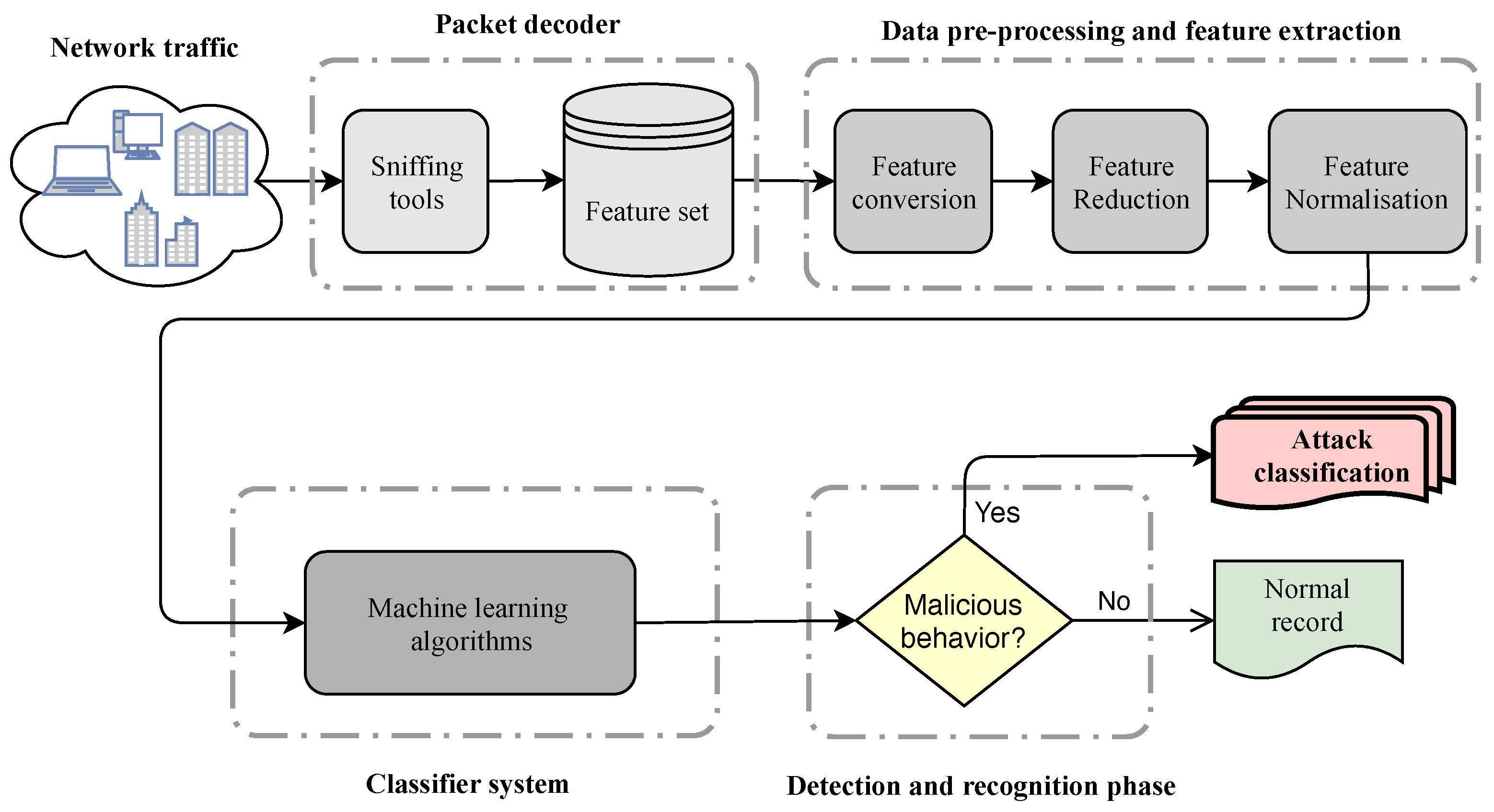
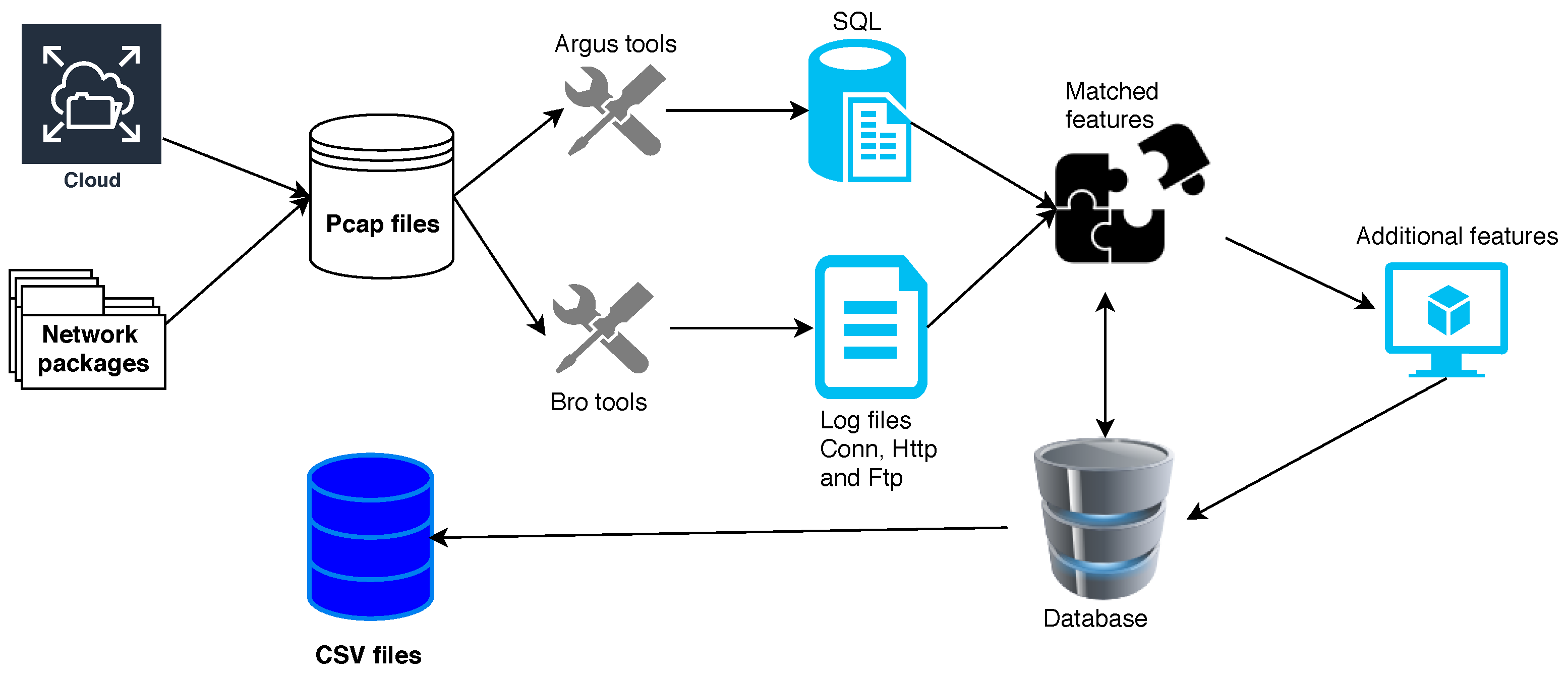
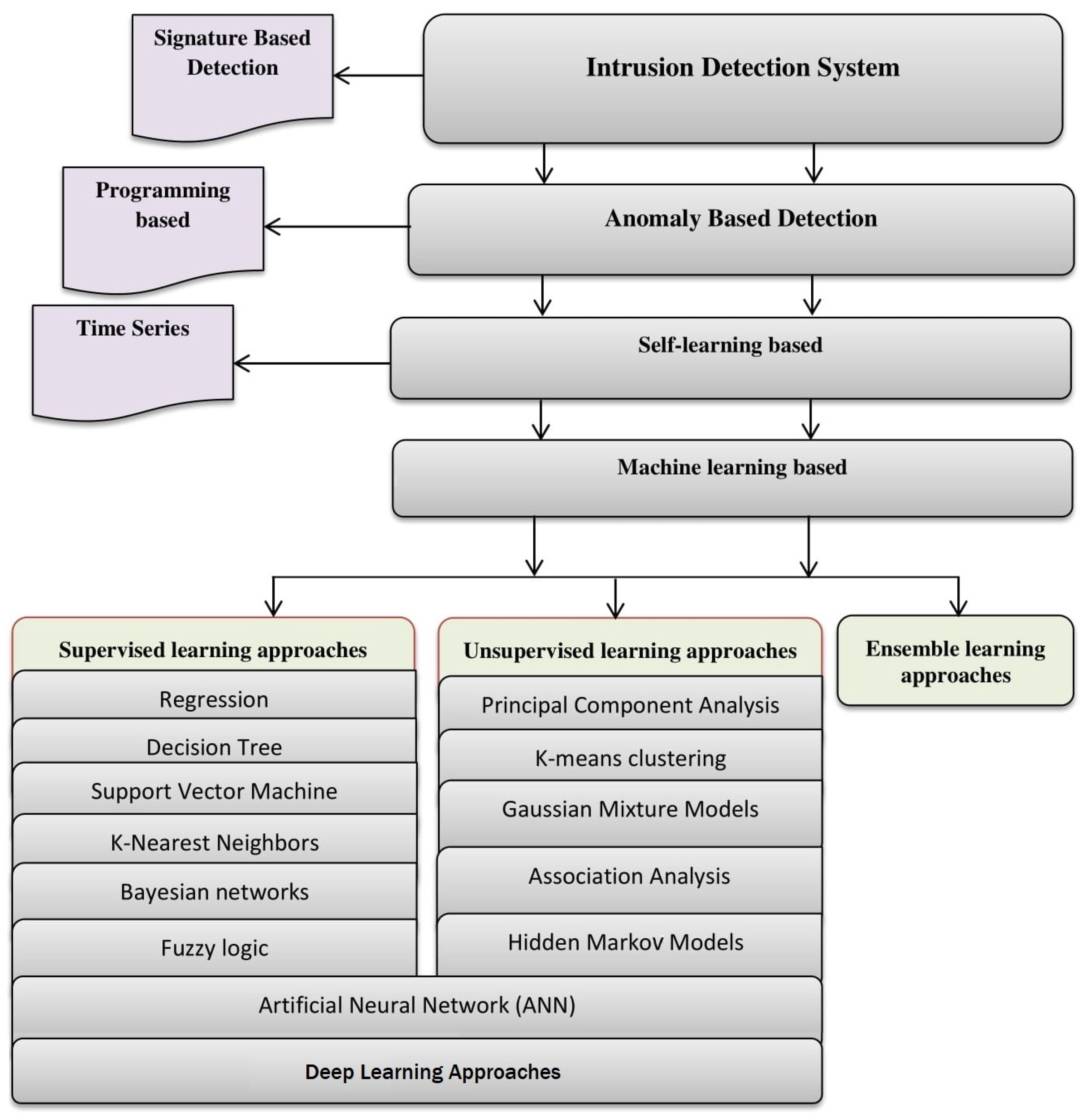
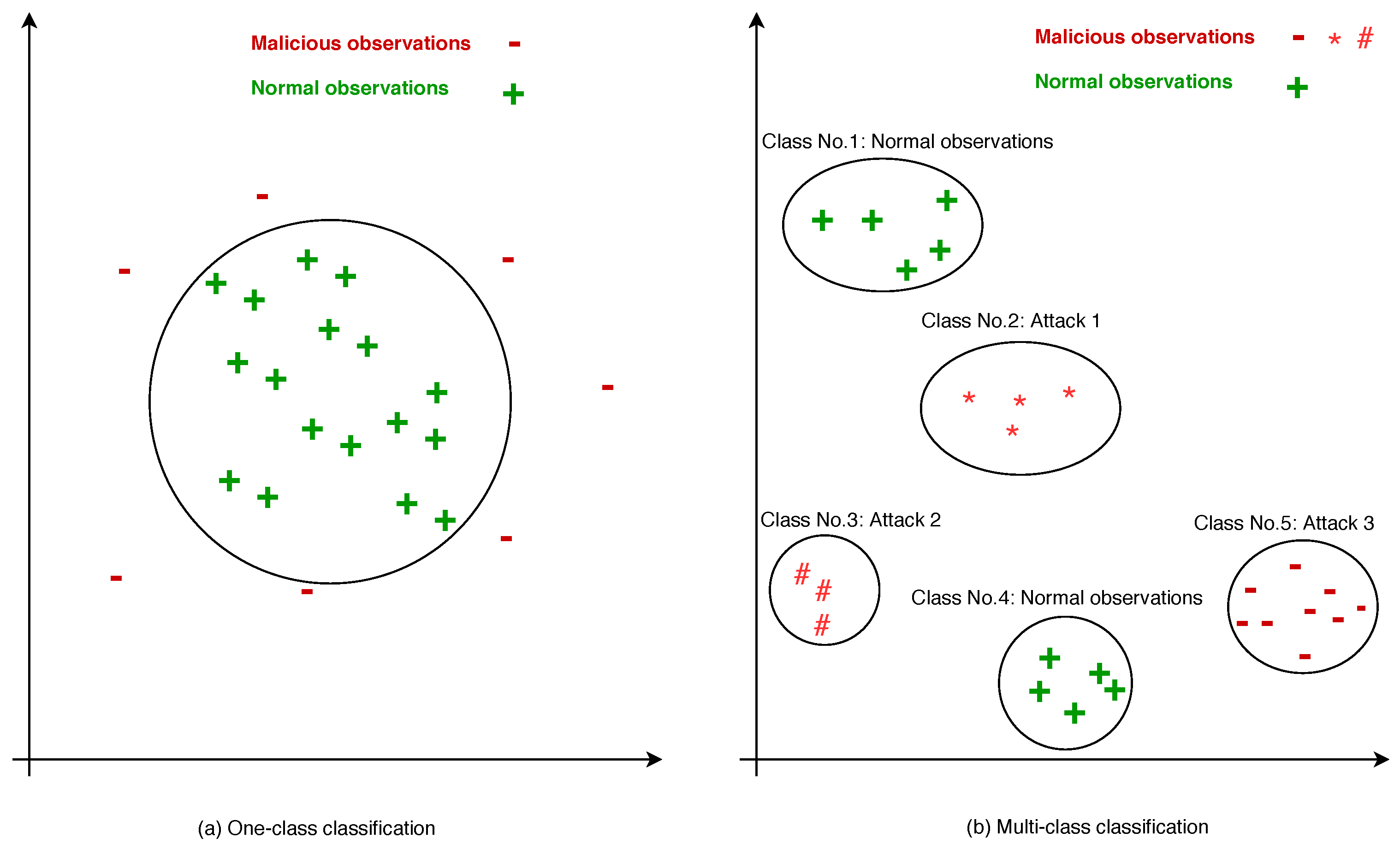
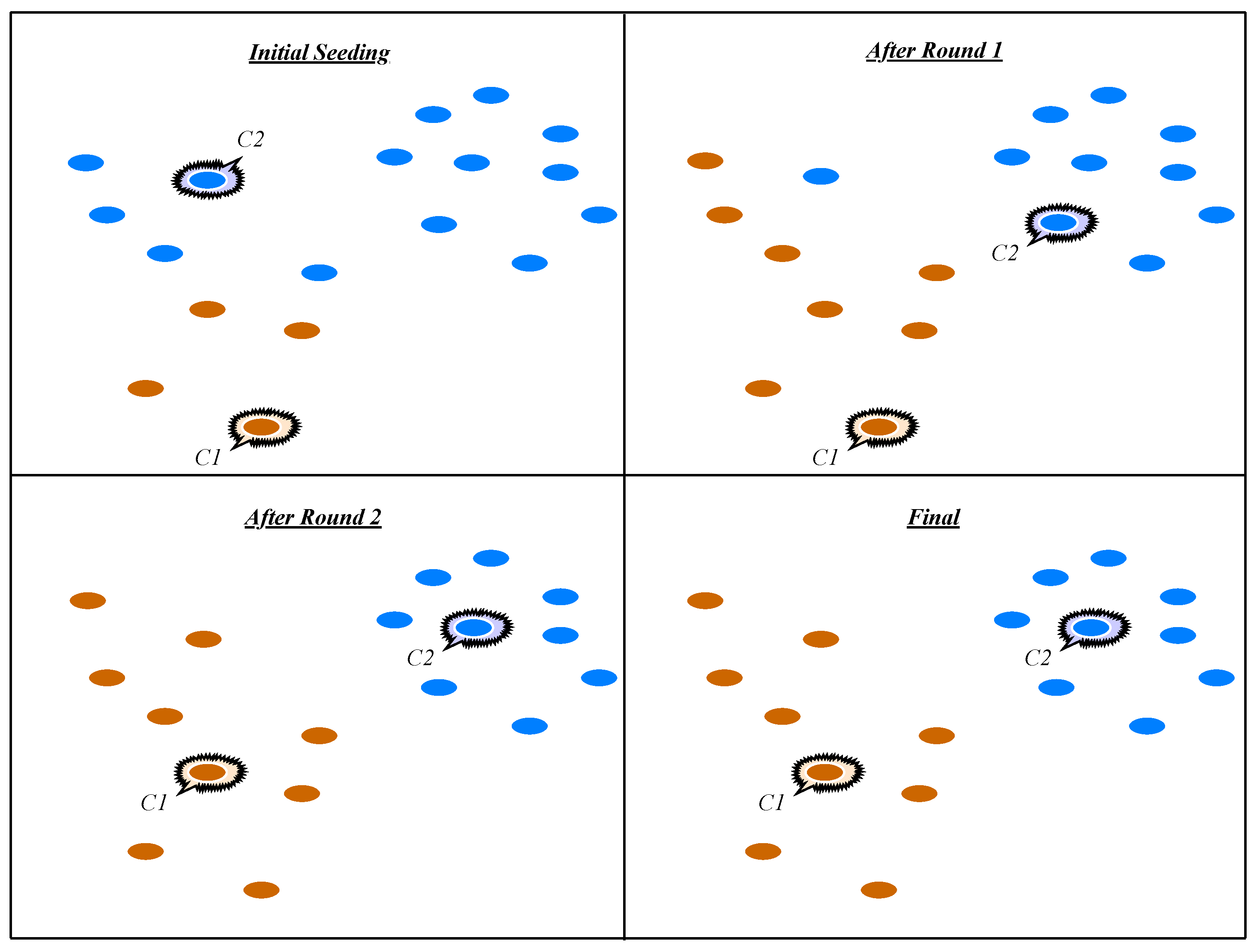

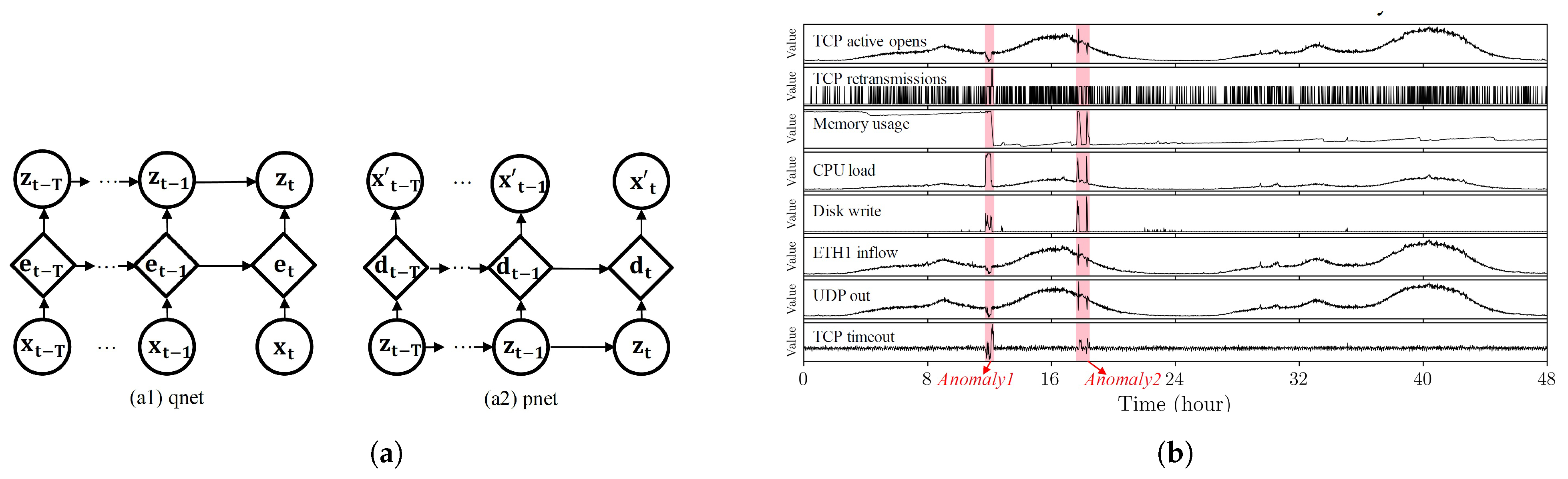
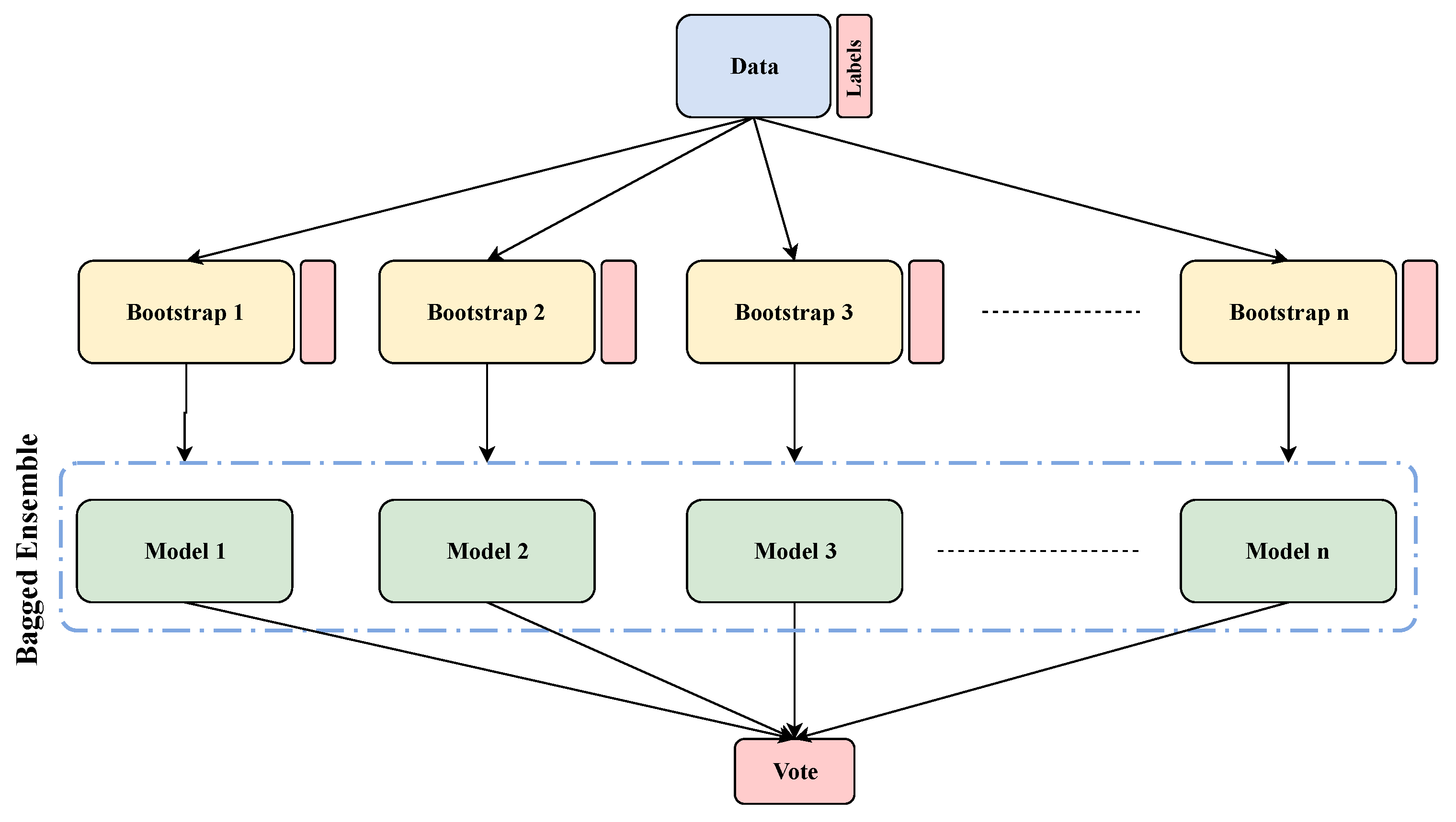
| NADS Aspects | [4] | [5] | [6] | [12] | [7] | [8] | [13] | [9] | [10] | [11] | Proposed Survey |
|---|---|---|---|---|---|---|---|---|---|---|---|
| Network Data Pre-Processing | × | ✓ | ✓ | × | ✓ | ✓ | ✓ | ✓ | ✓ | × | ✓ |
| Supervised Learning Approaches | ✓ | ✓ | ✓ | ✓ | ✓ | × | ✓ | × | ✓ | ✓ | ✓ |
| Unsupervised Learning Approaches | ✓ | ✓ | × | ✓ | ✓ | ✓ | ✓ | ✓ | ✓ | ✓ | ✓ |
| Deep Learning Approaches | × | ✓ | × | × | ✓ | × | ✓ | × | × | × | ✓ |
| Ensemble Learning Approaches | × | × | ✓ | × | × | ✓ | × | × | ✓ | × | ✓ |
| Datasets Discussion and Comparison | × | × | × | × | × | × | × | × | × | ✓ | ✓ |
| Evaluation Criteria | ✓ | × | ✓ | × | ✓ | × | × | × | × | ✓ | ✓ |
| Feature Type | Feature Number | Total |
|---|---|---|
| Integer | 2,4,8,9,10,11,12,13,17,18,19,20,21,22,23,24,25,26,37,38,40,41,42,43,44,45,46,47 | 28 |
| Nominal | 1,3,5,6,14 | 5 |
| Timestamp | 29,30 | 2 |
| Float | 7,15,16,27,28,31,32,33,34,35 | 10 |
| Binary | 36,39 | 2 |
| Used Algorithms | Authors | Objective(s) | FS | Accuracy (%) | FAR (%) | Datasets | Detected Attack(s) | Ref |
|---|---|---|---|---|---|---|---|---|
| K-means + KNN | Tsai et al. | IDS | Yes | 93.55 | 4.79 | KDD-Cup’99 | DoS, U2L R2L, Prode | [100] |
| Bar et al. | Encrypted traffic classification | Yes | 95.4 | - | Generated records | Malicious instances | [49] | |
| Lin et al. | IDS | Yes | 99.46 | 2.95 | KDD-Cup 99 | DoS, U2L R2L, Prode | [50] | |
| SVM + KNN | Comar et al. | Zero-day malware detection | Yes | 90 | 10 | Commercial IDS/IPS | High-risk malwares | [101] |
| SVM + kNN + PSO | Aburomman et al. | IDS | Yes | 88.44 | - | KDD-Cup 99 | DoS, U2L R2L, Prode | [113] |
| SVM + DT | Li et al. | Android malware detection | Yes | 93.62 | 2.36 | Generated dataset | - | [46] |
| K-Support Vector Classification-Regression | Bamakan et al. | IDS | Yes | 98.68 | 0.86 | NSL-KDD + UNSW-NB15 | All attacks in Table 7b | [102] |
| PCA Filtering + Probabilistic SOM | Hoz et al. | IDS | Yes | 88 | - | KDD99 | Anomalous connections | [111] |
| K-Means + NB + BNN | Dubey et al. | IDS | No | 99.9 | 0.1 | KDD cup99 | DoS, U2R, R2L, probe | [103] |
| Density Based Clustering + GMM | Gruhl et al. | IDS | No | 98.4 | 0.9 | - | - | [114] |
| HC + SVM | Horng et al. | IDS | Yes | 95.72 | - | KDD Cup 1999 | DoS, U2R, R2L, probe | [60] |
| Khan et al. | IDS | No | 69.8 | 37.8 | 1998 DARPA | DoS, U2R, R2L, probe | [104] | |
| RF + AODE | Jabbar et al. | IDS | Yes | 90.51 | 14 | Kyoto | - | [42] |
| DT + NB + ANN | Moustafa et al. | IDS | Yes | 95.25 | 0.01 | UNSW-NB15 and NIMS Botnet | Botnet, all attacks in Table 7b | [105] |
| NB + KNN | Pajouh et al. | NADS | Yes | 84.86 | 4.86 | NSL-KDD | DoS, U2R, R2L, probe | [23] |
| Multivariate Correlations + Triangle Area | Tan et al. | DoS attack detection | Yes | 99.93 | 2.64 | KDD Cup 99 | DoS | [109] |
| SVM + DT + KNN | Mohaisen et al. | Malware classification | Yes | 98 | - | AutoMal | ZAccess, Ramnit, FakeAV, Autorun, TDSS, Bredolab, Virut | [110] |
| Santos et al. | Unknown malware detection | Yes | 94.5 | 5.5 | VxHeavens | Malware families | [115] | |
| SVM + RF + DT | Islam et al. | Malware classification | Yes | 97.055 | 0.055 | Generated datasets | - | [116] |
| SVM + KNN + NB + RF | Wang et al. | Malicious apps detection | No | 99.39 | - | - | Android malicious instances | [117] |
| FL + ES | Liao et al. | Network forensics | Yes | 91.5 | - | DARPA 2000 | DDoS, DARPA attacks | [16] |
| GMMs + PSO + SVM | Hu et al. | IDS | Yes | 99.99 | 1.35 | KDD CUP 1999 | DoS, U2R, R2L, probe | [112] |
| FL + GA | Jongsuebsuk et al. | IDS | Yes | 97.5 | 13 | KDD99 | Various DoS and Probe attacks | [106] |
| Jongsuebsuk et al. | IDS | Yes | 97 | - | KDD99 | DoS, Probe | [107] | |
| Chadha et al. | IDS | Yes | 94.6 | - | DARPA-KDD99 | DoS, U2R, R2L, probe | [118] |
| Technique | Advantages | Disadvantages |
|---|---|---|
| Supervised Learning Approaches | Techniques are flexible for training and testing. | The techniques are very much relying on the presumptions. |
| Achieve high detection accuracy for known attacks based on appropriated threshold. | Need more patterns compare with other methods. | |
| The techniques are able to update implementation strategies with the concatenation of new data. | The techniques fail to identify unknown attacks until similar training data are fed. | |
| Unsupervised Learning Approaches | In case of clustering approach, such as K-mean, if k value is determined, then the remaining process is easy. | Most approaches have been developed for the clustering of continuous features only. |
| Clustering techniques are advantageous for quick response generation. | In anomaly detection systems based on clustering, an initial assumption is assigning a big cluster to the normal instances and smaller clusters to malicious instances. In the absence of this assumption, it is hard to assess the technique. | |
| In the case of a large training dataset, it is better to split it into similar classes to efficiently detect malicious instances, because it decreases the computational complexity. | Using unsuitable proximity measures often reduces the detection rate. | |
| The techniques provide a trustworthy performance in comparison to supervised or statistical approaches. | It is usually time-consuming to dynamically update the profiles. | |
| The techniques can identify outliers easily in small datasets. | Unsupervised techniques often utilize both clustering and outlier detection and it produces higher complexity compared with other methods. | |
| The techniques can detect bursty and isolated attacks. | The detection parameters are highly dependent on these techniques. | |
| Ensemble Learning Approaches | The ensemble classifier techniques perform better by combining multiple classifiers whenever the individual classifiers are weak. | Subset selection among unbiased classifiers is a difficult task. |
| Appropriated for large scale datasets. | The greedy approach for choosing subsets is often time-consuming for large scale datasets. | |
| Ensemble techniques use a set controlling parameters that are comprehensive and can be easily adjusted. | Real-time performance is hard to achieve. | |
| Adaboost and Stack generalization are efficacious due to the variety in predictions using multiple base level classifiers. | Lack of suitable hybridization often faces high computational costs. |
| Used Algorithms | Authors | Objective(s) | FS | Accuracy (%) | FAR (%) | Datasets | Detected Attacks | Ref |
|---|---|---|---|---|---|---|---|---|
| Support Vector Machine (SVM) | Prabaharan et al. | MDS | Yes | 72.75 | - | - | Drive-by-download | [45] |
| Ambusaidi et al. | IDS | Yes | 99.79 (KDD Cup 99 dataset) | 13 (KDD Cup 99 dataset) | KDD Cup 99, NSL-KDD, Kyoto | DoS, Probe, R2L, U2L | [43] | |
| Wagner et al. | NADS | No | 93.4 | 1 | Lincoln | Zero-day attacks | [44] | |
| Kang et al. | IDS | Yes | 96.9 | 7.7 | DARPA | DOS, R2L, U2R, PROBE | [34] | |
| Perdisci p et al. | NADS | Yes | 97.6 | 2.4 | Simulated dataset | Payload-based anomalies | [35] | |
| K-Nearest Neighbors (KNN) | Alazab | Malicious codes detection | Yes | 94 | - | Honeynet project Datasets | Malware and benign | [48] |
| Bar et al. | Anomaly traffic detection | No | 99.1 | - | - | Payload-based anomalies | [49] | |
| Zargar et al. | IDS | Yes | 99.01 | 17 | DARPA 1998 | DOS, R2L, U2R, Probe | [33] | |
| Lin et al. | IDS | Yes | 80.6 | 11.4 | KDD-Cup 99 | DOS, R2L, U2R, Probe | [50] | |
| Bayesian Networks | Jing et al. | IDS | Yes | - | - | DARPA 1998 | Intrusions using system call logs | [52] |
| Hesham Altwaijry | IDS | Yes | 96 | 3.15 | KDD-99 Dataset | DOS, Probe, U2R and R2L | [53] | |
| Moustafa et al. | Attack detection | Yes | 95.98 | 4.02 | UNSW-NB15 | All attacks in Table 7 | [54] | |
| Decision Tree | Singh et al. | Botnet detection | Yes | 99.8 | 3 | CAIDA | Botnets | [41] |
| Narouei et al. | Malware detection | Yes | 97.8 (Depth 6) | 8.3 | Nappa | Malware and benign programs | [40] | |
| Jabbar et al. | IDS | Yes | 82.5 | 17.3 | Kyoto | Attacks in Kyoto dataset | [42] | |
| Fuzzy Technique | Dickerson et al. | IDS | Yes | - | - | - | Malicious instances | [57] |
| Haider et al. | IDS | Yes | 92.8 | 8.1 | NGIDS-DS | DoS and DDoS | [59] |
| Used Algorithms | Authors | Objective(s) | FS | Accuracy (%) | FAR (%) | Datasets | Detected Attacks | Ref |
|---|---|---|---|---|---|---|---|---|
| K-means Clustering | Nguyen et al. | IDS | No | 90.22 | 2.75 | KDD99 | DOS, R2L, U2R, Probe | [66] |
| Lee et al. | Attack detection | Yes | - | - | DARPA 2000 | DDoS | [62] | |
| Li | NADS | Yes | 92.3 | 5.81 | KDD CUP 1999 | DoS, U2R, R2L, Probe | [61] | |
| Costa et al. | IDS | No | - | - | KddCup, NSL-Kdd and Netflow | Different attacks | [63] | |
| Jadhav et al. | IDS | No | 90 | - | - | Malicious instances | [64] | |
| HC | Horng et al. | IDS | Yes | 95.72 | 7 | KDD Cup 99 | DoS, U2R, R2L, Probe | [60] |
| GMM | Moustafa et al. | Web application attacks | Yes | 95.68 | 4.32 | UNSW-NB15 | All attacks in Table 7 | [67] |
| Fan et al. | NADS | Yes | 79.45 | 13.91 | KDD Cup 1999 and Kyoto | DoS, U2R, R2L, Probe | [68] | |
| Moustafa et al. | NADS | Yes | 96.7 | 3.5 | UNSW-NB15 | All attacks in Table 7 | [20] | |
| PCA | Han et al. | IDS | Yes | 80.31 | - | KDD CUP 99 | DoS, U2L R2L, Prode | [73] |
| Bhagoji et al. | Malicious detection | No | 97.52 | - | MNIST | Vanilla, Strategic attacks | [74] | |
| Jamdagni et al. | IDS | Yes | 99 | - | DARPA 99 and GATECH | Payload-based attacks | [37] | |
| Ding et al. | NADS | Yes | - | - | - | Anomalies network traffic | [75] | |
| HMMs | Moustafa et al. | Malicious detection | Yes | 98.45 | 2.21 | UNSW-NB15 | All attacks in Table 7 | [21] |
| Lin et al. | Virus detection | Yes | - | - | - | - | [77] | |
| GA | Folino et al. | IDS | No | 95 | - | KDD Cup 1999 | DoS, U2L R2L, Prode | [86] |
| Hasan et al. | IDS | Yes | - | - | - | Malicious instances | [119] | |
| Pillai et al. | IDS | Yes | - | - | Created dataset | Port scanning attacks | [87] | |
| ANN | Hawkins et al. | Outlier detection | Yes | - | - | KDD Cup 1999 | DoS, U2L R2L, Prode | [80] |
| Saber et al. | IDS | No | 80.05 | - | KDD99 | DoS, U2L R2L, Prode | [78] | |
| Jirapummin et al. | IDS | No | 90 | 5 | KDD cup 1999 | Neptune, Port Sweep, Satan | [81] | |
| Ghosh et al. | IDS | Yes | 84 | 7 | DARPA | U2R, R2L | [82] | |
| Saurabh et al. | NADS | No | 82.72 | 7 | KDD Cup 99 | DoS, U2L R2L, Prode | [84] | |
| Rabbani et al. | NADS | Yes | 97.5 | 3.6 | UNSW-NB15 | All attacks in Table 7 | [14] | |
| SOM | Ramadas et al. | NADS | Yes | 76.06 | - | - | - | [79] |
| Deep Learning | Ludwing et al. | IDS | Yes | 92.5 | 5.7 | NSL-KDD | DoS, U2L R2L, Prode | [98] |
| Bontemps et al. | NADS | No | 86 | 0 | KDD99 | DoS | [90] | |
| Shone et al. | IDS | No | 97.85 | 2.15 | KDDCup99 and NSL-KDD | DoS, U2L R2L, Prode | [91] | |
| Maya et al. | NADS | No | - | - | Artificial datasets | Anomalies | [92] | |
| Wu et al. | IDS | No | 82.78 | 4.72 | NSLKDD and UNSW-NB15 | All attacks in Table 7 | [96] | |
| Yin et al. | NIDS | Yes | 81.29 | 1.27 | KDDTest | DoS, U2L R2L, Prode | [120] | |
| Muna et al. | Malicious detection | No | 98.4, 92.5 | 1.8, 8.2 | NSL-KDD and UNSW-NB 15 | All attacks in Table 7a,b | [89] | |
| Alom et al. | IDS | Yes | 97.5 | - | NSL-KDD | DoS, U2L R2L, Prode | [99] |
| Actual | |||
|---|---|---|---|
| Positive (Attacks Classes) | Negative (Normal Class) | ||
| Predicted | Positive (Attacks classes) | TP | FP |
| Negative (Normal class) | FN | TN | |
Publisher’s Note: MDPI stays neutral with regard to jurisdictional claims in published maps and institutional affiliations. |
© 2021 by the authors. Licensee MDPI, Basel, Switzerland. This article is an open access article distributed under the terms and conditions of the Creative Commons Attribution (CC BY) license (https://creativecommons.org/licenses/by/4.0/).
Share and Cite
Rabbani, M.; Wang, Y.; Khoshkangini, R.; Jelodar, H.; Zhao, R.; Bagheri Baba Ahmadi, S.; Ayobi, S. A Review on Machine Learning Approaches for Network Malicious Behavior Detection in Emerging Technologies. Entropy 2021, 23, 529. https://doi.org/10.3390/e23050529
Rabbani M, Wang Y, Khoshkangini R, Jelodar H, Zhao R, Bagheri Baba Ahmadi S, Ayobi S. A Review on Machine Learning Approaches for Network Malicious Behavior Detection in Emerging Technologies. Entropy. 2021; 23(5):529. https://doi.org/10.3390/e23050529
Chicago/Turabian StyleRabbani, Mahdi, Yongli Wang, Reza Khoshkangini, Hamed Jelodar, Ruxin Zhao, Sajjad Bagheri Baba Ahmadi, and Seyedvalyallah Ayobi. 2021. "A Review on Machine Learning Approaches for Network Malicious Behavior Detection in Emerging Technologies" Entropy 23, no. 5: 529. https://doi.org/10.3390/e23050529
APA StyleRabbani, M., Wang, Y., Khoshkangini, R., Jelodar, H., Zhao, R., Bagheri Baba Ahmadi, S., & Ayobi, S. (2021). A Review on Machine Learning Approaches for Network Malicious Behavior Detection in Emerging Technologies. Entropy, 23(5), 529. https://doi.org/10.3390/e23050529