Abstract
Fuzzy differential equations provide a crucial tool for modeling numerous phenomena and uncertainties that potentially arise in various applications across physics, applied sciences and engineering. Reliable and effective analytical methods are necessary to obtain the required solutions, as it is very difficult to obtain accurate solutions for certain fuzzy differential equations. In this paper, certain fuzzy approximate solutions are constructed and analyzed by means of a residual power series (RPS) technique involving some class of fuzzy fractional differential equations. The considered methodology for finding the fuzzy solutions relies on converting the target equations into two fractional crisp systems in terms of ρ-cut representations. The residual power series therefore gives solutions for the converted systems by combining fractional residual functions and fractional Taylor expansions to obtain values of the coefficients of the fractional power series. To validate the efficiency and the applicability of our proposed approach we derive solutions of the fuzzy fractional initial value problem by testing two attractive applications. The compatibility of the behavior of the solutions is determined via some graphical and numerical analysis of the proposed results. Moreover, the comparative results point out that the proposed method is more accurate compared to the other existing methods. Finally, the results attained in this article emphasize that the residual power series technique is easy, efficient, and fast for predicting solutions of the uncertain models arising in real physical phenomena.
1. Introduction
Fuzzy set theory is of considerable interest in mathematics that generalizes the classical probability. The theory fulfills the need to express information of human knowledge in mathematical forms. Since its inception [1], it has been successfully applied in many fields, most notably in the areas of decision making, modeling uncertainty, pattern recognition, image processing, machine learning, economics, and artificial intelligence [2,3]. In the last few years, modeling uncertainty has gained the attention of numerous scholars as one of the most popular theories of describing physical phenomena using fuzzy fractional initial value problems (IVPs). In some cases, simulation and modeling of a real physical phenomenon shows information about issues associated with uncertainty. Such uncertainty may result from several factors, including the process of data collection and measurement errors, determining the initial data, and so forth. Therefore, it is necessary to develop convenient and reliable methods to clarify the presence of uncertainty in parameters, variables, and constants in a mathematical structure of different phenomena that can appropriately address the fuzzy fractional IVPs and study their qualitative and quantitative physical behavior.
Fuzzy differentiation and integration in recent years has witnessed fast-growing application in diverse and widespread fields in natural science and engineering, for instance, electrical engineering, synchronized hyperchaotic systems, quantum optics, chaotic systems, medicine, and many others (see [4,5,6,7,8]). In the literature, different fractional derivative operators have been proposed and improved, such as the Riemann–Liouville, Caputo, Caputo–Fabrizio, and conformable concepts (see [9,10,11,12]). Consequently, various numerical methods have been developed to deal with these fractional operators; for further applications, refer to [13,14,15,16,17,18]. The investigation of FFDEs and their solutions was initially established by Agarwal et al. in [19], in which they solved FFDE with respect to Riemann–Liouville differentiability. This contribution has spurred numerous researchers to devote their interest towards the study of the theoretical results of the existence and uniqueness of solutions side by side with the numerical approximation methods of FFDEs, including the reproducing kernel Hilbert space method, the fractional Euler method, the fuzzy Laplace transform method, the variational iteration method, the Adomian decomposition method, the Jacobi operational matrix method, the Taylor series expansion method, and others (see [20,21,22,23]).
The basic purpose of this analysis is to develop a framework to investigate the fuzzy approximate solutions of a certain class of fuzzy fractional IVP with respect to fuzzy conformable fractional derivative by applying the residual power series (RPS) technique. The proposed technique was initially introduced as an attractive novel numeric-analytic approach for constructing the series solutions for fuzzy IVPs by determining the component values of the expansion series. It depends on the fractional derivative of the so-called truncation residual error function in each stage of finding the solution. RPS has been widely used to find out the solutions of linear and nonlinear issues of fractional differential and fractional integrodifferential equations, including fractional Newell–Whitehead–Segel equation [24], fractional Sawada–Kotera–Ito, Lax, and Kaup–Kupershmidt equations [25], time-fractional Fokker–Planck equations [26], fractional Kundu–Eckhaus and massive Thirring models [27], coupled fractional resonant Schrödinger equation [28], and the fractional Sharma–Tasso–Olever equation [29]. The proposed algorithm is straightforward, accurate and powerful for creating a series of solutions for different models that occur in applied mathematics without terms of perturbation, discretization, and linearization. For more information about advanced different and approximate methods, refer to [30,31,32,33,34,35] and references therein.
In this analysis, we intend to design an efficient algorithm capable of implementing a direct and accurate iterative method to find approximate solutions to the fuzzy system in view of the conformable fractional sense of the domain of interest. The rest of this analysis is organized as follows. In the next section, some mathematical preliminaries and basic definitions related to fuzzy numbers, fuzzy conformable differentiation and fractional Taylor’s formula are reviewed. In Section 3, the formulation of fuzzy fractional IVPs of order is presented. The principle of the RPS method to detect the solutions of fuzzy fractional IVPs is introduced in Section 4. In Section 5, two linear FFDEs with appropriate fuzzy initial data under fuzzy conformable differentiability are tested to illustrate the simplicity and potential of the RPS approach for determining the approximate solutions. Finally, the conclusion of this work is given in Section 6.
2. Preliminaries
This section provides the fundamental definitions and preliminary results for elucidating sufficient fuzzy analysis theory, to enable us to investigate the fuzzy approximated solutions for certain classes of FFDEs. Throughout this article, refers to the set of all fuzzy numbers.
Definition 1.
[36] The -th conformable fractional derivative starting from of a function is denoted and defined as:
and provided that exists and is -differintiable in some .
Definition 2.
[5] A fuzzy number is defined as a fuzzy set such that
- is upper semi-continuous, i.e., , .
- is convex, i.e., for each , and , we have .
- is normal, i.e., there is at least one pointsuch that
- is compact set.
Theorem 1.
[6]Letsatisfy the following conditions:
- (i)
- is a bounded non-decreasing function.
- (ii)
- is a bounded non-increasing function.
- (iii)
- .
- (iv)
- For each,and.
- (v)
- and.
Then,given byis a fuzzy number with parameterization. Furthermore, ifis a fuzzy number with parameterization, then the functionsandsatisfy the aforesaid conditions (i)–(v). Consequently, the arbitrary fuzzy numbercan be presented as an ordered pair of functions
Definition 3.
[7] For the mapping can be defined as for arbitrary fuzzy numbers ( and , where is the Hausdorff metric: .
Definition 4.
[7] The -th fuzzy conformable fractional derivative for fuzzy function for is denoted by and defined by
Remark 1.
We define provided the limit is exists. Furthermore, is -th fuzzy conformable differentiable whenever exists for .
Definition 5.
[7] For , and we say that is strongly generalized th-fuzzy conformable differentiable at if there exists an element such that either:
- (i)
- The H-differences,exist for each sufficiently small, and.
- (ii)
- The H-differences,exist, for each sufficiently small, and.
It is worth mentioning here that the limits are taken in the metric space .
Remark 2.
If is fuzzy differentiable for any point in terms of (i) of Definition 2.5, then is a -fuzzy conformable differentiable on and its derivative is . Likewise, is a -fuzzy conformable differentiable on , if is fuzzy differentiable for any point in terms of (ii) of Definition 2.5 and its derivative is .
Theorem 2.
[7]Assume thatis a fuzzy function satisfies the following conditions:
- (i)
- For each there exists such that the H-differences: and exists for allζ∈ [0,δ).
- (ii)
- For eachandthere exists a constantsuch thatandfor all. Then, the set of functionsis-th conformable differentiable and its derivative is, wherefor each
Next, theorems assist us to convert the FFDEs into a system of ordinary fractional differential equations.
Theorem 3.
[7] Assume thatis a fuzzy function. Letfor each. Then,
- (i)
- If is -fuzzy conformable differentiable, then and are -th conformable differentiable functions on and .
- (ii)
- If is -fuzzy conformable differentiable, then and are -th conformable differentiable functions on and .
Definition 6.
[37] A fractional expansion representation at has the following form:
where, andis a fractional power series (PS) about.
Theorem 4.
[38] Suppose thathas the following fractional PS representation at:
where, then the unknown functionsare in the formfor, such that k-times.
Remark 3.
It should be mentioned that there is an exciting recent work on the conformable Euler method for finite difference discretization of FIVPs [39,40] showing that the fractional Taylor expansions in terms of the conformable fractional derivative presented in [36] is valid for . An alternative definition of the conformable fractional derivative introduced in [40] based on the exact spectral derivative discretization finite difference method showing that the conformable fractional derivative [36] is a fractional change of a variable rather that a fractional operator. In view of the results of [*], Definition 6 and Theorem 4 are incorrect, and the RPS results-based thereon can therefore be improved.
Definition 7.
[40] Given a real-valued function on , the conformable fractional derivative has the following alternative definition:
whereis understood to mean.
3. Fuzzy Conformable Fractional Initial Value Problems
Recently, fuzzy DEs have emerged as a powerful instrument for mathematical modeling of numerous real-life phenomena. In this section, let us consider the following fuzzy fractional IVPs of order :
with the fuzzy initial condition
where indicates the fuzzy conformable fractional derivative of order , is a continuous fuzzy-valued function, and is unknown analytical function to be determined. Consequently, if is a crisp function, then the solution of IVPs (1) and (2) is a crisp. Otherwise, if is a fuzzy function, then the IVPs (1) and (2) may possess only fuzzy solution . Anyhow, we assume that is a fuzzy function.
The -fuzzy solution of the fuzzy fractional IVPs (1) and (2) is a function which is ()-fuzzy conformable differentiable and satisfies (1) and (2). To obtain the fuzzy solution we firstly convert the fuzzy fractional IVPs (1) and (2) into equivalent systems of fractional IVPs, based upon the type of the fuzzy conformable differentiability and the fuzzy solution which satisfies the above conditions of Theorem 2. Then, by rewriting and the initial data , respectively, as a -cut representation: ,, and Additionally, can be reformulated as . The following systems will hold based on using Theorem 3:
- (1)
- If is -fuzzy conformable differentiable, then the corresponding crisp system of the IVPs (1) and (2) will be written in the form of the following:
- (2)
- If is -fuzzy conformable differentiable, then the corresponding crisp system of IVPs (1) and (2) will be written in the form of the following:The formulation of the fuzzy fractional IVPs (1) and (2) along with Theorem 2.3 show us how to deal with numerical solutions of fuzzy fractional IVPs. The original fuzzy fractional IVPs can be converted into a crisp system of fractional IVPs equivalently. This indicates that no need to rewrite the numerical methods for the crisp systems of the fractional IVPs in the fuzzy setting, but, instead, we may use the numerical methods directly on the obtained crisp systems.
4. Primary Principle of Residual Power Series Approach
This section is devoted to justifying the strategy of our proposed method in predicting and investigating the approximate solutions for the fuzzy fractional IVPs (1) and (2). The basic mainstay of the RPS approach is applying the residual error notion and the fractional Taylors series, where the components of truncated fractional Taylor’s series are computed via deriving the truncated fractional residual functions [41,42,43,44,45,46,47,48,49], see also [50,51,52,53] for further results.
Theorem 5.
For, let, andhave the following fractional expansions about,
whereand. Ifandare two continuous on, then the unknown functionsandare in the formsandforwherek-times.
Proof.
We need to prove that the unknown coefficients in the fractional expansions (5) have the forms:
Suppose that and are two functions which have the fractional PS expansions as in Definition 2.5. Its clear that, if we put in (5) leads to , and , for . Next, by operating -th conformable fractional derivative on both sides of (5) gives
Substitution of into (6) leads to and .
Additionally, we can apply on both sides of (6) to get
Then, by substituting into (7) gives that and .
Again, by operating on both sides of (7), we have
After that, substitute into (8) to obtain that and . Continuing in the same manner, apply -times, and then substitute into the obtained fractional expansions so that the pattern of and can be found. Therefore, the unknown coefficients in the fractional expansions (5) have the forms
Now, the process of obtaining -solution of the crisp system (3) corresponding the first case of fuzzy fractional IVPs (1) and (2) will be discussed. The same fashion can be used to create -solution. To reach our purpose, we assume that the solutions of the crisp system (3) about the initial point have the following fractional PS forms
We can approximate the solutions and for the system (3) by the following -th fractional PS approximate solutions
Applying the initial data of (3), when , in the expansions (10), we verify that the -th fractional PS approximate solutions of and are and .
Hence, the -th fractional PS approximate solutions (10) can be reformulated as
To find out the coefficients and , for of the fractional expansions (11), one can solve the following fractional algebraic equations manually for the target coefficients
where and are called the -th fractional residual functions of the crisp system (3) and defined as follows
and the -th fractional residual functions of the system (3) have the forms
Indeed, some useful facts concerned with the fractional residual functions are listed below, and form the mainstay of the RPS scheme
- ▪
- and for each .
- ▪
- and for each .
- ▪
- and for .
Based on this analysis, the process of obtaining the coefficients and in the fractional expansions (11) construct the fractional PS approximate solutions for the system (3) by RPS method which can be summarized via the next algorithm. □
| Algorithm 1. To deduce the approximate solutions of (3) in detail, one can perform the following manner by one of the known software packages like MATHEMATICA 12. |
| Step I: Write the system (3) in the form
|
| Step II: Suppose that the solutions of the system (3) about the initial point have the fractional PS expansion forms
|
| Step III: Set and , then the -th fractional PS approximate solutions and of can be written respectively as
|
| Step IV: Define the -th fractional residual functions and such that
|
| Step V: Substitute and in and so that
|
| Step VI: Consider , in Step V, then solve and at for and . Therefore, the first fractional PS approximate solutions and will be obtained. |
| Step VII: For in Step V, apply the operator -th on both sides of the resulting fractional equations such that and . Then, by solving and , and can be obtained. |
| Step VIII: Write the forms of the obtained coefficients and in terms of -th fractional PS expansions and and repeat the above steps to reach a closed-form in terms of infinite series as in Step II. Elsewhere, the solution obtained will be representing the -th fractional PS approximate solutions of the crisp system (3). |
5. Applications and Numerical Simulations
In this section, we consider two fuzzy fractional IVPs of order to demonstrate the efficiency and applicability of the RPS approach. Here, all of the symbolic and numerical computations performed by using Mathematica 12.
Application 1. Consider the following fuzzy fractional IVPs
with the fuzzy initial condition
where and .
By using Theorem 3 and the type of fuzzy conformable differentiability, we have the following cases:
Case I: If is -fuzzy conformable differentiable, then the corresponding crisp system of the fuzzy fractional IVPs (15) and (16) will be written in the form of the following:
For the standard case , the fuzzy exact solution in the -cut representation has the form
In view of the last discussion for the RPS scheme, starting with and , assume that the -th approximate fractional PS solutions for the fractional IVPs system (17) have the following forms
where the unknown coefficients and for can be determined by constructing the -th fractional residual functions and for (17) such that
For we have and . Then, and gives and .
For we have and By applying both sides of and yields and and then, by solving and , we conclude that , and .
In the same manner, for , we have and . Thus, by using the fact that and , it yields that and .
Continuing in this procedure, based upon the fact and for , it can be concluded that and . Therefore, the -th fractional PS expansions of the fractional IVPs (17) could be expressed as:
Moreover, the fractional PS approximate solutions of the fractional IVPs (17) have the general form in terms of the infinite series
In particular, for in (21), we have
which are compatible with the McLaurin series of the fuzzy exact solution
Case II: If is -fuzzy conformable differentiable, then the corresponding crisp system of fuzzy fractional IVPs (15) and (16) will be written in the form of the following
For the standard case , the fuzzy exact solution in term of -cut representation has the form
According to RPS procedure, the -th fractional residual functions and of the fractional IVPs (23) could be written as:
where and represent to the -th fractional PS approximate solutions of (23) such that
Following the process of Algorithm 1, the values of and , , in fractional expansions (25) can be reached as follows,
Thus, the -th fractional PS approximate solutions of fractional IVPs (23) have the expansions form
Correspondingly, the general forms of fractional PS approximate solutions of fractional IVPs (23) could be reformulated as
which agrees with the McLaurin series of the fuzzy exact solutions
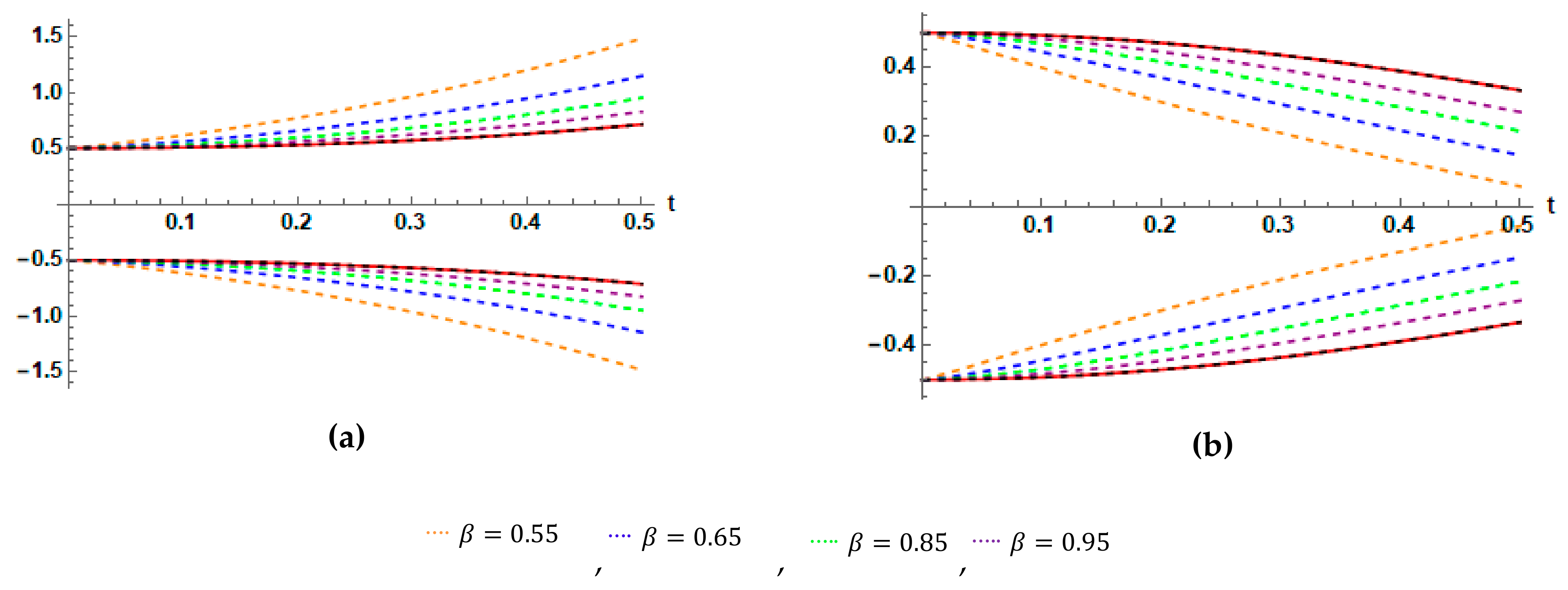
The accuracy and efficiency of the RPS method are validated by calculating the absolute errors and for and different values of , with some selected grid points of as shown in Table 1 and Table 2. Graphically, to illustrate the effects of the parameter on the behaviour of the fuzzy solutions, the exact and eighth fractional PS approximate solutions are plotted in Figure 1 at various values of where .
Table 1.
Absolute errors for Application 1, case I.
Table 2.
Absolute errors for Application 1, case II.
Figure 1.
(a) Plots of -cut representations of fuzzy exact solution and fuzzy approximate solution , case I. (b) Plots of -cut representations of fuzzy exact solution and fuzzy approximate solution , case II, for Application 1 at .
Application 2. Consider the following fuzzy fractional IVPs
with the fuzzy initial condition
where and .
Using Theorem 3 based on the type of conformable differentiability, we have the following cases.
Case I: If is -fuzzy conformable differentiable, then the corresponding crisp system of the fuzzy fractional IVPs (28) and (29) can be written in the following form:
For the standard case , the fuzzy exact solution in the -cut representation has the form
As we mentioned earlier, set the zeroth approximate solutions of , , respectively, where and , then the -th fractional PS approximate solutions of the fractional IVPs (30) have the forms
To determine the values of the components and , for solve the systems and at in which and are identified as:
For , the first fractional residual functions and could be expressed as:
Solving the systems and gives .
Again, to determine and set in (32), then taking into account the values of the obtained coefficients, yields
Applying the operator to both sides of (34) gives
According to and , we have and . By taking into account the obtained coefficients, for , we have
Using the fact and we have and .
By the MATHEMATICA Software Package 12 and employing the process of Algorithm 1 for our present method, we deduced that
| , | , |
| , | , |
| , | , |
| , | , |
Therefore, when the fractional PS approximate solutions of (30) could be written as
In case , the fractional expansions (37) reduced to the following classical expansions
which converges to the exact solutions and .
Case II: If is -fuzzy conformable differentiable, then the corresponding crisp system of fuzzy fractional IVPs (28) and (29) will be written in the following form
The fuzzy exact solution at in the -cut representation is . By applying the RPS method, and using the -th fractional residual functions and of the fractional IVPs, (39) could be expressed as
Following the same procedure as mentioned above, the first six coefficients and , for are listed below. More coefficients can be computed in the same manner.
| , | , |
| , | , |
| , | , |
| , | , |
| , | , |
| , | , |
Consequently, the sixth fractional PS approximate solutions for fractional IVPs system (39) have the forms
In particular, when , the fractional expansions (37) reduce to following finite series expansions
which agree with the first six terms of the McLaurin series of the exact solutions, and . Numerical simulation of the sixth fractional PS approximate solutions is performed for Application 2, case I at different values of and with some selected grid points with step size on the interval as shown in Table 3.
Table 3.
Numerical results of for Application 2, case II.
For the purpose of numerical comparisons, the absolute errors were calculated for Application 2, case I using the RPS method with the reproducing kernel Hilbert space method (RKHSM) method [53], for fixed value of , and different values of , where as shown in Table 4.
Table 4.
Numerical comparison of absolute errors of Application 2 case II.
It’s clear that from this table our method in comparison with the mentioned method is much better with a view to accuracy and applicability.
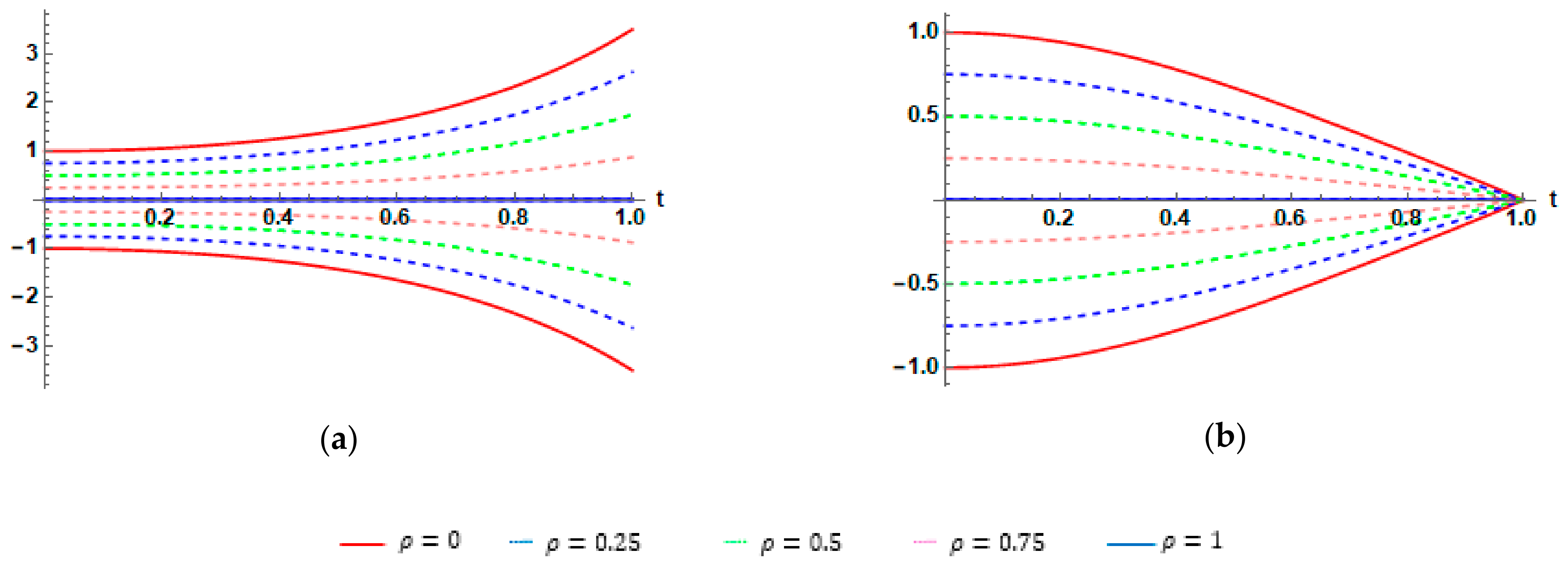
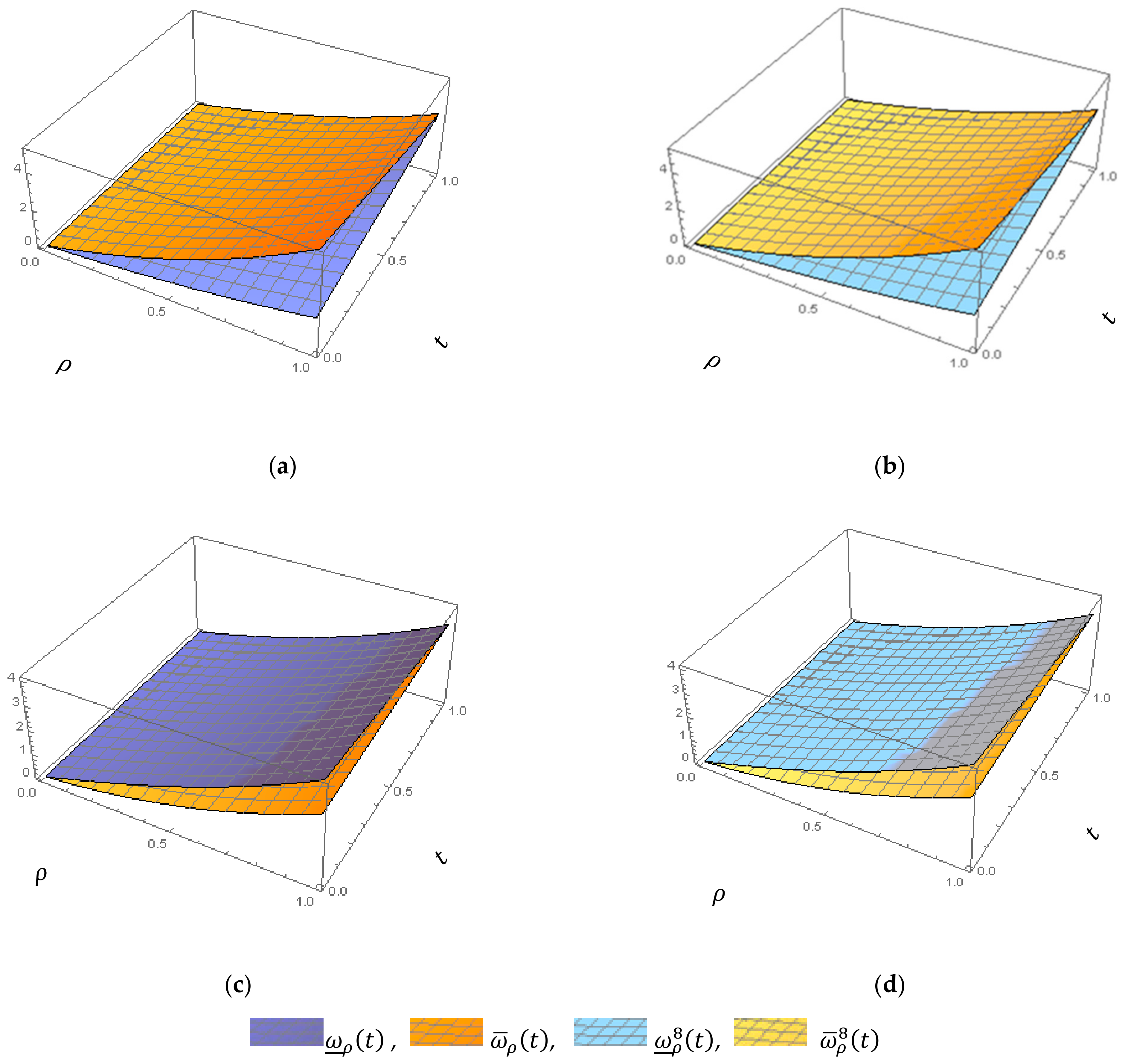
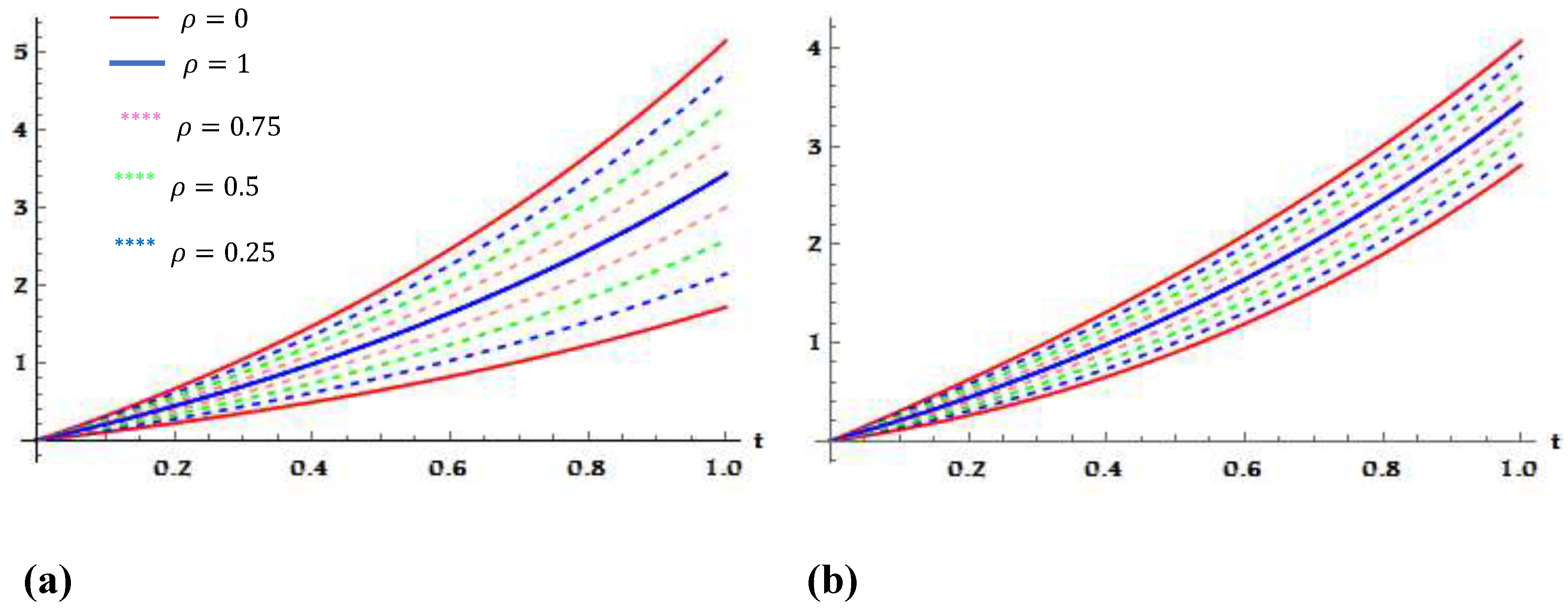
Graphically, to demonstrate the impact of parameters and on the behavior solutions, we plot the fuzzy exact and fuzzy sixth approximate solutions for Application 2, as shown in Figure 2, Figure 3 and Figure 4
Figure 2.
(a) 3D-Surfaces Plot of at , case I. (b) 3D-Surfaces Plot of at , case I. (c) 3D-Surfaces Plot of at , case II. (d) 3D-Surfaces Plot of at , case II; for Application 1.
Figure 3.
(a) Plots of -cut representations of the fuzzy exact solution and the fuzzy approximate solution , case I. (b) Plots of -cut representations of the fuzzy exact solution and the fuzzy approximate solution , case II, for Application 2, at different values of .
Figure 4.
(a) Plots of -cut representations of the fuzzy exact solution and the fuzzy approximate solution , case I. (b) Plots of -cut representations of the fuzzy exact solution and fuzzy approximate solution , case II, for Application 2, at .
6. Conclusions
In this analysis, fuzzy approximate solutions were created and studied for a certain class of FFDEs with fuzzy initial data by means of RPS approach under fuzzy conformable differentiability. The methodology for solving the target problem was based on converting it into two crisp systems of ordinary IVPs. Using the proposed approach, the fractional PS solutions were given in the parametric forms for fuzzy fractional IVPs. The benefit of employing the present approach is that it provides a rapidly convergent fractional PS with easily computable components using symbolic computation software without avoiding round-off errors and sometimes could be expressed in closed form. Two different fuzzy initial data are solved to show the applicability of the proposed approach and to test the accuracy of the RPS approach. The obtained results are compared with other existing approaches. Simulations of the obtained results are discussed quantitatively and graphically and shown that the behavior of the approximate solutions for different values of and continuously tends to the exact solutions. Therefore, the RPS approach is straightforward without using mathematical conditions in obtaining solutions of conformable FFDEs.
Author Contributions
Conceptualization, M.B.; methodology, S.A.-O.; software, M.A. and S.A.-O.; validation, P.A. and S.A.-O.; formal analysis, M.A.; investigation, M.B.; resources, M.B.; data curation, S.A.-O.; writing—original draft preparation, M.B.; writing—review and editing, P.A.; visualization, P.A.; supervision, M.A.; project administration, M.B.; funding acquisition, P.A. All authors have read and agreed to the published version of the manuscript.
Funding
This research received no external funding.
Institutional Review Board Statement
Not applicable.
Informed Consent Statement
Not applicable.
Data Availability Statement
Not applicable.
Conflicts of Interest
The authors declare no conflict of interest.
References
- Zadeh, L.A. Fuzzy sets. Inf. Control 1965, 8, 338–353. [Google Scholar] [CrossRef]
- Kandel, A. Fuzzy Mathematical Techniques with Applications; Addison-Wesley Longman Publishing Co., Inc.: Boston, MA, USA, 1986. [Google Scholar]
- Mendel, J.M. Fuzzy logic systems for engineering: A tutorial. Proc. IEEE 1995, 83, 345–377. [Google Scholar] [CrossRef]
- Bede, B.; Gal, S.G. Generalizations of the differentiability of fuzzy number value functions with applications to fuzzy differential equations. Fuzzy Sets Syst. 2005, 151, 581–599. [Google Scholar] [CrossRef]
- Chalco-Cano, Y.; Román-Flores, H. On new solutions of fuzzy differential equations. Chaos Solitons Fractals 2008, 38, 112–119. [Google Scholar] [CrossRef]
- Kaleva, O. Fuzzy differential equations. Fuzzy Sets Syst. 1987, 24, 301–317. [Google Scholar] [CrossRef]
- Hasan, S.; Al-Smadi, M.; El-Ajou, A.; Momani, S.; Hadid, S.; Al-Zhour, Z. Numerical approach in the Hilbert space to solve a fuzzy Atangana-Baleanu fractional hybrid system. Chaos Solitons Fractals 2021, 143, 110506. [Google Scholar] [CrossRef]
- Al-Smadi, M.; Abu Arqub, O.; Zeidan, D. Fuzzy fractional differential equations under the Mittag-Leffler kernel differential operator of the ABC approach: Theorems and applications. Chaos Solitons Fractals 2021, 146, 110891. [Google Scholar] [CrossRef]
- Al-Smadi, M.; Abu Arqub, O.; Gaith, M. Numerical simulation of telegraph and Cattaneo fractional-type models using adaptive reproducing kernel framework. Math. Methods Appl. Sci. 2021, 44, 8472–8489. [Google Scholar] [CrossRef]
- Caputo, M. Linear models of dissipation whose Q is almost frequency independent: Part II. Geophys. J. Inter. 1967, 13, 529–539. [Google Scholar] [CrossRef]
- Abu Arqub, O.; Al-Smadi, M. An adaptive numerical approach for the solutions of fractional advection-diffusion and dispersion equations in singular case under Riesz’s derivative operator. Phys. A Stat. Mech. Its Appl. 2020, 540, 123257. [Google Scholar] [CrossRef]
- Al-Smadi, M.; Abu Arqub, O. Computational algorithm for solving fredholm time-fractional partial integrodifferential equations of dirichlet functions type with error estimates. Appl. Math. Comput. 2019, 342, 280–294. [Google Scholar] [CrossRef]
- Akinyemi, L.; Iyiola, O.S.; Akpan, U. Iterative methods for solving fourth- and sixth-order time-fractional Cahn-Hillard equation. Math. Methods Appl. Sci. 2020, 43, 4050–4074. [Google Scholar] [CrossRef]
- Akinyemi, L.; Iyiola, O.S. Exact and approximate solutions of time-fractional models arising from physics via Shehu transform. Math. Methods Appl. Sci. 2020, 43, 7442–7464. [Google Scholar] [CrossRef]
- Akinyemi, L.; Iyiola, O.S. A reliable technique to study nonlinear time-fractional coupled Korteweg–de Vries equations. Adv. Differ. Equ. 2020, 2020, 169. [Google Scholar] [CrossRef]
- Şenol, M.; Iyiola, O.S.; Daei Kasmaei, H.; Akinyemi, L. Efficient analytical techniques for solving time-fractional nonlinear coupled Jaulent–Miodek system with energy-dependent Schrödinger potential. Adv. Differ. Equ. 2019, 2019, 462. [Google Scholar] [CrossRef]
- Akinyemi, L.; Iyiola, O.S. Analytical Study of (3+1)-Dimensional Fractional-Reaction Diffusion Trimolecular Models. Int. J. Appl. Comput. Math. 2021, 7, 92. [Google Scholar] [CrossRef]
- Hasan, S.; El-Ajou, A.; Hadid, S.; Al-Smadi, M.; Momani, S. Atangana-Baleanu fractional framework of reproducing kernel technique in solving fractional population dynamics system. Chaos Solitons Fractals 2020, 133, 109624. [Google Scholar] [CrossRef]
- Agarwal, R.P.; Lakshmikantham, V.; Nieto, J.J. On the concept of solution for fractional differential equations with uncertainty. Nonlinear Anal. Theory Methods Appl. 2010, 72, 2859–2862. [Google Scholar] [CrossRef]
- Al-Smadi, M.; Freihat, A.; Abu Arqub, O.; Shawagfeh, N. A novel multistep generalized differential transform method for solving fractional-order Lü chaotic and hyperchaotic systems. J. Comput. Anal. Appl. 2015, 19, 713–724. [Google Scholar]
- Altawallbeh, Z.; Al-Smadi, M.; Komashynska, I.; Ateiwi, A. Numerical Solutions of Fractional Systems of Two-Point BVPs by Using the Iterative Reproducing Kernel Algorithm. Ukr. Math. J. 2018, 70, 687–701. [Google Scholar] [CrossRef]
- Khodadadi, E.; Çelik, E. The variational iteration method for fuzzy fractional differential equations with uncertainty. Fixed Point Theory Appl. 2013, 2013, 13. [Google Scholar] [CrossRef][Green Version]
- Momani, S.; Djeddi, N.; Al-Smadi, M.; Al-Omari, S. Numerical investigation for Caputo-Fabrizio fractional Riccati and Bernoulli equations using iterative reproducing kernel method. Appl. Numer. Math. 2021, 170, 418–434. [Google Scholar] [CrossRef]
- Saadeh, R.; Alaroud, M.; Al-Smadi, M.; Ahmad, R.R.; Salma Din, U.K. Application of fractional residual power series algorithm to solve Newell–Whitehead–Segel equation of fractional order. Symmetry 2019, 11, 1431. [Google Scholar] [CrossRef]
- Al-Smadi, M. Fractional residual series for conformable time-fractional Sawada–Kotera–Ito, Lax, and Kaup–Kupershmidt equations of seventh order. Math. Methods Appl. Sci. 2021, 44, 1–21. [Google Scholar] [CrossRef]
- Freihet, A.; Hasan, S.; Alaroud, M.; Al-Smadi, M.; Ahmad, R.R.; Salma Din, U.K. Toward computational algorithm for time-fractional Fokker–Planck models. Adv. Mech. Eng. 2019, 11, 1687814019881039. [Google Scholar] [CrossRef]
- Al-Smadi, M.; Abu Arqub, O.; Hadid, S. Approximate solutions of nonlinear fractional Kundu-Eckhaus and coupled fractional massive Thirring equations emerging in quantum field theory using conformable residual power series method. Phys. Scr. 2020, 95, 105205. [Google Scholar] [CrossRef]
- Al-Smadi, M.; Abu Arqub, O.; Momani, S. Numerical computations of coupled fractional resonant Schrödinger equations arising in quantum mechanics under conformable fractional derivative sense. Phys. Scr. 2020, 95, 075218. [Google Scholar] [CrossRef]
- Kumar, A.; Kumar, S.; Singh, M. Residual power series method for fractional Sharma-Tasso-Olever equation. Commun. Numer. An. 2016, 2016, 1–10. [Google Scholar] [CrossRef]
- Al-Smadi, M.; Djeddi, N.; Momani, S.; Al-Omari, S.; Araci, S. An attractive numerical algorithm for solving nonlinear Caputo–Fabrizio fractional Abel differential equation in a Hilbert space. Adv. Differ. Equ. 2021, 2021, 271. [Google Scholar] [CrossRef]
- Agarwal, P.; Jain, S.; Ahmad, B.; Al-Omari, S. Certain recent fractional integral inequalities associated with the hypergeometric operators. J. King Saud Uni. Sci. 2015, 2015, 17. [Google Scholar]
- Al-Smadi, M.; Abu Arqub, O.; Shawagfeh, N.; Momani, S. Numerical investigations for systems of second-order periodic boundary value problems using reproducing kernel method. Appl. Math. Comput. 2016, 291, 137–148. [Google Scholar] [CrossRef]
- Hasan, S.; Djeddi, N.; Al-Smadi, M.; Al-Omari, S.; Momani, S.; Fulga, A. Numerical solvability of generalized Bagley–Torvik fractional models under Caputo–Fabrizio derivative. Adv. Differ. Equ. 2021, 2021, 469. [Google Scholar] [CrossRef]
- Hasan, S.; Al-Smadi, M.; Freihet, A.; Momani, S. Two computational approaches for solving a fractional obstacle system in Hilbert space. Adv. Differ. Equ. 2019, 2019, 55. [Google Scholar] [CrossRef]
- Al-Smadi, M. Simplified iterative reproducing kernel method for handling time-fractional BVPs with error estimation. Ain Shams Eng. J. 2018, 9, 2517–2525. [Google Scholar] [CrossRef]
- Khalil, R.; Al Horani, M.; Yousef, A.; Sababheh, M. A new definition of fractional derivative. J. Comput. Appl. Math. 2014, 264, 65–70. [Google Scholar] [CrossRef]
- Alaroud, M.; Al-Smadi, M.; Ahmad, R.R.; Salma Din, U.K. An analytical numerical method for solving fuzzy fractional Volterra integro-differential equations. Symmetry 2019, 11, 205. [Google Scholar] [CrossRef]
- Alaroud, M.; Al-Smadi, M.; Ahmad, R.R.; Salma Din, U.K. Computational optimization of residual power series algorithm for certain classes of fuzzy fractional differential equations. Int. J. Differ. Equ. 2018, 2018, 8686502. [Google Scholar] [CrossRef]
- Alaroud, M. Application of Laplace residual power series method for approximate solutions of fractional IVP’s. Alex. Eng. J. 2021, 61, 1585–1595. [Google Scholar] [CrossRef]
- Clemence-Mkhope, D.P.; Clemence-Mkhope, B.G.B. The Limited Validity of the Conformable Euler Finite Difference Method and an Alternate Definition of the Conformable Fractional Derivative to Justify Modification of the Method. Math. Comput. Appl. 2021, 26, 66. [Google Scholar] [CrossRef]
- Momani, S.; Abu Arqub, O.; Freihat, A.; Al-Smadi, M. Analytical approximations for Fokker-Planck equations of fractional order in multistep schemes. Appl. Comput. Math. 2016, 15, 319–330. [Google Scholar]
- Freihet, A.; Hasan, S.; Al-Smadi, M.; Gaith, M.; Momani, S. Construction of fractional power series solutions to fractional stiff system using residual functions algorithm. Adv. Differ. Equ. 2019, 2019, 95. [Google Scholar] [CrossRef]
- Al-Smadi, M.; Abu Arqub, O.; Hadid, S. An attractive analytical technique for coupled system of fractional partial differential equations in shallow water waves with conformable derivative. Commun. Theor. Phys. 2020, 72, 085001. [Google Scholar] [CrossRef]
- Moaddy, K.; Al-Smadi, M.; Hashim, I. A novel representation of the exact solution for differential algebraic equations system using residual power-series method. Discret. Dyn. Nat. Soc. 2015, 2015, 205207. [Google Scholar] [CrossRef]
- Komashynska, I.; Al-Smadi, M.; Abu Arqub, O.; Momani, S. An efficient analytical method for solving singular initial value problems of nonlinear systems. Appl. Math. Inf. Sci. 2016, 10, 647–656. [Google Scholar] [CrossRef]
- Harir, A.; Melliani, S.; Chadli, L.S. Fuzzy generalized conformable fractional derivative. Adv. Fuzzy Syst. 2020, 2020, 1954975. [Google Scholar] [CrossRef]
- Al-Smadi, M.; Freihat, A.; Khalil, H.; Momani, S.; Khan, R.A. Numerical Multistep Approach for Solving Fractional Partial Differential Equations. Int. J. Comput. Methods 2017, 14, 1750029. [Google Scholar] [CrossRef]
- Gumah, G.; Naser, M.; Al-Smadi, M.; Al-Omari, S.; Baleanu, D. Numerical solutions of hybrid fuzzy differential equations in a Hilbert space. Appl. Numer. Math. 2020, 151, 402–412. [Google Scholar] [CrossRef]
- Gumah, G.; Naser, M.; Al-Smadi, M.; Al-Omari, S. Application of reproducing kernel Hilbert space, method for solving second-order fuzzy Volterra integro-differential equation. Adv. Differ. Equ. 2018, 2018, 475. [Google Scholar] [CrossRef]
- Chandak, S.; Suthar, D.L.; Al-Omari, S.K.; Gulyaz-Ozyurt, S. Estimates of classes of generalized special functions and their application in the fractional (k,s)-calculus theory. J. Funct. Spaces Vol. 2021, 2021, 9582879. [Google Scholar] [CrossRef]
- Alaroud, M.; Tahat, N.; Al-Omari, S.; Suthar, D.L.; Gulyaz-Ozyurt, S. An attractive approach associated with transform functions for solving certain fractional Swift-Hohenberg equation. J. Funct. Spaces. 2021, 2021, 3230272. [Google Scholar] [CrossRef]
- Al-Omari, S.; Dayalal Suthar, D.; Araci, S. A fractional q-integral operator associated with a certain class of q-Bessel functions and q-generating series. Adv. Differ. Equ. 2021, 2021, 441. [Google Scholar] [CrossRef]
- Al-Smadi, M.; Dutta, H.; Hasan, S.; Momani, S. On numerical approximation of Atangana-Baleanu-Caputo fractional integro-differential equations under uncertainty in Hilbert Space. Math. Model. Nat. Phenom. 2021, 16, 41. [Google Scholar] [CrossRef]
Publisher’s Note: MDPI stays neutral with regard to jurisdictional claims in published maps and institutional affiliations. |
© 2021 by the authors. Licensee MDPI, Basel, Switzerland. This article is an open access article distributed under the terms and conditions of the Creative Commons Attribution (CC BY) license (https://creativecommons.org/licenses/by/4.0/).