Abstract
In this paper, we researched some dynamical behaviors of a stochastic predator–prey system, which is considered under the combination of Crowley–Martin functional response and stage structure. First, we obtained the existence and uniqueness of the global positive solution of the system. Then, we studied the stochastically ultimate boundedness of the solution. Furthermore, we established two sufficient conditions, which are separately given to ensure the stochastic extinction of the prey and predator populations. In the end, we carried out the numerical simulations to explain some cases.
1. Introduction
Population dynamics is one of the main parts of biological mathematics. The predator–prey model is a classical problem in population research. Lotka and Volterra [1] researched the origin and theory of predator–prey model, which is given by
where and represent the population density of the prey and predator, respectively; and denote the intrinsic growth rate and death rate, respectively; and and are the predation rate of a predator and nutrient-conversion rate, respectively.
An important feature of the predator–prey relationship is the functional response (i.e., the rate of prey consumption by an average predator). Mukherjee [2] discussed persistence and bifurcation on the predator–prey system of Holling Type II. Liu and Zhong [3] researched permanence and extinction for the delayed periodic predator–prey system with Holling Type II response function and diffusion. Zhang and Yang [4] studied Hopf bifurcation in the predator–prey system with Holling Type III functional response and time delays. The functional responses of Holling Types I–III are prey-dependent, which have been researched by many scholars. However, the functional response is inevitably influenced by the behavior of a predator, such as foraging and competing. Therefore, many scholars studied various types of predator-dependent functions. Gilliam and Skalski [5] claimed that the predator-dependent can provide better descriptions of predators feeding over a range of predator–prey abundances by comparing the statistical evidence from 19 predator–prey systems with the three predator-dependent functional responses (Hassell–Varley [6], Beddington–DeAngelis [7,8,9], and Crowley–Martin [10,11]), and, in some cases, the Crowley–Martin functional response is better. On the other hand, compared with the Hassell–Varley and Beddington–DeAngelis functional responses, the Crowley–Martin functional response is more suitable for the case that the predator feeding rate is decreased by higher predator density even when prey density is high. Thus, we consider the Crowley–Martin functional response in this paper.
In the classical predator–prey model, it is always assumed that each predator has the same predation capacity, and each prey has the same risk of predation. This assumption is unrealistic for many species. In nature, there are many species whose individuals have a life history that takes them through two stages, immature and mature. Individuals of different age groups exhibit different biological behaviors. In view of this, many scholars have studied the predator–prey system with stage structure [12,13,14,15,16]. Sun and Huo [17] considered bifurcation and stability in the predator–prey model with stage structure for the predator. Xu [18] discussed the global dynamics of the predator–prey model with time delay and stage structure for the prey. Lu [19] studied the stage-structured predator–prey model with predation over juvenile prey. However, few researchers have studied the predator–prey model with a stage structure for predator and prey. In nature, we know that immature predators have no predatory capacity. Meanwhile, many species hatch from eggs. For example, the Saltcedar leaf beetle is such a pest. In view of its eggshell, pathogens may not be effective against an immature pest. Based on this situation, it is reasonable to assume that immature prey does not run the risk of being preyed on. In terms of pest and disease control, the stage-structure model can better describe the dynamic behavior of some species. Therefore, in this paper, we mainly consider the predator–prey system with stage structure for both predator and prey.
We also consider the impact of environmental noise. Many scholars have studied various types of stochastic predator–prey systems with stage structure and functional-response functions [20,21,22]. Liu and Jiang [23] researched the dynamics of a stochastic predator–prey model with stage structure for predator and Holling Type II functional response. Chen and You [24] studied permanence, extinction, and periodic solution of the predator–prey system with a Beddington–DeAngelis functional response and stage structure for prey. Liu and Zhong [25] discussed the asymptotic properties of a stochastic predator–prey model with a Crowley–Martin functional response.
The main contributions of our work can be summarized as follows. The predator–prey model with random perturbation and Crowley–Martin functional response is established, which consider stage structure on both prey and predator. The existence and uniqueness of the global positive solution of the system is proved. Some sufficient conditions are given, which ensure the solutions of the system are stochastically ultimate boundedness. Then, sufficient conditions for the extinction of prey and predator are given, respectively. Finally, the conclusion is verified by numerical simulation results.
The paper is organized as follows. In Section 2, we give two prey–predator models with stage structure and a Crowley–Martin functional response. One is deterministic, and another is stochastic, which is discussed through the manuscript. In Section 3, we prove the existence and uniqueness of the global positive solution. In Section 4, we obtain sufficient conditions for stochastically ultimate boundedness of the prey and predator. In Section 5, we establish sufficient conditions for extinction of the predator and prey in two cases. The first case is the prey and predator extinction; another case is the predator extinction. In Section 6, numerical simulations illustrate the theoretical results. Section 7 gives the conclusions and future research directions.
2. Preliminaries
Before giving the main results, we first introduce some mathematical symbols and formulas in this paper. Throughout this paper, we define
Consider the process of q-dimensional
where ) denotes independent standard Brownian motions defined on a complete probability space with a filtration , and assume that the constant initial value . Differential operator L of Formula (4) is given by
We denote a function defined on . Applying L on , one has
where , , . By formula, we can obtain
If the system is autonomous, the definition of operator L and formula discussed above can be found in Reference [26].
Based on the statement in Section 1, consider the following model:
where and denote the densities of immature and mature prey at time t, respectively; and represent the densities of immature and mature predators at time t, respectively; the parameters a, , , , , , , p, h, e and c are positive constants, a is the birth rate of immature prey, p and h indicate maturity rate of immature prey and immature predator, respectively; and express the competition rate between a mature prey population and mature predator population, respectively; and are the death rates of immature and mature prey, respectively; and and represent the death rates of immature and mature predators, respectively.
May [27] pointed out that due to continuous fluctuation in the environment, the birth rate, death rates, carrying capacity, competition coefficients, and all other parameters involved with the model exhibit random fluctuation. Thus, we consider environmental random disturbance as follows:
where represent independent standard Brownian motions, and are the intensities of the environmental random disturbance. Then, we can obtain the following system:
In this paper, we mainly research some population characteristics of System (3).
3. Existence and Uniqueness of Global Positive Solution
As we know, the density of population , , and should be positive. Therefore, we give the following theorem to ensure that the system has a unique positive solution.
Theorem 1.
For any given initial data , , and , there is a unique solution to System (3), and the solution remains in with probability 1.
Proof of Theorem 1.
Since System (3) satisfies the local Lipschitz continuous condition, there is a local unique solution for any initial data on (with probability 1), where is the explosion time. To show that the solution is global, we only need to prove a.s. Give the following conditions for the initial value:
where is a sufficiently large number. For each integer , define the stopping time
where, in this paper, we set . According to the definition of , it is clear that increases as . Set , whence . That is to say, in order to prove the solution is global, it is sufficient to show that a.s. Then, we define a -function V: by
The non-negative of this function can be seen from
Let , for . Applying It’s formula to , we have
According to the definition of operator L, we have
where , , and .
Then, we have
where . It can be obtained from Formulas (6) and (7) that
Integrating both sides of Formula (8) from 0 to , we have
Taking expectations at both sides of Formula (9), it is easy to obtain
where . According to the definition of , there is some i (), such that and equal either or l. Then, is no less than either
Then, one has
According to Formula (10), we can obtain
Letting , we have
Since is arbitrary, we have
Then,
The proof of Theorem 1 is completed. □
4. Stochastically Ultimate Boundedness
Theorem 1 shows that the solution of System (3) remains in the positive cone . However, this nonexplosion property in a population dynamical system is often not good enough. Therefore, the property of ultimate boundedness is more desired. First, we give the definition of stochastically ultimate boundedness.
Definition 1
([28]). With respect to System (3), the solution is said to be stochastically ultimate bounded, if for , there is a positive constant such that for any initial data , the solution has the property that
where .
Assumption 1.
, , and .
Theorem 2.
Under Assumption 1, the solution of System (3) is stochastically ultimately bounded for any initial data .
Proof of Theorem 2.
For , define as the following
By ’s formula, we have
Therefore, it is easy to derive
Let
Under Assumption 1, it is easy to find that function has an upper bound. We assume that its upper bound is as follows
Letting and noticing , we have . According to Formula (14), we can obtain
By ’s formula, we have
Integrating both sides of Formula (18) from 0 to t and then taking expectations, we have
Hence, we have
where . Then, we have
For any , let . By Chebyshev’s inequality, we can obtain
Then,
The proof of Theorem 2 is completed. □
5. Stochastic Extinction
In this section, we show that the population becomes extinct with probability one.
Theorem 3.
Assume that is the solution of System (3) with initial data . Then,
(i) all prey and predators die out exponentially with probability one, if ;
(ii) predators and die out exponentially with probability one, if .
Proof of Theorem 3.
According to System (3), we get
where . Let . By ’s formula, we can obtain
Then,
We can write term
in the following way:
Letting the matrix
it is clear that matrix is negative definite under the condition in (i). Define as the maximum eigenvalue of matrix . According to the condition in (i), we obtain
Therefore, we have
Integrating both sides of Formula (19), it can be obtained that
Let and , where and are local martingales. By the strong law of large numbers for local martingales (see, e.g., Reference [26]), we can obtain the following properties:
Therefore, we can get
Then, we have
Then, with the extinction of the prey, we find the predator dies out according to System (3). The discussion of the predator population is similar. We have
where
Let be the maximum eigenvalue of matrix . Under the condition in (ii), we have
Then, it can be obtained that
which implies
The proof of Theorem 3 is completed. □
6. Numerical Simulations
In this section, we illustrate our theoretical results using the numerical simulations of System (3). We randomly selected the initial condition in . The initial state of the system is . We used the Milstein method mentioned in Reference [29] to substantiate the analytical findings. Consider the discretization transformation of System (3):
where time increment is positive and () are the Gaussian random variables that follow distribution . For System (3), the parameters are selected as follows:
(i). , , , , , , , , , , , , , , , , .
(ii). , , , , , , , , , , , , , , , , .
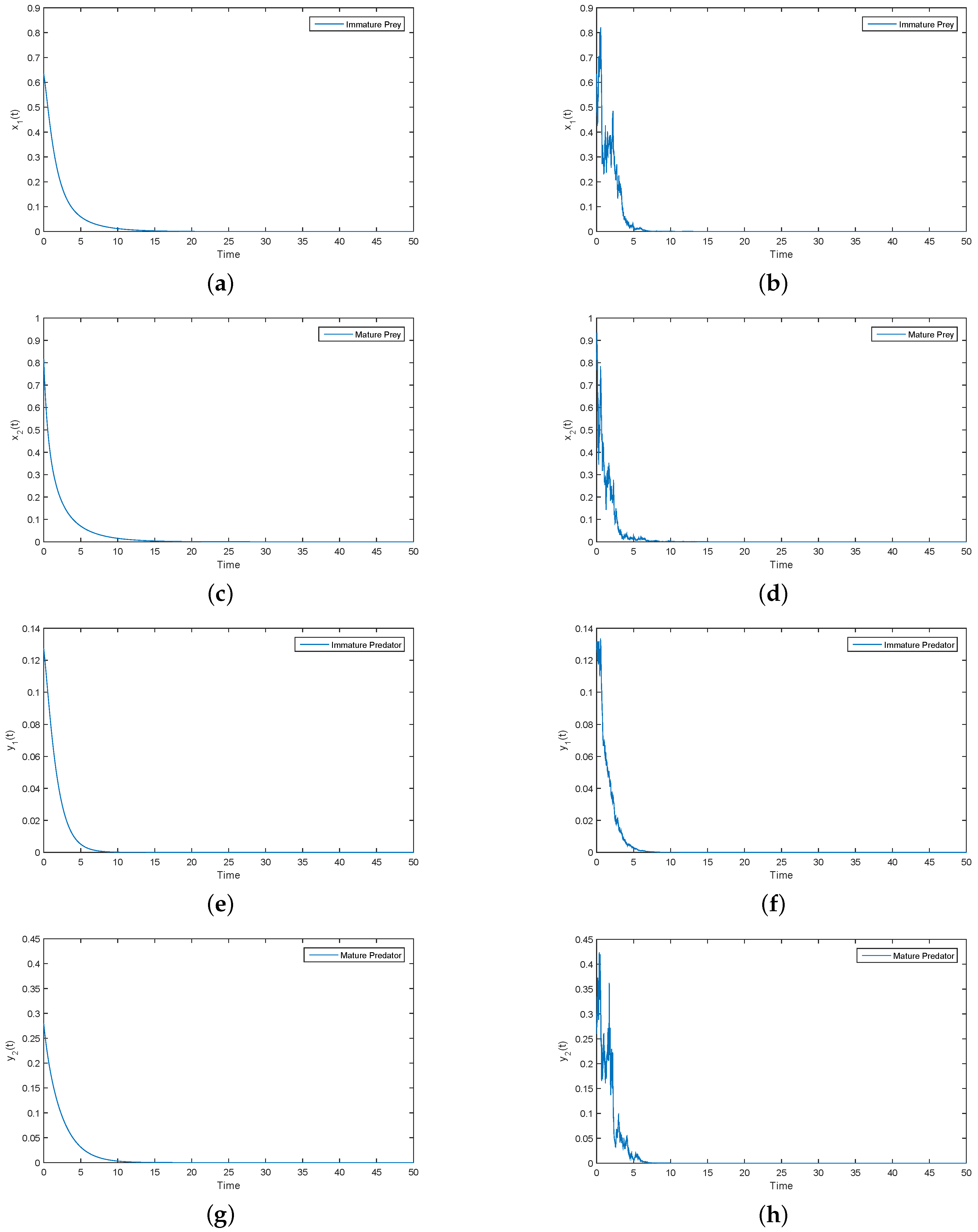
It is easy to verify that Parameters (i) satisfy the condition of the extinction of the prey population in Theorem 3. The corresponding numerical results are shown in Figure 1.
Figure 1.
(a,c,e,g) Solutions of , , and for deterministic System (2), respectively; (b,d,f,h) solutions of , , and for perturbation System (3), respectively.
As can be clearly seen from Figure 1, , , and tend to zero in both the deterministic and stochastic models. Under Parameter (i), we have . By Theorem 3, , , and tend to become extinct. Numerical simulations clearly support this result (see Figure 1). Therefore, Figure 1 provides evidence for the accuracy of Conclusion (i) in Theorem 3. Then, Under Parameter (ii), the corresponding numerical simulation results are as follows.
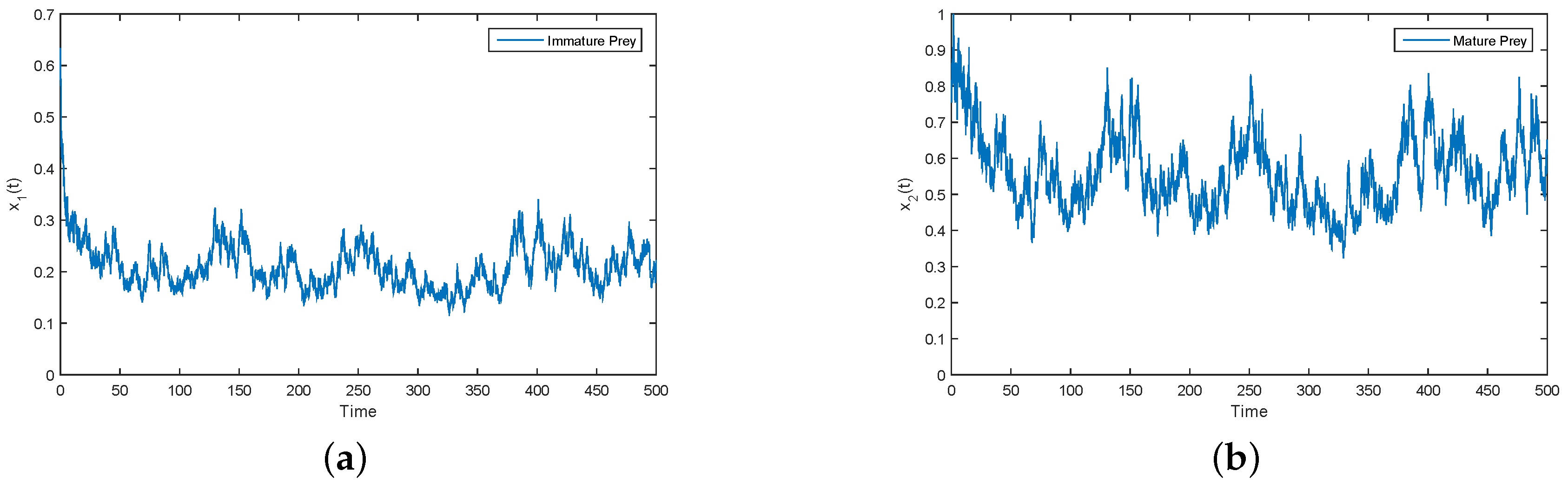
As can be clearly seen from Figure 2, and tend to zero in both the deterministic and stochastic models. By calculation, we can find that Parameter (ii) satisfies condition . According to Theorem 3, and tend to become extinct. Numerical simulations clearly support this result (see Figure 2). Meanwhile, under Parameter (ii), we give the trajectories of and over a long period of time (see Figure 3). Figure 3 shows that the immature prey and mature prey are permanence for a long time.
Figure 2.
(a,c) Solutions of immature and mature predator population for deterministic System (2), respectively; (b,d) solutions of immature and mature predator of perturbation System (3), respectively.
Figure 3.
(a,b) Solutions of and for perturbation System (3), respectively.
7. Conclusions
In this paper, we researched the predator–prey system with a Crowley–Martin functional response function and environmental noise. In Reference [5], we found that the predator-dependent functional response is more reasonable than the prey-dependent functional response. In particular, the Crowley–Martin functional response is more suitable for the case that the predator feeding rate is decreased by higher predator density. Compared with Holling Types I–III functional responses, the Crowley–Martin functional response has more complex forms. From an analysis point of view, the theoretical analysis of predator–prey system with a Crowley–Martin functional response is more difficult, and the results are more complex. Meanwhile, we know that the system is inevitably affected by environmental noise. Therefore, we researched the predator–prey model with a Crowley–Martin functional response function and environmental noise. On this basis, we first attempted to consider the stage structure on both prey and predator. First, we proved the existence and uniqueness of the global positive solution of System (3). Next, we pointed out that the positive solution is stochastically bounded. Then, we gave sufficient conditions for the extinction of the predator and prey populations in two cases. Some interesting questions deserve further investigation; we will research the stability and stationary distribution of System (3) (see Reference [30]), and consider the impact of sudden changes and time delays on population characteristics (see Reference [31]) in the future. In addition, we will research the chaotic behavior of a predator–prey system and the Allee effect (see References [32,33]).
Author Contributions
In this paper, C.X. was in charge of theoretical deduction, numerical simulation, and writing the paper. Y.Y. and G.R. were responsible for verifying the conclusion of the paper.
Funding
This work is supported by the National Nature Science Foundation of China (No. 61772063) and Beijing Natural Science Foundation (Z180005).
Acknowledgments
The authors thank the referees and the editor for their valuable comments.
Conflicts of Interest
The authors declare no conflict of interest.
References
- Lotka, A. Elements of Mathematical Biology; Dover Publications: New York, NY, USA, 1956. [Google Scholar]
- Mukherjee, D. Persistence and bifurcation analysis on a predator-prey system of Holling type. Esaim Math. Model. Numer. Anal. 2003, 37, 339–344. [Google Scholar] [CrossRef]
- Liu, Z.J.; Zhong, S.M. Permanence and extinction analysis for a delayed periodic predator-prey system with Holling type II response function and diffusion. Appl. Math. Comput. 2010, 216, 3002–3015. [Google Scholar] [CrossRef]
- Zhang, Z.; Yang, H.; Fu, M. Hopf bifurcation in a predator-prey system with Holling type III functional response and time delays. J. Appl. Math. Comput. 2014, 44, 337–356. [Google Scholar] [CrossRef]
- Sklaski, G.T.; Gilliam, J.F. Functional responses with predator interference: Viable alternative to Holling type II model. Ecology 2001, 82, 3083–3092. [Google Scholar] [CrossRef]
- Wang, K.; Zhu, Y.L. Permanence and global asymptotic stability of a delayed predator-prey model with Hassell-Varley type functional response. Bull. Iran. Math. Soc. 2013, 94, 1–14. [Google Scholar]
- Cui, J.; Takeuchi, Y. Permanence, extinction and periodic solution of predator-prey system with Beddington-DeAngelis functional response. J. Math. Anal. Appl. 2006, 317, 464–474. [Google Scholar] [CrossRef]
- Lahrouz, A.; Settati, A.; Mandal, P.S. Dynamics of a switching diffusion modified Leslie-Gower predator-prey system with Beddington-DeAngelis functional response. Nonlinear Dyn. 2016, 85, 853–870. [Google Scholar] [CrossRef]
- Tripathi, J.P.; Abbas, S.; Thakur, M. Dynamical analysis of a prey-predator model with Beddington-DeAngelis type function response incorporating a prey refuge. Nonlinear Dyn. 2015, 80, 177–196. [Google Scholar] [CrossRef]
- Tripathi, J.P.; Tyagi, S.; Abbas, S. Global analysis of a delayed density dependent predator–prey model with Crowley-Martin functional response. Commun. Nonlinear Sci. Numer. Simul. 2016, 30, 45–69. [Google Scholar] [CrossRef]
- Upadhyay, R.K.; Naji, R.K. Dynamics of a three species food chain model with Crowley–Martin type functional response. Chaos Solitons Fractals 2009, 42, 1337–1346. [Google Scholar] [CrossRef]
- Wang, W.; Chen, L. A predator-prey system with stage-structure for predator. Comput. Math. Appl. 1997, 33, 83–91. [Google Scholar] [CrossRef]
- Chen, Y.; Song, C. Stability and Hopf bifurcation analysis in a prey-predator system with stage-structure for prey and time delay. Chaos Solitons Fractals 2008, 38, 1104–1114. [Google Scholar] [CrossRef]
- Huang, C.Y.; Zhao, M.; Zhao, L.C. Permanence of periodic predator-prey system with two predators and stage structure for prey. Nonlinear Anal. Real World Appl. 2014, 2018, 503–514. [Google Scholar] [CrossRef]
- Yang, W.; Li, X.; Bai, Z. Permanence of periodic Holling type-IV predator-prey system with stage structure for prey. Math. Comput. Model. 2008, 48, 677–684. [Google Scholar] [CrossRef]
- Meng, X.Y.; Huo, H.F.; Xiang, H.; Yin, Q.Y. Stability in a predator–prey model with Crowley-Martin function and stage structure for prey. Appl. Math. Comput. 2014, 232, 810–819. [Google Scholar] [CrossRef]
- Sun, X.K.; Huo, H.F.; Xiang, H. Bifurcation and stability analysis in predator-prey model with a stage-structure for predator. Nonlinear Dyn. 2009, 58, 497–513. [Google Scholar] [CrossRef]
- Xu, R. Global dynamics of a predator-prey model with time delay and stage structure for the prey. Nonlinear Anal. Real World Appl. 2011, 12, 2151–2162. [Google Scholar] [CrossRef]
- Lu, Y.; Pawelek, K.A.; Liu, S. A stage-structured predator-prey model with predation over juvenile prey. Appl. Math. Comput. 2017, 297, 115–130. [Google Scholar] [CrossRef]
- Yang, L.; Zhong, S.M. Global stability of a stage-structured predator-prey model with stochastic perturbation. Discret. Dyn. Nat. Soc. 2014, 2014, 1–8. [Google Scholar] [CrossRef]
- Liu, M.; Wang, K. Global stability of stage-structured predator–prey models with Beddington-DeAngelis functional response. Commun. Nonlinear Sci. Numer. Simul. 2011, 16, 3792–3797. [Google Scholar] [CrossRef]
- Zhao, S.; Song, M. A stochastic predator-prey system with stage structure for predator. Abstr. Appl. Anal. 2014, 2014, 1–7. [Google Scholar] [CrossRef]
- Liu, Q.; Jiang, D.Q.; Hayat, T.; Alsaedi, A. Dynamics of a stochastic predator-prey model with stage structure for predator and Holling type II functional response. J. Nonlinear Sci. 2018, 28, 1151–1187. [Google Scholar] [CrossRef]
- Chen, F.D.; You, M.S. Permanence, extinction and periodic solution of the predator-prey system with Beddington-DeAngelis functional response and stage structure for prey. Nonlinear Anal.-Real World Appl. 2008, 9, 207–221. [Google Scholar] [CrossRef]
- Liu, X.Q.; Zhong, S.M.; Tian, B.D.; Zheng, F.X. Asymptotic properties of a stochastic predator-prey model with Crowley-Martin functional response. J. Appl. Math. Comput. 2013, 43, 479–490. [Google Scholar] [CrossRef]
- Mao, X.R. Stochastic Differential Equations and Applications; Horwood Publishing: Chichester, UK, 1997. [Google Scholar]
- May, R.M. Stability and Complexity in Model Ecosystems; Princeton University Press: Princeton, NJ, USA, 2001; Volume 6, p. 779. [Google Scholar]
- Li, X.Y.; Gray, A.; Jiang, D.Q.; Mao, X.R. Sufficient and necessary conditions of stochastic permanence and extinction for stochastic logistic populations under regime switching. J. Math. Anal. Appl. 2011, 376, 11–28. [Google Scholar] [CrossRef]
- Higham, D.J. An algorithmic introduction to numerical simulation of stochastic differential equations. SIAM Rev. 2001, 43, 525–546. [Google Scholar] [CrossRef]
- Liu, Q.; Jiang, D.Q.; Hayat, T.; Ahmad, B. Stationary distribution and extinction of a stochastic predator–prey model with additional food and nonlinear perturbation. Appl. Math. Computat. 2018, 320, 226–239. [Google Scholar] [CrossRef]
- Liu, M.; Bai, C.Z. On a stochastic delayed predator-prey model with Lévy jumps. Appl. Math. Computat. 2014, 228, 563–570. [Google Scholar] [CrossRef]
- Aguirre, P.; Eduardo, G.O.; Torres, S. Stochastic predator-prey model with Allee effect on prey. Nonlinear Anal. Real World Appl 2013, 14, 768–779. [Google Scholar] [CrossRef]
- Ali, E.; Asif, M.; Ajbar, A.H. Study of chaotic behavior in predator–prey interactions in a chemostat. Ecol. Model. 2013, 259, 10–15. [Google Scholar] [CrossRef]
© 2019 by the authors. Licensee MDPI, Basel, Switzerland. This article is an open access article distributed under the terms and conditions of the Creative Commons Attribution (CC BY) license (http://creativecommons.org/licenses/by/4.0/).