Article

Assessing of Losses and Dilution Impact on the Cost Chain: Case Study of Gold Ore Deposits
1
Saint Petersburg Mining University, 199106 Saint Petersburg, Russia
2
Silesian University of Technology, 44-100 Gliwice, Poland
*
Author to whom correspondence should be addressed.
Sustainability 2021, 13(7), 3830; https://doi.org/10.3390/su13073830
Submission received: 11 March 2021 / Revised: 26 March 2021 / Accepted: 28 March 2021 / Published: 31 March 2021
(This article belongs to the Special Issue Raw Materials and Circular Economy: Concepts and Evidence)

Abstract

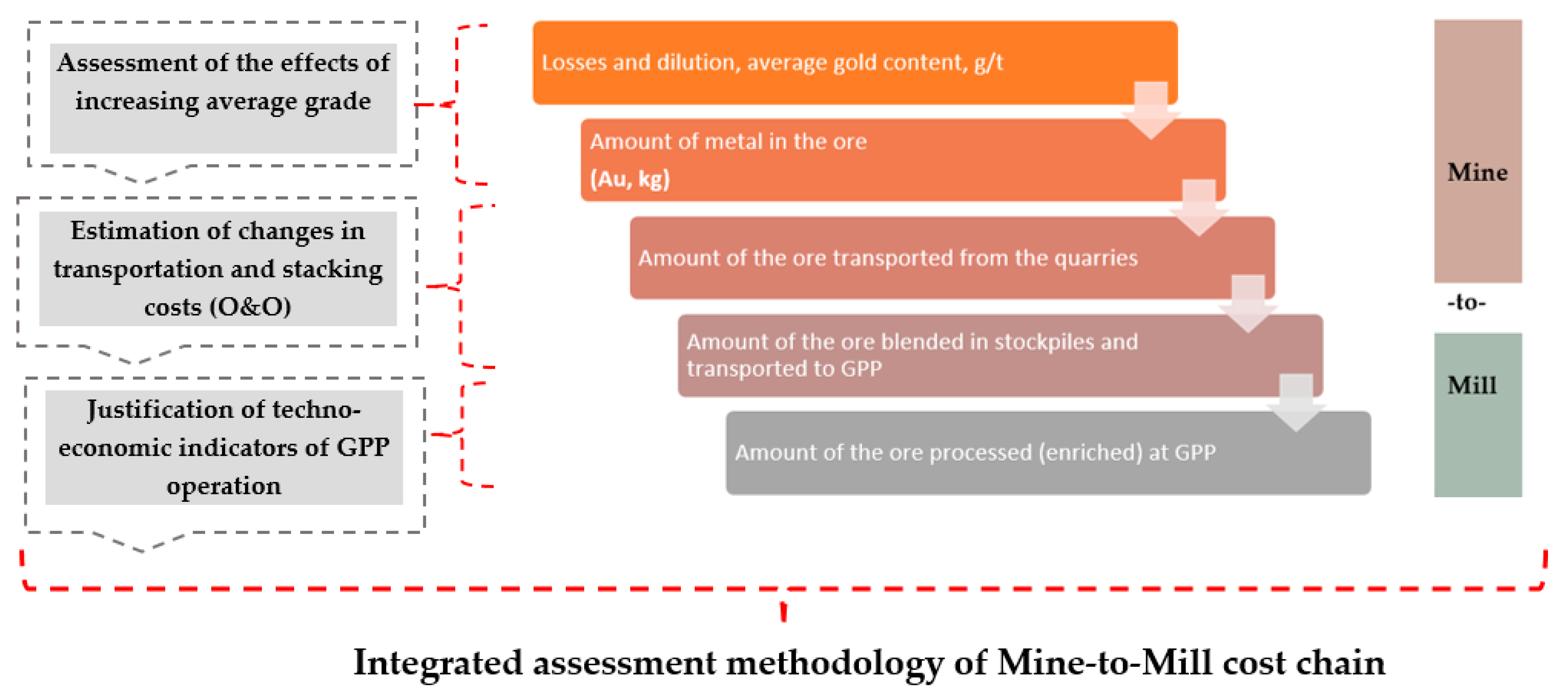
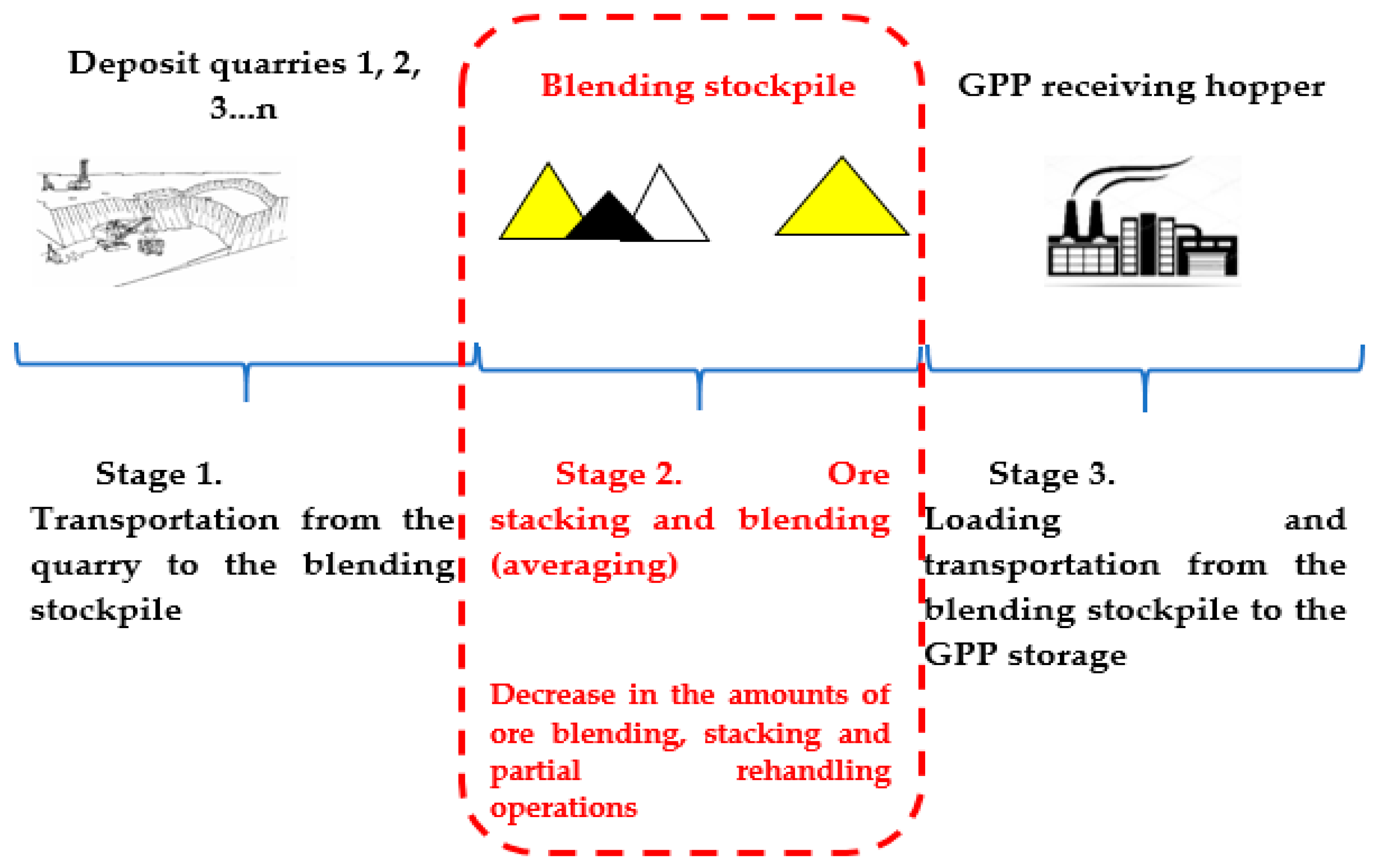
The conditions of declining gold grade in the ore, increasing depth of excavation, and de-creasing unallocated stock of deposits make it necessary to develop efficient solutions for the mine-to-mill process, which have to be adapted to each specific mining plant and will optimizes production costs. Current research focuses on a case study that demonstrates how indicators of mining losses and dilution influence the variation of costs chain in the production cycle. The article examines the topical issue of determining the effects at the mine-to-mill stages due to changes in losses and dilution. The author’s approach to the formation of a mine-to-mill cost chain is proposed by integrating several cost estimation methods into the general cost estimation methodology. The estimation methodology is a compilation of factor analysis and cost engineering methods that take into account the change in costs due to the variation of losses and dilution. It was proven that with variations in losses and dilution, cost savings arise due to changes in the volume of work on ore averaging, ore transportation, and beneficiation. For the case of the Kuranakh ore field, there are no effects at the mining stage. The use of internal reserves by means of managing ore quality parameters allows reducing the costs per ton of processed rock mass along the entire production chain.
Keywords: cost optimization; mine-to-mill; mineral losses; dilution; average grade; quarry; gold mining cost optimization; mine-to-mill; mineral losses; dilution; average grade; quarry; gold mining